Caste Discrimination in the United Kingdom:
Identifying Parliamentary Patterns in a Movement to Secure Caste in Equality Legislation
By
Katherine Anne Stotesbery
Senior Honors Thesis Political Science
University of North Carolina at Chapel Hill
Stotesbery 2
Table of Contents
I. Abstract 3
II. Introduction 4
III. History of Caste 8
A. Caste in India 8
B. Caste in the United Kingdom 9
IV. Literature Review & Theoretical Model 13
A. Previous Literature 13
B. Research Question 14
C. Hypotheses 15
V. Methods 20
A. Data Sources 21
B. Outcome Variables Definitions 22
1. Vocal Support 22
2. Vocal Opposition 23
3. Lords Amendment Support 24
C. Methodology 24
1. Table 1. Outcome Dichotomous Variables 25 2. Table 2. Hypothesis 1 Descriptive Statistics (Continuous Variables) 26 3. Table 3. Hypotheses 2 and 3 Descriptive Statistics (Dichotomous
Variables) 26
VI. Results
A. Table 4. Prediction Models Overview – Summary Statistics 29 B. Table 5. Logit Models Post-Estimation Results, by Model 30
C. Vocal Support Model – Results 31
D. Lords Amendment Support – Results 33
E. Vocal Opposition – Results 34
Stotesbery 3
Abstract
In India, caste-based discrimination is constitutionally prohibited. Among western
nations with large Indian populations, however, not one has implemented a law prohibiting caste discrimination. This thesis examines the reasons that Members of Parliament (MPs) in the United Kingdom supported, or declined to support, a movement to prohibit caste discrimination in law. When politicians discussed legislation to prohibit caste discrimination in 2012 and 2013, the Indian community was split on the issue; the Hindu lobby rallied fiercely against it, even as low-caste advocacy groups pushed it forward. Language outlawing low-caste discrimination was
provisionally passed in 2013 but not implemented, as of 2017. The central debates on the issue have come to be seen as a landmark case study on caste legislation outside of India. Despite this attention, how average citizens stood on the issue—and why MPs mobilized—remained opaque.
This study serves a twofold purpose. The first is to determine the demographic and political factors that influenced Members of Parliament to vocally support caste legislation. I examine whether the percent of Indians in a constituency, the MP’s ethnicity, or Labour party identification is the strongest predictor of vocal support. Vocal support is advocacy for the caste legislation movement, expressed through signing an Early Day Motion or advocating for
Stotesbery 4
Introduction
Caste identity is a complicated social and ethnic identity which has roots that run deeply through Indian and broader South Asian history. The tangled origin of caste names lies partially in Hindu belief systems, though many argue that the caste system only morphed into a socially rigid hierarchy through British colonial rule. No matter the origins of caste, however, this stratified, socio-ethnic identity has been sometimes used as justification for social and political discrimination in India in its modern history. To help remedy this, India’s constitution
fundamentally prohibits caste-based discrimination (Constitution of India 2011). Political scientists studying Indian politics widely treat caste as a salient political identity, analyzing voting trends by caste and party identification; there is a rich literature on the influence of caste on political identification and engagement throughout India (Jaffrelot 2011, 57). What we lack, though, is an investigation of how caste identity influences politics outside of India—if it does so at all. Further, there have been few studies on the possibility of passing caste non-discrimination laws in Western nations with large Indian populations. In this thesis, therefore, I investigate this question: How does a western, liberal democratic system address caste identity?
Stotesbery 5
discrimination because of their caste, there were murmurs of including caste in the UK’s Equality Act 2010; when activist networks began to work closely with the Labour Party before the revisions to the Equality Act in 2013, the debate broke out in full. Some Hindu temples and religious organizations vigorously opposed the measure, expressing concern that the law would be a reason for the white UK majority to control their religious activities—which might include temple hiring decisions influenced by caste. After much discussion, the House of Commons voted against a House of Lords’ amendment to the changes in the Equality Act 2010 that would include caste as a kind of discrimination. They voted this down as a part of a larger cluster of Lords’ revisions that they rejected. Just one week later, the Speaker of the House and an
Equalities Minister decided to table this legislation and instead determined that a Minister of the Crown may implement the amendment whenever a full consultation on caste had been
completed.
Essentially, years after the debate over caste legislation in the Equality Act 2010, this amendment has been signed into law but not implemented. The power of implementation lies with government ministers, and they have not put it in place. Though the spokespeople for the advocacy groups on each side of the debate are routinely interviewed in the media coverage of the issue, there has been little analysis of what motivated Members of Parliament to support this movement or oppose it and to what degree. This thesis examines precisely these dynamics.
Stotesbery 6
definitions of equality? The answers to these questions are not clearly dictated by any liberal democratic theory. They have become more complicated as minority groups that contain a braod socioeconomic spectrum (or internal diversity) assimilate and become an integral part of western democratic systems. And so this case is not a niche issue about one minority group in one
western European nation. Rather, the debate over caste legislation in the UK captures the fundamental question of what a majority group can dictate for a minority group in a liberal democratic nation. This case is all the more fascinating because it raises so many legitimate “rights” questions, and whether it is liberal—or ethical—for a majority to determine the terms of social equality on a minority community. If not, who within a minority group can decide what discrimination is, in its own social contract: the minority community’s elites, the community’s most vulnerable, or a majority? I believe that recognizing intersectional theories of race and gender should also lead political science scholars to interrogate their understandings of how ethnic minority groups assimilate.
This particular project aims to capture a piece of this through studying the caste legislation issue. It sets out to understand whether MPs decided their stance based off of representation of their Indian constituents, based on their own ethnicity, or based on their party identification. If this study can examine what principally predicted support of the movement for caste
Stotesbery 7
Specifically, in this thesis I use data gathered from parliamentary records and the UK 2011 Census to investigate what demographic or party identifiers predict an MP’s vocal support for the caste legislation movement in the House of Commons. The study attempts to determine whether any particular ethnic constituency composition, religious constituency composition, place-of-origin constituency composition, MP’s ethnicity, or party identification can predict whether or not an MP will support caste legislation, holding other demographic factors constant. I consulted an array of public parliamentary documents and debates to assemble an original database on MP’s stances on caste legislation. This study examines all Early Day Motions and debate records with “caste” in their headings to operationalize “Vocal Support” and uses the voting record on the Enterprise and Regulatory Reform Act 2013 to operationalize “Lords Amendment Support” (UK Parliament Website: Parliamentary Business 2010-2015).
Compiling these indicators of support with ethnic, religious, and place-of-origin data from the UK Census 2011, aggregated on the constituency level, and data on MPs’ ethnicity, I use logit models to identify predictive factors for support based on two levels. On the first level, “Vocal Support,” I examine which MPs were compelled to explicit support of the caste
Stotesbery 8
History of Caste
A. Caste in India
Caste identity has played an influential role in the social and political actions of citizens in India’s democracy, influencing everything from community formation to modern partisanship. Since the concept of varna—the four traditional classes of ancient Indian society—developed in ancient Vedic societies, these categories have informed Indian social organization and political makeup even in the modern era. The conception of caste (jati), which encompasses the idea of thousands of individual communities within Indian society, in all four spiritual varna, rose out of these Vedic societies. Together, these two concepts have been loosely translated as “caste,” and have informed the contemporary understanding of the social stratification of Indian society (Bayly 1999).
Caste has been historically associated with the Hindu religion; the social divisions loosely have their roots in Hinduism’s spiritual categories. During the British Raj, however, British colonial powers in South Asia cemented and formalized caste as a formal socio-ethnic identity (Dirks 2001). In 1901, this stratification gained formal political implications as the British Raj conducted the first thorough census of the subcontinent and cemented individuals’ caste
Stotesbery 9
important social factor in other South Asian communities besides India, I largely focus on the Indian diaspora in this thesis due to its explicitly political history in Indian democracy and the size of the Indian Diaspora.
Today, caste is widely recognized within India as both a politicized ethnic identity as well as a fairly rigid social identity. The Indian Constitution now grants formal reservation of seats in Parliament for Scheduled Tribes and Scheduled Castes, dividing democratic political representation along clear caste-based lines (Constitution of India 2011). Part III of the Indian Constitution also prohibits “discrimination on grounds of religion, race, caste, sex or place of birth” (Constitution of India 2011). Broadly, caste identities can be divided into two groups: individuals from a caste within the caste system, and Dalits, also known as Scheduled
Tribe/Scheduled Caste (SC/ST), from the group formerly called “Untouchable.” In this thesis, I use the term “low-caste” to designate people that are not from one of the traditional castes, but instead belong to a variety of historically marginalized, largely Dalit groups in the Indian Diaspora.
B. Caste in the United Kingdom
The population of people of Indian origin living within the United Kingdom is one of the only truly caste-diverse populations of people living outside of India; it is the closest nation in the Indian Diaspora to even roughly approximate an equivalent level of caste diversity as in India itself. The UK is estimated to hold a population of Dalits between 250,000 and 500,000 people out of an Indian population in the UK of over 1.4 million (Borbas et al. 2006, 4). This relatively large population springs from the mass migrations of many Indians of all socio-ethnic
Stotesbery 10
began to complain of experiencing workplace harassment in the UK on the basis of their caste, mostly with complaints against higher-caste Indian coworkers. Those that experienced this discrimination, they argued, faced institutional roadblocks to reporting their complaint in official employment tribunals. Caste was not clearly interpreted as a kind of race in the UK, and there was no law prohibiting discrimination based on caste (Dhanda et al. 2014).
Dalit activists lobbied for caste to be included in the Equality Act 2010, an inclusive act seeking to unite all existing protections from discrimination and legal guarantees of equality, but it won little support (Pyper 2015, 4). The debate re-ignited in the 2012-13 UK Parliament, as it considered amendments to the 2010 Equality Act. The Hindu Forum of Britain, the Hindu
Council UK, the Alliance of Hindu Organizations and the Council of Hindu Temples all opposed any kind of caste legislation (Neiyyar 2013). These Hindu organizations rallied together to argue that legislating on caste in the UK would create a problem that did not exist and would increase marginalization of the Hindu and Indian communities by the white, British majority.
Specifically, the associations asserted that legislating on caste would stigmatize followers of the Hindu religion and pin a largely fabricated accusation of institutional bias on a historically oppressed minority community (Samani et al. 2017). On the other side, low-caste (Dalit)
advocates argued that caste discrimination does not disappear from society when people of South Asian origin leave the subcontinent. Framing the issue as a no-cost advance for civil liberties for minority Britons, they painted caste legislation as an issue of general social equality under liberal ideals rather than a niche minority issue.
Stotesbery 11
discrimination in April 2013 through the Enterprise and Regulatory Reform Act 2013 (Enterprise and Regulatory Reform Act 2013). Advised by the House of Lords to add caste as a subsection of “race” in the Equality Act 2010, the House of Commons voted against adding caste to the bill, voting down the Lords’ suggested Amendment 37 of the Enterprise and Regulatory Reform Act 2013. Party leaders offered their stances before the vote, with the Conservative Party largely in opposition and the Labour Party and Liberal Democrats voicing support.
This single vote, however, is by no means the most reliable indicator of MPs’ individual stances on the movement, as a whole, for caste legislation. The House of Commons debated the caste legislation amendment in a series of votes on other Lords’ amendments to the Enterprise and Regulatory Reform Act. Likewise, some MPs were under the impression that there would be other opportunities to vote on caste legislation soon after; the issue was framed in a larger series of Commons disagreements with the House of Lords. In opposition to the House of Lords, the House of Commons voted against each of these four proposed amendments, including caste discrimination language. The votes fell into a similar pattern as the other three amendments on equalities law decided that day, with 307 MPs disagreeing with the Lords’ Amendment 37 and 243 MPs in agreement. These consecutive votes on April 16, 2013, fell largely along party lines, as Conservatives disagreed with the Lords’ Amendments in droves. Further, debate transcripts reveal that even some of the MPs that led the caste legislation movement were “confused” about the amendment, as pro-caste legislation campaigner Richard Fuller expressed in the April 16 debates (“Daily Hansard - Westminster Hall, 16 April 2013”).
Stotesbery 12
add caste as an addition to the clause on race in the Equality Act 2010 but delay implementing the provision. The government leadership decided to move forward and determined that adding caste would be delayed until the Equality and Human Rights Commission could conduct a thorough investigation on the prevalence of caste discrimination, with an order that it be implemented within five years of passage.
Stotesbery 13
Literature Review & Theoretical Model
This section will detail the hypotheses and theoretical model, and the literature used to formulate each, that I use to test the reasons that UK Members of Parliament decided to vocally support caste legislation between 2010 and 2015.
A. Previous Literature
These hypotheses treat caste like a fairly fixed socio-political identity, rather than as a spiritual or religious factor (Dirks 2001, Bayly 1999). This assessment is based on histories detailing many centuries of British rule, in which colonial powers served to cement caste as both a political and ethnic identity. It also rests on a body of scholarship that has investigated the evolution of caste into a rigid ethnic identity over time (Balagangadhara 2010). Likewise, I draw from the theory established in Jaffrelot 2011 that there is a quantifiable link between voting patterns and caste identity in India (Jaffrelot 2011). Katti 2015 also established evidence of low-caste Indians seeking low-caste representation in politics, demonstrating a solid link between low-caste identity and representation in a democratic system (Katti 2015, Shah 2004).
Where my research diverges fairly sharply from these accounts is that I attempt to test these foundational theories of caste in the Indian Diaspora. In the Diaspora, the topic of caste has been largely left to sociologists rather than political scientists (Dirks 2001). Few political
sub-Stotesbery 14
ethnic identities within immigrant communities remain socially and politically salient in the political system of the Western nation. And just as caste has not been recognized as a political identity in the Diaspora, it likewise has not been thoroughly studied as a basis for social
discrimination in Western democracies. I attempt to examine how the United Kingdom’s robust legal promises of equality are politically interpreted in the context of caste.
The research methodology of this paper is rooted in the examples of using logistic regressions to examine voting patterns by Kahane 1996 and Kaempfer and Marks 1993. Both of these works estimated voting patterns in Congress over trade deals using logit and probit models (Kahane 1996). Tzelgov 2013 provides a compelling research design that uses both voting and rhetorical data in a logit model, systematically drawing both into a model of MPs’ stances on European integration (Tzelgov 2013). Eggers and Spirling 2014 uses a multinomial logit model to analyze House of Commons debates, parsing the relationship between strength of the
government’s agenda-setting power and the opposition party’s arguments. I rely on this literature to design this study and to interpret its results.
B. Research Question:
The debates over caste legislation in the United Kingdom played out in the British media landscape, with conflicting accounts of the proposed amendment to the Equality Act and
Stotesbery 15
C. Hypotheses: Predictors of Support
The narrative of prominent Hindu groups, and reflected in much of the media coverage, asserted that the majority of Indian constituents oppose caste legislation and that it was only a fringe group of minority Dalits that supported legislating on the basis of caste. However, for my first hypothesis I posit that this narrative might not reflect the actual patterns of popular support. This hypothesis first hinges on a premise that MPs, as elected representatives, are responsive and aware of the attitudes of those that they represent in the House of Commons. Under the dynamic representation theory for American politics constructed by Stimson et al. 1995, both public opinion and election outcomes have a direct effect on the public policy decisions of
representatives (Stimson et al. 1995, 560). This hypothesis borrows that theoretical assumption from American politics and applies it to the British representational system; here, I assume that the attitudes of the constituents in districts will influence the voting patterns of their MPs and influence support. Thus if there is an issue supported deeply by a large subsection of an MP’s voters, they are likely to advocate for this cause.
Further, this first hypothesis conceptualizes that the dominant narrative about the attitudes of Indian Britons may be incorrect. Operating from the theory of intersectionality proposed in Crenshaw 1991, this hypothesis proposes caste as a type of identity that exists at the intersection of social hierarchy and status as an ethnic minority, leading to twofold social
Stotesbery 16
intersection with one’s identity as an Indian minority. Thus, allies in the broader Indian
community, who might have witnessed instances of caste discrimination firsthand but condemn it ideologically, could be well positioned to support the movement to legislate against caste discrimination. As individuals more likely than most Britons to identify and recognize caste discrimination when it occurs, they also may be the British community most aware of the issue. Further, there is no reliable estimate of the low-caste population in the United Kingdom; recent estimates place it somewhere between 250,000 and 500,000, out of a total of more than 1.4 million people of Indian origin, and it is very possible that the population is larger than estimated (Borbas et al. 2006).
With this strong of a coalition of low-caste Indians in the overall Indian population, and a strong possibility of some upper-caste Indian allyship with this division, it is possible that
constituencies with a large number of Indians could actually be associated with a higher likelihood of their MP supporting caste legislation. In the pattern I propose for the first hypothesis, a Member of Parliament is more likely to support caste legislation if the member comes from a district with a proportionally high number of Indian constituents. This would assert that the single strongest predictor of support for caste legislation in the United Kingdom is the percentage of Indian constituents in a Member of Parliament’s district. This is detailed in the following formal hypothesis:
Hypothesis 1 (H1): A high Indian population in a constituency is the single most
significant, largest determinant of an MP’s vocal support; MPs whose constituencies hold high Indian populations will be the most likely to support caste legislation, controlling for other relevant demographic, party, and ethnic identity factors.
Stotesbery 17
ethnicity of the Member of Parliament herself could outweigh the influence of a district’s demographics. I formulate this theory based on identity politics scholarship that theorizes that a politician from a particular ethnic or racial group is most likely to act on the interests of that group (Tatari et al. 2015). Based on the work of Stokes and Miller 1963, and its contrast of substantive and descriptive representation, I further consider evidence from Indian politics that this desire for representation is strongest when caste is a political issue at hand (Katti 2015). In this schema, I treat South Asian legislators as most likely to advocate on behalf of the low-caste minority community; here, I consider constituents’ low-caste status as a subsection of their status as an ethnic minority in the broad “South Asian” category. South Asian legislators are, under Stokes and Miller’s framework, the most well-equipped to represent the interests and needs of even the most vulnerable in their ethnic community (Stokes and Miller 1963). Thus, theorizing that minority MPs—and particularly South Asian MPs—could be most likely to support caste legislation, I propose H2:
Hypothesis 2 (H2): An MP’s ethnicity is the single most significant, strongest
determinant of an MP’s vocal support; Members of Parliament who are minorities or are South Asian are most likely to support caste legislation, controlling for other relevant demographic, party, and ethnic identity factors.
Stotesbery 18
so Labour Party identification would be most salient. In the narrative supported by Hindu activist groups, the movement to secure caste legislation was directed by a small minority of Indians and a coalition of well-intentioned, but misguided, white Labour Britons. The third hypothesis formalizes this theory that Labour functioned as an amplifying ally of the Dalit campaign. This hypothesis presents Labour as a very effective vessel of substantive representation (Stokes and Miller 1963). To theorize that party could be the most probable determinant of an MP’s support, I formulated H3:
Hypothesis 3 (H3): Labour Party identification is the single most significant, strongest determinant of an MP’s vocal support; Members of Parliament who are members of the Labour Party are most likely to support caste legislation, controlling for other relevant demographic, party, and ethnic identity factors.
In my quantitative analysis, I test the first hypotheses against these two rival hypotheses and use religion, place of origin, and other racial composition factors as control variables. The way this study operationalizes these hypotheses are further detailed in the “Methods” section. Crucially, I am primarily testing the ways that these demographic factors affect an MP’s motivations to join the movement of support for caste legislation, expressed through explicit support for the issue. Because of this, each hypothesis directly tests for the effects of the
Stotesbery 19
Stotesbery 20
Methods
To test my hypotheses, I conduct a multivariate statistical analysis on the voting records of UK Members of Parliament from 2010-2015. Data aggregation efforts were crucial to this project; because of the unique research question in this project, I assembled an original dataset. Examining every parliamentary point of debate with the word “caste” in it, as well as every Early Day Motion and every piece of legislation filed with the word “caste,” I coded every piece of parliamentary activity that related to caste legislation according to the categories detailed below in this section. I also coded for the ethnicity of MPs in the 2010- 2015, combining this data with the Nomis dataset of district-level demographics. I corrected discrepancies between datasets, and accommodated for special elections, individually in my coding. The dataset I created includes every constituency in England and Wales, with the name of its corresponding MP, her party, her ethnicity, and the racial, religious, and nation-of-origin information about her constituents.
Stotesbery 21
independent. By using this logit model, I am able to test the probability of an MP’s support if it is defined by one demographic, identity or party factor, holding all other variables equal. A. Data Sources
I constructed my own dataset on the United Kingdom’s 650 Members of Parliament, their constituency, party, stances on caste legislation, and their ethnicity. I used a list of 2010
Stotesbery 22
subsection below.
B. Outcome Variables Definitions
To code MPs for my outcome variable of “Vocal Support,” “Lords Amendment Support” and “Opposition,” I used a mix of voting records and floor debates. The methods used to define each category are included below.
Vocal Support
The variable “vocal support” is the strongest level of support for the caste legislation movement. It captures the small number of MPs (less than ten) that spoke strongly in favor of the movement to legislate against caste discrimination and the more than 60 MPs from England and Wales who signed Early Day Motions. I define a debate in the House, as does Eggers and
Spirling 2014 in their assessment of UK Parliamentary debates, as “a generic term for a sequence of utterances pertaining to the same subject at a particular time as demarcated by parliamentary recorders…and includes open discussion, questions and answers, or other statements” (Eggers and Spirling 2014). Thus I examined all debates in the 2010-2015 Parliament that included “caste” in a subject title in the Daily Hansard database.
For “Vocal Support,” I primarily drew from the UK Parliamentary records on all Early Day Motions that included “caste” in the 2010-2015 Parliament; they stretched between 2010 and 2013. The MPs that signed on to these initiatives, urging the House to act on caste
legislation, indicated their vocal support for caste legislation through that act (UK Parliament Website: Parliamentary Business 2015). Additionally, I use the transcripts from each debate that occurred on the floor of the House of Commons concerning caste legislation from 2010 to 2015; each of these debate transcripts are sourced from the UK Parliament’s published records
Stotesbery 23
the House of Commons concerning any caste legislation issue, between the dates of the 2010 and 2015 elections (UK Parliament Website: Parliamentary Business 2015). I interpreted their
arguments and coded “Vocal Support” if they expressed a clearly positive stance on caste
legislation. If the MP used the expressly positive language of “needing” caste legislation, drew in an argument for caste legislation on the basis of “equality” or “fairness,” the study includes them in the “Vocal Support” category. There are only three MPs who were classified in “Vocal
Support” purely based off of their debates; the rest of those who spoke in support on the floor also signed Early Day Motions.
This study uses these parameters for “Support” for caste legislation: If an MP signed an Early Day Motion calling for caste legislation or spoke explicitly in favor of caste legislation in the UK during oral statements, I coded that Member of Parliament as a “1” for support.
“Support” was therefore limited to the short list of those who took to the House floor to vocalize direct support for the movement to include caste legislation and those that signed motions explicitly in support of caste legislation. Only six MPs from England and Wales were coded for support solely on the basis of their oral arguments; almost all those who spoke on the floor also signed Early Day Motions.
Vocal Opposition
Stotesbery 24
Lords Amendment Support
For the third category, “Lords Amendment Support,” I included all MPs, restricted to England and Wales, who voted in favor of the Lords’ Amendment 37 to the Enterprise and Regulatory Reform Act. Incorporating the 190 of these MPs that voted for the amendment from England and Wales into my dataset, I relied on the Parliamentary record of the debate and full voting list of “Noes” and “Ayes” (“Daily Hansard - Westminster Hall, 16 April 2013”). C. Methodology
I compiled these outcome variables, categorized by constituency, into one dataset
alongside constituency-level data gathered in the UK census 2011 on the ethnicity, race, religion, country of origin, and other demographic factors of constituents (UK Parliament Website:
Parliamentary Business 2015). Each of these continuous, independent variables is detailed in Table 2. Because the census data was collected at the ward level, the UK government releases no comprehensive dataset with ethnic information downloadable by constituency. To use
constituency-level data, I relied partially on the work of Durham University researchers, through their data archive called Nomis. Through that project, they have aggregated ward-level census data into constituencies (Nomis 2017). I incorporated their constituency-level demographic data into my dataset.
Stotesbery 25
my sample. Other than the exclusion of those areas, the Durham University dataset of census records uses incredibly reliable methods of ward aggregation; further, by relying on direct census data my sampling error is, hopefully, as small as it could conceivably be. I hope that drawing my constituent data directly from the last comprehensive government-issued census before the caste debates will ensure reliability of my results and ensure that the external validity of this study is very high.
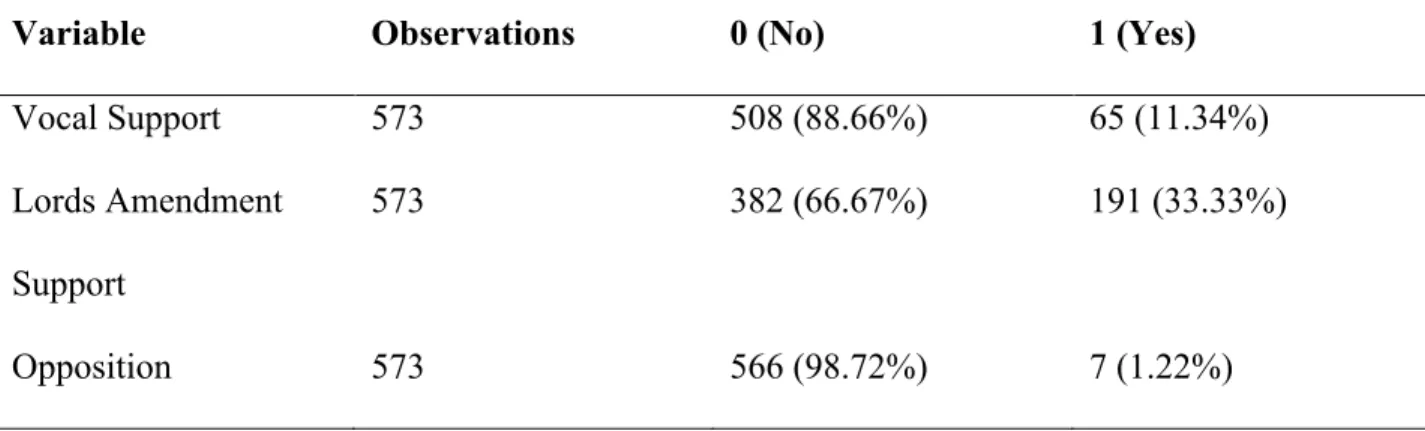
I test my three central hypotheses first in a comprehensive logit model to predict likelihood of “Vocal Support” for caste legislation, given one particular demographic or party factor and holding all others constant. I also ran logit models to predict voting patterns on the Lords Amendment 37 and to predict opposition to the law, to create points of comparison and to possibly elucidate the mechanisms of support. Though these two logit models are not central to my hypotheses, they provide an interesting point of comparison to the results of my tests for support. The descriptive statistics of these outcome variables is included in Table 1 below. Table 1. Outcome Dichotomous Variables
Variable Observations 0 (No) 1 (Yes)
Vocal Support 573 508 (88.66%) 65 (11.34%)
Lords Amendment Support
573 382 (66.67%) 191 (33.33%)
Opposition 573 566 (98.72%) 7 (1.22%)
All variables on ethnicity and religion included in Table 2 are collected from the United Kingdom’s 2011 Census categories. I created variables summarizing the percent of the
Stotesbery 26
religious affiliation or “no religion,” and were able to choose from broad categories of
ethnicity/race, including “white,” “mixed,” “Asian,” “Black” and “other” (Nomis 2017). Within these categories, there were multiple sub-categories; “Asian Indian” is one of the subcategories of “Asian.” Because my thesis seeks to compare determinants of support evenly across
constituencies, I use the “percent” of a constituency demographics variables rather than total populations. To capture the proportional weight of different demographic considerations, I created variables for the percent of constituents that identify as each demographic, per
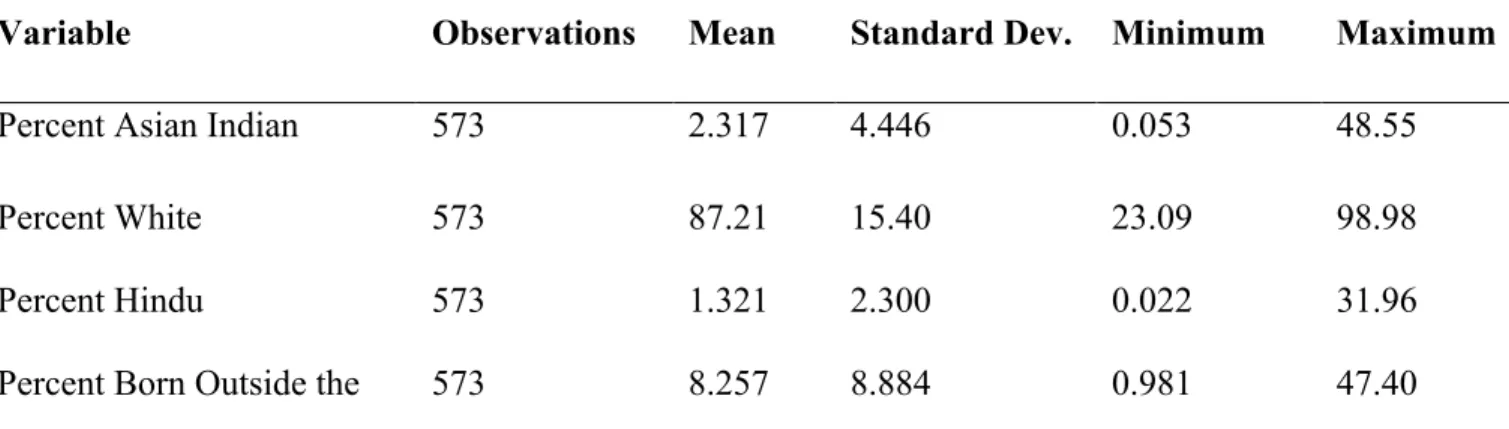
constituency. I used the census data on the total number of individuals per constituency in each group and converted these into percentages per total population in each constituency. The descriptive statistics of these independent variables are detailed in Table 2 below.
A notable limitation of my data is that this study only covers England and Wales, rather than the entire United Kingdom. The sample size for each of my demographic variables is n=573, rather than the full 650 constituencies in the UK, because the Nomis dataset has omitted Northern Ireland and Scotland. When deciding on the independent variables that I would use in my logit models, I was careful to avoid including variables that are highly correlated with one another in order to avoid collinearity. Although some demographic variables are inevitably associated with one another, like Hindu and Asian Indian, none are collinear.
Table 2. Hypothesis 1 Descriptive Statistics (Continuous Variables)
Variable Observations Mean Standard Dev. Minimum Maximum
Percent Asian Indian 573 2.317 4.446 0.053 48.55
Percent White 573 87.21 15.40 23.09 98.98
Percent Hindu 573 1.321 2.300 0.022 31.96
Stotesbery 27
EU
Percent Mixed Race 573 2.063 1.581 0.396 7.827
Percent Muslim 573 4.332 7.251 0.107 52.12
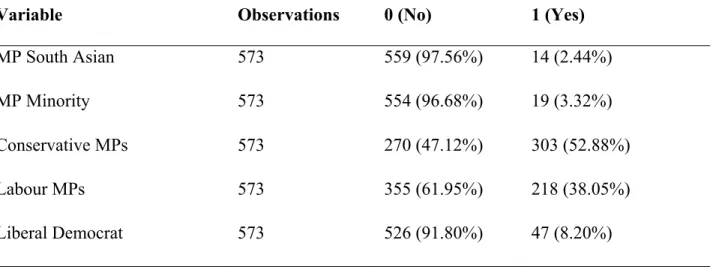
To define whether an MP was a minority, I relied on the definitions used in official parliamentary minority counts, like “Ethnic Minorities in Politics and Public Life” (House of Commons Library 2016). I used Parliament’s definitions of minority and South Asian to code these dichotomous variables as either a “1” or a “0.” Because much of my data relies on the Nomis dataset for these variables, which excludes Scotland and Northern Ireland, I use the same sample size in the sample size for my dichotomous variables, n=573, the full number of
Members of Parliament from England and Wales.
Table 3. Hypotheses 2 and 3 Descriptive Statistics (Dichotomous Variables)
Variable Observations 0 (No) 1 (Yes)
MP South Asian 573 559 (97.56%) 14 (2.44%)
MP Minority 573 554 (96.68%) 19 (3.32%)
Conservative MPs 573 270 (47.12%) 303 (52.88%)
Labour MPs 573 355 (61.95%) 218 (38.05%)
Liberal Democrat 573 526 (91.80%) 47 (8.20%)
Stotesbery 28
model regression, next to the dichotomous independent variables described above. All “percent” variables fell between 0 and 100, and all dichotomous variables were coded either as 0 or as 1.
However, a logit model’s coefficients cannot be used to determine probability, so I employ a post-estimation function after running the logit model to predict the probability of the outcome variable, comparing these outcomes to the overall probability of that outcome. To use post-estimations, I categorized constituent data as “Top 10%” and “Bottom 10%.” First, I predict “p,” or the raw probability of a positive outcome. Using the top 10% and bottom 10%
proportions of each demographic group per constituency, I calculate the mean value of “p” if that variable is greater than the 90th percentile and the mean value if it is lower than the 10th
Stotesbery 29
Results
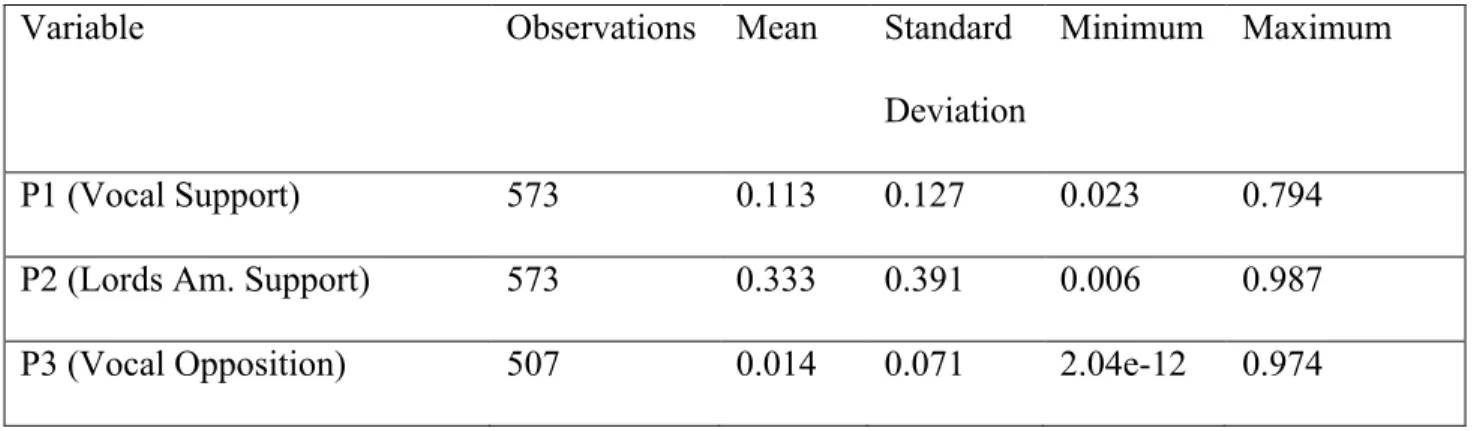
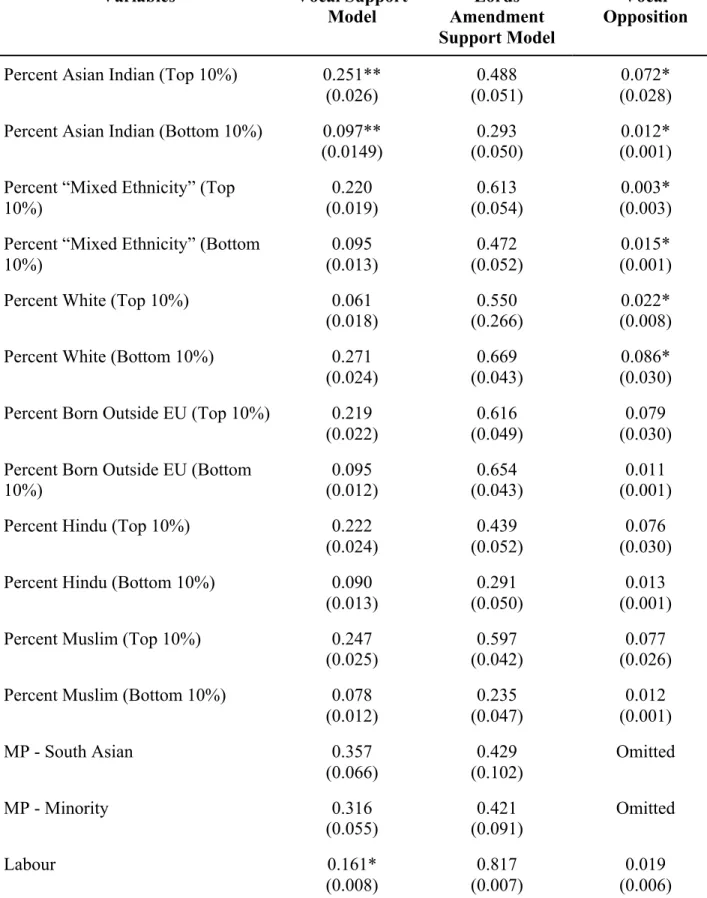
The results of my logistic regressions are recorded in the tables below. Table 4 details the mean probability that an MP, randomly chosen, would choose the outcome in each model. The probabilities for each model are sorted accordingly. Table 5 displays the results of the logistic regressions for each model. To understand the impact of an independent variable on the
probability of success for the outcome variable, we compare the post-estimation result for each model in Table 5 with the overall mean value of P1, P2 or P3 in Table 4. For the demographic characteristics, comparing the results for the 10th percentile and below with those of the 90th percentile and above further reveals the depth of that difference.
Table 4. Prediction Models Overview – Summary Statistics
Variable Observations Mean Standard
Deviation
Minimum Maximum
P1 (Vocal Support) 573 0.113 0.127 0.023 0.794
P2 (Lords Am. Support) 573 0.333 0.391 0.006 0.987
Stotesbery 30
Table 5. Logit Models Post-Estimation Results, by Model
Variables Vocal Support
Model Lords Amendment Support Model Vocal Opposition
Percent Asian Indian (Top 10%) 0.251** (0.026)
0.488 (0.051)
0.072* (0.028) Percent Asian Indian (Bottom 10%) 0.097**
(0.0149)
0.293 (0.050)
0.012* (0.001) Percent “Mixed Ethnicity” (Top
10%) 0.220 (0.019) 0.613 (0.054) 0.003* (0.003) Percent “Mixed Ethnicity” (Bottom
10%) 0.095 (0.013) 0.472 (0.052) 0.015* (0.001)
Percent White (Top 10%) 0.061
(0.018) (0.266) 0.550 (0.008) 0.022* Percent White (Bottom 10%) 0.271
(0.024)
0.669 (0.043)
0.086* (0.030) Percent Born Outside EU (Top 10%) 0.219
(0.022)
0.616 (0.049)
0.079 (0.030) Percent Born Outside EU (Bottom
10%) (0.012) 0.095 (0.043) 0.654 (0.001) 0.011
Percent Hindu (Top 10%) 0.222
(0.024)
0.439 (0.052)
0.076 (0.030) Percent Hindu (Bottom 10%) 0.090
(0.013) (0.050) 0.291 (0.001) 0.013
Percent Muslim (Top 10%) 0.247
(0.025)
0.597 (0.042)
0.077 (0.026) Percent Muslim (Bottom 10%) 0.078
(0.012)
0.235 (0.047)
0.012 (0.001)
MP - South Asian 0.357
(0.066)
0.429 (0.102)
Omitted
MP - Minority 0.316
(0.055)
0.421 (0.091)
Omitted
Labour 0.161*
(0.008)
0.817 (0.007)
Stotesbery 31
Liberal Democrat 0.319
(0.010)
0.064** (0.004)
Omitted
Conservative 0.040***
(0.002)
0.020*** (0.000)
0.010 (0.003)
Pseudo-R2 0.463 0.616 0.4636
Log likelihood -19.82 -140.2 -19.82
***p < .001, **p < .01, *p < .05. Standard Error is included in parentheses.
Vocal Support Model - Results
The results of the “Vocal Support” model provide the most revealing insight about the ways that demographics affected support for caste legislation. The logistic regression for the “Vocal Support” model shows three variables that produce statistically significant results at the
α<0.05 level: the percent of Indian constituents in a Member of Parliament’s district, Labour
Party identification, and Conservative Party identification.
The results provide evidence that, holding an MP’s party and other demographic factors constant, a statistically significant factor in predicting support of caste legislation is the
Stotesbery 32
probability of vocal support.
Likewise, the results indicate that party plays a strong role as well. A Labour MP has a 16.1% chance of vocally supporting the movement, at a 4.8% increase in likelihood from the overall mean. The likelihood that a Conservative MP will vocally support the caste legislation movement is 0.040, or 4.0%, which is a 7.3% decrease from the average. This could bolster the narrative that the Labour Party pushed to pass caste legislation and that the Conservative Party rallied on the side of the Hindu Forum, and could add evidence to Hypothesis 3 on the role of the Labour Party.
These results were significant at a α level of 0.05, and so we can reject the null
hypothesis that the proportion of a constituency that is of Indian origin has no effect on the likelihood of its MP to support caste legislation; we can do the same to reject the null hypothesis that Labour party identification has no effect. Though it is evident that party plays a role in determining vocal support, the change in likelihood of vocal support due to Labour identification was less significant than the change (13.8%) from the average to a high-Indian population
district. The results indicate support for Hypothesis 1 (H1), stating that: Members of Parliament with high Indian populations would be the most likely to support caste legislation, controlling for other demographic and party factors. Our post-estimation means show that the probability of supporting caste legislation is more than twice as large when the constituency is in the top tenth percentile of Indian constituents than in tenth percentile or less of Indian constituents, or than the overall average probability of support.
These results provided no statistically significant evidence that an MP’s ethnicity has any effect on their likelihood to support the caste legislation. It adds no weight to the second
Stotesbery 33
results indicate compelling evidence that, holding other demographic factors equal, an increased percentage of Indian constituents is the factor associated with the largest change in probability that an MP will vocally support the movement to legally prohibit caste-based discrimination in the United Kingdom.
Lords Amendment Support Model – Results
The results from the Lords Amendment Support model reveal that this particular piece of legislation on caste was struck down largely by the Conservative party. When the issue was introduced in an amendment, voted on along with multiple other amendments and seen through the lens of disagreement or accordance with the House of Lords, the primary determinant of the vote was identifying with the Conservative Party. At the α level of 0.001, the likelihood of a
Conservative MP to agree with the amendment was a mere 2%, compared with the average probability of 33.3% for all MPs. At a α level of 0.05, identifying with the Liberal Democrats
party changed an MP’s likelihood of support for the amendment to 6.4%, from the overall average of 33.3%. Here, the way that this amendment followed the pattern of Conservative disagreement with the House of Lords’ amendments is clear, along with a mixed Labour reaction and stance. There is little evidence that the percent of Indian Britons in a district was a
significant determinant of this particular vote.
Stotesbery 34
“Discussion & Conclusion” section weighs these results alongside the results of the “Vocal Support” model and further discusses how to interpret this evidence.
Vocal Opposition Model - Results
Though it does not directly test this study’s central hypotheses, I calculated a logistic regression to examine the relationship between these same independent variables and the probability that an MP would actively oppose caste legislation through either oral arguments or signing a motion. This regression, though peripheral in some ways, helps shed light on the motivations for Members of Parliament to take a stance on this movement for caste legislation. Contrasting these probabilities to the results generated in the first two models could elucidate areas of division, or perhaps clarify the reasons that the other two models produce different results. As demonstrated above, the general probability that an MP will actively oppose caste legislation is 0.014, or 1.4%. The logit model produced multiple statistically significant results at the α<0.05 level; “Percent Asian Indian,” “Percent ‘Mixed Ethnicity’” and “Percent White” were
proved to be statistically significant in this model. The sample size was reduced to 507, because the variables “MP Minority,” “MP South Asian,” and “Liberal Democrat” were omitted from the model because there were no MPs that opposed the movement in those categories, and so their inclusion would have predicted failure perfectly.
The vocal opposition model offers some limited insights into the various determinants of an MP’s reasons to support or oppose the caste discrimination legislation. Though there were a relatively small number of MPs to vocally oppose the movement, it is notable that both
Stotesbery 35
Vocal Support model, the low number of opponents to the law (seven) makes generalizing unwise; any analysis generalizing these to broader patterns should be done without giving them too much weight.
Stotesbery 36
Discussion & Conclusion
The results of my “Vocal Support” model provide strong evidence that the percent of Indians in an MP’s constituency is the single strongest predictor of their vocal support for the movement to legislate on caste; this confirms Hypothesis 1. Though Labour party identification and Conservative party identification still held strong influences, their influence was not nearly as strong as the effect of “Percent Asian Indian” on the probability of vocal support. However, it is still notable that the Conservative Party was so staunchly anti-caste legislation throughout the regressions; this may reveal the strength of the Conservative Party’s partnership with the Hindu organizations, since the party pattern—for the Conservative Party alone—was so strong.
Likewise, the comparative results of the vote on Amendment 37 indicate that the Conservative Party was uniquely mobilized against caste legislation, even as party identification failed to predict the stances of Labour politicians. These results as a whole compel me to reject the null hypothesis that the relationship between the proportion of Asian Indians in a district and the probability of that MP supporting caste discrimination are only randomly associated. Thus this quantitative analysis does not provide sufficient evidence to affirm either of the rival hypotheses presented in this thesis—that either party or an MP’s personal ethnic identity is the strongest predictor of vocal support.
Stotesbery 37
Hindu community and the Asian Indian community at large (Samani et al. 2017). The narrative adopted in the media coverage was that the majority of Indian and Hindu organizations opposed caste legislation, and only a small minority of Indians, allied with Evangelical Christians, was in favor of legislation.
The findings of this study certainly run counter to that narrative, as the evidence suggests that the percentage of Indian constituents in a constituency is the single most important influence on the probability of support, holding other demographic factors constant. This certainly supports the proposal behind the first hypothesis, which suggests that the issue of caste legislation is less a matter of overall equality measures and more an issue that particularly engages one minority part of the population: Asian Indians. Within this group, it is possible that either the Dalit influence is stronger than most assume, or that there are many in the Indian community that are both aware of and deeply opposed to caste discrimination. In either case, the community’s elites that lead religious organizations may not represent the Indian community at large. Thus the identity politics link that underpins that first hypothesis shows itself in this study, because the shared characteristic of large Indian populations serves as the most salient motivation for political action. The strength of the demographic factor—even over personal ethnic identity for an MP— point to the strong representation granted in the UK for MPs and their constituents, along the
lines of the Dynamic Representation model. Further, these results give less credence to the
theory that underpins the second hypothesis; the ethnicity of Indian MPs, though descriptively
representative of the Indian community, was not a significant factor in predicting vocal support.
There is one element, however, that confounds the seemingly clear relationship between
the percentage of a community that is Asian Indian (our independent variable) and its MP’s
un-Stotesbery 38
measurable factor throughout this study is the actual caste identities of the Asian Indians living
in these communities. While the result of this study, proving a strong connection between Indian
communities in the UK and supporting caste legislation, is certainly a new proposition, this work
leaves some questions unanswered. Namely, the comprehensive lack of data on the caste identity
on Indian Britons throughout the UK presents a unique challenge to interpreting the mechanism
behind these results.
As this research stands now, caste is a hidden variable in my results that may be
influencing this relationship between British Indian communities and support for caste
legislation. Essentially, these results show that the British Indian community, as a whole, could
be more inclined to the caste legislation issue than was realized, through the allyship theory, or
there could be a much larger population of low-caste individuals in Britain than expected, which
could influence the public perception of this issue. As mentioned before, there has been no
comprehensive study of any kind on the number of Dalits living in the UK; it is currently
estimated at 250,000, but that is a broad estimation not based in any census or any
comprehensive survey results (Borbas et al. 2006). Though the results of this study challenge the
common perception of caste legislation alliances, further investigation into the caste identities of British Indians will be needed to truly identify the mechanism behind this link—and to determine whether caste cleanly determines support, as a salient political identity.
Stotesbery 39
on caste legislation in the future and to the public understanding of the caste issue in Britain. Regardless of the available information on caste, it is certainly telling that the MPs of high-density Indian districts would be more likely to take a public stand on caste legislation, all else held equal. If any further studies are conducted that gather caste data on UK residents, this study’s theoretical model could be easily replicated, using caste demographics in place of “Asian Indian” to test a more refined version of Hypothesis 1. The results of that test could disentangle the effect of a large low-caste Indian community from the effect of a large high-caste Indian community. For now, though, “Asian Indian” is the most specific variable possible, and these results clearly indicate an identity-based link in the caste legislation issue. These results suggest that the theoretical underpinnings of this project—asserting that caste identity and caste issues in the Diaspora follows established patterns of identity politics—seem to be confirmed in the patterns of support across the House of Commons.
Though this study’s external validity is technically limited to the MPs that represent England and Wales, it provides an engaging hypothesis for legislating on the rights to non-discrimination based on sub-ethnic identities, and other kinds of double minorities in Western democracies. Would a minority community that has any kind of internal social hierarchy be more open, in a Western democracy, to legislating for the rights of its historically stigmatized
Stotesbery 40
Works Referenced
Allen, Robin. “Tackling Caste and Descent-Based Discrimination – Jews, Hindus and Others.” Discrimination Law Association Briefings, 2009, pp. 10-12.
Antonio, Anthony. “Diversity as a Class and Caste Issue.” Encyclopedia of Diversity in Education. 2012.
Balagangadhara, S.N.. “Orientalism, Postcolonialism and the ‘Construction’ of Religion.’” Rethinking Religion in India: The Colonial Construction of Hinduism, edited by E. Bloch, M. Keppens and R. Hedge, Routledge, 2010, pp. 135-163.
Balagangadhara, S.N; De Roover, Jakob. “The Secular State and Religious Conflict: Liberal Neutrality and the Indian Case of Pluralism.” The Journal of Political Philosophy. vol. 15, no. 1, 2007, pp. 67-92.
Ballard, Roger. “Ethnic Diversity and the Delivery of Justice: The Challenge of Plurality.” Migration, Diasporas and Legal Systems in Europe. Routledge-Cavendish, 2006.
Ballard, Roger. “Common Law and Common Sense: Juries, Justice and the Challenge of Ethnic Plurality.” Law and Ethnic Plurality: Socio-legal Perspectives. Leiden: Martinus Nihoff, 2007, pp. 69-105.
Bayly, Susan. Caste, Society and Politics in India from the 18th Century to the Modern Age, Cambridge University Press, 1999.
Bernstein, Mary. 2005. “Identity Politics”. Annual Review of Sociology vol. 31, 2005, pp. 47–74. http://www.annualreviews.org/doi/abs/10.1146/annurev.soc.29.010202.100054. Accessed 1 May 2016.
Bhatt, Chetan. Liberation and Purity: Race, New Religious Movements and the Ethics of Postmodernity. Routledge, 1997.
Borbas, Gina; Haslam, Rev’d David; Sampla, Balram; Mahimaidass, Savio Lourdu; Sadana, Nidhi. “No Escape: Caste Discrimination in the UK, Dalit Solidarity Network UK Report”. Dalit Solidarity Network, July 2006.
Census of India. “Scheduled Castes & Scheduled Tribes Population”. The Government of India: Ministry of Home Affairs. Census of India, 2011.
Stotesbery 41
Choudhary, Sunil K.. “Political colonization of multi-ethnic Britain: a study of Indian Diaspora.” Diaspora Studies, vol. 7, no. 2, 2014. pp. 1000-120, 2014,
http://www.tandfonline.com/doi/abs/10.1080/09739572.2014.911445. Accessed 10 March 2016.
Constitution of India. 2011. http://lawmin.nic.in/olwing/coi/coi-english/coi-indexenglish.htm. Accessed 2017.
Crenshaw, Kimberlie. “Mapping the Margins: Intersectionality, Identity Politics, and Violence Against Women of Color.” Stanford Law Review, vol. 43, no. 6., 1991.
“Daily Hansard - Westminster Hall, 9 July 2014.” UK Parliament Website: Parliamentary Business, 9 July 2014,
https://www.publications.parliament.uk/pa/cm201415/cmhansrd/cm140709/halltext/1407 09h0002.htm#14070973000219. Accessed 2017.
“Daily Hansard - Westminster Hall, 23 April 2013.” UK Parliament Website: Parliamentary Business, 23 April 2013,
https://www.publications.parliament.uk/pa/cm201213/cmhansrd/cm130423/debtext/1304 23-0002.htm#13042381000611. Accessed 2017.
“Daily Hansard - Westminster Hall, 16 April 2013.” UK Parliament Website: Parliamentary Business, 16 April 2013,
https://www.publications.parliament.uk/pa/cm201213/cmhansrd/cm130416/debtext/1304 16-0003.htm#13041638002330. Accessed 2017.
“Daily Hansard - Westminster Hall, 26 Jan. 2012.” UK Parliament Website: Parliamentary Business, 26 Jan. 2012,
https://www.publications.parliament.uk/pa/cm201212/cmhansrd/cm120126/halltext/1201 26h0001.htm#12012669000094. Accessed 2017.
Desai, Sonalde; Temsah, Gheda. “Muslim and Hindu Women’s Public and Private Behaviors: Gender, Family and Communalized Politics in India.” Demography no. 51, 2014, pp. 2307-2332.
Stotesbery 42
Dhanda, M.; Mosse, D.; Waughray, A.; Keane, D.; Green, R.; Iafrati, S. and Mundy, J.K.. Caste in Britain: Experts’ Seminar and Stakeholders’ Workshop. Equality and Human Rights Commission Research Report No. 92. Manchester: Equality and Human Rights
Commission, 2014.
Dirks, Nicholas. Castes of Mind: Colonialism and the Making of Modern India. Princeton University Press, 2001.
Doron, Assa. Caste, occupation and politics on the Ganges: passages of resistance. Ashgate, 2008.
Dumont, Louis. Homo Hierarchicus: The Caste System and Its Implications. University of Chicago Press, 1980.
“Early day motion 738: Caste Discrimination Legislation.” UK Parliament Website: Parliamentary Business, 12 Nov. 2013,
http://www.parliament.uk/business/publications/business-papers/commons/early-day-motions/edm-detail1/?edmnumber=738&session=2013-14. Accessed 2017.
“Early day motion 117: Caste Discrimination in the UK.” UK Parliament Website:
Parliamentary Business, 16 May 2013, http://www.parliament.uk/edm/2013-14/117. Accessed 2017.
“Early day motion 1183: Caste Discrimination in the UK.” UK Parliament Website:
Parliamentary Business, 13 Mar. 2013, http://www.parliament.uk/edm/2012-13/1183. Accessed 2017.
“Early day motion 572: National Institute of Economic and Social Research Study of Caste-Based Discrimination in the UK.” UK Parliament Website: Parliamentary Business, 20 July 2010,
http://www.parliament.uk/business/publications/business-papers/commons/early-day-motions/edm-detail1/?edmnumber=572&session=2010-12. Accessed 2017.
Eggers, Andrew; Spirling, Arthur. “Ministerial Responsiveness in Westminster Systems:
Institutional Choices and House of Commons Debate, 1832-1915.” American Journal of Political Science, vol. 58, no.4, 2014, pp. 873-887.
Stotesbery 43
Gelders, Raf; Balagangadhara, S.N.. “Rethinking Orientalism: Colonialism and the Study of Indian Territories.” History of Religions, vol. 51, no. 2, 2011, pp. 101-128.
Gelders, Raf; Derde, William. “Mantras of Anti-Brahmanism: Colonial Experience of Indian Intellectuals.” Economic and Political Weekly. vol. 38, no. 43, 2003, pp. 4611-4617. Ghurye, G. S. Caste and Race in India. London: Routledge and Kegan Paul, 1932.
Gidoomal, Ram; Mahtani, Deepak; Porter, David. The British and How to Deal with Them: Doing Business with Britain’s Ethnic Communities. Middlesex University Press, 2001.
Gold, Daniel. “Internal Diasporas, Caste Organizations, and Community Identities:
Maharashtrians and Sindhis in Gwalior, Madhya Pradesh.” International Journal of Hindu Studies vol. 11, no 2, 2016, pp. 171-190.
Green, Roger; Whittle, Stephen. Hidden Apartheid – Voice of the Community: Caste and Caste Discrimination in the UK, a Scoping Study. Anti Caste Discrimination Alliance, 2009.
Gupta, Dipankar. “Continuous Hierarchies and Discrete Castes.” Economic and Political Weekly vol. 19 no. 48, 1984, pp. 2049–2053.
Hindu Forum of Britain. Caste in the UK: A Summary of the Consultation with the Hindu Community in Britain. London: Hindu Forum of Britain, 2008.
Holden, Livia. Cultural Expertise and Litigation: Patterns, Conflicts, Narratives. Routledge, 2011.
Home Office. “Racist Incidents, England and Wales.” 2010-11. Accessed 2017.
https://www.gov.uk/government/statistics/racist-incidents-england-and-wales-2010-to-2011.
House of Representatives, Subcommittee on Africa, Global Human Rights and International Operations on the Committee on International Relations. India’s Unfinished Agenda: Equality and Justice for the 200 Million Victims of the Caste System. 109th Congress, First Session, 6 October 2005, Serial No. 109-102.
Hannett, S. “Equality at the intersections: the legislative and judicial failure to tackle multiple discrimination.” Oxford Journal of Legal Studies no. 23, 2003, pp. 65-86.
Stotesbery 44
Jaffrelot, Christophe. “Towards a De-Ethnicization of Politics in India? The Persistance of the Caste Vote.” Critique international no. 51, 2011, pp. 57-73.
Jain, Ravindra. January 01, 2010. “Diaspora, trans-nation and nation: reflections from India.” Sociological bulletin vol. 59, no. 1.
Kaempfer, William H.; Marks, Stephen V. “The Expected Effects of Trade Liberalisation: Evidence from US Congressional Action on Fast-Track Authority.” The World Economy, vol. 16, no. 6, 1993, 725-740.
Kahane, Leo H. “Congressional Voting Patterns on NAFTA.” American Journal of Economics and Sociology. vol. 55, no. 4, 1996, pp. 395-409.
Karade, Jagan, ed. Caste Discrimination. Jaipur: Rawat Publications, 2015.
Keane, David, Mr. 2013. Caste-based Discrimination in International Human Rights Law. Abingdon, GB: Ashgate.
Kumar, Pratap. 2015. Indian diaspora: socio-cultural and religious worlds. Boston: Brill.
Kumar, P. September 01, 2012. Place of subcaste (jati) identity in the discourse on caste: examination of caste in the diaspora. South Asian diaspora 4, no. 2.
Liddle, Joanna; Joshi, Rama. Daughters of Independence: Gender, Caste, and Class in India. London: Zed Books, 1986. Print.
Madan, T. N. “On the Nature of Caste in India.” Contributions to Indian Sociology 5 (1971): 1– 13.
Mehta, Pratap Bhanu. Lecture Given at the Conference on “Caste and Contemporary India.” 2009.
Metcalf, Hilary; Rolfe, Heather. “Caste Discrimination and Harassment in Great Britain.” National Institute of Economic and Social Research. Government Equalities Office, 2010.
Stotesbery 45
Office for National Statistics: Neighbourhood Statistics. UK Office for National Statistics. 2015. http://www.neighbourhood.statistics.gov.uk/dissemination/.
Poulter, Sebastian. Ethnicity, Law and Human Rights: The English Experience. Oxford, Clarendon. 1998.
Pyper, Doug. “The Equality Act 2010: Caste discrimination.” The House of Commons Library. House of Commons Briefing Paper. no. 06862.
Pirbhai, Mariam. Mythologies of Migration, Vocabularies of Indenture: Novels of the South Asian Diaspora in Africa, the Caribbean, and Asia-Pacific. Toronto: U of Toronto Press, 2009.
Quigley, Declan. The Interpretation of Caste. Delhi: Oxford University Press, 1993.
Radhakrishan, P. “Mandal Comission Report: A Sociological Critique.” In M.N. Srinivas (ed.) Caste” Its Twentieth Century Avatar. New Delhi: Penguin, 1996, pp. 203-220.
Rai, Rajesh. The South Asian Diaspora: Transnational networks and changing identities. 2008.
Ramaswamy, Krishnan; Nicolas, de Antonio and Banerjee, Aditi. Invading the Sacred: An Analysis of Hinduism Studies in America. New Delhi: Rupa and Co., 2007.
Reddy, Movindri. 2015. "Transnational Locality: Diasporas and Indentured South Asians." Diaspora Studies 8 (1): 1-17.
http://search.proquest.com/docview/1649638182?accountid=14244.
Reinventing Britain: Constitutional Change under New Labour. Ed. McDonald, Andrew. London: University of California Press, 2007.
Robinson, Rowena. “Minority Rights versus Caste Claims: Indian Christians and the Predicaments of Law.” Economic and Political Weekly, vol. 49, no. 14, 2014. Roy, Arundhati. “India’s Shame.” Prospect Magazine, no. 225. 2014.
Rubenstein, Michael. 2014. “Caste discrimination in the UK: legal developments.” Equal Opportunities Review. Equality Law Reports. no 247.
Stotesbery 46
Sandberg, R. and Doe, N. “Religious Exemptions in Discrimination Law.” Cambridge Law Journal vol. 2, no. 66, 2007, pp. 302-12.
Sargeant, Malcolm. Discrimination and the Law. New York: Routledge, 2013.
Sarwal, Amit. Labels and Locations: Gender, Family, Class and Caste-The Short Narratives of South Asian Diaspora in Australia. Newcastle upon Tyne: Cambridge Scholars
Publishing, 2015.
Sahoo, Sadananda, and B. K. Pattanaik. Global diasporas and development: Socioeconomic, cultural, and policy perspectives. Dordrecht: Springer India, 2014.
Sénart, Emile. Caste in India: The Facts and the System. New Delhi: Ess Ess Publications, 1975.
Sengupta, Jhumur; Sarkar, Debnarayan. “Caste and religious diversity on formation of social capital; a field survey in India and measurement issues.” Equality, Diversity and Inclusion: An International Journal 31 (2): 158-175.
Shah, Ghanshyam. 2004. Caste and Democratic Politics in India. London: Anthem.
Shah, Prakash. “Asking About Reasonable Accommodation in England.” International Journal of Discrimination and the Law. vol. 13, nos. 2-3, 1997, pp. 83-112.
Singh, Omendra Kumar. 2012. “Reinventing Caste: Indian Diaspora in Amitav Ghosh’s Sea of Poppies.” Asiatic: IIUM Journal Of English Language & Literature 6, no 1: 47-62. Literary Reference Center Plus, EBSCOhost (accessed March 6, 2016).
Stimson et al. “Dynamic Representation.” The American Political Science Review, vol. 89, no. 3, 1995, pp. 543-565.
Swapnil, Singh. "Caste and Diaspora." International Journal of Social Science and Humanity vol. 5, no. 1, 2015, pp. 80-82. doi:http://dx.doi.org/10.7763/IJSSH.2015.V5.426. http://search.proquest.com/docview/1557055594?accountid=14244.
Teltumbde, Anand. Persistence of caste: the Khairlanji murders and India's hidden apartheid. London: Zed Books, 2010.
Stotesbery 47
Waughray, Annapurna. “Capturing Caste in Law: Caste Discrimination and the Equality Act of 2010.” Human Rights Law Review.vol. 14, 2014, pp. 359-379.