APR-15-03 19:21 FROM=MRNC 10=8510236
Public Reporting and Nursing Home Quality hnprovement
by
Jill Blalock Jones PID 702958229
April 15, 2003
PAGE
A Master's paper submitted to the faculty of the University of North Carolina at Chapel Hill in partial fulfillment of the requirements for the degree of Master of Public Health in
the School of Public Health, Public Health Leadership Program.
Approved by:
Public Reporting and Nursing Home Quality Improvement
Abstract:
Improving the quality of care of nursing home residents is a constant concern.
Due to the recent rollout of the national Nursing Home Quality Improvement
Initiative by the Centers for Medicaid & Medicare Services (CMS), consumers
can find out specific quality information for nursing homes at the national and
state level. The CMSwebsite, http://www.medicare.gov,provides information
about individual nursing homes, specific quality measure information (which
includes bar graphs comparing facilities across the nation and at the state level},
inspection results from the facility's state survey and/or complaint investigations,
and finally, the website provides information about nursing staff This quality
measure information on the website, Nursing Home Compare, is updated every
three months. State survey results and staffing information is updated annually.
The public reporting of this data is not only useful for consumers in selecting a
nursing home for their loved ones, but providers can use this quality measurement
information as a way of improving the quality of care they are providing.
A famous nursing leader, Florence Nightingale once said, "The ultimate goal is to manage quality. But you cannot manage it until you have a way to measure it, and you cannot measure it until you are able to monitor it" (I).
If you are a health care professional or interact with the health care community on a regular basis, you've probably heard some of these "buzz words" recently: patient safety, health care report cards, public reporting, and quality measures. In
~--L
b
;
1
L
b-November 2002, the Centers for Medicaid & Medicare Services (CMS) rolled out a national program for public reporting of quality measures in skilled nursing facilities, in efforts to improve the quality of care provided to residents. The aging population is increasing; approximately 1.6 million Americans live in 17,000 skilled nursing facilities, costing $53 billion dollars annually. Five million Americans are expected to need nursing home care by the year 2030. The skilled nursing facility population is a heterogeneous one in that it represents a group of people all with diverse needs and medical conditions. These older and sicker residents are more functionally dependent than ever before. Also, in recent years, the media has increasingly reported on abuse, pressure ulcers and inappropriate restraints in nursing homes (2).
Approximately 17,000 Medicare and Medicaid certified homes across the nation are compared on ten different quality measures (3). These quality measures are being measured because they are problem areas that need to be addressed in nursing homes. These areas include the loss of ability in daily tasks, infections, pain, pressure ulcers, physical restraints, delirium, and the ability to walk. Due to the fact that many nursing homes need additional resources and expertise in improving the care that they provide, the state quality improvement
organizations (QIOs) are helping facilities to resolve such issues as part of this
l
initiative ( 4). This publicly reported data not only provides a resource fora result, admissions to homes with lower scores may decrease. Facilities may suffer as a result oflower scores. The Division of Facility Services (DFS) conducts surveys at facilities and is responsible for inspection and licensing of skilled nursing facilities. The outcome of the surveys is related to the quality of care being provided by facilities. If facilities have low scores on the quality measures, they can be fined and can even be closed if proper documentation is not shown to address the problem (6).
Public reporting of quality measures allows the public to choose nursing homes with better outcomes. In tum, if facilities know that the public is using this data to select a home for their loved one, they will by nature want to compare their rates to other facilities across the state, including their neighboring facilities. This should help them to become more cautious in their own quality measure scores, and in the future, they even may use quality measurement information as a marketing piece. For example, for someone taking a tour of a facility, a
representative from that facility might want to say, if you look at the Nursing Home Compare website, you will see that our facility has lower scores for percentages of patients with bed sores. Public reporting may result in
competition among facilities and drive them to want to improve their scores. In the April 2003 American Health Quality Association newsletter, AHQA Matters, one article suggests that for one large national managed care organization,
quality providers and scores improved on over half of the measurements" (7). Furthermore, while certain measures may be important to some people, others may not. For instance, the family member of a potential resident who is ambulatory, may not be as concerned with the pressure ulcer measure as the "walking more" measure. This data helps consumers to choose facilities who score higher on measures that are most important to them.
While public reporting might be a new "hot topic" in healthcare, quality improvement is not. For years, the healthcare industry has recognized that the quality of care can be improved, particularly in the nursing home setting, which
accounts for 12% ofhealthcare expenditures in the United States (8). Quality is
.
I
something that is controversial in many ways in that everyone has their own definition of quality and how quality is measured. A background review, "Quality Systems and Public Health" suggests four common major quality improvement principles: poor quality is a systems problem, everyone is in charge
~ of pointing out quality problems and coming up with solutions to those problems,
~---quality is seen from the customer's perspective, and poor ~---quality is expensive (1). 1n 1983, the Institute of Medicine (IOM) conducted a quality of care study for
differences in quality of care. Their study found that quality of care varies widely among nursing homes, from very poor care to excellent care. For individual Qis, the broad scale of differences in high scores and low scores, shows that care systems really do impact outcomes. One example is that for residents at low risk for incontinence, one nursing home had a 6% incontinence rate while another had a 29% rate. This study, published in the Journal for Nursing Care Quality in 1996, stressed the importance of using the MDS data in evaluating performance at the facility level and coming up with ways to improve care (9). A study published in 1991 by the American Geriatrics Society, showed that group outcomes may be related to the care provided in nursing homes. RN hours, nursing process,
security, and mean quality were all found to significantly improve mortality rates for residents (1 0).
In the July/August 2000 issue of the Journal for Healthcare Quality, an article
was published which outlined a comprehensive systems model for improving
quality of care in nursing homes. The model, similar to the Donabedian model of
~--quality, focuses on structure, process, and outcome, taking into consideration staff credentials, physical structure, following guidelines and standards of care, length of stay and quality measures (11 ). This article summarized findings from other
l
studies in addition to reporting on quality of care in reference to the model. This
l
model is comprised of four interacting sections: organizing arrangements, socialadministrative procedures, and benefits. Improving quality in this section would mean a change in structure and advising or creating new procedures. The next part of the model, social factors, includes the way that residents, families and staff work together and communicate. Improving quality in this dimension would mean altering behaviors and the way individuals act. The third dimension of the model is technology, which is information technology, equipment, and job design. Quality improvement in this area would mean "reengineering" or "process
design". Finally, physical setting, is the overall design of a facility, internally and externally (8).
Taking a more in depth look at the four dimensions of the comprehensive systems model, one study shows that many factors in the organizational enviromnent lead to poor quality care. From the perspective of organization arrangements, decisions are usually made from managers and supervisors who usually do not see the everyday care being provided. Those providing the care are not paid well, have little training, and no room for career growth within the
facility. Although they are usually the ones providing the direct care, they, along with the residents and family members, have minimal influence in the
development and implementation of procedures. A variety of sources also suggests that there is a shortage of nursing aide staffing in most nursing homes, although there is not any published information or studies which evaluates the ratio of staff to residents and how long it takes to care for residents (2)(8)(12)(13).
problems leading to poor quality care. Some of these differences include social/background differences and ethnic differences, which can lead to miscommunication and decreased work satisfaction. Residents and family members may be reluctant to report negative staff behaviors because they are afraid of it being used against them. Also, it is unfortunate that residents and their family members are generally not encouraged and advised to become an integral part of the care planning and decision process. For residents who are more involved in facility activities, resident council, and care decisions, they show increased positive emotional and physical well being (8).
For the technology dimension, it is important to point out that many nursing homes do not have computers, and for those that do, they are only used for basic office processes. Having the technology to build and track care protocols and organizational strategies may thereby affect the quality of care to residents. Also, technological assistance is limited if available at all in facilities (8).
four major interacting components of the comprehensive systems model. This . model allows issues to be addressed at all levels (8).
In an article entitled, "Interventions to Nurture Excellence in the Nursing Home Culture", published in the Journal of Gerontological Nursing by Marian Deutschman, PhD, the characteristics of a "quality" culture emphasized less hierarchical structure in nursing homes and more leadership and decision making at all levels of the organization. Constant improvement and change should be encouraged on an ongoing basis, and "information sharing, involvement, and participation" are priorities for model facilities that demonstrate the
characteristics of "excellence" and a "quality culture". The article looked at three r--
'
nursing homes with these characteristics and found that there was a much lowerturnover of staff, better attendance, and increased morale for employees at these facilities. As a result, these staff characteristics lead to further stimulation of residents in a more community like environment. This article did not concentrate or make reference to clinical outcomes and nursing home culture, but as indicated previously for other articles cited in this paper, staff interaction and satisfaction influences quality of care for residents (14).
A common thread in all of these sources/articles is that quality of care is an important issue that affects health outcomes. Proper training needs to be
t
and comparing it to other facilities, by nature, they would certainly want to improve upon their quality measures.
Prior to expanding on the CMS initiative, it is important to understand some of the background information associated with public reporting and health care in general. Purposes of public reporting in health care include: providing relevant and accurate information to the public, "stimulating" providers to enhance the quality of their services, "standardizing data collection priorities" (for hospitals in particular), allowing providers a "sense of predictability about public reporting expectations", and "supporting clinicians to provide quality care to their patients". There are also challenges of public reporting which include: provider and patient confidentiality, an increased "burden" on both clinicians and patients, "technical limits of science and data", and "feasibility for small and rural institutional settings" (15).
Department of Health has mandated a system for public reporting for all health care providers who are licensed. Health plan and provider reports have become more common in recent years, compared to few hospital and other health care reporting. Health plan performance reports are more population based, and facility reports focus on individual provider performance. Some common measures in performance reporting include: financial, utilization, clinical, and satisfaction measures. A 1996 nationwide study by the Agency for Health Care Policy and Research (AHCPR) and the Kaiser Family Foundation on the quality of health plans, determined that consumers rank quality higher than benefits, physician choice, and even costs (16).
The National Business Coalition on Health determined in 1998 that nine coalitions were developing report cards for hospitals. However, public reporting is only done by four of these coalitions. CMS is expected to announce the rollout of a national program for hospital reporting sometime in 2003/2004 and home
health agencies sometime this year (2003). Similar to the nursing home program, L this would provide consumers with more specific information related to quality
measures in these settings (15).
Home Compare website. In January 2003, there were 3628 hits on the website (18). For nursing homes, CMS identified 10 quality measures for short-stay and long-term residents. Quality measures are obtained from a resident's assessment MDS at their nursing facility (8). When calculated, quality measures are risk adjusted, in order to provide a fair and accurate description of the care provided in a facility and to account for variation in facilities. Specifically, these measures are listed below. For the long term population:
• Percentage of Residents with Loss of Ability in Basic Daily Tasks • Percentage of Residents with Infections
• Percentage of Long Term Residents with Pain • Percentage of Residents with Pressure Sores
• Percentage of Residents with Pressure Sores with an Additional Level of Risk Adjustment
• Percentage of Residents in Physical Restraints
For the short term population:
• Percentage of Short Stay Residents with Delirium
•
•
•
Percentage of Short Stay Residents with Delirium with an Additional Level of Risk Adjustment
Percentage of Short Stay Residents with Pain
Percentage of Short Stay Residents Who Walk as Well or Better on Day 14 as on Day 5 of Their Stay
Source: NH Quality Initiative Quality Measures Resource Manual Oct 2002(19).
Taking a closer look at these measures, below is an explanation of each measure and it's rationale. First, looking at a chronic measure, residents with loss of ability in daily tasks are those declining in being able to perform activities of
L
r:
'
daily living (ADLs), which are everyday activities such as eating, toileting, getting from one place to another, and the way someone moves around and
positions themselves in bed. As the ability to perform ADLs decreases, emotional stress can increase resulting in negative feelings oflow self-esteem and
worthlessness, and physically, the lack of activity can lead to dangerous falls, pressure ulcers, and other physical factors (19).
For the chronic measure, "percent of residents with infections", these include any new infection since being admitted to the nursing home. Examples provided in the Quality Measures Resource Manual include: fever, wound infection, viral hepatitis, urinary tract infection, pneumonia, respiratory infection, septicemia, recurrent lung aspiration, and end stage disease (19). Elderly people are more susceptible to infections due to their lower immune systems and infections due to underlying problems/diseases. Because of the "closed environment" of many nursing homes, there may be an increased chance of the spread of infectious organisms. The most common types of infections are urinary, respiratory, and gastrointestinal infections (20).
categories: back pain, bone pain, chest pain while doing usual activities,
headache, hip pain, incisional pain, joint pain, soft tissue pain, stomach pain, and other (19). According to the Rhode Island QIO, Rhode Island Quality Partners, Inc., 83% of nursing home residents have some type of pain on a regular basis (21).
A long term quality measure is the percent of residents with pressure ulcers. Elderly people, especially those who are bedridden or wheelchair bound are more susceptible to pressure ulcers or bedsores, which are very serious yet preventable, since they occur when a resident has been in one particular position for too long. The sore results because the tissue in a certain area dies due to the continued pressure and decreased blood supply to a certain area of the body. There are four stages of these sores, with the fourth stage being the most severe (22). According to the Quality Measures Resource Manual, 3 to 5% of residents suffer from bedsores. This quality measure has an additional level of risk adjustment (19).
A post acute measure that affects an estimated 25% of residents is the percent of residents with delirium, defined as "a stage of acute confusion that develops quickly and involves changes in awareness, attention, cognition (thinking and reasoning), and perception." Some important measures of delirium used on the MDS include: mental function that varies throughout the day, lethargy,
restlessness, disorganized speech, distracted easily and altered perception or awareness of surroundings. Delirium can be reversed; it is often mistaken as part
L. of the aging process. Delirium can impact a resident's progression in
rehabilitation and even can length a resident's stay at the nursing home. This quality measure has an additional level of risk adjustment (19).
Finally, another post acute measure is the percent of residents who walk as well or better on day 14 as on day 5 of their stay. This includes residents who are able to walk by themselves or with limited assistance. It is important to recognize that higher values on this measure show good quality of care in relation to
improvement of ADL functioning. For all of the other quality measures, lower scores are better. When mobility decreases, this can be a sign of many other factors such as decline in a resident's condition or too large of a dose of medication, resulting in falls and other serious circumstances (19).
Based on the quality measurement data released by the CMS, the
whether or not the quality of care being provided to residents is the same for facilities at different locations and different size facilities. Data were reviewed to determine if any association could be identified by type of facility and quality measure score. Originally, it was the intent of this paper to conduct this analysis at the patient level, but detailed resident specific date was not accessible.
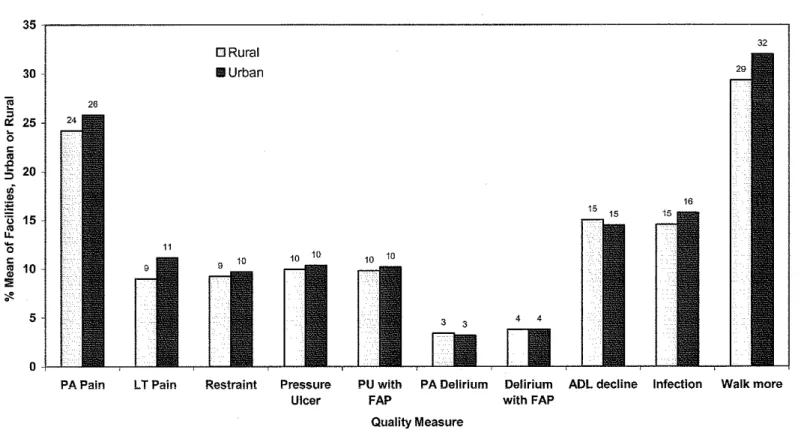
First, taking a look at rural versus urban facilities, the only statistically significant measure (p< . 05) was the chronic pain measure. Rural and urban counties are defined by CMS. The following 35 counties are considered urban:
L
Alamance, Alexander, Brunswick, Buncombe, Burke, Cabarrus, Caldwell,Catawba, Chatham, Cumberland, Currituck, Davidson, Davie, Durham, Edgecombe, Forsyth, Franklin, Gaston, Guilford, Johnston, Lincoln, Madison, Mecklenburg, Nash, New Hanover, Onslow, Orange, Pitt, Randolph, Rowan, Stokes, Union, Wake, Wayue, and Yadkin. Comparing the means often quality measures of facilities for rural vs. urban counties, a significant difference was found, by t-test, only for pain in long term residents, with the mean 9.0% for rural residents and 11.2% for urban residents (23). Could it be that perhaps there are more chronically ill patients at urban facilities being that urban areas are closer to larger, more specialized hospitals? Are rural facilities doing a better job at
reporting their quality measures? Maybe, urban facilities are focusing their
L
attention on other issues such as the state survey and other record keeping inFigure 1 shows the difference for each of these ten measures for rural/urban facilities. For the most part, there is a steady pattern, where urban facilities have slightly higher rates. For ADL decline, rural facilities are slightly higher.
Walking improvement in urban facilities was better but not statistically significant (14)(23)(24).
In comparisons of facilities with a chain name versus facilities without a chain name, no significant difference was found across all ten measures (23).
FIGURE 1
NC Nursing Home Quality Measures for 2nd Quarter of 2002, Urban vs. Rural Counties
35
32
DRural
30 Ill Urban
...
-"
« 25 5 ~
..
.Q-
20 ::> .;"
~ ·u 15"'
u.
15
~
..
10"
:; ....
5
0
PAPain LTPain Restraint Pressure PU with PA Delirium Delirium ADL decline Infection Walk more Ulcer FAP with FAP
Quality Measure
35 31 30 E ~ 1ij
eli
25"
N(ij
.<:
"
20..
"
.5
"'
.!!! 15
"'
~
..
u.
-
0 10~
..
"
:;; 5 0 PAPainIn stratification by five categories of size, 60 or fewer beds, 61 to 100 beds, 101 to 140 beds, 141 to 180 beds, and over 180 beds, three significant trends were found by regression analysis, all with lower scores (better) for increasing size. The significant trends were for pain in post -acute residents, delirium in post -acute residents and ADL decline in long-term residents. This is exemplified in Figure 2 (23).
LTPain
FIGURE2
North Carolina Second Quarter 2002 Nursing Home Quality Measures
Stratified by Number beds in Facility
060 or under 1!!1 061 to 100 lil1 01 to 140 11141 to 180 •181 orover
Restraint Pressure PU with PA Delirium Delirium ADL decline Infection Walk more
Ulcer FAP with FAP
Quality Measure
Source: A. Silver, Epidemiology & Biostatistics Division, Medical Review of North Carolina (23).
There are both advantages and disadvantages to using MDS data for evaluation of quality improvement, but the advantages appear to outweigh the disadvantages. Advantages would be that the data is collected per resident on a regular basis, using the standardized MDS tool. This data can of course, be used to monitor and track resident behavior and outcomes and is the same data that the Division of Facility Services uses when conducting onsite surveys at the home. The quality measures are all self reported by facilities, and they have control of what is actually reported. Another disadvantage is that different facilities may have different methods for reporting. Some facilities may have more stringent guidelines for how reporting is done, for example. However, the MDS is mandated nationwide; therefore, the MDS data seems to provide consistent information for both consumers and facilities and allows the comparison of all quality measures at the state and national level (1 0). The individual states do conduct training for reporting, and there are manuals that specifically describe the quality measures and how to assess them at the patient level. During the onsite surveys, DFS does conduct checks on a sample of the MDS tools. Furthermore, the data from the MDS is tied to payment for facilities, and there is a criminal penalty for inaccurate reporting (2).
In summary, over the years, there has been ongoing concern about the quality of care provided to both chronic and post-acute nursing home residents. Areas of particular concern include pain management, restraints, pressure ulcers, ADL decline, delirium and the ability to ambulate, all quality measures. Due to the
I
Iii
Frollout of the Nursing Home Quality Initiative by CMS, potential nursing home residents and their family members no longer have to rely solely on the physical appearance of facilities and other characteristics or word of mouth and limited survey results. They can now view more concrete information and compare, both statewide and nationally, facilities on different quality measures. These measures all address problem areas for facilities. The problem areas (or high scores on the quality measures) can result in the resident getting sicker in the facility. This only complicates the care of the resident, especially for the physician who is
concentrating on treating the health problem, but ends up treating other problems too.
Recurring issues in the nursing home quality improvement literature focused on staffing issues, such as poor training, nursing process, staff morality, and employee turnover. The literature does not address specifically the "magic solution" to these problems; however, the following are some ideas which might prove useful in helping to improve care in nursing homes. More staff should be trained to provide better care. Perhaps much like continuing medical education (CME) hours for physicians, mandated training for nurses aids and nursing staff in nursing homes, would help to improve quality measure rates. For example,
what if the state required that all nursing staff attended a pressure ulcer training ,_ __ session twice per year? This could be done for all of the quality measures. As
being performed at all facilities? The quality of the staff being hired is important in the care being delivered to residents. There needs to be closer monitoring of staff. Incentives could be offered to staff for reducing quality measure levels which are reported quarterly.
There should be strict documentation for every measure, and there should be a system in place to ensure that all facilities are reporting the information
REFERENCES
1. National Public Health Partnership. Quality Systems and Public Health: Background Review. Retrieved January 25, 2003, from
http://www.dhs.vic.gov.au/nphp/ppi/quality/bckpaper/#rl
2. McArdle, J. (2002). CMS' National Nursing Home Quality Initiative.
Medical Review of North Carolina Board Meeting held November 3, 2002, PowerPoint Presentation
3 . Public reporting on nursing home quality care impacts physicians, hospitals. (2002, December 16). Quality Partners, pp. 1, 10. 4. Piotrowski, J. (2002, November). CMS to expand nursing home program
Nationwide. Modern Healthcare, 26.
5. Harris, Y., & Clauser, S. (2002). Achieving improvement through nursing home quality measurement. Health Care Financing Review, 23( 4), 5-17.
6. Nursing home compare. The Official U.S. Government Site for People With Medicare. Retrieved January/February 2003, from
http://www.medicare.gov/NHCompare/home/asp.
7. MedP AC Staff: Financial quality incentives could pose difficulties. (2003 April). AHQA Matters, p. 9.
8. Stevenson, J., Beck, C., Heacock, P., Mercer, S., O'Sullivan, P., Hoskins, J., et al. (2000). A conceptual framework for achieving high-quality care in nursing homes. Journal for Healthcare Quality, 22(4), 31-34.
9. Rantz, M., Mehr, D., Conn, V., Hicks, L., Porter, R., Madsen, R., et al. (1996). Assessing quality of nursing home care: the foundation for improving resident outcomes. Journal for Nursing Care Quality, 10(4): 1-9. 10. Braun, B. (1991). The effect of nursing home quality on patient outcome.
American Geriatrics Society, 39, 329-338.
11. Donabedian, A. (1992). The role of outcomes in quality assessment and assurance. QRB, 356-360.
12. American Medical Directors Association Resource Library. Position on direct care staffing in nursing homes. Retrieved April 12, 2003 from
http://www.amda.com/library/governance/resolutions/h02.htm
13. The University of Texas Health Science Center at Houston Center on Aging.
Staffing shortages in nursing homes: a national crisis. Retrieved April 13, 2003 from
http://sonser4.nur.uth.tmc.edu/coa/pdfs/COA news march 200 l.pdf.
14. Deutschman, M. (2001 ). Interventions to nurture excellence in the nursing home culture. Journal of Gerontological Nursing, pp. 37-43.
L
15. Roman, S. The future is now: hospital public reporting. American Health
Quality Association Technical Conference held on February 7, 2003,
PowerPoint Presentation.
16. Qualidigm. (2000, July). A review of the current state of public reporting on health care quality performance: states, hospitals, and coalitions, public reporting scan final report. Middletown, CT: Author.
17. Consumers, media respond to NHQI rollout. (2003, February 17). Quality Partners, p. 5.
18. S. Hunter (personal communications, April 7, 2003).
19. Prepared under contract with the Centers for Medicare & Medicaid Services.
Nursing home quality initiative quality measures resource manual
(version 3.2). (2002).
20. Otero, R. (2001 ). Development of an infection control program for long term care facilities. Retrieved February 13, 2003, from
http://www.cinetwork.com/otero/icp.html.
21. Gifford, D., Teno, J., Patry, G., Bank, S., & DeSilva, D. Effective pain management and assessment in nursing facilities. Rhode Island Quality Partners, Inc. Retrieved February 4, 2003 from
http://www.ahqa.org/pub/uploads/AHQA jul25 pain pres Giffo rd.ppt.
22. Medline encyclopedia. Pressure ulcers. Retrieved February 21, 2003 from
http://www.nlm.nih.gov/medlineplus/ency/article/00707l.htm
23. A. Silver. Medical Review of North Carolina, Epidemiology and Biostatistics Division Analyses (2003 March).
24. Colorado Foundation for Medical Care. (2002). Nursing home quality initiative standardized analytic report.
L