Bruce
B.Clary
Measuring
Public
Values
in
Environmental
Assessment
Withthe
passage
oftheNational EnvironmentalPol-icy Act of
1969
andmany
corresponding state-levelacts,environmental
assessment
hasbecome
animpor-tant
component
ofenvironmentalplanning.A
number
ofassessment
techniqueshave been
developedand
rangefrom simple matrix analysisofstatic,directcause
and effectrelationshipstocomputersimulations based
ongridsystems(Lapping 1975). Mostofthese
assess-ment
methodologiesarehighly technical, butinsome
ofthem,the matrixbeing the foremostexample,thereisan
attempt to weigh technical evaluation of Impact with social judgments about the value of the affected en-vironmental features.
This latter approach to environmental
assessment
presents anumber
ofinteresting methodological prob-lems. Most obvious is the problem of determining the value of environmental characteristics. That is, arethese values measurable from the subjective percep-tionsofpeople abouttheirenvironment;forexample, in
comparisontotheenvironmental amenitiesofother lo-cations (Craik and
Zube
1976).A
second problem is the issue ofwho
shouldmake
thisvaluechoice. Isita matterof
consumer
preference,somethingthat can beascertained through surveyora typeofmarket research, orinstead is Itthe provinceof
the expert,
who
is usually the project consultant, tomake
the decision?The
latter alternativemay
be the easierone
tousein thecourseofaproject evaluation, butitcertainlyisquestionablewhetheritcanbeclaimedthat the judgments are reflective of
community
senti-ment.
A
third problemmay
be lesscomplex
and relevantonly if the
above
twohave
alreadybeen
solved. If thevalueoftheenvironment has
been measured
accordingto
some
scale, then Itbecomes
a matterof combining thisdatawith technicalevaluationstoprovideanoverallassessment
ofthe project's impact.Inthispaper,thequestionofusingpublicperceptions
in environmental
assessment
is approached from twoperspectives. First,matrix analysis,an approachtothe determinationofenvironmentalvalues,isdescribedand
other approaches which utilize citizen input are briefly
analyzed. Inthe second part, research findings from a
study conducted on a public development project are discussed.
The
research designwas
based on amatrixand
community
responseswere
employed
tomeasure
thevalue ofthe environment to local residents.
Problems
and
Strengths
of
Matrix
Assessment
One
ofthevaluesofmatrixassessment
is itssimplic-ity
and ease
of application.The
matrix structure pro-vides a clearand
straightforward organization andal-lows a rudimentary classification of cause-effect
rela-tionships.
The
Leopold efal. (1971) model is the bestknown
oftheseapproaches.The
matrixiscomprised of100categoriesofactionsand 88environmental
charac-teristics that can be affected by these actions. This
matrixproduces 8,800cells, eachofwhichIdentifiesan
environmental impact For each cell, two values are assigned.
A
magnitudeestimateismade
forthelevel ofimpactand thisscore is weighted by asubjective
judg-ment
aboutthevalueoftheenvironmentalcharacteristic that Is being affected.Itisthelattercharacteristicofmatrixassessment,the
assignment of
community
values to the environment,thatisofinterest tothe socialscientist.This
methodolog-ical approach provides a
way
to interjectcommunity
attitudes into the planning process and to integrate technical and social data into a comprehensivesum-mary
of a project's impact.Matrix analysis,however, is notwithout its
shortcom-ings, especiallyonthetechnicalsideofevaluation.
The
sizeofthematrix, 8,800cellsintheLeopoldmodel,can
make
conciseanalysisverydifficult(Fischerand Davies1973, p.211)and oftenresultsIn nothing
more
thananinventory of probable impacts (Lapping 1975, p. 125).
The
analysisiscross-sectionalintimesolongitudinalorseasonal
changes
intheenvironmentthatmightchange
the natureoftheimpacts arenotanalyzed (Fischerand Davies 1973, p. 211).A
related problem is the directcause-effectnatureofthe analysis. Cumulative,
syner-gisticand higher orderimpacts are not identified
(Lap-ping 1975, p. 125-126).
Bruce
B. Clary is Assistant Professor ofPoliticalSci-ence
at North Carolina State University, Raleigh.Portionsofthisarticle
were
presentedby
theauthoratasymposium
on AirportDevelopment
in North Carolinaheld at North Carolina State University on
June
19,Another area of controversy in matrix assessment, which is
more
germane
tothepurposesof thispaper, isthe assignment of subjective values to environmental characteristics. Leopold (1974, p. 31) has stated that
scientists should
make
the technical and social valuejudgments in matrix assessment. In the latterrole, the
scientist has
become
the surrogate representative ofcommunity
values. There are two important questions thatstemfromthisroleassignmenttothescientist.One
questionis normative, theotherempirical. First, should
itbethe role ofthescientisttobe anarbitrator of social
values? Itwould
seem
presumptuoustosayyes, sinceheisnot actingas a
member
ofasocialcommunity
inhis role as evaluator, but as amember
of a professionalcommunity
withnorms
very different from those ofthe former. McElrath (1973,p. 56)hasmade
this point. His view is that the primary client of the professional isgovernment and the public is a "distant, secondary
clientdimlyviewedthroughanorganizationalscreennot
directly related to their activities."
"This
methodological
approach
provides
a
way
to interject
community
attitudes
into
the
planning
process
and
to
integrate
technical
and
social
data
into
a
comprehensive
summary
of
a
project's
impact."
The
empirical question is not whether the scientistshould
make
the decision, buthow
he canmake
it.Even
ifwe
accord himtherighttomake
thisjudgment,canwe
reallyexpecthimtoadequately
make
anassessment
ofcommunity
values?What
standardwill he use andhow
will he apply it?Maybe
Plato's philosopher king could adequately performthisrole, but Iam
somewhat
reluc-tant to
concede
thatthe scientistas consultant hastheperspective that Plato gives to his ruler.
IncontrasttoLeopold'sattitudetoward determination
of the importance of environmental characteristics in matrixanalysis isthe positiontaken bysocial scientists working in the area of environmental perception and
behavior. Graik and
Zube
(1976, pp. 3-23) havecalledfor the development of standardized indicators of en-vironmental qualitybased on
human
perception, whichthey refer toas Perceived Environmental Quality
Indi-ces (PEQIs). It is their position thatthe
measures
canprovide a complementary set of indices to
physically-based ones,servetoincreaseourunderstandingofthe relationship between
man
and his environment, andprovide an alternative
method
of project-related en-vironmental assessment.Substantial research has
been
conductedonthede-velopmentofsuchindicatorsandthevalidityand
reliabil-ity problems associated with
them
(Graik and Zube,1976).
The
problem of community perception of en-vironmental values in matrix assessment is a related research questionandthesame
typeofmethodological considerations should apply. Matrix evaluation wouldnot be based onagenerally accepted setofindices as exemplifiedby GraikandZube's conceptofPEQIs, but
would be project-specific.
The
same
measurement
is-suesapply, however, anddata couldbegatheredinthe
same way
whether through verbal surveys or graphic simulations ofan environment.Surveytechniqueshave been used in othertypes of
assessment
methodologies tomeasure
environmental values.One
such methodology hasbeen
developed by Burnham, Nealey andMaynard
(1975) for the siting ofnuclear
power
plants. This approach employs respon-dent evaluations of project alternatives as weights totechnicaljudgments on environmental impact.
The
re-searchers
present therespondents
with"mini-environmental impact statements" for hypothetical
power
plantoptions.Each
statement describes the im-pact of each alternative according to eight criteria: aesthetic, land use, water, air, economic,cultural/-recreational, health/safety, and animal/plant. Visual representations are also used in areas like aesthetic values
where
verbal descriptions prove inadequate. In contrast to the matrix approach, respondents are in-structed to rate project alternatives according to theirlevel of acceptability.
In matrix assessment, a sample ofcomniunity
resi-dents would only indicate the value ofa particular en-vironmental attribute to them. Identification of project alternatives
and
theirimpacts would not be a part ofa matrix evaluation. Inthis regard,the matrixapproachismuch
less comprehensive in the level ofcommunity
input it provides, but highlights basic
project-environ-ment
relationships thatmake
iteasiertocommunicate
information about impacts. In doing so the matrix
ap-proach facilitates
community
involvement in the en-vironmental planning process.An
Exploratory Application
of
Matrix
Assessment
toan
Airport
Development
Project
Underagrantfromthe Environmental Studies
Coun-cil, University of North Carolina, research
was
con-ducted on the application ofthe Leopold matrix totheRaleigh-Durham airport development project and the
Residentattitudestowardsthenearbyairportwere measured.
use of this information asthe basis of a questionnaire
measuring environmental preferences.
The
goal ofthe researchwas
todetermineif itisfeasibletoderive socialrights from a matrix
assessment
methodology.The
environmentalparametersthatarefocusedon in the questionnaire are ofthree types: resources, prob-lems,and
processes.Resourcesreferstoenvironmen-tal amenities like parks,
employment
opportunities, health and safety, and forests. General land use pat-terns arealsoincludedinthiscategory. Aircraftnoiseisan
example
of a problem.Some
processes are soil erosion, compaction and deposition, and aquaticcy-cles. Air and water quality could be resources,
prob-lems,orprocesses depending
upon
thepollution levelin the area. Individualsrespondaccordingto their percep-tionsofthevalueorsignificanceofaparticular environ-mentalfeatureofthe area. Forexample,aconcernover erosion islikelytobeafunctionofhow
a personvalues waterand
landquality.". .
.research
was
conducted on
the
application
of
the
Leopold
matrix
to
the
Raleigh-Durham
airport
development
project."
Interviews
were
conductedwith arandom
sample oflocalresidents togatherthisinformation. Respondents
were
not asked to estimate the degree of impact they thought the airport would have on the environment.They were
simply required to indicate whether they thought an environmental resourcewas
an importantone
or that a problemwas
significant.The
technicaljudgment aboutthelevel ofimpactisthedecision
made
bytheexpert
and
isa separate evaluatory process.The
choices
made
by local citizensrepresentthepriorityor weightthatshould begiven anenvironmentalfeatureinthe planning process, quite apart from the degree of
impactthat a projectalternate could
have
on it.This dual definition ofenvironmental quality, impact
and
value, provides an approachto environmentalas-sessment
that is analogous to cost-benefit analysis ineconomics. For example, a proposed projectalternate could result in a significant disruption of an ecological system. Yetifthe affected residents
do
not place highpriority
on
this aspect of their environment, should thealternative be
abandoned
solely on the basis of the "objective"assessment?
A
negative decision of thistype, whilejustified ontechnicalgrounds, would notbe an accurate reflection of
community
sentiment. Giventhe lowvaluation placed by residents on this environ-mental attribute, a preferable alternative would be to
weightthe technical
assessment
withtheenvironmental preferencesofthepublic. Thisapproach wouldprovidean integrated "community-expert" profile ofa project's
anticipated environmental impact.
Itshouldbenotedthattheuseof citizenperceptionas the basis ofdetermining environmental value is based
on
theassumptionthatthenetwork ofcostsorbenefitsthat derive from a particular environment are
inter-nalized bythe public most immediatelyaffected by the
proposed project. This assumption, although a neces-sary
one
forpurposesof this methodology, is question-ableforenvironmental problems, like airorwaterpollu-tion. Environmental resourcesgenerallyhavea
compo-nentaffectingalargersegment
ofthe population outside the locality.The
questionofvalueextendsfurtherthan the preferences of local residents and placescon-straints on the applicability of this matrix technique to
projects that affect features of the environment that
have broad geographic significance.
With theselimitationsinmind,theLeopoldmatrix
was
applied to the Draft Environmental Impact Statement(DEIS) issuedbytheFederalAviationAdministrationon
the proposed Raleigh-Durham airport expansion.
The
approachidentified
240
environmental impacts from the 5 project alternates considered in the document.In Figure 1, the types of impact are identified.
The
mostfrequentlyoccurringimpactisonphysical
proces-ses likeflooding, soilerosion, deposition, and
compac-tion. Twenty-two percent of the impacts are in thiscategory. Water-related problemsare thesecond most
frequent impact.
Runway
construction will necessitate construction ofdams
fillingsome
marshes
inthe area.Aircraftnoise,themostpublicizedenvironmental impact
from airports, accounts for justfourpercentofthetotal
number
of impacts.A
majorlimitation ofthe Leopold matrix isthe lackofspecificationofsynergistic
and
secondaryenvironmen-talimpacts.Aircraftnoiseisan example. Itisaneffect of
airport expansion if air traffic is increased or different
flight patterns are adopted
due
to runway relocation.Residential neighborhoods
may
beexposed
to higher noise levels in either case. Additionally, there issome
evidence that aircraft noise can depress residential property values(Gautrin 1974;McGlure 1969)andso it
canfunctionas acauseorindependentvariable. Noise
fromaircraftcanalso
combine
withsurfacetrafficnoiseto produce a synergistic effect on the ambient noise
level in a neighborhood.
This
example
clearlydemonstratesthesimplified na-tureof matrix analysis.The
technique, however, doesallow basiccategorizationofcause-effectrelationships
and
thiscouldbesufficientinsome
casesforconstruc-tion of a questionnaire to
measure
environmentalval-ues.
The
problem is that if higher orderor synergisticcauses have not
been
specified, then all theconse-quences
of the actionhave
notbeen
identified.The
questionnaire would not reflect all the features of the
environmentthatmightbeaffectedbyaproject actionin
thistypeofmultiplecause-effectpattern.
The
validityofmatrix survey questions ultimately
depends
upon thethoroughness of the determination of the impacts by
technical experts.Sorenson's(1972) attempttodevelop
a matrix which deals with the multiple and interactive
causaldimensionsofenvironmentalimpacts represents a substantial improvement over Leopold's
more
directcausal model.
A
methodologicalimplicationforquestionnaire design from an approach which identified cause-effectFigure 1
MatrixIdentification of Effects ofRaleigh-Durham AirportExpansion
tnects (Changes in . . .)
N
50
%
Physical Processes 21
Water 43
18
Land Use 28 12
Aesthetics 25
10
Fauna
21 9
Flora 20
8
Earth 14
6
Cultural Land Use 11 5
Noise 10 4
Man-Made Factors 9 4
Atmosphere 5
2
Cultural Conditions 4 2
Total Numberof Impacts 240 100*
•Percentages do not sum to 100 dueto roundingerror.
accurately
measure
environmental preferencebased
on systemsofinteraction ratherthandiscreteelements.
In the Leopold matrix, environmental features are treated as single, unrelated items. If a matrix is
employed
thatmerges
thesephenomena
intoa system,e.g.,ecological orsocial,isitvalid toaskarespondentto
assign a value tothe entire setof
phenomena?
With a largenumber
of elements in the system, there would always loom the internal validity problem of "arewe
measuring whatwe
thinkwe
are measuring?" Thatis,on what basis would the respondent be making his decision: the system in its entirety ora particular
ele-ment
ofit that he might thinkimportant?Problems
InQuestionnaire
and
Scale Construction
The
first problem in constructing the questionnairewas
thenumber
of impacts.Two
hundred and fortyitems are too
many
for any type of sample survey, including a personal interview. Sincetherewere
multi-plecausesforasingleeffect, it
was
possibletoreducethis to a single item. Pre-testing of the questionnaire
also
showed
that inclusion ofthe causal action alongwiththeeffecttendedtoconfusethe respondent.
When
a cause
was
identified, the respondent often tried tomake
animpactjudgmentratherthan simply estimating the valueofthe environmentalcharacteristic.Thisprob-lem did not occur
when
only effects were listed.Identification ofthelocationoftheimpactprovedtobe
a problem. With
many
physical, air, andwater proces-ses, the location oftheactual impact could not beiso-latedtoasingle place.Therefore,forthese processes, it
was
necessarytoincludethelocationofalltheprobable impacts. In mostothercaseswhere
aphysical processwas
not involved, onlyone
locational variablewas
specified since the effectseemed
to be isolated to aparticulararea.
Seventy-three impacts
were
includedinthefinal ver-sion ofthe questionnaire.They
rangedfrom controver-sial issues like "aircraft noise over Raleigh and Garyresidential neighborhoods" to straightforward items
such as "soil composition surrounding
runways on air-port property."
The measurement
scale used in the questionnairewas
a Q-sort."Each
ofthe seventy-threeenvironmen-tal parameters were listed
on a separate card and the
respondents were asked to sort
them
on a ten-point scale ranging in value from importantto unimportant
The
cards could be re-sortedany
number
of times' providingtherespondentwithflexibility inhis rankingofthe environmental
attributes.
The
advantageofa Q-sortisthatitallowsthe respon-denttomake
comparisonsbetween
items in assigning
them
ranks. Scalesbased
on comparative appraisalsproducelessvariabilityinrespondentchoice than
prefe-rentialjudgment scales
where
rankings are
made
on a single issue-by-issue basis (Craikand
Zube
1976 pp14-20),
The
issues themselves are the frame ofrefer-encewiththe Q-sort technique, although the usual
pro-cedurein using comparative appraisal scalesto study environmental perceptionhas
been
toaskrespondentstoevaluate aparticular setting
againstsettingsthat
pos-sess different characteristics (Zube 1974). This
latter
approach is
more
complicated sincemany
more
ele-ments have to be introduced intothe research design
and
thus would limitthe easewith whichthe technique could be applied by planners.Data
Analysis
This exploratory survey
was
administered in July 1977, to 130 residents of Gary, North Carolina Thiscommunity was
chosen as thesampling areabecause
mostofthecity
was
withinthezoneoflowest noiselevelwhere
landuseimpactshavebeen
established (Federal Aviation Administration 1971,p. 49).
"A
major
limitation
of
the
Leopold
matrix
is
the
lack
of
specification
of
synergistic
and
secondary
environmental
impacts."
To
determine the priority of the seventy-threeen-vironmental attributes, a coefficient of variation
was
computed
foreach itemand theattributeswere rankedaccording to this value. This
measure
isbased
on themean
andstandarddeviation,thusallowingtheaveragescore for a given item to be weighted by the level of
agreement
among
the respondents on its importance. Using amean
to determine an item's priorityis a mis-leading statisticifthere
was
substantial varianceinthe
distribution of the scores.
The
importance of anen-vironmentalfeature should be afunction ofthe level of
consensus on its significance as well as the value as-signed to it on the ranking scale.
The
level of consensus on the value of anenviron-mentaldimension has
been emphasized
intheliterature
on environmental perception.
A
higher level ofagree-ment
among
the public overparticular issues orprob-lems provides a
more
reliable data base on which toThere area
number
ofways
toanalyze thedata. For thepurposesof thispaper,therankingsofthe issueswillbe
examined
according to the type of environmentalproblem and resource and its location. This type of
analysis would bethe
method employed
in matrixas-sessment. Alternatively, questionscan be asked about
thepatternofindividualresponses. Studiesindicate that
environmental
perception is a function ofmany
backgroundvariables: politicalideology, environmental
knowledge, education, and lack of personal efficacy (Arbuthnot 1977); self-confidence and
esteem
(Kaplan 1977); and occupation or role (Althoffand Grieg 1974; Constantiniand Hanf 1972). Forexample, inthissurvey did the respondentstend to group certain types of im-pacts together in that they assignedthem
all similarscores?
A
pattern of this type would suggestthattheyviewed the impacts from perspectives that reflected
broader concerns such as conservation, recreation,
economic
developmentorevenenvironmental ideology (see Tognacci efal. 1972).Questions comprising nine attitudinal scales
were
also included in the survey whichmeasured
attitudestoward such dimensions as aesthetic values, environ-mental regulationandutility, business,technology, and
ruralism.
Responses
totheseventy-threeenvironmen-talissuesidentifiedbythe matrixcan becorrelated with these scales to determine whether general attitudes
towardtheenvironmentandother
phenomena
affectedwhat issues the respondents thought
were
important.These
questionsabout backgroundand attitudinal cor-relatesofthe matrixresponses, althoughimportant,will notbe discussedinthisreportonthe study'sfindings. In thesubsequentdiscussion,theemphasis
willbeplacedon analysis of thedata in a matrix format.
Individual-Level
Environmental
Parameters Ratings
In Figure 2,the rankingsforthe top25 percentofthe issues (ranks1-18)appear.Thereisafairlyevenmixof
issues dealing with the physical and biological
dimen-sions ofthe environment along with cultural elements, although thelatterfactorstendtobe rankedhigher.This combination of issues indicates a concern
among
therespondents with both the natural and social environ-ment.
The
social dimension of environmental impacthas
been
increasingly stressed in discussions of en-vironmental assessment. Forthis reason, theanalysisof the rankings will focus on the social factors.
The
FederalAviationAdministrationina recentcircu-lar (U.S.
Department
of Transportation 1975)em-phasizedthe importanceofestimating cultural impacts
ifrom airport development projects.
Among
the socialimpactswhich
were
identified as items that should beconsideredinanEnvironmental ImpactStatement(EIS)
weredirect effectsofsurface trafficdisruptionon
com-munity socio-economic structure (roads and highways
was
ranked 18th in this survey) and indirect impactssuch as population
movement
and
growth,and
public servicedemands
(waste disposal and publicutility usewere
ranked 2and
6, respectively).The
highest ranked issue is anexample
of a broadcultural dimension, healthandsafety.
The
respondentsmost
likely perceived this environmental problem in a general sense without special referenceto theairport.However, thereis a directimpact on
community
safety thatisproducedbyanairport.Operational malfunctionslikeanairplanecrashcanresultinaseveredisruptionof
a community. Nevertheless, the probability ofsuch an occurrenceisverylow,sothisissuewould be an
exam-pleofanenvironmentaldimensionthatwould receiveaFigure 2
Rankingof Environmental Parameters (Top25 Percent)
Rank*/Environmental Parameter** /Type)***
1.
HEALTH
AND
SAFETY
OF
POPULATION
in
Wake
andDurham Counties (CO)
2.
WASTE
DISPOSAL
inWake
and Durham Counties(MMF)
3. RESIDENTIAL
LAND
USE
InWake
and DurhamCounties (LU)
4.
AIRCRAFT
NOISE in Raleigh and Cary ResidentialNeighborhoods (N)
5.
EMPLOYMENT
OPPORTUNITIES
inWake
andDurham Counties (CC)
6. PUBLIC UTILITY
USE
inWake
and Durham (MMF) 7. INDUSTRIALLAND
USE
inWake
and DurhamCounties (LU)
8.
LAND
ANIMALS
AND
THEIRHABITATS
onAir-port Property, Airport Peripheryand In Umstead
Park(FA)
9.
FLOODING
AROUND
STREAMS
on Airport Prop-erty,Airport Periphery and in Umstead Park (P) 10.EROSION
ALONG STREAMS
on Airport Property,Airport Periphery and in Umstead Park (P)
11.
STREAMS
in Northwest Raleigh (W)12.
WASHING OF
DIRT INTOSTREAMS
on AirportProperty, Airport Periphery and in Umstead Park
(P)*'
13.
COMMERCIAL LAND
USE
inWake
and DurhamCounties(LU)
14. AIR
QUALITY
overAirport Property, AirportPeriphery and Umstead Park (AT)
15.
STABLE
SOILCONDITIONS
ALONG STREAMS
onAirport Property, Airport Periphery and
Umstead Park (P)
16. INDUSTRIAL
LAND
USE
in Research Triangle Park (LU)17.
WATER
CYCLE
(PRECIPITATION, FILTERINGAND
EVAPORATION)
on Airport Property, AirportPeriphery and in Umstead Park (W)
18.
ROADS AND HIGHWAYS
in Airport Property(MMF)
*Coefficientsof Variation ranged from 22.9 (rank
no. 1) to40.4 (rank no. 18).The coefficient forthe
73rd ranked issue (the lowest rank) was67.6. **For manyofthe environmental parameters relating
to physical processes, the terminologywas
simpli-fied for purposes of thequestionnaire.
***Thegeneral categoryofeffectforthe specific en-vironmental parameter is listed in the parentheses.
Theabbreviations referto: (AE) Aesthetics, (AT) .
Atmosphere, (CC) Cultural Conditions, (CLU) Cul-tural Land Use, (E) Earth, (FA) Fauna, (FL) Flora,
(LU) Land Use, (MMF)
Man-Made
Factors, (N)high social value weighting, but the impact score, de-rived from an estimateoftherisl<and magnitude ofthe event, would be low.
The
problemofweighing riskver-sus magnitudeindeterminationofasingleimpact score
isnotsimple.
As
inthecaseofnuclearpower
plants,thelikelihood of catastrophic event is very small, but its
magnitudecouldbe enormous.
How
thisdecisionmightbe
made
isbeyond
the scope of this paper, but theexample serves to illustrate atypical problem
encoun-teredinmatrixassessment
where
asingleimpactscorehastobe assignedforanenvironmentalparameterthat
has multiple dimensions.
Among
the top eighteen ranked issues (25 percent)arefour thatdeal with landuse around anairport.
These
issues areexamples ofenvironmental dimensionsthat
would likely receive high impact along with high value scores although the direction of the impact could be
positive or negative.
The
relationship between airports and land use intheirperipheryisacomplex,multi-facetedproblem.
Air-ports can exert a major
economic
influence on theirenvironment through direct, indirect and secondary
employment
(employmentopportunitieswas
ranked5thinthe survey), and purchaseof
goods
andservice.The
economic stimulus provided by airports createsa high
demand
forcommercial landand residential housing intheirperiphery (U.S.DepartmentofHousing
and
UrbanDevelopment
1972).In contrast, aircraft noise has an adverse effect on
existing residential neighborhoods. Its effects include
residential turnover and reduced
demand
forsingle-familydwellings (Environmental StudiesBoard1971,p.
105), and lower residential property values (Gautrin 1974; McClure 1969).
The
importanceof this environ-mental dimension ofthe airport's expansion is clearlyshown
by the high ranking (4th) given aircraft noise inRaleigh/Cary residential neighborhoods.
"The
importance
of
an
environmental
feature
should
be
a
function
of
the
level
of
consensus
on
itssignificance
as
well
as
the
value
assigned
to
iton
the
ranking
scale."
The
evaluation ofthe actual impact of the airport'sexpansion, as described above, can be problematic.
The
difficulty is not always estimating the actual mag-nitudeofimpact, butindetermininginwhich cases(e.g., project alternates)itisnegativeorpositive. Mostmatrixsystems useaplus orminusvaluetoindicatethe direc-tionofimpact.
The dilemma
posed bytheairport's landuseimpacts, forinstance, is thatpositive and negative land use impactsoften occurin the
same
section of acommunity. It
may
not be possibleto empiricallysepa-rate these effects so the analytic requirement in the Leopold matrix thattheybetreatedseparately
may
not adequatelysummarize
the natureof the impact.BesidesaircraftnoiseinRaleighand Garyresidential
neighborhoods, there are six other environmental
^,
J:
Citizen perceptions are used to help determine the environmental
valueofnaturalareaslikethisoneneartheRaleighDurhamAirport.
Photo byBlairPollock
parameters that deal with aircraft noise. For these
re-maining issues theproblem isperceived asnot
particu-larlyimportant. Surprisingly,aircraftnoiseinastatepark
(Umstead) locatedadjacenttotheairportisconsidered
evenlessofaproblemthan noiseoverairportproperty.
One
reasonisthehighvarianceamong
therespondents on itspriority. Ithasthethirdhigheststandarddeviation forthe seventy-three environmental dimensions. Ifthemean
alonewere
used to rank the issue, its positionwould be49.5,
somewhat
higher.To
some
degree,thelowlevel ofconcern evidenced by therespondentsover
the noise problem in the park
may
be a result of the present noise levels, which are substantial insome
parts of the facility. Local residents
may
consider thisnoise level as a "natural" characteristic of the park, sinceit islocated nexttoanairportandis unlikelytobe
relocated.
In contrast, the high rankof aircraft noise in Raleigh
and Gary residential neighborhoods probably reflects
more
ofaconcernaboutthe futurethananassessment
of the present noise level. Residents value quiet
neighborhoods andthelevel ofexposuretonoiseunder
currentoperatingconditionsisminimal. Hence,the high ranking given this environmental dimension likely
re-flects a concern with conserving an existing resource,
residential peace.
Aircraft noise in another residential area, Durham, is
ranked
much
lower.This rankingispredictablesincethe survey,duetoitsexploratorynature,was
restricted toacommunity
in the Raleigh area. If a representativecross-sectionofcitizensfromtheRaleigh-Durham met-ropolitan area were used, this issue would likely be ranked
much
higher.Intermsofphysicalattributes oftheenvironment, the
respondents expressedsubstantialconcernover
flood-ing
and
erosionproblemsandrelatedwater dimensions.Stream and runoff problems have been a major en-vironmental issue in the Raleigh area since two major
floodsoccurredin1973.
The
issues,although important toresidents,wouldprobably receive lowimpactscores. Forall the project alternates, theairport has proposedextensive sedimentation pools and
dams
to preventGroup-Level
(Effectand
Location)
Rankings
An
alternativeway
toanalyzethedataistogroupthe environmental parameters according to twodimen-sions: category of effect,
and
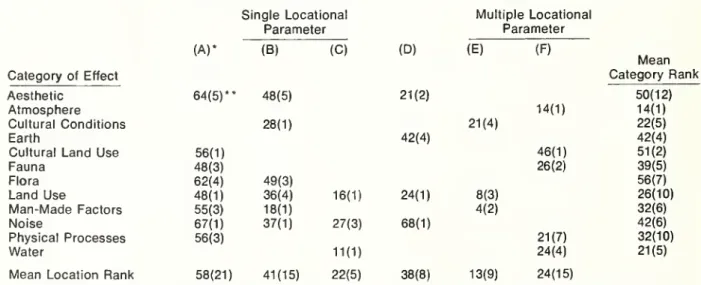
location. In Figure3, the data aresummarized
utilizing this format. There are twelve categoriesofeffects(orimpacts) rangingfrom a general value dimension, aesthetics, to physicalpro-cessesofair,water, andearth.Locationoftheseeffects are dividedintotwo parameters: singleand multiple.
A
multiple location refers toan action that has an impact
on a
number
of different geographic areas. Multiple locationalimpacts arecommon
inregardtoactions thataffectnaturalprocessesalthoughitisalso truefor
some
typesofsocialimpactslikeland use.
The
locationofthe effects orimpacts are almost equally dividedbetween
single and multiple sites.Figure 3 indicates that
most
of the impacts of theairport's expansion,
when
the effects ofthe projectal-ternatesare aggregated, arepredictably within the
facili-ty'sboundaries. Butit isclear that
none
ofthese cate-goryeffectsarehighly rankedby the respondents.The
rankings for the groups range from48
to 67, with theaveragerankforairportproperty(across the 12 groups)
being 58.
Incontrast, thegrouped impacts that
were
identified forWake
andDurham
counties receivethehighestrank-ing, 13.
These
issues deal primarily with social rather than natural dimensions oftheenvironment, e.g., resi-dential land use, density of housing,employment and
healthandsafety.Thisfindingagainsuggeststhatarearesidents are
more
concerned with the broad, socialdimensionsof theirenvironment. In Figure3,the
mean
ranksforthe categories of effectarepresented without reference to location. Although atmosphere (14) andwater(21)are rankedfirstandsecond, the next highest
ranked groups, cultural conditions (22)
and
land uses(26), also include
many
social factors.Figure 3, although a useful
way
tosummarize
the data, isbased
on anumber
of questionable assump-tions that also pertaintomatrixassessment
in general. Foreachproject alternatein amatrix analysis,thetotalnumber
ofcause andeffectrelationshipsareidentified;each
relationship then receives an impact and social value score;and
finally these scores aresummed
togive an aggregate impact score for the project.
How-ever, asdone
in Figure3, it isassumed
thatthe scoresfor differentenvironmentaldimensions canbe
added
toforman aggregateor
combined
index.A
valid question iswhethersucha multi-dimensionalindex has any
meaning
since it is multi-and
notuni-dimensional. Unlikeanairorwaterqualityindex,thereis
no standard interpretation that can
be
assigned to a project alternate's score. Inone
case,ahighscoremay
representmostlyaestheticimpacts.For another alterna-tive, thescoremay
bedue
toimpacts on physical pro-cesses. In an airquality index, ahigh value representshigh pollution levels. Different combinations of
pollu-tants
may
produce the score, but there is generalagreement
on themeaning
ofthe indexvalues. Thisisnotthecaseforanindexvalueinmatrixassessment.
An
aggregate score does not identify the specific impact: aesthetic, physical, orcombination ofboth. Inthelattercase,which
one
contributesmore
tothescore?An
alter-native approach would be togive a project alternate a separate score on each of the twelve categories ofenvironmental parameterslisted in Figure3.
Summary
interpretationwould bemore
difficult, but thevalidityofthe technique would be higher. It would not be
neces-sary to
make
the highly questionable assumption thatFigure3
Categoryof EffectbyLocational ParameterRankings
Single Locational Multiple Locational
(A)*
Parameter
(D)
Parameter
(B) (C) (E) (F)
Mean
Category of Effect
---Category Rank
Aesthetic 64(5)*' 48(5) 21(2) 50(12)
Atmosphere 14(1) 14(1)
Cultural Conditions 28(1) 21(4) 22(5)
Earth 42(4) 42(4)
Cultural Land Use 56(1) 46(1) 51(2)
Fauna 48(3) 26(2) 39(5)
Flora 62(4) 49(3) 56(7)
Land Use 48(1) 36(4) 16(1) 24(1) 8(3) 26(10)
Man-Made
Factors 55(3) 18(1) 4(2) 32(6)Noise 67(1) 37(1) 27(3) 68(1) 42(6)
Physical Processes 56(3) 21(7) 32(10)
Water 11(1) 24(4) 21(5)
Mean Location Rank 58(21) 41(15) 22(5) 38(8) 13(9) 24(15)
'Definition of Locational Parameters: (A) Airport Property, (B) Airport Periphery, (C) Durham or Raleigh
or Research Triangle Park, (D) Umstead Park, (E)
Wake
and Durham Counties, (F) Airport Property and/orAirport Periphery and/or Umstead Park and/or Northwest Raleigh.
'
'Figures represent the rank and number of cases, e.g. 64(5), for a category of effects, e.g., Aesthetics, for
the twelve dimensions
measure
thesame
phenome-non, whichis requiredifthescores areadded
together to form a composite index.Conclusion
inthediscussionofthe applicationofsurvey research
methods
inmatrixassessment
inthispaper,agenerally criticalposturewas
taken toward thevalidity ofthe ap-proach.The
criticisms made, however, should not betakenasrejectionoftheapproach.Itcanplaya valuable roleinenvironmentalplanning, butitslimitationscannot be ignored.
Matrix
assessment
representsan "approach, notanarrival," to borrow a quote from Merton (1957, p. 9).
Leopold efal. (1971, p. 6)
make
essentially thesame
point in evaluating the role that a matrix can play in
preparation of an Environmental Impact Statement
(EIS).
They
state:"Thematrixis,infact,the abstractforthetext ofthe environmental assessment."
Some
ofthe possible roles thatamatrixcanperformwereoutlinedinearliersectionsofthepaper.
By
relatingcauses and effects in one comprehensive scheme, it
provides a useful vehiclefor data reduction and
sum-mary.The
lackofintegrationinEISshasbeen
noted byReferences
Althoff, P. andW.H. Grieg. 1974. "Environmental Pollution Control Policy-Making:AnAnalysisof ElitePerceptions."Environment
andBehavior 6(September): 259-288.
Arbuthnot, J. 1977. "The Rolesof Attitudinaland Personality
Vari-ables in tfie Prediction of Environmental Knowledge and
Be-fiavior."EnvironmentandBetiavior9(June):217-232.
Burfiam,J.B., S.M. NealeyandW. S.Maynard. 1975."A Methodfor
IntegratingSocietalandTechnicalJudgmentsinEnvironmental
Decision-flaking."NuclearTechnology 25 (April):675-681.
Costantini, E.andK. Hanf. 1972."EnvironmentalConcern and Lake Tahoe: A Study of Elite Perceptions, Backgrounds and
At-titudes."EnvironmentandBehavior4(June):209-241.
Craik, K.H. and E.H.Zube, (eds.). 1976. Perceiving Environmental
Quality:Research andApplications. NewYork:Plenum Press. Dickert,T.G.andK.R. Domeny,(eds.). 1974. EnvironmentalImpact Analysis: GuidelinesandCommentary. Berkeley: Universityof
CaliforniaExtension Service.
Ditton, R.B. andGoodale, T.I., (eds). 1972. Environmental Impact Analysis: PhilosophyandMethods. Madison, Wisconsin:Sea
GrantPublication.
Environmental Studies Board, National Academy of Sciences and
NationalAcademyofEngineering.1971.Jama/caBayand
Ken-nedyAirport:A Multidisciptinary EnvironmentalStudy, Vol. 1.
Vi^ashington,DC: National Academyof Sciences andNational
AcademyofEngineering.
Federal Aviation Administration. 1971. Airport Master Plans,
Washington, DC:GovernmentPrintingOffice,AC150/5070-6.
Federal Aviation Administration. 1972. Community Values in the
Planning and Evaluation of Airport Development Projects,
FAA-AV-72-2.UrbanSystems Research andEngineering, Inc.,
Springfield,Virginia:NationalTechnicalInformation Service. Fischer, D.W. and G.S. Davies. 1973."AnApproachtoAssessing
Environmental Impacts." Journal of Environmental
Manage-ment 1 (July):207-227.
Gautrin,J. 1974. "An EvaluationoftheImpact of AircraftNoiseon
PropertyValueswithSimpleModelofUrbanLandRent."Land
Economics51 (February):80-85.
many
observers(DittonandGoodale
1972; DickertandDomeny
1974),somatricescanprovidean approachto this problem.Secondly,
when
asocialweightingscheme
based onsurvey research is
employed
in matrix assessment, amethod
to facilitate the input of citizen concerns intoplanning is provided.
The
importance of this element has been stressed in a report preparedforthe Federal Aviation Administration. It isemphasized
thata public hearing, whileausefulmeans
toobtaincitizen input, isjust a first step.
The
suggestion ismade
that the nextstep be for the "airport operators to weight affected
communities' attitudes in their
own
planning process" (Federal Aviation Administration 1972, p. 32).Survey-based matrix assessment provides such a weighting
system andarraysthe information ina formthatcan be
combined
with technical information on environmental impact.The
resultinganalysis, althoughfarfromdefini-tive, introducesthecitizen
component
intoenvironmen-tal planning and
assessment
in a systematic and rep-resentative fashion—
something often missing in the public hearingsand
other formats that are used in an attempt to produce a processmore
responsive andaccountable to citizen needs and perceptions.
Kaplan, R. 1977."Patterns ofEnvironmental Preference.'
ment andBehavior 9(June): 195-216.
Environ-Lapping, M.B. 1975. "Environmental Impact Assessment
Meth-odologies: A Critique." EnvironmentalAffairs 4 (Winter): 123-134.
Leopold,L.B. 1974. "TheUseofDatain Environmental Impact
As-sessment." inDickertand Domeny,27-34.
Leopold,L.B. ef.a/. ^9^^.AProcedureforEvaluating Environmental
Impact.GeologicalSurveyCircular645, Washington,D.C.: U.S.
Departinentofthe Interior.
McClure,P.T.1969. Indicators of the Effect of JetNoiseontheValue
ofRealEstate. Santa Monica,California: RandCorporation. McElrath, D.C.1973."PublicResponsetoEnvironmental Problems."
inPaulsen, D.F.andR.B.Denhardt (eds.)PollutionandPublic
Policy. NewYork:Dodd, MeadandCompany.
Merton, R. 1957. Social Theory and Social Structure. Glencoe,
Illinois:TheFreePress.
Sorenson,J.C. 1972.A FrameworkforIdentificationandControl of
ResourceDegradationandConflictinthe MultipleUseCoastal
Zone. Berkeley:DepartmentofLandscapeArchitectijre,
Univer-sityof California.
Tognacci,L.N. etal. 1972."EnvironmentalQuality:HowUniversalis
Public Concern." Environment and Behavior 4 (March): pp. 73-86.
U.S.DepartmentofHousingand UrbanDevelopment. 1972.Aircraft
Noise Impact: Planning Guidelines for Local Agencies.
PB-213020. WilseyandHam,Springfield, Virginia:National
Techni-cal Information Service.
U.S.DepartmentofTransportation,FederalAviation Administration.
1975. Processing AirportDevelopmentActions Affecting the
Environment. Washington,D.C:FederalRegister, Vol.40, No.
162,Wednesday, August20, 1975, 36516-36527.
Zube, E.H. 1974. "Cross-DisciplinaryandInter-ModeAgreement on
the Descriptionand Evaluationof Landscape Resources."