Opening Shops
Explanations for Resurgence in Right-to-Work Laws
Hunter Baehren Honors Thesis
Department of Political Science University of North Carolina at Chapel Hill
April 9, 2018
Approved:
Abstract
Since 2011, the United States has experienced a resurgence in state-level right-to-work laws. The causes of this trend, however, have remained unexplored by social science literature. In this paper, I examine the introduction and passage of bills among state legislatures and test the respective explanatory power of demographics, partisanship, union membership, small business prevalence, and joblessness. After applying regression models to introduction and passage models respectively, I find evidence that GOP
Table of Contents
List of Figures ... 4
List of Tables ... 4
Acknowledgements ... 5
Chapter 1: Introduction ... 6
Chapter 2: Literature and Theory Review ... 12
Chapter 3: Data and Methods ... 21
Chapter 4: Results ... 35
Chapter 5: Conclusion... 47
References ... 49
List of Figures
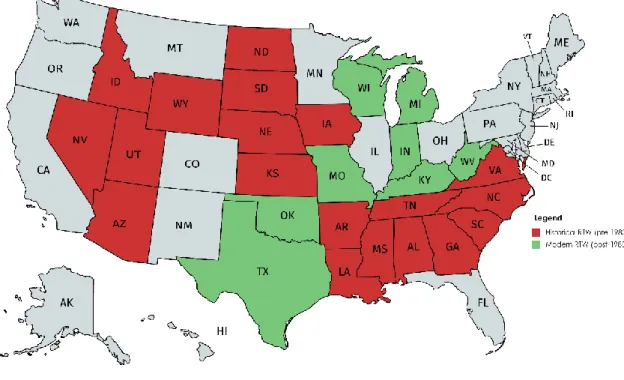
Figure 1: Map of RTW Passages ... 7
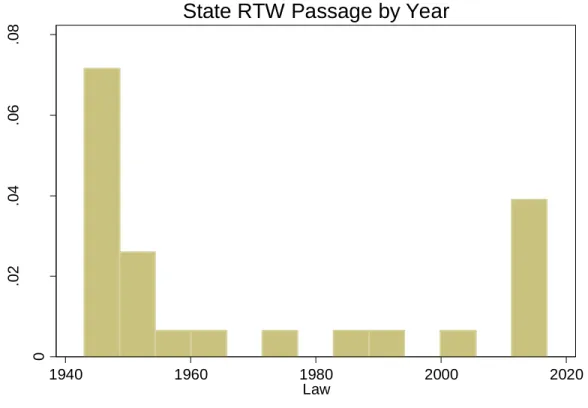
Figure 2: State RTW Passage By Year ... 8
Figure 3: Test of PH Assumption - GOP Composition... 31
Figure 4: Test of PH Assumption - Union Density ... 31
Figure 5: Partisanship Poisson Regression from Predicted Counts ... 38
Figure 6: Partisanship Survivor and Hazard Functions for Cox Model ... 43
Figure 7: Union Strength Survivor and Hazard Functions for Cox Model ... 43
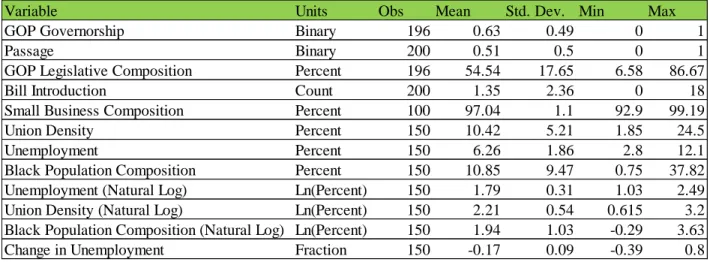
List of Tables Table 1: Introduction Summary Statistics of all Variables ... 24
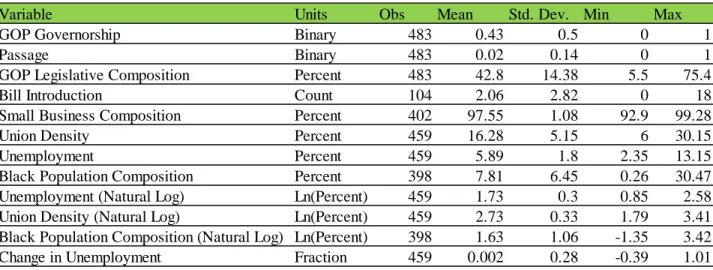
Table 2: Passage Summary Statistics of all Variables ... 25
Table 3: Summary Statistics of RTW Introduction ... 32
Table 4: Frequency of RTW Introduction Counts by Year ... 33
Table 5: Bill Introduction by Theory ... 37
Table 6: Binary Passage by Theory ... 42
Acknowledgements
This thesis would not have been possible without several key individuals. First and foremost, I would like to thank my advisor, Professor Santiago Olivella, for his
comments and advice, especially with regard to quantitative approaches. I would also like to thank Professor Michele Hoyman and Professor Patrick Conway for their
Chapter 1: Introduction
On December 11, 2012, Governor Rick Snyder signed Senate Bill No. 116, eliminating an employer’s ability to require the payment of union dues as a condition of employment.1 All major U.S. news outlets, and even some international syndicates, reported the bill’s passage, as well as the protestors and riot police stationed outside the Michigan state capitol building in Lansing. To many, the scenes were accompanied by the realization that the home of the United Automobile Workers and American
automotive industry had rebuffed the demands of organized labor. Across the political spectrum, many agreed that Michigan, and the United States, would not be the same.
Governor Snyder’s signature marked the beginning of a resurgence in right-to-work legislation. Right-to-right-to-work laws prohibit the establishment of union-security agreements, a contract resulting from collective bargaining negotiations between employers and unions. These contracts stipulate that all employees must become union members and begin paying union dues within 30 days of being hired.2 Security
agreements also allow for ‘core’ union members, which allows some employees to pay dues only directly used for representation in collective bargaining and contract
negotiations. Unions are obligated to inform all employees of this option.3
In the course of U.S. history, 28 states have passed right-to-work (RTW) laws (National Conference of State Legislatures).4 Before Michigan’s passage, 22 states passed right-to-work laws: Alabama, Arizona, Arkansas, Florida, Georgia, Idaho, Iowa,
1 Hartfield, Elizabeth. “Michigan Governor Signs Right-to-Work into Law.” ABC News. December 11,
2012. http://abcnews.go.com/Politics/michigan-governor-signs-work-bill-law/story?id=17934332
2 National Labor Relations Board. “Frequently Asked Questions – NLRB.” 2018.
https://www.nlrb.gov/resources/faq/nlrb
3Ibid.
4 Non-state U.S. territories and districts are not included in this analysis. However, I note that employees of
Kansas, Louisiana, Mississippi, Nebraska, Nevada, North Carolina, North Dakota, Oklahoma, South Carolina, South Dakota, Tennessee, Texas, Utah, Virginia, and Wyoming (National Conference of State Legislatures). These initial passages occurred largely in the West and South. I explore literature examining these different cases later. In the six years after passage in Michigan, the following five other states passed
comprehensive right-to-work legislation: Indiana, Kentucky, Wisconsin, Missouri, and West Virginia (National Conference of State Legislatures). Figure 1 displays this visually.
Most notable in this timeline is the recent resurgence of RTW law passage. Figure 1 depicts a histogram of state RTW passage frequency over the course of a 70-year period.
Figure 2: State RTW Passage By Year
The highest concentration of RTW law passage occurs in the late 1940s and early 1950s. After that point, the frequency of RTW laws decreases significantly. A resurgence, however, occurs within the last twenty years.
In this thesis, I seek to determine the factors leading to this resurgence. To clarify, this thesis does not attempt to examine the determinants of all RTW laws in U.S. history. Several previous studies have explored this question. None add post-2011 RTW law passages in their analyses. This thesis does not simply add these recent observations to previous analyses because RTW laws passed in the past twenty years may operate under
0
.0
2
.0
4
.0
6
.0
8
D
e
n
si
ty
1940 1960 1980 2000 2020
Law
different determinant factors than those of the 1940s and 1950s. Kaminski (2015) identifies this as a plausible assumption due to the apparent stronger role of partisanship in Michigan’s RTW passage compared to RTW passages in the South. Moreover, the question of this thesis is as follows: among the remaining non-RTW states, what factors play a significant role in increasing or decreasing the likelihood of RTW passage?
In Chapter 2, I describe previous literature focusing on RTW laws. During the first half of the review, I focus on previous research exploring the effects of right-to-work laws on a variety of economic and political indicators. During the latter half, I examine theories of determinants of RTW law passage, including those of demographics, joblessness, enterprise size, partisanship, and union density. From this analysis, I conclude that no rigorous quantitative analysis has been applied to the possible determinants of RTW laws passed in the previous six years. In addition, no previous analysis has utilized event history techniques.
In Chapter 3, I present data and methods utilized in this analysis. For the
introduction of RTW legislation, I utilize a Poisson model due to the dependent variable’s classification as a count variable. For the passage of RTW legislation, I utilize a Cox regression model, a type of continuous survival model with a nonparametric survival function. In contrast to previous passage models, this addresses the issue of endogeneity in years following the passage of right-to-work.
year is associated with a greater probability of RTW bill introduction. This falls in line with some theories explaining the introduction of bills, regardless of their likelihood of passing. For the passage of RTW laws, I find that only union density and GOP
composition of the legislature have a statistically significant relationship with the passage of RTW laws within the survival framework. These relationships do not appear to be based on moving past a particular threshold within the ranges of these variables. Rather, higher levels of GOP composition are associated with a higher likelihood of states passing a RTW law. Likewise, union density follows a similar relationship.
This generates a number of possible implications regarding the dynamics that lead to RTW passage. First, demographic changes or increased sensitivity to racial minorities among a portion of the population do not offer a compelling explanation of RTW
passage. Second, labor market conditions within a given state and year also does not offer a compelling explanation of RTW passage. Third, statistically significant relationships related to union density and GOP legislative composition imply that RTW laws are, among the factors examined, primarily driven by political agenda and strategy.
Chapter 2: Literature and Theory Review
This section details scholarly literature focusing on right-to-work legislation. This body of work can be divided into two categories: effects of right-to-work legislation and causes of right-to-work legislation. The former gives significance to the presence of right-to-work legislation on economic and political circumstances in a given state. The latter gives context to the subject and methods of this thesis. In summation, the economic and political consequences of right-to-work legislation have been established as
significant. While multiple theories have been proposed and tested to explain emergence of these laws, the literature has not tested these theories in the post-2011 resurgence of these laws. In addition, several tests have failed to eliminate bias, and the mere
introduction of RTW legislation has failed to be explored as an additional response variable.
Effects of Right-to-Work Legislation
Right-to-work laws prevent compulsory union membership for employees in a given profession. In employer-union negotiations, parties often agree that the employer in question may only hire union members, or cannot retain employees who fail to join a union in a given period of time. Unions and other parties have often advocated for allowance of these provisions by law in order to bolster union membership and, consequentially, maintain greater bargaining power in negotiations with employers.5 Employers and other parties have often advocated for the prohibition of these provisions
5 National Labor Relations Board. “Frequently Asked Questions – NLRB.” 2018.
due to their perceived strengthening of union bargaining power and perceived reduction of flexibility in human resources practices.6
An extensive body of literature exists examining the economic and political effects of right-to-work laws at the state level. This review heavily references Moore and Newman (1985) and Moore and Newman (1998). Most studies have found that RTW laws have a negative, statistically significant effect on union membership (Warren and Strauss, 1979; Hirsch, 1980; Farber, 1983; Hunt and White, 1983; Carroll, 1983; Reder, 1988; Fiorito, 1990; Eren and Ozbeklik, 2015). However, some notable exceptions have found no statistical significance (Koeller, 1985; Moore and Newman, 1975; Wessels, 1981). In contrast, the literature on wages has largely found no effect on average wages (Moore, 1980; Wessels, 1981; Eren and Ozbeklik, 2015). Some notable exceptions find a statistically significant negative effect on average wages (Carroll, 1983; Roberts and Habans, 2015).
Economists have also found that employment effects of RTW states to be largely negligible (Bennett and Johnson, 1980; Farber, 1983; Eren and Ozbeklik, 2015).
Moreover, declining union density has led to the growth of precarious work, leading to increased long-term unemployment, non-standard work arrangements, economic
inequality, and poor health among affected workers (Kalleberg, 2009). Further expanding this body were tests of the relocation hypothesis, wherein businesses tend to locate in RTW states. Some evidence indicates that businesses often relocate to RTW states from non-RTW states (Newman, 1984). In addition, RTW laws have been shown to increase productivity and population (Vedder, 2010; Hicks, LaFaive, and Devaraj, 2016). Some
6 National Labor Relations Board. “Frequently Asked Questions – NLRB.” 2018.
studies have contradicted this view by finding that highly-unionized industries show higher levels of productivity than others (Freeman and Medoff, 1983).
Insofar as effects categorized as political, extensive literature has been devoted to RTW effects on collective bargaining. Ellwood and Fine (1987) conduct a thorough analysis evaluating the effect of RTW laws on organizing success, wherein they attribute significant short-term reductions in union organizing success to RTW law passage across states. They also find similar declines in other union activities, such as success in
National Labor Relations Board (NLRB) elections. Some evidence also indicates that RTW laws dampen labor campaign contributions, decrease voter turnout, and lead to fewer working class candidates seeking and obtaining positions of elected office
(Feigenbaum et al. 2017). Several studies also indicate an increase in free riding, wherein increasing numbers of non-union members depend upon unions for collective bargaining (Katz, 1983; Davis and Huston, 1993; Sobel, 1995; Pierce, 2016). These political effects are significant to the strength and survival of American labor movements.7
Causes of Right-to-Work Legislation
The literature surrounding the determinants of right-to-work laws is relatively sparse. The 1947 Taft-Hartley Act, which was a federal law allowing state-level right-to-work legislation, is considered the genesis of modern right-to-right-to-work legislation (Feldacker 1990). As a result, several states, largely in the South and West, successfully passed comprehensive right-to-work laws in the 1940s and 1950s, and a small number of additional passages in the following decades. Beyond this, different factors have been examined for their contribution to the emergence of right-to-work legislation and laws.
7 Eidelson, Josh. “Attacks on Labor Put Unions on the Defensive in Election 2012.” The Nation. November
For the following review of this literature, I draw heavily from the review by Jacobs and Dixon (2006) of different theories of RTW law emergence and each theory’s empirical viability.
Innovation Theory
An innovation theoretical framework aids in forming the basis of RTW adoption. While previous studies have considered RTW specifically through an innovation
framework, some previous work remains applicable. Gray (1973) explores different dimensions of how states decide to adopt particular legislation. After the genesis of an idea, some or all states consider whether to adopt it as law. A wave of first adopters typically begins the process of implementation and is followed by subsequent adopters. Gray draws several conclusions regarding the characteristics of early adopters, such as higher levels of wealth and resources; however, due to her examination of primarily expenditure-based laws, these conclusions may not be applicable to largely regulatory-based RTW laws. Most important to note, however, is Gray’s conclusion that economic and political factors play a critical role in the “diffusion” of a policy idea. Moreover, following the genesis of an idea, political and economic factors determine which states adopt a given policy and in what order.
Racial Demographic Theory
Several studies have explored the relationship between racial demographics and collective bargaining legislation. Given the diversity of the modern American workplace, theories of racial motivation behind reductions in collective bargaining strength have been explored. Several explanations have been offered describing the underlying
racial divisions reduce the ability of unions to organize due to breakdowns in solidarity. Racial tensions between union members allows employers to divide members and better extract demands. Outside the internal dynamics of the union, racial demographics have been found to engender differing treatment of unions. Giles and Buckner (1993), as well as Giles and Hertz (1994), find that larger minority populations in a community increase the likelihood of legislation hostile to minorities. Specifically toward labor laws, Jacobs (1978) finds that states with the largest percentages of African Americans were more likely to have policies favoring collective bargaining. Thus, while African Americans often favor collective bargaining policies, states with large minority populations often maintain hostile policies toward minorities.
Union Density
Union strength often depends on the ability of unions to organize. The literature generally agrees that high union density has a negative impact on the passage of RTW laws (Tollefson and Pichler, 1974; Wessels, 1981; Nieswiadomy et al., 1991; Jacobs and Dixon, 2006). Private-sector union membership has declined substantially since the 1980s (Farber and Western 2000; Hirsch et al. 2001). As a result, declining union
strength may serve as a viable explanation for the resurgence in RTW law passage. Issues of reverse causality, however, have plagued the reliability of past estimates, and as a result, previous conclusions cannot be given a causal interpretation. In the years
exact difference in these pre- and post-passage conditions remains unclear because, with the exception of New Hampshire in 1949, no state has successfully repealed a RTW law.
Enterprise Size
Anecdotal evidence suggests high levels of small businesses as a portion of all businesses in a given state lead to greater likelihood of RTW passage. Previous literature suggests this conclusion on an empirical level as well. Hostility toward policies favoring labor unions is higher in areas with high levels of small enterprises (Reynolds et al., 1991). Jacobs and Dixon (2006), however, theorize that, in the context of RTW laws, this relationship changes over time. Several studies have concluded that large firms exhibited less hostility toward pro-labor policies prior to the 1970s (Canak and Miller, 1990; Brueggermann and Brown, 2003). Following the 1970s, however, large firms generally showed less deference to labor unions. As a result, Jacobs and Dixon (2006) theorize that the negative relationship between state enterprise size composition and RTW law passage diminishes in magnitude over time, and ultimately find empirical support for this
hypothesis.
Partisanship
effect of partisanship in the passage of RTW laws. These conclusions, however, could be less critical in evaluating recent passages due to the shifts in coalitions forming U.S. political parties in the last sixty years.
Previous Statistical Models
The literature has established several approaches to empirical analysis of the determinants of RTW laws, and explored the advantages and disadvantages of each approach. “Stock models” are most often used, wherein researchers collect cross-sectional or pooled state data over a number of years and measure this against an RTW outcome indicator variable (Moore and Newman, 1998). Two major issues result from the stock model. First, omitted-variable bias occurs when critical variables are not
included in the model, or rather, explanatory variables highly correlated with one another cannot be distinguished. Second, if highly correlated control variables are included in these models, issues of multicollinearity result. “Fixed effect models” are also often used, but only Jacobs and Dixon (2006) have incorporated a similar effect (Moore and
Newman, 1998).
Introduction Literature
While little to no previous research explores the determinants of RTW bill introductions, several studies allow us to generally build a framework of why bills could be introduced in the legislature. While bill sponsorship has been subject to frequent study, bill introduction has been less so. Some recent studies, however, should be
1989). Nonetheless, bill introduction has been used as indicator of the “importance” of an issue to legislators and how much influence particular interests exercise among
representatives (Flavin and Franko, 2016). Introductions often occur if legislators have constituents that largely subscribe to extreme beliefs on a particular issue, such as abortion (Highton and Rocca, 2005). Moreover, electoral considerations appear to play a significant role in the decision of legislators to introduce bills and stake particularly strong stance on an issue (Lazarus, 2013; Sulkin 2005). Surveyed constituents have often identified bill introduction as reason for liking a particular U.S. House incumbent (Box-Steffensmeier et al., 2003). Moreover, we would expect legislative introduction
frequency to correspond with the strength or influence of different constituent groups on state legislators.
Literature Conclusions
Chapter 3: Data and Methods
The following empirical framework aims to test five primary theories explaining the emergence of right-to-work legislation. This section first explores three different response variables that operationalize the presence of right-to-work legislation. Then it explores the two models (passage and introduction) meant to test each theory, including indicator variables, controls, and their interaction.
Response Variable: Presence of Right-to-Work Legislation
The presence of right-to-work legislation, as well as changes in its presence, are measured through two separate but related variables. State-level legislative data is provided by the National Conference of State Legislatures’ Collective Bargaining and Labor Union Legislation Database, which was last updated by the organization on July 1, 2016. For bill introductions, the database begins in 2011 and offers legislative data on all 50 states, Washington, DC, and major U.S. territories. NCSL also includes a section identifying RTW passage years by state beginning in 1947.8 All legislation is either introduced, or both introduced and passed, meaning the law has been passed by a given state legislature and signed into law. First, passage of a comprehensive right-to-work law in a given year and state is represented by a binary variable, “RTW Passage” (0, 1). Second, the number of introduced right-to-work laws in a given year and state, whether comprehensive or partial, is presented by a count variable, “RTW Introduction”. Only legislation favoring RTW laws is included, while bills against RTW laws are excluded.
8 NCSL also identifies years in which RTW state constitutional amendments were passed. These, however,
Each of these variables measures the presence of right-to-work legislation in distinctive ways. Binary passage/not passage measures what is commonly referred to as a right-to-work law, wherein compulsory membership in or payment of dues to any union is prohibited. This representation, however, fails to operationalize other dimensions of right-to-work legislation. Introduction of legislation can indicate overall willingness of legislatures to consider right-to-work legislation of varying comprehensiveness, which is not captured by the mere passage of legislation. This justifies the inclusion of a count variable measuring the introduction of legislation. Further interpretations of introductions will be explained in later sections.
Explanatory Variables
Each theory proposed by the literature requires a different explanatory variable for operationalization. While I have applied some precedents directly from the literature, others have been designed differently in order to build a more consistent and less bias model.
Demographics
The literature has established a possible relationship between racial demographics and the passage of RTW laws. In order to operationalize racial composition of a state, I will use the number of black residents as a proportion of total resident population in each given year and state. These are provided by Current Population Estimates by the U.S. Census. Given precedent in the literature and the role of this group as the largest minorities in the United States, this variable should
Partisanship
The literature has proposed, but not firmly established a relationship between partisanship of the state government and the passage of RTW laws. In order to operationalize partisanship of the state government, I will use two variables: GOP composition of the state legislature and presence of GOP governor. For
convenience, if a state maintains a bicameral system, I will combine the two bodies. Only 49 states will be utilized in this analysis.9 The relationship between
the legislature and the governor will be operationalized with the inclusion of an interaction term.
Enterprise Size
The literature has explored a relationship between enterprise size composition and the passage of RTW laws. In order to operationalize enterprise size composition of a state, I will use the number of small businesses (less than 100 employees) as a proportion of the total number of businesses in each given year and state. These estimates are provided by the Bureau of Labor Statistics (BLS). Given its measure of the presence of small businesses in a given state and year, this measure should approximate enterprise size composition (Jacobs and Dixon 2006).
Joblessness
The literature has also explored relationship between joblessness and the passage of RTW laws. In order to operationalize joblessness, I will use the unemployment rate for a given state and year. These estimates are provided by the BLS as well.
Given its measure of unemployment, this measure should accurately approximate the joblessness in a given state.
Union Strength
The literature has also explored a relationship between union strength and the passage of RTW laws. In order to operationalize union strength, I will use the percentage of a state’s workforce who claim union membership. These estimates are provided by BLS. Given that unions draw much of their strength from their numbers, this measure should offer an accurate approximation of general union strength in a given state.
Table 1: Introduction Summary Statistics of all Variables
Variable Units Obs Mean Std. Dev. Min Max
GOP Governorship Binary 196 0.63 0.49 0 1
Passage Binary 200 0.51 0.5 0 1
GOP Legislative Composition Percent 196 54.54 17.65 6.58 86.67
Bill Introduction Count 200 1.35 2.36 0 18
Small Business Composition Percent 100 97.04 1.1 92.9 99.19
Union Density Percent 150 10.42 5.21 1.85 24.5
Unemployment Percent 150 6.26 1.86 2.8 12.1
Black Population Composition Percent 150 10.85 9.47 0.75 37.82
Unemployment (Natural Log) Ln(Percent) 150 1.79 0.31 1.03 2.49
Union Density (Natural Log) Ln(Percent) 150 2.21 0.54 0.615 3.2
Black Population Composition (Natural Log) Ln(Percent) 150 1.94 1.03 -0.29 3.63
Table 2: Passage Summary Statistics of all Variables
Control Variables
Each model maintains different types of controls. In the introduction model, year- and region- fixed effects are applied across all models in order to capture unobserved characteristics across each state and year. Since these states and years vary significantly in different characteristics, fixed effects are suitable for inclusion in order to capture some of this variation. The inclusion of this effect also follows precedence from previous right-to-work analyses (Jacobs and Dixon 2006). Due to limited sample size and variation in the explanatory variables, I employ regional effects to account for variation between states. These regions conform to the regional system utilized by the U.S. Census, where the following four regions make up the United States: South, Midwest, Northeast, and West. These groupings compose the categorical, regional fixed effect variable.
In addition, a binary variable titled “Historically Right-to-Work States” will be included to the introduction model, where states with a comprehensive right-to-work law prior to 1985 will be coded as “1” and the remaining states as “0.” We can assume that state legislatures passing RTW laws in the 1940s, 1950s, and 1960s may have been operating by different forces in the “modern” era, or, by this definition, post-1980. This
Variable Units Obs Mean Std. Dev. Min Max
GOP Governorship Binary 483 0.43 0.5 0 1
Passage Binary 483 0.02 0.14 0 1
GOP Legislative Composition Percent 483 42.8 14.38 5.5 75.4
Bill Introduction Count 104 2.06 2.82 0 18
Small Business Composition Percent 402 97.55 1.08 92.9 99.28
Union Density Percent 459 16.28 5.15 6 30.15
Unemployment Percent 459 5.89 1.8 2.35 13.15
Black Population Composition Percent 398 7.81 6.45 0.26 30.47
Unemployment (Natural Log) Ln(Percent) 459 1.73 0.3 0.85 2.58
Union Density (Natural Log) Ln(Percent) 459 2.73 0.33 1.79 3.41
Black Population Composition (Natural Log) Ln(Percent) 398 1.63 1.06 -1.35 3.42
date cut-off is selected for a variety of reasons. First, data for various indicators becomes unavailable prior to the 1980s. Second, the cut-off for the modern RTW appears,
according to Figure 1, to occur between 1970 and 1990. Third, the 1980s mark a major point of party realignment in American politics, and given the importance of partisanship within this analysis, it becomes critical to control for factors like party realignments. For instance, changes within the Republican Party after the election of Ronald Reagan may have created different party alignments and dynamics in state legislatures. Some
historians view this point as a major realignment of Republican politics (Wilentz 2009). Moreover, this point marks the beginning of a Republican Party more focused on
platform planks such as fiscal and social conservatism. Since the model aims to examine only the modern resurgence in right-to-work laws and not RTW laws passed before that point, it becomes necessary to isolate these states, while still including introduced right-to-work legislation in historically right-right-to-work states. In the introduction model, this will serve as a control. In the passage model, due to the nature of a binary model, historical RTW states are eliminated from the regression altogether.
Hypotheses:
Based upon theories set forth in the literature, I offer five hypotheses to explain the introduction or passage of right-to-work legislation. The null hypothesis states that the introduction and/or passage of RTW legislation is due to random chance in a given state and year. For each respective hypothesis, I utilize a distinctive model to appropriately test for each theory’s viability and predictive power. They are as follows:
H0, Null: The introduction and/or passage of modern right-to-work legislation
Though unlikely, random chance forms the null hypothesis of this analysis. Despite no examination of modern RTW by previous literature, analyses of historical RTW indicate that several factors can play into the adoption of RTW laws.
H1, Demographics: States with higher minority populations are less likely to
introduce or pass modern right-to-work legislation.
This hypothesis is based upon mixed evidence. While some studies have associated larger minority populations with more hostile laws intended to limit minority rights and privileges, others show that black workers favor collective bargaining rights and unions.
H2, Partisanship: State legislatures under GOP control are more likely to
introduce or pass modern right-to-work legislation.
Anecdotal evidence indicates that modern RTW laws have been passed overwhelmingly by legislatures composed of a majority of Republican Party members. Furthermore, the modern Republican Party has often demonstrated hostility toward collective bargaining rights. Interestingly, studies have found that historical RTW law passage is not associated with GOP legislative composition (Jacobs and Dixon, 2006).
H3, Enterprise Size: States with a greater proportion of small businesses are
Evidence indicates that small business owners tend to support RTW laws. As a result, a state with a number of small businesses as a portion of all businesses will face stronger pressure to pass RTW laws. As a result, high relative numbers of small businesses will lead to a higher likelihood of passing RTW laws.
H4, Joblessness: States with higher unemployment rates are less likely to
introduce or pass modern right-to-work legislation.
Previous research has shown an association between worsening economic
conditions and increased protections of collective bargaining rights. However, on an intuitive level, the converse would also be reasonably predicted, as worsening employment conditions may create movement toward changes in labor market laws to generate perceived economic growth.
H5, Union Strength: States with lower union density are more likely to introduce
or pass modern right-to-work legislation.
Unions have served as strong political influences throughout American history. Smaller union membership often means unions exhibit less influence, and as a result, legislation against union interests faces more likely implementation. In this case, union density is operationalized by statewide union membership.
Model Specifications
The application of a probit model with fixed effects, however, presents a number of issues. First, lack of substantial variation in the response variable generates difficulties in estimating fixed effects for each state and each year. As a result, a fixed effect model will not reduce disturbance errors. Second, a probit model does not correct for endogeneity originating from years following a given state’s passage of a RTW work. Upon the passage of a RTW law, the response variable switches from “0” to “1,” and since no state has repealed a RTW law during this study’s timeframe, passage is coded as “1”
thereafter. Given the model treats each year and state as a separate observation, the model assumes that a given state legislature reevaluates whether to pass a RTW law. Since previous literature indicates that RTW laws subsequently affect a state’s economic and political institutions, we can assume that passage of a RTW law alters the likelihood that RTW laws will be repealed. As a result, a probit model introduces an element of reverse causality and thus endogeneity.
In light of these issues, I utilize a survival model. This model calculates the effect of variables on hazard toward “death,” or movement of a response variable from “0” to “1,” during a given time interval. In this case, “death” would be the passage of a RTW law. This type of legislative action matches this characterization because no state within the given timeframe has successfully repealed a RTW law.10 In accordance with this assumption, I drop all observations following the passage of a RTW within a given state. This addresses the issue of endogeneity stemming from the effect of a RTW law on future repeal decisions discussed in the previous paragraph. In addition, in order to
10 Only two states, Delaware and New Hampshire, have successfully repealed a RTW law (1949) after
examine only recent adoptions of RTW laws, I drop all observations characterized as “Historically Right-to-Work,” which equates to dropping Alabama, Arizona, Arkansas, Florida, Georgia, Idaho, Iowa, Kansas, Louisiana, Mississippi, Nebraska, Nevada, North Carolina, North Dakota, Oklahoma, South Carolina, South Dakota, Tennessee, Texas, Utah, Virginia, and Wyoming from the analysis.
Types of survival models differ based upon two primary dimensions:
discrete/continuous data and the shape of the hazard baseline. With regard to the former criteria, I characterize the RTW variable as continuous. While the presence of the RTW law is measured at discrete intervals, the adoption of a RTW law is a continuous process that could occur at any time within a given legislative period. With regard to the latter criteria, previous literature is both sparse and lacking of survival model usage. As a result, assuming a particular hazard baseline distribution (i.e. logistical, exponential, Weibull) would be inappropriate. Accordingly, the Cox regression model presents a key advantage, wherein no underlying hazard distribution is assumed and calculates a nonparametric baseline.
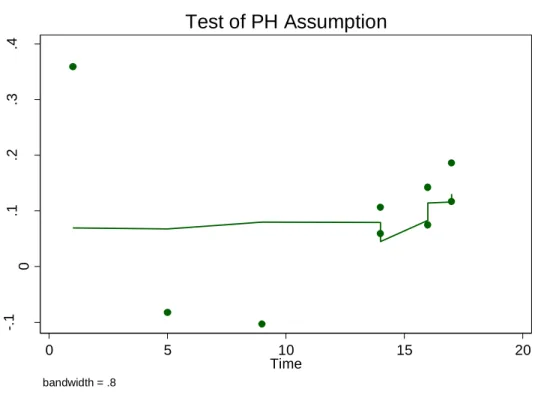
Figure 3: Test of PH Assumption - GOP Composition
Figure 4: Test of PH Assumption - Union Density
-. 1 0 .1 .2 .3 .4 sc a le d Sc h o e n fe ld - g o p _ co mp p
0 5 10 15 20
Time
bandwidth = .8
Test of PH Assumption
-1 0 -5 0 5 sc a le d Sc h o e n fe ld - ln u n io n _ d e n
0 5 10 15
Time bandwidth = .8
Fortunately, the Cox regression model allows for the slight relaxing of this assumption by specifying stratification within Stata. This specification serves as an adequate method of accounting for time effects, which have been addressed in previous literature, albeit through fixed or random effects. This method also avoids pitfalls resulting from lack of variation in the RTW binary variable.
In order to maximize consistency across groupings, I account for clustering between states. Given the adequate number of observations within each state, a
parametric clustering specification seems appropriate. In order to account for differences between states, I include Huber/White/sandwich errors. As a result, we can interpret the resulting model as a consistent estimation across clusters.
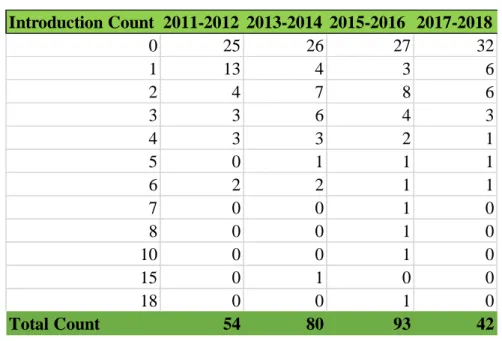
For count RTW introduction, I will use a Poisson distribution. In order to utilize the Poisson distribution, we must test whether the distribution of the response variable, bill introduction by state and year, conforms to the Poisson distribution. This can be examined by determining whether the response variable shows indications of over-dispersion. The following table displays that result:
Table 3: Summary Statistics of RTW Introduction
The standard deviation is nearly double the value of the mean, indicating that RTW introduction is over-dispersed. I utilize a negative binomial distribution to correct for this assumption of the Poisson distribution.
Variable Observations Mean Std. Dev. Min Max
Since legislative periods occur in two-year intervals, all variables will be coded according to two-year intervals. Two values across two years will be averaged. This applies to the following variables: unemployment, black population, union density, and small firm density. Coding variables by year rather than period would represent that state legislatures reevaluate each year whether to introduce and/or pass RTW legislation. In reality, this reevaluation more likely occurs after turnover from an election, and the legislative docket is reset. Most all states hold elections every two years for at least some members of their legislative assemblies.
RTW introduction will be measured from 2011 to 2017. Data unavailability prevents analysis of previous periods. Given that resurging passage begins in 2012, however, this period will suffice in measuring the introduction variable. The summary counts for each period are as follows:
Table 4: Frequency of RTW Introduction Counts by Year
Introduction Count 2011-2012 2013-2014 2015-2016 2017-2018
0 25 26 27 32
1 13 4 3 6
2 4 7 8 6
3 3 6 4 3
4 3 3 2 1
5 0 1 1 1
6 2 2 1 1
7 0 0 1 0
8 0 0 1 0
10 0 0 1 0
15 0 1 0 0
18 0 0 1 0
RTW passage will be measured from 1981 to 2017. The justification for
beginning the analysis in 1981 is the same as the above justification for the Historically RTW State control variable. Each period will be coded according to whether a
comprehensive RTW law exists during that period in that state.
Both models divide theories into separate equations and offer a combined
Chapter 4: Results
Model 1: Introduction Results
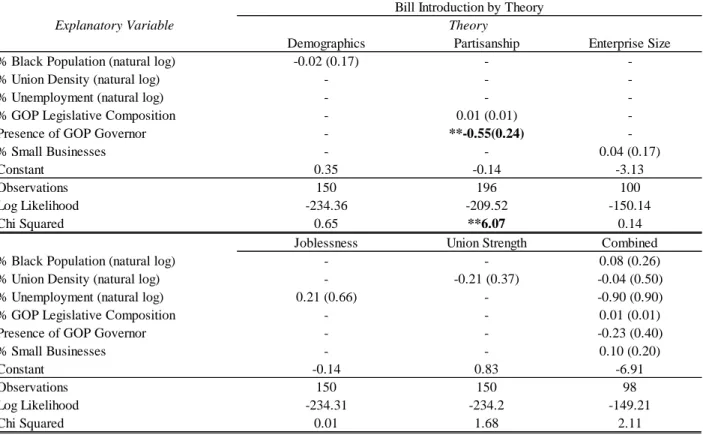
Table 5 displays the results of the negative binomial distribution across different explanatory variables. Neither the percent of black population nor percent of Hispanic population hold statistical significance in predicting the introduction of RTW legislation in a given year and state. Neither GOP composition of the legislature nor the portion of small businesses in a given state hold statistical significance in predicting the introduction of RTW legislation in a given year and state. Unemployment does not hold statistical significance in predicting the introduction of RTW legislation in a given year and state. Union density does not hold statistical significance in predicting the introduction of RTW legislation in a given year and state. Of the tested theories, only presence of a GOP governor holds statistical significance in predicting the introduction of RTW legislation in a given year and state (only in the deconstructed regression), and it holds a negative relationship with bill introduction.
With regard to the presence of a GOP governor, the difference in the logs of expected counts between presence of a GOP governor and lack thereof would be expected to decrease by 0.55 units. In other words, the number of introductions will be over 50 percent greater under a non-GOP governor compared to a GOP governor. Furthermore, in 2011-2012, the predicted number of introductions is 0.002, and in 2013-2014, the predicted number of introductions is 0.004. Statistically insignificant
Table 5: Bill Introduction by Theory11
11 Due to the number of periods being reduced to two in the combined regression, the year fixed effect is
excluded from this regression. Explanatory Variable
Demographics Partisanship Enterprise Size
% Black Population (natural log) -0.02 (0.17) -
-% Union Density (natural log) - -
-% Unemployment (natural log) - -
-% GOP Legislative Composition - 0.01 (0.01)
-Presence of GOP Governor - **-0.55(0.24)
-% Small Businesses - - 0.04 (0.17)
Constant 0.35 -0.14 -3.13
Observations 150 196 100
Log Likelihood -234.36 -209.52 -150.14
Chi Squared 0.65 **6.07 0.14
Joblessness Union Strength Combined
% Black Population (natural log) - - 0.08 (0.26)
% Union Density (natural log) - -0.21 (0.37) -0.04 (0.50)
% Unemployment (natural log) 0.21 (0.66) - -0.90 (0.90)
% GOP Legislative Composition - - 0.01 (0.01)
Presence of GOP Governor - - -0.23 (0.40)
% Small Businesses - - 0.10 (0.20)
Constant -0.14 0.83 -6.91
Observations 150 150 98
Log Likelihood -234.31 -234.2 -149.21
Chi Squared 0.01 1.68 2.11
Note: *p<0.1; **p<0.05; ***p<0.01
Theory
Figure 5: Partisanship Poisson Regression from Predicted Counts
0
1
2
3
4
Pr
e
d
ict
e
d
N
u
mb
e
r
O
f
Ev
e
n
ts
10 15 20 25 30 35 40 45 50 55 60 65 70 75 80
Percent GOP Composition of the Legislature
non-GOP Governor GOP Governor
95% Confidence Interval
Model 2: Passage
Table 6 displays the results of the survival model across different explanatory variables. Unemployment does not hold statistical significance in predicting the passage of RTW legislation in a given year and state. The percentage of small businesses does not hold statistical significance in predicting the passage of RTW legislation in a given year and state. Percentage of black population may hold statistical significance, but since it only meets the most liberal threshold of statistical significance, the significance of relative black population in predicting the passage of RTW legislation is inconclusive. Two theories hold statistical significance. Partisanship holds, wherein GOP composition of the legislature hold statistical significance in predicting the passage of RTW legislation in a given year and state. Even though GOP governorship does not hold individual
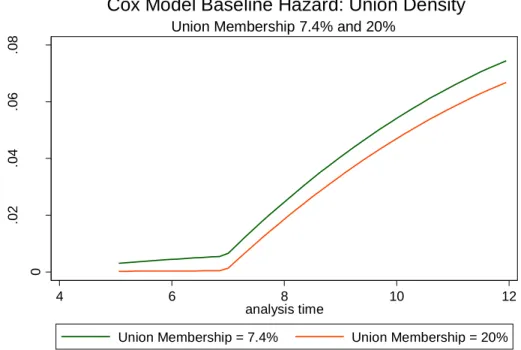
statistical significance, it, collectively with GOP composition, does hold statistical significance. In addition, union density holds statistical significance in predicting the passage of RTW legislation in a given year and state. Figures 7 and 8 display the hazard functions for GOP legislative composition and union density respectively in relation to time.
passage at every point in time. Rather, they occur at the mean levels of the explanatory variables of GOP composition and state union membership.
Figures 7 and 8 indicate how the hazard function behaves over time holding either GOP legislative composition or union density constant. With regard to both GOP
legislative composition and union density, the increased hazard with time involves a small magnitude. While statistically significant, the actual effect sizes with time involve small, insignificant changes. This appears to occur due to the rarity of RTW passage (only seven in approximately 15 legislative periods across over 20 states). Union density hazard functions also have little difference in shape, meaning that, no matter the level of union density in a given state, the underlying hazard of RTW passage is similar across time. GOP legislative composition, however, rises drastically higher in a given time period for 66 percent GOP legislative composition than with 33 percent GOP legislative composition. This difference in hazard function indicates that, while the magnitude of the effect over time remains small, the difference in effect between GOP legislative
composition levels is notably high.
To further explore the dynamic of GOP composition, I developed a more precise model attempting to account for “voting thresholds.” Moreover, passage may become substantially more significant after GOP legislative composition passes fifty and sixty-seven percent respectively. In order to account for this, I employ interaction terms
significance cannot be untangled from that of GOP governorship and GOP legislative composition. The same result occurs with an interaction term created for GOP
Table 6: Binary Passage by Theory1213
12 Small business composition is excluded due to an inability to calculate a Cox regression with all
variables included. Due to the rarity of RTW passage in the population and the number of variables included, convergence is reached before maximum likelihood estimation can be performed.
13 The values given for each theory are the hazard ratio and standard error. As a result, one by the other will
not obtain z-scores.
Explanatory Variable
Demographics Partisanship Enterprise Size
% Black Population (natural log) *1.70 (0.54) -
-% Union Density (natural log) - -
-% Unemployment (natural log) - -
-% Change in Unemployment - -
-% GOP Legislative Composition - ***1.10 (0.03)
-Presence of GOP Governor - 2.66 (1.79)
-% Small Businesses - - 1.78 (0.78)
Observations 398 483 402
Log Pseudolikelihood -19.3 -22.7 -12.9
Wald Chi Squared *2.78 ***11.32 1.71
Joblessness Union Strength Combined
% Black Population (natural log) - - *4.37 (3.45)
% Union Density (natural log) - ***0.05 (0.05) ***-0.01 (0.01)
% Unemployment (natural log) 8.81 (13.18) - *444.86 (1539.05)
% Change in Unemployment 3.01 (9.09) - 0.22 (0.65)
% GOP Legislative Composition - - ***1.09 (0.02)
Presence of GOP Governor - - 3.62 (5.16)
% Small Businesses - -
-Observations 459 459 398
Log Pseudolikelihood -22.58 -19.85 -11.43
Wald Chi Squared 2.92 ***7.24 ***62.37
Note: *p<0.1; **p<0.05; ***p<0.01
Binary Passage by Theory
Figure 6: Partisanship Survivor and Hazard Functions for Cox Model
Figure 7: Union Strength Survivor and Hazard Functions for Cox Model
0 .0 1 .0 2 .0 3 Sm o o th e d h a za rd f u n ct io n
6 8 10 12 14
analysis time
GOP Composition = 33.33% GOP Composition = 66.66%
GOP Composition 33% and 66%
Cox Model Baseline Hazard: Partisanship
0 .0 2 .0 4 .0 6 .0 8 Sm o o th e d h a za rd f u n ct io n
4 6 8 10 12
analysis time
Union Membership = 7.4% Union Membership = 20%
Union Membership 7.4% and 20%
Results Discussion
A number of notable observations can be identified from the results of these two estimated models. First, only one theory presented a statistically significant prediction of the introduction of RTW legislation: GOP governorship. Taken out of the context among the other tested theories, this result falls in line with some basic intuitions and previous research. GOP legislators generally support the passage of RTW laws. Introducing legislation to that effect would be one tool available to establish their position and attempt to pass a RTW law. Furthermore, even if passage of an introduced RTW bill were to be unlikely during a given session, introduction of RTW bills could serve as a valuable tool to some elected legislators. For example, if a given legislator sought to oppose the agenda of a sitting governor, introduction of RTW legislation could be a signaling device that indicates that legislator’s willingness to support their ideology and/or the interests of their constituents. If a non-GOP governor remains in power, more legislators would seek to demonstrate their support of RTW laws. In this sense, more introduced RTW bills would be expected from states with non-GOP governors. The estimated model ultimately supports this theory.
introduction of RTW laws. Lack of statistical significance with GOP legislative composition may also be explained. First, sample size may be impeding a finding of statistical significance. 98 observations may not be sufficient to establish a pattern. Second, legislators may behave differently based upon the party of the governor versus party of the legislative majority. For instance, legislators may respond with clearly “protest” bills when faced with a governor of the opposite political party, while a less definitive response occurs with the presence of a GOP-dominated legislature.
The results of the analysis regarding recent RTW passage has several key implications. First, partisan factors have a more substantial effect on recent RTW
adoption than do economic factors. Moreover, these laws do not appear to be adopted due to concerns regarding unemployment or small business density in a given state. Rather, RTW seems to be, primarily, a political issue and part of a conservative political agenda. Second, partisan factors have a more substantial effect on RTW adoption than do racial factors. RTW adoption does not seem to be driven by racial motivations. Third, union density appears to play a significant role in RTW passage. This conclusion is tentative. Since union density and GOP legislative composition are significantly negatively correlated with one another, union density may only be mirroring the variation
exemplified by GOP legislative composition. It does, however, indicate that states with lower union density tend to adopt RTW laws, whether or not this association serves as a causal mechanism.
that have recently adopted RTW laws were battleground, or “swing,” states in both the 2012 and 2016 U.S. elections.1415
Limitations
This analysis, while valuable, contains several limitations that merit explanation. First, the influence of other states in a given state’s introduction or passage of RTW legislation remains unaddressed. The relevance of this to RTW law passage seems plausible, as modern RTW has occurred primarily in the Midwest and Great Lakes regions. In addition, historical RTW tended to occur in the West and South. While this may simply be evidence of similar characteristics among states in a given region, state-to-state influence nonetheless remains plausible.
In addition, other variables operationalize the theories presented and could indicate other dimensions of determinants of RTW laws. For instance, labor market conditions could also be operationalized by wage levels or another variant of
unemployment. The goal of this analysis, however, was not to explore these different measures, but, rather, use the standard measures suggested by the determinants literature and apply those measures to modern RTW laws. Certainly, however, further research would be welcome exploring these theories through other measures of labor market conditions.
14 Mahtesian, Charlie. “What are the swing states in 2016?” Politico. June 15, 2016.
https://www.politico.com/blogs/swing-states-2016-election/2016/06/what-are-the-swing-states-in-2016-list-224327
Chapter 5: Conclusion
This thesis explores the complex dynamics involved in the introduction and passage of RTW legislation. Given the effects of RTW laws on the economic, social, and political dimensions of a given state, the importance of these dynamics cannot be
understated. Previous studies have examined these dynamics through the lens of a number of theories. In order to add to that body of literature, I operationalize these theories into a number of explanatory variables and examine “modern” RTW introduction and passage. Through regression analyses, I have tested the validity of several theories attempting to explain the introduction and passage of RTW laws. In an additional departure from previous literature, I employ a survival model that estimates the effect of different factors on the hazard toward RTW passage.
The results have been, while not necessarily surprising, clarifying, in that different theorized motivations for RTW passage have been examined and tested. The introduction of RTW bills may serve as a tool to oppose non-GOP governors within a state, regardless of whether these bills have any reasonable likelihood of becoming law. On the other hand, the passage of RTW laws likely serves as a political tool in order to undermine union interests and, presumably, other political groups that draw strength from union organizing and active memberships. While the passage of any bill is inherently “political,” the passage of RTW laws is not associated with particular employment or demographic conditions. Rather, passage is only associated with a political strategy to promote a conservative agenda rather than address adverse economic conditions.
state legislatures, these states likely face increased risk of becoming RTW states.
Conversely, state legislatures that remain in control of Democratic legislators face lower risk of becoming RTW states. Furthermore, higher union density also lowers the risk of RTW passage. Unemployment rate, small business density, and black population do not offer these predictions, and given the results of this analysis, these factors should not be examined as predictors of RTW passage.
Moreover, whether RTW laws represent an opportunity or a threat to the economic and political health of a given state, these factors are likely critical in determining a state’s future economic conditions and political landscape. Should the current resurgence continue, such an expectation would be even more salient. Further exploration into the determinants of RTW laws merits attentions by future research, especially with regard to assessing the risk of RTW passage in remaining states. The effects of more states passing RTW laws would be wide-reaching and likely alter the economic, social, and political characteristics therein.
References
Barry T. Hirsch and David A. Macpherson, "Union Membership and Coverage Database from the Current Population Survey: Note," Industrial and Labor Relations Review 56.2 (2003): 349-54.
Barzel, Yorham. The Economic Analysis of Property Rights. New York, Cambridge University Press (1997).
Bennett, James T. and Manuel H. Johnson. “The Impact of Right-To-Work Laws on the Economic Behavior of Local Unions: A Property Rights Perspective.” Journal of Labor Research 1.1 (1980): 1-27.
Box-Steffensmeier, Janet M., Kimball, David C., Meinke, Scott R., and Katherine Tate. “The Effects of Political Representation on the Electoral Advantages of House Incumbents.” Political Research Quarterly 56.3 (2003): 259-270.
Brueggermann, John and Cliff Brown. “The Decline of Industrial Unionism in the Meatpacking Industry.” Work and Occupation 30 (2003): 327-60.
Canak, William and Berkeley Miller. “Gumbo Politics: Unions, Business, and Louisiana Right-to-Work Legislation.” Industrial and Labor Relations 43 (2003): 258-271. Carroll, Thomas M. “Right-To-Work Laws Do Matter.” Southern Economic Journal 50.2
(1983): 494-509.
Cooper, Joseph and Cheryl Young. “Bill Introduction In the Nineteenth Century.”
Legislative Studies Quarterly 14.1 (1989): 67-105.
Cox, D. R. “Regression Models and Life-Tables.” Journal of the Royal Statistical Society
34.2 (1972): 187-220.
Davis, Joe C. and John H. Huston. “Right-to-Work Laws and Free Riding.” Economic Inquiry 31 (1993): 52-58.
Ellwood, David T. and Glenn Fine. “The Impact of Right-to-Work Laws on Union Organizing.” Journal of Political Economy 95 (1987): 250-273.
Eren, Ozkan and Serkan Ozbeklik. “What Do Right-to-Work Laws Do? Evidence from a Synthetic Control Method Analysis.” Journal of Policy Analysis and Management
Farber, Henry S. “Right-to-Work Laws and Unionization.” National Bureau of Economic Research, Working Paper No. 1136 (1983).
Farber, Henry S. and Bruce Western. “Round up the usual suspects: The Decline of Unions in the Private Sector, 1973-1998.” Working Paper (2000).
Feigenbaum, James, Hertel-Fernandez, Alexander, and Vanessa Williamson.
“Demobilizing Democrats and Labor Unions: Effects of Right-to-Work Laws.” Working Paper (2017).
Feldacker, Bruce S. Labor Guide to Labor Law. Englewood Cliffs, NJ, Prentice Hall (1990).
Fiorito, Jack. “Research on Unions: Agenda for the 1990s.” Proceedings of the Forty-Third Annual Meeting, Industrial Relations Research Association (1990): 284-286.
Flavin, Patrick and William W. Franko. “Government’s Unequal Attentiveness to Citizens’ Political Priorities.” Policy Studies Journal 45.4 (2016): 659-687. Freeman, Richard B. and James L. Medoff. “Trade Unions and Productivity: Some New
Evidence on an Old Issue.” National Bureau of Economic Research. (1983). Working Paper No. 1249.
Gall, Gilbert J. The Politics of Right to Work: The Labor Federations as Special Interests, 1943-1979. (1988) Greenwood Press Inc.
Giles, Michael W. and Kaenan Hertz. “Racial Threat and Partisan Identification.”
American Political Science Review 88 (1994): 317-326.
Giles, Michael W. and Melanie A. Buckner. “David Duke and Black Threat.” Journal of Politics 55 (1993): 702-713.
Griffin, Larry J. and Robert R. Korstad. “Class as Race and Gender.” Social Science History 19 (1995): 425-454.
Hacker, Jacob and Paul Pierson. Winner-Take-All Politics. (2010). New York, NY: Simon and Schuster.
Hicks, Michael J., LaFaive, Michael, and Srikant Devaraj. “New Evidence on the Effect of Right-to-Work Laws on Productivity and Population Growth.” Cato Journal
Highton, Benjamin and Michael S. Rocca. (2005). “Beyond the Roll-Call Arena: The Determinants of Position Taking in Congress.” Political Research Quarterly 58 (2) 303-316.
Hirsch, Barry T. “The Determinants of Unionization: An Analysis of Interarea Differences.” Industrial and Labor Relations Review 33.2 (1980): 147-161.
Hirsch, Barry T, MacPherson, David A, and Wayne G. Vroman. “Estimates of Union Density by State.” Monthly Labor Review 124.7 (2001).
Hunt, Janet C. and Rudolph White. “The Effect of Right-to-Work Legislation on Union Outcomes: Additional Evidence.” Journal of Labor Research 4.1 (1983): 47-63.
Jacobs, David. “On the Determinants of Class Legislation: An Ecological Study of Political Struggles Between Workers and Management.” The Sociological Quarterly 19 (1978): 469-480.
Jacobs, David and Marc Dixon. “The Politics of Labor-Management Relations: Detecting the Conditions that Affect Changes in Right-to-Work Laws.” Social Problems
53.1 (2006): 118-137.
Kalleberg, Arne. “Precarious Work, Insecure Workers: Employment Relations in Transition.” American Sociological Review 74.1 (2009): 1-22.
Kaminski, Michelle. “How Michigan Became a Right to Work State.” Labor Studies Journal 40.4 (2015): 362-378.
Katz, Lawrence. “Union Status Determination and the Free-Rider Problem in Right-to-Work States.” Right-to-Working Paper OBIR-7, University of California at Berkeley (1985).
Koeller, Charles T. “Wages, Trade Union Activity, and the Political Environment of Unionism: A Simultaneous Equation Model.” Journal of Labor Research 6.2 (1985) 147-165.
Krutz, Glen S. (2005). “Issues and Institutions: “Winnowing” in the U.S. Congress.”
American Journal of Political Science 49 (2) 313-326.
Lazarus, Jeffrey. (2013). “Issue Salience and Bill Introduction in the House and Senate.”
Congress & the Presidency 40 (3) 215-229.
Moore, William J. “Membership and Wage Impact of Right-To-Work Laws.” Journal of Labor Research 1.2 (1980): 349-358.
Moore, William J. “The determinants and effects of right-to-work laws: A review of the recent literature.” Journal of Labor Research 19.3 (1998): 445.
Moore, William J. and Robert J. Newman. “The Effects of Right-to-Work Laws: A Review of the Literature.” Industrial and Labor Relations Review 38.4 (1985): 571.
Moore, William J., and Robert J. Newman. “On the Prospects for American Trade Union Growth: A Cross-Section Analysis.” Review of Economics and Statistics 57.4 (1975) 435-445.
Newman, Robert J. Growth in the American South. New York, New York University Press (1984).
Nieswiadomy, Michael, Slottje, Daniel J., and Kathy Hayes. “The Impact of
Unionization, Right-to-Work Laws, and Female Labor Force Participation on Earnings Inequality across States.” Journal of Labor Research 12 (1991): 185-195.
Reder, Melvin. “The Theory of Union Wage Policy.” Review of Economics and Statistics
24.1 (1952): 34-45.
Reynolds, Lloyd G., Masters, Stanley H., and Colleta H. Moser. Labor Economics and Labor Relations. Englewood Cliffs, NJ, Prentice Hall (1991).
Roberts, Anthony J. and Robert A. Habans. “Exploring the Effects of Right-to-Work Laws on Private Wages.” Institute for Research on Labor and Employment, University of California, Los Angelses. Working Paper (2015).
Sobel, Russell S. “Empirical Evidence on the Union Free-Rider Problem: Do Right-to-Work Laws Matter?” Journal of Labor Research 16 (1995): 347-365.
Sulkin, Tracy. (2005). Issue Politics in Congress. New York: Cambridge University Press.
Tollefson, John O. and Joseph A. Pichler. “A Comment on Right-to-Work Laws: A Suggested Economic Rationale.” Journal of Law and Economics 17 (1974): 193-196.
Vedder, Richard K. “Right-to-Work Laws: Liberty, Prosperity, and Quality of Life.”
Cato Journal 30.1 (2010).
Warren, Ronald S. and Robert P. Strauss. “A Mixed Logit Model of the Relationship Between Unionization and Right-to-Work Legislation.” Journal of Political Economy 87.3 (1979): 648-654.
Wessels, Walter J. “Economic Effect of Right-To-Work Laws.” Journal of Labor Research 2.1 (1981): 55-75.
Appendix
Table 7: Variable Sources and Descriptions
Variable Source Description Pre-Processing Type
Response Variable RTW Passage National Conference of State Legislatures
The signing into law of a comprehensive right-to-work
law None Binary
RTW Introduction
National Conference of State
Legislatures
The number of introduced bills in a given state and
legislative session None Count
Explanatory Variable
State All 50 states None String
Year
1985 to 2017; some years excluded due to lack of
availability None String
GOP Legislative Composition National Conference of State Legislatures
Percentage of legislative composition in a given period
In order to align legislative sessions to the same years, some state legislatures are shifted by one year
forward Continuous
GOP Governorship
National Conference of State
Legislatures
Presence of a GOP governor in a given period
In order to align gubernatorial terms to the same years, some terms are shifted by 1-2
years forward Binary
Black Population Percentage
Current Population Survey and U.S. Census Annual Estimates
Black population as a percentage of whole state population in a given period
Natural logarithm; years in the same
period averaged Continuous
Small Business Percentage
Bureau of Labor Statistics and Small Business Administration
Businesses under 500 employees as a percentage of total businesses in a given period
None; years in the same period
Unemployment Rate
Bureau of Labor Statistics
Those unemployed seeking work as a percentage of the labor force
Natural logarithm; years in the same
period averaged Continuous
Union Membership
Bureau of Labor Statistics; Barry and Mcpherson (2003)
Members of labor unions as a percentage of labor force
Natural logarithm; years in the same
period averaged Continuous
Control Variable
GDP
Bureau of Labor
Statistics Gross Domestic Product
Years in the same
period averaged Continuous
State Fixed Effect N/A
Calculated based upon
variable None Continuous
Year Fixed Effect N/A
Calculated based upon