Bound by the Care We’ve Learned to Receive:
The Persistence of Adolescent
Health and Dental Care Utilization Behaviors into Young Adulthood
Jennifer Hausler Senior Honors Thesis Department of Sociology
University of North Carolina at Chapel Hill
April 2018
Approved:
ACKNOWLEDGEMENTS
I would like to thank Dr. Robert Hummer for serving as my advisor and for his support, feedback, time, and patience over the past year. This project would not have been possible without his assistance and guidance. I would also like to thank Iliya Gutin for providing me with the knowledge and resources necessary to perform my analysis, his time spent answering my (many) questions about Add Health and Stata, and his continued mentorship.
Many thanks to Dr. Liana Richardson and Professor Kathleen Mullan Harris for serving as my readers, and lending their time and feedback. I would like to extend my gratitude to Professor Howard Aldrich and Claire Chipman for their direction and advice throughout this school year and beyond. Also, thank you to my thesis classmates, Jamie, Katie, and Mary, for their encouragement, advice, solidarity, and friendship.
ABSTRACT
The transition from adolescence to young adulthood, though often considered a period of newfound independence and freedom, is characterized by worsening health and decreased health and dental care utilization, especially among males. To further understand the factors that shape health and dental care utilization during young adulthood, this study examines the
socioeconomic stratification of adolescent health and dental care utilization behaviors, the impact of these behaviors during adolescence on health and dental care utilization during young
TABLE OF CONTENTS
INTRODUCTION ... 1
LITERATURE REVIEW ... 4
CONCEPTUAL FRAMEWORK ... 21
DATA AND METHODS ... 29
RESULTS ... 40
DISCUSSION ... 56
CONCLUSION ... 68
REFERENCES ... 70
INTRODUCTION
Young adulthood is a critical and formative period in a person’s life. Individuals gain independence, decision-making power, and freedom, and develop skills and knowledge that shape career paths (Lau et al. 2014; Park et al. 2006). Although young adulthood is typically characterized as a positive life period, increased independence and decision-making power sometimes beget negative experiences and the acquisition of unhealthy habits and behaviors that tend to endure throughout adulthood (Arnett 2007; Harris 2010). Young adulthood, contrary to popular belief, is also characterized by worsening health; young adults face higher levels of many preventable diseases and a mortality rate more than twice that faced by adolescents (Fortuna et al. 2010; Fortuna, Robbins, and Halterman 2009; Park et al. 2006).
The general decline in health during the transition to young adulthood is not accompanied by an increase in health care utilization. Young adults report the lowest health and dental care utilization rates of almost all age groups in the U.S., largely explained by the unique set of barriers to health and dental care services faced by young adults (Fortuna et al. 2009; Lau et al. 2014; Manski, Moeller, and Maas 2001; Munson et al. 2012; Nasseh and Vujicic 2015). Such barriers to health and dental care among young adults include the lowest health insurance
coverage of all age groups in the U.S., limited access to care, and low perceived need (Brindis et al. 2006; Fortuna et al. 2010, 2009; Park et al. 2006).
health care utilization and SES is present in adolescence, young adulthood, and beyond (National Center for Health Statistics 2017).
Gender differences in utilization, however, are not prominent until young adulthood (National Center for Health Statistics 2017; Okunseri et al. 2013). Young adult men are more likely than women to have no health care visits, no dental care visits, and no usual source of care (Fortuna et al. 2009; Kirzinger et al. 2012; National Center for Health Statistics 2017; Okunseri et al. 2013). Higher rates of un-insurance, meaning the lack of health insurance coverage, among young men account for some of the gender differences in health and dental care utilization (Callahan and Cooper 2005; Park et al. 2006).
Young adult populations are often assumed to be healthy and, thus, are less frequently studied than perhaps is necessary, given that it is such a critical period of the life course (Callahan and Cooper 2005; Lau et al. 2013; Park et al. 2006). Underutilization of health and dental care services among young adults, especially among men and the poor, is not to be overlooked. Given young adults’ relatively poor health status, increased health and dental care utilization and access are vital for building long-term, positive health and dental care habits and for disease prevention and intervention. Loss of teeth, dental caries, and other oral health problems are often a result of poor dental hygiene and insufficient dental care, and can increase risk of heart disease (Handwerker and Wolfe 2010). Regular visits with a primary care provider are also associated with the provision and receipt of preventive care measures, lower rates of hospitalization, and better health outcomes (Starfield, Shi, and Macinko 2005).
and adolescence affect health outcomes throughout the remainder of life. Largely absent from this field of research is how childhood and adolescent circumstances affect health and dental care utilization behaviors during young adulthood. Therefore, this thesis explores the impact of socioeconomically stratified adolescent health and dental care utilization behaviors on health and dental care utilization during young adulthood.
Utilization of health and dental care may extend life expectancy, lower disease risk, and improve health-related quality of life. Rooted in various fundamental causes of health, disparities in the utilization of health and dental services lead to disparate health outcomes (Phelan, Link, and Tehranifar 2010). To further understand the factors that shape health and dental care
utilization, and in accordance with fundamental cause theory, the life course model, and various behavioral theories, I speculate that the impacts of socioeconomic status on health and dental care utilization during adolescence are echoed into adulthood, in that adolescent health and dental care utilization shapes young adult health and dental care utilization. In this paper, I address the following three questions: first, to what extent are adolescent health and dental care utilization patterns stratified by parental socioeconomic status? Second, after taking into account parental socioeconomic status, do socioeconomically stratified health and dental care utilization behaviors during adolescence impact health and dental care utilization during young adulthood? And finally, how does gender modify the relationship between adolescent and young adult health and dental care utilization?
descriptive and regression analyses and conclude my paper with a discussion of my findings, policy implications, the limitations of my study, and, finally, calls for further research related to the utilization of health and dental care services.
LITERATURE REVIEW
In this review, I establish the importance of health and dental care utilization during young adulthood before discussing the studies and findings relevant to my research questions. Healthcare is imperative to maintaining the health of individuals and to establishing a healthy population throughout society. While diagnostic care serves those with illness and helps to reduce disability, extend life expectancy, and reduce preventable deaths, primary and preventive care promote health before the onset of disease (Office of Disease Prevention and Health
Promotion 2018). Primary and preventive care services, although underused by American adults, also teach health behaviors and protect and treat people with increased risk of disease (Fortuna et al. 2010; Lau et al. 2014; Office of Disease Prevention and Health Promotion 2018). Proper dental care, beyond improving oral health and preventing dental disease and caries, can alleviate the need for health care services (Handwerker and Wolfe 2010). Dental disease and “bad teeth,” or teeth with severe caries, can lead to various health problems, including increased risk of heart disease, inhibited physical growth among children and adolescents, poor pregnancy outcomes, and many immunological, infectious, and inflammatory illnesses (Edelstein 2002; Handwerker and Wolfe 2010).
barriers to health care than older and younger Americans (Brindis et al. 2006; Callahan and Cooper 2005; Fortuna et al. 2010; Munson et al. 2012). Among young adults, a socioeconomic gradient is present in the utilization of primary health care services, with poorer young adults using primary health care and dental care less than their more affluent counterparts.
Researchers have delved into the barriers to health and dental care faced by young adults, which typically stem from structural factors and recent life circumstances. However, little
research has considered the impact of earlier life on young adult health and dental care
utilization, namely the effect of adolescent health and dental care utilization behaviors on health and dental care utilization during young adulthood. Given the lack of literature on the
relationship between adolescent and young adult health and dental care utilization behaviors, I instead present literature relevant to the various components of my research questions and use these findings to build my conceptual framework and hypotheses. First, I present relevant statistics and studies on young adult health and dental care utilization, and compare utilization during this life stage to utilization during adolescence. This section aims to outline the context in which this study is performed and the importance of research on young adult health and dental care utilization. In the second section, I evaluate literature on the complex socioeconomic stratification of health and dental care use during adolescence and young adulthood, taking note of how the distributions change across this age transition, as well as the role played by
socioeconomic disparities in health insurance coverage among young adults. The third section of this review examines the gender disparities in health and dental care utilization among young adults and explains the social phenomena behind the gender gap, including the social
establish an understanding of the existing literature, or the scarcity thereof, on health and dental care utilizations behaviors as adolescents transition to young adulthood.
The context of Add Health guided the selection of literature reviewed in the following sections. Because I use data from the National Longitudinal Study of Adolescent to Adult Health (Add Health) that were collected in 1994, 1995, and 2008 to explore my research questions, this literature review contains primarily data and studies collected and performed before the
Affordable Care Act’s (ACA) enactment in 2010. Prior to the ACA, young adults were dropped from their parent’s insurance policy, including Medicaid, at age 19, upon graduation from high school, or upon graduation from college if the young adult attended college (Monaghan 2014). The ACA changed this by allowing young adults to stay on their parent’s insurance up to age 26. As the ACA changed insurance eligibility for young adults, likely altering many measures of health and dental care utilization, most information included in the following literature review is dated from before the ACA. Specifically, I attempt to include findings on adolescents from the years surrounding the collection of Wave I data in 1994-95 and findings on young adults from the late 2000s, surrounding the 2008 collection of Wave IV data.
Health and Dental Care Utilization and the Transition to Young Adulthood
as the lowest health insurance coverage of all age groups (Brindis et al. 2006; Callahan and Cooper 2010; Lau et al. 2014).
Young adults’ increased need for health care is not accompanied by an increase in health care utilization. Overall utilization in the U.S. stands at 72% for young adults, 11% less than that of adolescents (Lau et al. 2014; Mulye et al. 2009). Within the decreased utilization of health care services, young adults report an increased reliance on emergency room (ER) services, especially for non-injury related reasons. Increased utilization of the ER is accompanied by underutilization of primary and ambulatory care doctors and facilities (Fortuna et al. 2010; Lau et al. 2014). In addition to decreased health care utilization, the transition to young adulthood is characterized by a decrease in dental care utilization. Studies and measurements of dental care utilization vary, leading to inconsistent estimates of dental care utilization (Nasseh and Vujicic 2015; Okunseri et al. 2013; Park et al. 2006). However, across most studies and measures, young adults report or exhibit lower levels of dental care use than adolescents (Mulye et al. 2009; Nasseh and Vujicic 2015; Okunseri et al. 2013). About 69% to 84% of adolescents and only 55% to 61% of young adults are estimated to have had a dental visit in the past year (Mulye et al. 2009; Okunseri et al. 2013).
34 had no insurance (National Center for Health Statistics 2017). Comparatively, only 6.4% of adolescents and children aged 10 to 17 were uninsured in 2006 (Mulye et al. 2009). Young adults with health insurance were found to use health care services at a rate three times higher than that of their uninsured counterparts (Fortuna et al. 2009). Indeed, only 48.1% of uninsured young adults reported a doctor’s visit in 2011, which is significantly less than the utilization rates of 77.9% and 83.3% reported by private and public insurance holders, respectively (Kirzinger et al. 2012). Like health care, health insurance is predictive of dental care utilization. Uninsured young adults were two to three times less likely to have had a dental care visit in the last year (Okunseri et al. 2013). Lau et al. found that, though more likely to receive dental care than the uninsured, young adults with public insurance were about 33% less likely than private insurance holders to report a dental visit in the last year (2014).
The high rates of un-insurance among young adults, especially before the passage of the Affordable Care Act, are attributed to various factors that limit enrollment and the ability to afford coverage. On average, young adults have much lower incomes than older adults, with over half of young adults reporting incomes less than 200% of the federal poverty level (FPL)
(Holahan and Kenney 2008). Young adults also face less desirable employment conditions, including unemployment, low-paying jobs, and a relatively lower likelihood of full-time
employment, meaning that young adults are less likely to be offered employee sponsored health insurance. Lastly, the eligibility and availability of public insurance, such as Medicaid, is low for young adults, especially the near poor (100% to 199% FPL).
behaviors (Fortuna et al. 2009). Young adulthood is usually perceived as a healthy life period, leading to attitudes towards health and insurance that discourage health insurance coverage and the utilization of care (Holahan and Kenney 2008). The effects of the transition from adolescence to young adulthood can also help explain low utilization rates. As previously discussed, the transition to young adulthood comes with a greater sense of independence and autonomy, as well as increased responsibilities (Harris 2010; Park et al. 2006). In conjunction with these changes, young adults lose support from many safety net programs and institutions that supported them throughout childhood and adolescence (Mulye et al. 2009; Park et al. 2006). Young adults, as a result of the transition, are susceptible to discontinuation of healthy behaviors and to poorer health outcomes, in addition to loss of health and dental care (Fortuna et al. 2009).
Socioeconomic Status and Health/Dental Care Utilization
The relationship between socioeconomic status and the utilization of health and dental care services during adolescence and young adulthood is complex. While utilization rates tend to fall along a socioeconomic gradient, the availability of Medicaid and other public assistance programs create an unexpected pattern of usage among the poor and near poor of both age groups. Differences in mortality, morbidity, and disability further complicate the relationship between utilization and socioeconomic status. From birth, low socioeconomic status is associated with higher rates of mortality, morbidity (including dental disease), and disability, which
generally translate to increased need for health and dental care services (Andersen 2008; Chen, Matthews, and Boyce 2002; Elo 2009; Patrick et al. 2006). The stratification of health and dental care utilization by socioeconomic status also varies by type of service, e.g., emergency
Health Statistics 2017). For this study, however, I only discuss routine medical exam and dental exam utilization.
Adolescent health care utilization is stratified by parental educational attainment and income. According to a study performed using data from the National Health Interview Survey (NHIS) of 1999 and 2000, poor adolescents are seven times more likely to report unmet medical needs than adolescents from middle and high income families (Newacheck et al. 2003).
Adolescents from poor and near poor families are also more likely to have no medical exam in the last twelve months (Yu et al. 2001). Closer examination of rates of healthcare utilization, as presented in Table 1, show that near-poor adolescents report higher rates of non-utilization than the poorest adolescents. The greater availability of public health insurance coverage, such as Medicaid, explains in part the difference between poor and near-poor health care utilization rates. Although poor adolescents are more likely to qualify for Medicaid than their near-poor counterparts, it is important to acknowledge that poor adolescents still have the highest un-insurance rates, at 24.6% in 1999 and 2000, closely followed by a rate of 24.0% among near-poor adolescents (Newacheck et al. 2003). Adolescents of middle and high income families reported un-insurance rates of 11.2% and 4.6%, respectively (Newacheck et al. 2003). When stratified by parental education, health care utilization appears more linear: 36% of adolescents whose parents achieved less than a high school degree, 34.7% of adolescents whose parents earned a high school diploma or GED, and 29.3% of adolescents whose parents attained more than a high school education reported no medical exam in the last twelve months, according to a study using 1994-95 Add Health data (Yu et al. 2001).
The benefits of Medicaid are less apparent in analysis of the socioeconomic stratification of adolescent dental care utilization. Parental educational attainment and family income are positively related to adolescent dental care utilization (Atkins, Sulik, and Hart 2012; Edelstein 2002). The disparity in dental care non-utilization rates, as displayed in Table 1, between the richest and poorest adolescents was 27% in 1994-95 (Yu et al. 2001). The disparity in medical care non-utilization rates between these groups is only 4.9%. Similarly, analysis of parental educational attainment yields a 21.8% disparity in dental care, but a disparity of only 6.7% in medical care (Yu et al. 2001). Unlike medical care, adolescents of the lowest socioeconomic status, despite having the highest rates of dental care insurance (attributed to Medicaid), are least likely to have a dental exam in the last year. This indicates that Medicaid’s dental benefits are insufficient and/or disparities in utilization behaviors are more apparent for dental care than medical care (Edelstein 2002). In their study of adolescent use of health and dental care services, Yu et al. also found that, after controlling for insurance status and perception of health need, adolescents with household incomes between $20,000 and $39,999 were significantly less likely to have no dental or health care visit in the past year than adolescents with a household income of at least $60,000. On the other hand, adolescents with a household income of $19,999 or less exhibited similar levels of health care utilization as those with incomes between $20,000 and $39,999, which may be attributable to the beneficial influence of Medicaid on access to health care for the poor.
near-poor adults also report lower rates of dental care use in the past year, a usual source of care, and contact with a health care professional in the last year (National Center for Health Statistics 2017; Pleis and Lucas 2009; Wall, Vujicic, and Nasseh 2012). Data on health and dental care utilization among young adults, however, is limited. Further, the available information on young adult utilization varies between survey instruments and studies, making generalizability difficult. In the following paragraphs, I will present findings from multiple studies and attempt to draw conclusions on the status of young adult health and dental care utilization.
Very few studies investigate the socioeconomic stratification of young adult health care utilization using multivariate analysis. In their study of un-insurance and access to health care using 1998-2001 NHIS data, Callahan and Cooper found that a household income of up to three times the federal poverty level is significantly associated with no health care visits in the last year among young adults aged 19 to 24, after controlling for insurance status, race/ethnicity, educational attainment, major activity in the previous week, marital status, and activity-limiting chronic conditions (2005). Lau et al. used 2009 Medical Expenditure Panel Survey data to predict utilization rates during young adulthood (ages 18 to 25), while controlling for demographics variables, employment status, insurance coverage, self-rated health, and
pregnancy status (2014). Near-poor and middle income young adults were least likely to report an based visit in the past year; poor young adults have the highest predicted rate of office-based visits. The values predicted by Lau et al. are shown in Table 2. It should be noted that the adjusted odds ratios associated with the estimates of office-based utilization by income are not statistically significant.
Differences in survey instruments and study methodologies lead to marked variations in descriptive statistics on the socioeconomic stratification of young adult health care utilization. In the following studies, covariates such as insurance status, race/ethnicity, education, and health status were not factored into the findings. Additionally, the exact coding for variables is
unknown, so the similarity across studies is unknown. Mulye et al. generated utilization statistics using 2006 NHIS data and found a bimodal distribution of health care utilization among young adults aged 18 to 24 (2009). About 74% of poor and not poor young adults had a doctor visit (besides hospital, ER, surgery) in the past year, whereas 65.9% of near poor young adults reported a doctor visit in the past year. Kirzinger et al. also used NHIS data, which indicated a similar pattern of health care utilization among young adults in 2011; however, unlike Mulye et al.’s study, Kirzinger et al.’s report showed higher rates of utilization among not poor adults by 1.5% (2012). Lastly, Wong et al. measured the percent of young adults aged 19 to 25 with a routine health care visit in the past year using Medical Expenditure Panel Survey data from 2006 to 2012 and found that low and middle income young adults reported lower utilization than their high income counterparts (2015).
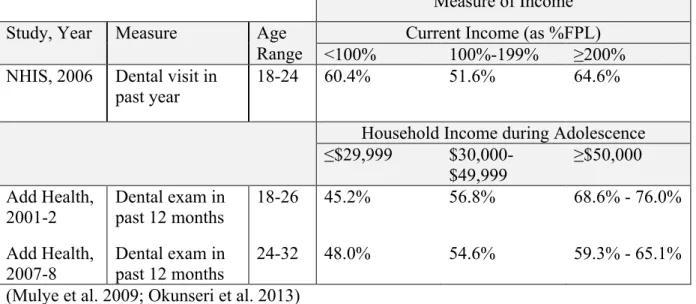
likely due to lower levels of dental disease among young adults (Grytten and Holst 2002). Other studies examined dental care across all adults (ages 17 or 18 and up) and also found a significant, positive relationship between utilization and income and/or education (Manski et al. 2001; Sabbah et al. 2009; Sanders, Spencer, and Slade 2006). Actual rates of dental care utilization by SES, despite consistent findings of statistical significance, vary, as shown in Table 3 below. Mulye et al. found that near-poor young adults use dental care less frequently than their poor counterparts; poor and near-poor young adults both use less dental care than those who are not poor (2009). Okunseri et al.’s findings showed a strictly positive gradient in dental care
utilization among young adults, with young adults with adolescent household incomes of at least $50,000 having the highest utilization rates and young adults with adolescent household incomes of less than $30,000 showing the lowest rates of utilization (2013). This pattern holds for both younger and older young adults, as shown in Table 3.
[TABLE 3 ABOUT HERE]
The following conclusions can be drawn from the literature on the socioeconomic
stratification of health and dental care utilization among young adults: (1) many factors influence young adult health care utilization, including SES, and although exact rates of utilization and findings vary, it is clear that socioeconomic status is an enabling factor in the acquisition of health care, particularly reducing near-poor young adults’ access to health care services; (2) socioeconomic status is a key predictor and determinant of young adult dental care utilization; (3) data and studies on the social determinants of young adult health care utilization are
40.9% of near-poor young adults aged 19 to 26 were uninsured during 2007 (Holahan and Kenney 2008). Only 9.0% of young adults with incomes at least four times greater than the FPL were uninsured in 2007 (Holahan and Kenney 2008). As discussed in the previous section, un-insurance is associated with low rates of health and dental care utilization (Fortuna et al. 2009; Kirzinger et al. 2012). In addition, young adults face more barriers to Medicaid and other public assistance due to eligibility rules, leading to a surge in un-insurance rates as adolescents
transition to young adulthood, especially among the poor and near poor (Holahan and Kenney 2008; Newacheck et al. 2003). Higher rates of health care utilization among poor young adults relative to near-poor young adults can be attributed to Medicaid coverage; Medicaid, however, does not mandate dental coverage for adults and result in the strong positive relationship between SES and dental care utilization.
Gender, Masculinity, and Young Adult Health and Dental Care Utilization
U.S. women face higher rates of illness and disability than U.S. men but, surprisingly, live longer lives (Cleary, Mechanic, and Greenley 1982; Green and Pope 1999; Verbrugge and Wingard 1987). During young adulthood, the male to female mortality ratio is at its peak
more frequently than men (National Center for Health Statistics 2009; Verbrugge and Wingard 1987).
Indeed, a range of studies show that young women use all types of health care more than young men (Fortuna et al. 2009). In 2011, 81.3% of females and only 58.5% of males reported a doctor’s visit in the past 12 months (Kirzinger et al. 2012). In a study of ambulatory care visits from 1996 to 2006, the gender disparity was even more dramatic: young men reported a per capita utilization rate less than half the rate reported by women (Fortuna et al. 2009). Gender is also a significant predictor of the receipt of preventive care services, including screenings for STDs, cholesterol, and emotional health, and diet and exercise counseling (Lau et al. 2013). Young men are also 25.4% less likely to have a usual source of care and receive a higher portion of care from the emergency department than women (Fortuna et al. 2010; Mulye et al. 2009). In addition to morbidity, insurance coverage differences account for a portion of the gender
disparities in health care utilization. Mulye et al. calculated young adult un-insurance rates using 2006 NHIS and found that 15.2% of women and 25.0% of men were uninsured throughout the full year preceding the study (2009). Medicaid coverage for poor, single moms likely contributes to the higher rates of insurance among young women (Callahan and Cooper 2005; Marcell et al. 2002; Park et al. 2006).
Regarding dental health and care, women report excellent or very good oral health at a significantly higher rate than men (Li et al. 2017). Among young adults, women are also
young men had a dental exam in the last year (Mulye et al. 2009; Okunseri et al. 2013). It is unclear if the link between more regular dental visits and better oral health among young women is causal. Nevertheless, young women are more likely than young men to visit the dentist, and insurance and oral health disparities cannot explain this gender gap (Li et al. 2017; Okunseri et al. 2013). Differences in morbidity, self-rated health, and insurance do not fully account for the large gender disparities in health and dental care utilization. Similar to the evidence presented on dental health and care utilization, gender predicts health care utilization after controlling for health and symptom-related factors (Green and Pope 1999).
As a social construct, gender provides norms, behaviors, and beliefs for young women and men in society and is thus largely responsible for the differential need, seeking, and receipt of health and dental care services (Green and Pope 1999; Marcell et al. 2007; Noone and
Stephens 2008). The U.S.’s current hegemonic, or ideal, masculinity creates societal pressures to conform to various stereotypes and norms; for example, men are taught to be strong,
independent, self-reliant, and tough (Courtenay 2000; Noone and Stephens 2008). Men use health beliefs and behaviors to further shape and construct hegemonic masculinity; such beliefs and behaviors reinforce the key tenants of dominant masculinity, that men are healthy (and healthier than women), strong, powerful, and that seeking help and self-care are feminine (Courtenay 2000). To conform to such masculinity and avoid feminine characterization, men tend to not seek care or create alternative justification for seeking care and go to extreme measures to hide illness, shaping a health care system that favors women (Courtenay 2000; Noone and Stephens 2008). In addition to attitudes toward care seeking, women and men exhibit different perceptions of health care need. With western and hegemonic constructions of
adolescent males, for example, report better mental and physical health, and fewer health problems, than their female counterparts (Marcell et al. 2002). Hence, methods of interacting with health and the health and dental care institutions often reflect “doing” gender (Noone and Stephens 2008:712).
Gender differences in health and dental care use emerge as adolescents transition to young adulthood, providing further support for the effects of gender roles and masculinity on utilization. From adolescence to young adulthood, female health care visits increased by 27%, while male visits decreased by 37%, according to a study by Callahan and Cooper (2010). When OB/GYN visits, a health care need that becomes especially pertinent to females upon entering adulthood, are factored out, female utilization also decreases but to a significantly lesser degree than that of males (Marcell et al. 2002). In a similar study by Mulye et al., gender differences among adolescents were marginal for usual source of care, doctor visit, well-check up, and dental care visit in the past, as well as insurance coverage (2009). Gender disparities in
utilization are drastically large among young adults; favoring females, the difference in doctor visits in the past year is 2.5% among adolescents and 25.4% among young adults (Mulye et al. 2009). Across the transition to young adulthood, the gender disparity in dental visits increases modestly, from 3.5% to 5.9%. As adolescents enter adulthood, individuals’ preferences and choices begin to take precedence over health and dental care decisions typically made by parents or legal guardians (Harris et al. 2006). The effects of gender on utilization increase with age, especially with the lessening impact and presence of a parent figure (Green and Pope 1999).
perception of health and dental symptoms (Green and Pope 1999; Verbrugge and Wingard 1987). Outside of inherited biological risk, the aforementioned explanations are all rooted in the differential socialization of men and women in American and most Western societies (Courtenay 2000). Gender schemas involve gendered beliefs and behaviors and create distinct, gender-specific orientations toward illness and prevention (Courtenay 2000; Verbrugge and Wingard 1987). As a part of health and gender socialization, these orientations are taught and develop at an early age, fueling the gender disparities in health and dental care utilization that persist throughout life (Marcell et al. 2002; Verbrugge and Wingard 1987).
Based on the gender analyses discussed above, I expect gender to have an increasingly significant relationship with health and dental care utilization as adolescents transition to young adulthood. I anticipate greater odds of seeking and receiving care among women relative to men. With the literature discussed thus far, however, it is difficult to make an informed hypothesis on the impact of gender on the relationship between adolescent and young adult utilization.
Health Behaviors in the Transition from Adolescence to Young Adulthood
Research on the persistence of health and dental care utilization behaviors from adolescence to young adulthood is scarce and provides no firm, unified stance on the lasting impact of adolescent health and dental care utilization. Missinne et al. studied the impact of intergenerational mobility on mammography screening among women aged 50 to 85 (Missinne, Daenekindt, and Bracke 2015). Using the Belgian sample of the Survey of Health, Ageing, and Retirement, researchers found that screening is significantly related to adult occupational status but not to social class of origin, meaning women assume the screening behaviors of their
generalizability of these findings. First, mammography screenings are a relatively new medical technology typically used by women age 50 and above, so there is no measure of mammography screening behaviors among the mothers of respondents nor of the respondents use of
mammography screenings (nor any other type of health care) during earlier periods in life. Second, Missinne et al. only use occupational position as an indicator of SES; income, wealth, and education tend to be positively related to access to medical care services and knowledge of medical treatments and technologies. Lastly, the models in this study use only social position of origin, destination social position, and age to measure predicted mammography screening use; failure to include other factors associated with the utilization of mammograms, such as health insurance, history of breast cancer, or access to screening centers or clinics, may cause omitted variable bias and lead to inaccurate estimates of the effects of the covariates on mammography screening behaviors.
Okunseri et al. conducted a study of dental care utilization among young adults using Waves I through IV of Add Health (2013). Unlike Missinne et al., Okunseri et al. predicted the effects of a range of covariates on dental care utilization during each wave of the study,
Beyond health and dental care utilization, some researchers have explored the persistence of health-risk behaviors. Studies by Paavola et al., Lau et al, and Kelder et al. found persistence of various health related behaviors, including smoking, physical activity, food preference, and alcohol use across childhood, adolescence, and/or young adulthood (Kelder et al. 1994; Lau, Quadrel, and Hartman 1990; Paavola, Vartiainen, and Haukkala 2004). Additionally, Lau et al. showed that parents play an increasingly important role in influencing health beliefs and behaviors throughout childhood, and such beliefs and behaviors tend to persist though early adulthood (1990). Outside of the studies mentioned in this section, little literature investigates how adolescent health and dental care behaviors continue into young adulthood. The purpose of this study, then, is to fill this gap and to add to the existing literature on the determinants and predictors of young adult health and dental care utilization, stratified by socioeconomic status and gender.
CONCEPTUAL FRAMEWORK
Utilization of health and dental care is not an independent event, but, rather, sits in a web of interrelated structures, including an array of social structural factors, as discussed, like
income, education, insurance coverage, gender, and age. Findings from studies on the durability of utilization and other health behaviors across time suggest that the effects of structural factors on an individual are not transient. To study, then, the persistence of health and dental care utilization behaviors from adolescence to young adulthood, I have developed a conceptual
Three health behavior-related social models and theories also guided the construction of my framework. In this section, I first briefly describe the theory of fundamental causes, the Behavioral Model of Health Services Use, and the life course perspective. I then outline and support my conceptual framework using these models and theories, supplemented by the findings discussed in the literature review. This section concludes with the presentation of the diagram or visual representation of my conceptual framework. My hypotheses, which correspond with the research questions listed in the introduction sections, are presented throughout the description of my conceptual framework and tied to parts of the framework diagram.
The theory of fundamental causes of health and health disparities provides explanations for the disparities present in health outcomes at all levels. Namely, the theory posits that
socioeconomic status, gender, and race, among other factors, are fundamental causes of health because they affect access to flexible resources and have a persistent impact on health by leading to multiple health outcomes and diseases through multiple mechanisms or pathways (Link and Phelan 1995; Phelan et al. 2010). Flexible resources include money, power, prestige, social connections and capital, and knowledge, and exist at the individual and contextual level (Phelan et al. 2010). For example, SES shapes the propensity that an individual will engage in health risk behaviors, such as the level of knowledge a person has about components of a healthy diet. Flexible resources also determine the context in which one makes health decisions; SES
determines the presence or absence of health factors, risks, and choices, such as the availability of healthy foods. Flexible resources impact health outcomes through various mechanisms, like stress, access to health care treatments, and health behaviors, which lead to or prevent a
causes is integral to creating policies that improve health and reduce health disparities, and to the effective interpretation of research findings, including this study.
In his Behavioral Model of Health Services Use, Andersen explains how social factors shape the use of health and dental care services. Andersen attempts to include all temporal factors that affect health and dental care use and respective outcomes in his model (2008). Acquisition of and access to health care services are first rooted in contextual characteristics, which are classified as predisposing (demographic, social, beliefs), enabling (health policy, financing, organization), or need (environment, population health indices) characteristics. The contextual characteristics shape individual characteristics, which are also classified as
predisposing (demographic, social, beliefs), enabling (financing, organization), or need
(perceived, evaluated) characteristics. Together, individual and contextual characteristics create health behaviors, such as personal health practices, processes of medical care, and utilization of care. These behaviors feed into health outcomes, including perceived and evaluated health status and consumer satisfaction. Health outcomes then further affect contextual characteristics,
individual characteristics, and health behaviors through feedback loops. Disparities in social structure, health beliefs, and enabling resources are responsible for inequitable access to services (Andersen 1995). In my study, I focus primarily on use of health services as a health behavior and the contextual and individual factors that effect disparate utilization; however, most parts of the model are considered in my discussion and interpretation of results.
adulthood health through varying interactive and cumulative pathways (Kuh et al. 2003). Three models dominate life course perspective studies and contribute to explanations of how socially determined and “patterned” characteristics and experiences during early life influence health, SES, and related inequalities during adulthood: the latency model, cumulative exposure model, and social trajectory model (Berkman 2009; Kuh et al. 2003). In this study, however, I focus only on the social trajectory model in my analysis of how adolescence impacts adulthood health and dental care utilization. The social trajectory model assumes that early life circumstances and exposures affect later life exposures and circumstance, thus influencing later, e.g., adult, health outcomes (Berkman 2009); this process is also referred to as a “cascade of exposures”
(Richardson et al. 2013:71). In addition to the impacts of child and adolescent exposures on later adolescent and adult exposures, which then affect adult health outcomes, circumstances and exposures during childhood and adolescence have direct impacts on adult health, independent of other earlier or later life exposures. This creates an additive effect, where exposures both
sequentially supplement and independently shape later adult health (Berkman 2009; Kuh et al. 2003). According to Hayward and Gorman, early life SES and educational attainment shape the adoption and persistence of health behaviors through and during adulthood (2004). The life course perspective can be applied to all phases and ages of life; Harris uses the life course perspective to emphasize the importance of the transition to young adulthood in shaping “health trajectories” for the remaining life course (2010:1). Harris best summarizes the life course perspective with the following statement: “Health tracks across the life course” (2010:12).
this framework is not a comprehensive model of all factors that influence use of care, and only includes the variables necessary to explore my research questions at this level of analysis. For the sake of clarity, I present my theoretical framework in three parts, one for each of my research questions. Each part will contain my corresponding hypothesis and a fragment of my complete conceptual framework. In the third part, I reveal my conceptual framework in full.
To what extent are adolescent health and dental care utilization patterns stratified by parental
socioeconomic status?
According to Link and Phelan, SES is a fundamental cause of health and health disparities (1995; Phelan et al. 2010). Health care and dental care access and utilization are, therefore, a mechanism through which SES impacts health outcomes, as SES limits or enables the ability to seek and receive preventive health care, dental care, and treatments. As a
fundamental cause of health, SES determines health status, which creates a feedback loop through which individuals with poor health typically exhibit a higher need for health and/or dental care services, which further contribute to an individual’s health status. The need for health services is also included in the Behavioral Model of Health Services Use. In this model, need, although also grounded in biology, is largely socially constructed, as it is shaped by structural factors like SES and exists at the individual and contextual levels (Andersen 2008). To
summarize, SES is not only a cause of health outcomes, but it influences how people perceive health and illness and their decisions to seek care.
In addition to impacting need for health and dental care services, SES affects access through its link to health insurance. Money, a flexible resources linked to SES, is a key
higher incomes are much more likely to be insured, usually through private or group policies, and poor and near-poor individuals are more likely to be covered by Medicaid or to be uninsured (Holahan and Kenney 2008). Health insurance acts as an enabling characteristic in Andersen’s Behavioral Model of Health Services Use (Andersen 1995).
As products of SES, need and insurance status combine with the direct effect of SES to shape utilization, as shown in Diagram 1a.
[DIAGRAM 1A ABOUT HERE]
This diagram only portrays the relationship between structural factors during adolescence, especially SES, and utilization during adolescence. It should be noted that I use parental SES to measure SES during adolescence, as adolescents’ social class is typically directly tied to their parents’ income, education, and occupational status. Gender and race, as shown at the bottom of Diagram 1a, influence the association between SES and utilization as fundamental causes of health (Cockerham 2016; Link and Phelan 1995). Gender and race also fit into Andersen’s model of utilization, because they are predisposing, structural characteristics that influence SES, access (demand and supply to care), health beliefs, and health status (2008).
SES, as discussed in my literature review, exhibits a complex relationship with health and dental care utilization during adolescence that varies with insurance status. However, in keeping with the aforementioned components of the theory of fundamental causes and the Behavioral Model of Health and Services Use, I expect to find higher rates of utilization among adolescents with higher parental SES.
Hypothesis 1 (H1): Parental socioeconomic status exhibits a positive relationship with
After taking into account parental socioeconomic status, do health and dental care utilization
behaviors during adolescence impact health and dental care utilization during young adulthood?
A possible conceptualization of utilization during adulthood that only considers conditions present during young adulthood looks very similar to the model presented for
adolescent utilization and is shown in Diagram 1b. The effects of young adult SES, measured by income, educational attainment, and occupational status during young adulthood, on utilization travel a similar path: SES impacts need and access to health care. Together, SES, need, and access construct utilization patterns and behaviors.
[DIAGRAM 1B ABOUT HERE]
However, I am exploring the influence of adolescent health and dental care utilization behaviors on utilization during young adulthood, so these two models alone do not suffice. Using the life course perspective’s concept that health outcomes and behaviors persist and shape health and related behaviors, I tie adolescent circumstances and utilization to young adult utilization.
[DIAGRAM IC ABOUT HERE]
model with additive effects in the utilization of health and dental care services. Applying the theory of fundamental causes, the Behavioral Model of Health Services Use, and the life course perspective, I assume that utilization is a learned behavior that is shaped by structural factors and endures throughout the life course. I therefore expect to find a significant relationship between health and dental care utilization during adolescence and young adulthood (Hayward and Gorman 2004).
Hypothesis 2 (H2): Controlling for parental socioeconomic status, adolescent health and
dental care utilization behaviors persist into young adulthood.
How does gender modify the relationship between adolescent and young adult health and dental
care utilization?
Lastly, in addition to the models and relationships addressed in hypotheses 1 and 2, I adjust my model to investigate how gender interacts with the persistence of adolescent utilization into young adulthood. The large disparities in health and dental care utilization rates do not emerge until individuals transition into young adulthood (Green and Pope 1999; Marcell et al. 2002; Mulye et al. 2009). However, little research examines the effects of gender on the
moderating effect on the persistence of adolescent utilization behaviors into young adulthood, as shown in Diagram 2.
Hypothesis 3 (H3): Across the transition to young adulthood, women are more likely to
retain the health and dental care utilization behaviors learned during adolescence.
These two theories, which are incorporated into my complete conceptual framework shown in Diagram 2, guide the remaining portions of this study and are used to create my empirical models.
[DIAGRAM 2 ABOUT HERE]
DATA AND METHODS
Data
I use data from Waves I and IV of the National Longitudinal Study of Adolescent to Adult Health (Add Health) to evaluate my hypotheses. Add Health is a school-based,
access to health insurance. The Wave IV in-home interview contains all aforementioned data and information on the respondent during young adulthood. Due to Add Health’s unequal selection and complex sample design, including oversampling of certain groups, I apply the sample weights provided with the Add Health data to generate generalizable and less biased results.
My analysis sample consists of 10,167 young adults from Add Health who were between the ages of 24 and 34 during Wave IV and had a parent or guardian complete the parent
questionnaire during Wave I. My original sample consisted of 20,745 adolescents; however, after omitting respondents who did not participate in the Wave IV in-home interviews (N=5,046) and/or those who had no parent questionnaire in Wave I (N=2,810), I was left with 13,805 respondents. During my initial analysis of the data, I identified cases for which provided
responses were contradictory or outlying, e.g., reporting of very high income but also receipt of public assistance, Medicaid, and/or an inability to pay bills; the source or reasoning for such responses is not known, and led to the exclusion of three additional cases from analysis. Additionally, per Add Health sample weighting instructions, cases without an assigned sample weight were deleted from the sample, resulting in N=12,980. To get to my final analysis sample, I implemented listwise deletion to omit all respondents with missing demographic, access and use of health and dental care services, health status, or socioeconomic status information. My final sample contains 10,167 total respondents, with 10,138 respondents in my medical care utilization sample and 10,146 respondents in my sample for dental care utilization.
Measures
care. My independent variables and covariates also differ between the models created for my three hypotheses but generally include measures of socioeconomic status, access to health and dental care, need for health and dental care, demographics, and, in models predicting the
persistence of utilization behaviors, measures of early life utilization of health and dental care. In this section, I describe all variables included in my analysis, starting with my outcome variables, followed by my covariates and predictor variables. The subsequent section, called “Methods,” contains and describes the empirical models into which these variables have been incorporated. Utilization
I create four variables to represent my core outcome and predictor variables, the
utilization of health and dental care services during adolescence and young adulthood. Routine medical exam in the past 12 months, or year, measured in Wave I and Wave IV, is the dummy variable for having a “routine physical exam” or a “routine checkup,” respectively, in the last 12 months or year. Similarly, dental exam in the past 12 months, or year, is the dummy variable for having a dental exam by a dentist or hygienist in the past 12 months in Wave I and Wave IV. Socioeconomic Status
Educational attainment, household income, and employment status are my measures of SES in adolescence and young adulthood. Due to differences in survey design across Waves I and IV, however, these variables require differential coding to produce similar classifications. For Wave I and Wave IV, I classify educational attainment into five, ordinal categories: less than high school, high school or equivalent, some college, college/university graduate, and beyond college. As adolescents’ SES is typically a reflection of their parents’ SES, I use parental educational attainment as the Wave I measure of education. If the parent also reported the
education between the pair. The Wave IV measure of educational attainment does not consider the education of the young adult’s partner. Beyond differences in the source of the educational attainment measure, there are minor discrepancies in the classification of education. For parental educational attainment, high school or equivalent includes parents or parent partners who
graduated from high school, completed a GED, or went to business, trade or vocational school instead of high school; some college means the parent went to college but did not graduate or a parent went to a business, trade, or vocational school after high school. In the Wave IV young adult measure of educational attainment, high school or equivalent includes high school
graduates and individuals who had some vocational or technical training after high school. Some college includes participants who completed vocational or technical training after high school. I define beyond college as any education beyond a bachelor’s degree, including professional degrees and any graduate school, complete or incomplete, for both parent and young adult educational attainment.
My measures for income in Waves I and IV are identical, in that both variables are split into the following four categories: less than $25,000, $25,000 to $49,999, $50,000 to $74,999, and $75,000 or more. This income classification closely mirrors the categories used by Okunseri et al. (2013). As with my measure of educational attainment for Wave I, I use the income
reported by the parents for my Wave I income variable. In both waves (parent and young adult income), the measure reflects the respondent’s total household income, including personal income, the income of other household members, and any income from welfare benefits,
Lastly, I include employment status as a means to incorporate occupation, a standard measure of SES, into my models. I classify employment status into unemployed, full-time, part-time, and not in the labor force. According to the Bureau of Labor Statistics (BLS), a person who is unemployed is eligible or available to work but does not have a job and has actively looked for work in the past four weeks (2015). Anyone who does not have a job and has not looked for work during the past four weeks is not in the labor force. There is no official definition for part-time work in the U.S. (United States Department of Labor n.d.); I use the definition provided in the BLS’s Current Population Survey results and the definition supplied by Kalleberg in his paper, “Nonstandard Employment Relations: Part-time, Temporary and Contract Work” to define part-time workers as those who work fewer than 35 hours per week (Bureau of Labor Statistics, U.S. Department of Labor 2018a; Kalleberg 2000). Thus, full-time is 35 hours or more of paid work per week.
parents who are not working outside the home and are not unemployed. As I only use a single measure of parental employment status, I combine the employment statuses of both parents. Parental employment status is full-time if at least one parent works full-time. I assign part-time if both parents are part-time, or one is part-time and one is not in the labor force. Unemployed denotes both parents reported unemployment, or one parent is unemployed and the other is either employed part-time or not in the labor force. Lastly, I reserve not in the labor force to parents both classified as not in the labor force. If the parent does not supply any information about a partner or a partner’s employment status, I use the responding parent’s employment status.
Although I use the same four categories to classify young adult employment status, the coding differs from that of parental employment status, due to variation in employment questions across the Add Health waves and my exclusion of a partner’s employment status in the young adult measure. I mark all respondents who are on active military duty or who work at least 35 total hours a week in one job or across multiple jobs, including respondents who report continued employment at their first place of full-time employment, as full-time. Part-time respondents are those who report current employment in at least one job with hours totaling to 34 or fewer hours a week. I classify all respondents who did not report current employment and marked
looking for work” (Bureau of Labor Statistics, U.S. Department of Labor 2015). In further support of my decision to classify such respondents as unemployed, marking these respondents as unemployed increases the analysis sample unemployment (UE) rate to 5.1% (see Table 4), which sits within the range of monthly UE rates during 2008 (4.9% to 7.3%; the UE rate rose from an average of 5.0% in the first quarter to 6.9% in the last quarter of the year), the year of Wave IV data collection (Bureau of Labor Statistics, U.S. Department of Labor 2018b). Respondents classified as not currently in the labor force include students, respondents with permanent disabilities, respondents in prison or jail, retirees, and respondents “keeping house” (Harris et al. 2009).
Health and Dental Care Access and Need
The use of health and dental care services is also dependent on access and need. Largely determined by SES, access involves the ability and means to receive appropriate health and dental care and functions at both the individual and contextual levels. Need also functions at both levels, but, given the nature of my research, I only incorporate individual level markers of need. Need, unlike access, is often subjective and is a mechanism through which fundamental causes impact health outcomes; need is socially constructed, typically varying across groups, time, and place. To account for potential differences in utilization rooted in disparate levels of access and need, I include measures of health insurance, self-rated health, pregnancy, and gum disease in my models.
code respondents who marked having private insurance or a PHP, even if “other” was also marked, as having private or PHP in my measure of insurance. I assign Medicaid or Medicare to any respondents who marked coverage from either government program, even if private, PHP, and/or other was also marked. Other indicates respondents who only chose “other” on the parent questionnaire, and none is for respondents who only chose “none.”
My measure of young adult health insurance status contains only three categories:
private/group/other, Medicaid, and none. Unlike Wave I, the Wave IV in-home interview asks of the young adult’s current health insurance status with a single-answer multiple choice question, allowing for easier coding. Respondents classified as having private/group/other include those who receive insurance from school, work, a union, or active military duty, are covered under their spouse’s or parent’s insurance, buy their own private insurance, or are covered through the Indian Health Service. Respondents classified as on Medicaid or having no insurance marked their response as such in the interview.
I use self-rated health (SRH) during adolescence and young adulthood to control for varying health status that may lead to differing levels of health care, and potentially dental care need. In Waves I and IV, Add Health asks respondents, “In general, how is your health?,” with the options of excellent, very good, good, fair, and poor. In my measure of SRH in adolescence and young adulthood, I combine fair and poor, similar to the classification used by Harris et al. and Beck et al., leaving me with four categories of SRH: excellent, very good, good, and fair or poor (Beck et al. 2014; Harris et al. 2006).
adult pregnancy is an indicator variable for being currently pregnant, at the time of the in-home interview. In Wave IV, I also create a variable for dental health, named young adult gum disease or tooth loss from cavities in the past 4 weeks, indicating if the respondent had such dental problems in the four weeks preceding the respondent’s in-home interview. Dental problems or disease likely increase the probability of seeking and receiving dental care.
Demographics
I incorporate gender, age, and race into all of my predictive models to account for any unobservable disparities stratified by any of these measures and for the direct or causal effects of the measure on utilization. Gender is the respondent’s marked gender, male or female, in Wave IV. For race, I created a variable with seven, distinct racial categories: Hispanic white, non-Hispanic black, non-non-Hispanic Asian or Pacific Islander (PI), non-Hispanic or Latino, American Indian or Native American (non-Hispanic), other (non-Hispanic), and multiracial (non-Hispanic) from a constructed multiple race variable provided in the Wave I Add Health data. I classify all respondents who marked more than one race, excluding Hispanic or Latino, as multiracial. I include any respondent who identified as Hispanic or Latino, regardless of race(s), as Hispanic or Latino in my measure. All other races, including other, are identical to the classifications
provided in the aforementioned constructed Wave I race variable, meaning the respondent only marked the race under which they are classified in my analysis.
typically increases until late in life. Thus, age is an important measure to include in my analysis. Using the age formula, I create two continuous age variables, with Wave I age ranging from 11 to 21 and Wave IV ranging from 24 to 34.
Methods
I first present and examine descriptive statistics of all variables used in models for analysis. Using my weighted sample data, I calculate the categorical frequencies of all variables. I also perform bivariate analysis by cross tabulating all analysis variables with gender and present those statistics in Table 1, with the total frequencies for each variable.
To test my hypotheses, I use multivariate logistic regressions, because my outcome variables, routine health exam or dental exam utilization during the past year during adolescence or young adulthood, are dichotomous/binary (Rodríguez 2007; UCLA Institute for Digital Research and Education n.d.). In each model, I request odds ratios instead of the regression coefficient, as odds ratios lend to easier interpretation, especially in practical models (Rodríguez 2007). Logistic regressions are superior to multivariate linear regressions due to the lack of constraints (zero to one) on the outcome variable, as outcomes outside of zero to one are not valid or plausible. Additionally, using logistic regression allows assumptions of linear relationship between the variables to be dropped.
predicted probability, or margins, of a routine medical exam and dental exam at the various levels of the three measure of parental SES (StataCorp 2017b).
To analyze the predicted effect of a routine health exam or dental exam in the past year during adolescence on health and dental care utilization during young adulthood for my second hypothesis, I use two sets of three nested models to show how the relationship between
utilization (util) during adolescence (AD) and young adulthood (YA) changes with the inclusion of various controls (Rodríguez 2007). The models are as follows for health and dental care: Model 1: 𝑌𝐴𝑢𝑡𝑖𝑙 =𝐴𝐷 𝑢𝑡𝑖𝑙+𝑑𝑒𝑚𝑜𝑔𝑟𝑎𝑝ℎ𝑖𝑐𝑠
Model 2: 𝑌𝐴 𝑢𝑡𝑖𝑙 =𝐴𝐷 𝑢𝑡𝑖𝑙+𝑑𝑒𝑚𝑜𝑔𝑟𝑎𝑝ℎ𝑖𝑐𝑠+𝐴𝐷 𝑆𝐸𝑆+𝐴𝐷𝑖𝑛𝑠𝑢𝑟𝑎𝑛𝑐𝑒+𝐴𝐷 𝑛𝑒𝑒𝑑
Model 3: 𝑌𝐴𝑢𝑡𝑖𝑙 =𝐴𝐷𝑢𝑡𝑖𝑙+𝑑𝑒𝑚𝑜𝑔𝑟𝑎𝑝ℎ𝑖𝑐𝑠+𝐴𝐷𝑆𝐸𝑆+𝐴𝐷𝑖𝑛𝑠𝑢𝑟𝑎𝑛𝑐𝑒+𝐴𝐷 𝑛𝑒𝑒𝑑+𝑌𝐴 𝑆𝐸𝑆
+𝑌𝐴𝑖𝑛𝑠𝑢𝑟𝑎𝑛𝑐𝑒+𝑌𝐴 𝑛𝑒𝑒𝑑
As previously discussed, I measure adolescent SES with parental SES. In the first set of nested models, I regress young adult routine medical exam in the past 12 months on adolescent routine medical exam in the past 12 months, and need includes pregnancy and SRH in both adolescence and young adulthood. The second set of nested models involves regressing young adult dental exam in the past 12 months on adolescent dental exam in the past 12 months, and I use SRH to define need at both ages, as well as recent gum disease during young adulthood. I then use margins to calculate the predicted probability of an exam in Wave IV, given an exam in Wave I (StataCorp 2017b).
𝑌𝐴𝑢𝑡𝑖𝑙 =𝐴𝐷 𝑢𝑡𝑖𝑙+𝑔𝑒𝑛𝑑𝑒𝑟+ 𝐴𝐷 𝑢𝑡𝑖𝑙∗𝑔𝑒𝑛𝑑𝑒𝑟 +𝑑𝑒𝑚𝑜𝑔𝑟𝑎𝑝ℎ𝑖𝑐𝑠+𝐴𝐷 𝑆𝐸𝑆
+𝐴𝐷𝑖𝑛𝑠𝑢𝑟𝑎𝑛𝑐𝑒+𝐴𝐷 𝑛𝑒𝑒𝑑+𝑌𝐴 𝑆𝐸𝑆+𝑌𝐴 𝑖𝑛𝑠𝑢𝑟𝑎𝑛𝑐𝑒+𝑌𝐴 𝑛𝑒𝑒𝑑
I estimate the interaction effects of gender and utilization for both dental care and routine medical care, using the specification for need outlined in the previous paragraph. I include gender only at the beginning of this model, not in the demographics. The odds ratios of interactions, however, are not as easily interpreted; therefore, I use margins first to predict the probability of a routine medical exam or dental exam in the past 12 months during young adulthood for men and women (Williams 2012). I then use margins again to calculate the marginal effect of a routine medical exam or dental exam during adolescence on health and dental care utilization during young adulthood for each gender (StataCorp 2017b; UCLA
Institute for Digital Research and Education n.d.; Williams 2012). I also calculate the difference between these predicted probabilities using contrast margins (StataCorp 2017b).
I perform all calculations in Stata. The results from my descriptive analysis and models are presented in Tables 4 through 9 in my Results section. In my tables, I juxtapose models of medical and dental use for hypotheses one and three to allow for cross-service comparisons of the effects of SES and gender on utilization of health and dental care. As I use a total of six models to test and present my second hypothesis, I create two tables, one for the nested health care models and one for the nested dental care models, allowing for visualization of the impact of added variables on my hypothesized relationships.
RESULTS
health care, namely having a routine medical exam in the past year, decreases from 66.5% to 58.6%. These rates closely mirror Lau et al.’s estimation of office-based medical exam rates in the past year from adolescence (67%) to young adulthood (55%) before the passage of the ACA (2014). The rates of dental exams in the past 12 months decrease from 69.2% during adolescence to 56.4% during young adulthood, and while other studies of dental care utilization also report decreases in utilization across the transition to young adulthood, the reported rates of dental care utilization vary greatly, with estimates both above and below the rates in my analysis (Lau et al. 2014; Mulye et al. 2009; Nasseh and Vujicic 2015).
[TABLE 4 ABOUT HERE]
In Table 4, I also present the weighted proportions for the key outcomes by gender. Regarding the utilization of routine health exams, 68.7% of adolescent males and 64.2% of adolescent females reported a visit in the last year. In young adulthood, the ratio of health care utilization rates flips drastically, as 47.7% of men and 70.2% of women have a routine medical exam in the past year, similar to the reversal found in extant literature (Kirzinger et al. 2012; Lau et al. 2014; Mulye et al. 2009). The increase in the gender gap in dental exam utilization across the transition to young adulthood is less dramatic; 67.3% of males and 71.2% of females report a dental exam in the past year during adolescence, while 51.9% of men and 60.6% of women report a dental exam in the past year during young adulthood.
school education, and 28.5% of males and 36% of females are at least college graduates. Parental household income during adolescence is more right-skewed than household income during young adulthood, with 27.9% of parents in 1994-95 and 16.7% of young adults in 2008 reporting incomes of less than $25,000.
These descriptive statistics provide a brief overview of the sample with respect to the focal variables used in subsequent multivariate models of health and dental care utilization. Using this sample, I present results of the logistic regression models below, organized based on my three hypotheses.
[TABLE 5 ABOUT HERE]
H1: Parental socioeconomic status exhibits a positive relationship with health and dental care
utilization during adolescence.
Table 5 shows the results of a multivariate logistic regression of health and dental care utilization during adolescence on parental socioeconomic measures during adolescence. Parent educational attainment and parent-reported household income during adolescence both exhibit a positive association with adolescents having a routine medical exam in the past year. In other words, adolescents have increasingly lower predicted odds of having a routine medical exam in the past year as parental educational attainment and household income decrease, independently. Adolescents whose parent(s) did not graduate from high school have 0.530 times lower odds of a routine medical exam in the past year than adolescents whose parent(s)’s education extends beyond a bachelor’s degree. Further, adolescents whose parents have at least a college degree have significantly higher odds of a routine medical exam in the past year, compared to
high school degree to 0.732 for parents with beyond a college degree, with notable, though not significantly different, increases from less than high school education to high school graduate, and some college to college graduate.
Household income is also positively associated with routine health care utilization during adolescence. Adolescents who live in households that earn less than $50,000 a year have
significantly lower odds of a routine medical exam in the past 12 months than their peers from households earning more than $75,000 a year (below $50,000 odds ratios range from 0.726 to 0.746). Like parent educational attainment, the odds of a routine medical exam in the past year during adolescence diminish as income decreases. The predicted probability of an adolescent having a routine medical exam in the past year is 0.643 in households with total incomes less than $25,000 and 0.711 in households earning more than $75,000. However, the lack of
significant difference between odds ratios suggests that income is a weaker predictor of routine health care utilization than parent education. Parent employment status is not significantly associated with routine health care utilization during adolescence.