The Dear Baby Project: An Interactive Journaling Tool for Pregnancy Education
Emily Danforth
A Project presented to the faculty of The University of North Carolina at Chapel Hill
in fulfillment of the requirements for Undergraduate Honors
Date Completed: April 11, 2014
Honors Advisor Approval: ___________________________ Honors Advisor
Abstract
A wide body of literature indicates that pregnancy and childbirth education is often inaccessible and that it inadequately addresses psychological aspects of pregnancy. This paper reviews the numerous barriers to providing useful prenatal education and outlines the ideal approach to prenatal teaching. Then, the author presents the concept for new tool for interactive pregnancy education, The Dear Baby Project. The Dear Baby Project is a self-contained kit that involves the cognitive, physical, and affective aspects of pregnancy and delivers health information while leading women to create a scrapbook and journal of their pregnancy. The Dear Baby Project capitalizes on the known benefits of reflection and journaling to provide a fun approach to pregnancy and parenting education. The exercises contained in the Dear Baby Project guide women through important learning topics and promote a feeling of mental and emotional readiness. The Dear Baby Project is meant to address six educational units and this paper presents the pilot materials for one of those units: emotions and emotional aspects of pregnancy and parenting. With careful attention to readability, appropriateness and suitability of materials, the author provides examples of educational, art, and literary components from the kit. The flexibility of this design will allow clinicians to select relevant modules and distribute kits that are tailored to each patient’s individual risks, needs, interests, and expectations. The final portion of this paper describes the next steps in the project’s design and implementation and proposes some innovative modifications for the project content.
The Dear Baby Project: An Interactive Tool for Pregnancy Education
Pregnancy is a time of excitement, change, and numerous learning needs. Expectant women experience the physiological changes of pregnancy and childbirth and must navigate a significant psychological transition as well. The work presented here details a tool, called the Dear Baby Project, that is designed to educate pregnant women while allowing them to engage in reflection, creativity, and thoughtful consideration of their pregnancy and future lives as mothers.
The Dear Baby Project is a self-contained arts and journaling kit complete with instructions, information fact sheets, crafting activities, supplies, and a binder to house the completed work. It consists of information and activities related to six general topics: the
development of the baby, emotional and relationship changes during pregnancy and beyond, the health and well-being of the mother, labor and delivery, caring for the baby, and emergencies or when/who to contact if something goes wrong. For each of the six broad topics, the kit contains modules with easy-to-understand information fact sheets, art projects, and literary/journaling exercises. In completing the Dear Baby Project kit, mothers will not only have reviewed useful health information but will also have chronicled their pregnancy and created a specialized scrapbook of their experience.
completed activities. The final sections of the paper lay out the next steps for the project, including suggestions for adaptation.
Literature Review
Pregnancy is a developmental period where patient education is critical and where
psychosocial well-being is a key component to a successful developmental transition. How many women actually receive this important preparation before the birth of their baby? How do most women and their families get their information and are they satisfied with that preparation? Gager, McLanahan, and Glei (2002) analyzed data from the 1996 Commonwealth Fund Survey of Families with Young Children and found that only 40 percent of parents felt confident about their abilities to parent and believed that they were coping well with the demands of new parenthood. Though dated, the statistic is unsettling. More recent research indicates that the health information, particularly the psychological preparation mothers receive in childbirth classes continues to be unsatisfactory. Prenatal education tends to focus physical needs and leaves significant gaps in provision of education regarding mental health issues, family life/sexuality, and parenting (Hanson, VandeVusse, Roberts, & Forristal, 2009).
In 2007, 70.5% of pregnant women in the United States received early and adequate prenatal care according to the U.S. Department of Health and Human Services (2013). While we might expect that women will receive education and information about their pregnancy during their prenatal visits, the actual clinical tasks tend to focus on immediate health issues and women are referred to attend childbirth classes separately (Novick, 2009). In the United States,
Pregnant women make up a large patient population of relatively healthy individuals with a strong readiness to learn. Taken together, the literature reviewed above indicates a definite need for enhanced prenatal education, particularly tools targeting the development of
psychological and other coping skills. Common Barriers to Prenatal Education
While there is little research on prenatal education effectiveness rates, there is ample research on the common barriers to accessing and receiving prenatal education. Common reasons why women do not attend childbirth classes or receive effective prenatal and parenting education include:
• Low average level of patient literacy and lack of informational materials written in
simple, easy-to-understand language (Hansford & Forsdike, 2013; Porter et al., 2012; Renkert & Nutbeam, 2001; Shieh & Hosei, 2008);
• Feeling confident enough without the classes or having attended classes for a
previous birth (Murphy-Black, 1993).
• Difficulty finding time to fit the classes into their schedule and/or needing to find
childcare in order to attend any additional classes or events (Murphy-Black, 1993; Novick, 2009);
• Financial costs (Murphy-Black, 1993; Novick, 2009; Phillippi & Roman, 2013); • A lack of culturally appropriate options (Nolan, 2005);
• A fear of being judged and a fear of being pressured to participate in specific prenatal
• Concern for being made to feel guilty about risky behaviors the mother has engaged
in (e.g. drug or alcohol use) (Phillippi & Roman, 2013; Roberts & Pies, 2011; Tighe, 2010);
• Worries that someone will contact Child Protective Services (Roberts & Pies, 2011).
Best Practices In Prenatal Education
Given the numerous barriers to accessing and understanding prenatal education, what can be done? What would an ideal prenatal education program look like? Most pregnant women are adults who appreciate and learn best when approached using the principles of adult learning
(Nolan, 2005; Nolan & Foster, 2005; Tighe, 2010). Based on those principles, childbirth and
parenting education should be client-led and dynamic. Women and their partners want to see themselves engaged in their own personal gain (Nolan, 2005). Education should draw on previous life experience, link experiences to the new learning, and should encourage clients to reflect on the influences their parents and family lifestyles have had on their beliefs and
behaviors (Nolan, 2005; Nolan & Foster, 2005). Ideal prenatal education would be casual and fun, offered early on with continuity throughout pregnancy, accommodate all social backgrounds, include flexibility on the topics covered, be conducted in a comfortable setting, and tailored toward each individual woman and her family (Candib, 2010; Tighe, 2010). The information should be free or inexpensive.
Description Of The Product
Perry, Thurston, & Osborn, 2008; Staricoff, 2006) as means of health promotion (Mills, Knuiman, Rosenberg, Wood, & Ferguson, 2013). The method allows women to work on the project at their own pace, in the comfort of their own familiar home or space, and using their own personal experiences as inspiration.
The Dear Baby Project is a self-contained kit for pregnant women. Health care providers may distribute the kits at the first prenatal visits, or women may request a kit on their own behalf. Women will use the kit to complete self-directed modules that each have three components: an educational fact sheet, an arts and crafts activity, and a related literary or journaling activity. The kit will contain everything the women need to complete each of the modules: instructions, examples, craft supplies, and some journaling stationary. In addition to each of the educational modules and their accompanying activities, the kit encourages women to write letters to their babies throughout their pregnancies. All of the letters, journaling, art activities, and educational handouts may be housed in a decorated three-ring binder that comes in the kit. By the end of the pregnancy, the woman will have a chronicle of her pregnancy with art activities, poems and other things she has created. This will serve as both a meaningful way for her to reflect on pregnancy and her transition to parenthood as well as a lovely keepsake to pass on to the baby when he or she is older. While some parents forgo prenatal education classes because they have been for a previous pregnancy, the Dear Baby Project offers an experience that parents can enjoy for each pregnancy, even including their existing children in its creation.
Target Audience
modules are written in English only. Ideally the modules will be available in different languages, with an adaptable set of culturally relevant modules.
When To Implement The Product
Providers should distribute the Dear Baby Project kit early on at one of the first prenatal visits. Women will then maximize their time journaling and will be able to work through project modules that are appropriate for their stage in the pregnancy. Qualitative studies indicate that nurses should help women develop coping skills early on in pregnancy (Côté-‐Arsenault, 2007; Perry, Thurston, & Osborn, 2008). Through providing education early, nurses enable women
to develop those problem-focused coping skills. Expected Outcomes
Women should learn about their pregnancy, birth, and the transition to parenthood while developing a sense that they have the ability to successfully give birth and parent their child. They should feel more confident in their knowledge and ability and recognize that they can make their own decisions. One of the main goals for the Dear Baby Project is to increase expecting women and their partners’ psychological skills and coping mechanisms.
In addition to benefiting women and their families, the Dear Baby Project will aid clinicians. Healthcare providers can use the Dear Baby Project as a means to encouraging patients’ self-directed preparation. Providers can also utilize the product as a way for patients to keep track of important information. For example, practitioners may want a mother with
Topics Covered
Extensive literature review reveals that prenatal information from practitioners, books, and birth/parenting classes falls into six broad categories (Billingham, 2011; Hanson,
VandeVusse, Roberts, & Forristal, 2009; Nolan, 2005; Novick, 2009):
• The development of the baby
• Emotional and relationship changes during pregnancy and early parenthood • The health and well-being of the mother
• Labor and delivery • Caring for the baby
• Emergencies or when/who to contact if something goes wrong
Eventually, The Dear Baby Project will include multiple modules for each of those six units. To limit the scope of the work presented here, this paper presents pilot materials for only one of the six units.
Research on parents’ and caregivers’ perspectives show parents are most interested in developmental information about their babies, practical skills, and information that is
timely/appropriate for their stage in the pregnancy and birth (Billingham, 2011; Candib, 2010; Hanson, VandeVusse, Roberts, & Forristal, 2009; Nolan, 2005; Tighe, 2010).
Practitioners may inadequately address this subject in order to prioritize immediate physiologic concerns.
In a longitudinal study of women’s health during pregnancy and the first six months postpartum, Tulman and Fawcett (2003) asked women to reflect about their pregnancy and their postpartum life. 52% of the women in the study said that they felt the first six months postpartum were harder than they had expected (Tulman & Fawcett, 2003a). Recommendations from the Tulman and Fawcett study include interventions that result in a reduction in anxiety and depression during pregnancy and postpartum, utilizing screening scales for depression, and counseling women about having realistic expectations for what can be accomplished during pregnancy and new parenthood.
With these psychosocial needs in mind, the selected pilot materials of the Dear Baby Project presented here target the broad category of emotional and social changes during pregnancy, birth and parenthood. Specifically, the work below explains four related modules. The four modules address: a) the women’s own internalization of their pregnancy and eventual transition to motherhood, b) changes in relationships, communication, and sexuality, c) perinatal anxiety and depression, and d) parenting philosophies and principles of parenting.
Design Process
All Dear Baby Project materials are designed using simple, easy-to-understand language with colorful pictures. American patients’ low level of health literacy is a major barrier to high quality health care provision. Recent research indicates that most printed medical
communications are written at a 9th grade or higher reading level, usually lacking interaction and summary components (Hansford & Forsdike, 2013; Shieh & Hosei, 2008). According to the Suitability Assessment of Materials (SAM) tool, materials written at or above a 9th grade reading level are not suitable, while materials at a 6th to 8th grade reading level are adequate and materials at a 5th or lower level are superior (Doak, 1996). It is imperative that prenatal health education materials contain simple and easy-to-understand information because a woman’s level of health literacy not only influences her ability to understand and act on health information, it also affects her ability to care for her children and other family members.
In order to ensure that the Dear Baby Project materials and instructions are easy to read, the work here utilizes an online tool that computes the Kincaid Reading Ease and Kincaid Grade Level for the educational materials (Flesch, 1948; Kincaid, 1975). The Flesch-Kincaid scoring method was first developed in the mid-twentieth century and is now a widely-used and recommended tool for assessing the reading level of health education materials (Shieh & Halstead, 2009). All of the Dear Baby Project educational information sheets are crafted to a 7th grade or easier reading level.
tool helps to ensure that there is clear communication and that the health education materials are suitable (Shieh & Halstead, 2009).
The Modules
This section briefly outlines the contents of the emotional/social modules of the Dear Baby Project. Each module contains one educational information sheet, instructions and materials for one art activity, and a guided literary activity. Some modules have additional journaling prompts that help initiate journaling.
A. Module 1: The Woman’s Experience of Pregnancy (See Appendix A for examples)
1. Educational component—The educational fact sheet reviews the three stages of emotional development during pregnancy and provides links
to online resources for further reading or information.
2. Art component—“Polaroids” of Then, Now, and Later.
This art activity prompts women to draw, collage or otherwise create
“snapshots” of important people, places, and events that are currently
important in their life. The pictures are “framed” in Polaroid-‐type
frames and then can be inserted into their journals. The activity helps
women identify existing resources in their life, encourages reflection
on what is important, and will later serve as a chronicle or time
capsule.
five best memories, five people who have been helpful to them during
the pregnancy, etc.
4. Journaling prompt—This activity includes prompts that encourage mothers to write about what they were like before they were
pregnant and what they are like now.
B. Module 2: Relationships and Pregnancy (See Appendix B for examples)
1. Educational component—The educational information sheet
addresses intimate partner violence and identifies warnings signs of
an unhealthy relationship. The sheet provides resources to contact for
women who believe they may be in an abusive relationship.
2. Art component—Coupon book for parenting partner.
Here, women fill in and decorate a book of 10 coupons. The completed
book can serve as a gift to a parenting partner like the baby’s father or
grandmother. Women design the coupons to be redeemable for low-‐
cost but fun activities that they can share with their parenting partner.
Examples might include a coupon for making the partner’s favorite
dinner, or for watching their favorite movie with them.
3. Literary component—This activity instructs women on creating an acrostic poem with the word TOGETHER to emphasize working
together (with husband, partner, mother, etc) to make it through
pregnancy and to raise the baby.
1. Educational component—The educational information sheet reviews the idea of stress and depression during pregnancy and presents
warning signs for perinatal anxiety or depressive disorders.
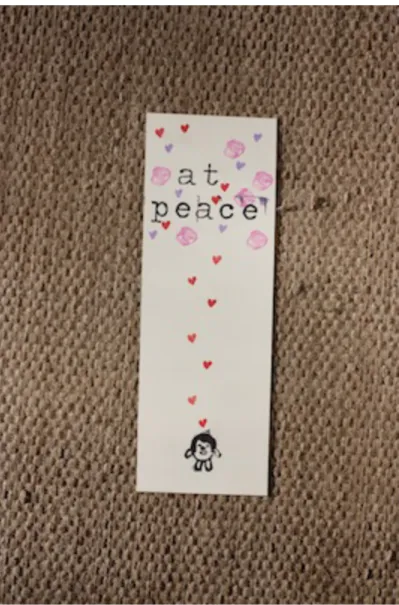
2. Art component—This art activity leads women in creating a bookmark or a hangtag that has inspiring phrases or calming
instructions. Women may choose phrases that speak to them and
decorate the bookmarker with favorite icons. Women can carry the
bookmarker as a totem or use it to encourage calming or
decompressing thoughts when they are feeling stressed.
3. Literary component—The literary exercise asks women to think about stressors in their life and to identify things they can do to
alleviate the stress. The women are also encouraged to think about
resources (people, books, etc.) they can use to address issues of
concern.
D. Module 4: Parenting Philosophies and Identifying Principles of Parenting (See Appendix D for examples)
1. Educational component—The educational information sheet
describes the concept of parenting philosophies and outlines
important components of parenting philosophies and styles.
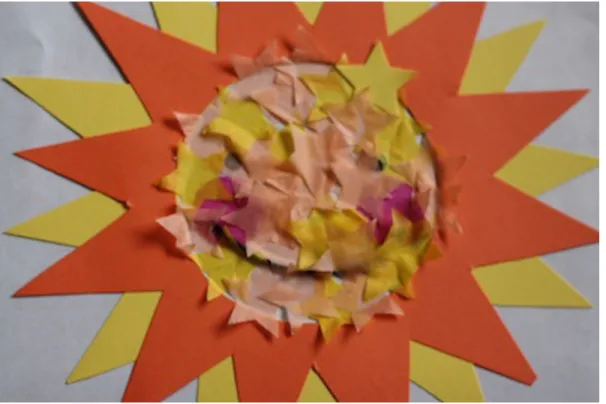
2. Art component—Favorite traits sun-‐catcher
With this activity, women create a cheerful sun that can be hung as a
sun-‐catcher or as a mobile. On the sun’s rays, women use rubber
children (e.g. “Courage”, “Humor”, “Integrity”, etc). This project can
serve as a decoration in the baby’s nursery and requires the mother to
think about what qualities she would like to teach her child.
3. Literary component—The literary exercise presents a framework that women can fill in to create their own personal parenting philosophy.
Next Steps
This paper proposed the concept of the Dear Baby Project and presented examples of modules related to one of the six core topics to be included in the kit. Future design will include related modules for each of the other five key subject areas. After creating modules for the other units, the next step is to implement a pilot test by distributing a number of kits to various prenatal care providers. Ideally, the implementation will include a pre- and post-test or survey to patients receiving the kits, providing feedback essential to refining the project. The surveys will also ask women about their satisfaction with the kit and ask about feelings of preparedness for childbirth and parenthood. Clinicians will complete a separate survey in order to generate feedback about their perspective of using the kits and suggestions for additional topics or modules.
Ideas For Adaptation
The Dear Baby Project is highly adaptable. In the future, the project may include specialized modules that clinicians select to order to tailor the kits to each patient’s individual needs. Additional modules beyond the six core topics mentioned above may include:
• Modules specific to teen pregnancy • Add-ons for older siblings to complete • A companion kit for fathers
• Adaption of the product for women who experience perinatal loss.
• An electronic version of the product with information and activities for the computer,
phone or tablet
A preliminary field test of the product and survey data collected from patients and clinicians will help inform priorities for new modules and formats.
Summary And Conclusions
In summary, a wide body of literature indicates that Americans struggle with access to education and preparation for childbirth and parenting. Prenatal education in the United States is fragmented, expensive, and insufficient for parents’ learning needs. This paper presents the concept for a novel approach to prenatal education. The Dear Baby Project utilizes the documented benefits of journaling and reflection and guides expectant women through fun writing and art activities while providing important pregnancy and parenting information. The Dear Baby Project employs a flexible design that allows clinicians to select relevant educational units and to provide a custom tailored learning tool for their patients. The design of the Dear Baby Project minimizes or eliminates many of the common barriers to utilizing prenatal and childbirth education:
• Materials are carefully designed with pictures and simple, easy-‐to-‐read language;
• Women can complete the project over time, at their convenience, in whichever
setting they choose;
• The activities in the kit draw on each woman’s personal experiences, making the
process more relevant and fun;
• The reflective process and the educational topics included in the kit target the
affective and emotional aspects of pregnancy that are often missed in traditional
childbirth classes.
This paper presented the pilot materials for four related project modules approaching emotional and relationship changes during pregnancy. Future work will include the
References
Billingham, K. (2011). Preparing for parenthood: The role of antenatal education. Community Practitioner, 84(5), 36-38.
http://www.ingentaconnect.com/content/cp/cp/2011/00000084/00000005/art00016
Breustedt, S., & Puckering, C. (2013). A qualitative evaluation of women's experiences of the mellow bumps antenatal intervention. British Journal of Midwifery, 21(3), 187-194.
http://www.britishjournalofmidwifery.com/cgi-bin/go.pl/library/article.html?uid=97377;article=BJM_21_3_187
Candib, L. M. (2010). The elements of the woman-centered relationship. In S. G. Shields, & L. M. Candib (Eds.), Woman-centered care in pregnancy and childbirth (First ed., pp. 387). Oxford, United Kingdom: Radcliffe Publishing Ltd.
Côté-Arsenault, D. (2007). Threat appraisal, coping, and emotions across pregnancy subsequent to perinatal loss. Nursing Research, 56(2), 108-116. doi:
10.1097/01.NNR.0000263970.08878.87
Demecs, I., Pappne, Fenwick, J., & Gamble, J. (2011). Women's experiences of attending a creative arts program during their pregnancy. Women & Birth, 24(3), 112-121. doi:10.1016/j.wombi.2010.08.004
Flesch, R. (1948). A new readability yardstick. Journal of Applied Psychology, 32(3), 221-233. doi:10.1037/h0057532
Gager, C. T., McLanahan, S. S., & Glei, D. A. (2002). Preparing for parenthood: Who's ready, who's not? In N. Halfton, K. T. McLearn & M. A. Schuster (Eds.), Child rearing in America. Challenges facing parents with young children. (pp. 50). New York, NY: The Press Syndicate of the University of Cambridge.
Hansford, J., & Forsdike, J. (2013). Learning about having a baby in easy English. Practising Midwife, 16(6), 26-27.
http://www.ingentaconnect.com/content/mesl/tpm/2013/00000016/00000006/art00008
Hanson, L., VandeVusse, L., Roberts, J., & Forristal, A. (2009). A critical appraisal of guidelines for antenatal care: Components of care and priorities in prenatal education. Journal of Midwifery & Women's Health, 54(6), 458-468. doi:10.1016/j.jmwh.2009.08.002
Kincaid, J. P. (1975). Derivation of new readability formulas (automated readability index, fog count and flesch reading ease formula) for navy enlisted personnel. (Naval Technical Training Command, Millington,TN.Research Branch.). Springfield, VA: National Technical Information Service.
Lane, M. R. (2006). Arts in health care: A new paradigm for holistic nursing practice. Journal of Holistic Nursing, 24(1), 70-75. doi: 10.1177/0898010105282465
attendance with breastfeeding initiation. Maternal & Child Health Journal, 7(2), 87. doi: 10.1023/A:1023812826136
Mills, C., Knuiman, M., Rosenberg, M., Wood, L., & Ferguson, R. (2013). Are the arts an effective setting for promoting health messages? Perspectives in Public Health, 133(2), 116-121. doi:10.1177/1757913911419895
Murphy-Black, T. (1993). Antenatal education. In J. Alexander, V. Levy & S. Roch (Eds.), Antenatal care: A research-based approach (pp. 88). Toronto: University of Toronto Press.
Nolan, M. (2005). Childbirth and parenting education: What the research says and why we might ignore it. In M. L. Nolan, & J. Foster (Eds.), Birth and parenting skills: New directions in antenatal education (pp. 1). Edinburgh: Elsevier/Churchill Livingstone.
Nolan, M., & Foster, J. (2005). Best practice in antenatal education. In M. Nolan, & J. Foster (Eds.), Birth and parenting skills: New directions in antenatal education (pp. 103). Edinburgh: Elsevier/Churchill Livingstone.
Novick, G. (2009). Women's experience of prenatal care: An integrative review. Journal of Midwifery & Women's Health, 54(3), 226. doi:10.1016/j.jmwh.2009.02.003
Perry, C., Thurston, M., & Osborn, T. (2008). Time for me: The arts as therapy in postnatal depression. Complementary Therapies in Clinical Practice, 14(1), 38-45. doi:
Phillippi, J. C., & Roman, M. W. (2013). The motivation-facilitation theory of prenatal care access. Journal of Midwifery & Women's Health, 58(5), 509-515.
doi:10.1111/jmwh.12041
Porter, E., Kidd, G., Murray, N., Uytman, C., Spink, A., & Anderson, B. (2012). Developing the pregnancy support pack for people who have a learning disability. British Journal of Learning Disabilities, 40(4), 310-317. doi:10.1111/j.1468-3156.2011.00713.x
Renkert, S., & Nutbeam, D. (2001). Opportunities to improve maternal health literacy through antenatal education: An exploratory study. Health Promotion International, 16(4), 381-388. doi: 10.1093/heapro/16.4.381
Roberts, S., & Pies, C. (2011). Complex calculations: How drug use during pregnancy becomes a barrier to prenatal care. Maternal & Child Health Journal, 15(3), 333-341.
doi:10.1007/s10995-010-0594-7
Shieh, C., & Halstead, J. A. (2009). Understanding the impact of health literacy on women's health. JOGNN: Journal of Obstetric, Gynecologic & Neonatal Nursing, 38(5), 601-612. doi:10.1111/j.1552-6909.2009.01059.x
Shieh, C., & Hosei, B. (2008). Printed health information materials: Evaluation of readability and suitability. Journal of Community Health Nursing, 25(2), 73-90. doi:
Slusser, W. M., & Lange, L. (2002). Breastfeeding in the united states today: Are families prepared? In N. Halfon (Ed.), Child rearing in america: Challenges facing parents with young children (pp. 191). New York: Cambridge University Press.
Staricoff, R. L. (2006). Arts in health: The value of evaluation. Journal of the Royal Society for the Promotion of Health, 126(3), 116-120. doi: 10.1177/1466424006064300
Tighe, S. M. (2010). An exploration of the attitudes of attenders and non-attenders towards antenatal education. Midwifery, 26(3), 294-303. doi:10.1016/j.midw.2008.06.005
Tulman, L., & Fawcett, J. (2003a). Looking back at childbearing: Women's expectations and recommendations. Women's health during and after pregnancy: A theory-based study of adaptation to change (pp. 135). New York: Springer Pub. Co.
Tulman, L., & Fawcett, J. (2003b). Motherhood, family relationships, and functional status. Women's health during and after pregnancy: A theory-based study of adaptation to change
(pp. 102). New York: Springer Pub. Co.
U.S. Department of Health and Human Services. Office of Disease Prevention and Health Promotion. Healthy People 2020. Washington, DC. Retrieved from
Appendix A Materials for Module 1
The materials below include the educational information sheet, literary activity, and art activity instructions. When printed, the educational information sheet fills a single sheet of paper.
Thinking About Your Pregnancy: What Does It Mean To You?
Purpose: This sheet will tell you about common emotional stages in
pregnancy.
How do you feel about this pregnancy? What are your goals for the next year? Five
years? How does the baby fit in to those plans? Pregnancy is a normal and healthy
process for most women. However, pregnancy comes with many changing
emotions. Women usually go through three emotional stages during their
pregnancy.
STAGE 1: Accepting Pregnancy—You are pregnant!
You might feel excited about being pregnant. You might also feel nervous or conflicted. By the end of this stage you will be aware that you are pregnant. STAGE 2: Realizing there are two of you—You are going to have a baby!
During this stage you will begin to see your baby as a unique individual. Your baby is a separate person growing inside of your body. You will feel an increased
responsibility. You will probably have a lot of questions. By the end of this stage you will realize you are going to have a baby.
STAGE 3: Preparing for birth and parenting—You are going to be a mother! During this stage it will sink in that you will soon be a mother. This may cause anxiety or fear. On the other hand, this time can be very exciting. You will wonder what your baby will look like and what the baby will be like. By the end of this stage you will realize that you will be a parent.
Want to learn more? Here are some online resources that are
helpful:
• National Childbirth Trust: Emotions during pregnancy
http://www.nct.org.uk/pregnancy/emotions-‐during-‐pregnancy#Normal
• Our Bodies Ourselves http://www.ourbodiesourselves.org/
• Childbirth Connection http://www.childbirthconnection.org/
Listing Activities To Get You Started Writing About Your
Pregnancy
5 things I have learned during this pregnancy:
5 best days in my life or best memories:
3 things about myself that I have improved or that I am working on
improving:
Picturing this Pregnancy: An Art Activity
The next two pages have pictures of empty photograph frames. If your
baby could see the outside world right now, what would he or she see?
What important things have happened this year before baby is born? Fill
in the blank photograph frames with pictures of important people, places
or things in your life. You can use a pen, markers or pencil to draw the
pictures. If you don’t want to draw, you can use scissors and a glue stick
to cut and paste pictures from magazines. Or, you could take pictures
with your phone or camera and print them out. Glue or tape the pictures
to the photograph frames. Make sure you label your photograph frames
so your baby can one day look back and see what you created.
Appendix B Materials for Module 2
The materials below include the educational information sheet, literary activity and art activity instructions. When printed, the educational information sheet fills a single sheet of paper.
In It Together: Family, Partners, and You
Purpose: This paper will tell you about feeling safe while you are
pregnant.
Has being pregnant changed how you get along with other people? How do you
think your family will change when you are a mother? Some women who are
pregnant feel supported and loved. Not all pregnant women feel safe, though.
Some pregnant women are victims of violence. Violence is not just a physical
thing. The chart below talks about different ways families get along. Some of the
ways are healthy; others are not. What are your family relationships like? Look at
the chart below to find out.
Signs of Healthy or Unhealthy Family Relationships Healthy Signs Unhealthy Signs
Respect Jealousy
Safety Controlling
Feeling loved Unrealistic expectations
Being open to talk about feelings Blaming others for problems or feelings
Enjoy spending time together Explosive
Listen to each other Feeling unstable
Have hopes and dreams Verbal abuse
Free from drug or alcohol abuse Sexual assault or forceful sex
Stable and reliable Acts or threats of violence
Want to learn more? Here are some online resources that you can
use:
• UNC Hospital’s Beacon Child and Family Program. Information on domestic
violence. http://www.med.unc.edu/beacon/forms-‐of-‐violence/domestic/domestic
• National-‐State Coalition Against Domestic Violence.
http://www.ncadv.org/resources/StateCoalitionList.php
Relationships and Emotions: Make An Acrostic Poem
Being pregnant can be hard and being a parent can be even harder!
Sometimes you may feel like you are doing it alone. But, there are
people who will help you through. Taking help from family or your
friend makes pregnancy easier. Help from family or a friend can also be
good for your baby. Think of someone who has helped you so far or will
help you in the future. It could be your partner, your mother or
grandmother, your best friend or a neighbor.
Relationships and Emotions: Make An Acrostic Poem
Here is an example of an acrostic poem that a mother made to describe
her own mother.
A person who has helped me during my pregnancy
is_______________________. Here is a poem to describe that person:
T
O
G
E
T
H
E
Relationships and this Pregnancy: How to Make a Personalized
Coupon Book
Purpose: This paper will tell you how to make a coupon book for
someone who has helped you during your pregnancy
In your packet you will find a blank coupon book. You can use your art supplies to
fill out the coupon book. It will make a nice gift for someone who has helped you
during this pregnancy.
Using markers, pens, stamps, stickers and other materials decorate the front of your
coupon book. Below is an example of a decorated book. It has simple stamped and
handwritten letters. It says “Coupons for my partner in crime”.
Figure 1 An example of how you might label your coupon book.
After you have decorated the outside of your coupon book, make a list of coupon
ideas. The ideas can be for activities or things that do not require money. They can
be simple.
Here is a list of some ideas:
•
Visiting a favorite museum
•
A back or foot rub
•
Enjoying ice cream sundaes together
•
Going to a concert
•
Taking a picnic
•
Making the person’s favorite dinner
•
Look up the schedule for the moon and admire a full moon
•
Breakfast in bed
Once you have a list of some “gifts” that you would like to put on your coupon
book, decorate each page of the book. The picture below shows what a coupon
could look like.
Figure 2 An example of what one coupon looks like. The coupon says “Blast from the past: Let’s have a brownie sundae and look through our old photo albums together.”
Appendix C Materials for Module 3
The materials below include the educational information sheet, literary activity and art activity instructions. When printed, the educational information sheet fills a single sheet of paper.
Anxiety and Depression During Pregnancy
Purpose: This sheet will tell you about depression and anxiety during
pregnancy
Feeling depressed when you are pregnant is more common than many people think.
About 1 out of every 5 or 6 mothers deals with anxiety or depression while she is
pregnant. Some women do not realize they are depressed when they are pregnant.
Being depressed while pregnant may be different than depression during other
times of life.
Signs Of Depression During Pregnancy
Strong anxiety or fear—more than just a little bit worried Feeling sad and/or crying a lot
Feeling worthless or like you will not be a good mother Wanting to be dead or thinking of killing yourself
Frequent headaches, fast beating heart, or feeling like you cannot breathe Not being able to sleep even when you are very tired, or sleeping too much Feeling overwhelmed or hopeless
Trouble making decisions Very low energy
It is normal to have some worries when you are pregnant. Writing in your journal
can help. You can also talk to someone you trust. If your worries keep you from
enjoying your life, you can talk to your healthcare provider. If you feel anxious or
depressed it is important you seek help. With help you can feel better. Whatever
you are feeling, you are not alone. If you struggle with depression, you are not to
blame.
• UNC’s Center for Women’s Mood Disorders
http://www.med.unc.edu/psych/wmd/mood-‐disorders/perinatal
• Postpartum Support International http://www.postpartum.net/
• Advice for finding a competent, caring therapist (via Our Bodies Ourselves)
http://www.ourbodiesourselves.org/book/excerpt.asp?id=11
Working Through Your Worries: Let’s Make A Plan
It is natural to feel tired, irritable or worried during pregnancy. One way to help
work through your worries is to write about them and make a plan.
1.
Use the space below to write down a concern or worry that you have
had during this pregnancy.
2.
List some people who might be able to help you figure out a solution.
3.
List some ideas you have for how to work through the problem.
Here is an example of a concern that mother had and her ideas for addressing that
worry.
One thing I have been concerned about is
__________________________________________________________________
__________________________________________________________________
__________________________________________________________________
Some people who might be able to help me are
__________________________________________________________________
__________________________________________________________________
__________________________________________________________________
__________________________________________________________________
Some ideas that might help with addressing my worry are
Now that you have seen an example, use the next page to write about your
concerns. If you need more room, you can use some journal paper to write down
more of your thoughts.
Working Through Your Worries: Let’s Make A Plan, Continued
One thing I have been concerned about is
__________________________________________________________________
__________________________________________________________________
__________________________________________________________________
__________________________________________________________________
Some people who might be able to help me are
__________________________________________________________________
__________________________________________________________________
__________________________________________________________________
__________________________________________________________________
__________________________________________________________________
__________________________________________________________________
__________________________________________________________________
__________________________________________________________________
__________________________________________________________________
Some ideas that might help with addressing my worry are
Keeping Calm and Carrying On: Making an Inspirational
Bookmarker
Purpose:
This paper will tell you how to make a bookmark that will help calm you
when you’re feeling overwhelmed.
In your packet you will find two blank bookmarkers. You can decorate the bookmarkers and carry them with you.
1. Use markers, pens, stamps and other materials to make a relaxing or peaceful design on the front one of the blank bookmarkers.
2.Next, think of a calming phrase. You could use phrases like “at peace” or “onward.” Using a marker, pen or alphabet stamps, write the phrase on the front of one of the bookmarkers.
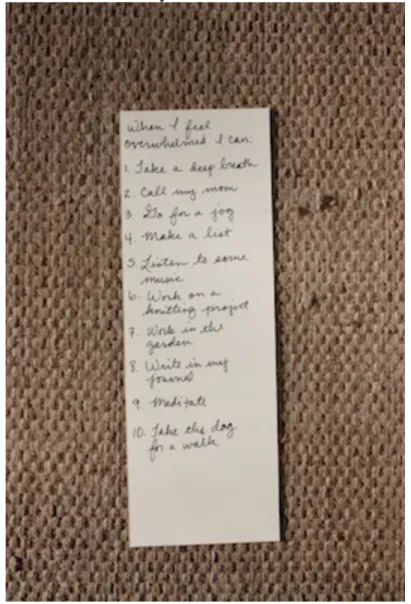
3. Now, make a list of a few things you can do when you feel overwhelmed. You could take a walk, call a friend, clean the house, listen to some music, or things like that. You will write or stamp this list on the back of your bookmarker.
Figure 4 The back of the bookmarker has a list of things to do when feeling anxious.
4. You can decorate your second bookmarker with a different design. You can write or stamp a quote that inspires you.
You can use your bookmarkers while reading. Or, you could carry them in your bag and look over them when you’re feeling anxious.
Appendix D Materials for Module 4
The materials below include the educational information sheet, literary activity and art activity instructions. When printed, the educational information sheet fills a single sheet of paper.
Parenting Philosophies: What Kind of Parent Will You Be?
Purpose: This sheet will tell you about different types of parenting.
What plans do you have for yourself after your baby is born? Many moms have a
certain way they want to raise their baby. A parenting philosophy is a set of ideas
about the way a person should raise her child. An example of a parenting
philosophy is “Attachment Parenting”. With attachment parenting, parents think
the bond formed between parent and child has important life-long meaning. The
parents try to be sensitive and available to their children. The chart below lists
some parts that make up different parenting styles. Often parents combine styles.
You can make a unique parenting style. You can pick and choose the parts that are
important to you.
Different Parts That Make Up Parenting Styles
Decision Making: Who makes the decisions in the family? Should the child make any decisions?
Control: Does the parent make the rules and demands? Does the parent explain the rules to the child?
Involvement: Is the parent involved in the child’s life? How much attention does the child get? Is the child the center of attention in the family?
Acceptance: Is the parent warm and responsive? Does the parent like to give the child whatever he or she wants?
Whose Job Is It?: Is the work shared equally between all adults? Whose job is it to raise the child?
Discipline: When your child does not follow the rules, what will you do?
Want to learn more? Here are some online resources that are
helpful:
• Attachment Parenting http://www.askdrsears.com/topics/parenting/attachment-‐
parenting
• Our Bodies Ourselves http://www.ourbodiesourselves.org/
• Mothers and Caregivers Online Resources
http://www.now.org/issues/mothers/resources.html
What Kind of Parent Do You Want to Be? Creating a Parenting
Philosophy.
Purpose: This sheet will help you to design a personal parenting
philosophy.
Think about the people who raised you when you were child. What kinds of things
did they do to help you grow? What kinds of things do you wish they had done?
Now think about your baby. What kinds of traditions do you want to pass on?
What kind of values do you want your baby to have? This sheet will help you write
about the kind parent you want to be.
What Kind of Parent Do You Want to Be? Creating a Parenting
Philosophy.
In our family, the main values we try to live by are:
_________________________________________________________________
__________________________________________________________________
_________________________________________________________________
__________________________________________________________________
__________________________________________________________________
As a mother, I would like to teach my baby ____________________________
__________________________________________________________________
__________________________________________________________________
__________________________________________________________________
__________________________________________________________________
My parenting philosophy means that every day I will remember this about
Parenting Your Baby: Make A Cheerful Sun-catcher
Purpose: This paper will tell you how to make a cheerful sun-catcher
for your baby.
When you are finished with this art project your sun-catcher will look like this.
Figure 5: You will make a sun-catcher like this one.
To start, get the plastic bag with the sun-catcher supplies in it. You will need the
yellow and the orange sun papers. You will also need the two pieces of sticky
plastic papers. You will need your alphabet stamps, inkpad, and your scissors, too.
Figure 6 You will stamp words on your yellow sun paper.
In the picture above, I used:
•
Courage
•
Humor
•
Determination
•
Empathy
•
Integrity
•
Gusto
2.
Use the alphabet stamps and your inkpad to stamp the words on your
yellow sun paper. If you do not want to stamp the words, you can write
them in pen or marker.
Figure 7 Plastic sticky paper has a shiny side and a sticky side that is covered by the white waxy paper.
Peel off the white waxy paper from the back of the sticky paper. Put the
paper on your table so the sticky side is toward the ceiling and the shiny
side is touching the table. Put your sun papers on the sticky paper. Put the
yellow sun with the words point down toward the paper. Next put the
orange paper on top of the yellow. It will look like the picture below.
4.
Now you will make the sun face. First put down two black circles inside of
the sun’s center. The black circles are the sun’s eyes. Then put down two
pink tissue paper circles on the sticky paper to make the sun’s cheeks. Then
you put the black string from cheek to cheek to make the sun’s smile. Your
sun will look the like the picture below.
Figure 9 Make the sun's face in the center of the circle.
Figure 10 The sun's face is covered with tissue paper bits.
6.
Now you will use the second piece of sticky paper. Peel off the white waxy
paper from the plastic sticky paper. Cover your sun with the sticky paper
so that the sticky paper points towards the table and the shiny side points
toward the ceiling. The sun will be sandwiched between the two sticky
papers. Smooth out your project.