between the amount of spam received after registering in different
websites. A Master’s Paper for the M.S. in I.S. degree. April, 2005. 28 pages. Advisor: Robert Losee
Some web sites require registration in order to use their free services. But is this really free? The goal of this paper is to describe an experiment that was conducted to explore the relation between registering in different websites and the amount of junk emails received. The whole experiment was divided into three periods and the collected data from them was compared. The paper contains also an analysis of the results and
recommendations for the users on how to avoid or at least limit the spam in their mailboxes.
Headings:
Spam
THE AMOUNT OF SPAM RECEIVED AFTER REGISTERING IN DIFFERENT WEBSITES
by
Dragomir V. Dimitrov
A Master’s paper submitted to the faculty of the School of Information and Library Science of the University of North Carolina at Chapel Hill
in partial fulfillment of the requirements for the degree of Master of Science in
Information Science.
Chapel Hill, North Carolina April 2005
Approved by
Table of Contents
Introduction...3
Table 1...5
Literature Review...7
Methodology...11
Table 2...13
Results and Analysis...14
Figure 1...15
Table 3...16
Figure 2...17
Figure 3...18
Figure 4...19
Conclusion...20
Further Research...21
Recommendations...22
Limitations...24
Introduction
It was the fall of 1971 when Ray Tomlinson, a Principal Scientist at BBN Technologies (http://www.bbn.com), sent the first email
message in his Cambridge MA lab. He used a program called CPYNET to send the message between two physically connected computers. Tomlinson also used for the first time the “@” sign to separate
username from host name in mail addresses. It took almost two decades to see the proliferation of this service. Nowadays email services are probably the most used form of communication. The people use emails to communicate with their friends, colleagues and relatives. The
advantages of the email are well known [1]. This is usually a free service, very fast (emails usually reach their destination in a matter of minutes or seconds.) and accessible from everywhere and any time, even through cell phones. Although there are several email providers who offer options for additional payable services, such as larger
choice. In comparison to the telephone, this is a great way to not interrupt people especially these in other time zones. A user can send an email to multiple people or to a group with just a few clicks. An email message can contain not only text, but also pictures, audio, video or other types of files. Some email providers offer encryption of the emails in order to protect the content of the messages from malicious people. Emails also offer other useful features as forwarding messages, keeping address books, anti-virus scanning, check spelling and spam filtering.
Nevertheless the email is not perfect. Emails can compromise the security of an organization because sensitive information can be easily distributed accidentally or deliberately. There are also access constraints – hardware, software or Internet. Security is low in email
“Unsolicited "junk" e-mail sent to large numbers of people to promote products or services. Sexually explicit unsolicited e-mail is called "porn spam." Also refers to inappropriate promotional or commercial postings to discussion groups or bulletin boards” [3]
In today’s business world, product advertising is of major
importance. Businesses use a vast array of advertising methods, such as television, radio, newspaper, Internet, emails. One of the features of the electronic mail, the possibility to send one message to large amount of people, facilitates spammers. They used this free service to overflow our mailbox with different kinds of advertisement. Table 1 presents a list of types of spam distribution [4]:
Money making opportunities 35%
Adult entertainment 11%
Direct marketing product and services 10% Informational and how-to guides 9% Internet services, computer hardware and software 7% Other products and services 25%
Non-commercial 3%
Email is a free service for the sender, but the recipients pay the bill. Spammers use automatic software, with prices varying from $100 to $600 [5]. Since there is no “free lunch” someone has to pay the cost. Internet services providers implement spam filtering programs, which cost money, bandwidth to deal with high volume Internet traffic and staff to cope with problems caused by spam. Regular users spend time to set filters, download, read, and delete messages and submit
complaints. Their privacy is also endangered.
There are a lot of studies dealing with the actual price paid by the user and ISPs. Computer Mail Services has created a calculator that projects the cost of spam:
“It shows that a company with 500 employees, each of whom receives five junk e-mails per day and spends about 10 seconds deleting each one, can expect to lose close to $40,000 per year in wasted salaries and 105 days in lost productivity” [6]
A study conducted in 2001 from the European Union calculated spam costs to be about $8.6 billion a year worldwide. Nowadays, 50 to 80 % of the emails are spam and this cost is even higher. Therefore it is very important to find ways to limit spam. In order to fight against spammers, we first have to identify its sources. Spamhouse.org
States ratified CAN-SPAM [8] act on January 1, 2004 it is interesting that about 75% of these website are operating in the United States. The battle with spammers will be really tough, but there is a real chance that email will be overwhelmed and subsequently discredited as a method of communication. Some studies claim that because of the spam, users decrease their email usage. That is why it is so important to limit the amount of unsolicited junk emails. The next source of spam is hackers who break into innocent people’s computers using high bandwidth connections and hi-jack processing power and resources to send spam.
Literature Review
The article is related to my experiment, because it presents
interesting history information about the proliferation of the spam. It is necessary to explore the beginning of this problem and the idea behind sending spam. The understanding of the principles which spammers use to send emails would help in creating more reliable filters. The article also provides a very interesting data analysis about the content of the spam emails in the period of March – May in 1997. Although it may seems that this analysis is a little bit obsolete, in such fast
developing sector as Internet, it carries valuable data for the content of the spam. Probably a contemporary study will give similar results about the distribution of the spam categories. The article describes a study about the number of spam messages received regarding the day of the week. It concludes that there was a decrease in the number of emails received during the weekends and major holidays. The authors of the study describe also how the automated spam filters works. They mention
• filteringsolutions, • counterattack solutions • opt-out lists
• referral networks • fee restructuring.
The next item is a research article titled named “Why Am I Getting All This Spam?” [9]. This article was published in March, 2003. The initiator of the study is the Center for Democracy and Technology. They wanted to determine what the sources of spam are. To do so, they set up hundreds of different e-mail addresses and then waited six months to see what kind of mail those addresses were receiving. They found out that the vast majority of the spam received, over 97% of it, was delivered to addresses that had been posted on the public Web and public postings to Usenet newsgroups and forums. This statement was proved by an experiment, in which they removed some of the email addresses “in order to determine how long an e-mail address, once placed on the public Web, would continue to receive spam after its removal”. The outcome is a significant decrease in the number of spam received. The instigators also proposed some valuable tips in order to avoid the receiving of spam. The authors of the study registered their emails in over 30 well – known websites, such as amazon.com,
to third party companies. This has to be a red light for the people and force them to have multiple addresses for different web services.
Since the spam became one of the biggest computer annoyances, the United States Senate issued CAN-SPAM Act of 2003 (Controlling the Assault of Non-Solicited Pornography and Marketing Act). The law requires, among other things, that recipients be allowed to opt out of being included in a marketing mailing list, simply by clicking a link on an e-mail notice from the business companies. In addition, the CAN-SPAM Act establishes harsh penalties for senders whose e-mail
Next article is “Should spam be on the menu”, published in
Communications of the ACM by J. Sipior et al in 2004 [11]. The motto of
the article is “Email marketing is an excellent, low-cost way to reach consumers, but spammers are currently looting much of its potential”. The authors describe the history of the spam and point out that the first spam was sent in 1975. 1994 is the year of the start of the real
proliferation when the law firm of Cantor and Siegel spammed more that 6000 Usenet newsgroups. The authors also affirm that about 60% of all Internet email is spam, which leads to about 25% decrease in email usage. They make several recommendations for dealing with spam: using opt-in lists and labeling emails with ADV and ADV-ADULT, which comes from advertisement and adult advertisement. This would facilitate spam filtering programs, but the question is “Are spammers willing to include these amendments?”
Methodology
The research question, which I would like to explore, is “What will be the amount of unsolicited message a user will receive if
addresses. Though spam could be received not only from websites but also from individuals in my study, I concentrated in websites as sources of spam. I created 30 emails using Yahoo mail service and registered each of them in 30 different websites. I wanted the name of the accounts to be in unison with my project, therefore I named them
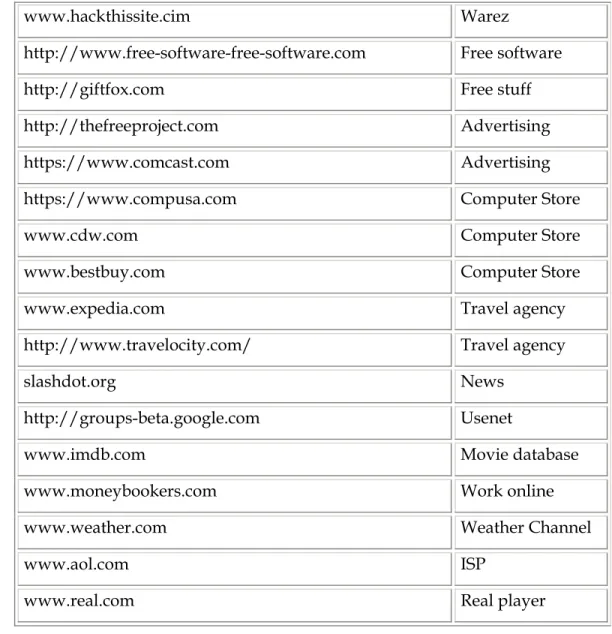
[email protected], where XX is from 01 to 30. Yahoo offers a pretty big amount of space (250 MB), so there is no danger to run out of space. In addition, it is expected to increase this space to 1 GB in April. I choose a wide variety of web places. Table 2 shows the full list of websites and their category distribution:
http://riseofchaos.com/index.php Gaming
https://www.pokerroom.com Gaming
www.playapal.com Gaming
http://freedom.qfetbays.biz/SendForm/sendform.aspx Mortgage
http://freedom.poepneat.biz Mortgage
www.dating.com Dating
www.match.com Dating
http://www.beted.com/default.aspx Betting
http://www.freelotto.com Gambling
www.gambling.com Gambling
http://www.grandonline.com/welcome.php Gambling
http://www.easywarez.com/ Warez
www.hackthissite.cim Warez
http://www.free-software-free-software.com Free software
http://giftfox.com Free stuff
http://thefreeproject.com Advertising
https://www.comcast.com Advertising
https://www.compusa.com Computer Store
www.cdw.com Computer Store
www.bestbuy.com Computer Store
www.expedia.com Travel agency
http://www.travelocity.com/ Travel agency
slashdot.org News
http://groups-beta.google.com Usenet
www.imdb.com Movie database
www.moneybookers.com Work online
www.weather.com Weather Channel
www.aol.com ISP
www.real.com Real player
Table 2. List of the websites and their category
In order to be representative I used one account in only one website. I tried to choose a wide variety of websites to determine which category is most “dangerous”. My suggestion is that probably
one of the places, from where spammers get our email addresses. They use software robots to scan Internet web pages and collect email
addresses. I selected several web sites of big companies that have good reputation, but could be possible spam-senders: Weather.com,
Real.com, Imdb.com and Aol.com.
Results and analysis
The purpose of the experiment I made was to check what will be the amount of spam received when registered in different websites. There is a contradiction what exactly spam is. Some people claim that spam is every unwanted message they received. Others prefer to receive emails with promotions and special offers from the business companies. They do not qualify this as spam and often use these messages to buy products. Therefore, it is quite difficult to distinguish spam from emails that could be in benefit for the users.
months is not enough to create general conclusions, but at least will provide patterns of what can be expected further.
I created a chart for each of these months and the February’s data is presented in Figure 1.
February 1, 2005
0 1 0 2 2 1 3 6 1 5 60 3 1 3 3
15
1 1 3 5 5
8
0 0 2 6
2 1 4 1 0 10 20 30 40 50 60 70 http ://ris eofc haos .com /inde x.ph p http ://w ww .bet ed.co m/def ault.a spx http ://free dom .poepn eat.b iz http ://w ww .grand online. com /wel com e.ph p http ://w ww .weat her .com http: //www .ao l.co m/ http ://w ww .real .com / ww w.d atin g.com http ://w ww .free -sof twar e-fre e-so ftwar e.co m https ://w
ww.p oker roo m.c om http ://w ww .free lotto. com http s://ww w.co mpu sa.com http ://the freepr oject .com ww w.m atch. com ww w.ga mblin g.com slas hdot .org ww w.imd b.co m ww w.ex pedi a.co m http ://w ww .trav eloc ity.co m/ http ://w ww .easy ware z.com / http ://g roup s-be ta.g oogl e.co m ww w.h ackt hiss ite.ci m ww w.c dw.c om ww w.be stbu y.co m ww w.pl ayap al.c om http ://fre edo m.q fetb ays .biz /Send Form /sen dfo rm.a spx http ://giftfo x.com http s://w ww .com cast .com ww w.m oney boo kers.c om http ://w ww .org site s.co m/fl /hac ker/i ndex. htm l
Websites where email address was placed
N u m ber of em ai ls
Figure 1. Number of emails received in the period January 15 - January 31
My suggestion before performing the experiment was that websites offering free products (iPods, hardware, software
sources of spam. In this two-week period I received total of 145 emails. The diagram shows an uneven distribution. There is an obvious leader – Freelotto.com. They sent 60 emails, which are 41% of the total number of spam during this period. The second place in the chart is for
Slashdot.org. However, the emails sent by them, were not exactly spam but electronic newsletters. Everyday, they send a message to the people registered in their website, containing a newsletter and headline mailer with the news related to the Information Technology area. These emails comprise useful information especially for people interested in the Internet, information security and politics. There are no significant trends in the amount of emails received from other websites, but I have to mention that there were four “good” websites, that did not send a single email (Table 3):
riseofchaos.com Gaming
freedom.poepneat.biz Mortgage
www.cdw.com Online store
www.bestbuy.com Store
Next counting I made was on March 1, which includes the period from January 15 to February 28. The graphical representation of the data is in Figure 2.
March 1, 2005
0 3 0 3 2 1 6 25
1 12
186
10 3 4 9
35
2 1
9 9 6 13 0 0 6
15 2 4 11 1 0 20 40 60 80 100 120 140 160 180 200 http ://ris eofc haos .com /inde x.php http ://w ww .bet ed.c om /def ault.a spx http ://fre edo m.p oepn eat.b iz http ://w ww .gra ndon line.c om/ welc om e.php http ://w ww .weat her.co m http ://w ww .aol .com / http ://w ww .real. com / ww w.da ting. com http ://w ww .free -sof twar e-free -sof twar e.co m http s://w ww .pok erroom .com http ://w ww. freel otto. com http s://w ww .com pusa .com http ://the freepr ojec t.com ww w.m atch .com www .gam bling .com slas hdot .org ww w.im db.c om ww w.ex pedi a.co m http ://w ww .trave loci ty.c om / http ://w ww .eas ywar ez.co m/ http ://gro up s-beta .goo gle. com ww w.h ackt hiss ite.cim ww w.cd w.com ww w.be stbu y.com ww w.pl ayapa l.com http ://fre edo m.q fetb ays .biz/ Send Form /sen dform .aspx http ://g iftfo x.co m http s://w ww. com cas t.com ww w.m one ybook ers.c om http ://w ww .orgs ites .com/ fl/hac ker /ind ex.ht ml
Websites where email address was placed
N u m b er of em ai ls
Figure 2. Number of emails received in the period January 15 - February 28
Slashdot.org holds the second place with 9% and the third is for Dating.com. The four sites that did not send spam in the first period, kept their behavior and I did not received emails from them. There are ten websites with no change in the number of sent emails, including the four “good” mentioned earlier.
The next period, for which I collected data, is from January 15 and April 1 – Figure 3. There were not any big or surprising changes. The top three senders kept their positions. Freelotto.com doubled the amount of emails, totaling 339 for the whole period. During the
April 1, 2005
0 5 0 6 6 1 11 56
1 26
339
15 4 6 16
92
3 1 19 14 17 34
0 0 10 26 2 8 20 1 0 50 100 150 200 250 300 350 400 http ://ris eofc haos .com /inde x.ph p http ://w ww .bet ed.c om /def ault.a spx http ://fre edo m.p oepne at.bi z http ://w ww .grand online. com /welc om e.ph p http ://w ww .wea ther .com http ://w ww. aol.c om / http ://w ww .real .com / ww w.da ting. com http ://w ww. fre e-softwa re-fr ee-sof twar e.com http s://w ww .pok erro om .com http ://w ww .free lotto. com http s://w ww .com pusa .com http ://the freepr ojec t.com ww w.m atch .com www .gamb ling .com slas hdot .org ww w.im db.c om ww w.ex pedi a.com http ://w ww .tra velo city. com/ http ://w ww .eas ywar ez.com / http ://gro up s-beta. goo gle.c om www .hack thiss ite.c im ww w.c dw.c om ww w.bes tbuy. com ww w.p layapa l.com http ://fre edom. qfet bay s.bi z/S end Form /sen dform .asp x http ://gi ftfo x.com http s://w ww.c omca st.c om ww w.m oney boo kers .com http ://w ww .org site s.co m/fl /ha cker /index .htm l
Websites where email address was placed
N u m ber of em ai ls
Figure 3. Number of emails received in the period January 15 - March 31
messages. The chart showed that Freelotto.com has sent 45% of all emails. Slashdot.org continued to send me their newsletters – 92 for the whole period. Dating.com is again on the third place with 56 emails. I registered one of the accounts in Google’s newsgroup, which is a Windows XP forum. The actual number of emails was 221, but I classified only 17 of them as spam. The others are questions and answers from the members of that forum. According to the data
or request for email verification. Therefore these ten websites could be qualified as safe places.
The websites I choose can be distributed into ten categories. It was interesting to find out, which of then is the biggest spam - generator. Figure 4 represents this distribution.
Total distribution by categories
62 42
360
92
20 17 52 15 7 54 18
0 50 100 150 200 250 300 350 400
dating gam ing
gam blin
g new
s
trav el a
genc y
usenet hacker s
onl ine s
tore
free s oftwa
re
mar ketin
g other
Categories
N
u
m
b
er
of
em
ai
ls
Figure 4. Total distribution by categories
With 360 emails, gambling is on the top, which is about 49% of all spam. 339 of them came from Freelotto.com. Next category is the news. The major part of these 92 emails is the newsletters sent by
conclude from this number that we can get viruses, Trojans and other malicious programs from hackers, but not so much spam.
Conclusion
Email marketing became a cheap and effective way for advertising services and products. It can efficiently reach a target market with personalized communication, at a cost lower than any other alternative media. This paper describes an experiment in which I registered 30 email accounts in 30 websites. My idea was to find out which of these websites are most dangerous in terms of sending spam. The results showed that gambling sites sent about 50% of all spam that I received. In general, these emails contained “free offers”, financial services and money - making opportunities.
The conducting of this experiment is important, because it tried to distinguish good from bad websites. The users will know which
websites are safe to register and which ones to avoid. As the results demonstrated, there are about ten websites that can be classified as good and other nine, with more than 20 emails, as spam-senders.
Email is a low cost, convenient, fast and relatively reliable service that facilitates our work and life. It is an irreplaceable way of
proliferating of the spam jeopardizes it as service. The users spend money ant time to get rid of this annoyance. The business world lose big amount of money dealing with spam, money that could be used for innovations, investment or development. Thus, must be found effective way to restrict spam propagation.
Further Research
This experiment was limited in time. It lasted only two and half months. The data collected, probably is not enough for making general conclusion and establishing patterns. That is why this experiment could be expanded for a longer period of time – one or two years. The
increasing the amount of observed websites would help for collecting more exhaustive data as well. The CAN-SPAM act requires from
websites to include unsubscription or opt-out option. Other direction, in which this experiment could continue, is attempting to unsubscribe from these websites and investigating the effect of this action. I will continue to watch the behavior of these sample websites further. It will be interesting to find out what will be the ratio between the big
Recommendations
There is a growing concern that the volume of the spam sent each day may increase significantly, even “kill” email as service. This is probably the worst scenario about electronic services. Understanding how spammers get our email addresses and what can be done for our protection, definitely will make our life easier.
The modern Internet society started to battle against spam-senders, by using spam-filtering program, government acts and teaching users how to avoid spammers. Recently in Leesburg, VA a man was convicted in the nation’s first felony case against illegal spamming and was sentenced to nine years in prison for “bombarding Internet users with millions of junk e-mails” [12]. This case classifies spamming as a crime which becomes a precedent that would hopefully mark the beginning of a decrease in the number of spam in our
mailboxes. But the most helpful action is self-protection. There are several precautions that the user can follow in order to defend from aggressive advertisements. The most important are to
• Be careful about disclosing email address and keep their primary
addresses only for people they know
• Review the privacy policies of websites to make sure that they do
parties. Probably this is the last thing that a user will read, but it is important to check for hidden clauses
• Block images which spammers can use to confirm their email
address
• Be very careful when publishing email addresses in news groups,
chats and forums
• Disguise email addresses posted in a public place. For example
using name at domain dot com instead of [email protected]
• Use multiple email addresses for different purposes – emails only
for well-known people, such as friends, relatives and colleagues, and other for registering in websites, web postings and electronic commerce
• Use longer email addresses – spammers exploit software robots
for sending spam and guess our emails. They use a method called dictionary attack to find valid addresses. The longer and
complicated names we create, the less spam we will get
• Install anti-spam filters. Although they are not perfect and have
some weaknesses, they could decrease significantly the amount of spam in our mailboxes.
“nearly a third of e-mail users have clicked on links in spam
messages” and “one in ten users has bought products advertised in junk mail” [13]. These numbers are really disturbing and could explain the proliferation of the spam. The people should be educated about the troubles related to email as service. They could get not only spam messages, but also could be target of phishing or scamming.
Limitations
During the experiment, I had several problems such as defining what exactly spam is. Some people could find a message that advertise a product, service or promotion as helpful, but other as a big
annoyance. I tried to classify a message as spam if it contains one or more of the well-known spam words or the advertisement was too aggressive [14].
References
1. Berghel, H. (1997). Email – the good. The bad, and the ugly. Communications
of the ACM, 40(4), 11-15
2. http://www.m-w.com/cgi-bin/dictionary?book=Dictionary &va =spam
3. http://www.getnetwise.org/glossary.php#S
4. Cranor, L.F., & LaMacchia, B.A. (1998). Spam!. Communications of the ACM,
41(8), 74-83
5. dir.yahoo.com/business_and_economy/business_to_business/
marketing_and_advertising/direct_marketing/direct_email/software/
6. ww.businessweek.com/technology/content/mar2002/tc2002031_8613.htm
7. 200 Known Spam Operations responsible for 80% of your spam.
http://www.spamhaus.org/rokso/index.lasso
8. http://www.ftc.gov/bcp/conline/pubs/buspubs/canspam.htm
9. Center for Democracy & Technology (2003) Why Am I Getting All This
Spam. http://www.cdt.org/speech/spam/030319spamreport.shtml
10. Spring, T. (2005) Spam Law Test. http://www.pcworld.com/news/article
/0,aid,118702,pg,4,00.asp
11. Sipior, J.C., Ward, B.T., & Bonner, P.G. (2004). Should spam be on the
menu? Wireless sensor networks, 47(6), 59-63
12. Spammer sentenced to 9 years. http://msnbc.msn.com/ID/7432555