Elise D Moore. Towards a Common Schema in Distributed Humanities Research. A Master’s Paper for the M.S. in I.S degree. July, 2010. 91 pages. Advisor: Stephanie Haas
As humanities scholars move from creating traditional scholarly publications to creating online collaborative research projects they have begun to realize the need for a common vocabulary or schema to describe their domains. This paper explores the study of moviegoing and the process of creating a schema to describe the field of moviegoing. The purpose is to involve scholars focused on different aspects of moviegoing in schema development so that they might be able to begin their research with this core schema, and share their research with each other using this schema as a crosswalk. Ten different moviegoing scholars were asked to participate in a Delphi study to help define the field of moviegoing for future research and analysis. The iterative process of a Delphi study allowed me to collate the thoughts of experts from around the world. It is hoped that the creation of an after-the-fact schema for existing.
Headings: Schema.
Delphi Method.
Collaborative Humanities.
TOWARDS A COMMON SCHEMA IN DISTRIBUTED HUMANITIES RESEARCH
by Elise D Moore
A Master’s paper submitted to the faculty of the School of Information and Library Science of the University of North Carolina at Chapel Hill
in partial fulfillment of the requirements for the degree of Master of Science in
Information Science.
Chapel Hill, North Carolina
July 2010
Approved by
_______________________________________ Stephanie Haas
Introduction
“One of the major strengths of the World Wide Web is that virtually everyone who owns a computer may contribute high-value information - the real
challenge is to make valuable information be found.” (Staab, et al., 2000, p 1)
The World Wide Web is more than a place to search for people and things; it is a
place where scholarship and information are published quickly, cheaply, and in new
ways. More and more humanities scholars are looking at online technologies and
collaborations as potential spaces for scholarship. Humanities scholars have been
much slower than their counterparts in science to utilize online collaborations in their
scholarship, but they seem able and willing to adapt new tools if they are useful
(Baruchson-Arbib and Bronstein, 2007). Work in the humanities has traditionally
been a solitary endeavor, however with digital technology providing new ways to
present, sort, and view information (spatially, relationally, aggregated, etc.), the
humanities field seems to be ready to participate in online, collaborative projects.
The traditional model of humanities scholarship entails long hours in libraries and
archives researching with primary source material and producing papers, books, and
journal articles, which are, in a sense, a synthesis and extension of the materials that
have been uncovered and identified. These papers are then submitted to
peer-reviewed journals in hopes that other scholars will find the paper valid and confirm
journal article, many humanities scholars are now creating digital collections. Digital
collections are collections of digital materials, curated much like a museum exhibit,
with the researcher’s arrangement and description building the perspective. By
creating digital collections, a scholar has the opportunity to bring together vast
amounts of “uncovered” primary resources to illustrate and further expand his/her
research and scholarship. With the use of digital surrogates, a scholar is able to put
together material that may be housed in disparate locations and make them available
to people around the world. By creating digital access to these materials, the scholar
has the opportunity to engage other scholars in related fields who might not otherwise
have been aware of these resources, as well as other potentially interested audiences.
In order to bring materials online and provide an easy way to search and browse, the
digital objects need to be described and a database needs to be created. A database is
a structured way to organize information and relationships. This structure is needed in
order to perform queries on the data and to facilitate multiple ways to browse and
search the content. However, defining a field of study in the humanities through use
of a database would formalize the nature of the field in a way that humanities scholars
have not necessarily thought about before. (Frenkel, 1991, p 53) Formalizing domains
that had traditionally have been studied through abstract concepts by individual
scholars pose new sets of questions for scholars. Abstract concepts allow for
flexibility in definitions, which has allowed for scholars to craft their various
interpretations of ideas. However databases and schemas ask that the scholars not
group collaboration they need to define these concepts together, with scholars who
might have slightly different perspectives on the subject
Many of these digital projects have been, and continue to be, curated and published
by museums, libraries, and scholars. These projects are often the product of years of
research and many hours of undergraduate and graduate labor to collect, catalog, and
present the materials online. Due to different funding sources, support networks, and
affiliations, these projects are often developed independently of similar work done by
their colleagues. The complex databases behind these projects make integrating data
from multiple databases at a later point very difficult. When scholars want to merge
data from their projects, differences in how they have defined terms become
problematic. Consider the size of a movie theater. A researcher studying early cinema
might call a movie theater that is larger than 300 seats large, however in modern
times this is a very small theater. Usually researchers look at data through the lens of
what they are studying, and often dismiss a more universal view, because it is not
important to their research.
As is shown in the rise of massive online collaborations such as Wikipedia and huge
group undertakings like the Human Genome Project, a collection of people can create
something much larger than any one person. A scholar who works alone to build a
digital collection often locks valuable sources inside a closed and usually narrowly
focused database specifically designed for a single project and purpose, isolating
from different databases to be linked together without losing meaning, there needs to
be some common definitions or ideas by which to connect the data together
(Rosenthal, et. al., 2004). There are many different ways one could define or
formalize the representation of an idea, depending upon one's particular interest. For
example, to someone studying film, a movie theater may be any place in which a film
is shown, perhaps because of a focus on the cultural influence the film may have had.
However, for the field of moviegoing scholars, a movie theater is very specifically a
public place in which films were shown, perhaps because they are more interested in
the space as a cultural force, and not the movie itself. By gathering related scholars
and projects into “community of interests” (COI), there is a higher chance of being
able to develop the generalized definitions needed to make the data interoperable,
while maintaining their utility for research (Martin and Groh, 2001). By querying a
group of scholars who study specifically the field of moviegoing, I hope to define a
core group of terms, definitions and tags that are broad enough to apply to each
participant’s research, but still specific enough so that there could be a benefit in
using this schema as a tool to exchange data across collections.
Background
“Going to the Show” (http://docsouth.unc.edu/gtts/) is a digital library project hosted
at Documenting the American South, University of North Carolina, Chapel Hill,
which was launched in the summer of 2009. The project was guided by Dr. Robert C.
Allen, whose research focuses on the experience of moviegoing in the early 1900s in
controversial movies, protests, race issues, and all sorts of related information, which
could be interesting to people studying other aspects of movies, theaters, city
development, moviegoing, urbanity, etc. This collection connects content from North
Carolina in new and innovative ways by digitizing and creating a searchable
relational database, as well as a mapping interface for exploring the content. The
database is focused around the idea of a “venue”, being a place where movies were
shown. A venue can be any type of building where movies where shown. Venues
have specific attributes, and are related to companies, people, and primary sources.
The primary sources include records in the Film Daily Yearbook, articles from local
newspapers, architectural blueprints, postcards, and photographs. The project was
able to link to other already existing content on the web, as well as bring together
digital copies of content from all over North Carolina. However, it is still a closed
collection, which sits on the servers at the University of North Carolina, and can not
be easily combined with other databases or projects about related subjects.
During the course of creating the database for “Going to the Show”, other projects
related to moviegoing (See Appendix 1: “Going to the Show” Experts Meeting) were
identified. The scholars involved in these various projects were invited to a day-long
workshop (See Appendix 2: “Going to the Show” Experts Meeting Schedule) to
discuss the domain of moviegoing. During the workshop, we covered some of the
decisions that were being made to define the “Going to the Show” database, and
asked for input from the scholars so that we could begin to define our data in a way
Each of these scholars approached the domain of moviegoing within their digital
projects from slightly different angles, often due to the specific interest of their lead
scholar, but other times due to technological constraints or choice of tools. For
example, Jeff Klenotic, a professor from the University of New Hampshire, described
his “moviegoing database” to the group, which was run entirely on his computer in an
instance of ArcGIS. He had taken a GIS class at NASA, and began using the tool for
the research of moviegoing in New Hampshire. ArcGIS is a very extensive GIS
package, which allows him to do complicated spatial analysis, which many of the
other projects did not focus on.
The scholars invited to the discussion were very interested in finding a way to share
their data with each other. The overlap they recognized suggested that it would be
useful to explore ways of importing and exporting data between projects in order to
allow comparison and other types of analysis. For example, Jeff Klenotic, who was
also planning research in New Hampshire similar to that of “Going to the Show”, was
very interested in the comparison of movie theaters in similar sized cities. Being able
to combine his research in New Hampshire with that of “Going to the Show” in North
Carolina might allow him to reach broader conclusions than would be possible with
only his own research. In order to merge data together from various sources, concepts
and relationships need to be mapped to similar concepts and relationships. The
database schema represents these relationships and the data elements within the
schema, or the terms represent the concepts. A schema in psychology is a mental
structure of a database system described in a formalized language. The data elements
within the schema are defined in both technical terms and conceptual terms.
Research Questions
The overarching research question I seek to answer is “What challenges arise when a
community of interest tries to create a common schema to facilitate the aggregation of
information?” Specifically, I am examining concepts and vocabulary needs of the
domain of moviegoing as well as the schema, or relationships among these concepts.
Importance of Study
While the ideal approach would be to create a common schema and terminology for a
Community of Interest from the beginning (Rosenthal, et. al. 2004), this is not always
possible. Scholars in the humanities are moving from individual research projects to
larger online collaborative projects and the possibility of combining their research
could produce interesting results and juxtapositions.
When creating a database, one must define the data model, or schema that is to be
used. This data model is the organization of various concepts and their relationships
to each other. If all of these scholars could work within a shared schema, comparison
of data would be easier. Using the same database, or at least parallel development of
projects could have allowed the scholars to develop a shared data model from the
start. However, as mentioned before, varying funding, timing of projects, proximity
of the scholars and other resources has guided their development of separate
In this study, I asked the members of this scholarly community themselves to help
define a base level of terminology or definitions within the field of moviegoing, in
order to be able to effectively share data across collections in a way that would still be
useful for their research.
What is the landscape?
A “Community of Interest” is a community of people with a shared interest or
passion, and is one way to provide a common ground even if other organizational
aspects are lacking (Rosenthal, et al. 2004). The community of moviegoing scholars
is a good example of a group with a shared interest but with no overarching
organizational structure in place.
In Rosenthal, Seligman, and Renner’s paper “From Semantic Integration to Semantics
Management: Case Studies and a Way Forward”, the authors explore the shift from
after-the-fact semantic integration to managing the semantics of a system from the
start. After a few years of trying to create a single data model for their entire
company, they realized that this task was too herculean, as there were too many
different focal points to be able to create a realistically usable model. They state that
although a single data model might seem most ideal, they have learned through
previous experiences that semantics should be managed “within communities of
interest (COI) rather than standardizing data elements across the entire department”
According to Rosenthal, et al. (2004):
“… we must go beyond after- the-fact semantic integration among existing systems, to actively guiding semantic choices in new ontologies and systems – e.g., what concepts should be used as descriptive vocabularies for existing data, or as definitions for newly built systems.” (p. 44)
Despite the differences in how researchers have begun to describe their domain
through databases and schemas, the specialized nature of this domain (moviegoing),
seems to be fertile for the development of a shared ontology and detailed data
concepts. Bringing this type of data together from different projects with varied focus,
and interests, relies upon a common understand of core terms, definitions, and
concepts which are of interest cross-collections.
Lessons to learn from the Sciences
The history of the Human Genome Project1 provides an example of how independent
researchers with shared interests worked together as a community of interest to
accomplish their shared goals. In the early 1990s, according to computational
biologist Tom Marr, of the Cold Spring Harbor Laboratory in New York:
“Biology [was] in a phase in which it's going from small, single-laboratory investigators into the computer age because instruments are pushing it.” (Frenkel, 1991, p 45)
One of the first big questions with the Human Genome Project, much like the
questions driving this project, was how to create a shared data model to encompass
data from pre-existing projects. Before the project was envisioned labs defined
relationships between elements as suited their needs for the individual projects they
were working on. It was soon discovered that it was not a common data model
between projects which matters when moving to merge databases, but the concepts
which are used need to be common across all of the databases (Frenkel 1991, p 50).
Genome sequencing began in small labs, which were attempting to understand one
particular part of the genome in order to develop new medicines or further
understanding into a particular medical problem. With private financing this was the
most logical approach, however “…the cost of finding individual disease genes, one
at a time, is often staggering” (Cantor, 1990, p 51). In the mid 1980s the Department
of Energy (DOE) and the National Institute of Health (NIH) separately began
pursuing the goal of mapping the entire human genome. After a “14-month-long
deliberation [that] led to a unanimous report, which urged the United States to begin
the Human Genome Project and to work cooperatively with other nations who wished
to jointly pursue the common goal” the DOE and the NIH combined their resources
and began the Human Genome Project (Watson, 1990, p 45). The Human Genome
Project (HGP) contained geneticists from the United States, United Kingdom, France,
Germany, Japan, China, and India. The HGP began by laying out a plan to move
forward with the project, focusing on how to merge already existing data, in order not
to re-map any part of the genome that had already been identified. Beyond combining
existing data, the HGP planned the mapping of the remaining parts of the genome.
It was “unlikely that these [sections of the genome] can be effectively parceled out as
into effective working partnerships for each genome region” (Cantor, 1990, p 51).
The question of how to store this information was in the forefront of everyone’s
mind. It was understood that a single genome database would not suffice for the
distributed nature of this field, besides each lab had its own unique needs for
presentation and analysis of the data. Also, each lab had varying degrees of resources:
“A lab might go with relational technology simply because the more mature
technology could make its staff less dependent on programmers” (Frenkel, 1991, p
50). This again posed the problem of integration.
If there are to be many separate genomic databases, some relational and some object-oriented, will data from each be comparable? (Frenkel, 1991, p 50)
Frenkel states that the problem does not lie in the database type or structure, but in
“the concepts that are used in creating the database” (Frenkel, 1991, p 50). The
Human Genome Project accomplished the enforcement of shared data concepts, by
developing data sharing guidelines, which made a condition of the genome grants the
sharing of data after a six month period- in order to allow for checking of data and
development of drugs or other inventions (Human Genome Program, 1993). This
stipulation encouraged the use of similar data concepts by each institution in order to
facilitate the sharing of data in various gene banks, that had preset data models.
The process that the Human Genome Project went through was very long, but in the
end they were able to map almost the entire human genome five years ahead of
schedule. The Human Genome Project is a model for distributed work and
combination of resources. One of the main struggles for the HGP was the
and flexible enough to change, and still be useful as the research evolved. (Frenkel,
1991) This model of flexibly defining semantics of a domain in order to allow the
rapid development and release of information has been a model for many fields, from
other scientific endeavors (Brooksbank and Quackenbush, 2006) to ones within the
humanities (Ball, 2010).
There is much that humanities scholars can learn from their science counterparts.
Despite the radically different topics, the group of moviegoing scholars queried for
this project have a lot in common with The Human Genome Project. They wish to
find a way to share data within their domain, without stifling the workflow and
projects already in place occurring around the world. The excitement and concern are
also shared. Hopefully by following in the example of the Human Genome Project by
working directly with scholars to define their field, this project will be able to create a
common semantics, which will allow the future merging and comparison of data.
Method
In order to come up with shared definitions, I molded an experiment using the Delphi
Method, in hopes of encouraging participation by the very specialized scholars of
moviegoing from around the world. The Delphi Method allowed me to systematically
elicit ideas from scholars in disparate locations over email, and help the group come
Method Justification
“The Delphi Method recognizes human judgment as legitimate and useful inputs in
generating forecasts. Single experts sometimes suffer biases; group meetings suffer
from “follow the leader” tendencies and reluctance to abandon previously stated
opinions” (H. Murat Gunaydin, 1998, para 2). The Delphi Method’s systematic
approach and ability to build an anonymous consensus of experts around the world
makes it an effective tool to solve complex problems such as defining a schema or
collating strong opinions. In order to create consensus on the design of a common
schema about moviegoing and definitions of relevant terms, a group discussion needs
to occur. However, due to the specialized nature of the sample field and the diverse
geographic locations, a group meeting would be too difficult (and expensive) to
coordinate at this time. The Delphi method allows each participant to think about the
concepts on their own time and be a part of this iterative consensus building process.
Overview of the Delphi Method
"Project Delphi" was the name of an Air Force-sponsored study, starting in the early
1950's, that tried to “obtain the most reliable consensus of opinion of a group of
experts” (Dalkney and Helmer, 1963 p.458) about possible Soviet attacks on United
States soil. This new approach was used because of the expense and time of other
methods (Linstone and Turoff, 1975 p.10). In 1963, Linstone and Turoff wrote a
seminal book about this process, The Delphi Method: Techniques and Applications.
This book outlines the basic parts to the Delphi Method, and shows examples of
studies that have used the approach. Linstone and Turoff’s book is the major resource
There are many different interpretations of the Delphi method, but it breaks down to
four basic parts, which can be iterated until a consensus is reached.
1. The first round of the Delphi Method begins with an open-ended
questionnaire. This allows the moderator to get a feel for each of the
participant’s responses to the information space, and is used in order to gather
perspectives for review in the second round.
2. Each participant is given a second questionnaire that contains responses from
the first round summarized by the moderator. Each participant is asked to
again discuss any discrepancies. This round is the beginning of consensus
building, and also where disagreements will begin to become evident; as it is
the first time the participants are able to comment on each other’s opinions.
3. In the third round the participants are again given the consolidated and
summarized version of the previous round. This round allows participants to
make further clarifications and refine their judgments.
4. In the final round, participants are given another opportunity to refine their
opinions, but mainly this round gives them an opportunity to see if they have
any major objections to the final group consensus.
There are three key characteristics of the Delphi method that distinguish it from other
methodologies: structured information flow, feedback and refined opinions from the
participants, and anonymity for the participants. The feedback from the participants
allows them to adjust their definitions, in order for the process of reaching a
Because “anonymity [is] employed, each participant [is] forced to judge the potential
of each possibility on the basis of his [or her] knowledge and the supporting
arguments presented” (Linstone and Turoff, 1975 p.189). This helps to curb the “band
wagon” effect, which is often seen during group discussions.
As noted previously, there are many applications of and benefits to the Delphi
method, particularly providing a systematic way to explore a subject where other
qualitative methods do not apply. The limitations of the Delphi method can be
minimized if careful thought is put into preparing the study. Selection of participants
is one of the most important steps in the process, because it directly affects the results
(Hsu and Sandford 2007, p. 3). The quality of the subjects is emphasized, however
the number of subjects needed to reach a consensus is not agreed upon. Time
requirements are another major obstacle to the Delphi method. Since the surveying is
done from a distance, each of the rounds can take up to two weeks, or more.
If performed with a group of experts and with relatively low bias from the moderator,
the Delphi method has been proven to be fairly reliable. I have the potential of bias on
the subject of moviegoing because of past work with “Going to the Show”. However
I hope this knowledge helps in understanding the various projects and scholar’s
needs, and does not prove a hindrance in defining specific terms and data structures.
Participants
Ten university professors from around the world in the fields of Communication
participate in this study. Eight of the ten agreed to participate in the study (See
Appendix 3: Participants of the Delphi Study). They were identified based on their
interest, and often-current development of digital projects relating to moviegoing and
cinema culture. This is not an exhaustive list, but each one is an expert in the field,
which is one of the most important stipulations of the Delphi process. Subjects
participated voluntarily without compensation. The eight experts who elected to
participate in this Delphi process were from America, Europe, and Australia. Their
common language is English, however it is not a first language for all participants.
There are also differences in the culture of the participants, which may affect the
research they focus on. For example, in the United States, there is much focus on
racial segregation, and the eventual racial integration of movie theaters. In contrast, in
Holland there is much less focus on race, but more interest in political association as
movie theaters were often used as vehicles to promote ideologies. These differences
may help this study to define the field of moviegoing in a general way, so that one
perspective is not favored over the other.
Initial Materials
The research project began with the collation of two moviegoing databases, the
Cinema Context database (See Appendix 4: Cinema Context Entities and Appendix 5:
Cinema Context Schema) and the “Going to the Show” database (See Appendix 7:
“Going to the Show” Abstracted Schema). I started with these two databases mainly
because of access, but also because these are two established digital moviegoing
interpretation of the fields listed in the diagrams. Not having the field definitions in
front of me, or access to a data dictionary, for the Cinema Context database perhaps
led me to misunderstand some of the fields. This is part of the reason the definitions
for the fields were initially left blank, so that the participating scholars could help
tease out any ambiguity.
“Cinema Context contains records of all cinemas that have existed in the
Netherlands since 1900. You can find information about the management, the
building’s history or the architect. And if a travelling cinema passed through your
hometown a hundred years ago, Cinema Context usually can tell you more about it”
(Dibbets, n.d.). “Cinema Context” goes into detail about specific movies shown at
theaters, as well as traveling exhibitors, whereas “Going to the Show” focuses more
on place, and what was associated with that space. Having access to these two
database schemas allowed me to create a data model that was slightly broader in
coverage than one based on a single project.
The “Going to the Show” database also included tags defined by the project’s
scholarly advisor Dr. Robert Allen. These tags were used to help describe articles and
advertisements found in various newspapers about movie venues in the early 1900s in
North Carolina, as well as the venues themselves. They were created as another way
to group, describe and provide access to the bulk of primary source material scanned
for the “Going to the Show” project. The tags from “Going to the Show” were used as
Process
The results of the Delphi Process were analyzed after each iteration. As the
moderator, I tried to be careful not to impose preconceptions or over-simplify the
concepts being explored. While the participants were provided with an initial set of
terms, their definitions and uses may not always be the same. For example, what is
the place where moviegoing occurs? Is it a cinema, a theater, or movie venue? A
movie venue could mean any place where a movie is shown, where as a movie theater
is usually a building specifically created for the purpose of showing movies, and a
cinema, is similar but comes from England and is a term that is not used in much of
the world. These variations in vocabulary make a difference in the type of
information that gets collected. According Dr. Robert Allen, the term cinema “could
NOT be used to handle movie exhibition prior to around 1905 because there weren’t
any cinemas (despite the fact that millions of people saw movies).” While this study
did not search for one definitive answer, the study would be successful if the resulting
schema and field definitions could be used by a majority of the participants in their
individual research. Another sign of success would be if participants and others who
study moviegoing in the future continued the discussion initiated by this study.
It is understood that not all scholars were able or desired to share their research with
others. It was also important to try and maintain anonymity through out the project.
Participants may become aware of the other scholars involved, but it was the
responsibility of me to ensure that the responses to various Delphi surveys remained
In round one of the Delphi process, participants were asked to review the combined
database described above, and consider if the combined schema could satisfy their
research needs. Participants each received an entity relationship diagram (See
Appendix 9: Initial Combined Schema (Delphi Round 1)) of the combined database, a
description of the database fields in a simplified data dictionary (See Appendix 10:
Initial Data Dictionary (Delphi Round 1)), and a link to the online survey of tags (See
Appendix 11: Initial Tag Survey (Delphi Round 1)). Participants were asked to mark
which of the fields they felt were essential fields for their research and should be in
the shared schema. Further, they were asked to provide examples or explanations of
how they have used this type of information in their research. Participants were also
asked to select a set of relevant keywords from the set of tags from the “Going to the
Show” project. This round was intended to help develop a common vocabulary to
further describe the concepts in the field. Participants were given the longest amount
of time for this first round of analysis, as the initial introduction to the project was
expected to take the most time.
Participants' responses were analyzed and merged with the original database and list
of tags, preserving any field or tag which was noted as important by more than one
person, and adding any additional field or term mentioned (See Appendix 12:
Combined Schema (Delphi Round 2) and Appendix 13: Data Dictionary (Delphi
Round 2)). The survey was modified to show definitions and examples that were
given for agreed upon fields, and notes about differences of opinions on disputed
fields (See Appendix 14: Tag Survey (Delphi Round 2)). The comments were edited
In the second Delphi round participants were asked to review the new fields and mark
which ones they felt were essential fields to include, and to look over any of the fields
where there was disagreement, and try to comment or further explain their opinion.
This round is an important step in consensus building as it is the first time the
participants see each other’s input and begin to refine the collective thought about
crucial and non-crucial elements as well as add any additional possibly useful tags to
the list.
I again collated the responses, and sent the information back to the participants for a
third and final review of the terminology and list of tags. In this round the participants
were asked to denote changes they felt strongly about. They reviewed the information
one last time. This was also an opportunity for the scholars to provide additional
feedback on anything else they felt was missing from this schema.
Results
Ten participants were invited to participate in the study. Nine agreed to participate,
but only eight participated in the first round. The second round only had seven
participants. During both rounds not all participants responded to every question;
many were skipped over.
The first and easiest set of terms Idiscuss are the terms that were agreed upon in
beginning. The next sets of terms I discuss were terms that there was some dispute
about in round one, but which was resolved during round two. Some of these terms
were added during round one and then immediately agreed upon, whereas others
needed a second round in order to bring more clarity to the definition. The third set of
terms discussed are terms, where there has yet to be a clear resolution on their
definition or relevance. This was sometimes due to the fact that I only held two
Delphi rounds, therefore issues brought up during the second round never had time to
fully develop, but often because they are very nuanced issues that need more
discussion from perhaps a larger group, in order to really understand.
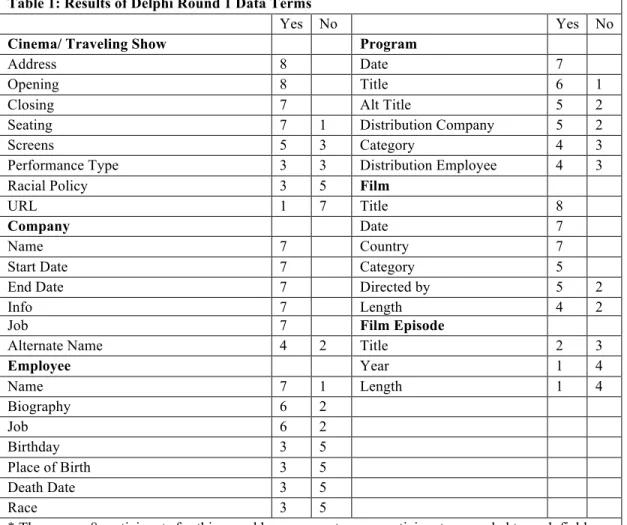
Table 1: Results of Delphi Round 1 Data Terms
Yes No Yes No
Cinema/ Traveling Show Program
Address 8 Date 7
Opening 8 Title 6 1
Closing 7 Alt Title 5 2
Seating 7 1 Distribution Company 5 2
Screens 5 3 Category 4 3
Performance Type 3 3 Distribution Employee 4 3
Racial Policy 3 5 Film
URL 1 7 Title 8
Company Date 7
Name 7 Country 7
Start Date 7 Category 5
End Date 7 Directed by 5 2
Info 7 Length 4 2
Job 7 Film Episode
Alternate Name 4 2 Title 2 3
Employee Year 1 4
Name 7 1 Length 1 4
Biography 6 2
Job 6 2
Birthday 3 5
Place of Birth 3 5
Death Date 3 5
Race 3 5
Delphi Round 1: Results
The first Delphi round helped to shape the discussion which continued through out
this process by highlighting which elements were accepted by all, and which elements
needed more attention. After the first round of the Delphi process, I eliminated fields
that were marked as important by fewer than two people, as this indicated that the
field was too specific or otherwise deemed unnecessary for a general schema.
Cinema & Company
Most of the participants immediately agreed upon the core elements of the Cinema
table, Cinema: Address, Opening, Closing, Seating, etc. This is the place where
moviegoing occurs, and therefore one of the central elements in almost all of their
research. The majority of the scholars also saw a need for most of the attributes of
Company. This may signal the importance that companies have when analyzing the
history of moviegoing development.
Film Episode
One whole table of the database was eliminated during the first round, the film
episode. A film episode refers specifically to a phenomenon that occurred in early
cinema. A “film episode” or “film serial” refers to short clips usually shown before a
feature film, which were broken into chapters, or episodes. Each episode would
generally be screened for about a week. While this phenomenon continued through
the 1950s, they were most prevalent in the silent film era. Although some of the
scholars worked in early cinema, with this group of scholars there was not enough
Lesser Entities: Program, Film
Within most of the other entities (Employee, Program, and Film), the participants had
needs for different levels of detail. For example, only about half of the participants
thought detailed information about employees such as date of birth, place of birth,
and date of death would be important to their research. Philippe Meers felt that this
information was useful just for “situating a person”, however, Daniel Biltereyst notes,
“We didn’t work on this for the large longitudinal project (Flanders, 1920-2008), but
we are gathering data of this type for the Ghent Cinema Capitol project. But family
histories (as in the Capitol case with one family controlling this major cinema
network in Ghent) and network histories are often very complex.” Most other
participants felt that this might be useful information when found, however this type
of detailed information is not easy to come by in all cases.
Within the Program and Film entities the needs of the researchers varied as well. For
instance, many of the scholars felt that details about a film or program were better left
to other databases that focus specifically on films such as the Internet Movie
Database (IMDB). Others, however, need film genre and length information in order
to determine the shift from shorter serials to full-length feature films. Names and
dates remained core elements of every entity.
Participants' quotations were used to build definitions for the terms for which there
was a consensus on importance in the first round. By pulling direct quotations from
the participants’ responses to useful fields to build definitions for each term, I sought
Delphi Round 2: Consensus
Cinema: Performance Type
Some of the more interesting points came out in cases where the participants did not
completely understand the term; one such example was “Cinema: Performance
Type”. In “Going to the Show” this field was used to indicate the different types of
performance, which might occur within a cinema, such as illustrated song, movies, or
dance. However this again is a phenomenon that occurred mainly in early cinema.
The following two quotes from the first Delphi round show the differences in how
this field was perceived and opinions on whether it should be an attribute of a cinema
at all.
“To date I have used this information primarily as it pertains to the
presentation of various forms of sound pictures during the silent film era and also as it pertains to the presentation of local amateur contests.”
(Jeff Klenotic)
“It’s not clear to me what the meaning of ‘performance type’ is. It sounds like a label to be applied to a building, a venue. Our database mainly catalogs movie theatres as buildings with a special purpose or function. So we
probably have collected only one performance type: cinema. … Other venues like town halls, music halls, circuses, bars, etc. are only mentioned as an address (location, property, lot) in relation to a programme. We think that a function or type will become clear by looking at what happens in the venue. Wherever a movie is shown, it counts as a venue, and becomes part of cinema history, even when it is not seen as a cinema proper. ‘Performance type’ is always temporary and it needs dates in case of type changes. In my opinion, it might be sufficient to mention a performance type in a general note describing the venue.”
During the first Delphi round, others noted the importance of tracking different types
of performances in order to understand the movement from a mixed performance
venue to more focused cinemas that only show films.
“Key data for charting the movement from music hall or fairground to fixed-site cinema.”
(John Caughie)
“I have only touched on this in my research, but I think it’s crucial to understand the cinema as an (often) “mixed” venue, and to be able to track how that changes over time.”
(Arthur Knight)
Based on these comments, and noting that the performances that appear within a
cinema can be determined by looking at what types of programs (another existing
entity) are associated with the cinema, the second round question about Cinema:
Performance Type was “Is this field necessary if “programs” denote whether they
are “mixed programs” or not?” By building this information into another entity,
“program”, that has a single date of occurrence, the type of performances at a cinema
becomes a temporal element of data, and it allows the value to change over time for a
specific venue. However, in order for this to be useful,the semantics of the basic
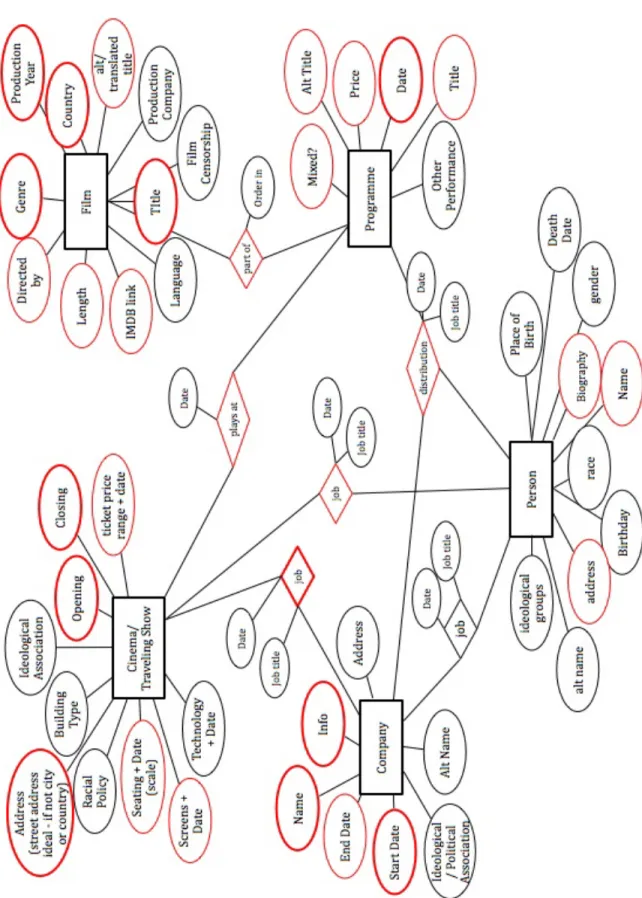
database diagram need to be agreed upon. A film or performance is arranged within a
program, which plays at a cinema.
Address Specificity
During the first Delphi round it became clear that Cinema: Location was very
important for each of the scholars, especially since many of them were using
geospatial tools to help understand “geographical, social, class and other parameters”
to ask the scholars what level of detail of geographic information is important for
their research. There was consensus that while GIS coordinates are ideal, gathering
them is very time consuming. In their absence, having a street address would be
satisfactory. However it was noted that any type of geographic data is helpful if a
ascertaining a street address is not possible.
Sources
One interesting topic that was brought up by two of the participants was the exclusion
of sources from the database.
“Our database has a facility to add information about sources and publications about a venue or other major entities. We don’t collect sources or
publications, but we can provide some references.”
(Karel Dibbets)
“There must be a field to capture the reference to the sources where the cinema is mentioned.”
(Maria A. Velez-Serna)
For the second Delphi round I responded by stating:
“Source material for films, cinemas, and companies will hopefully exist for many of your databases. I have opted to leave this out of the schema. I do think that they are important, and should be included whenever possible, but when merging databases, I think it’s best to deal with just the “data”, and allow the sources, to be browsed, or exchanged through a separate process”
The responses were:
“I would like to point to a difference in observing e.g. oral history accounts. In your interpretation, these are “sources” but we consider them as “data” of another kind: they supply information on image, distinction, meaning making, etc, that are not available from the hard “data”.”
“Maybe – but I hope that does not encourage us to ‘lose’ the reference info. We need to make sure that it is stored consistently and can be retrieved on request.”
(Maria A. Velez-Serna)
Participants were concerned that reference information would get lost if it were not
specifically included as part of this database outline. At this point, I did choose to
interject into the discussion. While the moderator of a Delphi study should allow an
open discussion in order to elicit opinions, it is also important to keep the discussion
within scope. I felt strongly that this was more of a technical discussion, and not part
of conceptualizing the schema. There are accepted standards2 to record information
about references, such as oral histories, newspaper clippings, and photographs. I
choose not to focus on this, because there are already many different tools to help
allow these standards to be used and to be interoperable with each other.
Open Issues
Cinema: Seating Capacity
During the first Delphi round participants were asked the importance of the seating
capacity of a cinema, and if it were best measured in “numbers, or S, M, L?” Almost
all of the participants noted the importance of seating capacity to their research and
commented that they preferred precise number of seats – however the availability of
this information depends on the quality of the data (Daniel Biltereyst). During Delphi
round two the participants were asked if a scale would be useful (0-150, 150-300,
2. There are many different standards for citing resources, and specifically primary resources – such as APA, MLA, Chicago Style. The Library of Congress has a good resource on using MLA and Chicago to cite primary resources
>300). In response to this, all of the participants agreed that scale would work better
for the type of data that existed, however the ranges of the scale were not agreed
upon. This will be important to explore with a group of moviegoing scholars, as the
scales at which cinemas operated varied greatly between different time periods and
locations. For example, a "large" cinema in the early 1900s might be one with a
seating capacity of 300, whereas in modern terms this would be considered small, or
medium at most. With further discussion, a seating capacity scale that is meaningful
to all participants can be developed.
Cinema: Racial Policy
Cinema: Racial Policy was the focus of interesting discussion throughout the Delphi
Process. This was a field that again, was pulled from “Going to the Show”, a project
that focused on early cinema in North Carolina where race was an issue in
relationship to policy and ownership. There were a few other scholars, mainly in the
United States, who used race as an important component of their research. Arthur
Knight’s research is about African American moviegoing, so this is a crucial field for
him. Most of the other scholars noted that while this might be an important bit of
information for other researchers, this was not relevant in their location or time of
focus.
However there was another type of association that was not covered in the original
schema; Political and Ideological association.
compartmentalization or Apartheid has characterized Dutch society up to the 1960s. One can differentiate between catholic, protestant, socialist, and ‘neutral’ attitudes towards the cinema, affecting cinema programming. This is less a feature of a building, and more of the cinema owner and his
programming. The role of Jewish cinema owners is the topic of a forthcoming PhD study.”
(Karel Dibbets)
Philipe Meers wanted cinema descriptions to include "Political orientation or not;
Precise political orientation". Similarly, Daniel Biltereyst would like to link cinemas
to "ideological groups and other companies." These comments and interest brought
me to ask about the usefulness of Ideological/ Political organizations in the second
Delphi round.
“Although this information has not been essential to me thus far, I would choose to include it in the database. For instance, I have often sought to research audiences in order to determine what social class was most likely to associate at/to a given cinema, and although I see this as a broad sociological designation rather than any sort of “official” ideological association, I could see specific class based organizations (e.g. Labor Unions) that ran cinemas as a kind of “ideological association.””
(Jeff Klenotic)
“Ideological association is part of our research, but it is not included in the public side of our database.”
(Karel Dibbets)
“I wonder if this category could be broadened, so it could include, say religion (films have often been shown in churches) or social club (Masons, etc.)-that could be useful.”
(Arthur Knight)
Arthur Knight’s comment about broadening the field to include religion begged the
question of what the purpose of this field would be. Would it be used to represent
potential for discrimination and favoritism in a cinema for a certain type or kind of
this same category? Or are they completely separate concepts that need to be handled
by unique fields? Unpacking these concepts and how they relate to the field of
moviegoing may reveal areas of similarity as well as difference. This may help decide
how these will be represented in the database.
Additional Relationships
During Delphi round one, Karel Dibbets wrote out the semantics for links between a
company and other entities within the database.
“A job is expressed by a link between the company and a venue, a movie, another company, a person, an address, etc.. Some information has to be added as to the meaning of the link. My suggestions:
A link with a venue means exhibition by a cinema chain.
A link with a programme means exhibition by a travelling cinema. A link with a movie means distribution (production being outside this domain).
A link with another company means a mother/daughter company. A link with a person means employment or ownership.
A link with an address means ownership of the building located at the address.”
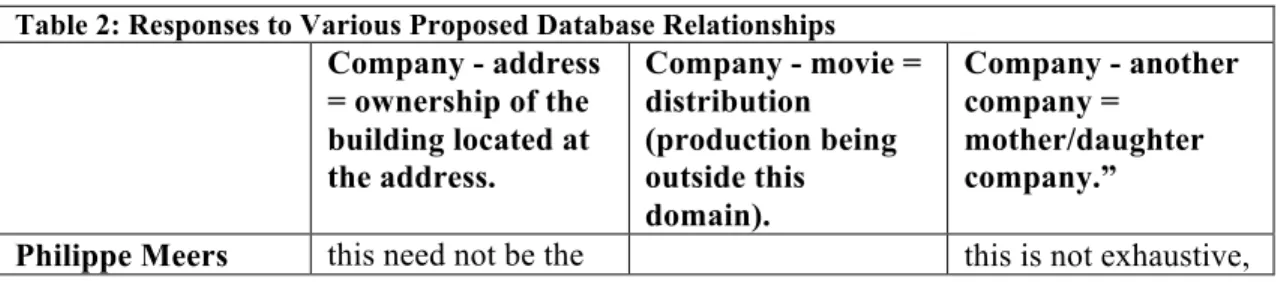
The first three statements were already represented in the schema. During the second
Delphi round, the participants were presented with these relationships and asked:
“The following was suggested as a way to indicate the relationship of a company to various other entities within the database. The first three connections exist within the current database structure. The last 3 are not – please discuss the importance of the different relationships, or if you would prefer to indicate them in a simple text field related to each field.”
There were varying responses within Delphi round two to these new relationships
Table 2: Responses to Various Proposed Database Relationships Company - address
= ownership of the building located at the address.
Company - movie = distribution
(production being outside this domain).
Company - another company =
case: a company can rent a building?
as it also could be a sister company, under the same mother
Maria A. Velez-Serna
You mean a link of a person with an address? As the coordinator indicated above, this would be covered by the Person – Job – Cinema relationship, where ‘Job’ is owner, lessee, etc.
This is related to the ‘Programme’ issue. What is distributed – a film or a
programme? There might be different answers to that. So if possible I would like to see a Company – Distribution – Film relationship.
This would be very useful, especially if these relationships could be built across databases, with company dependencies established around the world.
These statements show that there needs to be more discussion aimed at the specific
semantics of the database. Dibbets brings up some possibly important issues about the
relationships between a cinema or company to an address, the varying relationships
that a company could have with another company, and the different relationships a
company or person could have with a movie.
Geography as Place
Jeff Klenotic made the point that the geography of a cinema location could be defined
as more than just a set of coordinates or street address, but also as a social concept.
This is a very interesting topic for many of the moviegoing scholars who are now
looking at moviegoing through spatial and social lenses. Unfortunately, because this
was brought up during the second Delphi round there was not time to pursue a
Diagram 1: Final Database Schema
Tags
Tags were pulled from the “Going to the Show” database and scholars were asked to
mark any tags that they think might be of use to them, as well as note any additional
tags which they would find useful. The purpose of this portion of the study was to
find a common set of terms by which projects could begin to tag cinemas, content, or
other items within their database. Tags are useful in digital collections as they
facilitate more access points for users to search and browse the material by. If
scholars used a common set of tags, when they attempt to merge data, the tags would
still be meaningful.
The first Delphi round had eight participants, but only seven participants participated
in the online survey of tags for Round 1, and Round 2 only had 6 participants.
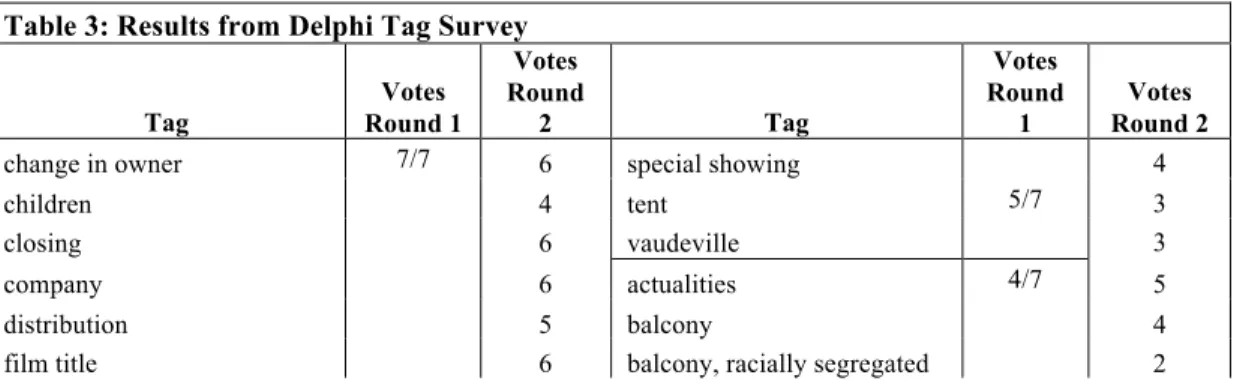
Appendix 11: Initial Tag Survey (Delphi Round 1) shows the list of all the tags
presented to participants during round one. “Votes Round 1” are the number of votes
which each tag received during the first round. The third column shows the number of
votes each tag received during the second round. There were 93 tags in round 1 of the
tag survey, seven of them received fewer than two votes, and were omitted from
round 2.
Table 3: Results from Delphi Tag Survey
Tag
Votes Round 1
Votes Round
2 Tag
Votes Round
1
Votes Round 2
change in owner 6 special showing 4
children 4 tent 3
closing 6 vaudeville
5/7
3
company 6 actualities 5
distribution 5 balcony 4
7/7
hours of operation 4 carnival 1
licensing 4 concessions 3
local films 5 midnight shows 3
manager 4 newsreels 5
music 5 opening notice 2
name change 6 public appearance 2
non-theatrical venue 5 school 3
pianist 5 separate entrance 2
program change 6 social club 4
purpose-built movie theater 4 women only screening 2
renovation 5 WWI 3
seating capacity 6 air conditioning 3
admission price 6 amusement park 2
architect 5 black theater 2
band or orchestra 5 color films 4
censorship 4 contest 3
church 5 drugstore 2
fair 3 fashion show 1
family 4 minstrel shows 2
feature film 6 morality 3
illustrated song 2 opera house 1
lecturer 3 penny arcade 1
location change 4 projectionist 3
organ 1 racial policy 2
re-opening 6 serials 1
religious films 4 streetcars 2
religious objection 5 ventilation 2
storefront theaters 3 ymca
3/7
3 traveling exhibitor
6/7
3 airdome 2
advertisement 5 american indians 1
charity 4 hotel 2
circus 2 motion picture party 2
fire 2 notable
2/7
0
ladies and children 3 crime
men only screenings 1 fight films
open-air screening 4 influenza
1/7
projection problems 1 alias
promotions 4 birth of a nation
proposed theater 4 boxing films
seasonal exhibition 3 photographer
0/7
sound films
5/7
3
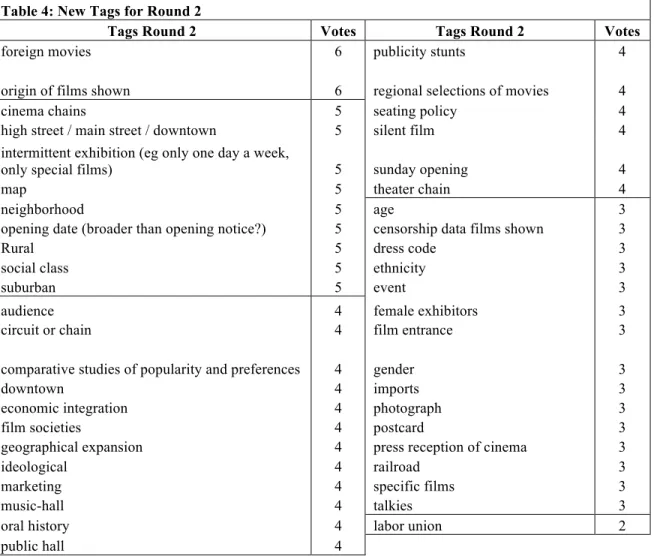
There were 45 new tags in round 2 that were added by the participants during round
1. Sixty-nine tags received fewer votes during round 2 than in round 1, and only three
Table 4: New Tags for Round 2
Tags Round 2 Votes Tags Round 2 Votes
foreign movies 6 publicity stunts 4
origin of films shown 6 regional selections of movies 4
cinema chains 5 seating policy 4
high street / main street / downtown 5 silent film 4 intermittent exhibition (eg only one day a week,
only special films) 5 sunday opening 4
map 5 theater chain 4
neighborhood 5 age 3
opening date (broader than opening notice?) 5 censorship data films shown 3
Rural 5 dress code 3
social class 5 ethnicity 3
suburban 5 event 3
audience 4 female exhibitors 3
circuit or chain 4 film entrance 3
comparative studies of popularity and preferences 4 gender 3
downtown 4 imports 3
economic integration 4 photograph 3
film societies 4 postcard 3
geographical expansion 4 press reception of cinema 3
ideological 4 railroad 3
marketing 4 specific films 3
music-hall 4 talkies 3
oral history 4 labor union 2
public hall 4
Two of the most popular tags added to the collection during round 2 (foreign films,
origin of films shown) were concepts that this larger group was able to bring to the
list. Just as having a variety of scholars broadened the database schema, having a range of different scholars participating in the tag survey helped to broaden the scope
of interested from the original set of tags
While some variation in voting was expected between round one and round two, there
were a few terms that were particularly interesting, as there were more than 3 people
organ (a change of 5), circus, men-only screenings, projection problems, and carnival.
All of these tags had fewer votes in round 2 than in round 1.
Discussion
This project really had two distinct parts, the terminology, or definitions of the
database fields, and the tags. The database fields were the heart of this study and
discussed by the participants in more detail. I felt that this project would have
benefited from more iterative rounds, as many ideas were introduced in Delphi round
one, but there was not an opportunity to fully tease out common meanings within one
additional round. I also feel that along with more iterations, this project would also
have benefited from even more participants. For example, when the results section
was sent back to the scholars for review, Maria A. Velez-Serna commented on the
open questions about racial/ political/ ideological association:
Maybe the difference is that as an ‘audience composition’ category, racial segregation was based on active, explicit exclusion, whereas ideological, religious or even class-based divisions are less watertight. Perhaps there could be two fields, one being something like ‘ethnic/racial composition of
audience’ (this would cover for instance diasporic audiences, such as in the case of Greek cinemas in Australia) and the other being ‘ideological
affiliation’ (religious, political, clubs, Freemasons, etc). In both of these fields it would be possible to note whether this was an explicit, enforced policy or just a customary one.
While seven was a very respectable number to begin to define complex relationships
and definitions, by the end of Delphi round two, there were noticeably different
“groups” of scholars who were swaying the conversation – and more varied input
noted “I think the database covers nearly all the topics, terms, concepts and data of
greatest significance to my research.” He also mentioned that:
One concept that I may yet need to tailor into the database has to do with the category of the audience. Two of the central questions of interest in my work are: 1) who chose to attend what cinemas, when, and why? and 2) who chose not to attend what cinemas, when, and why? These are questions relating to variable patterns of cinema attendance and film consumption, and I'm not completely sure how such data will fit into the database diagram.
It is very possible that there are other researchers who grapple with the same issues
that Jeff Klenotic feels are still unrepresented by this schema.
The tags were easier to manage, although they were never really defined, so while the
group agreed upon a set of tags, there was no discussion about their definitions. One
participant noted after completing the second round of tags that it was “somewhat
difficult to assess the distinction between my specific current research work and
general future research interests.” This might be one of the reasons for the variation in
voting on some of the selected tags during round 2. There was not as clear of
direction on whether the participants should select tags they have used or ones that
they might find interesting.
Conclusion and Future Work
This project tried to examine concepts and vocabulary needs of this specific domain
of moviegoing as well as the schema, or relationship of these concepts. The ideal
outcome of a project such as this would be a complete agreed-upon schema, with very
projects, much like the Dublin Core. However when one considers that the Dublin
Core has been a work in progress since 1994 (dublincore.org/about/history/), one
cannot expect to define a field with a few Delphi rounds. I felt that success for this
project would be if the majority of the scholars participating find some benefit to the
sharing of ideas and the iterative process are able to look at the definitions they use
with a broader perspective, and not just in terms of their own research. If the findings
of this project can be used as a reference for moviegoing scholars who begin new
projects, I would also feel that this project was very successful. Maria A.
Velez-Serna, a PhD student at the University of Glasgow who has yet to build a digital
project on her own, but is becoming more involved in this domain said:
I think the building of the core scheme has been very successful; I can look at your diagram now and it gives me an idea of the kind of data that I need to gather and how things are connected. I am going to start working in
organising my data tables into a more structured database soon and I will take this as a blueprint. I think the 'tags' part still needs some cleaning, and perhaps this would benefit most from input from more people, see if the tags we are using are understood and useful for scholars working on different topics too. The whole process has been a welcome opportunity to step back and try to understand what I mean when I use some words, and most of all it has given me some insight into the way that other scholars are working.
The group that ultimately participated in the project was very important in molding
the results. Because there were international scholars as well as scholars from
America, this project was able to uncover some regional/ national concerns that
brought up some very interesting topics for discussion. I do wish that there had been
even more variety in the research which was being done, such as scholars focused on
current-day moviegoing, or moviegoing in China. However, for such a complex
While none of the scholars who are currently working on projects came back to say
they wanted to change their schemas, they did seem very willing and interested in
continuing to tweak the schema definitions in order to “fit” their scholarship and the
scholarship of their peers into the schema. Almost every scholar who participated in
the process reported that they found the iterative process very interesting, and thought
that being forced to think about how other researchers were defining the field was an
interesting and worthwhile exercise for them. It seems that a valuable contribution to
the discipline to continue this exploration.
While I felt that this project was a great beginning to the development of a common
set of terms and elements for scholars within the moviegoing field to work with, there
are still many questions left unanswered beyond the “Open Issues” mentioned
previously.
Several scholars noted that while this schema is a great “core” to the field of
moviegoing, their specific research required additional fields and concepts that were
not included in this study. The Dublin Core, which began in 1995 developed a set of
15 basic metadata elements used to describe many different types of physical
resources, has basic core of simplified sets of elements. Beginning in 2009 Dublin
Core started to develop working groups, or "application profiles" which work to
develop specialized schemas that help to address the needs of various
Schema takes the basic elements of the Dublin Core and adds other elements specific
to an educational object, users, duration, learning process, etc. Similarly, this project
focused on finding commonalities in order to narrow down the fields to a core set,
which would ideally be applicable to all moviegoing projects. Opening up the process
to even more moviegoing scholars could provide further refinement of this core set of
fields. After this, it would be important to go back and establish working groups to
address sub topics that might be relevant to numerous scholars, although perhaps not
to the whole community.
Once a common set of definitions are in place and it becomes easier to share data
between the various projects, issues of data authority arise. Hired undergraduates or
students often fill in the majority of the content for these projects, and while the
scholar(s) still has responsibility for the work, they may not review all of it. This
noted, what types of citations are needed for these scholars to be able to make use of
data prepared by someone unknown? Scholars are often comfortable sharing their
data with each other, trusting in their peers to have done quality research. However
sharing data with a larger group, when not all of the participants are known, may
cause some of these scholars to be skeptical of the data. If this is the case, what types
of authority controls will be needed to ensure that the data is still useful?
With the iterative Delphi process that these scholars went through, an effort has
begun to define the field of moviegoing in a formalized sense. Hopefully as further
continue, and these scholars will begin to develop a schema not just with their
individual project in mind, but with the entire spectrum of moviegoing, taking into