Maria S Ramirez. Content Analysis of Digital Oral History Collections in Africa, Australia, Europe, and North America. A Master’s Paper for the M.S. in L.S degree. December, 2016. 60 pages. Advisor: Ron Bergquist
Over the past sixty-eight years, oral history interviews have emerged as valuable primary sources of research by capturing nuanced perspectives of the past. Proponents argue that the enduring value of these resources stems from their ability to fill the gap in archives by giving voice to those who have been historically marginalized in society. For much of the twentieth century these voices remained silent, as archivists struggled to provide access to these unique acquisitions. The digital revolution has ignited new hopes that technology can resolve the problems of access to oral history collections. This paper aims to shed light on how oral histories have been presented in the digital interfaces of several
collections from Africa, Australia, Europe, and North America. By examining the content that is available to users worldwide, a clearer image of the priorities and standards used in this new era of oral histories will be revealed.
Headings:
Oral history
Digital collections
Content analysis
CONTENT ANALYSIS OF DIGITAL ORAL HISTORY COLLECTIONS IN AFRICA, AUSTRALIA, EUROPE, AND NORTH AMERICA
by
Maria S Ramirez
A Master’s paper submitted to the faculty of the School of Information and Library Science of the University of North Carolina at Chapel Hill
in partial fulfillment of the requirements for the degree of Master of Science in
Library Science.
Chapel Hill, North Carolina
December 2016
Approved by
_______________________________________
Table of Contents
Table of Contents ... 1
Table of Figures ... 2
Acknowledgements ... 2
Introduction ... 4
Research Questions ... 6
Literature Review... 6
Methodology ... 12
Sampling ... 14
Findings ... 16
1.1 Accessibility Elements (1a-16a): ... 16
1.2 User Interface Design Elements (1b-16b): ... 30
Limitations and Future Work ... 36
Conclusion ... 38
Appendix I: Data Collection Elements Overview ... 39
Appendix II: Description of Selected Collections ... 41
Appendix III: Data Collection Results ... 46
1.3 Accessibility Results: ... 46
1.4 User Interface Results: ... 54
Table of Figures
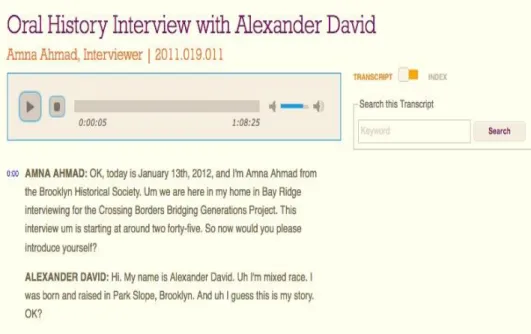
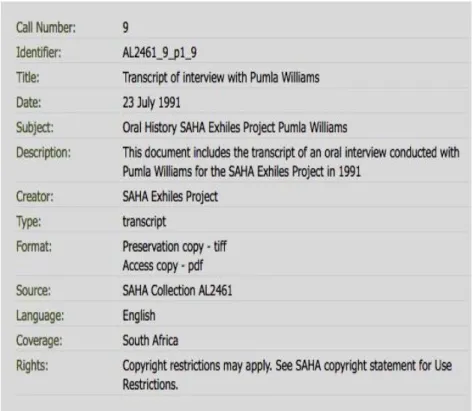
Figure 1. Google Trends results for term “Oral History” ... 15 Figure 2. Alternate view of Google Trends results indicating countries with high rates of searches for oral histories. ... 15 Figure 3. Segment of transcript from the Crossing Borders, Bridging Generations oral history collection with OHMS operated searching capabilities. ... 20 Figure 4. Segment of a tape log from The New Roots: Voices from Carolina del Norte collection correlating recording times with topics discussed. ... 21 Figure 5. Metadata fields from the South African History Archive (SAHA) collection showing no specification of the topics discussed in the interview. ... 23 Figure 6. Interview from The Italian Canadian Women Oral History Collection
displaying an English/ French Description and English-only metadata fields. ... Figure 7. PDF transcript from the OurVoices - Stories of Canadian People and Culture collection. The text is only presented in the aboriginal language spoken by the narrator, without any metadata related to the content of the interview. ... Figure 8. Side by side comparison of metadata fields available in English and Spanish versions of the same interview at the New Roots: Voices from Carolina del Norte
collection. ... Figure 9. Homepage of the Centre for Popular Memory (CPM) collection. ... 31 Figure 10. Interviews in Australia’s Behind the Wire collection. ... 32 Figure 11. Default view of interviews in Canada’s Italian Canadian Women Oral
Acknowledgements
I’d like to express my deepest gratitude to the people who made the completion of this Master’s thesis possible. First and foremost, thank you Dr. Ron Bergquist. Your guidance and kind words gave me the confidence to pursue this topic and to enjoy the journey. Thank you to Dr. Denise Anthony for her recommendations of South African collections and to Dr. Robert Losee for his teachings of research methods that lighted the way to this study’s findings. I’d also like to thank Dr. Hannah Gill, the director of the New Roots project at UNC Chapel Hill, a collection which I included in this paper. Working as your Bilingual
Documentation Archivist over the last year and a half has been the most fulfilling professional experience I’ve ever had. I look forward to the power this archive will bring to our community in bridging the divisions and misunderstandings of Latino culture and I’m honored to have formed a small part of this organization’s mission.
Introduction
Oral History is defined as “the process of deliberately eliciting and
preserving, usually in audio or audio and visual recording media, a person’s
spoken recollections of events and experiences based on first-hand knowledge”
(Wynne, S. C., 2009). Despite the idiosyncrasies of speech, these interviews
provide a human perspective that can be lost on the written page. Proponents of
oral history argue that the enduring value of these resources stems from their
ability to fill the gap in archives by giving voice to those who have been
historically marginalized in society. For much of the twentieth century these
voices remained silent, as archivists struggled to provide access to these unique
acquisitions.
“Audio and video have traditionally been very difficult and expensive to curate in an archival setting. The formats were fragile and proprietary and, as technologies advanced, the threats of compatibility and obsolescence grew. The greatest challenge oral history faced in the analog archive, however, was the threat of obscurity” (Boyd, D., & Larson, M., 2014, p.3).
The popularity of portable cassette recorders in the 1960s and later
advancements in video recording spurred an unprecedented increase in the
number of oral history projects, from 89 reported projects in 1965 to 230 by 1975
(Charlton, T. L., Myers, L. E., & Sharpless, R., 2006, p.31). As researchers turned
to archivists for the preservation of these tapes, the challenges of curating these
resources became apparent. Many collections lacked the funding and staffing
shelves, virtually invisible to users. Some of the tapes from those early
days have deteriorated and the voices behind those stories have been irreparably
lost to time. The analog format also posed a logistical burden on users, who had
to physically visit the archive to listen to recordings and navigate finding aids
intended for print materials.
The digital revolution we’ve witnessed over the last two decades has
ignited new hopes that technology can resolve the problems of access to oral
history collections. “Through technological advances, the Internet has become a
practical way of making recorded sound and video available, opening up a wide
range of possibilities for the presentation of material. The Internet has, quite
frankly, blown the hinges from doors of the archives, and access has come to have
a completely different meaning” (Boyd, D., & Larson, M., 2014, p.4). Collections
began planning digitization projects aimed at rescuing recordings from
backrooms and bringing the archive to the user. Other repositories took the
initiative themselves by actively collecting stories and making them available over
the web.
This new territory has brought the opportunity to connect with users who
don’t typically visit the archive. Educators are seeing the potential behind digital
oral history collections and implementing these resources into their curricula.
Community based projects are shedding light on local histories and bringing
attention to social issues that are rarely the focus of mainstream historical
narratives. However, as access to these collections expands to a global audience,
archivists must rethink their role as gatekeepers of information and take on new
interviews for users from diverse cultural, linguistic, and ethnic backgrounds.
This paper aims to focus on the user interfaces of several digital oral history
collections implemented in Africa, Australia, Europe, and North America. By
examining the content that is available to users worldwide, a clearer image of the
priorities and standards used in this new era of oral histories will be revealed.
Research Questions
What percentage of the selected digital oral history collections make full
audio recordings and full transcriptions available online?
How are oral history interviews arranged on the websites and how is
searching and navigation supported by the interface?
Do the digital archives employ other elements (photographs, maps, links
to outside resources) to contextualize the interviews?
What similarities/ differences appear across collections from South Africa,
the United States, Australia, Canada, and the United Kingdom?
Literature Review
The topic of access to oral history collections is not new. Since Allan
Nevins established the first official oral history collection at Columbia University
in 1948, oral history practitioners and library science professionals have been
discussing the underlying problems that hinder the usability of these resources.
The first conference that brought together stakeholders in the field took place at
Lake Arrowhead, California in 1966. Over the course of three days, archivists,
panel discussions on issues that continue to impact our understanding of oral
histories today (Charlton, T. L., Myers, L. E., & Sharpless, R., 2006, p.24). One of
the most pressing arguments discussed involved the role of transcripts. At the
time of this colloquium it was common practice to erase recordings and only
preserve the transcripts from interviews. While some backed this practice based
on economic concerns, others defended it based on the difficulty researchers had
accessing the information contained in the tapes.
“It’s foolish to imagine that it’s going to be worth saving fifty tapes of Francis Perkins. When you want to see exactly how she said it on page two thousand and sixty-three, you’re not going to be able to find that place on the tape for a whole half hour or so. By the time you have, you’ll decide it wasn’t worth the trouble” (Louis Starr, director of the Columbia University Oral History Research Office, as cited in Boyd, D., & Larson, M., 2014, p.2).
While the destruction of oral history recordings seems sacrilegious to
archivists in hindsight, the previous comment outlines the reality that the text
version of an interview has from the beginning been considered easier to navigate
than the recording itself. For librarians and archivists alike, the destruction of
oral history tapes meant that the difficulties of providing access to sound
recordings could be bypassed entirely. Nonetheless, the practice proved to be a
flawed solution to the problems of curating these resources. In response to Louis
Starr’s comments on the benefits of destroying the tapes, Louis Shores, dean of
the library school at Florida State University questioned, “is it not possible that
the distilling of the tape into a typescript has, even with the highest integrity and
devotion, resulted in the modification of the primary source, the tape?” (as cited
in Boyd, D., & Larson, M., 2014, p.3). While the debate over whether to erase oral
the literature continues to explore the difficulties of access to collections of oral
histories that lack transcriptions.
The issue of accessibility has been cited as a fundamental concern by the
Oral History Association, first established in 1967. “In recognition of the
importance of oral history to an understanding of the past and of the cost and
effort involved, interviewers and interviewees should mutually strive to record
candid information of lasting value and to make that information accessible” (as
cited in Charlton, T. L., Myers, L. E., & Sharpless, R., 2006, p.255). The
responsibility to provide access has, nevertheless, been closely connected to
archives. A recurring problem cited in the literature is the lack of standardization
in these institutions. “Access to oral histories still remains less standardized than
access to other types of materials. In 2004, respondents to MacKay’s survey of
oral history programs in several types of institutions were ‘fairly evenly divided
among those who create finding aids, those who create MARC records, and those
who don’t catalog at all’” (Wynne, S. C., 2009).
A survey conducted in 2007 of academic libraries in Georgia showed
persistent problems establishing policies and procedures to coordinate access to
oral history collections. The study found that of the 73 academic institutions in
the state of Georgia, only 35% of those that had oral history collections had
established guidelines or policies for the collection, processing, and/or use of oral
histories (Grimsley, R. L., & Wynne, S. C., 2009). The researchers quote similar
findings in earlier studies on the lack of standardization across oral history
collections housed at academic institutions, indicating that issues of access are
profession. For his 1987 PhD Dissertation at the University of Pittsburg, A. H.
Ekrish found that oral history centers operate through a trial and error
methodology due to the general lack of consensus on how to curate and
disseminate oral history materials. In a 1993 Master’s thesis at the University of
North Carolina at Chapel Hill, J.E. Sanner commented on the “virtual vacuum”
and “hodge-podge of methods” evidenced in his findings on the processing of oral
history collections. In MacKay’s 2004 survey, respondents working at institutions
responsible for oral history materials revealed the urgent necessity of “standards
and best practices for all phases of collection management” of these resources
(Grimsley, R. L., & Wynne, S. C., 2009).
In recent years, students from the University of North Carolina at Chapel
Hill have published papers on the ongoing challenges oral history collections face
in providing digital access to materials. In a 2008 Master’s thesis, C.M. Bertling
examined how twenty-two university oral history collections supplemented
access to their materials through the web. The researcher found that “almost 60%
(13 of 22) fail to connect users to even a single full interview in either an audio or
transcript format” (Bertling, C. M., 2008). In 2013, J.N. Vos’ Master’s thesis
focused on the lack of metadata content standards across oral history
repositories. The researcher noted “a strong need for a shared model for
metadata creation and entry that is interoperable across collections to ensure
quality, consistent metadata, and to promote access and usability” (Vos, J.N.,
2013). The thesis presented here expands on these earlier studies by examining
similar issues of digital access to oral history collections and fills an important
The interest in the topic of accessibility to oral history collections suggests
that the lack of consensus over how to curate these resources has been a systemic
problem for archives. “Because oral histories resemble archival materials in some
ways, but also share similarities with books and visual and/or sound recordings,
they do not always fall neatly into most established standards familiar to
catalogers and/or archivists, namely, Anglo-American Cataloguing Rules, 2nd
edition, published in 2002 (AACR2), and Describing Archives: A Content
Standard (DACS), published in 2004” (Grimsley, R. L., & Wynne, S. C., 2009).
The closest the archival community came to a stand-alone set of descriptive
standards for oral histories came with the publication of the Oral History
Cataloguing Manual (OHCM) in 1995. However, the manual was not uniformly
adopted across institutions and did not revolutionize the way archives provided
access to their oral history collections. Furthermore, it is widely recognized that
OHCM did not stand the test of time, as the available technologies we have today
greatly surpass those available 21 years ago.
While consensus is lacking when it comes to best practices, few archivists
would argue with the fact that the World Wide Web has opened new avenues for
access to oral history collections. Much of the literature acknowledges the great
potential the Internet harnesses for facilitating use by a global audience, creating
bridges to related content, and the ability to bring attention to interviews that
may have remained hidden in archives years ago. Yet, these new opportunities
offered by the web also bring about particular challenges. “The digital
information revolution certainly created more fluid access points to oral histories
HTML- or XML-based typescripts, and how and what to display on the World
Wide Web” (Grimsley, R. L., & Wynne, S. C., 2009). Research into the extent to
which digital oral history archives make their resources available suggests that
many collections have been reluctant to face these challenges head-on.
“In the year 2000 University of Alaska-Fairbanks research associate Karen Brewster conducted a survey of oral history projects online. She found and reviewed sixty-four oral history programs that had a presence on the World Wide Web. At this time, fewer than half posted any content, and most of those were excerpts of oral histories, not the full interview. The remainder offered a list, finding aid, or just a description of the program” (MacKay, N., 2010).
Archivists and librarians looking to digitize their analog oral history
collections or those leading projects with born-digital recordings are stepping
into a territory that requires a new set of skills that redefines their traditional
role. At the Oral History Association’s 1998 Conference, an issue that took center
stage was the implication of making oral history collections accessible over the
Internet. “Discussion included the need to protect interviewee’s privacy, the
danger of misuse and manipulation of sound recordings and transcripts, and the
‘unmonitored access’ of the Internet that would result in a loss of archival control
over the interviews” (Swain, E., 2003).
Brewster’s study of online oral history collections revealed how some
projects have managed to side step the issues behind copyright restrictions by
only providing access to finding aids or excerpts of interviews. “The largest
majority of the sites contained on-line finding aids to the contents of oral history
collections, most of which were a list of people interviewed. There were no hot
links to access the material itself” (Brewster, K., 2000). These findings suggest
complex than simply integrating content to a new medium. It also helps to
explain the reluctance to take full advantage of the Internet’s ability to provide
worldwide access to the audio or video source material.
Methodology
The following study focuses on the user interfaces of digital oral history
collections originating from Africa, Australia, Europe, and North America. After
sampling was completed, a content analysis approach was employed. Content
analysis was chosen as a research method due to its focus on “recorded human
communications” (Babbie, E. R. 2010, p.368). Digital oral history collections are
objects created for the information consumption of users, and thus qualify as a
form of communication. The study did not differentiate between the terms digital
archives, digital libraries, and digital collections. Instead, particular attention
was placed on collections that met the definition of being aggregated oral history
interviews presented through a digital platform.
Data collection was based entirely on content available through the web in
each of the organization’s oral history site. Therefore, no additional
considerations regarding restrictions of the resources studied is necessary. The
collections and their available content are in the public domain and analyzing the
structure of the websites does not violate any legal restrictions on the objects. The
researcher conducted the data collection through a form consisting of elements
identified as valuable to determining the general accessibility of the oral history
interviews in each collection. An interpretative approach was necessary in
the literature on accessibility and user interface design, as well as on personal
experiences working as an Assistant Archivist for a digital oral history archive in
North Carolina.
For the purposes of this paper accessibility is defined as the ease of
viewing and using content directly from the oral history collection’s website. This
includes streaming audio/video capabilities for each interview, bibliographic
information or finding aids to locate interviews for use, the availability of
additional documents to contextualize interviews, and metadata used to describe
the content of the collections. The term user interface is defined as the
representation of the oral history collection through a digital platform. This
encompasses the homepage, individual interview pages, project overview pages,
graphics, photographs, videos, fonts, styles, color-schemes, navigation tools,
icons, and other visual elements. A complete overview of elements used during
content analysis is available in Appendix I.
The terms full audio/video and full transcription refer to original
recordings and transcripts that encompass the entirety of the interview in the
interviewee’s original voice. Interviews with excerpts from the original audio or
with highly stylized renditions in text form were not deemed to satisfy the criteria
and were thus marked as N (no) during data collection. Timestamps refer to any
method of enumerating segments of the audio and connecting them to topics or
word-for-word statements said throughout the interview. Interviews deemed to
satisfy the elements were coded as Y (yes) and those for which elements did not
apply were coded as N/A (not applicable). Examples of situations in which N/A
transcript or audio exists or elements intended for multilingual materials where
content was presented in only one language.
Elements 5a (Is the transcript of interviews conducted in other languages
translated into English?) and 6a (Is metadata associated with interviews
conducted in other languages translated into the original language?) were chosen
to determine how digital oral history collections handle access to multilingual
materials. “While computer networks broke through national boundaries long
ago, they remain…more effective for communication in English than for
exchanges in most other languages, much less interactions involving multiple
languages” (Borgman, C. L., 1997). The dominance of English on the Internet
raises questions about how audio-based cultural materials can be made
accessible to the original culture as well as others who may not have knowledge of
the language. For the purposes of this study, English is viewed as the lingua
franca of the web and, as such, collections whose oral histories were conducted in
English were marked as N/A in elements 5a and 6a.
Sampling
The collections were chosen based on whether the initiative described
itself as a “digital archive”, “digital library”, “digital collection” or used
terminology indicating that the oral history resources could be accessed through
the web. The countries chosen for the study were selected based on the results
acquired through Google Trends of searching patterns for the term “oral history.”
oral history, which Google Trends identifies by examining search patterns in
different regions.
Figure 1. Google Trends results for term “Oral History”
Figure 2. Alternate view of Google Trends results indicating countries with high rates of searches for oral histories.
Additionally, sampling was influenced by the researcher’s ability to
understand the primary language of the collections. Multilingual content is
available in some sites, but this did not impede the study where the option to
view materials in English or Spanish was offered. Due to time constraints, the
researcher chose three collections that fit the sampling criteria from the five
countries listed in figure 1. A full description of the digital collections is available
A random sample of four interviews were selected in each of the 15
collections to test the accessibility elements of the study. A total of 60 interviews
were examined and the full results of the data collection phase are available in
Appendix III. The user interface (UI) design elements were applied to the 15
collections, without focusing on particular interviews. These elements focused on
appearance as well as the overall arrangement and navigation of the interfaces,
making a broader perspective necessary to ascertain the results. Accessibility
elements were enumerated as 1a through 16a and UI elements 1b through 16b to
facilitate data collection.
Findings
1.1
Accessibility Elements (1a-16a):
This study aimed to answer questions about the accessibility of digital oral
history collections from various countries. R1 (what percentage of the selected
digital oral history collections make full audio recordings and full transcriptions
available online?) is essential for gauging accessibility because oral history
resources are audio-visual materials that are notoriously difficult to use.
Transcripts can be a useful guide that allows users to navigate the audio.
However, transcripts alone do not reflect the intricacies of communication that
make oral histories such a valuable resource. “Beyond the dozens of ways in
which words can be said, each way conveying a different meaning, there are the
interpersonal and situational currents that shape the speaking, currents that are
palpable…to those seeing a video or hearing an audio recording, but completely
2006, p.243). Furthermore, relying solely on the text version of an interview
opens up the possibility for misunderstandings or erroneous statements to seep
into the record. Thus, providing audio with transcripts allows users to get a fuller
picture of what the interviewees intended to communicate and deeper context
from subtle changes of tone that cannot be easily reflected in writing.
Of the 15 collections examined in this study, 33% (5 of 15) made both full
audio streaming and PDF transcripts available to users online. All of the 12
interviews randomly chosen from collections in the United States had audio and
transcripts. Only one collection from Australia provided audio and transcripts of
interviews. Similarly, only one of the three Canadian collections chosen for this
study provided access to both audio and transcripts. Despite not providing
transcripts in all the collections, Canada was the only country outside of the
United States to provide full audio streaming for all of the interviews examined in
the study.
The results reflect long standing differences between the United States and
other countries regarding the practice of oral history. Elinor A. Maze’s essay The
Uneasy Page: Transcribing and Editing Oral History mentions the importance
of the transcript for oral historians in the United States, noting that “many
consider the transcript to be a primary source, equal for research purposes to the
audio recording from which it was made” (Charlton, T. L., Myers, L. E., &
Sharpless, R., 2006, p.241). Other countries place greater importance on the
audio itself. Maze traces the preeminence of oral history recordings in Canada to
early collections made by the Canadian Broadcasting Company (CBC) after World
archive, establishing the primacy of the recording in what became the nation’s
archival practice. Even today, the Canadian Oral History Association’s website
states that “the primary form of the oral history document is the recorded human
voice” (as cited in Charlton, T. L., Myers, L. E., & Sharpless, R., 2006, p.241).
It is also important to note the social dynamics that prevent certain
collections from uploading audio to the Internet for their oral history collections.
In South Africa, the mistrust caused by apartheid influenced the decision of some
interviewees to disallow audio recordings to be made. In these cases, the decision
to limit access to only the transcript or notes from the interviewer becomes a
conscious choice intended to balance the preservation of oral history testimonies
with the risk of endangering the well-being of interviewees sharing their
experiences. This is evidenced in one of the interviews chosen from the South
African History Online: toward a people’s history (SAHO) collection. The
transcript states: “[the interviewee] was very willing, but requested that a tape
recorder not be used, saying he might hear the tape played back to him in court
someday” (SAHO, interview 4). All of the interviews examined in this study from
The remainder of the accessibility elements in Appendix I focused on
answering R2 (how are oral history interviews arranged on the websites and how
is searching and navigation supported by the interface?). Searching within audio
recordings has been a perpetual challenge for oral history users. Although online
access facilitates discovery of segments in the interview far more easily than with
earlier analogue tapes, the process of locating themes and topics in a particular
recording continues to be cumbersome for users. Timestamps and indexes
providing summaries of topics discussed in increments throughout the interviews
provide an elegant solution to the awkwardness of this medium.
Four collections in the study employed some form of mechanism linking
segments of the audio to topics or statements mentioned in the interview. Two of
the three collections (67%) selected from the United States provided timestamps
for their oral histories. The New Roots: Voices from Carolina del Norte collection 0
2 4 6 8 10 12
South Africa United States Australia Canada United Kingdom
Int
ervi
ew
s
Country of Collections
Audio and Transcript Availability
offers a link to a PDF tape log outlining topics with their corresponding times in
the audio. The Crossing Borders, Bridging Generations oral history collection
utilizes an open-source system known as Oral History Metadata Synchronizer
(OHMS). This tool allows users to perform keyword searches in the
time-correlated transcript or index and connects the textual search term to the
corresponding moment in the recorded interview online (OHMS website, 2013).
Figure 4. Segment of a tape log from The New Roots: Voices from Carolina del Norte collection correlating recording times with topics discussed.
One collection from Australia (1 of 3) and one collection from the UK (1 of
3) provided timestamps to interviews. The City of Sydney’s Oral History
Collection enumerated segments of transcripts with the corresponding time in
recordings. The UK’s Invisible Histories- Salford’s Working Lives project
included an index summarizing segments of the audio along with the
corresponding time where users could find it in the recording. Although this
project only provided transcripts for 50% of the interviews examined (2 of 4), the
time-correlated index was available in each oral history. Despite the lack of
transcripts in Canada’s Island Voices Project, the interface provided an index in
75% (3 of 4) of the interviews examined. None of the South African collections
Metadata is essential to the topic of access because it enhances the user’s
ability to locate and contextualize information in a digital environment. “In both
library, archive, and museum (LAM) communities and in information industries,
the use of metadata… aids in the identification, discovery, assessment, and
management of the described entities we seek” (Zeng, M. L., 2016, p.3). For the
purposes of this paper, the researcher defined metadata as descriptions about the
interview, titles or identifiers, bibliographic information about interviewees,
copyright statements, and information describing the digital objects examined.
The use of metadata varied widely across the collections. The majority (9
of 12) of South Africa’s oral history interviews did not have abstracts or
descriptions that summarized the topics discussed in individual interviews. For
example, all of the interviews from the Centre for Popular Memory (CPM)
contained collection-level descriptions and did not specify the content of each
interview. Additionally, the CPM did not provide any bibliographic information
about interviewees. The other two collections from South Africa varied in their 0
2 4 6 8 10 12
South Africa United States Australia Canada United Kingdom
In
te
rvi
ew
s
w
ith
Tim
es
ta
m
p
s
use of descriptions. In the SAHO collection, 50% (2 of 4) of interviews provided
bibliographic information for the description metadata field, rather than
information related to the topics discussed. A similar inconsistency between
abstracts and bibliographic information was present in the collections found in
the South African History Archive (SAHA), with 75% (3 of 4) of the interviews
containing no description about the subject of the interview and instead focusing
on the name of the interviewee and the project.
Figure 5. Metadata fields from the South African History Archive (SAHA) collection showing no specification of the topics discussed in the interview.
The majority (10 of 12) of interviews selected from digital oral history
projects in the United States had both individual interview descriptions and
bibliographic information about interviewees. Interviews from collections in the
United Kingdom and Australia each provided descriptions for 58% (7 of 12) of
the only collection in the study to provide a METS schema for each of the
interviews examined. Canada exceeded both the United Kingdom and Australia
in providing descriptions, summarizing topics for 8 out of the 12 interviews
selected. However, bibliographic information ranked the lowest among Canadian
collections, with only 17% (2 of 12) providing any metadata related to the
interviewee’s background.
Four collections analyzed in this study contained interviews conducted in
languages that were not English. The results gathered from Canadian collections
revealed similar issues discussed in the literature concerning the dominance of
English in the web and the unintended effects this creates when representing
materials from other cultures.
“The language of description and access points in metadata records does matter, as it is a key to resource discovery. Information retrieval of digital objects is very much a linguistic endeavor. Monolingual metadata in English can create barriers to discovery and use for international users or, [limiting] access to elite scholars who are fluent in English” (as cited in Krystyna K. Matusiak Ling Meng Ewa Barczyk Chia-Jung Shih, 2015).
South Africa
United
States Australia Canada
United Kingdom
Copyright metadata 11 12 8 12 8
Bibliographic metadata 3 10 8 2 7
Abstracts/Descriptions 3 11 7 8 7
0 2 4 6 8 10 12
In
te
rvi
ew
s
Two interviews selected from the Italian Canadian Women Oral History
Collection were originally conducted in Italian. However, no metadata provided
in the interface reflects the original language of the interview. The interview
descriptions provided in the four interviews selected contain English and French
summaries of the topics discussed and all the other metadata fields are presented
in English, despite the fact that the collection focused on the topic of Italian
immigrants.
The lack of Italian metadata in this collection reflects a growing concern
over the creation of barriers to access for communities that may have contributed
to these oral histories and who may be most interested in the cultural value of the
collections. A similar issue appeared in another Canadian collection examined in
this study. The OurVoices - Stories of Canadian People and Culture collection
includes materials in Cree, one of Canada’s most widely spoken aboriginal
languages. The interface allows users to browse items in both languages.
However, metadata is exclusively presented in English regardless of the language
of choice. This problem hinders access to users not familiar with both languages
The New Roots: Voices from Carolina del Norte collection focuses on the
experiences of Latino communities in the United States. This digital archive
offers substantial metadata in both English and Spanish. The collection utilizes
translated controlled vocabularies of themes, occupations, gender, citations,
restrictions, and interview descriptions in English and Spanish. The metadata
fields are also translated between the languages. Users can select a language of
preference from the menu bar or homepage that allows the interface to change
the primary language of the collection. However, not all content is available in
both English and Spanish, as transcripts are presented in the language in which
the interview was conducted.
The Baylor University Institute for Oral History contains a large database
of 6000 oral history interviews primarily conducted in English. Of the four
selected interviews, one was originally conducted in Spanish. This collection was
the only one in the study to provide a translated transcript of the audio. However,
all metadata associated with this interview was presented in English. The scarcity
of translations in transcripts suggests that the endeavor must be incorporated
into the creation of the original document in order to bypass the difficult process
of translating the transcripts after they have already been archived. However, the
lack of metadata in the original language of the interview seems most pressing as
only one of the four collections with multilingual materials provided it, despite its
importance for discovery and retrieval.
The navigation and searching capabilities of digital oral history collections
can have a profound impact on the accessibility of resources. Providing access
points that allow users to browse collections by themes or subjects is one way of
facilitating the discoverability of materials that would otherwise remain hidden.
All the collections selected from the United Kingdom provided themes associated
to interviews. The United States and Australia used themes to enhance browsing
in 2 out of 3 of their collections. Results for the selected collections from South
Africa and Canada showed only 33% (1 of 3) provided any browsing mechanism
through themes, topics, or subjects.
Other searching capabilities examined in the study involved the use of
keyword or boolean searching. All the collections in this study supported keyword
searching for their materials through the interface. For interviews containing
transcripts, 91% (32 of 35) allowed keyword searching within the text document.
Two interviews from collections in South Africa presented scanned transcripts
that were handwritten or created with a typewriter and did not incorporate OCR,
making keyword searching within the documents impossible. Boolean searching
was supported in 40% (2 of 5) of the collections. Additionally, only two
collections provided users with tutorials on how to search materials in the
interface. The US’s Baylor University Institute for Oral History includes a video
management tool used to power the database. Canada’s Island Voices Project
includes a user guide page outlining how to perform keyword searches and how
to use other functionalities found in the interface.
1.2
User Interface Design Elements (1b-16b):
The user interface (UI) design elements outlined in Appendix I address R3
(do the digital archives employ other elements [photographs, maps, links to
outside resources] to contextualize the interviews?) and R4 (what similarities/
differences appear across collections from South Africa, the United States,
Australia, Canada, and the United Kingdom?). The researcher deemed the
appearance and placement of digital objects in oral history collections to have an
important role in enhancing the discoverability and access of materials.
Additionally, the UI elements chosen for this study revealed trends in different
countries regarding the style of presenting materials whose primary focus is
sound, a medium that has been traditionally difficult to contextualize on the
Internet.
When it came to appearance of the websites selected, the majority of the
collections (12 of 15) chose white as the background color. The color-scheme of
collections that did choose background colors tended to be soft shades. Only 27%
of collections (4 0f 15) used background images or photographs. The selection of
white or soft shade backgrounds brings the user’s focus to the textual
Figure 9. Homepage of the Centre for Popular Memory (CPM) collection.
73% (11 of 15) of the selected collections presented their oral history
interviews in list form. This minimized the amount of space necessary to display
the interviews, but also homogenizes the appearance of the oral histories and
removes any sense of uniqueness of the individual stories. In contrast, Australia’s
Behind the Wire collection represented its interviews with large icons depicting
stylized photographs of the interviewees in different poses. Hovering over a
particular photograph reveals to users the amount of time it takes to hear the
Figure 10. Interviews in Australia’s Behind the Wire collection.
Another collection from Australia that did not present interviews in list
form was the City of Sydney’s Oral History Collection. Each interview includes a
circular icon photograph of interviewees, highlighting the individuality of each
story. Comparing the presentation of interviews in this collection to Canada’s
Italian Canadian Women Oral History Collection reveals the importance of
highlighting the difference between interviews through images. The latter uses
icons as well, but repeats the same stock image for each interview. This method of
presentation fails to draw attention and does not emphasize the uniqueness of
Figure 11. Default view of interviews in Canada’s Italian Canadian Women Oral History Collection.
The images used to aestheticize the collections can also provide valuable
background information about the oral history. In the New Roots: Voices from
Carolina del Norte digital archive, interviews conducted with foreign born
immigrants are represented with maps tracking their journey from their places of
origin to the United States. The interface also provides several methods of
browsing interviews, including maps that display the amount of interviews held
by the collection from individuals living or originating from particular regions. In
contrast, the United Kingdom’s Commonwealth Oral History Project displays
interviews discussing several countries in list form without enumerating how
many interviews involve each country.
Figure 14. List of countries discussed in the Commonwealth Oral History Project.
The inclusion of a glossary of terms used throughout interviews in the
collection can be an important tool that helps users navigate and better
understand oral history interviews. Of the collections selected in this study, 27%
(4 of 15) employed some mechanism in the interface to outline and define the
terminology of the collection. Another important aspect of UI design involves
collections (12 of 15) selected in the study used menu-labels that guide users to
different sections of the interface that were self-explanatory. However, only 27%
(4 of 15) included explanations that appeared when hovering over the objects.
These elements can facilitate the navigation of websites and should be considered
when designing oral history interfaces.
The findings of this study suggest that countries employ UI elements in a
variety of ways across collections. Each collection, even those within the same
region, vary in the methods employed to represent and contextualize interviews.
These results suggest a greater need for oral history collections to collaborate on
standards that can become iconic to the way users expect to view these resources.
Because users have become accustomed to certain aspects of digital
environments, designing digital collections of oral histories that incorporate the
UI elements that have been proven to appeal to users in other online platforms
can enhance the appeal and accessibility of oral history collections.
Limitations and Future Work
Despite the researcher’s best efforts to select collections that are
representative of the oral history practice of regions as a whole, it is possible that
other digital collections from these countries would provide different results.
Additionally, the accessibility results for this study are based on findings using a
random sample of four interviews from each of the 15 collections. Future research
should aim to expand the sample size in order to draw from a wider pool of
digital objects and increase the reliability of the results. The selection of countries
combination of keywords searched through this web-based tool can influence the
results. As such, future research should use a combination of methods to
determine whether the selected regions have an active interest in the field of oral
history. Such methods may include, but are not limited to, membership rates in
oral history associations and the number of digital oral history projects launched
within a given set of years.
The researcher’s fluency in English and Spanish also presented a
limitation to this study. Collections with languages that were not familiar to the
researcher were excluded from the sample. Future research should explore digital
oral history projects in areas with diverse multilingual communities.
Additionally, an examination of metadata in collections from other regions would
provide valuable data on the ubiquity of the English language on the web. The
researcher’s results and the literature on multilingual digital libraries suggests
that English remains a dominant language in the Internet, but analysis of
collections from regions not discussed in this study could provide information on
how much this trend has changed over the years.
The elements used during data collection were created by the researcher
and applied uniformly to the chosen collections. However, other elements may
provide more reliable results. Although there are no standards from which the
researcher could draw from to assess the accessibility and user interface design of
the collections, it is possible that a less interpretative approach could enhance the
reliability of the findings in the study. Content analysis based on elements chosen
by users of the digital oral history interfaces is a possible framework that future
expanding to new horizons through the web. Future research could play an
important role in paving the path forward by examining how these digital
collections make their materials more accessible to global audiences.
Conclusion
Oral histories are unique resources that are able to preserve and give voice
to experiences and perspectives from the past. The issues of providing access to
these materials have not always been confronted directly. The Internet has
enormous potential to bring attention to the value of these testimonies and to
connect with audiences that may never have ventured into the physical archive.
This paper focused on how the current landscape of digital oral history has
provided access to diverse audiences. By incorporating an international
perspective to decisions about what and how to present these resources online,
oral history projects can expand their reach beyond local users and finally shake
the dust off the tapes that have for years remained hidden in the backrooms of
Appendix I: Data Collection Elements Overview
Accessibility Elements User Interface Design Elements
1a Is the full audio/video
available? Y N 1b Are interviews organized in list format as a default setting?
Y N
2a Is the full transcription available?
Y N 2b Are interviews organized by icons as a default setting?
Y N
3a Are timestamps
available to allow users to skip to segments in the audio/video of the interview?
Y N N/A
3b Does the interface explain icons, menu labels, and links through captions that appear when hovering over the digital objects?
Y N
4a If audio/video is available, can the user stream it directly from the site?
Y N N/A
4b Do icon images represent the content of the digital object?
Y N
5a Is the transcript of interviews conducted in other languages
translated into English? Y N N/A
5b Does the interface allow users to view
multilingual content separately?
Y N N/A
6a Is metadata associated with interviews
conducted in other languages translated into the original language?
Y N N/A
6b Do interviews include graphics such as photographs, maps or timelines?
Y N
7a Is there an abstract or description that summarizes the interview?
Y N 7b Are menu labels self-explanatory?
Y N
8a Is bibliographic information about interviewees included?
Y N 8b Does text populate the majority of the
collection’s homepage?
Y N
9a Is there a copyright statement or
restrictions of use statement?
Y N 9b Does the appearance of the site remain
consistent from page to page?
Y N
10a Does the interface provide tutorials for how to access and search the collection?
Y N 10b Are background colors used?
11a Can the interview be found by browsing themes, topics, or subjects?
Y N 11b Are background
photographs or images used?
Y N
12a Is keyword searching within the transcript supported by the interface?
Y N N/A
12b Are large/colorful fonts used to guide the user to relevant content?
Y N
13a Is boolean searching supported by the interface?
Y N 13b Does the interface allow users to hide/expand content?
Y N
14a Are tagging capabilities
utilized? Y N 14b Can the interface be customized by users? Y N 15a Is outreach for the
collection conducted through social media?
Y N 15b Is a glossary of terms used by the collection available and easy to find?
Y N
16a In interfaces containing a variety of collections, is the oral history interview easy to find?
Y N N/A
16b Are interviews with multiple parts kept together in the same page?
Appendix II: Description of Selected Collections
*The following descriptions include segments from the “About” pages or mission statements provided by these collections. For more information, visit the URLs provided in Appendix III.
Collection Country Description from website
South African History Online (SAHO)-towards a people’s history
SA South African History Online (SAHO) is a non-partisan people's history institution. It was established in June 2000 as a non-profit Section 21 organization, to address the biased way in which South Africa’s history is represented in educational and cultural institutions. SAHO has built a dynamic partnership with a number of local and international university history
departments which helps generate new research and content for the website. All of the interviews included in this study were donated by the Digital Innovation South Africa (DISA) archive.
Centre for Popular Memory (CPM), University of Cape Town
SA The Centre for Popular Memory (CPM) is an oral history based, research, advocacy and archival center located at the University of Cape Town. It records and disseminates peoples' stories to expand the
democratizing possibilities of public history.
The South African History Archive (SAHA)
SA SAHA is an independent human rights archive which collects and documents the struggle for justice in South Africa’s past and present and makes them available to the public. SAHA has conducted and documented numerous projects on oral history. The collections contain interviews with anti-Apartheid activists, certificates of staff of the Truth and Reconciliation
Commission, conversations with victims of the xenophobic violence in May 2008 and much more.
New Roots: Voices from Carolina del Norte
metadata in English and Spanish, transcripts and audio in the original language of the interview, and interactive maps.
The Baylor
University Institute for Oral History
US This collection contains over 4000 interview transcripts and 2000 complete interview audio files, representing over 200 projects from the BUI archive. The
transcripts and audio are available to be viewed/listened to online, or can be downloaded in PDF and MP3 formats. Crossing Borders,
Bridging
Generations oral history collection
US The Brooklyn Historical Society is a
nationally recognized urban history center dedicated to preserving and encouraging the study of Brooklyn’s 400-year history. Although some of its oral histories are only accessible at its museum, the
award-winning “Crossing Borders, Bridging
Generations” collection is entirely available online. The project’s mission is to document contemporary Brooklyn by collecting oral history interviews with people who self-identified as mixed heritage and creating a space for public dialogues about race, ethnicity, and intersecting identities. Australian War
Memorial
AUS The Australian War Memorial’s purpose is to commemorate the sacrifice of those Australians who have died in war. Its mission is to assist Australians to
remember, interpret and understand the Australian experience of war and its enduring impact on Australian society. Behind the Wire AUS Behind the Wire is an oral history project
documenting the stories of men, women and children who have been detained by the Australian government after seeking asylum in Australia. Through in depth interviews with current and ex-detainees, the
City of Sydney’s Oral History Collection
AUS The City of Sydney’s History Team has been generating oral histories for different
purposes since the 1980s and now has a dedicated ongoing oral history collection program. This website is the primary access point for the City’s oral history collection. It is a work in progress and interviews are being added continually to the site.
Interviews are arranged around particular themes.
Italian Canadian Women Oral History Collection
CAN Interviews collected in the 1970s and 1980s documenting the experiences of Italian women who immigrated to Canada throughout the first three quarters of the twentieth century. Between 1950 and 1975, over 100,000 Italian women came to Canada as sojourners and settlers. This collection, consisting of approximately 100 hours of interviews, documents the
experiences of Italian women who immigrated to Canada at different times throughout this period. Approximately 60% of the interviews are in English and 40% are in Italian.
OurVoices - Stories of Canadian People and Culture
CAN Made possible through a generous grant from Canadian Heritage, as well as a host of Manitoba community partners, the
OurVoices website is intended to provide access to a wealth of audio material on the history and culture of the People of Canada. Louis Bird, a renowned Aboriginal scholar and storyteller, shares - in Cree and in English - a sampling of the stories of the Omushkegowak or "Swampy Cree" people of the Hudson and James Bay Lowlands of northern Manitoba and Ontario.
Island Voices Project
CAN This archive was established through the support of the Prince Edward Island Museum and Heritage Foundation and from donations by Mr. Reg “Dutch” Thompson, one of the province’s best-known researchers in the fields of folklore and oral history. Mr. Thompson partnered with the UPEI Library to digitize his
Funding from the Inukshuk Wireless Foundation has allowed the archive to transfer this collection from its original audio and videocassette media to digital format, in keeping with established and emerging best practices for the digital archiving of sound and moving image recordings.
The British Library Oral History
section
UK The oral history collections at the British Library cover a wide range of subject areas relating to British life, work, culture, and experience. The British Library collects audio and video interviews, and suitable original oral history material that provides insight into aspects of UK personal
memory, identity and experience. A large number of recordings are freely available for listening online, though some are restricted to users in accredited higher education establishments.
Commonwealth Oral History Project
UK The aim of this Arts & Humanities Research Council (AHRC) funded project is to
produce a unique digital research resource on the oral history of the Commonwealth since 1965. When completed, it will include at least 60 major interviews with leading figures in the recent history of the
organization. The project will provide an essential research tool for anyone
investigating the history of the
Commonwealth and will serve to promote interest in and understanding of the organization. These interviews contain the views of a wide range of Commonwealth actors – politicians, diplomats and civil servants – on the evolution of the
Commonwealth and its activities since the creation of the Commonwealth Secretariat in 1965.
Appendix III: Data Collection Results
1.3
Accessibility Results:
Collection Name: South African History Online-towards a people’s history
Country: South Africa
URL: http://www.sahistory.org.za/ Accessibility
Elements
Interview 1 Interview 2 Interview 3 Interview 4
1a N N N N
2a Y Y Y Y
3a N/A N/A N/A N/A
4a N/A N/A N/A N/A
5a N/A N/A N/A N/A
6a Y Y Y Y
7a N Y Y N
8a Y N N Y
9a Y Y Y Y
10a N N N N
11a N N N N
12a Y N Y Y
13a Y Y Y Y
14a N N N N
15a Y Y Y Y
16a Y Y Y Y
Collection Name: Centre for Popular Memory Country: South Africa
URL: http://www.digitalcollections.lib.uct.ac.za/centre-popular-memory
Accessibility Elements
Interview 1 Interview 2 Interview 3 Interview 4
1a Y Y Y Y
2a Y N N N
3a N/A N/A N/A N/A
4a Y Y Y Y
5a N/A N/A N/A N/A
6a N/A N/A N/A N/A
7a N N N N
9a Y Y Y Y
10a N N N N
11a Y Y Y Y
12a Y N/A N/A N/A
13a N N N N
14a N N N N
15a Y Y Y Y
16a N N N N
Collection Name: The South African History Archive Country: South Africa
URL: http://www.saha.org.za/index.htm Accessibility
Elements
Interview 1 Interview 2 Interview 3 Interview 4
1a N N N N
2a N Y Y Y
3a N/A N/A N/A N/A
4a N/A N/A N/A N/A
5a N/A N/A N/A Y
6a N/A N/A N/A N
7a N Y N N
8a N Y N N
9a N Y Y Y
10a N N N N
11a N N N N
12a N/A Y N Y
13a N N N N
14a N N N N
15a Y Y Y Y
16a N N N N
Collection Name: New Roots: Voices from Carolina del Norte Country: United States
URL: https://newroots.lib.unc.edu/ Accessibility
Elements
Interview 1 Interview 2 Interview 3 Interview 4
1a Y Y Y Y
2a Y Y Y Y
3a Y Y Y Y
4a Y Y Y Y
5a N/A N/A N N/A
7a Y Y Y Y
8a Y Y Y Y
9a Y Y Y Y
10a N N N N
11a Y Y Y Y
12a Y Y Y Y
13a Y Y Y Y
14a N N N N
15a Y Y Y Y
16a N/A N/A N/A N/A
Collection Name: The Baylor University Institute for Oral History Country: United States
URL: http://www.baylor.edu/oralhistory/ Accessibility
Elements
Interview 1 Interview 2 Interview 3 Interview 4
1a Y Y Y Y
2a Y Y Y Y
3a N N N N
4a Y Y Y Y
5a N/A N/A N/A Y
6a N/A N/A N/A N
7a Y N Y Y
8a Y N N Y
9a Y Y Y Y
10a Y Y Y Y
11a N N N N
12a Y Y Y Y
13a Y Y Y Y
14a Y Y Y Y
15a Y Y Y Y
16a Y Y Y Y
Collection Name: Crossing Borders, Bridging Generations oral history collection
Country: United States
URL: http://cbbg.brooklynhistory.org/ Accessibility
Elements
Interview 1 Interview 2 Interview 3 Interview 4
1a Y Y Y Y
2a Y Y Y Y
3a Y Y Y Y
5a N/A N/A N/A N/A
6a N/A N/A N/A N/A
7a Y Y Y Y
8a Y Y Y Y
9a Y Y Y Y
10a N N N N
11a Y Y Y Y
12a Y Y Y Y
13a N N N N
14a Y Y Y Y
15a Y Y Y Y
16a N/A N/A N/A N/A
Collection Name: Australian War Memorial Country: Australia
URL: https://www.awm.gov.au/ Accessibility
Elements
Interview 1 Interview 2 Interview 3 Interview 4
1a Y Y Y Y
2a N N N N
3a N/A N/A N/A N/A
4a Y Y Y Y
5a N/A N/A N/A N/A
6a N/A N/A N/A N/A
7a Y Y Y N
8a N N N N
9a Y Y Y Y
10a N N N N
11a Y Y Y Y
12a N/A N/A N/A N/A
13a N N N N
14a N N N N
15a Y Y Y Y
16a N N N N
Collection Name: Behind the Wire Country: Australia
URL: http://behindthewire.org.au/ Accessibility
Elements
Interview 1 Interview 2 Interview 3 Interview 4
1a N N N N
2a N N N N
4a Y N/A N/A N/A
5a N/A N/A N/A N/A
6a N/A N/A N/A N/A
7a N N N N
8a Y Y Y Y
9a N N N N
10a N N N N
11a N N N N
12a N/A N/A N/A N/A
13a N N N N
14a N N N N
15a Y Y Y Y
16a N/A N/A N/A N/A
Collection Name: City of Sydney’s Oral History Collection Country: Australia
URL: http://www.sydneyoralhistories.com.au/ Accessibility
Elements
Interview 1 Interview 2 Interview 3 Interview 4
1a Y Y Y Y
2a Y Y Y Y
3a Y Y Y Y
4a Y Y Y Y
5a N/A N/A N/A N/A
6a N/A N/A N/A N/A
7a Y Y Y Y
8a Y Y Y Y
9a Y Y Y Y
10a N N N N
11a Y Y Y Y
12a Y Y Y Y
13a N N N N
14a Y Y Y Y
15a Y Y Y Y
Collection Name: Italian Canadian Women Oral History Collection Country: Canada
URL: http://digital.lib.sfu.ca/ioh-collection
Accessibility Elements
Interview 1 Interview 2 Interview 3 Interview 4
1a Y Y Y Y
2a N N N N
3a N/A N/A N/A N/A
4a Y Y Y Y
5a N/A N/A N/A N/A
6a N N N N
7a Y N Y Y
8a Y N Y N
9a Y Y Y Y
10a N N N N
11a N N N N
12a N/A N/A N/A N/A
13a N N N N
14a N N N N
15a N N N N
16a N N N N
Collection Name: OurVoices - Stories of Canadian People and Culture
Country: Canada
URL: http://www.ourvoices.ca/index
Accessibility Elements
Interview 1 Interview 2 Interview 3 Interview 4
1a Y Y Y Y
2a Y Y Y Y
3a N N N N
4a N N N N
5a N/A N/A N N/A
6a N/A N/A N N/A
7a N N N Y
8a N N N N
9a Y Y Y Y
10a N N N N
11a Y Y Y Y
12a Y Y N Y
13a N N N N
15a N N N N
16a N/A N/A N/A N/A
Collection Name: Island Voices Project Country: Canada
URL: http://www.islandvoices.ca/
Accessibility Elements
Interview 1 Interview 2 Interview 3 Interview 4
1a Y Y Y Y
2a N N N N
3a N/A Y Y Y
4a Y Y Y Y
5a N/A N/A N/A N/A
6a N/A N/A N/A N/A
7a Y Y Y Y
8a N N N N
9a Y Y Y Y
10a Y Y Y Y
11a N N N N
12a N/A N/A N/A N/A
13a N N N N
14a N N N N
15a N N N N
16a N/A N/A N/A N/A
Collection Name: The British Library Oral History section Country: United Kingdom
URL: http://sounds.bl.uk/Oral-history
Accessibility Elements
Interview 1 Interview 2 Interview 3 Interview 4
1a Y Y Y Y
2a N N N Y
3a N N N N
4a Y Y N Y
5a N/A N/A N/A N/A
6a N/A N/A N/A N/A
7a N Y Y Y
8a N Y Y Y
9a Y Y Y Y
10a N N N N
11a Y Y Y Y
12a N/A N/A N/A Y