Stressors that Affect Interracial versus Intraracial Relationships Emma Rich
University of North Carolina at Chapel Hill Spring 2015
A thesis presented to the faculty of The University of North Carolina at Chapel Hill in partial fulfillment of the requirements for the Bachelor of Arts degree with Honors in Psychology.
Advisor________________________ Dr. Enrique Neblett
Reader________________________ Dr. Lori Hoggard
Abstract
Interracial relationships have become more common over the last fifty years, but they still make up only a small percentage of marriages in the United States. The following study
investigates, first, whether individuals in interracial relationships report higher levels of stress and depressive symptoms and lower levels of relationship commitment than those in intraracial, or same-race, relationships. The study also evaluates whether these higher levels of stress and depressive symptoms will be mediated by the racial discrimination individuals face when with their partner and/or the stress of experiencing less social support from friends, family, and society because of their relationship. A survey was distributed via email to 33 individuals who identified as members of an interracial relationship and 67 individuals in an intraracial
relationship. This survey included questions about relationship commitment, relationship with family and friends, perceived discrimination, and stress and depressive symptoms. Results show no association between relationship investment and type of relationship, nor was there an
association between family and friend relationships and type of relationship. There was, however, a higher level of perceived discrimination reported by interracial versus intraracial couples. Moreover, perceived discrimination mediated the association between type of
relationship and perceived stress and depressive symptoms. Overall, findings do not fully support the hypotheses; however, this could be due to idiosyncrasies in the sample that was
surveyed. Implications of findings are discussed.
Variance in Stress and Stressors of Interracial Versus Intraracial Relationships Interracial relationships have become increasingly common in the United States over the last fifty years; the number of interracial marriages increased from 157,000 in 1960 to 1,674,000 in 2002 (Kao & Joyner, 2005). Despite the increase in the numbers in interracial relationships, only 64% of Americans approved of interracial marriages in 2003 (Killian, 2003). Moreover, while there has been a decline in more blatant and institutional forms of racial/ethnic
discrimination in the United States over the last 50 years, numerous studies reveal that discrimination on the basis of race and ethnicity remains a significant problem for racial and ethnic minorities (Harrell, 2000; Sellers, Copeland-Linder, Martin, & Lewis, 2006; Sue et al., 2007). The percentage of individuals who do not approve of interracial marriages in the United States, and the pervasive nature of discrimination contribute to the relative infrequency of interracial relationships. Furthermore, research has shown that partners in interracial
relationships are faced with racial prejudice, discrimination, and other unique challenges not encountered by their intraracial, or same race, counterparts (Tucker & Mitchell-Kernan, 1990). Consequently, the costs of being in an interracial relationship may be particularly high and may negatively impact both the psychological well-being of romantic relationship partners and the quality of these interracial relationships.
The present study examined whether interracial and intraracial partners differ with regard to their psychological functioning and relationship commitment. The present study also
functioning were mediated by social support from friends and family members as well as discrimination when in public.
The Infrequent Nature of Interracial Relationships
In 1970, only 1 out of 1000 marriages (.001%) in the United States was interracial (Kalmijn, 1993; Troy, Lewis-Smith, & Laurenceau, 2006). By the early 21st century, there were approximately 1.6 million interracial marriages, making up 3% of all marriages (U.S. Census Bureau, 2002). A primary explanation for the rise in the number of interracial marriages and acceptance rates is the repeal of the anti-miscegenation laws. Anti-miscegenation laws were constitutional laws that barred marriage between members of different races (Sohoni, 2007). In 1967, these laws were repealed by the United States Supreme Court following the Loving v. Virginia case (Sohoni, 2007), resulting in a gradual increase in interracial marriages and a shift in American citizens’ attitudes and dating behaviors over time. It is important to note, however, that few individuals in the United States report being in interracial relationships; census reports indicate that these individuals make up only 10 percent of individuals nationally as of 2010 (Census, 2010).
A major reason for the relatively few interracial marriages and interracial relationships more generally, is a possible persistent racial hierarchy. Specifically, this racial hierarchy has potentially led to the formation of a race-based caste system wherein non-white minority group members are less highly regarded than white Americans, although these minority group
group have acquired assets—more than what is typical for members of their group—that merit marrying into a “higher class” (Lewis & Ford-Roberston, 2010). For instance, black women who married white men tended to have a higher level of education than black women who married black men because, in general, white men have more access to higher levels of education and therefore seek partners with similar levels of education. Similarly, the caste system may result in interracial unions or relationships when members of a perceived “higher class” or majority group have very limited assets and resources—less than what is typical for members of their group— that merit marrying someone of a subordinate group (Lewis & Ford-Roberston, 2010). For instance, white women who married black men tended to have a lower level of education than white women who married white men (Lewis & Ford-Roberston, 2010).
A second reason for the relative infrequency of interracial relationships in the United States may be the fear of public judgment and discrimination that interracial couples experience when straying from intraracial relationship dating and marriage norms. Because of their
concerns about potentially experiencing racism, both implicit and explicit, these individuals may be afraid to legally and socially bind themselves to someone of another racial group ((Field, Kimuna, & Straus, 2013). Although interracial sexual and non-legalized relationships (e.g., cohabitation) are not as together in public as often as those interracial marriages and do not reflect the “…intention to remain with that partner for a lifetime” (Kao & Joyner, 2005, p 562), racism-related experiences may still be concerns for individuals who are romantically involved in interracial relationships.
trust one another. For instance, African Americans who report perceiving that there are considerable levels of discrimination against their racial group report less closeness in relationships and friendships with white people, even with a significant amount of contact (Tropp, 2007). Conversely, African Americans who report having close relationships with members of other races perceive less discrimination (Tropp, 2007). Fujino’s (1997) examination of dating patterns of Asian Americans revealed that both Chinese and Japanese participants indicated a preference for dating other Asian individuals. A likely possibility is that these participants preferred to date within their group because they share more similar social and cultural backgrounds (Fujino, 1997). About 64 percent of college student participants reported changing their behavior or speech when attempting to initiate a relationship with someone of a different race compared to someone of the same race (Harris & Kalbfleisch, 2010, pg. 62). While intraracial couples are getting to know each other, they must learn to accept the
similarities and differences between their own personal background and perspectives and those of their partner; interracial couples must learn the aforementioned differences in personal
background and perspectives as well as learn the similarities and differences between their racial groups and cultures (Foeman & Nance, 1999, pg. 549). Even if the couple does not value race highly or even acknowledge it, race will still influence many decisions in the early stages of the relationship, like where to eat or which friends to introduce his/her partner to (Foeman & Nance, 1999). Individuals who choose to enter into interracial relationships may be those who are willing to accept the challenges that accompany integrating a new culture into their lives, which might not be appealing to all people when the alternative is to simply date someone of their own race.
Although some studies have focused on the characteristics of people who are likely to become involved in interracial romantic relationships, few studies have comparatively examined the functioning of interracial and intraracial romantic relationships using a variety of relationship and psychological outcomes (Troy et al., 2006). Among the studies that have comparatively examined the functioning of inter and intraracial relationships, the findings are mixed. For
instance, cultural homogamy, or the similarity between the cultures of two married individuals, is found to be associated, in general, with lower levels of divorce and higher levels of relationship satisfaction (Fu, Tora, & Kendell, 2001). Because couples in interracial relationships, in general, share less of a common cultural background, they are more likely to have lower levels of
satisfaction (Fu, Tora, & Kendell, 2001). However another study found that, while individuals in interracial relationships did experience higher levels of racial discrimination, levels of
relationships are subject to more scrutiny than those in less committed relationships, which could explain the higher rates of divorce (Kao & Joyner, 2005).
In addition to the dearth of studies that have examined the functioning of interracial and intracial relationships, few studies have examined the mechanisms that may explicate the
differences in the way relationships function. It is important to evaluate these differences because they could provide possible explanations for why there are currently so few interracial
relationships. The current investigation focuses on societal discrimination and social support from friends and family as mechanisms that potentially explicate the differences in psychological functioning and relationship commitment between interracial and intraracial relationship
partners.
Racial Discrimination Theory
Racial/ethnic minorities living in the United States are known to experience
discrimination and prejudice in both blatant and subtle forms (Lewis & Ford-Robertson, 2010). Racial discrimination is defined as “any distinction, exclusion, restriction or preference based on race, color, descent, or national or ethnic origin which has the purpose or effect of nullifying or impairing the recognition, enjoyment or exercise, on an equal footing, of human rights and fundamental freedoms in the political, economic, social, cultural or any other field of public life” (Meron, 1985, pg. 286). Importantly, these experiences are detrimental the psychological
distress of these minority individuals. For instance, African Americans in the United States also experience more general stress than white Americans (Taylor & Turner, 2002). Specifically, African Americans experience more life-event stress than white Americans, including robbery, assault, unemployment, moving to less safe and comfortable housing, and other stress inducing events (Williams, Yu, & Jackson, 1997). It is therefore possible that race-related and non-race-related stressors can compromise the psychological functioning of the racial/ethnic minority individuals as well as their partners.
Experiences with discrimination are not uncommon for individuals involved in interracial relationships (Killian, 2003). In one study, Killian (2003) interviewed 12 black-white interracial couples who had been married for at least one year and had at least one child together, and asked these couples to talk about the prejudices they face daily as a couple (Killian, 2003). Participants explained that they experienced prejudice and discrimination in many typical public locations, such as restaurants or malls, and that the perpetrators were of all races (Killian, 2003).
Interestingly, the couples noted that while the acts of prejudice and discrimination sometimes took the form of verbal accusations and other explicit forms of racism, the majority of the acts were subtle (e.g., a stranger staring uncomfortably at the couple for a prolonged amount of time).
The discrimination experiences described in the study above provoked a wide range of responses in the participants (Killian, 2003); some experienced anger while others were able to brush it off. Many other couples discussed feeling the need to look presentable while out in public to ensure that they did not give strangers any reason for further judgment. Others reported feeling threatened when going to unfamiliar places. Finally, one couple even discussed
order to avoid coming in contact with racists (Hill & Thomas, 2000). These different narratives seemingly suggest that many of these interracial relationship partners often experience some sort of vigilance or anticipatory stress that their intraracial relationship counterparts are likely not faced with. Ultimately, these negative racialized experiences may take a toll on interracial relationships by contributing to higher levels of stress. As these discriminatory experiences may involve perpetrators of all racial and ethnic groups, interracial relationship partners may perceive that there is little societal support for their relationship. Consequently, individuals may become exhausted from having to defend themselves and their relationship (Kao & Joyner, 2005). Indeed, this need to frequently defend one’s relationship can be tiring and stressful, which may contribute to the infrequency of existing interracial relationships. Forty one percent of people in interracial relationships divorce by the tenth year of marriage, as opposed to 31% of intraracial couples (Bratner & King, 2008). This finding supports the notion that, even though interracial couples are more common now than they were even ten years ago, and they carry less stigma now than in earlier parts of 20th century, differences in background and external societal
pressures could be the cause of less successful interracial relationships (Bratner & King, 2008). Social Support Theory
Not having friends, family, spouses, or coworkers that an individual is able to relate to, rely on, and interact with has been shown to correlate with higher levels of suicide and other health issues (Kaplan, Castle, & Gore, 1977).
Interracial dating is still rather uncommon, with only 26 percent of 1,173 college students surveyed across the United States and Canada strongly agreeing that interracial relationships between African Americans European Americans or Asian Americans and European Americans are acceptable (Field, Kimuna, & Straus, 2013). A major reason for relatively few interracial relationships, as discussed above, is fear of discrimination and judgment from society, friends, and family. Many individuals interested in pursuing interracial relationships may fear the taboo nature of the relationships and the judgment they think will accompany the relationship (Harris & Kalbfleisch, 2010). Individuals in interracial relationships have reported experiencing pressure from friends and family not to marry his/her partner of another race, and once married many have found their social circles smaller as both friends and family choose to stop
associating with them (Killian, 2003).
A major stressor for interracial relationships is a lack of familial support (Usita & Poulsen, 2003). This can cause the couple to be isolated from their families, to forgo “lifecycle rituals,” such as weddings or birthdays, and sometimes not to have the necessary financial and emotional support usually provided by families to sustain a healthy relationship (Usita &
having to create wholly new traditions and household norms, which is an additional stressor that is less prevalent in couples of the same race.
Another coping mechanism used by these interracial couples when they experienced prejudice from their families or close friends is the attribution of the negative attitude to something outside of their race—the religion of the discriminator, for example. This is something that does not personally blame any members of the family, but instead gives the couple something external to their lives that they can blame for the unfair treatment they
experience. This can be helpful in bringing the couple closer together when they both experience little family support (Killian, 2003). Six of the couples Killian studied chose, instead of
attempting to label the origin of the discrimination, to deny that race had any effect on their relationship. One man who participated in the study claimed that, although others seem
preoccupied with race and ethnicity, he views everyone as part of the same race—the human race (Killian, 2003). This is a way for couples, even when experiencing external prejudice, to remain strong together by not allowing themselves to be defined only by their race; they instead force others to view them as human beings.
race on a daily basis than other races, which would also contribute to the fact that interracial relationships make up less than 5% of all marriages in the United States (Lewis, 2010). Present Study
It is easy when evaluating interracial relationships to assume that because interracial couples experience more stressors, these relationships are by definition weaker. In actuality, many interracial relationships are healthy and stable (Foeman & Nance, 1999). When evaluating the health of relationships one must look not only at the strength of the relationship itself but also the well-being of the individuals in the relationship. In the present survey study, I quantitatively evaluated the relationship strength and the psychological functioning or well-being of individuals in the interracial and intraracial relationships in order to directly compare the two types of
relationships. The primary objective was to comparatively examine the overall health or strength of the interracial and intraracial relationships, specifically relationship commitment, from the perspective of the relationship partner taking part in the study. I also sought to comparatively examine the psychological functioning of the interracial relationship partners versus the intraracial relationship partners by measuring their levels of perceived stress and depressive symptoms. The secondary objective was to investigate whether the potential differences in relationship commitment, perceived stress, and depressive symptoms were mediated by social support and discrimination.
Method Participants
A sample of 100 exclusive heterosexual relationship partners who were at least 18 years of age were recruited from the Chapel Hill, North Carolina area as well as from the psychology undergraduate subject pool of a predominantly white Southeastern United States university (69 females; Mage= 21.92; SD =5.74 ; range: 18-50). As a part of the study criteria, participants had to identify as being in an interracial (n=33) or intraracial, or same-race, relationship (n=67). The racial breakdown of the participants was as follows: 83 white/Caucasians, 3 black/African Americans, 10 Asian/Asian-Americans, 2 Latino/a/Central-Americans, and 2 multiracial/biracial individuals. The racial breakdown of the participants’ partners was as follows: 71
white/Caucasian, 6 black/African American, 7 Latino/a/Central-American, 7 Asian/Asian-American, and 6 biracial/multiracial individuals. Seven couples identified as being married, and the average length of relationship was 24.43 months (2 years) and ranged from one month to thirteen years in length. The majority of the participants identified both his/her socioeconomic status and his/her partner’s socioeconomic status as either middle class or upper middle class. Forty participants were recruited through the undergraduate subject pool and the remaining were recruited through flyers and emails sent to minority listservs.
Measures
Demographic Information. Participants reported on their sociodemographic
information, including, racial/ethnic identification, partner’s racial/ethnic identification, age, length of relationship, marital status, and socioeconomic status, etc.
Relationship Commitment. The Modified Investment Model Scale (Lehmiller
& Agnew, 2006) was used to evaluate relationship satisfaction (e.g., “my relationship makes me very happy”), alternatives (e.g., “My needs for intimacy, companionship, etc. could easily be fulfilled in an alternative relationship”), commitment (e.g., “I feel very attached to our
relationship—very strongly linked to my partner”), and investment (e.g., “I feel very involved in our relationship—like I have put a great deal into it”). In the present study, I focus on the
commitment subscale. Responses to all items were made on 9-point Likert scale ranging from 1= untrue to 9= very true. The overall score was computed by calculating the mean (4 items; a=.88). Higher scores are indicative of greater relationship commitment.
Perceived Stress. Participants completed the Perceived Stress Scale (Global Measure of Perceived Stress) (Cohen & McKay, 1984), which includes questions pertaining to how stressed the participant has felt in the last month and to what extent he/she has felt in control of his/her life (e.g., “In the last month, how often have you dealt successfully with irritating life hassles?”). Responses to all items were made on 5-point Likert scale ranging from 0=never to 4= very often. Appropriate items were reverse coded and the overall score was computed by calculating the mean (10 items, a=.92). Higher scores are indicative of higher levels of perceived stress.
Depressive Symptoms. Participants completed the Center for Epidemiologic Studies Depression Scale (CESD) (Andresen, Carter, Malmgren, & Patrick, 1994; Radloff, 1977), which
all items were made on a 5-point Likert scale ranging from 0= rarely or none of the time (less than 1 day) to 3= most or all of the time (5-7 days). Appropriate items were reverse coded and the overall score was computed by calculating the mean (20 items, a=.92). Higher scores are indicative of greater depressive symptomology.
Family and Friend Acceptance. The Perceived Acceptance Scale
(Brock, Sarason, Sanghvi, & Gurung, 2008) was employed to assess participants’ perceived familial and friendship support. The scale is comprised of two subscales: familial support and friendship support. The familial support subscale assessed participants’ perceptions of the support received from their family members. A sample item was, “My family members
frequently show me that they care”. Appropriate items were reverse coded and the overall score was computed by calculating the mean (13 items, a=.91). The frienship support subscale
assessed participants’ perceptions of the support received from their friends. A sample item was, “My friends frequently show me that they care”. Appropriate items were reverse coded and the overall score was computed by calculating the mean (12 items, a=.80). For both subscales, responses to all items were made on 5-point Likert scale ranging from 1=untrue to 5=very true. Higher scores are indicative of greater perceived familial or friendship support.
Discrimination. A modified version of the Everyday Discrimination Scale (Williams et. al, 1997) was employed to assess participants’ experiences with unfair treatment on a day-to-day basis when out in public with their partner (e.g., “When with your partner you both have
be a target of discrimination in the future when out in public with their partner (e.g., “In the future, how much do you think you will be personally a target of discrimination because of your or your partner’s race when together. This item was assessed on a 7-point Likert-type scale ranging from 1=not at all to 7=constantly.
Procedure
Individuals interested in participating in the survey study and who were recruited via fliers or minority listservs contacted the principal investigator via email. Introductory psychology subject pool participants signed up to participate in the study via SONA systems. Prospective participants were prescreened to verify that they met the requirements for participation,
including, being at least 18 years of age and being in a committed heterosexual relationship. If all requirements were met, the principal investigator then sent the participant an electronic survey link (Qualtrics) as well as a unique identification number that they would enter at the beginning of the survey. Prior to completing the survey, the participants were instructed to read and sign the informed consent form, verifying that they understood the risks associated with their
Results
Overview of Analyses. In order to determine whether individuals involved in interracial and intraracial relationships significantly differed with regard to their perceived stress,
depressive symptoms, and relationship commitment, we employed Univariate General Linear Model (GLM) tests. We tested for the mediating effect of relationship-based
discrimination/unfair treatment, concerns about experiencing relationship-based unfair treatment in the future, and perceived family and friend acceptance by linking X M Y, where X is relationship type; based discrimination, concerns about experiencing relationship-based unfair treatment in the future, or perceived family and friend acceptance is the mediator (M); and perceived stress, depressive symptoms, and relationship commitment is the outcome (Y). This required us to estimate two sets of coefficients: one in which the mediator (M) is modeled as the dependent variable, and another in which the outcome (Y) is modeled as the dependent variable (Preacher & Hayes, 2008). The effect of X on Y is mediated by M if the product of the XM coefficient (referred to as path a) and the M Y coefficient (referred to as path b) produces a bootstrapped coefficient (ab) whose confidence interval does not contain zero. Confidence intervals (CIs) were estimated using 10,000 bootstrap replications with replacement.
Main Effects. As seen in Table 1, there were no significant differences in the stress levels of individuals in interracial relationships (M=2.81, SD=4.88) versus intraracial
relationships (M=2.75, SD=5.27), F(1, 98)=.314, p=.58. There was also no significant difference between the levels of depressive symptoms of individuals in interracial relationships (M=1.73, SD=.50), and individuals in intraracial relationships (M=1.70, SD=.51), F(1, 98)=.04, p=.84. Lastly there was no reported difference in the level of relationship commitment reported by individuals in interracial relationships (M=7.83, SD=1.24), versus those in intraracial
relationships (M=7.91, SD=1.38), F(1, 98)=.081, p=.78. These data reveal that individuals in both interracial and intraracial relationships have similar levels of stress and depressive symptoms and are also equally committed to their romantic partners.
A multivariate GLM test was run to analyze specific aspects of discrimination. The results reveal that individuals in interracial relationships reported significantly more frequent experiences with everyday discrimination because of their relationship (M=1.58 SD=.11) than those in intraracial relationships (M=1.00, SD=.08), F(1, 98)=18.87, p<.001. Individuals in interracial relationships also reported that they believed they would experience more
discrimination in the future (M=2.09, SD=.14) than individuals in intraracial relationships (M=1.10, SD=.10), F(1, 98)=31.47, p<.001. The findings are depicted in Table 1.
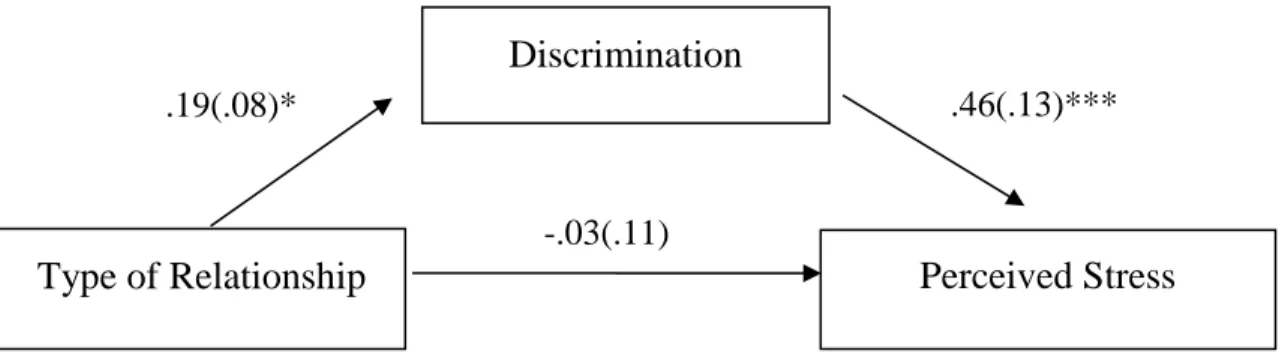
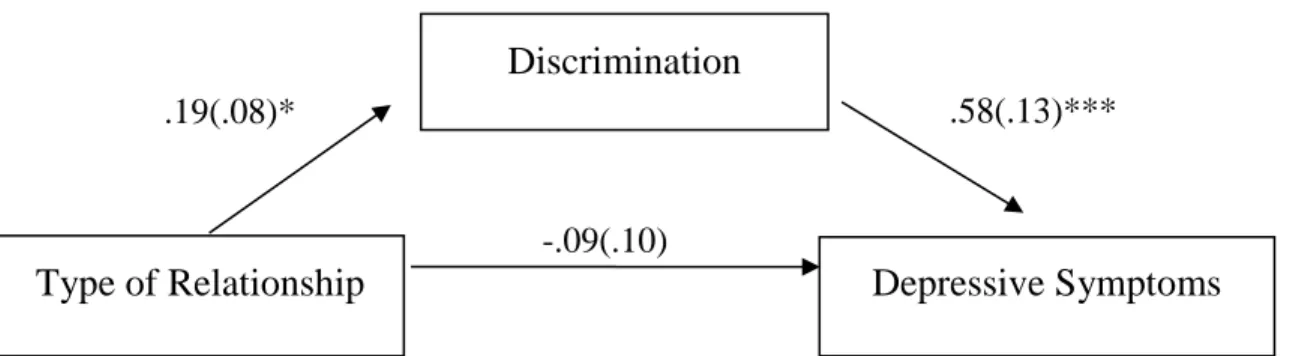
Mediation. Although I found no evidence that relationship type was associated with the outcomes (perceived stress, depressive symptoms, and relationship commitment), I proceeded to test the indirect effects. According to Hayes (2013), “it is possible for x to exert an effect on y indirectly through M even if one cannot establish through a hypothesis test that the total effect is different from zero” (p. 169). I hypothesized that relationship-based discrimination/unfair treatment would mediate the effects of relationship type on perceived stress, depressive symptoms, and relationship commitment. When specifying perceived stress as an outcome variable, results supported this mediation hypothesis as the bootstrapped confidence interval was entirely above zero (ab =.089, Bias-Corrected 95% CI [.006, .195]). As can be seen in Figure 1, participants who are in interracial relationships reported experiencing more relationship-based discrimination than participants who were in intraracial relationships, and experiencing more discrimination was associated more higher levels of perceived stress. Using depressive
I also hypothesized that perceived acceptance from family and friends would mediate the effects of relationship type on perceived stress, depressive symptoms, and relationship
Discussion
The first hypothesis tested examined whether or not individuals in interracial
relationships would experience higher levels of stress and depressive symptoms as well as lower levels of relationship commitment than those in intraracial relationships. The results of this study do not support the hypothesis that individuals in interracial relationships experience higher levels of perceived stress and depressive symptoms, and lower levels of relationship commitment than individuals in intraracial relationships. According to the data, both types of relationships yield similar levels of these three variables. The second hypothesis examined whether these higher levels of stress and depressive symptoms and lower levels of commitment would be mediated by friend, family, and societal support. There are also no differences in the level of friend and family support between individuals in interracial and intraracial relationships.
As I found no significant differences in stress, depressive symptoms, and commitment, there was limited support for the second hypothesis regarding friend and family support, and discrimination as mediating factors. The indirect effect of relationship type on the outcomes through family and friend support was not significant.
The data also showed that the higher the level of perceived discrimination the participants noted, the higher the levels of stress and depressive symptoms. This is interesting because, although the results did not show any significant difference between individuals in interracial as opposed to intraracial relationships, those who experience more discrimination report
experiencing more stress and depressive symptoms. This provides some support for the
hypotheses; that being discriminated against, as many individuals in interracial relationships are, causes more stress and depressive symptoms to be reported. In order to test this idea more fully a study could be completed that first prescreens for the level of discrimination experienced as a result of being in an interracial relationship and then investigates if the stress and depressive symptoms levels in those individuals are higher than that of other individuals in interracial relationships. That would indicate whether discrimination is one of the major factors that contributes to stress and depressive symptoms in individuals in interracial relationships; this might be a contributing factor in the higher divorce rates of interracial relationships.
Although the data did not support all of the hypotheses, there are possible flaws in the sample that could account for the lack of significance. For example, the majority of the
interracial couples were white/Asian-American or white/Latino/a couples, couples which are, in general, less stigmatized than white/African American relationships (Field, et. al, 2013). Due to cultural history, stereotypes, and existing prejudice white/African American relationships may receive more scrutiny than other types of interracial relationships, and were the sample to have had more white/African American participants there may have been higher levels of stress and depressive symptoms reported as well as lower levels of commitment in the interracial sample.
that evaluates relationship commitment are content with their relationship. Individuals who do not value their relationship highly are less likely to sign up for a study of this nature. The people taking the survey are also from one specific geographic region that houses a liberal university, which may have led to the sample to be more liberal overall.
The average age was relatively young and the average relationship length was just over 24 months which suggests that these relationships may not have existed long enough to
experience the discrimination that this survey was examining. Individuals who have been in a relationship for more time reported higher levels of experienced discrimination from friends, family, and society (Kao & Joyner, 2005), but since most couples from this study had been in a relationship for under three years they might not yet have experienced the majority of the discrimination they will face. Previous research also shows that interracial married couples experience the highest levels of discrimination from friends and families. Because there were only seven couples who identified as being married, it is possible that this small percentage contributed significant findings.
It is also possible that because only one member of the relationship was given the survey the full scope of discrimination, family support, and friend support for the couple was not reported. Indeed, the partner not the couple, was the unit of analysis in the present study Because the majority of individuals interviewed were white/Caucasian, it is possible higher levels of stress and depressive symptoms may have been displayed if the minority member of the relationship had been interviewed instead of or in conjunction with the participant. More
are not completely comfortable with one another. Further research should consider having both couples fill out the survey for more well-rounded results.
Further research should also look towards different types of interracial couples, for example white/black couples might be compared to white/Asian couples in order to determine whether the level of stigma and discrimination is high enough to account for the lack of significance in this study because this study contained mostly white/Asian-American couples. This study would also have benefitted from a higher number of interracial couples with a longer average relationship length. These hypotheses could still be supported if the conditions of the study, such as location and the participant pool, were different.
In conclusion, while the primary hypothesis was not supported, future studies with larger and more diverse samples may yield results supporting the idea that individuals in interracial relationships experience higher levels of stress and depressive symptoms and lower levels of commitment than those in intraracial relationships. It is also possible that if the average relationship length of couples was longer more discrimination and less societal support would have been reported by interracial couples. Overall, while the data from this study are
References
Andresen, E. M., Carter, W. B., Malmgren, J. A., & Patrick, D. L. (1994). Center for Epidemiologic Studies Depression Scale.
Form [Database record]. Retrieved from PsycTESTS. doi: 10.1037/t28615-000
Bratter, J. L. & King, R. B. (2008). “But Will It Last?”: Marital Instability Among Interracial and Same-Race Couples. National Council on Family Relations, 57, 160-171. Brock, D. M., Sarason, I. G., Sanghvi, H., & Gurung, R. A. R. (2008). Perceived Acceptance
Scale [Database record]. Retrieved from PsycTESTS. doi: 10.1037/t19970-000 Cohen, S., & McKay, G. (1984). Social support, stress and the buffering hypothesis: A
theoretical analysis. Handbook of psychology and health, 4, 253-267.
Dovido, J. & Gaertner, S. (1996). Spotlight on Research: Is Racism on the Decline in America? Association for Psychological Science, 9, 4.
Field, C. J., Kimuna, S. R., & Straus, M. (2013). Attitudes Toward Interracial Relationships Among College Students: Race, Class, Gender, and Perceptions of Parental
Views. Journal of Black Studies, 0021934713507580.
Finch, B. K., Kolody, B., & Vega, W. A. (2000). Perceived discrimination and depression among Mexican-origin adults in California. Journal of Health and Social Behavior, 295-313. Foeman, A., & Nance, T. (1999). From Miscegenation to Multiculturalism: Perceptions and
Stages of Interracial Relationship Development. Journal of Black Studies, 29(4), 540-557.
Fujino, D. (1997). The Rates, Patterns and Reasons for Forming Heterosexual Interracial Dating Relationships among Asian Americans. Journal of Social and Personal
Greene, M. (2006). Trajectories of perceived adult and peer discrimination among Black, Latino, and Asian American adolescents: Patterns and psychological correlates. Developmental Psychology, 42(2), 218-236.
Harris, T., & Kalbfleisch, P. (2000). Interracial Dating: The Implications of Race for Initiating a Romantic Relationship. Howard Journal of Communications, 11(1).
Hayes, A. F. (2013). Introduction to Mediation, Moderation, and Conditional Process Analysis. New York: Guilford Press.
Heaton, T. B. & Albrecht, S. L. (1996). The changing pattern of interracial marriage. PubMed, 43, 203-217.
Hill, M. R. & Thomas, V. (2000). Strategies for Racial Identity Development: Narratives of Black and White Women in Interracial Partner Relationships. National Council on Family Relations, 49, 193-200.
Ibañez, G. E., Van Oss Marin, B., Flores, S. A., Millett, G., & Diaz, R. M. (2009). Racism Scale for Latino Gay Men
[Database record]. Retrieved from PsycTESTS. doi: 10.1037/t01715-000
Joyner, K. & Kao, G. (2005). Interracial Relationships and the Transition to Adulthood.
American Sociological Review, 70, 4, 563-581. Kaplan, B., Cassel, J., & Gore, S. (1977, March 15). Social Support and Health
Lakey, B., & Cohen, S. (2000, April 15). Social Support Theory and Measurement. Retrieved October 6, 2014.
Lewis Jr, R. & Ford-Robertson, J. (2010). Understanding the Occurrence of Interracial Marriage in the United States Through Differential Assimilation. Journal of Black Studies, 41, 405-420.
Meron, T. (1985). The Meaning and Reach of the International Convention on the Elimination of All Forms of Racial Discrimination. The American Journal of International Law, 79(2), 283-318.
Operario, D., & Fiske, S. T. (2001). Perceptions of Racial Discrimination Measure [Database record]. Retrieved from PsycTESTS. doi: 10.1037/t16287-000
Preacher, K. J., & Hayes, A. F. (2008). Asymptotic and resampling strategies for assessing and comparing indirect effects in multiple mediator models. Behavior Research Methods 40, 879-891.
Salahuddin, N. M., & O'Brien, K. M. (2011). Multiracial Challenges and Resilience Scale [Database record]. Retrieved from PsycTESTS. doi: 10.1037/t07322-000
Sohoni, D. (2007). Unsuitable Suitors; Anti-Miscegenation laws, Naturalization laws, and the Construction of Asian Identities. Law & Society Review, 41(3), 587-618. Retrieved February 5, 2015, from
http://www.jstor.org/stable/4623396?Search=yes&resultItemClick=true&&searchUri=/ac tion/doAdvancedSearch?wc=on&q2=&acc=on&q5=&f0=all&q4=&f2=all&f3=all&isbn =&c6=AND&c2=AND&c1=AND&la
Taylor, J., & Turner, R. J. (2002). Perceived discrimination, social stress, and depression in the
Tropp, L. R. (2007). Perceived discrimination and interracial contact: Predicting interracial
closeness among Black and White Americans. Social Psychology Quarterly, 70(1),
70-81.
Troy, A., Lewis-Smith, J., & Laurenceau, J. (2006). Interracial and intraracial romantic relationships: The search for differences in satisfaction, conflict, and attachment style. Journal of Social and Personal Relationships, 23(1), 65-80.
Williams, D. (1997). Racial differences in physical and mental health socio-economic status
Table 1. Means and Standard Deviations for Stress, Depressive Symptoms, Commitment, Friend Acceptance, Family Acceptance, and Discrimination.
Interracial Intraracial Overall
n=33 n=67 n=100
Variables M SD M SD M SD
Stress 2.81 4.88 2.75 5.27 27.71 5.13
Depressive Symptoms 1.73 0.50 1.70 0.51 1.71 0.51
Commitment 7.83 1.24 7.91 1.38 7.89 1.33
Relationship with Friends 3.54 0.47 3.64 0.63 3.61 0.58
Relationship with Family 4.18 0.73 4.10 0.76 4.12 0.75
Everyday Discrimination
Measure 1.30 0.57 1.11 0.21 1.17 0.38
Note. *** p<.001; * p < .05. Intraracial relationship individuals were coded as a 0. Interracial relationship individuals were coded as a 1.
Figure 1. Mediation for perceived stress
.46(.13)*** .19(.08)*
-.03(.11) . .07 Discrimination
Note. *** p<.001; * p < .05. Intraracial relationship individuals were coded as a 0. Interracial relationship individuals were coded as a 1.
Figure 2. Mediation for depressive symptoms
Discrimination
Type of Relationship Depressive Symptoms
-.09(.10) . .07