Failed Promises: An Analysis of Post-Apartheid Land Reform Amy Cohen
Global Studies Department
The University of North Carolina at Chapel Hill April 2019
Approved by:
𝑇ℎ𝑜𝑚𝑎𝑠 𝐾𝑒𝑙𝑙𝑒𝑦, 𝐴𝑑𝑣𝑖𝑠𝑒𝑟
Table of Contents
Acknowledgements……….2
Prologue………...4
Chapter One: Introduction………6
I. Colonial history………6
II. 20th century land policy………...8
III. Post-apartheid land policy………..………10
IV. Why does this matter? ………...13
V. Research question………..…14
VI. Methodology………..16
VII. Chapter roadmap. ………..18
Chapter Two: Literature Review………19
I. Forced migrations.. ………...19
II. The importance of land.. ………...22
III. Expectations versus reality………24
IV. Racial divide………..25
V. Rule of law……….28
VI. Conclusion……….30
Chapter Three: Legal and Political Overview………...31
I. Land across politics………31
II. Urban land………..36
III. Land claims………38
IV. Transition to the real consequences………...41
Chapter Four: Real Consequences for South Africans……….44
I. Personal accounts of the case……….………44
II. Introduction to Imizamo Yethu………..47
III. Legal proceedings filed by the City………...52
IV. Response by the Legal Resources Centre on behalf of Imizamo Yethu………54
V. Analysis of motions filed………...56
VI. What eviction could mean……….60
Chapter Five: Conclusion………64
I. Relating to the broader perspective………64
II. What does the future look like? ………68
III. Final thoughts………69
Acknowledgements
I would like to thank the Legal Resources Centre of Cape Town for allowing me to access their resources to make this thesis possible. A special thanks to Steve Kahanovitz, the lead attorney on the Imizamo Yethu case, who was supportive of this research from the very beginning.
I would also like to thank all of the professors who advised me in this process. Thank you to Dr. Weiler, who constantly helped me go over edits and decide what would come next in my
process. Without Dr. Weiler, I would have been lost throughout the last year on this research. Thank you to Dr. Jenkins, who agreed to sit on my committee and provided helpful feedback to get this thesis to its final form. And lastly, thank you to Professor Kelley, my thesis adviser, who spent hours with me in his office tweaking this thesis and making sure it was the best it could be. I am very grateful to Professor Kelley for taking me on as a student and always making time for me.
Lastly, I would like to thank my thesis seminar classmates, friends, and family who supported me in this research over the last year. The encouragement and advice were much needed to finish this project.
Prologue
When I applied for a study abroad program in South Africa, I did not know much about the country’s past let alone its political history. In fact, my very reason for visiting South Africa was to learn about a country and region of which I knew nearly nothing. I sought to get outside of my comfort zone and confront my own privilege in an extreme way.
On my first morning in Cape Town, South Africa, the program I was a part of scheduled us for a cable car ride up the famous Table Mountain. The views from the cable car were unlike anything I had ever seen; before me were mountains, ocean, beaches, and a city right in the middle of it all. I could not quite capture the full beauty of Cape Town in pictures, but the landscape was breathtaking to say the least. One of my most vivid memories from the four months I spent in Cape Town was in that cable car with a group of strangers silently entranced by the imagery, when out of nowhere the cable car operator simply said “wow” over the loudspeaker. We all laughed and continued looking outside the windows in admiration. At the time, I was unaware of the battles over this amazing land that had gone on for centuries and continue to go on today.
A couple of weeks after witnessing Cape Town through that cable car, I began an internship at the Legal Resources Centre (hereinafter “LRC”). At the time I had no idea how instrumental this organization was in altering policy across all issues in South Africa and offering legal help to the many individuals who walked through their doors every day. I was thrilled with my position under an attorney who specializes in gender equality and
thesis. The historical injustices perpetrated by apartheid that I had only been learning about through class and readings took real life meaning when I started working on the case in Imizamo Yethu, also known as IY. I had the opportunity to work closely on the case by taking statements, attending court hearings, and even visiting the IY community. By the time I left Cape Town, the land and housing dilemma in IY remained unresolved and I was not sure what would come of it. Back on U.S. soil following study abroad, I sought to enrich my academic experience and decided that I would do this through writing a senior honors thesis about land in South Africa. At first, I did not know why this topic jumped out at me; land was not necessarily the largest focus of my studies in Cape Town or my time at the LRC. I did not even extensively study South Africa at UNC, as I concentrate in Latin America as part of Global Studies major. Still, I knew that I would not only be able to write an entire thesis on the issue of land, but that I felt
passionately about doing so. Everyone I talked to throughout the thesis process told me that I needed to write about a topic I felt great fervor for and for me this was it. I later realized through discussions with Dr. Weiler that my connection to this subject matter was because of IY.
Chapter 1: Introduction
With the world watching, Nelson Mandela was released from confinement on February 11, 1990 after 27 years of imprisonment. Four years following his release, South Africa saw a transition to democracy and, ever since, a government led by the African National Congress (ANC). These transitions came with a new wave of hope and what could only be described as an optimistic future (Cherry, 2010). One of the most contentious issues on the table following these dramatic shifts was land. In the first year of democracy, 87% of all land was owned by a white1 minority that comprised less than 9% of South Africa’s population (Jeter, 2018). The new
government, with activist Nelson Mandela as president, had to address this drastic inequality that they feared would lead to political instability. ANC leaders during apartheid promised to fix the issue of land and now it was time for them to make good on those promises.
I. Colonial history
One cannot understand land reform in contemporary South Africa without understanding the historical context, as briefly detailed in this section and the following section. South Africa had a long history of racial segregation and exploitation long before apartheid officially began. Dutch settlers arrived in the country in the 17th century, marking nearly 400 years since the original occupation and colonization (Secorun, 2018). The Dutch set out to colonize South Africa for purely economic reasons and thus South Africa was first colonized by the Dutch East India Company at Table Bay (Mitchell, 2009). Colonialism in South Africa was always about
resource extraction and exploitation, and this could offer one possible reason for the economic inequality that persists today.
The original inhabitants of the land settled by the Dutch were the Khoikhoi and the San, hunter-gatherer people grouped together as “Khoisan.” The Khoisan fought back against
European settlement, but were decimated by war and disease. Interestingly enough, the Khoisan are actually now considered “coloured”2 in South Africa’s racial classification system, even though they are the land’s original settlers. Their land was taken by the Dutch hundreds of years ago, but because the land debate in South Africa centers around black South Africans and land expropriation during the 20th century, the Khoisan are often forgotten in the discussion of land reform (Secorun, 2018). While the legal structure may have started with apartheid, clearly white Europeans began taking land from native South Africans long before the 20th century.
The South African War, also known as the Boer War, led to a British takeover of South African land. The war began in 1899 and ended in 1902, with both casualties and costs far higher than anticipated (Donaldson, 2013). This war was fought on the South African landscape largely as a dispute between European colonists. The British exemplified neocolonialism tendencies in their success of conquering already colonized land. Once again, the fate of their own land was out of the hands of indigenous South Africans, like the Khoisan and others. Native South Africans only continued to see the deterioration of their land rights after the British officially took control.
II. 20th century land policy
During the 20th century, both before and during apartheid, the government in South Africa put legal structures in place to take land away from native South Africans. In 1913, the South African government passed a key piece of legislation that would lay the foundation for land inequalities still seen today: the Natives Land Act (Beinart & Delius, 2014). Although black South Africans comprised the vast majority of the population, only 7% of arable agricultural land
was set aside on reserves for black South Africans (Bell, 2013). This share was later expanded to
13% by the Native Trust and Land Act of 1936 (Schneidman and Signé, 2018). After white
South Africans forcibly took land belonging to black South Africans, these black South Africans
settled on new reserves against their will. This Act was only the beginning of racial segregation
under what would become apartheid and was not repealed until after apartheid’s official end in
1991 (Bell, 2013). Under the Act, people were dispossessed from their land and their homes for
generations. Interestingly enough, the intent of the Act was not to create vast inequalities in land
ownership, but rather maintain land occupation as the norm and undermine black South Africans
(Beinart & Delius, 2014). Clearly the result was more far reaching and continues to affect all
South Africans, particularly the people and their families who had land taken in wake of the Act.
The following three acts were the most prominent pieces of legislation following the
Natives Land Act and before formal apartheid. The Housing Act of 1920 enhanced segregation
in public housing by requiring increased funding to build housing for the poor to be racially
segregated, even with separate access roads. Later, the Natives (Urban Areas) Act of 1923
segregated urban residential areas and created “influx controls” to reduce access black South
Africans had to the city. As a result, many black South Africans were restricted to townships and
condemnation of buildings and neighborhoods by local authorities, who then could move people
to new “housing estates” if funds were available (Mabin, 1992). This meant that local
government could continue to segregate races by moving them to these new housing estates.
However, the powers of these three acts were more limited than later legislation. Although they
contributed to growing inequalities since the original Natives Land Act, they were not considered
to be the harshest laws of the time.
With the official beginning of apartheid in 1948 following the election of the National
Party, some of the most damaging land policies emerged, further segregating the races to the
disadvantage of black and coloured South Africans. Most relevant to land inequalities,
particularly in the urban sphere, was the Group Areas Act of 1950 (Bell, 2013). This Act
enforced segregation of newly established “race groups” (see Footnote 1) in urban areas (Mabin,
1992). Here began mass forced migrations of black and coloured South Africans from urban
landscapes into the outskirts of cities in informal settlements, also known as townships. White
South Africans were strategic in implementing this segregation by keeping South Africans of
other races far away from where they lived, but not too far so they could still exploit their labor.
Although townships were not created under the Group Areas Act and existed long before it came
into fruition, they were certainly expanded in wake of the Act.
South Africa’s government before apartheid and under apartheid worked to ensure that
black South Africans and coloured South Africans would be subject to discrimination under the
law. This was not a unique circumstance, as this phenomenon of racial segregation and
oppression existed all over the world during this period. The difference in the case of South
Africa is how long these legal codes lasted, as apartheid ended in 1990 after more than 40 years
overnight, particularly in regards to land, but many found comfort in the fact that a political party
headed by black South Africans would be their guide. ANC members themselves were very
hopeful to solve the “land question.”
III. Post-apartheid land policy
Although the ANC sought to address land inequalities and grant land rights to black and coloured South Africans, the outcome thus far has been disappointing. With the first democratic elections in 1994 and the ANC finally in power, many South Africans were hopeful for their future in general and specifically as it related to land reform (Leyshon, 2009). As previously mentioned, only 13% of land was apportioned to black South Africans under apartheid and thus at the fall of apartheid, this majority group still owned just a fraction of the land. The ANC had a goal of redistributing 30% of South Africa’s land in the first five years after their initial election, but more than 10 years later in 2005 only 3% of this land had actually been redistributed
(Gjuvsland, 2009). Even in 2010, less than 5% of South Africa’s land had been effectively redistributed (Richen, 2010). This percentage has not climbed in any serious amount since 2010 either. Many question the effectiveness and efficiency of the land reform process as well as the ANC’s ability to accomplish what they set out to do in terms of land redistribution (Makombe,
2018).
Essentially that means if a person’s land was taken before 1913, i.e. during the period of primary colonization, they do not have a right to claim that land under this legislation. Black and
coloured South Africans could submit land claims until 1998 (LARC). In 1997, the government released the White Paper containing three pillars of land policy: (1) restitution, (2) redistribution, and (3) tenure reform3 (Arkadiusz, 2017). Unfortunately, as already discussed, very few land claims have been settled as a result of the government’s inefficient process for land reform. The South African government gave too few resources to institutions handling land claims and was not forceful enough in persuading white farmers to sell their land. A revision to this Act, the Restitution of Land Rights Amendment Act of 2014, opened up claims again until 2019, with priority given to those who filed before the 1998 deadline; however, this extended deadline was overturned in the courts. With thousands of new claims amassed in wake of the Amendment Act, the ANC is pressed to find a solution to the decades-old controversy.
The central strategy for land reform has been a “willing-buyer, willing-seller” model (Cousins, 2013). This model is predominantly used to handle rural land claims. Black South Africans who claimed their land was taken from them during apartheid had to submit legitimate documentation proving that the land once belonged to them or their families (Richen, 2010). Though this in itself was already a daunting task due to the inadequacy in official documentation for land ownership decades ago, many South Africans managed to gather the appropriate forms and submit their claims. But of course, willing-buyer, willing-seller depends on the consent of white South African farmers to sell their land to the government for the market price (Richen, 2010). This system was meant to be the basis for massive land redistribution. However, those
who implemented this program did not foresee how few white farmers would be willing to sell their land. A main worry of white farmers concerns their lack of faith in the government to follow through on compensation if they do choose to give up their land. The government has consistently under-resourced institutions that handle land reform, so it is reasonable to assume that land transfers and compensation will take years to process. White farmers’ unwillingness to sell their land to the government has led to stalemate in the willing-buyer, willing-seller model, and thus a significant contributing factor to the overall ineffectiveness and inefficiency in land reform (Richen, 2010).
Most recently in South African politics, Cyril Ramaphosa became president of the ANC and therefore the president of the country. His administration announced a planned change to the Constitution which will make expropriation of land without compensation much easier. This is presented as the ANC’s fix to the inefficiencies in the current land reform process and the still
vastly unequal land ownership in South Africa. Not surprisingly, this proposed amendment has been broadly compared to Zimbabwean land reform, which led to land grabs, destruction of property rights, and devastating decreases in foreign investment that drove Zimbabwe into economic crisis (Monteiro, 2018).4 Many attribute the sudden change in attitude of the ANC to electoral concern. In the last few years, the Economic Freedom Fighters has emerged as a far-left political party committed to economic equality, with an emphasis on land equality (Malema, 2018). Fearing that they could lose even more seats in parliament to the EFF, the ANC has ramped up its land reform rhetoric to appeal to the frustrations of many South African voters.
The “land question” as many South Africans refer to it, is yet to be fully answered. When the Restitution of Land Rights Amendment Act was passed in 2014, it opened up land claims for five additional years (LARC). This allowed those who were not able to file claims within the first five-year window a chance to claim their land, but also threatens to hinder the efficiency of the land reform process further. Additionally, around 50% of land that has been designated for restitution has not yet been transferred to the beneficiary (LARC).
There are conflicting opinions surrounding the future of land reform and whether it will bring about an actual resolution or destroy South Africa’s economy (Richen, 2010). In the past, the government has tried to keep the peace among South Africans and appease foreign investors by sticking to a willing-buyer, willing-seller model of land reform. The ANC has faced pressure from international institutions and feared that foreign investment would implode if expropriation occurred. At the same time, the ANC has not found a way to instill confidence in its land
redistribution program and government institutions continue to be abhorrently slow in settling land claims. The ANC, which has held majority rule in Parliament since the first democratic elections in 1994, has failed to answer to the land question nearly 30 years after the fall of apartheid.
IV. Why does this matter?
Africans most at risk for living in poverty (Greenwood, 2018). This inequality is inextricably tied to the issue of land, as the top 1% of South Africans still hold over 70% of the land (Greenwood, 2018). Leaders who sought to correct the harms caused by apartheid have only deepened the grasp inequality has on the country.
The ANC made many promises of swift land reform, but did not devote sufficient resources to accomplish what it set out to do. Inefficient methods for handling land reform have been coupled with political fear. The ANC fears economic crisis and failure of new policy that could lead to devastating electoral losses. Accordingly, the years have dragged on and the norm of ineffective and inefficient land reform has endured. Until the EFF achieved significant political standing, the ANC were not motivated to change its lasting policies. Many South Africans who lost their land during the 20th century have spent years waiting to see if they will ever receive justice for their loss. This failure to handle land reform appropriately reflects in individual circumstances, specifically in the case of Imizamo Yethu (“IY”). Ultimately, this thesis is about the government’s inability to deal equitably with land issues because it fails to understand the needs of the people involved, both nationally and locally. Remedying inequality falls into the hands of the government, and in South Africa this remedy requires an intervention in land reform.
V. Research question
This thesis centers around the following question: How has the South African government handled post-apartheid land reform and how does this compare to their original promises? The “South African government” is meant to be left broad, referring principally to the
My argument uses proof from the creeping pace of the land reform process, as reflected
nationwide and in the IY case, and the subsequent disappointing results. Most scholarly research on land in South Africa focuses on rural communities and farmland. This thesis will cover some rural land disputes, but also expand to detail processes of urban land reform in the post-apartheid era.
The Group Areas Act widely impacted urban settings and was a large contributing factor to the racial segregation still seen in South African cities today, particularly in Cape Town. There are parallel stories of rural land expropriation and urban land expropriation that both relate to each other and reveal differences in policy. Disproportionately distributed rural land produces much of the alarming inequality in South Africa, but based on my own experience and interests I have decided to focus on the urban sphere as an underrepresented and vastly important topic in land reform.
This interest in urban settings comes from the IY case directly and my time in Cape Town. South Africa is one of the most urbanized countries in the entirety of Africa; over two-thirds of the population live in urban areas (Mwanza, 2018). Why then, has the government focused on rural land as opposed to aiding the other two-thirds of their population? While some cities like Johannesburg and Pretoria, have become more integrated since the 1990s, Cape Town remains a notorious example of land inequality. Urban land in all of South Africa is still widely possessed by the wealthier, typically white, minority or held by the government, but this reigns particularly true in Cape Town (Mwanza, 2018). Black South Africans only hold 7% of
Although I will not discuss all of these matters in detail, combined they reveal underlying systemic issues affecting urban-dwelling South Africans, particularly those in Cape Town.
In this thesis, I will argue that land reform has not been handled effectively or efficiently, and that the government continues to place hardships on black South Africans most affected by land inequalities. I have chosen this argument because of the both the indications of my research and the government inefficiencies illustrated through the IY case. As established, South Africa is still the world’s most unequal country, and has even become more unequal since the 1990s. Land
has not been redistributed in any meaningful amount and that can only be attributed to
government failure. The IY case is a vehicle to demonstrate this larger picture. In both situations, the government treats the people involved as issues requiring resolution rather than humanizing the needs of those affected. Although the national government and the local government are separate functioning entities for the most part, their attitudes towards citizens under their authority are very similar. Both have let their constituents down with disappointing results. I recognize that land reform affects South Africans who beyond those who are just black or white, but for the purposes of this thesis I will focus on the relationship between black land ownership and white land ownership because the majority of South Africa’s population is black with most of the wealth in the white minority. As I will continue to demonstrate in this thesis, there were many promises made by the government, specifically the ANC, after the fall of apartheid with very discouraging outcomes. I will present ample evidence to this effect.
VI. Methodology
this thesis analyzes a particular case study in an informal settlement, or township, outside of Cape Town named Imizamo Yethu. IY is a community made up of black South Africans, many of whom live without access to electricity, reliable running water, or a sewage system. They have been plagued with numerous, devastating fires over time and now with eviction notices from the City of Cape Town over the last 18 months. IY represents a prime example of unresolved land issues and how they are dealt with; residents in the township are still suffering disastrous losses from apartheid and its fallout. South Africa continues to top charts with the worst inequality in the world (Beaubien, 2018). As an avenue for building wealth, land, or lack thereof, is a major contributing factor to this inequality.
In short, the primary method this thesis utilizes is case study analysis. The documents in the analysis are court records obtained via the LRC. Every document that I use has been filed in South African civil court and is publicly available. The two parties in the civil suit are the City and the LRC on behalf of IY. The LRC took on this case in the eleventh hour to try to prevent the eviction of approximately 120 families in IY. As I will show in my analysis, the residents who could be potentially evicted are willing to compromise with the City, but the City has ignored their requests for clarity and has routinely demonstrated resistance towards working with residents. Although this case is not a land claim specifically, the way it has been handled speaks to the larger picture of the South African land question.
of previous land reform research and court documents filed by the LRC on behalf of IY. The research I have done comes from a place of interest, not one of authority or superiority.
VII. Chapter roadmap
Following this introduction, my thesis contains a literature review examining major works around the topics of land reform and restitution. In the literature review, I critically engage with a range of sources from books to scholarly articles to commentaries. I also delve further into the Group Areas Act and its effect on the South African landscape. I address the common themes throughout the literature including the importance of land in South African culture, rhetoric around forced migration, racial polarization around land, and the utilization of law in solving the land issue. I express my own thoughts in comparison to the works of land scholars and highlight which predominant elements are crucial to the contextualization of the IY case study.
Chapter 2: Literature Review
As a divisive and highly politicized topic, there exists a wide range of sources that analyze land reform. Everyone holds an opinion on land reform, either based on research, personal belief, or both, and many express their thoughts via written platforms. In the chapter that follows, I will analyze major works that I have come across that advance my analysis of land reform and may offer distinct solutions to the land question overall. In my reading, I have found that there are a few major points of both agreement and disagreement among writers. I have narrowed those points down to the following, as reflected in the section headings: the
controversy over forced migrations; the importance of land for South Africans; how expectations have had to come to terms with the reality of the situation; the clear racial divide in the dialogue surrounding land reform; and the emphasis from all sides of how the law should be utilized to advance land reform. I will engage with many sources that critically examine the preceding issues and offer explanations for the phenomena seen in today’s discussion of South African land reform.
I. Forced migrations
The Group Areas Act of 1950 caused the largest forced migrations of South Africans over the course of apartheid (Surplus People Project, 1983). By the 1980s, 3.5 million South Africans had been forcibly removed from their homes into Bantustans5 or other undesirable areas (Kgatla, 2013). While some coloured and Asian South Africans were affected, the vast majority
of people affected by the Act were black; the Act affected very few white South Africans. Those 3.5 million people forcibly removed from their homes represented over 10% of South Africa’s
population at the time. These removals sometimes involved violence stemming from extreme action from the government and police brutality (Surplus People Project, 1983). These forced migrations, particularly outside of urban areas, expanded the township system that is still the norm today.
Selaelo Kgatla describes the racism underlying forced migrations initiated by the apartheid government (2013). Under the Group Areas Act, racial groups were assigned to townships based on their racial classification. The apartheid government promoted the removals under the pretense of peace and prosperity for all South Africans; it wanted to keep South Africa “racially pure” (Kgatla, 2013: 121). According to Kgatla, the forced migrations were
strategically oriented by the government under the guise of being beneficial to all groups (2013). The government cited security, ethnic purity, homeland policy, and more in their justification for the removals. In reality, almost no white South Africans were affected by forced migrations. Black South Africans paid the price of relocation. Kgatla sees removals as “one of the most humiliating experiences” black South Africans experienced during apartheid, and one of the most detrimental in the end (2013: 120).
work so that they do not have to make the daily trek to and from where their families reside, but commute regularly from rural areas or townships (2013: 73). Even after being forced out of urban settings, white South Africans have still managed to exploit the labor of black South Africans from the dawn of forced removals under apartheid to the present. To Reed, forced migrations created ongoing obstacles to freedom to movement (2013). Although much of the post-apartheid migration has led South Africans back to living in cities, not many black South Africans who experienced forced removals are able to return to their former areas of residence. Reed recognizes how the massive forced migrations have had lasting consequences on the informal segregation in contemporary South Africa.
Clearly, forced migrations are crucial to telling the story of land, especially in urban areas. These migrations led to unequal distribution of land in South Africa that requires post-apartheid land reform. There may never be racial distributions across land and neighborhoods equal to those prior to 1950. The apartheid government carried out force migrations under the facade of benefits to all racial groups. Land remains unevenly distributed across South Africa and this can be partially attributed to the restrictions to freedom of movement for black South Africans. These restrictions are both in the past and very much tangled with the present.
II. The importance of land
Land in South Africa holds significant cultural meaning and is deeply intertwined with identity. Issues regarding land have been at the top of the political agenda in the last two decades (Chigara, 2013). As already established, land has become a political rallying point for South Africans. This has been especially true recently with the rise of the far left in the form of the EFF. In the documentary Promised Land, the audience sees first-hand how attached both white and black South Africans are to their land. White landowners talk of how their fathers and their fathers’ fathers lived on the land, and how they grew up there alongside the black workers employed by their families (Richen, 2010). In contrast, black land claimants want the land back that their ancestors were forced to give up ownership to as means of reparations. Clearly seen through the film, white and black South Africans feel as though they have an ancestral right to the land and do not want to compromise on giving up even a portion of it (Richen, 2010).
In Oral History, Community, and Displacement, Sean Field introduces the expropriation
of land and forced migrations under apartheid as “cultural traumas” (2012). Land communicates
these comforts, or may have never known them at all as a result of colonization, imperialism, and apartheid. Additionally, Field emphasizes that the few South Africans that have either gained their land back or received compensation still suffer poverty and emotional deprivation (2012). When a South African regains land that was taken from them as a result of apartheid, that does not discount all the hardships they faced up until that point; those harsh memories and the feelings associated with those memories stick with a person throughout their life and may never be resolved. This relates to Ben Chigara’s comments on land reform when he introduced the psychological “invisible legacy of apartheid rule” (2013). Post-apartheid South Africa is
sometimes referred to as “so-called” post-apartheid South Africa for this very reason. The early 1990s may have brought an official end to apartheid, but it did not bring an end to enduring cultural trauma.
Bernadette Atuahene examines how land reform has happened and how people who have made successful land claims come to decisions in handling their restitution awards (Atuahene, 2014a). As discussed, land reform in South Africa has been a long and exhausting process, with very few people actually receiving redistributed land. Even after long fought battles in land claim cases, Atuahene states that most people actually choose financial compensation in the end, even though land and housing are the more valuable restitution awards (2014a). This may not
necessarily have to do with the importance South Africans place on land, but rather signs of an ineffective and inefficient government process. Most people cite poor institutional structure and worry over ever actually receiving the transfer of land as reasons they chose financial
compensation (2014a). Many who actually do wait for the transfer of land almost always cite cultural and political reasons, mainly the land as a “delayed reward for a hard-won fight”
South African land has considerable meaning for all racial groups and there are strong opinions on all sides, but some argue that South Africa faces greater issues outside of land. James L. Gibson identifies the three biggest problem he believes South Africa faces today: unemployment, HIV/AIDS, and crime (2009). In the piece by Field, he sees South Africa’s greatest failure not as their inability to provide significant land reform, but rather their response to the HIV/AIDS crisis (2012). However, Gibson and Field fail to recognize that poverty,
unemployment, crime, and disease are all inextricably linked to one another, and also linked with land reform. These systems of persecution intertwine and work together to impact the already most vulnerable South Africans concurrently.
III. Expectations versus reality
When the ANC came to power in 1994 following South Africa’s first democratic
elections, everyone expected change. South Africans who had been marginalized since the arrival of the Dutch saw this as a new beginning. However, it is evident that the ANC did not stick to its revolutionary rhetoric once in power. This is especially relevant for land policy. As established, many black South Africans were forcibly removed from their land during the 20th century. Land holds intimate value, as both a way to build wealth over generations and emotional attachment that comes with tradition and culture. After the transition to democracy, the ANC with president Nelson Mandela made it a goal to correct this wrong.
era of Mandela, Thabo Mbeki6 expanded expropriation, reconsidered buyer, willing-seller, and created a more proactive role for the state in the land reform process. One of Jacob Zuma’s three top priorities was land reform. Still, neither of these leaders was able to
successfully accomplish significant progress in land reform (Cousins, 2017). Cousins states that “land reform has barely altered agrarian structure of South Africa” meaning that most land claims have not been implemented in their entirety and have not affected South Africa’s inequality to any significant ends (2017: 142).
IV. Racial divide
Land reform is one of the most divisive issues in South Africa, and that division typically falls along racial lines. As land scholar Ben Cousins says “racialized inequalities in land holdings are a ticking time bomb” (2018). The EFF sustains electoral growth in areas where black South
Africans are most affected by inefficiency of land reform, while promoting land grabs and violence if necessary (Cousins, 2018). It is reasonable to think the EFF would turn to violence, given South Africa’s history and their radical leader Julius Malema. On the issue of race, Malema recently said “we have not called for the killing of white people...at least for now. I can’t guarantee the future” (Huffington Post, 2018). Cousins argues that the government’s failure
has made the deep racial divide on land much worse, an issue that should have been solved long before the now (2018).
The primary controversy over settling land claims between white and black South Africans is the question of who has the rights to the land. Both sides stand their ground in
believing that the true ownership should reflect their proclaimed right to the land. Ruth Hall considers the government’s dilemma in handling claims of historical authority over land from black South Africans and the property rights of white South Africans who currently inhabit the land (2004). During the time this article was written, Hall debates how the government will handle this racial divide in the future, with no clear answer. More than a decade later, the answer has yet to be seen and the stalemate in land redistribution persists. South Africa is no closer to compromising on land reform and bridging the racial divide in understanding land than more than a decade ago.
In Sean Field’s analysis of what he terms the “big three” in South Africa (unemployment, HIV/AIDS, and crime), he does state that the racial divide in the land question gives the issue a nuanced meaning outside of simply a political topic (2012). In his research, he found that black South Africans cite advantages held by whites as a result of apartheid and inability to recover from colonialism as the most widely accepted reason for land inequality (Field, 2012). While white privilege is definitely one causal factor, this logic deflects responsibility from the
government for its poor approach to land reform post-apartheid. According to Field, no issue in South Africa is more polarizing among racial groups than land. Field states that “political fires fueled by deeply felt senses of injustice are difficult indeed to extinguish,” offering an
explanation to both the continued racial divide in land and the constant discourse around land in the political sphere (2012: 218).
element of land reform as a process and not necessarily solely a policy procedure, that element being a “missing conversation.” To Makombe, the absent factor in the land reform program is
the “conversation that has not taken place between the previous farm owners and the
beneficiaries” (2018: 1416). There continues to be a distinct us versus them mentality from both sides of the issue, eliminating any chance of compromise between groups. He argues that the government should facilitate this conversation as a pillar of the land reform program (Makombe, 2018). The main flaw in Makombe’s piece is his assumption that once these groups come
together to talk, they will be able to set aside their differences in a compromise. As proven, land is an issue deeply embedded into both white and black South Africans, and there is no guarantee that compromise could ever happen. Both sides believe they should not have to compromise, and until there is a fundamental shift in the attitudes of South Africans, this “missing conservation” Makombe describes would be hopeless from the start.
V. Rule of law
When considering South African land reform, it is necessary to examine the rule of law and its role in the process. This looks at how the law is used to structure land reform and move the process forward. While the previous section discussed the great racial divide over land reform, interestingly enough the rule of law is a topic where nearly everyone agrees. According to various authors, for the most part South Africans across all races agree that the rule of law is necessary in land reform. This notion reveals great respect for the law and other legal framework in South Africa. Of course, all groups disagree over how exactly the law should be utilized in land reform going forward, but most South Africans see a need to obey the laws set forward by the government. The exception to this would be the EFF and its supporters, who do believe violence and land grabs may be necessary.
James L. Gibson identifies the most significant common support over land reform among South Africans as the rule of law to drive land reconciliation (2009). As Gibson describes, land is an issue of heavy concern, especially to potential beneficiaries of new land policy, and should be guided by comprehensive and informed policy rather than disorder. In a commentary by Derick Fay, he explains the necessity of rule of law in land reform going forward (2018). He emphasizes the need to resolve land claims faster, but not in an arbitrary way. Fay believes the government should be responsible for this process and in the future, legislators should create a more
sustainable procedure for handling land claims (2018). While Gibson emphasizes popular agreement over rule of law, Fay necessitates its value for prospective land policy.
haywire (2013: 89). As a country that was relatively stable until 2000, land seizures in the 21st century caused massive economic and political problems. Chigara even goes so far to say that the land grabs in Zimbabwe mirror similar tactics during the colonial period, with the exception being the racial role reversal. He sees the rule of law as a complicating factor because of how Zimbabwe responded with violence after changes to the law that favored black Zimbabweans. For Chigara, the disregard for rule of law reflects unresolved issues of colonial injustice (2013). While Chigara’s analysis of the situation is useful, there may be a way to approach land reform
using the law that would not lead to land grabs like the ones seen in Zimbabwe. The rule of law does not necessarily have to be a complex factor in the equation, but rather one that can settle land reform in the future if implemented properly. Clearly, South Africans have respect for rule of law based on research, and the government should take advantage of this in crafting land reform policy.
However, the amendment to the Constitution might perform better in theory than in practice. In theory, many South Africans support the rule of the law, but this may only be true if the rule of law operates in their favor. The same constitutional amendment is precisely what led to the crisis in Zimbabwe, meaning that reform by rule of law can have unintended and less than legal consequences. In the opinion of many land scholars, the most effective way to overcome institutional inefficiency that has plagued land reform for decades would be properly resourced administrative services that deal with land claims and more robust incentives for white
landowners to sell their land. In any solution to the land question, the rule of law is a major consideration and can be an advantage to policymakers if applied in the right way.
VI. Conclusion
Chapter 3: Legal and Political Overview
In previous chapters, I established the basis for my argument around land reform and reviewed major concepts regarding the discussion of land in South Africa. In the chapter that follows, I first outline the politics of post-apartheid land reform across different ANC
administrations. Then, I narrow the focus to urban land and its relation to the rest of my thesis. I give specific statistics and numbers on post-apartheid land claims. Finally, I explain the
transition the next chapter makes into the case study that will be the focus of the remainder of this thesis: Imizamo Yethu, or IY. This chapter communicates a more precise picture of the specific legal framework surrounding land reform and sets up precedent for the IY case in the next chapter.
I. Land across politics
Paper on Land Policy to guide future land legislation in the country (Parliament of South Africa, 2016).
Even though the ANC criticized capitalism during apartheid, it relied on the World Bank for financial support after coming to power. While the World Bank did seek out South Africa as a partner rather than the other way around, the World Bank was not South Africa’s only option (Smith, 2008). With opinions on entering into a relationship with the World Bank sharply
divided even amongst the ANC, Mandela’s administration re-established ties and pursued a more
liberal economic structure (Smith, 2008). At the time, the ANC was in the midst of its own transition from a revolutionary movement to an established political party. The party did not need to bring World Bank regulations to South Africa; the country was stable enough
economically to have pursued other avenues for development. Rather, the ANC actively chose to make the World Bank a part of its vision for a post-apartheid South Africa. Under pressure from the World Bank, the Mandela administration established use of the willing-buyer, willing-seller model. This model severely curtailed the ANC’s original land reform goals by placing
restrictions on land redistribution.
As discussed in chapter one, Mandela and the ANC stated that it would redistribute 30% of South Africa’s land within the first five years of their rule. This goal was part of the first land
offering market value compensation to purchase their land. While this was considered a concession to white South Africans, black South Africans still believed that the ANC would effectively and efficiently transfer back the land that was taken from them. Now it is evident that white South Africans got what they desired, but black South Africans are still waiting for their end of the deal to become a reality (Atuahene, 2014b).
After Mandela formally stepped down from politics in 1999, Thabo Mbeki took control of the ANC and the country between 1999 and 2008. Although Mbeki had spent 28 years in exile and returned to South Africa only after Mandela’s release from prison, ANC leaders did not consider him to be a legitimate revolutionary (CNN Library, 2018). While Mandela was supported on the basis of his popularity as a leader, Mbeki was only supported because he had been put in a leadership position (Gumede, 2013). Mbeki was less of a symbolic leader like Mandela and more of a technocrat. On land reform and other economic policy, Mbeki tended to embrace neoliberal structures that exacerbated South Africa’s extreme income inequality. In line with this set of beliefs, Mbeki followed the 1993 World Bank’s land reform principles of willing-buyer, willing-seller. He saw value in the World Bank’s insistence on the primacy of private property rights (Gumede, 2007). His administration primarily focused on a state-purchase-and-leasing model for land redistribution, which also impeded reliable land tenure (see Footnote 3) by granting the state ownership of the land rather than the individual citizen (Parliament of South Africa, 2016). South Africans criticized Mbeki for implementing policies that hurt the black majority, the very people the ANC claimed to be protecting. At the end of his second term, the ANC forced Mbeki’s resignation (Gumede, 2007).
Following Mbeki’s nine-year period as president and subsequent resignation, Jacob Zuma
development in his term as president, which necessarily meant improving the effectiveness of land reform (Arkadiusz, 2017). He called for an abandonment of the willing-buyer, willing-seller model in favor of “‘expropriation in the public interest’ and with ‘just and equitable’
compensation,” as provided for in Section 25 of the Constitution (Parliament of South Africa, 2016: 12). Although the Zuma administration did not completely abandon the willing-buyer, willing-seller model, it did not prioritize it as much as previous administrations. Since 2011, the only state land redistribution method has been a Proactive Land Acquisition Strategy, or PLAS, originally created in 2006 under Mbeki. Through this plan, the state purchases land and leases it to South Africans rather than transferring the land to beneficiaries, hence the uncertainty of land tenure (Parliament of South Africa, 2016). However, under a newer, revised version of PLAS, these land transfers are only available to tenants after an initial 30-year lease and then optional 20-year renewal, meaning that a tenant must rent from the government for 50 years before being eligible to have the land transferred to them (Parliament of South Africa, 2016). The goal of PLAS is eventual redistribution to private ownership after long term leases, but this portion of PLAS has yet to come to fruition.
Aided by Zuma’s lack of progress on land reform and other similar social welfare issues, the EFF emerged as a direct response to what many South Africans see as a failure of the ANC. Since its formation, the EFF have advocated for radical leftist policies including land
to allow land expropriation without compensation, but did not take any concrete steps towards ensuring this outcome (Graham, 2017). Land redistribution reached its slowest pace since 1995 during Zuma’s time as president (Parliament of South Africa, 2016).
At the beginning of 2018, Cyril Ramaphosa, former aid to Mandela and political rival of Mbeki, became the new president. The general public views Ramaphosa as more of a Mandela figure, which fueled hopes that real change is coming. With the EFF gaining electoral ground and siphoning off would-be members of the ANC over time, Ramaphosa has taken action. His administration has announced plans to allow for the expropriation of land without compensation (Kumwenda-Mtambo, 2018). This would be a radical shift in policy from the willing-buyer, willing-seller model that has been in place since the Mandela era. Ramaphosa has reassured South Africans that this change would not cause violent land grabs, but would in fact help expand the economy and address the country’s growing unemployment rate (Madia, 2018). However, similar policies that allowed uncompensated land expropriation in Zimbabwe led to economic despair and destruction of property rights (see Footnote 4) so Ramaphosa and the ANC will need to design its new plan with care to avoid a similar tragedy. This dramatic legislative adjustment can be attributed to Ramaphosa’s fear that the EFF will grow larger, taking more former ANC members with it.
although the report does note that figures for the 2016-2017 period at the time of publishing were incomplete. This graph does not cover land redistribution during Ramaphosa’s presidency since
his inauguration in February 2018.
Figure 1 - Taken from a 2016 report commissioned by the Parliament of South Africa on Land Redistribution in South Africa (32)
II. Urban land
made from any side. Land reform needs to include a specific discussion of how to improve urban areas going forward.
Understanding the complexity of contemporary urban land issues requires some historical context. When the National Party came to power in 1948, they were committed to mandatory urban segregation and instituted the Group Areas Act of 1950, which substantially worsened South Africa’s inequalities in the urban sphere (Mabin, 1992). This commitment manifested two years later with comprehensive segregation policies, most notably the Group Areas Act, which proposed retroactive segregation, forcing black and coloured South Africans out of cities where they then resided (Mabin, 1992). These South Africans were forced to live in designated areas on the outskirts of cities commonly referred as townships. Although they had been forcibly
relocated and now faced hours long commutes to the city, many black South Africans still had to make the trek into urban centers for work. The Act was calculated in this way; forcing black South Africans to live considerable distances from white South Africans in townships, but still able to work for them. This Act was not repealed until the fall of apartheid.
Since the end of apartheid, South Africa has failed to integrate its urban communities and provide sufficient housing to the populations that suffered discrimination under apartheid. There were more than 1.5 million informal units in urban landscapes when the ANC came to power in 1994 (Newton & Schuermans, 2013: 580). While the ANC tried to provide solid infrastructure for people living in these dwellings through fixed subsidies and construction projects, the subsidies were not adequate to cover the cost of building acceptable homes and actually
spatial perspective, developments in the private sphere have reinforced segregationist attitudes. This includes gated communities and barbed wire fences, which perpetuates fear and us versus them mentalities (Newton & Schuermans, 2013). There has been some integration in the urban sphere since 1991, but racial divides remain apparent in South African cities. Still more than 40% of the urban population resides in townships (TTRI, 2007:4). This contributes to the
extensive inequality in the country, as many black and coloured South Africans live as tenants on publicly owned land outside of cities in townships and white South Africans retain their own property within city limits.
III. Land claims
This section will discuss how many land claims have been made, how many of those claims have been settled, and what motivates people to choose either land or monetary
compensation once they reach settlement. Since 1994, many South Africans have been able to make claims to land that once belonged to them or their families, but was taken by whites during apartheid. To remedy consequences of dispossessed land, the ANC passed the Restitution of Land Rights Act 22 of 1994 very soon after coming to power (Beyers, 2016). This Act aimed to both recognize and compensate, financially or otherwise, individuals who had indeed lost land. As a caveat, this only includes land that was taken after the Natives Land Act of 1913 and not land that was taken during the initial colonial period.
by large groups. By 2001, the Land Claims Commission had only settled 12,314 of these cases (PLAAS, 2016:10). In 2009, the government claimed to have settled 75,787 of these claims, but most of these settlements involved monetary compensation rather than actual transfers of land (PLAAS, 2016: 11). An amendment to the Restitution of Land Rights Act in 2014 opened up land claims for another five years, which brought fears of an even less efficient settlement
process with potentially up to 397,000 new claims surfacing; this amendment was actually struck down by the Constitutional Court, citing the likelihood that any new claims would cause claims made before the initial 1998 deadline to become even further backlogged (PLAAS, 2016: 13). The Court ordered that all of the people who submitted land claims in 1998 or before have priority over those who submitted their claims during the reopening period in 2014. The land reform process has been plagued by slow official processes and poor inter-department
coordination (PLAAS, 2016). With the current governmental process and sheer amount of land claims, especially recently with new claims, researchers estimate that it would take at least 178 years to finish the land claim process at its current pace (Magubane, 2018).
monetary compensation over actual transfer of land, perpetuating inequality and precluding distributive justice.
South Africans eligible to receive land, particularly in urban landscapes, prefer monetary compensation due to lack of faith in state institutions. In We Want What’s Ours: Learning from
South Africa’s Land Restitution Program, Bernadette Atuahene displays her results from
extensive research and interviews with more than 150 South Africans who have taken part in the nation’s land reform program. According to her research, there are seven primary reasons people
choose monetary compensation: (1) the long and complicated process that many lack faith in, (2) if the urban land they once owned in an urban area was now undeveloped, they feared
development was unlikely to happen, (3) lack of coordination between agencies, (4) the high employee turnover rate in the land commission office, (5) knowledge that project officers would shy away from development projects, (6) not wanting to move from their current location, and (7) money was easier to split between family members than a physical landscape (Atuahene, 2014a: 146-149). Of these seven reasons that Atuahene cites, five include either ineffectiveness (2, 5) or inefficiency (1, 3, 4) in the land reform process.
between land and financial compensation, but it is rational to assume that many would choose land if their government was both effective and efficient. Even when settling slow land claims, the government, headed by the ANC, cannot seem to fully satisfy beneficiaries, leaving a system of inequality intact.
IV. Transition to the real consequences
Post-apartheid ANC governments have defined land reform based on three principles: (1) land restitution, (2) land redistribution, and (3) land tenure reform. Policy changes have been based around these premises. In the past, advances in land reform have constituted delayed justice, if justice is reached at all. Ineffective and inefficient land reform in South Africa has left many to suffer enduring injustice years after apartheid. The first three chapters have laid out the methods of injustice and how they have impacted the country as a whole. The overall results are clear; land reform in South Africa has not been the grand overhaul of the country’s landscape that many thought it would be once Mandela became president. The question now becomes, what does this lack of progress look like for a community or even an individual?
South Africa’s government functions at three primary levels: national, provincial, and local. These levels are at the same time distinct and connected, and are not meant to be seen as hierarchical. All divisions of government are also bound by the Constitution and by the national Parliament (ETU). This means that although the ANC is the ultimate authority over actions executed by the local government as the majority party, the local government has a great deal of autonomy in their decision-making. But, this thesis does not contend that the national
study. Government ineffectiveness and inefficiency as well as the attitudes of the elites involved in politics towards everyday South African citizens trickles down at every level of leadership.
As I will discuss in the next chapter, IY is one example of a community that awaits justice in land reform, both prior and subsequent to March 2017 when their current trouble began. While their type of issue with land may not be included under the three-principle reform program, it portrays how land justice is delayed by the government. The situation this
community finds themselves in can be explained by lasting inequality and failure of the government to ensure its citizens have access to basic needs and services. There has been no restitution, redistribution, or reliable land tenure for residents of IY. In fact, as the court
documents will show, the government may think it is providing the community with what they need, but it is actually actively working against them, much like land policy. The urban
landscape has notoriously evaded land reform due to how government policies and procedures have played out. The government has focused on rural land reform as a major source of
inequality, even as unsuccessful as its policies have been. Urban residents who are able to access land reform programs have primarily chosen compensation over land transfer because they fear more interaction with governmental land processes. In the case of IY, the government has continually put minimal resources towards solving the community’s problems and demonstrated
an attitude that refuses to respectfully involve community voices, similar to how land reform policy has functioned at the national level.
IY is a township within an otherwise wealthy area on the far side of Cape Town. Their requests for basic services and proper roads have long been ignored by local commissions. When the government decided to move forward with plans to alter the community’s landscape, it did so
Chapter 4: Real Consequences for South Africans
This chapter transitions from the broader picture of South African land reform to the land struggles of a particular South African community. Previous chapters have revealed how the ANC government has failed to meet the needs of its citizens in terms of land reform. Chapter three provided a legal and political framework for discussing land reform. Chapter four shows how this framework affects communities most severely impacted by inequality in South Africa. Cape Town remains one of the most segregated areas of South Africa, surpassing Johannesburg and most, if not all, other urban areas (Mwanza, 2018). This urban landscape has not seen meaningful integration since the 1990s, with most white people residing within city limits and black and coloured South Africans living outside of the main city center in townships. This chapter begins with personal observations and then shifts to historical and legal accounts of IY. Even though the legal case on behalf of IY does not deal with a land claim, there are still prevalent implications in how the government presently handles South Africans’ land claims. Although chapter four does not explicitly examine how IY ties into land reform generally, chapter five will include this analysis.
I. Personal accounts of the case
LRC’s interns were assigned to this urgent land matter. During one of the first days on the case, the lead attorneys asked for candidate attorneys and interns to come with them to IY for a evening meeting with the community about next steps.
I volunteered to go so I could experience the community we were working on behalf of with my own eyes. Almost all the previous work I had done involved clients indirectly, so this was an exciting opportunity for me. The meeting took place outside the home of a prominent community leader, Pamela Sofika. We drove up narrow, crowded roads to get to her home with people staring into our car the entire time, probably wondering what outsiders were doing in their community. Pamela welcomed us into her home, where the attorneys discussed plans for the impending meeting. Shortly after, the LRC attorneys spoke to the community about the situation, what the LRC was going to do to help, and how the community could help the LRC with the case in return. The primary attorney, a white man, spoke in English while another LRC attorney, a black woman, translated in isiXhosa through a megaphone. I could tell how worried the residents were about what could happen to their homes. They did not seem aggressive or unruly as the City would describe them in the case, but I can also understand how they might act differently around a group of lawyers hoping to help them rather than City officials demolishing their homes. At this meeting, the LRC attorneys informed the residents that they should bring a few community members to the LRC the following day to provide statements for the case, which would later become affidavits cited in section VI of this chapter.
interview with Thembela Liwani, who I will discuss more later. During our time together, he emphasized how he could not continue to support his family out of the structures that the City proposed to relocate him and his family to. He required only two more square meters of space for both his house and his plot so that he could keep selling meat out of the front of his house. I thought a lot that day about what the residents who came into the office were really asking for, which did not seem like much and certainly nothing unreasonable. It caused me to reflect on both their situation and the condition of South Africa as a whole, how people living in townships face repercussions from apartheid every single day and how almost all of it is out of their control. I am not going to say that I truly understand them because I cannot imagine what it is like to be their situation and have to fight for what they were fighting for, but I empathized with them and did my best to represent Thembela in the parts of his affidavit that I wrote.
Something so simple as speaking to the aggrieved residents in isiXhosa caused me to have a great deal of respect for him. Although nothing was resolved that day, the LRC attorneys ensured everyone that this was not typical behavior from a judge and this was a good sign for the future. Pamela and the other resident appeared to be happier walking out of the courtroom than when they first walked in. My journey with IY while in South Africa may have ended there, but both the case and my interest in South African land have endured over time.
II. Introduction to Imizamo Yethu
Imizamo Yethu, also known simply as IY, is an informal settlement on the outskirts of Cape Town. This informal settlement, or township, spans upward onto the bottom of one of Cape Town’s mountains. Many of IY’s residents do not have access to basic services such as
Figure 2 - Taken from the 2011 South African Census
IY sits between several mountains on the far side of Cape Town in a region called Hout Bay. This area is strikingly beautiful, but there is a stark division. The majority of Hout Bay contains well-established homes belonging to people who are comfortably wealthy, while IY is an extremely poor township. The land constituting IY is only a small fraction of the total landscape in the Hout Bay valley, yet these two land areas have roughly the same population (Miller, 2018). Traveling through the region, one can see how the wealthy parts of Hout Bay physically look down on IY from their side of the mountain. The land in Hout Bay is both
beautiful and troubling, with about half of the population occupying the vast majority of the land. This reflects typical patterns in land ownership throughout the country. Figure 3 shows the contrast between IY and the rest of Hout Bay. It is also worth mentioning that since IY is a township, the land is publicly owned (Van Staden, 2016). IY residents are tenants of the
Figure 3 - Taken from a photo series by Johnny Miller
As previously mentioned, the IY community holds a dense population on very little land area. This means that the homes are very close together, which causes a wide variety of
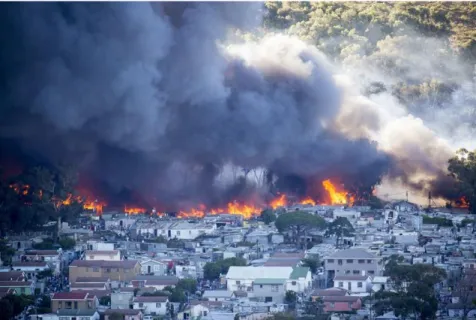
difficulties. The one that has most affected IY is fires. There is little to no running water in IY and currently no roads sufficient to provide access for emergency vehicles. When a fire starts in IY, it could go on for hours or even days, spreading deeply into the area. While IY has had fires before, none had been more disastrous than those that occurred on March 10 and 11, 2017. A fire that began in the evening hours of March 10 raged until the afternoon of the 11, destroying an estimated 3,500 homes and displacing thousands of residents (Harrison, 2017). After this fire, the City finally decided to act regarding the havoc fires had wreaked in the area by building proper roads. This process is called “super-blocking”7 and it requires the destruction of a few homes to build roads for emergency vehicles that will ultimately benefit the entire community. While IY
residents had been asking for these roads for years, the City went about providing them in almost the worst way possible.
Figure 4 - Photo of the March 2017 fires from HoutBay.org
Figure 5 - Another close up view of the fires in March of 2017 from GroundUp.org
utilized these results in Pamela Sofika’s original affidavit to reveal information about the average person living in the IY community who would have to relocate under the City’s plan. The results
revealed: the average age was 38; 96% of people owned their shacks8; 85% were victims of the March 2017 fires; on average the person had been living in their present shack for 15 years9; about 70% were employed; and the average monthly income was R1614 (approximately 120 USD) (8). Additionally, of the 106 residents who completed initial questionnaires, 17 of them claimed to be either elderly, disabled, or special needs. In total, the 106 residents had 58 children (8).
During the first few months of this case, the City compiled a data set to verify information on 178 IY residents that it believed would ultimately be affected by its super-blocking plan. This set of documents revealed some additional facts about the residents in question: 55% indicated that they were single, a little over half (52%) of those who marked their gender put down “male,” and on average they had between 3 and 4 dependents living with them.10 It is assumed that almost all, if not all, of the affected residents were black as IY is a black township.
When compared to statistics for South Africa as a whole, these numbers reveal that the people who would potentially be affected by the City’s super-blocking plan are not entirely
different from the average black South African, and in some ways the IY residents are more vulnerable than most. According to the 2011 Census, 79.2% of South Africans were black and 8.9% were white, confirming that black South Africans make up the vast majority of the country,
8 According to the residents’ own terms, in reality the City owns the land.
9 Presumably meaning prior to the March 2017 fires if their shack was burnt down and then rebuilt.