April 11, 2016. 99 pages. Advisor: Dr. Sandra Hughes-Hassell
This paper establishes an argument for the beneficial roles makerspaces can provide in school library programs. It builds a bridge between formal and informal education by grounding it in current accepted educational theories and frameworks including constructivism, constructionism, inquiry-based learning, and Backward Design. The paper stresses the importance of understanding adolescents and how they learn in a school library makerspace. It also addresses the role of school librarians as collaborators and their responsibility to conduct evidence-based practice. The final product resulting from this work is a makerspace collaboration guide intended for use by school librarians. It provides tools for facilitating productive collaborations between the school librarian, teachers, students, and community members. A version of this collaboration guide is available for download and modification at jennythelibrarian.wordpress.com. Headings:
Library media specialists Librarian-teacher cooperation Middle school libraries
by
Jennifer B. Parks
A Master’s paper submitted to the faculty of the School of Information and Library Science of the University of North Carolina at Chapel Hill
in partial fulfillment of the requirements for the degree of Master of Science in
Library Science.
Chapel Hill, North Carolina April 2016
Approved by
Table of Contents
Contents
Table of Contents ... 1
Contents ... 1
INTRODUCTION ... 3
Part 1: Background ... 7
Section 1.1: Makerspaces... 7
Section 1.1.1: What is a Makerspace? ... 8
Section 1.1.2: Planning a Makerspace ... 11
Section 1.2: Learning in the Makerspace ... 15
Section 1.2.1: Constructivism Complements Constructionism ... 15
Section 1.2.2: Inquiry-Based Learning ... 19
Section 1.2.3: STEAM and Interdisciplinary Education ... 25
Section 1.2.4: The uTEC Maker Model ... 30
Section 1.2.5: Preparing Students for the Future ... 31
Section 1.3: Adolescent Development ... 33
Section 1.3.1: Adolescent Development Overview ... 33
Section 1.3.2: Adolescent Information Needs ... 35
Section 1.3.3: Adolescent Information Seeking Behaviors ... 37
Section 1.3.4: Adolescent Use of Information ... 39
Section 1.4: Librarians in the Middle School Library Makerspace ... 42
Section 1.4.1: Role of the Librarian ... 42
Section 1.4.2: Collaboration ... 46
Section 1.4.3: Evidence Based Practice and Assessment ... 52
Section 1.4.4Evidence-Based Practice and Student Outcomes ... 54
Part 2: Project Design ... 59
Part 3: Future Practice and Implications ... 63
Collaboration Guide for a School Library Makerspace ... 65
Part 1: Preparing for Collaborations ... 65
Writing a Policy for Your Makerspace ... 65
Step 1: Align with your Library Mission ... 65
Step 2: Hear from your Users ... 67
Step 3: Write the Policy ... 68
Developing Community Partnerships ... 70
Step 1: Brainstorm Possible Partnerships ... 70
Community Partner Possibilities... 70
Step 2: Background Research ... 72
Step 3: Initiate Communication ... 73
Step 4: Mentor Matching ... 74
Makerspace Inventory ... 75
Part 2: Collaborative Planning for Makerspaces: Engaging with Teachers and Students ... 76
Step 1: Know What Your Teachers are Already Doing ... 76
Step 2: Identify Student Interests ... 77
Step 3: Think about Themes ... 78
Step 4: Organize Specific Content ... 78
Step 5: Backward Design ... 80
Step 6: Project Facilitation ... 81
Part 3: Assessing Learning in the Makerspace ... 84
Assessing Learning in the Makerspace ... 84
Step 1: Gather Acceptable Evidence ... 85
Step 2: Analyze the Evidence ... 85
Step 3: Disseminate your Findings ... 85
I
NTRODUCTIONMakerspaces have enjoyed recent attention in popular library and education journals, websites, and blogs, where they are often presented as being a beneficial
addition to a school library (Abram, 2013; Daley & Child, 2015; Hall, 2014; Kurti, Kurti, & Fleming, 2014b, c; Range & Schmidt, 2014; Smay & Walker, 2015). Most of these articles either document the experience of a librarian getting a makerspace started in their library, or give the reader instructions and tips for starting their own makerspace. The latter type of article tends to list helpful materials for the librarian to buy, or they might describe some one-shot project ideas to implement in the school library makerspace. These articles are a fantastic starting point for the librarian who is just hearing about makerspaces, but they do not allow librarians to tap into the true power of a makerspace and the significant impact it can have on student learning. They also provide little
guidance or concrete advice for teaching required national and state standards and content in school makerspaces.
A false dichotomy seems to exist when it comes to views about education in sthe United States. One idea is that students must perform well only on standardized tests. This view often results in teaching to the test rather than developing deep understandings. The other view is that imposing predetermined standards on students stifle real learning and creativity, so teachers should never interrupt student activity, nor should they attempt to measure the learning occurring because it is impossible. Curt Gabrielson (2013), a proponent of learning by tinkering and the founding director of the Watsonville
Environmental Science Workshop, an informal science education center in California, for example, believes that children can teach themselves almost anything just by tinkering and reading on their own. This hands-off view often results in a negative perception of school and can ignore the benefits of standards and outcome-based learning, such as providing structure for students and opportunities for assessment. Laura Fleming, an educator and media specialist who wrote Worlds of Making: Best Practices for
Establishing a Makerspace in your School, takes a more moderate stance between these two views by saying:
It is more than possible to do both, to improve teaching and learning by aligning the practice and formative development of skills and ways of thinking to the standards, and by means of a wide variety of creative innovative pathways to learning (Fleming, 2015, 32).
Syracuse University, and the developer the Stripling model of inquiry discussed later in this paper, comments on how educators must teach for understanding:
For students to understand fully, they must have access to textual sources and formal learning, but they must also develop their understand through tapping into their informal learning from their own life experiences, communicate with others
(including experts and practitioners in the field) and acting on the understanding) or applying and practicing it in multiple contexts) (Stripling, 2007, 43).
Different students learn in a multitude of different ways, and providing many different points of entry to different topics ensures that each student gets the most out of their school education.
To begin building this bridge between formal and informal education, I have created a makerspace collaboration guide for use in my own future practice. I anticipate that other school librarians will use my guide to inform their collaborations with the teachers in their building and to teach their own students in a school library makerspace. I will make the guide available on the internet under a Creative Commons license. It provides templates for planning, delivering, and assessing units taught in a school library makerspace, and explanations of how to use them. The guide is grounded in both
constructivist and constructionist theories, which are discussed in detail in the background section of the paper.
The makerspace collaboration guide also promotes the teaching of
We’ve created a global civilization in which most crucial elements –
transportation, communications, and all other industries; agriculture, medicine, education, entertainment, protecting the environment; and even the key
democratic institution of voting – profoundly depend on science and technology. We have also arranged things so that almost no one understands science and technology. This is a prescription for disaster. We might get away with it for a while, but sooner or later this combustible mixture of ignorance and power is going to blow up in our faces (1996, 26).
The learning environment in a makerspace encourages the understanding and exploration of STEAM topics. Makerspaces are a valuable learning environment that can help
Part 1: Background
The term “makerspace” is relatively new, so there is a limited amount of literature in the current body of work. However, the ideas the maker movement are founded upon align well with many ideas already deemed “best practice” is school libraries. This background section reviews what makerspace-specific publications are currently available. It also argues how existing theories—like constructivism and
constructionism—and frameworks—like inquiry-based learning, Connected Learning, STEAM education, interdisciplinary education, and Backward Design—are relevant to makerspaces in school libraries. Finally, I discuss the place of collaborative experiences and evidence-based practice in the school library makerspace.
Section 1.1: Makerspaces
Section 1.1.1: What is a Makerspace?
Each article written about makerspaces gives is a slightly different definition of a makerspace. This is not an inconsistency since a makerspace is responsive to the
community it serves and each one will look different from another. Despite these slight differences, many authors involved in the makerspace conversation agree on similar characteristics and themes that is required for a makerspace to be successful.
The overwhelming agreement among the maker community is that a makerspace is indeed a physical space where makers congregate to work on projects together (Bagley, 2014; Canino-Flint, 2014; Compton, Boese, Lewis, Teeri, & Yusko, 2014; Fleming, 2015; Graves, 2014; Loertscher, Preddy, & Derry, 2013; The Makerspace Team, 2013; Preddy, 2013; Range & Schmidt, 2014; Willingham & De Boer, 2015). In the school, the makerspace is a place where students can interact with other students, both across grade levels and within their own
peer group, and with adult mentors, such as their teachers, parents, and experts in the community. When students work with physical materials in the makerspace, abstract concepts can begin to become more concrete. This is especially helpful at the middle school level, when adolescents are beginning to develop their abstract thinking skills.
information and technology literacy skills they need to navigate the digital landscape. Finally, students have the opportunity to contribute to the wider maker community by creating their own content by documenting their projects in the makerspace and reflecting on their learning in the form of blog posts, videos, and other formats.
Another key theme feature of makerspaces is the back and forth flow of learning between the less-experienced students and the more-experienced mentors in which “the line between learner and instructor becomes blurred” (Kurti, Kurti, & Fleming, 2014a). When students are allowed to guide the direction of their own learning, it is unlikely that the librarian or the core subject teacher is going to be an expert in every topic that
interests each student. Rather than being a limitation, this facet of student-driven learning means that adults and adolescents can learn new things together. Furthermore, educators can focus more on teaching important skills that enable young people to take charge of their own learning, such as the ability to find and evaluate information independently and approaching issues from a problem-solving mindset. “More experienced” might not mean older in age because kids can become the experts on their topic of interest in this learning environment (Graves, 2014; Kurti, Kurti, & Fleming, 2014a; Loertscher, Preddy, & Derry, 2013).
innovation, and collaboration that occur between the people who work there. In other words, a makerspace can be any gathering place that promotes a maker culture and mindset. Shared knowledge and a participatory culture is vital to developing a robust makerspace (Barniskis, 2014, 7).
This is not to say that tools are unimportant. The second most discussed
characteristic of a makerspace is that it provides students with access to a variety of tools and resources that might not otherwise be available to the average person (Bagley, 2014; Canino-Fluit, 2014; Compton, et al., 2014; Fleming, 2015; The Makerspace Team, 2013). This means that school libraries committed to providing students with access to a vast collection of resources should consider developing a makerspace. Working with physical tools and materials allows students to experiment and “empower[s] them to think of themselves as something other than consumers” (Canino-Fluit, 2014, 22). Norton, Mochon, and Ariely, who all conduct research in the field of business, discuss a
Finally, the importance of developing information literacy skills is often overlooked in current writings about educational makerspaces. Users of makerspaces need access to information which enables them to work on problems and projects of interest to them. While librarians can be a great resource in pointing students to helpful resources, we can also “provide [students] with strategies for finding the right materials, and help unlock the powerful search tools that readers can use to find what they want now and in the future” (The Makerspace Team, 2013, 17-18). The school librarian is in an excellent position to teach various information literacy skills. Using the American Association of School Librarians’ Standards for the 21st Century Learner as a guide,
librarians can instill the skills, dispositions, responsibilities, and self-assessment strategies in the context of a makerspace. Since the makerspace inherently models real-world situations, transferring these skills to students’ everyday lives will be smoother than learning them out of context or in unauthentic learning experiences.
Section 1.1.2: Planning a Makerspace
Many articles and current publications inform the reader on how to plan and set up a school library makerspace. Laura Fleming, an experienced educator who has successfully developed a makerspace at her own school, suggests a simple, iterative framework for educators planning a school library makerspace:
● Understand your learners
● Assess existing curricula, programs, offerings within your school community
● Consider global trends and best practices
● Develop themes
● Order equipment and materials” (Fleming, 2015, 15).
2014; Range & Schmidt, 2014). Fleming further comments on the importance of personalizing the space suggesting that “rather than buying prepackaged kits or a makerspace in a box, better favored is a custom approach in creating a dynamic
makerspace” (Fleming, 2015, 13). When planning the makerspace, it is important to hear the voices of the main users of the space: the students. As students grow and graduate, the layout and focus of the space may change over time. Conducting a community
assessment on a regular basis is an effective way for the librarian to determine
“community needs, current resources, and general feasibility” (Range & Schmidt, 2014, 8) of makerspace activities and development. Describing the steps for conducting a community assessment fall outside the scope of this paper, however, the Compassion Capital Fund National Resource Center developed an excellent resource for this purpose available in the Strengthening Nonprofits resource library online. 1
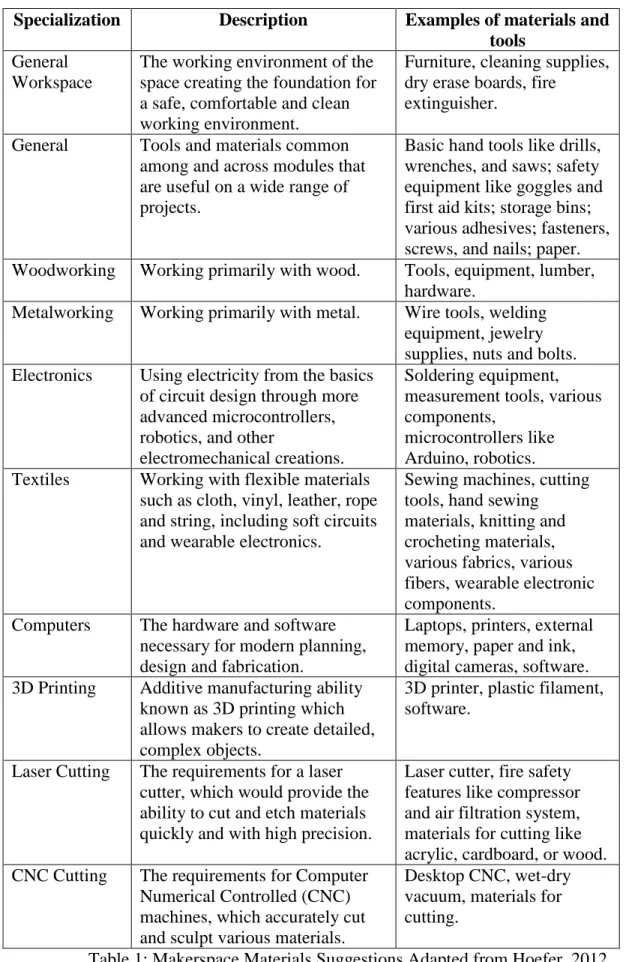
There are long lists of possible materials to include in the makerspace available in numerous popular library news publications, on blogs dedicated to the maker movement, and from the creators of Make magazine. Materials and equipment are expensive, so doing the required work of getting to know the maker community is essential to stocking an engaging, cost-effective makerspace. One document developed by Make magazine gives an excellent overview of the different specializations a high school makerspace might focus on. Lists of suggested tool and material purchases, safety tips, special
considerations regarding each specialization, and estimated pricing is included. The Table 1 below is a condensed version of the lengthy document (Hoefer, 2012):
1 Conducting a community assessment:
Specialization Description Examples of materials and tools
General Workspace
The working environment of the space creating the foundation for a safe, comfortable and clean working environment.
Furniture, cleaning supplies, dry erase boards, fire
extinguisher. General Tools and materials common
among and across modules that are useful on a wide range of projects.
Basic hand tools like drills, wrenches, and saws; safety equipment like goggles and first aid kits; storage bins; various adhesives; fasteners, screws, and nails; paper. Woodworking Working primarily with wood. Tools, equipment, lumber,
hardware.
Metalworking Working primarily with metal. Wire tools, welding equipment, jewelry supplies, nuts and bolts. Electronics Using electricity from the basics
of circuit design through more advanced microcontrollers, robotics, and other
electromechanical creations.
Soldering equipment, measurement tools, various components,
microcontrollers like Arduino, robotics. Textiles Working with flexible materials
such as cloth, vinyl, leather, rope and string, including soft circuits and wearable electronics.
Sewing machines, cutting tools, hand sewing
materials, knitting and crocheting materials, various fabrics, various fibers, wearable electronic components.
Computers The hardware and software necessary for modern planning, design and fabrication.
Laptops, printers, external memory, paper and ink, digital cameras, software. 3D Printing Additive manufacturing ability
known as 3D printing which allows makers to create detailed, complex objects.
3D printer, plastic filament, software.
Laser Cutting The requirements for a laser cutter, which would provide the ability to cut and etch materials quickly and with high precision.
Laser cutter, fire safety features like compressor and air filtration system, materials for cutting like acrylic, cardboard, or wood. CNC Cutting The requirements for Computer
Numerical Controlled (CNC) machines, which accurately cut and sculpt various materials.
Desktop CNC, wet-dry vacuum, materials for cutting.
While this list is a great jumping off point for a new makerspace, the librarian and other makerspace facilitators should consider the needs of their community. No makerspace is required, or even needs, to support all of these activities. If no students are interested in woodworking, there is no need to buy woodworking equipment. In contrast, combining specializations in different ways can lead to innovative creations, such as wearable electronics by combining electronics, programming, and textiles. Encouraging crossover between specializations should be encouraged because it further solidifies the idea that learning is interdisciplinary. The librarian should make sure there is a need for any
expensive equipment, general tools should be purchased before project-specific tools, and maintenance costs must be factored into purchasing decisions (The Makerspace Team, 2013, 10-12).
After identifying resources already available, the makerspace will still need significant funds to get running. Gaining support of the school community, local businesses, parent-teacher organizations, and local hackerspaces or tech clubs is an important first step, but if the money is not available in the yearly school budget, the librarian must get creative. While applying for grants can be time and labor intensive, they can provide significant funds for makerspace activities (Bagley, 2014; Willingham & De Boer, 2015). Donations are another possible source of funding (Bagley, 2014; The Makerspace Team, 2013; Martinez & Stager, 2013). Requests for donations may be made to directly to parent organizations present in the school. Looking into the wider
for computers when the makerspace needs sewing machines to meet student interests. Creating a specific list of what the space wants and needs can help ensure the donations are useful. Other suggestions for stocking the makerspace include holding a tool drive, where community members donate used tools for use in the makerspace (The Maker Team, 2013, 11), or using a crowdsourcing platform such as Donor’s Choose to raise funds for a specific project (Martinez & Stager, 2013).
Safety, while the last category in this list of makerspace planning
recommendations, is one of the most critical pieces for the school library makerspace. Creating a “makerspace handbook” that can be shared with members and other
stakeholders is an effective way to set rules and expectations for the makerspace. This document should outline various policies, such as hours of operation, safety training clearance levels for potentially dangerous equipment, safety rules, housekeeping,
maintenance, and a code of conduct (Willingham & De Boer, 2015). Willingham and De Boer, who are both consultants for developing makerspaces in public libraries, have an excellent view on how safety concerns can be managed effectively while not limiting the work that takes place in the makerspace: “Develop reasonable safety practices, display rules clearly, supervise responsibly, and make commonsense decisions about equipment, training, and usage so you can manage risk intelligently” (2015, 122-123).
Section 1.2: Learning in the Makerspace
Section 1.2.1: Constructivism Complements Constructionism
both experts on using technology in education, cite precursors to the modern maker movement, such as Jean-Jacques Rousseau, Johann Pestalozzi, Friedrich Froebel, Maria Montessori, Jean Piaget, John Dewey, Seymour Papert, and Reggio Emilia for their influence on the natural abilities of children, how people learn, and how people create their own meaning (2013). Two theories stand out as the guiding views for
makerspaces—constructivism and constructionism.
Jean Piaget’s theory of constructivism posits that knowledge is constructed in a learner’s head based on their experiences. Knowledge is not delivered from the teacher to the student; rather students must work through issues themselves so that they may reach their own conclusions. Piaget’s work also focused on “what children are generally interested in and capable of at different ages” (Ackermann, 2001, 3) and how they often have logical reasons for not immediately believing an adult when they hear something that conflicts with their current way of thinking.
Edith Ackermann, a researcher of developmental psychology and how technology influences development, outlines three major implications for education following a constructivist line of thinking:
2] “The transmission model, or conduit metaphor, of human communication
won’t do” [emphasis added] (Ackermann, 2001, 3). Information only truly has meaning when it is viewed through personal interactions with other people, natural phenomena, and things made by people. With this in mind, librarians and teachers can model good habits such as following safety procedures, citing sources, and documenting work done in the makerspace. By doing so, students can see their role models engaging in effective learning.
3]“A theory of learning that ignores resistances to learning misses the point”
[emphasis added] (Ackermann, 2001, 3). Youth hold their own personal views of the world, and while these views may not always reflect reality, they often have their own logic that suits their needs and current experience. Ackerman concludes “for a child—or adult—to abandon a current working theory, or belie[f] system, requires more than being exposed to a better theory” (Ackermann, 2001, 3).
As shown above, Piaget’s theory aligns well with the maker movement in that it encourages a learning environment where the student engages in hands-on and minds-on learning experiences (Bonawitz, Shafto, Gweon, Goodman, Spelke, & Schulz, 2011; Hira, Joslyn, & Hynes, 2013; Kurti, Kurti, & Fleming, 2014; Martinez & Stager, 2013). Giving students a chance to see abstract concepts in action through activities in the
makerspace will most likely have a more profound effect on their knowledge construction than just hearing about it from their teacher in an unauthentic experience.
mathematical knowledge (Martinez & Stager, 2013). Papert was a proponent of using computers as a teaching tool for children, and wrote several books that developed the theory of constructionism. With Gary Stager, an education expert and researcher, Papert developed the Constructionist Learning Laboratory (CLL) at The Maine Youth Center in 1999. (Stager, 2005, 1). The goal of the Center was to develop a vision for what learning would like in the future. The CLL was an educational center for teens in prison, and the work done by Papert and Stager there was imperative to understanding what
constructionist learning looks like.
Papert’s constructionism takes constructivist theory a step further towards action. Although the learning happens inside the learner’s head, this happens most reliably when the learner is engaged in personally meaningful activity outside of their head that makes the learning real and shareable (Martinez & Stager, 2013, 32).
Constructionists argue that whether the student is creating their own invention, making a digital video, or building a model, the learning begins in their head and is expressed in something outside of their head.
students can play around with ideas in a low-risk environment, where failure is not necessarily seen as a drawback and the things kids make are personally meaningful.
Section 1.2.2: Inquiry-Based Learning
Another application of Piaget’s constructivist learning theory is inquiry-based learning. In addition to learning by doing and integrating new information into past experiences, inquiry-based learning motivates and empowers students through two aspects: “engagement in authentic tasks and assessments and learning through social interaction” (Small, Arnone, Stripling, & Berger, 2012). In their Standards for the 21st
Century Learner, the American Association of School Librarians advocates for inquiry-based approaches “to learning and the information search process (AASL, 2009, 25) in school library programs. Additionally, the learning outcomes outlined in the Next
Generation Science Standards cannot be met by passive learning, rote memorization, and excessive standardized testing. Learning experiences must be:
designed to elicit student thinking and include time for explication of thinking, argumentation, and reflection. Students must engage in a ‘minds-on’ as well as a ‘hands-on’ process to achieve the conceptual growth and development that these standards will demand. Every activity must have a clear connection to specific learning goals and expected student outcomes Quinn & Bell, 2013, 25).
Inquiry-based learning aims to go beyond the mere comprehension of ideas and instead aims to instill deep understandings in students. It is a process that aims to connect student interests to learning, encourage students to ask probing questions, and motivate students to continue being curious (Small et al., 2004).
“their own ideas through guided experiences” (Stripling, 2003, 4). Students have
meaningful learning experiences and construct their own understandings from their work when they are allowed to approach new ideas through this lens. Inquiry-based learning accommodates a more “messy” learning environment that is student-centered. Student
questions are at the center of inquiry rather than strict imposed tasks given to them by an authoritative instructor. Stripling’s model (see Figure 1), is an iterative process and students usually begin the inquiry process by “connecting” a problem that needs to be solved to their experiences and previous knowledge. They may also do some initial background reading to gain a more solid foundation of the topic(s) at hand. Then, they “wonder” about how they might go about solving the problem. In this stage, students ask questions and develop hypotheses. During “investigation,” students find, evaluate, and reflect on information that helps them solve their problem. They may realize they need to gain a practical skill to move forward. Once enough information is collected, they
problem. They may talk with peers and mentors during this stage to further solidify their ideas. Students “express” their learning by applying their constructed knowledge to a problem they are trying to solve. They can share their final product with peers, mentors, and other members of the community to exhibit their hard work. Finally, students reflect on and self-evaluate what they learned. They may ask themselves what they did well, what they need to work on, and what new directions their learning might take next.
As represented in the diagram that this is not a linear process. It should also be noted that the diagram fails to show that students may jump from one stage to another, meaning the process is more of a web than a cycle. Students may go through any of the stages at various times. When they reflect on their work, students may realize that they need more knowledge; when they read something interesting, they might be pulled in a new direction that sparks a new sense of wonder.
Below, I analyze several studies that discuss the success of inquiry-based learning. Many of the reported results point to positive implications for library
makerspaces to be centers of inquiry, which is a common claim in popular publications (cf. Barron & Darling-Hammond, 2008; Canino-Fluit, A., 2014; Kurti, Kurti, & Fleming, 2014).
“disappointing and mediocre” (22), because the information was simply located and regurgitated for the teacher with little or no synthesis on the part of the student. Harada and Yoshina work to reframe the animal assignment as a unit of inquiry, where the students visit a zoo, generate their own questions about the animals they saw, search for and synthesize information that relates to their question, and present their final products to their entire school. Students are expected to reflect on their thinking throughout the project (23). The study’s end result showed that rote learning activities are far inferior to inquiry-based learning when it comes to deeper understandings. In school library
makerspaces, students are also encouraged to formulate their own questions, find relevant information, and make a final product that shares their learning with the wider maker community.
Chu, Tse, and Chow, a team of education researchers in China, studied how project-based inquiry learning could be used to teach information literacy and
information technology skills. In their study, students, teachers, and parents of a primary school in Hong Kong completed self-reported questionnaires and a variety of interviews (Chu, Tse, & Chow, 2011, 135). After conducting an intervention where the librarian and the Information Technology teacher collaborated on a project-based learning lesson, the researchers concluded that the inquiry method was effective in promoting information and technology skills because it placed essential skills in a real-world context. The results support the idea that information and technology literacy skills “cannot be learned
by the school library makerspace, where the school librarian can mentor the students who use the space by helping them find and use information to support their projects.
Bevan, Gutwill, Petrich, & Wilkinson of the Exploratorium in San Francisco, a museum-based learning lab based in tinkering and constructionism, conducted a research project negotiated between researchers and practitioners in a museum makerspace. They focused on the concept of “making [emphasis added] as an educative inquiry-based practice” (2015, 98), and developed their Tinkering and Learning Dimensions Framework that described the kinds of learning and interactions that can occur in makerspaces. The four Learning Dimensions they identified are: Engagement, Initiative & Intentionality, Social Scaffolding, and Development of Understanding. As discussed earlier in the constructivism section of this paper, a common criticism of makerspaces is that they are a passing trend that, while they fun for students, do not offer a platform for deeper learning. The researchers directly addresses this concern by clearly “articulat[ing] and document[ing] what learning looks like in a museum-based tinkering program” (100). In an era of high-stakes testing and quantitative accountability, this framework is useful because it helps define what learning looks like in a more informal setting than a traditional classroom (118). It allows for students to be involved in their own assessment of their learning. The framework can also be useful for librarians when they must
articulate the value their makerspace is adding to students’ education.
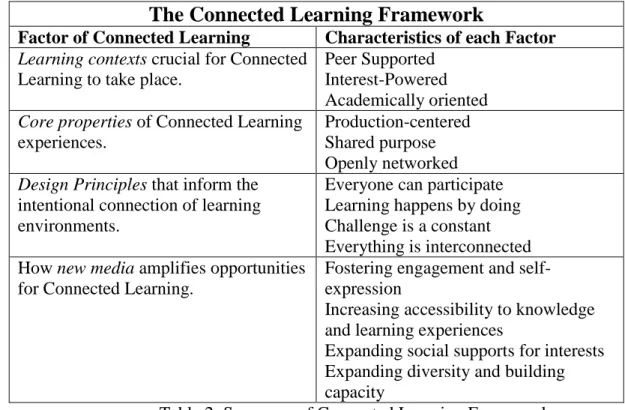
case studies show how the framework supports student growth by allowing students to learn important academic concepts through avenues like creative writing (11) and hip-hop music (26). A Connected Learning approach emphasizes learning should be “socially embedded, interest-driven, and oriented toward education, economic, or political
opportunit[ies]” (4) and an environment that fosters a sense of community, diverse ways of learning, and a shared purpose (8). The framework appears in a condensed version from the report in Table 2 below (12):
The Connected Learning Framework
Factor of Connected Learning Characteristics of each Factor
Learning contextscrucial for Connected Learning to take place.
Peer Supported Interest-Powered Academically oriented Core propertiesof Connected Learning
experiences.
Production-centered Shared purpose Openly networked Design Principlesthat inform the
intentional connection of learning environments.
Everyone can participate Learning happens by doing Challenge is a constant Everything is interconnected How new media amplifies opportunities
for Connected Learning.
Fostering engagement and self-expression
Increasing accessibility to knowledge and learning experiences
Expanding social supports for interests Expanding diversity and building capacity
Table 2: Summary of Connected Learning Framework
Section 1.2.3: STEAM and Interdisciplinary Education
STEAM (sometimes called STEM) stands for Science, Technology, Engineering, Art, and Mathematics education. The makerspace combines both high-tech and low-tech materials that can be very effective in teaching these concepts. STEAM falls under the umbrella term of interdisciplinary education. Breaking school down into subjects can have benefits, but doing so does not reflect how the real world works. The idea of interdisciplinary education, which views subject domains as interconnected rather than distinct disciplines, challenges students to see the interconnectedness of the world around them. The makerspace is a great place to foster this kind of learning because it
encourages students to experiment with different subjects, share ideas, and see how most real-world experiences cannot be put into a subject box (Bevan et al., 2015; Sheridan Sheridan, Halverson, Litts, Brahms, Jacobs-Priebe, & Owens, 2014).
meet these challenges head-on. When teachers come to the makerspace as learners as well, they can learn difficult STEAM concepts alongside their students in the true spirit of the makerspace.
A team of library science and education researchers wrote an article summarizing the different ways the school librarian can support STEAM education, especially for underserved populations such as youth of color, youth in poverty, and women (Subramaniam, Ahn, Fleischmann, & Druin, 2012). The authors make several
suggestions for librarians to support STEAM education, such as recommending various media about STEAM topics during reader’s advisory (172), collaborating with classroom teacher to break down barriers between the core subjects (173), and integrating
technology and digital tools into the library by fostering both learning through these tools and connecting with online communities that share their interests (175).
Shannon Barniskis, a doctoral student of library science, writes on her
experiences of teaching art in the makerspace by integrating high-tech tools such as laser cutters and 3D printers (Barniskis, 2014, 6-7). A makerspace can cultivate artistic
tendencies in students who do not consider themselves to be artists (9). She praises makerspaces for providing access to tools and resources that “encourage people to tinker, to fail, to experiment, to make things better” (9).
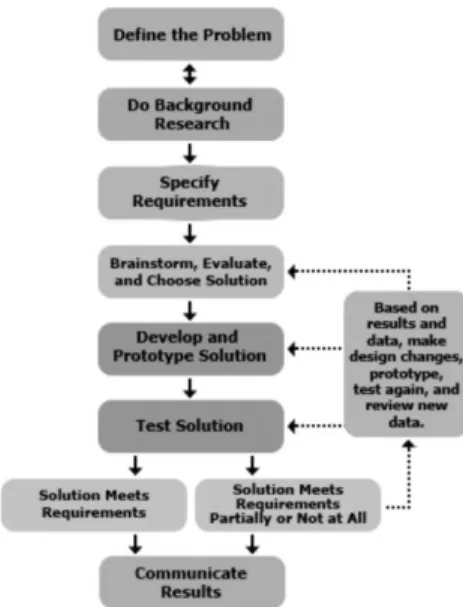
In addition to art, engineering principles are very compatible with the learning that occurs in makerspaces (Martinez and Stager, 2013) “The engineering design process is a series of steps that engineers follow to come up with a solution to a problem”
for younger students (Hynes, 2010). Morgan Hynes of the Center for Engineering Education and Outreach of Tufts University, cites Nigel Cross, an engineering design educator. Cross “reviewed a number of design models and noted that they have the basic structure of ‘analysis—synthesis—evaluation’” (Hynes, 2010, 346). Figure 2 is a youth-friendly representation of the engineering design process, and closely resembles the process a student might follow when working on any project in the makerspace. This model of the engineering design process is compatible with Stripling’s inquiry model, which was discussed earlier in this literature review. It can be embedded into the inquiry model, especially during the “construct” and “express” phases of the overarching inquiry process.
Martinez and Stager argue that there are several dimensions to learning in the makerspace, saying that “engaging children as quickly as possible in real projects creates an authentic context for learning a specific science formula or math equation since
students realize they need that skill or information to continue their projects” (Martinez & Stage, 2013, 40). They discuss three important ways of knowing in the makerspace, the first two of which provide a solid foundation for student engagement in engineering projects:
● “Making is about the active role construction plays in learning. The maker has a product in mind when working with tools and materials.
● Tinkering is a mindset – a playful way to approach and solve problems through direct experience, experimentation, and discovery.
● Engineering extracts principles from direct experience. It builds a bridge between intuition and the formal aspects of science by being able to better explain, measure, and predict the world around us.” (Martinez & Stager, 2013, 32).
Further, the authors argue that these types of learning provide students with a sense of “soft mastery” of STEAM skills and concepts. It is often common practice for teachers or textbooks to present students with the “hard facts” of science, which can be cause for the misconception that science is always a clean, easy process. In reality, scientists and engineers must work through problems by playing around, or tinkering, with new ideas (41). Of course, reading the work of fellow scientists is beneficial in that it can teach the reader about previous accomplishments and give a jumping off point for new work. However, kids are going to be much more engaged and motivated to engage with their textbooks if they have some firsthand experiences from the makerspace to bring context to the ideas being presented.
and Owens provide an excellent summary of Brahms and Crowley’s (2014) work in analyzing the core practices of the maker community as described in Make magazine:
“Makerspaces support making in disciplines that are traditionally separate. Sewing occurs alongside electronics; computer programming occurs in the same space as woodworking, welding, electronic music, and bike repair. This blending of traditional and digital skills, art and engineering creates a learning environment in which there are multiple entry points to participation and leads to innovative
combinations, juxtapositions, and uses of disciplinary knowledge and skill (Brahms & Crowley, 2014)” (Sheridan et al., 2014, 526).
These core practices in the makerspace clearly show how beneficial interdisciplinary is to the making and learning process.
The development of multiple literacies are a growing interest for learning in the twenty-first century. Both the Common Core State Standards and the Next Generation Science Standards call for schools to create a learning environment where students works together to solve problems, explain phenomenon, and argue nuanced viewpoints
Connected Learning Framework because students will more likely be personally invested in their projects and will learn such skills in an authentic environment.
Section 1.2.4: The uTEC Maker Model
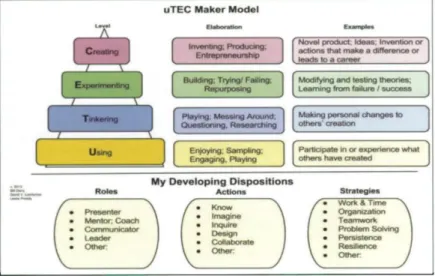
Loertscher, Preddy, and Derry (2013) created the uTEC Maker Model (see Figure 3), which “visualizes the developmental stages of creativity from individuals and groups as they develop from passively using a system of process to the ultimate phase of
creativity and invention” (49). This model helps foster certain dispositions in students working in a makerspace. As the students pass through each level, their personal expertise in a topic or skill grows and allows them to contribute more and more to their maker community (50). Cooperative group work is a lynchpin of the makerspace. An open floor space encourages the flow of thoughts, new ideas, opinions, and advice between individuals. In turn, Cooperation develops collaborative intelligence, where a group of students can collaboratively undertake finding a solution to a large problem. While guided learning experiences are important, the ultimate goals of the student in the makerspace should strive toward independent learning and inquiry (51).
Section 1.2.5: Preparing Students for the Future
The Partnership for 21st Century Learning lays out the Framework for 21st
Century Learning as a set of guidelines “to define and illustrate the skills and knowledge students need to succeed in work, life and citizenship” (P21, 2015). The dispositions outlined in this document call for multiple literacies, the ability to be creative and innovative, the ability to think critically and solve problems, proficient communication skills, skillful collaboration, information, media, and technology skills, and various life and career skills (P21, 2015).
The results of one ethnographic case study conducted in a middle school yielded promising preliminary results for the effectiveness of supporting twenty-first century skills in school library makerspaces (Koh, 2015). Kyungwon Koh, a researcher of library and information studies at the University of Oklahoma, identified “three dominant styles of student learning in the Makerspace, including: 1] learning by doing, 2] learning by seeking information on their own, and 3] learning through and with others” (Koh, 2015, 2). Koh commented on how important information seeking skills are when learning in the makerspace. Since the teacher is not simply imparting all of the content knowledge students need to complete a project, the students must strike out on their own in the setting of the makerspace. Koh found that this resulted in significant improvement in the development of various facets of the Partnership for 21st Century Skills framework. One result especially important for school librarians is that students were given “access to a range of technologies that would otherwise have not been available” (Koh, 2015, 2). Additionally important is the assertion that school libraries are excellent place for makerspaces because students often need to seek, evaluate, and use information
information and technology specialists in the makerspace to help them work through any difficulties,.
The job landscape of the present and future is uncertain due to frequent and rapid developments in digital technologies. This uncertainty makes it difficult to know how to prepare future generations for the workforce. The Institute for the Future (2011) released a report outlining six drivers of change that will influence the future job landscape: extreme longevity, the rise of smart machines and systems, a computational world, a new media ecology beyond text, superstructured organizations, and a globally connected world (4-5). In addition to these findings, the researchers identified vital work skills that our students will need to be successful in the workforce by 2020. In Table 3 below, I outline how each skill they identified can be fostered in a school library makerspace (Parks, 2015a).
Skill How a Makerspace Fosters this Skill
Sense-Making Students work with high-tech machines and tools to make decisions and solve problems. The machine or tool might do the heavy lifting and rote manufacturing, but the students work together to identify problems to solve. They then use software and other technology as tools to plan a project and solve their problem.
Social Intelligence
Makerspaces are centers where like-minded people come together to share ideas, help each other, and socialize. Individual interests may be diverse, but the dispositions makers have are similar. A good makerspace allows for the flow of ideas, skills, and know-how between individual members.
Novel and Adaptive Thinking
The core philosophy of the makerspace is that if you can think it, you can make it. The makerspace allows for students to think big and abstractly. Then, the students can use skill-based techniques to physically, or virtually, create their idea.
Cross-Cultural Competency
Skill How a Makerspace Fosters this Skill
Computational Thinking
The makerspace is the perfect place for interacting with new
technologies that require computational thinking. It gives students a place to learn coding and programing languages, and a space to make a physical object using their new thinking skills. This lays a foundation for students to then enter STEAM fields as they grow older.
New-Media Literacy
The makerspace community has a huge online presence, from blogs to intractables to forums. Allowing students to connect with other makers online is an appropriate context for teaching and practicing new media literacy skills, such as critical literacy (are the directions in this intractable safe?) and multimedia literacy (can students read an article, watch a video, then tweak what they learned to create their own project?)
Design Mindset The makerspace is an open space designed to induce creativity in its members. Areas for collaboration and individual work are provided. Students have access to tools they could not afford on their own. The mere presence of other people working on creative projects can inspire students to be productive themselves.
Cognitive Load Management
The makerspace can allow so many options as to be overwhelming at first, but guiding students to first learn one skill or tool, then another, helps them break down the information into manageable pieces. Then, students can begin to hone their researching abilities to support their own learning through their own projects.
Virtual Collaboration
This is another inherent piece of the maker community. There are numerous stories of kickstarters where, once a prototype was made in the makerspace, a company was staffed a conducted business over the Internet. Students can also share their work and tweak others’ work on blogs and other online sharing forums to make something even better.
Table 3: How Makerspaces Foster Future Job Skills
Section 1.3: Adolescent Development
2Section 1.3.1: Adolescent Development Overview
Adolescents in middle school are typically in sixth, seventh, and eighth grade, and fall between the ages of ten and fifteen. Developmentally, these students go through a multitude of changes very quickly. Their bodies change as they enter puberty, their cognitive capabilities begin to develop and allow them to think more abstractly, and they
may be emotionally vulnerable as their hormones fluctuate. Social situations become more difficult as student begin working out their identities, which may change each week as they continue to explore who they are in terms of their gender, sexual orientation, political stances, and spirituality. In short, adolescence is often a stressful but exciting time for young people (McNeely & Blanchard, 2009).
As students navigate these changes, they need support from their peers adults, and the community. The Search Institute (2007) developed a framework called the 40
Developmental Assets for Adolescents (ages 12-18) which they call the “building blocks of healthy development…that help young people grow up to be healthy, caring, and responsible.” Below Table 4 shows some of the assets that makerspaces can support:
External Assets Internal Assets
Support
- Caring school climate
- Parent involvement in schooling
- Other adult relationships Empowerment
- Youth as resources
- Service to others
- Safety
Boundaries and expectations
- School boundaries
- Adult role models
- Positive peer influence
- High expectations
Constructive use of time
- Creative activities
- Youth Programs
Commitment to learning
- Achievement motivation
- School engagement
- Bonding to school
- Reading for pleasure Positive values
- Caring
- Equality and social justice
- Honesty
- Responsibility Social competencies
- Planning and decision making
- Interpersonal competence
- Cultural Competence
- Peaceful conflict resolution Positive identity
- Personal power
- Self-esteem
- Sense of purpose
- Positive view of personal future Table 4: Selected Developmental Assets
A school library makerspace is a place that encourages collaboration and
can interact with peers and adults who are interested in their work in the makerspace. Adolescents can also be the experts in their area of interest and teach less experienced newcomers or provide input on their peers’ projects. Additionally, teachers and other adults in the community can volunteer to mentor young adolescents. With all of this external support, adolescents can work on developing their internal assets. A successful makerspace is one that foster the growth of the entire student, academically and
emotionally.
Section 1.3.2: Adolescent Information Needs
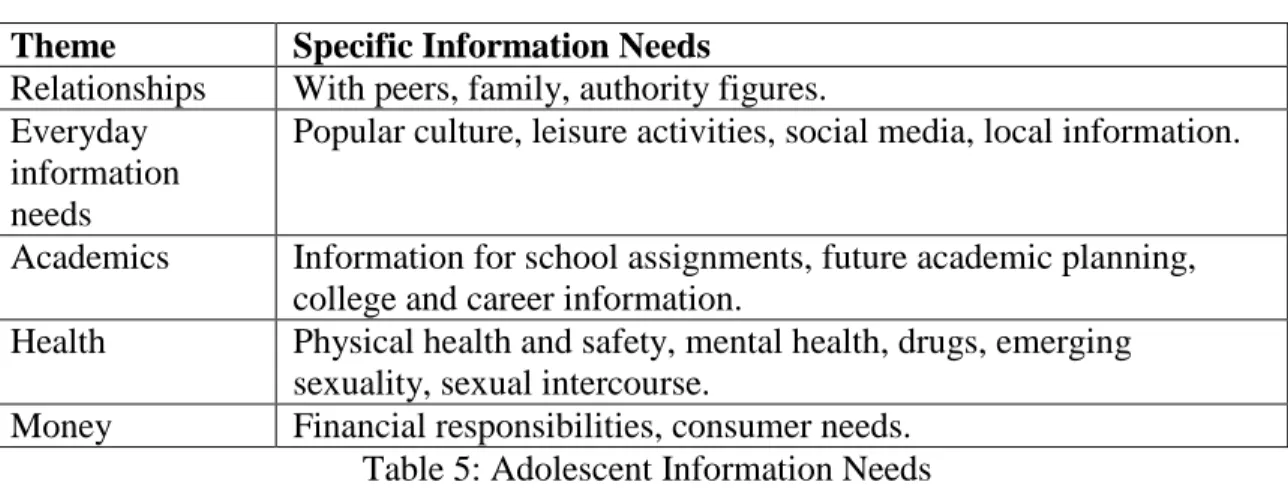
The information needs of adolescents are as diverse as adolescents themselves. Agosto (2011) and Hernandez (2010) reported similar generalized information needs of adolescents. From these two reports, I have identified six major themes in the information needs of adolescents shown in Table 5:
Theme Specific Information Needs
Relationships With peers, family, authority figures. Everyday
information needs
Popular culture, leisure activities, social media, local information.
Academics Information for school assignments, future academic planning, college and career information.
Health Physical health and safety, mental health, drugs, emerging sexuality, sexual intercourse.
Money Financial responsibilities, consumer needs. Table 5: Adolescent Information Needs
the topics they mentioned above. Additionally, gaining first-hand experience with the skills they need to pursue their career goals could easily happen in the context of the school library makerspace.
Like adults, adolescents encounter different types of information needs. One study found that students “had no trouble identifying the true information need” (Bilal, 2002, 112) when searching for entirely self-generated information tasks. In comparison, about half of the students were successful on the fact-based task while 69% were at least partially successful when researching a topic imposed by the teacher (112). While students should have practice in successfully completing imposed task, this finding should be kept in mind when teaching new technological and information literacy skills. Student may be more invested in learning a skill if they have a personal interest in the topic, and once learned, those skills can be transferred to “less interesting” imposed tasks.
wider community. Since adolescents can often be risk-takers, offering them “avenues for safe risk-taking” (48) in the form of trying a new sport, going out for a talent show, or trying a new project in the makerspace can meet this aspect of adolescents’ behavioral development needs. Part of meeting adolescents’ information needs in creating an environment in which they are comfortable to explore and deeply engage with the information.
Section 1.3.3: Adolescent Information Seeking Behaviors
often want to find one perfect source, but in reality it is required to find and read several sources in order to form their own understanding.
The type of search task (whether it is self-imposed or imposed) also affects how successful adolescents are in information seeking tasks. Depending on the type of resource students are used to using, finding current information such as news or local events can be difficult. While students may not have as much trouble finding information about topics they are personally invested in, they still need to be supported in finding information they need for school assignments or other everyday activities (Shenton & Dixon, 2004). When students have to find information that will allow them to make their makerspace project work, they are more likely to successfully develop and transfer essential information seeking skills.
Another study found that students were more likely to search results rather than the content of individual web pages, and students often make judgements based solely on titles or summaries of web pages (Walraven, Brand-Gruwel, & Boshuizen, 2009). It is often cited in the information seeking literature that adolescents have a difficult time evaluating information found on the internet. Few students name “accuracy” or
of information evaluation skills because students would have a record of what information had a positive or negative impact on their project.
Section 1.3.4: Adolescent Use of Information
In their book Hanging Out Messing Around, and Geeking Out, a team of
researchers present the “synthesis of three years of collaborative, ethnographic work” that focused on a multitude of case studies (Ito, et al., 2010, xvii). The authors delved deep into how youth use new media in both socially driven interactions and interest driven interactions, and how “media and technology are meaningful to people in the context of their everyday lives” (Ito et al., 2008, 4). “New media” is defined as an “ecology where more traditional media, such as books television, and radio are ‘converging’ with digital media, specifically interactive media and media for social communication” (Ito et al., 2010, 10). The learning that takes place in these environments is usually very informal. Adolescents using new media have the freedom to pursue various topics of interest, connect with like-minded people over the internet, and create their own content.
peer-based learning should be encouraged. Youth are often experts when it comes to using new media, and allowing them to teach each other as well as adults in the room can be empowering (Ito et al., 2008, 2). With these recommendations in mind, it is clear that adolescents need access to new media, online and in-person peer groups, and information related to their interests. This need can be met by encouraging students to engage with new media in the makerspace, both through technological projects and using digital tools to document their work over time.
Jessica Pater, Andrew Miller, and Elizabeth Mynatt, researchers in the field of technology, studied how adolescents live rich online lives. They reported that “28% of participants reported that they viewed their online identities as separate or different from their offline identities” (Pater et al., 2015, 2319). Hiding from parents was a common concern for adolescents. This could potentially be problematic if youth are using anonymity on the internet to bully others or participate in other harmful behaviors. However, while privacy is an issue, using the internet as a legitimate form of academic communication at school can allow students to participate in engaging learning activities.
authentic contexts. Susan M. Allen, the Director of Libraries and Academic Technology Coordinator at Nichols School in New York, researched this issue in her school library. She quantitatively evaluated how well her middle school and high school were supporting the development of their students’ information literacy skills (Allen, 2007). When
mapping information literacy skills to the fifth through eighth grade curriculums, she found that support for information literacy skills was well covered in lower grades, but drops off as students progress through school (18). This could happen because of a common misconception that young people are naturally competent and comfortable with technology. Helsper and Eynon (2010) concluded that age has little to do with how comfortable people are with using technology. Finally, Allen concludes that “to succeed in college, career, and twenty-first century life, students need to be information savvy, not tech-savvy” (Allen, 2007, 24).
Helping students become more information savvy could be supported by allowing them to work collaboratively, especially when two students are already friends. Werner, Denner, Campe, Ortiz, DeLay, Hartl, and Laursen (2013) conducted a study that explored the way friendship affected student outcomes in computer science skills. The researchers concluded that “since the benefit of working with more knowledgeable peers is greater when students are confident, it is important for teachers to focus on increasing confidence as well as knowledge” (425). The results of this study could be applicable to other
encouraged to work together and get feedback. Makerspaces might even allow new friendships to flourish between people who might not have otherwise interacted due to perceived differences in interests.
Section 1.4: Librarians in the Middle School Library Makerspace
Section 1.4.1: Role of the Librarian
School librarians are required to take on many roles to support students and teachers in a twenty-first century learning environment. The American Association of
School Librarians (AASL) gives five key roles school librarians: Leader, Instructional Partner, Information Specialist, Teacher, and Program Administrator (AASL, 2009). Subramaniam, Ahn, Waugh,Taylor, Druin, Fleischmann, & Walsh (2013) an information science research team from the University of Maryland, gives an excellent summary of the responsibilities each of these roles as they pertain to school librarians in Figure 4.
Librarians are leaders in their school community because they facilitate a major social and academic hub for the entire school. The AASL standards call for a shift to a
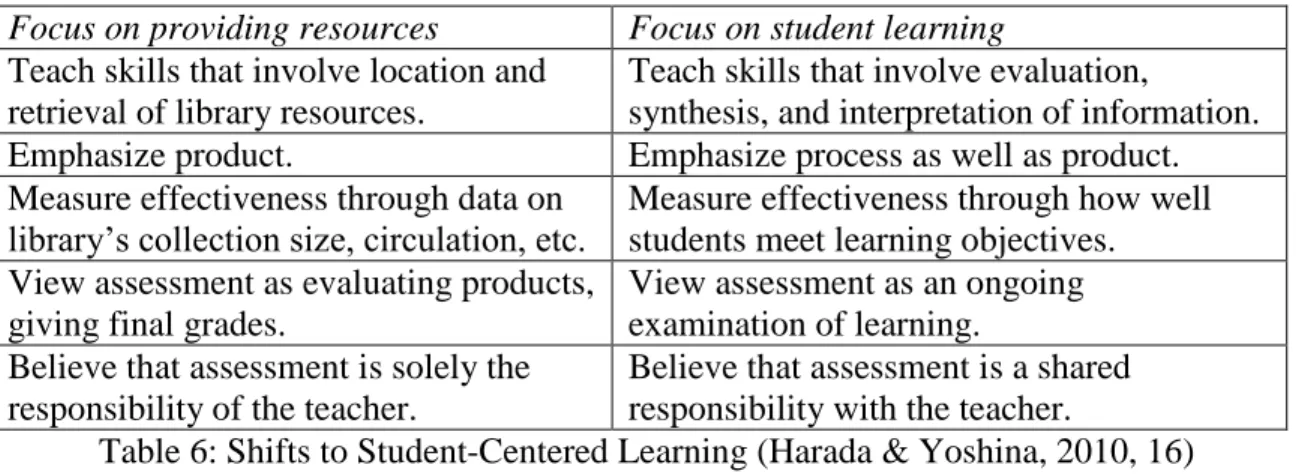
more student-centered library, where the learner is at the center rather than the materials. Harada and Yoshina (2010) summarize the main shifts in their book on teachers and librarians as assessment, seen in the table below:
Focus on providing resources Focus on student learning Teach skills that involve location and
retrieval of library resources.
Teach skills that involve evaluation,
synthesis, and interpretation of information. Emphasize product. Emphasize process as well as product. Measure effectiveness through data on
library’s collection size, circulation, etc.
Measure effectiveness through how well students meet learning objectives. View assessment as evaluating products,
giving final grades.
View assessment as an ongoing examination of learning. Believe that assessment is solely the
responsibility of the teacher.
Believe that assessment is a shared responsibility with the teacher.
Table 6: Shifts to Student-Centered Learning (Harada & Yoshina, 2010, 16) This shift from providing resources to focusing on student learning makes each role of the school librarian more important than ever.
The Association for Middle Level Education calls for leaders who collaborate with their school community to advocate for young adolescents and “change practices that do not serve students’ best interests” (AMLE, 2010, 29). Middle school librarians can lead the way to more authentic interdisciplinary education by 1] advocating for a makerspace in their library and 2] collaborating with every teacher in the school to show how beneficial making can be in deepening student understandings. Additionally, the school librarian is responsible for integrating twenty-first century skills throughout units, lessons, and learning throughout the school..
Standards, and any other state-mandated standards, such as the North Carolina Essential Standards. Using this knowledge, the librarian can partner with classroom teachers to create and co-teach interdisciplinary units. A school makerspace already promotes
thinking across various disciplines, and bringing classroom teachers into such a space can show students that classroom learning can have an authentic application. “It should be clear to students that the teacher and the school library media specialist are full and equal partners in designing, implementing, and evaluating the lesson” (Doll, 2005, 41).The combination of a big-picture view of the school and collaborating with teachers allows school librarians to provide continuity and structure for students throughout the school year and over the course their school career.
As an information specialist, the school librarian has a responsibility to “integrate information literacy by collaborating with teachers, teaching students directly, and serving on curriculum committees” (Doll, 2005, 77). School librarians work on several levels to make sure students know how to identify information needs, how to search for information, and how to synthesize information. Collaborating with teachers to integrate information literacy into classroom work is essential. Additionally, school librarians have an opportunity to engage teachers in professional development by introducing them to emerging technologies that make their lessons more meaningful for students. School librarians can teach students directly in the makerspace by facilitating an environment where students are motivated to learn information and technology literacy skills in order to complete their own projects. Finally, the school librarian must draw on their role as a leader in the school community to ensure information and technology literacy is
The school librarian as a teacher is concerned with reading, multiple literacies, the ethical use of information, and the facilitation of inquiry-based learning throughout the school. The first common belief stated in the AASL Standards for the 21st-Century Learner is that “reading is a window to the world (AASL, 2009, 12). Donham provides a
summary of what supporting reading looks like in the school library:
“The school library curriculum, while certainly concerned about students learning to access, use, and evaluate information, also needs to consider helping young people become competent and engaged readers. Creating a library curriculum that introduces young people to the best of literature for their respective ages and promotes discussion of that literature with questions that challenge them to draw inferences and make predictions and judgements affords a significant opportunity for creating excitement about literature and the experiences it provides” (Donham, 2013, 193).
The school library should create an environment where students are self-motivated to read for pleasure, work toward a project in which they are personally invested in, and enable them to learn about news topics and concepts because they are interested in them. The Common Core focuses on reading places great weight on students continuously increasing the complexity of the texts they read (Donham, 2013), but reading serves a more personal purpose for adolescents. In her article on building resiliency in adolescents through the school library program, high school media specialist Jami L. Jones offers practical protective factors in the form of the “Library Ladder of Resiliency” model. Grounded in a large body of research, one protective measure that encourages the
science fiction, science and engineering magazines, and non-print media (Subramaniam, Ahn, Fleischmann, & Druin, 2012). If students can see themselves in characters who are good at STEAM disciplines, they might begin to see these strengths in themselves as well.
Last but not least, the librarian is the program administrator. “School librarians typically ensure that resources and technology are available to all students and meet the variety of their needs and interests” (Subramaniam, Ahn, Waugh,Taylor, Druin,
Fleischmann, & Walsh, 2013, 10). As a facilitator of the school library makerspace, the school librarian must develop budgets, write policy, collaborate with students, teachers, and the wider community, and manage the physical and digital resources that make up the makerspace. Additionally, the librarian must be aware of any accommodations students with disabilities might need as laid out in an Individual Education Plan (IEP), such as access to assistive technology, physical accommodations, multiple formats, and differentiated instruction. Collaborating with the special education teachers is important when planning the library program as a whole, and especially when planning access to the school makerspace.
Section 1.4.2: Collaboration
All of the roles a school librarian must take as discussed in the previous section of this paper rely on a core factor: collaboration. School librarians work together with classroom teachers to enrich instruction. However, it goes further than just identifying problems in the school. Collaboration is an active process that, while time consuming, yields great results for student achievement (Lance, 2000). Carol Doll writes:
in their subject areas, and background in education and instructional design. The school library media specialist brings knowledge of the students in the media center setting (perhaps over a number of years), expertise in information literacy, and background in education and instructional design. Also, if fully involved in the school, the school library media specialist knows the curriculum and what is taught at each grade level. Everyone has something to contribute, and the students benefit. (Doll, 2005, 4).
Collaboration is essential to the success of the school library makerspace. A makerspace has the potential to bring every discipline across the school together into one place. Working with the experts available in the school community is the best way to make the interdisciplinary learning meaningful. “An effective library program cannot function in isolation” (Donham, 2013, 115).Collaboration with teachers, students, and community members gives direction and purpose to the school library by including key stakeholder voices in decision making.
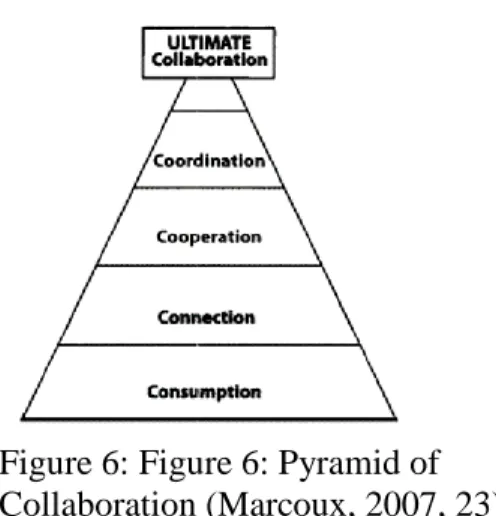
The process of collaboration must be a deliberate, conscious action for all parties involved. Patricia Montiel-Overall created a model, shown in Figure 5, of the
collaboration process between teachers and school librarians based on a case study of a collaborative effort, A school culture of teamwork is essential to the beginning phase of this model. It involves garnering interest in collaboration among teachers and
administrators, and requires the school librarian to articulate the benefits of collaborative experiences on student learning. This takes preparation on the part of the school librarian, who…
[should take time to] understand the culture of the school, learn about its curriculum, figure out the administrator’s preferred management style, connect with individual teachers in the school, and generally become acquainted with the setting in which everyone will be working (Doll, 2005, 31).
ways of doing things and advocating for best practices, school librarians should take care not to shut a potential door to collaboration due to disagreements with teachers. Taking on a helpful role, such as offering suggestions for helpful resources to use in a current unit, can lay the foundation for deeper collaborations in the future. When first beginning a collaborative effort, especially for a school librarian new to the school or trying a new program such as a makerspace, Carol Doll suggests choosing a teacher who is an
enthusiastic volunteer or mentor, a teacher who is starting a new unit, an innovator who is interested and willing to try new things (Doll, 2005, 37).
Once the librarian has a teacher partner, they must begin the lengthy process of getting to know one another and building a solid professional relationship (Montiel-Overall, 2010). The physical environment is one place to begin making everyone more open and comfortable. The participants in Patricia Montiel-Overall’s study identified “appropriate room size, adequate seating, temperature, and food” (Montiel-Overall, 2010, 47) as important factors to facilitating the growth of good relationships during the