A STUDY OF INDIVIDUAL PREDICTORS OF MATERNAL SELF-REPORTED
UNKNOWN HIV STATUS IN KENYA 2008
BY JOSEPH OBURE
A paper presented to the faculty of The University of North Carolina at
Chapel Hill in partial fulfillment of the requirements for the
Degree of Master of Public Health in the Department of Maternal and Child
Health
Chapel Hill, N.C.
(04/15/2011)
Approved by:
Advisor
TABLE OF CONTENTS
Dedication ... iii
Abstract ... iv
LIST OF TABLES ... v
CHAPTER I INTRODUCTION ... 1
1.1 Background information ... 1
1.2 Limitations of previous studies ... 6
1.3 Study rationale ... 7
1.4 Hypothesis ... 8
1.5 Research question ... 8
1.6 Conceptual Framework of the association between maternal Socio-economic status and self reported unknown HIV status ... 9
CHAPTER II METHODS ... 10
2.1 Study Population ... 10
2.1.1 Inclusion criteria ... 10
2.1.2 Exclusion criteria ... 10
2.2 Study variables ... 10
2.2.1 Dependent Variable ... 10
2.2.2 Independent variables ... 11
2.2.3 Other independent variables ... 11
2.3 Sample size and design ... 13
2.4 Data collection method ... 13
2.5 Data analysis plan ... 13
CHAPTER III RESULTS ... 15
3.1 Descriptive statistics ... 15
3.3 Association between maternal education and unknown maternal HIV status stratifying into place
of residence, ANC visits, birthplace & PMTCT knowledge. ... 20
3.4 Association between maternal wealth status and unknown HIV status on self-report ... 22
3.5 Association between maternal wealth status and unknown maternal HIV status stratifying into place of residence, ANC visits, birthplace & PMTCT knowledge. ... 24
CHAPTER IV DISCUSSIONS AND CONCLUSIONS ... 26
4.1 Discussion ... 26
4.2 Study strength. ... 30
4.3 Study limitations. ... 30
4.4 Conclusion and recommendation ... 30
References ... 32
Dedication
I dedicate this work to my lovely wife Veneranda Joseph and son Jesse Joseph who supported
me throughout my training period despite all difficulties we have gone through recently. Your
Abstract
Objectives: To determine if maternal education and wealth status predicts maternal
self-reported unknown HIV status among women in Kenya.
Methods: Kenya Demographic Health Survey (KDHS) 2008 – 2009 was used to examine the
association between unknown HIV status and education and wealth, controlling for age, place
of residence, place of delivery, history of intimate violence, knowledge of prevention of mother
to child transmission (PMTCT), and health decision-making.
Results: 617 (21.8%) had unknown HIV status. Education was not associated with unknown HIV
status. Only women in the richest wealth category reported less unknown HIV status. Home
and private facility births, high PMTCT knowledge and antenatal care (ANC) visits significantly
decreased likelihood of unknown HIV status in education and wealth status model. Rural
residence significantly predicted unknown HIV status in education model.
Conclusion: There is a need to improve PMTCT knowledge and services in rural areas, and to
LIST OF TABLES
Table Page
Table 1. Characteristics of the study population, Kenya DHS, 2008-9..………16
Table 2. Multivariate logistic regression indicating the association of maternal education and
unknown maternal HIV status on self-report……….19
Table 3. Logistic regression of education and unknown maternal HIV status stratifying into place
of residence, ANC visits, birthplace & PMTCT knowledge………..….20
Table 4. Multivariate logistic regression indicating the association of maternal wealth and
unknown maternal HIV status on self-report………..22
Table 5. Logistic regression of maternal wealth and unknown HIV status stratifying into place of
CHAPTER I INTRODUCTION
1.1
Background information
Worldwide, HIV has infected almost 60 million people, and 25 million people have died of
HIV/AIDS. (1) In 2008, 2.1 million children under the age of 15 years were living with HIV
infection, while 430,000 infants were born with HIV infection. (1) Sub-Sahara Africa is the home
for 67% of worldwide HIV infections and to 91% of all new infections among children. (1)
Mother-to-child-transmission of HIV infection (MTCT) accounts for about 90% of childhood HIV
infections (2). Without interventions the risk of vertical HIV transmission ranges from 20-50%,
however, with adequate prenatal, natal and post-natal intervention, the risk can be lowered to
less than 2%. (2) Prenatal HIV counseling and testing is an important entry point to receive
prevention of mother-to-child-transmission of HIV (PMTCT) services. Although many efforts
have been put in place to help reduce vertical HIV transmission, these efforts are hampered by
low uptake of PMTCT services. Furthermore, to reflect on low PMTCT uptake, in year 2008, 43%
of pregnant women in eastern and southern Africa had been tested for HIV, while only 58% of
those infected with HIV received antiretroviral drugs. (3) The World Health Organization brief
report on factors affecting the scaling of PMTCT uptake included limited human resources and
infrastructure for scale-up; weak health care systems; lack of demonstrated government
leadership and commitment in fulfilling the goal of universal access to PMTCT; limited
early testing of infants; lack of sustainable funding for scaling-up national programs; and lack of
coordination among partners. (4) Other individual and social factors include fear and distrust,
difficulties in HIV status disclosure and discrimination and access to PMTCT services. (5)
According to the 2008-2009 Kenya Demographic Health Survey (KDHS), 61% of pregnant
women received HIV pretest counseling, while 56% of pregnant women received HIV test
results following counseling and testing for HIV. (6) While prior knowledge of HIV status may
play some part in this, it is still possible to acquire HIV infection or seroconvert after prior HIV
tests through the conception and pregnancy period. It is not clear if these women attended
antenatal care or not. These women may be captured during intra- and post-partum care, an
effort hampered by a very low (43%) health facility delivery uptake in Kenya. (6) This situation
poses a huge risk for MTCT of HIV. Furthermore, individuals with unknown HIV status not only
deny themselves an opportunity to receive HIV treatment and care but also miss a chance to
reinforce positive behavior characteristics that prevent or reduce the risk of HIV
transmission/infections. Moreover, women with prenatal unknown HIV status have moderately
increased risks for perinatal deaths.(7), (8), (9), (10), (11) To highlight inaccessibility to PMTCT
services, a study conducted in Zimbabwe, found postnatal women who did not test for HIV in
their previous pregnancy reported willingness to test for HIV if the PMTCT services would be
made accessible even with an Opt-out strategy of HIV testing. (8) Different studies conducted in
South Africa, Kenya and Botswana reported lack of confidentiality by health care providers, or
lack of privacy during counseling as the reasons for not testing for HIV. (12), (13), (11). In this
case, a systematic review found that a positive attitude of the counselor could significantly
Moreover, the quality of PMTCT services has also been questioned, A study conducted in Dar es
Salaam, Tanzania showed the PMTCT site to be a significant predictor for maternal HIV testing
(15) as well as the time spent during counseling process.(10) Several studies reported poor
testing and treatment rates were associated with time spent during pretest or post-test
counseling. (10), (9), (11). In Uganda, clinics that operated for a prolonged duration of time had
significantly higher HIV testing rates among pregnant women. (10) Also a study in rural Burkina
Faso found a very poor quality of pre-test counseling such that 42% of pregnant women did not
understand the counseling process. (9) It is possible that providers have inadequate PMTCT
knowledge contributing to lower HIV testing in pregnancy. This may be suggested by a study
conducted in Botswana that found the providers of HIV services had discomfort with their
PMTCT knowledge and skills despite realizing the importance of HIV testing in pregnancy. (12)
In one study in South Africa, women reported delayed ANC attendance because of
facility-related barriers. (16) Also to suggest poor quality in health education services, some women
reported mistrust in reliability of the HIV test. (10)
Partner or family related factors associated with not testing for HIV include fear of stigma from
the partner and a need to have consent from the partner. (8), (17), (18) A cross-sectional study
conducted at a rural district hospital in Burkina Faso found that discussing HIV screening with
the partner and wanting the partner tested were significant predictors for HIV testing during
pregnancy. (17) HIV testing poses a huge stigmatization in the family. A study conducted in
Nigeria reported that women who anticipated male partner stigma were more than twice as
cross sectional study conducted in Kenya reported higher rates of HIV testing anticipated
stigma: about 32% of pregnant women anticipated break-up of the relationship with their
partners following HIV positive test. (18) Another study conducted in Nyanza province in Kenya,
80% of pregnant women did not turn up for post test HIV counseling irrespective of their HIV
status (11), while 95% did not disclose positive HIV status to spouses/relatives for fear of
stigma, discrimination and violence. (11) Lack of family support was associated with increased
likelihood of not testing for HIV and vice versa in a study conducted in Dar es Salaam, Tanzania.
(19)
There are mixed reports with regards to intimate partner violence and HIV testing. Intimate
partner violence predicted for not testing for HIV in pregnancy in Uganda and Tanzania. (20),
(21) A focus group discussion and interviews in Uganda reported women fear of testing for HIV
and disclosing HIV results, because of the fear of intimate partner violence. (20) Another study
conducted in two cities of Tanzania found that partner violence was significantly associated
with the partner being prevented or discouraged from antenatal care attendance. (21) Some
studies however found fear of stigma and increased resistance from partners and previous
history of domestic violence were not significantly associated with HIV testing (22)
Also, there are mixed reports with regards to personal or individual predictors for unknown
maternal HIV status or not testing for HIV during pregnancy. While some studies have reported
a positive association others have reported a negative association. Individual factors predicting
unknown HIV status include fear of receiving HIV test results, lack of knowledge of partner’s HIV
status, lack of PMTCT knowledge (13) (22), and other socio-demographic factors such as, low
In the individual socio-demographic characteristics, The KDHS 2008/9 report showed that
pregnant women with low education and low income have lower rates of HIV testing compared
to educated and higher income pregnant women. These results are different from Kenya
national representative ANC sentinel surveillance data obtained from 43 clinics in 2005 which
found that women were significantly less likely to accept HIV testing if they had secondary or
post-secondary education compared to primary or no education; however, this association was
lost after adjusting for PMTCT testing sites. It is possible that operation factors across the
PMTCT sites were the major determinant of PMTCT testing in this population. (23) The results
from the KDHS 2008/9 are supported by other studies conducted in Zimbabwe and Tanzania.(8)
(15) A cross-sectional study of the women attending postnatal care clinics in Zimbabwe found
that of 520 women sampled, 55% had been HIV tested during their last pregnancy. (8) In this
study, primary education level or no education and having attended less than six ANC visits
were associated with not having been tested for HIV. (8) Similarly a retrospective hospital based
birth registry in Tanzania reported single motherhood; rural residence, low maternal education,
and maternal farming to be associated with unknown HIV status.(7) Furthermore, these results
correspond with a nationally representative survey of 4494 women in Botswana that reported
younger age, more-educated women and those residing in towns to have a higher likelihood of
being offered both HIV counseling and testing than older, less-educated, and rural women.(12)
Compared to pregnant women from urban towns, rural residence has been found to be
associated with maternal unknown HIV status or not testing for HIV in both cross section and
Older pregnant women were found to have a lower likelihood of HIV testing. Studies
conducted in Tanzania and Botswana, (15) (12) found that women aged 35–39 years were 18%
less likely to accept testing than women <20 years of age. (15)
Pregnant women with fewer ANC visit are significantly less likely to test for HIV. (8) (17) One
study conducted in Zimbabwe found that having less than 6 ANC visits increases likelihood of
unknown HIV. (8)
1.2
Limitations of previous studies
Although previous studies differed with regards to socio-economic and demographic correlates
for unknown prenatal HIV status or HIV testing, they all used similar methodological
approaches in study design, methods and data analysis. Most of these studies instituted
cross-sectional surveys, qualitative interviews, and retrospective data review, or longitudinal surveys.
All studies were conducted in hospital/health facility settings and accounted for confounders by
adjusting for them in multivariate analysis. None of the studies were a community-based
survey that included women who may have not turned up for antenatal care in clinics or
delivery in the health facilities. This approach may have affected external validity since they
only recruited women from hospital/health care facilities, therefore excluding information from
women who did not use health care facility services. These studies may have underestimated
the prevalence of unknown HIV status and its predictors. Women who do not turn up regularly
for antenatal care and hospital deliveries may have specific socio-demographic characteristics
coming back for post natal care service to determine the correlates of prenatal HIV testing but
did not indicate how many women attended prenatal care services and what proportion of
those turned up for post partum follow up. (8)This approach may have excluded a large
proportion of women who did not turn up for post natal care given the fact that in developing
countries some women do not come back for post natal care follow up. Furthermore, there are
limited study reports that assessed the relationship between maternal income and HIV testing
in pregnancy. There is a need to conduct a study with data from a population-based
representative sample that may help to identify individual maternal predictors of unknown HIV
status in pregnant women. Such analysis will provide the programs and clinicians very
important information needed to increase the coverage for PMTCT services.
1.3
Study rationale
To my knowledge, there are limited and conflicting reports on how individual maternal
predictors are associated with unknown HIV status. Furthermore, none of the literature reports
on how maternal income associates with HIV testing in pregnancy.
Most previous studies used health facility based samples that do not represent the targeted
population leading to poor internal and external validity. This study includes all women, ages
15-49, who reported a pregnancy in the past three years, received ANC during their most
recent pregnancy, and who were offered an HIV test as part of their ANC and therefore
The study will analyze how maternal education and wealth are associated with testing for HIV
in pregnancy, while accounting for other individual characteristics.
1.4
Hypothesis
Low maternal education and low wealth status would lead to increased rate of unknown HIV
status while mediated by less knowledge on HIV disease, fewer ANC visits, and less access to
PMTCT services, while, residential place of the woman, age, marital status and parity confound
this association.
1.5
Research question
Is maternal low education and poor wealth status associated with increased unknown HIV
1.6 Conceptual Framework of the association between maternal Socio-economic
status and self reported unknown HIV status
Self reported
unknown
HIV status
+
+
+
+
+
+
+
+
Poor wealthy status
Low maternal education level
POTENTIAL CONFOUNDERS: Maternal age (low), high parity,
place of residence (rural). HYPOTHESIZED MEDIATORS: Few/No antenatal care visit, type of
birthplace, low knowledge on PMTCT, experience of partner
CHAPTER II METHODS
2.1 Study Population
This is a secondary analysis using cross section demographic health survey data from Kenya
(2008/2009), East Africa. The survey includes information from all individual women (N=2829)
who attended ANC in the last three years prior to the survey for their pregnancy
2.1.1 Inclusion criteria
1. Women in the Kenya DHS survey data within individual women survey category aged 15
to 49 years old.
2. Women who attended ANC in within last three years.
3. Women who were offered HIV testing in their most recent pregnancy as part of ANC
services.
2.1.2 Exclusion criteria
1. Pregnant women who did not attend ANC services in their most recent pregnancy three
years prior to the survey.
2. Women with missing data pertaining to HIV testing during pregnancy.
2.2 Study variables
2.2.1 Dependent Variable
1. Unknown maternal HIV status at most recent pregnancy
To obtain a group of women with unknown HIV status, I merged women who declined HIV
testing at their most recent pregnancy and those who tested but did not get their test results
results, but were you tested for HIV/AIDS as part of your ANC? Yes/No ii) I don’t want to know
the results, but did you receive the results of the test? Yes/No.
2.2.2 Independent variables
1. Maternal education status grouped into; i) no education (0 years of education), ii)
primary school (8 years of formal education), iii) secondary school (4 years of post
primary school education, iv) high education (college or any post secondary education.
2. Wealth status; derived from the pre-existing Kenya DHS data wealth index score built
based on questions asking for household’s ownership of consumer goods; dwelling
characteristics; presence and type of toilet facilities, type of drinking water and other
things/items that provide a proxy estimates of socio-economic status. . The obtained
score was summed up for each household and thereafter individuals were divided into
quintiles with a ranked scale of five categories; i) very poor, ii) poorer, iii) middle, iv)
richer, and v) richest.
2.2.3 Other independent variables
i. Number of antenatal care visits (1 to 3 visits, 4 to 6 visits, 7 to 18 visits) place of
residency (urban vs. rural),
ii. PMTCT knowledge score was composed following either Yes (1 point) or No (0 point)
responses to the following four questions; i) Do you know if AIDS is transmitted
during pregnancy? Ii) Do you know if AIDS is transmitted during delivery? Iii) Do you
To each respondent the point scored were summed up into a point scale ranging
from 0 – 4 such that (0 - 1=no knowledge), (2=minimal knowledge), (3=moderate
knowledge) and (4=high knowledge)
iii. Number of children ever born grouped into four categories of: (1), (2 – 5), (6 – 10),
(11 -13),
iv. Maternal years of age grouped into: (15 – 20), (21 – 30), (31 – 40) and (41 – 49),
v. Who makes decision for your health categorized into: (self made), (self and
partner/husband), and (Partner/husband only).
vi. Place of birth with 3 categories of: (public health facility), (private/maternity home)
and (home birth/birth before arrival)
vii. Intimate based violence variable had two options of Yes or No. This based on picking
any ‘Yes’ response that resulted from any of the following questions; Does/Did your
(last) husband/partner ever: (a) Push you, shake you, or throw something at you? (b)
Slap you? (c) Twist your arm or pull your hair? (d) Punch you with his fist or with
something that could hurt you? (e) Kick you or drag you or beat you up? (f) Try to
choke you or burn you on purpose? (g) Threaten or attack you with a knife, gun, or
any other weapon? (h) Physically force you to have sexual intercourse even when
you did not want to? (i) Force you to perform any sexual acts you did not want to?
2.3 Sample size and design
Kenya DHS data was collected after a probability sampling method, based on the stratified
two-stage cluster design. The first step involved selecting clusters from a nationally representative
sampling frame leading into 133 urban and 267 rural clusters. The second stage-involved
selection of 10,000 households from a list of household made from all selected clusters. From
the households interviewed, 8,767 women were found to be eligible and 8,444 were
interviewed, giving a response rate of 96%. However, for the purpose of this study, only
individual women in their reproductive age (15-49) who attended ANC services and gave birth
during the three years prior to the survey are included. Based on the KDHS report the total
number was 2829.
2.4 Data collection method
Kenya DHS used standardized face-to-face interview to collect information pertaining to their
reproductive life, maternal and ANC experiences. The questionnaires were adapted from
Measure DHS model and adjusted by translating them from English into Kiswahili and other ten
Kenyan local languages. These were further formatted following a feedback from the pretest
survey and training of the field staff.
2.5 Data analysis plan
Data abstraction was completed from the individual women survey in Kenya DHS 2008/2009.
The needed study variables will be kept while others dropped. Data cleaning was done,
survey (svy) command, which accounts for weighting and the cluster sampling, was used in all
analyses.
Frequency distributions and descriptive statistics for all study variables were generated. For
continuous variables such as age, parity, and number of antenatal visits, the mean, standard
deviations and range were calculated. Bivariate analysis was calculated by logistic regression to
determine the relationships between categorical predictor variables: Education and wealth
status versus dependent categorical variable of unknown maternal HIV status. Again, bivariate
logistic regression analysis was used to find relationships between other categorical predictor
variables such as maternal age, antenatal care visits, number of children, place of residence,
place of birth, any intimate based violence, who makes decision on your health and unknown
maternal HIV status. In this case the odds of an event occurring was captured within a 95%
confidence limit.
To look for effect modification, the odds of unknown HIV status in different categories of
wealth and education status were determined by stratifying the models into categories of place
of residence, ANC visits, birth place and PMTCT knowledge score using bivariate logistic
regression.
Multivariate Logistic regression model was used to estimate the association between maternal
levels of education; maternal wealth and self report unknown HIV status while adjusting for
other potential mediating and confounding categorical variables. In this case the odds of event
CHAPTER III RESULTS
3.1 Descriptive statistics
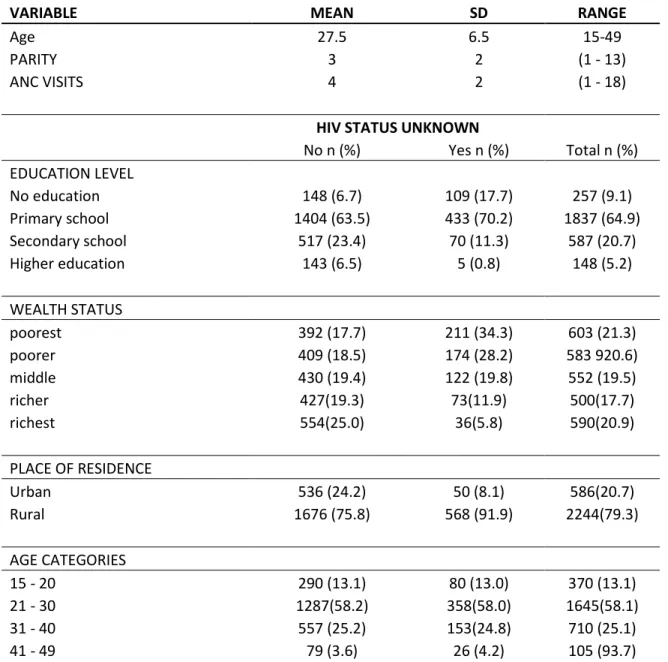
A total of 2829 individual women were included in this analysis. The mean age +/- (SD) was 27.5
+/- (6.5) years and range was 15 – 49 years old. Most of them were from rural areas (79.3). The
reported mean +/- (SD) number of ANC visits in the most recent pregnancy was 3.9 +/- (1.8)
with a range of 1 – 18 visits. (Table 1) The mean number of years spent in formal school was
7.5+/- (3.6) years, and range of 0 – 23 years. Women from urban residence had higher mean
years of education than with rural women (2.7 years, 95% CI: 2.38 – 3.03). (Not reported in
Table 1) The mean number of children ever born was 3 +/- (2). The majority (64.9%) of women
had a primary school level of education, while only (5.2%) had the highest level of education.
Only (21.3%) and (20.6%) women were poor and very poor, respectively similarly to (20.8%)
and (17.7%) who reported being very wealthy and wealthy respectively, (19.5%) women were
in the moderate wealth group between richer and poor. There was unequal distribution of
wealth status among rural and urban residence. In urban, 73.5% of women were categorized as
richest compared to only 0.8% in rural areas. Furthermore, 32% of women in rural residence
were categorized as poorest compared to only 5.5% in urban women. Most (58.1%) women
were between 21 – 30 years, and only (3.7%) were between 41 – 49 years old. Over a third of
women (37.9%) had high PMTCT knowledge scores while (5.5%) completely had no PMTCT
knowledge. Over a-third (34.7%) of women had experienced any form of intimate based
violence in the past year. For antenatal care visits, (49.9%) women attended 1 – 3 times, and
their partners/husbands. Most (60%) women had given birth 2 – 5 times, (16.8%) had delivered
6 – 10 times, (22.5%) gave birth only once, while (0.7%) had given birth 11 – 13 times. (Table 2)
Among 2829 women, 617 (21.8%) had unknown HIV status on self-report (Not included in table
2).
Table 1. Characteristics of the study population, Kenya DHS, 2008-9 (N= 2829)
VARIABLE MEAN SD RANGE
Age 27.5 6.5 15-49
PARITY 3 2 (1 - 13)
ANC VISITS 4 2 (1 - 18)
HIV STATUS UNKNOWN
No n (%) Yes n (%) Total n (%)
EDUCATION LEVEL
No education 148 (6.7) 109 (17.7) 257 (9.1)
Primary school 1404 (63.5) 433 (70.2) 1837 (64.9)
Secondary school 517 (23.4) 70 (11.3) 587 (20.7)
Higher education 143 (6.5) 5 (0.8) 148 (5.2)
WEALTH STATUS
poorest 392 (17.7) 211 (34.3) 603 (21.3)
poorer 409 (18.5) 174 (28.2) 583 920.6)
middle 430 (19.4) 122 (19.8) 552 (19.5)
richer 427(19.3) 73(11.9) 500(17.7)
richest 554(25.0) 36(5.8) 590(20.9)
PLACE OF RESIDENCE
Urban 536 (24.2) 50 (8.1) 586(20.7)
Rural 1676 (75.8) 568 (91.9) 2244(79.3)
AGE CATEGORIES
15 - 20 290 (13.1) 80 (13.0) 370 (13.1)
21 - 30 1287(58.2) 358(58.0) 1645(58.1)
31 - 40 557 (25.2) 153(24.8) 710 (25.1)
KNOWLEDGE OF PMTCT
None 85 (4.0) 63 (11.5) 148 (5.5)
Minimal 397(18.6) 141(25.6) 538(20.1)
Moderate 788 (37.0) 189 (34.4) 977 (36.5)
Higher 859 (40.3) 157 (28.5) 1016 (37.9)
FINAL SAY ON MATERNAL HEALTH DECISION
Respondent alone 460 (25.2) 132 (25.2) 592 (25.2)
Respondent & husband/partner 901 (49.3) 191 (36.5) 1092 (46.5)
Husband or partner alone 466 (25.5) 200 (38.2) 666 (28.3)
NUMBER OF ANTENAL VISITS
1 to 3 1009 (46.3) 385 (62.8) 1394 (49.9)
4 to 6 997 (45.8) 217 (35.4) 1214 (43.5)
7 to 18 172 (7.9) 11 (1.8) 183 (6.6)
INTIMACY VIOLENCE
No 1151 (65.2) 306 (62.1) 1457 (65.3)
Yes 588 (33.8) 187 (37.9) 775 (34.7)
PLACE OF DELIVERY
Public facilities 981 (44.4) 476 (77.1) 1457 (51.6)
Private facilities 920 (41.6) 104 (16.9) 1024 (36.2)
Home/before arrival to health
facility 308 (13.9) 37 (6.0) 345 (12.2)
TOTAL CHILDREN EVER BORN
1 528 (23.9) 108 (17.5) 636 (22.5)
2 to 5 1347 (60.9) 352 (57.1) 1699 (60.0)
6 to 10 321 (14.5) 154 (25.0) 475 (16.8)
11 to 13 17 (0.8) 3 (0.5) 20 (0.7)
Key; SD = Standard deviation
3.2 Association between maternal education and unknown maternal HIV status
on self-report
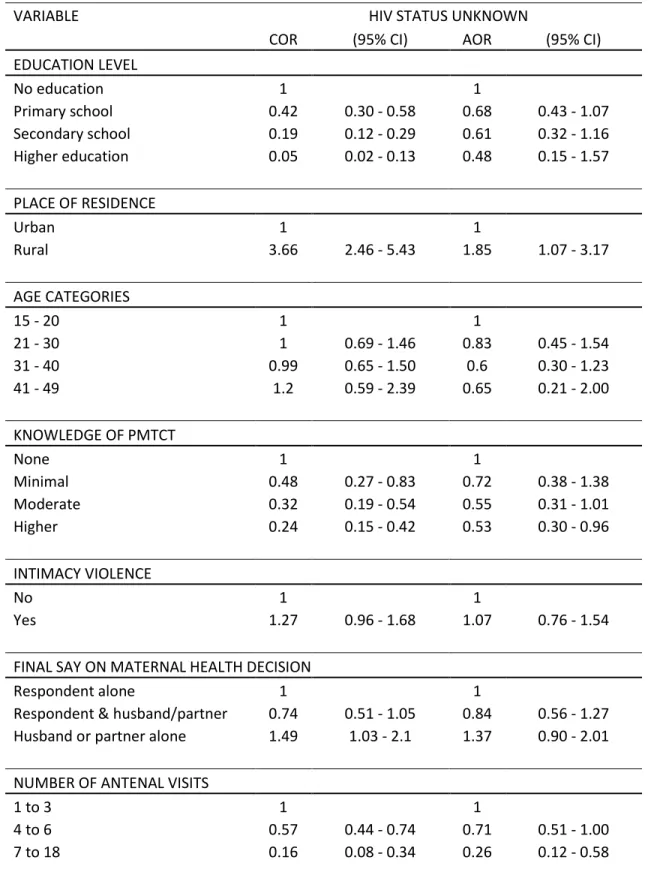
and higher education was (OR 0.42, 95% CI: 0.30 – 0.58), (OR 0.19, 95% CI: 0.12 – 0.29) and (OR
0.05, 95% CI: 0.02 – 0.13) respectively (Table 2, Column 1). This suggests that a significant
association exists between low maternal education and unknown HIV status. Women from rural
residence were three times as likely to have unknown HIV status (OR 3.66, 95% CI: 2.46 – 5.43),
while women with a higher PMTCT knowledge score were significantly less likely to report
unknown HIV status (OR 0.24, 95% CI: 0.15 – 0.42). Women whose health decisions are made
by husband/partners alone were 1.5 times as likely to report unknown maternal HIV status.
Increased frequency of maternal antenatal care visits significantly decreased the odds of
unknown HIV status on self-report. Compared to delivery at a public health facility, women who
reported giving birth at home or before arrival to the health facility (OR 0.24, 95% CI: 0.17 –
0.32) and those who delivered at the private health care facilities (OR 0.23, 95% CI: 0.15 – 0.39)
had reduced odds of unknown maternal HIV status on self-report. Women who gave birth 6 –
10 times had increased odds of unknown HIV status on self-report. (Table 2)
In multivariate logistic regression while adjusting for all other predictor variables, maternal
education was no longer associated with self-reported unknown HIV status. Women who
reported rural residence had a significant increase in odds of unknown HIV status while a higher
PMTCT knowledge scores, home birth, private facility birth and antenatal care of 7 – 18 visits
Table 2. Multivariate logistic regression indicating the association of maternal education and
unknown maternal HIV status on self-report
VARIABLE HIV STATUS UNKNOWN
COR (95% CI) AOR (95% CI)
EDUCATION LEVEL
No education 1 1
Primary school 0.42 0.30 - 0.58 0.68 0.43 - 1.07
Secondary school 0.19 0.12 - 0.29 0.61 0.32 - 1.16
Higher education 0.05 0.02 - 0.13 0.48 0.15 - 1.57
PLACE OF RESIDENCE
Urban 1 1
Rural 3.66 2.46 - 5.43 1.85 1.07 - 3.17
AGE CATEGORIES
15 - 20 1 1
21 - 30 1 0.69 - 1.46 0.83 0.45 - 1.54
31 - 40 0.99 0.65 - 1.50 0.6 0.30 - 1.23
41 - 49 1.2 0.59 - 2.39 0.65 0.21 - 2.00
KNOWLEDGE OF PMTCT
None 1 1
Minimal 0.48 0.27 - 0.83 0.72 0.38 - 1.38
Moderate 0.32 0.19 - 0.54 0.55 0.31 - 1.01
Higher 0.24 0.15 - 0.42 0.53 0.30 - 0.96
INTIMACY VIOLENCE
No 1 1
Yes 1.27 0.96 - 1.68 1.07 0.76 - 1.54
FINAL SAY ON MATERNAL HEALTH DECISION
Respondent alone 1 1
Respondent & husband/partner 0.74 0.51 - 1.05 0.84 0.56 - 1.27
Husband or partner alone 1.49 1.03 - 2.1 1.37 0.90 - 2.01
NUMBER OF ANTENAL VISITS
PLACE OF DELIVERY
Public facilities 1 1
Private facilities 0.23 o.17 - 0.32 0.29 0.19 - 0.42
Home/before arrival to health
facility 0.24 0.15 - 0.39 0.41 0.23 - 0.74
TOTAL CHILDREN EVER BORN
1 1 1
2 to 5 1.28 0.9 - 1.81 0.98 0.55 - 1.72
6 to 10 2.34 1.5 - 3.5 1.52 0.74 - 3.10
11 to 13 0.97 0.27 - 3.5 0.4 0.05 - 3.00
Key; COR=crude odds ratio, AOR=adjusted odds ratio, 95% CI=95% Confidence interval
3.3 Association between maternal education and unknown maternal HIV status
stratifying into place of residence, ANC visits, birthplace & PMTCT knowledge.
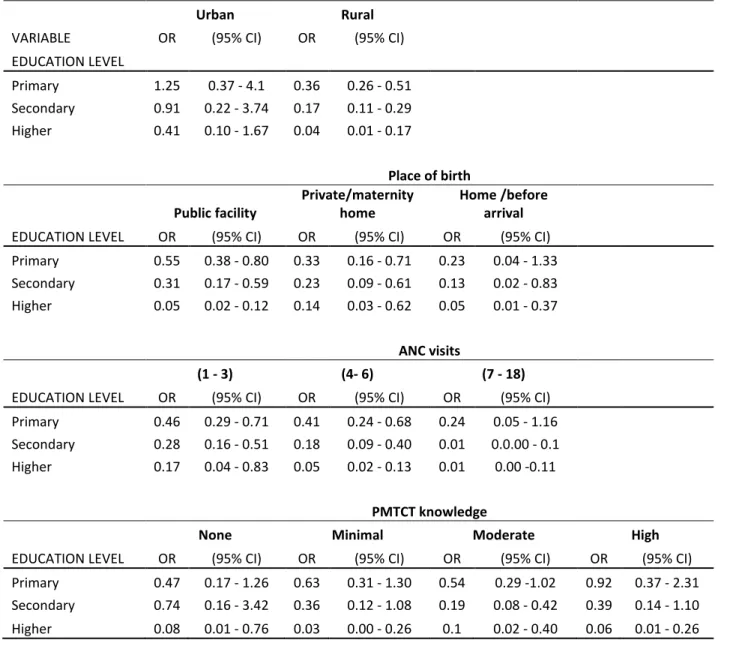
Despite the odds on unknown HIV status being attenuated, the increased maternal education
level was significantly and inversely associated with unknown HIV status only in rural women.
Increased education level significantly reduced the odds of unknown maternal HIV status across
Table 3. Logistic regression of education and unknown maternal HIV status stratifying into
place of residence, ANC visits, birthplace & PMTCT knowledge.
VARIABLE
Urban Rural
OR (95% CI) OR (95% CI)
EDUCATION LEVEL
Primary 1.25 0.37 - 4.1 0.36 0.26 - 0.51
Secondary 0.91 0.22 - 3.74 0.17 0.11 - 0.29
Higher 0.41 0.10 - 1.67 0.04 0.01 - 0.17
Place of birth
Public facility
Private/maternity home
Home /before
arrival
EDUCATION LEVEL OR (95% CI) OR (95% CI) OR (95% CI)
Primary 0.55 0.38 - 0.80 0.33 0.16 - 0.71 0.23 0.04 - 1.33
Secondary 0.31 0.17 - 0.59 0.23 0.09 - 0.61 0.13 0.02 - 0.83
Higher 0.05 0.02 - 0.12 0.14 0.03 - 0.62 0.05 0.01 - 0.37
ANC visits
(1 - 3) (4- 6) (7 - 18)
EDUCATION LEVEL OR (95% CI) OR (95% CI) OR (95% CI)
Primary 0.46 0.29 - 0.71 0.41 0.24 - 0.68 0.24 0.05 - 1.16
Secondary 0.28 0.16 - 0.51 0.18 0.09 - 0.40 0.01 0.0.00 - 0.1
Higher 0.17 0.04 - 0.83 0.05 0.02 - 0.13 0.01 0.00 -0.11
PMTCT knowledge
None Minimal Moderate High
EDUCATION LEVEL OR (95% CI) OR (95% CI) OR (95% CI) OR (95% CI)
Primary 0.47 0.17 - 1.26 0.63 0.31 - 1.30 0.54 0.29 -1.02 0.92 0.37 - 2.31
Secondary 0.74 0.16 - 3.42 0.36 0.12 - 1.08 0.19 0.08 - 0.42 0.39 0.14 - 1.10
3.4 Association between maternal wealth status and unknown HIV status on
self-report
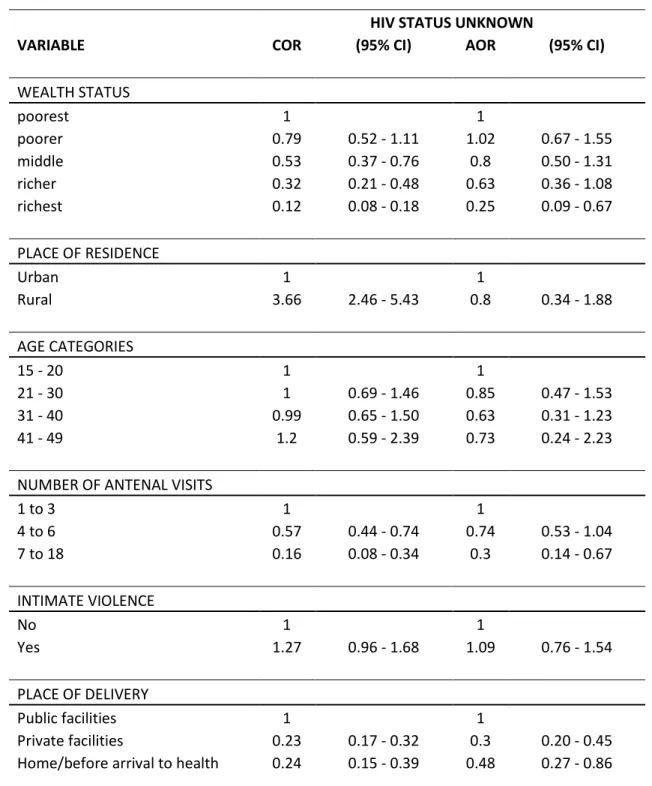
In bivariate logistic regression analysis of wealth status model, improved wealth status was
associated with decreased odds of unknown maternal HIV status. When compared with the
poorest pregnant women, the crude odds for unknown maternal HIV status was (0.53, 95% CI:
0.37 – 0.76) for the moderate group, (0.32, 95% CI: 0.21 – 0.48) for the richer group, and (0.12,
95% CI: 0.08 – 0.18) for the richest women. Women from rural residence were three times
likely to have unknown HIV status (OR 3.66, 95% CI: 2.46 – 5.43), while women with a higher
PMTCT knowledge score were significantly less likely to report unknown HIV status (OR 0.24,
95% CI: 0.15 – 0.42). Women whose health decisions are made by husband/partners alone
were 1.5 times as likely to report unknown maternal HIV status. Increased frequency of
maternal antenatal care visits significantly decreased the odds of unknown HIV status on
self-report. Compared to delivery at a public health facility, women who reported giving birth at
home or before arrival to the health facility (OR 0.24, 95% CI:0. 17 – 0.32) and those who
delivered at the private health care facilities (OR 0.23, 95% CI:0. 15 – 0.39) had reduced odds of
unknown maternal HIV status on self-report. Women who gave birth 6 – 10 times had increased
odds of unknown HIV status on self-report. (Table 4)
In multivariate logistic regression adjusted for all other predictor variables, the richest women
were significantly (AOR 0.25, 95% CI: 0.09 – 0.67) less likely to report unknown HIV status. Place
of delivery: (AOR 0.3, 95% CI: 0.2 – 0.45) for private facility, (AOR 0.48, CI: 0.27 – 0.86) for home
seven antenatal care visits (AOR 0.3, 95% CI: 0.14 – 0.67) significantly reduced the likelihood for
maternal unknown HIV status. (Table 4)
Table 4. Multivariate logistic regression of maternal wealth status and unknown maternal HIV
status on self-report
HIV STATUS UNKNOWN
VARIABLE COR (95% CI) AOR (95% CI)
WEALTH STATUS
poorest 1 1
poorer 0.79 0.52 - 1.11 1.02 0.67 - 1.55
middle 0.53 0.37 - 0.76 0.8 0.50 - 1.31
richer 0.32 0.21 - 0.48 0.63 0.36 - 1.08
richest 0.12 0.08 - 0.18 0.25 0.09 - 0.67
PLACE OF RESIDENCE
Urban 1 1
Rural 3.66 2.46 - 5.43 0.8 0.34 - 1.88
AGE CATEGORIES
15 - 20 1 1
21 - 30 1 0.69 - 1.46 0.85 0.47 - 1.53
31 - 40 0.99 0.65 - 1.50 0.63 0.31 - 1.23
41 - 49 1.2 0.59 - 2.39 0.73 0.24 - 2.23
NUMBER OF ANTENAL VISITS
1 to 3 1 1
4 to 6 0.57 0.44 - 0.74 0.74 0.53 - 1.04
7 to 18 0.16 0.08 - 0.34 0.3 0.14 - 0.67
INTIMATE VIOLENCE
No 1 1
Yes 1.27 0.96 - 1.68 1.09 0.76 - 1.54
PLACE OF DELIVERY
facility
TOTAL CHILDREN EVER BORN
1 1 1
2 to 5 1.28 0.9 - 1.81 0.94 0.53 - 1.67
6 to 10 2.34 1.5 - 3.5 1.4 0.68 - 2.90
11 to 13 0.97 0.27 - 3.5 0.42 0.06 - 3.00
FINAL SAY ON MATERNAL HEALTH DECISION
Respondent alone 1 1
Respondent & husband/partner 0.74 0.51 - 1.05 0.85 0.56 - 1.28
Husband or partner alone 1.49 1.03 - 2.1 1.4 0.91 - 2.13
KNOWLEDGE OF PMTCT
None 1 1
Minimal 0.48 0.27 - 0.83 0.7 0.37 - 1.33
Moderate 0.32 0.19 - 0.54 0.55 0.31 - 1.00
Higher 0.24 0.15 - 0.42 0.52 0.28 - 0.94
Key; COR=crude odds ratio, AOR=adjusted odds ratio, 95% CI=95% Confidence interval
3.5 Association between maternal wealth status and unknown maternal HIV
status stratifying into place of residence, ANC visits, birthplace & PMTCT
knowledge.
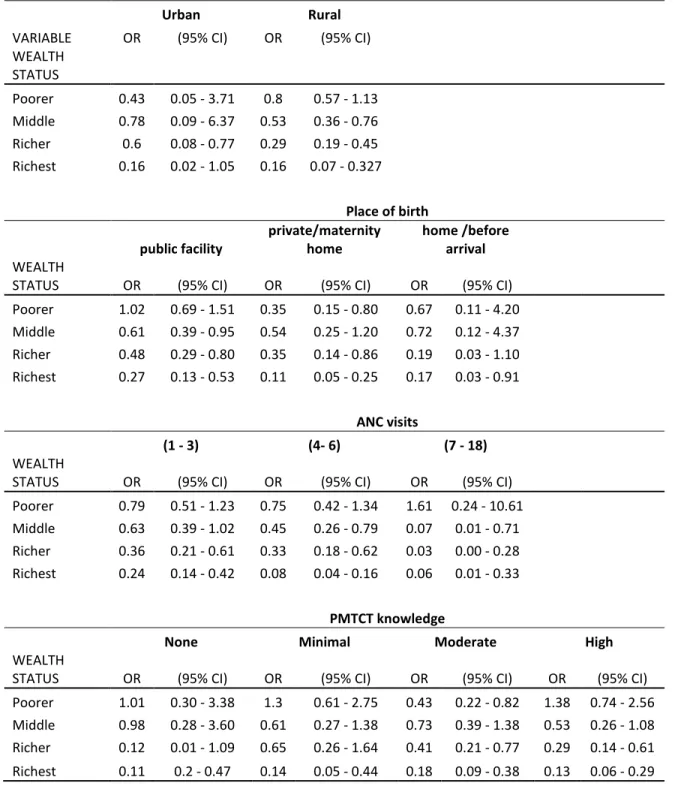
While the odds of unknown HIV status was attenuated compared with crude odds, the
increased maternal wealth level was significantly and inversely associated with unknown HIV
status in all variables with exception of richest women in urban who did not have any significant
Table 5. Logistic regression of wealth status and unknown maternal HIV status stratifying into
place of residence, ANC visits, birthplace & PMTCT knowledge.
VARIABLE
Urban Rural
OR (95% CI) OR (95% CI)
WEALTH
STATUS
Poorer 0.43 0.05 - 3.71 0.8 0.57 - 1.13
Middle 0.78 0.09 - 6.37 0.53 0.36 - 0.76
Richer 0.6 0.08 - 0.77 0.29 0.19 - 0.45
Richest 0.16 0.02 - 1.05 0.16 0.07 - 0.327
Place of birth
public facility private/maternity home home /before arrival WEALTH
STATUS OR (95% CI) OR (95% CI) OR (95% CI)
Poorer 1.02 0.69 - 1.51 0.35 0.15 - 0.80 0.67 0.11 - 4.20 Middle 0.61 0.39 - 0.95 0.54 0.25 - 1.20 0.72 0.12 - 4.37 Richer 0.48 0.29 - 0.80 0.35 0.14 - 0.86 0.19 0.03 - 1.10 Richest 0.27 0.13 - 0.53 0.11 0.05 - 0.25 0.17 0.03 - 0.91
ANC visits
(1 - 3) (4- 6) (7 - 18)
WEALTH
STATUS OR (95% CI) OR (95% CI) OR (95% CI)
Poorer 0.79 0.51 - 1.23 0.75 0.42 - 1.34 1.61 0.24 - 10.61 Middle 0.63 0.39 - 1.02 0.45 0.26 - 0.79 0.07 0.01 - 0.71 Richer 0.36 0.21 - 0.61 0.33 0.18 - 0.62 0.03 0.00 - 0.28 Richest 0.24 0.14 - 0.42 0.08 0.04 - 0.16 0.06 0.01 - 0.33
PMTCT knowledge
None Minimal Moderate High
WEALTH
STATUS OR (95% CI) OR (95% CI) OR (95% CI) OR (95% CI)
CHAPTER IV DISCUSSIONS AND CONCLUSIONS
4.1 Discussion
In this study, as many as 21.8% of women did not know their HIV status during their most
recent pregnancy. This is similar to studies conducted in the neighboring country of Tanzania
where unknown HIV status in pregnant women was found to be 22% and 22.8% in cities of
Moshi and Dar es Salaam respectively.(7) (8) This trend seems to be the same with countries in
West Africa where, 22.8% of pregnant women in suburban and rural primary care facilities
refused HIV testing, reflecting their rates of maternal unknown HIV status.(24)
In this study population, the crude analysis demonstrated that maternal education and wealth
status were associated with maternal unknown HIV status on self-report. Increased maternal
education was inversely and significantly associated with unknown HIV status. Furthermore,
increased number of antenatal care visits, high PMTCT knowledge score, and maternal birth in
public or home birth were significantly and inversely associated with unknown HIV status on
self-report unlike rural residence which significantly increased the likelihood of unknown HIV
status. Looking into the association between maternal education and unknown HIV status while
stratifying the analysis into various variable categories of ANC visits, birthplace and PMTCT
knowledge revealed similar significant results across all variables. However, when stratified in
rural and urban residence, low maternal education significantly predicted unknown HIV status
in rural only. This suggests that place of residence modifies the maternal education effect on
Furthermore, the significant association between maternal education and HIV status was
eliminated after adjusting for place of residence, number of antenatal care visits, and PMTCT
knowledge. Also, women who had 7 – 18 ANC visits, birth in private facility and home birth
although high PMTCT knowledge score still were significantly less likely to report unknown HIV
status. The odds for unknown HIV status in rural residence were slightly reduced but still
significant. This suggests that place of residence, number of antenatal care visits, PMTCT
knowledge, and maternal birthplace mediate the association between low maternal education
and unknown HIV status on self-report. These results are similar with previous studies
conducted in Africa that found low maternal education predicted unknown maternal HIV
status. (7), (8), (15), (12)
Similar with education status, maternal wealth status was significantly and inversely associated
with unknown maternal HIV status in crude analysis. Improved wealth status was inversely
associated with unknown maternal HIV status. Also, 7-18 ANC visits, birth in private and home
birth and high PMTCT knowledge score were significantly less likely associated with unknown
HIV status. Rural residence had a threefold significant increase in the odds of unknown HIV
status.
Stratifying the association between wealth status and unknown HIV status into categories of
ANC visits, birthplace and PMTCT knowledge led to similar significant results across all
variables. Logistic regression adjusting for all variables with significant results revealed the
unknown HIV status was attenuated however still significant. In this model place of residence
was not associated with unknown HIV status.
In models that separately adjusted for education and wealth, women with 7 – 18 ANC visits
were significantly less likely to have unknown HIV status. This finding resembles results from a
study conducted in Zimbabwe that found that having less than 6 ANC visits increases likelihood
of unknown HIV. (8) A study in Burkina Faso a found increased ANC visits was positively
associated with maternal HIV testing. (9)It is possible that increased number of visits is
associated with increased opportunities for counseling and testing and make up for days of
missed test or it could be due to other medical conditions in pregnancy that require frequent
visits, such as being HIV positive and other pregnancy complications.
In both models, high PMTCT knowledge score decreased the likelihood of unknown maternal
HIV status. These results correlates with other previous studies conducted in Africa, which
reported a higher PMTCT knowledge score was positively associated with HIV testing. (17), (22)
In both models delivery in private facility and home delivery/ birth before arrival to the health
facility were significantly associated with decreased unknown maternal HIV status when
compared to women who deliver in public health facilities. Women who delivered at home
accounted for 12.2% of study population, while making 6% of women with unknown HIV status.
This is a paradoxical results as it is very difficult to explain why women with home/birth before
arrival have lower likelihood for unknown HIV status however, It is possible that these are
women who either consider themselves to have no risk pregnancy and therefore do not
intrapartum services in most of developing countries. It should be remembered that, only 43%
of pregnant women in Kenya delivers in health facilities while 56% delivers at home. (4) This is
contrary to a very high (92%) uptake in ANC attendance. (4) It is also possible that birth place
has no influence on HIV testing but mainly the fact that previous studies did not include birth
place as one of study variable since most of these studies recruited women during pre-partum
period when most of HIV test in pregnancy are conducted.
In education model, rural residence was significantly associated with unknown HIV status on
self-report. The results are similar with other studies conducted in Tanzania (7) and Botswana.
(12) This could relate to the fact that most rural residencies have limited health care services to
meet the demands of its people in most of African countries. Living in urban residency was
found to predict the likelihood of being offered HIV test in pregnant women living in Botswana.
(12) It is unknown to me why rural residence was not a significant predictor for unknown HIV
status in the wealth model. This could be due to a huge difference in wealth status among
women of rural residence compared to urban residence. In urban, 73.5% of women were in the
richest category compared to only 0.8% in rural areas. Furthermore, 32% of women in rural
residence were categorized as poorest compared to only 5.5% in urban women. This un-equal
distribution of wealth status might have contributed to lack of significant effect of rural
residence in wealth model. Also the difference in levels of education may have accounted for
much of the difference seen on unknown HIV status compared to the effect of wealth status. In
this study population women in urban had a higher mean [9.1 (4.5)] years of education
4.2 Study strength.
This is probably the first study of its kind to evaluate the predictors to evaluate the predictors of
maternal unknown HIV status using a community survey representative of the population of
women who received antenatal care. Previous studies are based mostly on health facility
samples and therefore had poor representation and generalizability.
Also, this study included women with history of home birth or birth before arrival who have
systematically been omitted from previous research. This approach has increased both internal
and external validity for this study.
4.3 Study limitations.
The primary outcome measure for this study is unknown HIV status based on self-report, which
may have been reported incorrectly because there was no way to validate the individual
woman’s response. It is assumed that the problem of incorrect status this may have been
distributed in all sets of women, educated and non-educated, wealth and poorer. In this case
antenatal records were not used to confirm if someone had received a test result.
4.4 Conclusion and recommendation
Increased number of antenatal care visits, birth at home or in private facilities, higher PMTCT
knowledge scores independently decreases the likelihood of unknown maternal HIV status in
this population. Rural residence independently predicted unknown HIV status in the education
areas, and maximizing maternal contact opportunities available for counseling and testing
References
(1) UNAIDS; AIDS Epidemic updates (2009); available at;
http://www.unaids.org/en/KnowledgeCentre/HIVData/EpiUpdate/EpiUpdArchive/2009/default .asp; accessed in September 23rd, 2010
(2) USAID; Adding Family Planning to PMTCT increases PMTCT benefits (2006); available at; http://www.usaid.gov/our_work/global_health/pop/techareas/repositioning/briefs/adding_fp _pmtct.pdf; accessed in September 23rd, 2010.
(3) Preventing Mother to Child Transmission of HIV (PMTCT) (2009); available at;
http://www.unicef.org/aids/index_preventionyoung.html; accessed on 22nd, September 2010.
(4) Kenya Demographic Health Survey (KDHS) 2008-2009; available at;
http://pdf.usaid.gov/pdf_docs/PNADQ650.pdf; accessed in September 23, 2010.
(5)WHO; Department of HIV AIDS; Brief note on PMTCT (2007); available at;
http://www.who.int/hiv/pub/toolkits/PMTCT%20HIV%20Dept%20brief%20Oct%2007.pdf; accessed on 03-24-2011.
(6) AVERT; Preventing Mother to Child Transmission in Practice (PMTCT); available at; http://www.avert.org/pmtct-hiv.htm; accessed on 03-23-2011.
(7) Habib N, Daltveit A, Bergsjø P, Shao J, Oneko O, Lie R. Maternal HIV status and pregnancy outcomes in northeastern Tanzania: a registry-based study. BJOG: An International Journal of Obstetrics & Gynecology 2008; 115(5):616-624.
(8) Perez F, Zvandaziva C, Engelsmann B, Dabis F. Acceptability of routine HIV testing. JAIDS J Acquired Immune Defic Syndromes 2006; 41(4):514.
(9) Sarker M, Sanou A, Snow R, Ganame J, Gondos A. Determinants of HIV counseling and testing participation in a Prevention of Mother-to-Child Transmission programme in rural Burkina Faso. Tropical Medicine & International Health 2007; 12(12):1475-1483.
(10) Dahl V, Mellhammar L, Bajunirwe F, Björkman P. Acceptance of HIV testing among women attending antenatal care in south-western Uganda: risk factors and reasons for test refusal. AIDS Care 2008; 20(06):746-752.
(11) Moth I, Ayayo A, Kaseje D. Assessment of utilization of PMTCT services at Nyanza Provincial Hospital, Kenya. SAHARA J (Journal of Social Aspects of HIV/AIDS Research Alliance) 2005; 2(2):244.
(13) Peltzer K, Mlambo G, Phaweni K. Factors determining prenatal HIV testing for prevention of mother to child transmission of HIV in Mpumalanga, South Africa. AIDS and Behavior: online publication Jan 2010; page 1-9.
(14) Minnie KS, Van Der Walt S, Klopper HC. A systematic review of counseling for HIV testing of pregnant women. J Clin Nurs 2009; 18(13):1827-1841.
(15) Westheimer EF, Urassa W, Msamanga G, Baylin A, Wei R, Aboud S, et al. Acceptance of HIV testing among pregnant women in Dar-es-Salaam, Tanzania. J Acquired Immune Deffic
Syndromes 2004; 37(1):1197.
(16) Laher F, Cescon A, Lazarus E, Kaida A, Makongoza M, Hogg RS, et al. Conversations With Mothers: Exploring Reasons for Prevention of Mother-to-Child Transmission (PMTCT) Failures in the Era of Programmatic Scale-Up in Soweto, South Africa. AIDS and Behavior; online
publication Jan 2011: page 1-8.
(17) Daniel O, Oladapo O. Acceptability of prenatal HIV screening at the primary care level in Nigeria. Journal of Obstetrics & Gynecology 2006; 26(3):191-194.
(18) Turan JM, Bukusi EA, Onono M, Holzemer WL, Miller S, Cohen CR. HIV/AIDS Stigma and Refusal of HIV Testing Among Pregnant Women in Rural Kenya: Results from the MAMAS Study. AIDS and Behavior; online publication Sept 2010: page 1-10.
(19) Kominami M, Kawata K, Ali M, Meena H, Ushijima H. Factors determining prenatal HIV testing for prevention of mother to child transmission in Dar Es Salaam, Tanzania. Pediatrics International 2007; 49(2):286-292.
(20) Karamagi CA, Tumwine JK, Tylleskar T, Heggenhougen K. Intimate partner violence against women in eastern Uganda: implications for HIV prevention. BMC Public Health 2006 Nov 20; 6:284.
(21) Stockl H, Watts C, Kilonzo Mbwambo JK. Physical violence by a partner during pregnancy in Tanzania: prevalence and risk factors. Reprod Health Matters 2010; 18(36):171-180.
(22) Creek T, Ntumy R, Mazhani L, Moore J, Smith M, Han G, et al. Factors associated with low early uptake of a national program to prevent mother to child transmission of HIV (PMTCT): results of a survey of mothers and providers, Botswana, 2003. AIDS and Behavior 2009; 13(2):356-364.
Acknowledgments
I would like to show my gratitude’s to my advisor Prof Diane Louise Rowley MD, MPH, for all
her support throughout my training and in making this master paper possible.
I am also pleased to thank Prof Jon Hussey PHD, for accepting to be a second reader to this
master paper and whose teachings in Research Methods class provided a foundation to
accomplish this task.
I would also like to thank all my classmates and all people not mentioned by names but who