North Carolina Equity in Birth Outcomes Council
Reducing Inequities in Birth Outcomes in North Carolina:
Developing an Actionable Strategic Plan
Community Stakeholder Focus Group Research
Report written by: Kendall B. Gurske
A paper presented to the faculty of The University of North Carolina at Chapel Hill in partial fulfillment of the requirements for the
Degree of Master of Public Health
in the Department of Maternal and Child Health. Chapel Hill, N.C.
November 2012
Approved by:
First Reader
Acknowledgments
I would like to acknowledge the support and guidance of Dr. Sarah Verbiest, Executive Director of the UNC Center for Maternal and Infant Health, Co-‐PI of the Academic-‐ Community Partnership to Reduce Disparities in Infant Mortality Project, and my field preceptor. I’d like to acknowledge the key role of the North Carolina Child Fatality Task Force and the Equity in Birth Outcomes Council in this important work.
I would also like to recognize the many women and men who helped to identify groups and contacts in the communities for focus group participation, as well as those who facilitated focus groups, including Rovonda Bradford, Kay Freeman, Amy Hattem, Sharon Johnson, Amy Mullenix, Heather Owens, and Charmaine Purdum.
Table of Contents
Acknowledgements...ii
Introduction ...1
Methods...3
Results...5
1. Improving Healthcare for African American Women...5
I. Barriers to Access...5
i. Competing Priorities...5
ii. Time...5
iii. Healthcare Providers...6
iv. Transportation...7
v. Cost...7
II. Other Trends...8
i. Health Information Sources ...8
ii. Mental Health ...8
2. Strengthening African American Families and Communities...10
I. Community Engagement...10
i. Emerging Community Resources...10
ii. Faith Communities...11
II. Engaging Men and Fathers...12
i. Single Motherhood ...12
ii. Male-‐friendly Services...13
iii. Mentorship...14
3. Addressing Social and Economic Inequalities ...16
I. Breaking Cycles of Poverty...16
II. The Education System...16
III. Engaging Businesses...17
IV. Policymakers...18
Limitations...20
Conclusions and Recommendations...21
Appendices...24
Appendix A. 12-‐Point Plan to Close the Black-‐White Gap in Birth Outcomes...24
Appendix B. Focus Group Presentation Slides...27
Appendix C. Focus Group Facilitation Guide ...31
Introduction
In North Carolina, infant mortality and perinatal related conditions account for over 67% of all child deaths. The infant mortality rate for African American infants (12.6 per 1,000 live births) is more than twice that of Caucasian infants (5.4 per 1,000 live births).1 African American babies are also disproportionately low birth weight (14% of African American infants were less than 2500 grams in 2011 compared to 7.5% of White infants) and pre-‐ term (17% of African American infants were less than 37 weeks completed gestation compared to 11.2% of White infants).1
The causes of infant mortality are complex and extend beyond the traditional biomedical model to include factors related to family and community systems and social and economic inequalities. ADD MORE.
Public health efforts to close the racial and ethnic gap in birth outcomes have traditionally focused on increasing access to prenatal care, and while the gap has been closing, progress has been slow. In light of this, Lu et al proposed a life course approach to reducing
disparities which addresses the needs of African American women for quality healthcare across the lifespan, family and community systems that may influence the health of pregnant women, families, and communities, and the social and economic inequities that underlie health disparities—the 12-‐Point Plan to Reduce the Inequities in Birth Outcomes (Appendix A).2
This focus group research project was undertaken as a component of the ongoing North Carolina Equity in Birth Outcomes Council’s overarching goal to bring together leaders from different sectors to develop a strategic action plan for the state of North Carolina to eliminate racial and ethnic disparities in birth outcomes. Other components of this work included approximately 18 key informant interviews conducted with leaders in public health, education, and community and economic development across the state, a series of expert presentations, and feedback from the Leadership Team and larger Advisory Council. All of this work has been funded by an Academic-‐Community Partnership grant (U13) from the National Institutes of Health and Development. The work was approved by the
University of North Carolina and Chapel Hill Institutional Review Board and was
considered exempt as we didn’t collect personal information about participants in the focus groups.
Quantitative data alone is insufficient to understand the causes behind the racial and ethnic gap in infant mortality and other birth outcomes in our state. In order to obtain a clear picture of the interventions needed to close this gap, it is necessary to understand the
1 DeClerque JL, Shanahan E, Perry JR. Consensus in Region IV: Women and Infant Health Indicators for Planning and Assessment, Cecil G. Sheps Center for Health Services Research, University of North Carolina at Chapel Hill, September 2012. Accessed October 23, 2012.
2 Lu MC, Kotelchuck M, Hogan V, Jones L, Wright K, Halfon N. Closing the black-‐white gap in birth outcomes: A
life-‐course approach. Ethn Dis. 2010;20(1 Suppl 2):S62-‐76.
stories behind the quantitative data. Starting in August of 2012, we carried out a series of focus groups with the purpose of gathering ideas and opinions of key stakeholders
Methods and Procedures
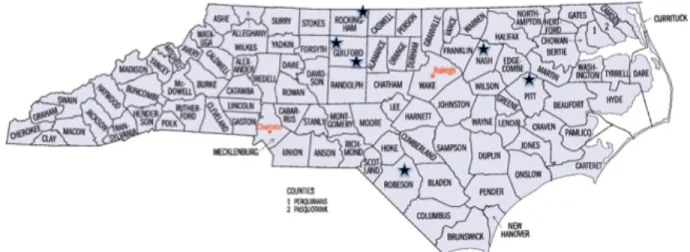
We set out with a goal of recruiting and conducting eight focus groups, and between August 9th and September 17th succeeded in conducting ten groups with over 130 participants in five North Carolina counties: Guilford, Robeson, Pitt, Rockingham, and Nash. Figure 1 below illustrates the geographic distribution of the focus groups. Groups consisted largely of local infant mortality coalitions, comprised of representatives from health departments, local agencies, local hospitals, coalition advisors, and some consumer representation.
Figure 1. Geographic Distribution of Focus Groups
Convenience samples were used for all of the focus groups. The rationale for the focus group selection was to recruit a representative sample of local stakeholders with
experience working to address infant mortality, and with geographic distribution across the central and eastern part of North Carolina where infant mortality rates are the highest.
The purpose of the focus group was explained to participants at the beginning of each group. As part of the introduction to the focus groups, Dr. Verbiest delivered a 20-‐minute presentation to most participants (Appendix B). This presentation consisted of an
explanation of inequities in birth outcomes, the life course model, the 12-‐point plan, and the purpose of the Equity in Birth Outcomes Council.
A facilitator and a note-‐taker attended each focus group, with the exception of the Young Moms Connect Advisory Council meeting in Rockingham. Facilitators varied depending on the group. In some cases, members of the committees or coalitions themselves facilitated the groups. African American women facilitated at least half of the groups. Every focus group session was audio recorded using a digital recording device after permission to record had been granted by each group. All recordings have been catalogued and stored for more in-‐depth analysis as needed. With the exception of one group, participants received a $20 gift card to Wal-‐Mart. Groups lasted approximately one hour.
encouraged to allow participants to talk in depth about some topics if they were very
engaged and had a lot to say. In the end, some groups were able to cover all of the questions while for other groups only about half were discussed. There were often overlapping
themes among the questions and the groups. The key topics covered in the majority of focus groups were:
• General thoughts on implementing 12-‐Point Plan (strengths and barriers) • Organizational and/or community interventions that address one or more of the
points on the 12-‐Point Plan
• The reasons for and ways to address racial and ethnic disparities in health-‐
promoting behaviors such as breastfeeding, birth spacing, and preconception health • Ways for the community at large to better support African American women during
adolescence, pregnancy, and postpartum
• Support services and changes needed within the healthcare system • Access to preventive care for African American women
• Ways to better support and engage young African American men and fathers
Following each group, facilitators, note-‐takers, and the PI debriefed about the groups, clarifying any areas of confusion. Note-‐takers edited their notes immediately following the groups, listening to portions of the recordings for clarification if necessary, and then shared those notes with the PI. As part of the note-‐takers’ write-‐ups for most of the groups, they included a brief section with personal reflections about the group’s process. Note-‐takers also identified the demographic information about most groups, including their size, the gender and racial make-‐up of participants, and the proportion of professionals to
consumers.
Upon completion of the ten groups, I compiled the individual notes from each group into a master document, de-‐identifying them and organizing them by the questions listed in the focus group facilitation guide (Appendix C). In addition, myself and the PI convened a meeting with some of the focus group facilitators as well as other involved parties to review and interpret this data in it’s entirety, disaggregated by question. We asked the participants of this group to identify common themes in the data, areas for further
exploration, specific data needs, and ideas for additional key informants and resources to explore. This report is based primarily on the focus group summaries and the data review session.
Results
The themes below are displayed generally by the 12-‐Point Plan section they most closely correspond with. The plan includes three overall imperatives: Improving Healthcare for African American Women, Strengthening African American Families and Communities, and Addressing Social and Economic Inequalities. 2
1. Improving Healthcare for African American Women
The first section of the 12-‐point plan includes four imperatives: to provide interconception care to African American women with prior adverse pregnancy outcomes; to increase access to preconception care for African American women; to improve the quality of prenatal care for African American women; and to expand healthcare access across the life course for African American women.2
The following themes emerged relating to improving healthcare for African American women:
I. Barriers to Access: All groups identified a number of barriers low-‐income African American women face in accessing and utilizing quality healthcare. The most common barriers were competing priorities, inadequate transportation, too few providers leading to long wait times, cost, not trusting providers, and communication challenges with providers. Respondents also frequently mentioned the need to help women to be proactive about their health in spite of these barriers.
i. Competing Priorities
The ability to prioritize health over other concerns emerged as a central theme. Some of the most widely cited barriers to accessing healthcare are the multiple competing
responsibilities that low-‐income women face. Those responsibilities cited include taking care of their children, their boyfriends or husbands, and their work and financial
responsibilities. The consensus among many groups was that women feel unable to prioritize their health over what they perceive to be more immediate stressors.
Relevant quotes:
“It isn’t valued. There are other issues that are more pressing than getting
healthcare… getting school supplies for the kids, dealing with housing, etc.” “Their boyfriend, having something to eat, life, - that is what is on top of people’s list,
not healthcare…They might not see the point in going to a provider – especially if someone else didn’t get care and the baby was fine then why should they go?” “When asked why women don’t seek family planning sooner, [one] consumer said
that there are more reasons not to do it than to do it. Other stressors.”
ii. Time
Some groups attributed this to too few providers, particularly providers that accept Medicaid. This reflects additional concerns about what will happen when more women have access to health care – there already aren’t enough providers and appointment times available for the people who have coverage now.
Relevant quotes:
“I know sometimes that a client will need an appointment immediately and [she] cannot get it. She can’t go to an urgent care because she doesn’t have funds.” “[Another challenge] to [accessing] health care services is the long wait time. First they
may call but then can’t get an appointment until three to four months later. They wait a long time for an appointment then wait to see the providers.” “There are not enough providers. Providers who take Medicaid patients are at their
max and can’t take more. This… is going to be even harder when more people have access to health care insurance.”
iii. Healthcare Providers
Many groups pointed out the influence of consumer perceptions about providers on healthcare seeking behavior. A number of groups discussed the social issues and norms around trusting providers, especially among low-‐income African Americans, due in part to historical trauma. There was a sense among some groups that for some women, health information received from a provider is not valued as highly as health information received from another source, for example, a mother or grandmother.
Relevant quotes:
“Momma might not know best or have the complete information. But the women believe their mothers and don’t have any other information so they might not ask the doctor.”
“There are social issues and norms about why people may not trust providers and what they sat. Some people don’t trust the providers – they might have heard something else and have that information as important.”
“Doctors are biased.”
“The trust factor is missing. Consumers do not trust health care providers.”
Groups also highlighted the communication difficulties between patients and their
providers. One participant felt that providers often fail to “meet clients where they are” and should utilize motivational interviewing techniques with their patients. Many perceived communication barriers to be a two-‐way street: providers are not effective in
communicating to low-‐income patients, but many patients aren’t empowered to
communicate their concerns to providers. Many groups felt that helping young women to assertively communicate their questions with their providers should be a top priority.
Relevant quotes:
“Doctors need to be relatable to me.” “They don’t speak to me.”
“They aren’t listening.”
that the patient can absorb.”
“[We] need to encourage our young moms to ask questions and to ask why. It is important to help them as they grow and mature by teaching them that you just don’t sign stuff without reading it…how to be assertive in an appropriate and respectful way is an important life lesson. Women need to know it is okay to ask questions about your body.”
“We need to let the women know that they need to ask the doctor questions. People go places and they do not know anymore when they left than when they walked in.”
iv. Transportation
Transportation was a frequently cited barrier to accessing healthcare services, in addition to other non-‐health services. One group saw this as an area that could be more cost
efficient as they noted that many buses are underused in urban areas. For most, the transportation barrier was perceived to be most restrictive for rural residents.
Some groups felt that for many consumers, transportation is a more complicated barrier than simply an inability to physically access it. One participant noted that in her county, a lot of resources and finances have been invested in making transportation easy and accessible, particularly for low-‐income pregnant women, and that the failure of women to use it to access care is an issue of prioritization more so than access. In general, it seemed to most groups that transportation is largely a factor of prioritization and that it augments other barriers.
Relevant quotes:
“Always and forever transportation.”
“[There are buses] all going in the same direction but all half empty. Combining services could benefit everyone as it could free up transportation money to reach further out into more rural areas.”
“If they really want to get somewhere they can get there – like the mall. What is their priority? But then on the other side of it, they might really care but they don’t have the energy to get through all the red tape.”
v. Cost
Cost was more often cited as a barrier to accessing things like healthy foods or exercise than healthcare, however, many groups cited that challenges Medicaid patients face with reimbursement as a barrier to accessing care. Some groups also mentioned that some consumers perceive the value of accessing medical care to not be worth the cost,
particularly when they feel that their appointments aren’t being used effectively, requiring them to come in for repeat appointments. This, compounded with competing priorities and time restrictions, lessened the value of healthcare appointments in the eyes of consumers.
Relevant quotes:
“Medicaid can be slow and insurance copayments aren’t always clear so there is a worry about having to pay up front and maybe not get paid back.”
expressed frustration with all the times she had to keep going back to the doctor, and she didn’t see the value of going so she stopped.
“All the different appointments really made life challenging.”
II. Other Healthcare Themes
i. Health Information Sources
Participants reported that many women and men, especially younger generations, receive an overload of health information from many different sources. These often competing messages make it challenging for providers and educators to make their information stand out and requires new approaches to outreach. It also makes it hard for consumers to get the correct information they need. In addition, some participants perceived the growing emphasis on social media to be problematic for particularly low-‐income, rural women and men who may not have access to these mediums.
Relevant quotes:
“Part of our problem now is an overload of information. Plus we also have to dispel all the incorrect messages that are out there. This makes it a lot harder to help people get it right.”
“[We] need to change the cultural messages…the media is really perpetuating these issues by promoting a certain mentality.”
ii. Bringing services to communities
Some participants suggested ideas for bringing health care services directly to
neighborhoods and housing developments through mobile clinics. They also suggested having individuals in these communities be trained to serve as community health
advocates who would know the needs of the people in their community and work to make sure they connected with services.
Relevant quotes:
“Social media does not work in all arenas as not all have access. Sometimes you have to go to where the people are; we have to take it to the community…Sometimes you need to go to the people because it may be hard to get the people to come to you…Outreach staff can help in getting the community to trust health workers and build relationships.”
“There are a lot of resources available to the community it is just hard to find them. There needs to be a creative way to get people to come out.”
iii. Mental Health
An additional area of concern for many groups was the underuse of mental health services, particularly for African Americans. Participants mentioned that both the difficulty
accessing services and the pervasive stigma within many communities create an
environment in which mental health services aren’t sought by those who really need them, and particularly young mothers. Some participants also connected this with substance abuse drug use in communities.
Relevant quotes
“We have a lot of mental illness in the black community. We really need to deal with that.”
“Mental health is a really huge issue. There aren’t many referrals – and it is going down the tubes. There are few alternatives to helping people. Access to services and how you get in changes a lot. And then there is the stigma of getting
services.”
“Access to mental health services is important in the context of substance use. Without having behavioral health, including for women experiencing intimate partner violence, it’s hard to really combat substance abuse.”
“Young moms don’t have a clue about how to deal with postpartum depression.” “[I have a] friend who was seeking out mental health services and her doctor
recommended that she go out of the county because of the stigma.”
“[There is] mental illness, especially in younger moms, who self-medicate with illegal drugs. Mental health is still stigmatized in xxx county. It’s better to say, “My mom has a drug problem than my mom has mental illness.” There is very little money/resources to provide mental health services. Nothing is going to change until we get the word out there about the populations that are affected by mental illness.”
2. Strengthening African American Families and Communities
The second section of the 12-‐point plan includes four imperatives: to strengthen father involvement in African American families; to enhance systems coordination and
integration for family support services; to create reproductive social capital in African American communities; and to invest in community building and urban renewal.2
The following themes emerged relating to strengthening African American families and communities:
I. Community Engagement
i. Emerging Community Resources
When we asked participants about positive ideas that are happening in their communities, most noticed positive changes related to healthy living (community gardens, green
walkways, farmers markets, community centers, etc). Participants also noticed positive changes happening in terms of breastfeeding and baby friendly hospitals. Participants emphasized the importance ensuring that all segments of their communities, and particularly low-‐income African Americans, benefit from these changes.
Relevant quotes
“There are a lot of sidewalks going in, new greenways and a focus on recreational activities which is great for people who want to be healthy. Having these things makes it more likely that people will use it and exercise.”
“We’re becoming more health conscious in our community. There are more healthy options especially in restaurants…The community gardens are also really nice. It brings people out.”
“We are becoming more environmentally friendly – recycling and going green.” “[In one county], the local farmers market has received permission to accept WIC
vouchers. One third of the population is in poverty in this county, so that has a big impact.”
“More hospitals are going baby friendly and promoting breastfeeding, and keeping mom and baby together from the beginning.”
“[We are] seeing some more encouragement/support for [breastfeeding]. Agencies are enforcing the joint commission. Some states won’t give Medicaid moms formula unless there is a medical reason.”
ii. Ensuring Equitable Access to Community Resources
Many participants have noticed that while new community resources are becoming available, they may be difficult for community members to find and may not work
Relevant quotes
“It is time to make sure community centers are actually opened and usable by the community. There is unused community space that people can’t access!” “There should be a group in the community to be appointed or paid to mediate on
behalf of the community with outside groups…like a community advocate group that can broker information on behalf of the community. Then they can share back the information with the community and get them to come out and access what they need. Communities feel like they have no voice. It would be great to have a community health coach – like who can promote healthy living and help drive the change.”
“Moving farmers markets closer to neighborhoods where people have limited access to healthy foods [would help].”
ii. Faith Communities
Most groups identified the faith community, which is expansive throughout the South, as a key partner in the effort to implement the 12-‐Point Plan. Many participants brought up the significant influence of local pastors on health decisions, especially for low-‐income African Americans in rural parts of the state. The church’s authority can be significant even for young men and women who do not attend church, as they often have older, influential family members who do.
Participants cited that while churches and faith communities sometimes offer resources and supports that aim to improve health, they can also work against these efforts by sending alienating messages to young parishioners, especially in matters of sexuality and relationships. In this way, churches have been and can be both part of the problem and part of the solution.
For churches that want to engage in their communities in matters of health promotion, working collaboratively with them can present challenges, particularly if they have their own agendas. Many participants suggested unless there is room for faith beliefs to be incorporated in community engagement, churches will be reluctant to become involved.
Relevant quotes
“Local pastors have a strong say – if valuing health and families was preached from the pulpit it would help change messages.”
“[For those who do not attend church]: somewhere in their family someone goes to church and has heard the message and can share it back with their
community.”
“Working in churches provides opportunities for cross-generational impact.”
“It is hard to get churches to come together…to reach churches we need to start with establishing relationships.”
“There need to be more pressures put on churches to give back to the community. They need to outreach beyond their members. Churches should be required to share their space with communities.”
money.”
“Could churches help give inspiration….help deal with mental illness?”
“Faith based leaders want to do something but they don’t know what to do or how to do it. Agencies could do training and provide resources for these communities. [We] need to also allow faith communities to also include their faith
beliefs...Connecting spirituality with information is also important.”
“A lot of churches already have programs going on – so [we] need to piggyback on those programs. As far as teen sexuality, there are some curriculums that incorporate spirituality into those messages. They bring scripture and sexuality and morals together.”
“A lot of pastors use the pulpit as a way to abuse their authority – they can be hurtful to individuals in the church. This can also get some people to start to shut down. It can create divisions in a family if the parents are wooed by the pastor’s message and then the young women and men don’t feel that they can really talk to their parents now. So they were damaged by the church.”
“For the faith-based community, they need to stop being judgmental and work with the young women where they are. Then through encouragement help them not get in the same place again.”
“[We] need to find the right church – some churches just aren’t going to change. You don’t want young moms to suffer more from this bias and prejudice.”
“It would be good if the faith community would have a conversation about how they can reach the young people without judgment about this issue…If a few of the churches could get the ball rolling that would be good. This is a very
conservative area.”
“Sometimes things have to speak to the pastors to make it a real experience. For example, my pastor’s daughter got pregnant and then he no longer preached that parents are the best birth control. Remember that pastors are people too, and that you can create leadership among the pastors with each other on this issue.”
“There needs to be time to educate the churches about the programs. The relationship really has to be with the pastor. That is still the key person and the leader of the church. It is important to educate the pastors as well.”
II. Engaging Men and Fathers
Participants had a lot to say on the topic of fatherhood and male engagement in the lives of their children and their children’s mothers. Given that over 72% of African American mothers are single3 and the way that African American men have been disenfranchised over decades in the South, it seems that this entire topic area needs further exploration. There are many complex issues from lack of cultural competence in schools in working with boys (especially African Americans) to lack of vision for future careers among these young men, the lack of male-‐friendly healthcare and social services, and issues of lack of male role models/presence in the home.
3 State Center for Health Statistics. Vital Statistics 2010, Volume 1, March 2012. Accessed November 1, 2012.
Available at http://www.schs.state.nc.us/schs/vitalstats/volume1/2010/Vol1_2010_PRT.pdf.
i. Single Motherhood
Single motherhood was an issue that, while not explicitly brought up by participants, was indirectly explored through many of their insights on inadequate father involvement for many African American families. While the majority of participants’ explanations for inadequate father and male involvement were male-‐centric, some of participants’ speculations focused on the attitudes and perceptions of mothers, including that some women perceive a financial advantage to being single parents. Some participants also brought up a larger theme of mothers isolating themselves not only from their children’s fathers, but also their extended families.
Relevant quotes:
“African American women will truly not get married because of concerns about losing economic benefits.”
“Sometimes there is a lot of stress in the beginning and sometimes women do not know how they feel about the father being involved.”
“[T]here are also mothers who are stupid – they don’t let the fathers help. Even if the men want to help and buy their children things sometimes the mothers reject them. It seems like if the child’s father isn’t with the mother then the women don’t want him to do anything for the child…women need to get smarter about getting help or letting the men do things for their children even if [she] doesn’t want him in [her] life.”
“Women went through a period of time where they had to do everything. We…need to let men step in and help, not just sign on the dotted line and be done.”
“Sometimes the moms don’t want all the dirty laundry aired…There may be issues around shame such as those whose families have cut them off or who have domestic violence. So women are choosing to isolate themselves from their families. It is important to get down to the why.”
ii. Male-friendly Services
Many participants attributed inadequate male involvement to the lack of male-‐friendly health and social services. Participants mentioned the lack of programs and interventions targeting young men and boys in schools, in social services such as WIC, in health
messaging and particularly in prevention messages, and in the health care system including at provider’s offices. A related assertion was the difficulties that single fathers face as a result of this service environment that is unfriendly and untrusting of males.
Relevant quotes:
“We need more male support groups or providers.”
“They don’t have any programs in the county for men. Men are coming to them asking, ‘what about me?’”
“There aren’t many grants for men about taking care of themselves, wearing condoms, etc.”
had children and can meet with girls to talk and mentor them about having children. I have never seen a likewise male part of this system.”
“[On WIC]: We should make things more male friendly. We should make it
more acceptable for fathers to be involved. We take for granted that mothers will do the work but we should make it more accepting for fathers to join in.” “As professionals we need to really engage them and help them feel a part.
Then they feel they have a choice to be involved. We need men to also see their leadership role in the home/family. This can start in childbirth classes and birth-five childcare to help men and boys know their roles.”
“We should make them [men] feel a part of the process. The man that is even at the appointments they took a step to be there. We should let him be a part of that and not leave him in the lobby or the car.”
“We need to check ourselves on how we are communicating to men in the practices and providers’ offices. Are we making men feel welcome? We need to engage them in the process. Before we invite men we need to be ready for them and understand what we want to do with them.”
“What can happen is we can alienate half of the population by focusing on
controversial parts of our message like birth control… We should focus on the things that everyone can agree on.”
“There needs to be a concentration on prevention for guys. It is done so much for girls but not as many programs for men.”
“The trust issue as a single father is hard – he isn’t able to get the same services that are available to single mothers. He has the same issues in wanting to finish his education, pay his bills and take care of his kids. So that isn’t fair. Something has to be done about that.”
iii. Mentorship for Men
A number of focus group participants perceived mentorship and mentoring programs, both for boys and men, to be a potentially successful intervention for engaging men and fathers. Some participants spoke to existing mentoring programs in their counties, and others spoke to the need for more programs like them. Participants perceived mentorship to be an effective avenue for instilling positive parenting and family responsibility. Some
participants also linked mentorship with employment, by suggesting that mentorship programs be employment or skills based, citing (un)employment as hugely important to a man’s self-‐esteem.
Relevant quotes:
“Some of the black male barrier is in having positive mentors. You are comfortable with people that can relate to you, but there are not many mentors or social workers that are visible. [Perhaps] we can pull professional black men to enter this.”
“There is a huge opportunity around here for mentoring. If every church took one school and provided volunteers to be mentors for that school, we could make a difference.”
With moms and dads working we need to bring in retired men and others who have the time to give. In terms of dads we need to cater more to their machismo and make sure that it is a macho thing to be a father. The media conveys a different image then we want. To be a real man you take care of your children.” “There is a need for more mentoring programs…[we] need more positive places for
men and women to go after school or just hang out spots that are positive, safe and have resources. Need some mentoring so that the cool kids will get involved in certain programs. The lack of jobs is hard – vocational training, internships would be something to put in a 5-year plan – getting businesses involved. For men their job really defines them…it really is who they are. The ability to support their significant other [and] children…can impact their self-esteem. As such, men will find other ways to make themselves feel like a man.”
“[Men need] help with employment-related things: resumes, interviewing skills, vocational skills that lead to temporary jobs with the possibility of a long-term position.”
3. Addressing Social and Economic Inequalities
The third section of the 12-‐point plan includes four imperatives: to close the education gap; to reduce poverty among African American families; to support working mothers and families; and to undo racism.2
The following themes emerged relating to addressing social and economic inequalities:
I. Breaking the Cycle of Poverty
In addressing the imperative to reduce poverty among African American families,
participants spoke about addressing and breaking cycles of poverty. Participants in several groups saw poverty as an intergenerational concern that requires intergenerational
interventions. Several groups spoke about the influence of fatalist messages that young people often receive from parents and the older generation of family members regarding their futures. Some participants shared that their clients and sometimes they themselves have received messages from older generations in their families about their likelihood of getting pregnant early in life, for example. Participants also noted that young people who have higher expectations for themselves may experience conflict with other in their families and social circles. Thus, a common theme among the groups was that these messages are often self-‐fulfilling and lead to generations of poverty and poor health.
Relevant quotes
“[We need to] break the cycle of generational poverty. Some women choose to have children in order to obtain financial support from the government. They don’t have any aspirations to work.”
“[We need] to combat fatalism in communities where children hear from
guardians that they have few choices and little control over their futures.” “We need to train the grandmothers! There is a lot of information that is still being
passed down. It is important to educate the grandparents so they are passing down the right information – they have a lot of influence. There is a lot of out dated info that the grandparents have.”
II. The Education System
Participants had a lot to say about pitfalls in North Carolina schools and their influence on later health outcomes. Groups identified several areas in which schools are failing to make an impact, including in sexuality and healthy relationships, reproductive health and life planning, life skills, budgeting, and career options. In general, participants felt that schools are a crucial point of intervention. However, most participants also felt that school systems are both guarded and underfunded, making their compliance a significant challenge.
Participants also identified financial literacy training as an essential as part of efforts to address poverty, and something that could be implemented at a young age through schools but is also important for young adults. The general consensus among most groups was that ensuring that students graduate from high school with life skills, especially communication skills, should be a top priority.
Relevant quotes
families… It would also be good to incorporate life skills at an earlier age in the school curriculum. High school is too late – start it younger at school or after school programs. This would involve some policy and curriculum changes.” “[Question regarding what the best age is to target to have the biggest impact]: It
should be intergenerational. Everyone is involved in the culture.”
“[We are] waiting too long to start working with children around these issues, it should be happening much earlier.”
“It is unlikely that people will drastically change their behavior as adults, [so it is] important to address these issues for school-aged children all the way through high school and college.”
“The school system is still so guarded.”
“We help students plan for their career and not for their family.”
“[We need] education around healthy relationships, early on in life, at school. This is difficult now that schools are cutting so much.”
“[We need to teach] skills about how to interact with professionals – how to interview childcare providers, apply for childcare assistance, talk with professionals – can be transitioned to many other areas in their lives. How to have conversations with adults and seek/receive the information they need is an important skill.” “The current curriculum in schools for health is very boring.”
“They have health classes but they need to not just follow the book but give much better education about other things – like what to do if they go to the doctor. Schools should educate young women and men on more than just saying this is your body and what it does but going more in depth.”
“The schools have made significant steps through their compliance in supporting the Healthy Youth Act. There is more information being shared by the schools about teen dating violence and bullying, and multiple policies being put into place. There is still push back from parents and the community but they have a good cheerleader in the schools who helps them and a good superintendant who believes in the whole child.”
“In xxx county we have school-based health centers. These centers have full time nurses, social workers; there are nutritionists, and a health education worker. This helped with absenteeism. All the resources are right there… You have lower teen pregnancy rates in these schools and lower adverse outcomes since they have resources there.”
“What about financial literacy training? … This is something young moms need – how to make a budget … One person does a forum about how much it costs to have a baby. The economic impact really adds up from that perspective.”
III. Engaging Businesses
other day care incentives, support for nursing mothers, and general health-‐promoting efforts.
Relevant quotes
“Women are still not allowed to take nursing breaks. We need to educate employers as well as women.”
“Companies can apply to be “fit friendly.” They get designated, if they promote health, wellness, and families. This could help businesses to attract better employees, retain employees, etc. Companies look for ways to donate, build their brand in the community. “
“[On the importance of daycare]: It is easy for five people not to show up for a shift if school is closed or someone is sick. It improves employee satisfaction and improves retention and attendance. A lot of this stuff is a ripple effect where you may not see the results immediately but it will take place over time.” “It helps when you work for a company that is supportive of working and single
mothers. If companies could come together and chip in as a group for day care services or such that was somewhat on site it would help if we provided that infrastructure. This would lead to more productivity. If you have all these industries that are so close together they all can benefit.”
“There are a lot of industries in the community and in one part of town there are a lot of businesses in one area. Perhaps they could work together to have a nearby daycare for their collective workers. They could also have a gym and perhaps a health care provider who could be there. Those industries could make a
difference for their employees. We could also give businesses incentives to mentor their employees, employees’ children and other children in the community.”
“Businesses, local lawmakers, they don’t totally understand the impact that health has on the economy. It has to be presented as a win-win.”
“We need to recruit and campaign those companies to get them involved. Show how it is good for their bottom line - less turnover, less absenteeism, etc. Show them the potential return on investment. Local stories from people in their company who could benefit from this help might spur them to action – also showing off companies who are doing good things is good for their business.”
“In working with businesses and others it is important to know the numbers – what we could save if the babies weren’t sick – what it costs when you have to ship babies off to higher care services. Make the economic case. For home health and social services this could show how much money we could save if babies were healthy.”
IV. Policymakers
Participants identified policymakers as another group that plays a role in disparities. In the same way that there are communication gaps between patients and health care providers, there are clearly gaps between policymakers and local communities. Engaging poor
Relevant quotes
“Our policymakers blame black women for outcomes and they will say that your face. If policymakers do not believe it they will not let these things happen. They are able to thwart any program at the community level, so what are we to do” “Policymakers should come to these meetings. It’s not hard to get legislators to come
to these meetings, especially before elections.”
“It would be nice if communities could have a chance to sit with someone from the City Council or police department or a health club. We really need more of a
personal relationship with these leaders. These leaders need to do better than just send out a complicated piece of paper about issues that are being voted on and that’s it.”
“[Policymakers] made Amendment One look like it was about gay people but it