Elizabeth J. Gregg. Public Library Programming for Youth: Creative Writing as a Tool for Literacy and Adolescent Development. A Master’s Paper for the M.S. in L.S degree. April, 2008. 38 pages. Advisor: Sandra Hughes-Hassell
This case study examines the self-reported benefits of participation in a creative writing workshop for young adults at Durham County’s Main Branch of the Public Library by interviewing past participants of the program.
Teenagers who participated in Write On! report an increase in the skills and attitudes that lead to the development of healthy adolescents.
Headings
Public Libraries -- Young Adult’s Library Services
Programming -- Case Studies
PUBLIC LIBRARY PROGRAMMING FOR YOUTH: CREATIVE WRITING AS A TOOL FOR LITERACY AND ADOLESCENT DEVELOPMENT.
by
Elizabeth J. Gregg
A Master’s paper submitted to the faculty of the School of Information and Library Science of the University of North Carolina at Chapel Hill
in partial fulfillment of the requirements for the degree of Master of Science in
Library Science.
Chapel Hill, North Carolina
April 2008
Approved by
_______________________________________
Table of Contents
Introduction……2
Write On! Structure & Background….2
Literature Review…..6
Methodology…….13
Results and Discussion…..15
Further Research…..25
Conclusion…..26
Works Cited…….27
Programming Resources….28
Write On!: Introduction
The goal of my research is to examine the self-reported benefits that students
experience when participating in creative writing programs co-sponsored by public
libraries. Specifically, this study investigates the benefits of joint programming and
collaboration as well as the development of literacy skills in the young writers who
participated in Write On!, a partnership between The University of North Carolina
Writing Center and the Durham County Library Main Branch. Student feedback
regarding participation in Write On! was examined in order to shed light on the
importance of young adult programming with regards to healthy development, resiliency
and literacy, and to examine the role of public libraries in fostering literacy through
creative writing programs such as Write On!.
Write On!: Structure and Background
Write On! began in the Spring of 2006, the brainchild of two UNC students Julie
Wilson and Kristal Moore under direction of Kim Abels, Director of UNC’s Writing
Center. Wilson and Moore researched other writing projects and took inspiration from
workshops such as 826 Valencia, The Community Writing Center of Salt Lake City
Community College and the University of Wisconsin Madison’s Community Writing
Assistance Program. The goal of Write On! is to promote fun, freedom and focus through
creative abilities in the company of other teens and with the guidance of writing
coaches.”(Write On! webpage).
While regular participation during the sessions is encouraged, writers may also
drop in as is convenient, allowing for some flexibility as well as the inclusion of new
participants from week to week. Participants provide written waivers allowing for the
publication online and in print of written work, and a website is maintained where this
information is available.
Coaches are typically recruited from within the staff of the writing center, which
we believe has contributed greatly to the success of Write On!. Coaches often have a
great amount of experience with writing in their own personal and educational endeavors,
and also bring with them the knowledge and perspectives of the field from which they
specialize. Coaches study Education, Compositional Literature, Library and Information
Science, Communication and a variety of other areas all of which contribute to the
knowledge-base of the coaching volunteers. Before a session begins a meeting is held to
discuss scheduling of lead coaches and goals for the workshop. Lead coaches (two per
week) create a warm up activity and a main writing activity for the class every week, and
additional coaches act (ranging from two to four coaches) as support staff by greeting
arriving writers, helping individuals stay on task and refine drafts of their work. There is
a heavy emphasis on writer ownership, and coaches encourage writers to make all
decisions regarding individual writing book content and other areas of the workshop.
The writing form is loosely broken down by semester. Spring semester classes
focus on poetry and creative writing, and the fall semester focuses on personal narratives,
who wants to write poetry in the fall is discouraged to do so, or vice versus. The spring
semester is usually a larger class and at the end the students have a book published of
their work and a reading where they invite friends and family to come and see their
performance. Typically class meets on Tuesday evening from 6pm until 8pm, although
the spring 2008 session ran later to account for students other after-school activities such
as sports teams. This most recent class ran from 7pm until 8:30pm, which seemed to fit
more seamlessly into various schedules.
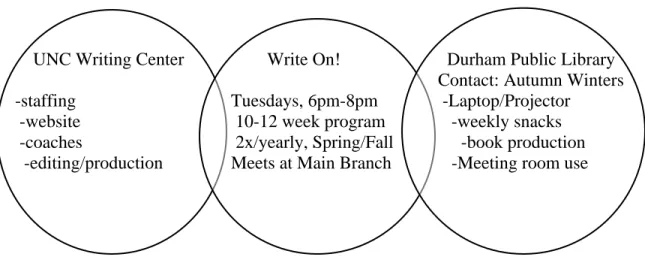
Figure 1 shows the primary contributors and their roles in supporting Write On!.
The Durham County library provides meeting space, drinks and snacks every week,
electronic equipment such as a laptop and projector, as well as printing and various needs
throughout the semester. Autumn Winters acts as a supporter, advocate, and contributor
at the library level who plays an integral role. Write On! is also known by many other
staff members at the library and the all are supportive of our goals. Having this
connection is of great benefit when collecting resources for class in the stacks, copying
posters for the book party or simply getting the auditorium unlocked before class in the
afternoon. The Durham Public Library’s Main Branch has also agreed to catalog and add
to their collection copies of all three books produced by Write On! as well as a spoken
word CD that was made in the Spring 2007 session.
The Writing Center provides all of the volunteer coaching staff for the workshop
sessions, as well as hosting and maintaining the web page. In the spring session lead
coaches are fundamental in the editing and production of the book of poetry that is
published each spring. Coaches contribute a significant amount of time to planning and
success. Each student in the class is given a notebook and encouraged to write in it
throughout the workshop series. Pieces are then selected by writers from their portfolio of
work and chosen for publication. Coaches are essential in their role as individual mentors
during the process of refining and selecting final pieces to publish. While individual
writers are the primary decision makers with regards to content the coaches provide
guidance through this process. At one point during the spring 2008 session coaches left
the writers alone for a 15-minute period to allow them to decide as a group what the title
of the book would be. While coach input is important, equally important is the emphasis
of writer-ownership and this value is well represented in the coaches who volunteer their
time to Write On!.
UNC Writing Center Write On! Durham Public Library Contact: Autumn Winters -staffing Tuesdays, 6pm-8pm -Laptop/Projector -website 10-12 week program -weekly snacks -coaches 2x/yearly, Spring/Fall -book production -editing/production Meets at Main Branch -Meeting room use
Purpose of Study
The purpose of this study is to discuss the self-reported benefits that writers share
in interviews regarding their experience as participants in Write On! and the role of this
program to promote healthy adolescent development, literacy skills and use of poetry as
an outlet for self-expression and creation of a sense of self and voice in participants.
Individual experiences will be discussed with regards to the Library Ladder of Resiliency
(Jones 2003) and the Chapin Hall discussion paper titled, “New on the shelf: teens in the
library”, in order to bring into focus the relationship between these goals and current
literature on young adult library programming, literacy and adolescent development
(Spielberger, Horton, & Michaels 2004).
Literature Review
The literature review will examine research in various fields such as adolescent
development, psychology, education and information and library science to flush out the
variety of impacts successful poetry and creative programming can have on communities
and adolescents in specific. At the same time this review will span a variety of resources
to emphasize the numerous professional areas that consider service to youth a priority
Library Programming and Youth Development and Empowerment
There is a long held belief in the library profession that there is a benefit to
partnership programs. Youth development and empowerment is a place where this
approach has found particular success (Spielberger et al. 22; Flowers 32). The text Teens
and Libraries points out that librarians are in a unique position to provide ways for teens
to make a difference in their communities by assuming roles and responsibilities that will
help their transition to adulthood (Walter 39).
A report out of the University of Chicago’s Chapin Hall Center for Children
further illustrates the impact of effective youth programming in libraries. This study
titled, “News on the shelf: teens in the library” focuses on the ways in which youth
programming has positive effects on the teens who participate. This report came out of a
program by the Wallace Foundation in 2004 called Public Libraries as Partners in Youth
Development (PLPYD) Initiative which began in 1999 (2). The report explains the
findings of four years of youth programming at the 9 libraries across the country that
participated (3). The researchers found that library based youth programming can
encourage healthy relationships with adults and peers, can increase the knowledge and
use of libraries by teens and can build library capacity by contributing to libraries and
communities (16).
In the theoretical framework she calls, “The Library Ladder of Resiliency” Jones
breaks the ways that librarians (more specifically in her case, school media specialists)
can promote resiliency and healthy youth development into five parts: mentoring and
(95). She makes a connection between the educational areas of youth development and
areas such as hobbies and interests and social skills.
Recent literature regarding extracurricular activities also highlights how teens
have a strong desire to be in partnership with mentors who act, “not in teaching youth but
helping them teach themselves.”(Dworkin 18). There is evidence to support the role of
these activities in healthy adolescent development. Library programming represents a
valid form and source of extracurricular activity. Larson’s work on youth development
and initiative highlights the role that structured youth activities have in the formation of
identity, altruism and initiative (178). He also argues for pursuing qualitative studies that
would look at participants over time in order to highlight the role of activities and
development goals (180).
Finally, Clark discusses a recently released Public Library Association survey
which revealed that 51.9% of public libraries have at least one full time librarian
dedicated to young adult services, a number that jumped from 11% in 1995 (qtd. in Clark
2007: 54). This increase in young adult advocates within libraries may play a factor in
the amount of time, money and energy spent on future young adult library programming.
Library Programs and Literacy Development
Jones (2002), in her book New Directions in Library Service to Young Adults
states clearly that:
“…there is a tendency to forget that reading development is a continuum, and the result is that the emphasis on literacy decreases after elementary school (30).
Jones continues in her discussion of the relationship between literacy and reading,
emphasizing research which shows that teens do in fact see the value of reading in their
lives (33). She notes that the essential role of librarians serving young adults is to
encourage teens relationship with reading (24) and discusses the need to map connections
between youth advocates; and how partnership programs with youth service agencies,
businesses, or parent groups strengthen young adult literacy (35).
A recent National Endowment for the Arts report shows a drop in the reading rate
and a correlating plateau or decline in reading scores for early teens (Clark 53),
highlighting the need within teen populations for continued support in this area of
development, with a reported 65% of graduating seniors and 71% of 8th graders reading
at or below grade level. Clark mentions a new NEA study, which will emphasize the
relationship between reading proficiency and pleasure reading, showing a important
relationship between reading for fun and academic success (53).
In her 2007 article entitled “Why Johnny needs a writing mentor”, Clark makes it
plain and clear when stating that, “Writing is fertilizer for building self esteem and basic
building blocks for all aspects of life.”(27). The article discusses the need for critical
writing skills in employment and quotes former English teachers who bemoan the
self-expression for students (27). Additionally, the students Clark interviewed expressed
frustration at entering college only to learn that their grammar and other written
communication skills are underdeveloped.
Reading comfort is highly correlated with level of literacy, and in Halpern’s study
he defines literacy as:
“The skills necessary for reading and writing; the habit of reading and writing; a disposition toward reading and writing; a view of what, how, where, and why one reads and writes; a particular identity as a reader and writer..” (3)
The relationship between literacy and writing is crucial, and it is the researchers
belief that through self-expression writers in this program gain significant skills that are
essential to overall literacy such as the quote above states.
Poetry: Tool for Empowerment and Literacy
Jocson writes of the role that a Poetry for People writing program (started by the
late June Jordan from UC-Berkeley) had on a group of inner-city youth, emphasizing the
benefits of this program with regards to student’s social skills, self-awareness and gaining
writing skills (703). Jordan began Poetry for People (P4P) program in 1991 and it has
been a model for poetry workshops across the country. The success of this program is
testament to the role poetry can play in the lives of young adults.
Libraries are in a position to act as a place where young adults have the
opportunity and are encouraged to test out their own voices in a supportive community
environment. Barbara Shoup writes in Voice of Youth Advocates about the concept of
‘feel like school’. She goes on to say, “The leader must introduce the concept of craft in
ways that make it seem challenging interesting and possible.” (175) and relates to the
reader how coaches who are engaged in their own writing process should “enter into the
creative process” as a means of gaining respect from participants. Shoup also points out
that, “each program will inevitably be shaped by the personality, talents and interests of
the adult leader…”(174). The coaches who participate add the value of experience,
dedication to their roles as volunteers, and various writing skills and educational
backgrounds that play a huge role in programming success.
Ian McKinney a librarian running a writing group in Lafayette, Indiana says about
his role:
“…I have certain advantages. I am not giving grades; I am in a profession that values freedom of speech; and I can tap this group for ideas for programs, volunteers, and other library activities.” (Shoup 176)
While there are advantages to having programming such as this full time in a
school or public library it may be the case that this is not an option due to issues of
staffing (Spielberger et al. 18). This is when the collaborative efforts such as the one
being investigated in this study are crucial to provide all the necessary resources. Write
On! has used the emphasis of coach experiences in writing to facilitate learning and
writing in class.
Even with staffing or volunteer shortages there exists a variety of information for
other potential educators (Flowers, 2006; Shoup, 2001) who are searching for resources
context of larger goals and needs of an organization while also being supported in part by
outside agents.
Summary
The research discussed above contributes to our understanding of literacy, young
adult development and consequently, the role of libraries. It is important to note that with
the definition of literacy under scrutiny (53) poetry, spoken word and other forms of
self-expression can contribute to a broad complex understanding of literacy and writing in
general. Glenn argues that creative writing affects a students reading skills in a positive
way, saying:
“When we allow students to write fiction unrelated to a particular text, their commitment to and resulting understanding of texts may be enhanced and might serve as an additional means to encourage student engagement and skill.” (11).
Although a college classroom setting, it is evident that the role of writing is central to the
success of the students. Her findings revealed that those who practiced writing were
likely to have unique perspectives on a piece of writing, saying “they read with a
different eye.” This highlights the importance of feedback in group-work such as a
writing workshop and shows the direct correlation of writing and reading comprehension.
It is tempting to assume that the role of feedback in workshop settings allows participants
the chance to not only share their own words but also are asked to provide feedback to
one another.
Yet even with new ways of engaging youth in poetry, more research is needed to
Jocson’s findings show how for individual students “…poetry became a vehicle for
exposing hers/his lived realities that are often hidden from public view.” (706). The role
of poetry as a venue for literacy development should be considered with regards to the
function of these types of programs in public libraries. Incorporating this type of writing
facilitation group can be a relevant, appropriate and community-based way for libraries to
support not only the literacy but also healthy development and increased skills of young
adults within a community. While varied in discipline, the predominant literature shows
that the promotion of literacy, community and healthy adolescent development can be
facilitated through writing programs.
Methodology
Students participating in the spring 2008 session of Write On! were interviewed in
a one-on-one setting and were asked to discuss their experience as a writer in the group.
The researcher interviewed individuals and recorded their responses to specific questions
as seen on the Interview Guide Sheet (Appendix A). Many of those interviewed had been
participants from the fall 2007 semester of Write On! and so there was an opportunity to
examine how over time experiences like Write On! may have shaped their library use,
their reported feelings of self-confidence with regards to self-expression and their
perceived writing skills and confidence levels regarding their writing and ability.
Once consent and ascent forms had been received (See Appendices B and C)
signed by potential interviewees a meeting time was set up for the researcher and each
Library. A time period of 30 minutes was allotted to discuss the pre-determined set of
questions. Additional notes were made as necessary. At the close of the interview
participants were asked to review the researchers notes in order to ensure proper
representation. As well participants were given the option to choose a pseudonym to hide
their identity in the discussion of the results. Because the researcher had participated as a
coach at Write On! a relationship existed between interviewee and participants. It is the
belief of the researcher that this facilitated a level of comfort between the two individuals
and was not a hindrance to the research. It is also important to note that none of the
participants interviewed chose to use the option for pseudonym, and many were excited
to be part of the research, however, according to the regulations provided by the UNC
Internal Review Board, the anonymity has been preserved for all participants
interviewed.
Of the 14 writers who were asked to participate, eight completed and returned the
assent and consent forms required for participation in the interview process itself.
Interviewees ranged in age from 15 to 18, with five males and three females. Due to the
limited time available and the busy schedules of this age group, some of those who
expressed interest in providing feedback simply did not have the time to do so. Interviews
were completed in the Main Branch of Durham Public Library in a variety of locations as
space was available.
In the next section, the interviews will be used to highlight how Write On! is an
example of successful library programming. Spielberger et al. completed case studies of
several libraries across the U.S. to show how youth programming promotes community,
participated in Write On! will be compared to the results reported in Spielberg et al.’s
research in order to highlight the student responses in the framework of a larger field of
library programming studies. Jones’ idea of the Library Ladder of Resiliency (95) will
also be used as a comparison to collected responses in hopes to highlight benefits and
help expand our understanding of these elements.
Interview Results and Discussion
Of those interviewed, three had participated in Write On! from the first class
meeting in 2005. Two of these three are graduating from high school in the spring of
2008 and will not be returning to Write On! as they are off to college in the fall. The only
writer of this group who is not graduating stated plans to attend the next session of Write
On! and remarked about his excitement in being “one of the seniors” in the class. Another
four writers had participated in the class for only two sessions, and all four of them
indicated they would return for the next class in interviews. The final interviewee was a
writer in the class for two-and-a-half of the three-year class, and was unsure about
returning for the next session.
Library Programming, Youth Development and Empowerment
The overwhelming majority of writers reported having never participated in
library programming in the past, with only one reporting an experience with tutoring
programs. All reported having been told about Write On! by a family member or
writing programs other than school. These responses highlight the role Write On! plays
in bringing in participants who may not necessarily have library or writing experience
and allows exposure to the space and community, while also providing a unique
experience to community members who otherwise may not have this type of outlet.
Writers were asked to explain what experience in Write On! most affected them
and why. The responses to this question, shown in figure 2, were varied but all revolved
around the ideas of self-expression, confidence and meeting new people.
Figure 2: Reported Experiences Experience that Affected you most:
1. Group-work like the "I am" poem
2. Free-writing exercises and warm up activities 3. Performing written pieces
4. Allowed self expression: not in other areas of life 5. Becoming more confident in writing and voice 6. Exposure to a new atmosphere/community
7. Meeting other writers 8. Learning from individual coaches
While the initial goals of participants were academic in scope it is apparent that
the benefits received go above and beyond just academic goals and into the areas of
self-awareness, community participation, self-expression and confidence. It is clear how
Spielberger et al.’s results are reflected in writer sentiment, as they regard opportunities
for developing relationships with adults and peers, and personal and social development
(5).
In the results of the interviews conducted with Write On! participants, Jones’
played a huge role in what she took from the workshops and commented that when
someone spoke they “had the mic” and were heard and respected by all members in the
group. Others reflected on the way the opportunity to express themselves through written
and spoken words had helped them better communicate with adults and peers.
Mentioned in another’s response was the sentiment that outlets for self-expression, free
writing, or an ‘artistic outlet’ in their daily life was limited, and Write On! filled that
need. The cover of the most recent publication of Write On! contained original
contributions from one of the writers whom the P.I. interviewed. He has been
participating for all three years and expressed his appreciation not only for the, “sense of
freedom” he felt in class but also enjoyed opportunities for self-expression. He was also
the only interviewee who noted using the library regularly (one time per week) for audio
books and other items, most of which were school related.
Those values expressed in the Ladder of Resiliency (96) are seen in all of these
individual writer’s responses regarding experiences and skills related to participating in
the workshop. Individual mentoring is another area noted by an interviewee who felt a
particular coach had been helpful to their writing. Again, this positive relationship
building is part of Spielberg et al.’s research as well as a tenant in Jones’ Library Ladder
Library Programming and Literacy Development
All of the writers reported a push to increase their writing skills as the reason
behind initial participation. Often, this push came from an external force such as a parent
or guardian. While initial interest may have revolved around rather academic goals, the
reported benefits and skills are not ones that are typically highlighted in school settings.
As mentioned in the literature review, Clark reports the lack of creative outlets in their
curriculum some English teachers have noted (27). In light of this Write On! and the
reported experiences of participants become all the more significant. Looking to Clark’s
work again one can see the case of a lack of writing skills in the work world, the lack of
creative writing as an outlet in school settings, as well as the issue of entering college
students failure to comprehend basic grammar it becomes apparent again that programs
such as Write On! can have a significant impact on participating writers, an impact that
may be highly useful in their futures as students, employees, or educators themselves.
One student responded that she, “needed help with writing and loved poetry so I tried it
[Write On!] out and liked it.”
We can see here that the goal of participation was two fold: both interest in poetry
and a desire to increase overall writing skills were evident in this response. When
considering the tenants of the Library Ladder of Resiliency it is apparent that the goals of
reading, social skills and supporting hobbies (95) .
Writers were asked what if any skills they felt Write On! helped them to hone,
and if these skills helped in other areas of life such as school, home, or other areas. All
writers interviewed reported feeling they had gained skills though participation in Write
communicating with adults (see Figure 3). These results are concordant with the
experiences reported and show how the writers act out these skills in other areas of life.
While these results are limited to self-reporting and could be subject to certain biases
there is also the perspective that while the personal perspectives on these changes can’t
be quantitatively the exclusive result of individual experience in class, the writer’s
perceived changes could be significant enough to have affects in their overall lives.
More research is needed to clearly and articulately identify the paths of success that
library programming such as Write On! and other similar workshops have been shown to
embody.
Figure 3: Reported Skills
Reported skills gained Reported effects
Self-expression Articulation of feelings
Communication with adults Confidence
More social with a variety of people Sense of community
Better writing skills Improved schoolwork
More artistic "I write what I feel"
Increased understanding of poetry/creative writing Journal keeping
The above data shows how the reported skills not only are intertwined with writer
experiences but also with the effects these skills have on other aspects of life. While not
directly correlated, it is easy to see how for instance, an improvement in schoolwork is
Perception and Use of Libraries
While the reported change in library use was not significantly change after
participation, there was a reported change in participant’s perception and understanding
of what the library had to offer. In considering the library use that did occur it should be
highlighted that three of eight reported no library use before Write On!, and the numbers
were the same for those who used the library only for school purposes (see Figure 4).
Figure 4: Reported library visits before participation in Write On!.
Visits before:
Never: 3
1x month: 2
1x week: 2
More than 1x
week: 1
Reasons:
Audio books: 1
Internet Use: 2
Other: 1
Just for
school: 3
Other reasons mentioned included checking out audio books and using public
Internet access. The use of public computers is in line with other information on this
topic, however the P.I. was surprised to hear of a teens use of audio books for school and
pleasure. This shows how beneficial getting teen user input can be with regards to library
services and collection development. One writer remarked, “Now I come every
Tuesday!” when asked about library use.
As mentioned the interviewees differed on the question of library opinions and
attitudes, reporting that there was either a big change in what they expected libraries to
offer or that they experienced no change at all. Those who reported their opinion having
changed mention being more likely to participate in other library activities, have a
impression of what libraries actually do. Some had never known that libraries would offer
programming that could be relevant to their lives, and another interview showed how
participation in Write On! made one writer consider his relationship with authors now
that he too has written creatively. All of these examples show how the changes that were
reported have important implications for future library service, programming, collection
development and marketing. Important to note in this is that when queried about other
programming events they might attend many mentioned programming that is the same or
similar to already existing events (see below).
Figure 5: Mentioned Library Programming
Other Programming I might Attend:
Theatre group
Author visits Video games Anime Club
Resume help Outdoor events
Music related events*** Job help
***Mentioned by more than 3 respondents.
This overlap could be the result of false data, ineffective marketing or a variety of other
related factors but it is important to consider. The responses regarding programming or
events which could bring these writers back to the library included activities such as an
Anime Club, theatre group, SAT Prep classes, video game playing (such as Dance, Dance
Revolution etc.), and more poetry and creative writing classes along with author
Public itself has Game Night, outdoor events and other mentioned activities. Events
incorporating music were also mentioned multiple times.
Revisiting marketing and investing more in advertisements might be an answer to
this, although most respondents noted that advertisements were the source of their
knowledge of the program. It seems important to recall that many participants reported
finding out about the workshop from guardians or parental figures. Perhaps it is these
figures who play the predominant role in informing and encouraging participation in
library programming such as Write On!. More research into the reasons for lack of
knowledge of other programming would help to clear up this relationship and increase
the efficiency of resource delegation in programming activities.
One additional comment that should be considered in the reaction (to the idea of
library programming) was, “Yeah, doesn’t Barnes and Noble do that kind of stuff?”
Perhaps this reality should be examined in relation to young adult programming in
particular and researchers should seek to understand what role bookstores and similar
institutions have in terms of youth programming that may nor may not be represented in
library services to teens.
In examining the responses to our survey it is possible to begin to stitch together
the qualities that make up effective library programming for young adults in regards to
artistic outlet, literacy skills, and healthy adolescent development. Interviewees were
quite interactive and allowed the P.I. to engage them in meaningful conversations
regarding their work in Write On! and the experiences they take away from completion of
Poetry: Tool for Empowerment and Literacy
In the final meeting of Write On! students and their families gather at the annual
book party and author reading held every spring. Upon completion of the semester a book
of poetry and other creative writing forms is created by the writers and published. Copies
are made available the day of the party and writers have the chance to perform their
work. Writers prepare for this event in the sessions prior, and time is dedicated to
presentation of the work paying attention to projection, intonation and rhythm. Almost
half of the students who were interviewed mentioned the performance as a defining
experience in the class, aiding in self-confidence, self-expression and an increase in
perceived ability to communicate with others. One particular interviewee had began her
experience in the workshop feeling very insecure regarding her voice, social interactions,
and speaking publicly. By the time of her interview she was confident in her words and
preformed for the author reading with passion and confidence. In these moments coaches,
participants and those attending get a glimpse of the power creative writing can have on a
young persons life. These results show how writers experiences and reported skills exist
as part of a skill set that has been proven to have a very high correlation with healthy
youth development.
As a past coach of Write On! authors, the P.I. has had the opportunity to
participate in the workshop environment and be a partner and guide to young writers. In
many cases through their own words it is apparent the role of writing creatively in their
lives. In the Spring 2008 publication by Write On! entitled, “Word” writers came
am’. The “I am” poem begins with an excerpt from N. Scott Momaday’s “The Delight
Song of Tsoai-taleee”
“I am a feather on the bright sky
I am the blue horse that runs in the plain”
Writers in the class continued in his footsteps to create a piece which is reflective
of his sentiment yet still entirely their own. The poem follows with these select lines:
“I am the tears falling from lustfull eyes I am the earth, dry and wanting
I am unique
I am a baller
I am the ten dollar bill dropped on the floor I am in love with everything that involves beauty,
Self-expression and confidence
I am who I am.” (p.1)
The sentiment we see in these words shows an adept understanding of literary
devices, the relationships between words and the strength of their claims. By participating
in group writing, writers were active in verbalizing a sense of community with one
another. This also occurs during the decision-making process of choosing a theme, a title
and deciding about presentation of readings during the book party. Writers experience a
sense of community, participation, and relevance that is essential to not only themselves,
Further Research Possibilities
Further research should explore the role of mentors and coaches in the role of
programming and specific impacts they have in relation to the development and skills of
writers who participate. As well, with current technologies there are a myriad of ways to
conduct writing workshops of this type online, and there are already groups such as the
Internet Public Library who have created teen writing wikis as a way to connect young
authors online. These spaces will be critical to study in order to define new ways to
expand youth literacy and development as well as the relationship with and attitude
towards local public libraries .
Clark’s article and other have links and lists of websites where online
collaborations and competitions occur (2007). The April 2008 issue of American
Libraries has an article titled “Finding Reason for Rhyme” that highlights new and
innovative case study examples of poetry in library programming and also points to the
enthusiasm shown from teens for:
“…the spoken culture of slam poetry and the rhymes of hip-hop, to
develop familiarity with the words and cadences of writers ranging from Sherman Alexie to Edna St. Vincent Millay.”(78)
This again exemplifies the ways in which poetry is bringing youth together across
a range of communities and plays a role in so many areas of development and
self-confidence. This article also highlights select online resources where teens can find
information on poetry competitions. The literature seems to suggest a large number of
teen writing competitions, it would be interesting to look at any academic literature
regarding these events to see what participants report as valueable in the act of being part
better define the relationships and processes that happen in the creation of a writing
workshop for teens such as Write On!.
Conclusion
Instructing, coaching and learning when studying creative writing, poetry, essay
writing or personal narratives is an opportunity to invite others into the reflective practice
that writers have been benefiting from for as long as there has been written word.
Libraries can provide an environment and resources where recreational writing and
reading help in the formation of self for young writers. Collaboration with other groups
allows for an expansion of a libraries connection to its community, and allows for joint
allocation of resources which may benefit many less funded libraries. Advocates for
young adults should look to libraries where meaningful partnerships can be created and
all members benefit while the ultimate goal is the success for the writers. Libraries
should pursue these relationships as a valuable, enjoyable programming option for an
Works Cited
Cart, Michael. “Teens and the future of reading.” American Libraries. (October 2007): 52-54.
Clark, C. H. “Why Johnny needs a writing mentor.” Voice of Youth Advocates. (April 2007): 27-29.
Flowers, Sarah. “Poetry Speaks.” Voice of Youth Advocates. 29.1 (Fall 2006): 32-33.
Dworkin, J. et al. (2007). “Adolescents accounts of growth experiences in youth activities.” Journal of Youth and Adolescence 32(1): 17-26. Accessed: Dec. 7, 2007.
Glenn, Wendy. “Real writer as aware readers: writing creatively as a means to
develop writing skills.” Journal of Adolescent & Adult Literacy, 51.1 (2003): 10-20.
Halpern, R. (2003). “Supporting the literacy development of low income children in after school programs.” The Robert Bowne Foundation, Afterschool Matters:
Occasional Paper Series, Fall 2003.
Jones, J. L. ““I build resiliency”: the role of the school media specialist.” School Libraries Worldwide. 9.2 (2006): 90-99.
Jones, P. New Directions in Library Service to Young Adults. Chicago: American Library Asssociation, 2002.
Jocson, K. ‘“There’s a better word”: urban youth rewriting their worlds through poetry.” Journal of Adolescent & Adult Literacy. 49.8 (2006): 700-707.
Jocson, K. “Beyond borders: Poetry slicing through steel gates and barbed wires.” English Journal. 93.3 (2003): 15-16.
Larson, R. (2001). “Towards a psychology of positive youth development.” American Psychology. 55.1 (2001): 170-183
Spielberger, J. et al. “Chapin Hall Discussion Paper. New on the shelf: teens in the library.” Chapin Hall Center for Children, University of Chicago. (2004).
Walter, Virginia A. Teens and libraries: getting it right. Chicago: American Library Association, 2003.
Select List of Programming Resources
Elveld, M., Ed. The spoken word revolution (slam, hip hop & the poetry of a new generation). Naperville, Ill. Sourcebooks, Inc. (2003).
Kaufman, A. The outlaw bible of American poetry. New York: Thunders Mouth Press. (1999).
Paschen, E. & Mosby, R. P. Poetry speaks expanded. Naperville, Ill. Sourcebooks, Inc. (2007).
Reed, I., Ed. From Totems to Hip Hop: a multicultural anthology of poetry across the Americas, 1900-2002. New York: Thunders Mouth Press. (2003).
http://www.unc.edu/depts/wcweb/write_on/index.html Write On! webpage
Appendix A
University of North Carolina-Chapel Hill Interview Guide Sheet
Students will be interviewed by the PI who will use this form to take notes during the interview process. Subjects will be given the opportunity to read any written comments if they wish. Write On! is referred to as WO in the notes below. An additional comments area is added for
comments not covered in the questions outlines below.
First Name_______________________ Pseudonym______________
1. Approximate length of participation in Write On! (ex: 1 month, 2 years, 1st time)?_______
2. What drew you to participate in Write On!? Had you participated in library programs before? If so, where and when? Have you participated in a writing workshop like Write On! before? If so, where and when?
3. What experience in Write On! has affected you the most, and why?
4. What (if any) skills do you think you have learned in WO? Have these skills had any effect on other areas of your life such as school, relationships with others, awareness of self? Explain.
6. How often did you visit the library before you began Write On! (x per week)? Has this changed since you began Write On!? How?
7. Has your participation in Write On! changed your attitude towards libraries? What about your expectations of libraries?
8. What other types of programs do you think libraries might provide for teens that would have similar benefits?
Appendix B
University of North Carolina-Chapel Hill
Parental Permission for a Minor Child to Participate in a Research Study Social Behavioral Form
________________________________________________________________________
IRB Study #__08-0106______
Consent Form Version Date: ____2/01/2008___
Title of Study: Public Library Programming for Youth: Creative Writing as a Tool for Literacy and Adolescent Development.
Principal Investigator: Elizabeth J. Gregg
UNC-Chapel Hill Department: School of Information & Library Science UNC-Chapel Hill Phone number: 919-962-8366
Email Address: [email protected] Faculty Advisor: Dr. Sandra Hughes-Hassell Funding Source: none
Study Contact telephone number: 540-239-6445 Study Contact email: [email protected]
_________________________________________________________________
What are some general things you should know about research studies?
You are being asked to allow your child to take part in a research study. To join the study is voluntary. You may refuse to give permission, or you may withdraw your permission for your child to be in the study, for any reason. Even if you give your permission, your child can decide not to be in the study.
Research studies are designed to obtain new knowledge. This new information may help people in the future. Your child may not receive any direct benefit from being in the research study. There also may be risks to being in research studies.
Details about this study are discussed below. It is important that you understand this information so that you and your child can make an informed choice about being in this research study.
What is the purpose of this study?
The purpose of this research study is to learn about how writing programs like Write On! benefit students who participate. In doing this we hope to highlight the key experiences students report having, along with the role that public libraries have in supporting
programs such as this one. As well, research can help emphasize areas students find most relevant in future Write On! sessions.
How many people will take part in this study?
If your child is in this study, your child will be one of approximately 15 people in this research study.
How long will your child’s part in this study last?
Student participation should last approximately 30 minutes and will be conducted at Durham Public Libraries Main Branch location.
What will happen if your child takes part in the study?
Your child will be interviewed by the PI whose name and contact information are on this form. Interviews will concentrate on the experience each student had in class, along with how these experiences may or may not have influenced either their library use or other areas of life such as school. Interviews will last approximately 30 minutes, and the PI will be available throughout the spring if students have any additional feedback.
What are the possible benefits from being in this study?
Research is designed to benefit society by gaining new knowledge. Your child may not benefit personally from being in this research study.
What are the possible risks or discomforts involved from being in this study? There are no known risks to participating in this study.
How will your child’s privacy be protected?
Only the researcher conducting the interviews will have access to information that could identify your child. Once research is complete, all interview notes will be destroyed. Students will be given pseudonyms when referred to in the final paper.
Participants will not be identified in any report or publication about this study. Although every effort will be made to keep research records private, there may be times when federal or state law requires the disclosure of such records, including personal
Will your child receive anything for being in this study? Your child will not receive anything for taking part in this study.
Will it cost you anything for your child to be in this study? There will be no costs for being in the study
What if you are a UNC employee?
Your child’s taking part in this research is not a part of your University duties, and refusing to give permission will not affect your job. You will not be offered or receive any special job-related consideration if your child takes part in this research.
What if you or your child has questions about this study?
You and your child have the right to ask, and have answered, any questions you may have about this research. If you have questions, or concerns, you should contact the researchers listed on the first page of this form.
What if you or your child has questions about your child’s rights as a research participant?
All research on human volunteers is reviewed by a committee that works to protect your child’s rights and welfare. If you or your child has questions or concerns about your child’s rights as a research subject you may contact, anonymously if you wish, the Institutional Review Board at 919-966-3113 or by email to [email protected].
- - -
Title of Study: Public Library Programming for Youth: Creative Writing as a Tool for Literacy and Adolescent Development.
Principal Investigator: Elizabeth J. Gregg
Guardian/Parent’s Agreement:
I have read the information provided above. I have asked all the questions I have at this time. I voluntarily give permission to allow my child to participate in this research study.
_________________________________________ Printed Name of Research Participant (Child)
_________________________________________ _________________
Signature of Parent/Guardian Date
Appendix C
University of North Carolina-Chapel Hill Assent to Participate in a Research Study Adolescent Participants age 15-17
Social Behavioral Form
________________________________________________________________________
IRB Study #___08-0106___
Assent Form Version Date: ___2/01/2008__
Title of Study: Public Library Programming for Youth: Creative Writing as a Tool for Literacy and Adolescent Development.
Principal Investigator: Elizabeth J. Gregg
UNC-Chapel Hill Department: School of Information & Library Science UNC-Chapel Hill Phone number: 919-962-8866
Email Address: [email protected] Funding Source: none
Study Contact telephone number: 540-239-6445 Study Contact email: [email protected]
Name of faculty advisor: Sandra Hughes-Hassell, Ph.D.
Department: School of Information & Library Science Mailing address/CB #: 3360; 100 Manning Hall
UNC-CH PID: 7017-37878 Pager: none
Phone #: 919-843-5276 Fax #: 919-962-8071 Email Address: [email protected]
_________________________________________________________________
What are some general things you should know about research studies?
You are being asked to take part in a research study. Your parent, or guardian, needs to give permission for you to be in this study. You do not have to be in this study if you don’t want to, even if your parent has already given permission. To join the study is voluntary. You may refuse to join, or you may withdraw your consent to be in the study, for any reason, without penalty.
Details about this study are discussed below. It is important that you understand this information so that you can make an informed choice about being in this research study. You will be given a copy of this consent form. You should ask the researchers named above, or staff members who may assist them, any questions you have about this study at any time.
What is the purpose of this study?
The purpose of this research study is to learn about how writing programs like Write On! benefit students who participate. In doing this we hope to highlight the key experiences students report having, along with the role that public libraries have in supporting
programs such as this one. As well, research can help emphasize areas students find most relevant in future Write On! sessions.
How many people will take part in this study?
If you decide to be in this study, you will be one of approximately 15 people in this research study.
How long will your part in this study last?
Participation should last approximately 30 minutes and will be completed at Durham Public Libraries Main Branch.
What will happen if you take part in the study?
You will be interviewed by the PI whose name and contact information are on page one of this letter. Interviews will concentrate on the experiences you had in class, along with how these experiences may or may not have influenced either your library use or other areas of life such as school.
What are the possible benefits from being in this study?
Research is designed to benefit society by gaining new knowledge. You may not benefit personally from being in this research study.
What are the possible risks or discomforts involved from being in this study? There are no known risks in participating with this research.
How will your privacy be protected?
Only the researcher conducting the interviews will have access to information that could identify your. Once research is complete, all interview notes will be destroyed. You will be given a pseudonym when referred to in the final paper.
Participants will not be identified in any report or publication about this study. Although every effort will be made to keep research records private, there may be times when federal or state law requires the disclosure of such records, including personal
University, research sponsors, or government agencies for purposes such as quality control or safety.
Will you receive anything for being in this study? You will not receive anything for taking part in this study.
What if you have questions about this study?
You have the right to ask, and have answered, any questions you may have about this research. If you have questions, or concerns, you should contact the researchers listed on the first page of this form.
What if you have questions about your rights as a research participant?
All research on human volunteers is reviewed by a committee that works to protect your rights and welfare. If you have questions or concerns about your rights as a research subject you may contact, anonymously if you wish, the Institutional Review Board at 919-966-3113 or by email to [email protected].
- - - -
Title of Study: Public Library Programming for Youth: Creative Writing as a Tool for Literacy and Adolescent Development.
Principal Investigator: Elizabeth J. Gregg
Participant’s Agreement:
I have read the information provided above. I have asked all the questions I have at this time. I voluntarily agree to participate in this research study.
_________________________________________ _________________ Your signature if you agree to be in the study Date