M.S. in L.S. degree. April, 2011. 50 pages. Advisor: Rebecca Vargha
The objective of this project is to understand the use of articles in the capstone papers (“master’s papers”) completed by Master’s of Library and Information Science students at the University of North Carolina at Chapel Hill. Specifically: Do articles play a major role, how current are the articles cited, and can a core group of periodicals be identified?
A bibliographic analysis of MLIS capstone research papers from the University of North Carolina at Chapel Hill from 2005-2010 was conducted. The research shows that the MLIS student researchers used a median of nine different periodicals in their master’s papers and that 48% of all references were to
periodicals. At least 39% of those article citations were from within the five years, with the exception of library science papers in 2009-10. Finally, 85% of all
periodicals cited are used by only one author.
Headings:
Bibliography -- Bibliometrics
Library Schools -- Theses -- University of North Carolina at Chapel Hill Library science libraries and collections -- Serial publications
Periodicals
University of North Carolina at Chapel Hill -- School of Information and Library Science
ARTICLE USE IN RESEARCH PAPERS BY MASTER’S STUDENTS IN THE SCHOOL
OF INFORMATION AND LIBRARY SCIENCE AT UNC-CHAPEL HILL
by Tammy Ivins
A Master's paper submitted to the faculty of the School of Information and Library Science of the University of North Carolina at Chapel Hill
in partial fulfillment of the requirements for the degree of Master of Science in
Library Science.
Chapel Hill, North Carolina
April, 2011
Approved by:
________________________
Contents
Figures and Tables ... 3
Introduction ... 4
Problem Statement ... 4
Purpose Statement ... 5
Research Questions ... 5
Definition of Citations and References ... 5
Definition of Core ... 6
About Periodicals ... 6
About Information Science and Library Science ... 7
About SILS Master’s Papers ... 9
Literature Review ... 10
Background ... 10
Role of Articles in Student Research ... 14
Cited Article Ages ... 16
Core Journals ... 18
Methodology ... 20
Methodology ... 23
Research Questions and Associated Measures ... 23
Hypotheses ... 23
Method ... 23
Data Source ... 24
Sample ... 25
Study Procedures ... 28
Limitations ... 30
Ethical Issues ... 31
Results ... 32
Research Question 2 – Currency ... 33
Research Question 3 - Core journals ... 33
Conclusions ... 36
Role ... 36
Currency ... 37
Core Journals ... 38
Summary ... 40
Areas of Future Research ... 41
Bibliography ... 42
Figures and Tables
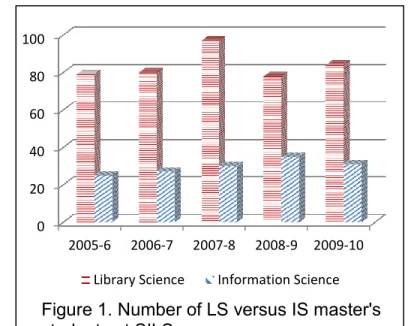
Figure 1. Number of LS versus IS master's students at SILS ... 8
Figure 2. Percentage of references that are periodical articles ... 36
Figure 3. Median number of periodicals used ... 37
Figure 4. Percentage of cited articles that are current ... 38
Figure 5. Periodicals used by only one author ... 39
Table 1 Percentage of references that are periodical articles ... 32
Table 2: Median number of periodicals used ... 32
Table 3: Percentage of cited articles that are current ... 33
Table 4: Periodicals with the most individual citations : % of references ... 34
Introduction
Master’s degree students in information and library science programs have access to a wide variety of reputable print and electronic resources through their campus libraries. With this accessibility can come an overabundance of resources. When students cannot possibly use all resources available, the question is: which ARE the students using?
Problem Statement
The researcher found no bibliographic analyses conducted of information and library science (LIS) students from the United States within the past 11 years. In addition, only two of the four existing studies specifically studied master’s degree students in LIS. More recent existing studies from outside the United States demonstrate that there is a difference in source-use among students in different countries. Therefore, it may not be possible to apply the findings of those studies to United States students. Furthermore, none of these studies specifically address differences in source-use by library science (LS) versus information science (IS) students. There is a gap in the literature in this area. This lack is problematic because such data could be used to assess
Purpose Statement
The purpose of this study is to understand the use of periodical articles in research conducted by master’s students in Information Science (MSIS) and Library Science (MSLS) programs. In this study, ―research‖ will be defined as the students’ capstone projects, known at the School of Information and Library Science in the University of North Carolina at Chapel Hill (SILS) as ―master’s papers.‖ For this paper, the researcher will refer to the graduates of both
programs jointly by the abbreviation ―MLIS.‖ As a bibliographic analysis, this will be a qualitative study rooted in a pragmatic philosophical view.
Research Questions
1. Do articles play a major role in MLIS student research? 2. How current are articles used in MLIS student research?
3. Can a core group of periodicals used in MLIS student research be identified?
Definition of Citations and References
Often the terms bibliography, citations, and references are used interchangeably because they usually refer to the same thing: an acknowledgement of another’s work. However, they represent different
perspectives on that acknowledgment. The term ―bibliography‖ is used to refer to a unified list of acknowledgments that appear at the end of the work. For
―reference‖ and ―citation,‖ we will use M.L. Poa’s definition:
contains a reference to paper P… Paper P is cited by paper A. A contains a reference [to] P; P has a citation from A. The number of references a paper has is measured by the number of items in its bibliographic list. (Pao. 19889, 20)
Definition of Core
Though commonly cited journals have been identified, most of those identified by existing studies do not fit Bradford’s Law. Bradford’s Law is a statistical formula for determining core resources. Therefore, in this study the term ―core‖ will be defined as the most commonly cited journals though those results may not match the statistical definition of ―core.‖ (Oppenheim, 2001, 9-10)
About Periodicals
The purpose of this study is to understand the use of periodical articles in MLIS research. This research scope includes articles from both popular and scholarly periodicals. Articles published in scholarly periodicals are usually selected through a peer-reviewed process in which other scholars evaluate an article’s suitability for publication. The effectiveness of this evaluation can depend on whether the peer review is conducted blindly (the reviewer is not aware of the author’s name), the size of the discipline, and the care with which reviewers are chosen. Popular periodicals have no such peer-reviewed process, yet some popular periodicals’ editors and editorial boards still use specific criteria when selecting articles. Because of the often nebulous distinction between ―scholarly‖ and ―popular‖ periodical, the author chose to include both.
bound, and sold at regular intervals. Digitized articles are articles published in print, but that are also available electronically. This can become complicated when the digital copy is available before the print is released.
The last format is material which is born-digital. This format is
controversial because much material that is born-digital can be found publically on the open web and therefore lacks the authentication that comes with being published (even in a popular periodical). There are increasing number of
subscription-based scholarly journals available electronically-only, but there are also a number of open-access blogs, electronic newsletters, and repositories which offer quality articles. Repositories can be hosted by an academic
institution, by a corporation, or by a nonprofit (such as an open-source software team). Having an article ―published‖ on such sites can be just as challenging and demanding as any print publication, or it could completely unmonitored. This study includes articles from electronic periodicals and edited blogs, but it does not include articles from repositories or entries posted on personal blogs hosted by the author. However, there are an increasing number of scholarly and well-respected personal blogs available, and that their relationship to the traditional concept of ―periodicals‖ and ―publishing‖ will continue to be debated for the foreseeable future.
About Information Science and Library Science
foundation of library science education (Bronstein, 2009, 87). Almost forty years later library science programs begun to incorporate information science into the curriculum. This integration steadily increased until the 1980’s, at which point the threat of closing schools encouraged the remaining library science programs to consider new ideas about required competencies and possible work
environments. (Griffiths, 1983, 48-9) With these new ideas also came an almost universal embracement of information science. By 1990, over 80% of the LIS programs names included ―information‖ (Bronstein, 88) By 2009, every one of
U.S. News and Reports’ top ten (actually 14 programs due to ties) Library and Information Studies programs included ―information‖ in their names. In fact,
seven out of the 14 do not have ―library‖ in their name at all. (―Rankings…,‖ 2009) Though library science predates information science as an academic discipline, information science is making strides and may eventually eclipse its older brother nationally. Yet,
at UNC-Chapel Hill’s School of Information and Library Science (SILS), library science is still a much more popular master’s degree than information science. Figure 1 is a comparison of the number of library science
and information science master’s students at SILS between 2005-10, as 0
20 40 60 80 100
2005-6 2006-7 2007-8 2008-9 2009-10
Library Science Information Science
measured by master’s papers submitted for graduation. Even at its most popular during 2008-9, information science master’s graduates equaled only 44.9% of library science students.
About SILS Master’s Papers
The documents examined for this study are the master’s papers from the School of Information and Library Science in the University of North Carolina at Chapel Hill (SILS). These papers are capstone projects, usually completed during the student’s final semester. Though students may take the required three credit course ―INLS 780: Research Methods‖ concurrently with writing their master’s paper, SILS highly recommends taking INLS 780 before. Students receive three credit hours the semester during which they complete the paper. Registration for a master’s paper automatically grants the student full-time status, which normally requires registration for nine credit hours. Students are
responsible for finding an advisor for their master’s paper. The advisor approves the student’s research proposal, offers advice during the process, and approves the final paper. To graduate, students must submit their final papers to the school approximately one month before graduation.
Literature Review
Background
This study is a bibliographic analysis to determine the usage of articles by MLIS students in their research papers. This section of the literature review describes the purpose of references, how bibliographies demonstrate source-use, and the basics of bibliographic analysis. Lastly, the usefulness of LIS student bibliographic analysis is illustrated by its role in collection development.
Existing studies. The author was able to identify nine bibliographic analyses of LIS student work from between 1976 and 2008, but the five studies conducted since 2000 were from LIS schools outside the United States. These countries are Malaysia, Turkey, and the UK. The four earlier studies were conducted in the United States, though only two studied master’s (rather than doctoral) students. In 1976, LaBorie and Halperin conducted a bibliographic analysis of doctoral LIS student work at Drexel University. In 1991, Hoy and Hale studied MLIS student work at Emporia State University. Their study was intended to gather initial data on source use by on-campus versus off-campus MLIS
students; as a result, it is extremely limited in scope and applicability. Glynn conducted a MLIS student bibliographic analysis for her 1995 dissertation at Central Missouri State University, and her detailed methodology was very helpful in the design of this research project. Most recent of the US studies, Buttlar conducted a bibliographic analysis of doctoral LIS student work at Kent State University in 1999.
(acknowledgements, dedications, endnotes, footnotes, etc.), a final bibliography should be the authoritative list of sources used in the creation of the new
document. Despite the intention of a bibliography it is not always a completely accurate description of use. Journals can be cited for a variety of reasons, not all of them for being used. (Boyce, 1994, 113) (Osareh, 1998, 152) These uses include but are not limited to:
- paying homage to pioneers in the field, - giving credit to related work,
- referencing a standard methodology or piece of equipment, - citing rather than describing it in detail,
- providing broad background to the topic. (Baird, 1993, 6)
One less acceptable reason for including a reference is bias, such as ―citing a major figure because you think he or she may be a referee of the paper when you submit it to the journal.‖ (Baird, 1993, 6) Another reason is to make the paper appear more carefully and thoroughly researched then it actually is by referencing works never consulted. (Baird, 1993, 6) In 2006, Clarke and Oppenheim conducted a survey of graduate student citation motivations. The survey revealed that the majority of students at that Loughborough University ―appear to be consciously citing for altruistic reasons, basing their decision on the relevance and importance of the work being cited,‖ rather than to simply have as many references as possible. (Clarke, 2006, 17) Though this survey may include some reporting bias from the students (who would admit to padding their
bibliography?), it does offer some measure of assurance that students at least understand the intention of citations.
when an author references a work because it is an incorrect or poor resource. (Baird, 1993, 7) While this is clear in the text of a paper, the bibliography does not indicate when a source is cited negatively. Clarke and Oppenheim’s survey provides some reassurance: ―94.4% of students said they cite to give positive credit to related work and 92.3% cite to persuade the reader of what they are saying.‖ (Clarke, 2006, 17) This data suggests that the majority of references in student research papers are positive. The last concern is that of relative value. Even if all the sources have been actually used, some will have been of much greater value than others cited. A bibliography cannot express the differing levels of source value. (Boyce, 1994, 113)
These factors are unavoidable; some references in bibliographies will be biased, false, negative, or of lesser value. Therefore in all applications of
bibliographic data (such the data collected in this study), it is important to remember that additional data from other sources should be used in tandem. (Baird, 1993, 6) These other sources could be relevance analyses, professional citation analyses, impact factors, and patron surveys. (Boyce, 1994)
About bibliographic analysis. This study will use a bibliographic analysis methodology. This is a type of citation analysis, which is in turn a type of
bibliometric analysis. Bibliometric analysis has a variety of definitions, one of which is "the application of quantitative analysis in the bibliographical references of the body of literature." (Osareh, 1998, 150) Of the various research
previously recorded information identify much of the earlier work that is pertinent to the subject of his present document.‖ (Weinstock, 1968, 16)
While printed citation indexes can still be found, they have been largely superseded by electronic databases. Thomson Reuters’ ―Web of Science‖ database is the most well-known of these. In addition to tracing citations to find previous sources, a database like Web of Science also allows the user to trace citations forward in order to determine to the number of times a source has been used. (Weinstock, 1968, p. 16) The popularization of powerful databases like Web of Science has made citation analysis an essential tool in analyzing scholarly communication, discipline definitions, source use, and more.
Bibliographic analysis is just about the simplest form of citation analysis possible. It is the study and identification of sources cited in a single or set of document bibliographies. It is not often used to study professional literature because those documents are usually already included in citation print indexes or electronic databases. However, gray literature and student work is not included in these databases and must be studied by hand.
expenditures. (Via, 2007)
In Kushkowski, et al’s 2003 study, Table 1 outlines 26 existing
bibliographic analyses of graduate theses. (462-3) Out of the 26 studies listed there, 16 applied their research data to collection development. This common application of bibliographic analysis data to collection development is reinforced by Loree’s 2007 Master’s Paper which compared the usefulness of various analyses for collection development. Loree found that a citation analysis was the most useful analysis method due to breadth and reliability of the data gathered.
Why should the researcher analyze student bibliographies, rather than only professional bibliographies? Over 30 years ago, Samuel Goldstein made an eloquent argument for context-specific bibliographic analysis:
[S]tudy of library science periodicals usage by library science students gives us a chance to examine 'the other side of the bibliometric coin'. Most bibliometric studies tell us what periodical titles or articles were 'significant' enough to have been cited by authors of articles, monographs, dissertations, reviews, syllabi, or what have you, or they tell us what
periodical titles yields the most entries in this or that abstracting or indexing service…. [W]e are being asked… to structure our operations environments in accordance with data adduced without direct reference to any operational setting, or at least the totality of any operational setting. (Goldstein, 1977, 2-3)
In an academic institution, students’ academic work is a critical part of the setting. Therefore to understand the totality of the academic setting, it is necessary to consider student source-use as well as use by faculty and other professionals.
Role of Articles in Student Research
This section outlines the findings of existing bibliographic analyses
will help form a hypothesis for the first research question: Do articles play a major role in student research?
Student journal use in the “hard” and “soft” sciences. In 2003, Kushkowski, et al conducted a cross-disciplinary bibliographic analysis of masters and doctoral theses in the US. They found that the majority of
references in most disciplines were to journals, ranging from 78.6% (Biological Sciences) to 29% (Arts and Humanities). (Kushkowski, 2003, 10) In 2009, Ucak and Al also conducted a cross disciplinary analysis of masters and doctoral theses in Turkey. They found that the majority of references in most disciplines were to books (48%), though journals were a close second at 42%. Journal citation amounts ranged from 8.7% (Art) to 80% (Chemistry). (Ucak, 2009, 171) These two studies indicate that the researcher cannot generalize the number of graduate student journal references across disciplines. However, the researcher can generalize that ―the science disciplines use more journal literature than either the Arts and Humanities or the Social Sciences.‖ (Kushkowski, 2003, 10) This varying use of journals in research has been noticed for a while. In 1970, D.J. de Solla Price wrote that the number of journals cited defines the difference between ―hard‖ and ―soft‖ sciences. (de Solla Price, 1970) His distinction has been
criticized by many, including the Library and Information Science (LIS)
Student journal use in LIS. In 1999, Buttlar found that 46% of
references in LIS doctoral research were to journal articles. (Buttlar,1999, 235-6). That particular study seems to be an exemption, since most other research
indicates that pre-2001 books were cited more often than journals. (Clarke, 2006, 11; Oppenheim, 2001, 303; Glynn, 1995, 19; LaBorie, 1976)
In 2006, Clarke and Oppenheim found among UK LIS masters students an overall decrease in book citations and increase in journal citations, though the number has oscillated and not always been a steady increase. (Clarke, 2006, 12,19 ) Clarke and Oppenheim noted that ~35.% of references are to journal articles, which is similar to the results found by Tedd’s 2006 analysis of LIS master’s research, also in the UK. (Clarke, 2006, 11, 19 11) She found that journals made up 30% of the references. (Tedd, 2006, 5) Also in 2006, Tonta and Al found that among their Turkish MLIS students, 52% references in theses and dissertations were to journal articles. (Tonata, 2006, 8) In 2008, Keat and Kiran of Malaysia found that among their MLIS students, just under half the references were to journal articles. (Keat, 2008, 5)
For this study, the researcher hypothesizes that the average percentage of journal articles in bibliographies will be higher than 45%.
Cited Article Ages
This section outlines the findings of existing student bibliographic analyses regarding the currency of articles cited. This existing data will help form a
Broad range. With the wide range of papers by LIS students (from historical case studies to patron interviews), it is to be expected that some students will make greater use of historical documents, while others will make greater use of current literature. Existing bibliographic analyses of LIS student research supports this expectation: cited journal articles range from one to 100 years old. (Tonta, 2006, 10; Glynn, 1995, 20)
Current references. Still, the bibliographic analyses do show that the majority of references are less than 10 years old. Laborie’s study of doctoral students at Drexel University proves this is not a recent trend, and that as early as 1976 36% of journal references are from within 10 years. (1976) By the mid to late 1990s, Glynn and Buttlar each found that even higher rates of citing recent articles: both doctoral and masters students rate of within-10-years journal
references were were now over 50%. (Glynn, 1995, 20; Buttlar, 1999, 238) In the 2000s, studies from LIS schools in the UK showed that 72-81% of journal
references by undergraduate, masters, and doctoral students were from the last 10 years. (Oppenheim, 2001, 7; Clarke, 2006, 11) Studies of Turkish and
Malaysian LIS students also support this trend. (Tonta, 2006, 10; Keat, 2008, 8) Finally, all these LIS studies are supported by Kushkowski, et al.’s large cross disciplinary bibliographic analysis, which found that, ―[o]verall, 70 percent of the citations are fewer than thirteen years old.‖ (Kushkowski, 2003, 10)
masters students citing a large number of current articles. The researcher hypothesizes that at least 40% of article citations will be from within the past 5 years (from the date of paper publication).
Other considerations. The literature does suggest two caveats to keep in mind. The first is the existence of references incorrectly formatted without a date. For example, Clarke and Oppenheim found an average of 11.8% nondated
journal citations. (Clarke, 2006, 11) If no attempt is made to determine the dates of these incomplete references, then their exclusions could skew results and should be noted in the results, as Clarke and Oppenheim have done. The second relates to very recent citations. Lois Buttlar noticed that less than 3% of journal citations in doctoral research are from within three years. She attributes this pattern to the lengthy formal research process involved in writing a dissertation. (Buttlar, 1999, 238) This will likely occur less among master’s papers, which have a shorter and less formal processes.
Core Journals
This section outlines the findings of existing bibliographic analyses regarding the most highly cited journals in student research. This existing data will help form a hypothesis for the researcher’s last research question: Can a core group of periodicals used in MLIS student research be identified?
resources will be used very often, while the majority of resources will be used rarely. Except for Hoy and Hale (Hoy, 1991) who did not collect this data, all of the bibliographic analyses of LIS student work have found a core group of journals which provide the majority of journal references. Additionally, they all found that the majority of journals were only cited rarely. (Goldstein, 1977, 1; Glynn, 1995, abstract; Tedd, 2006, 7; Oppenheim, 2001, 7; Keat, 2008, 10; Tonta, 2006, 7-8; Buttlar, 1999, 236). Via and Schmidle’s return-on-investment study of serial expenditures also identified core journals. They found that 19 journals were each cited over 100 times, while 38 were cited less than 11 times. (Via, 2007, 7)
Commonly cited journal titles. Among the US LIS student bibliographic analyses (all pre-2000), the most commonly referenced journal is Library Journal. (Goldstein, 1977, 1; Glynn, 1995, 31) The only exception is Buttlar’s study of doctoral students; she found the most referenced journals to be Citation Study of Library and Information Science Dissertations for Collection Development,
College & Research Libraries, and the Journal of the American Society for Information Science. (Buttlar, 1999, 227) A recent study in Turkey discovered that the top five most commonly referenced journals among LIS students are the
Journal of Turkish Librarianship, Resmi Gazette, College & Research Libraries,
The researcher hypothesizes that this study will identify a core group of journals used by LIS masters students. From the findings of existing studies,
Library Journal, Library Trends, and College & Research Libraries will likely be among the top referenced journals.
Other considerations. The literature does suggest a caveat: be wary of single papers which may drastically skew the results. For example, Lois Buttlar found the Law Library Journal to be a core journal, providing over 2% of all
references. However, a single dissertation provided 90.5% of the citations to that journal. (Buttlar, 1999, 236-7) Unfortunately, a situation like this is unavoidable in a random sampling, but it is worth noting and clarifying in the results, as Buttlar has done.
Methodology
This section of the literature review discusses the methodologies used by similar studies and begins to defend the methodology used in this study.
Sampling frame. A good sample frame is essential to a successful study, even more so then sampling. It is possible to sample 100% of papers in a sample frame, and yet not obtain statistically valid results. An example is the study by Hoy and Hale (1991) who conducted a bibliographic analysis of student papers from a single class assignment. Though they sampled 100%, their
sample frame (selected classes) is too small to represent the entire population of LIS graduate students at Emporia State University. They acknowledge that their study is not statistically valid and is meant to be an initial observation only.
All nine identified LIS student bibliographic analyses used only research papers available at their own institution. This was done largely for convenience; for example, Kushkowski et al. describe how conveniently they collected samples for their cross-disciplinary bibliographic analysis. (Kushkowski, 2003, 464)
However, restricting the study to one location also eliminates some possible problems, which are discussed further in the methodology section.
There is no similar agreement between researchers for the time period to be studied. Five years is the most common time period among the bibliographic analyses in this literature review (Keat, 2008; Tedd, 2006; Clarke, 2006), while second most common is three years (Buttlar, 1999, 231; Oppenheim, 2001, 3) However, studies have also used nine (Leiding, 420, 2005), 16 (Glynn, 1995, 16), 19 (Kushkowski, 2003), or 27 years (Tonata, 2006).
Sampling. As with the chronological frame, the literature does not provide much guidance regarding the sampled percentage. Among the
data), the samples were:
- 100%, ~100 bibliographies (Tedd, 2006, 1; Tonata, 2006, 5) - 95.2%, 50 bibliographies (Keat, 2008)
- 47%, 61 bibliographies (Buttlar, 1999, 231) - 35.5%, 120 bibliographies (Clarke, 2006) - 15%, 101 bibliographies (Leiding, 420, 2005) - 11.1%, 391 bibliographies (Ucak, 2009)
- 5%, 629 bibliographies (Kushkowski, 2003, 464)
Leiding, Ucak, and Kushkowski were sampling from multiple disciplines, and thus had considerably larger sample frames. Their smaller sample percentages are necessary to create manageable sized samples.
Methodology
Research Questions and Associated Measures
1. Do articles play a major role in MSIS or MSLS student research? a. On average, articles are what percentage of references? b. What is the average number of journals cited?
2. How current are articles used in MLIS student research? a. What percentage of articles are 5 or fewer years old? 3. Can a core group of periodicals used in MLIS student research be
identified?
a. What periodicals are cited by the most papers?
b. What periodicals receive the highest number of total citations?
Hypotheses
1. The percentage of articles in bibliographies will be higher than 35%. 2. At least 40% of article citations will be from within the past five years
(from the date of paper publication).
3. From the findings of existing studies, Library Journal, Library Trends,
and College & Research Libraries will likely be among the top cited journals.
Method
bibliographic analysis.
It is worth noting that in 1977, Samuel Goldstein and fellow researchers gathered their data on journal use by students via a survey: students self-reported their most commonly used journals. (Goldstein, 1977) However, bibliographic analyses of student papers can achieve the same result with less risk of bias because it generates uncontaminated and unobtrusive data. Unless the author is aware of the study before creating the bibliography, there is no way that the study can bias the subject. (Buttlar, 1999; Wildemuth, 2009)
Data Source
As shown in the literature review, eight of the nine identified LIS student bibliographic analyses have studied some sort of capstone project such as thesis or dissertation. This is not accidental, since capstone papers have numerous advantages over other coursework. The first advantage is consistency across a larger population. The researcher is not limited to the small sample size of a single course nor has to contend with differing writing requirements across
various courses. The second advantage is the number of references available for study. As the final application of a student’s accumulated training, a capstone paper is likely the most intensive research conducted by a student and requires the heaviest use of literature. This will result in the most developed bibliographies students will create during their studies.
study in-depth recurring problems and issues, citation analysis of library and information science dissertations can identify the information sources that meet the needs of scholars in the field.‖ (Buttlar, 1999, 227-8) Since many practitioners in library science have not received their doctoral degree, this
argument applies effectively to master’s student capstone papers. This study analyzed LIS master’s capstone papers on the basis of literary precedent and the research advantages offered.
Sample
Location frame. All nine of the LIS student bibliographic analyses discussed in the literature review used only research papers available at their own institution. This limitation prevents the validity problems introduced by a cross-institutional analysis. For this study, SILS is the only library or information science program in the US that requires all their students to complete a
cumulative writing experience. At other schools the cumulative writing experience is either completely optional, required for honors, or merely one of many
possibilities. See the appendix for a complete outline. The observation that many LIS graduates are not required to complete capstone papers is supported by data gathered by the WILIS2 project; the project found that only 15% of the LIS
In addition, the depth and complexity of MLIS capstone papers varies between institutions. One’s program’s thesis may be worth one credit hour, while another program’s is worth nine credit hours. That is the same reason this
research study is limited to just master’s students rather than including
undergraduates and doctoral students, because these other student types would possibly invest different levels of time and use different sources. For example, Keat and Kiran found a roughly 10% difference in journal use between masters and doctoral students. (Keat, 2008, 5) Similarly, a student who works on a
research project for nine credit hours may use different resources then a student who works for one credit hour.
Because of these population issues, the researcher chose to limit this study to one institution. If this study must be limited to one institution, the logical choice was the School of Information and Library Science (SILS) in the University of North Carolina at Chapel Hill (UNC-Chapel Hill). Firstly for convenience: the SILS capstone papers are largely available digitally, and those in print can be easily accessed for this study. Time saved by this convenience can be spent instead on a deeper analysis. Secondly, for the breadth of population sampled: unlike at other schools, SILS requires all graduates to complete capstone paper and therefore provides unique access to an entire MLIS student population. For these reasons and considering the scope of this study, the sample frame consists of the master’s papers from SILS.
review (Keat, 2008; Tedd, 2006; Clarke, 2006), though other studies used larger or smaller time frames. So, the author chose a five year sample frame from June 2005- May 2010. Though June-December 2010 papers will be submitted at the time of this study, they may not all be available when the study begins. Therefore, the author chose to end the study with the May 2010 submissions.
Sampling method. This study used stratified sampling by year, a method used in several existing studies. For purposes of this study a year is an academic year; master’s papers accepted between August and May are included as one academic year. The researcher further stratified the samples by into library science and information science authors, as self-declared by the students on the master’s paper cover page. Because they are lumped chronologically by date of submission, the master’s papers can easily be stratified by year. However stratifying them into LS and IS was problematic because neither the digital collection nor library collection cannot reliably stratify them through search. Therefore, the researcher manually examined the print collection to create lists (using the master’s papers unique identifying numbers) stratified by date and department. Three of the master’s papers collected were written by students claiming to graduate with a dual library/information masters; these were included in both the LS and IS strata.
(Wildemuth, 2009, 121-123) Because of the size of the collection, this study used systematic rather than random sampling. Using a random number generator to choose a number between one and five for each year sampled, the researcher began with that number and sampled every third paper after. (Wildemuth, 2009, 118) This was particularly straightforward since the master’s papers are
numbered sequentially. When using systematic sampling, a researcher must be aware of any patterns in the sample which may bias the systematic sample. In this case, master’s papers are arranged by date deposited and then (roughly) alphabetical order. Since this is a continuous rather than reoccurring pattern, it should not bias the result of systematic sampling.
Study Procedures
citations in these appendixes were not analyzed.
This study used the ―structured record review‖ method of data collection. (Creswell, 2009, 146) After being assigned an identifier, each sampled
bibliography was analyzed, and the results entered into Microsoft Access tables. Data for the study’s measures was as follows:
What percentage of student references are journal articles, and what is the average number of different journals cited? : The total number of references, of article references, and of individual journals cited in each bibliography were tallied.
What percentage of articles are five/ ten or fewer years old? : In addition to the total number of article citations tallied for each
bibliography, the researcher will also tallied how many were published within 5 years of the bibliography. To do so, the cited article’s
publication year was subtracted from the master’s paper publication year.
What journals are cited by the most papers, and what journals receive the highest number of total citations? : The researcher kept a list of cited journals, next to which will be tallied the number of citing papers and the number of total individual citations.
The scope of this research project includes print, digitized, and digital periodicals. The introduction outlines some of the complication involved in categorizing born-digital material as ―articles‖ or not. Both popular and non-peer reviewed
periodicals are counted. Proceedings, government documents, and task force/committee reports were not categorized as articles. Abbreviated journal names in references were expanded when the intended journal was completely clear, but otherwise the journal name was recorded in its abbreviated state. The same procedure was applied for typos.
converted into percentages to allow accurate comparison between the two departments. There was also a huge variety in the length of each paper’s
bibliography. Altogether, bibliographies ranged between zero and 144 references, but the width of the range is caused by only a few outlying papers. Because of these outliers, the median (rather than the average) was used to calculate all percentages presented in the results. Results were arranged into tabular and graphic form.
Limitations
Fortunately,the data analysis for this study was fairly straightforward and unambiguous because the content is manifest rather than latent. However, there are still a few possible problems. Firstly, there is a validity issue: this study
intends to study source-use, but authors may fail to cite some sources used. The researcher has decided that such omissions would be even greater in other forms of data collection (such as surveying), and thus that this risk to validity is the least possible. Secondly, due to time constraints the accuracy of citations will not be verified. This may cause reliability issues due to incorrect dating or journal naming. When a citation is incomplete and does not include a date, the
interaction with the document’s creator, meaning that the researcher cannot ask for clarification. Due to time constraints, this problem also could not be solved by extensive database searching to find the cited source. However, the researcher categorized them through reasonable use of databases and style guides.
Lastly, the presence of outliers may influence the results. (Buttlar, 1999, 236-7) This problem was addressed by using the median rather than mean a when analyzing data. (Wildemuth, 2009) Lastly, by restricting our sample frame to a single institution, the researcher inherently limited the application of results. (Boyce, 126, 1994) However, as discussed earlier, the increased variables presented by cross-institutional analysis would be more harmful to the study.
Ethical Issues
Results
Research Question 1 – Role Table 1
Percentage of references that are periodical articles
2005-6 2006-7 2007-8 2008-9 2009-10
LS + IS 46.1% 52.78% 40.4% 56.8% 47.5%
LS 50% 52.3% 54.9% 70.8% 51.6%
IS 41.5% 16.2% 27.6% 42.6% 41%
The first research question was ―do articles play a major role in MLIS student research?‖ Table 1 displays how many of the papers’ references are to periodical articles.
However many bibliographies include references to multiple articles from the same periodical. So, another measure of article use is the number of different periodicals cited in each student bibliography as illustrated in Table 2.
Table 2:
Median number of periodicals used
2005-6 2006-7 2007-8 2008-9 2009-10
LS + IS 7.5 10.75 8 9.75 9.25
LS 7.5 7.5 10 12 11
Research Question 2 – Currency
Table 3:
Percentage of cited articles that are current
2005-6 2006-7 2007-8 2008-9 2009-10
LS + IS 48.78% 47.46% 72.73% 61.11% 39.58%
LS 50% 60.87% 71.43% 58.82% 31.25%
IS 47.06% 38.89% 75.00% 65.00% 56.25%
The second research question was ―how current are articles used in MLIS student research?‖ Table 3 shows the median percentage of current articles. For this paper, current is defined as being were five or fewer years old when the paper was published.
Research Question 3 - Core journals
The final research question was ―can a core group of periodicals used in MLIS student research be identified?‖
The first analysis determined which periodicals received the most
Table 4:
Periodicals with the most individual citations : % of references
2005-6 2006-7 2007-8 2008-9 2009-10
LS Library Journal (6.1%) Journal of Academic Librarian- ship, The (11.4%)
APLIS (7.4%) Journal of Academic Librarian-ship, The (4.1%) American Archivist, The (3.8%) IS Communic-ations of the ACM (5.8%)
Communic-ations of the ACM (2.9%)
Communic- ations of the ACM (8.8%) New York Times, The (5.5%) Journal of Nursing Administ-ration (14.1%) Table 5:
Periodicals cited in the most bibliographies : % of bibliographies
2005-6 2006-7 2007-8 2008-9 2009-10
LS Library Journal (3.58%) College & Research Libraries (3.6%) Library Journal (2.7%) College & Research Libraries AND Journal of Academic Librarianship (3%) Journal of Academic Librarianship (3.1%)
IS Communic-ations of the ACM (5.6%)
Communic-ations of the ACM (3.6%)
Table 6:
Periodicals used by only one author - % of cited periodical titles
2005-6 2006-7 2007-8 2008-9 2009-10
LS + IS 80% 87.8% 85.2% 85.5% 84.1%
LS 79.3% 80.4% 79.3% 79% 80%
Conclusions
Role
Overall, the SILS students’ use of articles is fairly stable with an only ~11% variance (~46-57%) over the five years studied. The median percentage of the references that are articles is ~48%, supporting the study’s hypotheses that the percentage of articles in bibliographies will be higher than 35%. Figure 2 illustrates that this hypothesis is also true for LS students all five years, but periodical articles did contribute less than 35% of references for IS students from 2006-8. It is possible that the low use of articles by IS students in those two
Figure 2. Percentage of references that are periodical articles
years was caused by the popularity of certain topics chosen. Such a correlation could be identified by conducting an analysis of master’s paper topics. Another possibility is the availability of relevant IS journals. A study comparing cited journals to UNC-Chapel Hill’s journal holdings would help identify if that was the cause. Figure 2 also reveals that LS students have tended to use more
0.00% 10.00% 20.00% 30.00% 40.00% 50.00% 60.00% 70.00% 80.00% 90.00% 100.00%
2005-6 2006-7 2007-8 2008-9 2009-10
LS + IS
LS
periodicals than IS, though the 2009-10 numbers suggest that the two degrees are becoming similar in their article use. Continuing this study into future years would allow for a more reliable identification of such trends.
Regarding the number of different periodical titles used, students as a whole used a median of approximately nine titles, with a variance of ~ 8-11. The data illustrated in Figure 3 suggests that LS students have used a greater variety of titles than IS students for the past three years, but this could easily be caused by the considerably larger number of LS papers.
Figure 3. Median number of periodicals used
Currency
This study hypothesized that at least 40% of article citations will be from within the past five years (from the date of paper publication). Except for two exceptions, this hypothesis is accurate for both IS and LS. The first exception is the IS papers in 2006-7, which barely misses the mark with ~ 39%. Next, in 2009-10, LS papers show a marked decrease in the number of current articles: down to ~31% from ~ 59% the year before. One reason for this drop could be the popularity of particular topics, and again, a topical analysis of the master’s
0 2 4 6 8 10 12 14
2005-6 2006-7 2007-8 2008-9 2009-10
LS + IS
LS
papers could provide some useful correlative data. Continuation of this research will have to be conducted in order to determine if this was an oddity or the beginning of a trend.
Figure 4. Percentage of cited articles that are current
Core Journals
The study hypothesized that Library Journal, Library Trends, and College & Research Libraries will likely be among the top cited periodicals. Tables 4 and 5 on page 34 summarize the titles most cited and cited by the most papers.
Library Journal and College & Research Libraries both are cited by the most LS papers in 2005-9, but Library Trends was never the most cited.
From 2005-8 Communications of the ACM was inarguably the most commonly and often used periodical by IS students. Further analysis and
research is needed to determine why use of this journal has seemingly dropped off in the past two years. For LS papers, there is a noticeable discrepancy between the most commonly cited titles and the titles cited by the most papers.
0.00% 10.00% 20.00% 30.00% 40.00% 50.00% 60.00% 70.00% 80.00% 90.00% 100.00%
2005-6 2006-7 2007-8 2008-9 2009-10
LS + IS
LS
The same is fact true for recent IS papers. This suggests that a few individual authors make extensive use of particular titles. Surveys or another qualitative data gathering technique could determine whether this behavior is purposeful.
The most important conclusion drawn from this analysis is that 85% of periodicals cited are used by only one author, as illustrated by Figure 5. Research being conducted by these IS and LS students is extremely
Figure 5. Periodicals used by only one author
Summary
This study has filled a gap in existing literature by analyzing the MLIS student use patterns of periodicals. Because it is the least biased source of data possible, this study will use bibliographic analysis. This process has been shown to be especially useful for collection development.
On the basis of literary precedent and the research advantages, this study analyzed LIS master’s capstone papers. Because of convenience, population size, and the scope of this study, the sample frame was the master’s capstone papers from School of Information and Library Science in the University of North Carolina at Chapel Hill from August 2005- May 2010. A stratified systematic sampling technique was implemented to sample 30% from the Information Science and Library Science students each academic year. The bibliographies of the sampled papers were collected and analyzed by the measures outlined on page 40.
The research shows that the MLIS student researchers used a median of nine different periodicals in their master’s papers and that 48% of all references were periodical references. At least 39% of those article citations were from within the five years, with the exception of library science papers in 2009-10. Finally, 85% of all periodicals cited are used by only one author.
Areas of Future Research
This research revealed even more questions to be answered by additional research. These questions would complement the results of this study and further expand an understanding of MLIS master’s student source use. Some already mentioned in this paper are:
How do the most commonly cited periodicals compare to UNC library holdings?
What are common master’s paper topics, are there trends, and how do those trends correlate with article use?
Why do students use/not use periodicals, and why do they use particular ones?
Other questions include:
How often do MLIS students use unpublished articles or article self-published on a writer’s website?
How does source-use vary depending on the time spent on research? What percentage of cited sources are published in the what countries? Who are the most commonly cited authors, and how commonly are those
authors cited in professional literature?
How do the commonly cited journals compare to journal impact factors? What percentage of sources are from outside the LIS field?
Can the trends of growth or obsolescence among journals be identified? Via a full-text analysis, what percentage of articles in the bibliography are
Bibliography
Baird, L. M., & Oppenheim, C. (1994). Do citations matter? Journal of Information Science.
Boyce, B. R., Kraft, D. H., & Meadow, C. T. (1994). Measures of Bibliometric Phenomena. In Measurement in information science (pp. 112-28). San Diego, Calif.: Academic Press.
Bronstein, J. (2009). Current Trends in Library and Information Studies Curricula.
Libri, 59(2), 78-87. doi:10.1515/libr.2009.008
Buttlar, L. (1999). Information sources in library and information science doctoral research Library & Information Science Research 21(2), 227-45.
Capstone >> About. (n.d.). UT School of Information. Retrieved October 5, 2010, from http://www.ischool.utexas.edu/programs/capstone/
Clarke, M. E., & Oppenheim, C. (2006). Citation behaviour of information science students II: postgraduate students. Education for Information, 24(1), 1-30. Completed Theses. (n.d.). The iSchool at Illinois. Retrieved October 5, 2010,
from http://www.lis.illinois.edu/academics/programs/ms/masters-theses Course Worksheet. (n.d.). The iSchool at Illinois. Retrieved October 5, 2010,
Courses/Enrollment. (n.d.). University of Wisconsin-Madison School of Library & Information Studies. Retrieved October 6, 2010, from
http://www.slis.wisc.edu/academics-courses.htm
Glynn, D. L. (1995). A citation analysis of master's and education specialist theses and research papers by graduates of the Library Science and
Information Services Department at Central Missouri State University. Central Missouri State University.
Goldstein, S. (1977). Use of library science periodicals at the Simmons College School of Library Science. CALL (Current Awareness Library Literature),
6(2), 3-7.
Graduate Degree Programs. (n.d.). The iSchool at Drexel University. Retrieved October 5, 2010, from http://www.ischool.drexel.edu/PS/
GraduatePrograms
Griffiths, J. (1983). New Directions for Library and Information Science Education. Journal of Education for Librarianship, 24(1), 48-52. doi:10.2307/40322779
Hoy, C. J., & Hale, M. L. (1991). A comparison of references cited by on-campus and off-campus graduate library science students. In The fifth Off-campus Library Services Conference proceedings at Central Michigan Uniiversity
(pp. 123-130). Press; Central Mich. Univ. Press.
Individualized Program of Study | Library & Information Science Program. (n.d.).
October 6, 2010, from http://www.ischool.pitt.edu/lis/degrees/general/ index.php
Keat, Y. C., & Kiran, K. (2008). Citation Study of Library and Information Science Dissertations for Collection Development. Malaysian Journal of Library & Information Science, 13(2), 29-47.
Kling, R., & Callahan, E. (2005). Electronic journals, the Internet, and scholarly communication. Annual Review of Information Science and Technology, 37(1), 127-177. doi:10.1002/aris.1440370105
Kushkowski, J. D., Parsons, K. A., & Wiese, W. H. (2003). Master's and doctoral thesis citations: analysis and trends of a longitudinal study. Portal:
Libraries and the Academy, 459-479.
LaBorie, T., & Halperin, M. (1976). Citation patterns in library science dissertations. Journal of Education for Librarianship, (16).
Leiding, Reba. (2005). Using Citation Checking of Undergraduate Honors Thesis Bibliographies to Evaluate Library Collections. College & Research
Libraries, 66(5), 417-29.
Loree, S. (2007). Is Citation Analysis Worth It: A Comparison of Local Citation Analysis, Interlibrary Loan Records and Usage Statistics for Collection
Development Purposes in a Special Library. School of Information and Library Science in the University of North Carolina at Chapel Hill.
Implementing a Model for Ongoing Career Tracking of Library and Information Science Graduates. Library Trends.
Master of Library Science. (n.d.). iSchool @ UMD. Retrieved October 6, 2010, from http://ischool.umd.edu/programs/mls.shtml#req
Master's Degree. (n.d.). Simmons College Graduate School of Library and Information Science. Retrieved October 6, 2010, from
http://www.simmons.edu/gslis/academics/programs/ ms/index.php Master's Paper Guidelines. (n.d.). UNC School of Information and Library
Science. Retrieved November 22, 2010, from http://sils.unc.edu/current-students/masters-students/masters-paper/guidelines
Master's Paper Overview. (n.d.). UNC School of Information and Library Science. Retrieved October 5, 2010, from
http://sils.unc.edu/current-students/masters-students/masters-paper
MIS Curriculum. (n.d.). Indiana University School of Library and Information Science. Retrieved October 5, 2010, from http://www.slis.indiana.edu/ degrees/mis/degree_req.php
MLIS Culminating Experience Overview. (n.d.). University of Washington Information School. Retrieved October 5, 2010, from
http://ischool.uw.edu/mlis/culminating_experience
MLIS Curriculum. (n.d.). Syracuse University iSchool. Retrieved October 5, 2010, from
MLIS: Library and Information Science Courses. (n.d.). SC&I, Rutgers University. Retrieved October 5, 2010, from http://comminfo.rutgers.edu/component/ option,com_courses/ task,listing/sch,17/cur,610/Itemid,54/
MLS Degree Requirements. (n.d.). Indiana University School of Library and Information Science. Retrieved October 5, 2010, from
http://www.slis.indiana.edu/degrees/mls/ degree_req.html
MS in Bioinformatics. (n.d.). The iSchool at Illinois. Retrieved October 5, 2010, from http://www.lis.illinois.edu/academics/programs/ms-bioinformatics Oppenheim, C., & Smith, R. (2001). Student citation practices in an Information
Science Department. Education for Information, 19(4), 299-323. Osareh, F. (1996). Bibliometrics, citation analysis and co-citation analysis: a
review of the literature I. Libri.
Pao, M. (1985). Lotka's Law: A testing procedure. Information Processing and Managment, 21(4), 305-20.
Pickard, A. J. (2007). Research methods in information. London: Facet.
Rankings - Library and Information Studies - Graduate Schools - Education - US News. (2009). U.S. News & World Report. Retrieved October 5, 2010, from http://grad-schools.usnews.rankingsandreviews.com/best-graduate-schools/top-library-information-science-programs/rankings/
SI MSI Degree: Master's Thesis Option Program. (n.d.). University of Michigan School of Information. Retrieved October 5, 2010, from
de Solla Price, D. J. (1970). Citation measures of hard science, soft science, technology and non-science. Studii si Cercetari de Documentare, 12(3), 2005-21.
Tedd, L. A. (2006). Use of library and information science journals by Master's students in their dissertations: Experiences at the University of Wales Aberystwyth. Aslib Proceedings, 58(6), 570-581.
Tonta, Y., & Al, U. (2006). Scatter and obsolescence of journals cited in theses and dissertations of librarianship. Library and Information Science Research, 28(2), 281-296.
Ucak, N., & Al, U. (2009). The Differences Among Disciplines in Scholarly Communication A Bibliometric Analysis of Theses. Libri, 59(3), 166-179. doi:10.1515/libr.2009.016
Appendix: Top 10 LIS Programs and Capstone Requirements Programs are listed according to their ranks in U.S. News and Reports.
(―Rankings…,‖ 2009) An * indicates that the capstone is worth three credit hours.
Rank University Capstone
Paper
Notes
1 University of Illinois— Urbana-Champaign
* Optional Required for graduates with a focus in bioinformatics 1 University of North
Carolina—Chapel Hill
* Required
3 Syracuse University None
4 University of Washington Optional A thesis is one of four options for the required capstone.
5 University of Michigan— Ann Arbor
Optional
6 Rutgers, the State University of New
Jersey— New Brunswick
None
7 Indiana University—
Bloomington None
8 University of Texas— Austin
* Optional A thesis or a ―master’s report‖ are two of three options for the required capstone. The master’s report is three credit hours. 9 Drexel University None
10 Simmons College None Students can receive one to six credit hours for their capstone.
10 University of
Maryland--College Park * Optional 10 University of Pittsburgh None 10 University of