Angela M. McClendon. Archival Processing Information: Exploring Primary Source User Attitudes toward Extended Access. A Master’s Paper for the M.S. in L.S degree.
July, 2007. 46 pages. Advisor: Christopher Lee
In 2002, Tom Hyry and Michelle Light proposed the expansion of the “processing information” portion of archival finding aids to include more information on how collections are processed and the archivists who process them. This exploratory study investigated the attitudes of a selection of University of North Carolina at Chapel Hill faculty members with experience using archival collections. Surveys were used to collect biographical and attitudinal information from these researchers. The respondents did report a high level of interest in several types of administrative and processing information, particularly information regarding materials that were removed from collections and notes regarding the acquisition of collections. Respondents were most interested in professional information about the processing archivist, such as his or her title, employment status, and prior experience, and least interested in personal
information about the processing archivist such as gender or political affiliation.
Headings:
Access to archives Archives
by
Angela M. McClendon
A Master’s paper submitted to the faculty of the School of Information and Library Science of the University of North Carolina at Chapel Hill
in partial fulfillment of the requirements for the degree of Master of Science in
Library Science.
Chapel Hill, North Carolina July 2007
Approved by
TABLE OF CONTENTS
Acknowledgments ... 2
Introduction... 3
Literature Review ... 5
Methodology... 12
Findings ... 16
Conclusion ... 30
Works Cited ... 32
Appendix A: Email Request for Participation ... 35
Appendix B: Follow-up Recruitment Email... 37
Appendix C: Consent Form ... 38
Acknowledgments
Many, many thanks to my advisor, Christopher (Cal) Lee, for his endless supply of support and resources. I am inspired by his unlimited enthusiasm for the archival profession.
Without Tom Hyry and Michelle Light, this study simply would not have occurred. Thanks to “Hyry” and “Light” for providing feedback and advice on this study, as well as writing an article that inspired not only this study, but countless fascinating conversations with friends and colleagues.
Introduction
Traditionally, archivists have tended to consider the processing of archival materials—arranging, cataloging, and describing them in finding aids—to be a matter of professional objectivity. A growing number of archivists, however, have argued that maintaining objectivity is impossible in a job that requires making judgments about research value: archivists’ personal biases and experiences will inevitably affect the ways that they handle materials. Some have suggested that increasing the transparency of the archival practice to the users of archival materials is a crucial part of ensuring
archives’ accountability.
In 2002, archivists Tom Hyry and Michelle Light proposed a way to display that transparency to users: include a section in the archival collection’s finding aid that includes information about the archivist who appraised and organized the collection, and wrote the finding aid. Currently, this type of processing information typically extends no further than the name of the processor and the date(s) that processing was completed. But it might also include information about the archivist’s educational background,
employment status, and other collections he or she has processed. This information might even be extended to include more personal information such as the archivist’s gender or political affiliation.
finding aid would alert the user to the changes that were made. If materials were
discarded or returned to the donor of the collection, the rationale for their removal would be given. The finding aid would, therefore, become a tool for making processing more transparent. The provision of this information could serve to increase the visibility of archivists, a move that some have deemed vital to the survival of the library profession.
In rare cases, archives do offer this extended processing information. For example, the processor of the Janus Press Archive at the Library of Congress provides detailed information on the record creator’s organization of the collection.1 While this appears to be an encouraging step forward in transparency, the question remains: how much do our users actually want to know? To my knowledge, there have been no attempts to gather data from users of primary sources regarding their opinions of being provided this information.
This exploratory study seeks to answer three questions: How much information about processing do researchers want? How much of this type of information have they actually requested? Do certain types of researchers—the more seasoned users, or users in a particular academic field—want this information more than others? This paper aims to propose recommendations to archives regarding the inclusion of extended processing information in finding aids. A broader goal of the study is to introduce user feedback into archival discourse on the subject of transparency in archives.
1
Literature Review
From the perspective of postmodernism, the practice of keeping archives cannot be approached objectively. Terry Cook holds that “the traditional notion of the impartial archivist is no longer acceptable—if it ever was,”2 and argues that it is “inevitable” that this impartiality will affect many of the archivist’s major job functions, including appraisal, description, preservation, exhibition, and Web site construction. Within the archival literature, the idea of the subjective archivist appears most frequently in reference to appraisal, where decisions of what to include in an archives essentially predict the life or death of the collections being appraised. Because appraisal is
considered the archivist’s “first responsibility,”3 it is said to be most critical to be aware of one’s own personal biases during the appraisal process.
As materials are processed, an additional form of selection, usually called “weeding,” occurs, in which records are considered with finer granularity and items are discarded. How to Proceed, a processing procedures manual created by the Technical Services Department of the Southern Historical Collection at the University of North Carolina at Chapel Hill, lists fourteen types of materials “typically returned to donors or consigned to the trash, recycling, or sale heaps.”4 The list includes such mundane items as envelopes and picture frames, as well as items such as flowers and “pet bugs” that
2
Cook, Terry. “Remembering the Future: Appraisal of Records and the Role of Archives in Constructing Social Memory,” in Archives, Documentation, and Institutions of Social Memory, Francis X. Blouin, Jr. and William G. Rosenberg, eds. Ann Arbor: University of Michigan Press, 2006: 173.
3
Gerald Ham cites a 1986 Society of American Archivists report entitled Planning for the Archival Profession in which “archivists declared that their first responsibility was the ‘selection of records of enduring value.’” Ham, F. Gerald. Selecting and Appraising Archives and Manuscripts. Chicago: Society of American Archivists, 1993: 1.
4
Kaiser et al. How to Proceed: A Procedures Manual for the Southern Historical Collection and General Manuscripts. University of North Carolina at Chapel Hill, October 2006: 134.
most archives consider a mold or infestation hazard. The list also includes items, however, whose lack of informational value is perhaps less clear—research notes, sensitive materials, and “clippings of a miscellaneous nature.”5 This discarding of materials seems to be relatively routine—indeed, according to Richard J. Cox, “archivists admit that only a miniscule portion of all records created are ultimately saved.”6 The manual does not explicitly recommend documenting the decision-making behind discarding these items.
Cook admonishes archivists to “remain extraordinarily sensitive to the political and philosophical nature of…[their] personal biases”7 in appraisal. It seems impractical, however, to remain as cognizant of these biases during weeding. In the interest of processing a collection in a timely fashion, weeding decisions are made with a certain level of alacrity. Selection decisions are usually made at the item- or folder-level, and because there are often so many of these decisions to make while processing a collection, they are likely not approached with the gravity Cook suggests.
Additionally, the process of arranging a collection often requires rearranging the materials within it, therefore disrupting its original order. Frank Boles argues, primarily in the context of collections of personal manuscripts, that original order is often
inadequate, and that it should be maintained only “when it is usable.”8 Even when original order is maintained, Cook argues that this order still may not reflect the organic
5
Ibid, 134 6
Cox, Richard J. “Archival Anchorities: Building Public Memory in the Era of the Culture Wars.”
MultiCultural Review (June 1998): 53. 7
Cook, “Remembering the Future,” 169. 8
processes of arrangement maintained by the record creator: “Archivists seek to reimpose an original order rather than allowing for several orders or even disorders to exist among records and thus in their description.”9 Archivists again act as mediators between record creation and use when they arrange and describe a collection. Elizabeth Yakel supports Cook’s assertion that subjectivity touches arrangement and description, contending that “archival representation processes are neither objective nor transparent.”10
Because it does not seem possible to eliminate subjectivity from the archival practice, the concept of transparency—of being open about one’s practices—has emerged as a way to maintain trustworthiness. Yakel and others argue that archivists must make their practices more transparent to their users. Cox believes that the public should pay attention to “why certain records are deemed to be worth of long-term maintenance or preservation, and the majority are not,”11 and believes that it is the responsibility of archivists to make this information available in a way that is understandable to the
layman.12 According to Eric Ketelaar, transparency, along with visibility and access, is a “sister” of accountability, and accountability is what makes an archives valuable to its society. In a study of two Dutch newspapers, Ketelaar found that in 28 percent of the articles, “archives were treated not as historical sources, but as actual evidence in political and criminal cases, as primary sources of accountability in public and private organizations,” concluding, “This shows that the image of archives is formed equally by
9
Cook, “Remembering the Future,” 173. 10
Yakel, Elizabeth. “Archival Representation,” in Archives, Documentation, and Institutions of Social Memory, Francis X. Blouin, Jr. and William G. Rosenberg, eds. Ann Arbor: University of Michigan Press, 2006: 161.
11
Cox, Richard J. “Archival Anchorities,” 53. 12
their function for understanding the past, and by their function in achieving
accountability.”13 In order to be transparent, Ketelaar suggests making clear, to funding authorities and to the public at large, “what our goals and priorities are [and] what we do to achieve these.”14
Cook supports transparency in the assertion that archivists should “leave very clear recorded evidence explaining their choices to posterity.”15 Hyry and Light assert that this evidence is indeed often being recorded, but not shared with users: “Most archives keep track of [appraisal decisions] but keep it in the privileged spaces of
collection and/or donor files, which are off limits to researchers.”16 They suggest using a portion of the finding aid, which they term a “colophon,” to make processing practices clear. The colophon would be used to “allow archivists to make our technical processes more transparent, thereby supplying researchers with a fuller understanding of a
collection.”17 Hyry and Light delineate the types of information that a colophon might contain:
Without being prescriptive, archivists could use a colophon to record what they know about the history and provenance of a collection and to reveal appraisal, arrangement, description, preservation, and other decisions they made while working on a collection. The colophon could be used to record biographical information about the processor, as well as any perspective they would like to contribute to the finding aid.18
13
Ketelaar, Eric. The Archival Image: Collected Essays. Hilversum: Verloren, 1997: 116-117. 14
Ibid, 118. 15
Cook, Terry. “Archival Science and Postmodernism: New Formulations for Old Concepts.” Archival Science 1 (2001): 24.
16
Hyry, Tom and Michelle Light. “Colophons and Annotations: New Directions for the Finding Aid.”
American Archivist 65 (Fall/Winter 2002): 224. 17
Ibid, 225. 18
The authors suggest placing this information under the collection-level “Processing Information” heading. If the finding aid is encoded using Encoded Archival Description (EAD), Hyry and Light suggest placing this information inside the <processinfo> tag.
Typically, collection-level “Processing Information” headings contain little more information than the name of the processor and the date the collection was processed. Often, this information is excluded altogether from the finding aid. A search for the phrases “processing information,” “processing note,” and “processed by” in
ArchiveGrid,19 a database of “nearly a million” collection descriptions from thousands of contributing archives, result in a combined 65,762 hits (“processing information” alone yields only 6,315 hits). Although ArchiveGrid does not indicate the exact number of collection descriptions, if “one million” is substituted for “nearly a million,” then the number of collection descriptions containing processing information comprises roughly 6.6 percent.
In addition to increasing the transparency of archival processing information, Hyry and Light’s colophon might also increase the visibility of archivists themselves. Richard Cox analyzed the content of eight months of news coverage of archives and archivists in the New YorkTimes, finding that “one of the major absences of reporting about records and archives is that of the role of the archivist.”20 Indeed, in a recent New Yorker article about the Harry Ransom Humanities Research Center at the University of Texas at Austin, author D.T. Max claims that “the authority on [a collection’s] contents is
19
ArchiveGrid: http://archivegrid.com/web/index.jsp (Accessed June 20, 2007) 20
the scholar who has studied it the most”21—the archivist who processed the collection is not mentioned at all, much less considered an equal authority. Cook, considering an essay by postmodern philosopher Jacques Derrida, concurs that “archivists remain shadowy ghosts to most historians and other users.”22
Hyry and Light posit that the colophon may remind researchers of the archivist’s existence, “self-consciously alert[ing] the researcher about the subjective and mediating role of the processor in appraising, arranging, and describing a set of records.”23 Bonnie Nardi and Vicki O’Day believe that one must be cognizant of the existence of mediation: “There are two foolish mistakes we can make: we can assume that the way something is now is the way it has always been and must be, or we can assume that the way something is now has no particular motivation or rationale behind it.”24 Yakel argues that “visibility of information professionals is key,” and cites Nardi’s assertion that “much of the work of librarians is invisible and therefore undervalued and unacknowledged, thus threatening their existence.”25 It is fitting, then to use the word “colophon” to refer to an entity that may increase archivists’ visibility; according to Christopher de Hamel, the colophon was, in fact, a common forum for scribes to insert subjective commentary about the work they
21
Max, D.T. “Final Destination.” The New Yorker (11 June 2007). 6 June 2007 < http://www.newyorker.com/reporting/2007/06/11/070611fa_fact_max?currentPage=5>. 22
Cook, “Remembering the Future,” 170. 23
Hyry and Light, 226. 24
Nardi, Bonnie A. and Vicki L. O’Day. Information Ecologies. Cambridge: The MIT Press, 1999: 68-69. 25
had completed, and that “the old image of the anonymous craftsman needs to be re-thought.”26F
Although several arguments have been made to be more transparent and visible to users of archives, it is important to acknowledge that these arguments have come out of theoretical discourse, and not from the demand of users. Archivists do not have empirical evidence of whether users actually want access to more information about the archivists who process collections, or to information regarding the decisions that the archivist made during appraisal (or weeding) or arrangement and description. Ketelaar urges archivists to consider their users in decision-making, asking, “When was the last time you asked a user what he really wants from your archives or what service your archives should improve?”27 User studies have been conducted to inform other aspects of archival practice such as user education28 and finding aid usability.29 This study seeks to gather feedback from users that may inform archives’ decisions regarding whether to provide greater access to processing information.
26
De Hamel, Christopher. Scribes and Illuminators. Toronto: University of Toronto Press, 1992: 44. 27
Ketelaar, 118. 28
Yakel, Elizabeth and Deborah A. Torres. “AI: Archival Intelligence and User Expertise.” American Archivist 66.1 (Spring/Summer 2003): 51-78.
29
Methodology
This study sought to gauge primary source users’ attitudes towards being
provided with extended processing information. A “primary source user” was defined in this study as a current member of the faculty of the University of North Carolina at Chapel Hill with experience conducting research with primary source (archival)
materials. “Extended processing information” was defined broadly as information about archival appraisal, arrangement, and description not routinely provided to researchers and fell into two categories: administrative records and information about the processing archivist. “Administrative records” was defined specifically as records and notes of: discarded, removed, or returned materials; original physical condition of the materials; original organization of the collection; and earlier versions of the collection’s finding aid. A “processing archivist” was defined in this study as the archivist who organizes or writes the descriptions (e.g., the finding aid) for a collection. Questions were also designed to gauge primary source users’ experiences with attempting to access extended processing information in the course of conducting research.
in this survey were applicable to any user of archival materials, I sought to survey a wide breadth of subject specialists.
The population from which I sampled was current faculty of the University of North Carolina at Chapel Hill. I used purposive sampling to select participants in this study who were considered potential users of archival materials based on their academic departments. Based on this sample, I cannot generalize participants’ survey responses to the population of all potential archives users. This exploratory study provides findings that can inform current professional practice and suggest promising directions for future research.
Participants
The study was conducted using an online survey that was sent to a selection of potential primary source users. Survey recipients were advised, both in the invitation email and the survey itself, to complete the survey only if they had conducted research with primary source materials (see Appendix A: Email Request for Participation). For this study, the primary source user is the unit of analysis. Survey recipients were selected on the basis of their field of study. “Field of study” was defined broadly by the faculty members’ department affiliation.
Eleven departments were chosen: Anthropology, Classics, Communication Studies, English,30 Geography, History, Journalism and Mass Communication, Music,31
30
The English department also includes instructors of rhetoric and composition. 31
Political Studies, Religious Studies, and Sociology. Departmental websites were
reviewed to cull the names of current faculty members.32 All current faculty members in these departments were included, with the exception of Applied Music faculty, as
previously noted; professors emeriti were excluded. The survey was sent to a total of 366 current faculty members. See Table 1, below, for a complete breakdown of the survey recipients by their department affiliation.
Table 1. Survey Recipients by Department
Department Number of
Recipients
% of Total Recipients
Anthropology 27 7.4%
Classics 15 4.1%
Communication Studies 34 9.3%
English/Rhetoric 75 20.5%
Geography 20 5.5%
History 57 15.6%
Journalism and Mass Communication 47 12.8%
Music 12 3.3%
Political Studies 38 10.4%
Religious Studies 14 3.8%
Sociology 27 7.4%
Totals 366 100%
Survey Questions
The survey was administered using the online survey tool Qualtrics. I configured Qualtrics to prevent multiple responses from a single email address. To enter the survey, participants were required to provide their consent, which was indicated by clicking “I
32
Agree” at the end of a consent form (see Appendix C: Consent Form). If participants clicked “I Do Not Agree,” they were directed to the final screen of the survey and were not asked any questions.
Survey questions were designed to gather two types of general information: biographical and attitudinal. Biographical questions included those assessing participants’ level of archival experience, their experiences with accessing extended processing information, and their primary field of study, with the final question designated as optional. Attitudinal questions asked participants to rate their level of interest in two types of information: administrative records of archival processing that accompany archival collections, and information about the archivists who processed the collections. Participants were asked a total of twelve questions (see Appendix D: Survey).
Survey Dissemination and Analysis
On June 15, 2007, the online survey was emailed to all the identified scholars, for a total of 366 survey recipients. It was requested that the survey be completed by June 22, 2007. A follow-up email request was sent on June 20, 2007 (see Appendix B: Follow-up Recruitment Email). Recipients whose email addresses proved invalid during the first mailing, or who responded directly to me to decline the invitation, were not sent the follow-up request. The survey was closed to responses at midnight on June 22, 2007.
Findings
Respondents
Of the 366 emails sent to potential participants in the initial invitation to participate, 361 emails were successfully delivered. Five of the emails were
automatically returned. Four participants responded directly to me to decline. Because the participants who directly or indirectly declined were still able to take the survey, the total number of possible respondents was 361.
Twenty-eight surveys were completed, yielding a response rate of about 8 percent. A low response rate was expected; the selected recipients of the survey were chosen based on academic field and not an indication of archival usage, and so many survey recipients were likely ineligible for this study. Because this was an exploratory study, however, all responses contributed to a better understanding of the subject.
Table 2. Survey Respondents by Academic Field
Academic Field
% of Total Recipients (Total=366)
Number of Respondents
(n=28)
% of Total Respondents
Anthropology 7.4% 0 0
Classics 4.1% 1 4%
Communication
Studies 9.3% 1 4%
English/Rhetoric 20.5% 5 14%
Geography 5.5% 1 4%
History 15.6% 2 7%
Journalism and Mass
Communication 12.8% 3 11%
Music 3.3% 3 11%
Political Studies 10.4% 5 18%
Religious Studies 3.8% 0 0
Sociology 7.4% 2 7%
Other: History of
Music and Theater -- 1 4%
Other:
Multidisciplinary -- 1 4%
Other: Linguistics -- 1 4%
Other: Applied
Physics -- 1 4%
Other:
Interdisciplinary Philosophy
-- 1 4%
Overall, respondents indicated a high level of proficiency and experience using archival materials. Over half of the respondents reported having visited “more than 10” archival repositories, and 93% of respondents reported having visited at least three archival repositories. Respondents were also asked to rate their “understanding of archives and skill level in using archival materials.”33 Proficiency rates tended to correspond with the number of visits to archives. The four respondents who had visited more than 10 archives all indicated “expert” status. Only four respondents rated their
33
proficiency as “low” or “adequate”; the remaining 85% of respondents rated their proficiency levels as at least “competent.”
Participants were then questioned regarding their research habits. Familiarity with finding aids was gauged, as this was considered a potential indicator of archival experience. Finding aid familiarity seemed to follow users’ overall familiarity with archives; 86% of respondents reported “frequent” or “very frequent” use of finding aids in planning or conducting research with archival materials. Participants were also asked about the types of primary source research they had conducted. All participants reported using primary sources for research on a book, article, or report; respondents also reported using primary sources for class assignments, dissertations and theses, genealogy,
administrative or work-related tasks, and a Web site.
Experience Accessing Administrative Records and Extended Processing Information The administrative records that archives create for individual collections are likely to vary from institution to institution, with some showing more depth than others.
Archives’ policies on allowing researchers to access their administrative files— correspondence with donors, records of discarded materials, records of processing or conservation decisions—are also likely to vary. While this information is seldom, if ever, made available in a finding aid, researchers did report having knowledge of the existence of these files. Surprisingly, 68% of respondents reported attempts to access them.
for information to include in a finding aid “colophon.” For a complete breakdown of responses to this question, see the table below.
Table 3. Requests for Administrative Records – by Record Type
Respondents who indicated requesting Record Type
(n=28)
Record Type Number Percentage
Notes regarding the acquisition of the materials 8 29% Records of materials transferred to other repositories 7 25% Records of books removed and cataloged separately 7 25% Criteria for selecting materials to include in the collection 7 25% Notes regarding the original organization of the materials 7 25% Correspondence between the archives and the donor of the
materials 6 21%
Records of discarded materials 5 18%
Notes regarding the original physical condition of the materials 4 14% Old versions of the collection’s finding aid 4 14%
Previous requests to see the collection 3 11%
Records of materials returned to the donor 2 7%
Donor agreement 1 4%
Previous requests for copying/duplication 1 4%
his or her archival proficiency as “expert.” Of the three respondents who had reported requesting 8 types of administrative records (the next-highest number), two reported having visited more than 10 archives, with the other respondent indicating that he or she did not recall the number of visits. One respondent, who had requested only records of previous requests to see collections, commented that “It generally would not have occurred to me to ask for several of these items.”34
The 68% of respondents who indicated having requested administrative records were also asked to indicate which of the items the archives provided to them. Exact calculations of the success rate of these requests could not be calculated as two
respondents did not provide a response to this question.35 Of the 17 who did answer this question, 14 respondents (82%) indicated that the archives had provided at least one type of record they requested. A notable exception to this fairly high success rate is “criteria for selecting materials to include in the collection”; of the 7 respondents who had requested this information, only one reported having obtained the information. One respondent who was unsuccessful in obtaining the information stated, “They were not able to answer the question.”36 It is possible that the data underscores the lack of a written collecting policy among many archives.37
Interest in Administrative Records and Extended Processing Information
34
R11. Interestingly, this respondent had visited more than 10 archives, and rated his or her understanding and skill level as “proficient.”
35
Survey question number 6b. See Appendix D. 36
R13. 37
Given the relatively low number of requests for particular types of administrative records, the overall level of reported interest in these materials was surprisingly high. See Table 4 below for a breakdown of reported interest level in each type of
administrative record, based on responses on a 5-point Likert scale. The most common response for each type of material was “interested”; the average level of interest overall was 2.55 (between “interested” and “neutral”). The most common responses for 11 of 13 record types were 1 (“very interested”) or 2 (“interested”).
Table 4. Interest in Administrative Records by Type of Record
Type of Record
Mean Interest
Level
Mode Interest Level
Records of materials transferred to other repositories 1.79 1 Notes regarding the acquisition of the materials 2.00 1,2
Records of discarded materials 2.07 2
Records of materials returned to the donor 2.07 2 Records of books removed and cataloged separately 2.11 2 Criteria for selecting materials to include in the collection 2.18 2 Notes regarding the original organization of the materials 2.54 2 Correspondence between the archives and the donor of the
materials 2.75 2
Notes regarding the original physical condition of the materials 3.00 2
Donor agreement 3.07 4
Old versions of the collection’s finding aid 3.14 2 Previous requests to see the collection 3.21 3 Previous requests for copying/duplication 3.21 3
All Types Combined 2.55 2
1=Very Interested 2=Interested 3=Neutral 4=Uninterested 5=Very Uninterested
transferred to other repositories, or kept separate from the collection. One respondent, who reported working primarily with government archives, pointed out that much of this information will remain unavailable, regardless of interest or requests to see it, due to the classified nature of the documents. In cases where classification was not a cause for restricted access, that is, with “privately donated material,” the respondent suggested the following: “When such material is presented in the donated material but withdrawn, libraries should follow NARA practice and create withdrawal sheets specifying what was removed from the file.”38 The data suggest that this might be a good practice for non-government archives to adopt as well.
Respondents also showed interest in notes regarding the acquisition of materials and criteria for selecting materials for a collection. This is consistent with Table 3 above, in which “notes regarding the acquisition of materials” was the most frequently reported type of record requested and “criteria for selecting materials” was one of the second-most reported type.
Respondents reported being less interested in other patrons’ requests to see, copy, or duplicate materials; the level of interest in these materials (falling between “neutral” and “uninterested”) corresponds to the low number of reported requests for them. The four respondents who reported having previously requested these types of records provided surprisingly varied responses to the question of interest level: only one of these respondents reported being “interested” in other patrons’ request to see, copy, or
duplicate materials; two reported feeling “neutral” and one even “uninterested.” These answers seem dissonant; however, it is possible that some of the respondents who had
previously accessed these types of records found them to be unhelpful. Respondents seem to take an interest in other patrons’ research only when it may help their own: one respondent reported a request of this nature “to find out who had made various notes on the materials,”39 another because it “helps me to identify the community of people working in my area.”40
The Processing Archivist: Interest and Prior Interactions
The second type of information suggested by Hyry and Light for placement in a finding aid “colophon” relates to the archivist who processed the collection. Participants were given a list of possible information types and asked to select the types of
information from the list that they would like to have. They were also offered the option to write in their own answers. Twenty-four (86%) survey respondents answered this question. Because there was no option to select “none” on the list, it might be assumed that the four who did not reply are simply uninterested in any type of information about that archivist; however, no comments were offered from those who did not reply, and it is possible that they simply skipped the question.
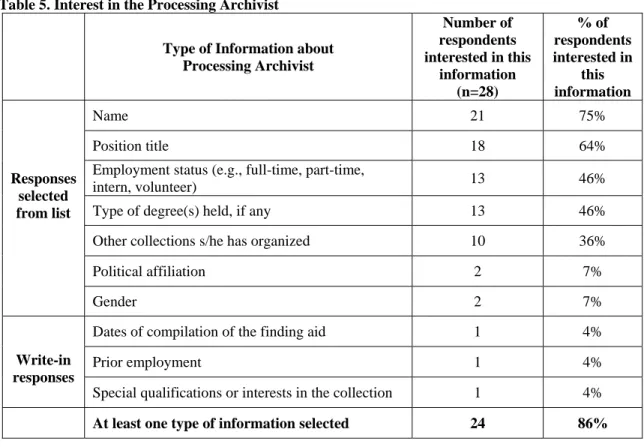
Table 5 provides a breakdown of the types of information about the processing archivist in which respondents reported interest. The most popular response was the archivist’s name, selected by 21 respondents (75% of all survey respondents and 88% of those who answered this question); this will be encouraging to archives in the practice of routinely providing that information in their finding aids. Respondents also showed interest in what can be categorized as “professional information” about the archivist.
39 R26. 40
Eighteen respondents indicated interest in the archivist’s professional title, 13 indicated interest in the archivist’s employment status and type(s) of degree held, and 10 indicated interest in other collections the archivist has organized. Two of the three write-in responses also pertained to professional information, with the first being “prior employment” and the second “special qualifications or interests in the collection.”
Least popular on the list were more personal types of information such as political affiliation and gender—arguably the types of information that are most likely to bias the archivist. One respondent detected the motive for the question, stating that the question “seems to assume a political/gender/educational bias on the part of the archivist that, in my experience, I have never encountered.”41 The same respondent, who reported interest only in the processing archivist’s name, noted, “Their names may be useful if I need to talk with them about the finding aid, but other information is irrelevant to me.” Other respondents’ comments on this question suggest that they made distinctions between the information that interests them and the information to which they feel entitled. One respondent noted, “I’d like to know more about political affiliation but believe it would violate their privacy to ask for more than what is publicly available.”42 It is also possible that researchers may not want the knowledge of personal information to influence their views of the archives or archivist.
41 R8. 42
Table 5. Interest in the Processing Archivist
Type of Information about Processing Archivist
Number of respondents interested in this
information (n=28) % of respondents interested in this information
Name 21 75%
Position title 18 64%
Employment status (e.g., full-time, part-time,
intern, volunteer) 13 46%
Type of degree(s) held, if any 13 46%
Other collections s/he has organized 10 36%
Political affiliation 2 7%
Responses selected from list
Gender 2 7%
Dates of compilation of the finding aid 1 4%
Prior employment 1 4%
Write-in responses
Special qualifications or interests in the collection 1 4%
At least one type of information selected 24 86%
Respondents were also asked to describe the nature of their prior interactions with processing archivists, defined as “the archivist who organized or wrote the descriptions (e.g., the finding aid) for the collection.”43 The comments for this question revealed that many researchers do consider the processing archivist a useful resource for specific collections, and do utilize the processing archivist whenever he or she may support their research.
Thirteen of the respondents (46%) reported having requested to speak to a
processing archivist. In most of these interactions, it appears that the processing archivist was utilized in a specialized reference capacity, providing details about collections that are typically considered too specific for inclusion in the finding aid. One respondent
43
reported phone, email, or in-person contact with the archivist, stating that this type of interaction “proves particularly helpful if finding-aid descriptions remain too generic.”44 Another respondent spoke to the “generic” state of finding aids, noting, “I’ve sometimes asked archivists for help in finding information in a collection that would not come up in the finding aid. For example, I might ask if the archivist knew if certain topics came up in the course of someone’s correspondence, journals, writings, etc.”45 In one case, the processing archivist aided the researcher’s planning; the researcher reported having “dozens of conversations with archivists over the content of collections…usually about the chances of finding materials on a particular subject or of a particular type in those files.”46 One respondent offered to help the processing archivist in clarifying a piece of information in the finding aid: “I was able to correct one speculation that she had made about one proper name that showed up in the materials.”47
The respondents reported some cases of asking a processing archivist for help in locating related materials, such as “other collections similar to the ones I am working with” or unprocessed collections. One respondent reported “trying to get the archivist to either open a sealed archive or provide information so that I may request access,”48 another that “the archivist helped me to locate uncatalogued materials.”49 One respondent, particularly insightful about the process of arranging and describing
44 R3. 45
R29. 46
R9. 47
R18. 48
R5. 49
materials, described asking an archivist about “background on the original condition of the collection, criteria that guided processing, and materials moved to other collections in the same library.”50
One respondent selected the answer “not sure” to the question of whether he or she had requested to speak to the processing archivist. While this response only represents 4% of the respondent pool, it poses an interesting question of whether
researchers—and seasoned researchers at that; this particular respondent reported visiting more than 10 archives—are aware of the existence or functions of the processing
archivist. Of course, the “not sure” answer could have been a result of visiting smaller, less stratified archives, or another reason altogether. Given that so many respondents reported gaining very useful information by speaking with the processing archivist, it seems a shame that fourteen (50%) of them reported that they had never requested to do so.
Limitations and Suggestions for Further Research
One goal of this study was to present a sort of portrait of the type of researcher— in terms of academic field, archival experience, and so forth—who is interested in
administrative and processing information beyond that which is typically made available. Two factors limited this type of generalization. Only faculty from UNC-Chapel Hill were surveyed; further research would need to include many more types of researchers (for example, students, genealogists, journalists, and so forth), reflecting the diversity of primary source users. Secondly, this study’s response rate proved too low to generalize to everyone within the sample (the 361 recipients of this survey).
Conducting this study with an online questionnaire and limited resources proved to be a challenge. One 2003 study51 showed lower response rates for Web surveys that did not involve some sort of telephone contact, but given the large recipient pool and the time constraints of one academic semester, this additional contact would have been prohibitively labor-intensive.
Targeting appropriate recipients for the questionnaire proved to be a challenge. Ideally, the survey would have been sent only to known primary source users. This challenge could be overcome if the study were conducted by an archives, as archivists could distribute the survey to their patrons, either in-person or through their Web site, as long as they were able to sufficient protect the confidentiality of those patrons. Because a goal of this study is to aid archives in making decisions regarding whether to provide extended access to administrative records and processing information, it would be an appropriate study for individual archives. In addition to surveying their users, archives might also gather the opinions of their non-users: people who could potentially be served by their collections, but who have not used them.52
Further, the questionnaire itself could be either replaced or accompanied by one-on-one interviews with primary source users. A 1995 study53 cited a general rise in non-response rates for survey research, and though the questionnaire offers useful,
51
Porter, Stephen R. and Michael E. Whitcomb. “The Impact of Contact Type on Web Survey Response Rates.” Public Opinion Quarterly 67.4 (Winter 2003): 579-588.
52
For one example of how an archives’ non-users were selected for surveying, see Matthew T. Turi’s
Working on the South: A Statistical Description of Scholarly Use and Non-Use of the University of North Carolina at Chapel Hill’s Manuscripts Department’s Collections (master’s paper). Chapel Hill, N.C.: University of North Carolina at Chapel Hill, 2004.
53
Conclusion
This exploratory study suggests that researchers are indeed interested in accessing the types of information that Hyry and Light suggest including in a “colophon,” and the study has provided valuable user feedback towards this proposed addition to finding aids. The benefits of the colophon extend further, however, than the reported desires of the researchers in this study. The colophon should also be considered as a useful educational tool—for users, but also for archivists and archivists-in-training.
This research did not explicitly support the perception of the archivist as an individual with personal or experiential bias; in fact, as noted, one researcher rejected this suggestion. That does not mean that the bias does not exist; it simply suggests that if bias does exist, many researchers may not recognize it. To this end, Elizabeth Yakel suggests using something like a colophon as a user education tool: “Attribution and perhaps even the addition of the authors’ biographies is essential contextual information for researchers in evaluating the authority and perspective of the finding aid.”54
To practicing archivists, it may seem impractical to spend time writing an extended processing note. This is particularly probable in light of the current “minimal processing” trend first proposed by Mark A. Greene and Dennis Meissner as a solution to
54
decreasing backlogs.55F
Considering these critical changes in the practice of processing, however, the documentation of processing decisions is arguably more important than ever. If more archives are moving toward minimal processing, colophons—particularly those made available in online finding aids—may offer valuable insight into the actual decision-making that went into the choice to minimally process a collection. Likewise, the colophon offers an accessible way for archivists and archival theorists to study this shift in practice.
Few people know a collection better than the person who processed it. This research suggests that any extended processing information, whether in the form of written records or the processing archivists themselves, is most valuable when it helps primary source users conduct their research. In addition to the broader accountability, transparency and visibility that the colophon supports, it also provides a relatively simple way for processors to share—over the long term—their intimate knowledge of collections with researchers who work toward knowing the collection intimately themselves.
55
WORKS CITED
Altman, Burt and John R. Nemmers. “The Usability of On-line Archival Resources: The Polaris Project Finding Aid.” American Archivist 64 (Spring/Summer 2001): 121-131.
Boles, Frank. “Disrespecting Original Order.” American Archivist 45.1 (Winter 1982): 26-32.
Cook, Terry. “Archival Science and Postmodernism: New Formulations for Old Concepts.” Archival Science 1 (2001): 3-24.
---. “Remembering the Future: Appraisal of Records and the Role of Archives
in Constructing Social Memory,” in Archives, Documentation, and Institutions of Social Memory, Francis X. Blouin, Jr. and William G. Rosenberg, eds. Ann Arbor: University of Michigan Press, 2006: 169-181.
Cox, Richard J. “Archival Anchorities: Building Public Memories in the Era of the Culture Wars.” MultiCultural Review (June 1998): 52-60.
---. “International Perspectives on the Image of Archivists and Archives: Coverage by
The New York Times, 1992-1993.” International Information & Library Review
25 (1993): 195-231.
De Hamel, Christopher. Scribes and Illuminators. Toronto: University of Toronto Press, 1992: 44.
Traditional Archival Processing.” American Archivist 68 (Fall/Winter 2005): 208- 263.
Ham, F. Gerald. Selecting and Appraising Archives and Manuscripts. Chicago: Society of American Archivists, 1993.
Hyry, Tom and Michelle Light. “Colophons and Annotations: New Directions for the Finding Aid.” American Archivist 65 (Fall/Winter 2002): 216-230.
Kaiser et al. How to Proceed: A Procedures Manual for the Southern Historical
Collection and General Manuscripts. University of North Carolina at Chapel Hill, October 2006. http://www.lib.unc.edu/mss/processing_manual_for_pdf.pdf Ketelaar, Eric. The Archival Image: Collected Essays. Hilversum: Verloren, 1997. Max, D.T. “Final Destination.” The New Yorker (11 June 2007). 6 June 2007
<http://www.newyorker.com/reporting/2007/06/11/070611fa_fact_max?currentPa ge=5>.
Nardi, Bonnie A. and Vicki L. O’Day. Information Ecologies. Cambridge: The MIT Press, 1999.
Porter, Stephen R. and Michael E. Whitcomb. “The Impact of Contact Type on Web Survey Response Rates.” Public Opinion Quarterly 67.4 (Winter 2003): 579-588. Smith, Tom W. “Trends in Non-response Rates.” International Journal of Public Opinion
Research 7.2 (Summer 1995): 157-171.
Department’s Collections (master’s paper). Chapel Hill, N.C.: University of North Carolina at Chapel Hill, 2004.
Yakel, Elizabeth. “Archival Representation,” in Archives, Documentation, and
Institutions of Social Memory, Francis X. Blouin, Jr. and William G. Rosenberg, eds. Ann Arbor: University of Michigan Press, 2006: 151-163.
---. “Thinking Inside and Outside the Boxes: Archival Reference Services at the Turn of the Century.” Archivaria 49 (1999): 140-160.
Yakel, Elizabeth and Deborah A. Torres. “AI: Archival Intelligence and User Expertise.”
Appendix A: Email Request for Participation
Dear Scholar:
Hello. I am Angela McClendon, a graduate student in the School of Information and Library Science at the University of North Carolina at Chapel Hill. I am conducting research in support of a master’s paper, “Extending Access to Archival Processing Information.”
This study is an attempt to learn about the attitudes of users of archival materials about gaining access to administrative and background information related to archival
collections (administrative files and information about staff who process the collections). A richer understanding of the research preferences of working scholars will help archives to decide whether or not to provide additional information about collections.
The survey, accessible through a link at the end of this email, asks questions about your experience using archival collections, as well as questions about your interest in gaining access to extended information about archival processing. It is designed to be completed in 10-15 minutes. Participation in this study is completely voluntary and you may choose not to answer any particular question or questions. Any information that you do provide will be kept anonymous.
All research on human volunteers is reviewed by a committee that works to protect your rights and welfare. If you have questions or concerns about your rights as a research subject you may contact, anonymously if you wish, the Institutional Review Board at 919-966-3113 or by email to [email protected].
If you have any concerns, questions, or comments about this survey and the research study it supports, please feel free to contact me (by telephone (919) 929-9686 or email [email protected]) or my academic advisor, Professor Christopher A. Lee at (919) 962-7024 or at [email protected]).
I sincerely hope that you will choose to participate in this study by completing this survey by June 22, 2007. Your contributions will be very valuable to the study. Thank you for your consideration.
Appendix B: Follow-up Recruitment Email
Dear Scholar:
Hello. I am writing to follow up on an invitation to participate in a 10-15 minute online survey in support of a UNC School of Library and Information Science master's paper, "Extending Access to Archival Processing Information." If you've already completed the survey, thank you very much for participating. If you have not completed the survey and would like to participate, this link will direct you to the survey: [Survey URL]
The survey asks questions about your experience using archival collections, as well as questions about your interest in gaining access to extended information about archival processing. Participation in this study is completely voluntary and you may choose not to answer any particular question or questions. Any information that you do provide will be kept anonymous.
All research on human volunteers is reviewed by a committee that works to protect your rights and welfare. If you have questions or concerns about your rights as a research subject you may contact, anonymously if you wish, the Institutional Review Board at 919-966-3113 or by email to [email protected].
If you have any concerns, questions, or comments about this survey and the research study it supports, please feel free to contact me (by telephone (919) 929-9686 or email [email protected]) or my academic advisor, Professor Christopher A. Lee at (919) 962-7024 or at [email protected]).
I sincerely hope that you will choose to participate in this study by completing this survey by June 22nd, 2007. Your contributions will be very valuable to the study. Thank you for your consideration.
Appendix C: Consent Form
University of North Carolina-Chapel Hill Consent to Participate in a Research Study Adult Participants
Social Behavioral Form
________________________________________________________________________
IRB Study # 07-0988
Consent Form Version Date: May 15, 2007
Title of Study: Extending Access to Archival Processing Information
Principal Investigator: Angela McClendon
UNC-Chapel Hill Department: School of Information and Library Science
UNC-Chapel Hill Phone number: (919) 962-8366
Email Address: [email protected]
Faculty Advisor: Dr. Christopher A. Lee
Funding Source: not funded
Study Contact telephone number: (919) 929-9686
Study Contact email: [email protected]
_________________________________________________________________
What are some general things you should know about research studies?
You are being asked to take part in a research study. To join the study is voluntary. You may refuse to join, or you may withdraw your consent to be in the study, for any reason, without penalty.
Research studies are designed to obtain new knowledge. This new information may help people in the future. You may not receive any direct benefit from being in the research study. There also may be risks to being in research studies.
Details about this study are discussed below. It is important that you understand this information so that you can make an informed choice about being in this research study. It is recommended that you print out a copy of this consent form for your records. You should ask the researchers named above, or staff members who may assist them, any questions you have about this study at any time.
What is the purpose of this study?
The purpose of this research study is to learn about the attitudes of users of archival materials towards the provision of extended administrative background information about archival collections, as well as information about the people who process archival
collections.
You are being asked to be in the study because your field of study often involves the use of archival materials.
Are there any reasons you should not be in this study?
You should not be in this study if you have never used archival materials (unpublished letters, photographs, diaries, deeds, oral histories, legal or financial papers, blueprints, ledgers, original writings, maps, administrative papers, audiovisual recordings, contracts, case studies, survey data, etc.).
How many people will take part in this study?
If you decide to be in this study, you will be one of approximately 150 people in this research study.
How long will your part in this study last?
This survey takes 10-15 minutes to complete. There will be no follow-up.
What will happen if you take part in the study?
You will complete a questionnaire asking you two types of questions: general questions about your experience using archival materials, and specific questions about your level of interest in extended access to information regarding the organizing and describing of archival collections. You may stop participating and exit the survey at any time.
What are the possible benefits from being in this study?
Research is designed to benefit society by gaining new knowledge. You may not benefit personally from being in this research study.
What are the possible risks or discomforts involved from being in this study?
There are no known risks involved from participating in this study.
How will your privacy be protected?
Participants’ survey answers are collected by the online survey tool Qualtrics. You will be identified by a unique number, and your answers will not be connected to your email address or any other identifiable information. The Principal Investigator is the only person with access to this Qualtrics account. The account is on a secure network. After survey data have been analyzed, the Qualtrics account and all data will be deleted.
Will you receive anything for being in this study?
You will not receive anything for taking part in this study.
There will be no costs for being in the study.
What if you are a UNC employee?
Taking part in this research is not a part of your University duties, and refusing will not affect your job. You will not be offered or receive any special job-related consideration if you take part in this research.
What if you have questions about this study?
You have the right to ask, and have answered, any questions you may have about this research. If you have questions, or concerns, you should contact the researchers listed on the first page of this form.
What if you have questions about your rights as a research participant?
All research on human volunteers is reviewed by a committee that works to protect your rights and welfare. If you have questions or concerns about your rights as a research subject you may contact, anonymously if you wish, the Institutional Review Board at 919-966-3113 or by email to [email protected].
Appendix D: Survey
[The first page of the online survey was the study’s consent form. See Appendix C: Consent Form.]
1. How many archives (e.g. university and college special collections, government agencies, historical societies) have you visited?
[ ] 0 [ ] 1-2 [ ] 3-10
[ ] More than 10
[ ] I do not recall, but I have used archival (primary source) materials.
2. How would you rate your understanding of archives and skill level in using archival materials?
[ ] Low [ ] Adequate [ ] Competent [ ] Proficient [ ] Expert
3. If you have used primary source materials in conducting any kind of research, please indicate the anticipated outcome of that research (select all that apply):
[ ] Gathering information, but without a final product in mind [ ] Class assignment
[ ] Dissertation or thesis [ ] Book, article, or report [ ] Family history research
[ ] Administrative or work-related task
[ ] Other (Please specify): __________________________________
a description of the scope and contents of a collection, administrative information, restrictions, and a detailed box and folder listing.
How often do you typically consult a finding aid in planning or conducting research with archival materials?
[ ] Very frequently [ ] Frequently [ ] Occasionally [ ] Infrequently [ ] Very infrequently [ ] Never
5. The following are examples of information about a collection that most archives keep apart from a collection, sometimes inaccessible to researchers. If these materials were made available to you, how interested would you be in seeing them?
Very Interested
Interested Neutral Uninterested Very Uninterested Notes regarding the acquisition of the
materials
Correspondence between the archives and the donor of materials
Donor agreement
Criteria for selecting materials to include in the collection
Records of discarded materials Records of materials returned to the donor
Records of materials transferred to other repositories
Records of books removed from the collection and kept separately Notes regarding the original physical condition of the materials
Notes regarding the original organization of the materials
Previous requests to see the collection Previous requests for
6a. In the process of doing research, have you ever requested to see any of the following materials?
Yes No Not sure
Notes regarding the acquisition of the materials
Correspondence between the archives and the donor of materials
Donor agreement
Criteria for selecting materials to include in the collection
Records of discarded materials
Records of materials returned to the donor
Records of materials transferred to other repositories
Records of books removed from the collection and kept separately Notes regarding the original physical condition of the materials
Notes regarding the original organization of the materials
Previous requests to see the collection Previous requests for copying/duplication of items
Old versions of the collection’s finding aid
6b. If you answered YES to any of these items, please indicate which items the archives provided to you.:
6c. Comments:
7. What information about the archivist who organized or wrote the descriptions (e.g., the finding aid) for a collection would you like to have? Select all that apply.
[ ] Name [ ] Position title
[ ] Employment status (e.g., part-time, full-time, intern, volunteer) [ ] Type of degree(s) held, if any
[ ] Political affiliation [ ] Gender
8a. Have you ever requested to speak to the archivist who organized or wrote the descriptions (e.g., the finding aid) for a collection?
[ ] Yes [ ] No [ ] Not Sure
8b. If you answered YES, please describe the nature of your interaction with the archivist.
9. What is your primary field of study? (optional)
[ ] Anthropology [ ] Journalism and Mass Communication
[ ] Classics [ ] Music
[ ] Communication Studies [ ] Political Science
[ ] English [ ] Religious Studies
[ ] Folklore [ ] Sociology
[ ] Geography [ ] I prefer not to answer.
[ ] History [ ] Other: ____________________
10. Please provide any further comments you may have.
[end]