Abstract
One issue associated with Staphylococcus aureus is the development of drug resistance. A recently emerged strain of MRSA, ST398, has been identified as livestock-associated and transmission has been found between animal and human. In the U.S., ST398 has been identified in livestock workers in Iowa and North Carolina. The development of virulence factors in S. aureus is also an issue. The virulence factor Panton-Valentine leukocidin increases the pathogenicity of a specific S. aureus infection. The goal of this study is to evaluate the
prevalence of pvl in S. aureus isolates collected from a community of North Carolina livestock workers. PCR was utilized to identify pvl carriage. All S. aureus isolates examined have been negative for pvl. In order to achieve a better understanding of the isolates, more research can be done looking at the prevalence of other virulence factors.
Introduction
Staphylococcus aureus is a gram-positive bacterium that has the ability to cause infection and disease in humans. Human infections caused by S. aureus can vary from soft tissue
Panton-Valentine Leukocidin
Genes encoding various virulence factors and antibiotic resistance in S. aureus are located on the single circular chromosome as well as on extrachromosomal DNA such as plasmids (Lowy, 1998). One common virulence factor is Panton-Valentine leukocidin (PVL), a cytotoxic extracellular protein associated with necrotizing pneumonia, a type of human infection (Genestier et al., 2005). This virulence factor is encoded by a prophage and is integrated into the S. aureus circular chromosome (Boakes et al., 2011). PVL affects the pathogenicity of a specific S. aureus infection as it forms pores in host defense cells, especially neutrophils, which damage these cells irreversibly and provides nutrients to the specific S. aureus infection (Löffler et al., 2010). Specifically, PVL is a synergohymenotropic toxin, a toxin that works via the association of two distinct secreted polypeptides, LukS-PV and LukF-PV (Lina et al., 1999; Miles et al., 2002). The two polypeptides, LukS-PV and LukF-PV, are encoded by two genes on the
integrated prophage. Less than 2% of current S. aureus strains produce the virulence factor PVL (Dyer, 2007).
Livestock-Associated ST398 MRSA
between different humans (Voss et al., 2005). ST398 MRSA isolates from pigs were all found to be negative for pvl. However, some ST398 MRSA isolates from farmers were found to be positive for pvl, suggesting that this specific strain has the ability to acquire the PVL virulence factor (Wulf et al., 2008). In the United States, ST398 has been identified in pig farm workers in Iowa and North Carolina (Smith et al., 2009; Rinsky et al., 2013). However, no studies in the United States have examined whether ST398 or other livestock-associated strains carry PVL. Without this information, it is difficult to determine whether these strains pose a potential health risk to workers, their household members, and their communities.
The goal of this study is to evaluate the prevalence of pvl in S. aureus isolates collected from North Carolina livestock workers and their corresponding household members. Data so far is limited with regard to the virulence of livestock-associated strains of S. aureus, and because these strains can develop high levels of antibiotic-resistance, more information concerning the pathogenicity of livestock-associated strains of S. aureus is required.
Methods
Data Collection
S. aureus isolates collected for a four month epidemiology study of North Carolina livestock workers were tested for Panton-Valentine leukocidin gene positivity. A total of 722 S. aureus isolates were identified and archived from 183 North Carolina participants, forming the collection of S. aureus isolates to be examined in this study. The 183 participants from this study were recruited by members from the Rural Empowerment Association for Community Help (REACH). To be eligible for participation, participants had to be residents of North
were also able to be participants. REACH members utilized a snowball sampling method to recruit all participants of this study. Participants provided samples with BD BBL CultureSwabs every two weeks from both nares, resulting in a baseline sample and up to eight chronological follow-up samples. Isolates were grown from these nasal samples on both Baird Parker and BBL CHROMagar media plates and stored cryogenically at -80°C.
Detection of Panton-Valentine Leukocidin Gene
For pvl testing, isolates were collected from freezer storage and grown at 37°C on 5% Sheep Blood Agar (Thermo Scientific Remel, Lenexa, KS) for a period of 24 hours. A sterile 10µL loop was used to transfer S. aureus culture to microcentrifuge tubes containing 100µL of DNA Extraction Buffer (Reischl et al., 2000). The microcentrifuge tubes were vortexed and then heated on a heating block set to 100°C for 10 minutes. After letting the microcentrifuge tubes cool for 2 minutes, they were again vortexed and then placed in a microcentrifuge.
Centrifugation occurred for 5 minutes at 13,000 rpm. 2µL of the completed DNA extract for each S. aureus isolate were pipetted into PCR tubes containing 23µL of PCR master mix. One aliquot of PCR master mix was composed of 10µL 2.5x 5’ MasterMix, 5pmol pvl forward primer, 5pmol pvl reverse primer, and 12.5nmol MgCl2. The two primers utilized to amplify the pvl were luk-PV-1 (forward) and luk-PV-2 (reverse). The primer sequences for luk-PV-1 and luk-PV-2 can be seen below in Table I.
Table I. Primer sequences used for pvl.
Gene Target Direction Sequence (5'-‐-‐3')
pvl F (luk-‐PV-‐1) ATC ATT AGG TAA ATG GAC ATG ATC CA R (luk-‐PV-‐2) GCA TCA AST GTA TGG ATA GCA AAA GC
Source: (Lina et al., 1999)
30 seconds (denaturation), 55°C for 30 seconds (annealing), and 72°C for 1 minute (extension)
(Lina et al., 1999). PCR products were separated via gel electrophoresis utilizing ethidium bromide staining on 1.5% agarose gel for 45 minutes at 120V. A clinical isolate (provided courtesy of Dr. Jill Stewart, UNC Gillings School of Global Public Health) was used as a positive control for presence of pvl. The positive and negative controls were run through the same extraction protocol used for the test S. aureus isolates. Agarose gels were visualized using ultraviolet light.
Results
All S. aureus isolates examined have been negative for the presence of the
Panton-Valentine leukocidin gene. Figure 1, below, shows a visualized agarose gel utilized to detect the presence of pvl.
Figure 1. Detection of Panton-Valentine leukocidin gene via polymerase chain reaction amplification. Gene product was visualized with ethidium bromide staining on 1.5%
agarose gel. DNA ladder was loaded in lane 1 as a means of molecular weight identification (far left). Lanes 2-17 were loaded with PCR product for 16 different S. aureus isolates. Lane 18 was loaded with positive pvl control PCR product from S. aureus isolate CA 5003. Lane 19 (far right) was loaded with negative pvl control PCR product.
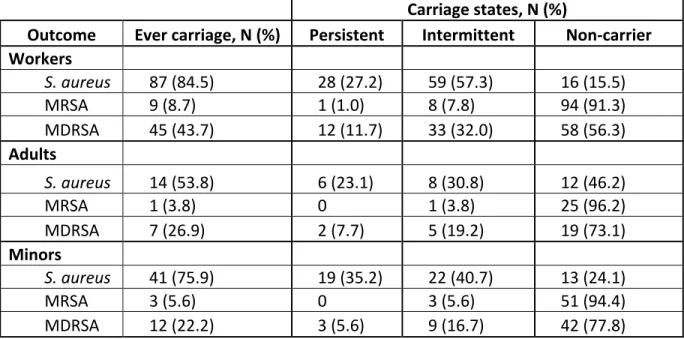
In addition to the above results, all of the collected isolates from the 183 participants were identified and characterized as S. aureus, methicillin-resistant S. aureus (MRSA), or multidrug-resistant S. aureus (MDRSA) by a graduate student. MRSA are S. aureus isolates positive for the mecA gene. MDRSA are S. aureus isolates resistant to three or more different classes of antibiotics. This data can be seen presented below in Table II.
Table II. Occurrence of nasal carriage of Staphylococcus aureus, methicillin-resistant S. aureus (MRSA), and multidrug-resistant S. aureus (MDRSA) from 183 North Carolina livestock worker, adult household member, and minor household member (age 7-17) participants.
Outcome Ever carriage, N (%) Persistent Carriage states, N (%) Intermittent Non-‐carrier
Workers
S. aureus 87 (84.5) 28 (27.2) 59 (57.3) 16 (15.5) MRSA 9 (8.7) 1 (1.0) 8 (7.8) 94 (91.3) MDRSA 45 (43.7) 12 (11.7) 33 (32.0) 58 (56.3)
Adults
S. aureus 14 (53.8) 6 (23.1) 8 (30.8) 12 (46.2) MRSA 1 (3.8) 0 1 (3.8) 25 (96.2) MDRSA 7 (26.9) 2 (7.7) 5 (19.2) 19 (73.1)
Minors
S. aureus 41 (75.9) 19 (35.2) 22 (40.7) 13 (24.1) MRSA 3 (5.6) 0 3 (5.6) 51 (94.4) MDRSA 12 (22.2) 3 (5.6) 9 (16.7) 42 (77.8)
classifications for at least one (1/9) but less than all but one (<8/9) of the sample nasal swabs. The non-carrier carriage state was defined as being negative for one of the classifications for all of the sample nasal swabs (Nadimpalli et al., 2014).
Discussion
The overall goal of this study was to evaluate the prevalence of the Panton-Valentine leukocidin gene in S. aureus isolates collected from livestock workers with occupations in industrial hog operations in North Carolina as well as their corresponding household members. As seen in the Results section, all isolates analyzed with polymerase chain reaction amplification have been negative for pvl.
One important consideration when evaluating current findings is the snowball sampling method utilized in this study to enroll participants. In this specific method of sampling, a participant was enrolled initially and additional participants resulted from communication from this initial participant. As more participants enrolled by word of mouth, the sample size became larger and larger. This method was utilized in order to ensure this study remained within the community of livestock workers and their household members with no risk to their careers or livelihood. Because this snowball sampling method was utilized, it cannot be said that acquired data represents the state of North Carolina or any specific community as a whole. Although biases do exist with this sampling method and the extent to which this data can be utilized is somewhat restricted, the collected data is still valuable to investigate the disease ecology of S. aureus among livestock workers in the United States.
Global and Regional Prevalence of Panton Valentine-Leukocidin Gene
aureus bacteria in general produce PVL (Dyer, 2007). Although minimal research documents the prevalence of pvl, especially with regard to different regions of the world, in the Netherlands ST398 MRSA has been found in 20% of pig farmers and 39% of slaughterhouse pigs (Wulf et al., 2008). As mentioned briefly in the Introduction, tested isolates from slaughterhouse pigs were all found to be negative for pvl, however, some tested isolates from pig farmers were found to be positive for pvl. This research indicates that strain ST 398 MRSA can acquire the PVL virulence factor (Wulf et al., 2008). With regard to North Carolina, ST398 has been found to be present in humans in North Carolina (Rinsky et al., 2013). However, no pvl positive S. aureus isolate, ST398 or other, has been found among livestock workers in North Carolina. Presence of pvl would warrant cause for concern, as PVL has been found to be associated with necrotic infections as well as increased virulence of S. aureus in general (Lina et al., 1999). From the public health perspective, presence of pvl in this North Carolina community and environment would reinforce the idea that steps need to be taken towards limiting the spread and development of drug-resistant S. aureus, especially with regard to antibiotic use in livestock.
Other Virulence Factors
Prevalence of S. aureus, MRSA, and MDRSA and Conclusions
References
Boakes, E., Kearns, A. M., Ganner, M., Perry, C., Hill, R. L., & Ellington, M. J. (2011). Distinct bacteriophages encoding Panton-Valentine leukocidin (PVL) among international
methicillin-resistant Staphylococcus aureus clones harboring PVL. Journal of Clinical Microbiology, 49(2), 684-692. doi:10.1128/JCM.01917-10
Dyer, O. (2007). New MRSA strain is not at epidemic level, expert says. BMJ : British Medical Journal, 334(7583), 10–10–b. doi:10.1136/bmj.39073.635613.DB
Genestier, A.-L., Michallet, M.-C., Prévost, G., Bellot, G., Chalabreysse, L., Peyrol, S., … Genestier, L. (2005). Staphylococcus aureus Panton-Valentine leukocidin directly targets mitochondria and induces Bax-independent apoptosis of human neutrophils. Journal of Clinical Investigation, 115(11), 3117–3127. doi:10.1172/JCI22684
Gorwitz, R. J., Kruszon-Moran, D., McAllister, S. K., McQuillan, G., McDougal, L. K., Fosheim, G. E., et al. (2008). Changes in the prevalence of nasal colonization with Staphylococcus aureus in the United States, 2001–2004. Journal of Infectious Diseases, 197(9), 1226-1234. doi:10.1086/533494
Holden, M. T. G., Feil, E. J., Lindsay, J. A., Peacock, S. J., Day, N. P. J., Enright, M. C., et al. (2004). Complete genomes of two clinical Staphylococcus aureus strains: Evidence for the rapid evolution of virulence and drug resistance. Proceedings of the National Academy of Sciences of the United States of America, 101(26), 9786-9791.
doi:10.1073/pnas.0402521101
Kluytmans, J., van Belkum, A., & Verbrugh, H. (1997). Nasal carriage of Staphylococcus aureus: epidemiology, underlying mechanisms, and associated risks. Clinical Microbiology Reviews, 10(3), 505–520.
Lina, G., Piémont, Y., Godail-Gamot, F., Bes, M., Peter, M.-O., Gauduchon, V., Vandenesch, F., & Etienne, J. (1999). Involvement of Panton-Valentine Leukocidin—Producing
Staphylococcus aureus in Primary Skin Infections and Pneumonia. Clinical Infectious Diseases, 29(5), 1128-1132. doi: 10.1086/313461
Löffler B, Hussain M, Grundmeier M, Brück M, Holzinger D, et al. (2010) Staphylococcus aureus Panton-Valentine leukocidin is a very potent cytotoxic factor for human
neutrophils. PLoS Pathog 6(1): e1000715. doi: 10.1371/journal.ppat.1000715
Lowy, F. D. (1998). Staphylococcus aureus infections. New England Journal of Medicine, 339(8), 520-532. doi: 10.1056/NEJM199808203390806
Nadimpalli, M., Rinsky, J. L., Wing, S., Hall, D., Stewart, J., Larsen, J., et al. (2014). Persistence of livestock-associated antibiotic-resistant Staphylococcus aureus among industrial hog operation workers in North Carolina over 14 days. Occupational and Environmental Medicine, doi:10.1136/oemed-2014-102095
Reischl, U., Linde, H.-J., Metz, M., Leppmeier, B., & Lehn, N. (2000). Rapid identification of methicillin-resistant Staphylococcus aureus and simultaneous species confirmation using real-time fluorescence PCR. Journal of Clinical Microbiology, 38(6), 2429–2433.
Rinsky, J. L., Nadimpalli, M., Wing, S., Hall, D., Baron, D., et al. (2013) Livestock-associated methicillin and multidrug resistant Staphylococcus aureus is present among industrial, not antibiotic-free livestock operation workers in North Carolina. PLoS ONE, 8(7), e67641. doi: 10.1371/journal.pone.0067641
Smith, T. C., Male, M. J., Harper, A. L., Kroeger, J. S., Tinkler, G. P., Moritz, E. D., Capuano, A. W., Herwaldt, L. A., & Diekema, D. J. (2009). Methicillin-resistant Staphylococcus aureus (MRSA) strain ST398 is present in Midwestern U.S. swine and swine workers. PLoS ONE, 4(1), e4258. doi: 10.1371/journal.pone.0004258
Voss, A., Loeffen, F., Bakker, J., Klaassen, C., & Wulf, M. (2005). Methicillin-resistant Staphylococcus aureus in pig farming. Emerging Infectious Diseases. doi:
http://dx.doi.org/10.3201/eid1112.050428
Williams, R. E. O. (1963). Healthy carriage of Staphylococcus aureus: Its prevalence and importance. Bacteriological Reviews, 27(1), 56-71.
Wulf, M., Voss, A. (2008). MRSA in livestock animal--an epidemic waiting to happen? Clinical Microbiology and Infection, 14(6), 519-521. doi:10.1111/j.1469-0691.2008.01970.x