pages. Advisor: Brian Sturm.
This study addresses a difference in settings in fantasy novels with female
protagonists, written with teenage girls as their target readership. The two sets of novels – novels set completely in other worlds and novels set in both the real world and a fantasy world – are analyzed through latent content analysis by five aspects of portrayal of their female protagonists. The protagonists are discussed through their feelings on their worlds' gender roles, feelings of isolation and belonging, close relationships, body image, and personal growth. The implications of the differences between the two categories of novels are discussed in the context of the developmental needs of teenage girls. The generalized strengths and weaknesses of each category are explored in relation to how librarians might make collection development decisions.
Headings:
Fantasy fiction, American – History and criticism – juvenile literature Fantasy fiction, English – History and criticism – juvenile literature
by
Meredith S. Sutphin
A Master’s paper submitted to the faculty of the School of Information and Library Science of the University of North Carolina at Chapel Hill
in partial fulfillment of the requirements for the degree of Master of Science in
Library Science.
Chapel Hill, North Carolina April 2009
Approved by
Table of Contents
Introduction 2
The Readers: Young Adult Girls 3
The Protagonists: Young Women 4
The Genre: Fantasy 6
The Context: Place 9
Methodology 13
Characteristics of Portrayal 14
Gender Roles and Behaviors 15
Belonging and Isolation 27
Close Relationships 36
Body and Self Image 46
Inner Quest 57
Analysis of the Five Aspects of Portrayal 66
Otherworld Novels vs. Gateway Novels: Implications 70
Conclusions 74
Introduction
The shaping and growth of the psychological selves of teenage girls fascinates doctors, educators, and the media in our culture, with good reason. Parents and
educators have much to fight: eating disorders, abusive relationships, test scores lagging behind those of boys in math and science. At a time when mass media stereotypes of what girls should be can reach their demographic on cell phones at any time of day, in any location, some educators and librarians are championing the selling power of a popular genre of media to challenge images of girls as shallow, weak, and valuable only for their attractiveness. Fantasy stories in movies and novels have been popular teen picks for decades; however, as a number of fantasy stories have reached levels of popularity that seem to have shocked businesspeople in the movie and publication industries, more fantasy books are being published and promoted now than ever before. Set in worlds limited only by authors' imaginations, these books offer new possibilities of portrayals of strong, inspiring young women, and with the genre's boom in popularity, these empowering role models have the potential to reach more young women than ever before.
broken down into two very large categories: novels that take place entirely in worlds different from our own and novels that take place in this world and another world, with action moving between the two. Do these two categories of novels tend to portray female characters in different ways from one another? If there are differences, what are they and what different roles to they depict for young women to follow?
The Readers: Young Adult Girls
The years of middle adolescence which, for girls, fall between age thirteen and age sixteen, are when the characteristic upheavals of young adulthood begin to take place. Cognitively, teens begin to embark upon a journey of discovering who they want to be as they become more intellectually capable to think abstractly and comprehensively, as well as being able to better understand points of view different from their own
(Mitchell, 1979, p. 43-45). However, as teens' capabilities to think and feel mature, young adults often turn those thoughts and feelings on themselves with troubling effects as they being to develop their senses of identity.
Girls in particular face psychological challenges brought on by a barrage of messages about who they should be and what they should want. Though the current state of the psychology of gender has come to value traits and roles formerly thought of as “feminine” along with “masculine,” as well as moving away from the practice of viewing these traits and the two genders as being at opposite ends of a spectrum, present-day American culture does not reflect this thought (Reid, Cooper, and Banks, 2008, pg. 240). Most portrayals of girls and women in the media still promote the stereotypes of
mass media, viewing an average of eight hours of media per day (Reid et. al., 2008, pg. 246-7). Girls internalize and reflect upon the images of womanhood that they are shown, and it is unsurprising that the differences they see between themselves and the images presented or between their inner selves and the roles portrayed can cause them to suffer a loss of self-esteem (Reid et. al., 2008, pg. 249). With the years of adolescence being a crucial time for the formation of self-esteem and building one's identity, it seems crucial that librarians who serve young adults be aware of the messages that the media on their shelves portray (Impett, Sorsoli, Schooler, Henson, and Tolman, 2008, p. 722).
Just two decades ago, librarians clamored for more books for young adults that portrayed women in non-stereotypical ways. While the past fifteen years have seen many developments in the world of young adult literature, from the relative disappearance of the teenage problem novel to the overwhelming popularity of hit book series such as the Harry Potter and Twilight series, Linda Forrest identified in 1993 that “fantasy is one
area of young adult literature that offers a rich source of gender-fair fiction.” The
freedoms that the fantasy genre allows permit writers to create dynamic female characters whose roles are not limited by the realities of this world's modern-day culture.
The Protagonists: Young Women
and body image in novels for teenage girls; the frequent focus of the novels themselves on these issues and the prolific discussion about the way they are portrayed indicates, as Beth Younger says, that “these texts ... are important sites of cultural contestation” (2003). However, still, many novels for this group of readers promote images of young women who are not sexually liberated; frequently, female protagonists' nurturing, friendly, self-sacrificing natures were emphasized (Benjamin and Irvin-DeVitis, 1998). Perhaps the protagonists who fall between the two poles of “sugar, spice, and everything nice” and shocking have not been the subject of study, but the emphasis of these many studies on these two types of portrayal of teenage girls may show that few protagonists fit other roles.
Even as the number of young adult novels that have strong, empowering female protagonists grows, some researchers wonder if readers can take inspiration from those characters or if readers have been conditioned to value characters for certain traits based on gender stereotypes. Benjamin and De-Vitis surveyed both male and female teenagers about their thoughts on female characters in books; the responses of the young adults emphasized that attractiveness was what made them like female characters most
the novels' target readers and on a wider scale in our culture. Yet, teenagers may not be choosing to read the novels that do explore these issues well, and when these novels are selected, readers may not choose to take the same empowerment and inspiration from them that their adult critics seek to promote. However, what librarians and educators who advocate the power of fantasy novels to promote these messages believe is that setting novels in a whole new world with its own rules can help readers to think outside the boxes of our own culture.
The Genre: Fantasy
The rise of the fantasy genre to a level of relevance in popular culture beyond that of other genres of fiction such as westerns and science fiction can be seen through
looking at recent movies released targeting teenagers: Twilight, the Harry Potter movies, Narnia and Prince Caspian, and The Golden Compass are among the past few years'
releases which are all dramatizations of works of fantasy fiction written for young people. Few cultural phenomena have been followed with the same dedicated fervor that has been given to J.K. Rowling's Harry Potter series (which, in 2005, had sold enough copies of the books to circle the globe 1.4 times) and Stephenie Meyer's Twilight series (Oatman, 2005). And many of these young fantasy readers are female; a 2000 survey by
Smartgirl.com revealed that fantasy is the second-most popular genre among the female respondents (Chance, 2000). A number of scholars have observed the potential in this trend, positing that fantasy fiction can provide varied and new portrayals of female identity for girls to observe:
and has traditionally been a genre in which women escape the standard cultural roles. Portrayals of passive females can certainly be found; nevertheless, readers are often offered a chance to experience what females could be instead of what they are. (Forrest, 1993, pg. 38) Fantasy has not always been a haven for prominent female characters; in her content analysis of twenty-six award-winning fantasy novels published between 1953 and 1979, Carol Whitehurst found that the majority of female characters still played mainly
supporting roles, rarely featuring as protagonists in fantasy novels over the span of thirty years (Du Mont, 1993, pg. 12). However, female characters began to come into more prominence in young adult fantasy novels in the 1980s; Du Mont concluded in her own study that this change was due to the increasing number of female fantasy authors, as well as increasing opportunities for women in the real world, which were being reflected in popular literature (pg. 15). “This reason is somewhat depressing,” Du Mont writes, “because science fiction and fantasy, as literature of change should be more than one step ahead of real-world society” (pg. 15). The final decade of the twentieth century saw the true rise of the female heroine in young adult fantasy, and with the genre's commercial success, especially among female readers, it shows promise of becoming the genre of equality that Du Mont, Whitehurst, and others anticipated (Forrest, 1993, pg. 39).
Fantasy has been defined by critics, fans, and authors with a multitude of definitions that span from simple literature of escapism to complex “quest[s] of
(Blackford, 2004, pg. 17).
Blackford approached her own study of adolescent female readers of fantasy with the expectation that the inner journeys of the female characters would provide girl readers with memorable, valuable opportunities to identify with role models in literature.
However, Blackford found that the girls in her study rebelled against the idea that they were supposed to identify with the female character or see through her eyes; instead, the girls expressed that they enjoyed fantasy novels (with either male or female protagonists) for the feeling of becoming immersed in the unfamiliar and different worlds of the novels (pg. 19). For the study participants, the experience of ludic reading was the most salient reason for opening a fantasy book: Blackford's study suggests that, perhaps, “escapism” is not such a simple definition after all (p. 7).
challenges of life are dramatized with overt grandeur (2004, pg. 33). Chase M. Will, a teen writer for Young Adult Library Services, provides a more concrete example: “in Harry Potter, readers [...] see everything through the spectacled eyes of an orphan who
goes from thinking he's nobody to finding out that he has a purpose of dire importance to the entire world, something that all teens hope to discover about themselves on some level” (2008, pg. 17). The allure of the other (a world of witchcraft and wizardry, in the case of Harry Potter) is combined with the reflection of self provided by the human emotions and motivations expressed by the characters. While Blackford's readers appreciate otherness most and Will appreciates human connection, both elements are important parts of the fantasy fiction genre.
The Context: Place
Fantasy unites both these impulses – the impulse to escape and the impulse to connect – through setting stories that speak to readers' hearts and minds in settings bounded only by the imagination. The worlds of fantasy fiction are an essential part of their genre. John Timmerman defines fantasy world by three particular characteristics that address the importance of otherness. First, he emphasizes that fantasy “matches our world in reality, [...] a world in which characters confront the same terrors, choices, and dilemmas we confront in our world” (1983, p. 49). Second, he qualifies his first
word “escapist” that some critics of the genre use to denigrate it (p. 50). However, Timmerman's reference to this use of “escapism” seems to refer to the simplification of the genre into the idea of simple fancifulness; the girls in Blackford's study “escape” into fantasy literature in a way that seems more complex than either Timmerman or the critics he refers to mean. Timmerman gives a definition of fantasy as a genre based on place and rooting the genre in its connection to the inner reality of the experience of life, but narrower terms are needed to examine place in fantasy in more depth.
The fantasy genre covers a wide variety of stories set in a variety of different worlds. Trying to examine the role of place in fantasy requires this variety to be narrowed down and categorized in a meaningful way; however, surprisingly, few categorical systems for approaching fantasy this way exist. Farah Mendlesohn's groundbreaking Rhetorics of Fantasy, published in 2008, outlines a language for discussing place in fantasy through observing the ways that the other and the everyday intersect (or do not intersect). She provides four distinct categories: immersive fantasy, portal-quest fantasy, intrusive fantasy, and liminal fantasy.
entirely in another world does not automatically situate a story in the immersive category; many quest fantasies, such as The Lord of the Rings or Robert Jordan's Wheel of Time series begin in another world familiar to the protagonists, yet the protagonists themselves are plunged into a world unfamiliar to them (p. 2). It is the characters' familiarity with the world, not the readers', that is the essential defining characteristic of each category. The language of the label “portal-quest fantasy” points to the dual nature of this category. Mendlesohn explains: “Modern quest and portal fantasies rely upon very similar narrative strategies because each assumes the same two movements: transition and exploration” (pg. 2). In portal fantasies, the protagonist begins the story in this world and moves into the otherworld; quest fantasies echo this structure, taking the protagonist from the known (though his or her “known” may be a new world for the reader) to the unknown, with some event as the point of entry to the action (pg. xix). This category, in particular, emphasizes that place is more than setting – the idea of place also includes how the protagonist knows and understands that setting, with emphasis on the transition of setting.
Intrusive fantasy can be said to be portal-quest fantasy's opposite. Instead of entering into a different world, the protagonist of the intrusive fantasy finds the
or her own world and the otherworld, an outsider to both, and much of the tension in intrusive fantasy comes from the drawing, seductive pull of the otherworld presented before the protagonist (p. 115). At the same time, intrusive fantasy novels build around the push of escalation; the situation gets more and more dire, pressing the protagonist toward action (p. 153). In intrusive fantasies, the balance and tension of place moves the plot and the growth and change of characters.
Mendlesohn also addresses liminal fantasies (which present fantasy worlds entirely separate from the realities of the protagonist and which the protagonist does not interact with) and fantasy stories that cannot be categorized within her system; however, liminal fantasies are few and obscure (especially within the realm of young adult
fantasy), and these three categories provide the main substance of her system.
Methodology
I chose to combine Mendlesohn's categories of portal-quest fantasy and intrusive fantasy into a single category which I have termed gateway world fantasy: stories with a protagonist who crosses back and forth between her own world and another. I termed Mendlesohn's immersive fantasies otherworld fantasies to clarify the distinction between the two categories. With these two categories in mind, I used selection sources for young adult literature to find six books to fit each category; I felt that six books of each would provide enough variety to allow me to see patterns and draw conclusions without being beyond the scope of a masters paper.
Characteristics of Portrayal
Gender roles and behaviors
Table 1. Gender roles and behaviors
Open and varied roles for protagonist to choose from
Roles are strict: protagonist accepts them Roles are strict: protagonist struggles against Otherworld
Chalice x
Fairest x
Graceling x
The Naming x
Singer of All Songs x
Terrier x
Gateway
East x
A Great and Terrible Beauty
x
Marked x
Tithe x
Wicked Lovely x
Wildwood Dancing x
to speak out, to hold positions of power and influence, to make their own decisions, and to choose their own destinies, depending on the type of world the author creates and how the protagonist is situated in that world. All the different portrayals of female characters and how they embody their world's concepts of what a woman should be provide a variety of models for readers to observe and provide new perspectives through which they can explore their own lives and worlds.
Otherworld novels usually include the building of societies as part of larger world-crafting, and authors of stories set in these worlds must make decisions regarding how women are expected to act and whether their protagonists will follow those
expectations. Gateway novels provide opportunities for protagonists to experience two sets of societal expectations, and the way that protagonists fit and react to the conventions of new worlds allow authors to challenge the societal expectations of protagonists' own worlds.
Though the fantasy genre gives authors many freedoms that writers of other genres popular with teens (such as realistic fiction and historical fiction) do not have, not all fantasy books are set in worlds where women are free, equal, and without limits. On the contrary, many of the stories in the selected novels are propelled by tensions between the protagonist and her society. At the same time, not all of the novels in this study included gender role issues at the centers of their stories; though all the worlds made some sort of statement about what was expected of women, these expectations affected the stories and the characters with varying degrees of intensity.
which had strict, rigid social expectations. I had anticipated that more of the otherworld novels would provide female characters with more freedoms than characters in gateway worlds had; I came to find that few of the books chosen in either category had worlds that provided these freedoms. Perhaps this is because the tensions between characters' actions and the expectations of their world are powerful tools for characterization and moving the plot along, and teen girl readers may identify more readily with characters who
experience limitations similar to the ones they face in the real world. The books that did not center on that tension had other issues that drove their plots. Notably, the two otherworld books that contained the least tension between their protagonists' actions and societal gender roles were the two books that fit certain narrative patterns most closely, namely the patterns of the police procedural novel and the epic quest.
and a lady knight. Other women choose more traditional ways of life (though, in Tortall, all the roles mentioned so far are in some way traditional) as housewives, seamstresses, waitresses, and market vendors. However, Pierce displays the variety of occupations and roles women can hold without fanfare; Beka's story is about her training as a police officer, the solving of a mystery, and the meting out of justice, none of which are related to Beka's gender.
The epic quest form of Alison Croggon's The Naming does not necessarily push the novel away from focusing on gender issues (there are a number of epic quest fantasies that do focus on these issues); however, there is so much more going on that there is little reason to include exploring gender roles when they are not central to the story. Maerad, Croggon's heroine, grows up as she begins learning about her past and discovering her latent magical powers that come with being born a Bard. It is her growth as a Bard and as an individual that take precedence in this book, and her gender plays little part in that role. Both men and women may be Bards; some have the power in their genetic heritage while others develop the power without genetic predisposition, but the power comes to both genders alike. Within the Bard schools and society, men and women both
ways.
Gender roles and behavior were emphasized in most of the gateway world novels; however, Holly Black's Tithe is not a story that uses these societal expectations as a framework for the protagonist's actions. The protagonist, Kaye, has always felt out of place in her world, but this is due to the fact that she is a changeling, a fact unrelated to her gender. Between the worlds of the Seelie and Unseelie courts and the gritty urban atmosphere of New Jersey, it is easy for both readers and the main characters of the story to lose track of what is expected gender behavior. Early on in the book, Kaye is involved in a sexual encounter that leaves her feeling confused about why it happened; however, as she and her friend Corny cross over into the fairie realms and all expected limits on behavior fall away, Kaye discovers that her latent powers of enchantment had taken hold over the boy who had previously made advances on her. Kaye is both enamored of her own seductive power and under the sway of the same power of a fairie knight, while Corny, who had been spending his everyday life as a frustrated gay teenager, gladly becomes the plaything of a sadistic fairy knight from the other court. The otherworldly nature of the fairie kingdoms strips away the conventions of the human world, a world which had few limits (at least in Kaye's life) in the first place, and this world without rules is both freeing and dangerous.
highschooler with family problems to becoming the newest student as the House of Night, described by the authors as “vampyre finishing school” (as the Casts describe in the book's dedication). Zoey had been comfortable being the “typical” teenage girl the Casts describe, interested in makeup and shopping, and though moving to the House of Night makes her worry about how she will fit in and what it means to be a vampyre, she is very much at home with vampyre society's matriarchal structure and goddess-centered religion. The contrast between the two societies is drawn by the juxtaposition of Zoey's new school life with her former home life, where her shallow mother is bullied around by Zoey's stepfather, who wants to control his whole family and have them all live by the strict (and vaguely described) patriarchal religion he believes in. The common beliefs of the human world are portrayed negatively through the emphasis on Zoey's father's strict rules and conservative beliefs, while the vampyre world looks positive and good in comparison; however, because Zoey herself does not react to these societal expectations, they serve as little more than social commentary.
unusual features, and she discovers that the queen's beauty potion comes with a terrible cost – spending one's afterlife trapped in a magic mirror. Through her journey, Aza learns that she should have been valuing herself more than the opinions of the people around her, and her new confidence brings a happy conclusion to her story. In the case of Fairest, Levine makes statements against ideas the idea that women should be valued by their appearance by exploring the cost of measuring one's worth through the eyes of others.
Mirasol, the protagonist in Robin McKinley's Chalice, uses the role she must fill in her society to work against a corrupt government in order to save the land on which she and her people live. Mirasol is the Chalice, the second-highest head of local government in the demesne of the Willowlands. The Chalice has power in politics, religion, and in the actual prosperity of the land, and the rules about how to be a proper Chalice are strict and prolific; Mirasol must follow ritual structures, prepare her Chalice mixtures according to ancient recipes, and even stand in traditional postures. However, Mirasol discovers the heart of what it means to be Chalice when she learns that there is a plot to overthrow the Master, the man who governs the land at the Chalice's side. The Chalice is vitally connected to the land and responsible for its care; Mirasol uses her connection to the earth to help it heal, and it, in turn, helps her fight to keep the right Master. Though the rules of how to be a Chalice are confining and are used by other Circle members in sexist ways to keep Mirasol from interfering with their plot, she uses those rules for empowerment instead, in order to do what the rules were designed for – protecting and caring for the land.
of the books in the study. While two of the otherworld books, Graceling and The Singer of All Songs explored gender roles in the context of an entirely author-built society, four of the six gateway world novels used this tension in depth, a high number from this subset of novels selected.
The Singer of All Songs is written for a slightly younger audience than most of the other novels in the study, and most of its heroine's story is focused on adventure and quest. However, Singer is different from The Naming in that Calwyn's world has many more strict rules about gender roles and behavior than Maerad's world has. Calwyn herself comes from a country where only women can learn the magic of chantment that creates ice and cold; as she travels with the sorcerer Darrow to different lands, she finds that she is thought of as a witch for being a female priestess, is deemed to be bad luck on ships because of her gender, and even sneaks into a city where women are forbidden to learn in the schools of metal chantment. Calwyn never simply accepts being told that she cannot or should not do something because she is a girl; though she runs across many limitations in her journeys, she follows her own decisions and usually breaks the limitations in the process.
Grace even as she uses the threat of it to keep others away to preserve her freedom. However, as Katsa's story progresses, she begins to find true freedom in learning to trust others and learning to understand herself; as she begins to work through the layers of protection she has built up around her heart, she begins to understand that her Grace is not of killing, but of survival. When Katsa stops letting others' distaste and fear of her change the way she feels about herself, she finds a way to forgive and understand herself, and this leaves her more free from being limited by society than before. She learns to value her Grace rather than fear it, and through that, she learns to value rather than fear herself. Katsa never marries or has children the way women in her culture are expected to do, but she is able to appreciate her own choices after coming to accept herself.
It is notable that three of the four gateway world novels that use societal gender roles heavily are set in historical periods distant from modern times: Northern Europe in the 16th century, 19th century Transylvania, and London and India during the late
Victorian period. Edith Pattou's East seems to use the gender roles for the world of Rose, her protagonist, least of these three works. Though Rose dreams of being an explorer as a small child and does, in fact, go on to travel to many different lands with her White Bear and in search of him after he is taken away to the Troll lands, it is clear that her family and most of the people she encounters find it strange that a young woman would want to travel the frozen Northern wastelands. Rose defies the clear societal expectations for women in her own culture, but she encounters a number of other strong,
society do not seem to limit her; she focuses on her own goals, whether they be exploring or saving the man she loves from a live of enslavement under the name of marriage. Rose defies her society's limits not out of rebellion, but out of love.
Jena, the protagonist of Juliet Marillier's Wildwood Dancing, faces threatening pressure to conform to gender roles as her cousin, Cezar, grows more and more hungry for power over Jena's family, their family trade business, and the land on which the family lives. Jena is trusted with the family finances when her father goes to a warmer climate so that he might live through the winter despite his illness, and she is used to the freedom of being able to go back and forth between the human world and the fairy realm that lies beneath the human reality of the estate lands. Cezar feels that the fairy realm robbed him of his brother and gave him nothing in return, and his grief turned to a maniacal need for control; he tries to force Jena and her sisters into “proper” womanly behavior (which means giving all their freedom and assets over to him) through threats and brute force. Jena stops his plan to control her sisters, the land, and herself by using her intellect and bravery to seek aid from the fairy queen of the forest, and order is restored once more, including Jena's freedom to determine her own life choices – a freedom which she asserted to set the situation to rights.
before a suitor discovers she has epilepsy. Felicity wants to wield power and influence in a world where women are expected to be domestic and subservient. Anne has no other options for her life than to become a governess because she is too plain to marry well and too poor to have any other recourse. Gemma herself is the group's key to the magical realm they enter, and Gemma goes there to seek answers from her mother's spirit; she is limited herself in her quest to understand herself and the magic she is capable of by the fact that the Order has disbanded and gone underground, too powerful and dangerous in a society where women are to be kept down. Though the group discovers that the price of using magic for one's own desires can be steep, Gemma does not let go of her desire to unearth the secrets of the Order and learn who she truly is.
true emotional connection to anyone) or Summer Queen (a life with Kenan but without her lover Sean) is a good one. However, Aislinn uses the knowledge of how fairies think and what rules they must live by in order to bargain for a compromise, breaking the rules of the Court roles – and, by breaking those rules, she proves her power as the true
Belonging and Isolation
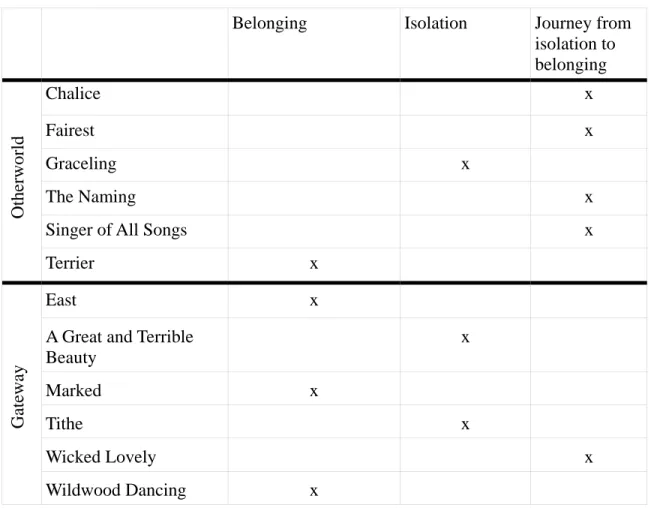
Table 2. Belonging and Isolation
Belonging Isolation Journey from
isolation to belonging
Otherworld
Chalice x
Fairest x
Graceling x
The Naming x
Singer of All Songs x
Terrier x
Gateway
East x A Great and Terrible
Beauty
x
Marked x
Tithe x
Wicked Lovely x
Wildwood Dancing x
integration into society, with this journey forming a central theme of their stories. Group identity and social integration are important parts of the development of teenage girls, and it is no surprise that this theme would appeal to teenagers, male and female alike. Interestingly, four of the six otherworld novels included the journey from separation to integration as a central theme. I had expected the gateway world novels to include
heroines who felt isolated from their own worlds, making the otherworlds more tempting; however, instead, I noticed that half of the books I selected had protagonists who felt grounded and comfortable in their own societies and, to a large extent, comfortable in the otherworlds they travel as well.
Two of the books with protagonists who felt isolated from their worlds through the course of their novels were, notably, two protagonists most ill at ease with the behavior expected of them and gender roles they were expected to fill. Katsa of
Graceling is one of the few heroines who does not feel choose to integrate with the larger society of her world by the end of her story. Katsa forms stronger relationships with her friends, takes responsibility for a young queen, and learns love and trust through a relationship with a compassionate man who is her equal; however, though her
Gemma of A Great and Terrible Beauty also does not find integration through her story. While Gemma, like Katsa, develops deeper relationships with her friends, helping her feel more integrated with a small group, the girls' use of magic and journeys to the other realm set them apart from their own world. They work hard to keep their
otherworld a secret, and the act of keeping the secret separates them from the other girls in the school, including the former friends that used to be a part of Felicity and Pippa's clique. Pippa chooses the otherworld over her own world, choosing to stay behind in the magic realm rather than return to her epilepsy and her arranged marriage, the clearest break from human society in the book. Gemma herself came to boarding school feeling guilty for her mother's death and strange for her eerie visions; by the end of her story, she has a better understanding of the magic she and her mother have accessed, but she is almost more alone than before, her knowledge separating her out. However, the three girls choose freely to pursue something that separates them from the rest of their world because of the lure of what magic can bring, and separation is a part of that bargain.
Kaye comes to feel most at home with others who fit into neither world yet come to know both, including her friend Corny and Roiben, the silver-haired knight who has been trapped in the political power-play between the two Courts.
Two of the protagonists who feel comfortable and integrated into their own worlds have a deep desire to protect them; to them, their worlds are under their care, and they are in the position of fighting off the forces that threaten their worlds' stability. Beka Cooper expresses this feeling the most; she is bound to protect her district by her profession, but she also feels a great loyalty to the people there, who helped her grow up into the young woman she has become. When children begin to be kidnapped, held for ransom, and murdered in the Lower City and when grown men and women begin to go missing, Beka is determined to see the criminals uncovered and justice served. Beka's feelings of kinship for the Lower City district are shown not only in her dedication to her cases, but also in the company she keeps. Beka understands that some who would be considered criminals – for instance, members of the Court of the Rogue – play a part in keeping the Lower City running. To catch the killers, Beka works with the people of the Lower City (savory and unsavory alike), to defeat the criminals who threaten them all.
stand against the forces on either side that wish to control the other, whether that is Cezar wanting to cut down the forest or Tadeusz killing animals and young women in the night. Jena is a protector of both worlds, and has found a place for herself in each.
In East, Rose's comfort in the worlds around her is surprising. Much of her story is spent in the large, empty palace given to the White Bear for the duration of his time to end his curse, journeying alone or in strange company, or hiding among the Troll people while pretending to be a mindless softskin slave, placated by the drugged effects of a hot drink called slank. However, Rose's story is not about a need for belonging; in the same way that she pays little heed to what good young women are supposed to be like, she has little concern for connections with society at large. Rose's desire is to save the White Bear because she loves him, and this requires her to make choices that send her away from her family and into new territories. Even at the end of the story, Rose and Charles (formerly the White Bear) go to live on their own at a secluded estate, away from the rest of the world. In many ways, Rose's story resembles Katsa's; Rose, too, chooses what makes her happy and does not feel the loss of connection with society. However, unlike Katsa, Rose is able to make friends and fit in wherever she goes. In the White Bear's palace, she befriends a young Troll named Tuki, who helps her learn Troll language. She manages to win over the fierce wanna-be Viking sailor, Thor, to gain passage north. She and Malmo make good companions, and she even finds Tuki once more in the Troll lands while she plans her rescue of the White Bear. Unlike Katsa, Rose seeks out connection and finds it naturally, and even in lonely lands, she finds belonging as much as she can wherever she goes.
in the House of Night as a vampyre. She worries about fitting in when she first comes to the school, but she quickly makes friends – and enemies. The queen bee of the school, Aphrodite, leads the prestigious school club, the Dark Daughters, which prepares its leader for the eventual role of high priestess in the school. Aphrodite and Zoey are continually at odds, and Zoey must navigate Aphrodite's manipulative, cruel games; however, Zoey still enjoys having a close circle of friends and a budding relationship with Aphrodite's old boyfriend and the hottest vampyre in the school, Erik. As she begins to discover her affinity with the elements, a gift that indicates she may be destined to be the future high priestess, it becomes even clearer that Zoey fits in well in vampyre society. This makes Aphrodite's scheming seem to be only the whining of a jealous teen, with no lasting effect on Zoey's feelings about how she fits in. Though the Casts may have decreased Zoey's potential to show depth and growth as a character through this choice, her comfort in both worlds gives her confidence and spunk that may make her feel buoyant to readers.
Zoey's physical body changes from that of a human girl to that of a vampyre over the course of her novel; Wicked Lovely's Aislinn, too, changes from a human to a
creature belonging to her otherworld, the Courts of the fae. However, unlike Zoey, Aislinn faces unavoidable and harsh consequences of her changing nature; she has no other choice than to become fae in some fashion, but no matter what, she will be a type of creature that her human friend and lover Seth is not. Though Aislinn feels caught
novel. Aislinn goes from risking all for the possibility of nothing to having the best of both worlds, which includes having a place in both. Of all the protagonists in the
gateway world novels, Aislinn is the only one who journeys through this process of being isolated to finding a place to belong. Though Kaye of Tithe goes through a similar process of trying to understand the implications of her fae nature, Kaye rejects the fairy world while Aislinn finds a way to accept her place within it.
Four otherworld books explore the theme of finding a place to belong from a past of being isolated in one sense or another. Aza of Fairest seems to feel her isolation in her society most keenly, with her burning desire to change her appearance. However, Aza possesses an amazing singing voice and a talent for ventriloquism, which give her strengths in Ayorthan society, where singing is valued more highly than almost anything else. When Queen Ivi discovers Aza's talents, she manipulates Aza into throwing her voice and singing for the Queen at all necessary occasions. Though helping the Queen gives Aza a chance to live at court and meet other nobles (including Prince Ijori, who falls in love with her), Aza remains isolated both because of her appearance and because she knows that she is supporting a lie. However, once Aza begins to come to terms with her feelings and works to set the situation to rights, Ijori forgives her for her participation in the Queen's deception. She and Ijori are married, and now that Aza feels comfortable with herself, she is able to feel comfortable with her people as well.
group of people that form around her and Darrow as they journey to stop the sorcerer Samis from mastering all the forms of chantment magic known in the lands of Tremaris. Her friends come to include a young engineer who believes in science rather than magic, a former slave girl on a pirate ship who possesses a talent for wind chantment, and a young boy from a forest that grew over an ancient civilization's city who knows chantments of healing. Calwyn is more at home with others who have shared her adventures and have seen as much of the world as she has than with the priestesses who never leave their city ringed with ice walls.
Maerad's journey, too, takes the form of a quest which introduces her to new friends and allies along her way; however, Maerad's experience of finding belonging in a community is even stronger than Calwyn's because of the stark difference between her former life and her life as a Bard. Maerad has few memories of her early childhood, when she lived with her parents (both Bards) at the now-destroyed school of Pellinor. When the school was attacked, Maerad's mother fled with her, and they were kidapped and sold into slavery. After Maerad's mother died, Maerad had no one, until the fateful day when she found the Bard Cadvan hiding in the cow byre. Upon taking up her role as a young Bard, Maerad discovers a whole society of people who are like her, who knew her family, and even respect that she has great power, a power she's still coming to understand. Along with finding a home among the Bardic society, she also finds her younger brother, Hem, and the two are reunited. The first Book of Pellinor introduces readers to Maerad by taking them along as she becomes a part of the society she is destined to save.
difficult; Mirasol's role necessarily separates her out from the woodskeepers she used to live among, while her gender separates her from the rest of the governing Circle. At the same time, being Chalice means that Mirasol is intimately connected with the earth and its creatures, particularly with the bees she has kept all her life and the leylines of energy beneath the soil, which she has always been able to feel. In one way, being Chalice separates her out, while, in another, it emphasizes her connection to the world more strongly than before. Mirasol's role as Chalice does not change through the course of the story; however, the way she uses the role does, and it is within the context of her
Close Relationships
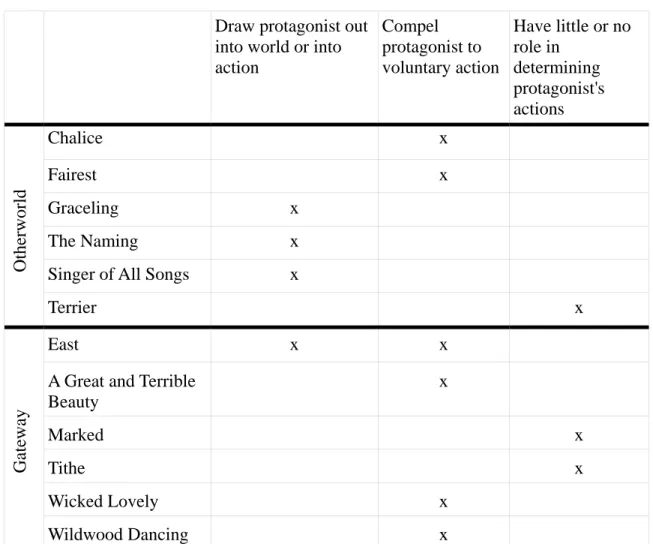
Table 3. Close Relationships
Draw protagonist out into world or into action
Compel protagonist to voluntary action
Have little or no role in
determining protagonist's actions
Otherworld
Chalice x
Fairest x
Graceling x
The Naming x
Singer of All Songs x
Terrier x
Gateway
East x x
A Great and Terrible Beauty
x
Marked x
Tithe x
Wicked Lovely x
Wildwood Dancing x
forward, often one that is romantic. Teenage readers may look to relationships in books for modeling, especially during this period of their lives, when they are learning to develop positive relationships with romantic partners. Though many of the books in this study included a primary romantic relationship (or begin setting up such a relationship for sequel novels), some of the protagonists were most influenced by their friends or family members. I will discuss characters' relationships in the context of the relationships that matter most to them, whether they be romantic or not.
There are many ways to discuss how relationships shape characters; however, for the purposes of examining the differences between books set in otherworlds and gateway worlds, I looked at how each protagonist's relationships led her to interact with or act in her world. For these characters, as well as for the teenagers who read about them, relationships are a powerful motivation for action, and most of the books studied reflected that in their plots. Notably, there was a significant split in the ways
protagonists' relationships led them to action between the otherworld novels and the gateway novels. In half of the otherworld novels, protagonists were usually drawn out into the larger world and into action by another character, to whom they become close over the course of the story. The majority of gateway world novels featured characters who transgress boundaries or set out on their own on behalf of the characters they hold dear. Though three of the books did not feature relationships that led the protagonist straightforwardly into action, there was no other commonality between these three; the protagonists of each have a variety of motivations other than relationships that lead them to act.
protagonists out into their worlds to explore and grow are books that include quest plots. Katsa and Po in Graceling have a quest that must be undertaken in secrecy, though they have the support of Katsa's underground network; they pair their powerful Graces to dethrone a powerful king who has been using his own Grace – the ability to change how people think of him – to usurp power and treat his country poorly. Katsa stumbles onto Po's quest when she rescues his grandfather from imprisonment; as the two get to know each other and as Katsa learns the truth about this political situation, she decides that working with Po to dethrone the king is a just use of her Grace. Though Katsa joins Po because she feels it is the right thing to do, her feelings for Po are intertwined with her reasoning. Po is the first person she has ever trusted with her whole heart, the first person she believes has ever understood her. However, she feels betrayed when she learns that Po has been keeping his true Grace a secret from her; he uses the true Grace, the ability to know what others think about him, to excel in hand-to-hand combat. Feeling that Po has violated her thoughts and her trust, she agrees to accompany him on his mission because she believes in the mission itself. Yet her relationship with Po, which they heal over time, played a major part in giving her both the opportunity to use her Grace for something good and to change the ways in which she thought about herself, healing in ways that help her in their quest.
Calwyn of The Singer of All Songs is drawn from her ice-walled world of
following him out into the lands beyond the walls of Antaris and joining him in his quest to defeat Samis. However, it is not Calwyn's desire to adventure or any effort by Darrow that initially brings her along; she is swept away by the rushing river of melting water that carries Darrow beyond the ice-bound lands. Darrow and Calwyn have a tension in their friendship, with friction between Darrow's feeling that his experience entitles him to make all the decisions and Calwyn's headstrong nature. When Darrow begins to seem unreasonably controlling, Calwyn wonders if he himself wishes to master all chantments to become the singer of all songs, but she still trusts in him by the end of the novel. Also, over the course of their travels, it becomes clear that Calwyn's feelings for Darrow are deeper than friendship, though the possibility of a romantic relationship between the two is only touched upon in this book (the later books in the series explore this more). Though Calwyn comes to be a central part of the effort to defeat Samis, she began her part of the quest with the desire to follow Darrow, who comes to her as a refugee and becomes a dear friend.
rescued her from her life of slavery. Though Maerad relates to him as a teacher and as a friend for the most part, it is clear that the chemistry between them hints at something more to come in later novels in the series. Cadvan is instrumental in helping Maerad learn to trust others, face her past, and understand her own potential as a Bard; since she sees him as the facilitator of this growth, she follows him through woods and wastelands and into danger.
It would be a misrepresentation of East to place it solely in either category of action I use to discuss relationships, for Rose makes two journeys out into the world. First, she agrees to go with the White Bear in exchange for prosperity for her family, and the White Bear takes her out of her familiar home world and to the edges of the strange, magical world in which he lives. Rose gets her first understanding of the White Bear's situation while she lives in his castle, though the White Bear must keep her from learning the nature of his curse if she is to have any chance of breaking it. In this part of the story, the White Bear has drawn her out into action that has been taking place ever since he was captured by the Troll Queen. However, when Rose accidentally crosses the terms of the curse and the White Bear is taken away to be with the Troll Queen forever, Rose's love for him compels her to seek him out, traveling to the Arctic Circle and into the kingdom of the Trolls to rescue him. Rose could not have saved the White Bear without knowing the information she learned while she stayed in his house, and she never would have come to know him in the first place had he not taken her from her home. The love story of East is strengthened by both types of relationship-related action, which is part of what makes it one of the most complete romance stories in this study.
compelled to act because of someone she feels close to is that the protagonists of both stories have worlds to set right rather than quests to complete. Aza of Fairest is compelled to tell the truth to the court and the king because she knows that she is responsible for a portion of Queen Ivi's deception. But along with her desire to do the right thing, Aza holds hope that Prince Ijori will be able to forgive her, even if he can no longer love her. The fact that Ijori believed in her and supported her while she was still at court was part of what began to help her value herself instead of judging herself by her appearance. This new strength she begins to find, the strength fostered by her former relationship with Ijori, helps her stand up to do the right thing, tell the truth, and restore the land to a good ruler.
Chalice's Mirasol must set her world to rights by helping the Master hold his claim to his role. At first, Mirasol herself doubts his suitability for the position; he is barely human after his years in training as a priest of fire, with skin that is black from char rather than melanin and so hot that he burns others when he touches them without being prepared for it. But as she begins to spend time with him, Mirasol sees that the Master is good for the land and connected to it in his own special way, a connection which forms strong bonds between them, and Mirasol finds herself desperate to help him navigate the political intrigue and survive the duel that is engineered to remove him from power. It is this relationship, based on a gentle understanding of one another and a common love for their land, that compels Marisol to take extreme measures to heal the land. Knowing that her efforts may be futile, she journeys the borders of the
in the Master and support of him is what helps her heal the land, grow into her role as Chalice, and come to marry the Master in the end.
Along with East, three other gateway world books had action spurred on by characters in the protagonists' lives. In Wicked Lovely, the relationship that compels Aislinn to action is her love for Seth. Seth is the only person with whom Aislinn feels comfortable sharing her confusion and fear about the fairies' interest in her. Their friendship turns to a relationship as Seth does everything he can to support Aislinn and help her figure out what is happening, and the more Aislinn learns about how she will be torn from the human world, the stronger her feelings for Seth become. Her desire to keep her relationship with Seth is what drives her to fight the Winter Queen and bargain with Keenan; she is fighting not only for herself, but for Seth as well. The solid foundation of their relationship helps her find strength and serves as a resource for her that none of the fairies have – support without betrayal. Though the Winter Girl, Donia, and Keenan still love one another, they both know that they can never be together, and Donia will always feel the pain of loving someone who cannot give himself to her in return. Though they work together to get Aislinn instated as the Summer Queen, their constricted relationship causes hurt rather than comfort because they cannot give each other what Aislinn and Seth share.
named Sorrow. Jena stands up against the Cezar's efforts to harass her sisters, and she travels into the Other Realm at the dark of the moon, facing the dark creatures that come out at that time, to find seek answers for how to help her sister stop pursuing Sorrow. Eventually, Jena comes to see that Sorrow is not evil, and she begins to understand that the helping Tati and Sorrow do what they need to do to be together is the most loving thing she can do for her sister. When Gogu first turns back into a man, Jena feels that he broke her trust by not telling her what he was, and the Night People planted false visions in her head of Costi as a being of evil. When Jena reflects upon how she has rejected Costi, she sets out to win back his heart and his forgiveness. Jena's love for those who are close to her is at the heart of most of her actions and decisions.
powers even as she becomes aware of just how dangerous they may be.
Though three of the books selected for this study did not emphasize relationships as motivation for protagonists' actions, relationships still played important roles in their stories. For Beka of Terrier, relationships with her friends, both from the streets and from the police force, help her see situations from many perspectives, which helps her solve the crimes, and her friends contribute their skills, coming together because of Beka's vision to catch the criminals. Beka's wide group of friends extends beyond the society of humans; she has a pet cat who converses with her, can hear the ghosts of the dead who ride on the wings of pigeons that inhabit the Lower City, and can speak with the
whirlwinds of dust that form at the corners of streets. Beka's gift for magic, which allows her to communicate with other creatures in these ways, gives her the opportunity to form useful friendships and alliances with give her access to information outside of the human realm. Beka's friendships with all manner of creatures and people in many parts of society are a vital asset to her career as a future Provost's Dog.
relationship with her family is even more distant; she has spent her life taking care of her drunken rock-star-wannabe mother as they go from club to club, and when they come to live with Kaye's grandmother in New Jersey, Kaye's only seems to want to escape her grandmother's rules. The atmosphere of mistrust in people and the lack of loving relationships in the novel help built its dark and gritty urban feel; the negative space left where meaningful relationships should be can portray characters and their actions effectively to readers as well.
The relationships that Zoey forms in Marked have little impact on her actions because those relationships are shallow. The only deep relationship Zoey shows evidence of having is her relationship with her grandmother; her interactions with her mother, her stepfather, her old friends from high school, her new friends at the House of Night, her new vampyre mentor, and her new vampyre boyfriend all have little basis. Zoey seems to go from place to place being liked because she's likable, without taking the time to
Body and Self-Image
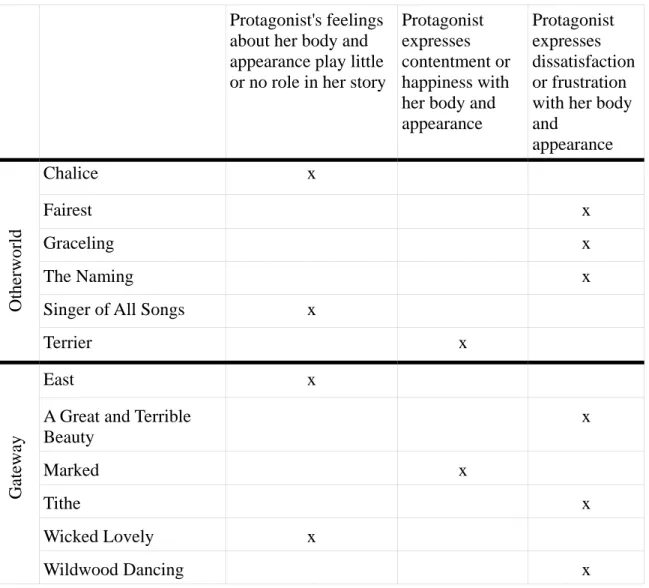
Table 4. Body and Self-Image
Protagonist's feelings
about her body and appearance play little or no role in her story
Protagonist expresses contentment or happiness with her body and appearance
Protagonist expresses dissatisfaction or frustration with her body and
appearance
Otherworld
Chalice x
Fairest x
Graceling x
The Naming x
Singer of All Songs x
Terrier x
Gateway
East x A Great and Terrible
Beauty
x
Marked x
Tithe x
Wicked Lovely x
Wildwood Dancing x
how characters appear, how their appearances affect how others think of them and how they think of themselves are important tools of character portrayal. Teenage girls often struggle with their feelings about their own appearances in a youth culture where the way one chooses to brand one's self can be intimately tied to how well they get along with their peers and where they fit in social groups. Few girls feel entirely happy with their bodies, either in terms of their appearance or physical abilities. Books give readers a chance to see their own feelings and experiences mirrored in those of the characters, both through characters who are uneasy with their appearances and through characters who think about their bodies positively.
Of the many ways to discuss the self-images of the protagonists in these novels, I have chosen to focus my analysis on how the characters think about themselves. Some characters have primarily positive feelings about their appearances and are comfortable in their bodies, while others express dissatisfaction with their appearances and discomfort in their bodies. A significant third of the books included little or no reflection by the
protagonist on her body; though her physical traits may be described, she has little to say about them and they do not particularly affect her understanding of herself.
one sees on the surface.
Though all five women become involved romantically with men, they may feel insecurities that do not relate to their appearances and, instead, relate to other qualities. Calwyn, the protagonist of The Singer of All Songs, is described in little detail; all readers really know about her is that she wears her dark hair in two plaits that fall down her shoulders. As she begins to develop feelings for Darrow, Samis preys upon her insecurities when he tries to convince her to join him, cloaked in the shape of Darrow. As Darrow-Samis reaches out to touch her, she realizes how desperately she wants Darrow to want her – however, her insecurities are related to her sheltered life, youth, and inexperience, not the way she looks. She recognizes that Darrow is both very learned himself and appreciates others who are the same, and she worries that she could not be engaging to him because of her limited knowledge. Darrow himself does not do much to reassure her; it is clear that feels slightly superior to others and desires to learn more, traits that are part of why Calwyn sometimes wonders about his motives in seeking out Samis. However, Darrow does appreciate Calwyn, and by the end of the novel, she finds she has become more of the learned and well-traveled woman that she once believes Darrow would want instead of her.
surprise to her when he admits that he had been waiting for months for her to let a romantic relationship develop. The friendship that has been built grounds their relationship, and though they are physically attracted to one another, their emotional bonds are what take the foreground. Aislinn's initial dismissal of the idea that Seth could be interested in her is not based on her own feelings about her appearance; instead, she bases her assumption on Seth's past behavior patterns and sees that they do not fit the relationship she has with him.
Mirasol of Chalice and Rose of East both have relationships with men who have unconventional appearances themselves, and both characters have more pressing concerns to save their men from greater dangers than winning them over with looks. Given the rules that apply to Master and Chalice, Mirasol does not think of the Master as a romantic prospect until the very end of the novel, for Masters and Chalices do not marry each other except under the most extreme of circumstances. At first, Mirasol believes that they cannot marry each other at all until her research turns up an exception – an exception that she learns will be used against her to force her into marriage with the new Master candidate being raised, Horuld, a move that those plotting against the current master would propose as being for the good of the land. With avoiding one forced marriage and frantically searching for ways to save the Master filling her mind, there is little call for her to reflect on her appearance in the story. The only time she does is when she realizes that Horuld is looking closely at her body; her feelings in response only clarify that thinking about her body is something she rarely does herself.
tell his story, that he finds Rose attractive. However, Rose herself comes to love the White Bear first in his bear form – a form which would not allow them to have any sort of romantic relationship. In this way, Rose is similar to Aislinn; the love they both share for their partners is built on something deeper than appearances first, before any physical relationship develops. And, like Mirasol, Rose's primary goal becomes saving the man she loves, a goal which requires her to risk her life in journeying sea and tundra and to bide her time as a slave to the Trolls while she forms a plan. We see that Rose has little thought for her own appearance when she weaves and sews the three dresses she makes while living in the White Bear's palace, one gold, one silver, and one the color of moonbeams. When she tries on the moonbeam dress, she is shocked to see herself in a mirror and think of herself as beautiful for the first time. Yet her relationship with the White Bear is built on a quiet trust and calm understanding that requires little mention of how Rose feels about her appearance.
Zoey's lack of thought about her self-image particularly noticeable. Without any
reflection, Zoey gives readers no clues as to whether she feels the same way about herself as the people around her do.
Only one protagonist in the selected books had particularly positive attitude toward her body. Beka Cooper of Terrier takes a practical approach to understanding her body. When she gives a description of herself at the beginning of her journal (which forms the narrative of the book), she describes her hair, her eyes, her stature, and even the size of her breasts, and she values her appearance for the surprising effect it has on
others; she enjoys the fact that that effect isn't one of lust, but, instead, is one of slight intimidation. She is able to stare others down with her ice blue eyes, making them uneasy enough to give up information more readily. Her wiry yet solid build helps her keep from getting too beaten up on the job, and she wears her red hair braided back to keep it out of her way. Beka enjoys the ways that her body lets her do her job, and though she chooses to dress for practicality, she has had experience with men in the past and feels confident that she is attractive to men, if she had any desire in her current life to attract one.
The fact that a full half of the protagonists in this study had negative feelings about their bodies makes a strong statement about both the self-images many teenage girls hold and the models authors provide for them in the books they read. On one hand, teens can empathize with characters whose feelings and thoughts reflect their own, but, on the other hand, teens may need more examples of girls who view their bodies positively to help teens learn to feel that way about themselves.
clearly Aza of Fairest. Aza saw when she was small that others stared at her in curiosity and an amount of distaste, and she was exposed to these reactions day after day in her adopted family's inn, where she lived before being taken to court as an emergency
builds with Po allows her to begin feeling comfortable with her body, finding healing through the experience of opening up physically to someone who has no desire to control her. Katsa begins to make peace with the capabilities of her Grace when the experience of trekking through a dangerous mountain pass in the winter shows her that she is built for survival and preserving her live against threat rather than for emotionless killing. The new light shed on her Grace gives Katsa a new way to understand and make peace with her body. This process forms a core theme of the book.
journeys until an ancient spirit of the forest gifts her by curing those pains forever. Though Maerad begins to understand that she can live safely and comfortably as a woman Bard and that her body and appearance do not necessarily bring pain, this understanding does not manifest (in this novel) as a more positive body image.
None of the heroines in the three gateway world books have the same deep-seated discomfort with their bodies that Aza and Katsa feel. However, like both of these
characters, Kaye of Tithe has physical traits that make her feel strange and unusual in her world. Kaye's physical traits reflect that she is an outsider in both the human realm and the fairy realm; she has always felt weird as a human, having Asian features and blonde hair (a number of male characters remark that this makes her ideal for Japanese schoolgirl fantasies). When she begins to remove the glamour that the fairies put on her when she was a changeling baby, she discovers that she has green skin, dark black eyes, and wings – characteristics of a pixie – but she is still the full size of a human. Kaye never seems to feel at home in any place, including in her own skin. In a way, Kaye does seem to feel increasingly comfortable with the powers of glamour, the powers to change the way she appears, as they develop; the encounter which turns sexual between her and her best friend's boyfriend makes her feel uneasy early on in the book, but when she discovers the power of glamour, she uses it to taunt him before ripping it away. The message that the way to feel comfortable with your body by putting up a mask to change how you appear is questionable, and the intensity with which Kaye uses glamour implies that it doesn't actually help her address her feeling about her self-image.
historical periods in which they live, and their self-images are very much tied to the gender roles acceptable in their societies – and, taken into account with those gender roles, their dissatisfaction with their bodies may not be a bad thing. Jena recognizes that her sister, Tati, is the beauty of the family, but Jena's plainness does not bother her as much as her discomfort at the idea of being put on display as a prospect for marriage. When Jena's aunt begins to raise the idea that the girls should host a ball to introduce them to eligible young men in the area, Jena balks; she has no wish to be married based on her appearance at a ball and is repelled by the idea of having to market herself in this way. Though this discomfort she expresses may not be empowering in the sense of positive self-image, it shows her mature and deep way of thinking about love. In the end, she marries Costi, who, as a frog, spent years being ironically physically close to her. In a society where women are expected to be fragile, delicate, and valued for their beauty, Jena's rejection of valuing herself through these terms gives a positive meaning to that rejection.
Gemma, too, recognizes that she is not the beauty of her group; she and Anne pale in contrast to the dark and light beauties of Pippa and Felicity. Witnessing Anne's
Inner Quest
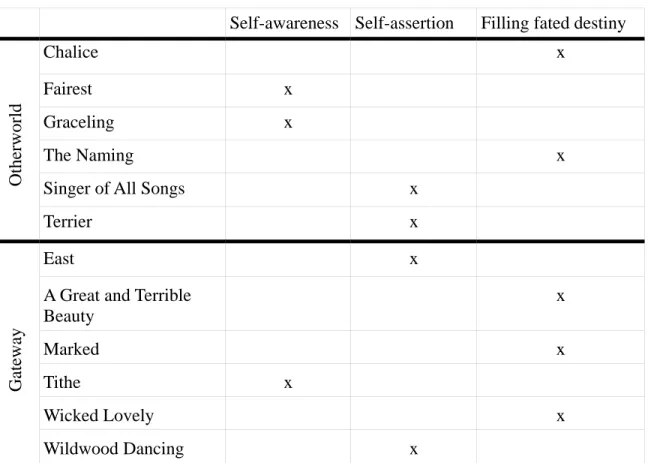
Table 5. Inner Quest
Self-awareness Self-assertion Filling fated destiny
Otherworld
Chalice x
Fairest x Graceling x
The Naming x
Singer of All Songs x
Terrier x
Gateway
East x
A Great and Terrible Beauty
x
Marked x
Tithe x
Wicked Lovely x
Wildwood Dancing x
the resolution of her tale. Teenage women may look to these protagonists for examples of how to make sense of the experiences of their lives and how to synthesize them in order to achieve their goals.
Three major patterns of inner quests emerged from this selection of books. Some protagonists went through inner journeys of discovering parts of who they are that were hidden from them and coming to accept and integrate those parts into their self-identities. Other characters achieved their goals by stepping up to assert their own knowledge, discoveries, desires, and abilities, applying these parts of themselves to bring about positive resolutions to their stories. Many of the protagonists in these stories discovered greater purpose in their lives by finding that they were important threads in a greater tapestry, taking up their places in fated destinies and coming to terms with the
responsibility of those fates. This type of inner journey, in particular, is popular in the fantasy genre, and the grand scope of many fantasy novels lends itself to this theme.
We have already seen many parallels between Fairest's Aza and Graceling's Katsa; here again, Aza and Katsa both go through similar journeys of coming to understand and act in their worlds by learning more about who they truly are and integrating that