SOLVABILITY OF A NORMAL SUBGROUP IN
RELATION TO ITS CHARACTER DEGREES
*M. A GANIYU1, F. M JIMOH1, A. D. AKWU2
*1Department of Physical Science , Al-hikmah University, Ilorin, Kwara State, Nigeria.
Department of Mathematics, Federal University of Agriculture, Makurdi, Benue State.
*Corresponding author: [email protected] Tel: +2348051711777
trace.
A character is called irreducible if is an irreducible representation. A character is linear if the dimension of is 1. If is a character of G. then the kernel of is given by:
Ker = (g G: (g) = (1) Characters are class functions i.e. they take a constant value on a given conjugacy class. Isomorphic representations have the same characters and if a representation is the di-rect sum of subrepresentations, then the cor-responding character is the sum of the
char-ABSTRACT
In this work, how the structure of a normal subgroup of a group G is influenced by the degrees of an appropriate subset of irreducible character of a group G was verified. The characters that were used in controlling the structure of N Δ G are exactly those whose kernels do not contain N.
Given that N Δ G,
Irr (G/N) = { Є Irr (G)/N ker } and
cd (G/
N) = { (1) / Irr (G/N)}
Keywords: Normal Subgroup, Character degrees, Solvable groups, Derived length and irreducible
Character.
INTRODUCTION
In group theory, the character of a group representation is a function on the group which associates to each group element, the trace of the corresponding matrix. The character carries the essential information about the representation in a more con-densed form.
Let V be a finite dimensional vector space over a field F and let : G ® GL (V) be a representation of a group G on V. The character of is the function.
: G ® F given by
(g) = Tr ( (g)). Where Tr is the
Journal of Natural Science, Engineering
and Technology
ISSN:
Print - 2277 - 0593 Online - 2315 - 7461 © FUNAAB 2012
acters of those subrepresentations.
Let P and s be representations of G, then the following identities hold:
ρ Ås = ρ + s
ρ Äs = ρ . s
ρ =
Alt2 (g) = ½ [( (g))2 - (g2)]
sym2 (g) = ½ (g))2 + (g2)]
Where Äs is the direct sum, Äs is the tensor product, * denotes the conjugate
transpose of , Alt2 is the alternating
product and sym2 is the symmetric square.
Garrison (1973) wrote on ‘on groups with a small number of character degrees’ where he stated that if |cd(G)|= 4, then dl (G) ≤ |cd (G)| for all solvable groups. Isaacs (1975) also stated that if |cd (G)| ≤ 3, then G is necessarily solvable and dl (G) ≤ |cd (G)| in his work character degrees and de-rived length of a solvable group.
Berger (1976) ‘characters and derived length in groups of odd order’ wrote that if |G| is odd, then dl (G) ≤ |cd (G)|. Also, Gluck (1985) wrote on Bounding the number of character degrees of a solvable groups where he stated that dl (G) ≤ 2/cd(G)/ holds for all solvable group.
Mark (1998) wrote on derived lengths and character degrees. Gustavo and Alexander (2001) treated groups with two extreme character degrees and their normal
sub-groups. Isaacs and Moreto (2001) estab-lished a linkage between the character de-grees and Nilpotency class of a P-group. Alexander and Sanius (2005) wrote on char-acter degrees, blocks and normal subgroup. Chen et al (2006) worked on groups with character degrees of two distinct primes. Cossey (2006) showed the bounds on the number of lifts of a Brauer Character in a P-solvable group.
The goal of this paper is to verify how the structure of a normal subgroup of G is influ-enced by the degrees of an appropriate sub-set of Irr (G).
RESULTS AND DISCUSSION
Character table
The irreducible complex characters of a fi-nite group form a character table which en-codes much useful information about the group G in a compact form. Each row is labelled by an irreducible character and the entries in the row are the values of that char-acter on the representatives of the respective conjugacy class of G. The columns are la-belled by (representatives of) the conjugacy classes of G. It is customary to label the first row by the trivial character and the first col-umn by (the conjugacy class of) the identity. The entries of the 1st column are the values of the irreducible characters at the identity, the degrees of the irreducible characters. Characters of degree are known as Linear Character.
The character table is always square because the number of irreducible representations is equal to the number of conjugacy classes. The first row of the character table always consist of 1’s and that corresponds to the trivial representation. The order of G is given by the sum of the squares of the
en-tries of the 1st column (the degrees of the irreducible characters). More generally, the sum of the squares of the absolute values of the entries in any column gives the order of the centralizer of an element of the corre-sponding conjugacy classes.
All normal subgroups of G (and whether or not G is simple) can be recognised from its character table. The kernel of a character is the set of elements g in G for which (g) = (1). This is a normal subgroup of G.
Orthogonality relations
The space of complex – valued class func-tions of a finite group G has a natural inner product.
< , β > = (g) β Where β means the complex conjugate of the value of β on g. With respect to this product, the irreducible characters form an orthonormal basis for the space of class functions, and this yield the orthogonality relation for the rows of the character table.
< i, j> =
For g, h Є G, the orthogonality relation for
column is as follows:
i (g) =
if g, h are conjugate
otherwise
Where the sum is overall of the irreducible characters of G and the symbol | (g)| denotes the order of the centralizer of g. The orthogonality relations can aid many computations including: decomposing an unknown character as a linear combination of irreducible characters; constructing the complete character table when only some of the irreducible characters are known; finding the orders of the centralizers of representa-tives of the conjugacy classes of a group G; Finding the order of the group. Theorem 1:
Berkovich’s Theorem [ 3]
Let N G and suppose that every mem-ber of cd (G/N1) is divisible by some fixed
prime number P. Then N is solvable and has a normal P – complement.
Verification of Berkovich’s Theorem
Let S4 (a symmetic group on 4 objects) be a
finite group of order 24. i.e. |S4| = 24. The
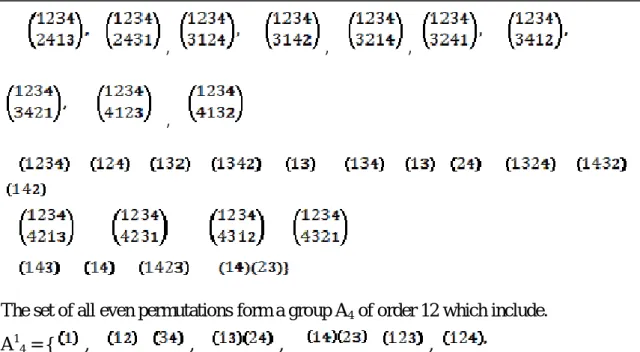
elements of S4 include:
S4 = { , , , , ,
, ,
, , ,
,
The set of all even permutations form a group A4 of order 12 which include.
A14 = { , , , ,
,
Which form a normal subgroup of S4. The commutator subgoup of A14 was obtained by
using the formular
A14 = {[ , y] : -1 y-1 y Є A4}
A14 = {(1), (12) (34), (13 (24), (14) (23)} which is called four group or (klein 4-group).
To get the character table of S4; we let (1), (12), (12)(34), (1234), (123) be representatives of
its conjugacy classes. This implies that S4 have 5 irreducible characters denoted by
Table 1: Character table of S4
Representative (1) (12) (12) (34) (1234) (123)
Class Size 1 6 3 6 8
|CG(g)| 24 4 8 4 3
1 1 1 1 1
1 -1 1 -1 1
2 0 2 0 -1
3 1 -1 -1 0
By definition
Irr (S4/A14) = { Irr (S4)/A14 ker
( ) }
Irr (S4/A14) = { , }
And cd (S4/A14) = { (1)/ Irr (S4/
A14) }
Þ cd (S4/A14) = { (1), (1) }
Þ cd (S4/A14) = { 3, 3, }
Suppose every member of cd (S4/A14) is
di-visible by a fixed prime 3; then A4 is
solv-able which is true and A4 has a normal
P-Complement which means A4 has a normal
subgroup of index P.
i.e A14 is a normal subgroup of A4 and [A4 :
A14] = |A4| = = 3, the fixed prime
A14
Theorem 2: Isaacs and Greg Theorem [10]
Let N G and suppose that |cd ( )| ≤ 1, then dl (N) ≤ |cd | and in par-ticular, N is abelian.
Verification:
Let C4 C2 be finite group of order 8 where
C4 = { 1, a, a2, a3}, a4 = 1
and C2 = {1, b}, b2 = 1
C4 C2 = { (1, 1), (1, b), (a, 1), (a, b), (a2, 1), (a2, b), (a3, 1), (a3, b)}
Order of each element in C4 C2include:
(1, 1) - 1
(1, b) - 2
(a, 1) - 4
(a, b) - 4 (a2, 1) - 2
(a2, b) - 2
(a3, 1) - 4
(a3, b) - 4
Subgroup of C4 C2 of order one
H1 = {(1,1)}
Subgroup of C4 C2 of order two
H2 = { (1, 1), (1, b)}
H3 = { (1, 1), (a2, 1)}
H4 = { (1, 1), (a2, b)}
Subgroup of C4 C2 of order four
H5 = { (1, 1), (1, b), (a2, 1), (a2, b) }
H6 = { (1, 1), (a, 1), (a2,1), (a3,1) }
H7 = { (1, 1), (a2, 1), (a,b), (a3 , b) }
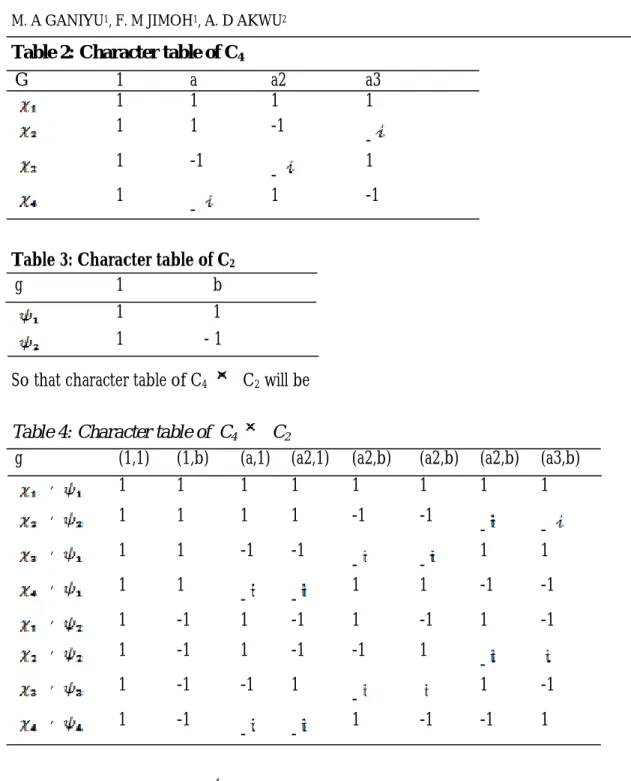
Table 2: Character table of C4
G 1 a a2 a3
1 1 1 1
1 1 -1
-1 -1
- 1
1
- 1 -1
Table 3: Character table of C2
g 1 b
1 1
1 - 1
So that character table of C4 C2 will be
Table 4: Character table of C4 C2
g (1,1) (1,b) (a,1) (a2,1) (a2,b) (a2,b) (a2,b) (a3,b)
´ 1 1 1 1 1 1 1 1
´ 1 1 1 1 -1 -1 - -
´ 1 1 -1 -1 - - 1 1
´ 1 1 - - 1 1 -1 -1
´ 1 -1 1 -1 1 -1 1 -1
´ 1 -1 1 -1 -1 1
´ 1 -1 -1 1 - 1 -1
´ 1 -1 - - 1 -1 -1 1
Irr (C4 ´ C2/H5) = { ´ }
Now, cd (C4 ´ C2/H5) = {1}
\ |cd (C4 ´ C2 /H5)| = 1
The derived length of H5
H5 = {(1,1), (1,b), (a2,1), (a2, b)}
[(1,b), (a2,1)] = (1,b)-1 (a2,1)-1 (1,b) (a2,1)
= (1,1)
[(1,b), (a2,b)] = (1,b)-1 (a2,b)-1 (1,b) (a2,b)
= (1,b) (a2,b) (1,b) (a2,b)
= (1,1)
[(a2,1), (a2,b)] = (a2,b)-1 (a2,b)-1 (a2,1) (a2,b)
= (a2,1) (a2,b) (a2,1) (a2,b)
= (1,1)
\ H51 = (1,1), H5 H51 = (1,1)
\ the derived length of H5 = 1
\ dl(H5) ≤ |cd (C4 ´ C2/H5)|
In particular, H5 is abelian
(1,b) ´ (a2,1) = (a2,b)
(a2,1) ´ (a,b) = (a2,b)
Also (a2,a) ´ (a2 ´ b) = (1,b)
(a2,b) ´ (a2 ´ 1) = (1,b)
Theorem 3: Isaacs and Greg Theorem [10]
Let N Δ G and suppose that |cd (G/N)| = 2. If N is solvable, then dl (N) = 2.
Verification:
Let ´ C2 be a finite group of order 12; where
S3 = { , , , , , }
(1) (23) (12) (123) (132) (13) C2 = {1,a)}, a2 = 1
S3 ´ C2 = { ((1), 1), ((23), 1), ((12),1), ((123),1),
((132),1), ((13) ,1), ((1), a), ((23), a), ((12),a), ((123), a), ((132), a) ((13), a)}
Order of each element in S3 ´ C2
( ,1) – 1
(( ),1) - 2
( (12),1) - 2 ( (123),1) - 3
( (132),1) - 3
( (13),1) - 2 ( (1), a) - 2 ( (23), a) - 2 ( (12), a) - 2 ( (123), a) - 6 ( (132), a) - 6 ( (13), a) - 2 1 element subgroup
H1 = {(1), 1)}
2 elements subgroup
H2 = { ((1), 1), ((2,3), 1)} H3 = { ((1), 1), ((12), 1)}
H4 = { ((1), 1), ((1,3), 1)} H5 = { ((1), 1), ((1), a)}
H6 = { ((1), 1), ((23, a)} H7 = { ((1), 1), ((12), a)}
H8 = {((1), 1), ((13), a)}
3 elements subgroup
H9 = {((1), 1), ((123), 1), ((132), 1) }
4 elements subgroup
H10 = {((1), 1), ((23), 1), ((1), a), ((123), 1)}
H11 = {((1),1), (12), 1), ((1), a), (12), a)}
H12 = {((1), 1), ((13), 1) ((1),a), ((13), a)}
6 elements subgroup
H13 = {((1), 1), ((123), 1), ((132), 1), ((123), a), ((132), a) ((1), a)}
H14 = {((1), 1), ((23), 1), ((12), 1), ((132), 1), ((13), 1), ((123), 1)}
H15 = {((1), 1), ((23), a), (12), a), ((132), 1), ((13), a), ((13), a)}
12 element subgroup
H16 = {((1), 1), ((23), 1), ((12), 1), ((123), 1), ((132), 1), ((13), 1)}
((1), a), ((23), a), ((12), 1), ((123), a), ((132), a), ((13), a)} Testing for normal subgroup, we get
H9 = {((1), 1), ((123), 1), ((132), 1)} to be a normal subgroup of S3
The character table of S3 is given below:
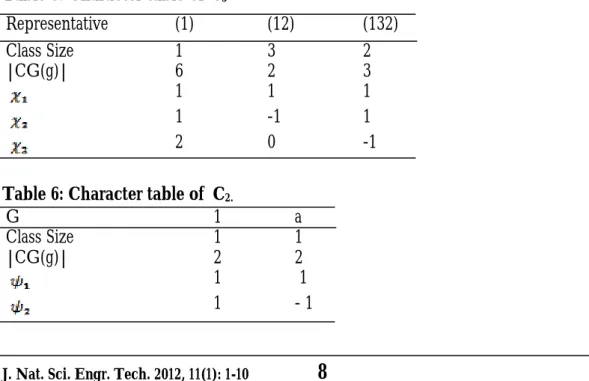
S3 has 3 conjugacy classes (1), (12) and (132) with 3 irreducible characters
Table 5: Character table of S3
Representative (1) (12) (132)
Class Size 1 3 2
|CG(g)| 6 2 3
1 1 1
1 -1 1
2 0 -1
Table 6: Character table of C2.
G 1 a
Class Size 1 1
|CG(g)| 2 2
1 1
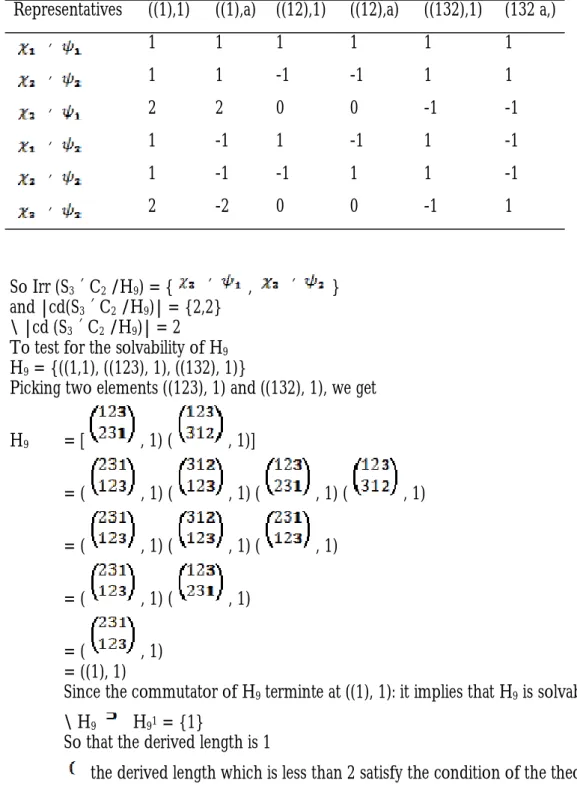
So that we have the following for the character table of S3 ´ C2.
Table 7: Character table of S3 ´ C2
Representatives ((1),1) ((1),a) ((12),1) ((12),a) ((132),1) (132 a,)
´ 1 1 1 1 1 1
´ 1 1 -1 -1 1 1
´ 2 2 0 0 -1 -1
´ 1 -1 1 -1 1 -1
´ 1 -1 -1 1 1 -1
´ 2 -2 0 0 -1 1
So Irr (S3 ´ C2 /H9) = { ´ , ´ }
and |cd(S3 ´ C2 /H9)| = {2,2}
\ |cd (S3 ´ C2 /H9)| = 2
To test for the solvability of H9
H9 = {((1,1), ((123), 1), ((132), 1)}
Picking two elements ((123), 1) and ((132), 1), we get H9 = [ , 1) ( , 1)]
= ( , 1) ( , 1) ( , 1) ( , 1)
= ( , 1) ( , 1) ( , 1)
= ( , 1) ( , 1) = ( , 1)
= ((1), 1)
Since the commutator of H9 terminte at ((1), 1): it implies that H9 is solvable.
\ H9 H91 = {1}
So that the derived length is 1