A multi-objective mathematical model for nurse scheduling
problem with hybrid DEA and augmented ε-constraint method:
A case study
Mojtaba Hamid
1, Farnaz Barzinpour
1*, Mahdi Hamid
2, Saeed Mirzamohammadi
11
School of Industrial Engineering, Iran University of Science and Technology, Tehran, Iran
2
School of Industrial Engineering, College of Engineering, University of Tehran, Tehran, Iran
[email protected], [email protected], [email protected], [email protected]
Abstract
The efficient management of nursing personnel is of vital importance in a hospital’s environment comprising a vast share of the hospital’s operational costs. In the nurse scheduling problem (NSP), the target is to allocate shifts to the nurses in order to satisfy the hospital’s demand during the planning horizon by considering different objective functions. This paper presents a multi-objective mathematical model with the aims of reducing the costs that the hospital is supposed to pay, maximizing nurses’ satisfaction, and balancing the workload of nurses. Nurses’ preferences for working in particular shifts and weekend off are considered in this model. In order to solve the model, a two-step procedure is used. In the first step, to show the applicability of the proposed model, a real case study is provided and is solved using augmented ε-constraint method. Then, the best solution is selected among Pareto solutions using data analysis envelopment (DEA). Finally, several analyses are performed to develop managerial implications.
Keywords
:
Nurse scheduling problem, multi-objective model, augmented ε-constraint method, data envelopment analysis (DEA)1-Introduction
The efficient management of nurses is critical to any organization’s universal success because nursing labor costs generally demonstrate over 40% of a hospital’s total budget (Mullinax and Lawley, 2002). Hence, it is important to concentrate on the work environment of nurses to ameliorate their job satisfaction, and also decline healthcare cost by increasing efficiency.
In the nurse scheduling problem (NSP), the aim is to determine the timetable of working shifts and off days of nurses during the planning horizon. In general, NSP is categorized into three different groups: (i) fixed scheduling, (ii) cycling scheduling and (iii) non-cyclic scheduling. Fixed scheduling includes a timetable which is practicable and feasible in different periods and will be used changelessly. However, cyclic scheduling is a constellation of shift arrangements in a group of nurses that eventually, by the end of this planning horizon, each type of shifts is assigned to any nurse (Curtois, 2008). Unlike these two types, non-cyclic scheduling offers a brand new scheduling (at the end of each planning horizon) on which, due to nurses’ preferences, working days and off days would be different from one week to another (Solos et al., 2013).
*Corresponding author
ISSN: 1735-8272, Copyright c 2018 JISE. All rights reserved Journal of Industrial and Systems Engineering
Vol. 11, Special issue:14th International Industrial Engineering Conference Summer (July) 2018, pp. 98-108
(IIEC 2018)
TEHRAN, IRAN
Also, non-cyclic scheduling is far more flexible in boosting nurses’ satisfaction and consequently, a desirable result with a win-win policy will be concluded for both nurses and managers (Solos et al., 2013). In order to make a proper schedule, there are certain key factors such as nurses’ preferences for days and certain shifts, and also their workload that must be considered (Lu, 2002).
Heavy workload is one of the main reasons of nurses’ dissatisfaction which may result in decreasing service quality and patients’ safety. Moreover, this might lead to discrimination and conflict among nurses (Acar, 2010). Balance in working hours, the number of off days, and number of working shifts of each nurse in night shifts and at weekends’ can improve satisfaction level of nurses.
In this paper, a multi objective model is presented to schedule nurses for a neurology unit of Baqiyatallah hospital. The objectives are balancing the nurses’ workload, maximizing the nurses’ preferences and also minimizing the costs related to hospital pays. This model tries to provide a win-win situation for both nurses and managers. Moreover, limitations of governmental regulations, labor laws, and hospital policies have been taken into account. In order to solve the model, a two-step procedure is used. In the first step, to show the applicability of the proposed model, a real case study is provided and is solved using augmented method. Then, the best solution is selected among Pareto solutions using a DEA model.
The other sections of this study are summarized as follows: A review of the previous studies in this field is provided in section 2. The mathematical model is provided in section 3. The solution method is presented in section 4. A case study is provided to show the applicability of the proposed model in section 5. The computational results and sensitivity analysis are presented in section 6 and finally, in the last section the conclusion is presented.
2- Literature review
In literatures related to health care managing systems, NSP has been widely scrutinized. There is several literature reviews that are scrutinized NSP based on several aspects such as type of constraints, approaches, being multi objective or single objective (Ernst et al., 2004a), (Ernst , 2004b), (Cheang , 2003) and (Burke , 2004).
Most nurse scheduling models apply hard and soft constraints. Soft constraints are those that can be violated with a penalty cost. Hard constraints are those that cannot be violated and one is supposed to provide feasible solutions to satisfy them. Nevertheless, other papers have offered different classifications for NSP. For instance, Ikegami and Niwa have divided these constraints into two categories which the first is shift-related constraints (pertaining to required number of nurses and required skill for each shift) and the second is nurse related constraints (Considering workload of every single nurse, nurses, preferences, consecutive shift and gaps between shifts) (Ikegami and Niwa, 2003). Ásgeirsson and Sigurðardóttir (2016) provided a mixed integer linear programming in order to find a feasible solution that satisfied all hard constraints and also minimize the violation of soft constraints. The hard constraints considered in that model included maximum time of continuous working time in each day, maximum number of working days, the shortest possible time of resting between shifts and maximum number of weekends off. The soft constraints of model include the minimum and maximum number of needed nurses in each shift, minimum and maximum working hour and nurses’ preferences for not working in last two adjacent weekends (Ásgeirsson, and Sigurðardóttir, 2016).
In NSP related literature, different methodologies have been employed. In earlier studies, researchers have used mathematical programming for solving NSP (Warner and Prawda , 1972) and (Beaumont , 1997). Mathematical programming moves toward finding optimal solutions, despite the fact that the process is extremely time-consuming, which clearly makes it difficult to encompass all the constraints. Some other researchers used heuristic approaches which provide near optimal solutions (Bard and Purnomo, 2007) and (Beliën et al., 2005). Other approached that had been adopted recently in NSP are as follows: Artificial intelligence methods such as knowledge-based approaches (Beddoe et al., 2009), Constraint Programming (Fozveh et al., 2016) and (Meyer auf’m Hofe , 2001) and Meta heuristic methodologies (e.g. Memetic Algorithm (Burke et al., 2001), Tabu Search Algorithm (Burke et al., 1998), Genetic Algorithm (Easton and Mansour, 1991), Variable Neighbored Searches (Burke et al., 2008) , (Rahimian et al., 2017) and (Karmakar et al.,
2016),Simulated Annealing (Brusco, M. J., & Jacobs et al., 1993) and Ant Colony Algorithm (Fozveh et al., 2016).
In the literature of NSP, another classification that has been discussed is the matter of using single or multi objective mathematical models. Most of studies have reviewed and looked at NSP in a single objective manner. Jafari and Salmasi (2015) have offered a mathematical program with aims to maximize nurses’ preferences for working shift and preferences in weekends off. A heuristic method was initially used to determine the minimum number of required nurses. Afterwards, in order to solve the mathematical model, simulated annealing algorithm was used, along with the actual data obtained from Milad hospital. In another study; M’Hallah and Alkhabbaz (2013) focused on making a timetable for the nurses of Kuwaiti Health Care. Accordingly, a mixed integer linear programming was offered and then solved by using a mathematical programming (M’Hallah and Alkhabbaz, 2013).
Some researchers suggested multi objective programs in order to satisfy different needs. Azaiez and Al Sharif offered a goal programming model for NSP. They aimed to optimize hospital related objectives and nurse related preferences (Azaiez and Al Sharif, 2005). In study of Arthur and Ravindran (1981) , a two-step procedure were used, where in first step, working days and weekends off of every single nurse was determined by using goal programming. Then in the second step, the shifts were assigned to the nurses. Yin, Chao and Chiang (2011) proposed a multi objective mathematical programming model with aims of nurses’ preferences, costs and filling the empty shift. The model was solved using Cyber Swarm Algorithm and then, the performance of suggested algorithm was compared with two algorithms named NSGAII and MOPSO. Legrain, Bouarab and Lahrichi (2015) considered both regular and cyclic nurses who are to compensate the lack of staff, in their study. They developed a heuristic approach to solve the model. Recently, a multi objective mathematical program was developed by Sadjadi et al. (2014). They compared the solutions obtained from GP and Augmented in their study. The results showed that the schedule obtained by Augmented had better performance in comparison with the schedule proposed by GP. Nasiri and Rahvar (2017) used a two-step approach to solve a multi objective mathematical model. In the first step, they solve the model using the AUGMECON method to maximize nurses’ preferences. Afterward, they selected the preferred solutions using an analytical method.
In this paper, a multi objective model is presented to schedule nurses during planning horizons. In order to solve the model, a two-step procedure is used. In the first step, the model is solved by AUGMECON method. Then, the best solution is selected among Pareto solutions obtained by AUGMECON method using DEA.
3-Problem statement
In neurology unit of Baqiyatallah, a hospital located in Tehran, the scheduling is devised manually by manager of human resource (MHR).This manual schedule not only is time-consuming to be provided, but also is just a feasible schedule where, necessarily is not optimal. In this section, a multi objective program is proposed and the purpose of which is not only to decrease hospital cost, but also to balance nurses’ workload and to maximize nurses’ preferences.
The assumptions of the proposed model are as follows:
• The horizon of planning is considered one week (7 days).
• Every working day is divided into four6-hour shifts: 6am to 12am (morning shift), 12am to 6pm (evening shift), 6pm to 12pm (evening-night shift), and 12pm to 6am (midnight shift). • Based on the skill, nurses are categorized into three classifications: Head Nurse, Nurse, and
nurse aid.
• Each nurse can work at most in two shifts on each day.
• Nurses’ preferences are considered for working shifts-days and for weekends off are considered. We quantified nurses’ preferences by the number of set {1, 5 and 10} which respectively indicates low, medium and high preference.
The indices, parameters and decision variables are shown in table 1.
3-1- Notations
Table1. Sets, parameters and variables
3-2- Mathematical model
Min 𝑦𝑦𝑚𝑚𝑚𝑚𝑚𝑚− 𝑦𝑦𝑚𝑚𝑚𝑚𝑚𝑚 (1)
𝑀𝑀𝑀𝑀𝑀𝑀 � � � 𝑐𝑐𝑚𝑚𝑖𝑖𝑖𝑖𝑥𝑥𝑚𝑚𝑖𝑖𝑖𝑖 𝑖𝑖
𝑖𝑖 𝑚𝑚
(2)
𝑀𝑀𝑀𝑀𝑥𝑥𝛼𝛼 ∑ ∑ ∑𝑚𝑚 𝑖𝑖 5𝑖𝑖=1𝑝𝑝𝑚𝑚𝑖𝑖𝑖𝑖× xisd+ (1-𝛼𝛼)∑ ∑𝑚𝑚 7𝑖𝑖=6𝑝𝑝𝑚𝑚𝑖𝑖′ ×𝑜𝑜𝑚𝑚𝑖𝑖 (3) � 𝑥𝑥𝑚𝑚𝑖𝑖𝑖𝑖=𝑀𝑀𝑖𝑖𝑖𝑖𝑔𝑔
𝑚𝑚∈𝑚𝑚𝑔𝑔
∀𝑠𝑠,∀𝑑𝑑,∀𝑔𝑔 (4)
� � 𝑥𝑥𝑚𝑚𝑖𝑖𝑖𝑖 𝑖𝑖 𝑖𝑖
≤ 𝑦𝑦𝑚𝑚𝑚𝑚𝑚𝑚∀𝑀𝑀 (5)
� � 𝑥𝑥𝑚𝑚𝑖𝑖𝑖𝑖 𝑖𝑖 𝑖𝑖
≥ 𝑦𝑦𝑚𝑚𝑚𝑚𝑚𝑚∀𝑀𝑀 (6)
𝑥𝑥𝑚𝑚1(𝑖𝑖+1)+𝑥𝑥𝑚𝑚2(𝑖𝑖+1)≤ 𝑀𝑀(1− 𝑥𝑥𝑚𝑚4𝑖𝑖)∀𝑀𝑀,∀𝑑𝑑 (7) � 𝑥𝑥𝑚𝑚𝑖𝑖𝑖𝑖≤ 𝑀𝑀𝑀𝑀𝑀𝑀
𝑖𝑖
∀𝑀𝑀,𝑑𝑑 ∈ 𝑀𝑀𝑊𝑊𝑊𝑊𝑊𝑊𝑊𝑊𝑀𝑀𝑑𝑑 (8)
� 𝑥𝑥𝑚𝑚4𝑖𝑖 𝑖𝑖
≤ 𝑀𝑀𝑀𝑀𝑀𝑀∀𝑀𝑀 (9)
Sets Description
I Set of nurses S Set of shifts {1,2,3,4}
D Set of days in planning horizon g Set of the nurse skills categories Ng Set of nurses with skill category g Parameters Description
𝑐𝑐𝑚𝑚𝑖𝑖𝑖𝑖 Cost(wage) which is paid for nurse i on shift s and day d
𝑝𝑝𝑚𝑚𝑖𝑖𝑖𝑖 1,5 and 10, if the preference of nurse i is low, medium and high to work on shift
s and day d, respectively
𝑝𝑝𝑚𝑚𝑖𝑖′ 1,5 and 10, if preference of nurse i is low, medium and high to be off in
weekend (d=6,7), respectively
𝑀𝑀𝑖𝑖𝑖𝑖𝑔𝑔 Number of required nurses with skill category g at shift s and day d MSW Maximum of on duty weekends for each nurse
MSN Maximum of night shifts for each nurse
𝑂𝑂𝑂𝑂𝑂𝑂𝑚𝑚𝑚𝑚𝑚𝑚 Minimum of off days for each nurse
𝑂𝑂𝑂𝑂𝑂𝑂𝑚𝑚𝑚𝑚𝑚𝑚 Maximum of off days for each nurse
𝛼𝛼 Weight of the preferences for working shifts
𝑏𝑏𝑚𝑚 1 if nurse i worked on the last days of the previous planning horizon, 0
otherwise.
Variable Description
xisd 1 if nurse i worked in shift s and day d, 0 otherwise.
oid 1 if nurse i is off in day d, 0 otherwise.
𝑦𝑦𝑚𝑚𝑚𝑚𝑚𝑚 The maximum number of assigned shift to any nurse.
𝑦𝑦𝑚𝑚𝑚𝑚𝑚𝑚 The minimum number of assigned shift to any nurse.
𝑂𝑂𝑂𝑂𝑂𝑂𝑚𝑚𝑚𝑚𝑚𝑚 ≤ � 𝑜𝑜𝑚𝑚𝑖𝑖 ≤ 𝑂𝑂𝑂𝑂𝑂𝑂𝑚𝑚𝑚𝑚𝑚𝑚 𝑖𝑖
∀𝑀𝑀 (10)
𝑥𝑥𝑚𝑚1𝑖𝑖+𝑥𝑥𝑚𝑚2𝑖𝑖+𝑥𝑥𝑚𝑚3𝑖𝑖+𝑥𝑥𝑚𝑚4𝑖𝑖 ≤2 × (1− 𝑜𝑜𝑚𝑚𝑖𝑖)∀𝑀𝑀,∀𝑑𝑑 (11) 𝑜𝑜𝑚𝑚𝑖𝑖 ≤1− 𝑥𝑥𝑚𝑚𝑖𝑖𝑖𝑖∀𝑀𝑀,∀𝑠𝑠,∀𝑑𝑑 (12) 𝑜𝑜𝑚𝑚𝑖𝑖 ≥1− � 𝑥𝑥𝑚𝑚𝑖𝑖𝑖𝑖
𝑖𝑖
∀𝑀𝑀,∀𝑑𝑑 (13)
𝑜𝑜𝑚𝑚1 ≥ 𝑏𝑏𝑚𝑚 ∀𝑀𝑀 (14)
𝑦𝑦𝑚𝑚𝑚𝑚𝑚𝑚,𝑦𝑦𝑚𝑚𝑚𝑚𝑚𝑚 ≥0 (15)
𝑥𝑥𝑚𝑚𝑖𝑖𝑖𝑖, 𝑜𝑜𝑚𝑚𝑖𝑖= {0, 1} (16)
In the formulation given above, the first objective function minimizes the differentiation between the most and least number of working shifts of nurses so that it can result in a balance in working hours of nurses. Focus of the second objective function is on creating financial savings, minimizing the costs designated to nurses. The third objective function emphasized on two parts where the first is to maximize nurses’ preferences in working shifts and the second is on the weekends off. This will lead to increasing satisfaction of nurses in scheduling planning. Constraint (4) determines the number of required nurses with various skills in each shift and on each day. Constraints (5) and (6) specify the maximum and minimum number of working shifts among nurses. Constraint (7) ensures a crucially important issue pertaining to NSP in real life where the nurse who works in late night shifts are not permitted to work in the morning and evening shifts of the day after. This constraint will diminish the tiredness and human errors. Thus, an increase in efficiency of nurses will be concluded. Constraint (8) confined the on-duty weekends working days of each nurse. Also, Constraint (9) confined the number of late nights working shifts of each nurse in the planning horizon. Constraint (10) specifies the maximum and minimum number of off days for each nurse. Constraint (11) states that every nurse can only have up to two shifts on one day. Constraint (12) and (13) determine the off days for each nurse. Constraint (14) states that the nurses who are supposed to work at previous weekends are off on the first day.
4- Solution method
4-1-
Augmented ε-constraint method
In literatures, several approaches have been developed for solving multi objective programs (such as Weighted Sum Method, Goal Programming, ε-constraint method, Tchebycheff-based Method). The general form of the method “ε-constraint” is that one of the objective function will be chosen as the main objective function and the other objective functions, whilst upper and lower bounds are considered, will be converted to constraints. Thereby, all the possible Pareto solutions may be obtained by changing the right side of the constraints which are related to these objective functions from an upper bound to the lower (i.e. ε2 in equation 17) and repeating this solution.
Max 𝑓𝑓1(𝑥𝑥) (17)
s.t. f2(x)−𝑠𝑠2=ε2
xϵS
The general form of ε-constraint has some disadvantages. For instance, this procedure cannot guarantee the efficiency of the Pareto solutions. Mavrotas (2009) introduced a newer version of ε-constraint named augmented ε-constraint method (AUGMECON method). The formulation of augmented ε-constraint method is as follows:
Max 𝑓𝑓1(𝑥𝑥)+𝜑𝜑 (𝑠𝑠2+𝑠𝑠3) (18) s.t. f2(x)−𝑠𝑠2=ε2
f3(x)−𝑠𝑠3=𝜀𝜀3
xϵS, 𝑠𝑠𝑚𝑚 ∈ 𝑅𝑅+
S is the area, 𝜑𝜑 is a small number (often between 10-3 and 10-6) and S
i*𝜑𝜑guarantee that ε-constraint method finding the only effective solution.
4-2- Data envelopment analysis
DEA is one of significant and important approaches of decision making that includes several inputs and outputs. This methodology used to choose the most proper decision maker unit (DMU), which is used in different issues such as Health Care Services, customers’ satisfaction, gas consumption and choosing investors. To determine the weight of each input and output, DEA allows each DMU to specify a set of weights, which show that unit, in the most favorable situation than other units. Model 19, reviews those efficiencies related to n DMU (j=1…, s). Each DMU consists of input (m) and output (s) which are respectively shown as𝑥𝑥1𝑗𝑗, 𝑥𝑥2𝑗𝑗,…,𝑥𝑥𝑚𝑚𝑗𝑗and𝑦𝑦1𝑗𝑗, 𝑦𝑦2𝑗𝑗,…,𝑦𝑦𝑖𝑖𝑗𝑗. In this study, Charnes, Cooper and Rhodes (CCR) (1978) are used in a way that will be discussed below.
) 19 (
𝑀𝑀𝑀𝑀𝑀𝑀 𝜃𝜃
𝑠𝑠.𝑡𝑡. 𝜃𝜃𝑥𝑥𝑚𝑚𝑖𝑖≥ � 𝜆𝜆𝑗𝑗𝑥𝑥𝑚𝑚𝑗𝑗, 𝑀𝑀= 1, … ,𝑚𝑚 𝑚𝑚
𝑗𝑗=1
𝑦𝑦𝑟𝑟𝑖𝑖≤ � 𝜆𝜆𝑗𝑗𝑦𝑦𝑟𝑟𝑗𝑗, 𝑟𝑟= 1, … ,𝑠𝑠 𝑚𝑚
𝑗𝑗=1
𝜆𝜆𝑗𝑗≥0𝑗𝑗= 1, … ,𝑀𝑀
𝜃𝜃is the overall score of the unit P and 𝜆𝜆𝑖𝑖is a dual variable.
Mathematical model proposed in section3 had three objective functions. The first objective function (Z1) was the balance of nurse’s workload, the second (Z2) was minimized hospital costs and the third (Z3) was maximizing nurses’ preferences in planning horizon. Looking upon the nature of minimizing, objective functions1 and 2 are considered as input variables of the model, and the objective function of preferences as output in DEA.
5-Case study
In order to show the applicability of the proposed model, we provided a case study, according to a normal week in the Neurology unit at the Baqiyatallah Hospital in Tehran. There are 22 nurses of three grades to be assigned to four-shift-day in a one-week planning horizon. Three grades of nurses include head nurses, nurses and nurse aid. According to the hospital’s rules, the required number of head nurses, nurses and aids in each shift are one, two and one respectively. Moreover, the maximum of night shifts and weekend shifts are decided to be two and the planning horizon is considered seven days where the d=6, 7 are as weekends.
6-Computational results
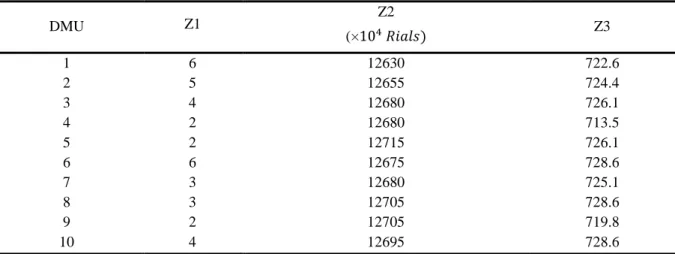
The case study solved using CPLEX solver in GAMS software. Table 2 depicts Pareto optimal solutions obtained from AUGMECON method.
Table 2. The non-dominated solutions obtained by AUGMECON method
Z3 Z2
(×104𝑅𝑅𝑀𝑀𝑀𝑀𝑅𝑅𝑠𝑠) Z1 DMU 722.6 12630 6 1 724.4 12655 5 2 726.1 12680 4 3 713.5 12680 2 4 726.1 12715 2 5 728.6 12675 6 6 725.1 12680 3 7 728.6 12705 3 8 719.8 12705 2 9 728.6 12695 4 10
As it is seen in table2, AUGMECON method finds 10 Pareto solutions. However, we should present a solution to HRM. Therefore, the CCR input oriented model is employed in order to choose the best solution from the Pareto solutions obtained from AUGMECON method.
Hence, results were considered as DMUs and objective functions were seen as input and output based on their nature (minimum and maximum was respectively considered as input and output of CCR). According to table 3, DMU 4 was selected as the most effective scheduling which is depicted in figure1. For example, as it is seen in figure 1, in the second day nurse 1 allocates to shifts 2 and 4.
Table 3. The efficiency and rank of the solutions model Efficiency The rank DMU 1.0047 3 1 1.0034 4 2 1.0023 6 3 1.0149 1 4 1.0000 7 5 1.0000 7 6 1.0029 5 7 1.0000 7 8 1.0080 2 9 1.0000 7 10
Day Nurse
1 2 3 4 5 6 7 8 9 10 11 12 13 14 15 16 17 18 19 20 21 22
1 2 3 1,4 2 2,3 4 1 3 1,4 4 2 3 1
2 2,4 1 3 4 3 2 2 1 1,4 3 3 4 2 1
3 3 4 2 1 1,2 3 1 4 4 3 2 2 1 3 4
4 2 3 4 1 1,2 4 2,3 3,4 1 2 4 1 3
5 1,4 2 3 2 1 4 2 3 4 3 1 4 2 1 3
6 1,3 2,4 1,2 1,4 2,3 3,4 2 1 3 4
7 2,3 1,4 3,4 3,4 1,2 1,2 4 2 1 3
Fig 1. The preferred schedule selected by DEA model
6-1- Sensitivity Analysis
In this section, the proposed nurse scheduling problem has been solved under variations of two important factors: the number of individuals in each expertise, importance weight of nurses’ preferences in working shifts and weekends off.
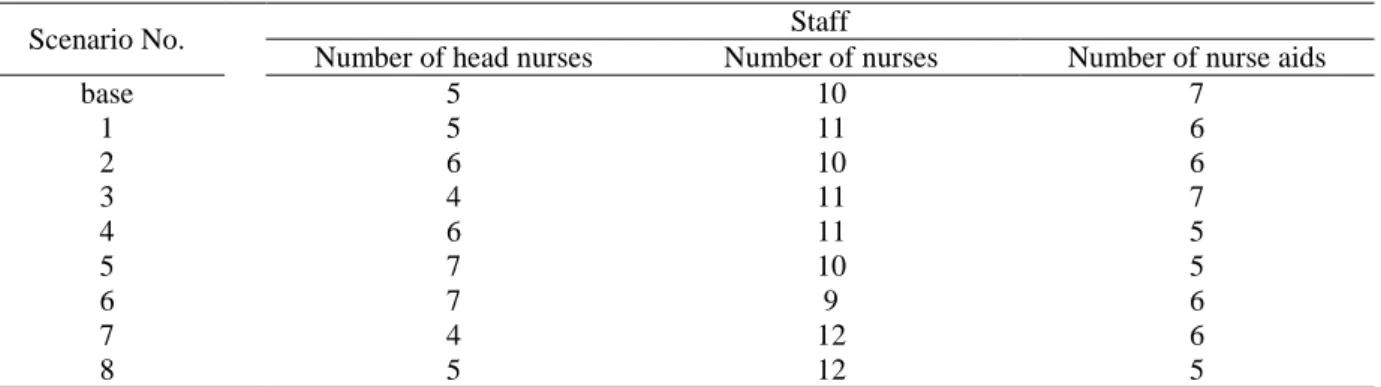
For these papers with fixing the total number of nurses several feasible and rational scenarios are designed by changing the number of the available nurses in each expertise. It should be noted that these changes may be resulted in infeasible scenarios. Hence, only feasible scenarios are investigated, showed in table 4.
Table 4. Different scenarios based on number of nurses in each expertise Staff
Scenario No.
Number of nurse aids Number of nurses
Number of head nurses
7 10
5 base
6 11
5 1
6 10
6 2
7 11
4 3
5 11
6 4
5 10
7 5
6 9
7 6
6 12
4 7
5 12
5 8
We investigate this scenarios based on three measures, including 1) total cost (i.e. second objective function) 2) total workload (i.e. first objective function) 3) the workload related to each expertise. The results are depicted in figure 2 and 3. As far as workload is considered, we can express senario5 is the best, because the average value of workload in each expertise has the lowest value (i.e. 0.66) in this scenario. Also, scenario 3 has the best performance based on cost indicator.
Fig 2. Behavior of the workload indicator for each scenario
Head nurses (HN), Nurse (NU), Nurse Aid (NA), and Total Workload (TW)
Fig 3. Behavior of the total cost indicator for each scenario
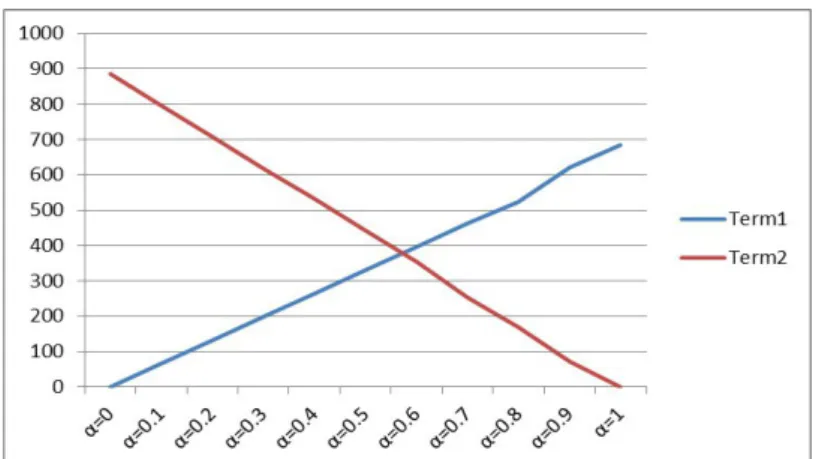
A sensitivity analysis was also performed on α value (the importance of the each term in third objective function). As it is seen in figure4 by increasing α, the value of the first term (i.e. the preferences of working in job shifts) is increased, while the value of the second term (i.e. the preferences of working in weekend) is decreased. Thus, the decision maker can select the favorable value of 𝛼𝛼based on his/her inclination.
Fig 4.Sensitivity analysis of α value based on preference indicator
7-Conclusion
In this research, a multi objective program was proposed for NSP. Objective functions included balancing the number of working shifts among nurses, minimizing hospital costs and maximizing nurses’ preferences in working shifts and weekends off. In this model, the limitations and constraints of real life that include governmental regulations, labor laws, and hospital policies were considered. Hospital policies were derived based on the observations in the Neurology section of Baqiyatallah hospital. Current scheduling of this hospital was being devised manually by the MHR. Unfortunately, these manual plans lead to discrimination and conflict between nurses. In this paper, a new two-step approach was proposed in order to solve the multi objective model. At first step, a real example was provided and then solved using of AUGMECON method. Then in the second step, to select the best solution among the Pareto solutions, one decision making approach named CCR Input Oriented model was used. The results were shown in table 3. In addition, the best scheduling was depicted in figure 1. Finally, sensitivity analysis has been carried out by changing effective and important parameters of the problem to improving nurse workload while keeping higher nurse job satisfaction and minimizing total cost. For further studies, these are the recommendations:
• Considering the uncertainty related to absenteeism of the nurses.
• Considering human error in mathematical model as respects to macro ergonomic factors. • Considering priorities for senior nurses.
• Considering patient acuity metrics.
References
Acar, I. (2010). A decision model for nurse-to-patient assignment.
Arthur, J. L., & Ravindran, A. (1981). A multiple objective nurse scheduling model. AIIE transactions, 13(1), 55-60.
Ásgeirsson, E. I., & Sigurðardóttir, G. L. (2016). Near-optimal MIP solutions for preference based self-scheduling. Annals of Operations Research, 239(1), 273-293.
Azaiez, M. N., & Al Sharif, S. S. (2005). A 0-1 goal programming model for nurse scheduling. Computers & Operations Research, 32(3), 491-507.
Bard, J. F., & Purnomo, H. W. (2007). Cyclic preference scheduling of nurses using a Lagrangian-based heuristic. Journal of Scheduling, 10(1), 5-23.
Beaumont, N. (1997). Scheduling staff using mixed integer programming. European journal of operational research, 98(3), 473-484.
Beddoe, G., Petrovic, S., & Li, J. (2009). A hybrid metaheuristic case-based reasoning system for nurse rostering. Journal of Scheduling, 12(2), 99.
Beliën, J., Demeulemeester, E., & Cardoen, B. (2005). Building cyclic master surgery schedules with leveled resulting bed occupancy: A case study.
Brusco, M. J., & Jacobs, L. W. (1993). A simulated annealing approach to the cyclic staff‐scheduling problem. Naval Research Logistics (NRL), 40(1), 69-84.
Burke, E. K., Curtois, T., Post, G., Qu, R., & Veltman, B. (2008). A hybrid heuristic ordering and variable neighbourhood search for the nurse rostering problem. European journal of operational research, 188(2), 330-341.
Burke, E. K., De Causmaecker, P., Berghe, G. V., & Van Landeghem, H. (2004). The state of the art of nurse rostering. Journal of scheduling, 7(6), 441-499.
Burke, E., Cowling, P., De Causmaecker, P., & Berghe, G. V. (2001). A memetic approach to the nurse rostering problem. Applied intelligence, 15(3), 199-214.
Burke, E., De Causmaecker, P., & Berghe, G. V. (1998, November). A hybrid tabu search algorithm for the nurse rostering problem. In Asia-Pacific Conference on Simulated Evolution and Learning (pp. 187-194). Springer, Berlin, Heidelberg.
Charnes, A., Cooper, W. W., & Rhodes, E. (1978). Measuring the efficiency of decision making units. European journal of operational research, 2(6), 429-444.
Cheang, B., Li, H., Lim, A., & Rodrigues, B. (2003). Nurse rostering problems––a bibliographic survey. European Journal of Operational Research, 151(3), 447-460.
Curtois, T. (2008). Novel heuristic and metaheuristic approaches to the automated scheduling of healthcare personnel (Doctoral dissertation, University of Nottingham).
Easton, F. F., & Mansour, N. (1999). A distributed genetic algorithm for deterministic and stochastic labor scheduling problems. European Journal of Operational Research, 118(3), 505-523.
Ernst, A. T., Jiang, H., Krishnamoorthy, M., Owens, B., & Sier, D. (2004a). An annotated bibliography of personnel scheduling and rostering. Annals of Operations Research, 127(1-4), 21-144. Ernst, A. T., Jiang, H., Krishnamoorthy, M., & Sier, D. (2004b). Staff scheduling and rostering: A review of applications, methods and models. European journal of operational research, 153(1), 3-27. Fozveh, I., Salehi, H., & Mogharehabed, K. (2016). Presentation of Multi-Skill Workforce Scheduling Model and Solving the Model Using Meta-Heuristic Algorithms. Modern Applied Science, 10(2), 194. Ikegami, A., & Niwa, A. (2003). A subproblem-centric model and approach to the nurse scheduling problem. Mathematical programming, 97(3), 517-541.
Jafari, H., & Salmasi, N. (2015). Maximizing the nurses’ preferences in nurse scheduling problem: mathematical modeling and a meta-heuristic algorithm. Journal of Industrial Engineering International, 11(3), 439-458.
Karmakar, S., Chakraborty, S., Chatterjee, T., Baidya, A., & Acharyya, S. (2016, September). Meta-heuristics for solving nurse scheduling problem: A comparative study. In Advances in Computing, Communication, & Automation (ICACCA)(Fall), International Conference on (pp. 1-5). IEEE.
Legrain, A., Bouarab, H., & Lahrichi, N. (2015). The nurse scheduling problem in real-life. Journal of medical systems, 39(1), 160.
Lu, K. Y., Lin, P. L., Wu, C. M., Hsieh, Y. L., & Chang, Y. Y. (2002). The relationships among turnover intentions, professional commitment, and job satisfaction of hospital nurses. Journal of Professional Nursing, 18(4), 214-219.
Mavrotas, G. (2009). Effective implementation of the ε-constraint method in multi-objective mathematical programming problems. Applied mathematics and computation, 213(2), 455-465. Meyer auf’m Hofe, H. (2001). Solving rostering tasks as constraint optimization. In Practice and Theory of Automated Timetabling III: Third International Conference, PATAT 2000 Konstanz, Germany, August 16–18, 2000 Selected Papers 3(pp. 191-212). Springer Berlin Heidelberg.
M’Hallah, R., & Alkhabbaz, A. (2013). Scheduling of nurses: a case study of a Kuwaiti health care unit. Operations Research for Health Care, 2(1-2), 1-19.
Mullinax, C., & Lawley, M. (2002). Assigning patients to nurses in neonatal intensive care. Journal of the operational research society, 53(1), 25-35.
Nasiri, M. M., & Rahvar, M. (2017). A two-step multi-objective mathematical model for nurse scheduling problem considering nurse preferences and consecutive shifts. International Journal of Services and Operations Management, 27(1), 83-101.
Rahimian, E., Akartunalı, K., & Levine, J. (2017). A hybrid integer programming and variable neighbourhood search algorithm to solve nurse rostering problems. European Journal of Operational Research, 258(2), 411-423.
Sadjadi, S. J., Heidari, M., & Esboei, A. A. (2014). Augmented ε-constraint method in multiobjective staff scheduling problem: a case study. The International Journal of Advanced Manufacturing Technology, 70(5-8), 1505-1514.
Solos, I. P., Tassopoulos, I. X., & Beligiannis, G. N. (2013). A generic two-phase stochastic variable neighborhood approach for effectively solving the nurse rostering problem. Algorithms, 6(2), 278-308.
Yin, P. Y., Chao, C. C., & Chiang, Y. T. (2011, June). Multiobjective optimization for nurse scheduling. In International Conference in Swarm Intelligence (pp. 66-73). Springer, Berlin, Heidelberg.
Warner, D. M., & Prawda, J. (1972). A mathematical programming model for scheduling nursing personnel in a hospital. Management Science, 19(4-part-1), 411-422.