channel parameters is derived. In [6], for a two-user Gaussian interference channel, an outer bound is derived by considering that the side information is given to each receiver to decode both transmitters` messages and also a bound for the weak interference regime is obtained. The best known achievable rate region is due to Han-Kobayashi scheme [7] by combination the ideas of time sharing and rate splitting, where users are allowed to split their transmit power into two parts: the private part and the common part. In [8] by making significant progress towards the general capacity region, a new outer bound on the capacity region is obtained and it has been shown that for the Gaussian inputs the Han-Kobayashi scheme without time sharing comes within one bit of the derived outer bound.
One of the low complexity methods to deal with the interference channel is to allow the communication links to treat each other’s interference as an addition to the noise floor. In [9], it has been shown that treating interference as noise (TIN) not only is optimal for the entire generalized degree of freedom region but also it reaches within constant gap of the entire capacity region.
On the other hand, game theoretic approaches have been received significant attention for utility maximization and resource allocation in the wireless communication networks [10]. Most game-theoretic approaches in wireless communication networks are grouped into two categories: Non-cooperative games [11]-[13] and Cooperative games [14]-[15].
In the recent decade, game-theoretic approaches also have been used in the interference channel and interference management systems [16]-[22].
On the interference channel, the operating point is chosen to achieve efficiency and fairness in resource allocation [16]. The behavior of the users in the interference channel is generally rational and selfish, which means that they have incentive to obtain more achievable rates and they only try to maximize their own utility without considering the whole system utility. In these environments where users are selfish, there is no guarantee that the efficient and fair operating point is achieved [16]. Sometimes the efficient and fair operating point is obtained by users` cooperation in choosing power transmission, codebook and rate allocation. But in practice users may not have motivation to cooperate with each other. Some techniques have been used to control the selfish and non-cooperative behavior of the users [16]. Also it has been shown in [16] that unfair situations on the spectrum sharing for multiple interfering systems may occur because of the asymmetry and selfishness behavior of the users. By proposing self-enforcing spectrum sharing rules efficient and fair situations have been obtained.
In [17], the notion of Nash equilibrium region has been exactly characterized in a non-cooperative one-shot game on the two-user linear deterministic interference channel where the utility of each user has been defined as its achievable rate. Nash bargaining solution (NBS) is used in [18] as a tool to get fair information rates and to obtain a specific point on the
rate region of the interference channel which is better than other points in the context of bargaining theory.
Also, pricing schemes have drawn more attention in resource allocation and power control. For mentioning a few, in [19] a distributed pricing scheme has been used for the MIMO interference channel that reflects compensation paid by the other users for their interferences.
The paper [20] has studied a bargaining approach on the 2-user Gaussian interference channel, which is also the motivation of this paper. Authors in [20] have proposed a two-phase mechanism for the selfish users to incentive them to coordinate their transmission strategies. The phase 1 includes choosing a simple Han-Kobayashi type scheme with Gaussian codebooks and fixed power split and the phase 2 includes bargaining over the achievable rate region to obtain a fair operating point.
In [21], in the 2-user weak GIC, a utility for users has been defined by using pricing scheme to control non-cooperative behavior of them. They have defined the utility of each user as its achievable rate minus the cost of each unit transmission power. There, the fair operating point has been defined as proportional fair point.
In this paper, which is an extended version of the paper [22], we consider the N-user weak GIC and use the power pricing scheme in each user’s utility to force them to agree in operating at a fair point. We use the Kalai-Smorodinsky bargaining solution (KSBS) [23]-[24] instead of proportional fair solution and NBS [25]-[26], because in considering the fairness point, KSBS is fairer than proportional fair solution and NBS [23]-[24]. Therefore, in what follows two games are considered. In the first game, we show that users` utility functions are their achievable rates using TIN. The users want to maximize their utilities by choosing power transmission strategy on multi-user GIC non-cooperatively and selfishly. Thus, the KSBS fair operating point is not achieved. Therefore, for punishing users and forcing them to choose their power transmission strategies to obtain the KSBS, we need to change the utility functions of the users. A price-based utility function for each user is defined. For all ranges of given prices (the price of each unit of transmit power) we define the best response function for the transmission power. Then we substitute the obtained best response function in the utility function. For the second game, we put the obtained utility function in the KSB problem and by solving the optimization problem for the given prices, the best transmit power for achieving KSBS is obtained theoretically. At last, the best prices of all users participating in the bargaining in order to reach the KSBS are obtained numerically through a proposed iterative algorithm.
There are some significant differences and improvement in comparing our approach in this paper and the paper [20]. One of the differences is the bargaining operating point where the NBS has been used as system operating point in [20], while in this paper, we use KSBS for introducing our efficient and fair operating point which is fairer than NBS [23]-[24]. Also this study is among N users in the GIC while the game in [20] is among 2 users. Another difference is in
the users’ incentivizing techniques. As it is mentioned in [20], in information theoretic approaches, full cooperation is assumed among users for the rate selection. In the environments where there is no cooperation among the users, the NBS may not necessarily be the agreement reached in practice because a centralized management is required to ensure that all users agree to operate at the fair point that is the solution point of Nash bargaining scheme. In many communication channels, having such a manager is lacking. Thus, in [20], a non-cooperative bargaining approach as alternating-offer bargaining game (AOBG) has been proposed to take into account the cost of delay of each user in bargaining and control the users’ actions to reach the fair operating point. As mentioned above, we use price-based punishment techniques to force the users to choose their power transmission strategy in such a way that efficient and fair operating point is achieved. Also in the game formulation in [20], an extensive form game with perfect information has been investigated, while here a strategic form game is used.
The significant difference between [21] and this paper`s scenario, in addition to the extension in the number of the users and the definition of fair operating point, is that in [21] the price of each unit of the transmission power has been obtained by a price function which the network manager derives it and announces the transmission power prices to the users. In the scenario of this paper, there is no manager and users obtain their transmission power prices in a distributed manner with an iterative algorithm which is more practical than centralized scenarios for implementing in the communication networks.
The rest of the paper is organized as follows. In Section II, the system model and some preliminaries are described. In Section III, a non-cooperative power control game without pricing is considered and then by applying pricing schemes, the result of the new game is presented. In Section IV, KSBS on the N-user GIC is obtained and an iterative algorithm is proposed. In Section V numerical results are presented that confirm the analytical development. Finally, in Section VI, the paper is concluded.
Notation: All logarithms are to the base 2.
II. SYSTEM MODEL AND PRELIMINARIES
A. Channel Model
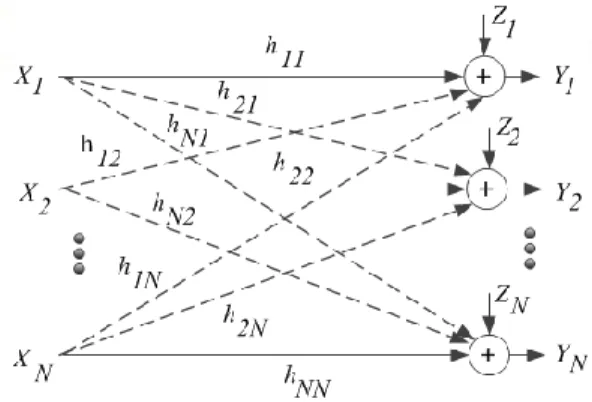
The multi-user Gaussian interference channel with 𝑁 transmitters and their corresponding receivers is depicted in Fig.1 and is formulated by the following,
𝑌𝑗,𝑡= ∑ ℎ𝑗𝑖𝑋𝑖,𝑡+ 𝑍𝑗,𝑡 𝑁
𝑖=1
𝑗 ∈ {1, … , 𝑁} (1) where 𝑋𝑖,𝑡 and 𝑌𝑗,𝑡, 𝑡 = 1, … , 𝑛 represent the input and output at transmitter 𝑖 and receiver 𝑗(𝑖, 𝑗 ∈ {1, … , 𝑁}) at time 𝑡, respectively, and 𝑍𝑗,𝑡 is assumed to be the independent additive complex white Gaussian noise with zero mean and variance of 𝜎𝑛2. ℎ𝑗𝑖 is the channel gain between receiver 𝑗 and transmitter 𝑖.
Fig. 1. Multi-User Gaussian interference channel.
Each transmitter 𝑖, transmits its message 𝑊𝑖 to the related receiver. Receiver 𝑖, (𝑖 = 1, … , 𝑁) is only interested in the message sent by transmitter 𝑖.
For a given block length 𝑛, user 𝑖 sends a message 𝑊𝑖∈ {1,2, … , 2𝑛𝑅𝑖} by encoding it to a codeword 𝑋𝑖(𝑛)= (𝑋𝑖,1, 𝑋𝑖,2, … , 𝑋𝑖,𝑛).
The codewords are real-valued and satisfy the block average power constraints given by,
1
𝑛∑ |𝑋𝑖,𝑡|2≤ 𝑃𝑖𝑚𝑎𝑥 𝑛
𝑡=1
, 𝑖 = 1, … , 𝑁. (2) Receiver 𝑖 observes the channel output 𝑌𝑖(𝑛)= (𝑌𝑖,1, … , 𝑌𝑖,𝑛) and uses a decoding function 𝑓𝑖∶ ℝ𝑛⟶ {1,2, … , 2𝑛𝑅𝑖} to get the estimate 𝑊̂
𝑖 of the transmitted message 𝑊𝑖. The probability of error at each receiver is defined by the expression,
𝑝𝑒,𝑖𝑛 = P{𝑓𝑖(𝑌𝑖(𝑛)) ≠ 𝑊𝑖} 𝑖 = 1, … , 𝑁. (3) and 𝑝𝑒𝑛= max{𝑝𝑒,1𝑛 , 𝑝𝑒,2𝑛 , … , 𝑝𝑒,𝑁𝑛 }.
A rate tuple (𝑅1, … , 𝑅𝑁) is said to be achievable if there is a sequence of (2𝑛𝑅1, … , 2𝑛𝑅𝑁, 𝑛) codes with
𝑝𝑒𝑛⟶ 0 as 𝑛 → ∞. The capacity region of the interference channel is the closure of the set of all achievable rate tuples.
By TIN, the achievable rate for each transmitter-receiver pair is:
𝑅𝑖(𝑃𝑖; 𝐏−i) = log (1 +
𝑃𝑖|ℎ𝑖𝑖|2 𝜎𝑛2+ ∑ 𝑃𝑗|ℎ𝑖𝑗|
2 𝑗≠𝑖
), (4) where 𝑖, 𝑗 ∈ {1, … , 𝑁}, 𝑖 ≠ 𝑗.
Also in this network, it is assumed that the total available transmission power for users is limited. Thus, another restriction is defined here as
∑ 𝑃𝑖𝑚𝑎𝑥 = 𝑃𝑇𝑜𝑡𝑎𝑙 𝑁
𝑖=1
. (5) which means that the sum of maximum available power for all users is 𝑃𝑇𝑜𝑡𝑎𝑙.
B. Review of Nash Equilibrium in a Non-Cooperative
Game
A game 𝐺 = 〈𝒩 , (𝑃𝑖), (𝑈𝑖)〉 has three elements: a set of users (transmitters and their corresponding receivers) 𝒩 = {1, … , 𝑁} as players, the strategy space
𝒫𝑖= [0, 𝑃𝑖𝑚𝑎𝑥] for each user 𝑖 which is the interval that contains the transmit power choices, and a utility function 𝑈𝑖 for each strategy profile 𝐏 = [𝑃1, … , 𝑃𝑁]𝑇.
In a non-cooperative power control game 𝐺 = 〈𝒩, (𝑃𝑖), (𝑈𝑖)〉, each user tends to maximize its utility by choosing appropriate power, so users compete for achieving more utility. Formally a non-cooperative power control game can be expressed by [11], [21] and [27],
max
𝑃𝑖∈𝒫𝑖𝑈𝑖(𝑃𝑖, 𝐏−𝑖), for all 𝑖 ∈ {1, … , 𝑁} (6) where 𝐏−𝑖 denotes the vector consisting of elements of 𝐏 other than the 𝑖th element.
Definition 1: As in [11], [21] and [27], a transmit
power profile 𝐏∗= [𝑃1∗, 𝑃2∗, … , 𝑃𝑁∗]𝑇 is the Nash equilibrium point of the non-cooperative power control game 𝐺 = 〈𝒩, (𝑃𝑖), (𝑈𝑖)〉, if for all 𝑖 ∈ {1, … , 𝑁} and
for all 𝑃𝑖∈ 𝒫𝑖, we have, 𝑈𝑖(𝑃𝑖∗, 𝐏−𝑖∗ ) ≥ 𝑈𝑖(𝑃𝑖, 𝐏−𝑖∗) . The most favorable strategy which is being chosen
by each rational self-optimizing user is the best response to the rivals power profile 𝐏−𝑖. So the best response can be defined as ℬ𝑖(𝐏−𝑖) = arg max
𝑃𝑖∈𝒫𝑖𝑈𝑖(𝑃𝑖, 𝐏−𝑖), and Nash equilibrium (NE) is a fixed point of all best responses and in other words NE is an operating point that none of the players can improve its utility by unilaterally changing its strategy.
C. Kalai-Smorodinsky Bargaining Solution (KSBS)
A famous solution to the bargaining game which could be utilized to guarantee fairness is KSBS. In KSBS, the goal is maximizing 𝑟 where 𝑟 =𝑈𝑖−𝑈𝑖
0
𝑈𝑖∗−𝑈𝑖0, and 𝑈𝑖∗ is the maximum possible utility for user 𝑖 and 𝑈𝑖0 is the disagreement point. The NBS is another fairness criterion [23]-[24]. However, KSBS emphasizes on the equal ideal point more than NBS and it is more reliable than NBS from the fairness criterion point of view [24]. NBS fairness is a generalized proportional fairness and this form can ensure fairness of resource allocation [26]. Also, cooperative game theories prove that there exists the unique and efficient NBS under the six axioms. The Nash bargaining problem is formulated as
max
𝑃𝑖 ∏(𝑈𝑖− 𝑈𝑖 0) 𝑁
𝑖=1
(7) where 𝑈𝑖 is the user 𝑖 utility and 𝑈𝑖0 is the disagreement point.
III. GAME FORMULATION
A. Power Control Game Without Pricing
By assuming 𝑈𝑖= 𝑅𝑖 defined in (4), all users choose their maximum power for maximizing their utilities, so the power profile at the NE point with the assumed utility is 𝐏∗= [𝑃1𝑚𝑎𝑥, 𝑃2𝑚𝑎𝑥, … , 𝑃𝑁𝑚𝑎𝑥].
As it has been mentioned in the weak GIC, users use TIN scenario to obtain their achievable rates. It is trivial that when users do not coordinate, each user uses TIN scenario [20]. Therefore, KSBS operating point is not necessarily obtained, because all of the users prefer using their maximum power in an uncoordinated case.
Fig. 2. KSBS vs. NBS on the two-user GIC rate region [28].
We cannot force users to adjust their powers in a way that the KSBS operating point would be established in the network.
In Fig. 2, the bargaining points mentioned above are illustrated on the rate region of the two-user GIC in weak interference scenario, which is comparing KSBS and NBS and also has been illustrated in [28].
Note that also in [20], the NBS point on the rate region of the two-user Gaussian interference channel is depicted. There, this point is achieved by using optimal Han-Kobayashi power splitting.
It is clear that the power profile 𝐏∗= [𝑃1𝑚𝑎𝑥, 𝑃2𝑚𝑎𝑥] for two-user and 𝐏∗= [𝑃1𝑚𝑎𝑥, 𝑃2𝑚𝑎𝑥, … , 𝑃𝑁𝑚𝑎𝑥] for N-user (which N-users choose the maximum power to maximize their achievable rate) do not necessarily result in NBS or KSBS. Operating on these points in practice is not guaranteed. So we add a cost function to the achievable rate of each user to force them operate on bargaining points which are the fair operating points. As mentioned above KSBS emphasizes on fairness more than NBS so we concentrate on KSBS in this paper.
By changing users` pay-off function in the next section and applying prices for transmitting messages, the power profile for achieving the maximum pay-off would be changed.
B. The Proposed Price-Based Power Control Game
As discussed in the previous section, from game-theoretic point of view, rational users without any cost, use their maximum power, so the rate tuple with this power profile is not necessarily a fair operating point and by assuming users’ rate as their utilities, the results in the previous section are obtained which are not fair necessarily. When users should pay price for using power to transmit, then their selfishness behavior can be controllable. By defining a pay-off function like (8) in which the utility of each user is its achieved rate minus the price of the used power, we can investigate the behavior of users for choosing the transmit power. 𝑈𝑖(𝑃𝑖, 𝐏−𝑖) = 𝑅𝑖(𝑃𝑖, 𝐏−𝑖) − 𝛽𝑖𝑃𝑖 (8) In (8), 𝑈𝑖,𝑅𝑖 and 𝛽𝑖(𝑖 = 1, … , 𝑁) are respectively each user`s utility, rate and the price of per unit of the used power.
It is shown that for the game 𝐺 = 〈𝒩 , (𝑃𝑖), (𝑈𝑖)〉, where 𝑈𝑖(𝑃𝑖; 𝐏−𝑖) = 𝑅𝑖(𝑃𝑖; 𝐏−𝑖) − 𝛽𝑖𝑃𝑖, a unique and Pareto-efficient NE exists for all 𝛽𝑖≥ 0. Also it is shown that there is a unique tuple 𝛽1,…, 𝛽𝑁 that results in fairness and Pareto-efficiency at the same time.
𝑏𝑖(𝑷−𝒊) = {
𝑃𝑖𝑚𝑎𝑥, 𝑖𝑓 0 ≤ 𝛽𝑖≤ 𝑅𝑖′(𝑃𝑖𝑚𝑎𝑥) min{ 𝑃𝑖𝑚𝑎𝑥,
1 𝛽𝑖𝑙𝑛 (2)−
𝜎𝑛2+ ∑ 𝑃𝑗|ℎ𝑖𝑗| 2 𝑗≠𝑖
|ℎ𝑖𝑖|2 }, 𝑖𝑓 𝑅𝑖 ′(𝑃
𝑖𝑚𝑎𝑥) < 𝛽𝑖≤ 𝑅𝑖′(0) 0, 𝑖𝑓 𝑅𝑖′(0) < 𝛽𝑖
(9)
Lemma1 : In the game with pricing, where utility of
each user defined by (8), the best response of user 𝑖 to
a given interference is (9), where 𝑖, 𝑗 ∈ {1, … , N}, 𝑖 ≠ 𝑗.
Proof: For obtaining 𝑏𝑖(𝐏−𝑖) , we should solve
max
𝑃𝑖 𝑈𝑖(𝑃𝑖; 𝐏−𝑖). So the first and the second derivative of the proposed utility which is 𝑈𝑖(𝑃𝑖; 𝐏−𝑖) = 𝑅𝑖(𝑃𝑖; 𝐏−𝑖) − 𝛽𝑖𝑃𝑖 with respect to 𝑃𝑖 are used.
𝜕𝑈𝑖
𝜕𝑃𝑖=
|ℎ𝑖𝑖|2
(ln2) (𝜎𝑛2+ ∑ 𝑃𝑗|ℎ𝑖𝑗|
2
𝑗≠𝑖 + 𝑃𝑖|ℎ𝑖𝑖|2)
− 𝛽𝑖 (10)
∂2𝑈
𝑖
∂𝑃𝑖2
= −|ℎ𝑖𝑖|
4
(ln2) (𝜎𝑛2+ ∑ 𝑃𝑗|ℎ𝑖𝑗|
2
𝑗≠𝑖 + 𝑃𝑖|ℎ𝑖𝑖|2)
2 (11)
Note that ∂ 2𝑈
𝑖
∂𝑃𝑖2 is always negative. We know that
𝑅𝑖′(𝑃𝑖), i.e., 𝜕𝑅𝜕𝑃𝑖
𝑖 that is
|ℎ𝑖𝑖|2
(ln2)(𝜎𝑛2+∑ 𝑃 𝑗|ℎ𝑖𝑗|2
𝑗≠𝑖 +𝑃𝑖|ℎ𝑖𝑖|2) is a strictly decreasing function of 𝑃𝑖 and 𝑅𝑖′(𝑃𝑖𝑚𝑎𝑥) < 𝑅𝑖′(𝑃𝑖) ≤ 𝑅𝑖′(0). Thus, for 0 ≤ 𝛽𝑖≤ 𝑅𝑖′(𝑃𝑖𝑚𝑎𝑥), we have 𝜕𝑈𝜕𝑃𝑖
𝑖 > 0, so 𝑈𝑖 is an increasing function of 𝑃𝑖. In this case, similar to the mentioned game in section III, the best response for each user is to transmit at its maximum power, i.e., for 0 ≤ 𝛽𝑖≤ 𝑅𝑖′(𝑃𝑖𝑚𝑎𝑥) 𝑏𝑖(𝐏−𝑖) = 𝑃𝑖𝑚𝑎𝑥 that 𝑖 ∈ {1, … , 𝑁}. For 𝑅𝑖′(𝑃𝑖𝑚𝑎𝑥) < 𝛽𝑖≤ 𝑅𝑖′(0) , the equation 𝜕𝑈𝜕𝑃𝑖
𝑖= 0, or equivalently
𝑅𝑖′(𝑃𝑖) = 𝛽𝑖, has the unique solution 𝑃𝑖= 𝛽 1
𝑖ln (2)−
𝜎𝑛2+∑𝑗≠𝑖𝑃𝑗|ℎ𝑖𝑗|2
|ℎ𝑖𝑖|2 for 𝑖, 𝑗 ∈ {1, … , 𝑁} and 𝑖 ≠ 𝑗 . As
𝑅𝑖′′(𝑃𝑖) < 0 for all 𝑃𝑖, and hence ∂2𝑈𝑖
∂𝑃𝑖2< 0, the roots of (8) maximize 𝑈𝑖 for a given interference ∑ 𝑃𝑗|ℎ𝑖𝑗|
2
𝑗≠𝑖 .
In this case, it is obvious that transmitter 𝑖 cannot transmit more than 𝑃𝑖𝑚𝑎𝑥for a fixed interference so if the obtained 𝑃𝑖 be more than 𝑃𝑖𝑚𝑎𝑥, the best response to 𝐏−𝑖 is the maximum value of transmit power.
Therefore, in this case we have
𝑏𝑖(𝐏−𝑖) = min{ 𝑃𝑖𝑚𝑎𝑥,𝛽 1
𝑖ln (2)−
𝜎𝑛2+∑𝑗≠𝑖𝑃𝑗|ℎ𝑖𝑗|2
|ℎ𝑖𝑖|2 }. For 𝑅𝑖′(0) < 𝛽𝑖, we have 𝜕𝑈𝜕𝑃𝑖
𝑖 < 0, thus 𝑈𝑖 is a decreasing function of 𝑃𝑖, and the best response for transmitter 𝑖 is no transmission, i.e., for 𝑅𝑖′(0) < 𝛽𝑖,
𝑏𝑖(𝐏−𝑖) = 0 for 𝑖 ∈ {1, … , 𝑁}. ∎ By substituting (9) in (8), we can obtain 𝑈𝑖∗ in (12),
which is the maximum utility for user 𝑖. IV.KSBS ON GIC
A. Power Allocation Setting
In this section we are going to find the best power allocation for all users in Gaussian interference channel based on KSBS. First we assume that the prices (for a unit of power) for all users, i.e., 𝛽𝑖 (𝑖 = 1, … , 𝑁) are given (At the end of this section, the way of obtaining prices will be discussed) and they are not changed at each level of the game. Now, KSBS is obtained by solving,
max
𝑃𝑖 𝑟 (13) s.t. 𝑟 =𝑈𝑖−𝑈𝑖
0
𝑈𝑖∗−𝑈𝑖0
where 𝑈𝑖 is mentioned in (8). 𝑈𝑖0 is the disagreement point where user 𝑖 uses its maximum power, i.e., 𝑈𝑖0= 𝑅𝑖(𝑃𝑖𝑚𝑎𝑥, 𝐏−𝑖) − 𝛽𝑖𝑃𝑖𝑚𝑎𝑥 and 𝑈𝑖∗ is the maximum utility which is derived in (12). Similar to [25], this problem is equivalent to
max 0≤𝐏≤𝐏𝐦𝐚𝐱min𝑖
𝑈𝑖− 𝑈𝑖0
𝑈𝑖∗− 𝑈𝑖0 (14) where 0 ≤ 𝐏 ≤ 𝐏𝐦𝐚𝐱means 0 ≤ 𝑃𝑖≤ 𝑃𝑖𝑚𝑎𝑥for all 𝑖 ∈ {1, … , 𝑁}. The problem in (14) is also mentioned as max-equal problem, i.e., 𝑚𝑎𝑥{𝑟|𝑟 =𝑈𝑖−𝑈𝑖
0
𝑈𝑖∗−𝑈𝑖0}, subject to 0 ≤ 𝑃𝑖≤ 𝑃𝑖𝑚𝑎𝑥 for all 𝑖 ∈ {1, … , 𝑁}.
It is obvious that if 𝑈𝑖∗= 𝑈𝑖0, then 𝑈𝑖−𝑈𝑖0
𝑈𝑖∗−𝑈𝑖0 for user 𝑖 goes to infinity. Therefore, we use an assumption here 𝑈𝑖∗(𝑏𝑖(𝑷−𝒊), 𝑷−𝒊)
=
{
log (1 + 𝑃𝑖𝑚𝑎𝑥|ℎ𝑖𝑖|2 𝜎𝑛2+ ∑ 𝑃𝑗|ℎ𝑖𝑗|
2 𝑗≠𝑖
) − 𝛽𝑖𝑃𝑖𝑚𝑎𝑥, 𝑖𝑓 0 ≤ 𝛽𝑖< 𝑅𝑖′(𝑃𝑖𝑚𝑎𝑥)
log (1 + |ℎ𝑖𝑖|2 𝛽𝑖𝑙𝑛 (2) − 𝜎𝑛
2+ ∑ 𝑃
𝑗|ℎ𝑖𝑗| 2 𝑗≠𝑖 𝜎𝑛2+ ∑ 𝑃𝑗|ℎ𝑖𝑗|
2 𝑗≠𝑖
) − 1
ln(2)− 𝛽𝑖
𝜎𝑛2+ ∑ 𝑃𝑗|ℎ𝑖𝑗| 2 𝑗≠𝑖
|ℎ𝑖𝑖|2 , 𝑖𝑓 𝑅𝑖 ′(𝑃
𝑖𝑚𝑎𝑥) ≤ 𝛽𝑖< 𝑅𝑖′(0) 0, 𝑖𝑓 𝑅𝑖′(0) ≤ 𝛽𝑖
(12)
that the users whom it is beneficial for them to use their maximum power according to their prices, (i.e., 𝑈𝑖∗= 𝑈𝑖0happens for these users), are not allowed to take part in the bargaining. So, we can find 𝑀 users (𝑀 ≤ 𝑁) that participate in the bargaining and 𝑁 − 𝑀 users quit the game because more benefit is never acquired.
Without loss of generality, it is assumed that the 𝑀 users can be sorted in the order 𝑅1′ ≥ 𝑅2′ ≥ ⋯ ≥ 𝑅𝑀′ . It is investigated that with the given 𝛽𝑖, users whose 𝑅𝑖′(𝑃𝑖𝑚𝑎𝑥) is not more than 𝛽𝑖 would not participate in the game (i.e., the 𝑁 − 𝑀 users mentioned above ). So to force 𝑀 users to take part in the game the range of 𝛽𝑖 should be 𝑅𝑀−1′ > 𝛽𝑖≥ 𝑅𝑀′. Therefore, we should find the power allocation of these 𝑀 users based on KSBS with the given prices 𝛽𝑖 for 1 ≤ 𝑖 ≤ 𝑀.
The other 𝑁 − 𝑀 users use their maximum power according to their price (𝛽𝑖) and do not attend in the bargaining problem. Actually, the dual of maximizing the sum rate is maximizing the minimum rate which is the fairness scheme [11].
We next obtain the solution of 𝑃𝑖 for 1 ≤ 𝑖 ≤ 𝑀 , according to KSBS. Therefore we have,
𝑈1− 𝑈10 𝑈1∗− 𝑈10=
𝑈2− 𝑈20 𝑈2∗− 𝑈20= ⋯ =
𝑈𝑀− 𝑈𝑀0
𝑈𝑀∗ − 𝑈𝑀0 = 𝑟 (15) By defining 𝑈𝑖−1 as the inverse function of 𝑈𝑖(𝑃𝑖, 𝐏−𝑖), we have 𝑃𝑖∗= 𝑈𝑖−1(𝑟𝑈𝑖∗+ (1 − 𝑟)𝑈𝑖0). Note that although there might be multiple solutions of 𝑃𝑖∗ , we choose the exclusive one which holds
∑ 𝑈𝑖−1(𝑟𝑈
𝑖∗+ (1 − 𝑟)𝑈𝑖0) = 𝑃𝑇𝑜𝑡𝑎𝑙
𝑀
𝑖=1 − ∑𝑁𝑘=𝑀+1𝑃𝑘𝑚𝑎𝑥. So
it leads to the single solution 𝑟∗due to monotonicity, and further yields 𝑃𝑖∗.
B. Price Setting with Distributed Iterative Resource
Allocation Algorithm
In this part, we introduce an iterative algorithm for setting the price of transmit power among users to reach the KSBS point. In this algorithm 𝑃𝑖∗ (which is mentioned in the above subsection) and 𝛽𝑖∗ are obtained from solving KSB. Moreover, a power allocation is Pareto-efficient, if it is not possible to increase the utility of any user without decreasing the utility of the other user, based on Pareto-efficiency definition in [11], [21] and [27]. Here, at the end of the game, there exists no power vector like 𝐏′, such that 𝑈𝑖(𝐏′) ≥ 𝑈𝒊(𝑷∗)for all users 𝑖 ∈ {1, . . , 𝑀}. So, this achieved operating point is also Pareto-efficient.
Distributed Resource Allocation Algorithm
1: Each user 𝑖, chooses initial power from [0, 𝑃𝑖𝑚𝑎𝑥] for transmitting its message and also an initial price 𝛽𝑖≥ 0 is set for user 𝑖.
2: In each iteration 𝑛, power is updated according to (9).
3: The price of each unit of transmit power is updated in each iteration 𝑛 according to:
𝛽𝑖(𝑛 + 1) = [𝛽𝑖(𝑛) + 𝜅(𝑃𝑖(𝑛) − 𝑃𝑖∗)]+. where 𝜅 is the step size.
4: The utility of each user is updated from (12). 5: Jump to step 2 until
𝑈𝑖(𝑛)−𝑈𝑖0(𝑛) 𝑈𝑖∗(𝑛)−𝑈𝑖0(𝑛)−
𝑈𝑖(𝑛−1)−𝑈𝑖0(𝑛−1)
𝑈𝑖∗(𝑛−1)−𝑈𝑖0(𝑛−1)> 𝜀 for all users
𝑖 ∈ {1, . . , 𝑀}, where 𝜀 is a small constant.
V. NUMERICAL RESULTS
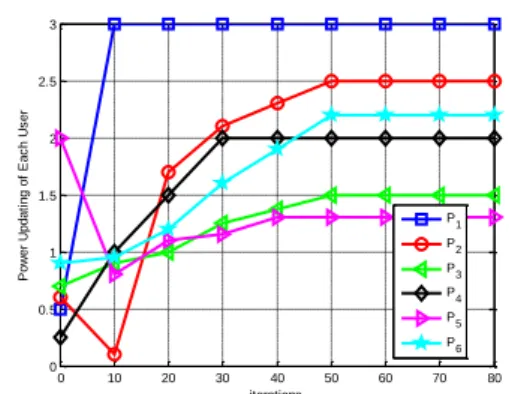
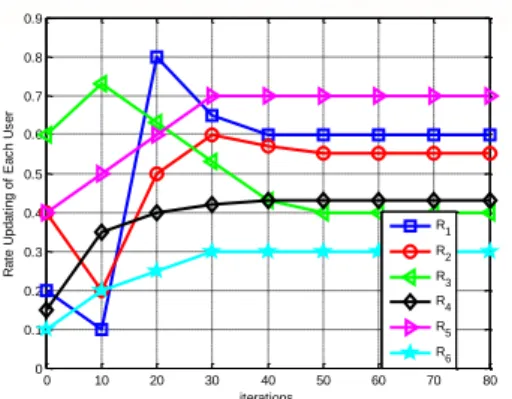
Numerical results for the described scenario are depicted in Fig. 3, Fig. 4, Fig. 5 and Fig. 6. It is assumed that 6 users take part in the bargaining game. Coefficient 𝜅 (convergence step size) in the iterative algorithm is set to 0.01. The channel gains have been chosen randomly and all channel gains are positive and less than 1 (This is because of weak interference channel definition [5]). It is assumed that all channel gains are known to users and are fixed during the game. In Fig. 3, for each iteration the transmit power of users according to step 2 in the iterative algorithm is depicted. The maximum power for all users is equal to 3.5 watts. In Fig. 4, the updating prices of transmit power unit are illustrated. In Fig. 5 rates of users and in Fig. 6 the utility of users in the bargaining scenario during the iterative algorithm are illustrated. One can see that utilities are become equal and fairness among users are established in about 60 iterations by using KSBS to find optimal transmit powers.
VI. CONCLUSION
In this work, first we have assumed that users in multi-user Gaussian interference channel do not have equal rates and the users with good channel gains interfere to other users, so the fairness is not satisfied. Then, a utility is introduced with pricing for competing users and also KSBS is considered as an efficient and fair operating point. It is shown that by applying the resulted prices and power allocation during the proposed iterative resource allocation algorithm for all users the fair points are obtained. The numerical results show that all users reach the KSBS fair operating point after about 50 to 60 iterations.
Fig. 3. The illustration of updating transmit power by users and reaching the KSBS operating point.
Fig. 4. The illustration of updating prices of transmit power unit.
0 10 20 30 40 50 60 70 80 0 0.5 1 1.5 2 2.5 3 iterations P o w e r U p d a ti n g o f E a c h U s e r P1 P2 P3 P4 P5 P6
0 10 20 30 40 50 60 70 80 0 0.1 0.2 0.3 0.4 0.5 0.6 iterations P ri c e U p d a ti n g o f E a c h U s e r 1 2 3 4 5 6
Fig. 5. The illustration of updating rates by users and reaching the KSBS operating point.
Fig. 6. The illustration of reaching the KSBS operating point.
REFERENCES
[1] J. He, S. Ji, Y. Pan, Y. Li (Eds.), Wireless ad-hoc and Sensor
Networks: Management, Performance, and Applications. Boca
Raton, FL: CRC Press, 2014.
[2] A. Elgamal and Y. Kim, Network Information Theory.
Cambridge University Press, 2011.
[3] A. B. Carleial, “A case where interference does not reduce capacity,” IEEE Trans. Inf. Theory, vol. IT-21, no. 5, pp. 569– 570, Sep. 1975.
[4] H. Sato, “The capacity of the Gaussian interference channel under strong interference,” IEEE Trans. Inf. Theory, vol. IT-27, no. 6, pp. 786-788, Nov. 1981.
[5] A. Motahari and A. Khandani, “Capacity bounds for the Gaussian interference channel,” IEEE Trans. Inf. Theory, vol. 55, no. 2, pp. 620–643, Feb. 2009.
[6] G. Kramer, “Outer bounds on the capacity of Gaussian interference channels,” IEEE Trans. Inf. Theory, vol. 50, no. 3, pp. 581–586, Mar. 2004.
[7] T. Han and K. Kobayashi, “A new achievable rate region for the interference channel,” IEEE Trans. Inf. Theory, vol. 27, no. 1, pp. 49–60, Jan. 1981.
[8] R. Etkin, D. Tse, and H. Wang, “Gaussian interference channel capacity to within one bit,” IEEE Trans. Inf. Theory, vol. 54, no. 12, pp. 5534–5562, Dec. 2008.
[9] C. Geng, N. Naderializadeh, A. S. Avestimehr, and S. Jafar, “On the optimality of treating interference as noise,” IEEE Trans. Inf.
Theory, vol. 61, no. 5, pp. 1753-1767, Apr. 2015.
[10] Z. Han, D. Niyato, W. Saad, T. Basar, and A. Hjørungnes,
Game Theory in Wireless and Communication Networks:
Theory, Models and Applications, Cambridge University Press,
2012.
[11] C. U. Saraydar, N. B. Mandayam, and D. J. Goodman, “Efficient power control via pricing in wireless data networks,”
IEEE Trans. Commun., vol. 50, no. 2, pp. 291–303, Feb. 2002.
[12] M. Rasti, AR. Sharafat, and B. Seyfe, “Pareto-efficient and goal-driven power control in wireless networks: a
game-theoretic approach with a novel pricing scheme,” IEEE/ACM Trans. Netw., vol. 17, no. 2, pp. 556-568, April 2009. [13]Z. Han, Z. Ji, and K. J. R. Liu, “ Non-cooperative resource
competition game by virtual referee in multi-cell OFDMA networks,” IEEE J. Sel. Areas Commun, vol. 25, no. 6, pp. 1079-1090, August 2007.
[14] H. Zhang, C. Jiang, N. C. Beaulieu, X. Chu, X. Wang, and Q. S. Quek, “Resource allocation for cognitive small cell networks: a cooperative bargaining game theoretic approach,” IEEE Trans. on Wireless Commun., vol. 14, no. 6, pp. 3481-3493, June 2015.
[15]Q. Cao, H. V. Zhao, and Y. Jing, “Power allocation and pricing in multi-user relay networks using Stackelberg and Bargaining games,” IEEE Trans. on Vehicular Techmology, vol. 61, no. 7, pp. 3177-3190, Sept. 2012.
[16]R. Etkin, A. P. Parekh, and D. Tse, “Spectrum sharing in unlicensed bands,” IEEE J. Sel. Areas Commun., vol. 25, no. 3, pp. 517–528, April 2007.
[17]R. Berry and D. Tse, “Shannon meets Nash on the interference channel,” IEEE Trans. Inf. Theory, vol. 57, no. 5, pp. 2821-2836, May 2011.
[18] A. Leshem and E. Zehavi, “Cooperative game theory and the Gaussian interference channel,” IEEE J. Sel. Areas Commun.,
vol. 26, pp. 1078–1088, Sep. 2008.
[19] C. Shi, D. A. Schmidt, R. A. Berry, M. L. Honig and W. Utschick, “Distributed interference pricing for the MIMO interference channel,” in Proc. IEEE Int. Conf. Commun., Jun. 2009.
[20] X. Liu and E. Erkip, “A game-theoretic view of the interference channel: impact of coordination and bargaining,” IEEE Trans.
Inf. Theory, vol. 57, no. 5, pp. 2805-2820, May 2011.
[21] A. Ebrahim Khani and B. Seyfe, “A game-theoretic approach based on pricing scheme on the two-user Gaussian interference channel,” in Proc. Iran Workshop on Commun. and Inf. Theory
(IWCIT), May 2014.
[22] A. Ebrahimkhani, and B. Seyfe, “ A new bargaining approach on the N-user Gaussian interference channel,” in Proc. 8th
International Symposium on Telecommunications (IST), Iran,
Sept. 2016.
[23] E. Kalai and M. Smorodinsky, “Other solutions to Nash bargaining problem,” Econometrica, vol. 43, pp. 513-518, May 1975.
[24] J. Yue, B. Yang and X. Guan, “Fairness-guaranteed pricing and
power allocation with a friendly jammer against
eavesdropping,” in Proc. international conference on wireless
communications and signal processing, Huagshan, Oct. 2012.
[25] Z. Han, Z. Ji, K. Liu, "Fair Multiuser Channel Allocation for OFDMA Networks Using Nash Bargaining Solutions and Coalitions", IEEE Trans. on Commun., pp. 1366-1376, Aug. 2005.
[26] J. Nash, “Two-person cooperative games,” Economica, vo.21, pp. 128-140, 1953.
[27] D. Fudenberg and J. Tirole, Game Theory. Cambridge, MA: MIT Press, 1991.
[28] S. Kim, “News-vendor game-based resource allocation scheme
for next-generation,” EURASIP Journal on Wireless
Communications and Networking, 2016:158, pp.1-11, Jul. 2016.
Atena Ebrahimkhani is a Ph.D.
student in the Faculty of Electrical Engineering at K. N. Toosi University of Technology, Tehran, Iran. She received her M.Sc. from the Department of Electrical Engineering, Shahed University, Tehran, Iran in 2014. Her research interests include game theory and wireless communication networks.
0 10 20 30 40 50 60 70 80 0 0.1 0.2 0.3 0.4 0.5 0.6 0.7 0.8 0.9 iterations R a te U p d a ti n g o f E a c h U s e r R1 R2 R3 R4 R5 R6
0 10 20 30 40 50 60 70 80 0 0.05 0.1 0.15 0.2 0.25 0.3 0.35 0.4 0.45 0.5 iterations B a rg a in in g R e s u lt s o f E a c h U s e r
U1-U10/U1*-U10 U2-U20/U2*-U20 U3-U30/U3*-U30 U4-U40/U4*-U40 U5-U50/U5*-U50 U6-U60/U6*-U60
𝑟∗
Bahareh Akhbari received the B.Sc. degree in 2003, the M.Sc. degree in 2005 and the Ph.D. degree in 2011 all in Electrical
Engineering from Sharif
University of Technology (SUT), Tehran, Iran. She was also a visiting Ph.D student at the University of Minnesota for one year, starting in 2010. Since 2012, she is an assistant professor of the Faculty of Electrical Engineering, K. N. Toosi University of Technology (KNTU), Tehran, Iran. Her research interests include
information theory, communication theory
and information-theoretic security.
Babak Seyfe received the B.Sc.
degree from the University of Tehran, Tehran, Iran, and the M.Sc. and Ph.D. degrees from Tarbiat Modares University, Tehran, Iran, in electrical and computer engineering in 1991, 1995, and 2004, respectively. He is associate professor at the
Department of Electrical
Engineering, Shahed University, Tehran, Iran. Prior to this, he was with the Centre for Digital Signal Processing Research at King’s College, London, U.K. He was with the Department of Electrical and Computer Engineering at Tarbiat Modares University from 2004 to 2005 and with the Department of Electrical and Computer Engineering, University of Toronto, Toronto, Canada, as a Visiting Researcher in 2002. His research interests are detection and estimation theory, statistical signal processing, communication systems, nonparametric and robust statistics, and information theoretic learning.
![Fig. 2. KSBS vs. NBS on the two-user GIC rate region [28].](https://thumb-us.123doks.com/thumbv2/123dok_us/8369568.2222848/4.893.492.731.95.238/fig-ksbs-vs-nbs-user-gic-rate-region.webp)