HIV as a Risk Factor for Multi-Drug Resistant Tuberculosis: A Systematic
Review
By Sujit Suchindran
A Master's Paper submitted to the faculty of the University ofNorth Carolina at Chapel Hill
In partial fulfillment of the requirements for the degree of Master of Public Health in
the Public Health Leadership Program.
Chapel Hill
INTRODUCTION
Winstone Zulu is featured prominently in a tuberculosis (TB) and HIV awareness campaign sponsored by the Stop TB Partnership, a network of organizations, countries and donors that have made the elimination of tuberculosis a priority. He is a Zambian who contracted HIV and later acquired infection with TB. He managed to survive the co-infection when so many around him, including four of his brothers, died of tuberculosis in the 1990s. This defining experience led him to become a leading advocate for TB and HIV patients worldwide. Like those in his family, many people in sub-Saharan Africa and throughout the world who suffer from TB and HIV do not survive the deadly combination. The terrifying consequences of the two infections have now become even graver- a newer threat of multi-drug resistant TB (MDR-TB) jeopardizes what little control there is now over the dual epidemic. Understanding the relationship between HIV and MDR-TB has profound implications for the many people like Winstone Zulu's brothers, who have all but received a death sentence.
The Scope ofTB
to 181 in South-East Asia and 39 in the Americas. The highest mortality rates also occur in Africa (74 per 100,000).1 While TB remains a major cause of mortality, incidence rates have recently remained stable or have declined in most regions worldwide.
Nonetheless, the number of new TB cases still rose slightly in 2005 because of the case load in Africa and South-East Asia.2
Though tuberculosis has consistently remained a major cause of morbidity and mortality worldwide, it has received varying levels of attention from the public health and medical community. Initial large scale public health responses to tuberculosis began in the post World War II era as vertical programs. This approach succeeded in stemming the tide of infection in industrialized countries but did little to control TB in resource poor countries.3 In the latter, TB control had to be incorporated into the general health services. This integration into general health services marginalized tuberculosis control efforts in certain nations for decades. This continued into the 1980s as the HIV pandemic was about to profoundly increase rates of tuberculosis worldwide.
Response to the resurgence and drug resistance
In 1995, the World Health Organization adopted the DOTS (Directly Observed Therapy Short-Course) program as a systematic strategy to combat rising rates ofTB. Among the central tenets ofthe program was the recognition ofTB chemotherapy as a highly cost effective intervention. Also important were government commitment to TB .control, diagnosis with sputum microscopy, appropriately managed short-course
chemotherapy, readily available pharmaceuticals and infrastructure for outcomes measurement.4 Initial efforts in the DOTS era proved limited as only 11% ofTB cases were estimated to be treated under its guidelines in a 1997 study.6 DOTS gradually expanded but its shortcomings led to new threats: the double threat of HIV /TB and the continued escalation ofMDR-TB rates.
However, the most important consequence of resistance is that MDR-TB has higher treatment failure and death rates in new andre-treatment cases.9 Aside from the pharmacologic and physiologic properties, MDR-TB treatment is prohibitively more expensive than the traditional six month short-course chemotherapy. Accordingly, the financial burden ofMDR-TB places considerable stress on the health budgets of resource poor nations.
Investigations into the prevalence and trends ofMDR-TB began with the
WHO/IUALTD Global Project on Anti-tuberculosis Drug Resistance Surveillance, which was completed in 1997 .10• 11 These reports demonstrated that drug resistant TB, including MDR-TB, was present worldwide and that better TB control practices were associated with lower rates of bacterial resistance. Furthermore, MDR-TB was shown to be especially problematic in certain 'hot-spots' such as Russia, Latvia and the Dominican Republic. A follow up report from 2001 showed especially high rates ofMDR-TB in certain areas? While the median rate ofMDR was 1.0% among new cases ofTB, the rates varied considerably. MDR accounted for 14.1% of new cases in Estonia, 9.0% of new cases in Latvia, 9.0% of new cases in the Ivanovo oblast (region) of Russia, 5.0% of new cases in Iran and 4.5% of cases in the Zhejiang province of China. The latest report from WHO/IUALTD confirms these "hot spots" of epidemic MDR-TB while
additionally warning about high rates ofMDR-TB in Kazakhstan, Lithuania, Uzbekistan, Ecuador and Israel.12
complementary DOTS-plus program, which would uses DOTS programs as a base to address MDR-TB in needed areasY Patients with drug resistant TB would be treated on individualized regimens. At the same time, others contended that the best use of
resources was to focus on treating drug susceptible TB with short course chemotherapy .14 Not only would this strategy be cheaper, but effective control of susceptible TB leads to effective prevention ofMDR-TB.
With the rethinking of the DOTS strategy and disappointments in MDR-TB and TB/HIV control, a new Stop TB Strategy came to fruition in early 2006. The underlying reason for the Stop TB Strategy was that DOTS alone would be inadequate for achieving the 2015 Millennium Development Goals related to TB, which include halting and reversing the incidence of tuberculosis by 2015.15• 16 The Stop TB Strategy includes expansion of DOTS but also addresses other issues. It promotes collaboration between TB/HIV control efforts and prevention and control ofMDR-TB. Other components include structural changes as a method of curbing TB. These consist of strengthening health systems, engaging health care providers, empowering TB patients and their
communities, and promoting TB research regarding diagnostics, drugs and vaccines. The heightened emphasis on HIV and MDR-TB will hopefully lead to a better understanding of the relationship between HIV, TB and drug resistance as well as decrease the case load ofTB/HIV co-infection and drug resistant TB.
Co-infection with TB and HIV
leads to the clinical syndrome AIDS. Currently, there are an estimated 39.5 million people living with HIV around the world. Around 4.3 million new people were infected with the virus in 2006 and about 2.9 million died of AIDS.17 The burden of suffering is concentrated in sub-Saharan Africa, which contains 63% of cases. HIV prevalence worldwide continues to increase; an estimated 2.6 million more people had HIV in 2006 compared to two years previously. The most conspicuous increases have been in Eastern Europe and Central Asia, two areas also hard hit by the TB epidemic.17
HIV changes the epidemiology, case presentation and pathophysiology of tuberculosis infection. The virus increases the chances of a reactivation of latent TB infection in addition to speeding the progression of active TB disease. TB patients with. HIV are more likely to have atypical signs and symptoms of the disease and more likely to have extrapulmonary dissemination. The pharmacologic treatment of TB is
particularly difficult in HIV patients because of the interactions between protease inhibitors and rifampin. Furthermore, treatment ofHIV can paradoxically worsen TB disease by restoring immune function.18 Regarding mortality, the risk of death in HIV patients with TB is twice that of HIV patients without TB even when factors such as CD4+ cell count and antiretroviral therapy are taken into account.19 In the developing world, the leading cause of death among HIV patients remains TB?0
the African region, 39% ofTB deaths are attributable to HN. In general, TB incidence rates are strongly correlated with HIV prevalence rates. Looking at the issue from the HN perspective, of the 40 million people living with HN worldwide, about one-third of them are infected with TB.Z1
Compounding the problem: the addition of MDR-TB
Given the dynamic interplay between HN and TB, it is not surprising that the addition ofMDR-TB has complicated the picture. HIV and MDR-TB are a deadly combination: one cohort ofHIV/MDR-TB patients had more than 50% mortality within two months of diagnosis.22 Longer follow up times in co-infected patients have shown death rates of between 72-89%.23 Another study of risk factors affecting survival in MDR-TB patients showed that immunocompromised MDR-TB patients are nine times more likely to die than MDR-TB patients who are not immune compromised.24 Many of the published studies involving HIV, MDR-TB and non-drug resistant TB involve small case series from isolated outbreaks with some larger surveillance studies. The '
studies which have looked at rates ofMDR-TB in patients with and without HIV infection.
METHODS
The purpose of this review is to investigate whether TB patients co-infected with HIV are more likely to have multi-drug resistant tuberculosis than TB patients not co-infected with HIV. The general strategy was frrst to come up with eligibility and quality criteria for published literature to be included in the review. Subsequently the body of literature would be searched with a predetermined search strategy.
Eligibility criteria
The body of evidence regarding the specific relationship between HIV infection and MDR-TB is lacking. While there are countless articles and even journals devoted to tuberculosis and HIV, the intersection of the two with drug resistance is an uncommon topic. As this type of systematic review has not been done before and the body of evidence was apparently sparse, fairly lenient eligibility criteria were chosen.
presumption was made that most of the data would come from cohort studies,
surveillance data and case series Although in theory a clinical trial is the best design to minimize biases, one would be unrealistic and unethical for this study question since the exposure (intervention) is essentially HIV infection.
The next grouping of eligibility criteria related to populations, definitions and outcomes. All patients studied must be infected with tuberculosis. It was deemed acceptable if this group was formed in a manner unrelated to the main question of the study. Sputum culture had to be a part of the study and a positive culture had to be an inclusion criteria for the study population for the research study to be eligible. Only with this diagnostic test could further testing for drug resistance patterns (the outcome) be assessed. A clinical diagnosis of active tuberculosis infection based on symptoms and a PPD skin test would be unacceptable for eligibility.
Regarding the exposure (HIV infection), studies must have included mention of how HIV infection was assessed to be eligible. This could include previous mention in the medical record or for example, ELISA (enzyme linked immunosorbent assay) test or rapid HIV tests. Also for eligibility, the studies had to give some indication of an HIV negative population which would serve as a control for this review. It would be acceptable if this grouping of HIV negative TB patients was not related to the primary outcome of that particular study. However, somewhere in the study, whether a table or within the results section, there had to be a clear indication of a grouping of HIV negative patients along with HIV positive.
could be compared to cmmtry specific levels ofMDR-TB. In this sense, the country wide surveillance data would serve as a proxy for MDR-TB rates in HIV negative patients. Nevertheless, this could be problematic as HIV and MDR-TB prevalence rates are not distributed uniformly throughout regions and countries. The importance of having an exposure group and a control group within the same study furthermore necessitated the inclusion of an HIV negative group within the eligibility criteria.
Clear description of outcome measurement is an important eligibility criterion. Studies had to describe culture and drug susceptibility testing done along with which anti-tuberculosis chemotherapy agents were tested. Resistance to both isoniazid and rifampin was needed for eligibility since MDR-TB is defmed by resistance to these. Therefore, a study would be deemed ineligible if it included individual resistances to the chemotherapeutic agents but did not include a combined resistance profile to both isoniazid and rifampin. The MDR-TB rates had to be presented as percentage or these percentages had to be readily extractable from data presented. If a study did not present percentages but did present an odds ratios or risk ratio for MDR-TB infection in HIV positive compared to HIV negative patients, this was also decided to meet eligibility criteria,
Tuberculosis cases occur under different circumstances: they can be epidemics on inpatient hospital wards or can be community based. They can be new cases or recurrent. These distinctions are important in classifying the type of patient and the type of disease. They are also key determinants of rates ofMDR-TB. In the early history of MDR-TB, the infection spread in hospital wards from one HIV patient to another. Intuitively, with a few patients spreading MDR in an HIV ward, outcome rates would probably be higher in HIV co-infected patients compared to HIV negative patients. The outbreak and patient proximity associated with it could be considered a confounding factor. This does not necessitate elimination from the review but is important
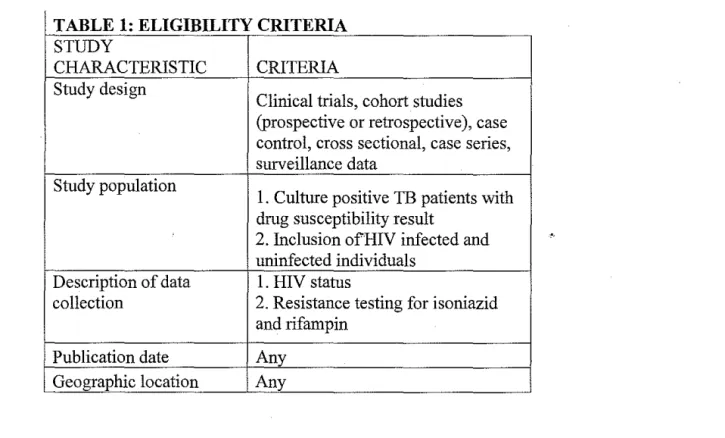
TABLE 1: ELIGIBILITY CRITERIA STUDY
CHARACTERISTIC CRITERIA
Study design
Clinical trials, cohort studies (prospective or retrospective), case control, cross sectional, case series, surveillance data
Study population
I. Culture positive TB patients with drug susceptibility result
2. Inclusion ofHIV infected and
..
uninfected individualsDescription of data I. HIV status
collection 2. Resistance testing for isoniazid and rifampin
Publication date Any Geographic location Any
Quality criteria
Prerequisites of sufficiently large sample sizes are oft used quality markers. For this review, there was no minimum sample size required for eligibility. Given the paucity of data on this particular clinical question, any studies which met the other criteria were considered important in being able to assess the relationship between HIV and MDR-TB. However, sample sizes were duly noted as a quality indicator. The quality criteria table (Table 2) notes whether each study had a sample of at least 5Q patients in both the HIV • positive and HN negative groups.
Appropriate statistical measures are another useful measure of quality for this review. Generally studies present two percentages ofMDR-TB infection, one in HIV positive and patients and the other in HIV negative patients. While the sole presentation of these numbers is valuable, statistical testing of the differences is an important indicator of quality. This information was noted during the appraisal of each study.
Linked to the baseline characteristics is the question of whether groups selected
are representative samples of the population at large. This would be important in
assessing the external validity, or generalizability, of studies. In most cases then, we
would not be able to assess how valid study results are to another population of baseline
TB patients. This is an important issue which must be considered during the larger
implications of the review, particularly since geography plays such an important.role in
rates of TB and HIV. In this review, an assessment of generalizability by the study
authors is considered a quality standard. Even if the authors note poor generalizability,
their consideration demonstrates concern about the implications of their study.
Masking, another traditional quality criterion, is not included in this review. The
one stage in the clinical question for this review where masking would be appropriate is
resistance assessment by a laboratory technician. Ideally, this person would be blinded
to HIV status. This is generally the case since drug resistance testing is done in
laboratories that are normally unaware of the HIV status of the patient
TABLE 2· QUALITY CRITERIA
• Sample size > 50
• Statistical testing of differences • Description of baseline characteristics • External validity considered
Search strategy
Articles were searched using the MEDLINE/PubMed database. Other databases
were not used due to the strictly clinical nature of the research question. The keywords
"multi drug resistant tuberculosis" and "HIV" were used as search terms instead of the
MeSH terms "Tuberculosis, Multidrug-Resistant" and "HIV" because considerably more
published prior to April 2007. The initial search yielded 738 articles which were then
limited to English language and human subjects studies. This led to 577 articles. The
titles and abstracts of these articles were reviewed for subject matter related to the topic
and broadly evaluated for eligibility criteria. Two hundred articles were selected for full
text review. Afterwards, there were 22 articles which met the specified eligibility criteria.
The references ofthese were hand searched for potentially relevant articles. This method
yielded four additional studies which met the eligibility. One of the studies found was a
meta-analysis of European studies that included seven studies in its calculation of an odds
ratio for the outcome of interest of this systematic review.
The group of studies ranged in publication date from 1992 to 2006. A wide
variety of geographic areas were covered including four studies from Europe, nine from
the United States, three from Latin America, three from Southeast Asia and seven from
sub-Saharan Africa. Of note, no eligible studies were found that were based on data from
Russia, former Russian republics, India or China. These areas contain a substantial
portion of the burden of suffering of drug resistant and drug susceptible tuberculosis.
The glaring omission of these areas from published data is highly relevant to the general
FIGURE 1
RESULTS
PubMed!MEDLINE searched with 'multi drug resistant tuberculosis hiv' search terms, yields 738 articles
English language and human subjects limits placed, yields 577 potentially relevant articles
'
.
Titles/abstracts reviewed, 377 out of scope of the topic and removed, yields 200 articles
Reviewed text/references of 200 articles, applied inclusion/exclusion criteria, yields 22 articles
26 studies used in review
Added 4 studies based on hand search of references
Critical appraisal of the studies and data extraction was done in groups defined by geographic areas.
Southeast Asia
Thailand concluded that HIV patients were more likely to have MDR-TB than HIV negative patients. The study from Vietnam showed no association between the two, but the sample size, particularly for the HIV + group was miniscule.
Punnotok et al showed a statistically significant relative risk of 11.9 (95% CI: 4.3, 33) for MDR-TB in HIV patients compared to non-HIV patients. This strong association is backed by solid methodology. TB cases were well documented and HIV patients received both ELISA and Western blot for confirmation, limiting potential
misclassification. A table of demographic differences shows that the two groups are generally comparable for TB risk factors, with the exception of smoking history and history of alcohol drinking. However, like many of the studies included for review, there is a large discrepancy between the number of patients originally recruited and those tested for HIV and TB drug susceptibility. There is no good indication of whether the patients who did not receive all tests were systematically different from those who did. Another possible source of bias is addressed by the authors. TB infection in HIV patients may reflect more recent infection, as opposed to reactivation of latent infection. Thus, TB drug resistance patterns in HIV patients more closely reflect those strains currently circulating in the community.
hypothesis that primary infections are associated with recent strains that are more likely to be drug resistant. In the study, HIV testing and TB drug resistance surveillance were done in a clear and appropriate manner. However, the primary research question was not to assess the difference in MDR-TB rates by HIV status; rather, they sought to fmd the prevalence of drug resistance in Chiang Rai and look for other associated risk factors. As such, there is no baseline comparison of risk factors in HIV positive and MIV negative patients. This raises the possibility of confounders influencing the relationship. Furthermore, the external validity of the findings is questionable given the lack of baseline characteristics.
The third study from Southeast Asia from Quy et a! shows no statistically significant relationship between HIV status and MDR-TB in a group from Ho Chi Minh City, Vietnam?7 There was no association even after adjustment for age, sex and
treatment history. The rate ofMDR-TB in HIV negative patients was 21.3% while it was 0% in their sample ofHIV positive patients. However, there were only six HIV positive patients who had resistance testing done, compared to 188 HIV negative patients. The authors conceded that the study only had 20% power to detect a two-fold increase in MDR rate in HIV positive patients compared to negative.
Sub-Saharan Africa
Braun et al. undertook one of the first studies of antituberculosis drug resistance and HIV status in sub-Saharan Africa in 1992.28 This cross sectional prevalence study looked at rates of resistance to first and second line TB drugs by HIV status. Among the
17 patients with HIV, 0% had MDR-TB and among the 29 patients without HIV, 3.4% had MDR-TB. The sample size is among the smallest of all studies in the review, particularly for the HIV positive group-(17 patients). While statistical testing was done on differences in some resistance patterns, it was not done for the specific MDR
resistance pattern of isoniazid and rifampin resistance. The reason for this might be that the specific threat ofMDR might not have been as widely understood at the time of publication, There is little description of baseline characteristics of the HIV positive and negative groups, allowing little insight into possible confounders driving the relationship. Like most cross sectional studies, Braun et a! simply look for an association and
seemingly find none, which is not surprising given the small sample size.
sampled were representative of all Tanzanian TB patients by including patient from each of the country's districts.
More recently, Anastasis eta!. conducted a smaller retrospective descriptive study ofHIV and TB drug resistance in Durban, South Africa. 30 Overall, 2.4% of 42 HIV co-infected TB patients had MDR-TB while 11.5% of253 HIV negative TB patients had MDR-TB. The authors write that no association between MDR-TB and HIV is
demonstrated; nonetheless, statistical significance is not given. Given the smaller sample size and the inherent biases of retrospective chart abstraction, this one is among the weaker of the study designs.
A succinct letter to the editor by Post and Wood meets the review eligibility criteria as well.31 It describes a prospective cohort ofTB patients admitted to a hospital in Cape Town, South Africa. The rate ofMDR in 88 HIV positive patients is 2.9% and the rate is 2.6% in 107 HIV negative patients. While no statistical test is done on the difference, the authors conclude their data supports the body of evidence that HIV infection is not associated with MDR-TB. Given the brevity of the letter, there is little description of the cohort by HIV status even though the measurement ofHIV and TB drug resistance are reasonably well described.
that the fmdings are externally valid to Botswana. However, like many other studies, the
survey was not specifically designed to compare rates ofMDR-TB by HIV status.
Accordingly, there is no information given about baseline characteristics comparing HIV
positive versus HIV negative patients. Appropriate confounders and adjusted odds ratios
carmot be calculated.
Murray eta!. investigate rates of drug resistant TB in South Africangoldminers.33
Of 425 patients with sputum positive pulmonary TB, 422 had known HIV status. Among
those with HIV, the rate ofMDR-TB was 5.3% and among those without HIV, the rate of
MDR-TB was 6.5%. Statistical testing is not done to test the difference between these
two rates. While the methods of this study, including HIV and resistance testing are clear,
there are important biases to consider. The study is not specifically undertaken to study
the difference between HIV positive and negative patients. As such, there is no baseline
characterization looking at the differences between these two populations. It is also
important to consider the generalizability of these findings. A population of goldminers
might be systematically different from others, in terms of risk factors such as crowded
living conditions or occupational lung disease. Without a thorough description of the
baseline populations, it is difficult to assess the possibility of confounders or address
external validity.
The final study included from sub-Saharan African is among the strongest.
Mac-Arthur eta!. conduct a survey ofTB drug resistance and HIV in Mozambique.34 No
statistically significant relationship is found between MDR-TB and HIV: 2.2% ofHIV
co-infected had MDR-TB while 3.2% of non-HIV infected had MDR-TB with odds ratio
culture positive TB patients minimizing bias from differential loss to follow up. This study is one of the few to describe baseline characteristics by HIV status. While not an extensive list, it does show that certain factors like education and prior STis occur at different rates in both groups. The health facilities used are selected randomly but the provinces housing those facilities are not selected randomly. The authors admit that the provinces not selected were systematicaLly different from those selected in health care resources. This could bias the survey's external validity.
Europe
Of the four European studies included in the review, two are surveys from
localized areas in Spain, one is a large case control study of national laboratories serving 80% of France's public hospitals and one is a systematic review itself.
A large survey conducted by Schwoebel et a! in France had data on thousands of
TB patients from the early !990's.36 They find infection with HIV as the only
statistically significant risk factor associated with primary MDR-TB with an odds ratio of 5.6 (95% CI: 2.6, 12.!) for HIV positive versus HIV negative. The odds ratio presented is adjusted but the details of the adjusted variables are not given. No statistically
significant relationship is found between acquired MDR-TB and HIV. The main , strengths of the study are the large sample size (10267 HIV negative patients and 893 HIV positive patients with primary TB) and good external validity since the network of laboratories used served 80% of French public hospital beds. Unfortunately, since rates ofMDR-TB by HIV status were not the only outcome, there is insufficient description of baseline characteristics and inadequate discussion of confounding factors. Nonetheless, the template of a large scale TB survey is useful for future studies on MDR-TB and HIV.
positive patients. The search strategy and statistical analyses are well described. Basic
characteristics of the studies reviewed are given but a detailed description of patient
populations, particularly among those included in the 7 studies analyzing HIV, are not
given. Interestingly, some variables that can be considered confounders in other studies
are used as criteria for study exclusion; these include TB cases limited to an outbreak and
studies limited to high risk groups such as prisoneis. While the authors did not provide a
critical appraisal of individual studies, they discussed limitations in broad terms. The
authors admit that selection bias is a major problem given the way groups were formed.
Also importantly, there is missing data on risk factors. Because these limitations are not
specifically discussed for the seven studies analyzing HIV, the meta-analysis is not as
strong. The role of publication bias, an important consideration in meta-analyses, is also
left unaddressed.
The most recent study from Europe was from the Castilla-Leon region of Spain. 38
The study showed that overall rates ofMDR-TB are low in this particular region and
suggests no relationship between MDR-TB and HIV. The rate ofMDR-TB in HIV
patients was 0% (out of 59 sampled) and the rate was 0.1% in HIV negative patients.
The odds ratio for MDR-TB infection in HIV patients is not significant at 0.19 [0-4.8].
The small sample ofHIV patients and the low levels ofMDR-TB in the region lead to the
wide confidence interval. The patient population is not well described though attempts
are made to make the sample representative of the area of Castilla-Leon. Nonetheless,
these efforts are not fully described. The authors also write that independent variables
are not described afterwards. The reader is left unsure whether the odds ratio presented for MDR-TB is adjusted for these variables.
Latin America
Campos eta!. published one of the first Latin American studies ofMDR-TB and HIV in 2003. This study found one ofthe.strongest associations between HIV and MDR-TB as 43% ofHIV/MDR-TB patients had MDR-MDR-TB while only 3.9% of non-co-infected
patients had MDR-TB. The difference is statistically significant with a large sample sizes in both comparison groups. The study gave a table of baseline characteristics comparing HIV positive and HIV negative patients which suggests certain important differences between groups. These include marriage status, income, exposure to TB at work, inpatient care and receiving ambulatory care at hospitals/health centers. Although these factors are not adjusted for, they at least provide an indication of possible associated variables which confound the relationship. One major concern is where the two groups were drawn from: HIV patients were recruited exclusively from hospitals whereas HIV negative controls were recruited from clinics. The groups might not be apt for
comparison. Because hospitalized patients with TB are more likely to have MDR-TB than patients treated at community-based clinics independent of HIV infection status, this study is likely to overestimate the association between HIV and MDR-TB. Among other concerns, this would limit external validity to all HIV patients.
were small, particularly for HIV patients, for which there were only 16. Since the primary goal of this study was to elucidate characteristics ofHIV positive and HIV negative TB patients, there is a table of comparison between the two groups. Some of the differences between the groups include sex, IV drug use, and male homosexual relations. Key variables which are similar include previous TB exposure and alcohol consumption. Some possible confounders of the relationship such as hospitalization are not included .• Although the study shows no difference by HIV status, the potential effect of
confounders would be useful to consider. Generalizability of the findings was not
explicitly addressed. However, since patients were recruited from outpatient clinics, they. might be more representative ofTB patients than recruiting just from hospitals. Since this study was undertaken in the Northeastern region of Brazil, it would also be useful to compare the characteristics of the health system here with other parts of Brazil.
North America
One of the most important studies which brought attention to the problem of
MDR-TB was published in 1993 by Frieden et a1 based on data from New York City.41
There was a statistically significant difference in MDR-TB rates by HIV status: 19.5% of
HIV patients had MDR-TB while 2% of patients with unknown HIV status did. The
comparison of HIV patients to those with unknown, status could bias the results towards
the null if there were by chance HIV positive individuals in the unknown group. Since
the study gives a broad description of the emergence of drug resistant TB in New York
City, the comparison ofMDR-TB rates by HIV status is not the primary outcome. As
such, there is no description of baseline characteristics or discussion of confounding
factors. Since the study included TB patients from New York City, the generalizability to
other populations outside this area is questionable.
Gordin eta!. investigated the relationship between MDR-TB and HIV but with
the primary intention of comparing a New York City based population to a mixed group
from seven other metropolitan areas.42 In New York, there was a statistically significant
difference in MDR-TB rates by HIV status: 19.4% for HIV positive patients and 5.8% for
HIV negative. On the other hand, outside of New York, there was no statistically
significant difference in MDR-TB rates: 2.8% in HIV positive patients and 1.4% in HIV
negative patients. While there was no comparison of baseline characteristics by HIV
status, there was a comparison of New York City patients to non-New York patients.
Possible confounders like homelessness, unemployment, alcohol use and the use of street
of patient populations throughout the United States, it has better external validity than studies limited to one area.
A subsequent descriptive analysis by Moore et al. analyzed national data from the United States from 1993-1996, which included a subset of the patients used in the Gordin study.43 However, it is nnclear exactly how much of the data is overlapped. Moore showed two statistically significant differences in MDR-TB rates by HIV status, one for US born patients and one for foreign born patients (both groups were aged 25-44 years though). Among US born, rates in HIV infected were 6.4% while rates in HIV
nninfected were 1.4%. Among foreign born, rates in HIV infected were 4.7% while rates in HIV uninfected were 3.0%. There is little description of the population aside from the resistance data; therefore, it is difficult to assess the importance of outside variables that could have confounded the two relationships. Because this study contains data of all TB patients from the United States, the study is more widely generalizable.
The data used by Moore et al. was also later published by the CDC in a Morbidity and Mortality Weekly Report.44 Here the results were not split by foreign born status. Among all HIV patients, 6.2% had MDR-TB while in HIV negative patients, !.3% had MDR-TB, which was a statistically significant difference. Once again, there is no description of patient characteristics which could help point to confounding factors.
Moore et al. subsequently published a limited part of the same data set (only TB cases from 1993-1994) and found a statistically significant result similar to the previous two analyses: 6% MDR-TB rates in HIV patients and 2% MDR-TB rates in HIV
were younger, more likely to be male and more likely to be born in the United States. Other important variables of interest like hospitalization and drug use are not listed. Rates of previous TB were similar.
Localized surveillance data continued to be published with Liu et a!., who specifically looked at drug resistance patterns in New Jersey in the early 1990s.46 There was therefore some degree of overlap with the national data,published by Moore. MDR-TB rates in HIV patients were 4.9% while they were 1.2% in HIV negative patients. The odds ratio for MDR-TB in HIV compared to non-HIV was statistically significant at 3.6 (95% CI: 1.5, 8.8). Like the many other studies which looked at risk factors, Liu eta!. examine factors such as previous TB, homelessness, and injection drug use but do not stratifY by HIV status. It is difficult then to assess possible confounders. Because of the close proximity ofNew Jersey to New York City, the authors admit that the
generalizability of these findings remains questionable.
Soon after, Taylor et al. published a wider survey ofTB in Texas with data from 1987 to 1996.48 Like the Spellman study, this found no significant relationship between HIV and MDR-TB. Rates in HIV positive patients were 1.1% and rates in HIV negative patients were 1.4% with a risk ratio of0.78 (95% CI: 0.50, 1.21). Demographic and clinical variables like history of incarceration, drug abuse, and recurrent TB are presented but not by HIV status. However, the authors do state that there was no nosocomial or prison outbreak ofMDR-TB during this time. Regardless, to assess the risk ofMDR-TB attributable to HIV, more specific information is needed. Given that all TB patients were included and there were no real eligibility criteria, the external validity is sound.
The final study from the United States was a time series of four cross sectional surveys of TB in New York City, beginning in 1991 and finishing in 2003.49 The odds ratio for MDR-TB in HIV positive compared to negative was 7.3 (95% CI: 2.7, 20.0) in
1991, 5.5 (95% CI: 0.96, 30.8) in 1994, 1.0 (95% CI: 0.2, 5.2) in 1997 and 0.8 (95% CI: 0.04, 17.5) in 2003. The last two surveys show no association between HIV and MDR-TB in New York. Baseline characteristics are presented for all MDR-TB patients. The
characteristics do suggest changing rates of drug use, previous treatment and foreign born among TB patients. Unfortunately, it is not possible to assess the role of these possible confounders since they are not presented by HIV status. As with the other studies from a specific area, the findings in New York over these 4 surveys are not obviously
TABLE 3· BASIC INFORMATION AND RESULTS OF INCLUDED STUDIES
% MDR-
%MDR-Number TB in Number TBin Authors' conclusion Year of ofHIV+ HIV+ of HIV- HIV- regarding risk of MDR-TB First author Publication Country patients patients patients patients in HIV+ patients
SOUTHEAST ASIA
Punnotok"" 2000 Thailand 192 5% 685 0.4% Increased risk, RR 11.9 [95% Cl: 4.3, 33]
Yoshiyama 2001 Thailand
-primary MDR-TB 377 8.5% 474 4.4% Increased risk, OR 2.00
-
•· [95% Cl: 1.1, 3.5] '-acquired
MDR-49 40.8% 85 32.9% No increased risk, OR 1.40
TB [95% Cl: 0.68, 2.91]
Quy<' 2006 Vietnam 6 0% 188 21.3% No increased risk
SUB-SAHARAN AFRICA
Braun 1992 Cote d'lvoire 17 0% 29 3.4% No increased risk*
Chum= 1996 Tanzania
-primary MDR-TB 275 1.1% 816 1.1% No increased risk*
-- acquired
MDR-21 4.8% 52 7.7% No increased risk* TB
Anastasis 1997 South Africa 42 2.4% 253 11.5% No increased risk*
Post 1997 South Africa 99 2.6% 115 2.9% No increased risk*
Kenyon".: 1999 Botswana 107 0.9% 119 0.8% No increased risk
Murray 2000 South Africa 207 5.3% 215 6.5% No increased risk*
Mac~Arthur 2001 Mozambique 179 2.2% 530 3.2% No increased risk, OR 0.7
[95% Cl: 0.2, 2.2]
. EUROPE
Ausina"~ 1995 Spain 184 0.5% 317 0.6% No increased risk*
Schwoebel 1998 France
Faustini37 2006 Europe 2843 4.1% 49111 1.2% Increased risk, OR 3.52
(systematic [95% Cl: 2.48, 5.01]
review}
Alberte- 2006 Spain 59 0% 926 0.1°/1) No increased risk, OR 0.19
Castineiras38 [95% Cl: 0, 4.8]
LATIN AMERICA
Campos 2003 Peru 81 43% 965 3.9% Increased risk
Liberato~:~ 2004 Brazil 16 6.3% 76 6.6% No increased risk
-~~
" "
Joseph 2006 Haiti
-primary MDR-TB 115 10% 166 3% Increased risk in primary, RR 3.2 [95% Cl: 1.1, 8.9]
- acquired
MDR-16 0% 33 30% No increased risk in
TB recurrent
UNITED STATES
Frieden 1993 USA (NYC) 82 19.5% 145 2% Increased risk
Gordin 1996 USA
-- New York City 252 19.4% 69 5.8% Increased risk in NYC
--non-NYC 179 2.8% 473 1.4% No increased risk in
non-NYC
Moore4~
1997 USA
-USA born 6.4% 1.4% Increased risk
6442 5855
(total) (total)
-- foreign born 4.7% 3.0% Increased risk
Liu 1998 USA (NJ) 556 4.9% 413 1.2% Increased risk
Spe!lman4
' 1998 USA (TX) 646 0% 55 4% No increased risk
CDCMMWR 1998 USA 5112 6.2% 3754 1.3% Increased risk
Moore 1999 USA 6833 6% 42828 2% Increased risk
Taylor 1999 USA (TX) 2221 1.1%
--
1.4% No increased risk, RR 0.78Munsiff'9 2006 USA (NYC) -- -- - --- No increased risk in last two surveys, ORs from 4 years: 1991 OR: 7.3 [95% Cl: 2.7, 20.0], 1993 OR: 5.5 [95% Cl: 0.96, 30.8], 1997 OR: 1.0 [95% Cl: 0.2, 5.2], 2003 OR: 0.8 [95% Cl: 0.04, 17.5]
*Signifies no statistical testing done to test the difference
TABLE 4· QUALITY CRITERIA
Statistical Baseline External Sample testing of characteristics validity AUTHOR size> 50 differences described considered
SOUTHEAST ASIA
Punnotok'"" ./ ./ ./ ./
Yoshiyama
--primary MDR-TB ./ ./ X X
-acquired
MDR-X ./ X X
TB
Quy"' X ./ X ./
SUB-SAHARAN AFRICA
Braun'"' X X X X
Chum
-primary MDR-TB ./ X ./ ./
- acquired
MDR-X X ./ ./
TB
Anastas is X X X ./
Post ./ X X X
Kenyon~~ ./ ./ X ./
Murray"" ./ X X X
Ausfna35 ,/ X X X
Schwoebel36
-primary MDR-TB ,/ ,/ X ,/
~-acquired MDR ,/ ,/ X ,/
Faustinf31 ,/ ,/ X ,/
(systematic review)
Alberte- ,/ ,/ X X
Castineiras38
'
LATIN AMERICA
Campos:.o ,/ ,/ ,/ ,/
Liberato X ,/ ,/ ,/
Joseph
--primary MDR-TB ,/ ,/ X ,/
-acquired MDR~
X TB
,/ X ,/
UNITED STATES
Frieden ,/ ,/ X X
Gordin
~-New York City ,/ ,/ X ,/
-non-NYC ,/ ,/ X ,/
Moore
--US born ,/ ,/ X ,/
--foreign born X ,/ X ,/
Liu4
, ,/ ,/ X X
Spellman ,/ ,/ ,/ ,/
CDCMMWR ,/ ,/ X ,/
Moore4
:. ,/ ,/ ,/ ,/
Munsiff9
X X
*signifies inability to assess
DISCUSSION
The twenty-six studies reviewed in this article come from different areas around the world and different time periods. Some are based on large nation-wide surveys while others are smaller studies and include just a few TB patients with and without HIV. The results themselves are quite disparate with some showing a strong relationship between HIV and MDR-TB and others showing no effect. To understand the implications of the synthesis in this review article, it is necessary to consider the possible biological
mechanism of a link between HIV and TB drug resistance.
Possibilities for a causal/ink
Dye considers five possible mechanisms linking drug resistant TB to HIV 51 One ·is "functional monotherapy". The argument is that HIV patients are more likely to be
subjected to monotherapy, a significant risk factor for drug resistance, than non-HIV patients. This could occur if reduced immune function allows M tuberculosis to
continue replication even after the initial2 month intensive treatment period (four drugs) in HIV patients. Thus, HIV patients would be more likely to have reproducing bacteria that are only treated by rifampin or isoniazid during the continuation phase ofTB
A second mechanism is that drug resistant strains of TB are less virulent and
would preferentially lead to disease progression in immune compromised patients who
cannot fight off the bacteria as easily. Data supporting this hypothesis comes from
laboratory studies and some animal data but has not been shown in humans. A third
possibility is that MDR-TB among HIV patients could actually be reflective of time of
infection. Non-HIV patients who develop TB might be rea~tivating a latent infection,.
from decades ago, whereas HIV patients who develop TB might be reactivating a latent
infection acquired much more recently. With the increasing prevalence of drug
resistance globally7, a higher percentage of recent infections are likely to be drug resistant
compared to infections that occurred in the more distant past.
A fourth mechanism linking MDR-TB to HIV involves bacterial burden. HN
patients might harbor greater numbers of M tuberculosis than non-HIV patients because
of immunosuppression and the inability to fight off infection. This could mean that a
prolonged treatment course would be necessary in HIV patients to achieve the same
levels of bacterial burden in non-immune compromised patients. This pathway could
then be tied to functional monotherapy since more HIV patients would possibly enter the
continuation phase of TB therapy with uncontrolled levels of bacteria. Having more
bacteria could also make the population of M tuberculosis in HIV patients more
genetically diverse and thus inherently more susceptible to drug resistance.
The final mechanism on which Dye focuses is shared risk factors for HIV and
drug resistant TB strains. These shared risk factors can essentially be considered
confounders of the relationship between MDR-TB and HIV. Confounding occurs when
suggests injection drug use and hospitalization as two possible confounders. Injection drug use is a risk factor for HIV infection but also for tuberculosis and MDR-TB. Hospitalization is a confounder because it is associated with HIV infection and also associated with conditions needed for the spread ofMDR-TB such as close contact. Unrecognized MDR-TB infection in a hospital could spread quickly among HIV patients because of immune suppression. By the same token,outbreaks ofMDR-TB in,the community are more likely to appear in HN patients because they are the most
susceptible.54 Other possible shared risk factors include imprisonment, education level and other measures of socioeconomic status, unemployment and alcohol use. Of note, it might be useful to consider time of TB infection, which is labeled in the causal pathway, as a confounding variable as well. Time since infection is associated with resistance patterns but it also might be associated with HIV infection as well.
The difference between the causal pathway from HIV to MDR-TB and
HIY patients have higher bacterial burden
NIDR-TB reflection of recent
infection
Resisiant strains are less virulent
Functional monotherapy
Hospitalization
Injection drug use
Socioeconomic status/unemployment
Imprisonment
. .<\lcoholuse
POTLvnALCO~XOD~DERS
What can we learn from the published studies?
FIGURE2
Except for the studies from Africa, where the majority of studies fail to demonstrate an association between HIV and MDR-TB, the results from studies performed in other regions of the world produced conflicting results.
The initial history ofMDR-TB in the early 1990s seemed to show strong evidence of a link with HIV. In a seminal paper, Frieden eta! show that in some of the first
other smaller studies found no relationship. Perhaps one of the most illuminating studies
was that ofMunsiffet a! which calculated four time series odds ratios for MDR-TB
infection by HIV status based on surveillance data from four surveys over twelve years in
New York City. The lack of association between HIV status and MDR-TB in the most
recent surveys suggests a time trend that is difficult to glean from a cursory look at the
results of other studies from the United States. One conclusion of this study could be that ,
the relationship between MDR-TB and HIV can change over time. However, another
possibility is that the confounding variables are the ones that changed over time and the
risk attributable to HIV remained the same. This is certainly a possibility in New York
where variables like hospitalization, proportion of foreign born and outbreak control
could have changed.
The studies from Europe show no clear trend. Two of the smaller studies, both
from Spain, show no relationship between MDR-TB and HIV. However, given the small
numbers ofMDR-TB cases in both of these studies, neither provides convincing data.
F austini et a! provide a meta-analysis of European studies, which includes the
Schowoebel study from France. The combined large sample (n=2727 for HIV positive
and n=48571 for HIV negative) of the meta-analysis gives an odds ratio of3.52 (95% CI:
2.48, 5.01) for MDR-TB by HIV status but the authors admit that the selection ofHIV
infected patients may have been biased. Regardless, the authors contend that their results
suggest that HIV infection favors the transmission ofMDR-TB compared to drug
sensitive TB in Europe in the late 1990s and early 2000s. As the estimate was not
Studies from Latin America also produced contrasting results. The studies are notable for being among the few that consider baseline characteristics as potential confounders of the relationship between HIV and MDR-TB. While neither offers
statistical adjustments, Campos in particular suggests that income, workplace exposure to TB, inpatient care and receiving ambulatory care may be confounders of the association between HIV and MDR-TB.
Of the three studies from Southeast Asia, two Thai studies found a statistically significant relationship between HIV and MDR-TB whereas the study from Vietnam found no significant relationship. Yoshiyama encourages the reader to apply the lesson from Munsiff et a!, which is that local factors are important in determining the
relationship between HIV and MDR-TB. Similar to the US and Europe, Thailand introduced rifampin before the emergence ofHIV.Z6 Once HIV did emerge, MDR-TB strains were probably already circulating and the stage was set for an upsurge in MDR-TB cases, especially among HIV patients who progress quickly from infection to disease. Nonetheless, the contribution of unaccounted for confounders in these studies clouds the association between MDR-TB and HIV.
One of the most important fronts for TB/HIV co-infection is sub-Saharan Africa. While the seven studies from that region included in this review may have had limitations, none found a relationship between HIV and MDR-TB. The studies came from a variety oflocales and ranged from the early 1992 to 2001. Taken as a whole, they suggest that during this time period in sub-Saharan Africa, it seems likely that there was no
of rifampin led to delayed introduction of this drug into sub-Saharan African.
Consequently, MDR-TB may not have had the opportunity to take hold in sub-Saharan Africa prior to the time when HIV began its devastating conquest of the continent. HIV uncovered the untold amount oflatent TB infections, but these had yet to acquire drug . resistance. It is important to note that the most recent study from Africa was published in
2001. Most recently, outbreaks ofXDR, or extensively drug resistant tuberculosis (defined as resistance to isoniazid, rifampin and at least three classes of second-line drugs), have brought frightening implications for the continent. One study from South Africa argued that the prevalence ofMDR is higher than earlier estimated and that XDR is being disproportionately transmitted to HIV infected patients. 55 The changing
epidemiology ofMDR and XDR in South Africa might indicate an altering of the previous balance between MDR-TB and HIV. However, the body of literature on XDR-TB is still small.
Assessing publication bias
When considering the results and implications of a systematic review, it is
imperative to judge the contribution of publication bias. A review is only as strong as its component studies but its strength is also determined by what information is not included.
the relationship between the two was often not the primary research question in many studies. Some were surveys to fmd the proportion of TB cases which were drug resistant in the whole population and others were intended to explore a number of risk factors for MDR-TB. Accordingly, the relationship between HIV and MDR-TB was often a secondary outcome and was not subject to the same publication debate as primary outcomes.
Another consideration is the omission of certain countries from the published literature. For this review, the argument can be made that if the relationship between HIV and MDR-TB is causal, it would not matter where the component studies are drawn from. The key would be to adjust for potential confounders. However, this has not been readily done in the published literature. It will be important to collect data from areas where the burden ofMDR-TB is disproportionate, like Russia, Eastern Europe, India and China. While not necessarily answering the question of the attributable risk of HIV for MDR-TB, data from these areas would give a better idea of the current association between the two.
Do we need a meta-analysis?
The data extracted from the individual studies and presented in this review is amenable for pooling into one risk ratio. A meta-analysis would give a clear, qualitative relationship between MDR-TB and HIV. However, the presentation of one ratio should be considered carefully.
HIV and MDR-TB, calculations must be adjusted for associated variables which can confound the relationship. Most studies do not give baseline characteristics of HIV positive or HIV negative patients, do not adequately consider confounding factors and not a single study estimated a measure of association between HIV and MDR-TB
adjusted for confounders. Meta-analysis would thus combine studies that were subject to various levels of confounding.
Implications for practice and new research
In terms of public health research, this review demonstrates clear needs. More complete surveys on TB/HIV co-infection are needed throughout the world. These · surveys and subsequent publications should be undertaken with sound methodology,
including attention to statistical tests, sample sizes, baseline characteristics and potential confounders. As noted, rates ofMDR-TB might vary between primary and acquired cases due to more resistant strains circulating at different times. To investigate this, future research should clearly delineate patients as either primary or acquired cases of MDR-TB and analyze rates in the two groups.
REFERENCES
1. Tuberculosis Fact Sheet. March 2007; TB Epidemiologic Data. Available at: http://www. who .int/mediacentre/factsheets/fs 1 04/ en/index.html. Accessed 4/11/07, 2007.
2. Global tuberculosis control: surveillance, planning, financing. WHO Report 2007.
(WHO/HTM/TB/2007.376) ed. Geneva: World Health Organization; 2007. 3. Raviglione MC, Pio A. Evolution of WHO policies for tuberculosis control,
1948-2001. Lancet. Mar 2 2002;359(9308):775-780.
4. Raviglione MC. The TB epidemic from 1992 to 2002. Tuberculosis (Edinb).
2003;83(1-3):4-14.
-5. Sudre P, ten Dam G, Kochi A. Tuberculosis: a global overview of the situation today. Bull World Health Organ. 1992;70(2):149-159.
6. Raviglione MC, Dye C, Schmidt S, Kochi A. Assessment of worldwide
tuberculosis control. WHO Global Surveillance and Monitoring Project. Lancet.
Aug 30 1997;350(9078):624-629.
7. Espinal MA, Laszlo A, Simonsen L, et al. Global trends in resistance to
antituberculosis drugs. World Health Organization-International Union against Tuberculosis and Lung Disease Working Group on Anti-Tuberculosis Drug Resistance Surveillance. N Engl J Me d. Apr 26 2001 ;344(17): 1294-1303.
8. Ormerod LP. Multidrug-resistant tuberculosis (MDR-TB): epidemiology, prevention and treatment. Br Med Bull. 2005;73-74:17-24.
9. Espinal MA, Kim SJ, Suarez PG, et al. Standard short-course chemotherapy for drug-resistant tuberculosis: treatment outcomes in 6 countries. Jama. May 17 2000;283(19):253 7-2545.
10. Anti-tuberculosis drug resistance in the world: The WHOIIUATLD Global
Project on Anti-Tuberculosis Drug Resistance Surveillance. (WHO/TB/97.229)
ed. Geneva: World Health Organization; 1997.
11. Anti-tuberculosis drug resistance in the world: The WHO/IUATLD Global
Project on Anti-Tuberculosis Drug Resistance Surveillance. Report 2: Prevalence
and trends. (WHO/CDS/TB/2000.278) ed. Geneva: World Health Organization;
2000.
12. Anti-tuberculosis drug resistance in the world: The WHOIIUATLD Global
Project on Anti-Tuberculosis Drug Resistance Surveillance. Report 3.
(WHO/HTM/TB/2004.343) ed. Geneva: World Health Organization; 2004.
13. Farmer P, Kim JY. Community based approaches to the control ofmultidrug resistant tuberculosis: introducing "DOTS-plus". Bmj. Sep 5 1998;317(7159):671-674.
14. Espinal MA, Dye C, Raviglione M, Kochi A. Rational 'DOTS plus' for the control ofMDR-TB. Int J Tuberc Lung Dis. Jull999;3(7):561-563.
15. Raviglione MC, Uplekar MW. WHO's new Stop TB Strategy. Lancet. Mar 18 2006;367(9514 ):952-955.
16. Raviglione MC. The Global Plan to Stop TB, 2006-2015. Jnt J Tuberc Lung Dis.
18. Aaron L, Saadoun D, Calatroni I, eta!. Tuberculosis in HN -infected patients: a comprehensive review. Clin Microbial Infect. May 2004;10(5):388-398.
19. Whalen C, Horsburgh CR, Hom D, Lahart C, SimberkoffM, Ellner J. Accelerated course of human immunodeficiency virus infection after tuberculosis. Am J
Respir Crit Care Med. Jan 1995;151(1):129-!35.
20. Corbett EL, Watt CJ, Walker N, eta!. The growing burden of tuberculosis: global trends and interactions with the HIV epidemic. Arch Intern Med. May 12
2003;163(9): 1009-1021.
21. Frequently asked questions about TB and HN.
http://www.who.int/tb!hiv/fag/en/index.html. Accessed 4/12/07, 2007.
22. Kawai V, Soto G, Gilman RH, et al. Tuberculosis mortality, drug resistance, and infectiousness in patients with and without HIV infection in Peru. Am J Trap Med
Hyg. Dec 2006;75(6):1027-1033.
23. Coker RJ. Review: multidrug-resistant tuberculosis: public health challenges.
Trap Med Int Health. Jan 2004;9(1):25-40.
24. Drobniewski F, Eltringham I, Graham C, Magee JG, Smith EO, Watt B. A national study of clinical and laboratory factors affecting the survival of patients with multiple drug resistant tuberculosis in the UK. Thorax. Sep 2002;57(9):81 0-816.
25. Punnotok J, Shaffer N, Naiwatanakul T, eta!. Human immunodeficiency virus-related tuberculosis and primary drug resistance in Bangkok, Thailand. Int J
Tuberc Lung Dis. Jun 2000;4(6):537-543.
26. Yoshiyama T, Supawitkul S, Kunyanone N, eta!. Prevalence of drug-resistant tuberculosis in an HIV endemic area in northern Thailand. Int J Tuberc Lung Dis.
Jan 2001;5(1):32-39.
27. Quy HT, Buu TN, Cobelens FG, Lan NT, Lambregts CS, BorgdorffMW. Drug resistance among smear-positive tuberculosis patients in Ho Chi Minh City, Vietnam. Int JTuberc Lung Dis. Feb 2006;10(2):160-166.
28. Braun MM, Kilburn JO, Smithwick RW, eta!. HIV infection and primary resistance to antituberculosis drugs in Abidjan, Cote d'Ivoire. Aids. Nov 1992;6(11 ): !327-1330.
29. Chum HJ, O'Brien RJ, Chonde TM, GrafP, Rieder HL. An epidemiological study of tuberculosis and HIV infection in Tanzania, 1991-1993. Aids. Mar
1996; 1 0(3):299-309.
30. Anastasis D, Pillai G, Rambiritch V, Abdool Karim SS. A retrospective study of human immunodeficiency virus infection and drug-resistant tuberculosis in Durban, South Africa. Int J Tuberc Lung Dis. Jun 1997; I (3):220-224.
31. Post FA, Wood R. HIV infection is not associated with an increased rate of drug-resistant tuberculosis. S Afr Med J. Jull997;87(7):903.
32. Kenyon TA, Mwasekaga MJ, Huebner R, Rumisha D, Binkin N, Maganu E. Low levels of drug resistance amidst rapidly increasing tuberculosis and human immunodeficiency virus co-epidemics in Botswana. Int J Tuberc Lung Dis. Jan 1999;3(1 ):4-11.
33. Murray J, Sonnenberg P, ShearerS, Godfrey-Faussett P. Drug-resistant
34. Mac-Arthur A, Gloyd S, Perdigao P, Noya A, Sacarlal J, Kreiss J. Characteristics of drug resistance and HIV among tuberculosis patients in Mozambique. Int J Tuberc Lung Dis. Oct 2001;5(10):894-902.
35. Ausina V, Riutort N, Vinado B, eta!. Prospective study of drug-resistant tuberculosis in a Spanish urban population including patients at risk for HIV infection. Eur JClin Microbial Infect Dis. Feb 1995;14(2):105-110.
36. Schwoebel V, Decludt B, de Benoist AC, eta!. Multidrug resistant tuberculosis in France 1992-4: two case-control studies. Bmj. Sep 5 1998;317(7159):630-631. 37. Faustini A, Hall AJ, Perucci CA. Risk factors for multidrug resistant tuberculosis
in Europe: a systematic review. Thorax. Feb 2006;61(2):158-163.
38. Alberte-Castineiras.A, Brezmes-Valdivieso MF, Campos-Bueno A, et al, Drug-resistant tuberculosis in Castilla-Leon, Spain, 1996-2000. Int JTuberc Lung Dis. May 2006;10(5):554-558.
39. Liberato IR, de Albuquerque Mde F, Campelo AR, de Melo HR. Characteristics of pulmonary tuberculosis in HIV seropositive and seronegative patients in a Northeastern region of Brazil. Rev Soc Bras Med Trap. Jan-Feb 2004;37(1):46-50.
40. Joseph P, Severe P, Ferdinand S, eta!. Multidrug-resistant tuberculosis at an HIV testing center in Haiti. Aids. Feb 14 2006;20(3):415-418.
41. Frieden TR, Sterling T, Pablos-Mendez A, Kilburn JO, Cauthen GM, Dooley SW. The emergence of drug-resistant tuberculosis in New York City. N Eng! J Med. Feb 25 1993;328(8):521-526.
42. Gordin FM, Nelson ET, Matts JP, eta!. The impact of human immunodeficiency virus infection on drug-resistant tuberculosis. Am J Respir Crit Care Med. Nov 1996;154(5): 1478-1483.
43. Moore M, Onorato IM, McCray E, Castro KG. Trends in drug-resistant
tuberculosis in the United States, 1993-1996. Jama. Sep 10 1997;278(10):833-837. 44. Prevention and treatment of tuberculosis among patients infected with human
immunodeficiency virus: principles of therapy and revised recommendations. Centers for Disease Control and Prevention. MMWR Recomm Rep. Oct 30 1998;47(RR-20): 1-58.
45. Moore M, McCray E, Onorato IM. Cross-matching TB and AIDS registries: TB patients with HIV co-infection, United States, 1993-1994. Public Health Rep. May-Jun 1999;114(3):269-277.
46. Liu Z, Shilkret KL, Finelli L. Epidemiology of drug-resistant tuberculosis in New Jersey from 1991 to 1995. Int J Epidemiol. Feb 1998;27(1):121-126.
47. Spellman CW, Matty KJ, Weis SE. A survey of drug-resistant Mycobacterium tuberculosis and its relationship to HIV infection. Aids. Jan 22 1998;12(2):191-195.
48. Taylor JP, Bergmire-Sweat D, Suarez L. Epidemiology of drug-resistant tuberculosis in Texas. Am J Epidemiol. Feb 15 1999;149(4):359-365.
49. MunsiffSS, Li J, Cook SV, eta!. Trends in drug-resistant Mycobacterium tuberculosis in New York City, 1991-2003. Clin Infect Dis. Jun 15
2006;42(12): 1702-1710.
51. Dye C, Williams BG, Espinal MA, Raviglione MC. Erasing the world's slow stain: strategies to beat mnltidrug-resistant tuberculosis. Science. Mar 15 2002;295(5562):2042-2046.
52. Patel KB, Belmonte R, Crowe HM. Drug malabsorption and resistant tuberculosis in HIV-infected patients. N Engl J Med. Feb 2 1995;332(5):336-337.
53. Rothman KJ. Epidemiology An Introduction. New York: Oxford University Press; 2002.
54. Angarano G, Carbonara S, Costa D, Gori A. Drug-resistant tuberculosis in human immunodeficiency virus infected persons in Italy. The Italian Drug-Resistant Tuberculosis Study Group. Jnt J Tuberc Lung Dis. Apr 1998;2( 4):303-311.