ORIGINAL RESEARCH ARTICLE
Maternal Education and Diarrhea among Children aged 0-24
Months in Nigeria
Desmennu Adeyimika T
1,3, Oluwasanu Mojisola M
1, John-Akinola Yetunde O
1, Oladunni
Opeyemi
1, Adebowale S. Ayo
2Department of Health Promotion and Education, Faculty of Public Health, College of Medicine, University of Ibadan, Ibadan, Nigeria1; Department of Epidemiology and Medical Statistics, Faculty of Public Health, College of Medicine, University of Ibadan, Ibadan, Nigeria2; Department of Health Promotion and Education, Faculty of Public Health, University of Ibadan, Ibadan, Nigeria3
*For Correspondence: Email: [email protected]; Phone: +234 8034087648
Abstract
Childhood diarrhea remains a problem in countries like Nigeria where access to potable water, good hygiene and sanitation are lacking. Maternal education is an important determinant of health status of under-five children. Very few studies have investigated the relationship between maternal education and diarrhea in children in Nigeria. Therefore, this study was implemented to fill the gap. The study design was cross-sectional and 2013 National Survey was used. Children aged 0-24 months were investigated and the dependent variable was diarrhea status of the index child in the last two weeks prior the survey. The main independent variable was maternal education. Data were analyzed using Chi-square and Logistic regression models (α=0.05). Diarrhea prevalence was 13.7% and higher (15.5%) among children of women who have no formal education, and mothers living in the North East region of Nigeria experienced the highest prevalence (26.4%). Children whose mothers had no formal education were 2.69(CI= 1.800-4.015, p<0.001) more likely to have diarrhea as compared to those who had higher education. Maternal education is an important predictor of diarrhea among children aged 0-24 months in Nigeria. Policies to reduce diarrhea among children in Nigeria should target children of the illiterate, less educated mothers and those living in the North-West. (Afr J Reprod Health 2017; 21[3]: 27-36).
Keywords: Maternal Education, Childhood diarrhea, Nigeria
Résumé
La diarrhée infantile demeure un problème dans des pays comme le Nigéria où l'accès à l'eau potable, à la bonne hygiène et à l'assainissement manque. L'éducation maternelle est un déterminant important de l'état de santé des enfants de moins de cinq ans. Très peu d'études ont étudié la relation entre l'éducation maternelle et la diarrhée chez les enfants au Nigeria. Par conséquent, cette étude a été mise en œuvre pour combler l'écart. La conception de l'étude était transversale et l'enquête nationale de 2013 était utilisée. Les enfants âgés de 0 à 24 mois ont été étudiés et la variable dépendante était le statut de diarrhée de l'index chez les deux dernières semaines avant l'enquête. La principale variable indépendante était l'éducation maternelle. Les données ont été analysées à l'aide de modèles de régimes de Chi-carré et de régression logistique (α = 0,05). La prévalence de la diarrhée était de 13,7% et plus élevée (15,5%) chez les enfants des femmes qui n'ont pas reçu l'éducation formelle, et les mères qui habitent dans la région nord-est du Nigeria ont connu la plus forte prévalence (26,4%). Les enfants dont les mères n'ont pas reçu une éducation formelle étaient 2,69 (IC = 1,800-4,015, p <0,001) plus susceptibles d'avoir une diarrhée par rapport à ceux qui avaient fait des études supérieures. L'éducation maternelle est un indice important de la diarrhée chez les enfants âgés de 0 à 24 mois au Nigéria. Les politiques visant à réduire la diarrhée chez les enfants au Nigéria devraient cibler les enfants des analphabètes, des mères moins instruites et des personnes habitant dans le Nord-Ouest. (Afr J Reprod Health 2017; 21[3]: 27-36).
Mots clés: Education maternelle, diarrhée infantile, Nigéria
Introduction
Diarrhea is the second disease responsible for under-five mortality worldwide after pneumonia1. Each year, 2.5 billion cases of diarrhea, likely to
rotavirus annually (with 232,000 deaths occurring in sub-Saharan Africa)4. Statistics have shown that about 20% of child death in sub-Saharan Africa occurs in Nigeria5-7. The infant and childhood mortality rates in Nigeria are 69 and 128per 1,000 live births respectively and these are among the highest rates globally8. Childhood diseases including diarrhea account for greater proportion of childhood deaths in Nigeria2, 9. The incidence of childhood diarrhea is estimated to account for over 160,000 of all deaths in under-five children annually in Nigeria10. Diarrheal incidence has been found to be highest in the first two years of life and declines as a child grows older11. The occurrence of diarrhea comes with symptoms like vomiting, stooling and can quickly lead to dehydration in young children1,12. Signs of dehydration include thirst, irritability, restlessness, lethargy, sunken eye, dry mouth and tongue, dry skins and fewer trips to the bathroom to urinate. Others include lack of interest in playing and extreme sleepiness, fast breathing and rapid heartbeat12. Diarrhea incidence remains a tremendous burden on children in low- and middle-income countries due to multiple determinants such as; child malnutrition, low socioeconomic status, maternal education, lack of safe drinking-water, inadequate sanitation and poor hygiene11. These determinants of diarrheal disease are strongly linked to poverty and social inequities11. Children living in impoverished areas also have higher case-fatality rates compared to children living in high-income countries due to lack of access to quality health care and timely and effective treatment with oral rehydration solution (ORS) and zinc13,14. Maternal education is recognized as one of the strongest determinants of infant survival in developing countries15.
In Nigeria, most of the studies linking maternal education and child nutrition have focused on detecting different ways through which the education of a mother affects the health of her children16, 3. Raji and Ibrahim (2011)16 argued further that the education of the mother plays an important role in determining child survival. The pathways highlighted by his paper include improved mother‘s health knowledge and greater control over the health choices for her children, among others. Also studies from Caldwell‘s‘ paper
have shown mixed results about the effect of maternal education on child health status17. Gwatkin et al.8 found that prevalence of child health especially diarrhea is lower among children of educated mothers. It is therefore not unlikely that low level of mother‘s knowledge may militate against the effective performance of diarrhea prevention practices.
However, it is expected that maternal education should improve child health because education has been linked to family socioeconomic situation, which in itself is a determinant of child health19. Above and beyond this, maternal education is hypothesized to bring about certain changes in individual behavior that result in better child health19. Caldwell and Caldwell17 suggests two potential paths: education improves child health solely by enhancing the use of modern health services; and education results in a wide range of favorable behaviors-mostly connected with child care-that play a role in improving child health.
Years of formal education are a well-recognized indicator of social position and have been frequently used in international surveys to explore social inequalities20- 22. These studies show that people with progressively more advanced levels of education have better health and longer lives than those without. However, going by the benefits of education in the management of disease conditions, one may ponder that maternal education is likely to be linked to diarrhea, since women are primary caregivers of under-five children. Therefore, this study investigated the relationship between maternal education and childhood diarrhea among children aged 0-24 months which in agreement with other studies is a less researched area in Nigeria. The study also seeks to understand the mechanism by which education affects child health as an imperative for policy making.
Methods
Study area
pyramid shows the population is young and children between the ages of 0 and 5 years are more than any other age segment of the population. The country is predominantly rural and a higher proportion of women of reproductive age are still uneducated. Potable water supply is inadequate and many households find their own means of water supply such as wells, bore-holes, rain water, and streams. There are two major seasons in Nigeria, the dry and wet seasons. Nigeria has tropical climate with temperatures staying consistently hot. April to October is the rainy season. Average temperatures at this time range from a low of 23°C / 74°F to a high of 30°C / 86°F.
Data collection and sample selection
The study was cross-sectional in design and used a national representative data that is 2013 Nigeria Demographic and Health Survey. During the survey, cluster sampling approach was used to select the respondents based on allocation of specific numbers of clusters to rural and urban settlements in the country. Different questionnaires were designed to obtain information related to men, women, household, couples and children. However, the current study used children recode data and analysis was based on information supplied on index child by subjects (care givers). Subjects with no information on diarrhea status of the index child were excluded from the study. Thus, 6834 women who provided information on the diarrhea status and other socio-economic characteristics were studied.
Variable description
In the original questionnaire used for the survey, a question was asked to ascertain whether a child had diarrhea in the last 2 weeks prior the survey and the response was either yes or no. This variable was used as the dependent variable and demographic variables such as; age of the mother, region, place of residence, marital status, sex of the child and age of the child were used as independent variables. Others include the socio-economic characteristics of women like toilet facility, religion, ethnicity, wealth index, working
status and disposal of youngest child stool. Education was the main independent variable.
Data analysis
Since cluster design approach was used for data collection, the data was weighted before use in order to extrapolate and account for other areas not included in the clusters during the survey. Data were analyzed using descriptive statistics, Chi-square and logistic regression model. Frequency distribution was used to present the data and Chi-square test was conducted to determine factors that are significantly associated with diarrhea status of the children. At multivariate level of analysis, logistic regression was used due to dichotomous nature of the dependent variable to identify the predictors of diarrhea among the children. At this stage of analysis, three models were generated. Three models were used to describe the relationship between maternal education and diarrhea among 0-24 months‘ old children. In the first model, only maternal education, which was the main independent variable, was introduced into the model while the disposal of youngest baby‘s stool in the household and education were jointly used in the second model, the third model is the full model where all variables that were found to be statistically significant at bivariate level of analysis were used. The last model was used to identify the predictors of diarrhea among children aged 0-24 months in Nigeria. It also reveals the influence of other variables on the relationship between education and diarrhea among the children. All statistical tests were performed at 5.0% level of significance.
The three models were defined by the mathematical equations as follow:
(
)
(
)
(
)
Chi-square value =35.993, p<0.001
Figure 1: Prevalence of Diarrhea among Children aged 0-24 Months according to Maternal Level of Education
Ethical consideration
Ethical approval was obtained from the National Ethical Review Board of the Federal Ministry of Health before conducting this survey. Informed consent was obtained from the study participants at the point of data collection and all the consented participants were assured of confidentiality and anonymity of the information they supplied.
Results
In figure 1, the data show that there was a significant association between level of education and diarrhea status among children aged 0-24 months in Nigeria. Also, the prevalence of diarrhea falls consistently as the level of maternal education increases. It reduces from 15.5% among children of women who have no formal education to 6.4% among those whose mothers have tertiary education. Diarrhea prevalence among children aged 0-24 months was found to be 13.7% in Nigeria.
Data in Table 1 showed that the prevalence of diarrhea was significantly associated with the: geopolitical region, marital status of the mother and age of the child. Children residing in the North East region of Nigeria had the highest prevalence
of diarrhea (26.4%) (p= 0.001). Children with mothers who were formerly in a union and those aged 7-18 months had the highest diarrhea prevalence of (21.6%) (p<0.007), and (18.5%) (<0.001) respectively.
In Table 2, the data showed that experience of diarrhea in the last 2-weeks before the survey was significantly associated with religion, ethnicity, wealth index and the disposal practices of fecal waste of the youngest child in the household. Children of mothers who practiced Islamic religion had higher prevalence of diarrhea (15.5%) compared to their counterparts who are Christians (10.7%). About 15.0% of children of mothers who are from Hausa/Fulani ethnic background had diarrhea, while 13.1% and 8.9% were found among the children of Igbo and Yoruba mothers respectively. The percentage of mothers who reported that their children had diarrhea reduced as the level of wealth index increased; it reduced from 16.4% among children of women in poorest wealth index category to 9.6% among children of mothers in the richest wealth quintile.
The disposal practices of the fecal waste of the youngest child were significantly associated with the prevalence of diarrhea. Children whose mothers reported disposing the fecal waste of their youngest child in the pit toilet/ latrine
15.5
14.6
11.6
6.4
13.7
0 2 4 6 8 10 12 14 16 18
No formal education
Primary Secondary Higher Nigeria
P
re
va
lenc
e
(%
)
Table 1: Percentage Distribution of Children according to Diarrhea Status by Demographic Characteristics
Demographic Experienced Diarrhea Total χ2-value
Characteristics No (%) Yes (%) (p-value)
Total 5899(86.3) 935(13.7) 6834
Age of the mother (in year) 7.385
15-24 1758 (84.8) 315(15.2) 2073 (0.061)
25-29 1698 (86.9) 256 (13.1) 1954
30-34 1243 (87.8) 172 (12.2) 1415
35-49 1200(86.2) 192 (13.8) 1392
Region 273.531***
North Central 868 (89.9) 98 (10.1) 966 (<0.001) North East 1033 (73.6) 371(26.4) 1404
North West 2069(88.4) 271(11.6) 2340
South East 497 (85.5) 84 (14.5) 581
South South 685 (95.1) 35 (4.9) 720
South West 747 (90.8) 76 (9.2) 823
Place of Residence 3.755
Urban 1910 (87.5) 273(12.5) 2183 (0.053)
Rural 3989 (85.8) 662 (14.2) 4651
Marital Status 7.334
Currently in union 5794 (86.5) 906 (13.5) 6700 (0.007)** Formerly in union 105 (78.4) 29 (21.6) 134
Sex of child 0.178
Male 2953 (86.1) 475 (13.9) 3428 (0.673)
Female 2946 (86.5) 460 (13.5) 3406
Age of the child (in months)
0-6 1592 (95.7) 71 (4.3) 1663 182.256***
7-18 2333 (81.5) 529 (18.5) 2862 (<0.001)
19-24 1974(85.5) 335(14.5) 2309
***Significant at 0.1%; **Significant at 1.0%
reported highest prevalence of diarrhea (14.5%) than those who throw it into the garbage (13.6%) or rinse away (8.3%).
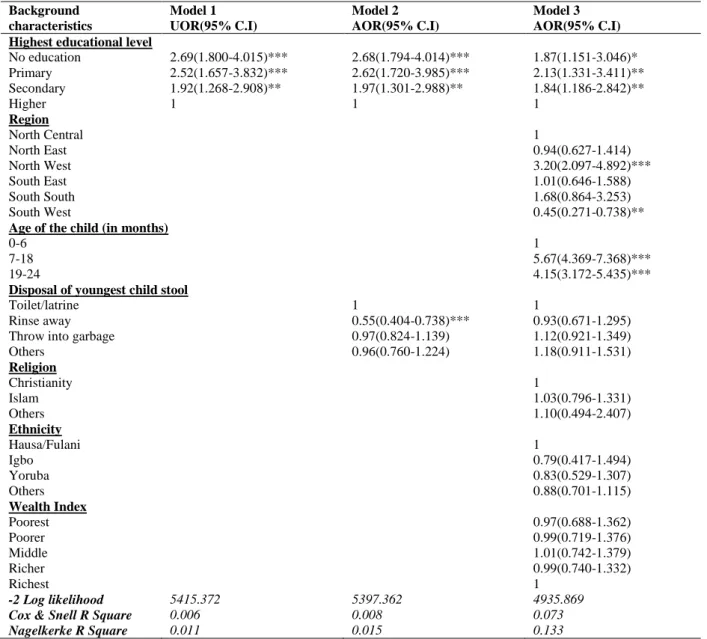
In Table 3, the first model showed that diarrhea prevalence decreased consistently with increasing educational level. Children whose mothers had no formal education (OR=2.69; CI= 1.800-4.015, p<0.001) were more likely to have diarrhea compared to those who had higher education. This was also the pattern for those who had primary and those with secondary education.
In the second model, the significant association between mothers‘ educational level and the prevalence of diarrhea remained with the addition of another predictor- the disposal practices of the youngest child‟s stool into the regression analysis. Mothers who rinsed away the stool of the youngest child in the household were less likely to have an index child with diarrhea (OR= 0.55; CI = .404 - .738, p<.000) compared to those who threw it in the garbage (OR=0.97;
CI=0.824-1.139, p>0.05).
Table 2: Percentage Distribution of Children according to Diarrhea Status by Socio-economic/health Related Characteristics
Background Experienced Diarrhea Total χ2-value
Characteristics No (%) Yes (%) (p-value)
Total 5899(86.3) 935(13.7) 6834
Toilet facility 1.841
Improved 2856 (85.7) 475 (14.3) 3331 (0.175) Unimproved 3043 (86.9) 460 (13.1) 3503
Religion 31.331***
Christianity 2303 (89.3) 276 (10.7) 2579 (<0.001) Islam 3545 (84.5) 651 (15.5) 4196
Others 51 (86.4) 8 (13.6) 59
Ethnicity 18.067***
Hausa/Fulani 2489 (85.2) 434 (14.8) 2923 (<0.001)
Igbo 605 (86.9) 91 (13.1) 696
Yoruba 668 (91.1) 65 (8.9) 733
Others 2137 (86.1) 345 (13.9) 2482
Wealth Index 32.940***
Poorest 1341 (83.6) 263 (16.4) 1604 (<0.001) Poorer 1377 (84.6) 251 (15.4) 1628
Middle 1139 (86.7) 175 (13.3) 1314 Richer 1096 (88.3) 145 (11.7) 1241 Richest 946 (90.4) 101 (9.6) 1047
Working Status 0.352
Not-working 2036(86.0) 332(14.0) 2368 (0.553) Working 3863 (86.5) 603 (13.5) 4466
Disposal of youngest child stool 17.809***
Toilet/latrine 3112 (85.5) 527(14.5) 3639 (<0.001) Rinse away 573(91.7) 52 (8.3) 625
Throw into garbage 1670(86.4) 262 (13.6) 1932
Others 544(85.3) 94(14.7) 638
***Significant at 0.1%
likely to have diarrhea (OR=5.67; CI= 4.369 - 7.368, p<.000) compared to those aged 19-24 months (OR =4.15; CI= 3.172- 5.435, p<.000).
The predictors of diarrhea prevalence were mother‘s level of education, disposal practices of the youngest child‘s stool, the geopolitical region where the child is domiciled and the age of the child.
Discussion
Studies in developed and developing countries have investigated factors contributing to the prevalence of diarrhea among children in diverse settings23, 24. A number of studies conducted in Nigeria focused on diarrhea morbidity, risk factors, care and management24, 16, 3. There are however few documented national studies that used maternal education as a major factor for diarrhea occurrence. This study has therefore revealed how maternal educational attainment influences
childhood diarrhea in Nigeria. In this study, the factors found to be associated with diarrhea among children aged 0-24 months were; maternal education, religion, ethnicity, wealth index and the disposal practices of fecal waste of the youngest child, while the identified predictors were maternal education, the geopolitical region where the child resides and child‘s age.
Table 3: Binary Logistic Regression of Relationship between Diarrhea among Children according to Background Characteristics
Background characteristics
Model 1 Model 2 Model 3
UOR(95% C.I) AOR(95% C.I) AOR(95% C.I)
Highest educational level
No education 2.69(1.800-4.015)*** 2.68(1.794-4.014)*** 1.87(1.151-3.046)* Primary 2.52(1.657-3.832)*** 2.62(1.720-3.985)*** 2.13(1.331-3.411)** Secondary 1.92(1.268-2.908)** 1.97(1.301-2.988)** 1.84(1.186-2.842)**
Higher 1 1 1
Region
North Central 1
North East 0.94(0.627-1.414)
North West 3.20(2.097-4.892)***
South East 1.01(0.646-1.588)
South South 1.68(0.864-3.253)
South West 0.45(0.271-0.738)**
Age of the child (in months)
0-6 1
7-18 5.67(4.369-7.368)***
19-24 4.15(3.172-5.435)***
Disposal of youngest child stool
Toilet/latrine 1 1
Rinse away 0.55(0.404-0.738)*** 0.93(0.671-1.295) Throw into garbage 0.97(0.824-1.139) 1.12(0.921-1.349)
Others 0.96(0.760-1.224) 1.18(0.911-1.531)
Religion
Christianity 1
Islam 1.03(0.796-1.331)
Others 1.10(0.494-2.407)
Ethnicity
Hausa/Fulani 1
Igbo 0.79(0.417-1.494)
Yoruba 0.83(0.529-1.307)
Others 0.88(0.701-1.115)
Wealth Index
Poorest 0.97(0.688-1.362)
Poorer 0.99(0.719-1.376)
Middle 1.01(0.742-1.379)
Richer 0.99(0.740-1.332)
Richest 1
-2 Log likelihood 5415.372 5397.362 4935.869
Cox & Snell R Square 0.006 0.008 0.073
Nagelkerke R Square 0.011 0.015 0.133
***Significant at 0.1%; **Significant at 1.0%; UOR: Un-adjusted Odds Ratio; AOR: Adjusted Odds Ratio
basic consequences of unhealthy living than the less educated. World-wide, previous studies have identified maternal education as a major predictor of child health outcomes27. In this study, maternal education has been identified as an important predictor of childhood diarrhea. This finding is an indication that children of mothers with lower educational attainment have a higher risk of experiencing childhood diarrhea than those whose mothers are better educated. This is in line with community-based studies conducted in Asia and
sub-Saharan Africa28, 29, 21, 22. The possible reasons for this finding in Nigeria, is that better educated mothers are involved in practices that are of benefit to the health of their children.
most children are exposed to contaminants through their surroundings by crawling. This period is also associated with the weaning period of the children and its associated challenges. A study by Sinmegn
et al30, corroborates this assertion.
Wealth index was found to be related to the occurrence of diarrhea and more prevalent among children of women from poorer homes. This finding is corroborated by the study of Boardi and Keutunen31. However, according to Siziya, et al 32, no relationship was established between wealth index and childhood diarrhea. In Nigeria, potable water as one of the key social responsibilities of the Government is either not available or not within the reach of the generality of the population. While the rich circumvent this situation by sinking boreholes in their houses, the poor still get their domestic water sources from unprotected wells, brooks and streams. Ability to make provisions for some factors that could limit diarrhea disease transmission by wealthier families can be explained from these findings.
Nigeria is a large country in terms of population and geographical distribution. The access to good health varies widely across the regions in Nigeria. The literacy level varies considerably across the regions in Nigeria. For instance, higher proportion of women of reproductive age has at least secondary education in the southern part of the country compared to their counterparts in the North. Even within the regions in the North, there are disparities in literacy level. Further, important finding from this study is that, diarrhea was mostly prevalent among children of women living in the Northwestern part of Nigeria. This result conforms to Raji and Ibrahim16 study outcome where prevalence of diarrhea was found to be highest among children of women in the Northwest Nigeria. A research report by Raji et al33, has also confirmed instances of disease outbreak in this region of Nigeria due primarily to water contamination. The same study showed that drinking water sampled from Sokoto, a major town in this region was found to contain a very high load of microbes which were far beyond the allowable limits by WHO2. A study carried out in Sudan by Siziya et al32, also supports variation in diarrhea prevalence by geographic distribution.
The often consistent outcome in Nigeria could be due to the intensity of grazing which exposes most of the farmlands to contamination by cow dung and some of these animals drink from the same water sources as humans.
Limitations of the Study
The data used for this study was cross-sectional survey based on reported information on diarrhea status by the mother or caregiver of the index child in two weeks preceding the survey. As such, their responses could be subjected to recall bias and misreporting of other diseases for diarrhea. Although, the data originator ensured that such errors were minimized at the time of the study. Also, diarrhea reported for the children was not based on their clinical examination especially since reporting of illnesses differs among sociocultural groups, this could be a source of variability and thus generalization should be done with caution.
Conclusion
Maternal education is an important predictor of diarrhea among children aged 0-24 months in Nigeria. Other important factors are age of the child and region of residence. While care should be provided for all children, strategies to reduce diarrhea disease among children in Nigeria should focus more on the children of the uneducated, less educated mothers and those living in the Northwest. This study has provided a baseline for future intervention studies which could inform policy formulation and review in Nigeria towards diarrhea prevention and its control.
References
1. Mihrete TS, Alemie GA and Teferra AS. Determinants of childhood diarrhea among underfive children in Benishangul Gumuz Regional State, North West Ethiopia. BMC pediatric, 2014; 14(1), 1.
2. World Health Organisation (WHO). Reducing mortality from major childhood killer diseases.Mortality Country Fact Sheet. 2006. https://apps.who.int/chd/publications/imci/fs_180.ht m.
Health Sciences, 2014; 14(4).
4. Nakawesi JS, Wobudeya E, Ndeezi G, Mworozi EA and Tumwine JK. Prevalence and factors associated with rotavirus infection among children admitted with acute diarrhea in Uganda. BMC pediatrics, 2010; 10(1), 69.
5. National Bureau of Statistics (NBS). Nigeria: Monitoring the situation of children and women. Nigeria Multiple Indicator Cluster Survey 2011Summary Report. National Bureau of Statistics, Abuja Nigeria. 2011.
6. World Bank. World Development Indicators: Mortality (Table 2.21). World Bank Group. 2013. http://wdi.worldbank.org/table/2.21
7. Adetoro GW and Amoo EO. A Statistical Analysis of Child Mortality: Evidence from Nigeria Journal of Demography and Social Statistics, 2014; 1, 110-120. 8. Population Reference Bureau. World Population Data
sheet with a special focus on human needs and sustainable resources. 2016
9. Adepoju AO. Differential Pattern in Child Mortality Rate in Rural Nigeria. Annual Research & Review in Biology, 2015; 7(5): 309-317.
10. Yilgwan CS and Okolo S. Prevalence of diarrhea disease and risk factors in Jos University Teaching Hospital, Nigeria. Annals of African medicine, 2012; 11(4), 217
11. Agustina R, Sari TP, Satroamidjojo S, Bovee-
Oudenhoven IM, Feskens EJ and Kok FJ. Association of food-hygiene practices and diarrhea prevalence among Indonesian young children from low socioeconomic urban areas. BMC public health, 2013; 13(1), 1.
12. Junaid SA, Umeh C, Olabode AO and Banda, JM. Incidence of rotavirus infection in children with gastroenteritis attending Jos university teaching hospital, Nigeria. Virology journal, 2011; 8(1), 1. 13. Walker CLF, Perin J, Aryee MJ, Boschi-Pinto C and
Black RE. Diarrhea incidence in low-and middle-income countries in 1990 and 2010: a systematic review. BMC public health, 2012; 12(1), 1. 14. National Population Commission (NPC) [Nigeria] and
ICF International. 2014. Nigeria Demographic and Health Survey 2013. Abuja, Nigeria, and Rockville, Maryland, USA: NPC and ICF International. 15. Abuqamar M, Coomans D and Louckx F. The impact of
parental education on infant in Gaza strip, Palestine. Journal of Public Health and Epidemiology 2011; 3(1), 28-33.
16. Raji MIO and Ibrahim YKE. Prevalence of waterborne infections in Northwest
Nigeria: A retrospective study. Journal of Public Health and Epidemiology 2011; 3(8), 382-385. 17. Caldwell JC. Education as a factor in mortality decline an
examination of Nigerian data. Population studies, 1979; 395-413.
18. Gwatkin, D.R., S. Rutstein, S. Johnson, K. Pande and A. Wagstaff.. Socioeconomic Differences in Health, Nutrition and Population in Cameroon. Washington
DC., USA: NP/Poverty Thematic Group, the World Bank 2000.
19. Cleland JG and Van Ginneken JK. Maternal education and child survival in developing countries: the search for pathways of influence. Social science & medicine, 1988; 27(12), 1357-1368.
20. Karlsen S, Say L, Souza, JP, Hogue CJ, Calles DL, Gülmezoglu AM and Raine R. The relationship between maternal education and mortality among women giving birth in health care institutions: analysis of the cross sectional WHO Global Survey on Maternal and Perinatal Health. BMC public health, 2011; 11(1), 1.
21. Avachat SS, Phalke VD, Phalke DB, Syed MMA and Kalakoti P: A cross-sectional study of socio demographic determinants of recurrent diarrhea among children under five of rural area of Western Maharashtra. AMJ, 2011; 4(2):72–75.
22. George CM, Perin J, Karen J, de Calani N, Norman WR, Perry H, Davis Jr TP and Lindquist E. D (2014)Risk Factors for Diarrhea in Children under Five Years of Age Residing in Peri-urbanCommunities in Cochabamba, Bolivia Am. J. Trop. Med. Hyg., 2014; 91(6), 1190–1196
23. Oni GA, Schumann DA and Oke EA. Diarrheal Disease Morbidity, Risk Factors and Treatments in a Low Socioeconomic Area of Dorin, Kwara State, Nigeria. Diarrheal Dis Res 1991; 9(3), 25G - 257
24. Ene-Obong H. N, Iroegbu C. U and UwaegbuteA. C (2000) Perceived Causes and Management of Diarrhea in Young Children by Market Women in Enugu State, Nigeria. J Health Popul Nutr, 2000; 18(2), 97-102
25. United States Department of Health and Human Sciences and Center for Disease Control and Prevention (USDHHS and CDC and P) (2013). Diarrhea, common illness, global killer.
26. Partnership for Child Development. Impact of Education on Health; A Partnership for Child Development report (2016).
27. Vikram K, Vanneman R and Desai, S. Linkages between maternal education and childhood immunization in India. Social science & medicine, 2012; 75(2), 331-339.
28. Senyonga R, Muwonge R, Tewbaze FBN and
Mutayabule R: Determinants of acute diarrhea in children aged 0–5 in Uganda. East Afr Med Journal, 2009; 86(11), 513–519.
29. Desalegn M, Kumie A and Tefera W. Predictors of under-five childhood diarrhea: Mecha District, West Gojjam, Ethiopia. Ethiop. Journal Health Dev, 2011; 25(3), 192–200.
30. Sinmegn MT, Alemie GA and Tefera AS. Determinants of childhood diarrhea among underfive children in BenishangulGumuz Regional State, North West Ethiopia. BMC Pediatrics, 2014; (14)102.
2005; (15) 193-206.
32. Siziya S, Muula AS and Rudatsikira E. Correlates of diarrhea among children below the age of 5 years in Sudan. African Health Sciences, 2013; 13(2) 376 – 383.
33. Raji MIO, Ibrahim YKE and Ehinmidu JO.