African Journal of Reproductive Health June 2018; 22 (2):
40
ORIGINAL RESEARCH ARTICLE
Complementary and Alternative Medicine Used by Infertile Women in
Turkey
DOI: 10.29063/ajrh2018/v22i2.4
Filiz Süzer Özkan
1, Aysel Karaca
1*
and Kader Sarak
2Duzce University, Faculty of Health Sciences, Department of Nursing, Duzce, Turkey1; Zeynep Kamil Women and Children's Hospital Training and Research Hospital, Istanbul, Turkey2
*For Correspondance: E-mail: [email protected], [email protected]; Phone: +90 380 5421141
Abstract
This study was carried out to determine the use of complementary and alternative medicine (CAM) methods by women diagnosed with infertility who had undergone assisted reproduction methods to conceive a child. The study was descriptive and cross-sectional in design. The study was composed of 310 women admitted to the infertility clinic of a Women‘s and Children's Hospital in Istanbul, Turkey. Data were collected via a questionnaire form that was prepared based on the literature. Data were assessed by percentage calculation. The ratio of CAM use among the women in the study was 51%. The most commonly used practices involved the consumption of onions (65.1%) and figs (45.2%), insertion of sheep tail fat into the vagina (42.9%) and eating walnuts (41.7%). The most commonly known practice was the use of onions (81.9%), followed by figs (56. 3%), amulets (34.1%), parsley (30.67%) and prayers (30.3%). Participants stated that only three methods had been beneficial, with onions (two individuals), diet (one individual), and psychotherapy (one individual), considered as successful practices. Evidence-based studies on the most well-known and practiced methods are needed. Therefore, it is essential to perform meta-analyses and randomized controlled studies. (Afr J Reprod Health 2018; 22[2]: 40-48).
Keywords: complementary and alternative medicine, infertility, assisted reproduction techniques, Turkey
Résumé
Cette étude a été réalisée pour déterminer l'utilisation des méthodes de médecine complémentaire et alternative (MCA) par les femmes diagnostiquées avec l'infertilité qui avaient subi des méthodes de reproduction assistée pour concevoir un enfant. L'étude était descriptive et transversale dans sa conception. L'étude était composée de 310 femmes admises à la clinique d'infertilité d'un hôpital pour femmes et enfants à Istanbul, en Turquie. Les données ont été recueillies au moyen d'un formulaire de questionnaire préparé en fonction de la documentation. Les données ont été évaluées par calcul de pourcentage. Le ratio d'utilisation de MCA parmi les femmes dans l'étude était de 51%. Les pratiques les plus couramment utilisées impliquaient la consommation d'oignons (65.1%) et de figues (45.2%), l'insertion de graisse de queue de mouton dans le vagin (42.9%) et la consommation de noix (41.7%). La pratique la plus connue était l'utilisation d'oignons (81.9%), suivie des figues (56.3%), des amulettes (34.1%), du persil (30.67%) et des prières (30.3%). Les participants ont déclaré que seules trois méthodes avaient été bénéfiques, les oignons (deux individus), l'alimentation (un individu) et la psychothérapie (un individu) étant considérées comme des pratiques réussies. Des études fondées sur les preuves des méthodes les plus connues et pratiquées sont nécessaires. Par conséquent, il est essentiel d'effectuer des méta-analyses et des études contrôlées randomisées. (Afr J Reprod Health 2018; 22[2]: 40-48).
Mots-clés: médecine complémentaire et alternative, infertilité, techniques de reproduction assistée, Turquie
Introduction
The National Centre for Complementary and
Alternative Medicine (NCCAM) defines
complementary and alternative medicine (CAM) simply as various medical and healthcare interventions, treatments, products or disciplines that are not considered as a part of conventional medicine1.
African Journal of Reproductive Health June 2018; 22 (2):
41
treatments, stress derived from repeated IVF cycles and the costs associated with these treatments, women seek different treatments in order to increase their chance of experiencing a healthy pregnancy and to manage their infertility-associated stress. It is observed that during infertility treatment, the
biomedical and CAM treatments can be
simultaneously applied. Although CAM treatments have been commonly used alongside conventional medicine, more studies are needed now that they have recently begun to be used in the treatment of infertility3.
The CAM applications that are used in infertility vary based on the country. According to the study by Clark et al. 4 the most common CAM practices recommended by doctors during infertility treatment were determined to be acupuncture (60.4%), massage (40.9%), nutritional supplements (40.9%), praying (47.1%), psychotherapy (46.2%), physical exercise (51.6%), and meditation (54.7%). In another study which was carried out on women and men who were diagnosed with infertility in Australia, the reported CAM practices used included multivitamins, herbs, mineral supplements, natural methods, massage and acupuncture4,5. Studies conducted in Turkey have focused directly on conventional methods used by women to get pregnant instead of CAM practices used during infertility treatment6-9.
However, these methods vary based on the geographical region in which the study was carried out; therefore, they are not general, and data related to CAM methods used by infertile patients in Turkey are not sufficient. Recently, published research in Turkey has indicated that women used CAMs frequently during infertility treatment (78% of 127 infertile women); and they preferred mostly praying (100%), laughing (98%), visiting neighbours (91.9%) and performing ritual prayer (79.8%)10.
This study provides information regarding CAM methods used by women who had undergone infertility treatment in Turkey and the benefits of these methods. At the same time, it provides an evaluation of different regional practices in Turkey as it was carried out in a center for infertility treatment serving many regions of the country. A database can thus be established for the commonly used CAM methods which have been found to be beneficial. This study aimed to determine the CAM methods which women admitted to using after they were
diagnosed with infertility and had undergone assisted reproduction techniques in order to conceive a child.
Methods
Design
The study followed a descriptive and cross-sectional design.
Sample
The study was carried out in an infertility unit of a Women's and Children‘s Hospital in Istanbul. Assisted reproduction techniques including IUI, ICSI and IVF are performed in this unit. There were no CAM protocols recommended/applied to the patients in this unit, which only applied biomedical treatment. For the study, 310 infertile women 18-45 years of age, admitted to the unit between July and October, diagnosed with infertility and admitted for assisted reproduction techniques agreed to participate in the study with written and verbal consents.
Instrument
Data were collected through a questionnaire form which was prepared in accordance with information obtained from the literature by the researchers. This form was examined by experts and the final version was generated in accordance with the recommended changes. The questionnaire was composed of two parts. The first part consisted of 13 questions involving socio-demographic characteristics. The second part examined the knowledge level, frequency of use and efficacy of the CAM methods the women admitted using to conceive a child, which included sitting over water/vapour, food and drinks, placing an object directly into the vagina, materials applied to hygienic pads, practices recommended by hodjas, heat-treatment therapies and other procedures including doing exercises, following a diet, acupuncture, reiki, hypnosis, meditation, and psychotherapy.
Data analysis
African Journal of Reproductive Health June 2018; 22 (2):
42
Results
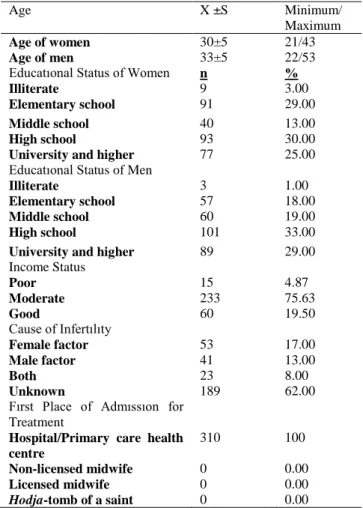
The mean age of the women included in the study was 30 ± 5 years (min = 21, max = 43) and the mean age of the men was 33 ± 5 years (min = 22, max = 53). When the educational status was examined, it was found that most of the women were high school (30%) and elementary school (29%) graduates and their spouses were mostly high school (33%) and university (29%) graduates. Of the participants, 75.63% had a moderate level income. The reason for infertility was not known among 62% of the couples, and all women (11%) were initially admitted to a hospital-health clinic, etc. for treatment (Table 1).
Results showed that 51% of the women stated they used CAM, and 51.45% declared that they had learned of these methods from their families, relatives and friends. Only 7% of the women recommended the CAM methods that they had used (Table 2).
In the study, it was found that women who wanted to get pregnant used the following CAM applications:
1. Sitting over water/vapour of hibiscus, plantain, chamomile, milk, parsley, stinging nettles, and chicory
2. Foods and drinks (walnuts, parsley, stinging nettles, onions, figs)
3. Placing an object directly into the vagina (sheep tail fat, hibiscus, honey, plantain, turmeric) 4. Materials applied to a hygienic pad (egg yolk,
hibiscus, plantain, stinging nettles)
5. Practices recommended by hodjas (amulets, blessings, visiting tomb of a saint, eating blessed food, drinking blessed water)
6. Heat-treatment therapies (going to a hot spring or Turkish bath, applying fresh animal manure up to the waist, entering in hot sand up to the waist, applying hot vacuum glasses on the groin, applying heat on the abdomen, wrapping the pelvic region)
7. Other practices (doing exercises, following a diet, acupuncture, reiki, hypnosis, meditation, psychotherapy, massage, music therapy, physical therapy).
In addition, based on the information obtained from the participants, 26 practices that were not included under the above mentioned practices were detected. These included eating camel tongue, eating carob molasses, camomile tea, lady‘s mantle, ginger, garlic,
Table 1: Descriptive Characteristics of the Women (n = 310) undergoing Assisted Reproductive Technology in Turkey
Age X ±S Minimum/
Maximum
Age of women 30±5 21/43
Age of men 33±5 22/53
Educatıonal Status of Women n %
Illiterate 9 3.00
Elementary school 91 29.00
Middle school 40 13.00
High school 93 30.00
University and higher 77 25.00 Educatıonal Status of Men
Illiterate 3 1.00
Elementary school 57 18.00
Middle school 60 19.00
High school 101 33.00
University and higher 89 29.00 Income Status
Poor 15 4.87
Moderate 233 75.63
Good 60 19.50
Cause of Infertılıty
Female factor 53 17.00
Male factor 41 13.00
Both 23 8.00
Unknown 189 62.00
Fırst Place of Admıssıon for Treatment
Hospital/Primary care health centre
310 100
Non-licensed midwife 0 0.00
Licensed midwife 0 0.00
Hodja-tomb of a saint 0 0.00
Virgin Mary grass, April rain, bee pollen, carrot juice, herbal medicine, broccoli juice, carrying a small blessed lock, sugar, leeches, white soap, mint sugar, alum, gum mastic, herbal suppositories, cloth plaster, yarrow and cupping.
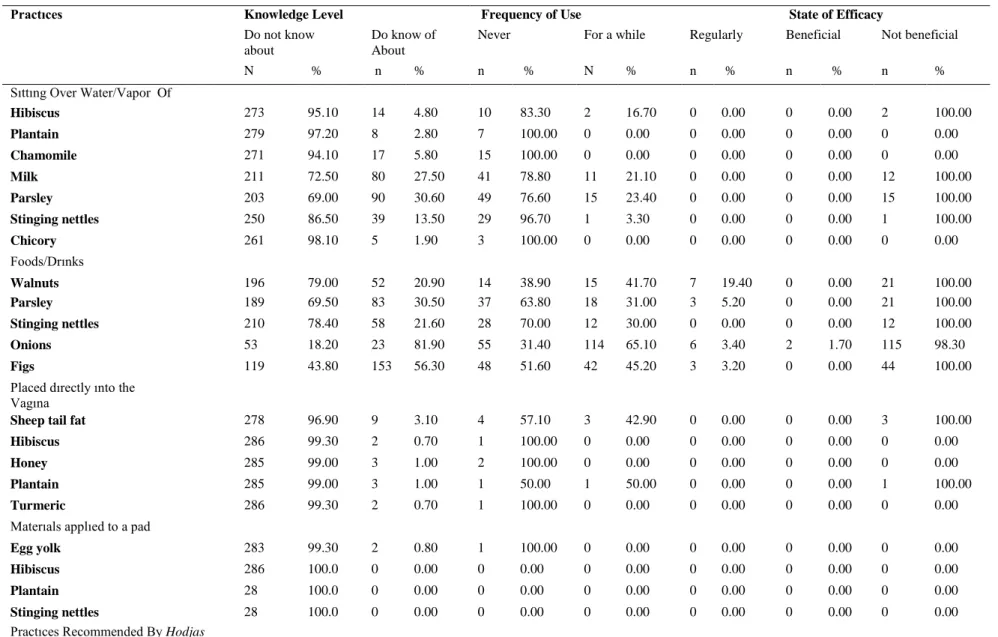
The results of the study listed under the categories of main methods and sub-practices according to the first allocation are summarized in Table 3.
Levels of knowledge
African Journal of Reproductive Health June 2018; 22 (2):
43
Table 2: CAM use among the Women (n = 310)undergoing Assisted Reproductive Technology in Turkey
Dıd you use CAM? n %
No comment 39 12.00
Yes 158 51.00
No 114 37.00
Dıd CAM work?
No comment 279 90.00
Yes 3 1.00
No 29 9.00%
Where dıd you learn about CAM?
No comment 28 9.00
Doctor 7 2.25
Doctor and social environment together 4 1.29
Patient group 1 0.32
Media tools (TV, newspaper, internet, etc.)
61 19.61
Media and social environment together 49 15.76
Social environment (family, friends, neighbours, relatives, etc.
160 51.45
Social environment and patients 1 0.32 Any harmful effects from CAM?
No comment 262 84.20
Yes 13 4.20
No 36 11.60
Would you recommend CAM?
No comment 240 77.20
Yes 24 7.70
No 47 15.10
expressed as ―do not know‖ (between 96% and 99.3%). The most widely known practice in this group was the use of sheep tail fat (3.1%). The distribution in terms of knowledge level for the category of recommendations by hodjas was more homogenous (between 30% and 34%). The most well-known practice in this group was the use of amulets and blessings (34.1% each). Under the category of heat-treatment therapies, the best-known practice was going to a hot spring or Turkish bath (30.3%), while the least-known was entering hot sand up to the waist. For the last category of other therapies, the best- and least-known methods were doing exercises (6.1%) and physical therapy (0.4%), respectively.
Frequency of use
Frequency of use consisted of three categories: ―never used‖,‖used for a while‖ and ―regularly used‖. It was impossible to make a meaningful evaluation for groups when "I used for a while" was examined. When examined individually, the most commonly used practices were eating onions (65.1%) and figs (45.2%), inserting sheep tail fat into the vagina (42.9%) and eating walnuts (41.7%). In the regular
use category, this condition became more attenuated. The level of use was revealed as very low. The most regularly used practices were eating walnuts (1.9%) and following a diet (1.5%).
Efficacy
The state of efficacy was evaluated as beneficial or not beneficial. Participants declared that only three practices were beneficial: eating onions (two individuals), following a diet (one individual) and psychotherapy (one individual).
Discussion
This study was performed to determine the CAM methods used by women diagnosed with infertility in order to conceive a child. The study detected that all women (100%) were initially admitted to a health centre for infertility treatment. In other studies carried out in Turkey, Engin et al. reported that in cases of infertility problems, 80.7% and 98% of women initially had visited a doctor or hospital, respectively, in order to conceive a child8,9. The use of the conventional medical treatment option by all the women in the study in order to conceive a child can be interpreted as an indicator of their reliability on the medical treatment in this field. At the same time, more than half of the women were using CAM as well . In studies performed in Turkey, Edirne et al found that 82% and Başgöl and Beji reported that 78% of women used CAM at least once for infertility purposes7,10. Other studies in Turkey reported that traditional methods were used during infertility treatment in 9%6 , 71%8, and 29%9 of women. In studies performed in other countries, the level of CAM use for infertility treatment was found to be 44% in Jordan, 41% in Lebanonn and 91% in the
USA6,8,9-12.
Complementary and alternative medicine is commonly used in the treatment of infertility. The level of CAM use was found to be higher in Turkey than in Jordan and Lebanon, but greatly lower compared to the level of use in the USA11,12. This result is thought to be related to the percentage of CAM recommendation by the teams that carry out infertility treatments in these countries. Meanwhile, the differences between the levels of CAM use may be derived from differences in study designs and cultural differences.
African Journal of Reproductive Health June 2018; 22 (2):
44
Table 3: Knowledge about CAM and its use among the Women (n = 310) undergoing Assisted Reproductive Technology in TurkeyPractıces Knowledge Level Frequency of Use State of Efficacy
Do not know
about
Do know of About
Never For a while Regularly Beneficial Not beneficial
N % n % n % N % n % n % n %
Sıttıng Over Water/Vapor Of
Hibiscus 273 95.10 14 4.80 10 83.30 2 16.70 0 0.00 0 0.00 2 100.00
Plantain 279 97.20 8 2.80 7 100.00 0 0.00 0 0.00 0 0.00 0 0.00
Chamomile 271 94.10 17 5.80 15 100.00 0 0.00 0 0.00 0 0.00 0 0.00
Milk 211 72.50 80 27.50 41 78.80 11 21.10 0 0.00 0 0.00 12 100.00
Parsley 203 69.00 90 30.60 49 76.60 15 23.40 0 0.00 0 0.00 15 100.00
Stinging nettles 250 86.50 39 13.50 29 96.70 1 3.30 0 0.00 0 0.00 1 100.00
Chicory 261 98.10 5 1.90 3 100.00 0 0.00 0 0.00 0 0.00 0 0.00 Foods/Drınks
Walnuts 196 79.00 52 20.90 14 38.90 15 41.70 7 19.40 0 0.00 21 100.00
Parsley 189 69.50 83 30.50 37 63.80 18 31.00 3 5.20 0 0.00 21 100.00
Stinging nettles 210 78.40 58 21.60 28 70.00 12 30.00 0 0.00 0 0.00 12 100.00
Onions 53 18.20 23 81.90 55 31.40 114 65.10 6 3.40 2 1.70 115 98.30
Figs 119 43.80 153 56.30 48 51.60 42 45.20 3 3.20 0 0.00 44 100.00 Placed dırectly ınto the
Vagına
VAGINA
Sheep tail fat 278 96.90 9 3.10 4 57.10 3 42.90 0 0.00 0 0.00 3 100.00
Hibiscus 286 99.30 2 0.70 1 100.00 0 0.00 0 0.00 0 0.00 0 0.00
Honey 285 99.00 3 1.00 2 100.00 0 0.00 0 0.00 0 0.00 0 0.00
Plantain 285 99.00 3 1.00 1 50.00 1 50.00 0 0.00 0 0.00 1 100.00
Turmeric 286 99.30 2 0.70 1 100.00 0 0.00 0 0.00 0 0.00 0 0.00 Materıals applıed to a pad
Egg yolk 283 99.30 2 0.80 1 100.00 0 0.00 0 0.00 0 0.00 0 0.00
Hibiscus 286 100.0 0 0.00 0 0.00 0 0.00 0 0.00 0 0.00 0 0.00
Plantain 28 100.0 0 0.00 0 0.00 0 0.00 0 0.00 0 0.00 0 0.00
African Journal of Reproductive Health June 2018; 22 (2):
45
Amulets 187 65.80 97 34.10 51 71.80 20 28.10 0 0.00 0 0.00 19 100.00
Blessings (Reading and blowing on) 186 66.00 96 34.10 51 78.50 14 21.60 0 0.00 0 0.00 14 100.00
Visiting tomb of a saint 192 68.10 90 31.80 46 73.00 17 26.90 0 0.00 0 0.00 15 100.00
Eating blessed food 187 66.10 96 33.90 50 73.50 17 25.00 1 1.50 0 000 17 100.00
Blessed water 195 69.40 86 30.70 51 86.40 8 13.60 0 0.00 0 0.00 7 100.00 Heat-treatment therapıes
Going to a hot spring or Turkish bath
205 69.70 89 30.30 40 64.50 22 35.50 0 0.00 0 0.00 20 100.00
Fresh animal manure up to the waist 274 96.50 10 3.60 6 85.70 1 14.30 0 0.00 0 0.00 0 0.00
Entering into the hot sand up to the waist
285 98.30 5 1.70 5 100.00 0 0.00 0 0.00 0 0.00 0 0.00
Hot vacuum glasses on the groin 279 95.90 12 4.10 5 50.00 5 50.00 0 0.00 0 0.00 5 100.00
Heat treatment on the abdomen 277 95.50 13 4.50 5 41.70 6 50.00 1 8.30 0 0.00 7 100.00
Wrapping the pelvic region 264 97.80 6 2.30 5 83.30 1 16.70 0 0.00 0 0.00 0 0.00 Other Therapıes
Doing exercises 265 94.00 17 6.10 11 84.60 1 7.70 1 7.70 0 0.00 2 100.00
Following a diet 267 94.30 16 5.70 8 57.10 4 28.50 2 14.30 1 20.00 4 80.00
Acupuncture 270 96.40 10 3.60 5 71.40 2 28.60 0 0.00 0 0.00 0 0.00
Reiki (Touching therapy) 274 98.20 5 1.80 3 100.00 0 0.00 0 0.00 0 0.00 0 0.00
Hypnosis 279 99.60 1 0.40 2 100.00 0 0.00 0 0.00 0 0.00 0 0.00
Meditation 277 98.60 4 1.40 3 100.00 0 0.00 0 0.00 0 0.00 0 0.00
Psychotherapy 271 96.80 9 3.30 6 100.00 0 0.00 0 0.00 1 100.0 0 0.00
Massage 276 98.90 3 1.10 4 100.00 0 0.00 0 0.0 0 0.00 0 0.00
Music therapy 275 0.979 6 2.10 5 83.30 1 16.70 0 0.00 0 0.00 0 0.00
African Journal of Reproductive Health June 2018; 22 (2):
46
and figs (56.3%). These were followed by obtaining an amulet from a hodja and blessings (34.1% each), sitting over water/vapour of parsley (30.67%) and going to a hot spring or Turkish bath (30.3%). Similar to the results of other studies in Turkey, these findings showed that the traditional CAM practices best known by the women were foods and drinks, amulets and blessings (spiritual practices). Traditional method use varies according to the geographical region; thus there are variations in the results of the study. For instance; in the study performed by Şimşek
6
in the eastern part of the country, traditional methods most commonly known by the women in order to get pregnant were determined to be sitting over the vapour of a herbal mixture (75%), applying a herbal mixture to the vagina (46%), making a heat treatment on the abdomen (27%), and drinking a herbal mixture (25%). The eastern part of Turkey is the region in which the gender difference in education level is the highest (74% of the men have completed elementary school education, while this ratio is 54% among women). Moreover, this region includes the least number of educated women13 . Education is one of the basic factors affecting women‘s health. The use of the healthcare services was found to be lower in the eastern part of Turkey14. In a case from the eastern region, when a 22-year old woman who had been married for two years was admitted to the hospital with complaints of a malodorous vaginal discharge and infertility, a solid foreign object was detected in the posterior fornix during her examination, and upon removal, it was found to be a raw fig1. This finding illustrates that healthcare professionals should be aware of the CAM practices used by women and that they should be followed up for health risks.
The most commonly used practices among the women were eating onion (65.1%) and figs (45.2%), inserting sheep tail fat into the vagina (42.9%) and eating walnuts (41.7%). These findings show that the majority of methods involve eating specific foods. In another study performed in Turkey, Edirne et al. found that 46.3% of women asked for help from hodjas and agreed to use the solutions recommended by them 7. In this study, the ratio of the patients who had used herbs and had made a visit to a hodja or entombed saint was 36.6%. Kurçer et al 9 found that 36% of women used a vaginal suppository made of herbs and 15% used the method of boiling herbs and sitting over the vapour. In the study by Şimşek, women
stated that they used sitting over vapour (7.5%), applying a mixture directly into the vagina
(4.2%), applying a mixture to a pad (1.4%) and drinking several herbal mixtures (4.2%) in order to get pregnant6.
In the study by Başgöl and Beji carried out on 127 infertile women, the most preferred practices were found to be praying (100%), laughing (98%), visiting neighbours (91.9%), and performing ritual prayer (79.8%) 10. As in the other studies conducted in Turkey, the results of the current study showed that CAM practices such as herbal treatments, acupuncture, psychotherapy and physical exercise were little known and were not practiced by the women included in the study. Studies performed in Western countries such as Ireland and the USA have found that CAM practices such as acupuncture, exercise, herbal medicine and psychotherapy were more frequently used in infertility treatment16,17. It was determined that the methods most frequently used by the women in Jordan were spiritual support (44%) and herbs (36%), which were similar to those practised in Lebanon such as spiritual support /prayer (56.5%) and herbal medicine (43%),11,12. In a study carried out in Ireland, 46% of the patients undergoing infertility treatment admitted that they were regularly using herbal medicine16. In the USA, acupuncture was found to be the CAM method most frequently used during in vitro fertilization treatment17. The lower per cent of recognition and practice of these methods in Turkey may be due to the fact that the numbers of evidence-based studies regarding CAM practices are limited and sufficient support by doctors for the use of CAM practices in addition to biomedical treatment is lacking. There is no data in Turkey regarding the status of doctor recommending CAM practices and the frequency of their CAM use in infertility treatment. In the current study, only seven women (2.25%) declared that they had learned about CAM practices from a doctor, and more than half (51.45%) had learned about it from their families, relatives and friends. This gives a brief indication regarding CAM recommendation and its use by the doctors who implement infertility treatment. However, the study by Clark et al.4 found that the practices recommended by doctors during infertility treatment were acupuncture (60.4%), massage (40.9%), nutritional supplements (40.9%), praying (47.1%), psychotherapy (46.2%), physical exercise (51.6%), and meditation (54.7%).
African Journal of Reproductive Health June 2018; 22 (2):
47
these are favourite methods in Turkish culture for healing diseases and realizing wishes. However, the ratio of those using these methods (21-28%) was found to be lower than for methods involving food and drink (41-65%). In the study by Edirne et al.7 conducted in a city in the eastern part of Turkey, it was determined that all patients prayed routinely to get pregnant and nearly half of them visited a hodja and used the methods recommended by her/him even though they did not conceive. However, these religious methods were not shown to affect fertility directly. Again, even foods and methods recommended by hodjas may have a harmful effect on health7. Moreover, in this study, blessings and practices by hodjas were not included among CAM methods that were stated by the patients to be beneficial.
When the state of efficacy was examined, only onions (two individuals), diet (one individual) and psychotherapy (one individual) were considered to be beneficial. Despite limited data, acupuncture and psychotherapy have been shown to have some positive effects on the psychological well-being of patients undergoing infertility treatment 4. The study conducted by Smith et aldetermined that acupuncture aided in decreasing infertility-associated stress18. In their study performed with 1366 women, Manheimer et al. reported that acupuncture given complementary to IVF increased the chance of conceiving a pregnancy19.
In some studies, CAM has been shown to have a non-significant role towards an increase in pregnancy rates. Additional studies should be performed to confirm these tendencies4. It is quite difficult to determine what kind of efficacy the onion cure in this study generated and whether or not it had a direct effect. However, the high incidence of its use and positive statements about its usefulness warrant evaluating the evidence of the onion cure. In Turkey, the use of nutritional supplements, acupuncture, diet and psychotherapy has recently become common for infertility; however, it is difficult to comment on their routine use. Therefore, these practices were evaluated as low in terms of the level of knowledge of them, the frequency of their use and their efficacy.
Conclusions
Turkish women diagnosed with infertility often admitted to using CAM and traditional practices in order to conceive a child. The CAM practices that were most frequently used by the women were
onions, figs, and walnuts within the category of food and drinks. The least- known and least practiced ones were nutritional supplements, acupuncture, diet and psychotherapy. Evidence-based studies should be conducted on the best-known and most widely practiced methods in Turkey. To this purpose, the performance of meta-analyses and randomized controlled studies is crucial. Healthcare professionals should approach infertile patients with sensitivity and give their patients adequate information about CAM when appropriate.
Ethıcs Consıderatıon
The study was deemed appropriate by the Clinical Research Ethics Committee of the Women's and Children‘s Hospital. Written consent was obtained from the institution with which the hospital was affiliated in order to conduct the study. Participants were informed about the aim and content of the study and their written consents were taken before the beginning of the study.
Acknowledgements
The authors thank all the women who participated in the study.
Contribution of Authors
Study design: FSÖ, AK; data collection: KS; article drafting: FSÖ, AK and data interpretation and revision and final approval of the article: all authors.
References
1. National Center for Complementary and Alternative
Medicine Third Strategic Plan 2011–2015 Exploring the Science of Complementary and Alternative Medicine, p.1. Available from URL: https://nccih.nih.gov/sites/nccam.nih.gov/files/NCCAM _SP_508.pdf. Accessed 03.01.2017.
2. Taşkın L. Birth and Women's Health Nursing. Offset Printing System, X. 2012.
3. Özcan H and Beji NK. Complementary and Alternative Medicine Practice in Infertility. Okmeydanı Tıp Dergisi 2016; 32(1): 36-44.
4. Clark NA, Will MA, Moravek MB, Xu X and Fissea S. Physician and patient use of and attitudes toward complementary and alternative medicine in the treatment of infertility. International Journal of Gynecology and Obstetrics 2013; (122):253–257. 5. Stankiewicz M, Smith C, Alvino H and Norman R. The use
African Journal of Reproductive Health June 2018; 22 (2):
48
Zealand Journal of Obstetrics and Gynaecology 2007;47(2): 145-149.
6. Şimşek Ş. Traditional Methods of Married Women Living in Iğdır Melekli Village for Their Pregnant Women. Hacettepe Üniversitesi Sağlık Bilimleri Enstitüsü,Yayınlanmamış yüksek lisans tezi ,Ankara 2013 (in Turkish)
7. Edirne T, Arıca SG, Gucuk S, Yıldızhan R, Kalusari A, Adali E and Can M. Use of complementary and alternative medicines by a sample of Turkish women for infertility enhancement: A descriptive study. BMC Complementary and Alternative Medicine 2010; (10)11:1-10.
8. Engin R and Pasinlioğlu T. The tradioal belief and aplications of infertile women regarding infertility in and around Erzurum. Atatürk Üniv. Hemşirelik Yüksekokulu Dergisi 2002; 5(1): 20-28 (in Turkish)
9. Kurçer AM, Eğri M, Genç M, Pehlivan E, Güneş G, Karaoğlu L and Kaya M. Behaviors of infertil women with regard to tradional infertility treatments and influenced factors. Turgut Özal Tıp Merkezi Dergisi 1999; 6(4):12-17 (in Turkish)
10. Başgöl Ş and Beji KN. Use of Complementary and
Alternative Medical Therapies by Women Undergoing Reproductive Technology. Turkiye Klinikleri J Obstet Womens Health Dis Nurs-Special Topics 2016; 2(3):70-76.
11. Bardaweel SK, Shehadeh M, Suaifan G and Kilani MV. Complementary and alternative medicineutilization by a sample of infertile couples in Jordan for infertility treatment: Clinics-based survey. BMC Complementary and Alternative Medicine 2013; 13(1):35
12. Ghazeeri GS, Awwad JT, Alameddine M, Younes ZMH and Naja F. Prevalence and determinants of complementary
and alternative medicine use among infertile patients in Lebanon: A cross-sectional study. BMC Complementary and Alternative Medicine 2012; 12(1): 29.
13. TDHS (Turkey Demographic and Health Survey). Hacettepe Üniversitesi Nüfus Etütleri Enstitüsü, T.C. Kalkınma Bakanlığı ve TÜBİTAK, 2013, Ankara, Turkey. (in Turkish)
14. TC Ministry of Health Health Statistics Yearly..Sentez Matbaacılık ve Yayıncılık. ISBN : 978-975-590-508-2, Sağlık Bakanlığı Yayın No : 956. Ankara 2014.(in Turkish)
15. Kurdoğlu Z. Foreign A. Body Determined in the Vagina of Infertile Woman Treated with Traditional Methods. Van Tıp Dergisi 2011;18 (4): 217-219. (in Turkish) 16. Shannon J, El Saigh I, Tadrous R,Mocanu E and Loughrey J.
Usage of herbal medications in patients undergoing IVF treatment in an Irish infertility treatment unit. Ir J Med Sci 2010;17(9): 63–65.
17. Weiss AD, Harris CR and Smith JF. The use of
complementary and alternative fertility treatments. Current Opinion in Obstetrics and Gynecology 2011; 23: 195–199.
18. Smith CA, Ussher JM, Perz JB and Carmady SL. The effect of acupuncture on psychosocial outcomes for women experiencing infertility: A pilot randomized controlled trial.The Journal of Alternatıve and Complementary Medıcıne 2011; 17(10): 923–930.