ORIGINAL RESEARCH ARTICLE
Factors Associated with Parental Intent not to Circumcise
Daughters in Enugu State of Nigeria: An Application of the Theory
of Planned Behavior
DOI: 10.29063/ajrh2018/v22i1.3
Cajetan I. Ilo
1*
,Sandra A. Darfour-Oduro
2, Jerome O. Okafor
3, Diana S. Grigsby-Toussaint
2,4,
Ignatius O. Nwimo
1and Chinagorom Onwunaka
3Department of Human Kinetics and Health Education, Ebonyi State University Abakaliki, Nigeria1; Department of Kinesiology and Community Health, University of Illinois at Urbana-Champaign, USA2; Department of Human Kinetics and Health Education, Nnamdi Azikiwe University Awka, Nigeria3; Division of Nutritional Sciences, University of Illinois at Urbana-Champaign, USA4
*For Correspondence: Email: [email protected]; Phone: +234 (0) 8033430522
Abstract
This study explored intention of parents not to circumcise daughters in Enugu State, Nigeria using theory of planned behavior (TPB) as a framework. A survey of 1345 parents was carried out using structured questionnaire with FGM question items based on TPB constructs of attitude, subjective norm (SN), perceived behavioral control (PBC), and intention. Intention was dichotomized into two categories and logistic regression analysis was performed to examine the association between the constructs of TPB while controlling for some socio-demographic factors. 70% of respondents did not intend circumcising daughters. Constructs of TPB associated significantly, at p < 0.0001, with intention not to perform FGM on daughters with PBC having the strongest association. Having a post-secondary education (OR = 3.94; CI = 2.73-5.67) and absence of history of FGM in family (OR = 3.39; CI = 2.62-4.39) are the socio-demographic variables most significantly associated with the intention not to circumcise daughters. Homer-Lemeshow goodness-of-fit statistics indicated logistic regressions model 1 was significant (p < 0.05) making TPB a good theoretical basis for study of FGM. Intervention activity should focus on improving attitude of parents and especially those with less than post-secondary education and those with cases of FGM in their household. (Afr J Reprod Health 2018; 22[1]: 29-37).
Keywords: Female genital mutilation, parental intent, circumcision, childbearing age, Enugu State, Nigeria, Theory of planned behavior
Résumé
Cette étude a exploré l'intention des parents de ne pas exciser leurs filles dans l'État d'Enugu, au Nigeria, en se servant de la théorie du comportement planifié (TCP) comme cadre. Une enquête auprès des 1345 parents a été réalisée à l'aide d'un questionnaire structuré avec des éléments des questions sur les MGF basés sur les construits TCP d'attitude, la norme subjective (NS), le contrôle comportemental perçu (CCP) et l'intention. L'intention a été dichotomisée en deux catégories et une analyse de régression logistique a été effectuée pour examiner l'association entre les constructions de TCP tout en contrôlant certains facteurs sociodémographiques. 70% des interviewés n'avaient pas l'intention d‘exciser leurs filles. Les constructions de TCP associées de façon significative, à p <0,0001, avec l'intention de ne pas effectuer de MGF sur les filles avec la CCP ayant l'association la plus forte. Les études postsecondaires (RC = 3,94; IC = 2,73-5,67) et l'absence d'antécédents de MGF dans la famille (RC = 3,39; IC = 2,62-4,39) sont les variables sociodémographiques les plus significativement associées à l'intention de ne pas exciser les filles. Les statistiques de Homer-Lemeshow sur la qualité de l'ajustement ont indiqué que le modèle 1 de régressions logistiques était significatif (p <0,05), ce qui fait du TCP une bonne base théorique pour l'étude des mutilations génitales féminines. L'activité d'intervention devrait être axée sur l'amélioration de l'attitude des parents, en particulier ceux qui n'ont pas suivi d'études postsecondaires et ceux qui ont des MGF dans leur ménage. (Afr J Reprod Health 2018; 22[1]: 29-37).
Introduction
Female genital mutilation (FGM) is a cultural practice widespread in the majority of Africa and the Asian countries. It has attracted global attention and efforts are underway to overcome the practice due to threats to the health and rights of millions of women and children1. The World Health Organization (WHO) explained that FGM comprises all procedures concerning fractional or total taking away of the external genitalia of the girl child whether for cultural or other non-medical reason2. Approximately 200 million girls and women alive today have undergone female genital mutilation in the countries where the practice is concentrated3. In Nigeria, 25% of women aged 15-49 and 17% of girls aged 0-14 years have undergone FGM4. The Nigerian Demographic and Health Survey (NDHS) puts the prevalence of FGM at 25%5. The concern about FGM stems from the observed dire consequences of the procedure on females, of which some are found to be debilitating, life threatening and may have a long-term effect and complications1. In reaction to this harmful traditional practice, the international community, national and local institutions have designed programs to eliminate the practice. Most of these intervention efforts have, in many situations, produced incomplete results1. Moreover, emphasis has been placed on improving understanding on why and how interventions for FGM influence change, with the integration of theories on behavior change6. Therefore, to understand and predict intention towards FGM practice, a supportive assumption which recognizes the social foundation of behavior and includes behaviors which may possibly be under complete voluntary control is needed to guide the study. The theory of planned behavior (TPB) presents such a base.
Theoretical background
TPB is a theoretical model that is propounded to predict and illuminate a range of behaviors7. In health psychology, this theory is one that reveals relationship between feelings and behavior. Three cognitive indicators to whether FGM will be performed on daughters by parents were identified.
These indicators include attitude towards performing FGM, perceived attitude of other people towards practice of the act, and apparent control over the practice of FGM. Each indicator contributes independently to intention to carry out or not to carry out FGM, while perceived control makes an autonomous contribution to the real practice or non-practice of FGM8. These indicators are showcased in the TPB. This theory explains that individuals form intention in advance of behavior9. Intention which is a powerful predictor of behavior is also predicted by behavioral attitude, subjective norms and perceived behavioral control. These psychological dispositions have been indicated to predict a wide range of health-related behaviors10 including fertility studies11, preventing weight gain12 and cervical cancer screening uptake13.
Methods
Participants and recruitment
The sample for this cross-sectional study was 1345 parents aged 15 years and above selected out of an estimated population of 1, 454,889 through multistage sampling conducted in August 2012 in Enugu State, Nigeria. Greater percentages of the population live in the rural areas and are made up of more females (61%) than males14, 15. The urban population is predominantly civil servants. Some inhabitants engage in small and medium scale business. The rural counterparts are predominantly subsistent farmers, petty traders and craftsmen. Enugu State has common values, beliefs and some cultural practices which negatively influence personal health of women, especially the girl child14, 15.
The study adopted multi-stage sampling approach. The first stage involved purposive selection of one Local Government Area (LGA) with both rural and urban characteristics each from the three Senatorial Zones in the State. The next stage was identification and stratification of the Enumeration Areas (EAs) in which 30 EAs were randomly selected; 5 urban and 5 rural from each of the three sample LGAs. Houses in the sample EAs where numbered and from each EA, 25 households were selected making up 750 households from which all eligible parents were sampled. The characteristics of the final sample are shown in Table 1.
Measures
Parent‘s intention toward female genital mutilation/cutting questionnaire (PIFGMCQ), a structured questionnaire was utilized for data collection. Instructions on preparation of TPB questionnaires items guided the compilation of the instrument8. The questionnaire contained two sections in which section one solicited information on socio-demography of respondents and section two contained questions on the constructs of TPB, namely: intent, attitude, subjective norms and perceived behavioral control of parents as regards not circumcising daughter(s). Face validity of the instrument was established by experts in relevant
speciality areas in education leading to reviews based on validator‘s suggestions.
TPB constructs
Intention: Participants‘ intention was assessed
with three (3) question items which asked respondents whether they ―intend‖, ―will try‖ and ―plan‖ not to circumcise daughter(s). The 3 questions all had 5-point response scales ranging from 1 (strongly disagree) to 5 (strongly agree). The 3-item approach to measuring intention was adopted to make sure that all aspects of intention were captured for the respondents.
Attitude: Attitude towards not circumcising
daughter was measured with 4 question items. The 4 question items all had a 5-point response scale of how ―harmful or beneficial‖ it is not to circumcise daughter (1 = harmful to 5 = beneficial).
Subjective norms: This was measured with three
items of whether the respondents thought ‗important others‘ (spouse, family, friend, religious and community leaders) want them not to circumcise or whether the respondents feel social pressure not to circumcise or thinks it is expected of them not to circumcise; 1 (strongly disagree) to 5 (strongly agree).
Perceived behavioral control: Four items where
used to assess perceived behavioral control. One item asks how difficult or easy it is for respondents not to circumcise daughters (1 = very difficult; 5 = very easy). The other 3 items included ―Confident that I would not circumcise daughter‖, ―The decision not to circumcise daughter is not beyond my control‖ and ―whether I circumcise daughter or not is completely up to me‖ (1 = strongly disagree; 5 = strongly agree).
Analysis methods
0.60 was obtained on all the subscales, the instrument was considered reliable for use in the study. Based on the obtained reliability coefficients, the instrument was deemed good8, 16.
Descriptive statistics were used to present the socio-demographic characteristics of parents enrolled in the study. Bivariate logistic regression was performed to determine the association between the predictor variable of TPB and education, age, gender, FGM status of females in the household and location of residence of parents on intention. To perform logistic regression, the dependent variable ‗intention‘ was dichotomised by categorizing respondents whose mean intention score fell between 1-3, that is (1. ―Strongly disagree‖ 2. ―Disagree‖ and 3. ―Undecided‖) as having intention to circumcise and those whose score was above 3 (4. ―Agree‖ 5. ―Strongly agree‖) as those who do not having intention to circumcise. The logistic regression analysis was conducted using the stepwise approach to determine the association between the predictor variable of TPB and intention, the association between the socio-demographic variables (education, age, gender, FGM status of females in the household, location of residence of parents) and intention; the association between a combination of both the predictor variables of TPB and socio-demographic variables and intent. The Hosmer-Lemeshow goodness-of-fit statistics test was used to evaluate the model fit of all logistic models. The survey data were analysed using STATA version 14, software.
Results
Sample characteristics
In total 1345 parents participated in the study. Approximately 59.63% (n = 802) were females and 40.37% (n = 543) were males. The distribution of respondents by age indicated that age group 25-34 (35.32%) had the highest percentage while age group 45 and above (20.74%) had the lowest. A higher number of the respondents (55.54%) had a history of FGM among females in the household. Regarding parent‘s place of residence, 50.19% of respondents lived in urban areas. Education was measured by the highest level of educational attainment of parents, 12.79% had no formal
Table 1: Characteristics of Parents in Enugu State, Nigeria
Characteristics
Socio-demographic variables N (%) Education
No formal 172 (12.79) Primary 152 (11.30) Post primary 394 (29.29) Tertiary 627 (46.62) Age of Parents
15-24 303 (22.53) 25-34 475 (35.32) 35-44 288 (21.41) 45 and above 279 (20.74) Gender
Male 543 (40.37) Female 802 (59.63) FGM status in family
Positive 747 (55.54) Negative 598 (44.46) Location
Urban 675 (50.19) Rural 670 (49.81) Predictor variables Mean ±(SD)
Attitude 3.26 (1.50)
Subjective Norm 3.48 (1.29)
PBC* 3.84 (1.18)
Intention 3.73 (1.52)
*PBC = Perceived behavioral control
education, 11.30% had primary education, and 29.29% had secondary education while 46.26% attained post-secondary education (see Table 1).
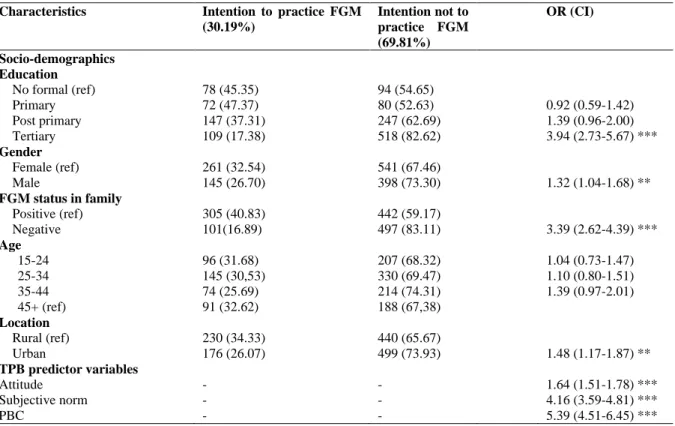
Table 2: Independent Bivariate Logistic Regression of Association Between Socio-demographic Variable, TPB Predictor Variables and Intention not to Circumcise Daughter
Characteristics Intention to practice FGM (30.19%)
Intention not to practice FGM (69.81%)
OR (CI)
Socio-demographics Education
No formal (ref) 78 (45.35) 94 (54.65)
Primary 72 (47.37) 80 (52.63) 0.92 (0.59-1.42)
Post primary 147 (37.31) 247 (62.69) 1.39 (0.96-2.00) Tertiary 109 (17.38) 518 (82.62) 3.94 (2.73-5.67) *** Gender
Female (ref) 261 (32.54) 541 (67.46)
Male 145 (26.70) 398 (73.30) 1.32 (1.04-1.68) **
FGM status in family
Positive (ref) 305 (40.83) 442 (59.17)
Negative 101(16.89) 497 (83.11) 3.39 (2.62-4.39) *** Age
15-24 96 (31.68) 207 (68.32) 1.04 (0.73-1.47)
25-34 145 (30,53) 330 (69.47) 1.10 (0.80-1.51)
35-44 74 (25.69) 214 (74.31) 1.39 (0.97-2.01)
45+ (ref) 91 (32.62) 188 (67,38)
Location
Rural (ref) 230 (34.33) 440 (65.67)
Urban 176 (26.07) 499 (73.93) 1.48 (1.17-1.87) ** TPB predictor variables
Attitude - - 1.64 (1.51-1.78) ***
Subjective norm - - 4.16 (3.59-4.81) ***
PBC - - 5.39 (4.51-6.45) ***
***p ≤ 0.001, **p ≤ 0.05, ref = reference category, OR = odd-ration, CI = confidence interval, PBC = Perceived Behavioral Control
1.04-1.68). Parents with no history of FGM in their families were 3.39 times likely not to intend to perform FGM on daughters than those with FGM history in family (OR = 3.39; CI = 2.62-4.39). Parents who lived in the urban areas were 1.48 times more likely not to have intention to perform FGM on daughter compared to parents in the rural areas. Perceived behavioral control showed a higher association with intention than the other TPB variables (OR = 5.39; CI = 4.59-6.45; p < 0.001), though all the TPB variables had significant association with intention.
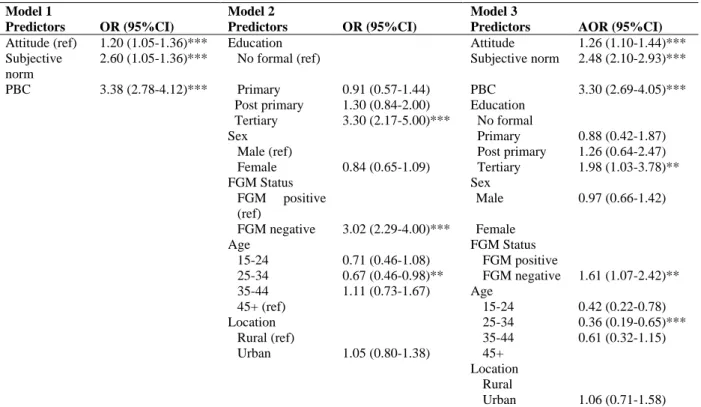
A stepwise logistic regression model was used to test the factors associated with intention not to circumcise daughter. Model 1 looked at the association between the predictors of TPB and intent. Model 2 investigated the association between the socio-demographic variables (parent‘s education, gender, FGM status of girl members of household, age and location of residence) with intention. Model 3 investigated the association
Table 3: Results of Logistic Regression Models of Association between the TPB Predictors and Socio-demographic Variables on Intention not to Circumcise Daughters
Model 1 Model 2 Model 3
Predictors OR (95%CI) Predictors OR (95%CI) Predictors AOR (95%CI) Attitude (ref) 1.20 (1.05-1.36)*** Education Attitude 1.26 (1.10-1.44)*** Subjective
norm
2.60 (1.05-1.36)*** No formal (ref) Subjective norm 2.48 (2.10-2.93)***
PBC 3.38 (2.78-4.12)*** Primary 0.91 (0.57-1.44) PBC 3.30 (2.69-4.05)*** Post primary 1.30 (0.84-2.00) Education
Tertiary 3.30 (2.17-5.00)*** No formal
Sex Primary 0.88 (0.42-1.87)
Male (ref) Post primary 1.26 (0.64-2.47) Female 0.84 (0.65-1.09) Tertiary 1.98 (1.03-3.78)**
FGM Status Sex
FGM positive (ref)
Male 0.97 (0.66-1.42)
FGM negative 3.02 (2.29-4.00)*** Female
Age FGM Status
15-24 0.71 (0.46-1.08) FGM positive
25-34 0.67 (0.46-0.98)** FGM negative 1.61 (1.07-2.42)** 35-44 1.11 (0.73-1.67) Age
45+ (ref) 15-24 0.42 (0.22-0.78)
Location 25-34 0.36 (0.19-0.65)***
Rural (ref) 35-44 0.61 (0.32-1.15)
Urban 1.05 (0.80-1.38) 45+ Location
Rural
Urban 1.06 (0.71-1.58)
Homer-Lemeshow goodness-of-fit test was significant for model 1 at p > 0.05.
associated with intention not to perform FGM on daughters, and that having a post-secondary education, not having FGM history in a family and being aged 25-34 are the socio-demographic variables that were strongly association with intention not to practice FGM on daughters (.p ≤ 0.05). The Homer-Lemeshow goodness-of-fit statistics indicated logistic regressions model 1 was significant at p > 0.05 while models 2 and 3 were not significant.
Discussion
The present study utilized TPB in exploring the factors associated with intention of parents in Enugu State, Nigeria not to practice FGM on their daughters. The findings of the study indicate strong support for specific aspects of TPB in predicting intention not to perform FGM among the study population. Most parents (69.81%) in Enugu State, Nigeria had a positive intention not to practice FGM on their daughters, a finding that supports the
This might be indicative of the fact that there is need to equip parents with correct information on FGM practice and its consequences with aim of improving their attitude towards FGM positively through intervention activities. These findings have implication for FGM intervention programmes. While the study demonstrated that parents in Enugu State Nigeria possess high PBC and subjective norms there is still a need to target and reinforce the beliefs that significant others expect them not to perform FGM on their daughters and work on their control beliefs over not performing FGM on their daughters to ensure that these attitudinal dispositions are translated to actual behavior.
The Homer-Lemeshow goodness-of-fit test indicated that the logistic regression model comparing TPB predictor variables and intention was significant (p > 0.05) but not significant for model comparing intention and the socio-demographic variables and combined model. This finding indicates that TPB is a good theoretical foundation for understanding and explaining intentions towards FGM practice and therefore, can
be adopted for the design of FGM
intention/behavior studies and interventions. Socio-demographic variables such as education, gender, FGM status in family, and location also significantly predicted intention not to practice FGM. Also, having a post-secondary education and not having a history of FGM in a family strongly predicted intention not to practice FGM, having a post-secondary education for parents was a very strong predictor of intention not to practice FGM. This finding is consistent with studies which investigated the association between education and FGM 17-19. In addition, it was contended that education appeared to be strong predictor of whether a woman would want FGM either performed on her daughter or not20. A research also found that the factors responsible for decline in prevalence of FGM practice in Nigeria are the rising rate of education among women in Igbo society21. The inference that could be drawn from the findings is that proper education will be a factor in eliminating FGM practice and its consequences.
The significant association between not having a history of FGM among females in family
and intention is supported by the findings of other studies that one of the most significant predictor of whether a daughter will be circumcised or not is the FGM status of the mother or other girl members of the family22-24. One implication of this finding is for intervention programmes to pay special attention to families with history of FGM practice through educating families on dangers of its practice. The finding also presents a support for the clamor for including past behavior as an approach to the improvement of the predictive ability of TPB23.
The finding that being male more than being female significantly predicted intention not to perform FGM on daughter is surprising because women are primarily affected by the consequences of FGM and therefore, are expected to resist the practice more. There are conflicting findings across studies that women are more intentional on not circumcising daughters than men25, 26. UNICEF reported studies in some parts of Guinea, Sierra Leone and Chad whose results are consistent with the findings of this study indicating that more men than women want FGM to end27. This implies therefore, that men should be targeted in intervention programmes as change agents since there is the propensity among women in Africa to rely on husbands in decision making process.
The present study reported that age significantly predicted intention not to practice FGM. This finding corroborates the findings of other studies which indicated that older mothers exhibited greater intention to circumcise their daughters than younger ones17,28. The study also indicates living in an urban area is a significant predictor of intention not to perform FGM on daughter, a finding that is in line with other studies17,18,22,29. This has obvious implications for intervention programming especially in deciding which segment of society to target in FGM eradication programmes.
Limitations of the Study
social-desirability and self-report bias which has been identified in some other studies. Furthermore, further studies might explore the use of longitudinal design to establish causality and explore the full ambit of the TPB. Another limitation of the study is that the direct measures of the TPB constructs were used for the study leaving out the indirect measures. Though this is acceptable7, it limits the ability of the study to understand the underlining beliefs that drive the associations identified in the study. For the development of intervention, it will be more informative to identify for instance the behavioral beliefs that drive attitude towards not performing FGM on daughters and understand what intervention programmes will target for change.
Ethical Considerations
Steps were taken to protect the confidentiality of the study participants. The purpose of the study and the procedures were explained to the participants and they were assured that their responses would be treated with utmost confidentiality. They were also made to understand clearly that their participation in the study was completely voluntary and that they were under no obligation to participate, complete or attend to all the question items. The participants who gave verbal consent were included in the study.
Conclusion
In recognition of the health consequences of FGM on women and the seeming failure of intervention programs to eliminate the practice in Enugu State Nigeria, this study found that all the predictor variables of TPB significantly predicted parents‘ intention not to perform FGM on their daughters and this is in line with the TPB theory. The socio-demographic variables, specifically post-secondary education and absence of FGM history in family, significantly predicted intention not to perform FGM on daughters. The study found that TPB will be a good theoretical basis for FGM intention/behavior studies and interventions in FGM eradication programmes.
Acknowledgements
The authors are grateful to the education experts who validated the instrument used for data collection, those who offered advice during the process of compiling the manuscript and the researchers whose works are cited in this article.
Conflicts of Interest
No conflict of interest.
Funding
No funds were received for this study.
References
1. Deutsche, Gesellschaft Fur Techische Zusammenarbeit. Addressing female genital mutilation: Challenges and prospective of health programmes Path 1: Selected approaches. Echborn: GTZ; 2003.
2. World Health Organization. Female genital mutilation: A Joint WHO/UNICEF/UNFPA statement. Geneva: World Health Organization; 1997.
3. World Health Organization. Female genital mutilation; 2016. Retrieved June 26, 2016, from http://www.who.int/reproductivehealth/topics/fgm/p revalence/en/
4. United Nations Children‘s Fund. Female genital mutilation/cutting: A global Concern. New York: UNICEF; 2016. Retrieved February 7, 2016, from http://www.unicef.org/media/files/FGMC_2016_bro chure_final_UNICEF_SPREAD.pdf
5. National Population Commission (NPC) [Nigeria] and ICF International. Nigeria Demographic and Health Survey 2013. Abuja, Nigeria, and Rockville, Maryland, USA: NPC and ICF International; 2014. 6. Shell-Duncan B, Hernlund Y, Wander K and Moreau A.
Contingency and change in the practice of female genital cutting: dynamics of decision making in Senegambia. Summary Report; 2010. http://csde.washington.edu/bsd
7. Ajzen I. The theory of planned behavior. Organization Behavior and Human Decision Processes. 1991; 50: 179-211.
8. Francis JJ, Eccles MP, Johnston M, Grimshaw J, Foy R, Kaner EFS and Bonnetti D. Constructing questionnaire based on the theory of planned behavior: A manual for researchers. Newcastle UK: Centre for Health Service Research; 2004.
unix.oit.umass.edu%7Eaizen/
10. Armitage C and Conner M. Efficacy of the theory of planned behavior: A meta-analytic review. British J Soci Psy. 2001; 40: 471-497.
11. Liefbroer AC. The impact of perceived cost and rewards of childbearing on entry into parenthood: evidence from a panel study. European J Popul. 2005; 21: 267-291.
12. Wammes B, Kremers S, Breedveld B and Brug J. Correlates of motivation to prevent weight gain: a cross sectional survey. BMC International J Behavioral Nutr Phy Activity. 2005; 2: 1. doi:10.1186/1479-5868-2-1
13. Roncancio A, Ward K, Sanchez B, Cano M, Byrd T, Vermon S, Fernandez-Esquer M and Fernandez M. Health Edu Behavior. 2015; 42(5): 621-6, doi: 10.1177/1090198115571364
14. Jones GI. Ecology and social structures among north eastern Igbos. J International Afr Instit. 1988; 6(2): 9-25.
15. National Bureau of Statistics. Annual abstract of Statistics 2012. Abuja: Federal Republic of Nigeria; 2012.
16. Ogbazi JN and Okpala J. Writing research report: Guide for researchers in education the social sciences and humanities. Enugu: Press Time Ltd; 1994.
17. Pashaei T, Ponnet K, Moeeni M, Khazaeepool M and Majlessi F. Daughters at risk of female genital mutilation: examining the determinants of mothers‘ intentions to allow their daughters to undergo female genital mutilation. PLoS ONE. 2016; 11(3): E0151630.doi:10.1371/journal.pone.0151630 18. Tamire M and Molla M. Prevalence and belief in the
continuation of female genital cutting among high school girls: a cross-sectional study in Hadiya zone, Southern Ethiopia. BMC Public Health. 2013; 13: 1120.doi: 10.1186/1471-2458-13-1120.
19. Obi SN. Female genital cutting in south-east Nigeria. International J Gynaecol Obstetr. 2004; 84(2): 183-4.
20. Mandara M. Female genital mutilation in Nigeria.
International Journal of Gynaecol Obstetr. 2004; 84(3): 291-8.
21. Nkwo PO and Onah HE. Decrease in female genital mutilation among Nigerian Ibo girls. International J Gynaecol Obstetr. 2001; 75: 21-32.
22. Yoder PS and Henry R. Female genital cutting a coming of age in Guinea. Calverton, MD: Measure DHS+; 2003. Retrieved August 9, 2002, from http:\\www.measuredhs.com/about/qualitativeflyers 2.pdf
23. Population Reference Bureau. Abandoning female genital cutting: Prevalence, attitude and efforts to end the practice. Washington DC: Measures Communication; 2001.
24. Foster C. On the trail of a taboo: Female circumcision in the Islamic world. Contemp Rev. 1992; 35(6): 244– 9.
25. Brigg LA. Male and female viewpoint on female circumcision in Ekpeye, River Nigeria. Afr J of Reprod Health. 2000; 6(30): 44-52.
26. Babalola S and Amouzuo J. Baseline survey of
knowledge, attitudes and practice about FGC in Eastern Nigeria: Report of findings. Baltimore, USA: Johns Hopkins Centre for Communication Program; 2003.
27. United Nations Children‘s Fund. Female genital mutilation/cutting: a statistical overview and exploration of the dynamics of change; 2013. Retrieved June 16, 2016, from http://www.unicef.org/publications/index_69875.ht ml
28. Msuya SE, Mbizvo E, Hussain A, Sundby J, Sam NE and Stray-Pedersen D. Female genital cutting in Kilimanjaro, Tanzania: Changing attitude. Trop Med International Health. 2002; 7(2): 159-165.