ORIGINAL RESEARCH ARTICLE
Trends and Determinants of Comprehensive Knowledge of HIV
among Adolescents and Young Adults in Nigeria: 2003 - 2013
Ayodeji B. Oginni
1*, Sylvia B. Adebajo
1, Babatunde A. Ahonsi
2Population Council, Nigeria1, United Nations Population Fund, Beijing, China2
*For Correspondence: Email: [email protected]; Phone: +234 909 320 8837
Abstract
This study examined comprehensive knowledge of HIV (CKH) and its determinants among young people aged 15-24 years in Nigeria between 2003 and 2013. Secondary analysis was conducted on three rounds of NDHS 2003, 2008 and 2013 data. CKH increased significantly between 2003 and 2013, but the level reached in 2013 fell short of the global expectation for young people. Its significant determinants included gender, age, educational attainment, place and region of residence, household wealth status and uptake of HIV test. There is need to sustain all on-going effective youth-focused interventions and programmes to meet the comprehensive knowledge needs for all young people in Nigeria. (Afr J Reprod Health 2017; 21[2]: 26-34).
Keywords: Young people, HIV and AIDS, Comprehensive knowledge, Nigeria, Determinants
Résumé
Cette étude a examiné la connaissance approfondie du VIH (CCV) et ses déterminants chez les jeunes gens âgés de 15 à 24 ans au Nigeria entre 2003 et 2013. Une analyse secondaire a été menée sur trois séries de données de NDHS 2003, 2008 et 2013. La CCV a augmenté de manière significative entre 2003 et 2013, mais le niveau atteint en 2013 était inférieur aux attentes mondiales pour les jeunes. Ses déterminants importants comprennent le genre, l'âge, le niveau de scolarité, le lieu et la région de résidence, l'état de la richesse des ménages et l'adoption de l‘analyse pour le dépistage du VIH. Il est nécessaire de soutenir toutes les interventions et programmes efficaces axés sur les jeunes pour répondre aux besoins globaux en connaissances de tous les jeunes du Nigeria. (Afr J Reprod Health 2017; 21[2]: 26-34).
Mots-clés: Jeunes, VIH et SIDA, connaissance compréhensive, Nigeria, déterminants
Introduction
With 3.2% HIV prevalence, 3.4 million persons living with HIV and 170,000 new infections, Nigeria contributes the world‘s second highest number of persons living with HIV and 10% of new HIV infections1-3. Although HIV prevalence is reported to have declined in the general adult (≥25 years) population by 18% between 2007 and 2012, there has been a concomitant increase in prevalence by 25% from 2.4% to 3.0% among youth 15-24 years during the same period4,5. While it is not known what proportion of estimated annual new HIV infections occur among young persons (age 15-24) in Nigeria, there is a postulation that more than half of those newly infected with HIV today are between 15 and 24
6
gaps and refining activities12. This study was undertaken to examine trends and determinants of comprehensive knowledge of HIV among young people aged 15-24 in Nigeria between 2003 and 2013.
Methods
Data sources and study population
The study data were obtained on request from the Demographic and Health Surveys (DHS) Program, ICF International. Three primary datasets of men and women of reproductive ages from the 2003, 2008 and 2013 Nigeria Demographic and Health Surveys (NDHS) conducted in Nigeria were obtained from the DHS Program. The datasets were trimmed down and pooled to contain a study population of young people aged 15-24 years.
Study variables
The dependent variable, comprehensive knowledge of HIV was measured as a composite score of the following elements - accepting common ways of preventing HIV (being faithful, correctly and consistently using condom and agreeing that a healthy-looking person can be infected with HIV) and rejecting two most common local misconceptions of HIV transmission (HIV can be transmitted by mosquito bites and HIV can be transmitted by supernatural means). A binary outcome of "1" was designated if all questions were answered correctly and "0" if any of the questions was answered incorrectly13-15.
The independent variables of interest were selected based on literature12,16-24 and availability in the dataset; the variables were: survey year, age, gender, education, marital status, place of residence, region of residence, household wealth index,1 and previous uptake of HIV test.
Statistical analysis
To ensure representativeness of our study results, we applied sampling weights to the analyses to adjust for non-response and differences in probability of selection. Meta-analysis was
conducted to pool the three survey years‘ crude relative risk ratio estimates (CRR, 95%CI) of association between the dependent and the independent variables. Using Log-binomial regression analysis, a generalized linear regression model was obtained with adjusted relative risk ratio estimates (ARR, 95% CI) for each category of the independent variables in the model relative to its reference category. The analyses were conducted with Stata /SE 11.0 for Windows.
Results
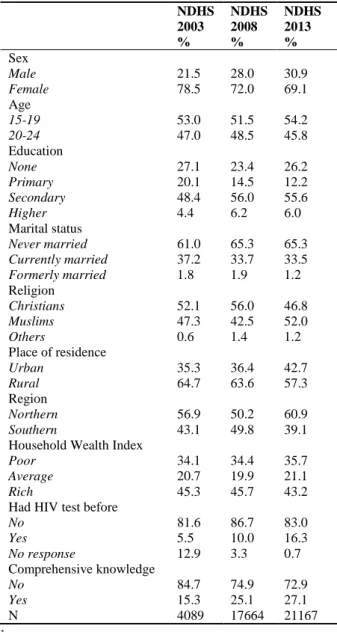
Females predominated (>69.0%) in each survey period and slightly more than half of all respondents were 15-19 years (Table 1). Over 70% of the respondents had formal education, with more than half (<52.0%) having at least secondary education and many (>61.0%) were single. More than half of the respondents resided in rural areas and about one-third resided in poor households. Although proportion of respondents who reported ever testing for HIV was very low across the study periods, there was an increase from 6% to 10% and 16% in 2003, 2008 and 2013 respectively. Proportion of respondents with comprehensive knowledge of HIV increased from 15.3% in 2003 to 25.1% and 27.1% in 2008 and 2013 respectively. (Table 1)
Table 1: Characteristics of Study Populations
NDHS 2003
NDHS 2008
NDHS 2013
% % %
Sex
Male 21.5 28.0 30.9
Female 78.5 72.0 69.1
Age
15-19 53.0 51.5 54.2
20-24 47.0 48.5 45.8
Education
None 27.1 23.4 26.2
Primary 20.1 14.5 12.2
Secondary 48.4 56.0 55.6
Higher 4.4 6.2 6.0
Marital status
Never married 61.0 65.3 65.3
Currently married 37.2 33.7 33.5
Formerly married 1.8 1.9 1.2
Religion
Christians 52.1 56.0 46.8
Muslims 47.3 42.5 52.0
Others 0.6 1.4 1.2
Place of residence
Urban 35.3 36.4 42.7
Rural 64.7 63.6 57.3
Region
Northern 56.9 50.2 60.9
Southern 43.1 49.8 39.1
Household Wealth Index
Poor 34.1 34.4 35.7
Average 20.7 19.9 21.1
Rich 45.3 45.7 43.2
Had HIV test before
No 81.6 86.7 83.0
Yes 5.5 10.0 16.3
No response 12.9 3.3 0.7
Comprehensive knowledge
No 84.7 74.9 72.9
Yes 15.3 25.1 27.1
N 4089 17664 21167
1
The DHS wealth index indicates inequalities in household characteristics, in the use of health and other services, and in health outcomes. It serves as an indicator of wealth that is consistent with expenditure and income measures. The index was constructed using household asset data via a principal components analysis.
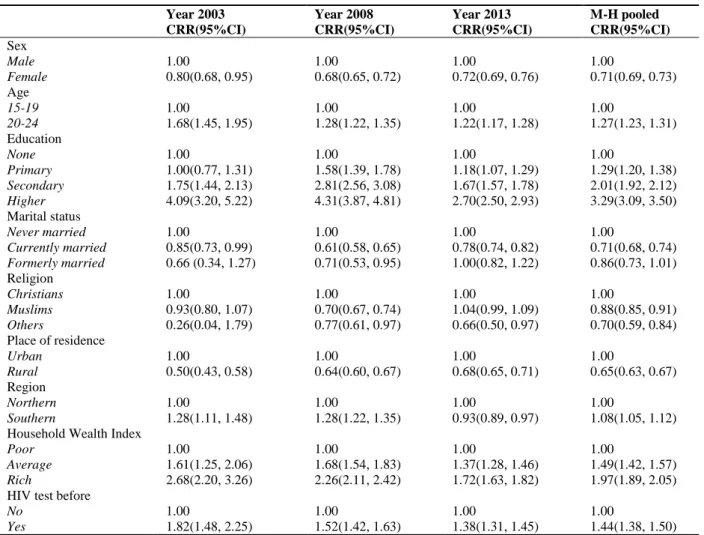
and previous reports of uptake of HIV test. (Table 2)
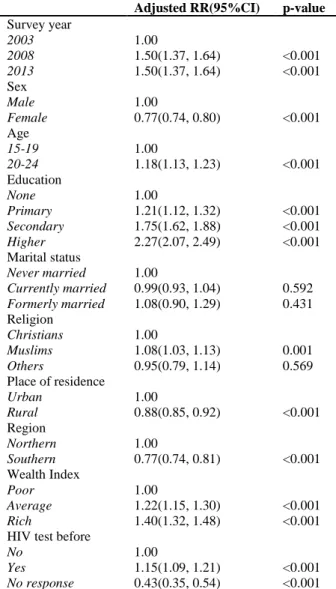
Table 3 presents the results of the multivariate analysis of the pooled data. The multivariate model controlled for the confounding effects of each variable and presented adjusted relative risk ratio estimates. The results indicate that
comprehensive knowledge of HIV among young people in 2013 increased 1.5 times the level in 2003. Whilst female adolescents and young adults, those residing in rural areas, and those located in Southern Nigeria were less likely to have comprehensive knowledge of HIV; it increased significantly with age, formal education, household wealth and previous uptake of HIV test. (Table 3)
Discussion
In sub-Sahara Africa, comprehensive knowledge of HIV remains low10,25, A review of Demographic and Health Surveys (DHS) from countries across West Africa from 2003–2008 estimated that less than 50% of the population between the ages of 15 and 49 had adequate correct knowledge about HIV/AIDS10,25. This is also evident from the findings of this study. Comprehensive knowledge of HIV among young people in Nigeria increased between 2003 and 2013, but the increase fell short of the universal target of 95% by 2010 for HIV knowledge among young people9,11,26. A previous study conducted among young people aged 10-24 years in two states in Nigeria, showed that despite the high level of awareness about HIV, knowledge of transmission and basic HIV prevention facts was low23. In contrast, Liberia achieved a level above 50% among young men and women aged 15–24 in the same period9. Also in Kenya, a higher increase in comprehensive knowledge of HIV from 22% in 2003 to 54% in 2008/09 was recorded among urban female youth16. However, it is believed that opportunities to improve HIV prevention knowledge and behavior still exist in Nigeria as evident in the increased knowledge about HIV reported among young persons9.
Table 2: Meta-analysis of Determinants of Comprehensive Knowledge of HIV among Young People in Nigeria (2003-2013)
Year 2003 Year 2008 Year 2013 M-H pooled
CRR(95%CI) CRR(95%CI) CRR(95%CI) CRR(95%CI)
Sex
Male 1.00 1.00 1.00 1.00
Female 0.80(0.68, 0.95) 0.68(0.65, 0.72) 0.72(0.69, 0.76) 0.71(0.69, 0.73)
Age
15-19 1.00 1.00 1.00 1.00
20-24 1.68(1.45, 1.95) 1.28(1.22, 1.35) 1.22(1.17, 1.28) 1.27(1.23, 1.31)
Education
None 1.00 1.00 1.00 1.00
Primary 1.00(0.77, 1.31) 1.58(1.39, 1.78) 1.18(1.07, 1.29) 1.29(1.20, 1.38)
Secondary 1.75(1.44, 2.13) 2.81(2.56, 3.08) 1.67(1.57, 1.78) 2.01(1.92, 2.12)
Higher 4.09(3.20, 5.22) 4.31(3.87, 4.81) 2.70(2.50, 2.93) 3.29(3.09, 3.50)
Marital status
Never married 1.00 1.00 1.00 1.00
Currently married 0.85(0.73, 0.99) 0.61(0.58, 0.65) 0.78(0.74, 0.82) 0.71(0.68, 0.74)
Formerly married 0.66 (0.34, 1.27) 0.71(0.53, 0.95) 1.00(0.82, 1.22) 0.86(0.73, 1.01) Religion
Christians 1.00 1.00 1.00 1.00
Muslims 0.93(0.80, 1.07) 0.70(0.67, 0.74) 1.04(0.99, 1.09) 0.88(0.85, 0.91)
Others 0.26(0.04, 1.79) 0.77(0.61, 0.97) 0.66(0.50, 0.97) 0.70(0.59, 0.84)
Place of residence
Urban 1.00 1.00 1.00 1.00
Rural 0.50(0.43, 0.58) 0.64(0.60, 0.67) 0.68(0.65, 0.71) 0.65(0.63, 0.67)
Region
Northern 1.00 1.00 1.00 1.00
Southern 1.28(1.11, 1.48) 1.28(1.22, 1.35) 0.93(0.89, 0.97) 1.08(1.05, 1.12)
Household Wealth Index
Poor 1.00 1.00 1.00 1.00
Average 1.61(1.25, 2.06) 1.68(1.54, 1.83) 1.37(1.28, 1.46) 1.49(1.42, 1.57)
Rich 2.68(2.20, 3.26) 2.26(2.11, 2.42) 1.72(1.63, 1.82) 1.97(1.89, 2.05)
HIV test before
No 1.00 1.00 1.00 1.00
Yes 1.82(1.48, 2.25) 1.52(1.42, 1.63) 1.38(1.31, 1.45) 1.44(1.38, 1.50)
CRR= Crude RR
another study among rural youth in India, no significant difference in knowledge between males and females was reported18.
The gender differential in comprehensive knowledge of HIV may have implications for HIV prevention interventions in Nigeria given the higher prevalence of HIV among young women than their counterpart men3. Ochako et al therefore recommended that while targeting both young women and men with education on HIV prevention, additional concerted efforts should also be directed at young women16. The reasons for the gender disparity in comprehensive knowledge of HIV in Nigeria need to be further investigated through qualitative inquiries.
Table 3: Log-binomial Regression Model of Comprehensive Knowledge of HIV among Young People in Nigeria (2003-2013)
Adjusted RR(95%CI) p-value
Survey year
2003 1.00
2008 1.50(1.37, 1.64) <0.001
2013 1.50(1.37, 1.64) <0.001
Sex
Male 1.00
Female 0.77(0.74, 0.80) <0.001
Age
15-19 1.00
20-24 1.18(1.13, 1.23) <0.001
Education
None 1.00
Primary 1.21(1.12, 1.32) <0.001
Secondary 1.75(1.62, 1.88) <0.001
Higher 2.27(2.07, 2.49) <0.001
Marital status
Never married 1.00
Currently married 0.99(0.93, 1.04) 0.592
Formerly married 1.08(0.90, 1.29) 0.431 Religion
Christians 1.00
Muslims 1.08(1.03, 1.13) 0.001
Others 0.95(0.79, 1.14) 0.569
Place of residence
Urban 1.00
Rural 0.88(0.85, 0.92) <0.001
Region
Northern 1.00
Southern 0.77(0.74, 0.81) <0.001
Wealth Index
Poor 1.00
Average 1.22(1.15, 1.30) <0.001
Rich 1.40(1.32, 1.48) <0.001
HIV test before
No 1.00
Yes 1.15(1.09, 1.21) <0.001
No response 0.43(0.35, 0.54) <0.001
low-income African American adolescents41 could also be the underlying factors responsible for the insufficiency in comprehensive knowledge of HIV among adolescents in Nigeria. Lack of accurate knowledge about HIV/AIDS among youth has also been linked with a dearth of comprehensive sexuality and HIV education coupled with likely inaccuracies in abstinence-only curricula used by some school systems42.
As in other studies12,16,18,20,23,24,27,43, education is a major driver of comprehensive knowledge of HIV in this study. Thus, comprehensive knowledge of HIV among young
attainment. To this effect, several adolescents and youth-focused HIV prevention interventions in school settings have been established since around 2000. One of such interventions is the National Youth Service Corps (NYSC) Peer Education Training Scheme (PETS), where volunteer corps members are trained as peer educators and trainers and deployed as teachers to various schools throughout Nigeria to increase the knowledge of their peers on HIV and motivate them to adopt preventive behavior44 and also spread the information in their community45. Another major
youth focused school-based HIV/AIDS
intervention proven to be effective among adolescents with hearing impairment in some states in Nigeria46, is the Family Life and HIV/AIDS Education (FLHE) curriculum introduced in 2003 as the main Education Sector Response to HIV/AIDS in Nigeria47. Unfortunately, these interventions by their design are targeted at only young people in secondary and tertiary institutions of learning leaving a teeming population of out-of-school adolescents and youth without HIV prevention interventions. . The 2008 NDHS showed that about 27% of youth (aged 15-24) in Nigeria had no education14 which is too huge a population to ignore in the national HIV response to improve their comprehensive knowledge of HIV, stimulate behavioral change and reduce new HIV infections.
In consonance with previous studies18-20, 27,33
, the current study has shown that rural youth in Nigeria could be more vulnerable than urban youth because of their consistently lower level of comprehensive knowledge of HIV for over a decade (2003-2013). A probable reason for the deficit in comprehensive knowledge of HIV among youth residing in rural areas could be limited access to HIV prevention information. Findings from some studies23,24 have shown that much of the large rural-urban differences in mean knowledge is due to differences in schooling/education, exposure to mass media and wealth. Thus, education plays a significant role in determining adolescents and youth‘s socio-economic status and in influencing comprehensive knowledge of HIV.
comprehensive knowledge of HIV among young people in Nigeria. For instance, among unmarried youth in Cameroon, living in poor households and disadvantaged neighborhoods significantly increased inaccurate knowledge of HIV transmission modes and prevention strategies35; while in eastern Ethiopia, comprehensive knowledge of HIV and AIDS was better among in-school adolescents from families with a relatively middle or high wealth index48. In this study, youth from average and rich households respectively had
more comprehensive knowledge of HIV
significantly more than youth from poor households.
The regional differential in comprehensive knowledge of HIV observed among young people in this study is noteworthy. However, deducing the probable reasons for the regional disparity is beyond the scope of this present study. Further research will be required to gain insight into regional differential in comprehensive knowledge among youth in Nigeria.
Uptake of HIV test16 is also a significant determinant of comprehensive knowledge of HIV among young people in Nigeria. HIV testing is likely to increase comprehensive knowledge of HIV because of the pre- and post-test HIV counseling which is an integral part of HIV testing in Nigeria49-51. Although a similar study conducted among young urban women in Kenya16 showed that knowing someone who has HIV or died of AIDS was predictive of having comprehensive knowledge of HIV, in this study, knowing someone who has HIV or has died of AIDS was marginally correlated with comprehensive knowledge of HIV among those aged 15-24. This could be attributed to the high level of awareness of HIV/AIDS in the country resulting from mass media campaigns during that period.
A major strength of this study is the use of three cycles of large national datasets spanning a decade to assess the trend and determinants of comprehensive knowledge of HIV among young people. Nonetheless, this study is not without some limitations. It was based on further analysis of data collected in three cross-sectional surveys. By design, cross-sectional surveys are weak in establishing temporal relationships between the exposure and the outcome. Although this study
presents important information on the knowledge of HIV among Nigerian youth over ten years, with implications for programming to reduce the prevalence and incidence of the disease in the country, the datasets are four years behind time limiting its generalizability to the current situation in 2017. It is plausible that the increase in comprehensive knowledge of HIV observed in this study would be sustained through 2017 for adolescents and youth in schools and not necessarily for out-of-school youth. The findings of this study reveal that the national HIV response falls short of the needs and expectations of young people in the areas of HIV education and appropriate access to youth friendly services especially for the most vulnerable groups of youth. Besides the Family Life HIV and AIDS Education program and the National Youth Service Corps (NYSC) Peer Education Training Scheme (PETS) both designed to improve the knowledge of in-school adolescents and youth, programs covering out-of-school youth are few, and small in scale.
The recently launched National HIV Strategy for Adolescent and Young people (2016-2020) by the National Agency for the control of AIDS (NACA) to reduce new HIV infections among adolescents and young people in Nigeria targeting in-school youth, out-of-school youth, and key populations at higher risk is a welcome development. In addition, there should be improved resourcing (funding, personnel, infrastructure & supplies) of programs and services especially targeted at female adolescents and youth, the rural and poor urban youth, out-of-school youth, and young key populations who are systematically left out of national HIV prevention programs.
Conclusion
short of the global expectation for young people. Determinants of comprehensive knowledge include gender, age, and place of residence, education, household wealth index, and uptake of HIV test. Specifically, female adolescents and young adults, those aged 15-19 years, those with no formal education, those from poor households, those residing in rural areas or in the southern regions of Nigeria, and those who had never had HIV test before had lower comprehensive knowledge of HIV.
Our findings therefore suggest the need to intensify efforts in ensuring that all on-going and future youth-focused interventions in the country meet the knowledge (sexual health and HIV/AIDS) needs of these sub-populations of young people in Nigeria. However, there are still several policy issues hampering the national response to young people‘s sexual and reproductive health in Nigeria, which must be addressed to create an enabling environment that would allow SRH programming for young people to thrive.
Competing Interests
The authors declare that they have no competing interests.
Authors’ Contributions
AB, BA and SB conceived the study; AB obtained the dataset from the DHS Program, conducted data analysis and participated in writing the manuscripts; SB reviewed and contributed to the manuscripts; BA reviewed and contributed to the manuscripts. All authors read and approved the final manuscript.
Acknowledgement
We acknowledge Dr. George Eluwa for his contribution to conception and design of this study. We also acknowledge the support of the DHS Program and ICF International for the release of the NDHS dataset used for this study.
References
Epidemic update and health sector progress towards Universal Access. Progress Report, 2011.
3. UNAIDS. The Gap Report: Begining of the End of the AIDS Epidemic, 2014.
4. Federal Ministry of Health [Nigeria]. 2007 National HIV & AIDS and Reproductive Health Survey Plus: Federal Ministry of Health National AIDS/STI Control Programme, 2008.
5. Federal Ministry of Health [Nigeria]. National HIV & AIDS and Reproductive Health Survey, 2012 (NARHS Plus): Federal Ministry of Health Abuja, Nigeria, 2013.
6. United Nations Children‘s Fund, Joint United Nations Programme on HIV/AIDS, World Health Organization. Young People and HIV/AIDS: Opportunity in Crisis, 2002.
7. UNAIDS/09.10E / JC1676E. Monitoring the Declaration of Commitment on HIV/AIDS : guidelines on construction of core indicators : 2010 reporting., 2010.
8. United Nations Children‘s Fund (UNICEF). Opportunity in Crisis: Preventing HIV from early adolescence to young adulthood, 2011
9. UNAIDS. UNAIDS Report on the global AIDS Epidemic Global Report, 2010
10. USAID. HIV/AIDS Health Profile Sub-Saharan Africa, 2011.
11. Global Interagency Task Team on HIV and young people. Securing The Future Today. Synthesis of Strategic Information on HIV and Young People. Geneva: UNAIDS, 2011:1-80.
12. Cicciò l and Sera D. Assessing the knowledge and behavior towards HIV/AIDS among youth in northern uganda: a cross-sectional survey. Giornale Italiano Di Medicina Tropicale 2010;15(1-4):29-34. 13. National Population Commission (NPC) [Nigeria] and ICF
International. Nigeria Demographic and Health Survey 2013. Abuja, Nigeria and Rockville, Maryland, USA: NPC and ICF International., 2014. 14. National Population Commission (NPC) [Nigeria] and ICF
Macro. Nigeria Demographic and Health Survey 2008. Abuja, Nigeria: National Population Commission and ICF Macro, 2009.
15. National Population Commission (NPC) [Nigeria] and ORC Macro. Nigeria Demographic and Health Survey 2003. Calverton, Maryland: National Population Commission and ORC Macro, 2004. 16. Ochako R, Ulwodi D, Njagi P, Kimetu S and Onyango A.
Trends and deteriminants of Comprehensive HIV and AIDS knowledge among urban young women in Kenya. AIDS Research and Therapy 2011;8(11). 17. Fako T, Kangara L and Forcheh N. Predictors of
knowledge about HIV/AIDS among young people: Lesson from Botswana. Journal of AIDS and HIV Research 2010;2(6):116-30.
HIV/AIDS knowledge and the implications for health promotion programs among Chinese college students: geographic, gender and age differences. Health Promotion International 2004;19(3).
20. Siziya S, Muula A and Rudatsikira E. HIV and AIDS- related knowledge among women in Iraq. BMC Research Note 2008;1(123).
21. Omeonu P and Kollie E. Knowledge and attitude of Babcock University students on risk behaviours of HIV/AIDS. Journal of Life & Physical Sciences, acta SATECH 2010;3(2):135-42.
22. Lammers J, van Wijnbergen S and Willebrands D. Gender Differences, HIV Risk Perception and Condom Use, 2011.
23. Rahnman M. Determinants of knowledge and awareness about AIDS: Urban-rural differentials in Bangladesh. Journal of Public Health and Epidemiology 2009;1(1):014-21.
24. Glick P, Randriamamonjy J and Sahn D. Determinants of HIV Knowledge and Condom Use among Women in Madagascar: An analysis Uisng Matched Household and community Data, 2008.
25. Mishra V, Agrawal P, Alva S, Gu Y and Wang S. Changes in HIV-Related Knowledge and Behaviors in Sub-Saharan Africa. No. 24. Calverton, Maryland, USA: ICF Macro, 2009.
26. Statement to the Forty-fifth session of the Commission on Population and Development Special Theme: Adolescents and Youth. New York, 2012.
27. Knowledge of HIV/AIDS and Unsafe sex practices among Filipino youth.; 2004; Boston, Massachusetts. 28. Shweta C, Mundkur S and Chaitanya V. Knowledge and
Beliefs about HIV/AIDS among Adolescents.
WebmedCentral PAEDIATRICS
2011;2(12:WMC002830).
29. Asekun-Olarinmoye E, Olajide F and Asekun-Olarinmoye I. HIV/AIDS Preventive Measures among In-school Adolescents in a Sub-Urban Community in Southwestern Nigeria. actaSATECH 2011;4(1):81-96.
30. Singh A and Jain S. Awareness of HIV/AIDS Among School Adolescents in Banaskantha District of Gujarat Health and Population: Perspectives and Issues 2009;32(2):59.65.
31. Diala C, Olujimi S, Harris F and Feyisetan K. HIV-Related Knowledge, Attitudes, Behaviors, and Practices of Young People in Cross River State and Kogi State, Nigeria. Washington DC: C-Change, 2011.
32. Rahman MM, Kabir M and Shahidullah M. Adolescent Knowledge and Awareness about AIDS/HIV and Factors affecting them in Bangladesh. J Ayub Med Coll Abbottabad 2009;21(3).
33. Peltzer K and Promtussananon S. HIV/AIDS Knowledge and Sexual Behavior Among Junior Secondary School Students in South Africa. Journal of Social Sciences 2005;1(1):1-8.
34. Sawhney S and Koul S. AIDS – Knowledge and
Information needs of Adolescent Girls (16-18 yrs) of Jammu. International Journal of Scientific and Research Publications 2011;2(10).
35. Dimbuene Z and Defo B. Fostering accurate HIV/AIDS knowledge among unmarried youths in Cameroon: Do family environment and peers matter? BMC Public Health 2011;11:348.
36. Speizer I, Magnani R and Colvin C. The effectiveness of adolescent reproductive health interventions in developing countries: A review of the evidence. Journal of Adolescent Health 2003;33(5):324-48. 37. Perrino T, González-Soldevilla A, Pantin H and
Szapocznik J. The role of families in adolescent HIV prevention: A review. Clinical Child and Family. Psychology Review 2000;3(2):81-96. 38. Whitaker D and Miller K. Parent-adolescent discussions
about sex and condoms: Impact on peer influences of sexual risk behavior. Journal of Adolescent Research 2000;15(2):251-73.
39. Lefkowitz E, Boone T and Shearer C. Communication with best friends about sex-related topics during emerging adulthood. Journal of Youth and Adolescence 2004;33(4):339-51.
40.Campbell C and MacPhail C. Peer education, gender and the development of critical consciousness: Participatory HIV prevention by South African Youth. 2002;55(2):331-45.
41. Swenson RR, Rizzo CJ, Brown LK, Vanable PA, Carey MP, Valois RF, DiClemente RJ and Romer D. HIV Knowledge and its Contribution to Sexual Health Behaviors of Low-Income African American Adolescents. J Natl Med Assoc 2010;102(12):1173– 82.
42. amfAR. Youth and HIV/AIDS in the United States: Challenges and Opportunities for Prevention.
Issue Brief, 2010.
43. Anwar M, Sulaiman SAS, Ahmadi K and Khan TM. Awareness of school students on sexually transmitted infections (STIs) and their sexual behavior: a cross-sectional study conducted inPulau Pinang, Malaysia. BMC Public Health 2010;10(47).
44. UNICEF Nigeria. HIV/AIDS-Action.
45. UNICEF/National Youth Service Corps Peer education training project in Nigera and Challenges.XVI International AIDS Conference 2006.
46. Adeniyi S, Oyewumi M and Fakolade A. An Assessment of the Level of Influence of Family Life and HIV/AIDS Education on HIV/AIDS related Knolwedge, Attitude and Decision making among Adolescents with Hearing impairment in some States in Nigeria. The African Symposium 2010;10(2):60-68.
47. Nigerian Educational Research and Development Council (NERDC). Family Life and HIV Education Curriculum for Junior Secondary Schools: Federal Ministry of Education, igerian Educational Research and Development Council (NERDC), Universal Basic Education (UBE), Action Health Incorporated (AHI), 2003.
of the International AIDS Society 2013;16 (17349).
49. National Agency for Control of AIDS (NACA). Federal Governement of Nigeria National Policy on HIV/AIDS, 2009.
50. South African Government Information. HIV
Couselling and Testing. FAQs-HIV/AIDS, 2011.
51. Fischer S, Reynolds H, Yacobson I, Barnett B and
Schueller J. HIV Counseling and Testing for Youth. A Manual for Providers: USAID and FHI, 2007.
52. NACA National HIV Strategy of Adolescents and Young
People 2016 - 2020.
http://www.ilo.org/wcmsp5/groups/public/---ed_protect/---protrav/---