Improved VSF Algorithm for Smooth
Surface Reconstruction from Sparse
Medical Data
Ahmad Almhdie
1,4, Christophe L´eger
1, Ma¨
ı
tine Bergounioux
2,
Mohamed Deriche
3and Roger L´ed´ee
11LESI, Polytech’Orl´eans, Universit´e d’Orl´eans, Orl´eans, France 2MAPMO, Facult´e des Sciences, Universit´e d’Orl´eans, France
3Electrical Engineering Department, King Fahd University of Petroleum and Minerals, Saudi Arabia 4Electrical and Communication Engineering Department, University of Sebha, Libya
This paper presents a Modified Variational Splines Fitting
(MVSF)algorithm for surface reconstruction using thin plate splines on scattered patches or points of originally smooth surfaces. In particular, a more accurate derivation of the discrete equations for the energy corresponding to the thin plate model is introduced. The results obtained on simulated data show that the proposed algo-rithm converges faster than the original VSF algoalgo-rithm. Additionally, we discuss an approach for choosing the algorithm’s parameters using a cross validation tech-nique. Results obtained with the modified algorithm are compared to those using a Frequency Fourier-based 3D Harmonic modelling(3DHM)algorithm and show that the proposed algorithm gives an improved performance under the small sample size condition. The developed model has been successfully applied for real biomedical data; in particular for the reconstruction of left ventricle of human heart.
Keywords: sparse or scattered data, medical data, surface reconstruction, thin plate model, smooth surface
1. Introduction
Surface reconstruction and smoothing methods are widely used in practice to best estimate the original surface represented by a scattered noisy point set arising in a number of scien-tific and engineering application domains in-cluding medical imaging applications [1]. For instance, the number and the distribution of the initial samples of an organ surface lead to in-complete meshes. Stacks of two-dimensional contours can also be used to reconstruct three-dimensional surfaces [2]. The problem of sur-face reconstruction can be solved using a variety
of techniques. The finite element method is one of these techniques. An example of this method is the use of Voronoi diagram and Delaunay tri-angulation[3]to find the topological connection of the sample points.
Another type of reconstructing smooth surfaces rely on the finite difference methods using de-formable models[4]such as thin plate model[5]. The main idea is to create an initial mesh and deform it to best match the range input data. This is usually expressed as an energy min-imisation problem. There are two forces that formulize the final shape of the reconstructed surface. One attracts the surface towards the input data and the other tries to keep the surface smooth. Fourier-based interpolation methods
compatibility constraint of the thin plate model and the smoothness constraint are also presented in this section. We then introduce our modifi-cation to the original VSF algorithm in order to improve its performance. The resulting algo-rithm is called the Modified Variational Splines Fitting (MVSF) algorithm. At the end of the section, the overall discrete optimization prob-lem is formulated. For comparison reasons, the Fourier-based 3DHM algorithm is described in Subsection 2.2. This algorithm was previously developed by the authors. Simulation results are presented in Section 3 and application re-sults are presented in Section 4. We finally conclude our paper in Section 5 by a summary and some keynotes for future work.
2. Algorithm Description
2.1. Variational Splines Fitting Algorithms
In [7], Szeliski proposed to use a deformable model to estimate the missing points (here we call it VSF). In this algorithm, the problem is formulated as an optimization one. The func-tion to be minimized is written:
E(x) =Ed(x) +λEs(x), (1) where
x= [xi,j], (i=0 :N−1, j=0 :M−1) are the mesh regular points of the reconstructed surface, i and j indicate spatial positions. This function includes two constraints: the data com-patibility constraintEd(x), and the smoothness constraintEs(x). λ(λ >0)is the regularization parameter which is used to adjust the closeness of the fit between the surface and the sparse data set. This parameter depends on the sparse data set and can be estimated using a gener-alised cross validation technique. In general, as
λ increases, the reconstructed surface becomes smoother. However, the probability of error between the original sparse samples and their corresponding estimated ones becomes higher. For very high values of λ,(λ ≈ ∞), the fitted surface tends towards a flat one. As λ tends to zero, this probability becomes smaller, but the reconstructed surfaces might no longer be smooth.
The above formulation is usually expressed as an energy minimisation problem where an at-tracting force draws the mesh towards the sparse
data and a tension in the mesh keeps the surface smooth[2].
The data compatibility constraint measures the distance between the original sparse points and the interpolated smooth surface. The energy ex-pression corresponding to the data compatibility constraint can be written as:
εd(x) = 1 2
i
wi(f(ui,vi)−di)2. (2)
The discrete form is:
Ed(x,d) = 12
i,j
wi,j(xi,j−di,j)2, (3)
wherexi,jstands for the discrete values of f(ui,vi) : xi,j = f(ui,vi), di,j(di,j = 0 at miss-ing points)are the sparse samples of the orig-inal incomplete surface and the weights wi,j
(wi,j =0 at missing points)are inversely related to the variance of the measurements. The higher the weights, the better the reconstructed surface fits the original sparse samples. In this case, the data compatibility constraint overinfluences the overall energy function and the reconstructed surface become no longer smooth.
Reassembling all mesh points into a vector x, one can rewrite equations(3)in a matrix form. The energy corresponding to the data compati-bility constraint becomes:
Ed(x,d) = 12(x−d)T Ad(x−d), (4) where d is a zero-padded vector of data val-ues and the diagonal matrix Ad has entrieswi at which the data coincide with the sparse data points and zeros elsewhere. In particular, this allows treating problems with missing or un-known data.
Using the thin plate model, the energy function corresponding to the smoothness constraint can be written in continuous form as:
εs(f) = 12
fuu2 +fvv2 +2fuv2 dudv,
(5)
Original VSF Algorithm
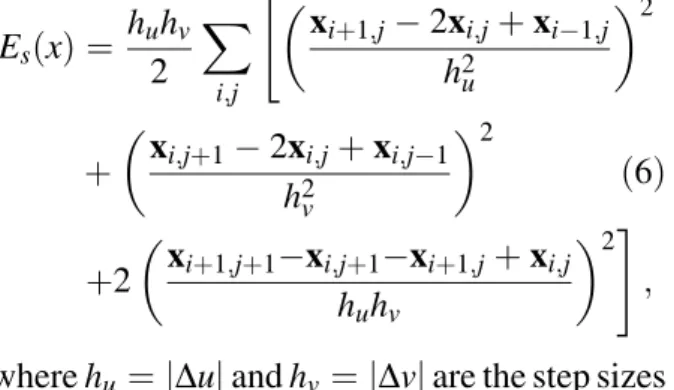
In the original VSF algorithm, the discrete form of the above energy function is derived using a classical finite-difference scheme. The result-ing discrete function is:
Es(x) = huhv 2
i,j
x
i+1,j−2xi,j+xi−1,j h2
u
2
+
xi,j+1−2xi,j+xi,j−1
h2
v
2
(6)
+2
x
i+1,j+1−xi,j+1−xi+1,j+xi,j huhv
2 ,
wherehu =|Δu|andhv =|Δv|are the step sizes of the regular mesh of the reconstructed surface in theuandvdirections respectively.
MVSF Algorithm
In this work, we propose a more accurate deriva-tion process to get the discrete energy corre-sponding to the above continuous function(5). In particular, we propose to take into consider-ation higher element components of the corre-sponding two-variable Taylor formula:
Es(x) = hu2hv
i,j
x
i+1,j−2xi,j+xi−1,j h2
u
2
+
xi,j+1−2xi,j+xi,j−1
h2
v
2
(7)
+18
x
i+1,j+1−xi+1,j−1−xi−1,j+1+xi−1,j−1
huhv
2
.
We can see from the above expression that the first two terms are similar to the original formu-lation given in equation(6). They both use the so-called 5-star-points scheme.
The main advantage of the expression given in equation(7)is its accuracy in using the 4 diag-onal points to approximate the crossed second-order derivative at position (i,j), as shown in Figure 1. Obviously, Szeliski’s approximation is a biased forward approximation, as shown in Figure 2.
Reassembling all mesh points into a vector x, we can rewrite equations (6) and(7) in a ma-trix form. The energy corresponding to the thin plate model can also be written in compact form as:
Figure 1. Point estimation using MVSF algorithm.
Figure 2.Point estimation using VSF algorithm.
E(x) = 12xTAsx, (8) where the stiffnessmatrixAs is a sparse block diagonal matrix. The matrixAs has at most 13 non-zero entries per row, as discussed in [7]. The rows with the maximum number of entries are: (n+1)M+ (m+2); n=1 :N−4 andm=1 :M−4;N andM >4.
However, when periodicity is imposed upon the stiffness matrix As, all rows would then have 13 non-zeros entries. Note that such periodic-ity constraint is appropriate when considering spherical coordinates used in describing human organs. The resultingstiffnessmatrix has a ho-mogeneous structure and can be easily coded.
AS=
⎛ ⎜ ⎜ ⎜ ⎜ ⎜ ⎜ ⎜ ⎜ ⎜ ⎜ ⎝
B C D 0 . . . 0 D C C B C D 0 . . . 0 D D C B C D 0 . . . 0 0 D C B C D 0 . . .
..
. ... ... ... ... ... ... ... 0 . . . 0 D C B C D D 0 . . . 0 D C B C C D 0 . . . 0 D C B
⎞ ⎟ ⎟ ⎟ ⎟ ⎟ ⎟ ⎟ ⎟ ⎟ ⎟ ⎠ ,
(9)
The Discrete Problem
The combined discrete energy expression can hence be written in matrix form as:
E(x) = 12xTA x−xTb+c, (10)
whereA=λ·As+Ad,b=Ad·dandcis a con-stant that may be omitted in the minimization process. This energy function has a minimum at x = x∗, which is the solution of the follow-ing linear system that is obtained via the Euler equation:
A x∗=b, (11)
sinceAis a strictly positive matrix. The above set of linear equations is, hence, a high di-mension homogeneous positive definite system, that can be solved using the conjugate gradient method, thanks to the strict positivity of the ma-trixA.
Our approximation is found to lead to better performance compared to that used in original VSF algorithm.
2.2. 3DHM Fourier-based Algorithm
For comparison purposes, we considered the
use of the 3D Harmonic Modelling (3DHM)
algorithm(developed previously by the authors
[6]). This algorithm is much less complex than the previous thin plate splines algorithm. The 3DHM algorithm reconstructs the incomplete surface using an iterative algorithm based on Fourier analysis. This algorithm consists of four major steps(per iteration):
A)The 2D Fourier transformD(u,v)of the kth doubly periodic meshxki,jis computed. B)The resultingD(u,v)is low-pass filtered to
reduce discontinuities in the space domain. C)The missing points are then estimated using
the inverse Fourier transform.
D)The algorithm terminates the iterations when the Mean Square Error between the esti-mated values of the missing points from suc-cessive iterations falls below a preset thresh-old ζ. If not, the algorithm restarts using the recently generated mesh(k = k+1) as an input to step A. The data from the initial sparse mesh is retained.
The mean square error(MSE)between succes-sive surfaces is calculated as follows:
1 N·M
N
i=0
M
j=0
xik,j−xki,+j12, (12)
whereNandMrepresent the size of the regular mesh in theithandjthdirections, respectively.
3. Simulation Result
Our first aim was to compare the convergence characteristics of the original and modified Sze-liski algorithm for relatively smooth surfaces. We then compared the performance of the mod-ified algorithm and that of the 3DHM algorithm. In order to limit the scope of the problem, we adopted the following methodology for choos-ing the optimal values for the control parameters
(ω,λ).
A)Choose a smooth surface as a reference model. B)Randomly select about 30% of the total
sur-face patches.
C)Reconstruct the surface using these selected patches.
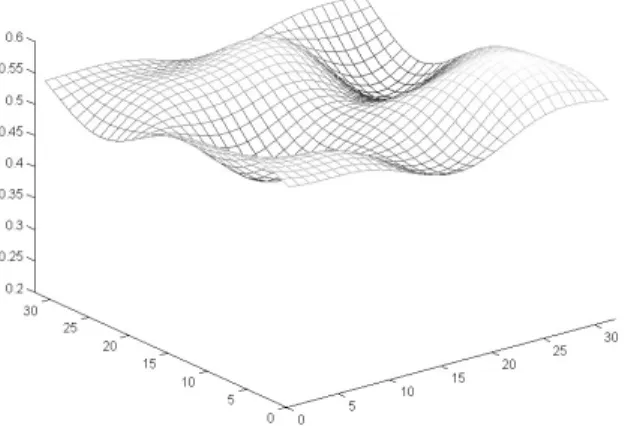
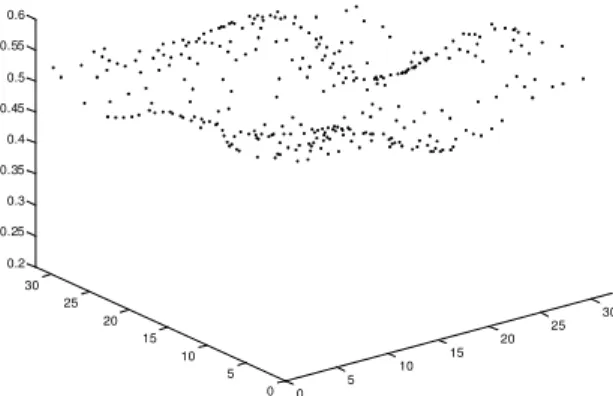
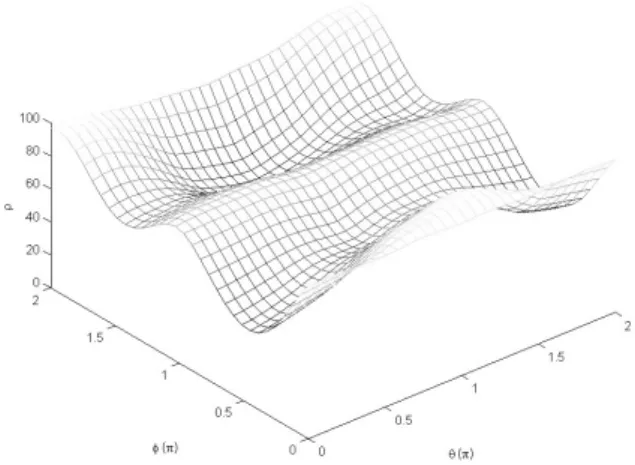
D)Calculate the mean square error between the reconstructed surface and the reference model using different values of(ω,λ). Figure 3 presents a reference model of a 32×32 smooth surface, and Figure 4 shows a surface with about 70% of missing points. Figure 5 shows a reconstructed surface and Figure 6 shows the main square error between the ref-erence and reconstructed surfaces.
0 5
10 15
20 25 30
0 5 10 15 20 25 30 0.2 0.25 0.3 0.35 0.4 0.45 0.5 0.55 0.6
Figure 4.Randomly selected 30% of the total samples of the reference surface.
Figure 5.Reconstructed surface.
0 50 100 150 200 250 300 350 400 450 500 0
0.1 0.2 0.3 0.4 0.5 0.6 0.7 0.8 0.9
1x 10
-4
Iterations
MSE
Figure 6.Mean square error between reference and reconstructed surfaces.
Figure 7 displays the MSE as a function of(ω,
λ). Notice that the MSE almost stabilizes when
ω is greater than 300 and λ is less than 30.
ω=314 is actually the inverse of the variance of the selected sample [7]. The results displayed in Figure 8 show that the proposed algorithm,
MVSF, outperforms the original VSF algorithm, e.g. when the tolerance value of the iterative conjugate gradient algorithm is set to 10−4, the
modified algorithm converges about 100 itera-tions faster than the original algorithm. One can also notice that the inappropriate choice of
ω andλ can lead to substantial deterioration in performance.
Figure 7.The MSE vs.ωandλ.
Figure 8.Rate of convergence of the conjugate gradient algorithm.
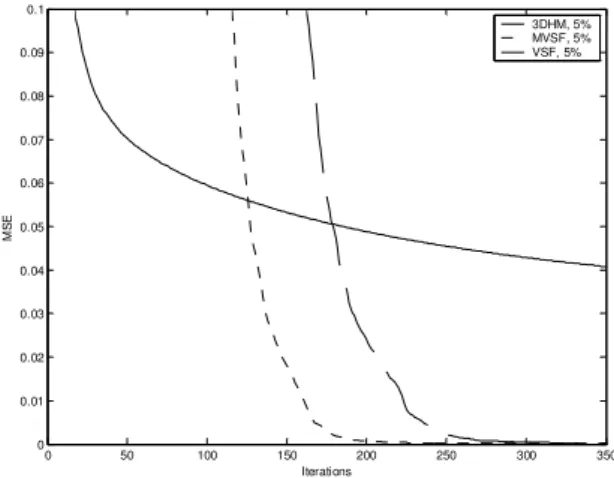
As expected, with a very small number of sparse patches, both the VSF and the MVSF algorithms performed better than the 3DHM algorithm. As it can be seen from Figure 9, the 3DHM cannot achieve an MSE of the ratio of 10−4, while both other algorithms achieved such tolerance in less than 300 iterations.
0 50 100 150 200 250 300 350
0 0.01 0.02 0.03 0.04 0.05 0.06 0.07 0.08 0.09 0.1
Iterations
MS
E
3DHM, 5% MVSF, 5% VSF, 5%
Figure 9.MSE comparison for the 1st scenario.
Figure 10 corresponds to the 2nd scenario, where about only 30% of the total mesh samples were chosen. In this case the 3DHM algorithm out-performs both the original and improved VSF algorithms. One may conclude that as the num-ber of missing samples gets lower, it would be better using the 3DHM algorithm. In case of relatively small size of sparse data, it would be better using the MVSF algorithm. In general, the 3DHM algorithm is much faster than the two spline-based algorithms. For example, do-ing 300 iterations takes about 20 computation times longer for the original and modified algo-rithm than it takes for the 3DHM algoalgo-rithm.
0 50 100 150 200 250
0 0.1 0.2 0.3 0.4 0.5 0.6 0.7 0.8 0.9 1x 10
-4
Iterations
MS
E
3DHM, 30% MVSF, 30% VSF, 30%
Figure 10. MSE comparison for the 2nd scenario.
4. 3D Surface Reconstruction Example
Smooth surface reconstruction techniques can be used for medical applications where rela-tively smooth organs like the left ventricle of the heart. In this section, the MVSF algorithm has been used to reconstruct the surface of the left ventricle of the heart starting with data acquired along three contours(Figure 11)extracted by a specialist from echocardiographic images. The 3D data is first transferred into a 2D developed surface(Figure 12). The available data is about 23% of the total mesh points. The missing points on the resulting incomplete surface are then estimated using the MVSF algorithm as shown in Figure 13. The reconstructed LV sur-face in Conclusion is a 3D representation of the 2D developed surface of Figure 13. Even if results from the original VSF algorithm looked visually similar, the computation time of the im-proved algorithm is relatively reduced. Using
-100 -50
0 50
100
-100 -50 0 50 100 -100 -50 0 50 100
x y
z
Figure 11.Three 3D contour data of a left ventricle.
Figure 13.2D developed surface from the original sparse data which are represented here by black dots.
Figure 14. 3D reconstructed surface of the left ventricle using MVSF algorithm.
the same initial parameters to reconstruct the LV surface, the MVSF algorithm converges in about 50% faster than the original VSF algo-rithm, as a result of a reduction of about 100 iterations. As expected, the computation time of both VSF and MVSF is much higher when compared to the 3DHM algorithm.
5. Conclusion
In this paper, we presented an improved mod-ification of the Variational Spline Fitting Al-gorithm. The proposed algorithm is based on a more accurate approximation of the energy equations in discrete time. Additionally, the al-gorithm takes into account the periodicity con-straints which apply to our target application of modelling human internal organs such as the left ventricle of the heart. For simulated surfaces, we showed that our algorithm outperforms the original implementation discussed by Szeleski.
When compared to the 3DHM Fourier-based al-gorithm(developed earlier by the authors), the proposed algorithm was found to be best suited for the small sample-size case.
We have also shown that the proposed algorithm converges faster than the original one. Our re-sults related to the reconstruction of the left ven-tricle of the heart have been very promising. We are currently investigating the use of the MVSF algorithm in 3D medical image registration.
References
[1] O. GARCIA, A. SUSIN, Left ventricle’s surface recon-struction and volume estimation.Terceres jornades de recerca en Enginyeria Biom`edica,(2002), Spain.
[2] H. HOPPE, T. DEROSE, T. DUCHAMP, J. MCDON -ALD, W. STUETZLE, Surface reconstruction from unorganized points. The 19th Annual Conference on Computer Graphics and Interactive Techniques,
(1992).
[3] S. GAO, H.-Q. LU, A Fast Algorithm for Delau-nay based Surface Reconstruction.The 11th Inter-national Conference in Central Europe on Com-puter Graphics, Visualization and ComCom-puter Vision,
(2003), China.
[4] Y. F. WANG, J. F. WANG, Surface reconstruction us-ing deformable models with interior and boundary constraints.Journal of IEEE Transactions on Pat-tern Analysis and Machine Intelligence, 14(1992), pp. 572–579.
[5] R. ENCISO, J. P. LEWIS, U. NEUMANN, J. MAH, 3D Tooth Shape from Radiographs using Thin-Plate Splines.The 11th Annual Medicine Meets Virtual Reality Conference,(2003), Newport Beach, Cali-fornia.
[6] C. BONCIU, R. WEBER, C. L´EGER, 4D reconstruc-tion of the left ventricle during a single heart beat from ultrasound imaging.Journal of Image Vision Computing, Elsevier Eds, 19(2001), pp. 401–412.
[7] R. SZELISKI, Fast surface interpolation using hierar-chical basis functions.Journal of IEEE Transactions on Pattern Analysis and Machine Intelligence, 12
(1990), pp. 513–528.
Received:March, 2006 Accepted:April, 2007
Christophe L´eger University of Orleans 12 rue de Blois 45067 Orleans Cedex 2 France e-mail:[email protected]
Ma¨ıtine Bergounioux MAPMO, Facult´e des Sciences Universit´e d’Orl´eans France
Mohamed Deriche Electrical Engineering Department King Fahd University of Petroleum and Minerals Saudi Arabia
Roger L´ed´ee LESI, Polytech’Orl´eans Universit´e d’Orl´eans France
AHMADALMHDIEreceived the BSc degree in Electrical and Electronic
Engineering from Al-Fateh University, Tripoli, Libya, in 1990, the MSc degree in Communication Engineering from McMaster Univer-sity, Hamilton, Ontario, Canada, in 1999. His MSc research focused on the efficiency of the TDMA/SDMA frame generation process when using a switched parasitic antenna arrays for indoor smart antenna sys-tems. From 1999-2002, he joined the department of Electrical and Communication Engineering at the University of Sebha, Sebha, Libya. He is currently a PhD student at Laboratory of Electronics, Signals, Images(LESI), University of Orl´eans, Orl´eans, France.
Almhdie’s research interests include 3D image registration, surface re-construction and local comparison of 3D medical data.
CHRISTOPHEL´EGERreceived the Ph.D. degree in Sciences for
Engi-neering from the University of Orl´eans, France, in 1993. His research concerned the visualization of the volumic deformations of the left ventricle of the heart, using ultrasound images. This work was led in conjunction with the cardiology and nuclear medicine departments of the Hospital of Orl´eans. Since September 1998, he leads the LV4D(Left Ventricle of the heart in 4 Dimensions)team at the LESI(Laboratory of Electronics, Signals, Images).
Christophe L´eger’s primary research interests are spatio-temporal inter-polation, Fourier analysis and dynamic modelling registration.
MA¨ITINEBERGOUNIOUXis full Professor of Mathematics at the
Uni-versity of Orl´eans. Her research concerns mathematical and numerical analysis of partial derivative equation and particularly optimal com-mand of systems. Bergounioux’s research interests include image and signal processing, mathematical modeling and numerical analysis.
MOHAMEDDERICHEreceived his B.S. degree from the National
Poly-technic School of Algeria, Algiers, Algeria, and the M.S. and Ph.D. degrees from University of Minnesota, Minneapolis, in 1988 and 1992, respectively.
He taught at Queensland University of Technology, Australia, before joining King Fahd University of Petroleum and Minerals, Saudi Arabia, where he is currently leading the Signal Processing Group. He has published over 150 refereed papers. His research interests include mul-tiscale signal processing, wavelets, fractals, with particular emphasis on multimedia applications and biometrics. Dr. Deriche has delivered numerous tutorial and invited lectures. He received the Best Electrical Engineering Student award at NPS and the IEEE Third Millennium Medal in 2000.
ROGERL´EDEE´ received a Ph.D. Degree in Electronics from the Uni-versity of Lille, France, in 1987. He joined the UniUni-versity of Orl´eans, France, since 1989 as a lecturer and researcher at LESI(Laboratory of Electronics, Signals, Images). His research concerned medical image processing for diagnostics purposes in nuclear medical imaging. He works in cooperation with the nuclear department of the hospital of Orl´eans.