VOLUME 17 ISSUE 2 (2019), Page 27 – 37
THE QUANTIFICATION OF URBAN LITTER LOAD AT GROSS POLLUTANT TRAP ALONG SUNGAI BATU, SELANGOR
Nur Khaliesah Abdul Malik1, Latifah Abd Manaf2, Nor Rohaizah Jamil3, Mohd Hafiz Rosli4, Fasihah Mohd Yusof5, & Zulfa Hanan Ash’aari6
1,2,3,4,5,6
Faculty of Environmental Studies UNIVERSITI PUTRA MALAYSIA
Abstract
The massive amount of urban litter in Malaysia is influenced by rapid population growth, development, economic growth and unsustainable lifestyles. Few studies have assessed the amount of urban litter load and its composition at gross pollutant trap (GPT), significantly contributing to lack of historical data. This study is aimed to assess the amount of urban litter load in wet basis condition at individual GPTs along Sungai Batu, Selangor in 2015. The urban litter collection data at each GPT in 2015 were sourced from Department of Irrigation and Drainage (DID). Samples were manually collected once a month, stored in plastic bag and immediately weighed and recorded by following the ASCE standard method.The result shows that the total amount of urban litter load in 2015 was 3761.72 kg/year (Mean ± SD; 313.4767 ± 141.9105 kg/year). In such situations, further study on urban litter load and its composition trapped at GPTs is urgently required as it is crucial to establish baseline data information during the decision making process, holistically improving stormwater management and urban litter management in Malaysia.
INTRODUCTION
Urban litter is commonly known as the trash, debris, flotsam, jetsam, floatables, gross pollutants, rubbish or solid waste (Armitage, 2007). The technical definition of urban litter is a visible solid waste arising from urban environment (Armitage, Rooseboom, Nel, & Townshend, 1998). In fact, the rising levels of urban litter composition and quantity load are the most challenging environmental issues to be addressed due to the various factors such as the growth of the human population, type of development, anthropogenic activities through littering; excessive of packaging; inefficient service of street sweeping; lack of disposal facilities and lack of enforcement from authorities (Hall, 1996). The high population and the areas with high levels of commercial activity produced massive amount of urban litter in terms of quantity (Purcell & Magette, 2009). The abundance of urban litter derived from residential and commercial areas have a high tendency to be visible at the drainage and river that might be due to lack number of disposal bins or individual behaviour in managing the waste. Ab Ghani et al. (2011) stated that the rising urban population and developed areas also can influence hydrological processes through stormwater runoff and characteristics of peak flow. Impervious surfaces increase due to rapid development in urban areas, which subsequently can generate more surface runoff which conveys urban litter into receiving water bodies such as rivers.
Furthermore, the rising urban litter composition and quantity load at GPT is also derived from the characteristics of catchment, management practices including law enforcement and services, the efficiency and effectiveness of litter removal by local authority (Marais, Armitage, & Pithey, 2001); environmental awareness among the communities (Sidek, Basri, Lee, & Foo, 2016); types of land use (Lariyah, Norazli, Nasir, Hidayah, & Zuleika, 2011); and climate conditions and rainfall patterns (Mohd Shah et al., 2016; Alam, Anwar, Sarker, Heitz, & Rothleitner, 2017). Therefore, in such a situation, the factors described above contribute to the various types of litter composition in the stormwater system, which encompasses plastic, paper, metal, glass, metal, vegetation, sediment and others (Marais et al., 2001) illegally dumped nearby or directly into the drainage system through the littering activities or transported by wind or surface runoff.
GPT IN STORMWATER MANAGEMENT PRACTICES IN MALAYSIA
There are several types of GPTs available for urban stormwater management and treatment applications in Malaysia, such as Type 1 (floating debris trap; trash racks and litter control devices); Type 2 (sediment basin and trash rack (SBTR) traps); and Type 3 (oil and grease interceptor) (Jabatan Pengairan dan Saliran, 2012).
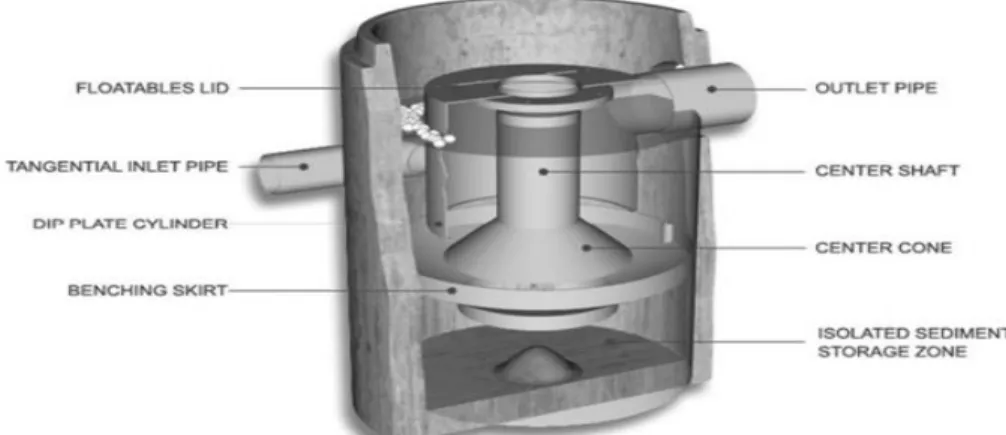
separation device (Fitzgerald & Bird, 2011) with hydrodynamic vortex separator system for stormwater treatment applications (Faram, Lecornu, & Andoh, 2000) to trap litter at the drainage conveyance along Sungai Batu, Selangor. The mechanism of this device can be described as diverting the incoming flow and associated pollutants away from the main flow stream of the pipe or waterway into a pollutant separation and containment chamber. Generally, GPTs are vital in stormwater management practices where GPTs act as devices to control water quality by trapping and removing gross pollutants which commonly greater than five millimetres (>5mm) such as urban litter washed into stormwater system and reduce the effect of pollutants loads from entering the receiving water bodies (Madhani & Brown, 2015). However, Alam et al. (2017) stated that the periodic cleaning process of GPTs is challenging and ineffective for removal of pollutants less than 5 millimetres (<5mm). The estimation performance of GPTs efficiency to remove the urban litter is about 10% to 30% (Fletcher, Duncan, Poelsma, & Lloyd, 2004). High proportions of pollutants including gross pollutants, sediments, and nutrients will be transported from the contributing catchment area to the receiving water bodies during the higher runoff volume.
In such situations, the size of catchment, pollutant load, type of drainage system and cost are the main factors in operating the gross pollutant devices (Sidek et al., 2016) prior to installation of GPT at the selected site. The installation and maintenance costs, and costs of gross pollutant disposal can also affect the efficiency of GPTs indirectly through the budget and capacity of the management, as the conditions of gross pollutant vary during the different season in terms of load and its composition. Generally, a trap with a dry load condition is easier to operate and deliver to the landfill as compared to traps with wet load, which are more expensive to operate due to difficulty in the cleaning process (Fitzgerald & Bird, 2011).
RESEARCH METHODOLOGY
Study Area
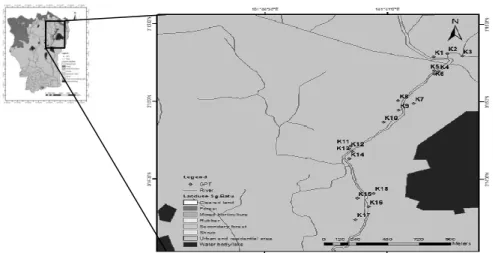
The total area of Sungai Batu catchment is about 103.50 km2 and covers a small part of south area in Selangor State (upstream) to Federal Territory of Kuala Lumpur (downstream) before entering Sungai Klang. The Sungai Batu catchment in Selangor was selected as a study area due to the dense population and developing areas, including both residential and industrial areas. The DID has installed 18 GPTs (K1 to K18) with downstream defenders at upstream area of Sungai Batu (Figure 1) in order to trap the urban litter in drainage, subsequently minimises the amount of urban litter from being transported into water bodies.
Selection of installation sites was based on several factors such as topography, soil and geology, groundwater, space availability and road accessibility. Other social factors, such as odour, health and safety, visual/aesthetics and vermin, were also considered as the GPT sites are usually in close proximity to residential area.
Figure 1 The location of GPTs along Sungai Batu, Selangor
Field Sampling and Data Collection
passing under the dip plate and moving upward through the inner annular space and subsequently to the outlet pipe. The function of the centre cone is to direct flow into the inner annular space and protect the accumulated sediment from being incorporated and swept along in its flow.
Figure 2 The illustration of downstream defender components Source: Osei, Faram, & Iwugo (2007)
In this study, the amount of urban litter collection data at each GPT along Sungai Batu in 2015 was sourced from DID and used in the analysis. Field sampling was performed once in a month during cleaning operation at each GPT along Sungai Batu. However, there is no recorded data on the amount of urban litter collection in February due to the absence of cleaning operation during that month. As litter was left some days with monthly interval in an area until the day of cleaning operation, field sampling for urban litter collections at GPT under wet basis conditions was performed accordingly to American Society of Civil Engineers guidelines under the litter section for Wet Best Management Practices (BMPs) (ASCE, 2007). In order to obtain the precise weight of litter in wet basis condition at each GPT, litter was manually collected using nets to filter the excess water content prior to storage in plastic bags. Each bag was immediately weighed and recorded (Alam et al., 2017).
Statistical Data Analysis
statistical analysis. Therefore, as a decision for normality test, the null hypothesis was rejected as the data was not normally distributed. The Kruskal-Wallis test was applied in this study in order to test the significance differences in total urban litter load between individual GPT along Sungai Batu and months in 2015.
RESULTS AND DISCUSSION
Quantification of Urban Litter Load Trapped at Individual GPT
Based on Table 1 and Figure 3, the results show that the urban litter collection in August contributed to the highest amount of urban litter load with 510.00 kg/month (Mean ± SD; 28.3333 ± 18.9426 kg/month), followed May with 435.00 kg/month (Mean ± SD; 24.1667 ± 14.9755 kg/month). Meanwhile, urban litter collection in March was the lowest with 121.00 kg/month (Mean ± SD; 6.7222 ± 11.9029 kg/month). There is no recorded data on the amount of urban litter load in February due to the absence of cleaning operations during the month. The amount of urban litter load trapped at GPTs generally derived from several factors including the growth of human population; type of development; characteristics of the catchment area; management practices including law enforcement and services; environmental awareness among the communities (Sidek et al., 2016); types of land use (Lariyah et al., 2011); and climate conditions and rainfall patterns (Mohd Shah et al., 2016; Alam et al., 2017).
Figure 3 Total litter weight trapped at 18 GPTs along Sungai Batu in Year 2015
Table 1 Descriptive statistics for total urban litter weight (by month) in 2015 for 18 GPTs along Sungai Batu
Month Min Max Sum Mean ± SD Skewness Kurtosis
Jan 0.00 88.66 317.72 17.6511 ± 31.3192 1.6467 1.2779
*Feb 0.00 0.00 0.00 0.0000 ± 0.0000 N/A N/A
Mar 0.00 37.48 121.00 6.7222 ± 11.9029 1.9665 2.8610
Apr 3.00 85.00 393.00 21.8333 ± 17.8696 2.7934 9.6823
May 5.00 55.00 435.00 24.1667 ± 14.9755 1.0525 0.1796
0 100 200 300 400 500 600
Jan Feb Mar Apr May Jun Jul Aug Sep Oct Nov Dec
Tota
l
w
ei
gh
t of
li
tt
er
loa
d
(k
g/mon
th
)
June 0.00 50.00 360.00 20.0000 ± 12.7187 0.6272 0.6919
July 0.00 45.00 355.00 19.7222 ± 11.3075 1.0384 1.5589
Aug 15.00 95.00 510.00 28.3333 ± 18.9426 2.8389 9.4201
Sept 5.00 30.00 330.00 18.3333 ± 7.0711 -0.4523 -0.3574
Oct 10.00 60.00 425.00 23.6111 ± 11.9811 1.5234 4.0701
Nov 10.00 40.00 300.00 16.6667 ± 7.0711 2.6984 7.5221
Dec 5.00 20.00 215.00 11.9444 ± 3.8877 0.8377 0.5168
Note: *There is no recorded data on the amount of urban litter collection in February due to the lack of cleaning operations during that month
Comparison by Month: Total Urban Litter Load at GPT along Sungai Batu
The Shapiro-Wilk test was applied in this study. The results show that the statistic value for the total urban litter load come as 0.821 corresponds to p-value = 0.000. Since the p-value is 0.000 < 0.05, as a decision for normality test, the null hypothesis was rejected as the data was not normally distributed. The Kruskal-Wallis test was applied in this study in order to test the significance differences in total urban litter load between months in Year 2015. The result revealed a statistically significant difference in total urban litter load between each month at 18 GPT along Sungai Batu, ꭕ2 (11) = 85.516, p = 0.000. The total urban litter load in May 2015 recorded a highest mean rank at 158.03, corresponding to the highest total weight of urban litter load (Table 2).
The total urban litter load is significantly influenced by the seasonal variation through the rainfall pattern throughout the year. Alam et al. (2017) have proved in their study where the urban litter load during wet season was significantly higher as compared during the dry season due to factors of rainfall-runoff in carrying these pollutant loads through a large volume of stormwater that could convey the gross pollutant into water bodies. Allison, Chiew and McMahon (1997) found that most of the load was conveyed during high flow condition. The types of gross pollutant composition which are able to be captured within a catchment also can be influenced through rainfall and runoff pattern, rate of infiltration, and stormwater system connectivity (Fitzgerald & Bird, 2011).
Table 2 Kruskal-Wallis test of monthly urban litter load at 18 GPT along Sungai Batu
Month Mean Rank df ꭕ2 p – value
Jan 73.11
Feb 19.00
Mar 62.94
Apr 127.56
May 139.39 11 85.516 0.000
June 126.56
July 127.17
Aug 158.03
Sept 128.83
Oct 144.78
Nov 111.31
Dec 83.33
Comparison by GPT: Total Urban Litter Load at GPT along Sungai Batu
The result derived from Kruskal-Wallis test revealed a statistically significant difference in total urban litter load among individual GPTs along Sungai Batu, ꭕ2 (17) = 34.255, p = 0.008. The total urban litter load in K2 recorded a highest mean rank with 163.25 than the other GPTs which correspond to the highest total weight of urban litter load (Table 3).
Table 3 Kruskal-Wallis test of urban litter load at individual GPT along Sungai Batu
GPT Mean Rank df ꭕ2 p – value
K1 69.46
K2 163.25
K3 102.33
K4 85.92
K5 106.92
K6 85.88
K7 111.29
K8 132.79 17 34.255 0.008
K9 104.58
K10 83.79
K11 88.58
K12 117.92
K13 92.88
K14 114.63
K15 138.75
K16 113.50
K17 152.79
K18 87.75
Alam et al. (2017) on types of urban litter composition found at GPTs in different regions in Klang River catchment and Gosnells Western, Australia, respectively, show that both plastics and vegetation such as leaves are the most commonly found in GPTs during the cleaning operation. The amount of urban litter generation and its composition are fundamental information strongly required for urban litter management systems in terms of planning, operation and optimization (Beigl, Lebersorger, & Salhofer, 2008). The characteristics of litter differ with time and are exaggerated by socio-economic conditions (Buenrostro, Bocco, & Vence, 2001; Gómez, Meneses, Ballinas, & Castells, 2009). In addition to the structural method applied in this study to filter the gross pollutants, including urban litter, from flowing into water bodies, environmental education programs, cleaning operations and law enforcement play crucial roles in mitigating the urban litter management issue, which indirectly affects the stormwater quality.
CONCLUSION
This paper has demonstrated the quantification of urban litter load trapped at 18 GPTs along Sungai Batu, Selangor in 2015. The growing issue of urban litter in drainage systems is mainly influenced by the growth of the human population, lack of environmental awareness in waste disposal, littering, law enforcement and policy, type of development, land use changes, and rainfall patterns. The result shows that the total amount of urban litter load in 2015 was 3761.7200 kg/year (Mean ± SD; 313.4767 ± 141.9105 kg/year). DID has installed GPTs with downstream defender at selected sites along Sungai Batu which are functioning as hydrodynamic vortex separator systems for stormwater treatment to trap litter at drainage conveyances before it enters the main river. A significance difference in total urban litter load between individual GPT along Sungai Batu obtained in this study were mainly influenced by various type of urban litter composition derived from land based sources including the human activities; consumption and production; and types of development. The different types of development and land use will generate different urban litter compositions. However, the urban litter composition at individual GPT was not evaluated in this study due to unavailability of baseline data. Moreover, a significant difference in total urban litter load for each month at 18 GPTs along Sungai Batu also were mainly influenced by seasonal condition through rainfall pattern throughout the year, as the efficiency of trapping at GPTs can be less effective during the extreme storm event and high flow conditions, and tend to be more effective during low-flow conditions.
this information is crucial for GPT efficiency in trapping urban litter and other pollutants. This information will serve as baseline data for knowledge contribution and informative input during the decision-making process, subsequently improving stormwater management and urban litter management in a comprehensive way.
ACKNOWLEDGEMENTS
The authors in this paper would like to thank the Department of Irrigation and Drainage (DID) Malaysia for the informative input on GPT. The authors would also like to express deep appreciation to the reviewers for spending time and providing valuable comments for this paper.
REFERENCES
Ab. Ghani, A., Azamathulla, H. M., Lau, T. L., Ravikanth, C. H., Zakaria, N. A., Leow, C. S., & Yusof, M. A. M. (2011). Flow pattern and hydraulic performance of the
REDAC gross pollutant trap. Flow Measurement and Instrumentation, 22,
215-224.
Alam, M. Z., Anwar, A. H. M. F., Sarker, D. C., Heitz, A., & Rothleitner, C. (2017). Characterising stormwater gross pollutants captured in catch basin inserts.
Science of the Total Environment, 586, 76-86.
Allison, R., Chiew, F., & McMahon, T. (1997). Stormwater gross pollutants: Industry
report. Retrieved from https://clearwatervic.com.au/user-data/resource-files/CRC-Gross-Pollutants-Industry-Report-2001.pdf
Armitage, N., Rooseboom A., Nel, C. & Townshend, P. (1998). The removal of urban
litter from stormwater conduits and streams. WRC Report No. TT 95/98, Pretoria, South Africa.
Armitage, N. (2007). The reduction of urban litter in the stormwater drains of South
Africa. Urban Water Journal, 4(3), 151-172.
ASCE. (2007). Guideline for monitoring stormwater gross pollutants. Retrieved from https://stormwater.ucf.edu/fileRepository/docs/conferences/9thstormwaterCD/ documents/ASCEguidelines.pdf on 25th April 2018.
Beigl, P., Lebersorger, S., & Salhofer, S. (2008). Modelling municipal solid waste
generation: A review. Waste Management, 28(1), 200-214.
Buenrostro, O., Bocco, G., & Vence, J. (2001). Forecasting generation of urban solid waste in developing countries: A case study in Mexico. Journal of the Air & Waste Management Association, 51(1), 86-93.
Faram, M. G., Lecornu, P., & Andoh, R. Y. G. (2000). The “Mk2” downstream defender
TM for the removal of sediments and oils from urban runoff. In WaterTECH,
April 9-13, 2000, Sydney, Australia,.
Fletcher, T., Duncan, H., Poelsma, P., & Lloyd, S. (2004). Stormwater flow and quality, and the effectiveness of non-proprietary stormwater treatment measures : A review and gap analysis. Technical Report, December, 1-171.
Ghasemi, A., & Zahediasl, S. (2012). Normality tests for statistical analysis: A guide for
non-statisticians. International Journal of Endocrinology and Metabolism,
10(2), 486-489.
Gómez, G., Meneses, M., Ballinas, L., & Castells, F. (2009). Seasonal characterization of
municipal solid waste (MSW) in the city of Chihuahua, Mexico. Waste
Management, 29(7), 2018-2024.
Hall, M. (1996). Litter traps in the stormwater drainage system (Master’s thesis). Swinburne University of Technology, Melbourne, Australia.
Jabatan Pengairan dan Saliran. (2012). Urban stormwater management for Malaysia:
MSMA 2nd Edition. Kuala Lumpur: Author.
Lariyah, M. S., D, M. N. M., Norazli, O., Nasir, M. N., Hidayah, B., & Zuleika, Z. (2011). Gross pollutants analysis in urban residential area for a tropical climate country. In 12th International Conference on Urban Drainage. September 11–16, 2011, Porto Alegre, Brazil.
Lun, P. I., Gasim, M. B., Toriman, M. E., Rahim, S. A., & Kamaruddin, K. A. (2011). Hydrological pattern of Pahang river basin and their relation to flood historical event. Jurnal E-Bangi, 6(1), 29-37.
Madhani, J. T., & Brown, R. J. (2015). The capture and retention evaluation of a
stormwater gross pollutant trap design. Ecological Engineering, 74, 56-59.
Marais, M., Armitage, N. & Pithey, S. (2001). A study of the litter loadings in urban
drainage systems – Methodology and objectives. Water Science and
Technology, 44(6), 99-108.
Mohd Shah, M. R., Zahari, N. M., Md Said, N. F., Sidek, L. M., Basri, H., … & Mohd Dom, N. (2016). Gross pollutant traps: Wet load assessment at Sungai Kerayong,
Malaysia. In IOP Conference Series: Earth and Environmental Science, 32(1),
1-6.
Osei, K., Faram, M. G., & Iwugo, K. O. (2007). Physical and chemical characterization of sediments captured by flow-through stormwater interceptors. In 6th North American Surface Water Quality Conference and Exposition. August 20-23, 2007, Phoenix, Arizona, USA.
Purcell, M., & Magette, W. L. (2009). Prediction of household and commercial BMW generation according to socio-economic and other factors for the Dublin region.
Waste Management, 29(4), 1237-1250.
Sidek, L., Basri, H., Lee, L. K., & Foo, K. Y. (2016). The performance of gross pollutant trap for water quality preservation: A real practical application at the Klang
Valley, Malaysia. Desalination and Water Treatment, 57(52), 24733-24741