Formation and Study of mechanical properties of High Density Polyethylene and Nanoparticle of Silica Composite
Deepika Shukla1
Mechanical Engineering Department, Faculty of Engineering and Technology, Rama University,
Kanpur, Uttar Pradesh, India
Shivam Trivedi2
Assistant Professor, Mechanical Engineering Department, FET, Rama University,
Kanpur, Uttar Pradesh, India
Abstract
High density polyethylene based composite is prepared by using silica nanoparticles obtained from many resources. The reinforcement of high density polyethylene is done by silica nanoparticles due to their low cost, fairly good mechanical properties and high aspect ratio. A composite has been prepared by mixing 3% silica nanoparticles (by weight) into high density polyethylene by using compression moulding and stirrer. A uniaxial tension test and flexural testing has been performed on the HDPE composite using UTM and Impact testing machine in order to determine elongation behavior and flexural strength. It has been observed by the tests performed that the mechanical properties of HDPE enhances when it is mixed with silica nanoparticles.
Keywords: HDPE (High Density Polyethylene); reinforcement; UTM; Impact testing machine; flexural strength.
1. Introduction
This work evaluates reinforcement of high density polyethylene using silica nano particles and as an alternative reinforcement for High density polyethylene composite due to their fairly good mechanical properties, low cost and high aspect strength. Lots of silica is wasted in India. The wasted silica is mixed with high density polyethylene in order to find commercial application. High density polyethylene based composite has been prepared using silica Nanoparticles obtained from many resources. High density polyethylene is mixed into silica nanoparticles at 3 % by weight by using moulding and stirrer. The composite is compression moulded at specific time and temperature. High density polyethylene and silica Nanoparticles reinforced composite has better flexural and tensile strength than other. Colom et al prepared HDPE composite using a compounding step at 200 Centigrade in crucible and moulding step at 150 Centigrade in a compression Die for up to 50 minutes and 4 hours for cooling in air[1].
a compound of low molecular weight that can be joined together to give a polymer and a monomer is a short polymer chain. Plastics are typically organic polymers having high molecular mass, but they usually contain other substances. They are generally synthetic, most commonly extracted from petrochemicals, but many are partly natural. Majorly, there are seven commodity polymers in use – polypropylene, polyethylene, polystyrene, polyvinylchloride, polycarbonate and polyethylene-terephthalate. These all make up nearly 97% of all polymers and plastics are experienced in daily life.
To overcome some of the limitations of polymers, the composites are prepared by adding some more materials to the basic polymers. Composites are light weighted, compared to the most metals and woods. Their light weight is critical in airplanes and automobiles, for instance, where less weight stands for better
fuel efficiency. Composites have the highest strength to weight proportion in structures today. Composite
materials are gaining popularity in the new generation industries because of their existing properties like High strength and stiffness, environmental friendly nature, chemical and corrosion resistance, ease of fabrication, and economically efficient properties. Researchers mainly focus on the improvement of thermal and mechanical properties of the developed composite material. The polymeric matrix is usually selected on its inherent properties, product need, availability, cost, and the manufacturer's familiarity with the material. Polymeric matrices include both thermoplastic and thermosetting resins [2-4]. Most composites based on thermoplastics for use in interior and exterior building components are currently produced from polyethylene [5] and polypropylene [6].
High density polyethylene is the most common matrix material used for the composite material development. This is because of the properties of HDPE like low price, good adhesion to almost all substrates, chemical stability, good mechanical properties, high adhesive strength, high hardness, excellent heat and moisture resistance, high damping properties, higher intermolecular forces etc. Because of the desirable properties of HDPE is now widely used in mechanical, chemical, electrical and electronics engineering applications, as well as in aerospace and aviation industries
In order to further enhance the scope for its applications, it can be modified or blended with different
inorganic fillers. It is reported that higher loadings of macro sized fillers are needed for improving the tensile
strength whereas only small amount of nano-sized fillers like MWCNT, silica, titanium, CaCO3 improve the
toughness of the composites [7]
It has been suggested that the limitations of the composites should be addressed by the use of different fillers to enhance the scope for their utilisation. Considerable improvements in elastic modulus and creep resistance have been achieved by using surface treated nano-silica particles [8].
Chrissafis et al.[9] have observed that addition of SiO2 nano particles enhances the mechanical and
thermal properties. PMCs are light weighted with high stiffness and strength along the direction of the reinforcement. Therefore they are useful in aircraft, automobiles, and other moving structures [10].
2. Experimental procedure
HDPE and nanoparticle of silica are taken as raw material. Silica is selected for reinforcement of Hdpe. Silica have special properties for binding. So we select the silica nanoparticle. A composite sample has been
prepared by mixing homogeneous liquid of hdpe and nanoparticles of SiO2.
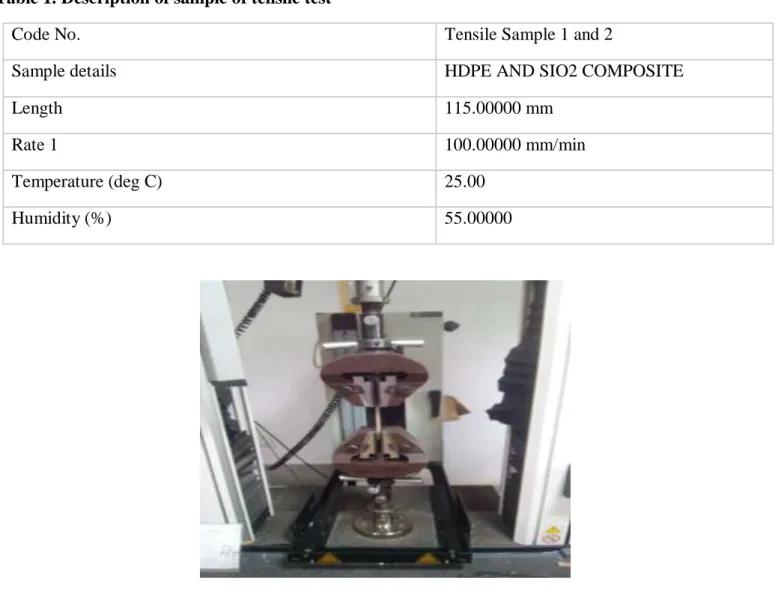
Table 1. Description of sample of tensile test
Code No. Tensile Sample 1 and 2
Sample details HDPE AND SIO2 COMPOSITE
Length 115.00000 mm
Rate 1 100.00000 mm/min
Temperature (deg C) 25.00
Humidity (%) 55.00000
Figure 1. Tensile test of specimen
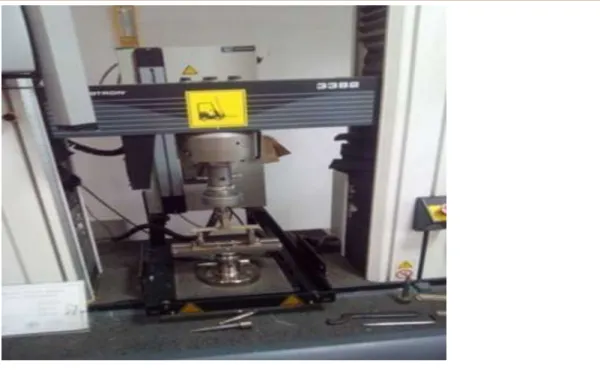
Flexural test has also been performed on the sample in order to determine flexural modulus. The description of sample is discussed i Table 2.
Table 2. Description of sample of flexural test
Test: Rate 1 2.77000 mm/min
Text Inputs: Sample details HDPE & Nano particle of Sio2
Number Inputs: Temperature (C) 18.00
Figure 2. Flexural test of specimen
3. Results and discussion
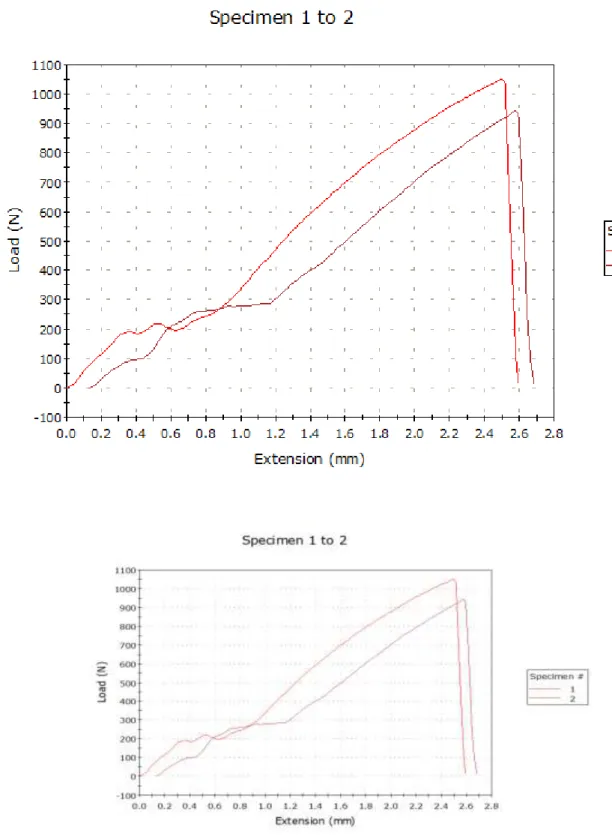
A uniaxial tension test has been performed on the sample prepared and the results obtained are discussed below:
Table 3. Observation of tensile test
Stages Length
(mm)
Thickness
(mm)
Width
(mm)
Maximum Load
(N)
Tensile stress at Maximum Load (MPa)
1 115.00000 6.50000 12.90000 1050.80 12.5
2 115.00000 6.50000 12.90000 941.95 11.2
Maximu m
115.00000 6.50000 12.90000 1050.80 12.5
Minimu m
115.00000 6.50000 12.90000 941.95 11.2
Figure 3. Graph between Load v/s Extension under Tensile Force.
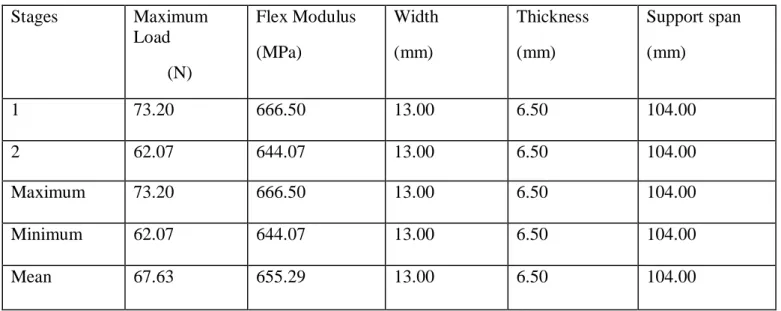
gets failed. The maximum noted force is known as the flexural strength of that particular sample. The following results are obtained by performing flexural test on the specimen:
Table 4. Observation of flexural test
Stages Maximum
Load
(N)
Flex Modulus
(MPa)
Width
(mm)
Thickness
(mm)
Support span
(mm)
1 73.20 666.50 13.00 6.50 104.00
2 62.07 644.07 13.00 6.50 104.00
Maximum 73.20 666.50 13.00 6.50 104.00
Minimum 62.07 644.07 13.00 6.50 104.00
Mean 67.63 655.29 13.00 6.50 104.00
Figure 4. Graph between Flexure Stress v/s Flexure Strain
4. Conclusions
1. With the results of tensile test and flexural test we can conclude that tensile and flexural property of
hdpe, nano silica give positive effect.
2. We can see that when we use hdpe in pure form it has slightly low properties but when we used with
silica it gives better performance.
3. Incorporation of nano-SiO, particles that are pre-treated by graft polymerization into HDPE is a much
effective way for improving some mechanical properties of the matrix. This kind of improvement can be acquired at a nano-SiO, content as low as 0.75 ~01%. The mechanical response of the modified nanoparticles composites behaves differently, especially when elongation to break is taken into consideration, depending upon the structural nature of the polymers.
5. Acknowledgement
At this moment of accomplishment, first of all I would like to show deep sense of gratitude to my guide Mr.
ShivamTrivedi. This work would not have been possible without his guidance, support and encouragement.
Under hisguidance I successfully overcame many difficulties and learned a lot. Despite of all difficulties, he
used to review my thesis progress, give his valuable suggestions and made corrections. His unflinching courage and conviction will always inspire me, and I hope to continue to work with his noble thoughts.
6.References
[1] Mohsen Mohseni Tabar Taghi Tabarsa Mehdi Mashkour Abolghasem Khazaeian Using silicon
dioxide (SiO2) nano-powder as reinforcement for walnut shell flour/HDPE composite materials.
Received: 2 February 2015 / Accepted: 6 April 2015 Indian Academy of Wood Science 2015.
[2] Bledzki AK, Gassan, J. Composites reinforced with cellulose based fibers. J Prog Polym
Sci.1999;24(2):221–274.[Crossref], [Web of Science ®][Google Scholar].
[3] Peijs T. Composites turn green. E-Polymers. 2002;T_002:1–12.[Google Scholar].
[4] Marcovich NE, Villar MA. Thermal and mechanical characterization of linear low-density
polyethylene/wood flour composites. J Appl Polym Sci. 2003;90:2775–2784.[Crossref], [Web of
Science ®][Google Scholar]
[5] Li Z, Gao H, Wang Q. Preparation of highly filled wood flour/recycled high density polyethylene
composites by in situ reactive extrusion. J Appl Polym Sci. 2012;124(6):5247–5253.
[6] Keledi G, Sudar A, Burgstaller C, et al. Tensile and Impact properties of three-component
PP/wood/elastomer composites. Express Polym Lett. 2012;6(3):224–236.
[7] Tjong SC. Structure and mechanical properties of polymer Nano composites. Mater Sci Eng
Rep. 2006;53(3):73–197.
[8] D'Amato M, Dorigato A, Fambri L, et al. High performancepolyethylene nano composite fibers.
eXpress Polym. 2012;6(12):954–964.
[9] Chrissafis K, Paraskevopoulos KM, Pavlidou E, et al. Thermaldegradation mechanism of HDPE
nano composites containing fumed silica nanoparticles. Thermochim Acta. 2009;485(1):65–71.
[10] Chung DDL. Continuous carbon fiber polymer-matrix composites and their joints, studied by