52
How can Sequence Alignment Method Affect the
Phylogenetic Relationship Results?
Hossam F. Abou-Shaara
Damanhour University, Faculty of Agriculture, Departmentof Plant Protection, Damanhour, 22516, Egypt
Abstract
Sequence alignment is a fundamental step before analysing the phylogenetic relationships between organisms. The effect of the alignment method on the phylogenetic relationship results has not been well studied. Three methods for sequence alignment are available in Geneious software: (1) Geneious alignment, (2) ClustalW, and (3) MUSCLE. The study aimed to investigate the impacts of these three alignment methods on the phylogenetic relationships between test organisms. Therefore, the phylogenetic tree was established for the same organisms (honey bee species and subspecies) after using the three alignment methods, and then the results were compared. The constructed tree after using ClustalW differed than Geneious alignment and MUSCLE without a clear effect on relationship between the closely related organisms. Based on this study, it is better for researchers to test different alignment methods before constructing the final phylogenetic tree to select the most suitable one.
Keywords: bioinformatics; software; Geneious; NCBI; genetics.
1. Introduction
Bioinformatics is essential interdisciplinary field
of science to understand relationships between
organisms based on their genetic materials. Also,
this field of science helps in understanding the
genetic structure of organisms including the
effects
of
hybridization
on
them
[1].
Bioinformatics is developed rapidly in line with
the development of computer programs and
mathematical models. There are various computer
programs and online resources available to
perform bioinformatics studies.
The phylogenetic relationships between species
and subspecies of many organisms have been
studied [1-6]. Sequence alignment is the basic step
before constructing the phylogenetic tree between
organisms. The alignment can be performed using
different methods including: ClustalW [7],
MUSCLE [8], and Geneious [9]. The effects of
* Corresponding author: Hossam Abou-Shaara, Tel, 0453209743 Fax, 0453316535 Email,
the sequence alignment method on the constructed
phylogenetic
tree
have
not
been
widely
investigated. There are many programs currently
available to study the phylogenetic relationships
between organisms including Geneious software
[9]. This software allows the use of different
alignment methods. Therefore, the study aimed to
investigate the effects of three alignment methods
available
at
Geneious
(
Geneious alignment, ClustalW, and MUSCLE) on the results of the
phylogenetic relationships between some honey
bee species and subspecies (test organisms). The
outcomes of this study are essential for researchers
using bioinformatics.
2. Materials and methods
Sequences
Sequences for some honey bee subspecies and
species were selected to perform the analysis. The
sequences were downloaded from the National
Center
for
Biotechnology
Information
(https://www.ncbi.nlm.nih.gov/) (NCBI) for
Apis
53
16589 bp, [3]),
Apis mellifera sahariensis
(Accession no. NC_035883.1, 16569 bp, [10]),
Apis
mellifera
scutellata
(Accession
no.KJ601784.1, 16411 bp, [11]),
Apis mellifera
capensis
(Accession no. KX870183.1, 16470 bp,
[2]), and
Apis mellifera syriaca
(Accession no.
KP163643.1, 15428 bp, [12]). These subspecies
are highly close to each other and belong to the
same species (mellifera). Also, sequences to some
close bee species were used in the analysis,
Apis
nuluensis
(Accession no. NC_036235.1, 15843
bp,
[13]),
Apis
cerana
(Accession
no.
GQ162109.1, 15895 bp, [14]),
Apis koschevnikovi
(Accession no. AP017643.1, 15278 bp, [15]),
Apis
laboriosa
(Accession no. NC_036155.1, 15058
bp, [5]), and
Apis florea
(Accession no.
JX982136.1, 17694 bp, [16]).
Sequence alignment methods
The analysis was performed using Geneious prime
2019.1 (www.geneious.com). Three alignment
methods were tested: 1) Geneious alignment
(type: global alignment with free end gaps, and
cost matrix: 65% similarity), 2) MUSCLE
(3.8.425 by Robert C. Edgar with maximum
number of iterations of 8), and 3) ClustalW (2.1,
cost matrix: IUB, gap open cost=15, gap extend
cost= 6.66, with free end gaps). Then, the
phylogenetic trees were built using geneious tree
builder (genetic distance model: Tamura-Nei, tree
build method: Neighbor-joining, and without
outgroup) for the aligned sequences by the three
methods.
3. Results and Discussion
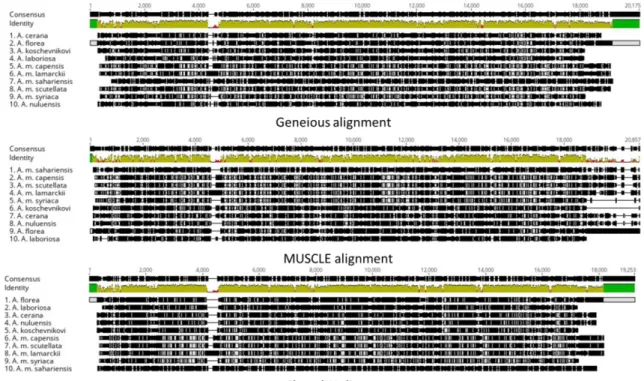
The results varied according to the alignment
method (Figure 1and 2). The subspecies
A. m.
sahariensis
had the lowest identity percentage
according to the three alignment methods. The
identity percentage of
A. m. sahariensis
ranged
from 53.19 to 55.82%, 43.87 to 48.29%, and
48.50 to 49.45% for Geneious alignment,
MUSCLE, and ClustalW, respectively.
54
Figure 2. Heat-map and identity% resulted from the three methods. The lowest identity percentage is to A. m. sahariensis (marked by a rectangle)
The phylogenetic trees constructed after Geneious
alignment or MUSCLE were highly similar
(Figure 3 and 4) and correctly separate subspecies
than species while
A. m. sahariensis
was placed in
a
separated
branch.
55
Figure 4. Phylogenetic trees constructed using MUSCLE (B). The lowest identity percentage is to A. m. sahariensis
(marked by a rectangle)
The tree constructed after using ClustalW (Figure
5) was partially different, and incorrectly placed a
subspecies (
A. m. sahariensis
) close to species (
A.
florea
). This can be explained by the differences
in the mathematical models used in each sequence
alignment method.
Figure 5. Phylogenetic trees constructed using ClustalW (C). The lowest identity percentage is to A. m. sahariensis
(marked by a rectangle)
Most relationships between the studied subspecies
except
A. m. sahariensis
were in line with
56
m. lamarckii
) and the Syrian honey bees (
A. m.
syriaca
) was previously found based on protein
coding genes and rRNA [3]. Also, the Egyptian
bees were placed away from other African bees
including
A. m. capensis
and
A. m. scutellata
[6],
and this supports the findings of the constructed
phylogenetic trees in this study using different
alignment methods. Moreover, the constructed
trees successfully placed two wild bees:
A. florea
and
A. laboriosa
close to each other and away
from cavity-nesting bees and this in accordance
with [17], except when ClustalW was used (Fig.
5).
4. Conclusion
It can be concluded that sequence alignment
method can affect the phylogenetic relationship
results. Based on this study, it is better to test
different sequence alignment methods to select the
most appropriate one for the analysis.
References
1. Abou-Shaara, H.F., Bayoumi, S.R. Using mitochondrial DNA similarity percentages to analyze the maternal source of hybrid bees from two honey bee subspecies. Scientific Papers: Animal Science and Biotechnologies, 2019, 52, 32-40.
2. Eimanifar, A., T. Kimball, R., L. Braun, E., Ellis, J. D., The complete mitochondrial genome of the Cape honey bee, Apis mellifera capensis Esch.(Insecta: hymenoptera: apidae). Mitochondrial DNA Part B,
2016, 1, 817-819.
https://doi.org/10.1080/23802359.2016.1241682
3. Eimanifar, A., T. Kimball, R., L. Braun, E., M. Moustafa, D., Haddad, N., Fuchs, S., Grunewald, B., Ellis, J. D., The complete mitochondrial genome of the Egyptian honey bee, Apis mellifera lamarckii (Insecta: Hymenoptera: Apidae). Mitochondrial DNA Part B,
2017a, 2, 270-272.
https://doi.org/10.1080/23802359.2017.1325343
4. Abou-Shaara, H.F. A scientific note on the evolutionary relationships between honey bees and their enemies. Agronomical Research in Moldavia, 2018, 51, 101-107.
https://doi.org/10.2478/cerce-2018-0009
5. Takahashi, J. I., Rai, J., Wakamiya, T., Okuyama, H., Characterization of the complete mitochondrial genome of the giant black Himalayan honeybee (Apis laboriosa) from Nepal. Conservation Genetic Resources, 2018, 10, 59-63.
https://doi.org/10.1007/s12686-017-0765-6
6. Abou-Shaara, H.F. Utilizing bioinformatics to detect genetic similarities between African honey bee
subspecies. Journal of Genetics, 2019, 98, 96.
https://doi.org/10.1007/s12041-019-1145-7
7. Thompson, J. D., Gibson, T. J., Higgins, D. G., Multiple sequence alignment using ClustalW and ClustalX. Current Protocols in Bioinformatics, 2003, 1, 2-3. https://doi.org/10.1002/0471250953.bi0203s00 8. Edgar, R. C., MUSCLE: multiple sequence alignment with high accuracy and high throughput. Nucleic Acids Research, 2004, 32, 1792-1797.
https://doi.org/10.1093/nar/gkh340
9. Kearse, M., Moir, R., Wilson, A., Stones-Havas, S., Cheung, M., Sturrock, S., Buxton, S., Cooper, A., Markowitz, S., Duran, C., Thierer, T., Ashton, B., Mentjies, P., Drummond, A. Geneious Basic: an integrated and extendable desktop software platform for the organization and analysis of sequence data. Bioinformatics, 2012, 28, 1647-1649.
https://doi.org/10.1093/bioinformatics/bts
10. Haddad, N., Adjlane, N., Loucif-Ayad, W., Dash, A., Rajashekar, B., Al-Nakeeb, K., Sicheritz-Ponten, T., Mitochondrial genome of the North African Sahara Honeybee, Apis mellifera sahariensis (Hymenoptera: Apidae). Mitochondrial DNA Part B, 2017, 2, 548-549.
https://doi.org/10.1080/23802359.2017.1365647
11. Gibson, J. D., Hunt, G. J., The complete mitochondrial genome of the invasive Africanized honey bee, Apis mellifera scutellata (Insecta: Hymenoptera: Apidae). Mitochondrial DNA Part A,
2016, 27, 561-562.
https://doi.org/10.3109/19401736.2014.905858
12. Haddad, N. J., Mitochondrial genome of the Levant Region honeybee, Apis mellifera syriaca
(Hymenoptera: Apidae). Mitochondrial DNA Part A,
2016, 27, 4067-4068.
https://doi.org/10.3109/19401736.2014.1003846
13. Eimanifar, A., Kimball, R. T., Braun, E. L., Fuchs, S., Grünewald, B., Ellis, J. D., The complete mitochondrial genome and phylogenetic placement of
Apis nigrocincta Smith (Insecta: Hymenoptera: Apidae), an Asian, cavity-nesting honey bee. Mitochondrial DNA Part B, 2017b, 2, 249-250.
https://doi.org/10.1080/23802359.2017.1318683
14. Tan, H. W., Liu, G. H., Dong, X., Lin, R. Q., Song, H. Q., Huang, S. Y., Yuan,Z.G., Zhao,G.H., Zhu, X. Q., The complete mitochondrial genome of the Asiatic cavity-nesting honeybee Apis cerana (Hymenoptera: Apidae). Plos one, 2011, 6, e23008.
https://doi.org/10.1371/journal.pone.0023008
15. Wakamiya, T., Tingek, S., Okuyama, H., Kiyoshi, T., Takahashi, J. I., The complete mitochondrial genome of the cavity-nesting honeybee, Apis koschevnikovi (Insecta: Hymenoptera: Apidae). Mitochondrial DNA Part B, 2017, 2, 24-25.
https://doi.org/10.1080/23802359.2016.1275847
57
(Hymenoptera: Apidae). Mitochondrial DNA, 2013,
24, 208-210.
https://doi.org/10.3109/19401736.2012.744986
17. Arias, M.C., Sheppard, W.S. Phylogenetic relationships of honey bees (Hymenoptera: Apinae:
Apini) inferred from nuclear and mitochondrial DNA sequence data. Molecular Phylogenetic and Evolution,
2005, 37, 25-35.