Aliso: A Journal of Systematic and Evolutionary Botany
Volume 14 | Issue 4
Article 9
1995
Crossroads, Milestones, amd Landmarks in Insect
Development and Evolution: Implications for
Systematics
Rob DeSalle
American Museum of Natural History
Donat Agosti
American Museum of Natural History
Michael Whiting
American Musem of Natural History
Beatriz Perez-Sweeney
Columbia UniversityJames Remsen
New York UniversitySee next page for additional authors
Follow this and additional works at:
http://scholarship.claremont.edu/aliso
Part of the
Botany Commons
Recommended Citation
DeSalle, Rob; Agosti, Donat; Whiting, Michael; Perez-Sweeney, Beatriz; Remsen, James; Baker, Rick; Bonacum, James; and Bang, Ranhy (1995) "Crossroads, Milestones, amd Landmarks in Insect Development and Evolution: Implications for Systematics,"Aliso: A Journal of Systematic and Evolutionary Botany: Vol. 14: Iss. 4, Article 9.
Crossroads, Milestones, amd Landmarks in Insect Development and
Evolution: Implications for Systematics
Authors
Rob DeSalle, Donat Agosti, Michael Whiting, Beatriz Perez-Sweeney, James Remsen, Rick Baker, James
Bonacum, and Ranhy Bang
Ill•'
---l
I
Il
Aliso, 14(4), pp, 305-321
© 1996, by The Rancho Santa Ana Botanic Garden, Claremont, CA 91711-3157
CROSSROADS, MILESTONES AND LANDMARKS IN INSECT DEVELOPMENT AND EVOLUTION: IMPLICATIONS FOR SYSTEMATICS
RoB DESALLE, DoNAT Aoosn, MICHAEL WHmNG
Department of Entomology American Museum of Natural History
79th Street at Central Park West New York, New York 10024
FAX: 212-769-5277 e-mail: [email protected]
BEATRIZ PEREZ-SWEENEY
Department of Anthropology Columbia University New York, New York 10035
JAMES REMSEN
Department of Biology New York University New York, New York 10003
RICK BAKER AND JAMES BONACUM
Department of Biology Yale University
New Haven ConneCticut 06511
RANHY BANG
Department of Entomology Cornell University Ithaca, New York 14853
ABSTRACT
Our understanding of insect development and evolution has increased greatly due to recent advances in the comparative developmental approach. Modem developmental biology techniques such as in situ hybridization and molecular analysis of developmentally important genes and gene families have greatly facilitated these advances. The role of the comparative developmental approach in insect systematics is explored in this paper and we suggest two important applications of the approach to insect systematics--character dissection and morphologicallandmarking. Exi~ng morphological char-acters can be dissected into their genetic and molecular components in some cases and this will lead to more and richer character information in systematic studies. Character landmarking will be essential -to systematic studies for clarifying structures such as shapes or convergences, which are previously hard to analyze anatomical regions. Both approaches will aid greatly in expanding our understanding of homology in particular, and insect development in general.
Key words: Drosophila, germ-band formation, insect development, insect evolution, insect systematics
INTRODUCTION
The role of developmental information in system-atics has been twofold (Shubin 1994). First, embryo-logical information has been used to establish hypoth-eses of homology among characters in systematic anal-yses and second the information has been used to po-larize characters (the ontogenetic criterion; Nelson
tech-niques can add to systematic analyses in other equally important ways.
In particular, molecular comparative biology of de-velopment allows the discovery of new morphological characters and more detailed dissection of existing morphological characters. In order to detail how mod-em developmental biology can interact with systmod-ematic analyses we need to first show what kinds of morpho-logical information this new technology can provide, and to place this new information in the context of systematics. The purpose of this paper, therefore, is twofold. The first objective is to give the reader an indication of the state of the art of developmental bi-ology and genetics in the model organism Drosophila melanogaster and to relate this knowledge to insect systematics. The summary presented herein should demonstrate both the great potential of insect devel-opment systems and the difficulties associated with collecting the developmental information from a wide variety of taxa for systematic purposes. The second objective of this paper is to make some suggestions as to how developmental analysis can and will be used in future systematic studies of insects.
CROSSROADS AND MILESTONES
Modem developmental biology and evolutionary bi-ology have recently converged at a significant and pro-ductive crossroads. Developmental biologists have re-cently spread out from their favorite model organisms to impart an evolutionary aspect to their understanding of development. Drosophila specialists have recently recognized the importance of applying developmental
techniques and approaches to organisms other than D.
melanogaster (Patel 1994a, b; Carroll 1994; Tautz 1994; Tautz et al.1994; Akam et al. 1994). Other in-vertebrate developmental biologists and in-vertebrate spe-cialists have applied their approaches to questions re-lated to evolution (Kenyon 1994; Davidson 1991, 1994; Tabin 1992; Gurdon 1992; Wolpert 1994; DeRobertis 1994; Duboule 1994; Sander 1994; Laufer and Marigo 1994; Burke et al. 1995; Zuker 1994). Fol-lowing the insightful lead more than 10 years ago of Raff and Kaufman (1983), evolutionary biologists are again taking a hard look at developmental biology as a source of information in understanding evolutionary mechanisms and pathways and also in systematics (Conway-Morris 1994; Wray and Bely 1994; Dickin-son et al. 1993; DeSalle and Grimaldi 1993; Jacobs 1990, 1994; Davidson 1991, 1994; Bitsch 1994).
One of the factors that has most assuredly facilitated this broadening of interests by both developmental and evolutionary biologists is the availability of a wide va-riety of techniques for developmental analysis. For the most part, these techniques have been unavailable for
organisms other than model systems. If not for the
model systems though, these tools and techniques would not exist and much of the broadening of the comparative method has these model systems to thank. In insect studies advancement of Drosophila as a mod-el system (Rubin 1989; Merriam et al. 1991; DeSalle and Grimaldi 1993) has been a critical step in reesta-blishing insect development as a part of evolutionary studies. The development of Drosophila as a model system has proceeded largely because of three histor-ical events that have or will reach significant anniver-saries by 1995. These three milestones are the clarifi-cation of the term homeosis (Bateson 1894; McGinnis 1994; Gehring 1993; Lewis 1994; Laufer and Marigo 1994), the classification of early developmental events via massive mutant screens (Niisslein-Volhard and Weischaus 1980) and the discovery of the homeobox
using molecular techniques (McGinnis et al. 1984a, b;
Scott and Weiner 1984). William Bateson's (1894)
coining of the term homeosis1 and clarification of its
role in producing morphological variation in organ-isms was an important first step in the unraveling of the genetics of development. Undoubtedly, this clari-fication of the role of homeosis in morphological evo-lution such as first described by Bateson ( 1894) has greatly advanced our knowledge of development. One need look no further than Lewis (1978) or Kaufman et al. (1980) and the discovery and characterization of the Bithorax (BX-C) and Antennapedia (ANT-C) Complexes, respectively in D. melanogaster to grasp the importance of Bateson's clarification of the term homeosis.
Equally important as the pioneering work done by Bateson (1894) is the second milestone accomplished 15 years ago, the immense mutant screening forma-ternal effect genes and early embryonic genes con-ducted by Niisslein-Volhard and Weischaus (1980). Up to the time of this 1980 study only a handful of ma-ternal effect and embryonic lethal mutants had been characterized. This work established the developmen-tal hierarchy in Drosophila discussed below, and is remarkable in that the majority of mutants isolated by
1 Morphological anomalies were known to be present in a wide
~---VOLUME 14, NUMBER 4
these workers were embryonic lethal. The clarification and characterization of homeotic transformations in a wide variety of organisms by Bateson (1894) and early developmental genes in Drosophila (Niisslein-Volhard and Weischaus 1981) laid the groundwork for the third milestone alluded to above: the lOth anniversary of the discovery of the homeobox (McGinnis et al.
1984a, b; Scott and Weiner 1984). The discovery of
this protein motif and its subsequent characterization gave molecular biologists a foothold into developmen-tal processes (reviewed in McGinnis 1994 and Gehring 1993). One significant contribution from these molec-ular studies is that the homeobox genes in a wide va-riety of organisms are very similar in sequence. The sequence similarity of these genes allowed a great leap forward in developmental biology because important developmental genes could be obtained relatively sim-ply and compared across large phylogenetic distances. Most importantly for our discussion, the techniques of antibody staining and in situ hybridization of probes to embryos were developed as a direct result of these molecular studies. Antibody staining and in situ hy-bridization as well as enhancer trap methods (Bier et al. 1989; Bellen et al. 1989; Wilson et al. 1989) facil-itated the direct localization of developmental gene products in developing D. melanogaster embryos. These techniques allow the comparison of altered and wild type gene function in the fruit fly by direct de-termination of the spatial organization of gene prod-ucts.
More recently, developmental biologists and molec-ular biologists have begun to broaden the organismal base for spatial expression studies of developmentally important genes. Davidson ( 1994) offers a lucid re-view of the growth and the state of the art in the field of "developmental molecular biology." In order to discuss some of the exciting results obtained from the molecular approach to comparative biology and their implications in systematics, some background on the processes involved in the spatial organization of the embryo and its gene products is necessary. Obviously, space restrictions do not allow a thorough discussion of all of the nuances of Drosophila development. However, the following discussion should provide an adequate background yet instill in the reader the notion that development of even this relatively simple insect is quite complex.
THE COMPARATIVE MOLECULAR APPROACH
Axes, Germ-Bands and Secondary Fields in Insect Development
One area of the tree of life that has experienced a relatively intense organismal sampling of developmen-tal processes are the Arthropods. In particular, a large number of research programs have exploited the vast
307
knowledge and technical expertise that is centered around the understanding of the development of the model research organism, D. melanogaster (Ransom 1982; Ashburner et al. 1978; DeRobertis et al. 1986; Ashburner 1989; Campos-Ortega and Hartenstein 1985; Lawrence 1992; Bate and Martinez-Arias 1993; Lindsley and Zim 1992) to examine other insect sys-tems. In addition, excellent classical treatments of in-sect morphology and development exist (Sander 1976; Matsuda 1976; Snodgrass 1935; Schwalm 1988; Anderson 1972a, b, 1973) that allow the application of developmental principles and patterns obtained from the study of Drosophila to a wider array of insect taxa.
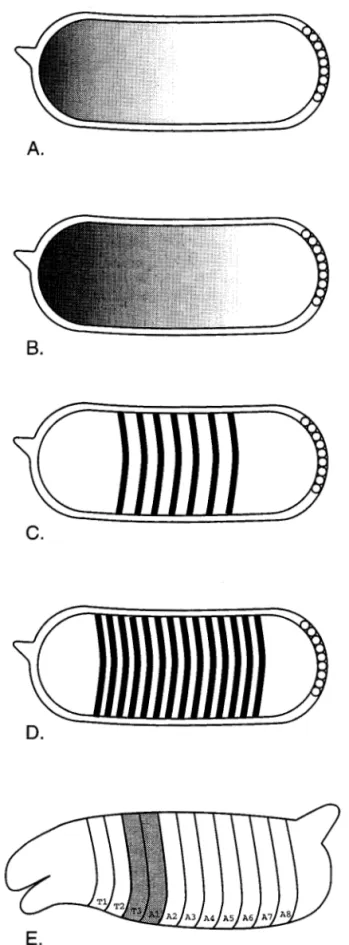
The initial determination of the spatial and temporal distribution of gene products in the developmental hi-erarchy of D. melanogaster resulted in several sur-prising discoveries such as the existence of protein gradients in the early embryo and distinctive "band-ing" or "strip"band-ing" patterns of gene products in the developing embryo (Fig. 1). The targets of molecular studies in insect development can be conveniently sep-arated into two areas that roughly coincide with Dav-idson's (1994) "initial spatial specification mecha-nisms" and limb "pattern formation" subdivisions. These two areas also coincide with the primary em-bryonic axes determining systems and the secondary fields within these primary embryonic axes that give rise to limbs (Williams and Carroll 1993).
Studies emphasizing analyses of the primary em-bryonic axes concern analyses of zygotic and early embryonic groundplan. These studies involve the ex-amination of early developmental events such as de-termination of germ-band formation, segmental iden-tity, and segment polarity. Maternally and zygotically active genes determine the Anterior-Posterior (AP), and the Dorsal-Ventral (DV), embryonic axes. Three gene systems determine the AP axis and one deter-mines the DV axis (Niisslein Volhard 1980; Govind and Steward 1991; Lawrence and Sampedro 1993; Sprenger and Niisslein-Volhard 1993). Zygotically ac-tive pattern genes then refine the AP and DV axes by appearance in a regulatory hierarchy (Niisslein-Vol-hard and Wesichaus 1980; Pankratz and Jackle 1990, 1993; Carroll 1990) that includes gap genes, pair-rule genes, segment polarity genes and homeotic genes· (Fig. 1). Each segment can be thought of as being divided into an anterior and posterior compartment and the pair-rule genes and segment polarity genes are es-sential for this compartmentalization in the developing segments of the embryo.
I' i
A.
Fig. 1. Schematic drawings of antibody and in situ staining of Drosophila melanogaster embryos to show the embryonic location of gene products from the five classes of genes in the developmental hierarchy. A representative gene from each class in the hierarchy is presented in these schematics. In general, antibody and in situ ex-periments give the same results for the genes depicted. For a more detailed description of these types of experiments see Patel
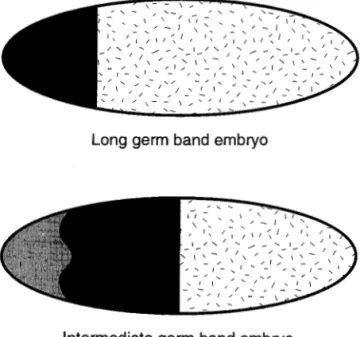
b, c). These terms describing the embryo are meant to differentiate functional aspects of insect embryogene-sis. At the germband stage all insects have the same basic segmental organization which consists of a head with three gnathal segments (the mandibular, maxil-lary, and labial segments) and a procephalic region. Three thoracic segments follow the head with 8-11 abdominal segments completing the posterior portion of the germ-band stage embryo. Long-germ-band em-bryos appear to lay down the entire segmental pattern by the onset of gastrulation; short-germ-band insects deploy body segments during a post-blastoderm growth phase, and intermediate band insects have seg-ments as far posterior as the thorax and even the an-terior abdomen established at the blastoderm stage, while segments posterior to these are established after gastrulation in a processional fashion. The utility of the germ-band terminology with respect to systematics and homology is discussed below.
The secondary fields mentioned by Carroll (1994, 1995) and Davidson (1994) involve, among other things, the development of limbs. Holometabolous in-sects such as the Diptera and Lepidoptera develop through larval stages where limb anlagen called ima-ginal discs are formed on the inside of the larvae. These discs form as epidermal invaginations in genet-ically and developmentally predetermined positions along the anterior posterior axis of the larva. In Dro-sophila there are 19 imaginal discs that correspond to the eye-antennal pair, the three pairs of leg discs, a pair of wing discs, a pair of haltere discs, a pair of labial discs, a pair of clypeo-labral discs, a pair of dorsal prothoracic discs (humeral discs) and a genital disc (Russel 1982; Oberlander 1985). Like the seg-ments in the developing embryo, each imaginal disc can also be divided into compartments that are estab-lished by the interaction of developmental gene prod-ucts discussed below.
Development of secondary fields in the larvae of holometabolous insects is extremely complex, but re-cent work (Williams and Carroll 1993; Cohen 1990,
VOLUME 14, NUMBER 4
Long germ band embryo
Intermediate germ band embryo
Short germ band embryo
-
head and thorax._I''_,_'
_::---'-,'-"~1
metameric regionFig. 2. Schematic representation of a long-germ-band embryo (top), an intermediate germ-band embryo (middle) and a short-germ-band embryo (bottom). The black regions will eventually develop into head and thoracic structures. The metameric region is stipled and will eventually develop into the abdominal and terminal regions of the insect. For more details see the text.
1993) has somewhat clarified our understanding of the processes that occur at the genetic and molecular lev-els. In this section we will concentrate on a brief re-view of the events responsible for wing development, as this particular limb has been used as a paradigm for limb development by several authors (Williams and Carroll 1993; North and French 1994; Davidson 1994). We divide the events for limb differentiation into five, more or less, distinct stages that correspond roughly to the stages listed in Williams and Carroll
309
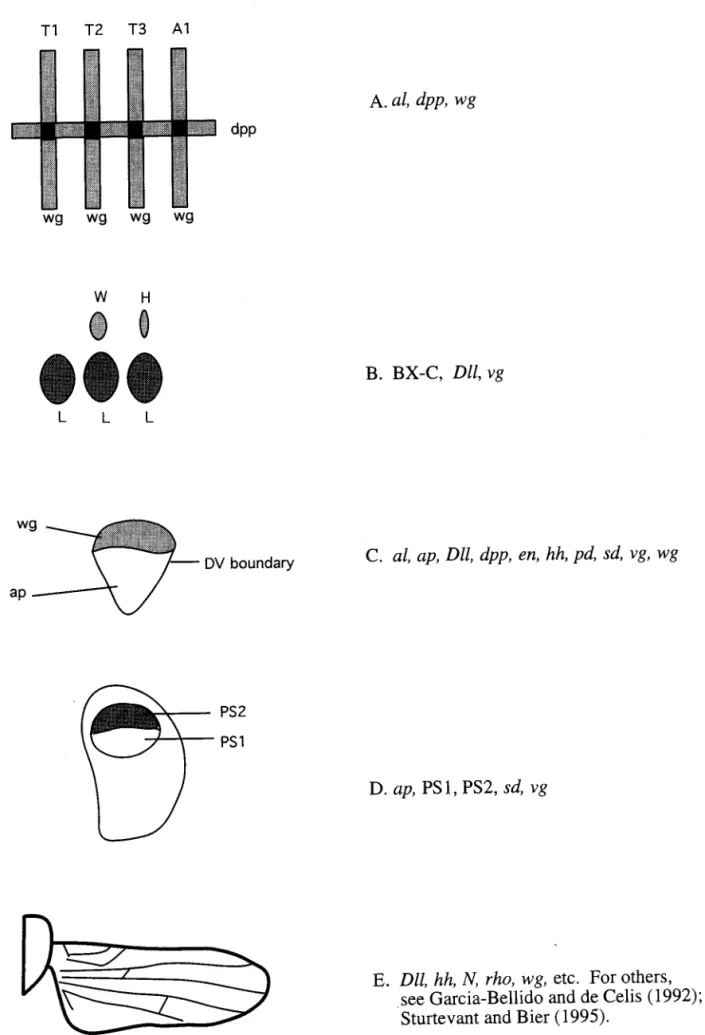
(1993). Although we list these as distinct stages, gene products and interactions required in one stage are of-ten essential in other stages (Fig. 3).
The five stages are: 1) determination of the position of the wing disc along the AP axis of the larval body plan; 2) determination of limb fate, i.e., whether the disc will become a wing, a leg, a haltere, etc.; 3) the establishment of the three fields of orientation in the imaginal disc: anterior-posterior (AP), dorsal-ventral (DV), and proximal-distal (PD); 4) surface elaboration including the determination of the position of the no-tum versus the wing proper and differentiation of the dorsal and ventral wing surfaces; and 5) the imple-mentation of venation and sensilla formation by a wide variety of genes and genetic interactions. Unique evo-lutionary questions can be assigned to each of these different stages. Most of the evolutionary questions addressed to date have been concerned with limb fate and position, but studies on pattern elaboration of wings show great potential (Carroll 1994).
Comparative Molecular Insights: The Primary Developmental Field
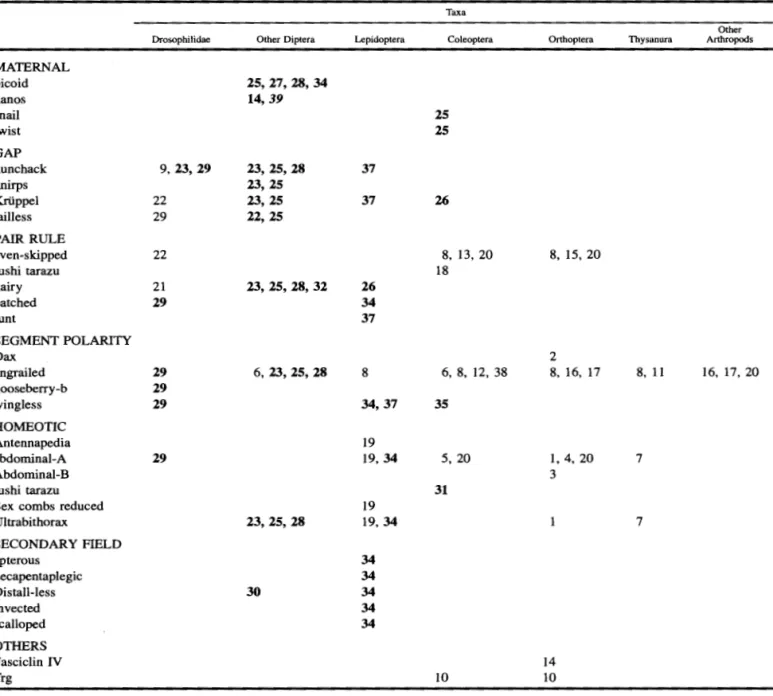
Studies examining the early embryonic develop-ment of insects have for the most part used early-act-ing segment polarity genes and pair-rule genes, and have in general been instrumental in forming a picture of segmentation in developing insect embryos as well as a better understanding of the evolution of the germ-band developmental strategies discussed in Fig. 2. The strategy used in these studies is to directly compare the patterns seen in D. melanogaster with other taxa and to place the observed differences in an evolution-ary context using the current hypotheses concerning insect phylogeny (Patel 1994a, b, c; Tautz et al. 1994; Akam et al. 1994). Table 1 summarizes these types of comparative molecular studies done for insects. The types of insect developmental evolution questions con-cerning the primary fields of development that have been addressed using this comparative approach in-clude the evolution of mesoderm formation, formation of the gut, the evolution of oogenesis and maternal gene function (Tautz et al. 1994; Patel1994a), the uni-versality of parasegments and the origins of pair-rule organization in insect embryos (Patel et al. 1994; Patel 1994a, b, c)
Germ-band formation in insects has been the major subject of comparative molecular studies. Drosophila melanogaster, a long-germ-band insect, has been ex-amined for several early segmentation genes (Table 1). The general approaches to examining this problem in-volve the determination of the position and timing of expression of engrailed (en) stripes in a variety of long- and short-germ-band insects (Patel 1994a, b;
ob-T1 T2 T3
wg wg
w
Ht
''
L L L
A1
dpp
wg
DV boundary
A.
al, dpp, wg
B. BX-C, Dll, vg
C. al, ap, Dll, dpp, en, hh, pd, sd, vg, wg
D. ap, PS1, PS2, sd, vg
E. Dll, hh, N, rho, wg, etc. For others,
.see Garcia-Bellido and de Celis (1992);
Sturtevant and Bier (1995).
'
VOLUME 14, NUMBER 4
tained from studies using pair-rule and segment polar-ity genes (Patel et al. 1994).
The spatial and temporal distribution of the en gene product can conveniently be used to determine the po-sition of the posterior compartment of each segment during development. In this sense, en expression can refine our understanding of germ-band extension at the molecular level by actually demonstrating whether or not the signals for segmentation are present at various developmental stages in insects with different germ-band strategies. In D. melanogaster there are 14 en stripes in the blastoderm embryo, three representing the head segments, three for the thoracic segments and eight for the abdominal segments. These data suggest that the signals necessary for all segments are present in this long-germ-band insect at the blastoderm stage. Patel (1994a) suggests that there are two possibili-ties for the formation of segments in the short-germ-band insects; first, all segments could be established at the blastoderm stage as in long-germ-band insects and expand during the growth phase, or, second, the proliferative zone could generate the information need-ed for segments and the segments would then form sequentially after the growth phase. Two short-germ-band insects have been used to determine the mode of segment determination. Using the en antibody to detect segmental position in developing embryos, the short-germ beetle, Tribolium castaneum, shows sequential establishment of segments. In particular, at the begin-ning of gastrulation a single en stripe appears that cor-responds to the mandibular segment. The remaining en stripes corresponding to the rest of the segments in this insect then appear sequentially during the rest of embryogenesis. A second short-germ insect, Schisto-cerca, shows establishment of the first en stripes in the
311
thorax, with no apparent evidence of en activity in the area where abdominal cells will eventually proliferate. Later in embryogenesis, the abdominal en stripes be-gin to appear sequentially from an area of new cell proliferation. Examination of the distribution of other developmental gene products in embryos of short-germ-band insects supports the contention that these insects develop by sequential differentiation of seg-ments from zones of cell proliferation (wingless [wg] in T. castaneum: Nagy and Carroll 1994; Antennape-dia [Antp], Ultrabithorax [Ubx], abdominal-A [abd-A] and Abdominal-B [Abd-B] in Schistocerca: Tear et al. 1990, Kelsh et al. 1993, 1994, Patel 1994b; hairy
[h) and even skipped [eve] in T. castaneum: Sommer
and Tautz 1993, Patel et al. 1994; eve in Schistocerca: Patel et al. 1992; Patel 1994a).
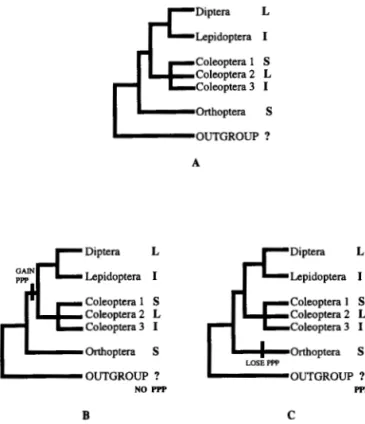
Although en staining at various developmental stages in a wide variety of organisms has been instru-mental in determining the modes of germ-band elon-gation (Patel 1994a; Sommer and Tautz 1993) an ex-planation for the phylogenetic distribution of germ-band strategies comes from other sources. Figure 4 shows the phylogenetic distribution of long-, short-and intermediate-germ-bshort-and strategies for several or-ders of insects and demonstrates that germ-banded-ness, per se, shows a homoplasious distribution.
Characterization of the spatial distribution of pair-rule genes that are responsible for the "transient
dou-ble segmental organization" of the developing D.
mel-anogaster embryo (Patel et al. 1994) has added to the understanding of germ-band formation in insects. More detailed examination of this pair-rule gene ex-pression in the four insect orders discussed in Table 1 (Diptera, Coleoptera, Lepidoptera and Orthoptera) ren-der a high degree of interpretability of
Table 1. Summary of the antibody staining (plain text) and in situ hybridization (bold text) studies done on the various classes of genes in the regulatory hierarchy.1
Taxa
Drosophilidae Other Diptera Lepidoptera Coleoptera Orthoptera Thysanura
Other
Arthropods
MATERNAL bicoid nanos snail twist GAP hunchack knirps Knippel tailless PAIR RULE even-skipped fushi tarazu hairy patched runt
SEGMENT POLARITY Dax
engrailed gooseberry-b
9, 23, 29
22 29
22
21 29
25, 27' 28, 34 14,39
23, 25,28 23, 25 23, 25 22, 25
23, 25, 28, 32
6, 23, 25,28 37
37
26
34 37
8
25 25
26
8, 13, 20 18
6, 8, 12, 38
8, 15, 20
2
8, 16, 17 8, 11 16, 17, 20
wingless
29 29
29 34,37 35
HOMEOTIC Antennapedia abdominal-A Abdominal-B
29
19
19,34 5, 20 1, 4, 20 3
7
fushi tarazu 31
19 Sex combs reduced
Ultrabithorax 23, 25,28 19, 34 7
SECONDARY FIELD apterous
decapentaplegic Distall-less invected scalloped OTHERS Fasciclin IV Trg
30
34 34 34 34 34
10
14
10
1 The individual genes used in the studies are indicated in the left hand column. The studies are also listed so that the particular type of
insect on which the experiments were performed are indicated in the row at the top. References in bold refer to in situ hybridization, otherwise to antibody hybridization. 1 Kelsh et al. 1994; 2 Dawes et al. 1994; 3 Kelsh et al. 1993; 4 Tear et al. 1990; 5 Stuart et al. 1993; 6 Schmidt-Ott et al. 1994; 7 Carroll et al. 1995; 8 Patel 1994b; 9 Treier et al. 1989; 10 Kispert et al. 1994; 11 Scholtz et al. 1994; Brown et al. 1994; 13 Patel et al. 1994; 14 Kolodkin et al. 1992; 15 Patel et al. 1992; 16 Patel et al. 1989a; 17 Patel et al. 1989b; 18 Brown et al. 1994; 19 Warren et al. 1994; 20 Patel 1994a; 21 Tautz and Sommer 1995; 22 Reuter et al. 1989; 23 Sommer and Tautz 1991; 24 Lukowitz et al. 1994; 25 Sommer and Tautz 1994; 26 Sommer and Tautz 1993; 27 SchrOder and Sander 1993; 28 Tautz and Sommer 1995; 29 Dickinson et al. 1993; 30 Panganiban et al. 1994; 31 Brown et al. 1994; 32 Carroll et al. 1994; 33 Langeland and Carroll 1993; 34 Carroll 1994; 35 Nagy and Carroll 1994; 36 Webster et al. 1994; 37 Kraft and Jiickle 1994; 38 Fleig 1994; 39 Curtis et al. 1995.
ness in these insects. The domains of segment polarity genes such as en and wg are established by pair-rule genes in D. melanogaster. When examined for eve
ex-pression, this long-germ-band insect has a seven stripe pattern in the early embryo that modulates the fourteen stripe en pattern. The short-germ-insect Schistocerca
displays no segmental pattern of eve expression with
the domain of expression of this gene product being
primarily in the posterior portion of the gastrulating embryo. Sequential en expression that marks the
seg-ments in the embryo (see above) proceeds without the expression of eve to regulate position as the eve signal
remains in the posterior domain of the developing em-bryo. In the second short-germ-insect Tribolium, eve
lepidop-VOLUME 14, NUMBER 4
L
s
L I..._ _ _ Orthoptera S . _ _ _ _ •OUTGROUP ?
A
Diptera L
Lepidoptera
Coleoptera I
s
Coleoptera 2 LColeoptera 3 I
Orthoptera
s
OUTGROUP?
NO PPP
B
Diptera L
Lepidoptera
Coleoptera I
s
Coleoptera 2 LColeoptera 3 I
Orthoptera
s
OUTGROUP?
ppp
c
Fig. 4. A. The phylogenetic distribution of long-, short- and in-termediate-germ-band modes of development among Diptera, Co-leoptera, Orthoptera and Lepidoptera are shown. The germ-band character state for the outgroup is presumed unknown.-B, C. Dis-section of germ-band character state using the pair-rule prepatteming (PPP) criterion established by Patel (1994a, b). These cladograms suggest two character reconstructions due to the unknown character state for PPP in the ancestor to the four insect orders examined. In one reconstruction (B) the ancestor is presumed to lack PPP and hence the gain of PPP is a synapomorphy for Diptera, Coleoptera and Lepidoptera. In the second reconstruction (C) the outgroup is presumed to have PPP and hence the loss of PPP is an apomorphy for the Orthopteran lineage. Either reconstruction would reinterpret the homoplasy of the short- and long-germ-banded character states depicted in A and suggest a lack of homology for character desig-nations such as long, short, and intermediate.
teran Manduca sexta, can be used as an example of an intermediate band insect (Broadie et al. 1991; Sander 1976; Kraft and Jackie 1994). Manducas sexta shows an early embryonic morphology that resembles short-germ-band insects in that only head lobes and a region that resembles a growth zone are present in the de-veloping embryo. The major difference between M.
sexta and a short-germ-band insect is that instead of undergoing cell proliferation in the growth zone as short-germ-band insects will do, M. sexta develops by elongation of the germ-band through tissue reorgani-zation. When M. sexta was examined using the pair-rule gene runt and the segment polarity gene wg, 8 and 16 stripes, respectively, were observed in the early embryo (Kraft and Jackie 1994). These results suggest a pattern of pair-rule regulation of segment polarity expression in this insect also. Two other Coleoptera have been examined (Patel et al. 1994) due to their variable germ-band designations and it is evident that
313
there is pair-rule prepatterning in these taxa similar to that of Tribolium. These comparative molecular stud-ies demonstrate that a complex morphological char-acter such as germ-handedness can be interpreted in molecular terms. Germ-handedness can be dissected into the presence or absence of pair-rule prepatterning and the implications for this dissection with respect to character evolution in insects will be discussed below.
Comparative Molecular Insights: The Secondary Developmental Field: Limbs
Carroll (1994; 1995) has divided the problem of in-sect appendage development and evolution into three major questions concerning differences in appendage number, differences in appendage type, and differences in pattern on the appendage. The evolution of append-age number has recently been examined by Carroll et al. (1995). This study used the observation that wing primordia can first be visualized in the developing em-bryo as discrete clusters of snail expressing cells and
vestigial producing cells using antibodies for these two gene products (Alberga et al. 1991). In D. melanogas-ter development of wings in all segments but T2 is repressed by homeotic gene activity (Ubx, abdA, AbdB, Scr and Antp; for a concise review see Carroll et al. 1995). Although homeotic gene repression is the mechanism by which loss of wing formation is imple-mented in the various segments, these genes are not at all involved in the actual development of adult wings (Carroll et al. 1995). This is an important piece of information because it suggests that the sole role of homeotic genes in the formation of wings in D. mel-anogaster is to repress expression of vestigial and
snail in the wing primordia and hence to repress the development of the wing.
In developing embryos of Thermobia domestica (a primitive apterygote Thysanurid insect that would rep-resent the condition prior to the "invention" of insect wings), abdA and Ubx are expressed in the posterior thoracic segments and the anteriormost abdominal seg-ments just as in the more derived pterygote insects described above. Carroll et al. ( 1995) use these data and the fossil record to suggest a plausible scenario for the evolution of insect wings. They suggest that the first stage in the evolution of wings in pterygote insects occurred on all segments of the insect, because there was no homeotic gene input into the repression of these structures on these segments. Subsequently, certain elements of wing formation must have evolved response mechanisms to homeotic (ANT-Cor BX-C) gene regulation. The Thermobia results suggest that homeotic gene structure and function have been con-served in the ancestral taxa and hence evolution of Scr
similar way, the evolution of Ubx and abdA responsive elements resulted in the repression of wing develop-ment on abdominal segdevelop-ments and further in diptera (two-winged pterygotes) the reduction of wings on the third thoracic segment.
Carroll (1994, 1995) suggests that the second class of questions one can approach with respect to limb development concerns determination of appendage type. He uses the evolution of halteres versus wings as an example of these differences and concludes that the regulation of homeotic target genes is involved in this class of differences. This mode of regulation should be contrasted with the appendage number dif-ferences where control of those difdif-ferences is through regulation by homeotic repression.
A recent study of the systematics of the enigmatic insect order Strepsiptera (twisted-wing parasites) sug-gests that regulation of appendage type and position may have been a factor in the evolution and diversi-fication of this group (Whiting and Wheeler 1994). Strepsiptera are a small order of insects (520 species) that are exclusively parasitic on a wide range of insect taxa. Adult male Strepsiptera have wings fully devel-oped on the third thoracic segment and wings on the second thoracic segment that are reduced to structures similar morphologically and functionally to the halter-es (reduced hind wings) of Diptera. Strepsiptera have been posited as the sister group to nearly every other order of insects, but recent work using 18S rONA and 28S rONA sequences and morphological characters strongly support the placement of Strepsiptera as the sister group to Diptera (Whiting and Wheeler 1994). This phylogenetic conclusion is important in that it raises the possibility that the same developmental mechanism responsible for the modification of the hal-tere in Diptera is also operating in Strepsiptera but on a different thoracic segment. It is plausible that this mechanism arose in the dipteran-strepsipteran ancestor, and its expression was subsequently switched to a dif-ferent thoracic segment, presumably in the strepsipter-an lineage, after their divergence. Studies into the ex-pression patterns of Ubx, abdA, AbdB, Scr and Antp in Strepsiptera, primitive Diptera, and other mecopter-oid insects, will bring further insight into the evolution of these genes in a phylogenetic context.
The final aspect of appendage development, pattern formation on the appendage, has used the excellent background work of Nijhout (1991, 1994) on butterfly wings. In particular, the buckeye, Proecis coenia, has been used as a model system. The unique aspect of Lepidoptera wings concerns the elaborate coloring and patterning of the colors on the wing, that although present in other orders of insects, is by no means as extreme as in the Lepidoptera. Carroll (1994) sum-marizes the developmental genes that have been iso-lated and characterized from this insect, and in
partie-ular these genes represent DV axis determining genes (apterous), PD axis determining genes (scalloped, Dis-tal-less), AP axis determining genes (invected, en-grailed and decapentaplegic) and wing margin genes (wingless) in the developing limb. Not surprisingly, Carroll et al. (1994) showed that the expression of these genes in P. coenia is very similar to the expres-sion patterns in D. melanogaster. On the other hand, the startling result arose that in the fifth instar P. coen-ia, these coordinate systems have been co-opted to produce a second pattern of transcription. Although the transcription patterns of most of the genes used do not correspond directly to pigment patterns in the adult wings, Carroll et al. (1994) suggest that they, "do re-flect a fundamental dynamic patterning system within each wing cell". Dll is one exception to this general noncorrespondence in that it has been suggested to be responsible for the initial proximodistal restriction of pigments, midline rays, posterior enlargements and the posterior eyespot (Carroll et al. 1994; Carroll 1995). The success stories that arise from studies in the three major areas of limb development discussed by Carroll (1994, 1995) demonstrate the plausibility of using the developmental approach to examine limb characters in systematic studies.
PHYLOGENETIC ANALYSIS AND PARALLELISMS
The deciphering of the evolution of germ-band
for-mation (Patel 1994a, b; Tautz et al. 1994) and the
tell-ing of the evolution of insect appendages (Carroll 1994, 1995) are indeed exciting, but these topics are not necessarily questions on which the typical insect systematist might capitalize. From the standpoint of systematics we are struck with very different group-specific problems that the developmental comparative approach can aid in deciphering. An examination of the systematics of the Drosophilidae will assist in dem-onstrating the kinds of problems that may arise in sys-tematic analysis at the generic level. Although the morphologies discussed below are highly specific for this family of Diptera, the methods used to pinpoint them and, in general, their distribution should be fa-miliar to most systematists.
Hirtodroso-...
,---VOLUME 14, NUMBER 4
Morphological
Hypothesis
sg. Sophophora
sg Drosophila
Zaprionus
Hawaiian Dros.
Hirtodrosophila Chymomyza
Scaptodrosophila Total Evidence
Hypothesis
Fig. 5. Right panel shows the total evidence cladogram for sev-eral genera of Drosophilidae taken from DeSalle and Grimaldi (1991). The left panel shows the cladogram obtained when only morphological characters are used to infer phylogeny. The single character that supports the Hirtodrosophila-Hawaiian Drosophila sister grouping in the morphological hypothesis (raised nasal carina: RNC) is shown mapped on both cladograms and implies that this character is homoplasious in the total evidence hypothesis.
phila-Hawaiian Drosophila sister group relationship. There is a single morphological character in the DeSalle and Grimaldi (1991; originally described in Grimaldi 1990) analysis that hypothesizes these two groups as sister taxa: a raised nasal carina. This ex-ample, points out the type of morphological character that will concern most systematists.
We suggest that the first step in an integrative ap-proach to development and evolution is the construc-tion of a cladogram from all available evidence that approximates the genealogical history of a group in question. Morphological characters are then mapped (Maddison and Maddison 1992; Brooks and Mc-Lennan 1991; Harvey and Pagel 1991; Miller and Wenzel 1995) on the cladogram and convergences and parallelisms are pinpointed for further scrutiny. One caveat that must be made clear concerning this char-acter-mapping approach is that character optimization (Maddison and Maddison 1992; Swofford and Mad-dison 1992) on the tree can have a profound effect on how the evolution of the character is interpreted.
Several authors in the systematics literature have in-dicated an interest in this approach. Saether (1983) and Sluys 1989) both suggest that these types of characters can be used in phylogenetic analyses. Saether (1983) coined the term "underlying synapomorphy" and de-fined the phenomenon as a "close parallelism" pro-duced by the same underlying genetic factors in a monophyletic group. Sluys (1989) examined this idea of underlying synapomorphy in more detail and sug-gested that under cases of "rampant parallelism" the principle of parsimony is not appropriate. Although we disagree with the use of underlying synapomorphy as a foible for debunking parsimony (DeSalle and Gri-maldi 1993), some interesting and important ideas about "rampant parallelism" are discussed by these authors. For instance, Sluys (1989) rightly points out
315
that homology is the cornerstone of these types of analyses. He also interestingly suggests that rampant parallelism is intricately connected to canalization and the organization of genetic and epigenetic systems controlling morphology. In other words, characters with common epigenetic potential and canalization patterns or similar genetic elements are more prone to rampant parallelism. In the context of developmental genetics, Sluys (1989 p. 366) suggests that "a back mutation in the regulatory mechanism would switch on again the gene complex that remained unexpressed in the predecessors of a species."
The rationale for the general approach we suggest for pinpointing interesting morphological phenomena is explained best by referring to Sluys's (1989) differ-entiation of parallelism versus convergence. Systems where homologous genes and developmental processes are involved are most appropriate for understanding the interface of development and evolution. In order for homologous developmental processes to be in-volved in morphological change, examination of par-allelisms is most appropriate. Convergence in its most strict definition does not necessarily involve the reap-pearance of morphologies caused by the homologous genetic elements or developmental mechanisms. Sluys (1989) and Saether (1983) both indicate this difference and suggest that recognition of parallelisms versus convergence is important. Whereas they suggest that parallelisms are grounds for reinterpretation of char-acters in parsimony analysis we feel that rampant par-allelisms are grounds for further character dissection using modern molecular and developmental biology.
An excellent case in point occurs again in the Dro-sophilidae and concerns a morphological trend called hypercephaly (Grimaldi and Fenster 1989; summa-rized in DeSalle and Grimaldi 1993). Within the fam-ily Drosophilidae, hypercephaly or broad headedness has arisen at least eleven independent times, twice within the genus Chymomyza, twice within the sub-genus Drosophila, once within the sub-genus Mulgravea and six times within the genus Zygothrica (Grimaldi 1987). DeSalle and Grimaldi (1993) discuss this hy-percephalic trend in Zygothrica and suggest that the head region of the fly be used as a "starting point" for understanding the bridge between development and evolution. Their suggestion concerning the importance of the head in systematic studies of flies arose not only from the analysis of parallelisms and convergences in the group but also from the observation that the ma-jority of the characters used by Drosophilidae system-atists concerned the morphology of the head (DeSalle and Grimaldi 1992, 1993).
CHARACTER DISSECTION
and molecular basis. Genetic dissection of complex traits is a difficult task, and usually entails application of rather sophisticated genetic approaches (linkage analysis, allele sharing methods, association studies in human populations, and genetic analysis of large crosses in model organism studies; Lander and Schork 1994). In light of the fact that most systematists are interested in typically nonmodel organisms and hence will be unable to apply these techniques, we feel that the use of the phyletic phenocopy paradigm (Bassile and Stebbins 1985; DeSalle and Carew 1992) often times can allow an educated guess as to the genetic basis for certain characters. Examination of a parallel-ism concerning a morphological character used in Dro-sophilidae generic-level systematics called interfacetal setae (Grimaldi 1990) is a good example of this pre-liminary approach. The character arises at least four times in the family Drosophilidae (DeSalle and Gri-maldi 1992). A close examination of the morphology involved in this character indicates that the loss of in-terfacetal setae is a phenocopy of simple mutations found in D. melanogaster (Hairless and deltoid). It should be noted that these two mutant forms in D.
melanogaster are a simple point mutation and an allele produced by the insertion of a transposable element into the Notch locus, respectively. Other D. melano-gaster loci can produce the phenotype (such as Shibire
and DOA) but these are embryonic lethals and it is difficult to suggest that these mutants are responsible for the loss of interfacetal setae. The phyletic pheno-copy approach may result in valuable suggestions as to which loci could be examined to further dissect characters.
Some character systems are more complicated in that they do not have an obvious phenocopy or in that the phenocopies are produced by more complex ge-netic interactions. An example using an admittedly poor morphological character has been discussed at length by DeSalle and Grimaldi (1992, 1993). This example takes advantage of the interest in the bobbed
(bb) phenotype in D. melanogaster and the fact that the bb morphology appears as a rampant parallelism with respect to Drosophila phylogeny. When the un-derlying molecular and genetic mechanisms involved in the production of the morphology are examined a phylogenetically informative molecular character is re-vealed and the causes of the multiple independent mor-phological arisals can be explained (DeSalle and Gri-maldi 1992).
Germ-band determination in insects can be used as an example of character dissection at higher taxonomic levels. As explained in Fig. 2, the character germ-handedness can be coded as long, intermediate or short. The phylogenetic distribution of the character states for this character is depicted in Fig. 4. This fig-ure also shows two possible character reconstructions
using these data that reinterpret the underlying ho-moplasy of the germ-band character states. In the first scenario, it is assumed that the ancestral outgroup lacked pair-rule prepatterning, so that such prepattern-ing becomes a synapomorphy for Coleoptera, Diptera and Lepidoptera. In the second scenario, the ancestral outgroup is assumed to have pair-rule prepatterning and hence the loss of this prepatterning is seen as an apomorphy that diagnoses the Orthoptera. Either char-acter reconstruction reinterprets the homoplasious na-ture of germ-band designation via the dissection of germ-handedness using pair-rule genes.
LAND MARKING
Wheeler (1981, p. 4) made the insightful observa-tion that many of the major groups of Drosophilidae are diagnosed by, "whether a certain bristle is present or absent, or if it is directed forward or backward". In addition, in the morphological revision of the family Drosophilidae (Grimaldi 1990) nearly 70% of the fe-male characters and 55% of fe-male characters concern morphological variation of the head region. The con-centration of Drosophilidae morphological systematics on the head and on sensilla is the result of the occur-rence of readily identifiable morphological variation of these structures, and new sources of characters are highly desirable.
The vast majority of the morphological characters used by Drosophila systematists are adult characters (Grimaldi 1990), however, there exists a wealth of lar-val characters in other dipteran systems (Meier 1995). In addition, ultrastructure offers a source of characters in the Drosophilidae that has only recently been ex-ploited (Grimaldi 1990). Developmental approaches offer yet another source of characters for the morpho-logical systematist. Use of well-defined molecular markers of development may allow for a more concise delineation of morphological structures in develop-mental stages that to this point have been considered lacking in structure.
Schmidt-VOLUME 14, NUMBER 4
Ott et al. 1994a). Since en is a marker for the posterior compartment of segments, this result is taken as strong evidence for the existence of seven segments in the drosophilid head (Schmidt-Ott and Technau 1992). Other difficult morphological characters that have been ignored in the past because of our inability to deter-mine homology or even to discern structure may now be examined using an approach similar to this. Local-ization of the en gene product in developing D. mel-anogaster embryos, as well as other important head development genes such as Dfd (Chadwick and McGinnis 1987; Mahaffey et al. 1989; Regulski et al. 1987), lab, Scr and pb (Mahaffey et al. 1989), spalt
(Kuhnlein et al. 1994), hh (Mohler and Vani 1992,
crumbs (Tepass et al. 1990; Tepass and Knust 1990) and cap and collar (Mohler et al. 1995) among others are examples of the potential of the approach. In fact, Younossi-Hartenstein et al. (1993) have used the po-sition of crumbs antibody staining in conjunction with patterns from two en-enhancer trap lines to determine the embryonic origin of imaginal discs (see also Bate and Martinez-Arias 1991) in the drosophilid head. Data such as these on the origin of imaginal discs are essential for addressing the important problem of ho-mology of imaginal discs in the Holometabola (Svacha 1992) and to allow the utilization of information on discs in systematic studies.
Another excellent example of the application of this approach that concerns the discovery of several new structures in the drosophilid head is the use of the 22C 10 antibody to visualize structures in the head of
D. melanogaster embryos. Schmidt-Ott et al. (1994a p. 8365) show in their Fig. 2 staining patterns with this antibody and demonstrate the delineation of sev-eral new sensory organs in the larval head region. In addition, they were able to use these staining patterns in combination with mutant analysis to determine the genes that are responsible for these structures. In all, seven new sensory organs were identified and their fasciculation patterns were established.
Another source of characters using these well-de-fined molecular markers has been discussed by Col-lazo and Fraser ( 1995) and is also relevant to our dis-cussion of discovering new Drosophila characters. He has described systems where the researcher can follow developmental markers and this allows the visualiza-tion of developmental and morphogenetic events and hence morphologies in developmental stages that have been ignored. Certain cell lineages in the developing embryo can also be marked using developmental tech-niques. Schmidt-Ott and Technau (1992, 1994) have used horse-radish peroxidase (HRP) staining by injec-tion to mark cells in the developing head of D. mel-anogaster embryos. Their Figure 2 (Schmidt-Ott and Technau 1994b p. 368) shows staining of specific cells in the developing head at various stages. These data
317
allow the characterization of morphogenetic move-ments and changes in the head of developing D. mel-anogaster and are potentially a great source of char-acter information.
SUMMARY
The recent explosion of molecular techniques and approaches in developmental biology has added a new dimension to our approach to comparative biology. The pioneering work of Bateson (1894) on homeosis is the cornerstone to all subsequent work on homeotic phenomena in insects and opened the way for the clas-sical genetic work of Lewis (1978) Kaufman et al. (1980) and Niisslein-Volhard and Wieschaus (1980) on the BX-C, ANT-C and maternal and early embryonic loci respectively. These genetic studies were essential for the molecular analysis of homeotic genes and early developmental genes and resulted in molecular cloning of homeobox genes (McGinnis et al. 1984a; Scott and Weiner 1984) and other developmentally important genes. The cloning of homeotic loci and other devel-opmentally important genes allowed technological ad-vances such as antibody staining, in situs and enhancer traps that are essential for analysis of developmental pathways in insects. It is interesting to note that the entire chain of events described above make Bateson's (1894) ideas concerning homeosis even more timely. The genetics and technology that arose as a result of his work can now be looped back to clarify and en-lighten our ideas about homeosis in insects in partic-ular, and insect evolution, in general.
that embryonic stages of a wide variety of taxa can be examined.
ACKNOWLEDGMENTS
We thank Dr. Elliot Meyerowitz for two clarifying comments on the content of this talk. The first con-cerns Bateson's role in defining the term homeosis and the second concerns the fact that some of the eye setae mutants (Shibire and DOA) that produce visible mor-phological change are embryonic lethals. They mani-fest the visible phenotype only through genetic mosaic and recombination techniques, but when they occur naturally produce lethality at early developmental stages. Any misinterpretations of the literature even after being made aware of these suggestions are of course ours. We also thank Elizabeth Bonwich for help with the manuscript, and Chris Fisher for drawing the figures. Finally, we thank Dr. Elizabeth Zimmer for the invitation to speak at the symposium and for her sup-port during the writing of the manuscript.
LITERATURE CITED
AKAM, M., M. AVEROF, J. CASTELLI-GAIR, R. DAWES, F. FALCIANI AND D. FERRIER. 1994. The evolving role of Hox genes in ar-thropods. Development 1994 Supplement: 209-215.
ALBERGA, A., J.-L. BOULAY, E. KEMPE, C. DENNEFIELD, AND M. HEIN-LIN. 1991. The snail gene required for mesoderm formation in Drosophila is expressed dynamically in derivatives of all three germ layers. Development 111: 983-992.
ANDERSON, D. T. 1972a. The development of hemimetabolous in-sects, pp. 96-163. In: S J. Counce and C .H. Waddington [eds.], Developmental systems: Insects. Academic Press, London. - - - . 1972b. The development of holometabolous insects, pp.
165-242. In: S. J. Counce and C. H. Waddington [eds .. ], Devel-opmental systems: Insects. Academic Press, London.
- - - . 1973. Embryology and phylogeny in Annelids and
Ar-thropods. Pergamon Press, Oxford, U.K.
AsHBURNER, M. 1989. Drosophila: A laboratory handbook. Cold Spring Harbor Press, Cold Spring Harbor, New York.
- - - , AND T. R. F. WRIGHT. 1978. The genetics and biology of Drosophila; Volume 2. Academic Press, London.
BASLER, K., AND G. STRUHL. 1994. Compartment boundaries and the control of Drosophila limb pattern by hedgehog protein. Na-ture 368: 208-214.
BASSILE, P., AND G. L. STEBBINS. 1985. Phyletic phenocopies: A useful technique for probing the genetic developmental basis of evolutionary change. Evolution 40: 422-425.
BATE, M., AND A. MARTINEZ-ARIAS. 1991. Embryonic origin of ima-ginal discs in Drosophila. Development 112: 755-761.
- - - , A N D - - - . 1993. The Development of Drosophila mel-anogaster. Cold Spring Harbor Press, Cold Spring Harbor, New York.
BATESON, W. 1894. Materials for the study of variation treated with especial regard to discontinuity in the origin of species. Macmil-lan, New York.
HELLEN, H., C .J. O'KANE, C. WILSON, U. GROSSNIKLAUS, R. PEAR-SON, AND W. GEHRING. 1989. P-element mediated enhancer de-tection: A versatile method to study development in Drosophila. Genes and Developm. 3: 1288-1300.
BIER, E., H. V AESSIN, S. SHEPHERD, K. LEE, K. McCALL, S. BARBEL, L. ACKERMAN, R. CARRETO, T. UEMURA, E. GRELL, L. JAN, ANDY.
N. JAN. 1989. Searching for pattern and mutation in the Dro-sophila genome with P-lacZ vector. Genes and Developm. 3: 1273-1287.
BrrscH, J. 1994. The morphological groundplan of Hexapoda: Crit-ical review of recent concepts. Ann. Soc. Entomol. France. 30: 103-129.
BLAIR, S. 1995. Compartments and appendage development in Dro-sophila. BioEssays 17: 299-309.
BROADIE, K .S., M. BATE, AND N .J. TUBLITZ. 1991. Quantitative staging of embryonic development of the tobacco hawkmoth, Manduca sexta. Raux's Arch. Developm. Bioi. 199: 327-334. BROOKS, D., AND D. A. McLENNAN. 1991. Phylogeny, ecology and
behavior: A research program in comparative biology. University of Chicago Press, Chicago, Illinois.
BROWN, S. J, R. B. HILGENFELD, AND R. E. DENELL. 1994a. The beetle Tribolium castaneum has afushi tarazu homolog expressed in stripes during segmentation. Proc Natl. Acad. Sci. U.S. A. 91: 12922-12926.
- - - , N. H. PATEL AND R. E. DENELL. 1994b. Embryonic ex-pression of the single Tribolium engrailed homolog. Developm. Genet. 15: 7-18.
BuRKE, A., C. NELSON, B. MORGAN, AND C. TABIN. 1995. Hox genes and the evolution of vertebrate axial morphology. Development 121: 333-346.
CAMPOS-ORTEGA, J. A., AND V. HARTENSTEIN. 1985. The embryonic development of Drosophila melanogaster. Springer-Verlag, Ber-lin.
CARROLL, S .B. 1990. Zebra patterns in fly embryos: Activation of stripes or repression of interstripes. Cell 60: 9-16.
- - - . 1994. Developmental regulatory mechanisms in the evo-lution of insect diversity. Development 1994 Supplement: 217-223.
- - - . 1995. Homeotic genes and the evolution of arthropods and chordates. Nature 376: 479-485.
- - - , J. GATES, D. N. KEYS, S. W. PADDOCK, G. E. PANGANIBAN, J. E. SELEGUE, AND J. A. WILLIAMS. 1994. Pattern formation and eyespot determination in butterfly wings. Science 265: 109-114. - - - , S. E. WEATHERBEE, AND J. A. LANGELAND. 1995. Homeotic
genes and the regulation and evolution of insect wing number. Nature 375: 58-61.
CHADWICK, R., AND W. McGINNIS. 1987. Temporal and spatial dis-tribution of transcripts from the Defonned gene of Drosophila. EMBO J. 6: 779-789.
CHASAN, R., AND K. ANDERSON. 1993. Maternal control of dorsal-ventral polarity and pattern in the embryo, pp. 387-424. In M. Bate and A. Martinez-Arias [eds .. ], The development of Drosoph-ila melanogaster. Cold Spring Harbor Press, Cold Spring Harbor, New York.
CoHEN, S .M. 1990. Specification of limb development in the Dro-sophila embryo by positional cues from segmentation genes. Na-ture 344: 173-177.
- - - . 1993. Imaginal disc development, pp. 747-842. In M. Bate and A. Martinez-Arias [eds.], The development of Drosophila melanogaster. Cold Spring Harbor Press, Cold Spring Harbor, New York.
CoHEN, B., A. A. SIMCOX, AND S. M. COHEN. 1993. Allocation of the imaginal primordia in the Drosophila embryo. Development 117: 597-608.
COLLAZO, A., AND S. E. FRASER. 1995. Integrating cellular and mo-lecular approaches into studies of development and evolution: The issue of morphological homology. Aliso 14:
CoNWAY-MORRIS, S. 1994. Why molecular biology needs paleon-tology. Development 1994 Supplement: 1-13.
·.?,
VOLUME 14, NUMBER 4
DAVIDSON, E. H. 1991. Spatial mechanisms of gene regulation in metazoan embryos. Development 113: 1-26.
- - - . 1994. Molecular biology of embryonic development-how far have we come in the last ten years. BioEssays 16: 603-615. DAWES, R., I. DAWSON, F. FALCIANI, G. TEAR, AND M. AKAM. 1994.
Dax, a locust Hox gene related to fushi-tarazu but showing no pair-rule expression. Development 120: 1561-1572.
DEROBERTIS, E., E. FAINSOD, L. GoNT, AND H. STEINBEISSER. 1994. The evolution of vertebrate gastrulation. Development 1994 Sup-plement: 117-124.
DESALLE, R. 1994. Flies and congruence. Amer. J. Phys. Anthro. 90: 201-220.
---,AND E. CAREW. 1992. Phyletic phenocopy and the role of developmental genes in morphological evolution of the Droso-philidae. J. Evol. Bioi. 5: 364-374.
---,AND D. A. GRIMALDI. 1991. Morphological and molecular systematics of the Drosophilidae. Ann. Rev. Ecol. Syst. 22: 447-475.
- - - , A N D - - - . 1992. Characters and the systematics of the Drosophilidae. J. Heredity. 83: 182-188.
- - - , A N D - - - . 1993 Phylogenetic pattern and developmental process in Drosophila. Syst. Bioi. 42: 458-475.
DICKINSON, W. F., Y. YANG, K. SCHUSKE, AND M. AKAM. 1993. Con-servation of molecular prepatterns during the evolution of cuticle morphology in Drosophila larvae. Evolution 47: 1396-1406. DEROBERTIS, D. B. 1986. Drosophila a practical approach. IRL
Press, Oxford, U. K.
DUBOULE, D. 1994. Temporal colinearity and the phylotypic pro-gression: A basis for the stability of a vertebrate Bauplan and the evolution of morphologies through heterochrony. Development 1994 Supplement: 135-142.
FLEIG, R. 1994. Head segmentation in the embryo of the Colorado beetle Leptinotarsa decemlineata as seen with anti-en immuno-staining. Raux's Arch. Developm. Bioi. 203: 227-229.
FRENcH, V. 1988. Gradients and insect segmentation. Development 1988 Supplement: 3-16.
GARCIA-BELLIDO, A., AND J. DE CELIS. 1992. Developmental ge-netics of the venation pattern of Drosophila. Ann. Rev. Genet. 26: 277-304.
GEHRING, W. 1993. Exploring the homoebox. Gene 135: 215-221. GoVIND, S., AND R. STEWARD. 1991. Dorsoventral pattern formation
in Drosophila. T/G 7: 183-190.
GRIMALDI, D. A. 1987. Phylogenetics and taxonomy of Zygothrica Diptera: DrosophHidae. Bull. Amer. Mus. Nat. Hist. 7: 183-190. - - - . 1990. A phylogenetic revised classification of genera in
the family Drosophilidae. Bull. Amer. Mus. Nat. Hist. 186: 1-268. - - - , AND G. FENSTER. 1989 Evolution of extreme sexual
di-morphisms: Structural and behavioral convergence among broad-headed male Drosophilidae, Diptera. Amer. Mus. Novit. 2939: 1-25.
GURDON, J. B. 1992. The generation of diversity and pattern in animal development. Cell 68: 185-199.
HARVEY, P. H., AND M. D. PAGEL. 1991. The comparative method in evolutionary biology. Oxford University Press, Oxford, U. K.
JACOBS, D. 1990. Selector genes and the Cambrian radiation of Bilateria. Proc. Natl. Acad. U.S.A .. 87: 4406-4410.
- - - . 1994. Developmental genes and the origin and evolution of Metazoa, pp. 537-550. In B. Schierwater, B. Streit, G. Wagner and R. DeSalle [eds .. ], Molecular ecology and evolution: Ap-proaches and applications. Birkhliuser, Basel.
KAUFMAN, T., R. LEWIS, AND B. WAKIMOTO. 1980. Cytogenetic anal-ysis of chromosome 3 in Drosophila melanogaster: the homeotic gene complex in chromosome interval 84A-B. Genetics 94: 115-133.
KELSH, R. N., I. DAWSON, AND M. AKAM. 1993. An analysis of Abdominal-B expression in the locust Schistocerca gregaria. De-velopment 117: 293-302.
319
KELSH, R N., R. 0. WEINZIERL, R. A. WHITE, AND M. AKAM. 1994. Homeotic gene expression in the locust Schistocerca: An antibody that detects conserved epitopes in Ultrabithorax and abdominal-A proteins. Developm. Genet. 15: 19-31.
KENYON, C. 1994. If birds can fly, why can't we? Homeotic genes and evolution. Cell18: 175-180.
KiSPERT, A., B. G. HERRMANN, M. LEPTIN, AND R. REUTER. 1994. Homologs of the mouse Brachyury gene are involved in the spec-ification of posterior terminal structures in Drosophila, Tribolium, and Locusta. Genes and Developm. 8: 2137-2150.
KLuGE, A. 1989. A concern for evidence and a phylogenetic hy-pothesis of relationships among Epicrates: Boidae, Serpentes. Syst.
Zool. 38: 7-25.
KOLODKIN, A. L., D. J. MATTHES, T. P. O'coNNOR, N. H. PATEL, A. ADMON, D. BENTLEY, AND C. S. GOODMAN. 1992. Fasciclin N:
sequence, expression, and function during growth cone guidance in the grasshopper embryo. Neuron 9: 831-845.
KRAFT, R., AND H. JACKLE. 1994. Drosophila mode of metameri-zation in the embryogenesis of the intermediate germ-band insect Manduca sexta. Proc. Natl. Acad. U.S.A.. 91: 6634-6638. KRAusE, G. 1939. Die Eitypen der lnsekten. Bioi. Zentralbl. 59:
495-536.
KUHNLEIN, R., G. FROMMER, M. FRIEDRICH, M. GONZALEZ-GAITAN, A. WEBER, J. W AGNER-BERNHOLZ, W. GEHRING, H. JACKLE, AND R. SCHUH. 1994. Spalt encodes an evolutionary conserved zinc finger protein of novel structure which provides homeotic gene function in the head and tail region of the Drosophila embryo. EMBO J. 13: 168-179.
LANDER, E. H., AND N.J. SCHORK. 1994. Genetic dissection of com-plex traits. Science 265: 2037-2048.
LANGELAND, J.A., AND S. B. CARROLL. 1993. Conservation of reg-ulatory elements controlling hairy pair-rule stripe formation. De-velopment 117: 585-596.
LAUFER, E., AND V. MARIGO. 1994. Evolution of developmental bi-ology: morphology and molecules. TIG 10: 261-263.
LAWRENCE, P. A. 1992. The Making of a Fly. Blackwell Scientific Publications, London, U. K.
- - - , AND J. SAMPEDRO. 1993. Drosophila segmentation after the first three hours. Development 119: 971-976.
LEWIS, E. B. 1978. A gene complex controlling segmentation in Drosophila. Nature 276: 565-570.
- - - . 1994. Homeosis: the first 100 years. TIG 10: 341-343. LINDSLEY, D. L., AND G. G. ZIMM. 1992. The genome of Drosophila
melanogaster. Academic Press, San Diego, California.
LUKOWITZ, W., C. SCHRODER, G. GLASER, M. HULSKAMP, AND D. T AUTZ. 1994. Regulatory and coding regions of the segmentation gene hunchback are functionally conserved between Drosophila virilis and Drosophila melanogaster. Mech. Developm. 45: 105-15.
MADDISON, W. P., AND D. R. MADDISON. 1992. MacClade: interac-tive analysis of phylogeny and character evolution. Sinauer As-sociates, Sunderland, Massachusetts.
MAHAFFEY, J. W., R. DIEDRICH, AND T. C. KAUFMAN. 1989. Novel patterns of homeotic protein accumulation in the head of the Dro-sophila embryo. Development 105: 167-174.
MASTERS, M. 1869. Vegetable teratology. Robert Hardwicke, Lon-don, U.K.
MATSUDA, R. 1975. Morphology and evolution of the insect abdo-men. Pergamon, Oxford, U. K.
McGINNIS, W. 1994. A century of homeosis, a decade of borneo-boxes. Genetics 137: 607-611.