539
Study the Effect of the Foundation
Surface on the Vibration Data at the
Worker Arm Using Drilling Machine
Jumaa S. Chiad, Bashar A. Bdawi, Ali. J. Abbed
Mechanical Engineering Dept., College of Engineering Al-Mustansirya University
Physical Education, University of Babylon
[email protected],[email protected], [email protected]
Article Info
Received: January 20, 2015
Accepted:February 27, 2015
Published online: March 01, 2015
ABSTRACT
The hard workers are usually suffering from big medical problems after working with vibrating equipment such as compressor and different type of drills.These troubles give a big engorgement to study,measuring and analysis the vibration data resulting from the hard worker hand that is in touch with this vibrating equipment. This work studies the frequency and acceleration that will be measured at command,wrist, elbow, and shoulder in the human arm of hard works with different foundation boundary condition. The measuring of the vibration data in the human arm of hard workers is based namely on design and manufacturing a vibration measurement system according to international standard( ISO 28927-10) which consists of foundation structure, working structure ,drill,worker arm and vibration measuring system . The suggested vibration measurement system was used to measure vibration in the hard worker arm as a case study.The worker is of age, weight, length and arm length of 26 years, 85kg, 175cm and 80 cm respectively. The results shows that values of acceleration and frequency are increased with the decreasing the distance of sensor point from the drill handle. Also when using the concrete as ground foundation , the reduction in frequency at wrist, elbow, and shoulder in comparison with comhand were.( 53.9%,72.5%,and 72.6%), (37.94%,10%,and 81.27.%), ( 55%,57.17%,and 57.7.%) for X,Y,and Z direction. While when using the Precast concrete as ground foundation , the reduction in frequency at wrist,elbow,and shoulder in comparison with comhand were (67.9%,71.2%,and90.29%),(8.9%,16.5%,and74,39%),and(8.44%,13.18%,and20.74%)for ,Y,and Z direction.
540
1. Introduction
Human vibration is defined as the effect of mechanical vibration on the environment on the human body. During our normal daily lives, we are exposed to various sources of vibration, for example, in buses, trains, and cars. Many people are also exposed to other vibrations during their working day, for example, vibrations produced by hand-tools, machinery or heavy vehicles (Raw, 2013)
Vibration in the human body is divided into two main parts,the first one is hand-arm vibration (HAV)during which the vibration is transmitted by the use of vibrating hand-held power tools, such as pneumatic jackhammers, drills or electrical tools such as grinders.While the second is whole-body vibration (HBV)during which the mechanical vibrations are transmitted to the body via the buttocks or back in the case of sedentary work, via the feet in the case of work performed while standing or the head and back when working in supine position.
Vibrations influence the human body in many different ways. The response to a vibration exposure is primarily dependent on the frequency, amplitude, and duration of exposure. Other factors may include the direction of vibration input, location and mass of different body segments, level of fatigue and the presence of external support. The human response to vibration can be both mechanical and psychological. Mechanical damage to human tissue can occur, which are caused by resonance within various organ systems. Psychological stress reactions also occur from vibrations. However, they are not necessarily frequently related.
From an exposure point of view, the low-frequency range of vibration is the most interesting. Exposure to vertical vibrations in the 5-10 Hz range causes resonance in the thoracicabdominal system, at 20-30 Hz in the head-neck-shoulder system, and at 60-90 Hz in the eyeball. When vibrations are attenuated in the body, its energy is absorbed by the tissue and organs. The muscles are important in this respect. Vibration leads to both voluntary and involuntary contractions of muscles, and can cause local muscle fatigue, particularly when the vibration is at the resonantfrequency level. In addition, it may cause reflex contractions, which will reduce motor performance capabilities (Drugă, 2007)
Massimo, (1989) Studied the effects of hand-arm vibration on workers using hand-held vibrating tools.Epidemiological, clinical and physiological investigations indicate that hand-arm vibration can provoke digital vasospastic symptoms (vibration-induced white finger), peripheral sensorineural disturbances (finger numbness, impaired tactile function) and musculoskeletal abnormalities in the hands and arms (muscle fatigue, degenerative changes in bones and joints). Steve, (1995) Studied the dynamic response of the hand-arm system due to exposure to two types of vibrations, one from an impact hammer and one from a grinder. The aim of the investigation was to study whether the dynamic response was dependent on the type of exposure and the frequency of the vibration.
541
combined grip and push).(Adewusi.,2013) Covers distributed vibration power absorption of the human hand-arm system in different postures coupled with vibrating handle and power. The results showed that the extended arm posture should be avoided since higher power (1.63 Watts) was absorbed in the hand-arm system in the extended arm posture than in the bent-arm posture (0.67 Watts) for identical hand forces and excitation level. The VPAs in the arms are greater in the low-frequency region (below 25 Hz) than those of the hand. The VPA distributions of the hand are, however, greater than those of the arms above 100 Hz, the VPA values are, however, smaller than those below 25Hz. Peaks in the VPA of the fingers and palm, the substructures mostly affected by vibration-induced white fingers, occurred at 160 and 60 Hz, respectively, while those of the arms occurred in the 5-16 Hz frequency range.
Singh, (2013) Studied the effect of different coatings on the handle of hand-held drilling machines. Out of five different handles chosen for this study, including one handle uncoated. Root mean square (RMS) values of the vibration levels (acceleration) were recorded at the surface of handle and wrist of the operators. Results showed that Coating on handles of a hand-held vibrating tool is an effective way of reducing vibrations. Results showed that maximum vibrations were reduced by coating of handle coated with rubber sheet and Rexene followed by handle coated with cotton sandwiched between jeans cloth.
This coating was able to reduce RMS value of vibrations by 59%. Welcome, (2014) Studied the effects of vibration-reducing gloves on finger vibration. Vibration-reducing (VR) gloves have been used to reduce the hand-transmitted vibration exposures from machines and powered hand tools but their effectiveness remains unclear, especially for finger protection. The objectives of this study are to determine whether VR gloves can attenuate the vibration transmitted to the fingers and to enhance the understanding of the mechanisms of how these gloves work. Seven adult male subjects participated in the experiment.
There is limited reliable information about the effects of the type of foundation or working structure on resulting shock and vibration forces on the hard workers human arms. This work studies the frequency and acceleration that will be measured at command,wrist,elbow, and shoulder in the human arm of hard works with different foundation boundary condition
2. Methodology
542
Figure . (1) The Equipment for measuring vibration data of drill
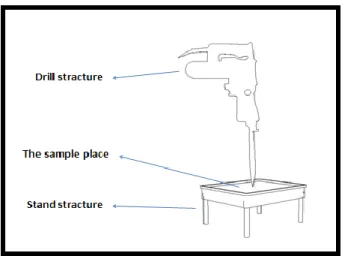
The vibration measurement system can be described by a drill accelerated vertically up and down when it is oscillating according to working energy with different velocities during daily working of the hard worker as shown in figuer (2).
The accelerometer is firmly fixed on different points on the arm parts of body fig.(3). The vibration data is transmitted to a computer using a Noraxon U.S.A. Inc. • 13430 N. Scottsdale Rd., Suite 104 • Scottsdale, AZ 85254. This measuring system is used to get various parameters such as (velocity, acceleration, and frequency) at each point.
543
Figure. (3) Accelerometer Points positions along Human arm
3. Results and Discussion
The vibration data that are acceleration, velocity, displacement and frequency are measured at four positions command, wrist, elbow and shoulder for had workedwith drill tool. Each point was measured five times, and the mean were taken. RMS value of acceleration ,velocity , and frequency result were recorded in the table (1),Fig.(4) , Fig.(5) ,Fig.(6),and Fig.(7)while working on concrete grand structure.The above measuring procedure are repeated four times with different drilling foundation structures thatare Concrete,Precast concrete, Tiles, and Marble. These results show that as the sensor point height increased from the drillhandle, the acceleration and frequency decreases.
The reason behind this behavior is that, when the sensor position height increased,this mean the distance from the excitation source increased and then the frequency and acceleration decreased. In addition to that the muscles,skin and fat may function as a damper reducing the frequency and acceleration. The Results show that the frequency in X- direction for concrete ground structure will be (63.88, 29.407, 17.56 and 17.45HZ) for (command, wrist, elbow, and shoulder) respectively.
544
Also in Z-direction more the frequency for concrete ground structure will be (65.34, 29.4, 27.98 and 27.63Hz) for (command, wrist, elbow, and shoulder) respectively. These values show that there is areduction in frequency of 55%, 57.17 %, and 57.7%, for (wrist, elbow, and shoulder) respectively in comparison with command frequency.
When using the Precast concrete as ground foundation , the reduction in frequency at wrist, elbow, and shoulder in comparison with comhand were (67.9%, 71.2%, and90.29%), (8.9%, 16.5%, and 74, 39%) ,and (8.44%, 13.18%, and 20.74%) for X,Y, and Z direction. Also for using the Tiles as ground foundation , the reduction in frequency wrist, elbow, and shoulder in comparison with comhand were (7.58%, 19.2%, and 91.9%),(-.38%,7.17%, and 85.64%), and(6.68%, 21%, and 87.43%) for X,Y,and Z direction. Finally for using the marble as ground foundation , the reduction in frequency wrist, elbow, and shoulder in comparison with comhand were (11.83%,80.06%,and 82.35%),(44.47%, 20.56%, and 92.9%), and(24.4%, 31.2%, and 98.28%)for X,Y,and Z direction.
Figure.(4)Vibration data acceleration ,velocity and displacement at comhand region with respect to time in X-
direction using the precast concrete as ground foundation
545
Figure. (6) Vibration data acceleration , velocity and displacement at elbow region with respect to time in z-
direction using the tiles as ground foundation
Figure. (7)Vibration data acceleration, velocity and displacement at shoulder region with respect to time in
546
Table (1)
RMS Vibration data for worker'shand while using a drill with different grand structure
Shoulder Elbow Wrist command Freque ncy (HZ)* 10-3 Acc.
(m/s2) Frequenc
y (HZ)* 10-3 Acc.
(m/s2) Frequenc
y (HZ)* 10-3 Acc.
(m/s2) Frequenc
y (HZ)* 10-3 Acc.
547
4. Conclusion
1- The values of acceleration and frequency are increased with the decreasing the distance of sensor point from the drill handle.
2- When using the concrete as ground foundation , the reduction in frequency at wrist,elbow,and shoulder in comparison with comhand were.( 53.9%, 72.5%, and 72.6%), (37.94%, 10%, and 81.27.%), ( 55%, 57.17%, and 57.7.%) for X ,Y, and Z direction.
3-When using the Precast concrete as ground foundation , the reduction in frequency at wrist,elbow,and shoulder in comparison with comhand were (67.9%,71.2%, and 90.29%), (8.9%, 16.5%, and 74, 39%), and (8.44%, 13.18%, and 20.74%)for X,Y, and Z direction
4- When using the Tiles as ground foundation , the reduction in frequency wrist,elbow,and shoulder in comparison with comhand were (7.58%, 19.2%, and 91.9%), (-.38%, 7.17%, and85.64%), and (6.68%, 21%, and87.43%) for X,Y,and Z direction.
5-when using the marble as ground foundation , the reduction in frequency wrist,elbow,and shoulder in comparison with comhand were (11.83%, 80.06% ,and 82.35%), (44.47%, 20.56%, and 92.9%), and (24.4%, 31.2%, and 98.28%)for X,Y,and Z direction.
6- The max. Value of frequency was recorded in X-direction at command region when using the precast concrete as ground foundation with 103.248 Hz.
7- The min. value of frequency was recorded in z-direction at shoulder region when using the marble as ground foundation with 0.647 Hz.
Nomenclature
HAV = hand-arm vibration
WBV = whole-body vibration
DELV= daily exposure limit value
VEA = vibration energy absorption
VWF = vibration-induced white finger
Vx,y,z= velocity in x,y,z direction
z y x
548
References
C.Drugă, D.Barbu,S. Lache, " Vibration and the Human Body ",Fascicle of Management and Technological Engineering, Volume VI (XVI), 2007.
International . Standard " Hand-Hell sport able power tools-test method for evaluation of vibration emission ", ISO 28927-10,first edition 2011.
M. Bovenzi,"Medical Aspects of the Hand -Arm ",International Journal of Industrial Ergonomics, 6 (1990) 61-73.
R.G. Dong, A.W. Schopper, T.W. McDowell, D.E. Welcome, J.Z. Wu, W.P. Smutz " Vibration energy absorption (VEA) in human fingers-hand-arm system", Medical Engineering & Physics 26 (2004) 483–492.
S S. Raw, "Mechanical Vibration", fifth edition, Prentice Hall,2013.
S. J. Singh, A.A. Khan " Effect of coating over the handle of a drill machine on vibration transmissibility", Applied Ergonomics 45 (2014) 239e24.
S. J. Singh, A.A. Khan "The effects of vibration-reducing gloves on finger vibration", International Journal of Industrial Ergonomics 44 (2014) 45e5.
S. Kihlberg " Biodynamic response of the hand-arm system to vibration from an impact hammer and a grinder ", International Journal of Industrial Ergonomics 16 (1995).