Community health workers trained to
conduct verbal autopsies provide better
mortality measures than existing surveillance:
Results from a cross-sectional study in rural
western Uganda
Doreen NabukaluID1*, Moses Ntaro1, Mathias Seviiri2, Raquel Reyes3, Matthew Wiens4,
Radhika Sundararajan5, Edgar Mulogo1, Ross M. BoyceID6
1 Department of Community Health, Mbarara University of Science & Technology, Mbarara, Uganda, 2 Department of Health, Wakiso District Local Government, Kampala, Uganda, 3 Division of General Medicine & Clinical Epidemiology, University of North Carolina at Chapel Hill, Chapel Hill, United States of America, 4 Center for International Child Health, BC Children’s Hospital, Vancouver, BC, Canada, 5 Department of Emergency Medicine, Weill Cornell Medical Center, New York, NY, United States of America, 6 Division of Infectious Diseases, University of North Carolina at Chapel Hill, Chapel Hill, United States of America
Abstract
Background
In much of sub-Saharan Africa, health facilities serve as the primary source of routine vital
statistics. These passive surveillance systems, however, are plagued by infrequent and unreliable reporting and do not capture events that occur outside of the formal health sector. Verbal autopsies (VA) have been utilized to estimate the burden and causes of mortality where civil registration and vital statistics systems are weak, but VAs have not been widely employed in national surveillance systems. In response, we trained lay community health workers (CHW) in a rural sub-county of western Uganda to conduct VA interviews in order to assess the feasibility of leveraging CHW to measure the burden of disease in resource limited settings.
Methods and findings
Trained CHWs conducted a cross-sectional survey of the 36 villages comprising the Bugoye sub-county to identify all deaths occurring in the prior year. The sub county has an estimated population of 50,249, approximately one-quarter of whom are children under 5 years of age (25.3%). When an eligible death was reported, CHWs administered a WHO 2014 VA ques-tionnaire, the results of which were analyzed using the InterVA-4 tool. To compare the find-ings of the CHW survey to existing surveillance systems, study staff reviewed inpatient registers from neighboring referral health facilities in an attempt to match recorded deaths to those identified by the survey. Overall, CHWs conducted high quality VA interviews on direct observation, identifying 230 deaths that occurred within the sub-county, including 77
a1111111111 a1111111111 a1111111111 a1111111111 a1111111111
OPEN ACCESS
Citation: Nabukalu D, Ntaro M, Seviiri M, Reyes R, Wiens M, Sundararajan R, et al. (2019) Community health workers trained to conduct verbal autopsies provide better mortality measures than existing surveillance: Results from a cross-sectional study in rural western Uganda. PLoS ONE 14(2): e0211482.https://doi.org/10.1371/journal. pone.0211482
Editor: Helen Schneider, University of the Western Cape, SOUTH AFRICA
Received: August 23, 2018
Accepted: January 15, 2019
Published: February 13, 2019
Copyright: This is an open access article, free of all copyright, and may be freely reproduced, distributed, transmitted, modified, built upon, or otherwise used by anyone for any lawful purpose. The work is made available under theCreative Commons CC0public domain dedication.
Data Availability Statement: All relevant data are within the manuscript and its Supporting Information files.
Funding: This research was funded by the Joint AFRO/TDR Small Grants Scheme for
(33.5%) among children under five years of age. More than half of the deaths (123 of 230, 53.5%) were reported to have occurred outside a health facility and thus would not be cap-tured by passive surveillance. More than two-thirds (73 of 107, 68.2%) of facility deaths took place in one of three nearby hospitals, yet only 35 (47.9%) were identified on our review of inpatient registers. Consistent with previous VA studies, the leading causes of death among children under five years of age were malaria (19.5%), prematurity (19.5%), and neonatal pneumonia (15.6%). while among adults, HIV/AIDS-related deaths illness (13.6%), pulmo-nary tuberculosis (11.4%) and malaria (8.6%) were the leading causes of death. No child deaths identified from inpatient registers listed HIV/AIDS as a cause of death despite 8 deaths (10.4%) attributed to HIV/AIDS as determined by VA.
Conclusions
Lay CHWs are able to conduct high quality VA interviews to capture critical information that can be analyzed using standard methodologies to provide a more complete estimate of the burden and causes of mortality. Similar approaches can be scaled to improve the measure-ment of vital statistics in order to facilitate appropriate public health interventions in rural areas of sub-Saharan Africa.
Introduction
Despite longstanding efforts to improve epidemiological surveillance, most sub-Saharan Afri-can countries still face challenges associated with identifying communicable disease outbreaks and reporting routine vital statistics [1,2]. The lack of accurate and up-to-date information regarding the number, location, and causes of death negatively impacts the nature and timing of subsequent policy responses [3]. Improvements in existing surveillance systems, which are primarily facility-based, are unlikely to yield comprehensive data, as many births and deaths in rural sub-Saharan Africa occur outside of health facilities, especially among the most vulnera-ble [4,5]. These information gaps thus contribute to underreporting of infectious diseases of poverty and other health conditions that disproportionately impact the poorest and most iso-lated segments of society. The Ebola virus outbreak that occurred in West Africa between 2014 and 2016 highlighted these vulnerabilities and demonstrated how an epidemic can proliferate with enormous socio-economic disruption in the absence of strong health systems capable of a rapid and integrated response [6,7].
In Uganda, like many countries in sub-Saharan Africa, health facilities serve as the primary data collection sites for routine health statistics. Each month, individual patient information is aggregated and forwarded to the respective District Health Office and to the Ministry of Health [8]. This passive surveillance system is plagued by a number of issues, including inadequate capacity, weak and irregular monitoring, and reporting bias, all of which negatively affect the validity and thus utility of the data [9,10]. Although civil registration with high and represen-tative coverage should be the long-term goal, investment in complementary, interim sources of statistics are urgently needed to accelerate the design, implementation, and evaluation of cost-effective interventions and meet the Sustainable Development Goal of 100% birth and 80% death registration [5,11,12].
Verbal autopsies (VA) have been adopted as a practical means of determining the cause of death based on an interview with the next of kin or caregiver of the deceased in areas where collection and analysis, decision to publish, or
preparation of the manuscript.
civil registration and vital statistics (CRVS) systems are weak [13–15]. Multiple studies have demonstrated that non-physician, mid-level providers can conduct the verbal autopsies with a reasonable estimate of the cause of death [16–18]. Some studies have also shown that commu-nity health workers (CHW) can successfully carry out VA interviews using simplified ques-tionnaires [19,20]. In Uganda, community health workers, known as village health teams (VHTs), are lay volunteers who are members of the communities where they work, are selected by the communities and are answerable to the communities for their activities. They form the first health unit according to Uganda’s health sector structure with a wide range of functions including disease surveillance, record keeping, collecting of data on vital events and data man-agement among others [21]. However, standardized methods and reporting structures are not well defined. Surveillance and mortality data from village health teams continues to be scanty or unavailable [22]. Because of their trusted status in the community, we hypothesized that VHTs would be uniquely positioned to identify deaths and conduct VA interviews. Therefore, the objective of this study was to assess the feasibility of leveraging CHW to measure the bur-den of disease in resource limited settings.
Methods
Study setting
The study was conducted in Bugoye sub-county in the Kasese District of western Uganda (0o 18’ North, 30o5’ East). The sub-county is comprised of five parishes and 36 villages spanning an area of 55 km2with an estimated population of 50,249, approximately one-quarter of whom are children under 5 years of age (25.3%) [23]. There are nearly 7,000 households in the sub-county, with an average size of 7.3 persons per household.
The terrain in the sub-county is rugged and highly varied. Village elevations range from 1,100m along the river basins to upwards of 1,800m near the western border with the Rwenzori National Park. The area is predominantly rural and most residents work as subsistence farm-ers. Road access in many villages is limited, especially during the rainy seasons. The main means of transport is via motorcycle taxi, although some villages can only be reached on foot.
Although no sub-county specific data is available, it is assumed that like much of Uganda, malaria, along with respiratory illnesses and diarrheal diseases, accounts for the majority of deaths in children under five years of age. Local adult mortality statistics, including those describing maternal mortality, are also limited to generalizations drawn from national surveys.
There are seven public health facilities distributed throughout Bugoye sub-county. These include five Level II Health Centers staffed by nurses and midwives, and two Level III Health Centers, which are led by a clinical officer, and include inpatient and labor and delivery wards, in addition to limited laboratory services. The nearest referral hospital is Kilembe Mines Hos-pital, which is a private not-for-profit facility located approximately 25 km from the sub-county. Public transport to Kilembe Mines Hospital typically takes 45 minutes at costs that can represent the weekly income for a typical subsistence farmer.
Study design
This was a population-based, cross-sectional study of Bugoye sub-county to assess the feasibil-ity of leveraging CHW to measure the burden of disease in resource-limited settings using a validated WHO 2014 verbal autopsy tool.
the cause of death [24,25]. Results of the survey were compared to routinely collected records from the Kasese District Health Office and clinical records from the nearest referral centers.
Selection and training of VHTs
One VHT member with at least one year of secondary education, and competent in both read-ing and writread-ing, was identified by the VHT Coordinator at BHCIII from each of the 36 villages of Bugoye sub county. The thirty-six VHTs were trained for one week at Bugoye Health Center III (BHC) in the conduct of verbal autopsy interviews, conducted in February 2018 and led by the first author. During the training, Trainers reviewed all elements of the questionnaire, as well as the flow, meaning, and purpose of each question with the participants The VHTs also learned about the cardinal signs and symptoms, Description of the different diseases in the local language, community entry skills among others, the Techniques utilized in the training sessions included lectures, group discussions, practical exercises, and role play. The trainers conducted quality assurance exercises including direct observation of VA interviews and inspection of completed questionnaires to confirm adherence to study protocols and ensure the completeness and accuracy of the data. Approximately 20% of the VHT interviews were directly observed by the trainers.
Identification of deaths in the village
In rural settings of Uganda, the village council chairman (LC) and respective VHT are gener-ally invited to attend every burial ceremony in their village. Using this information, the VHTs in collaboration with the LCs, identified all households where a death occurred in the preced-ing twelve months. A next of kin or caretaker who was present with the deceased was identified and an appointment made for the interview. If a household had multiple deaths, data was col-lected on each individual death in that household using a separate survey.
Conducting of verbal autopsy interviews
For the households which had reported a death and an appointment had been made, a trained VHT of that respective village conducted a verbal autopsy interview using a WHO 2014 VA questionnaire with the primary caregiver.
Data collection tool /questionnaire
WHO 2014 VA questionnaires [24] were used to collect data on the identified deaths. The questionnaire captures information relevant to assessment of causes of death and the context including demographic information of the deceased, medical history, general signs, symptoms, risk factors, service utilization and reported cause of death. This tool also includes an open nar-rative text field.
Passive surveillance
Statistical analysis
Data from VA interviews was assessed for quality and extracted from the questionnaire into an EpiData database (EpiData Association, Odense, Denmark). The results were analyzed using the InterVA4 (www.interva.net) to estimate the cause of death from verbal autopsy [25]. The InterVA-4 computer program was chosen because it presents a relatively simple, fast, cheap, very accessible, do not require training of physicians to review and ideal for determining cause of death on a large scale. Cause. Specific mortality fractions were determined as the proportion of all deaths that were attributable to any specific cause of death. We stratified mortality analy-sis by age. All statistical analyanaly-sis was carried out using Stata 14 (College Station, TX).
Ethical considerations
Ethical approval of the study was provided by the institutional review committee of the Mbar-ara University of Science and Technology and the Uganda National Council for Science and Technology. A Meeting was held with the DHO, sub county leaders and LC1 chairmen and verbal ascent was obtained on behalf of the community after the researcher gave them a pre-sentation about the study, In the villages the VHTs consented the participants by briefing them on the objectives of the study and procedure, benefits for participating, what happens in case one does not participate, contacts in case of a problem arising from the study among oth-ers. After the brief, participants who verbally consented were requested to sign or put a thumb print on the consent form. All the participants consented.
Results
Household survey & verbal autopsies
The VHT-led household survey identified a total of 243 deaths occurring during the pre-speci-fied study period. Of the identipre-speci-fied deaths, 13 (5.3%) were stillbirths and excluded from the analysis. The remaining 230 deaths were included in the analysis.
The age and sex distribution of the 230 deaths included in our analysis is shown inTable 1. More than a quarter (n = 59, 25.7%) of reported deaths took place in the first year of life, and more than one-third (n = 77, 33.5%) occurred before the age of five years. Overall, there were more deaths among males (n = 137, 59.6%) even though they comprise less than half of the sub-county population (47.9%). The vast majority of respondents (211 of 230, 91.7%) reported living more than thirty minutes from the nearest health facility, and more than half of deaths (123 of 230, 53.5%) occurred outside a health facility.
Table 1. Age and sex distribution of deaths identified by VHT-led household survey.
All deaths, n = 230 Sex
Male, n = 137 (59.6%) Female, n = 93 (40.4%)
Age group n % n % n %
Neonate 38 16.52 26 18.98 12 12.90
1–11 months 21 9.13 12 8.76 9 9.68
1–4 years 18 7.83 8 5.84 10 10.75
5-14years 13 5.65 8 5.84 5 5.38
15–49 years 65 28.26 36 26.28 29 31.18
50–65 years 23 10.00 17 12.41 6 6.45
>65 years 52 22.61 30 21.9 22 23.66
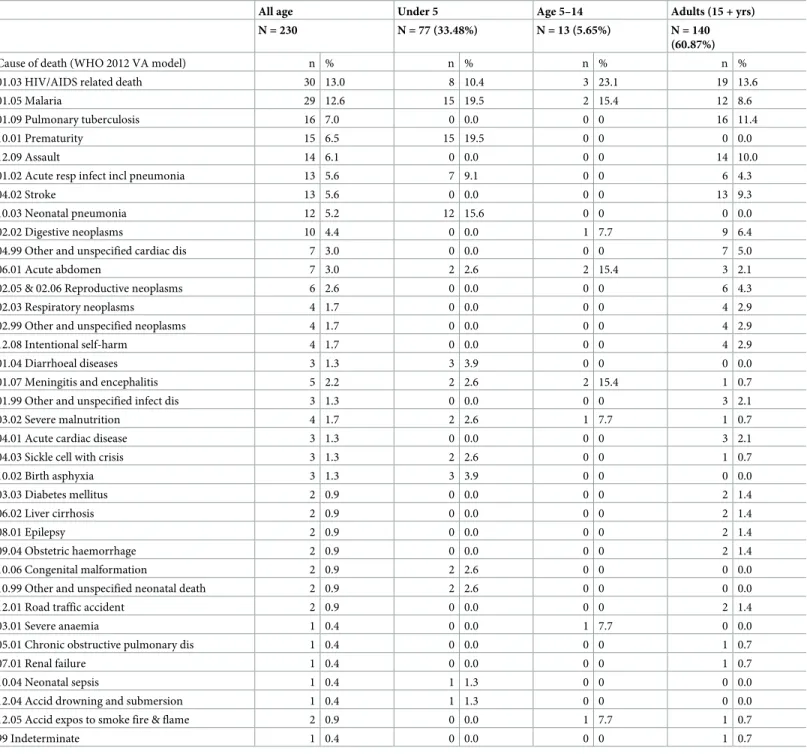
For children under five years of age, the leading causes of mortality were malaria (19.5%), prematurity (19.5%), and neonatal pneumonia (15.6%), while among adults, HIV/AIDS-related illness (13.6%), pulmonary tuberculosis (11.4%) and malaria (8.6%) were the leading causes of death. Notably, when combined, various cancers (i.e. digestive, respiratory, reproductive) accounted for a substantial number of deaths among adults (24 of 230, 10.4%). (Table 2)
There were differences in the distribution of causes of deaths which were reported to have occurred at home and those reported to have occurred at health facility. For example, among
Table 2. Causes specific mortality fractions by age.
All age Under 5 Age 5–14 Adults (15 + yrs)
N = 230 N = 77 (33.48%) N = 13 (5.65%) N = 140
(60.87%)
Cause of death (WHO 2012 VA model) n % n % n % n %
01.03 HIV/AIDS related death 30 13.0 8 10.4 3 23.1 19 13.6
01.05 Malaria 29 12.6 15 19.5 2 15.4 12 8.6
01.09 Pulmonary tuberculosis 16 7.0 0 0.0 0 0 16 11.4
10.01 Prematurity 15 6.5 15 19.5 0 0 0 0.0
12.09 Assault 14 6.1 0 0.0 0 0 14 10.0
01.02 Acute resp infect incl pneumonia 13 5.6 7 9.1 0 0 6 4.3
04.02 Stroke 13 5.6 0 0.0 0 0 13 9.3
10.03 Neonatal pneumonia 12 5.2 12 15.6 0 0 0 0.0
02.02 Digestive neoplasms 10 4.4 0 0.0 1 7.7 9 6.4
04.99 Other and unspecified cardiac dis 7 3.0 0 0.0 0 0 7 5.0
06.01 Acute abdomen 7 3.0 2 2.6 2 15.4 3 2.1
02.05 & 02.06 Reproductive neoplasms 6 2.6 0 0.0 0 0 6 4.3
02.03 Respiratory neoplasms 4 1.7 0 0.0 0 0 4 2.9
02.99 Other and unspecified neoplasms 4 1.7 0 0.0 0 0 4 2.9
12.08 Intentional self-harm 4 1.7 0 0.0 0 0 4 2.9
01.04 Diarrhoeal diseases 3 1.3 3 3.9 0 0 0 0.0
01.07 Meningitis and encephalitis 5 2.2 2 2.6 2 15.4 1 0.7
01.99 Other and unspecified infect dis 3 1.3 0 0.0 0 0 3 2.1
03.02 Severe malnutrition 4 1.7 2 2.6 1 7.7 1 0.7
04.01 Acute cardiac disease 3 1.3 0 0.0 0 0 3 2.1
04.03 Sickle cell with crisis 3 1.3 2 2.6 0 0 1 0.7
10.02 Birth asphyxia 3 1.3 3 3.9 0 0 0 0.0
03.03 Diabetes mellitus 2 0.9 0 0.0 0 0 2 1.4
06.02 Liver cirrhosis 2 0.9 0 0.0 0 0 2 1.4
08.01 Epilepsy 2 0.9 0 0.0 0 0 2 1.4
09.04 Obstetric haemorrhage 2 0.9 0 0.0 0 0 2 1.4
10.06 Congenital malformation 2 0.9 2 2.6 0 0 0 0.0
10.99 Other and unspecified neonatal death 2 0.9 2 2.6 0 0 0 0.0
12.01 Road traffic accident 2 0.9 0 0.0 0 0 2 1.4
03.01 Severe anaemia 1 0.4 0 0.0 1 7.7 0 0.0
05.01 Chronic obstructive pulmonary dis 1 0.4 0 0.0 0 0 1 0.7
07.01 Renal failure 1 0.4 0 0.0 0 0 1 0.7
10.04 Neonatal sepsis 1 0.4 1 1.3 0 0 0 0.0
12.04 Accid drowning and submersion 1 0.4 1 1.3 0 0 0 0.0
12.05 Accid expos to smoke fire & flame 2 0.9 0 0.0 1 7.7 1 0.7
99 Indeterminate 1 0.4 0 0.0 0 0 1 0.7
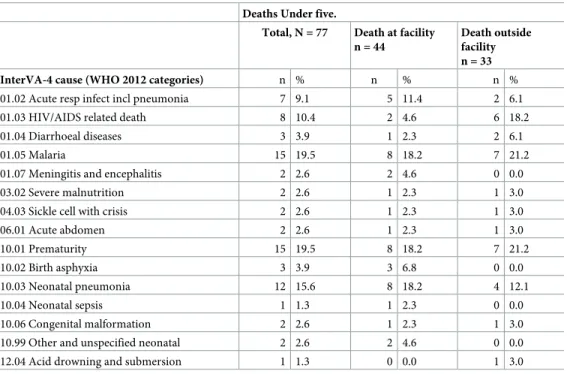
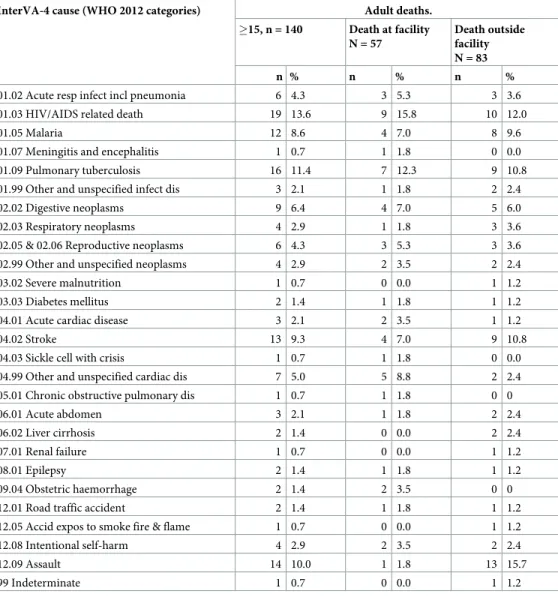
children under five, HIV/AIDS related causes were more common among deaths that occurred at home compared to those that occurred in a health facility (18.2% vs. 4.6%, p = 0.07) (Table 3). Among adults, deaths attributed to assault occurred more frequently out-side of health facilities (15.7% vs. 1.8%, p = 0.004) (Table 4). Deaths due to malaria, one of the leading causes of morbidity, occurred with similar frequencies between home and health facili-ties both among children (21.2% vs. 18.2%, p = 0.78) and adults (9.6% vs. 7.0%, p = 0.56).
Passive surveillance
Of the 107 respondents who reported the death of a household member in a health facility, 73 (68.2%) were reported to have occurred in one of the three referral facilities in the district. A subsequent review of inpatient registers at these facilities identified 35 deaths of Bugoye sub-county residents, representing 47.9% of the total number of deaths which were reported to have occurred in these facilities as per the VHT household survey. More than half (19 of 35, 54.3%) of the deaths were recorded at Kilembe Mines Hospital, with the remainder from Kagando Hospital (9 of 35, 25.7%) and St. Paul’s Level IV Health Center (7 of 35, 20%).
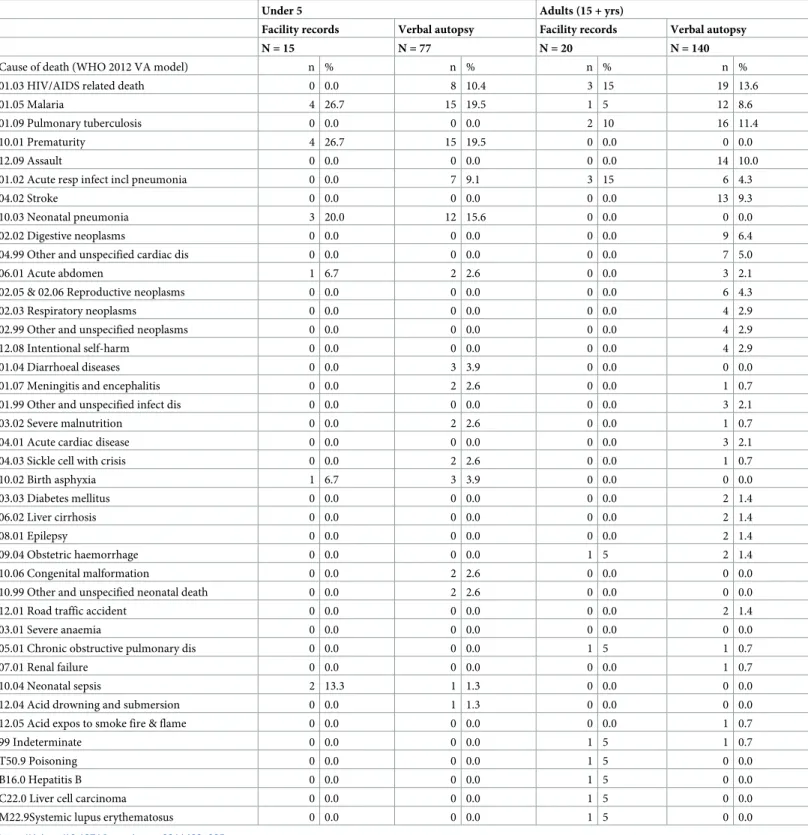
According to the inpatient registers, the leading causes of death among hospitalized chil-dren under five years of age (n = 15), were malaria, prematurity, and neonatal pneumonia. This trend is similar to those determined by the verbal autopsies. Notably, no child deaths identified from inpatient registers listed HIV/AIDS as a cause of death, despite 8 deaths (10.4%) attributed to HIV/AIDS as determined by verbal autopsy. Among adults (n = 20), there was much less agreement between the inpatient registers and VA findings (Table 5).
Discussion
Our results demonstrate that lay community health workers are able to conduct quality VA interviews to capture critical information that can be analyzed using standard methodologies
Table 3. Comparison of the causes of deaths among children under five years who died in health facilities and those who died at home as reported by the verbal autopsy.
Deaths Under five.
Total, N = 77 Death at facility n = 44
Death outside facility n = 33
InterVA-4 cause (WHO 2012 categories) n % n % n %
01.02 Acute resp infect incl pneumonia 7 9.1 5 11.4 2 6.1
01.03 HIV/AIDS related death 8 10.4 2 4.6 6 18.2
01.04 Diarrhoeal diseases 3 3.9 1 2.3 2 6.1
01.05 Malaria 15 19.5 8 18.2 7 21.2
01.07 Meningitis and encephalitis 2 2.6 2 4.6 0 0.0
03.02 Severe malnutrition 2 2.6 1 2.3 1 3.0
04.03 Sickle cell with crisis 2 2.6 1 2.3 1 3.0
06.01 Acute abdomen 2 2.6 1 2.3 1 3.0
10.01 Prematurity 15 19.5 8 18.2 7 21.2
10.02 Birth asphyxia 3 3.9 3 6.8 0 0.0
10.03 Neonatal pneumonia 12 15.6 8 18.2 4 12.1
10.04 Neonatal sepsis 1 1.3 1 2.3 0 0.0
10.06 Congenital malformation 2 2.6 1 2.3 1 3.0
10.99 Other and unspecified neonatal 2 2.6 2 4.6 0 0.0
12.04 Acid drowning and submersion 1 1.3 0 0.0 1 3.0
to provide a more complete estimate of the burden and causes of mortality. This is due to the fact that findings conform to the patterns and causes of mortality which have been reported in other studies and trends similar to National level estimates [26]. A critical finding of this study was that more than half of all deaths (n = 123, 53.5%) occurred outside of the health facilities, and thus were not captured by the existing facility-based passive surveillance system. this is consistent with other reports from the region [26] and underpins the need for a functional community surveillance system which can help capture such deaths that go an accounted for. Additionally, there are important differences in the causes of death between those occurring in the community and those occurring in health facilities. The high number of out of the facility deaths could be explained by the limited access to health facilities due to the highly mountain-ous and extremely hard to reach by motorized transport nature of the sub county. Other fac-tors like HIV AIDS-related stigma [27]. Lack of appropriate health care infrastructures like trauma centers [28] limited pediatric health services in lower health facilities [29] could be driving the lack of engagement with healthcare resources and contribute to the discrepancy between VA and facility mortality.
Table 4. Comparison of the causes of deaths among adults for the deaths reported to have occurred in health facil-ities and those that occurred at home.
InterVA-4 cause (WHO 2012 categories) Adult deaths.
�15, n = 140 Death at facility N = 57
Death outside facility N = 83
n % n % n %
01.02 Acute resp infect incl pneumonia 6 4.3 3 5.3 3 3.6
01.03 HIV/AIDS related death 19 13.6 9 15.8 10 12.0
01.05 Malaria 12 8.6 4 7.0 8 9.6
01.07 Meningitis and encephalitis 1 0.7 1 1.8 0 0.0
01.09 Pulmonary tuberculosis 16 11.4 7 12.3 9 10.8
01.99 Other and unspecified infect dis 3 2.1 1 1.8 2 2.4
02.02 Digestive neoplasms 9 6.4 4 7.0 5 6.0
02.03 Respiratory neoplasms 4 2.9 1 1.8 3 3.6
02.05 & 02.06 Reproductive neoplasms 6 4.3 3 5.3 3 3.6
02.99 Other and unspecified neoplasms 4 2.9 2 3.5 2 2.4
03.02 Severe malnutrition 1 0.7 0 0.0 1 1.2
03.03 Diabetes mellitus 2 1.4 1 1.8 1 1.2
04.01 Acute cardiac disease 3 2.1 2 3.5 1 1.2
04.02 Stroke 13 9.3 4 7.0 9 10.8
04.03 Sickle cell with crisis 1 0.7 1 1.8 0 0.0
04.99 Other and unspecified cardiac dis 7 5.0 5 8.8 2 2.4
05.01 Chronic obstructive pulmonary dis 1 0.7 1 1.8 0 0
06.01 Acute abdomen 3 2.1 1 1.8 2 2.4
06.02 Liver cirrhosis 2 1.4 0 0.0 2 2.4
07.01 Renal failure 1 0.7 0 0.0 1 1.2
08.01 Epilepsy 2 1.4 1 1.8 1 1.2
09.04 Obstetric haemorrhage 2 1.4 2 3.5 0 0
12.01 Road traffic accident 2 1.4 1 1.8 1 1.2
12.05 Accid expos to smoke fire & flame 1 0.7 0 0.0 1 1.2
12.08 Intentional self-harm 4 2.9 2 3.5 2 2.4
12.09 Assault 14 10.0 1 1.8 13 15.7
99 Indeterminate 1 0.7 0 0.0 1 1.2
The substantially higher number of deaths which were identified using the VA approach compared with facility registers indicates a strong need to better understand health seeking behaviors in the general population, especially in the vulnerable age of under-five. While
Table 5. Comparison of the reported causes of deaths among children under five years and adults as determined by verbal autopsy and healthy-facility records.
Under 5 Adults (15 + yrs)
Facility records Verbal autopsy Facility records Verbal autopsy
N = 15 N = 77 N = 20 N = 140
Cause of death (WHO 2012 VA model) n % n % n % n %
01.03 HIV/AIDS related death 0 0.0 8 10.4 3 15 19 13.6
01.05 Malaria 4 26.7 15 19.5 1 5 12 8.6
01.09 Pulmonary tuberculosis 0 0.0 0 0.0 2 10 16 11.4
10.01 Prematurity 4 26.7 15 19.5 0 0.0 0 0.0
12.09 Assault 0 0.0 0 0.0 0 0.0 14 10.0
01.02 Acute resp infect incl pneumonia 0 0.0 7 9.1 3 15 6 4.3
04.02 Stroke 0 0.0 0 0.0 0 0.0 13 9.3
10.03 Neonatal pneumonia 3 20.0 12 15.6 0 0.0 0 0.0
02.02 Digestive neoplasms 0 0.0 0 0.0 0 0.0 9 6.4
04.99 Other and unspecified cardiac dis 0 0.0 0 0.0 0 0.0 7 5.0
06.01 Acute abdomen 1 6.7 2 2.6 0 0.0 3 2.1
02.05 & 02.06 Reproductive neoplasms 0 0.0 0 0.0 0 0.0 6 4.3
02.03 Respiratory neoplasms 0 0.0 0 0.0 0 0.0 4 2.9
02.99 Other and unspecified neoplasms 0 0.0 0 0.0 0 0.0 4 2.9
12.08 Intentional self-harm 0 0.0 0 0.0 0 0.0 4 2.9
01.04 Diarrhoeal diseases 0 0.0 3 3.9 0 0.0 0 0.0
01.07 Meningitis and encephalitis 0 0.0 2 2.6 0 0.0 1 0.7
01.99 Other and unspecified infect dis 0 0.0 0 0.0 0 0.0 3 2.1
03.02 Severe malnutrition 0 0.0 2 2.6 0 0.0 1 0.7
04.01 Acute cardiac disease 0 0.0 0 0.0 0 0.0 3 2.1
04.03 Sickle cell with crisis 0 0.0 2 2.6 0 0.0 1 0.7
10.02 Birth asphyxia 1 6.7 3 3.9 0 0.0 0 0.0
03.03 Diabetes mellitus 0 0.0 0 0.0 0 0.0 2 1.4
06.02 Liver cirrhosis 0 0.0 0 0.0 0 0.0 2 1.4
08.01 Epilepsy 0 0.0 0 0.0 0 0.0 2 1.4
09.04 Obstetric haemorrhage 0 0.0 0 0.0 1 5 2 1.4
10.06 Congenital malformation 0 0.0 2 2.6 0 0.0 0 0.0
10.99 Other and unspecified neonatal death 0 0.0 2 2.6 0 0.0 0 0.0
12.01 Road traffic accident 0 0.0 0 0.0 0 0.0 2 1.4
03.01 Severe anaemia 0 0.0 0 0.0 0 0.0 0 0.0
05.01 Chronic obstructive pulmonary dis 0 0.0 0 0.0 1 5 1 0.7
07.01 Renal failure 0 0.0 0 0.0 0 0.0 1 0.7
10.04 Neonatal sepsis 2 13.3 1 1.3 0 0.0 0 0.0
12.04 Acid drowning and submersion 0 0.0 1 1.3 0 0.0 0 0.0
12.05 Acid expos to smoke fire & flame 0 0.0 0 0.0 0 0.0 1 0.7
99 Indeterminate 0 0.0 0 0.0 1 5 1 0.7
T50.9 Poisoning 0 0.0 0 0.0 1 5 0 0.0
B16.0 Hepatitis B 0 0.0 0 0.0 1 5 0 0.0
C22.0 Liver cell carcinoma 0 0.0 0 0.0 1 5 0 0.0
M22.9Systemic lupus erythematosus 0 0.0 0 0.0 1 5 0 0.0
previous studies have employed community health workers in small pilot studies [30] or to augment surveillance using simplified VA tools [19,20], our use of a validated WHO question-naire over a large area is relatively novel and improves the generalizability of our findings. This success should not come as a surprise, as previous studies have shown that with training, com-munity health workers can rapidly adopt the skills needed to perform VAs despite the lack of formal education[16]. Overall, we believe that this approach represents a promising and likely cost-effective means of improving the measurement of vital statistics in resource-limited set-tings with established community health workers infrastructure.
The potential public health implications of this study are important. First, our study shows that with appropriate training, community health workers can be mobilized to improve the col-lection of vital statistics and perform communicable disease surveillance. For example, with more frequent surveys, such an approach could track rapidly-spreading infectious disease epi-demics, such as Ebola, Yellow Fever, or measles. Second, our results cast further doubt on the validity of existing passively collected data. A high proportion of deaths (n = 38, 52.1%) reported to have occurred in one of the three referral health facilities in the district could not be identified on review of the health facility records. This could be due to a number of factors, including incomplete or inaccurate recordkeeping inadequate health workers and weak health informa-tion systems and poor diagnostic infrastructure [31]. Additionally, the results show that a high number of deaths due to HIV/AIDS among children under five years occur in communities. This could be due to factors like lack of appropriate treatment for these children or late enroll-ment on care. Together, these results suggest that deaths in rural communities are greatly underreported, thereby exacerbating already stark urban–rural disparities. Lastly, our findings indicate a potential underestimation of the burden of non-communicable diseases (NCDs) and traumatic injuries, which were more commonly reported to have occurred outside of the formal health sector. If this pattern is consistent across rural sub-Saharan Africa, it may partly explain the long-standing under-appreciation of NCDs as a major cause of morbidity and mortality.
Our study has a number of strengths including the use of a validated VA tool and public-domain analytic software, relatively large sampling frame, and rigorous attempts at identifying deaths outside of the sub-county. Our study also has limitations. First, we did not directly com-pare the results of the VHT-administered VAs to results obtained by professional study staff. However, we are reassured by (1) the high quality of the directly observed encounters and [2] the general agreement in the leading causes of death identified with our survey and similar work con-ducted in other parts of Uganda. [32–35]. Second, we did not assess the feasibility of using com-munity health workers to assign causes of death. Instead, we relied on study staff to enter the data into the InterVA tool. Thus, the issue of data entry and analysis will still need to be solved prior to implementation into routine surveillance programs. We assume these tasks will take place at the district level, but the ability of already overburdened health management teams to complete this work in a timely manner will need to be tested. We however believe that the recent release of the InterVA-5 model which is compatible with the WHO 2016 standard will make the task of analyz-ing verbal autopsy data much easier for the district statisticians. [31] Lastly, there is no reference standard for the true number of deaths occurring in the sub-county. Therefore, we cannot esti-mate the sensitivity of our approach for identifying deaths. Given that the survey recorded more than six times as many deaths as was reported to the District Health Office, there is little doubt that it represents a significant improvement over existing data collection systems.
Conclusion
scaled to improve the measurement of vital statistics in order to facilitate appropriate public health interventions in rural areas of sub-Saharan Africa.
Supporting information
S1 File. (DTA)
S2 File. (DTA)
S3 File. (CSV)
Acknowledgments
We acknowledge the great contribution of Mr. Muhindo Rabbison and Mr. Matte Michael towards the administration and execution of the study. We are grateful to the staff of Bugoye HCIII, and Bugoye integrated management initiative for the support rendered during the sur-vey. We thank the community health workers of Bugoye Sub County and the Kasese district health office for their support and participation in this study.
Author Contributions
Conceptualization: Doreen Nabukalu, Edgar Mulogo, Ross M. Boyce.
Data curation: Doreen Nabukalu, Moses Ntaro.
Formal analysis: Doreen Nabukalu, Mathias Seviiri, Ross M. Boyce.
Funding acquisition: Doreen Nabukalu, Edgar Mulogo, Ross M. Boyce.
Investigation: Doreen Nabukalu, Moses Ntaro, Edgar Mulogo.
Methodology: Doreen Nabukalu, Edgar Mulogo, Ross M. Boyce.
Project administration: Doreen Nabukalu, Moses Ntaro, Edgar Mulogo.
Resources: Doreen Nabukalu.
Supervision: Doreen Nabukalu, Edgar Mulogo, Ross M. Boyce.
Validation: Doreen Nabukalu, Edgar Mulogo.
Visualization: Doreen Nabukalu.
Writing – original draft: Doreen Nabukalu, Ross M. Boyce.
Writing – review & editing: Doreen Nabukalu, Raquel Reyes, Matthew Wiens, Radhika Sun-dararajan, Edgar Mulogo, Ross M. Boyce.
References
1. Mathers CD, Fat DM, Inoue M, Rao C, Lopez AD. Counting the dead and what they died from: an assessment of the global status of cause of death data. Bulletin of the World Health Organization. 2005; 83(3):171–7. Epub 2005/03/31. PMID:15798840
2. Mikkelsen L, Phillips DE, AbouZahr C, Setel PW, de Savigny D, Lozano R, et al. A global assessment of civil registration and vital statistics systems: monitoring data quality and progress. Lancet. 2015; 386 (10001):1395–406. Epub 2015/05/15.https://doi.org/10.1016/S0140-6736(15)60171-4PMID:
3. Bryce J, Amouzou A, Victora CG, Jones G, Silva R, Hill K, et al. "Real-Time" Monitoring of Under-Five Mortality: Lessons for Strengthened Vital Statistics Systems. PLoS medicine. 2016; 13(1):e1001904. Epub 2016/01/26.https://doi.org/10.1371/journal.pmed.1001904PMID:26808277
4. Kahn K, Tollman SM, Garenne M, Gear JS. Validation and application of verbal autopsies in a rural area of South Africa. Trop Med Int Health. 2000; 5(11):824–31. Epub 2000/12/21. PMID:11123832
5. Setel PW, Macfarlane SB, Szreter S, Mikkelsen L, Jha P, Stout S, et al. A scandal of invisibility: making everyone count by counting everyone. Lancet. 2007; 370(9598):1569–77. Epub 2007/11/10.https://doi. org/10.1016/S0140-6736(07)61307-5PMID:17992727
6. Kieny MP, Evans DB, Schmets G, Kadandale S. Health-system resilience: reflections on the Ebola cri-sis in western Africa. Bulletin of the World Health Organization. 2014; 92(12):850. Epub 2015/01/02.
https://doi.org/10.2471/BLT.14.149278PMID:25552765
7. Thomas Gregory MRS; Ferreira Francisco H. G.; Evans David; Maliszewska Maryla; Cruz Marcio; Himelein Kristen; Over Mead. The economic impact of Ebola on sub-Saharan Africa: updated estimates for 2015. Washington, DC: World Bank Group, 2015.
8. Uganda Ministry of Health, Health Systems 20/20, Makerere University School of Public Health. Uganda Health System Assessment 2011. Kampala, Uganda and Bethesda, MD,: 2012.
9. Sserwanga A, Harris JC, Kigozi R, Menon M, Bukirwa H, Gasasira A, et al. Improved malaria case man-agement through the implementation of a health facility-based sentinel site surveillance system in Uganda. PloS one. 2011; 6(1):e16316. Epub 2011/02/02.https://doi.org/10.1371/journal.pone.0016316
PMID:21283815
10. Setel PW, Sankoh O, Rao C, Velkoff VA, Mathers C, Gonghuan Y, et al. Sample registration of vital events with verbal autopsy: a renewed commitment to measuring and monitoring vital statistics. Bulletin of the World Health Organization. 2005; 83(8):611–7. Epub 2005/09/27. PMID:16184280
11. United Nations. Sustainable development goals. New York: 2017 [cited 2018 May 10]; Available from:
http://www.un.org/sustainabledevelopment/development-agenda/
12. AbouZahr C, Bratschi MW, Munoz DC, Santon R, Richards N, Riley I, et al. How can we accelerate progress on civil registration and vital statistics? Bulletin of the World Health Organization. 2018; 96 (4):226–A. Epub 2018/04/27.https://doi.org/10.2471/BLT.18.211086PMID:29695876
13. Byass P, Herbst K, Fottrell E, Ali MM, Odhiambo F, Amek N, et al. Comparing verbal autopsy cause of death findings as determined by physician coding and probabilistic modelling: a public health analysis of 54 000 deaths in Africa and Asia. Journal of global health. 2015; 5(1):010402. Epub 2015/03/04.https:// doi.org/10.7189/jogh.05.010402PMID:25734004
14. Fottrell E, Byass P. Verbal autopsy: methods in transition. Epidemiol Rev. 2010; 32:38–55. Epub 2010/ 03/06.https://doi.org/10.1093/epirev/mxq003PMID:20203105
15. Nichols EK, Byass P, Chandramohan D, Clark SJ, Flaxman AD, Jakob R, et al. The WHO 2016 verbal autopsy instrument: An international standard suitable for automated analysis by InterVA, InSilicoVA, and Tariff 2.0. PLoS medicine. 2018; 15(1):e1002486. Epub 2018/01/11.https://doi.org/10.1371/ journal.pmed.1002486PMID:29320495
16. Engmann C, Jehan I, Ditekemena J, Garces A, Phiri M, Mazariegos M, et al. Using verbal autopsy to ascertain perinatal cause of death: are trained non-physicians adequate? Trop Med Int Health. 2009; 14 (12):1496–504. Epub 2009/10/06.https://doi.org/10.1111/j.1365-3156.2009.02395.xPMID:19799757
17. Prata N, Gerdts C, Gessessew A. An innovative approach to measuring maternal mortality at the com-munity level in low-resource settings using mid-level providers: a feasibility study in Tigray, Ethiopia. Reprod Health Matters. 2012; 20(39):196–204. Epub 2012/07/14.https://doi.org/10.1016/S0968-8080 (12)39606-7PMID:22789098
18. Rao C, Bradshaw D, Mathers C. Improving death registration and statistics in developing countries: les-sons from sub-Saharan Africa. South African Journal of Demography. 2004; 9(2):81–99.
19. Krishnan A, Kumar R, Nongkynrih B, Misra P, Srivastava R, Kapoor SK. Adult mortality surveillance by routine health workers using a short verbal autopsy tool in rural north India. J Epidemiol Community Health. 2012; 66(6):501–6. Epub 2011/03/05.https://doi.org/10.1136/jech.2010.127480PMID:
21372064
20. Kumar R, Kapoor SK, Krishnan A. Performance of cause-specific childhood mortality surveillance by health workers using a short verbal autopsy tool. WHO South East Asia J Public Health. 2012; 1 (2):151–8. Epub 2012/04/01.https://doi.org/10.4103/2224-3151.206928PMID:28612791
21. Health UMo. Community Health Extension Workers Strategy in Uganda (2015/16–2019/20). Kampala: 2016.
22. Uganda Ministry of Health. Health Sector Development Plan (2015/16-2019/20). Kampala: 2015. 23. Uganda Bureau of Statistics (UBOS). National Population and Housing Census 2014: Provisional
24. Byass P, Chandramohan D, Clark SJ, D’Ambruoso L, Fottrell E, Graham WJ, et al. Strengthening stan-dardised interpretation of verbal autopsy data: the new InterVA-4 tool. Glob Health Action. 2012; 5:1–8. Epub 2012/09/05.
25. UmeåCentre for Global Health Research. Inter-VA. 2018 [cited 2019 January 4]; Available from:http:// interva.net.
26. Mpimbaza A, Filler S, Katureebe A, Quick L, Chandramohan D, Staedke SG. Verbal Autopsy: Evalua-tion of Methods to Certify Causes of Death in Uganda. PloS one. 2015; 10(6):e0128801. Epub 2015/06/ 19.https://doi.org/10.1371/journal.pone.0128801PMID:26086600
27. Chan BT, Weiser SD, Boum Y, Siedner MJ, Mocello AR, Haberer JE, et al. Persistent HIV-related stigma in rural Uganda during a period of increasing HIV incidence despite treatment expansion. AIDS. 2015; 29(1):83–90. Epub 2014/10/01.https://doi.org/10.1097/QAD.0000000000000495PMID:
25268886
28. Naddumba EK. Musculoskeletal trauma services in Uganda. Clin Orthop Relat Res. 2008; 466 (10):2317–22. Epub 2008/07/17.https://doi.org/10.1007/s11999-008-0369-2PMID:18629599
29. Waiswa P, Kallander K, Peterson S, Tomson G, Pariyo GW. Using the three delays model to under-stand why newborn babies die in eastern Uganda. Trop Med Int Health. 2010; 15(8):964–72. Epub 2010/07/20.https://doi.org/10.1111/j.1365-3156.2010.02557.xPMID:20636527
30. Proctor MH, Ellison RC, Moore LL. The feasibility of using rural health workers to determine cause of death in remote regions of Cameroon, West Africa. Ethn Dis. 2001; 11(4):701–10. Epub 2002/01/05. PMID:11763294
31. Ronsmans C, Graham WJ, Lancet Maternal Survival Series steering g. Maternal mortality: who, when, where, and why. Lancet. 2006; 368(9542):1189–200. Epub 2006/10/03. https://doi.org/10.1016/S0140-6736(06)69380-XPMID:17011946
32. Uganda Bureau of Statistcs (UBOS) MIIaME. Uganda Child Verbal Autopsy Study. Calverton, Mary-land: UBOS, Macro International Inc. and Measure Evaluation, 2008.
33. Mpimbaza A, Filler S, Katureebe A, Kinara SO, Nzabandora E, Quick L, et al. Validity of verbal autopsy procedures for determining malaria deaths in different epidemiological settings in Uganda. PloS one. 2011; 6(10):e26892. Epub 2011/11/03.https://doi.org/10.1371/journal.pone.0026892PMID:22046397
34. Kananura RM, Tetui M., Mutebi A., Bua J. N., Waiswa P., Kiwanuka S. N., Makumbi F. The neonatal mortality and its determinants in rural communities of Eastern Uganda. Reproductive Health. 2016; 13. 35. Uganda Bureau of Statistcs (UBOS) and ICF. Demographic and Health Survey 2016: Key Indicators