HARRY F. HARLOW University oj Wisconsin
Love is a wondrous state, deep, tender, and re-warding. Because of its intimate and personal na-ture it is regarded by some as an improper topic for experimental research. But, whatever our per-sonal feelings may be, our assigned mission as psy-chologists is to analyze all facets of human and animal behavior into their component variables. So far as love or affection is concerned, psycholo-gists have failed in this mission. The little we know about love does not transcend simple obser-vation, and the little we write about it has been written better by poets and novelists. But of greater concern is the fact that psychologists tend to give progressively less attention to a motive which pervades our entire lives. Psychologists, at least psychologists who write textbooks, not only show no interest in the origin and development of love or affection, but they seem to be unaware of its very existence.
The apparent repression of love by modern psy-chologists stands in sharp contrast with the atti-tude taken by many famous and normal people. The word "love" has the highest reference fre-quency of any word cited in Bartlett's book of Familiar Quotations. It would appear that this emotion has long had a vast interest and fascina-tion for human beings, regardless of the attitude taken by psychologists; but the quotations cited, even by famous and normal people, have a mun-dane redundancy. These authors and authorities have stolen love from the child and infant and made it the exclusive property of the adolescent and adult.
Thoughtful men, and probably all women, have speculated on the nature of love. From the de-velopmental point of view, the general plan is quite
1 Address of the President at the sixty-sixth Annual
Con-vention of the American Psychological Association, Wash-ington, D, C., August 31, 1958.
The researches reported in this paper were supported by funds supplied by Grant No. M-722, National Institutes of Health, by a grant from the Ford Foundation, and by funds received from the Graduate School of the Univer-sity of Wisconsin.
clear: The initial love responses of the human be-ing are those made by the infant to the mother or some mother surrogate. From this intimate attach-ment of the child to the mother, multiple learned and generalized affectional responses are formed.
Unfortunately, beyond these simple facts we know little about the fundamental variables under-lying the formation of affectional responses and little about the mechanisms through which the love of the infant for the mother develops into the multifaceted response patterns characterizing love or affection in the adult. Because of the dearth of experimentation, theories about the fundamental nature of affection have evolved at the level of observation, intuition, and discerning guesswork, whether these have been proposed by psycholo-gists, sociolopsycholo-gists, anthropolopsycholo-gists, physicians, or psychoanalysts.
The position commonly held by psychologists and sociologists is quite clear: The basic motives are, for the most part, the primary drives—particu-larly hunger, thirst, elimination, pain, and sex— and all other motives, including love or affec-tion, are derived or secondary drives. The mother is associated with the reduction of the primary drives—particularly hunger, thirst, and pain—and through learning, affection or love is derived.
It is entirely reasonable to believe that the mother through association with food may become a secondary-reinforcing agent, but this is an in-adequate mechanism to account for the persistence of the infant-maternal ties. There is a spate of re-searches on the formation of secondary reinforcers to hunger and thirst reduction. There can be no question that almost any external stimulus can be-come a secondary reinforcer if properly associated with tissue-need reduction, but the fact remains that this redundant literature demonstrates un-equivocally that such derived drives suffer rela-tively rapid experimental extinction. Contrariwise, human affection does not extinguish when the mother ceases to have intimate association with the drives in question. Instead, the affectional
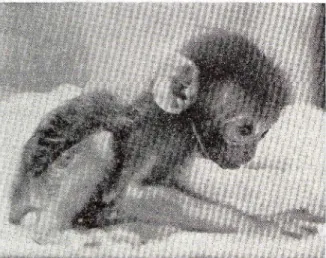
Pte. 1. Response to cloth pad by one-day-old monkey.
ties to the mother show a lifelong, unrelenting per-sistence and, even more surprising, widely expand-ing generality.
Oddly enough, one of the few psychologists who took a position counter to modern psychological dogma was John B. Watson, who believed that love was an innate emotion elicited by cutaneous stimu-lation of the erogenous zones. But experimental psychologists, with their peculiar propensity to dis-cover facts that are not true, brushed this theory aside by demonstrating that the human neonate had no differentiable emotions, and they established a fundamental psychological law that prophets are without honor in their own profession.
The psychoanalysts have concerned themselves with the problem of the nature of the development of love in the neonate and infant, using ill and aging human beings as subjects. They have dis-covered the overwhelming importance of the breast and related this to the oral erotic tendencies de-veloped at an age preceding their subjects' memo-ries. Their theories range from a belief that the infant has an innate need to achieve and suckle at the breast to beliefs not unlike commonly accepted psychological theories. There are exceptions, as seen in the recent writings of John Bowlby, who attributes importance not only to food and thirst satisfaction, but also to "primary object-clinging," a need for intimate physical contact, which is initially associated with the mother.
As far as I know, there exists no direct experi-mental analysis of the relative importance of the stimulus variables determining the affectional or
love responses in the neonatal and infant primate. Unfortunately, the human neonate is a limited ex-perimental subject for such researches because of his inadequate motor capabilities. By the time the human infant's motor responses can be pre-cisely measured, the antecedent determining condi-tions cannot be denned, having been lost in a jumble and jungle of confounded variables.
Many of these difficulties can be resolved by the use of the neonatal and infant macaque monkey as the subject for the analysis of basic affectional vari-ables. It is possible to make precise measurements in this primate beginning at two to ten days of age, depending upon the maturational status of the in-dividual animal at birth. The macaque infant differs from the human infant in that the monkey is more mature at birth and grows more rapidly; but the basic responses relating to affection, in-cluding nursing, contact, clinging, and even visual and auditory exploration, exhibit no fundamental differences in the two species. Even the develop-ment of perception, fear, frustration, and learning capability follows very similar sequences in rhesus monkeys and human children.
Three years' experimentation before we started our studies on affection gave us experience with the neonatal monkey. We had separated more than 60 of these animals from their mothers 6 to 12 hours after birth and suckled them on tiny bottles. The infant mortality was only a small fraction of what would have obtained had we let the monkey mothers raise their infants. Our
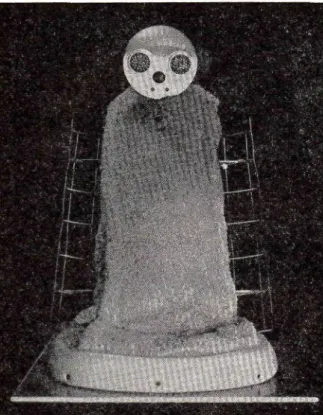
FIG. 3. Cloth mother surrogate.
fed babies were healthier and heavier than monkey-mother-reared infants. We know that we are better monkey mothers than are real monkey mothers thanks to synthetic diets, vitamins, iron extracts, penicillin, chloromycetin, 5% glucose, and con-stant, tender, loving care.
During the course of these studies we noticed that the laboratory-raised babies showed strong attachment to the cloth pads (folded gauze dia-pers) which were used to cover the hardware-cloth floors of their cages. The infants clung to these pads and engaged in violent temper tantrums when the pads were removed and replaced for sanitary reasons. Such contact-need or responsiveness had been reported previously by Gertrude van Wagenen for the monkey and by Thomas McCulloch and George Haslerud for the chimpanzee and is remi-niscent of the devotion often exhibited by human infants to their pillows, blankets, and soft, cuddly stuffed toys. Responsiveness by the one-day-old infant monkey to the cloth pad is shown in Fig-ure 1, and an unusual and strong attachment of a six-month-old infant to the cloth pad is illustrated
in Figure 2. The baby, human or monkey, if it is to survive, must clutch at more than a straw.
We had also discovered during some allied ob-servational studies that a baby monkey raised on a bare wire-mesh cage floor survives with difficulty, if at all, during the first five days of life. If a wire-mesh cone is introduced, the baby does better; and, if the cone is covered with terry cloth, husky, healthy, happy babies evolve. It takes more than a baby and a box to make a normal monkey. We were impressed by the possibility that, above and beyond the bubbling fountain of breast or bottle, contact comfort might be a very important vari-able in the development of the infant's affection for the mother.
At this point we decided to study the develop-ment of affectional responses of neonatal and infant monkeys to an artificial, inanimate mother, and so we built a surrogate mother which we hoped and believed would be a good surrogate mother. In devising this surrogate mother we were dependent neither upon the capriciousness of evolutionary processes nor upon mutations produced by chance radioactive fallout. Instead, we designed the mother surrogate in terms of modern human-en-gineering principles (Figure 3). We produced a perfectly proportioned, streamlined body stripped of unnecessary bulges and appendices. Redun-dancy in the surrogate mother's system was avoided by reducing the number of breasts from two to one and placing this unibreast in an upper-thoracic, sagittal position, thus maximizing the natural and known perceptual-motor capabilities of the infant
THE AMERICAN PSYCHOLOGIST
FED ON CLOTH MOTHER FED ON WIRE MOTHER
CU>rH MOTHER WIRE MOTHER
-§18
1-3 6-K> IHH 16-20 21-25 DAYS OF AGE
• CLOTH HOTHW « WIRE MOTHER
1-5 6-10 11-tG 16-20 21-25
DAYS OF AGE
FIG. S. Time spent on cloth and wire mother surrogates.
operator. The surrogate was made from a block of wood, covered with sponge rubber, and sheathed in tan cotton terry cloth. A light bulb behind her radiated heat. The result was a mother, soft, warm, and tender, a mother with infinite patience, a mother available twenty-four hours a day, a mother that neved scolded her infant and never struck or bit her baby in anger. Furthermore, we designed a mother-machine with maximal main-tenance efficiency since failure of any system or function could be resolved by the simple substi-tution of black boxes and new component parts. It is our opinion that we engineered a very su-perior monkey mother, although this position is not held universally by the monkey fathers.
Before beginning our initial experiment we also designed and constructed a second mother surro-gate, a surrogate in which we deliberately built less than the maximal capability for contact comfort. This surrogate mother is illustrated in Figure 4. She is made of wire-mesh, a substance entirely ade-quate to provide postural support and nursing ca-pability, and she is warmed by radiant heat. Her body differs in no essential way from that of the cloth mother surrogate other than in the quality of the contact comfort which she can supply.
In our initial experiment, the dual mother-surro-gate condition, a cloth mother and a wire mother were placed in different cubicles attached to the in-fant's living cage as. shown in Figure 4. For four newborn monkeys the cloth mother lactated and the wire mother did not; and, for the other four, this condition was reversed. In either condition the infant received all its milk through the mother sur-rogate as soon as it was able to maintain itself in this way, a capability achieved within two or three days except in the case of very immature infants. Supplementary feedings were given until the milk
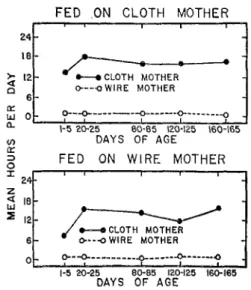
intake from the mother surrogate was adequate. Thus, the experiment was designed as a test of the relative importance of the variables of contact com-fort and nursing comcom-fort. During the first 14 days of life the monkey's cage floor was covered with a heating pad wrapped in a folded gauze diaper, and thereafter the cage floor was bare. The infants were always free to leave the heating pad or cage floor to contact either mother, and the time spent on the surrogate mothers was automatically re-corded. Figure 5 shows the total time spent on the cloth and wire mothers under the two con-ditions of feeding. These data make it obvious that contact comfort is a variable of overwhelming importance in the development of affectional re-sponses, whereas lactation is a variable of negli-gible importance. With age and opportunity to learn, subjects with the lactating wire mother showed decreasing responsiveness to her and in-creasing responsiveness to the nonlactating cloth mother, a finding completely contrary to any in-terpretation of derived drive in which the mother-form becomes conditioned to hunger-thirst reduc-tion. The persistence of these differential responses throughout 165 consecutive days of testing is evi-dent in Figure 6.
One control group of neonatal monkeys was raised on a single wire mother, and a second con-trol group was raised on a single cloth mother. There were no differences between these two groups in amount of milk ingested or in weight gain. The
FED .ON CLOTH MOTHER
24
18
>- 1? <
Q 6
X.
UJ 0
-J» , „
• • CLOTH MOTHER 0-— - O W I R E MOTHER
-_
-a:
r> o
2
S
1-5 20-25 80-85 120-125 160-165 DAYS OF AGE
FED ON W I R E MOTHER
-« CLOTH MOTHER 0---OWIRE MOTHER
O-.-O Q 0
1-5 20-25 80-85 120-125 160-165 DAYS OF AGE
only difference between the groups lay in the com-position of the feces, the softer stools of the wire-mother infants suggesting psychosomatic involve-ment. The wire mother is biologically adequate but psychologically inept.
We were not surprised to discover that contact comfort was an important basic affectional or love variable, but we did not expect it to overshadow so completely the variable of nursing; indeed, the disparity is so great as to suggest that the primary function of nursing as an affectional variable is that of insuring frequent and intimate body contact of the infant with the mother. Certainly, man cannot live by milk alone. Love is an emotion that does not need to be bottle- or spoon-fed, and we may be sure that there is nothing to be gained by giving lip service to love.
A charming lady once heard me describe these experiments; and, when I subsequently talked to her, her face brightened with sudden insight: "Now I know what's wrong with me," she said, "I'm just a wire mother." Perhaps she was lucky. She might have been a wire wife.
We believe that contact comfort has long served the animal kingdom as a motivating agent for af-fectional responses. Since at the present time we have no experimental data to substantiate this po-sition, we supply information which must be ac-cepted, if at all, on the basis of face validity:
—From Look, August 19, 1958
The Hippopotamus
This is the skin some babies feel Replete with hippo love appeal. Each contact, cuddle, push, and shove Elicits tons of baby love.
—From Zoo Guide, Zoological Society of London
The Rhinocerus
The rhino's skin is thick and tough, And yet this skin is soft enough That baby rhinos always sense, A love enormous and intense.
From All About Snakes, E. M. Hale & Co.
The Snake
To baby vipers, scaly skin
-Ylla
The Elephant
Though mother may be short on arms, Her skin is full of warmth and charms. And mother's touch on baby's skin Endears the heart that beats within.
—Sponholz
The Crocodile
Here is the skin they love to touch. It isn't soft and there isn't much, But its contact comfort will beguile Love from the infant crocodile.
You see, all God's chillun's got skin.
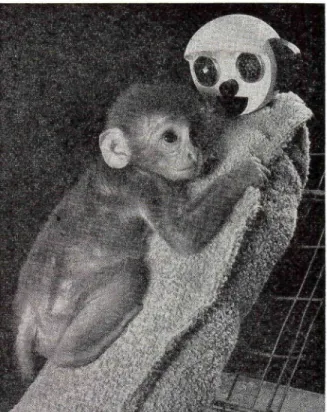
One function of the real mother, human or sub-human, and presumably of a mother surrogate, is to provide a haven of safety for the infant in times of fear and danger. The frightened or ailing child clings to its mother, not its father; and this selec-tive responsiveness in times of distress, disturbance, or danger may be used as a measure of the strength of affectional bonds. We have tested this kind of differential responsiveness by presenting to the in-fants in their cages, in the presence of the two mothers, various fear-producing stimuli such as the moving toy bear illustrated in Figure 13. A typi-cal response to a fear stimulus is shown in Figure 14, and the data on differential responsiveness are presented in Figure IS. It is apparent that the cloth mother is highly preferred over the wire one, and this differential selectivity is enhanced by age and experience. In this situation, the variable of nursing appears to be of absolutely no importance: the infant consistently seeks the soft mother surro-gate regardless of nursing condition.
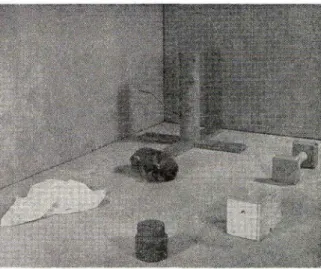
role or function is seen with special clarity when mother and child are in a strange situation. At the present time we have completed tests for this rela-tionship on four of our eight baby monkeys as-signed to the dual mother-surrogate condition by introducing them for three minutes into the strange environment of a room measuring six feet by six feet by six feet (also called the "open-field test") and containing multiple stimuli known to elicit curiosity-manipulatory responses in baby monkeys. The subjects were placed in this situation twice a week for eight weeks with no mother surrogate present during alternate sessions and the cloth mother present during the others. A cloth diaper was always available as one of the stimuli through-out all sessions. After one or two adaptation ses-sions, the infants always rushed to the mother sur-rogate when she was present and clutched her, rubbed their bodies against her, and frequently manipulated her body and face. After a few ad-ditional sessions, the infants began to use the mother surrogate as a source of security, a base of operations. As is shown in Figures 16 and 17, they would explore and manipulate a stimulus and then return to the mother before adventuring again
FIG. 14. Typical response to cloth mother surrogate in fear test.
into the strange new world. The behavior of these infants was quite different when the mother was absent from the room. Frequently they would freeze in a crouched position, as is illustrated in Figures 18 and 19. Emotionality indices such as vocalization, crouching, rocking, and sucking in-creased sharply, as shown in Figure 20. Total emotionality score was cut in half when the mother was present. In the absence of the mother some of the experimental monkeys would rush to the
100 80
O § 6 0 o:
z LJ O
40
20
°CLOTH MOTHER
oWIRE MOTHER
„- -o
FIG. 13. Typical fear stimulus.
7 12 22 42 62
M E A N DAY OF AGE
•••IRSIISSgS' •^B^"iS*-r;w'::s';;i;?iHvSiS;5|f|piS^^^M
FlS. 16. Response to cloth mother in the open-field test.
center of the room where the mother was custom-arily placed and then run rapidly from object to object, screaming and crying all the while. Con-tinuous, frantic clutching of their bodies was very common, even when not in the crouching position. These monkeys frequently contacted and clutched the cloth diaper, but this action never pacified them. The same behavior occurred in the pres-ence of the wire mother. No differpres-ence between the cloth-mother-fed and wire-mother-fed infants was demonstrated under either condition. Four control infants never raised with a mother surro-gate showed the same emotionality scores when the mother was absent as the experimental infants showed in the absence of the mother, but the con-trols' scores were slightly larger in the presence of the mother surrogate than in her absence.
Some years ago Robert Butler demonstrated that
FIG. 18. Response in the open-field test in the absence of the mother surrogate.
mature monkeys enclosed in a dimly lighted box would open and reopen a door hour after hour for no other reward than that of looking outside the box. We now have data indicating that neonatal monkeys show this same compulsive visual curi-osity on their first test day in an adaptation of the Butler apparatus which we call the "love machine," an apparatus designed to measure love. Usually these tests are begun when the monkey is 10 days of age, but this same persistent visual exploration has been obtained in a three-day-old monkey dur-ing the first half-hour of testdur-ing. Butler also dem-onstrated that rhesus monkeys show selectivity in rate and frequency of door-opening to stimuli of differential attractiveness in the visual field out-side the box. We have utilized this principle of
FIG. 19. FIG. 17. Object exploration in presence of cloth mother.
SAVd NOI1N313H NV3H
S8I SSI SZI S6 S9 SC S 3AUWWON
0 m OS ^ 00'S OSI 5
ooz:°
m OSE# m OOS™-sqiuora 9Aiss90ons xjs joj S[BA.ra:(ui A"Bp -Of }B ugq; puB sA"Bp g guiMorpj gq; guunp uo;;u9} -ai JQJ pg}sg; pun ggB jo sA~Bp oil puB 591 u99M}9q Iraq} uioaj pg^BjBdas gaam dnojS 9}B§o.uns
aq; ui SA^UOUI }UBJUT jnoj ^sjg 9qx
ST 9AO[
-UOQ
uo p9srej[ }ou SBM qotqM 'dnojg Aq sjaq^oui 9JIM pire q;op o;
ou SMoqs
9q} uo uo
9JCB
puoogs
JOJ^UOD H JTOJ
-pu9d3pu; 9JB uBq} aaq^oui 9JIM puB 'X9i[uoui o; Suipuodsgj 9anSiiij jo
-owns agqiora OM} gq; p9ure;qo
dnoaS
'9JIAV
jo -)U9 UB o;
uo qdBa§ 9q i u; jB9ddB
j ;ou ;nq '
9UIBS
jo pui5
-xoq
; 0} ss9U9Aisuods9J J91B3J8 ou j9q;ouB puB J9q;oui qjop gqj Xp;Biu;xojddB Moqs pun n
ui p9;u9
pasiBj SJUBJUI jnoj '\Z gjnSij ui i si snjBJBddB gqx JBHSIA jo ;ugui
[EnsiA oj sasuodsai
l^-N) y3HiOW (fr-N) (fr-NJ H10HO 3H9NIS 03d HVOQ SIOHINOO OJ r > z f s — X m 33 O § X
1
m 2> z o x . at i— z ^5 E MOTHE R o O X1
R 71 z o n a> z -^ ^ m I R 3) — _ 5 i 1 m 31 S m _ V m z oos m 31 TJ 0001 Sto
CO
m CO
nn&i
T89 stAoi do :
-dopA9p gqj o; SupBpa uopBuuojut uiB^qo o; u9Ai§ Suraq si spgfqns anoj jo :ps puoogs ^uasgjd 3JB B;BP ai9q; Xjuo puB 'sn^BJBd -dB gq^ jo A^nqEHBAB gq; uodn Suipugdgp '9gB jo
SA"Bp OS 01 Ot Vs 83U9tlbgS JS9^ 9{SuiS B U9AI§ 313M.
dnojg 9iBgojJins-j9q;oui [Bnp 9qi ui spgfqns jnoj 'sABp 9Aiss9oons uo poijgd 9inu;ui-o? B 9JB — xoq A"}dui9 puB 'Xg^uoiu ^UBJUI 'jgqjoui ajiM ;J9q;oiu qiop — nnuiijs anoj qoiqM ui
B jo suoppgdgj jnoj sgAjoAui 3DU9nb9S aqx 'xoq la^ng 9qi jo UOISJ9A AqBq gqi ui
S}UBJUI jnO UI SS9U9AISUOdS9J p3UOIp9JJB JO q;gU9HS
9jnsB9ui 01 A'gjpioui aqi Xq AijAipgps asuodsgj •jaqiora q^op aip jo aouasaid
682
Si 00
g - 8 0
h 60
o u
40
\ ~ ~ i I I r
e • CLOTH MOTHER
9~-« BLANK
Z NORMATIVE 5 35 65 95 125 155 IBS MEAN RETENTION DAYS
FIG. 24. Retention of puzzle manipulation responsiveness.
retention as measured by the modified Butler box is given in Figure 23. In keeping with the data obtained on adult monkeys by Butler, we find a high rate of responding to any stimulus, even the empty box. But throughout the entire 185-day retention period there is a consistent and signifi-cant difference in response frequency to the cloth mother contrasted with either the wire mother or the empty box, and no consistent difference be-tween wire mother and empty box.
Affectional retention was also tested in the open field during the first 9 days after separation and then at 30-day intervals, and each test condition was run twice at each retention interval. The in-fant's behavior differed from that observed during the period preceding separation. When the cloth mother was present in the post-separation period, the babies rushed to her, climbed up, clung tightly to her, and rubbed their heads and faces against her body. After this initial embrace and reunion, they played on the mother, including biting and tearing at her cloth cover; but they rarely made any attempt to leave her during the test period, nor did they manipulate or play with the objects in the room, in contrast with their behavior before maternal separation. The only exception was the occasional monkey that left the mother surrogate momentarily, grasped the folded piece of paper (one of the standard stimuli in the field), and brought it quickly back to the mother. It appeared that deprivation had enhanced the tie to the mother and rendered the contact-comfort need so prepotent that need for the mother overwhelmed the explora-tory motives during the brief, three-minute test ses-sions. No change in these behaviors was observed throughout the 185-day period. When the mother was absent from the open field, the behavior of the infants was similar in the initial retention test
to that during the preseparation tests; but they tended to show gradual adaptation to the open-field situation with repeated testing and, consequently, a reduction in their emotionality scores.
In the last five retention test periods, an addi-tional test was introduced in which the surrogate mother was placed in the center of the room and covered with a clear Plexiglas box. The monkeys were initially disturbed and frustrated when their explorations and manipulations of the box failed to provide contact with the mother. However, all ani-mals adapted to the situation rather rapidly. Soon they used the box as a place of orientation for ex-ploratory and play behavior, made frequent con-tacts with the objects in the field, and very often brought these objects to the Plexiglas box. The emotionality index was slightly higher than in the condition of the available cloth mothers, but it in no way approached the emotionality level displayed when the cloth mother was absent. Obviously, the infant monkeys gained emotional security by the presence of the mother even though contact was denied.
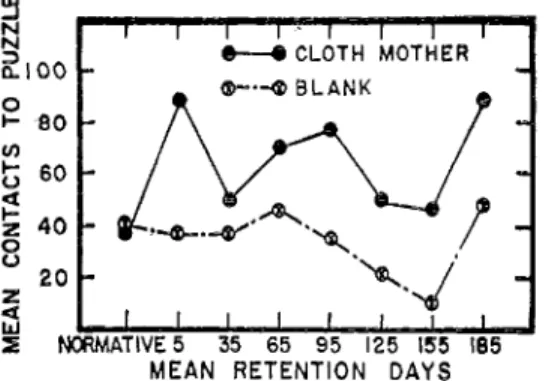
Affectional retention has also been measured by tests in which the monkey must unfasten a three-device mechanical puzzle to obtain entrance into a compartment containing the mother surrogate. All the trials are initiated by allowing the infant to go through an unlocked door, and in half the trials it finds the mother present and in half, an empty compartment. The door is then locked and a ten-minute test conducted. In tests given prior to separation from the surrogate mothers, some of the infants had solved this puzzle and others had failed. The data of Figure 24 show that on the last test before separation there were no differences in total manipulation under mother-present and mother-absent conditions, but striking differences exist between the two conditions throughout the post-separation test periods. Again, there is no interaction with conditions of feeding.
depend-ent upon the results obtained. It would appear that affectional responses may show as much re-sistance to extinction as has been previously dem-onstrated for learned fears and learned pain, and such data would be in keeping with those of com-mon human observation.
The infant's responses to the mother surrogate in the fear tests, the open-field situation, and the baby Butler box and the responses on the retention tests cannot be described adequately with words. For supplementary information we turn to the mo-tion picture record. (At this point a 20-minute film was presented illustrating and supplementing the behaviors described thus far in the address.)
We have already described the group of four con-trol infants that had never lived in the presence of any mother surrogate and had demonstrated no sign of affection or security in the presence of the cloth mothers introduced in test sessions. When these infants reached the age of 250 days, cubicles containing both a cloth mother and a wire mother were attached to their cages. There was no lacta-tion in these mothers, for the monkeys were on a solid-food diet. The initial reaction of the mon-keys to the alterations was one of extreme disturb-ance. All the infants screamed violently and made repeated attempts to escape the cage whenever the door was opened. They kept a maximum distance from the mother surrogates and exhibited a consid-erable amount of rocking and crouching behavior, indicative of emotionality. Our first thought was that the critical period for the development of maternally directed affection had passed and that these macaque children were doomed to live as affectional orphans. Fortunately, these behaviors continued for only 12 to 48 hours and then gradu-ally ebbed, changing from indifference to active contact on, and exploration of, the surrogates. The home-cage behavior of these control monkeys slowly became similar to that of the animals raised with the mother surrogates from birth. Their ma-nipulation and play on the cloth mother became progressively more vigorous to the point of actual mutilation, particularly during the morning after the cloth mother had been given her daily change of terry covering. The control subjects were now actively running to the cloth mother when fright-ened and had to be coaxed from her to be taken from the cage for formal testing.
Objective evidence of these changing behaviors is given in Figure 25, which plots the amount of time
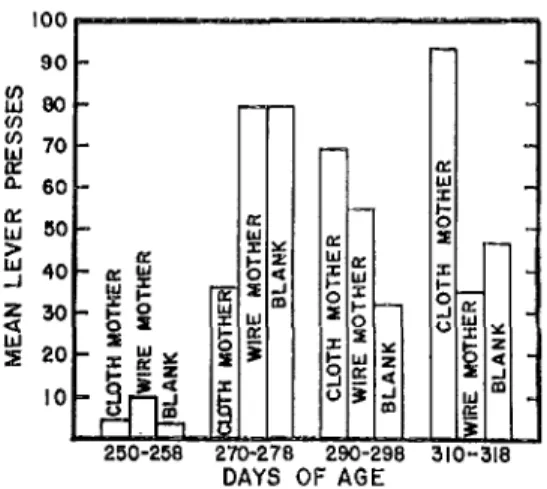
these infants spent on the mother surrogates. Within 10 days mean contact time is approxi-mately nine hours, and this measure remains rela-tively constant throughout the next 30 days. Con-sistent with the results on the subjects reared from birth with dual mothers, these late-adopted in-fants spent less than one and one-half hours per day in contact with the wire mothers, and this ac-tivity level was relatively constant throughout the test sessions. Although the maximum time that the control monkeys spent on the cloth mother was only about half that spent by the original dual mother-surrogate group, we cannot be sure that this discrepancy is a function of differential early experience. The control monkeys were about three months older when the mothers were attached to their cages than the experimental animals had been when their mothers were removed and the reten-tion tests begun. Thus, we do not know what the amount of contact would be for a 250-day-old ani-mal raised from birth with surrogate mothers. Nevertheless, the magnitude of the differences and the fact that the contact-time curves for the moth-ered-from-birth infants had remained constant for almost 150 days suggest that early experience with the mother is a variable of measurable importance. The control group has also been tested for dif-ferential visual exploration after the introduction of the cloth and wire mothers; these behaviors are plotted in Figure 26. By the second test session a high level of exploratory behavior had developed, and the responsiveness to the wire mother and the empty box is significantly greater than that to the cloth mother. This is probably not an artifact
z
< LlJ
(CLOTH MOTHER 0—OWIRE MOTHER
O— -Q-_i ' I I
250499 260-269 270-279 280-289 290-299
DAYS OF AGE
THE AMERICAN PSYCHOLOGIST
90
W
</)
V) -,(. UJ TO °- 60 U 80 3 40 < 3° £ 20 10 -B. - a; w
• |i I
I WIR E MOTHE R | BLAN K — i | CLOT H MOTHE R | WIR E MOTHE R | | BLAN K | ffi Ul X
1
X o -[WIR E MOTHER ! | BLAN K 1-250-258 270-278 290-298 DAYS OF AGE
310-318
FIG. 26. Differential visual exploration of monkeys started at 250 days of age.
since there is every reason to believe that the face of the cloth mother is a fear stimulus to most mon-keys that have not had extensive experience with this object during the first 40 to 60 days of life. Within the third test session a sharp change in trend occurs, and the cloth mother is then more frequently viewed than the wire mother or the blank box; this trend continues during the fourth session, producing a significant preference for the cloth mother.
Before the introduction of the mother surrogate into the home-cage situation, only one of the four control monkeys had ever contacted the cloth mother in the open-field tests. In general, the surrogate mother not only gave the infants no se-curity, but instead appeared to serve as a fear stimulus. The emotionality scores of these con-trol subjects were slightly higher during the mother-present test sessions than during the mother-absent test sessions. These behaviors were changed radi-cally by the fourth post-introduction test approxi-mately 60 days later. In the absence of the cloth mothers the emotionality index in this fourth test remains near the earlier level, but the score is re-duced by half when the mother is present, a result strikingly similar to that found for infants raised with the dual mother-surrogates from birth. The control infants now show increasing object explora-tion and play behavior, and they begin to use the mother as a base of operations, as did the infants raised from birth with the mother surrogates. However, there are still definite differences in the behavior of the two groups. The control infants do not rush directly to the mother and clutch her violently; but instead they go toward, and orient
around, her, usually after an initial period during which they frequently show disturbed behavior, ex-ploratory behavior, or both.
That the control monkeys develop affection or love for the cloth mother when she is introduced into the cage at 250 days of age cannot be ques-tioned. There is every reason to believe, however, that this interval of delay depresses the intensity of the affectional response below that of the infant monkeys that were surrogate-mothered from birth onward. In interpreting these data it is well to remember that the control monkeys had had con-tinuous opportunity to observe and hear other monkeys housed in adjacent cages and that they had had limited opportunity to view and contact surrogate mothers in the test situations, even though they did not exploit the opportunities.
During the last two years we have observed the behavior of two infants raised by their own moth-ers. Love for the real mother and love for the surrogate mother appear to be very similar. The baby macaque spends many hours a day clinging to its real mother. If away from the mother when frightened, it rushes to her and in her presence shows comfort and composure. As far as we can observe, the infant monkey's affection for the real mother is strong, but no stronger than that of the experimental monkey for the surrogate cloth mother, and the security that the infant gains from the presence of the real mother is no greater than the security it gains from a cloth surrogate. Next year we hope to put this problem to final, definitive, experimental test. But, whether the mother is real or a cloth surrogate, there does de-velop a deep and abiding bond between mother and child. In one case it may be the call of the wild and in the other the McCall of civilization, but in both cases there is "togetherness."
particularly natural, maternal sounds, may operate as either unlearned or learned affectional variables. Visual responsiveness may be such a variable, and it is possible that some semblance of visual im-printing may develop in the neonatal monkey. There are indications that this becomes a variable of importance during the course of infancy through some maturational process,
John Bowlby has suggested that there is an af-fectional variable which he calls "primary object following," characterized by visual and oral search of the mother's face. Our surrogate-mother-raised baby monkeys are at first inattentive to her face, as are human neonates to human mother faces. But by 30 days of age ever-increasing responsive-ness to the mother's face appears—whether through learning, maturation, or both—and we have reason to believe that the face becomes an object of spe-cial attention.
Our first surrogate-mother-raised baby had a mother whose head was just a ball of wood since the baby was a month early and we had not had time to design a more esthetic head and face. This baby had contact with the blank-faced mother for 180 days and was then placed with two cloth moth-ers, one motionless and one rocking, both being en-dowed with painted, ornamented faces. To our surprise the animal would compulsively rotate both faces 180 degrees so that it viewed only a round, smooth face and never the painted, ornamented face. Furthermore, it would do this as long as the patience of the experimenter in reorienting the faces persisted. The monkey showed no sign of fear or anxiety, but it showed unlimited persist-ence. Subsequently it improved its technique, com-pulsively removing the heads and rolling them into its cage as fast as they were returned. We are in-trigued by this observation, and we plan to ex-amine systematically the role of the mother face in the development of infant-monkey affections. Indeed, these observations suggest the need for a series of ethological-type researches on the two-faced female.
Although we have made no attempts thus far to study the generalization of infant-macaque affec-tion or love, the techniques which we have devel-oped offer promise in this uncharted field. Beyond this, there are few if any technical difficulties in studying the affection of the actual, living mother for the child, and the techniques developed can be utilized and expanded for the analysis and develop-mental study of father-infant and infant-infant af-fection.
Since we can measure neonatal and infant affec-tional responses to mother surrogates, and since we know they are strong and persisting, we are in a position to assess the effects of feeding and con-tactual schedules; consistency and inconsistency in the mother surrogates; and early, intermediate, and late maternal deprivation. Again, we have here a family of problems of fundamental interest and theoretical importance.