DEVELOPMENTAL RELATIONS BETWEEN READING SKILLS AND ATTENTION PROBLEMS AMONG ELEMENTARY SCHOOL STUDENTS
Sarah Rabiner Eisensmith
A dissertation submitted to the faculty of the University of North Carolina at Chapel Hill in partial fulfillment of the requirements for the degree of Doctor of Philosophy in the School of
Social Work
Chapel Hill 2020
Approved by:
David Ansong
Gary L. Bowen
Kirsten Kainz
Travis Albritton
ii
©2020
iii ABSTRACT
SARAH RABINER EISENSMITH: Developmental Relations Between Reading Skills and Attention Problems Among Elementary School Students
(Under the direction of David Ansong)
Since racial, socioeconomic, and gender-based gaps are observed both in reading
performance and in ratings of attention problems, it follows that the study of the relationship
between these constructs is warranted. However, such an investigation is mostly absent from the
current literature. The three studies comprising this dissertation investigate the developmental
relations between reading and attention, and whether these relations vary by subgroups of
students who are at elevated risk for high ratings of attention problems and lower ratings of
reading skills. The first paper systematically reviewed studies on the developmental relationship
between inattention and reading. The second paper used a multiple-group path analysis design to
test two competing explanations of how attention problems are related to reading skills, and the
role moderation role of gender, race, and family poverty status, and their intersections. The third
paper used a structural equation framework to empirically test whether growth in attention
problems from kindergarten through third grade is associated with growth in reading skills over
the same period. Both Paper 2 and 3 used data from the Early Child Longitudinal Study,
Kindergarten Class of 2010-2011.
Results from Paper 1 indicate that inattention has a consistent and negative impact on
reading skills through multiple pathways. Results from Paper 2 indicate that students’ attention
iv
and through their impact on first-grade reading skills. Black students, boys, and students from
low-income families had higher average ratings of attention problems and lower levels of
average reading skills relative to White students, girls, and students from more affluent families.
Results from Paper 3 indicate that attention problems and reading skills grow independently
from kindergarten through third-grade. Initial levels of attention problems were negatively and
significantly related to initial levels of reading skills, and rates of change in reading skills. All
three subgroup measures—child race, poverty status, and gender—were statistically significantly
related to average levels of attention problems at school entry and the rate of change in reading
skills. Only gender statistically significantly moderated the rate of change in attention problems.
This research has strengthened the foundation for testing for intersectionality in the study
of factors associated with student academic performance. Future studies can employ longitudinal
designs and multidimensional measures to this area and others, as evidence of differential
v
vi
ACKNOWLEDGMENTS
I am so very thankful to those who have helped me through this journey. First, I thank my
dissertation committee; this research is better because of your support and feedback. In
particular, thank you, Dr. David Ansong, for serving as my dissertation chair. For five years,
your advocacy, guidance, kindness, and patience were limitless as we worked together. You
were truly the best advisor I could have ever dreamed of having. I grew tremendously under your
mentorship, and my work will forever be enriched for having worked with you.
To my other esteemed committee members, thank you for always being so gracious and
willing to provide feedback and support. Kirsten Kainz, you build competence, confidence, and
excitement in your students. Your kindness and passion are matched by your methodological
expertise, commitment to justice, and advocacy on behalf of students. Thank you for being one
of my greatest mentors and champions for the last five years. Travis Albritton, thank you for
your interest in and thoughtful feedback about my ideas, which I found to be profoundly
insightful and encouraging. Gary Bowen, I appreciate your high standards for doctoral student
work, and your feedback over the years has helped me become a more thoughtful scholar. April
Harris-Britt, thank you for modeling practice-informed scholarship and scholarship-informed
practice, and for always going the extra mile in providing helpful suggestions and motivation.
I also want to acknowledge those who provided the excellent training that I received in
the doctoral program. Thank you, Gary Cuddeback, Betsy Bledsoe, Din Chen, Sheryl
Zimmerman, Matthew Howard, Kim Strom, Mark Fraser, and Paul Lanier. You all
vii
Zerden, Kanisha Coleman, Tonya VanDeinse, Tauchiana Williams, Phil Kaufman, Vanessa
Mitchell, Jim Griffith, Brenda Vawter, Drew Lassiter, and the entire School of Social Work staff,
faculty and administrators who have modeled commitment to social work professional values.
It is also important that I acknowledge doctoral students, past and present: Stefanie
Baca-Atlas, Premela Deck, Annie Francis, LB Klein, Michael Lazar; Laurie Graham, Elaina Sabatine,
Will Hall, Todd Jensen, Tricia McGovern, Joe Frey, Erum Agha, Brittney Chesworth, Gerard
Chung, Ting Guan, Brooke Jordan, Anna Parisi, Jon Phillips, Anjalee Sharma, Melissa Jenkins,
Quentin Smith, Mel Villodas, Hayden Dawes, Daniel Gibbs, Terence Johnson, Alex Forte, and
Andy Al Wazni. Thank you for your passion, drive, and solidarity. You inspire me to be better.
To my clinical teammates and warriors at The AHB Center for Behavioral Health and
Wellness—thank you for your wisdom, insight, compassion, fierce commitment to serving
others, and patience with me while I pursued this goal. It is an honor to work alongside you.
Finally, I would like to thank my family. To my grandparents, Edwin and Ruth Rabiner,
and Joan and Don Shapiro, thank you for inspiring me to pursue a life of service through
dedicating yours to providing care and support of others. To my parents, thank you for your
unconditional love and support. It is a rare treat and privilege to be able to seek guidance, input,
and feedback from kind and esteemed scholars who also happen to be my fiercest supporters. I
want to thank my sister, Rebecca, for making time to ask about my studies while you were busy
with your own, for playlist recommendations, and endless laughs. To my husband, John, I love
you, thank you. You sacrificed for years so that I could accomplish this goal. I could only make
viii
TABLE OF CONTENTS
LIST OF TABLES………. ix
LIST OF FIGURES……….……….……….. x
LIST OF ABBREVIATIONS……….…………... xi
INTRODUCTION……….. 1
References Introduction……….. 9
PAPER 1: ATTENDING TO ATTENTION: A SYSTEMATIC REVIEW OF ATTENTION AND READING DEVELOPMENT FOR EDUCATORS AND PRACTITIONERS………...13
Introduction………....13
Methods………..16
Results ………18
Conclusion……….33
References Paper 1 ………36
PAPER 2: PATH TO PROFICIENCY THE ROLE OF ATTENTION, RACE, GENDER, AND POVERTY STATUS ON READING SKILLS………43
Introduction………43
Methods……….50
Results………54
Discussion………..65
ix
PAPER 3: EXAMINING DEVELOPMENTAL RELATIONS BETWEEN ATTENTION PROBLEMS AND READING SKILLS
IN ELEMENTARY SCHOOL………..75
Introduction………... 76
Methods………..83
Results ………91
Discussion………..96
References Paper 3………...102
CONCLUSIONS……….110
x
LIST OF TABLES
Table 2. 1. Study characteristics and findings for articles reporting
a direct, indirect, and mixed relationship between attention problems
and reading outcomes……….………….19
Table 3. 1. Correlation Matrix………...………53
Table 3. 2. Descriptive characteristics of the analytical sample………55
Table 3. 3. Model fit indices for invariance tests………...………...57
Table 4. 1. Correlations among study variables………...………... 92
Table 4. 2. Means and standard deviations for study variables in the overall sample and by subgroup………93
xi
LIST OF FIGURES
Figure 2. 1. Search strategy for identifying studies for inclusion………..17
Figure 3. 1. Testable “competing” models of attention problems and reading skills………48
Figure 3. 2. Results of multi-group invariance tests showing
the extent to which the final path model is variant and invariant across
subgroups………59
Figure 3. 3. Path model showing the hypothesized relations
between initial levels and growth trajectories in attention problems and
x
LIST OF ABBREVIATIONS
ADHD Attention deficit hyperactivity disorder
AIC Akaike information criterion
BIC Bayesian information criterion
CFI Confirmatory Fit Index
ECLS:K-2011 Early Childhood Longitudinal Study Kindergarten Cohort of 2011
ERIC Education Resources Information Center
LRRC Language and Reading Research Consortium
MLR Maximum likelihood estimation with robust standard errors
NAEP National Assessment of Educational Progress
NASW National Association of Social Workers
NCES National Center for Education Statistics
RMSEA Root mean square error of approximation
1
INTRODUCTION
DEVELOPMENTAL RELATIONS BETWEEN READING SKILLS AND ATTENTION PROBLEMS
Reading is a building block of development, a foundation of individual and collective
identity, and a critical tool for daily living. Educators expect reading proficiency to vary across
students because students arrive with differences in motivation, preparation, learning abilities,
and educational experiences. However, other gaps in student reading performance have been
associated with the entanglement of poverty and race since the 1960s when data about such gaps
was first collected. Data from the National Assessment of Education Progress (NAEP), a
long-running testing effort of the federal Education Department provides evidence of these gaps: as
early as fourth-grade, Black students’ reading ability is nearly one full grade level lower than that
of White students (National Center for Education Statistics (NCES), 2018). Similarly, students
who qualify for free and reduced lunch score one grade level behind their more affluent peers
(NCES, 2018). Girls also outscore boys by half a year in reading (NCES, 2018). It is important
to note that these gaps are not caused by a fundamental, inherent difference in the capacity of
children along with gender, racial or socioeconomic lines (Ansong, Okumu, Albritton, Bahunk &
Small, 2020; Hyde, 2005; Hyde & Mertz, 2009; Spearman & Watt, 2013). Rather, these
associations are likely explained by an uneven distribution of resources, the concentration of
poverty and its far-reaching effects, and the socialization of students in school (Hening, Hula,
Orr & Pedescleux, 1999).
Improving students’ reading skills to provide all students with access to educational
2
attentional capacity is one of the most stable child-level predictors of academic performance,
with lower levels of attention skills associated with poorer grades (Duncan et al., 2007; Frazier et
al., 2007; Gray, Dueck & Tannock, 2017). In preschool and early school grades, attentional
capacity is malleable and responds to environmental intervention (Jones, Aber & Brown 2011;
van Lier, Muthen, van der Sar & Crijnen, 2004), and efforts to foster attention through
interventions aimed at classrooms and students can serve to reduce performance gaps. Thus,
exploring student attention can be critical to combat the risk of poor educational outcomes.
Attention Problems and Reading Performance: Current Evidence and Empirical Gaps
Attention problems can indicate severe impairment (i.e., Attention Deficit Hyperactivity
Disorder, ADHD), or mild attention problems, both of which can contribute to poor academic
outcomes and a widening performance gap if unaddressed. Attention problems have implications
for reading achievement, in particular (Frick et al., 1991; Hinshaw, 1992; Rabiner & Coie, 2000).
In fact, of children who meet criteria for ADHD, 25-40% also meet the criteria for reading
disorders, and of students who meet criteria for reading disorders, 15-40% also meet the criteria
for ADHD (Epstein, Shaywitz, Shaywitz, & Woolston, 1991). Evidence of a link between
attentiveness and reading development is well established in the literature (Duncan et al., 2007;
Frazier et al., 2007; Gray, Dueck & Tannock, 2017). In addition, many attention-supporting
interventions aim to improve students’ academic performance (Allan et al., 2018; LRRC, Jiang
& Farquharson, 2018; Pham, 2016). Despite the robust evidence base on the association between
attention problems and reading skills, there has been less study of how attention problems may
be related to reading skills.
Just as there is evidence that students’ reading skills vary as a function of race, gender,
3
as a function of these characteristics both individually and through interactive effects. For
instance, children in families of low socioeconomic status are more likely to be rated as
inattentive relative to their more affluent peers (Georges, Brooks-Gunn & Malone, 2012).
Results of one meta-analysis suggest that, on average, students from families of low
socioeconomic status are 1.85-2.21 more likely to have a diagnosis of ADHD relative to their
peers from families with high socioeconomic status (Russel, Ford, Williams & Russel, 2015).
Boys are also generally more likely to be identified as having attention problems (DuPaul et al.,
2014), with a male to female ratio of having a diagnosis of ADHD estimated at 2.28:1
(Ramtekkar, Reiersen, Todorov & Todd, 2010). Turning to race, in settings where Black and
White students are primed to behave similarly, Black students are rated as more inattentive
relative to White students (DuPaul et al., 1997; Epstein, March, Conners & Jackson, 1998;
Lawson et al., 2017; Peters et al., 2014; Rabiner, Murray, Schmid, & Malone 2004). In other
words, Black students may be overrepresented for ratings of attention problems, even when their
behavior is the same as their White peers.
Because racial, socioeconomic, and gender-based gaps are observed both in reading
performance and in ratings of attention problems, it follows that the study of the relationship
between these constructs is warranted and emergent. Unfortunately, there has been little study of
how variation in attention ratings may relate to variations in reading skills. This empirical gap is
especially disappointing in light of the proliferation of evidence about differences in ratings of
attention problems and reading skills by child race, gender, and socioeconomic status. One study
exploring growth in student attention and reading reported that slower gains in reading among
Black students were partially explained by higher ratings of attention problems among Black
4
reported that the impact of higher ratings of attention problems was associated with lower
reading scores for Black students and boys relative to White students and girls. The authors
explained the finding that differences in teacher ratings of attention problems by student race and
gender are correlated with observed racial performance gaps by proposing that ratings of
attention represent a social process.
Study Focus
This dissertation research builds on existing evidence and takes an exploratory approach
to investigate the developmental relations between reading and attention, and whether these
relations vary by subgroups of students who are at elevated risk for having high ratings of
attention problems and lower ratings of reading skills. By exploring developmental trajectories
of attention problems and reading skills, their relations with one another, and whether their
trajectories vary as a function of child gender, race, and family poverty status, it is possible to
gain insight for when and with whom to intervene to promote student success.
This three-paper dissertation addresses the following objectives:
(1) systematically identify, examine, and synthesize substantive findings from theoretical and
empirical literature linking attention and reading development and provide suggestions
for future research;
(2) test two competing explanations of how attention problems may be related to reading
proficiency; and whether the relation between attention and reading proficiency holds for
boys and girls, Black and White students, students whose families are poor and those
whose families are not poor, and combinations of these characteristics;
(3) examine whether initial scores and rates of change for attention problems and reading
5
growth in attention problems from kindergarten through third grade is associated with
growth in reading skills over the same period of time.
Theoretical Underpinnings
This dissertation study seeks to meet the need to study further how variation in attention
problems relates to variations in reading skills over time and for students of different
sociodemographic backgrounds through a review of the theoretical and empirical literature and
empirical testing. In so doing, this research draws from two contextual theories of development:
the Integrative Model for the Study of Developmental Competencies in Minority Children
(García-Coll et al., 1996), and the Transactional Model of Development (Sameroff, 1975, 2009).
Together, these two theories allow for the nuanced study of the development of attention
problems and reading skills among diverse subgroups of students.
The Integrative Model for the Study of Developmental Competencies in Minority
Children accounts for experiences of prejudice, racism, oppression, segregation, and
discrimination in the development of competencies among non-White children. The
Transactional Model of Development, on the other hand, holds that growth in any given year of
schooling may depend on the child’s experiences in previous years, as these experiences affect
the reading skills that children bring to their new classroom (Sameroff, 1975, 2009). This
dissertation tests these two theories to understand the developmental relations between reading
skills and attention problems.
Relevance to Social Work Practice and Research
Social work is committed to improving well-being, particularly among those who are
vulnerable and oppressed (National Association of Social Work, NASW, 2008). In the realm of
6
schools. The NASW Standards for School Social Workers states that school social workers must
seek to ensure equitable educational opportunities for all students, with particular attention to
students who struggle to fully benefit from the educational system (NASW, 2012). This
inherently includes students who are at elevated risk for poor educational outcomes due to
attention problems, as well as those who have historically had less access to educational
opportunities.
Social workers employed in educational settings are well-positioned to contribute to
solutions to observed racial, economic, and gender performance gaps in reading proficiency.
Social work training enables these professionals to consider the interrelationship of social
problems and academic outcomes in a broad context and to contribute to interventions aimed at
reducing performance gaps. Typically, school social workers interested in addressing
performance gaps in their schools are directed to provide social welfare and services solutions
(Allen-Meares, 1994; Berzin et al., 2011; Kelly, 2008; Kelly et al., 2016). However, school
social workers are specially prepared and located to address the interaction of child and
classroom factors within schools that impede student performance in early grades and set up
challenges for later success.
School social workers are best positioned to not only facilitate better understandings of
the social processes at play in school but also use their roles to contextualize teacher ratings of
student attention. By increasing the awareness and understanding of the dynamics affecting
students’ attention, school social workers can make meaningful, well-informed proposals to
implement interventions designed to improve reading proficiency and overall student success.
This dissertation also has implications for social work research. This dissertation study
7
problems and reading skills by child race, gender, and family poverty status despite evidence that
such gaps exist. This research has established the foundation for testing for intersectionality in
the study of factors associated with student academic performance. Future studies can employ
longitudinal designs and multidimensional measures to this area and others, as evidence of
differential relations can be keys to unlocking the processes that perpetuate performance gaps.
Using this dissertation study as a foundation, social work researchers, in concert with: (1)
scholars from education, policy, and psychology, (2) school social workers, teachers, and other
school staff, and (3) families, children, and child-advocates, can foster a shared understanding of
the problem of racial, socioeconomic and gender performance gaps in readings (Jensen & Kainz,
2019). Such work is in service of— and necessary for—making a real difference for children.
Organization of the Dissertation
This dissertation followed the three-paper format and focused on the developmental
relations between attention problems and reading skills among subgroups of elementary school
students. This introductory chapter presented a review of the current evidence on the relationship
between attention and problems, the study focus, theoretical underpinnings of the study, and the
relevance of the study for social work practice and research. Chapter 2 presents a systematic
review of literature linking attention to reading development among all students and those who
are at elevated risk for both attention problems and diminished reading performance. Chapter 3
presents results from a multiple-group path analysis design that tested two competing
explanations of how attention problems are related to reading skills, and the role of gender, race,
and family poverty status on this relation as moderators individually and through interactive
effects. Chapter 4 presents results on whether growth in attention problems from kindergarten
8
Together, all three papers address important gaps in the literature and form cohesive yet distinct
results that can be used to inform ongoing intervention development for children with attention
problems and exploration into the mechanisms that drive persistent gender, race, and
socioeconomic performance gaps. Following the presentation of each of the three papers,
Chapter 5 integrates findings from the three papers, and implications for social work practice and
9
REFERENCES: INTRODUCTION
Allan, D. M., Allan, N. P., Lonigan, C. J., Hume, L. E., Farrington, A. L., & Vinco, M. H. (2018). The influences of multiple informants' ratings of inattention on preschoolers' emergent literacy skills growth. Learning and Individual Differences, 65, 90-99.
Allen-Meares, P. (1994). Social work services in schools: A national study of entry-level tasks. Social Work, 39(5), 560-565.
Ansong, D., Okumu, M., Albritton, T. J., Bahnuk, E. P., & Small, E. (2020). The Role of Social Support and Psychological Well-Being in STEM Performance Trends across Gender and Locality: Evidence from Ghana. Child Indicators Research.
https://doi.org/10.1007/s12187-019-09691-x
Aunola, K., Leskinen, E., Onatsu‐Arvilommi, T., & Nurmi, J. E. (2002). Three methods for studying developmental change: A case of reading skills and self‐concept. British Journal of Educational Psychology, 72(3), 343-364.
Berzin, S. C., O'Brien, K. H. M., Frey, A., Kelly, M. S., Alvarez, M. E., & Shaffer, G. L. (2011). Meeting the social and behavioral health needs of students: Rethinking the relationship between teachers and school social workers. Journal of School Health, 81(8), 493-501.
Chapman, J. W., Tunmer, W. E., & Prochnow, J. E. (2000). Early reading-related skills and performance, reading self-concept, and the development of academic self-concept: A longitudinal study. Journal of Educational Psychology, 92(4), 703-708.
Duncan, G. J., Dowsett, C. J., Claessens, A., Magnuson, K., Huston, A. C., Klebanov, P., Pagani, L.S., Feinstein, L., Engel, M. Brooks-Gunn, J., Sexton, H., Duckworth, K., & Japel, C. (2007). School readiness and later achievement. Developmental Psychology, 43(6), 1428.
DuPaul, G. J., Reid, R., Anastopoulos, A. D., & Power, T. J. (2014). Assessing ADHD
symptomatic behaviors and functional impairment in school settings: Impact of student and teacher characteristics. School Psychology Quarterly, 29(4), 409.
Eisensmith, S. R., & Kainz, K. L. (2019). Unpacking the Relationship between Elementary School Teachers' Ratings of Student Attention and Student Reading Scores. School Social Work Journal, 43(2), 63-89.
Epstein, J. N., March, J. S., Conners, C. K., & Jackson, D. L. (1998). Racial differences on the Conners teacher rating scale. Journal of Abnormal Child Psychology, 26, 109–118.
Epstein, M., Shaywitz, S., Shaywits, B., Woolston, J. (1991). The boundaries of attention deficit disorder. Journal of Learning Disabilities, 24, 78-86.
Frazier, T. W., Youngstrom, E. A., Glutting, J. J., & Watkins, M. W. (2007). ADHD and achievement: Meta-analysis of the child, adolescent, and adult literatures and a
10
Frick, P. J., Kamphaus, R. W., Lahey, B. B., Loeber, R., Christ, M. A. G., Hart, E. L., & Tannenbaum, L. E. (1991). Academic underachievement and the disruptive behavior disorders. Journal of Consulting and Clinical Psychology, 59(2), 289-294.
Georges, A., Brooks-Gunn, J., & Malone, L. M. (2012). Links between young children’s
behavior and achievement: The role of social class and classroom composition. American Behavioral Scientist, 56(7), 961-990.
Gray, S.A., Dueck, K., Rogers, M., & Tannock, R. (2017) Qualitative review synthesis: the relationship between inattention and academic achievement. Educational Research, 59(1), 17-35.
Henig, J. R., Hula, R. C., Orr, M., & Pedescleaux, D. S. (2001). The color of school reform: Race, politics, and the challenge of urban education. Princeton University Press.
Hinshaw, S. P. (1992). Externalizing behavior problems and academic underachievement in childhood and adolescence: Causal relationships and underlying mechanisms. Psychological Bulletin, 111, 127–155.
Hooper, S. R., Roberts, J., Sideris, J., Burchinal, M., & Zeisel, S. (2010). Longitudinal predictors of reading and math trajectories through middle school for African American versus Caucasian students across two samples. Developmental Psychology, 46(5), 1018.
Hyde, J. S. (2005). The gender similarities hypothesis. American Psychologist, 60(6), 581 - 592.
Hyde, J. S., & Mertz, J. E. (2009). Gender, culture, and mathematics performance. Proceedings of the National Academy of Sciences, 106(22), 8801-8807.
Isbell, E., Calkins, S. D., Swingler, M. M., & Leerkes, E. M. (2018). Attentional fluctuations in preschoolers: Direct and indirect relations with task accuracy, academic readiness, and school performance. Journal of Experimental Child Psychology, 167, 388-403.
Jones, S. M., Brown, J. L., & Lawrence, Aber, J. (2011). Two‐year impacts of a universal school‐based social‐emotional and literacy intervention: An experiment in translational developmental research. Child Development, 82(2), 533-554.
Kelly, M. S. (2008). The domains and demands of school social work practice: A guide to working effectively with students, families, and schools. Oxford University Press.
Kiuru, N., Aunola, K., Lerkkanen, M. K., Pakarinen, E., Poskiparta, E., Ahonen, T., Poikkeus, A., & Nurmi, J. E. (2015). Positive teacher and peer relations combine to predict primary school students’ academic skill development. Developmental Psychology, 51(4), 434.
11
Lonigan, C. J., Allan, D. M., & Phillips, B. M. (2017). Examining the predictive relations between two aspects of self-regulation and growth in preschool children’s early literacy skills. Developmental Psychology, 53(1), 63-76.
Language and Reading Research Consortium, Jiang, H., & Farquharson, K. (2018). Are working memory and behavioral attention equally important for both reading and listening comprehension? A developmental comparison. Reading and Writing, 31(7), 1449-1477.
National Association of Social Workers. (2008). Code of Ethics. Retrieved from http://www.socialworkers.org/pubs/code/default.asp
NASW 2012. NASW Standards for School Social Work Services. Retrieved from
https://www.socialworkers.org/LinkClick.aspx?fileticket=1Ze4-9-Os7E%3D&portalid=0
National Center for Education Statistics. (2018). Report Card for the Nation, States, and Districts (grades 4 and 8). Washington, D.C.: National Center for Education Statistics, Institute of Education Sciences, U.S. Dept. of Education.
Peters, C. D., Kranzler, J. H., Algina, J., Smith, S. W., & Daunic, A. P. (2014). Understanding disproportionate representation in special education by examining group differences in behavior ratings. Psychology in the Schools, 51(5), 452-465.
Pham, A. V. (2016). Differentiating behavioral ratings of inattention, impulsivity, and hyperactivity in children: effects on reading achievement. Journal of Attention Disorders, 20(8), 674-683.
Rabiner, D., & Coie, J. D. (2000). Early attention problems and children's reading achievement: A longitudinal investigation. Journal of the American Academy of Child & Adolescent Psychiatry, 39(7), 859-867.
Rabiner, D. L., Godwin, J., & Dodge, K. A. (2016). Predicting academic achievement and attainment: the contribution of early academic skills, attention difficulties, and social competence. School Psychology Review, 45(2), 250-267.
Rabiner, D. L., Murray, D. W., Schmid, L., & Malone, P. S. (2004). An exploration of the relationship between ethnicity, attention problems, and academic achievement. School Psychology Review, 33(4), 498-509.
Ramtekkar, U. P., Reiersen, A. M., Todorov, A. A., & Todd, R. D. (2010). Sex and age differences in attention-deficit/hyperactivity disorder symptoms and diagnoses: implications for DSM-V and ICD-11. Journal of the American Academy of Child and Adolescent Psychiatry, 49(3), 217–218.
12
Sameroff, A.J. (1975) Early influences on development: Fact or fancy? Merrill-Palmer Quarterly, 21, 267-294.
Sameroff, A. (2009). The Transactional Model. American Psychological Association.
Spearman, J. & Watt, H. M. G. (2013). Perception shapes experience: The influence of actual and perceived classroom environment dimensions on girls’ motivations for science. Learning Environment Research, 16(217), 217-238. doi: 10.1007/s10984-013-9129-7.
Stanovich, K. E. (1986). Cognitive processes and the reading problems of learning disabled children: Evaluating the assumption of specificity. Psychological and Educational Perspectives on Learning Disabilities, 87-131.
ten Braak, D., Kleemans, T., Størksen, I., Verhoeven, L., & Segers, E. (2018). Domain-specific effects of attentional and behavioral control in early literacy and numeracy
development. Learning and Individual Differences, 68, 61-71.
van de Sande, E., Segers, E., & Verhoeven, L. (2017). How executive control predicts early reading development. Written Language & Literacy, 20(2), 170-193.
Van Lier, P. A., Muthén, B. O., van der Sar, R. M., & Crijnen, A. A. (2004). Preventing
13
PAPER 1
ATTENDING TO ATTENTION: A SYSTEMATIC REVIEW OF ATTENTION AND READING DEVELOPMENT FOR EDUCATORS AND PRACTITIONERS
Reading is a building block of development, a foundation of individual and collective
identity, and a critical tool for daily living. Students’ ability to pay attention is one of the most
stable and direct child-level predictors of academic performance (Trentacosta & Izzard, 2007),
and on reading achievement in particular (Frick et al., 1991; Hinshaw; 1992; Rabiner & Coie,
2000). The field of cognitive science defines attention as a sensory and motor system of the brain
that: (1) selects, prioritizes and directs attention in response to stimuli (Hendry et al., 2016;
Posner & Peterson 1990, 2012); (2) prepares the student to anticipate incoming stimuli (Posner
& Peterson, 1990, 2012); and (3)enables planning, problem-solving, conflict resolution and
decision making (Posner & Rothbert, 1998; Shallice & Burgess, 1996; Wang, Liu & Fa, 2011).
Either “top-down” or “bottom-up” processes can trigger attention. Top-down processes are
initiated by one’s desire to gain information about something in the environment, such as looking
for a friend in the school cafeteria. Bottom-up processes, on the other hand, are driven by
external stimuli, such as a flash of light or unexpected noise, and are relatively reflexive and a
There are key areas of overlap in attention and other constructs such as executive
function (Bornstein, 1990; Diamond, 2002; Klein & Lawrence, 2012; Kofler at al., 2011)
Executive function has become an umbrella term for a variety of top-down cognitive processes
14
However, there are key distinctions between executive function and attention. For one, attention
and executive functioning are rooted, at least partially, in distinct neural nodes (i.e., dorsal vs.
medial prefrontal cortex; rostral v. caudal anterior cingulate cortex), which provides objective
evidence of their distinctiveness (Nigg, 2017). Attention and executive function are also
conceptually distinct. For instance, the orienting system of attention is a largely reflexive process
that does not rely on the simple or complex cognitive processes of executive function. In
addition, cognitive functions involved in situations with simple cognitive tasks such as solving
mental math problems may not relate to attention. This differentiation helps illustrate that deficits
in executive functioning can lead to diagnoses of specific learning disabilities that have nothing
to do with attention (Klein & Lawrence, 2012).
Inattention manifests in observable behaviors such as wandering off tasks, being
disorganized, having difficulty focusing, lacking persistence, and being forgetful (American
Psychiatric Association, 2013). When inattention symptoms are persistent and impairing at
school, home, and with peers, they constitute part of the attention deficit hyperactivity disorder
(ADHD) diagnostic criteria (Groen-Blokhuis et al. 2014; Marcus and Barry 2011).
Students with attention problems perform below expected levels and have worse grades
relative to peers without attention problems (Barry, Lyman & Klinger, 2003; Duncan et al.,
2007; Frazier et al., 2007). Attention problems have implications for reading achievement in
particular (Frick et al., 1991; Hinshaw; 1992; Rabiner & Coie, 2000). Learning to read is
cognitively demanding and requires sustained attention and on-task behavior over extended
periods (Dittman 2016). Specific skills needed for reading achievement, such as letter-word
identification and comprehension, have been linked to the ability to concentrate (Rabiner &
15
Attention responds to environmental intervention during preschool and early elementary
school years (Jones, Aber & Brown 2011; van Lier, Muthen, van der Sar, & Crijnen, 2004).
However, by the time children are in first grade, their sustained attention abilities have developed
with adult-like levels of stability (Deter-Deckard & Wang, 2014). At this age, attention problems
can indicate severe impairment (i.e., Attention Deficit Hyperactivity Disorder, ADHD), or more
mild attention problems, both of which can contribute to poor academic outcomes if
unaddressed. Murray (2014) estimates that approximately 16 percent of students experience
attention problems. Identifying children with attention problems early may be critical to promote
reading development and performance for all children.
Although there is a consensus among researchers and educators that there is a
relationship between attention and reading abilities, the process by which attention impacts
reading remains somewhat elusive (O’Neill et al., 2016). Besides, much less is known about
potential differential relations between attention and reading development among students who
are overrepresented in ratings of inattention, such as boys and students of color. Students of color
are rated as having higher levels of attention problems relative to their White peers, even in
controlled settings where children are primed to behave identically to one another, which may be
evidence of racial bias that disadvantages non-White students (DuPaul et al., 1997; Epstein,
March, Conners & Jackson, 1998; Rabiner, Murray, Schmid, & Malone 2004).
The purpose of this article is to systematically review the contemporary literature on
attention and reading. The primary goals of this review were to (1) describe how inattention and
literacy develop both independently and concurrently from preschool through middle childhood,
and (2) to summarize recent research on the potential differential relationship between attention
16
provide educators and practitioners with a summary of the most current literature linking
inattention to reading to inform instructional and intervention practices.
Methods
Best practices for the conduct of systematic reviews, as outlined by Litell, Corcoran, and Pillai
(2008), were used in the completion of this review.
Inclusion Criteria
Inattention manifests as a dimensional trait in the general population (Gray, Dueck,
Rogers & Tannock, 2017). This study aimed to capture the most current research on the natural
development of the spectrum of inattention and its relationship with reading development that
reflects a typical classroom, rather than focus on a subgroup of children whose severe attention
problems cause clinical levels of impairment. Therefore, the following criteria were used to
identify studies for inclusion in this systematic review. To be eligible for inclusion, studies had
to (1) focus on reading skills, early literacy skills, or reading performance as an outcome; (2)
include measures of attention or inattention; (3) use longitudinal data; (4) be published on or
after December or 2015, so that the current study serves as an update to four previous reviews of
the relationship between ADHD symptoms and academic outcomes (i.e., Arnold at al., 2015;
Frazier et al., 2007; Gray, Dueck, Rogers & Tannock, 2017; Polderman et al., 2010); (5) include
quantitative or qualitative data analyses (i.e., no narrative reviews, conceptual frameworks, book
reviews, etc.); and (6) be published in English.
Search and Coding Strategy
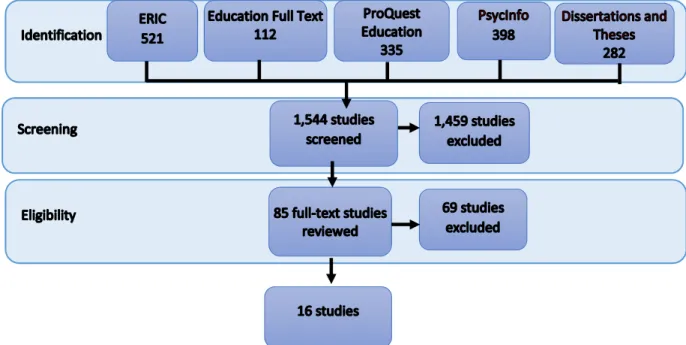
Figure 2.1 illustrates the search strategy. A university social science reference librarian
with systematic review experience consulted on the overall search strategy and helped identify
17
studies from the search. Therefore, the final search string was inclusive and broad. It was as
follows: attention AND inattention OR ADHD AND (read* development OR literacy OR
pre-read* skills) AND elementary AND student AND (achievement OR growth), limited from
December 2015 and onward, and limited to English language and peer-reviewed only. Asterisks
indicated that words beginning with that term, but with variant endings, would be included (e.g.,
read* would include search results containing the words reading and read). The search was
conducted in September 2019 and updated in January 2020.
Figure 2. 1. Search strategy for identifying studies for inclusion
A search of ERIC, ProQuest Education, Education Full Text, PsycInfo, and Dissertations
and Theses yielded 1,652 studies. I then imported all identified studies into Covidence (i.e.,
online software for systematic review management), and duplicate references were omitted. A
total of 1,544 studies were identified for initial screening. After a review of titles, abstracts, and
full text, if necessary, 85 studies were assessed for eligibility. Of these, 16 were included in the
18
ADHD. Ten intervention research studies were screened out because this review focused on the
natural development of inattention and reading, eight were eliminated because they focused on
executive function and self-regulation, which are related to but separate from attention. An
additional ten studies were removed because their focus was too broad. Two studies were
duplicates and were also excluded.
Coding sheets were used to abstract relevant data from all studies, including author
information, research questions, sample information, participant characteristics, and study
conclusions. Completed coding sheets were used to generate Table 2.1.
Results Study Characteristics
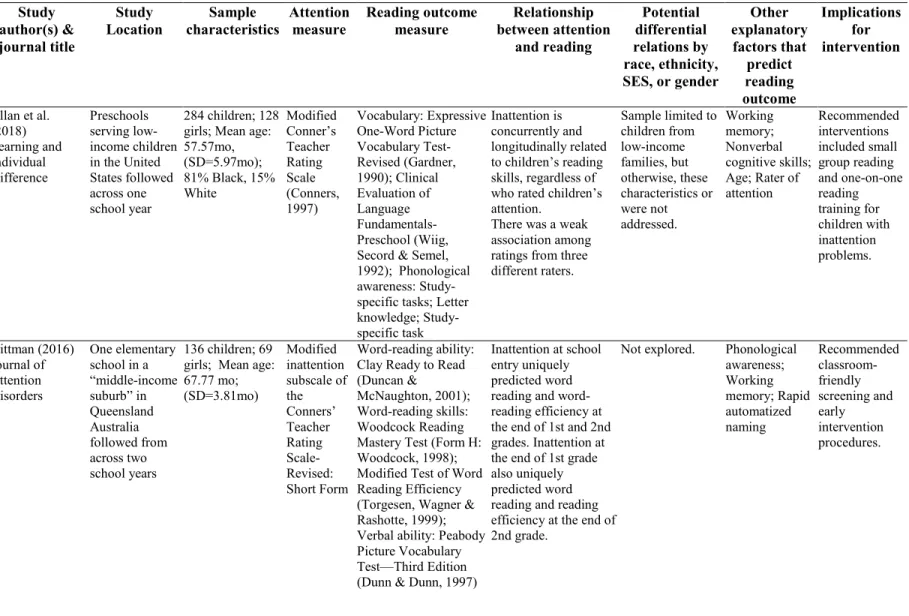
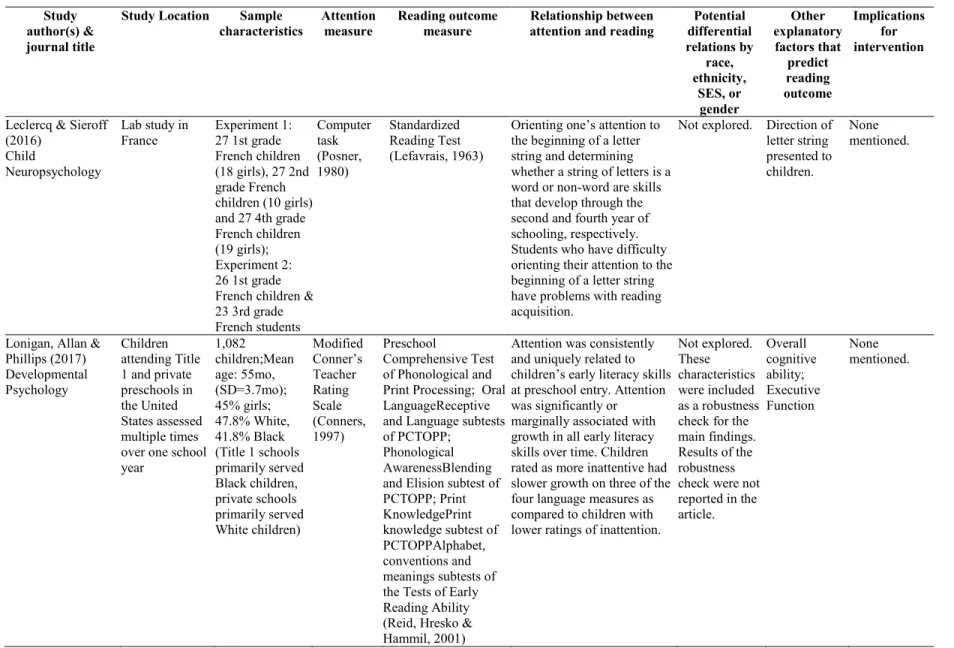
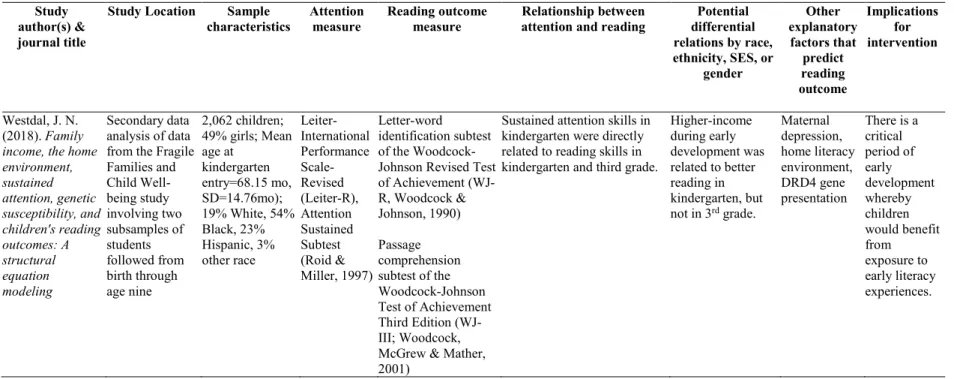
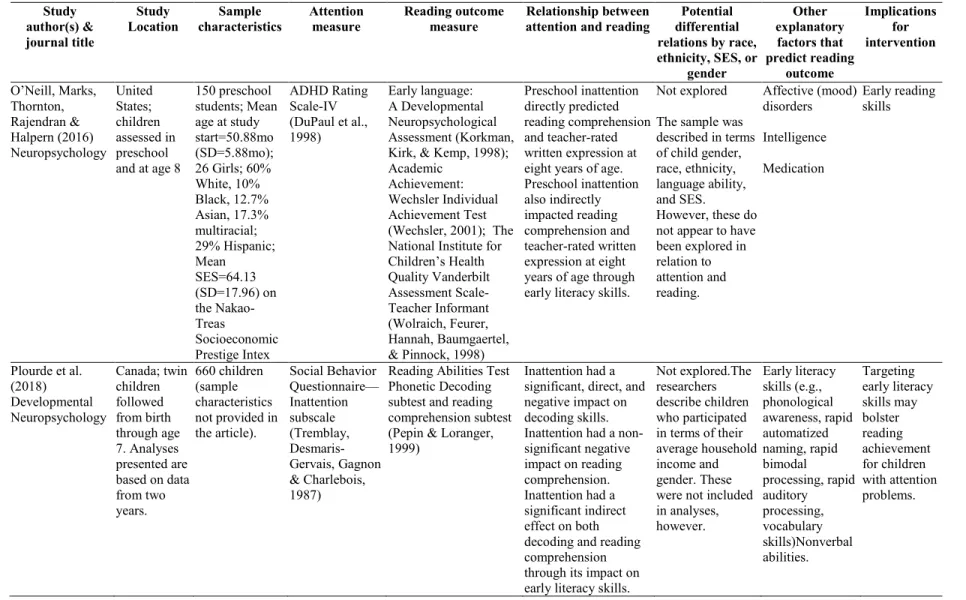
Table 2.1 displays descriptions and findings for each of the 16 studies reviewed. There
was wide variation in terms of data collected, sample characteristics, and measured used. Three
studies used large, nationally representative datasets; five employed primary, non-probability
samples; and seven conducted secondary data analysis of existing data. Seven studies included
1
9
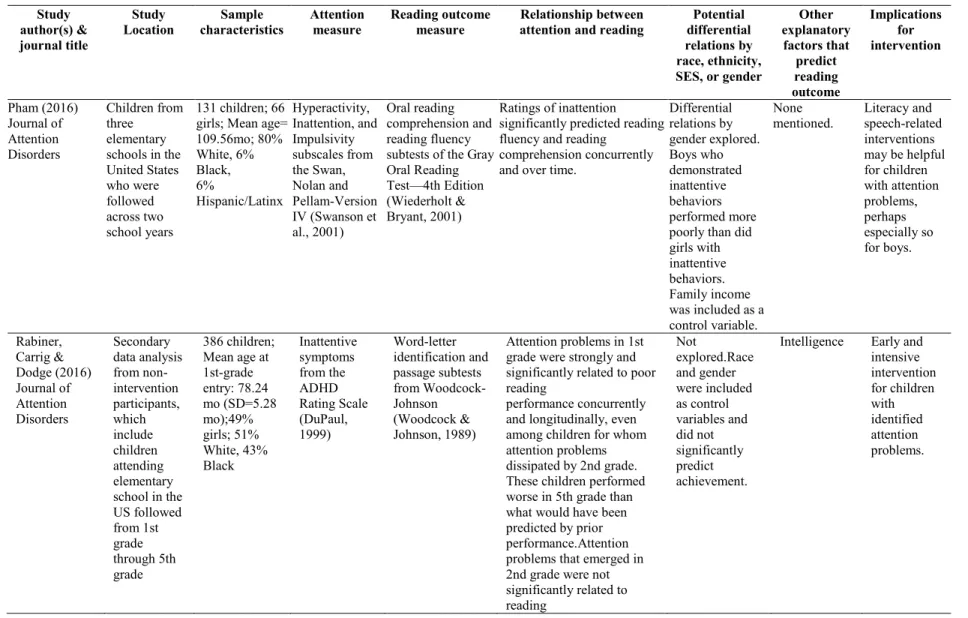
Table 2. 1.Study characteristics and findings for articles reporting a direct, negative relationship between attention problems and reading outcomes. Study author(s) & journal title Study Location Sample characteristics Attention measure Reading outcome measure Relationship between attention and reading Potential differential relations by race, ethnicity, SES, or gender
Other explanatory factors that predict reading outcome Implications for intervention
Allan et al. (2018) Learning and Individual Difference Preschools serving low-income children in the United States followed across one school year
284 children; 128 girls; Mean age: 57.57mo, (SD=5.97mo); 81% Black, 15% White Modified Conner’s Teacher Rating Scale (Conners, 1997) Vocabulary: Expressive One-Word Picture Vocabulary Test-Revised (Gardner, 1990); Clinical Evaluation of Language Fundamentals-Preschool (Wiig, Secord & Semel, 1992); Phonological awareness: Study-specific tasks; Letter knowledge; Study-specific task
Inattention is concurrently and longitudinally related to children’s reading skills, regardless of who rated children’s attention.
There was a weak association among ratings from three different raters.
Sample limited to children from low-income families, but otherwise, these characteristics or were not addressed. Working memory; Nonverbal cognitive skills; Age; Rater of attention Recommended interventions included small group reading and one-on-one reading training for children with inattention problems. Dittman (2016) Journal of Attention Disorders One elementary school in a “middle-income suburb” in Queensland Australia followed from across two school years
136 children; 69 girls; Mean age: 67.77 mo; (SD=3.81mo) Modified inattention subscale of the Conners’ Teacher Rating Scale-Revised: Short Form Word-reading ability: Clay Ready to Read (Duncan &
McNaughton, 2001); Word-reading skills: Woodcock Reading Mastery Test (Form H: Woodcock, 1998); Modified Test of Word Reading Efficiency (Torgesen, Wagner & Rashotte, 1999); Verbal ability: Peabody Picture Vocabulary Test—Third Edition (Dunn & Dunn, 1997)
Inattention at school entry uniquely predicted word reading and word-reading efficiency at the end of 1st and 2nd grades. Inattention at the end of 1st grade also uniquely predicted word reading and reading efficiency at the end of 2nd grade.
2
0
Table 2.1. Study characteristics and findings for articles reporting relationships between attention problems and reading outcomes (cont’d).
Study author(s) & journal title
Study Location Sample characteristics Attention measure Reading outcome measure Relationship between attention and reading
Potential differential relations by race, ethnicity, SES, or gender Other explanatory factors that predict reading outcome Implications for intervention
Leclercq & Sieroff (2016)
Child
Neuropsychology
Lab study in France
Experiment 1: 27 1st grade French children (18 girls), 27 2nd grade French children (10 girls), and 27 4th grade French children (19 girls); Experiment 2: 26 1st grade French children & 23 3rd grade French students Computer task (Posner, 1980) Standardized Reading Test (Lefavrais, 1963)
Orienting one’s attention to the beginning of a letter string and determining whether a string of letters is a word or non-word are skills that develop through the second and fourth year of schooling, respectively. Students who have difficulty orienting their attention to the beginning of a letter string have problems with reading acquisition.
Not explored. Direction of letter string presented to children.
None mentioned.
Lonigan, Allan & Phillips (2017) Developmental Psychology
Children attending Title 1 and private preschools in the United States assessed multiple times over one school year 1,082 children;Mean age: 55mo, (SD=3.7mo); 45% girls; 47.8% White, 41.8% Black (Title 1 schools primarily served Black children, private schools primarily served White children) Modified Conner’s Teacher Rating Scale (Conners, 1997) Preschool Comprehensive Test of Phonological and Print Processing; Oral LanguageReceptive and Language subtests of PCTOPP;
Phonological AwarenessBlending and Elision subtest of PCTOPP; Print KnowledgePrint knowledge subtest of PCTOPPAlphabet, conventions and meanings subtests of the Tests of Early Reading Ability (Reid, Hresko & Hammil, 2001)
Attention was consistently and uniquely related to children’s early literacy skills at preschool entry. Attention was significantly or marginally associated with growth in all early literacy skills over time. Children rated as more inattentive had slower growth on three of the four language measures as compared to children with lower ratings of inattention.
2
1
Table 2.1. Study characteristics and findings for articles reporting relationships between attention problems and reading outcomes (cont’d).
Study author(s) & journal title
Study Location Sample characteristics Attention measure Reading outcome measure Relationship between attention and reading
Potential differential relations by race, ethnicity, SES, or
gender Other explanatory factors that predict reading outcome Implications for intervention
Westdal, J. N. (2018). Family income, the home environment, sustained attention, genetic susceptibility, and children's reading outcomes: A structural equation modeling Secondary data analysis of data from the Fragile Families and Child Well-being study involving two subsamples of students followed from birth through age nine 2,062 children; 49% girls; Mean age at
kindergarten entry=68.15 mo, SD=14.76mo); 19% White, 54% Black, 23% Hispanic, 3% other race Leiter-International Performance Scale-Revised (Leiter-R), Attention Sustained Subtest (Roid & Miller, 1997) Letter-word identification subtest of the Woodcock-Johnson Revised Test of Achievement (WJ-R, Woodcock & Johnson, 1990) Passage comprehension subtest of the Woodcock-Johnson Test of Achievement Third Edition (WJ-III; Woodcock, McGrew & Mather, 2001)
Sustained attention skills in kindergarten were directly related to reading skills in kindergarten and third grade.
Higher-income during early development was related to better reading in kindergarten, but not in 3rd grade.
Maternal depression, home literacy environment, DRD4 gene presentation
2
2
Table 2.1. Study characteristics and findings for articles reporting relationships between attention problems and reading outcomes (cont’d). Study author(s) & journal title Study Location Sample characteristics Attention measure Reading outcome measure Relationship between attention and reading
Potential differential relations by race, ethnicity, SES, or gender
Other explanatory factors that predict reading outcome Implications for intervention Pham (2016) Journal of Attention Disorders Children from three elementary schools in the United States who were followed across two school years
131 children; 66 girls; Mean age= 109.56mo; 80% White, 6% Black, 6% Hispanic/Latinx Hyperactivity, Inattention, and Impulsivity subscales from the Swan, Nolan and Pellam-Version IV (Swanson et al., 2001)
Oral reading comprehension and reading fluency subtests of the Gray Oral Reading Test—4th Edition (Wiederholt & Bryant, 2001)
Ratings of inattention significantly predicted reading fluency and reading
comprehension concurrently and over time.
Differential relations by gender explored. Boys who demonstrated inattentive behaviors performed more poorly than did girls with inattentive behaviors. Family income was included as a control variable. None mentioned. Literacy and speech-related interventions may be helpful for children with attention problems, perhaps especially so for boys. Rabiner, Carrig & Dodge (2016) Journal of Attention Disorders Secondary data analysis from non-intervention participants, which include children attending elementary school in the US followed from 1st grade through 5th grade 386 children; Mean age at 1st-grade entry: 78.24 mo (SD=5.28 mo);49% girls; 51% White, 43% Black Inattentive symptoms from the ADHD Rating Scale (DuPaul, 1999) Word-letter identification and passage subtests from Woodcock-Johnson (Woodcock & Johnson, 1989)
Attention problems in 1st grade were strongly and significantly related to poor reading
performance concurrently and longitudinally, even among children for whom attention problems dissipated by 2nd grade. These children performed worse in 5th grade than what would have been predicted by prior performance.Attention problems that emerged in 2nd grade were not significantly related to reading Not explored.Race and gender were included as control variables and did not significantly predict achievement.
2
3
Table 2.1. Study characteristics and findings for articles reporting relationships between attention problems and reading outcomes (cont’d).
Study author(s) & journal title
Study Location Sample characteristics Attention measure Reading outcome measure Relationship between attention and reading
Potential differential relations by race, ethnicity, SES, or
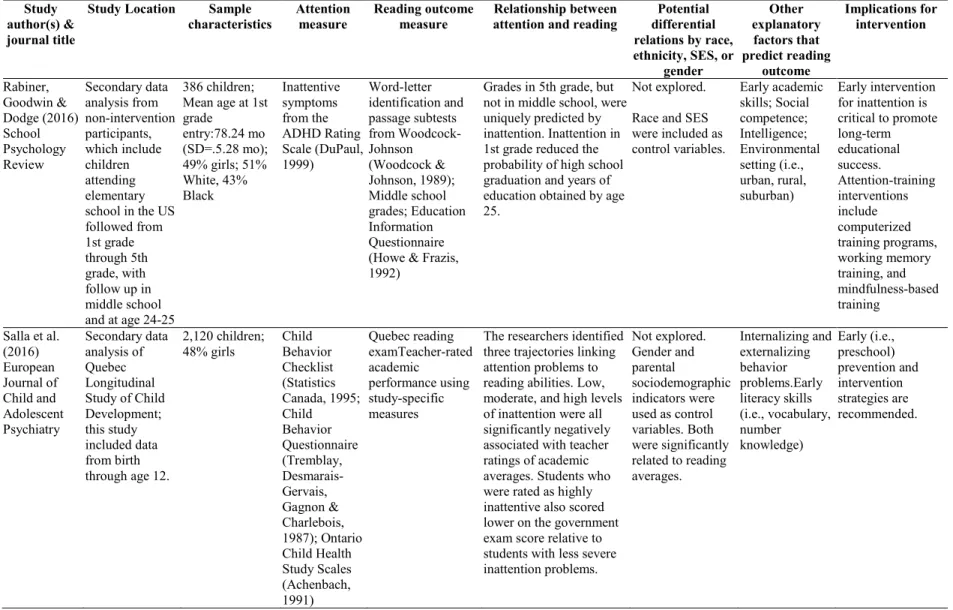
gender Other explanatory factors that predict reading outcome Implications for intervention Rabiner, Goodwin & Dodge (2016) School Psychology Review Secondary data analysis from non-intervention participants, which include children attending elementary school in the US followed from 1st grade through 5th grade, with follow up in middle school and at age 24-25
386 children; Mean age at 1st grade
entry:78.24 mo (SD=.5.28 mo); 49% girls; 51% White, 43% Black Inattentive symptoms from the ADHD Rating Scale (DuPaul, 1999) Word-letter identification and passage subtests from Woodcock-Johnson (Woodcock & Johnson, 1989); Middle school grades; Education Information Questionnaire (Howe & Frazis, 1992)
Grades in 5th grade, but not in middle school, were uniquely predicted by inattention. Inattention in 1st grade reduced the probability of high school graduation and years of education obtained by age 25.
Not explored. Race and SES were included as control variables. Early academic skills; Social competence; Intelligence; Environmental setting (i.e., urban, rural, suburban) Early intervention for inattention is critical to promote long-term educational success. Attention-training interventions include computerized training programs, working memory training, and mindfulness-based training
Salla et al. (2016) European Journal of Child and Adolescent Psychiatry Secondary data analysis of Quebec Longitudinal Study of Child Development; this study included data from birth through age 12.
2,120 children; 48% girls Child Behavior Checklist (Statistics Canada, 1995; Child Behavior Questionnaire (Tremblay, Desmarais-Gervais, Gagnon & Charlebois, 1987); Ontario Child Health Study Scales (Achenbach, 1991) Quebec reading examTeacher-rated academic performance using study-specific measures
2
4
Table 2.1. Study characteristics and findings for articles reporting relationships between attention problems and reading outcomes (cont’d).
Study author(s) & journal title
Study Location Sample characteristics Attention measure Reading outcome measure Relationship between attention and reading Potential differential relations by race, ethnicity, SES, or
gender Other explanatory factors that predict reading outcome Implications for intervention
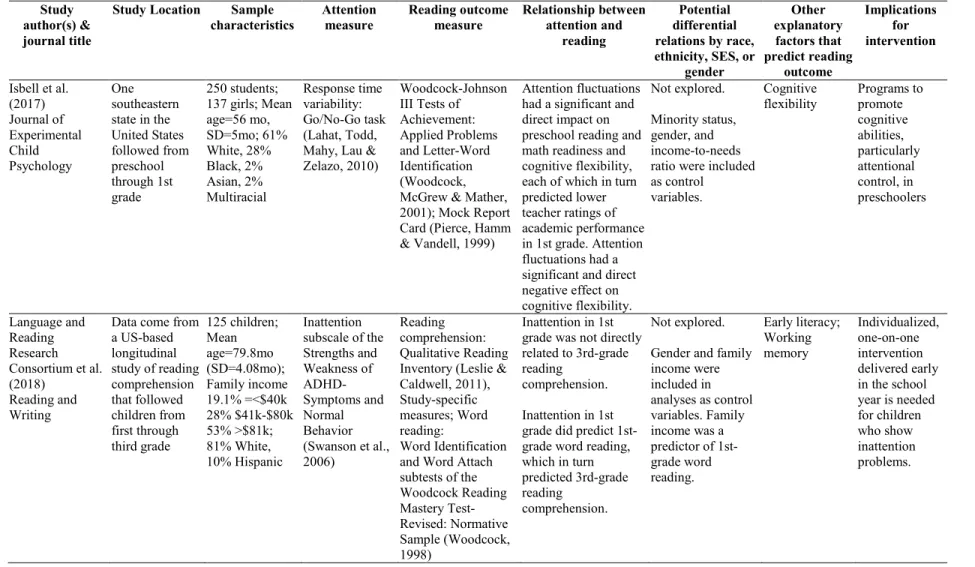
Isbell et al. (2017) Journal of Experimental Child Psychology One southeastern state in the United States followed from preschool through 1st grade 250 students; 137 girls; Mean age=56 mo, SD=5mo; 61% White, 28% Black, 2% Asian, 2% Multiracial Response time variability: Go/No-Go task (Lahat, Todd, Mahy, Lau & Zelazo, 2010)
Woodcock-Johnson III Tests of Achievement: Applied Problems and Letter-Word Identification (Woodcock, McGrew & Mather, 2001); Mock Report Card (Pierce, Hamm & Vandell, 1999)
Attention fluctuations had a significant and direct impact on preschool reading and math readiness and cognitive flexibility, each of which in turn predicted lower teacher ratings of academic performance in 1st grade. Attention fluctuations had a significant and direct negative effect on cognitive flexibility.
Not explored. Minority status, gender, and income-to-needs ratio were included as control variables. Cognitive flexibility Programs to promote cognitive abilities, particularly attentional control, in preschoolers Language and Reading Research Consortium et al. (2018)
Reading and Writing
Data come from a US-based longitudinal study of reading comprehension that followed children from first through third grade 125 children; Mean age=79.8mo (SD=4.08mo); Family income 19.1% =<$40k 28% $41k-$80k 53% >$81k; 81% White, 10% Hispanic Inattention subscale of the Strengths and Weakness of ADHD-Symptoms and Normal Behavior (Swanson et al., 2006)
Reading comprehension: Qualitative Reading Inventory (Leslie & Caldwell, 2011), Study-specific measures; Word reading:
Word Identification and Word Attach subtests of the Woodcock Reading Mastery Test-Revised: Normative Sample (Woodcock, 1998)
Inattention in 1st grade was not directly related to 3rd-grade reading
comprehension. Inattention in 1st grade did predict 1st-grade word reading, which in turn predicted 3rd-grade reading
comprehension.
2
5
Table 2.1. Study characteristics and findings for articles reporting relationships between attention problems and reading outcomes (cont’d).
Study author(s) & journal title
Study Location Sample characteristics Attention measure Reading outcome measure Relationship between attention and reading Potential differential relations by race, ethnicity, SES, or
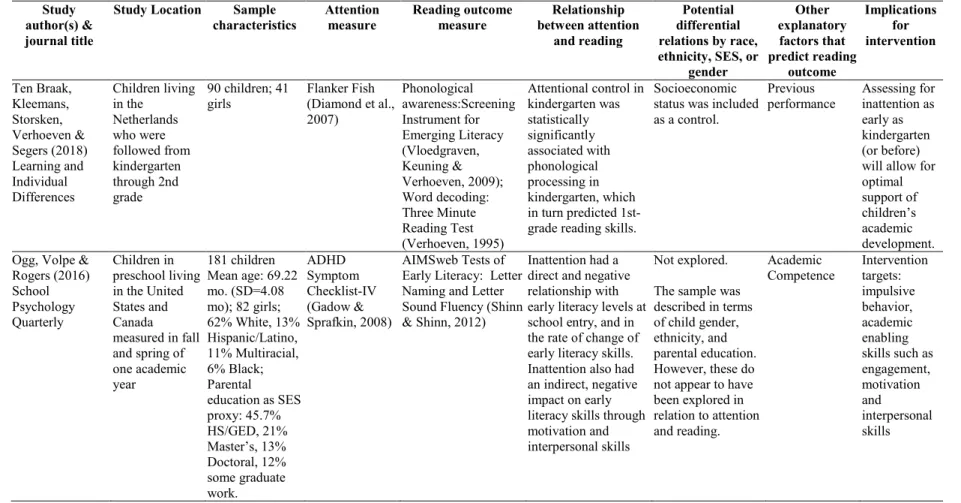
gender Other explanatory factors that predict reading outcome Implications for intervention Ten Braak, Kleemans, Storsken, Verhoeven & Segers (2018) Learning and Individual Differences Children living in the Netherlands who were followed from kindergarten through 2nd grade
90 children; 41 girls
Flanker Fish (Diamond et al., 2007) Phonological awareness:Screening Instrument for Emerging Literacy (Vloedgraven, Keuning & Verhoeven, 2009); Word decoding: Three Minute Reading Test (Verhoeven, 1995)
Attentional control in kindergarten was statistically significantly associated with phonological processing in kindergarten, which in turn predicted 1st-grade reading skills.
Socioeconomic status was included as a control.
Previous performance Assessing for inattention as early as kindergarten (or before) will allow for optimal support of children’s academic development. Ogg, Volpe &
Rogers (2016) School Psychology Quarterly Children in preschool living in the United States and Canada measured in fall and spring of one academic year
181 children Mean age: 69.22 mo. (SD=4.08 mo); 82 girls; 62% White, 13% Hispanic/Latino, 11% Multiracial, 6% Black; Parental education as SES proxy: 45.7% HS/GED, 21% Master’s, 13% Doctoral, 12% some graduate work. ADHD Symptom Checklist-IV (Gadow & Sprafkin, 2008)
AIMSweb Tests of Early Literacy: Letter Naming and Letter Sound Fluency (Shinn & Shinn, 2012)
Inattention had a direct and negative relationship with early literacy levels at school entry, and in the rate of change of early literacy skills. Inattention also had an indirect, negative impact on early literacy skills through motivation and interpersonal skills
Not explored. The sample was described in terms of child gender, ethnicity, and parental education. However, these do not appear to have been explored in relation to attention and reading. Academic Competence Intervention targets: impulsive behavior, academic enabling skills such as engagement, motivation and
2
6
Table 2.1. Study characteristics and findings for articles reporting relationships between attention problems and reading outcomes (cont’d). Study author(s) & journal title Study Location Sample characteristics Attention measure Reading outcome measure Relationship between attention and reading
Potential differential relations by race, ethnicity, SES, or
gender Other explanatory factors that predict reading outcome Implications for intervention O’Neill, Marks, Thornton, Rajendran & Halpern (2016) Neuropsychology United States; children assessed in preschool and at age 8
150 preschool students; Mean age at study start=50.88mo (SD=5.88mo); 26 Girls; 60% White, 10% Black, 12.7% Asian, 17.3% multiracial; 29% Hispanic; Mean SES=64.13 (SD=17.96) on the Nakao-Treas Socioeconomic Prestige Intex ADHD Rating Scale-IV (DuPaul et al., 1998)
Early language: A Developmental Neuropsychological Assessment (Korkman, Kirk, & Kemp, 1998); Academic
Achievement: Wechsler Individual Achievement Test (Wechsler, 2001); The National Institute for Children’s Health Quality Vanderbilt Assessment Scale-Teacher Informant (Wolraich, Feurer, Hannah, Baumgaertel, & Pinnock, 1998)
Preschool inattention directly predicted reading comprehension and teacher-rated written expression at eight years of age. Preschool inattention also indirectly impacted reading comprehension and teacher-rated written expression at eight years of age through early literacy skills.
Not explored The sample was described in terms of child gender, race, ethnicity, language ability, and SES.
However, these do not appear to have been explored in relation to attention and reading. Affective (mood) disorders Intelligence Medication Early reading skills
Plourde et al. (2018) Developmental Neuropsychology Canada; twin children followed from birth through age 7. Analyses presented are based on data from two years.
660 children (sample characteristics not provided in the article). Social Behavior Questionnaire— Inattention subscale (Tremblay, Desmaris-Gervais, Gagnon & Charlebois, 1987)
Reading Abilities Test Phonetic Decoding subtest and reading comprehension subtest (Pepin & Loranger, 1999)
Inattention had a significant, direct, and negative impact on decoding skills. Inattention had a non-significant negative impact on reading comprehension. Inattention had a significant indirect effect on both decoding and reading comprehension through its impact on early literacy skills.
2
7
Table 2.1. Study characteristics and findings for articles reporting relationships between attention problems and reading outcomes (cont’d). Study author(s) & journal title Study Location Sample characteristics Attention measure Reading outcome measure Relationship between attention and reading
Potential differential relations by race, ethnicity, SES, or
gender Other explanatory factors that predict reading outcome Implications for intervention
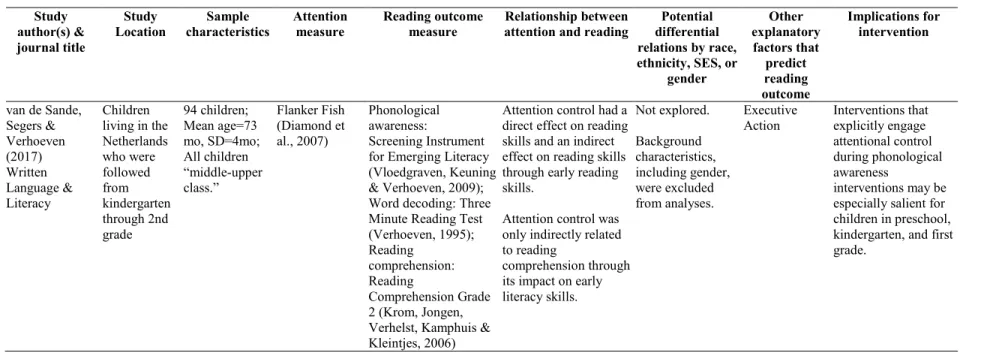
van de Sande, Segers & Verhoeven (2017) Written Language & Literacy Children living in the Netherlands who were followed from kindergarten through 2nd grade 94 children; Mean age=73 mo, SD=4mo; All children “middle-upper class.” Flanker Fish (Diamond et al., 2007) Phonological awareness: Screening Instrument for Emerging Literacy (Vloedgraven, Keuning & Verhoeven, 2009); Word decoding: Three Minute Reading Test (Verhoeven, 1995); Reading
comprehension: Reading
Comprehension Grade 2 (Krom, Jongen, Verhelst, Kamphuis & Kleintjes, 2006)
Attention control had a direct effect on reading skills and an indirect effect on reading skills through early reading skills.
Attention control was only indirectly related to reading
comprehension through its impact on early literacy skills. Not explored. Background characteristics, including gender, were excluded from analyses. Executive Action Interventions that explicitly engage attentional control during phonological awareness
28
Measures of reading and pre-reading skills and reading proficiency were diverse across the 15
studies reviewed. Reading outcomes were assessed with the following measures: phonological
awareness and knowledge (n=6), word reading (n=5), reading comprehension (n=3), letter
knowledge (n=3), teacher ratings of reading performance (n=4), and objective performance
measures (i.e., grades, standardized test scores) (n=2). Attention and inattention were measured
using observer rating scales completed by teachers (n=7), teachers, and another rater (n=4), as
well as task performance on observable measures (n=4).
Substantive Findings
Effect of inattention on concurrent and long-term reading skills.
Direct effects. Results from nine of the sixteen studies suggest that inattention has a
direct impact on children’s reading and early literacy skills, both concurrently and longitudinally.
Among preschool student samples, higher levels of inattention were directly and significantly
related to early literacy skills, including vocabulary, phonological awareness, and letter
knowledge (Allan et al., 2018; Lonigan, Allan & Phillips, 2017). Among elementary student
samples, higher levels of inattention significantly predicted lower performance on standardized
reading assessments (Pham, 2016; Rabiner, Carrig & Dodge, 2016; Rabiner, Goodwin & Dodge,
2016; Salla et al., 2016; Wesdal, 2018) and school grades (Rabiner, Goodwin & Dodge, 2016).
In addition, Leclerq and colleagues (2016) created two experiments to examine the unique role
of the orienting subsystem of attention on reading abilities and found that children who have
difficulty orienting their attention to the beginning of a letter string have more problems reading
relative to children without orienting issues.
Results from longitudinal studies indicated that inattention was directly linked to
long-term academic consequences. For instance, Rabiner, Goodwin, and Dodge (2016) found that a
29
deviation decrease in reading performance on standardized measures and a .25 standard
deviation decrease in average grades. These authors also reported that students whose attention
problems in 1st grade were one standard deviation above average were 40% less likely to
graduate from high school relative to children with average levels of attention problems.
Taken together, the results of the studies reviewed provide consistent and compelling evidence
that attention problems are directly linked to poor reading outcomes for children concurrently
and over time.
Several hypotheses as to why inattention has a direct impact on the development of early
literacy skills are presented. Pham (2016) first presents that attention and reading difficulties
share small but significant genetic underpinnings (i.e., Willcutt et al., 2001; Willcutt et al., 2005).
He also proposes a neuropsychological perspective, whereby atypical behavior inhibition can
alter one’s ability to process visual or auditory information while simultaneously refraining from
reacting to a stimulus too quickly. In the context of reading, children with impaired behavioral
inhibition may impulsively read a word incorrectly, which can lead them to misinterpret or
miscomprehend the text. Interestingly, others have suggested that impulsivity can also be
positively associated with reading attainment, as it signals engagement in the learning. Related to
inattentive symptoms, a neuropsychological perspective holds that students with impaired
attentional processes may become easily distracted, and are more likely to experience difficulty
in sustained or selective attention when reading for long periods. Finally, both Pham (2018) and
Leclerq and colleagues (2016) suggest that the development of efficient attentional processes
involved in reading—specifically, the dominant orientation of attention—is necessary for both