Functional Dependencies (FDs)
2.1 Definition of FD
2.2 Inference Rules for FDs
2.3 Equivalence of Sets of FDs
2.4 Minimal Sets of FDs
Normal Forms Based on Primary Keys
3.1 Normalization of Relations
3.2 Practical Use of Normal Forms
3.3 Definitions of Keys and Attributes Participating in Keys 3.4 First Normal Form
3.5 Second Normal Form 3.6 Third Normal Form
2.1 Functional Dependencies (1)
Functional dependencies (FDs)
Are used to specify
formal measures
of the
"goodness" of relational designs
And keys are used to define
normal forms
for
relations
Are
constraints
that are derived from the
meaning
and
interrelationships
of the data attributes
A set of attributes X
functionally
determines
a set
Functional Dependencies (2)
X -> Y holds if whenever two tuples have the same value
for X, they must have the same value for Y
For any two tuples t1 and t2 in any relation instance r(R): If
t1[X]=t2[X], then t1[Y]=t2[Y]
X -> Y in R specifies a constraint on all relation instances
r(R)
FDs are derived from the real-world constraints on the
Examples of FD constraints (1)
Social security number determines employee
name
SSN -> ENAME
Project number determines project name and
location
PNUMBER -> {PNAME, PLOCATION}
Employee ssn and project number determines the
hours per week that the employee works on the
project
Examples of FD constraints (2)
An FD is a property of the attributes in the
schema R
The constraint must hold on
every
relation
instance r(R)
If K is a key of R, then K functionally determines
all attributes in R
(since we never have two distinct tuples with
2.2 Inference Rules for FDs (1)
Given a set of FDs F, we can infer additional FDs that
hold whenever the FDs in F hold
Armstrong's inference rules:
IR1. (Reflexive) If Y subset-of X, then X -> Y IR2. (Augmentation) If X -> Y, then XZ -> YZ
(Notation: XZ stands for X U Z)
IR3. (Transitive) If X -> Y and Y -> Z, then X -> Z
IR1, IR2, IR3 form a sound and complete set of
inference rules
These are rules hold and all other rules that hold can be
Inference Rules for FDs (2)
Some additional inference rules that are useful:
Decomposition:
If X -> YZ, then X -> Y and X ->
Z
Union:
If X -> Y and X -> Z, then X -> YZ
Psuedotransitivity:
If X -> Y and WY -> Z, then
WX -> Z
The last three inference rules, as well as any
Inference Rules for FDs (3)
Closure
of a set F of FDs is the set F
+of all FDs
that can be inferred from F
Closure
of a set of attributes X with respect to F
is the set X
+of all attributes that are functionally
determined by X
X
+can be calculated by repeatedly applying IR1,
2.3 Equivalence of Sets of FDs
Two sets of FDs F and G are equivalent if:
Every FD in F can be inferred from G, and
Every FD in G can be inferred from F
Hence, F and G are equivalent if F+ =G+
Definition (Covers):
F covers G if every FD in G can be inferred from F (i.e., if G+ subset-of F+)
F and G are equivalent if F covers G and G covers F
There is an algorithm for checking equivalence of sets of
2.4 Minimal Sets of FDs (1)
A set of FDs is
minimal
if it satisfies the
following conditions:
1.
Every dependency in F has a single attribute for
its RHS.
2.
We cannot remove any dependency from F and
have a set of dependencies that is equivalent to
F.
3.
We cannot replace any dependency X -> A in F
with a dependency Y -> A, where Y
Examples 1
Since smith teaches two course namely data structure and data management,
teacher not functionally determine course(tuples 1 & 2 violates)
Example 2
Here, the following FDs may hold because the four tuples in the current
extension have no violation of these constraints: B → C; C → B; {A, B} → C; {A, B} → D; and {C, D} → B.
However, the following do not hold because we already have violations of them
3 Normal Forms Based on Primary Keys
3.1
Normalization of Relations
3.2
Practical Use of Normal Forms
3.3
Definitions of Keys and Attributes
Participating in Keys
3.4
First Normal Form
3.5
Second Normal Form
3.1 Normalization of Relations (1)
Normalization:
The process of decomposing unsatisfactory "bad"
relations by breaking up their attributes into
smaller relations
Other meaning:
Normalization is the process of restructuring the logical
data model of a database to eliminate redundancy,
organize data efficiently and reduce repeating data and to reduce the potential for anomalies during data
operations.
Normal form:
Condition using keys and FDs of a relation to
Normalization of Relations (2)
2NF, 3NF, BCNF
based on keys and FDs of a relation schema
4NF
based on keys, multi-valued dependencies : MVDs;
5NF
based on keys, join dependencies : JDs
Additional properties may be needed to ensure a
3.2 Practical Use of Normal Forms
Normalization is carried out in practice so that the
resulting designs are of high quality and meet the desirable properties
The practical utility of these normal forms becomes
questionable when the constraints on which they are based are hard to understand or to detect
The database designers need not normalize to the highest
possible normal form
(usually up to 3NF, BCNF or 4NF)
Denormalization:
The process of storing the join of higher normal form
3.3 Definitions of Keys and Attributes
Participating in Keys (1)
A
superkey
of a relation schema R = {A1, A2, ....,
An} is a set of attributes S
subset-of
R with the
property that no two tuples t1 and t2 in any legal
relation state r of R will have t1[S] = t2[S]
A
key
K is a
superkey
with the
additional
Definitions of Keys and Attributes Participating in Keys (2)
If a relation schema has more than one key, each is
called a candidate key.
One of the candidate keys is arbitrarily designated to
be the primary key, and the others are called
secondary keys.
A Prime attribute must be a member of some candidate
key
A Nonprime attribute is not a prime attribute—that is, it
is not a member of any candidate key.
In Figure below, {Ssn} is a key for EMPLOYEE, whereas
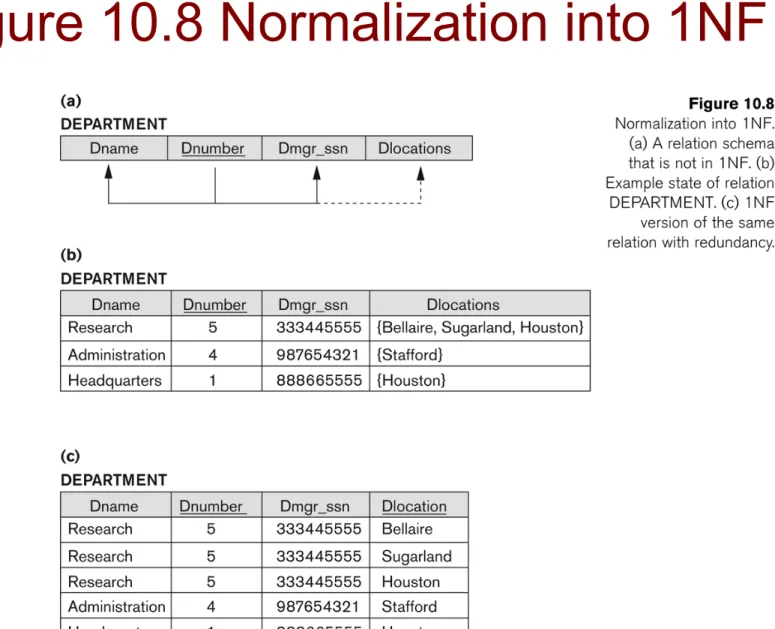
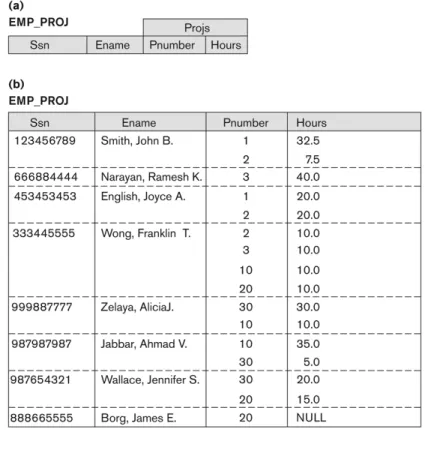
3.2 First Normal Form
Disallows
composite attributes
multivalued attributes
nested relations
; attributes whose values for an
individual tuple
are non-atomic
3.3 Second Normal Form (1)
Uses the concepts of FDs, primary key Definitions
Prime attribute: An attribute that is member of the primary
key K
Full functional dependency: a FD Y -> Z where removal
of any attribute from Y means the FD does not hold any more
Examples:
{SSN, PNUMBER} -> HOURS is a full FD since neither SSN
-> HOURS nor PNUMBER -> HOURS hold
{SSN, PNUMBER} -> ENAME is not a full FD (it is called a
Second Normal Form (2)
A relation schema R is in
second normal form
(2NF)
if every non-prime attribute A in R is fully
functionally dependent on the primary key
R can be decomposed into 2NF relations via the
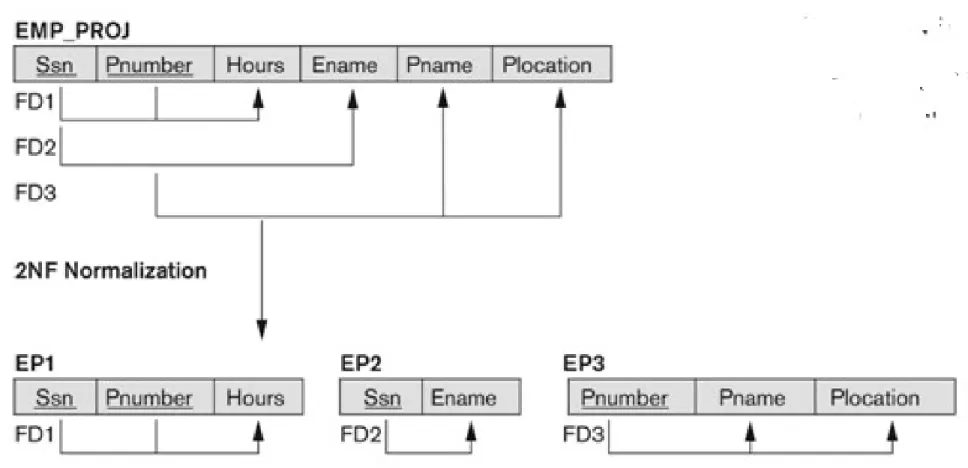
Figure Normalizing into 2NF
Normalizing EMP_PROJ into 2NF relations.
Here {Ssn, Pnumber} → Hours is a full dependency (neither Ssn →
Hours nor Pnumber→Hours holds).
However, the dependency {Ssn, Pnumber}→Ename is partial because
3.4 Third Normal Form (1)
Definition:
Transitive functional dependency:
a FD X -> Z
that can be derived from two FDs X -> Y and Y ->
Z
Examples:
SSN -> DMGRSSN is a
transitive
FD
Since SSN -> DNUMBER and DNUMBER ->
DMGRSSN hold. (Here since DNUMBER is not
prime attribute so we should not have dependency DNUMBER->DMGRSSN)
SSN -> ENAME is
non-transitive
Since there is no set of attributes X where SSN -> X
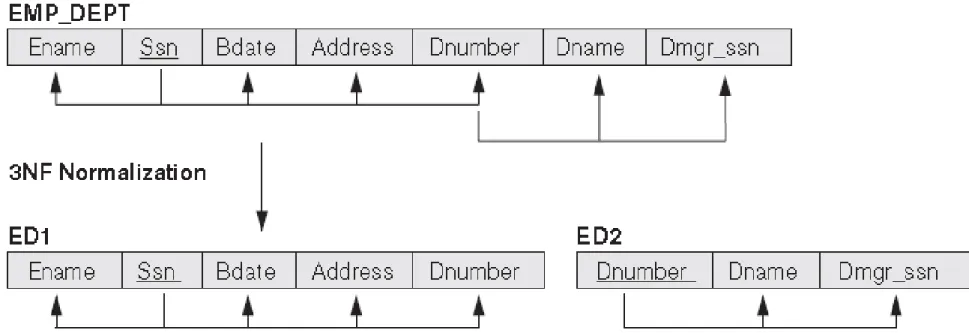
Figure Normalizing into 3NF
Normalizing EMP_DEPT into 3NF relations.
Because, According to Codd’s original definition, a relation schema R
is in 3NF if it satisfies 2NF and no nonprime attribute of R is transitively dependent on the primary key.
I.e. figure shows SSN->DNUMBER, DNUMBER->DMGRSSN(Here since DNUMBER is not prime attribute so we should not have
Third Normal Form (2)
A relation schema R is in third normal form (3NF) if it is
in 2NF and no non-prime attribute A in R is transitively dependent on the primary key
R can be decomposed into 3NF relations via the process
of 3NF normalization
NOTE:
In X -> Y and Y -> Z, with X as the primary key, we consider
this a problem only if Y is not a candidate key.
When Y is a candidate key, there is no problem with the
transitive dependency .
E.g., Consider EMP (SSN, Emp#, Salary ).
Normal Forms Defined Informally
1
stnormal form
All attributes depend on
the key
2
ndnormal form
All attributes depend on
the whole key
3
rdnormal form
General Normal Form Definitions (For
Multiple Keys) (1)
The above definitions consider the primary key
only
The following more general definitions take into
account relations with multiple candidate keys
A relation schema R is in
second normal form
General Normal Form Definitions (2)
Definition:
Superkey
of relation schema R - a set of attributes
S of R that contains a key of R
A relation schema R is in
third normal form (3NF)
if whenever a FD X -> A holds in R, then either:
(a) X is a superkey of R, or
(b) A is a prime attribute of R
NOTE: Boyce-Codd normal form disallows
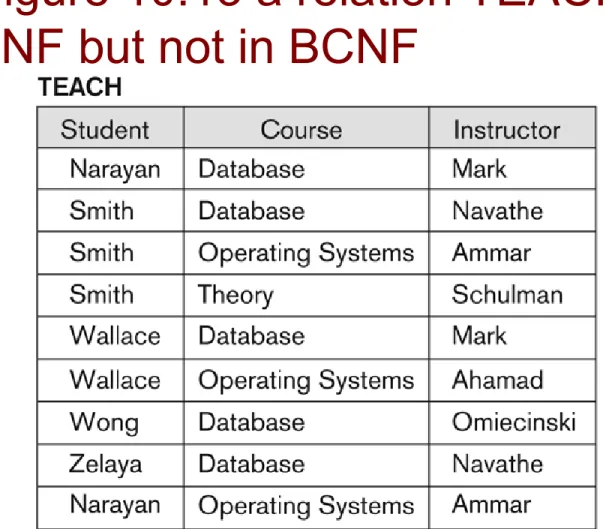
BCNF (Boyce-Codd Normal Form)
A relation schema R is in Boyce-Codd Normal Form
(BCNF) if whenever an FD X -> A holds in R, then X is a superkey of R
Each normal form is strictly stronger than the previous
one
Every 2NF relation is in 1NF
Every 3NF relation is in 2NF
Every BCNF relation is in 3NF
There exist relations that are in 3NF but not in BCNF
Achieving the BCNF by Decomposition (1)
Two FDs exist in the relation TEACH:
fd1: { student, course} -> instructor fd2: instructor -> course
Explanation: let us consider X-> A, here X= { student,
course} and A={instructor}, and X=Super key and A=Prime Atrribute. For BCNF we should not allow.
{student, course} is a candidate key for this
A relation NOT in BCNF should be decomposed so as to
Achieving the BCNF by Decomposition (2)
Three possible decompositions for relation TEACH
{student, instructor} and {student, course}
{course, instructor } and {course, student}
{instructor, course } and {instructor, student}
All three decompositions will lose fd1.
We have to settle for sacrificing the functional dependency
preservation. But we cannot sacrifice the non-additivity property after decomposition.
Out of the above three, only the 3rd decomposition will not generate
spurious tuples after join.(and hence has the non-additivity property).
A test to determine whether a binary decomposition (decomposition