
Jules Villard1 Etienne Lozes´ 1 Cristiano Calcagno2 1
LSV, ENS Cachan, CNRS 2Imperial College, London
Abstract. Handling concurrency using a shared memory and locks is tedious and error-prone. One solution is to use message passing instead. We study here a particular, contract-based flavor that makes the ownership transfer of messages explicit. In this case, ownership of the heap region representing the content of a message is lost upon sending, which can lead to efficient implementations. In this paper, we define a proof system for a concurrent imperative programming lan-guage implementing this idea and inspired by the Singularity OS. The proof sys-tem, for which we prove soundness, is an extension of separation logic, which has already been used successfully to study various ownership-oriented paradigms.
Introduction
Asynchronous message passing often suffers from two drawbacks: contents of mes-sages have to be copied, and deadlocks can be tricky to avoid. However, if mesmes-sages to-be live in the same address space, the first issue can be resolved by sending a mere pointer to the memory region where the message is stored instead of issuing a copy. This implementation is sound provided that the emitting thread loses ownership over the message,i.e.does not access it for reading or writing after emission.
The goal of this paper is to give a semantics and a proof theory for this way of programming. Our idealized programming language allows memory manipulation and asynchronous communications ruled by contracts, a basic form of session types, fol-lowing the ideas ofSing#. Our proof system is based on separation logic [12], which has already been used to specify and prove various ownership-based paradigms [10,4]. Contracts play an essential role in this proof system: message invariants are associated to every contract’s message, in the same spirit as resource invariants in concurrent sepa-ration logic [10]. Moreover, we show that they can ensure the absence of memory leaks when channels are closed.
To better illustrate copyless message passing, consider the following code snippet, wherex,ycan be thought of as buffers, ande,e0as the two endpoints of a channel:
(e,e’) = open(); send(e,x); y = receive(e’); close(e,e’);
In a copying implementation, a whole copy of the bufferxwould be allocated, and its address stored iny, whereas in copyless message passing, the whole code would be equivalent tox = y.
Our first contribution is the proof of soundness for our proof system: provable pro-grams do not fault on memory accesses, are race free, and are contract obedient. How-ever, and unlike for concurrent separation logic, it cannot entail the absence of memory leaks, due to the possibility of non-local leaks when channels are closed.
Finding a semantics that both establishes the soundness of our proof system and corresponds to the intended behaviour was challenging, because the standard semantics for separation logic is a local semantics, for which for instance the equivalence between the code above andx = ywould not hold. Our second contribution is to propose a new approach for defining such a semantics. Indeed, we define alocalsemantics based on abstract separation logic [5], for which our proof system is sound, and then restrict it to aglobalsemantics, also sound by restriction. However, neither the local nor the global semantics reflect the intended semantics faithfully.
Our third contribution is to state and prove a more general result that entails the validity of the pointer-passing implementation and the absence of memory leaks. This result, which we christen the transfers erasure property, relates the global semantics to the intended semantics in a non-trivial way, and allows to state that programspfor which the Hoare triple{emp}p{emp}is valid are leak free under some conditions on the contracts.
We first introduce the language and its main features by a small motivating exam-ple. We then present the programming language and our proof system in Sec. 2, and demonstrate how to prove the example. Sec. 3 gives an overview of the main ingredi-ents of our semantics. We develop the semantics in more details in Sec. 4, leading to a soundness result for our logic. Sec. 5 is devoted to the transfers erasure property. Related work The Singularity operating system [6] is a prominent application of contract-based copyless message passing ideas. It can safely run processes sharing a unique address space without memory protection. Executables are written in theSing# pro-gramming language, which supports (copyless) message passing primitives. Ownership violations are detected at compile-time using static analysis techniques, and communi-cations are ruled by contracts. Our work can be seen as an abstract model ofSing#, though some differences between the two are worth noting: we chose to be able to de-tect memory leaks, whileSing#is equipped with a garbage collector, and we support complete mobility of channels, similar toπ-calculus, whereasSing#provides internal mobility only. Finally, as our language is not full-fledged, we did not provide mecha-nisms for error handling, for example when one endpoint is abruptly closed.
Concurrent Separation Logic [10] and the logic of Gotsman & al. for locks in the heap [7] inspired our work. While the former cannot handle an unbounded number of resources, it would surely have been possible to encode message passing commands in the toy programming language of the latter. However, contracts seem of such a differ-ent nature that it appeared simpler to take message passing instructions as primitive. More importantly, the local semantics used in these works is an over-approximation of the intended semantics, as the exchange of shared resources involves a possible non-deterministic change of the resource content provided it still respects some invariant. The transfers erasure property cannot be established in these approaches.
Contracts may be viewed as session types [13]. However, the approach is different in this work, as our main concern with contracts is how they can help us to prove that
channels do not leak memory, and not how they can prove the absence of communica-tion errors (although this certainly is an interesting topic for future work). Session types were also used on top of Java in SessionJ [9], but this does not address the problem of copyless message passing.
Pym and Tofts [11], and O’Hearn and Hoare [8] have defined two other logics for resource aware message passing programs. However, their respective models differ sig-nificantly from ours as they are based on process algebras, and are not centered around memory management.
1
Programming language
1.1 Contracts
Contracts describe the behavior of channels. A channel is asynchronous, bi-directional, and has two endpoints, distinguished for ease of reference: the serving endpoint and the client endpoint. Contracts are state machines describing what sends (!) and receives (?) are allowed in a given state. They are written from the server’s point of view, the client’s one being dual. Each message sent over the channel is described by a message identifier. Moreover, each message identifier is annotated with an invariant (between brackets) for proofs’ purpose. These invariants are separation logic formulas, and replace Sing# messages’ types. Their syntax and purpose will be explained in the next sections.
The contractCbelow describes the protocol implemented by our example. It has three states, three transitions, and three messages may trigger these transitions.
contract C {
message ack [emp]
message cell [val7→X]
message close_me [src7→ep(C{end},−)∧src=val] initial state transfer { !cell --> wait_ack;
!close_me --> end; } state wait_ack { ?ack --> transfer; }
final state end {} }
ackis a message used for synchronization purpose only, whereascellandclose_me
respectively carry (the addresses of) a list’s head and an endpoint. On a channel follow-ingC, the serving endpoint would be able to perform as many sequences of sending a memory cell and then waiting for an acknowledgment as it wishes, and will eventually send aclose memessage to go to the final stateend. This protocol can be used to send a linked list over the channel until it is empty, and finally request a closing of the channel, as we will see next.
1.2 Sending a list cell by cell
The imperative programming language we use features standard variable and memory manipulation. We moreover usesend(m, e, x)to send messagemwith valuexover
endpointeandx = receive(m, f)to retrieve this value throughf, provided it is the
asynchronous communications, and act as enqueuing and dequeuing over one of the two queues that are shared by two coupled endpoints (one queue for each direction). Endpoints are allocated on the heap upon channel creation ((e,f)=open(C)) and closed
together (close(e,f)). This differs from most implementations, where endpoints can
be closed independently, but this case an implicit message is sent to notify the closing of one of the endpoint to the other; in our setting, such a message has to be sent explicitly. Let us now give a program implementing contractC. The serving endpointeis held by theputter program, which communicates withgetter. The program is given a list starting at the addressxthat it sends cell by cell overe.getterdisposes the cells one by one, and when the list becomes empty,puttersends its endpoint over itself so thatgettermay close the channel. Comments (lines starting with//and annotations between brackets) are elements of the proof and will be explained later.
1 putter(e,x) [e, xe7→ep(C{transfer},X)∗list(x)] { 2 local t;
3 while (x != 0) {
4 // e, x, tx7→Y ∗list(Y)∗e7→ep(C{transfer},X)
5 t = *x;
6 send(cell, e, x);
7 // e, x, tlist(t)∗e7→ep(C{wait ack},X)
8 x = t;
9 receive(ack, e); }
10 // e, x, te7→ep(C{transfer},X)
11 send(close_me, e, e); } [e, xemp] 12 13 getter(f) [ff7→ep( ¯C{transfer},Y)] { 14 local x, e = 0; 15 // 0 =x, e, f 16 while (e == 0) { 17 // Of ep 7→( ¯C{transfer},Y)∗e=0 18 switch receive { 19 x = receive(cell, f): { 20 // Of7→ep( ¯C{wait ack},Y)∗e=0∗x7→ − 21 free(x) 22 // Of7→ep( ¯C{wait ack},Y)∗e=0 23 send(ack, f); } 24 e = receive(close_me, f): {} }} 25 // Oe7→ep(C{end}, f)∗f7→ep( ¯C{end},e) 26 close(e, f); } [femp] 27 28 main() [xlist(x)] { 29 local e,f; 30 (e,f) = open(C);
31 // x, e, flist(x)∗e7→ep(C{transfer},f)∗f7→ep(¯C{transfer},e) 32 putter(e,x); || getter(f); } [xemp]
2
A separation logic for copyless message passing
2.1 Syntax of programs
We assume infinite setsVar={e, f, x, y, . . .},Loc={l, . . .},Endpoint={ε, . . .}, MsgId ={m, . . .},State ={a, b, . . .}andVal ={v, . . .}of respectively variables,
memory locations, endpoints, message identifiers, contracts’ states and values. All sets but values are pairwise disjoint, andLoc]Endpoint] {0} ⊆ Val. The grammar of expressions, boolean expressions, atomic commands and programs is as follows:
E::=x∈Var |v∈Val B ::=E=E|BandB|notB c::=assume(B)|x = E|x =new()| ∗E = E|x =∗E| free(E)
|(e , f ) =open(C)| close(E,E)|send(m, E, E)|x = receive(m, E)
p::=c|p; p|pkp|p+p|p∗| local x inp
assume(B)blocks unlessBholds, and does nothing otherwise. Compound commands are standard and are in order sequential and parallel composition, non-deterministic choice, Kleene iteration and local variable creation.switch receiveis defined as a non-deterministic choice of the{x=receive(m,E);p}for everyx = receive(m,E): pof its body. We leave the similar definitions ofwhileloops andifstatements to the attention of the reader. In our example of Sec. 1.2, subroutines putterandgetter
should actually be inlined to fit our model, as it does not feature procedure calls. We writev(E)the set of variables that appear in expressionE.
Contracts A contract is an edge-labeled oriented graph. Vertices are calledstates, and every contractCdistinguishes an initial stateinit(C)and a set of final statesfinal(C). Labels are either send label!mor receive label?m, wheremis a message identifier. We writeC¯for the dual of contractC,i.e.Cwhere!and?are swapped.
A contract specification is given by a mapm 7→ Imfrom message identifiers to precise separation logic formulas (to be defined soon).Imis called the invariant of the message. Only special variablesvalandsrccan appear free inIm.
2.2 Syntax of the logic
We assume an extra infinite setLVar ={X, Y, . . .}of logical variables distinct from the program’s variables. We extend the grammar of expressions to allow them to contain logical variables. The assertion language is then as follows:
A::= emps|own(x)|E=E stack predicates
|emph|empep |E7→E|E7→ep(C{a}, E) heaps predicates | ¬A|A∧A| ∃X. A|A∗A|A−−∗A connectives All predicates and connectives are standard, exceptempepandE
ep
7→(C{a}, E). Be-fore defining the semantics of the logic, let us define some useful shorthands.
We will writeempforemph∧empepand, for instance,E 7→ −for∃X. E 7→X. In this work, we use variables as resources [2] without permissions for simplicity, thus forbidding concurrent reads. WhenO = x1, . . . , xn, we will write, as usual,OA as a shorthand for(own(x1)∗. . . ∗own(xn))∧A. Moreover, to avoid cumbersome notations in formulas, we will sometimes allow reads to the same variable in the stack in two disjoint states,i.e.have formulas of the formxA(x)∗B(x). They should be understood asx∃X. x=X∧(A(X)∗B(X)).
2.3 Basic memory model
Formulas are interpreted over a subsetΣwf of the setΣ of basic memory pre-states
(s, h, k)defined by:
Σ,Stack×CHeap×EHeap Stack ,Var*Val CHeap,Loc*Val
EHeap,Endpoint*Contract×State×Endpoint
It is equipped with a composition law◦of a separation algebra (see Sec. 3.1) defined as the disjoint union]of each of the components of the pre-states:(s, h, k)◦(s0, h0, k0),
(s]s0, h]h0, k]k0).StackandCHeap(cell heap) are standard, andEHeap(endpoint heap) works in the same way asCHeapbut is used to represent endpoints.
We definememory statesΣwf as the elements ofΣthat satisfy the axioms
Dualk(ε) = (C, a, ε0) &k(ε0) = (C0, b, ε00)⇒ε00=ε&C0 = ¯C
Irreflexivek(ε) = (−,−, ε0)⇒ε6=ε0
Injectivek(ε1) = (−,−, ε01) &k(ε2) = (−,−, ε02) &ε16=ε2⇒ε016=ε02 We restrict◦to a new operation•on memory states defined only whenσ◦σ0∈Σwf. We will writeσ]σ0 when this is the case. Let us now give the satisfaction relation between states inΣwfand formulas. We writeJxKsto denotes(x)ifx∈dom(s), and
JvKsdenotesv.
(s, h, k)E1=E2 iff v(E1, E2)⊆dom(s) &JE1Ks=JE2Ks
(s, h, k)emp♠ iff dom(♠) =∅ (♠ ∈ {s, h, k}) (s, h, k)own(x) iff dom(s) ={x}
(s, h, k)E17→E2 iff v(E1, E2)⊆dom(s) &dom(h) ={JE1Ks}
&dom(k) =∅&h(JE1Ks) =JE2Ks
(s, h, k)E1 ep
7→(C{a}, E2) iff v(E1, E2)⊆dom(s) &dom(k) ={JE1Ks}
&dom(h) =∅&k(JE1Ks) = (C, a,JE2Ks)
σ¬A iff σ2A
σA1∧A2 iff σA1&σA2
σ∃X. A iff ∃v∈Val. σA[X←v]
σA1∗A2 iff ∃σ1, σ2. σ=σ1•σ2&σ1A1&σ2A2
σA−−∗B iff ∀σ0]σ. σ0Aimpliesσ•σ0B
2.4 Proof system
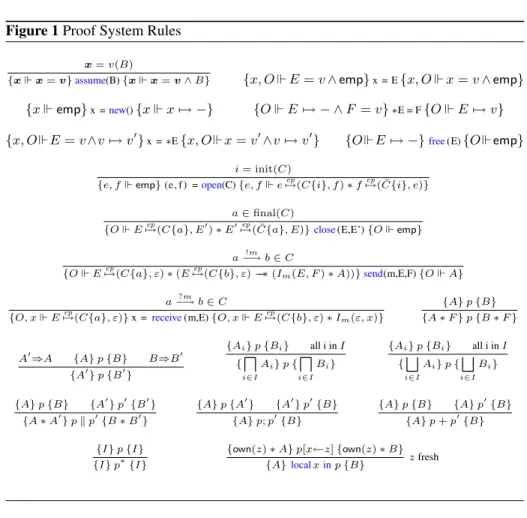
Our proof system is based on the framework of abstract separation logic. We extend the rules of separation logic (frame rule, composition rules and the standard small axioms for all pointer instructions) with four new small axioms for channel instruc-tions. We abbreviateIm[src←E1,val←E2]asIm(E1, E2). Figure 1 presents all the rules. Among these four new small axioms, the one for send deserves a special at-tention, as we can derive two different small axioms from it:{OE7→ep(C{a}, ε)∗
Im(E, F)}send(m,E,F){OE ep
7→(C{a}, ε)}that accounts for the most standard send-ing (taksend-ingA =E7→ep(C{b}, ε)), and sending the endpoint over itself is accounted by {OE7→ep(C{a}, ε)∗(E7→ep(C{b}, ε)−−∗Im(E, F))}send(m,E,F){Oemp}(taking
Figure 1Proof System Rules
x=v(B)
{xx=v}assume(B){xx=v∧B} {x, OE=v∧emp}x = E{x, Ox=v∧emp} {xemp}x =new(){xx7→ −} {OE7→ − ∧F=v}∗E = F{OE7→v} {x, OE=v∧v7→v0}x =∗E{x, Ox=v0∧v7→v0} {OE7→ −}free(E){Oemp}
i= init(C)
{e, femp}(e , f ) =open(C){e, fe7→(ep C{i}, f)∗f7→( ¯ep C{i}, e)} a∈final(C)
{OE7→(ep C{a}, E0)∗E07→( ¯ep C{a}, E)}close(E,E’){Oemp} a−→!m b∈C {OE7→(ep C{a}, ε)∗(E7→(ep C{b}, ε)−−∗(Im(E, F)∗A))}send(m,E,F){OA} a−→?m b∈C {O, xE7→(ep C{a}, ε)}x =receive(m,E){O, xE7→(ep C{b}, ε)∗Im(ε, x)} {A}p{B} {A∗F}p{B∗F} A0⇒A {A}p{B} B⇒B0 {A0}p{B0} {Ai}p{Bi} all i inI {l i∈I Ai}p{l i∈I Bi} {Ai}p{Bi} all i inI {G i∈I Ai}p{G i∈I Bi} {A}p{B} {A0}p0{B0} {A∗A0}pkp0{B∗B0} {A}p{A0} {A0}p0{B} {A}p;p0{B} {A}p{B} {A}p0{B} {A}p+p0{B} {I}p{I} {I}p∗{I} {own(z)∗A}p[x←z]{own(z)∗B} {A}localxinp{B} zfresh
2.5 Back to the example
We now highlight some steps of the proof that the program ppresented at Sec. 1.2 satisfies the Hoare triple {xlist(x)} p {xemp}. Bracketed formulas are used to denote the pre and post-condition of a program. We start with the precondition
xlist(x), where list(x)is the inductive list predicate verifying empifx = 0and ∃X. x 7→X ∗list(X)otherwise. Before entering the parallel composition, we obtain
x, e, flist(x)∗e7→ep(C{transfer}, f)∗f7→ep( ¯C{transfer}, e). To apply the rule for parallel composition, we have to split the state into two.putterwill get resources
e, xe7→ep(C{transfer},−)∗list(x)andgetterf f7→ep( ¯C{transfer},−). The next important step is after the loop, at line 9; we are left with just the endpointe, which we send in aclose memessage. According toIclose meand the rule ofsend
withA=emp, the post-condition ofputteris thuse, xemp.
The proof of thegetterprogram follows the same lines. Crucially, after receiving
theclose memessage, we can deduce that we have received thepeeroff thanks to
up. At the end of the parallel composition, we thus obtain empty heapsxempwhich concludes the proof.
3
Soundness
We now turn to proving that the proof system is sound and giving an accurate semantics for programs. As the soundness of concurrent separation logic itself has proven hard to establish in the past [3], we base our work on abstract separation logic, which allows us to deduce the soundness of our proof system from the sole soundness of its axioms. But this only resolves half of our concerns, for concurrent separation logic is not fit to describe synchrony issues, for example that sends must happen before receives, nor does it entail a pointer passing semantics, without transfers (the transfers erasure property). In this section, we explain how to remedy this by extending the basic memory model.
As even an informal presentation of our semantics relies heavily on abstract separa-tion logic [5], we begin this secsepara-tion by a short introducsepara-tion to this framework.
3.1 Abstract separation logic in a nutshell
Aseparation algebrais a cancellative, partial, commutative monoid (Σ,•, u)where cancellative means that the partial functionσ•(·) : Σ * Σ is injective; one may write eitherσ1]σ2orσ1⊥σ2whenσ1•σ2 is defined,σ σ0 if there isσ1 such that
σ0 = σ•σ1, and denote the unique suchσ1 byσ0−σ when it exists.(P(Σ)>,v) denotes the powerset ofΣordered by inclusion, extended with a greatest element>. The operator∗defined byA∗B={σ0•σ1|σ0]σ1&σ0∈A&σ1∈B}ifA, B6=>, >otherwise, defines a commutative ordered monoid(P(Σ)>,∗,∅,v). A propertyAis preciseif for allσ, there is at most oneσ0σinA.
We will later define the semantics of all atomic commands as local functions. A local functionf : Σ → P(Σ)> is a total function such that for allσ, σ0 ∈ Σ, if
σ]σ0 then f(σ•σ0) v {σ} ∗f(σ0). f v g denotes the pointwise order on local functions. Compositionf;g of local functions is performed using the obvious lifting of g toP(Σ)>:(f;g)(σ) , F
{g(σ0) | σ0 ∈ f(σ)} or>if f(σ) = >. A specifi-cation φis a set of pairs(A, B)in P(Σ). We write f φ and say thatf satisfies
φwhen f(A) v B for every(A, B) ∈ φ. The best local action of φis defined by bla[φ](σ) =dσ0σ,σ0∈A,(A,B)∈φ{σ−σ0} ∗B. It is local, satisfies its specification, and is the greatest such local function for the pointwise order on local functions [5].
Lemma 1. Basic memory states(Σwf,•, u)and pre-states(Σ,◦, u), whereu= (∅,∅,∅), are separation algebras.
A simple way to obtain a soundness result for our proof system would thus be to define the semantics of all atomic commands as the best local actions of their specifica-tions. Using the trace semantics we will present soon, all proof rules would be sound. As we will explain now, this would lead to a very coarse semantics without synchro-nization that over-approximates the communications. In particular, as mentionned in the introduction, sending a message with valuexand immediately retrieving it inywould not be equivalent to simply assigningxtoy.
3.2 Trace semantics and global semantics
Syntactic traces Let us define the tracesT(p)of a programpas a set of sequences of actionsα∈ {c,norace(c1, c2),nx,dx}for all commandsc,c1,c2, following the origi-nal approach of abstract separation logic extended with the treatment of local variables: nxallocatesx∈Varon the stack anddxdisposes it.
T(α) ={α} T(p1+p2) =T(p1)∪T(p2) T(p∗) = (T(p))∗
T(p1;p2) ={tr1;tr2|tri∈T(pi)} T(p1kp2) ={tr1zip tr2|tri∈T(pi)}
T(local x inp) ={nz;T(p[x←z]); dz|zfresh inp}
Parallel composition is treated as a syntactic interleaving of commands. We force all racy programs to fault by placing norace(c1, c2)each timec1andc2may be executed simultaneously. This command will check thatc1 andc2 can execute on disjoint por-tions of the state.zipis thus defined byεzip tr=tr zipε=trin the base case, and by (c1;tr1)zip(c2;tr2) =norace(c1, c2); ((c1; (tr1zip(c2;tr2)))∪(c2; (c1;tr1)zip tr2)). Semantics The denotational semantics of traces is the composition of the interpretation of atomic actions:JαK=LαMandJtr1;tr2K=Jtr1K;Jtr2K. This assumes that a
seman-ticsLcMis defined for all primitive commands, which we will give later. The semantics
of norace(c1, c2)is the local functionnorace(Lc1M,Lc2M), defined by
norace(f, g)(ˆσ), (
{σˆ} if∃σˆf,σˆg.σˆf•σˆg= ˆσ&f(ˆσf)6=>&g(ˆσg)6=> > otherwise
Finally, the semantics of stack bookkeeping actionsnxanddxare defined as the best local actionsLnxM,nx,bla[emps,own(x)]andLdxM,dx,bla[own(x),emps].
Following this approach is essential for deriving easily the soundness of the parallel rule:Jpkp 0 K(σ•σ 0) v JpK(σ)∗Jp 0 K(σ
0). The downside is that parallel threads have to work on disjoint memory states, hence receiving a message cannot be blocking and must be non-deterministic. This poses two challenges: how to synchronize concurrent actions and how to model inter-threads communication.
Successive semantics Our approach here relies on three successive refinements of the semantics defined by the small axioms of our proof system.
The first one enriches the memory model and the communication primitives so that, at any point in the execution, the history of all past communications, including the contents of all messages, can be observed in the resulting states. This is covered in Sec. 4. However, this semantics is still local so we cannot link the histories of two corresponding endpoints yet, as one of them may reside outside of the current heap. Moreover,sendandreceivestill act respectively as a disposal and a non-deterministic creation of the message’s contents.
The next step is thus to consider programs as wholes. In this case, we can observe the whole state at every point of the execution. In particular, both endpoints of every opened channel will always be present. We may now restrict the states produced by the commands tolegalones,i.e.states where receives have happened after the correspond-ing send, and where contents of sent and received messages match (intuitions about
how this will be performed are introduced in the next two subsections). This will au-tomatically restrict traces in the same way: a receive preceding the corresponding send will produce an empty set of legal states. This is also howassume(B)works: it blocks
executions whereBdoes not hold.
The third and final semantics is the same as the global one, except that the commu-nications are not loggued, thus achieving a pure pointer-passing semantics.
We will explain now what information histories will have to contain in the h.p. model. The formal definition of legal states can be found in Sec. 5.
3.3 Synchronization
Concurrent separation logic uses critical sections to synchronize and communicate be-tween processes. In this case, the synchronization may be performed at the syntactic trace level, by considering onlywell-formedtraces, in which two critical sections over the same resource are never interleaved [5]. This syntactic synchronization is possible because resources are not part of the expression language, and determining whether two critical sections refer to the same resource can be done just by looking at the resource identifier. This is not the case for channel communication, as retrieving which endpoint is used for sending or receiving involves evaluating an expression, which cannot be done at the trace level.
Instead, we rule out ill-synchronized traces at the semantics level by making them block when executed. To achieve this, we must add information to the endpoints in the model, namely how many messages have been sent and how many have been received on this endpoint (see Sec. 3.5), and modifysendandreceiveto increment these coun-ters. Legal states will thus be such that any endpoint εmust have received less than what its peer has sent. This ensures that traces where areceivehappens when there is no pending message inside the channel will block.
3.4 Communication
In concurrent separation logic, communication is achieved by passing pieces of states around using conditional critical regions: acquiring a shared resource is modeled by an allocation (roughly, LacquirerM(σ) = {σ} ∗Ir), and releasing it is modeled by
deallocation of the part of memory corresponding to the invariant. Acquiring a resource is thus non-deterministic, as the resourcermay be acquired in any state satisfying the resource invariantIr, and not the state in which it was left after the last release. The local semantics ofreceivesuffer from the same caveat.
The semantics to which we aspire should be more precise and ensure that the con-tents of what is received match what was sent. For this purpose, we have chosen to “log” a copy of the message contents that is sent or non-deterministically received in the thread-local heap. To describe “logging”, we enrich the model withtimestamps: each cell and endpoint is tagged with a timestampτ ∈ T and a direction† ∈ {?,!}. We will note[τ†]ˆσfor the memory state formed of a single log using timestampτ. Sending ˆ
σwill deallocate it and allocate the log[τ!]ˆσ, whereas the corresponding
receivewill
state[τ!]ˆσ•[τ?]ˆσ0will be declared legal if and only ifσˆ = ˆσ0, which will ensure the coherence of communications in the global semantics.
Moreover, we have to provide a mechanism for choosing which timestamp should be used for logging for each message, and the endpoint’s owner that will issue a message should locally choose its timestamp. We thus attach to every channel a pair ofhistories
(`!, `?)where`!, `?contain a list of the successive (distinct) timestamps at which the messages respectively sent and received (from the serving endpoint point of view) will have to be logged. Both endpoints will be equipped with these histories upon creation (the client endpoint will be equipped with the dual pair(`?, `!)) in order to log the same message with the same timestamp when it is sent and received.
Finally, histories can also be used to check that the value and message identifier of a message is the same on both endpoints involved. This could have been part of the logging mechanism, but it has turned out to be simpler to consider it apart.
3.5 Refined model
Adding up what has been informally described above, we obtain the followinghistory preserving memory modelΣˆ defined from historiesHist,(MsgId×Val× T)ω:
ˆ
Σ,Stack×CHeapˆ ×EHeapˆ ˆ
CHeap,Loc× T{?,!}*Val
ˆ
EHeap,Endpoint× T{?,!}*Contract×State×Endpoint×
N2×Hist2 Timestampsτform an infinite setT, disjoint from previously defined sets, from which we definepolarized timestampsT{?,!}
, (T × {?,!}) +{now}. We extendVal to containT. For simplicity, we may writenow!andnow?fornow.
( ˆΣ,◦, u)defines a separation algebra where◦denotes disjoint union of (tuples of) partial functions. To distinguish heaps of the basic and h.p. model, we adopt a hat nota-tion, and letˆh,k, . . .ˆ range overCHeapˆ ,EHeapˆ .
We define the projectionnow : ˆΣ→Σwhich associates to a stateσˆ = (s,ˆh,kˆ)∈ ˆ
Σthe stateσ= (s, h, k)whereh= ˆh(·,now)andkisˆk(·,now)where histories and counters have been erased. We can now define what it means for a program executing on h.p. states to satisfy a Hoare triple.
Definition 1 (Semantic Hoare Triple).
– IfA, B∈ P(Σ)andf : ˆΣ→ P( ˆΣ)>, we writehhAiifhhBiiiff∀ˆσ.now(ˆσ)∈A
impliesnow(f(ˆσ))vB.
– We write{A}p{B}iff∀tr ∈T(p).hhAiiJtrKhhBii.
4
Semantics of programs
4.1 Refined assertions
We now show how to interpret the logic in the refined model, so as to give a semantics of commands from logical specifications and state the soundness theorem later on.
We letts(`)denote the set of timestamps that appear in`. If`is a history list and
iis an integer, `[i]represents theith item of`. We writelogs(ˆσ)to denote the set of
polarized timestamps that appear inσˆ,i.e.snd(dom(ˆh))∪snd(dom(ˆk)).
Ifσˆ = (s,ˆh,kˆ), we writeσˆτ†(resp.σˆT) to denote the pre-state at timestampτ† defined by restrictingˆhandkˆto the timestampτ†(resp. the set of polarized timestamps
T). This gives a semantics for formulas overΣˆ: for anyˆσ∈Σˆ, and for anyA,σˆ A
if and only if (1)logs(ˆσ)⊆ {now}and (2)ˆσnowA.
We now extend the logic to be able to talk about logged cells. Note that, within a memory state, the same location may be allocated with a different content for dif-ferent timestamps, which we call conflicting cells. For σˆ = (s,ˆh,kˆ) and a polar-ized timestamp τ†, we write hτ†iσˆ for the set of states that result from σˆ by tag-ging all cells with timestampτ†, for any possible resolution of conflicting cells. For-mally, ˆσ0 = (s,ˆh0,ˆk0) ∈ hτ†iσˆ if logs(ˆσ0) = {τ†} and for alll ∈ Loc (resp. for all ε ∈ Endpoint) there is a timestamp τ0‡ such that ˆh0(l, τ†) = ˆh(l, τ0‡) (resp. ˆ
k0(ε, τ†) = ˆk(ε, τ0‡)). When there are no conflicting cells, that is whenhτ†iˆσ={σˆ 0}, we write[τ†]ˆσto denoteσˆ
0. Finally, we writehτ†iAto denoteF{hτ†iσˆ|ˆσA}, and hτ1†∗τ2‡iAto denote the set of states{[τ1†]ˆσ•[τ2‡]ˆσ|σˆA}.
Finally, we restrict h.p. memory states to well-formed ones in the same way as for memory states, and limit the composition of states so that the logged content of a message is never split into two, nor extended by the frame rule, thus preventing two distinct messages from being logged at the same timestamp.
Definition 2 (H.P. memory states). The separation subalgebra ( ˆΣwf,•,uˆ)of well-formed h.p. memory states is the subalgebra of( ˆΣ,◦,uˆ)obtained by restrictingΣˆ to statesσˆsuch thatnow(ˆσ)∈Σwf, and strengthening the compatibility relation⊥by:
AtomicLogs:ˆσ•σˆ0 is defined ifˆσ◦σˆ0 ∈ Σˆwf and for all† ∈ {?,!}andτ 6= now,
[now](ˆστ†)empor[now](ˆσ0τ†)emp.
Lemma 2. ( ˆΣwf,•,uˆ)is a separation algebra.
Finally, we extend the satisfaction relation of Sec. 2.3 to h.p. states by overloading every predicate but7→ep and every constructor in the obvious way. We overload7→ep with two new meanings:
(s,ˆh,ˆk)E7→ep(C{a}, E0, n?, n!, `?, `!)iff
v(E, E0)⊆dom(s) &dom(ˆk) ={(JEKs,now)}&dom(ˆh) =∅ & ˆk(JEKs,now) = (C, a,JE 0 Ks, n?, n!, `?, `!) (s,ˆh,ˆk)E7→ep(C{a}, E0)iff∃n?, n!, `?, `!.(s,ˆh,ˆk)E ep 7→(C{a}, E0, n?, n!, `?, `!)
4.2 Refined small axioms
We define the semantics LcM : ˆΣwf→P( ˆΣwf)> of an atomic command c as the best local action of a specificationφˆoverΣˆwf. For most of the commands,φˆis simply the specificationφgiven by the small axiom associated to it in the proof system, interpreted over Σˆwf (according to the already mentioned interpretation of σˆ A: logs(ˆσ) = {now}andnow(ˆσ) A). The only commands for whichφˆ6=φareopen,sendand receive, which need to deal with histories.
Figure 2Small axioms of the sub-atomic operations {OE7→(ep C{a}, ε, n?, n!, `?, `!)∧E0=v} enq(E,E’) {OE7→(ep C{a}, ε, n?, n!+ 1, `?, `!)∧E0=v∧`![n!] = (−, v,−)} {O, xE7→(ep C{a}, ε, n?, n!, `?, `!)} x =deq(E) {O, xE7→(ep C{a}, ε, n?+ 1, n!, `?, `!)∧`?[n?] = (−, x,−)} a−→†m b∈C {OE7→(ep C{a}, ε, n?, n!, `?, `!)} contract†(m,E) {OE7→(ep C{b}, ε, n?, n!, `?, `!)∧`†[n†] = (m,−,−)} {O, xE7→(ep C{a}, ε, n?, n!, `?, `!)} x = cur ts†(E) {O, xE7→(ep C{a}, ε, n?, n!, `?, `!)∧`†[n†−1] = (−,−, x)} {O, eE7→(ep C{a}, ε, n?, n!, `?, `!)}e =peer(E){O, eE ep 7→(C{a}, ε, n?, n!, `?, `!)∧e=ε}
{OE=ε∧E0=v∧emp}new(m,E,E’){OE=ε∧E0=v∧Im(ε, v)}
{OIm(E, E0)}free(m,E,E’){Oemp}
ˆ
σOIm(E, E0)∧t=τ {ˆσ}log†(m,E,E’,t){hnow∗τ†iˆσ}
The semantics ofopenis the simplest one. As mentioned in Sec. 3.4, the histories
attached to the endpoints are guessed when they are created, and dual histories should match; moreover, the queues’ counters are initialized to zero. The refined small axiom foropenis hence the following:
i=init(C)
{e, femp}(e , f ) =open(C){e, fe7→ep(C{i}, f,0,0, `, `0)∗f7→ep( ¯C{i}, e,0,0, `0, `)} The semantics ofsendandreceiveare more complex: they are the composition of several sub-atomic operations that perform basic tasks.
send(m, E, E’),atomic{contract!(m,E); enq(E,E’); local t in {
t = cur_ts!(E); log!(m,E,E’,t); free(m,E,E’);}}
x = receive(m,E),atomic{contract?(m,E); x = deq(E);
local t,e in { t = cur_ts?(E); e = peer(E);
new(m,e,x); log?(m,e,x,t);}}
Intuitively,contract†checks whether the contract authorizes the communication, enqanddeqare the pure pointer passing counterparts ofsendandreceive,cur_ts†
selects in the history which timestamp to use for logging the current communication,
peer(E)retrieves the peer ofE,log†logs a copy of the part of the heap that is trans-ferred, andnew andfreeallocate and deallocate this transferred heap. Fig 2 presents the small axioms defining these sub-atomic operations.
4.3 Soundness
In order to establish the soundness for the whole proof system, all we have to do is to establish the soundness of all atomic commands with respect to their coarse small
axioms. We say that a local functionfoverΣˆwfsatisfies a specificationφoverΣwfand writef φif for all(A, B)∈φ,hhAiif hhBii. Letnow−1(A)denote the set of all ˆ
σ∈Σˆwfsuch thatˆσ= ˆσ
nowandnow(ˆσ)∈A.
Definition 3 (Implementation).A specificationφˆoverΣˆwfimplements a specification
φoverΣwf if∀(A, B)∈φ.∃( ˆA,Bˆ)∈φ.ˆ now−1(A)vAˆ& now( ˆB)vB. Lemma 3. Ifφˆimplementsφ, then for all local functionf,f φˆimpliesf φ.
We can show that the refined small axiom ofopenimplements the corresponding
coarse axiom, and that sub-atomic commands implement some specifications which, composed together, allow us to derive the coarse small axioms ofsendandreceive.
Abstract separation logic allows us to conclude that our proof system is sound.
Lemma 4 (Soundness for atomic commands).If{A}c{B}is an axiom of our proof system then for allσˆsuch thatnow(ˆσ)A,now(LcM(ˆσ))vB.
Theorem 1 (Soundness).` {A}p{B}implies {A}p{B}.
We can easily derive from this theorem that in every provable program, there is no memory violation or race, and contracts are respected. Memory leaks are not yet guaranteed to be avoided: this is the purpose of the transfers erasure property.
5
Transfers erasure property
In this section, we relate the transferring, local semantics we introduced for establishing the soundness of our proof system to the intended non-transferring, global semantics. Defining the non-transferring semantics is rather simple thanks to our decomposition ofsendandreceivein sub-atomic operations.check_invis added so thatsendntg still
faults whenever the invariant of the message is not satisfied.
Definition 4 (Non-transferring semantics).The non-transferring semantics L.M nt is
the semantics that differs fromL.Mby erasing transfers insendandreceive:
send(m,E,E’)nt ,atomic{contract!(m,E);enq(E,E’);check_inv(m,E,E’);} x=receive(m,E)nt ,atomic{contract?(m,E); x = deq(E);}
cnt
,c otherwise
where check_inv(m,E,E’) is the best local action defined by the Hoare triples {ˆσ} check inv(m,E,E’){σˆ}for allσˆsatisfyingIm(E, E0).
In order to relateL.MandL.M
nt, we first need to restrict them to well-interleaved local
traces, otherwise many undesired executions would have to be considered: a receive may precede a send, or the message that is sent may not necessarily be the same as the one that is received. This can be observed directly on the resulting memory states thanks to histories, so restricting the semantics to legal states is enough to rule out executions that do not comply with the intended global semantics.
LetUL(ˆσ)denote the set of unmatched logs ofσˆ, that isUL(ˆσ) ={τ† ∈logs(ˆσ)|
ifhnowitransfer(ˆσ) = {σˆ0}andˆσnow⊥σˆ0. When this is the case, the closure of
ˆ
σis defined asclosure(ˆσ),σˆnow•[now]transfer(ˆσ). A legal state should always be partitioned (intuitively, a cell cannot be both in transfer and owned by a thread), the logged contents of dual messages should match, and the read history of any endpoint should have been played at most up to the same point as the write history of its peer. Moreover, all timestamps should be different, except dual timestamps.
Definition 5 (Legal state).A stateˆσ= (s,ˆh,kˆ)islegalwhen it satisfies
Partitionsˆσ∈Σˆwfis partitioned
DualMatch∀τ.[now](ˆστ?)¬emp⇒σˆτ! = ˆστ? Asynchclosure(ˆσ) ε7→ep(−, ε0, n ?,−,−,−)∗ ε0 ep 7→(−, ε,−, n!,−,−)∗true ⇒n!≥n? DisjointLogs ∀ε, ε 0, ε00. k(ε) = (−,−,−,−, `?, `!) &k(ε0) = (−, ε00,−,−, `0?, ` 0 !) &ε6=ε0&ε6=ε00
⇒all timestamps appearing ints(`?), ts(`!),ts(`0?),ts(` 0
!)are distinct The global semantics is then defined as LcMg(ˆσ) , {σˆ0 ∈ LcM(ˆσ) | ˆσ
0legal} if LcM(ˆσ) 6= >,> otherwise. The global non-transferring semanticsL.M
nt
g is defined the same way. Our aim is to show that the global semantics is the same as the non-transferring one, up to a closure that brings back cells that are being transferred. It might be a surprise that this result does not hold without some particular restrictions on the contracts that ensure that no messages are lost when a channel is closed. We do not give the most general condition on contracts that achieves this non-leaking prop-erty, but rather provide a sufficient condition that is easy to check syntactically on the contract. These restrictions are very similar to those used in Singularity. A contract is deterministicif any two distinct edges with the same source have different labels. It is positionalif every two edges with the same source are labeled with either two sends or two receives. A state issynchronizingif every graph cycle that goes through it contains at least one send and one receive.
Definition 6. A contract isnon-leakingif it is deterministic, positional, and every final state is a synchronizing state.
For instance, the contract of the example is non-leaking, but would be leaking if all states were merged in a single state.
Theorem 2. For any provable programpwith non-leaking contracts, for alltr ∈T(p),
JtrK nt
g (u) =closure(JtrKg(u)).
Remark 1. In particular, if` {emp}p{emp}andpterminates, thenpdoes not fault on memory accesses nor leaks memory for any of the considered semantics.
We establish this result by induction ontr with a stronger inductive property. Due to lack of space, we do not detail the rather involved proof. One hard part of the proof, as mentioned earlier, is to establish that no memory is leaked when a channel is closed. Since non-leaking contracts are deterministic and positional, it can be proved that chan-nels are in fact half-duplex. Moreover, as contracts are respected, in any reachable mem-ory state, and for any coupled endpointsε, ε0of this state, the list of unread messages by
ε, if not empty, is the same as the one labeling a read path from the contract’s state ofε
to the one ofε0. We then prove the absence of memory leak by the following argument: as a channel is closed if and only if the two endpoints are in the same final state, their histories may differ only from a read or a write cycle in the contract, and since final states are synchronizing, this cycle must be the empty cycle.
Conclusion and future work
We presented a proof system for copyless message passing ruled by contracts, illustrat-ing how contracts may facilitate the work of theSing#compiler in the static analysis that verifies the absence of ownership violations. We established the soundness of the proof system with respect to an over-approximating local semantics where message exchanges are unsynchronized, and restricted it to a global semantics for which we established the transfers erasure property.
We illustrated our proof system on a small and rather simple example. We focused on the foundations of our proof system in this work, but we wish to tackle more case-studies in the future. We moreover plan to automate the proof inference using an ex-isting tools likeSmallfoot[1]. Another challenging application of our proof system could be to prove a distributed garbage collector synchronized by message passing, for which the transfers erasure property would potentially be an important issue.
References
1. http://www.dcs.qmul.ac.uk/research/logic/theory/projects/smallfoot/. 2. R. Bornat, C. Calcagno, and H. Yang. Variables as Resource in Separation Logic.Electronic
Notes in Theoretical Computer Science, 155:247–276, 2006.
3. S. Brookes. A semantics for concurrent separation logic.TCS, 375(1-3):227–270, 2007. 4. C. Calcagno, M. Parkinson, and V. Vafeiadis. Modular Safety Checking for Fine-Grained
Concurrency.Lecture Notes in Computer Science, 4634:233, 2007.
5. Cristiano Calcagno, Peter O’Hearn, and Hongseok Yang. Local action and abstract separa-tion logic. In22nd LICS, pages 366–378, 2007.
6. M. F¨ahndrich, M. Aiken, C. Hawblitzel, O. Hodson, G. C. Hunt, J. R. Larus, and S. Levi. Language support for fast and reliable message-based communication in Singularity OS. In
EuroSys, 2006.
7. Alexey Gotsman, Josh Berdine, Byron Cook, Noam Rinetzky, and Mooly Sagiv. Local rea-soning for storable locks and threads. InAPLAS, LNCS, pages 19–37, 2007.
8. Tony Hoare and Peter O’Hearn. Separation logic semantics for communicating processes.
Electron. Notes Theor. Comput. Sci., 212:3–25, 2008.
9. Raymond Hu, Nobuko Yoshida, and Kohei Honda. Session-based distributed programming in java. In Jan Vitek, editor,ECOOP, volume 5142 ofLNCS, pages 516–541. Springer, 2008. 10. P.W. O’Hearn. Resources, concurrency, and local reasoning.TCS, 375(1-3):271–307, 2007. 11. D. Pym and C. Tofts. A Calculus and logic of resources and processes. Formal Aspects of
Computing, 18(4):495–517, 2006.
12. J. C. Reynolds. Separation logic: A logic for shared mutable data structures. InLICS 2002. 13. K. Takeuchi, K. Honda, and M. Kubo. An Interaction-Based Language and Its Typing
![Figure 2 Small axioms of the sub-atomic operations {O
E 7→(C{a}, ε, nep ? , n ! , ` ? , ` ! ) ∧ E 0 = v} enq(E,E’) {O
E 7→(C{a}, ε, nep ? , n ! + 1, ` ? , ` ! ) ∧ E 0 = v ∧ ` ! [n ! ] = (−, v, −)} {O, x
E 7→(C{a}, ε, nep ? , n ! , ` ? , ` ! )} x = de](https://thumb-us.123doks.com/thumbv2/123dok_us/9237356.2409455/13.918.205.722.163.489/figure-small-axioms-sub-atomic-operations-nep-enq.webp)
