GMO Extraction Kit
USER GUIDE
Extraction and purification of DNA from food and feed for
next-generation sequencing applications
Catalog Number 4466336 Publication Number MAN0017943
Life Technologies Limited | 3 Fountain Drive, Inchinnan Business Park | Paisley PA49RF, Scotland, United Kingdom For descriptions of symbols on product labels or product documents, go to thermofisher.com/symbols-definition.
The information in this guide is subject to change without notice.
DISCLAIMER: TO THE EXTENT ALLOWED BY LAW, THERMO FISHER SCIENTIFIC INC. AND/OR ITS AFFILIATE(S) WILL NOT BE LIABLE FOR SPECIAL, INCIDENTAL, INDIRECT, PUNITIVE, MULTIPLE, OR CONSEQUENTIAL DAMAGES IN CONNECTION WITH OR ARISING FROM THIS DOCUMENT, INCLUDING YOUR USE OF IT.
Revision history: Pub. No. MAN0017943
Revision Date Description
B.0 20 May 2020 Removed plant-specific sample buffer. A.0 08 October 2018 New document.
Limited Use Label License No. 492: Environmental Testing, Quality Control/Quality Assurance Testing, Food and Agricultural Testing: Notice to Purchaser: The purchase of this product conveys to the purchaser the limited, non-transferable right to use the purchased amount of the product (a) to perform internal research for the sole benefit of the purchaser; and (b) for environmental testing, quality control/quality assurance testing, food and agricultural testing, including reporting results of purchaser's activities in
environmental testing, quality control/quality assurance testing, food and agricultural testing for a fee or other commercial consideration. No other right is hereby granted expressly, by implication, or by estoppel. This product is for environmental testing, quality control/ quality assurance testing, food and agricultural testing and research purposes only. The purchase of this product does not grant the purchaser any additional rights, including (without limitation) the right to transfer or resell the product in any form or the right to use the product as a therapeutic agent or diagnostics test component. For information on obtaining additional rights, please contact [email protected] or Licensing and Commercial Supply, Thermo Fisher Scientific, 5823 Newton Drive, Carlsbad, CA, 92008, United States.
Trademarks: All trademarks are the property of Thermo Fisher Scientific and its subsidiaries unless otherwise specified. The Imegen Agro trademark is a trademark of Instituto de Medicina Genómica. SGS DNA is a registered trademark of Scandinavian Gene Synthesis. ©2020 Thermo Fisher Scientific Inc. All rights reserved.
Contents
■
Product information ... 4
Product description . . . 4
Kit contents and storage . . . 4
Required materials not included with the kit . . . 5
Workflow . . . 6
■
Methods ... 7
Before first use of the kit . . . 7
Prepare Proteinase K . . . 7
Before each use of the kit . . . 7
Prepare the materials . . . 7
Lyse the sample . . . 7
Bind and wash the DNA . . . 8
Elute the DNA . . . 9
■
APPENDIX A
Troubleshooting ... 10
■
APPENDIX B
Safety ... 12
Chemical safety . . . 13
Biological hazard safety . . . 14
■
Documentation and support ... 15
Food Safety support . . . 15
Related documentation . . . 15
Product information
IMPORTANT! Before using this product, read and understand the information in the “Safety” appendix in this document.
Product description
The Thermo Scientific™ GMO Extraction Kit (Cat. No. 4466336) enables isolation of
total genomic DNA from raw food, processed food, beverages, and feed.
The kit uses silica-based spin column technology. First, samples are treated with Proteinase K, then applied to a silica-based spin column. The DNA remains bound to the column while the RNA and protein are removed in two wash steps, then the purified DNA is eluted from the column.
The purified DNA is ready for quantification, followed by library preparation for next-generation sequencing applications using the appropriate SGS All Species ID kit. The expected DNA yield depends on sample type.
Kit contents and storage
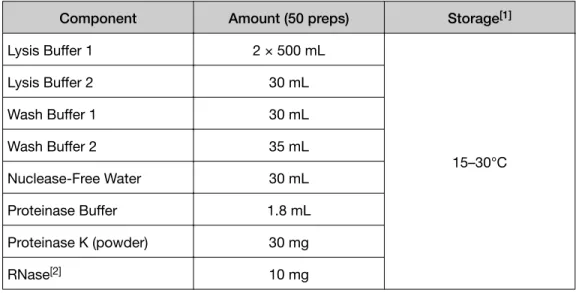
Table 1 GMO Extraction Kit (Cat. No. 4466336)
Component Amount (50 preps) Storage[1]
Lysis Buffer 1 2 × 500 mL
15–30°C
Lysis Buffer 2 30 mL
Wash Buffer 1 30 mL
Wash Buffer 2 35 mL
Nuclease-Free Water 30 mL Proteinase Buffer 1.8 mL Proteinase K (powder) 30 mg
Component Amount (50 preps) Storage[1] DNA Filter Columns 50
15–30°C
Collection Tubes 100
[1] See the expiration date on the box. [2] Not used in these procedures.
Required materials not included with the kit
Unless otherwise indicated, all materials are available through the Thermo Fisher Microbiology ordering process or thermofisher.com. MLS: Fisher Scientific (fisherscientific.com) or other major laboratory supplier.
Item Source
Equipment
Benchtop centrifuge, with adapters for 1.5–mL tubes MLS
Qubit™ 4 Fluorometer Q33226
Block heater for 1.5-mL tubes or water bath; 56°C, and 70°C MLS
Homogenizer Laboratory Blender DB5000A
Laboratory scale MLS
Laboratory mixer (Vortex or equivalent) MLS
Pipettors MLS
Plastics and other consumables
Tubes (1.5 mL and 50 mL), nuclease-free MLS Micropipette tips, aerosol-resistant MLS Disposable gloves, talcum powder-free MLS
Plastic paraffin film MLS
Reagents
Ethanol, absolute MLS
Product information Required materials not included with the kit
Workflow
Lyse the sample
(page 7) 1–16 hours
Sample + Lysis Buffer 1 ▼
Proteinase K, 56°C ▼
▼
Lysis Buffer 2, 70°C ▼
Absolute ethanol ▼
Bind and wash the DNA
(page 8) ~5 minutes
X2 Wash Buffer 1
▼
▼ Wash Buffer 2
▼
X2 ▼
Elute the DNA
(page 9) ~5 minutes
Nuclease-Free Water, 70°C
▼
▼ Purified DNA : centrifugation
Product information Workflow
Methods
Before first use of the kit
Add 1.35 mL of Proteinase Buffer to the vial of Proteinase K, then mix well. Store at – 20°C; stable for 6 months.
Before each use of the kit
• Place Proteinase K on ice until ready to use.
• Examine the reagents for a white precipitate, which can form if the reagents have been stored at a low temperature. Dissolve the precipitate by heating to 50– 70°C.
• Heat a block heater or water bath to 56°C.
• Heat a sufficient volume (100 µL per sample) of Nuclease-Free Water to 70°C. • Assemble filtration columns by inserting DNA Filter Columns into Collection
Tubes.
Lyse the sample
Prepare samples as described in the Thermo Scientific™ NGS Food Authenticity
Workflow Guide: Step 1—Sample Homogenization.
1. Combine 200 mg of prepared sample with the indicated reagents in a 1.5-mL tube.
Sample type Reagents
Meat, plant, and fish samples
550 µl Lysis Buffer 1
Note: Powdered samples should be gradually added to the lysis buffer to ensure that the sample can move in the liquid. It may be necessary to use less sample (approx. 40mg) or increase the amount of lysis buffer.
Prepare
Proteinase K
Prepare the
materials
2. Add 10 µL of Proteinase K, mix thoroughly, then incubate at 56°C for 1–16 hours.
All samples should be incubated for 1 hour. If low DNA yields are experienced, incubation of up to 16 hours can be used.
3. Centrifuge at 11,000 × g for 1 minute.
4. Transfer the supernatant to a new 1.5-mL microcentrifuge tube.
5. Add 400 µL of Lysis Buffer 2, mix thoroughly, then incubate at 70°C for 10 minutes.
6. Add 420 µL of absolute ethanol, then mix thoroughly. Proceed immediately to “Bind and wash the DNA” on page 8.
Bind and wash the DNA
If precipitate has formed after the addition of absolute ethanol, remove the precipitate with a pipette tip.
1. Transfer 600 µL (or as much as you can) to a DNA Filter Column-Collection Tube assembly, then centrifuge at 11,000 × g for 1 minute.
2. Remove and retain the column from the tube, discard the liquid in the tube, then reinsert the column into the tube. Add the remainder of the sample, then
centrifuge at 11,000 × g for 1 minute.
3. Remove and retain the column from the tube, discard the used tube, then insert the column into a new tube. Add 500 µL of Wash Buffer 1, then centrifuge at 11,000 × g for 1 minute.
4. Remove and retain the column from the tube, discard the liquid in the tube, then reinsert the column into the tube. Add 600 µL of Wash Buffer 2, then centrifuge at 11,000 × g for 1 minute.
5. Remove and retain the column from the tube, discard the liquid in the tube, then reinsert the column into the tube. Centrifuge again at 11,000 × g for 1 minute.
6. Remove and retain the column in the tube, then proceed immediately to “Elute the DNA” on page 9.
Methods
Elute the DNA
1. Insert the DNA Filter Column into a new nuclease-free 1.5-mL tube.
2. Add 100 µL of heated (70°C) Nuclease-Free Water, then incubate at room temperature for 3 minutes.
3. Centrifuge at 11,000 × g for 1 minute to elute DNA. The purified DNA is in the 1.5-mL tube.
Proceed directly to DNA quantification using the Qubit™ fluorometer, or store the DNA
in one of the following ways: • At 5 ± 3°C for up to 24 hours. • Below –18°C for long-term storage.
Methods Elute the DNA
Troubleshooting
Observation Possible cause Recommended action
No DNA, a very low yield of DNA, or poor-quality DNA (A260/A280 <1.6 or >2.0).
Incomplete sample lysis. Homogenize sample completely.
Mix thoroughly after adding Lysis Buffer 1 and Proteinase K.
Suboptimal Proteinase K activity. Store Proteinase K at –20°C. It is stable for 6 months.
Reagents are prepared incorrectly.
See “Prepare Proteinase K” on page 7 and “Prepare the materials” on page 7.
Suboptimal DNA elution. Ensure that Nuclease-Free Water used for
elution is heated to 70°C.
Place Nuclease-Free Water used for elution in the center of the column using a pipette. If reagents other than those supplied in the GMO Extraction Kit are used, ensure that the pH is >7.0.
A pH <7.0 decreases elution efficiency. Reagents that are supplied in the GMO
Extraction Kit have a pH appropriate for elution. Sample was taken from the fatty
section of food containing multiple textures.
Ensure that the sample for DNA extraction is representative of the whole food, feed, or beverage sample. If the sample contains multiple textures (for example, lasagna):
1. Cut the sample into small pieces. 2. Homogenize completely.
3. Take a portion of the sample from the aqueous phase if the sample cannot be made uniform. Fat can adversely affect DNA extraction.
Longer lysis is required. Increase incubation time at 56°C in
Lysis Buffer 1 and Proteinase K to 16 hours. Lysis of plant samples is not
optimal.
Use 700 μL CTAB Extraction Buffer + 21 mg of PVPP (Polyvinylpolypyrrolidone) instead of 550 μL of Lysis Buffer 1.
CTAB Extraction Buffer: 2% CTAB (Hexadecyltrimethylammonium bromide or
A
Observation Possible cause Recommended action Columns are saturated. Liquid
not passed through the filter completely.
Too much sample was used. See “Lyse the sample” on page 7 and “Elute the
DNA” on page 9. A precipitate forms after addition
of absolute ethanol.
Remove the precipitate with a pipette tip to allow buffer to pass through the column.
Sample lysis is incomplete. Homogenize sample completely.
Mix thoroughly after adding Lysis Buffer 1 and Proteinase K.
Reagents are prepared incorrectly.
See “Prepare Proteinase K” on page 7 and “Prepare the materials” on page 7.
DNA is suboptimal for PCR reactions (A260/A280 <1.6 or >
2.0).
Ethanol and salts are not adequately removed.
Follow all centrifugation steps to remove buffers and ethanol.
DNA is contaminated with inhibitors (A260/A280 <1.6).
1. Add 1 volume each of Lysis Buffer 2 and absolute ethanol, and mix thoroughly. 2. Load the mixture into a new filtration
column and repeat the procedure from “Bind and wash the DNA” on page 8.
Appendix A Troubleshooting Elute the DNA
A
Safety
WARNING! GENERAL SAFETY. Using this product in a manner not specified in the user documentation may result in personal injury or damage to the instrument or device. Ensure that anyone using this product has received instructions in general safety practices for laboratories and the safety information provided in this document.
·
Before using an instrument or device, read and understand the safety information provided in the user documentation provided by the manufacturer of theinstrument or device.
·
Before handling chemicals, read and understand all applicable Safety Data Sheets (SDSs) and use appropriate personal protective equipment (gloves, gowns, eye protection, and so on). To obtain SDSs, see the “Documentation and Support” section in this document.Chemical safety
WARNING! GENERAL CHEMICAL HANDLING. To minimize hazards, ensure laboratory personnel read and practice the general safety guidelines for chemical usage, storage, and waste provided below. Consult the relevant SDS for specific precautions and instructions:
·
Read and understand the Safety Data Sheets (SDSs) provided by the chemical manufacturer before you store, handle, or work with any chemicals or hazardous materials. To obtain SDSs, see the "Documentation and Support" section in this document.·
Minimize contact with chemicals. Wear appropriate personal protective equipment when handling chemicals (for example, safety glasses, gloves, or protective clothing).·
Minimize the inhalation of chemicals. Do not leave chemical containers open. Use only with sufficient ventilation (for example, fume hood).·
Check regularly for chemical leaks or spills. If a leak or spill occurs, follow the manufacturer cleanup procedures as recommended in the SDS.·
Handle chemical wastes in a fume hood.·
Ensure use of primary and secondary waste containers. (A primary waste container holds the immediate waste. A secondary container contains spills or leaks from the primary container. Both containers must be compatible with the waste material and meet federal, state, and local requirements for container storage.)·
After emptying a waste container, seal it with the cap provided.·
Characterize (by analysis if needed) the waste generated by the particular applications, reagents, and substrates used in your laboratory.·
Ensure that the waste is stored, transferred, transported, and disposed of according to all local, state/provincial, and/or national regulations.·
IMPORTANT! Radioactive or biohazardous materials may require special handling, and disposal limitations may apply.WARNING! HAZARDOUS WASTE (from instruments). Waste produced by the instrument is potentially hazardous. Follow the guidelines noted in the preceding General Chemical Handling warning.
WARNING! 4L Reagent and Waste Bottle Safety. Four-liter reagent and waste bottles can crack and leak. Each 4-liter bottle should be secured in a low-density polyethylene safety container with the cover fastened and the handles locked in the upright position.
Appendix B Safety Chemical safety
B
Biological hazard safety
WARNING! Potential Biohazard. Depending on the samples used on this instrument, the surface may be considered a biohazard. Use appropriate decontamination methods when working with biohazards.
WARNING! BIOHAZARD. Biological samples such as tissues, body fluids, infectious agents, and blood of humans and other animals have the potential to transmit infectious diseases. Conduct all work in properly equipped facilities with the appropriate safety equipment (for example, physical containment devices). Safety equipment can also include items for personal protection, such as gloves, coats, gowns, shoe covers, boots, respirators, face shields, safety glasses, or goggles. Individuals should be trained according to applicable regulatory and company/ institution requirements before working with potentially biohazardous materials. Follow all applicable local, state/provincial, and/or national regulations. The following references provide general guidelines when handling biological samples in laboratory environment.
·
U.S. Department of Health and Human Services, Biosafety in Microbiological and Biomedical Laboratories (BMBL), 5th Edition, HHS Publication No. (CDC) 21-1112, Revised December 2009; found at:https://www.cdc.gov/labs/pdf/
CDC-BiosafetymicrobiologicalBiomedicalLaboratories-2009-P.pdf
·
World Health Organization, Laboratory Biosafety Manual, 3rd Edition, WHO/CDS/CSR/LYO/2004.11; found at:www.who.int/csr/resources/publications/biosafety/Biosafety7.pdf
Appendix B Safety Biological hazard safety
Documentation and support
Food Safety support
Website: thermoscientific.com/foodmicro or thermofisher.com/foodsafety
Imegen website for Certificates of Analysis and other product documentation:
imegen.es/cms_kits_for_analysis_food.php
Support email:
• Europe, Middle East, Africa: [email protected]
• North America: [email protected]
Phone: Visit thermofisher.com/support, select the link for phone support, then select the appropriate country from the dropdown list.
Related documentation
Document Pub. No.
Thermo Scientific™ NGS Food Authenticity Workflow
Guide: Step 1—Sample Homogenization
LT2390A
Available at the product web page for the SGS All Species ID kits at
thermofisher.com.
Related products
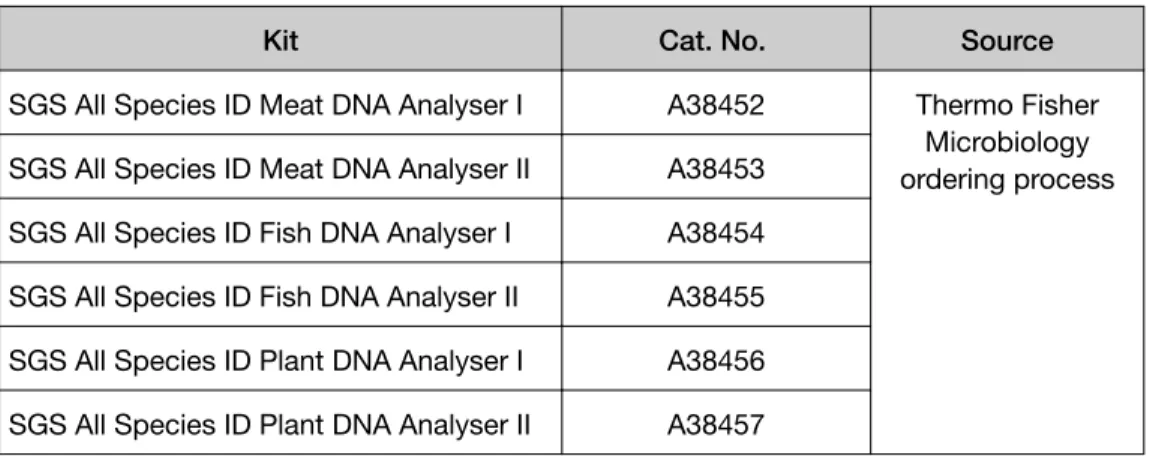
Table 2 NGS library preparation kits
Kit Cat. No. Source
SGS All Species ID Meat DNA Analyser I A38452 Thermo Fisher Microbiology ordering process SGS All Species ID Meat DNA Analyser II A38453
SGS All Species ID Fish DNA Analyser I A38454 SGS All Species ID Fish DNA Analyser II A38455 SGS All Species ID Plant DNA Analyser I A38456