College of Public Health and Human Sciences
Self-Study for CEPH Accreditation
November 2013
TABLE OF CONTENTS
Preface: Background of the OSU College of Public Health and Human Sciences
GLOSSARY... iv
CRITERION 1.0 1.1. Mission ... 7
1.2. Evaluation ... 14
1.3. Institutional Environment ... 30
1.4. Organization and Administration ... 36
1.5. Governance ... 42
1.6. Fiscal Resources ... 52
1.7. Faculty and Other Resources ... 58
1.8. Diversity ... 66
CRITERION 2.0 2.1. Degree Offerings... 77
2.2. Program Length ... 80
2.3. Public Health Core Knowledge ... 82
2.4. Practical Skills ... 84
2.5. Culminating Experience ... 92
2.6. Required Competencies ... 94
2.7. Assessment Procedures ... 102
2.8. Other Graduate Professional Degrees ... 112
2.9. Bachelor’s Degrees in Public Health ... 114
2.10. Other Bachelor’s Degrees ... 118
2.11. Academic Degrees ... 120
2.12. Doctoral Degrees ... 122
2.13. Joint Degrees ... 126
2.14. Distance Education or Executive Degree Programs ... 128
CRITERION 3.0 3.1. Research ... 131
3.2. Service ... 158
3.3. Workforce Development ... 170
CRITERION 4.0 4.1. Faculty Qualifications ... 179
4.2. Faculty Policies and Procedures ... 200
4.3. Student Recruitment and Admissions ... 204
Preface: Background of the OSU College of Public Health and Human Sciences
Recognizing the compelling need to address emerging public health challenges facing the nation and the need for an accredited school of public health in the state of Oregon, the College began laying the foundation with a focus on public health in 2007. After two years of strategic planning, establishing the first CEPH accredited College of Public Health and Human Sciences (PHHS) in Oregon became an institutional goal as part of OSU Strategic Plan Phase II in 2009. OSU identified Improving Human Health and Wellness (Healthy People) as one of 3 signature areas of distinction to be achieved through the University’s strategic plan along with Advancing the Science of Sustainable Ecosystems (Healthy Planet) and Promoting Economic Growth and Social Progress
(Healthy Economy). Because collaboration, integration, and consolidation were hallmarks of the OSU strategic process, Divisions aligning colleges with signature areas of distinction were established. However, the dean of each college in the Division continues to retain a direct reporting relationship with the University Provost. In addition, a university-wide integrative and consolidation guideline that each administrative unit will have a minimum of 20 faculty members/unit was proposed. Hence, our College’s new academic structure is composed of schools instead of more traditional departments, a structure that aligns with the University’s guideline. PHHS faculty, staff and the leadership team have worked more than 2 years to position the College for a leadership role in interdisciplinary public health education. We have leveraged existing strengths and increased our collective capacity for research, teaching and outreach in the focus area of Healthy People providing an innovative and valuable contribution to the state of Oregon. Building on our tradition of excellence in public health, nutrition, exercise sciences, and human development and family sciences, we have reorganized academic programs to develop the infrastructure and capacity for accreditation. Collectively, we designed and
reorganized the College to provide a learning environment that supports interdisciplinary collaboration,
promotes a broad intellectual framework for problem solving and fosters the development of professional public health values.
The new College features realignment of disciplines to create 2 Schools (Biological and Population Health Sciences, and Social and Behavioral Health Sciences), 3 Research Centers (Hallie Ford Center for Healthy Children and Families; Center for Healthy Aging Research; and Moore Family Center for Whole Grain Foods, Nutrition and Preventive Health), and an integrative Extension unit (unique to the land grant institution) called Public Health and Human Sciences Extension (comprised of 4-H Youth Development and Family &
Community Health Programs). The reorganized PHHS functions as a collaboration of 9 disciplines, addressing the health of populations and the community through instruction, research and service. Most importantly, the PHHS brings to the field of public health a forward thinking, comprehensive, and integrative approach to population health that uses an ecological and life course perspective at individual, family and community levels. Faculty in PHHS embraces the vision, goals and values common to public health and understands the culture and breadth of public health disciplines. These disciplines are rooted in the CEPH-accredited Oregon Master of Public Health (OMPH) Program we founded in collaboration with Portland State University and Oregon Health and Science University in 1996. As part of the accredited OMPH Program, OSU began offering MPH Programs in Health Promotion & Education and Health Policy & Management in 1996. The International Health and the Environment, Safety & Health tracks were added in 2000 and 2004, respectively. In 2009, OSU developed curricula and competencies for our new Epidemiology and Biostatistics MPH tracks, which CEPH added to the OMPH unit of accreditation in 2010. We also revised our PhD degree in Public Health to develop competencies and advanced courses specific to each of the 3 distinct concentrations (Environmental and Occupational Health & Safety, Health Policy, and Health Promotion & Health Behavior) that are consistent with national standards in each field. Faculty redesigned the undergraduate public health degrees to provide a BS in Public Health with concentrations in Health Management & Policy and Health Promotion & Health Behavior. During 2010-2013, the College recruited and hired 12 new tenure/tenure-track faculty members trained in public health as well as additional new faculty in the human sciences whose training bridges to public health disciplines. Collectively and intentionally we are transforming the College to become a pre-eminent leader in public health. Form follows function. Together we have created the organizational structure, systems, culture, and processes that foster a multidisciplinary approach to advancing knowledge, policies, and practices needed to improve population health in communities across Oregon and beyond.
OSU College of Public Health and Human Sciences Page iv
GLOSSARY
Acronyms Meaning
APHA American Public Health Association
AUPHA Association of University Programs in Health Administration BioPop School of Biological and Population Health Sciences
BS Bachelor of Science
CAC Community Advisory Council
DPD Difference, Power and Discrimination DVM/MPH DVM & MPH Dual Degree
E&G Education & General
EHSC Environmental Health Sciences Center
EOHS Environmental and Occupational Health & Safety EXSS Exercise & Sport Science
F&A Facilities & Administrative
FCH Family and Community Health
FTE Full-Time Equivalent
GCPH Graduate Certificate in Public Health GRA Graduate Research Assistantships GTA Graduate Teaching Assistantships HDFS Human Development & Family Sciences HERO Health Equity Researchers of Oregon HMP Health Management & Policy HPHB Health Promotion & Health Behavior
IGERT Integrative Graduate Education and Research Training IPE Interprofessional Education
IRB Institutional Review Board
IS Information Services
IT Information Technology
KCC Kaleidoscope of Colleges and Cultures LPI Linus Pauling Institute
MPH Master of Public Health
MS Master of Science
NEP Nutrition Education Program
NIEHS National Institute of Environmental Health Sciences NIH National Institutes of Health
NSF National Science Foundation
NWCCU Northwest Commission on Colleges and Universities
OCAT Oregon CEPH Action Team
OCHO Outreach Collaboratives for a Healthy Oregon OGEC Oregon Geriatric Education Center
OHSU Oregon Health and Science University OEI Office of Equity and Inclusion
OMPH Oregon Master of Public Health Program ONID OSU Computer Network Identification Account OPAA Office of Post Award Administration
OPHA Oregon Public Health Association OSU Oregon State University
OSU College of Public Health and Human Sciences Page v OSUL Oregon State University Libraries
OUS Oregon University System
P&T Promotion and Tenure
PETE Physical Education Teacher Education
PhD Doctor of Philosophy
PHHS College of Public Health & Human Sciences
PI Primary investigator
PROF Periodic Review of Faculty RAM Resource Allocation Model RFP Request for proposals
SET Student Evaluation of Teaching
SLICE Service Learning Initiative for Curricular Engagement SOBE School of Social and Behavioral Health Sciences SOPHAS Schools of Public Health Application Service SWPS Statewide Public Services
TFDI Tenured Faculty Diversity Initiative URAP Undergraduate Research Awards Program
URISC Undergraduate Research Innovation Scholarship Creativity
URL Uniform resource locator
USDA U.S. Department of Agriculture VPN Virtual Private Networking
OSU College of Public Health and Human Sciences Page iii
Oregon State University | College of Public Health and Human Sciences
Criterion 1
OSU College of Public Health and Human Sciences Page 7
CRITERION 1.0: THE SCHOOL OF PUBLIC HEALTH
The proposed accreditation unit under review is the Oregon State University College of Public Health and Human Sciences (PHHS). The term “College” will be used in this document to mean the entire College, which the Council on Education for Public Health (CEPH) generally terms a “School of Public Health.” Our College is comprised of 2 Schools. We will use the term “Schools,” instead of more traditional “Departments,” to refer to our 2 large subunits: a) the School of Biological and Population Health Sciences (also known as BioPop); and b) the School of Social and Behavioral Health Sciences (also known as SOBE). These variations reflect our University’s unique nomenclature for academic units that report directly to the Provost as well as the requirement in the University Strategic Plan for integration and consolidation of administrative units. Our new structure meets these requirements and, most importantly, promotes interdisciplinary collaboration with particular attention to the integration of all disciplines in the framework of public health values.
The School of Biological and Population Health Sciences is the administrative home of the academic disciplines of: 1) Biostatistics, 2) Epidemiology, 3) Environmental and Occupational Health & Safety, 4) Exercise & Sport Science, 5) International Health, and 6) Nutrition. The School of Social and Behavioral Health Sciences is the administrative home of the academic disciplines of: 1) Health Management & Policy, 2) Health Promotion & Health Behavior, and 3) Human Development & Family Sciences. Our organizational approach capitalizes on the synergies made possible through collaborations across disciplines in order to preserve our College’s signature, interdisciplinary and ecological approach to public health and human sciences. The creation of 3 multidisciplinary research centers (Hallie E. Ford Center for Healthy Children and Families; Center for Healthy Aging Research; and Moore Family Center for Whole Grain Foods, Nutrition and Preventive Health) provides a special research environment that supports and promotes a broad intellectual framework for problem solving and fosters the development of professional public health values. Furthermore, as a public land grant university, the integration of Extension Services in our College affords us the unique opportunity to create a distinctive program of outreach and service for PHHS Extension that serves as a model for effective interaction and engagement with local communities across the state.
Our self-study covers the 2 academic years from July 1, 2011 to June 30, 2012 (designated 2011/12) and from July 1, 2012 to June 30, 2013 (designated 2012/13). We will use that naming convention for both fiscal and academic years throughout this document.
1.1. Mission. The school shall have a clearly formulated and publicly stated mission with supporting goals, objectives and values.
1.1.a. A clear and concise mission statement for the school as a whole.
Our Mission. Inspired by our mission as a leading land grant university, we create synergy in teaching, research, and outreach to develop the next generation of globally minded public health and human sciences professionals. Through interdisciplinary research and innovative curricula, we advance knowledge, policies, and practices that improve population health in communities across Oregon and beyond.
1.1.b. A statement of values that guides the school.
Our Values. We share the values that guide Oregon State University: Accountability, Diversity, Respect, Responsibility, and Truth. To these values, we add our dedication to:
OSU College of Public Health and Human Sciences Page 8
Health: We are committed to advancing lifelong health and well-being for all.
Care and Compassion: With compassion and understanding, we commit to caring for ourselves and others.
Innovation: We embrace innovative approaches to addressing challenges and
opportunities.
Continuous Improvement: We continually strive toward high standards by optimizing individual and collective strengths.
Cooperation & Collaboration: We promote a collegial learning and work environment that encourages cooperation, collaboration, and active participation.
1.1.c. One or more goal statements for each major function through which the school intends to attain its mission, including at a minimum, instruction, research and service.
During the strategic planning process, we identified 5 goals to build our new College of Public Health and Human Sciences. These goals are:
Goal 1 (Infrastructure): Develop and maintain operational and academic infrastructure that supports meeting the mission of our College.
Goal 2 (Teaching): Deliver outstanding and distinctive graduate and undergraduate programs of instruction in which all graduates demonstrate attainment of program competencies.
Goal 3 (Discovery): Conduct, disseminate and translate high-quality research addressing the health of populations and the community.
Goal 4 (Service & Workforce Development): Partner with academic, workforce and community stakeholders in service and outreach to enhance the health of communities in Oregon and beyond. Goal 5 (People): Attract, support and sustain excellence in a diverse complement of faculty, staff and students.
1.1.d. A set of measurable objectives with quantifiable indicators related to each goal statement as provided in Criterion 1.1.c. In some cases, qualitative indicators may be used as appropriate.
In Table 1.1.d. below we list the specific measurable objectives and indicators that have been selected to track our goals listed in Section 1.1.c.
Table 1.1.d. Objectives and Indicators
Objectives Indicators
Goal 1 (Infrastructure): Develop and maintain operational and academic infrastructure that supports meeting the mission of our College.
Establish and sustain an administrative,
operational and physical infrastructure that fully supports our College in achieving its mission
PHHS College organizational structure
Adequate % of total initial budget that is designated as reserve funds
Undergraduate and graduate student councils contribute to development of College
Establish and maintain College planning, evaluation and improvement systems
Primary faculty are trained to and update their data in Digital Measures (DM) at least once per year
Evaluation and Assessment Activity Timeline is established, implemented and completed each year
OSU College of Public Health and Human Sciences Page 9
Establish and sustain a system of external stakeholders to contribute to the development of the College as well as a development program to increase funding for the College
Number of Community Advisory Council (CAC) meetings per year
Amount of annual fund donations from alumni and friends Number of development visits with donors, corporations, and foundations that will benefit programs, faculty and students Goal 2 (Teaching): Deliver outstanding and distinctive graduate and undergraduate programs of instruction in which all graduates demonstrate attainment of program competencies.
Provide a competency-based curriculum and achieve program quality through assessment of degree appropriate learning objectives and competency attainment
Percent of faculty who complete and return Competency Reporting Forms and Competency Reporting Forms for Events
Percent of MPH students reporting attainment of MPH Core Competencies
Percent of academic program meetings to discuss competency-based curriculum, learning objectives, and competency attainment
Periodically review existing curricula to identify changes needed to enhance the preparation of students to meet emerging public health needs
Frequency of curricula reviews for all academic programs
Ensure the availability of courses that introduce students to the 5 core areas of public health knowledge
Develop and offer courses for undergraduate students that provide knowledge of the foundations of public health and epidemiology
Percent of undergraduate PHHS students enrolled in course (H 100) providing knowledge of the foundations of public health
Enrollment of MPH students in 5 courses reflecting core areas of public health knowledge
Enrollment of non-public health graduate students in courses providing knowledge of the foundations of public health and epidemiology
Ensure effective mentoring and advising for every student to achieve timely completion of requirements including internships, graduation and employment within discipline-related positions
Student satisfaction with academic advising and support Centralized internship coordination available to all MPH students
Undergraduate graduation rates within 6 years
Graduation rates within 3 years for masters students and within 7 years for PhD students
Ensure mastery in essential work skills for public health practice, academic careers and other professional positions for all MPH students
Percent of MPH graduates who complete an internship Percent reporting satisfaction with level of preparation to work in public health
Ensure mastery of 5 core areas of knowledge and public health practice for all MPH students
Average GPA in 5 core public health courses for all MPH students who completed 1 or more public health core courses during that year
Encourage graduate students to engage in
multidisciplinary studies Number of students in concurrent/dual degree programs Goal 3 (Discovery): Conduct, disseminate and translate high-quality research addressing the health of populations and the community.
Increase the involvement of students in research and scholarly activities
Percent of research grants awarded to primary faculty that involve students
Number of undergraduate students participating in URAP program for undergraduate research
OSU College of Public Health and Human Sciences Page 10
Increase external funding for research
Number of primary faculty members who submit applications for external funding
Percent of faculty who complete the Grant-Writing Workshop who submit applications for external funding
Research dollars awarded to primary faculty Conduct community-based research that
improves the practice of public health
Number of research grants awarded to primary faculty that are community-based
Disseminate research findings to practitioners, policy-makers, educators and the public
Average number of publications in peer-reviewed journals per primary faculty
Number of primary faculty who present at state, regional, national and/or international meetings
Link members of the public with PHHS faculty members who have expertise in specific health areas
Number of media releases regarding faculty research and publications
Encourage and support interdisciplinary research
Percent of College-sponsored research projects that are interdisciplinary
Number of seminars/events sponsored to encourage interdisciplinary research
Goal 4 (Service & Workforce Development): Partner with academic, workforce and community stakeholders in service and outreach to enhance the health of communities in Oregon and beyond. Pursue service activities consistent with the
stated mission of our College, including collaborating more effectively with faculty and projects of PHHS Extension
Number of primary faculty providing service to communities and the public
Number of primary faculty providing service to the profession Design and deliver outreach and engagement
programs designed to improve the health status of individuals, families and communities
Number of Oregonians participating in outreach and engagement programs of the College
Engage in activities that support the professional development of the public health workforce
Number of continuing education courses offered
Quarterly webinar series for public health practitioners and health professionals
Graduate Certificate in Public Health (GCPH) program implemented
Goal 5 (People): Attract, support and sustain excellence in a diverse complement of faculty, staff and students.
Enhance efforts to recruit and retain faculty, staff and students from diverse backgrounds
Equity, Inclusion and Diversity Committee established Equity, Inclusion and Diversity Enhancement Plan developed Activities to improve diversity among faculty and staff implemented and evaluated
Activities to improve diversity among undergraduate students Activities to improve diversity among graduate students Demonstrate commitment to offer and promote Graduate Certificate in Public Health (GCPH) to rural and
underrepresented students
Ensure faculty have opportunities for continuous development, recognition and input into their work and/or academic life
Number of faculty nominated for College and University awards and recognition
Percent of eligible faculty successfully tenured and promoted Number of faculty participating in leadership development training
OSU College of Public Health and Human Sciences Page 11
Hire and retain faculty who demonstrate
excellence in research, teaching and service Percent of primary faculty who are evaluated as “Extraordinary” or “Strong and Positive” in all 3 areas Recruit and retain graduate students who have
the potential to become professional, academic and scientific leaders in Public Health and Human Sciences
Number of graduate students enrolled
Average GRE scores (Verbal and Quantitative) for enrolled students
Ensure staff and professional faculty have opportunities for continuous development, recognition and input into their work life
Number of College and School committees that include staff and professional faculty
Number of staff and professional faculty nominated for College and University awards and recognition
Number of open forums with dean to ensure ongoing dialogue Hire and retain faculty who promote the
College’s interdisciplinary focus
Percent of new tenure/tenure-track/clinical primary faculty hires whose qualifications cross disciplines
Percent of new tenure/tenure-track/clinical primary faculty hires with experience in interdisciplinary research 1.1.e. Description of the manner through which the mission, values, goals and objectives were developed, including a description of how various specific stakeholder groups were involved in their development.
Mission. In January 2011 faculty began revision of our College mission statement. In support of the effort, the Dean engaged AHA!, a strategic communications consulting firm, to lead faculty through a participatory values clarification process at the winter faculty meeting. The consulting firm conducted interviews with numerous focus groups of faculty, staff and students, and a new draft mission statement was developed during a 3-month process. The College’s Administrative Team members and
representative faculty and staff met with the consulting firm and finalized the new mission statement in May 2011.
Values. Faculty members participating in the College’s 2011/12 Leadership Development Program revised and developed a new list of values for our College. The revised statement of values was posted on a confidential electronic survey site. During a 2-week period 415 College faculty members, staff, research assistants/associates, administrators, and students reviewed and provided feedback. The proposed statement of values that incorporated the feedback was then presented to the faculty in each School for approval. In the spring of 2012, faculty in both Schools approved the statement of values. Goals and Objectives. The College’s Administrative Team plus representative faculty and staff members undertook strategic planning beginning summer of 2011. The process started with a two-day retreat where goals and objectives were discussed. Members of subgroups were assigned specific goals to work on during subsequent meetings. The Administrative Team reconvened for another 2.5 day retreat for discussion and approval of the goals and objectives.
1.1.f. Description of how the mission, values, goals and objectives are made available to the school’s constituent groups, including the general public, and how they are routinely reviewed and revised to ensure relevance.
The College’s mission, statement of values, goals, and objectives are disseminated to the campus
community and general public through our College’s website, newsletters, and other College publications including Synergies. Periodic reviews of the College’s goals and objectives include input from
constituents from within the College and external stakeholders including our Community Advisory Council (CAC). The next comprehensive review is planned for academic year 2014/15.
OSU College of Public Health and Human Sciences Page 12 1.1.g. Assessment of the extent to which this criterion is met and an analysis of the school’s strengths, weaknesses and plans relating to this criterion.
This criterion is met. Strengths:
Our College has a clear, concise mission statement; well-articulated values; and goals and measurable objectives in the areas of infrastructure, teaching, research, service, workforce development and people.
Major College goals and objectives are consistent with those of Oregon State University's Strategic Plan: Phase II (2009 – 2013).
Our statement of values and goals were developed through a strategic process involving multiple stakeholders.
Weaknesses:
During the development of our mission, goals, and objectives, the College did not have organized and functioning stakeholder groups; we now have in place functioning student councils and a Community Advisory Council to provide us with systematic and regular feedback.
Plan:
In addition to the regular engagement and feedback from our faculty and staff, we will continue to seek input from the student councils and the Community Advisory Council regarding our mission, statement of values, goals, and objectives.
OSU College of Public Health and Human Sciences Page 14 1.2. Evaluation. The school shall have an explicit process for monitoring and evaluating its overall efforts against its mission, goals and objectives; for assessing the college’s effectiveness in serving its various constituencies; and for using evaluation results in ongoing planning and decision making to achieve its mission. As part of the evaluation process, the school must conduct an analytical self-study that analyzes performance against the accreditation criteria defined in this document. 1.2.a. Description of the evaluation processes used to monitor progress against objectives defined in Criterion 1.1.d., including identification of the data systems and responsible parties associated with each objective and with the evaluation process as a whole. If these are common across all objectives, they need be described only once. If systems and responsible parties vary by objective or topic area, sufficient information must be provided to identify the systems and responsible party for each. Evaluation Process for Monitoring Progress. The College has developed a culture of an ongoing and routine process (what, by whom, by when) in planning, evaluating, monitoring and reporting progresses for the last 10 years. The College will continue to undertake a systematic and integrated process to determine our effectiveness in achieving our mission, goals and objectives developed for the CEPH self-study and beyond. We have developed new data information systems, with proposed timelines for data collection. We also engage multiple constituents in the evaluation process. Strategies to obtain and integrate data, solicit input, and engage in discussion with key constituencies, include the following: routine, ongoing data collection and analysis; consultations with important stakeholders; use of campus-wide assessment resources; and ad hoc, timely assessments that address specific questions whenever needs arise. These quantitative indicators and qualitative information are then used to inform the College planning and quality-improvement processes.
The timeline for College planning is regularly scheduled in the summer during a 3-4 day administrative retreat. Before the scheduled retreat, the Dean requests all responsible parties to compile data and information from multiple sources with various methods for reporting, discussion, and evaluation. Representative faculty and staff are invited to participate in specific topics of discussion. During the retreat, the Administrative Team and representative faculty and staff evaluate, monitor, and report on progress made in achieving our mission, goals, and objectives. Based on the outcomes, the
Administrative Team makes specific plans for the following year to follow through with the goals and objectives. In the early Fall term, the progress of the past and the plan for the future are discussed during the annual College Meeting attended by all faculty and staff. Feedback from the College Meeting will further improve the plan for the next year. An Annual College Report is produced and posted on the College’s website for public review and comments by October of each year.
The sections that follow describe the data management systems, data collection methods, responsible parties involved with oversight of the evaluation process, and specific evaluation strategies by goals. Data Management Systems. The College uses data from a number of sources for our evaluations. In 2012 our College instituted 2 new data management systems, Digital Measures and Sales Force. We also use the data management systems operated by the University as a whole, including Banner and Data Warehouse. Collectively, these data systems provide broad capabilities for tracking outcome indicators and analyzing data to assess the College’s progress toward its goals and objectives including data and metrics related to research, faculty, staff, students, and administration. Using these management systems we collect and monitor the following:
Faculty publications and presentations
Faculty promotion and tenure statistics
Faculty extramural funding
OSU College of Public Health and Human Sciences Page 15
Undergraduate student retention and academic progress
Undergraduate student graduation rates
Graduate student retention, academic progress, graduation rates, and degrees awarded.
With Digital Measures and Sales Force information systems operational, we instituted regular trainings to ensure optimal use by faculty and staff across our College. The first trainings for Digital Measures occurred in Spring 2012 with further trainings offered throughout summer and Fall 2012. Our College also instituted online tutorials for personnel to gain expertise in the use of the new systems. Additionally, the Accreditation and Assessment Manager provided 4 small group work sessions in Winter 2013, as well provides ongoing individual support for College personnel using both systems. Faculty and staff are informed of work sessions through emails, announcements at School meetings, the Dean’s weekly emails, and direct communication with the Accreditation and Assessment Manager. All primary and secondary faculty members have active Digital Measures accounts and update their accounts regularly.
Data Collection Methods. We systematically collect primary data to provide information for evaluation. Data collection methods include on-line surveys, interviews, and group discussions. As described above, we collect and integrate data from a wide range of sources, including data and metrics related to research, faculty, staff, students, and administration as well input and advice from community stakeholders
including preceptors, employers, and alumni (see Table 1.2.a.). Table 1.2.a. Data Sources and Description of Periodic Assessment
Data Source Description of Periodic Assessment Frequency
Annual Reviews Faculty Staff
Administrators
Faculty, staff, and administrators are evaluated annually on performance measures including teaching, research, service, and
administration Yearly
Competency Reporting and Event Forms
Faculty members assess students enrolled in courses with assigned competencies and culminating experiences for competency attainment
Quarterly
Internship Preceptor Survey
Preceptors evaluate students’ preparation for public health practice, attainment of competencies, and indicate gaps in training and preparation
Bi-Yearly
Student Exit Survey
Students respond to questions related to satisfaction with their degree program, field experience, advising, and career services; the extent to which they believe they had developed competencies specific to their degree program (MPH students only); and employment status
Yearly
Alumni Survey
Graduates respond to questions related to satisfaction with their degree program, field experience, advising, and career services: the extent to which they can perform competencies in an employment setting (MPH students only); and employment status
Yearly
Employers’ Assessment Employers participate in interviews/surveys to assess graduates’ attainment of core public health competencies and preparation for workforce
Yearly Community Advisory
Council (CAC) Feedback
The CAC provides feedback and counsel to assess the public health needs in Oregon
Quarterly (3 times/yr)
Responsible Parties. Under the leadership of the Dean, multiple parties collaborate to ensure the tracking and maintenance of satisfactory progress toward our College’s objectives. Responsibilities for specific objectives and data systems are shared by individuals, standing committees, and ad hoc groups to optimize effectiveness and efficiency. The responsible parties include:
OSU College of Public Health and Human Sciences Page 16
Dean. The Dean has the oversight on the operational and physical infrastructure of the college, including college budget, space, and personnel. Working with the College Administrative Team and University leadership (such as the Provost, and Director of University Budget and Fiscal Planning) the Dean is responsible for planning, monitoring and assessment of strategic planning to ensure sustainability of resources that support the mission and goals of the College. Working with the OSU Foundation and the Director of Development, the Dean is primarily responsible for the development program that enhances the resources and opportunities that benefit programs, faculty and students.
Associate Dean for Research and Graduate Programs. The Associate Dean for Research and Graduate Program is responsible for assuring that the research and graduate program activities align with our College’s vision, mission, and goals; monitoring and reporting our College’s graduate assessment of student learning; and working directly with the Accreditation and
Assessment Manager to assess the extent to which graduate students in all degree programs have demonstrated achievement of the program competencies. She assists in the data collection efforts and assessment of graduation rates and job placement rates for all graduates. She also monitors and assesses our College’s research activities.
Associate Dean for Undergraduate Programs. The Associate Dean for Undergraduate Programs is responsible for assuring that the undergraduate program activities align with our College’s vision, mission, and goals; monitoring and reporting our College’s undergraduate assessment of student learning to the Office of Academic Programs, Assessment, and
Accreditation; and working directly with the Accreditation and Assessment Manager to assess the extent to which undergraduate students in all degree programs have demonstrated achievement of the program competencies. Additionally, he is responsible for the coordination of international experiences directly related to undergraduate and graduate student learning during study abroad, internship, and faculty-led exchanges.
Associate Dean for Outreach and Engagement. The Associate Dean for Outreach and Engagement assures congruence of outreach activities with the College vision and mission; assesses progress toward outreach and engagement goals; monitors compliance with relevant benchmarks and standards; and provides Extension faculty/staff with resources they need to evaluate programs and projects effectively. He works closely with the 2 other Associate Deans to assure synergy and integration of research, teaching, service, and workforce development.
School Co-Directors. With regard to program review, the Co-Directors of each School coordinate the functioning of committees that oversee the assessment of the School’s programs and ensure educational excellence. With regard to personnel review, the Co-Directors are responsible for annual review of the School’s faculty members and staff. They also have an important role in overseeing the promotion and tenure process.
Accreditation and Assessment Manager. This full-time position was created and filled in 2012. The Accreditation and Assessment Manager has primary responsibility for the management and assessment of the performance of our College against accreditation criteria for CEPH and the University. She works with College leadership on establishment of the evaluation plan and procedures, management and maintenance of information databases, development and administration of surveys and other assessment instruments, data collection and analyses, and other activities for tracking and monitoring progress toward College objectives.
OSU College of Public Health and Human Sciences Page 17 Evaluation Strategies by Goals. We employ a number of specific strategies and tools to guide our evaluation activity. Organized by goal statement, these include the following:
Goal 1 (Infrastructure). Many of the designated indicators under Goal 1 utilize data already being collected on an ongoing basis or are readily accessible within our College or the University. Objectives of Goal 1 will be evaluated annually during the College’s summer Administrative Retreat. The College Annual Report submitted to the Provost and posted on OSU’s website is another strategy to monitor our progress and make us accountable publically. Evaluation and monitoring the College budget is an ongoing process with the Manager of Health Science Business Center. Quarterly meetings with the Dean and Co-Directors ensure the appropriate expenditure and balance of the budget for the College and Schools. Quarterly reports from the OSU Foundation will evaluate and monitor the development visits of the Dean with donors, alumni, and corporations and the percent of College annual development goal achieved. In collaboration with the Administrative Team and faculty, the Dean tracks the establishment and launch of new operational units such as the Community Advisory Council (CAC).
Goal 2 (Teaching). Our College tracks statistics including 6-year undergraduate graduation rates, time to degree, graduation rates for graduate students, employment placement rates for graduates, and other indicators. Each degree program within our College assesses competencies and learning outcomes of its undergraduate and graduate students. At the discipline level there are curriculum committees for: Human Development & Family Sciences, BioPop Human
Sciences, and Public Health. Each of these committees includes members from varied disciplines to ensure that program content benefits from multiple viewpoints. At the College level, the College Curriculum Committee reviews and approves curricular proposals (see Criterion 2.7. for more information on oversight and monitoring of graduate and undergraduate instruction). At the University level, the Office of Academic Programs, Assessment, and Accreditation (http://oregonstate.edu/admin/aa/apaa/), located within the Office of Academic Affairs, is dedicated to the structure and quality of curricular programs. This office provides leadership, guidance, and support for each program in conducting assessments of student learning outcomes at the undergraduate level. The Graduate School supports 3 processes for assessment and review of graduate programs: external graduate program reviews, internal assessment carried out by individual graduate programs on a continuing basis, and institutional strategic planning.
Goal 3 (Discovery). The Digital Measures data system described above is used to track many of the indicators listed in these objectives, including numbers of faculty publications, number of faculty presentations, and student participation in research programs. The Associate Dean for Research and Graduate Programs and Accreditation and Assessment Manager guide collection and use of this detailed information for College planning and improvement.
Goal 4 (Service & Workforce Development). We use Digital Measures and other systems to track and assess the majority of the indicators associated with these objectives, including primary faculty serving in leadership roles on panels and commissions, faculty providing technical assistance, and local, state, national, and international collaborations.
Goal 5 (People). A broad range of data sources are employed to evaluate the indicators for these objectives. For example, faculty complete and submit their Annual Summary of Academic and Professional Activities using Digital Measures. Additionally, College data systems track rates of faculty turnover, graduate student admission, and recognition and awards each year. The
OSU College of Public Health and Human Sciences Page 18 processes for evaluating College success in establishing, expanding, and maintaining faculty, staff, and student diversity are discussed in Criterion 1.8.
1.2.b. Description of how the results of the evaluation processes described in Criterion 1.2.a. are monitored, analyzed, communicated and regularly used by managers responsible for enhancing the quality of programs and activities.
Our evaluation processes are iterative and serve to monitor and improve the quality of our programs. As needed, the College makes changes in our programs and activities to meet our mission, goals, and objectives. As described above, evaluation and planning is an ongoing process in the College with active participation from internal and external stakeholders.
Strategic Planning. Our College has established and encouraged formal and informal feedback,
information loops, and communication channels throughout the process of planning and embarking on the accreditation process. For example, our College Administrative Team held several internal focus groups and faculty listening sessions in 2009/10, at which faculty provided recommendations that were
incorporated into the new College’s structure. One recommendation was that the Dean establish a faculty advisory group that would provide ongoing input for administrative decisions. The Dean created this ad hoc group, known as the Faculty Transition Team (FTT), which met on an ongoing basis with the Administrative Team, including at planning retreats in 2010/11. The Dean also established an advisory focus group to provide input on transitions relating to our College’s Extension programs. The 2008 College strategic plan is grounded in the University’s Strategic Plan: Phase II (2009 – 2013) and aligns with its metrics (see http://oregonstate.edu/leadership/strategicplan/phase2). Our College’s strategic plan
was redesigned in the summer of 2011 and provides the basis for our specific measureable objectives found in this self-study. Progress on the plan is monitored by the Administrative Team at its annual summer retreat and at meetings of the Dean and Associate Deans. Progress toward achieving the College’s strategic plan is communicated to faculty at the Dean’s quarterly faculty meetings, through her weekly e-mails, and editions of Synergies, our College newsletter. Our strategic plan will be updated again in 2015/16.
Instructional Programs. The curriculum committee structure of our College and its 2 Schools has played a central role in establishing, revising, and refining instructional plans. Evaluation of individual courses is conducted through several channels, specifically the campus-wide student course evaluation process. In addition, faculty in the Schools engage in peer evaluations of teaching, in which faculty review course materials, observe classes, and provide written assessments to the individual instructor and the School Co-Directors.
Our College seeks input from students through other channels as well. In 2012 our College administered separate online Exit Surveys of graduating undergraduate and graduate students. The purpose of the Exit Survey was to ask questions related to degree programs, query MPH students on their perception of competency development for core and track level competencies, and gather contact information for future communication with our graduates. The OSU Graduate School also conducts a survey of graduating students, but that survey does not address discipline-specific competencies, so it serves different and complementary purposes to our College’s Exit Survey.
Research and Discovery. The Dean’s office regularly uses feedback from faculty, School Co-Directors, and Research Center Directors to allocate resources for research and faculty professional development. As an example, based on faculty feedback the Associate Dean for Research and Graduate Programs provides opportunities and infrastructure to assist in research productivity and maximize the research potential of faculty (see Criterion 3.1.a. for details).
OSU College of Public Health and Human Sciences Page 19 Outreach and Engagement. Our College has instituted a number of mechanisms for offering input, both formal and informal, from public health professionals in Oregon. One of these is OSU’s continuing partnership with the Oregon Public Health Association (OPHA), which has held its annual conference on the OSU campus since 2005. Another joint program was a 1-day conference held on the OSU campus in June 2011 as part of the Outreach Collaboratives for a Healthy Oregon Project (OCHO), aimed at building campus-practitioner collaborations and promoting joint translational research projects. The conference was attended by 125 researchers and practitioners, including approximately 65 state and local health department personnel. These meetings provide opportunities for practitioners to give input in informal collegial settings; their input is used by our College to plan further outreach and engagement activities.
Strengthening relationships between county Extension offices and local departments of health across Oregon is another example of how our evaluation is monitored and analyzed. In 2011 our College’s Health Extension programs and the Dean’s office used internal funds to launch a new initiative. By requirement of the grant, these projects needed to include a partnership between PHHS Extension
personnel, local departments of health, and campus research personnel. When the grants were completed in June 2012, their project reports were evaluated to ascertain the initiative’s effectiveness in achieving its aim of strengthening local partnerships between OSU Extension faculty and local health personnel. These assessments permit our College to plan future activities so as to enhance the skills, capabilities, and project opportunities of all parties, including students, University personnel, and local practitioners. 1.2.c. Data regarding the school’s performance on each measurable objective described in Criterion 1.1.d. must be provided for each of the last three years. To the extent that these data duplicate those required under other criteria, the school should parenthetically identify the criteria where the data also appear.
Because the College of Public Health and Human Sciences came into existence in July 1, 2011, 2011/12 is the first year for which data on most of the objectives are available. We provide indicators, targets, and data for 2011/12 and 2012/13 in Table 1.2.c. Please note, for objectives whose indicators have been met during the self-study period, we will no longer track. We anticipate that new objectives and
OSU College of Public Health and Human Sciences Page 20 Table 1.2.c. Data Regarding Performance on Indicators Related to Goals and Objectives
Goal 1 (Infrastructure): Develop and maintain operational and academic infrastructure that supports meeting the mission of our College.
Objective Indicator Target 2011/12 2012/13
Objective 1.1: Establish and sustain an administrative, operational and physical infrastructure that fully supports our College in achieving its mission
PHHS College organizational structure
By end of 2011/12 academic year, PHHS organizational structure in place and operational
Met Met
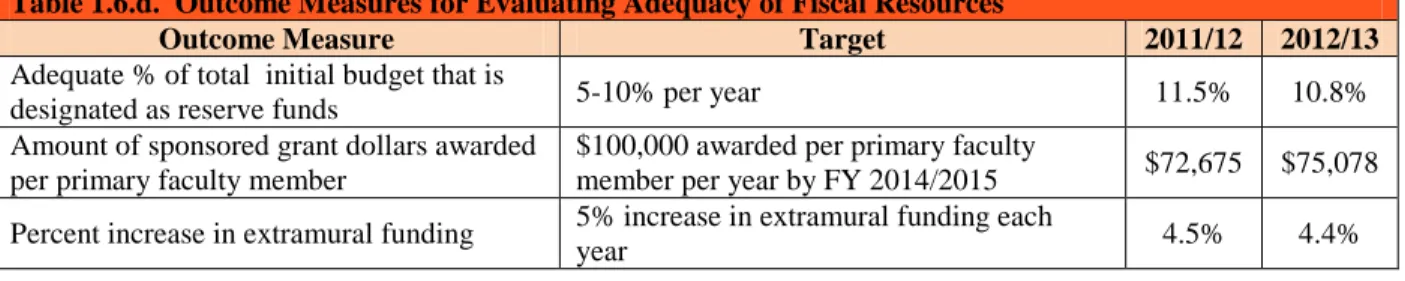
Adequate % of total initial budget that is
designated as reserve funds 5-10% per year 11.5% 10.8%
Undergraduate and graduate student councils contribute to development of College
Undergraduate and graduate student councils
meet once per term (i.e. 3 times per year) N/A
Undergrad: 9 Graduate: 3
Objective 1.2: Establish and maintain College planning, evaluation and improvement systems
Primary faculty are trained to and update their data in Digital Measures (DM) at least once per year
100% of primary faculty update their data in
Digital Measures annually N/A 100%
Evaluation and Assessment Activity Timeline is established, implemented and completed each year
By end of 2012/13 academic year, Evaluation
and Assessment Activity Timeline developed N/A Met
Objective 1.3: Establish and sustain a system of external stakeholders to contribute to the development of the College as well as a development program to increase funding for the College
Number of Community Advisory Council (CAC) meetings per year
Community Advisory Council (CAC) meets quarterly (3 times/yr). Minutes of meetings indicate involvement in College development and improvement
N/A
28-Jan-13 08-Apr-13 07-May-13 Amount of annual fund donations from alumni
and friends
Meet College gifts and pledges goal set
annually by OSU Foundation Met Met
Number of development visits with donors, corporations and foundations that will benefit programs, faculty and students
Meet the number of development visits by the
OSU College of Public Health and Human Sciences Page 21 Goal 2 (Teaching): Deliver outstanding and distinctive graduate and undergraduate programs of instruction in which all graduates demonstrate attainment of
program competencies.
Objective Indicator Target 2011/12 2012/13
Objective 2.1: Provide a competency-based curriculum and achieve program quality through assessment of degree appropriate learning objectives and competency attainment
Percent of faculty who complete and return Competency Reporting Forms and Competency Reporting Forms for Events
By 2012/13, 95% of faculty per cycle return Competency Reporting Forms
N/A 92%
Percent of MPH students reporting attainment of MPH Core Competencies
80% of respondents will report attainment of 7 MPH Core Competencies 1. 80% 2. 72% 3. 68% 4. 76% 5. 92% 6. 84% 7. 84% 1. 100% 2. 100% 3. 86% 4. 96% 5. 100% 6. 100% 7. 96% Percent of academic program meetings to discuss
competency-based curriculum, learning objectives, and competency attainment
By spring 2013, 100% of programs meet once per year
N/A 100%
Objective 2.2: Periodically review existing curricula to identify changes needed to enhance the preparation of students to meet emerging public health needs
Frequency of curricula reviews for all academic programs
Starting 2013/14 academic year, 100% of curricula reviewed yearly and revised as needed
N/A N/A
Objective 2.3: Ensure the availability of courses that introduce students to the 5 core areas of public health knowledge
Develop and offer courses for undergraduate students that provide knowledge of the foundations of public health and epidemiology
By 2012/13, courses implemented and undergraduate students enrolled
N/A Met
Percent of undergraduate PHHS students enrolled in course (H 100) providing knowledge of the foundations of public health
20% of total PHHS undergraduates enrolled each year
N/A 29%
(890/3,121)
Enrollment of MPH students in 5 courses reflecting core areas of public health knowledge
All 5 courses implemented and MPH students enrolled in appropriate classes
Met Met
Enrollment of non-public health graduate students in courses providing knowledge of the foundations of public health and epidemiology
By 2012/13, courses implemented and graduate students enrolled
OSU College of Public Health and Human Sciences Page 22
Objective 2.4: Ensure effective mentoring and advising for every student to achieve timely completion of requirements including internships, graduation and employment within discipline-related positions
Student satisfaction with academic advising and support 75% students report satisfaction with advising and support
BS - na MPH - 57% MS - na PhD - na
BS - 81% MPH - 82% MS - 90% PhD - 100% Centralized internship coordination available to all
MPH students
By 2012/13, hire a full-time MPH Internship Coordinator trained in public health
N/A Met
Undergraduate graduation rates within 6 years At least 70% BS – 64.2% BS - 63.2%
Graduation rates within 3 years for masters students and within 7 years for PhD students
At least 70% for MPH and masters students, and 60% for PhD students
2008/09 MPH Cohort-94% MS-na PhD-na 2011/12 MPH Cohort – na MS – na PhD – na 2009/10 MPH Cohort-85% MS-na PhD-na 2010/11 MPH Cohort-78% MS-na PhD-na Among graduates who can be located, job placement
rates in a discipline-related position within 1 year of graduation
By 2012/13, 80% working in a discipline-related job
BS – na MPH – 89% MS – na PhD - na
BS – 90% MPH – 93% MS – 100% PhD – 100% Objective 2.5: Ensure mastery in essential
work skills for public health practice, academic careers and other professional positions for all MPH students
Percent of MPH graduates who complete an internship 100% of MPH graduates complete an internship
100% 100%
Percent reporting satisfaction with level of preparation to work in public health
75% of MPH students will report satisfaction
100% 93%
Objective 2.6: Ensure mastery of 5 core areas of knowledge and public health practice for all MPH students
Average GPA in 5 core public health courses for all MPH students who completed 1 or more public health core courses during that year
Steady or increasing
3.6 3.5
Objective 2.7: Encourage graduate students
to engage in multidisciplinary studies. Number of students in concurrent/dual degree programs
Increase the number of students in concurrent/dual degree programs
OSU College of Public Health and Human Sciences Page 23 Goal 3 (Discovery): Conduct, disseminate and translate high-quality research addressing the health of populations and the community.
Objective Indicator Target 2011/12 2012/13
Objective 3.1: Increase the involvement of students in research and scholarly
activities
Percent of research grants awarded to
primary faculty that involve students 80% by 2014/15
70% (16 out of 23)
100% (12 out of 12) Number of undergraduate students
participating in URAP program for undergraduate research
5% annual increase in number of undergraduate students
28 students 18 faculty
26 students 19 faculty
Objective 3.2: Increase external funding for research
Number of primary faculty members who submit applications for external funding
10% annual increase in number of primary faculty submitting proposals 2010/11 through 2012/13; 5% annual increase through 2014/15
30 (N=76, 40%)
29 (N=76, 38%) Percent of faculty who complete the
Grant-Writing Workshop who submit applications for external funding
90% 100%
(N=12) Pending
Research dollars awarded to primary
faculty 10% increase/year $5,523,264 $5,705,948
Objective 3.3: Conduct community-based research that improves the practice of public health
Number of research grants awarded to primary faculty that are community-based
Increase number of research grants that are community-based
7 (N=23, 30%)
4 (N=12, 33%) Calendar Year Calendar Year 2011 2012 2013 2014
Objective 3.4: Disseminate research findings to practitioners, policy-makers, educators and the public
Average number of publications in peer-reviewed journals per primary faculty
5% increase in average number of
publications/year through 2014/15 2.0 2.2 1.4* na Number of primary faculty who present at
state, regional, national and/or international meetings
5% increase in number of faculty presenting/year through 2014/15
58 (N=76, 76%) 53 (N=76, 70%) 37* (N=76, 49% na Link members of the public with PHHS
faculty members who have expertise in specific health areas
By April 2012, College’s Faculty Experts
Directory developed and operational Met Met Number of media releases regarding
faculty research and publications
5% increase in number of media releases
annually 226 445
Objective 3.5: Encourage and support interdisciplinary research
Percent of College-sponsored research projects that are interdisciplinary
80% of College-sponsored research
projects are interdisciplinary 100% 100%
Number of seminars/events sponsored to encourage interdisciplinary research
Sponsor 8 or more seminars/events
OSU College of Public Health and Human Sciences Page 24 Goal 4 (Service & Workforce Development): Partner with academic, workforce and community stakeholders in service and outreach to enhance the health of
communities in Oregon and beyond.
Objective Indicator Target 2011/12 2012/13
Objective 4.1: Pursue service activities consistent with the stated mission of our College, including collaborating more effectively with faculty and projects of PHHS Extension
Number of primary faculty providing service to communities and the public
Maintain or increase number of primary faculty providing service to
communities and the public
26 (N=76,
34%)
26 (N=76,
34%) Number of primary faculty providing
service to the profession
Maintain or increase number of primary faculty providing service to the
profession
59 (N=76,
78%)
57 (N=76,
75%)
Objective 4.2: Design and deliver outreach and engagement programs designed to improve the health status of
individuals, families, and communities
Number of Oregonians participating in outreach and engagement programs of the College
5% annual increase through 2015 134, 251
Available January
2014
Objective 4.3: Engage in activities that support the professional development of the public health workforce
Number of continuing education courses offered
3 continuing education courses offered
annually 2 2
Quarterly webinar series for public health practitioners and health professionals
By June 2013, Webinar Series
developed and first webinar held N/A Met
Graduate Certificate in Public Health (GCPH) program implemented
By Fall 2012, distance education Graduate Certificate in Public Health (GCPH) implemented and MPH courses offered so a student can complete in 1 year
N/A Met
Enroll 20 students per year in the
OSU College of Public Health and Human Sciences Page 25 Goal 5 (People): Attract, support and sustain excellence in a diverse complement of faculty, staff and students.
Objective Indicator Target 2011/12 2012/13
Objective 5.1: Enhance efforts to recruit and retain faculty, staff and students from diverse backgrounds
Equity, Inclusion and Diversity Committee established
By Fall 2012, Equity, Inclusion and Diversity Committee established and meeting
N/A Met
Equity, Inclusion and Diversity Enhancement Plan developed
By June 2013, Equity, Inclusion and
Diversity Enhancement Plan developed N/A Met Activities to improve diversity among
faculty and staff implemented and evaluated 4 activities planned for 2013/14 N/A Pending Activities to improve diversity among
undergraduate students 4 activities planned for 2013/14 N/A Pending Activities to improve diversity among
graduate students 4 activities planned for 2013/14 N/A Pending
Demonstrate commitment to offer and promote Graduate Certificate in Public Health (GCPH) to rural and
underrepresented students
Offer and promote GCPH to reach rural and
traditionally underrepresented students N/A Met
Objective 5.2: Ensure faculty have opportunities for continuous
development, recognition and input into their work and/or academic life
Number of faculty nominated for College and University awards and recognition
Maintain number of faculty nominated for College and University awards
7 nominated 5 recipients
8 nominated 7 recipients Percent of eligible faculty successfully
tenured and promoted 90% successful tenured and/or promoted 100% 100% Number of faculty participating in
leadership development training
Starting in 2011/12, 8-12 faculty participants in the College’s Leadership Development Program
9 9
Objective 5.3: Hire and retain faculty who demonstrate excellence in research, teaching and service
Percent of primary faculty who are
evaluated as “Extraordinary” or “Strong and Positive” in all 3 areas
85% of faculty annually 73% Not yet available
Objective 5.4: Recruit and retain graduate students who have the potential to become professional, academic and scientific leaders in Public Health and Human Sciences
Number of graduate students enrolled By June 2013, 5% increase/year
MPH – 47 MS – 22 PhD – 25
MPH – 67 MS – 26 PhD – 29
Average GRE scores (Verbal and
Quantitative) for enrolled students Steady or increasing
Verbal GRE MPH – 481 MS – 510/141 PhD – 521/141 Quantitative GRE MPH – 586 MS – 645 PhD – 688/150
Verbal GRE MPH – 485/153 MS – 463/154 PhD – 480/152 Quantitative GRE MPH – 608/148 MS – 499/150 PhD – 671/161
OSU College of Public Health and Human Sciences Page 26
Objective 5.5: Ensure staff and professional facultyhaveopportunities for continuous development, recognition and input into their work life
Number of College and School committees that include staff and professional faculty
Maintain and increase number of staff and
professional faculty serving on committees 15 16 Number of staff and professional faculty
nominated for College and University awards and recognition
Maintain number of staff and professional staff nominated for College and University awards
7 nominated 3 recipients
5 nominated 3 recipients Number of open forums with dean to ensure
ongoing dialogue 1 per quarter N/A
02-Nov-12 06-Mar-13 Objective 5.6: Hire and retain faculty
who promote the College’s interdisciplinary focus
Percent of new tenure/tenure-track/clinical primary faculty hires whose qualifications cross disciplines
Maintain or increase percentage 67% (10/15)
100% (1/1) Percent of new tenure/tenure-track/clinical
primary faculty hires with experience in interdisciplinary research
Maintain or increase percentage 80% (12/15)
100% (1/1) N/A = Not Applicable
na = Not Available
OSU College of Public Health and Human Sciences Page 27 1.2.d. Description of the manner in which the self-study document was developed, including effective opportunities for input by important school constituents, including institutional officers, administrative staff, faculty, students, alumni and representatives of the public health community.
The self-study document was developed through a comprehensive, multi-phased process with broad input and feedback on working drafts. In Fall 2011, we established an 8 member self-study steering committee and 4 sub-committees with the charge of producing initial drafts for each of the 4 criteria. Members of our College’s Administrative Team and 29 non-administrative faculty and staff members from both Schools within our College, including county-based Extension faculty, participated on these committees, affording a broad scope of participation. See RF C1.A. for Steering Committee and Sub-committee membership and charters, and minutes of meetings. These initial working drafts were completed in May 2012. Members of the Oregon CEPH Action Team (OCAT) composed of the Associate Dean for Research and Graduate Programs, Associate Dean for Undergraduate Programs, 1 of the Co-Directors of the School of Social and Behavioral Sciences, and the Accreditation and Assessment Manager were then appointed by the Dean to oversee the final phase of the development of the self-study and the
accreditation process. During this next phase the members of the OCAT edited drafts of the 4 criteria to produce the next draft of the full self-study document, checked the initial drafts for accuracy, eliminated redundancy, and filled in details where needed.
We posted the self-study draft on our College’s web site September 15, 2012. All faculty and staff within our College were invited by email to provide commentary on the document. The email invitation
provided a link to the self-study document and asked members of the College for their critical review and constructive feedback of the initial draft. The OCAT team provided several ways for College personnel to give feedback including meeting individually with members of the OCAT, emailing comments to a College self-study email account, or leaving feedback on hard copy documents in the Dean’s Office. Additionally, faculty and staff were invited to participate in 1 of 2 College wide listening sessions held in October 2012. These sessions provided faculty and staff with the opportunity to share comments and suggestions regarding the self-study with OCAT. Based on input from faculty and staff, we revised the document.
The next draft of the self-study document was posted on the College website for public comment on December 3, 2012. All faculty and staff within our College were again invited by email to provide feedback. Additionally, the Dean invited community stakeholders and members of the Community Advisory Council (CAC) to provide commentary. Feedback was gathered from faculty, staff, students, and the general public, including alumni, public health practitioners, agency partners, and other external stakeholders, including industry and government representatives.
In February 2013 we hired a consultant to review our self-study and to provide feedback. During March and April 2013, faculty, staff, students, and external constituents including alumni, preceptors, employers and CAC members were invited to attend 1 of 6 different Information Sessions to learn more about the status of the self-study, to provide feedback about the document, and to learn more about our scheduled Mock Site Visit. On May 6th and 7th, our College held a mock site visit with 3 consultants to help us, among other things, identify gaps in our self-study document and obtain additional feedback from highly informed external reviewers. During May 2013 we incorporated changes into the preliminary draft of the self-study document in response to feedback from all constituencies including our mock site reviewers.