Human Resource
Software Comparison
2015
A REVIEW OF HUMAN RESOURCE SOFTWARE
FOR LARGE ENTERPRISES IN THE MIDDLE EAST
Executive Summary
4
Introduction
5
Chapter 1. HR Software Overview
6
a. HR Software Components
6
b. Business Delivery Model
7
c. Major HR Suite Vendors
8
d. Trends in HR Software Market
9
Chapter 2. HR Software Feature Comparison
11
a. On-premise HR Software
12
b. SaaS HR Software
12
Chapter 3. HR Software Price Comparison
14
Chapter 4. Support by HR Software Vendors
17
a. Global Support
17
b. Support in Middle East
18
Chapter 5. HR Software Integration
19
Chapter 6. Best Practices in HR Software Selection
20
a. HR Software Selection Process
20
b. Questions to Ask During HR Software Selection
24
c. HR Software Checklist
25
Chapter 7. Comparison Summary
26
Chapter 8. Conclusion
27
Appendix
28
a. SAP
28
b. Oracle
28
c. SkillSoft SumTotal
28
d. Workday
28
e. Ultimate Software
28
f. ADP
28
g. Kronos
28
Table of Contents
HUMAN RESOURCE SOFTWARE COMPARISON 2015
Figure 1: Major components of HCM
6
Figure 2: Major HR software based on delivery model
7
Figure 3: Major HR software vendors
8
Figure 4: SaaS HR software vendor landscape
10
Figure 5: Talent management market growth
10
Figure 6: Pricing models
14
Figure 7: Perpetual license price ranges (in USD)
15
Figure 8: Subscription price ranges (in USD)
15
Figure 9: HR software selection process
20
Figure 10: HR software selection process steps 1-3
21
Figure 12: Questions for HR vendor and references
24
Table 1: On-premise comparison with on SaaS deployment
8
Table 2: Major features of each HCM component
11
Table 3: On-premise based major vendor features comparison
13
Table 4: SaaS based major vendor features comparison
13
Table 5: Software prices for core HR (in USD )
16
Table 6: Comparison of global support from major HR software vendors
18
Table 7: Support comparison in Middle East
18
Table 8: HR software checklist
25
Table 9: Summary comparison of major HR software
26
List of Figures
Executive Summary
Human Resource (HR) software companies globally are enhancing their portfolio in order to support changing customer needs. This report provides a comparative analysis of the major HR software packages available on the market for large enterprises in the Middle East. This report covers:
y Overview of the HR software industry
y Breakdown of modern HR software features
y Comparisons of HR software based on feature support and price
y Level of support provided by HR software vendors (Global vs Middle East)
y Best practices in HR software selection
This report entails all major areas that need consideration before selecting a HR software and help in taking an informed decision.
This report has been prepared on the basis of detailed secondary research analysis.
HUMAN RESOURCE SOFTWARE COMPARISON 2015
Introduction
Human Resource (HR) software empowers organizational HR to streamline their functions from benefit administration to managing employee payroll. Increasingly, HR software is used to manage and grow talent, attract and retain employees, and long-term succession planning.
Varied HR software offerings exist in the market aimed at different industries and organization sizes. In order to support varying business needs, HR software has transitioned from providing only core HR functions to Human Capital Management (HCM) suites that provide tools such as workforce management, talent management, and recruitment, as well as core HR and Payroll.
The growth of HR software into HCM stems from the need for organizations to maintain competitiveness in the employment market. The HR software industry is enjoying outstanding growth and is expected to rise from USD 9.2 billion in 2012 to USD 13.5 billion by 2017 at compounded annual growth rate of 8%.
A significant source of growth has been from new vendors that have harnessed cloud computing to offer HR software as a SaaS (software-as-a-service). Several large enterprises have migrated to cloud-based HR software including Symantec, Aviva, and Yahoo.
Pricing of HR software continues to remain a dark art with little data available publicly. Organizations are recommended to acquire multiple quotations and ensure vendors to compete aggressively for their business. While the successful deployment of SaaS should
reduce TCO, but the increasing number of functions in modern HR software may increase costs. To keep costs under control, organizations should carefully analyze the features offered by each vendor and integrate only those their business requires.
Technical support continues to be strong from vendors that focus on large enterprises. Global telephone customer support, on-premise technical support, training, and priority handling are available. However, services vary from region to region and are subject to rapid change. Integration with major ERP systems is common, ensuring organizations can continue to use their existing packages, or migrate away entirely.
Migrating to any new software package is a complex task that should be undertaken with diligence. This report provides notes on best practices for selecting an HR software vendor, and ensuring smooth integration of new HR software into an organization’s systems and business processes.
Chapter 1. HR Software
Overview
A. HR SOFTWARE COMPONENTS
HR software industry has evolved over the years from supporting simple task-based applications to providing end-to-end HR functions.
Today, HR software consists of a broad set of components to support changing business requirements and diverse organizational processes. HR software is increasingly identified as Human Capital Management (HCM) suites to reflect the large number of features that have been integrated over time. Figure 1 illustrates the major components of HCM suites. HCM suites cover different areas of functionalities ranging from core HR functions, workforce management, benefits and administration, talent acquisition, and succession planning to learning management.
With increasing business complexities, customers globally have customized their needs to manage their human resource tasks. Their requirement for HR software also vary based on their size, location, and industry. Large enterprise organizations (with 1,000+ employees) prefer end-to-end HCM suites that cover core HR functions along with functionalities such as talent and workforce management, while a start-up has limited functional requirements with employee payroll management being the major one. In general, organizations face stiff competition in hiring and retaining talent, and thus, there is greater need for talent management and recruitment functionality.
Figure 1: Major components of HCM
HR software are available in standalone or bundled in HCM suite for customers, as per requirement
Major components offered as part of HCM include:
Core HR and Payroll Benefits Administration Talent Management Workforce Management Learning and Development Compensation management
HUMAN RESOURCE SOFTWARE COMPARISON 2015
B. BUSINESS DELIVERY MODEL
License-based, on-premise HR software deployment model has been dominant in the industry with traditionally enterprise resource planning (ERP) vendors such as Oracle and SAP active in providing HR software to large organizations. Oracle provides multiple ERP-based HR software, such as Oracle E-Business Suite, Oracle PeopleSoft, and Oracle J.D. Edwards. SAP provides SAP ERP HCM and Infor provides Lawson1 .
However, the emergence of cloud computing has enabled HR software to be delivered via SaaS (software-as-a-service). Figure 2 below provides snapshot of major HR software available in on-premise and SaaS HR deployment model. Large organizations have begun to migrate to their HR requirements to the cloud. Leading companies, such as AMD, Deutsche Bank, and Capgemini, have moved to SaaS solutions provided by major HR software vendors such as Oracle, SAP, and Skillsoft SumTotal.
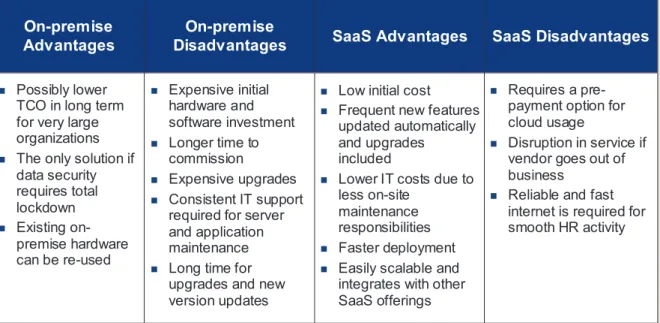
This shift is due to various organizational requirements such as integrating new HR software with third-party applications, removing aging legacy systems, achieving efficiency, standardizing across global locations, and to reduce cost. Table 1 provides an overview of the benefits of on-premise and SaaS HR software.
Cloud computing data security issues have also largely been addressed. Certain organizations (such as government organizations) have strict security rules associated with their sensitive data and spend considerable money on data security, including hiring specialists to manage their data security. For such customers, cloud computing was perceived to have data security risks. In response, cloud providers hired specialists
themselves to improve their security infrastructure. Today, many SaaS HR software suites offer better security than most small, medium, and even large organizations could achieve in-house.
Figure 2: Major HR software based on delivery model
Some large enterprises may utilize a hybrid deployment that provides an on-premise copy (or cache) of the cloud service, especially at sites where internet availability is poor or unreliable. This prevents the enterprise from losing HR functions if the internet connection goes down.
C. MAJOR HR SUITE VENDORS
Vendors such as Oracle and SAP2,3 have a large presence
in the HR software market, but there are other notable vendors suitable for large enterprises such as ADP, Kronos,
SumTotal, and Ultimate Software. Figure 3 shows the major vendors that offer complete HCM suites covering major functionalities and tasks used by HR departments in large enterprises. For more information on these companies, please see the Appendix.
Note that there are many other vendors providing HR software on the market, but most are not suitable for large enterprises.
2: http://ww2.cfo.com/applications/2013/05/hr-tech-vendors-whos-out-there/
3: http://searchfinancialapplications.techtarget.com/feature/Which-HR-tools-are-right-for-your-company Figure 3: Major HR software vendors On-premise
Advantages DisadvantagesOn-premise SaaS Advantages SaaS Disadvantages
Possibly lower
TCO in long term for very large organizations
The only solution if
data security requires total lockdown Existing on-premise hardware can be re-used Expensive initial hardware and software investment Longer time to commission Expensive upgrades Consistent IT support
required for server and application maintenance
Long time for
upgrades and new version updates
Low initial cost
Frequent new features
updated automatically and upgrades included
Lower IT costs due to
less on-site maintenance responsibilities
Faster deployment Easily scalable and
integrates with other SaaS offerings
Requires a
pre-payment option for cloud usage
Disruption in service if
vendor goes out of business
Reliable and fast
internet is required for smooth HR activity
HUMAN RESOURCE SOFTWARE COMPARISON 2015
D. TRENDS IN HR SOFTWARE MARKET
Transition from Core HR to HCM Suite
The HR software landscape has changed over the past decade based on organizational needs. HR software used to support only core HR functions, with even payroll often a separate component. This migrated to “best of breed” software that would incorporate various components of what is today known as HCM, but inconsistently across vendors. Today, the components are well-defined and packaged as HCM, and although vendors still vary in their support of all HCM features, it is easier to compare.
SaaS based HR Software
SaaS is a revolutionary trend in most software areas, and the HR software industry is no exception. Major ERP vendors and emerging players have invested significantly to meet the significant rise in demand for SaaS HR software. Several major ERP vendors chose to acquire other companies rather than build their own SaaS solutions due to customer demand.
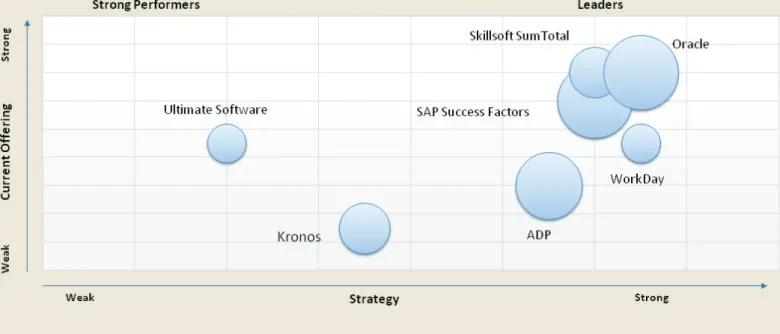
Figure 4 (following page) contrasts the size, strategy, and offerings of major SaaS HR software vendors.
Oracle and SAP are well-known vendors, and both have become strong players in the SaaS market through acquisitions. SumTotal rivals them in feature offerings due to its focus on HR software alone. Workday gained popularity by being an early adopter of SaaS for HR software4. Ultimate Software, ADP, and Kronos have
similarly made moves towards SaaS, but their offerings are not as feature rich.
Rise in Demand for Talent Management
Strong competition in many market segments is leading to increasingly long-term strategic planning from organizations, and HR is no exception. Growing demand for succession management and hiring and retaining the best talent has led to a particularly significant increase in demand for the talent management component of HCM. Figure 5 (following page) shows revenues from talent management are expected to grow at a compound annual growth rate (CAGR) of 10% from 2012 to 2016; and reach USD 5.65 billion in 20165. Consequently, many
HR software providers have focused development on this component.
4: https://www.workday.com/company/news_events/press_releases/detail. php?id=1884876#.VdTew_mqqko
Figure 4: SaaS HR software vendor landscape
Note 1. Bubble size refers to vendor size in by number of customers, strategy refers to expansion in multiple geographies and degree of focus in acquiring new customers, and customer offering based on features offered by the solution.
HUMAN RESOURCE SOFTWARE COMPARISON 2015
Chapter 2. HR Software
Feature Comparison
HCM suites cover six major HR components illustrated
earlier. Table 2 below lists the features of each component
6, which is used in the comparison between
on-premise and SaaS vendor offerings.
Core HR ManagementWorkforce ManagementTalent Recruitment ManagementLearning Compensation & Benefits
Employee
Records Time reporting Talent assessment Workforce planning Leadership development Base salary admin
Payroll Attendance Succession
planning Social Recruitment Learning course admin Bonus program
Benefits admin Workforce
scheduling Competency management Candidate engagement Content management Employee recognition
Employee
shared service Productivity analysis Career planning On-boarding Certifications Commission
Managed
shared service Labor cost optimization Employee performance Applicant evaluation Mobile learning Stock and long term incentive
Jobs and
positions Absence mgt. Corporate goal management Requisitions Social and informal learning Wellness
Organizational
structure Retirement and savings
Table 2: Major features of each HCM component
A. ON-PREMISE HR SOFTWARE
Table 3 (next page) illustrates the strength of offerings from the major on-premise HR software vendors. Not all vendors are listed as either they do not provide on-premise delivery, or do not offer sufficient information about their on-premise offering to evaluate with confidence. Refer to the Appendix for brief vendor profiles.
Key points:
y In compensation management, SAP ERP HCM has a diverse reward strategy comprising of pay for performance, long-term incentive, and variable pay programs.
y Oracle E-business Suite HCM provides a high degree of HR analytics in different HR functional categories.
y Infor Lawson is the third largest ERP software vendor behind SAP and Oracle. Infor Lawson HCM also falls behind SAP and Oracle in the talent management suite.
y ADP, Kronos, and SumTotal offer on-premise delivery, but there is insufficient data to compare them in the table above.
B. SAAS HR SOFTWARE
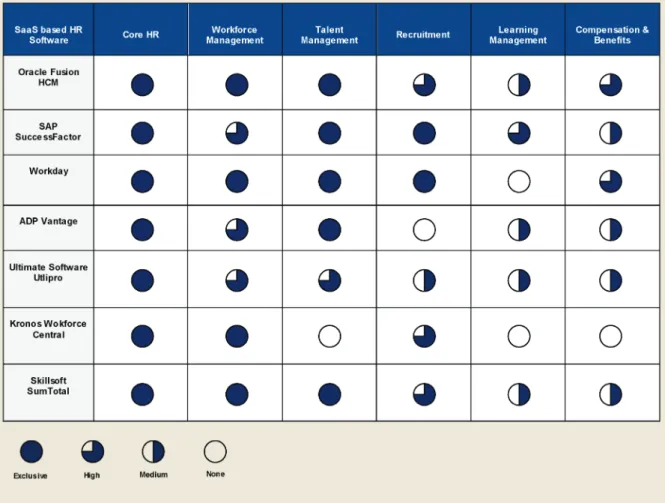
Table 4 (next page) illustrates the strength of offerings from the major SaaS HR software vendors. Not all vendors are listed as either they do not provide SaaS delivery, or do not offer sufficient information about their SaaS offering to evaluate with confidence. Refer to the Appendix for brief vendor profiles.
y Workday is active in four of the six major HR functionalities, with medium functionality offerings in compensation management. It leads the SaaS HR software segment. A major challenge with Workday is it does not provide support for learning management.
y Oracle Fusion HCM provides a complete HCM suite on SaaS-based platform. Oracle is quite strong in supporting core HR and workforce management; however, Oracle Fusion HCM does not provide support for mobile learning and mentoring.
y SAP SuccessFactor provides SaaS-based HR solutions to its clients. SAP covers a few functions in compensation and benefits, but does not provide support in wellness, retirement and benefit tasks in the same category. In 2014, to reduce time and improve cost efficiency, SAP introduced SuccessFactors presentation tool to its functionality to automate and improve the talent management process. It was the market leader in a Gartner Magic Quadrant for its talent management.
y ADP Vantage lacks recruitment management and does not support mobile learning and mentoring. Under compensation, it does not cover employee recognition, wellness and retirement benefit tasks. ADP has a strong hold in core HR, payroll and talent management. In 2014, ADP introduced health care tax credit tools to its human resource and payroll platform to simplify processes.
y Ultimate Software UltiPro suffers from weak performance management and recruitment capabilities. Also, Ultipro lacks module integration and has issues in salary planning and budgeting. However, Ultipro has a strong hold in supporting core HR functions.
y Kronos is mostly recognized for workforce management with incorporated core HR and payroll functionalities. Key strengths of Kronos lie in time and attendance management, controlling labor cost, and minimizing compliance risks.
y Skillsoft Sumtotal is stronger in performance and succession management, which are part of talent and workforce management. Sumtotal has strong visibility in talent management, but weak in compensation and benefits aspect of HR.
HUMAN RESOURCE SOFTWARE COMPARISON 2015
Table 3: On-premise based major vendor features comparison
Chapter 3. HR Software
Price Comparison
Pricing of HR software is driven by multiple factors, with limited information available around cost offered by software or functionality in the open market. Vendors prefer getting requests along with the requirement from potential customers and offer quotes based on customer’s defined needs, size of the customer, industry of the customer, location of the customer, level of customization required, support and training requirements, and various internal measures such as possible competitors.
There is large scope for negotiation, making it difficult to quote accurate price figures.
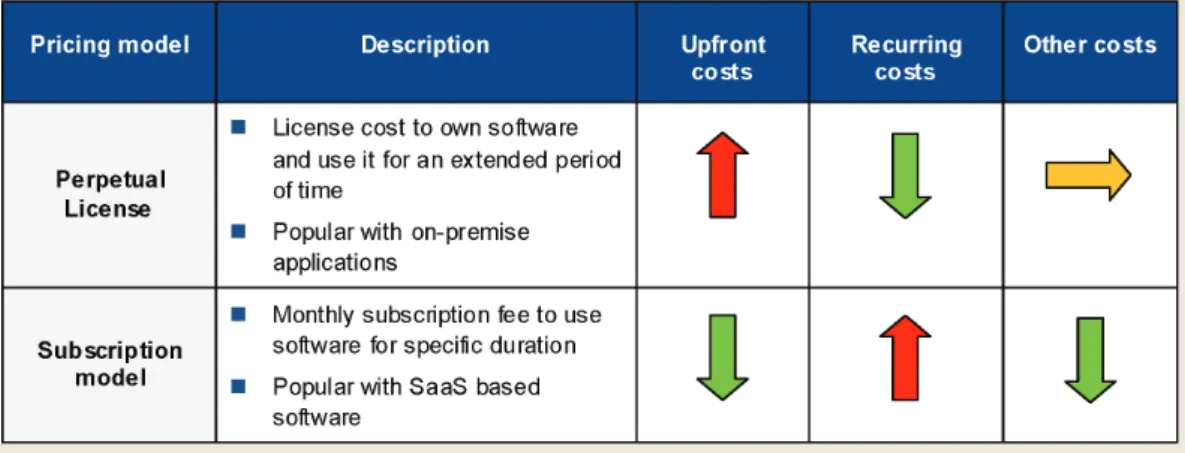
Figure 6 below indicates two common pricing models followed in the market by HR software vendors across the world: the perpetual license model and the subscription model.
HUMAN RESOURCE SOFTWARE COMPARISON 2015
In addition to licensing costs, there may be further upfront/one-off or recurring costs in a vendor offer:
Up-front costs include
y Customizations
y Installation/setup
y Integration with existing systems
y Upgrades
Recurring costs include
y Cost for premium support service
y Multi-year maintenance costs
Internally, an organization should also consider costs due to data migration or additional hardware/IT.
Prices offered by vendors vary depending on the size of the organization.
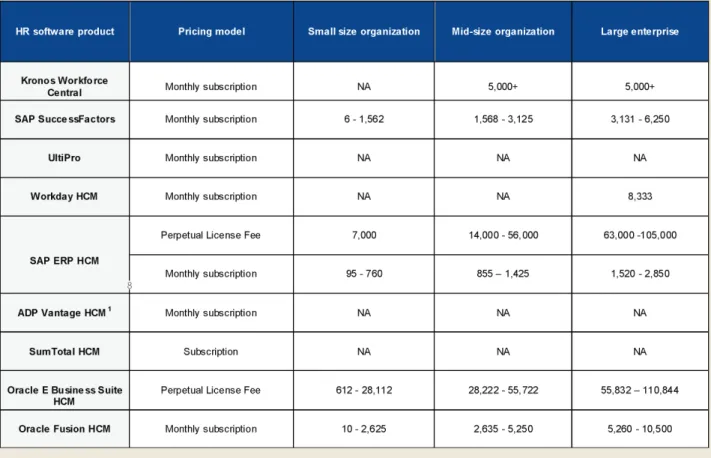
Figure 71 below shows the price range for perpetual
licenses offered by vendors based on company size. Figure 82 below illustrates the price range for monthly
subscriptions offered by vendors based on company size. Table 5 (next page) highlights how organizations compare on prices for HR software for core HR functionality:
1This section covers prices of HR software supporting core HR functionality only 2This section covers prices of HR software supporting core HR functionality only..
Figure 7: Perpetual license price ranges (in USD)
Table 5: Software prices for core HR (in USD ) 7
8
7: Software Advice, pricing guide core HR software
HUMAN RESOURCE SOFTWARE COMPARISON 2015
Chapter 4. Support by HR
Software Vendors
A. GLOBAL SUPPORT
Large organizations with global offices or those looking to expand into new regions often pay extra attention to the global support offered by their vendors. HR software is no exception and several vendors offer global support at varying levels.
Below are the important parameters on which HR software vendors are evaluated for the level of support they offer:
y How many regions do they serve directly or through channel partners
y How robust is their customer support
» Is there 24/7 availability
» Are there a variety of mediums such as phone, email, and chat,
» Are there dedicated account or service managers
» Are the above available in all regions
y How robust is their technical support
» In addition to the customer support points above, what kind of availability is there for product experts, system specialists, etc.
y Software and system maintenance: how and when does the vendor offer updates for critical flaws, and how long do they support a certain version of their software
y What training and certification is available, and through what mediums: online training, on-demand training, instructor-led training, self-study courses, etc.
y What does the vendor’s online portal offer in terms of functional and technical documentation, knowledge base, user community, software downloads, and issue tracking
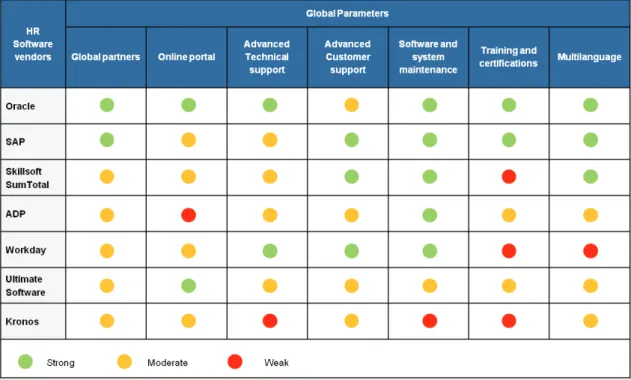
Table 6 below provides a comparison of major HR software vendors on all-important parameters indicated above.
Oracle has the most versatile global support, followed by SAP. The other vendors have strengths in several areas, but also weaknesses in certain areas. Ultimate Software is not weak in any particular area, but neither does it have a number of strengths.
Oracle scores high on providing advanced technical support, which includes 2-hour response time on priority issues.
B. SUPPORT IN MIDDLE EAST
Oracle and SAP are the leading players in the Middle East with strong support for localization, such as conformance with local business and tax laws. They are followed by ADP and Kronos, which provide support through channel partners.
Table 7 below provides comparison among HR software vendors in terms of providing support in Middle East.
Table 6: Comparison of global support from major HR software vendors
HUMAN RESOURCE SOFTWARE COMPARISON 2015
Chapter 5. HR Software
Integration
Software integration of an HR system with existing systems is often a requirement for large enterprises that may be running multiple different systems across global regions (e.g., different payroll systems in different geographic areas). The vendors mentioned in this report all provide support for integration with existing major ERP systems, databases, authentication systems, and a myriad of third-party applications.
However, not all vendors support a large number of legacy applications, and enterprises should check carefully with a vendor’s ability to integrate their HR software with any existing legacy applications, or any custom applications, that the enterprise uses. The largest vendors such as Oracle and SAP are able to provide custom integration, but this is often comes at a premium cost.
Large enterprises have successfully migrated to new HR systems in recently, including complete migrations to SaaS HR software from previous on-premise installations. Yahoo moved from its legacy system to a cloud based SaaS HR software provided by Workday HCM9 with great success. Amway was facing a challenge
in managing their HR software at various locations and was looking for a solution to integrate their employee information with talent management. It then adopted SAP SuccessFactors solution after major consideration around integration with their existing HR software and third party applications10. Alcoa deployed Oracle Fusion
HCM with existing Oracle E business suite application to support its growth and innovation11.
9: http://www.workday.com/customers/yahoo.php
10: http://www.successfactors.com/en_us/customers/amway.html 11: http://www.slideshare.net/oracle/hcm-cloudcustomersuccess2067414
Chapter 6. Best Practices in
HR Software Selection
A. HR SOFTWARE SELECTION PROCESS
HR software selection involves multiple steps expected to enable better decision making and assist in creating an environment for successful HR software implementation.
Figure 9 below is a detailed overview of the chronological process to undertake in selecting and deploying HR software 12,13,14 .
12: http://www.erpsearch.com/hrms-selection.php 13: ACCPAC report, How to choose a HR system
14: Software advice report, Ten steps to selecting a right human resource software
HUMAN RESOURCE SOFTWARE COMPARISON 2015
Each abovementioned step needs to have a predefined timeline attached to it to make the implementation smooth with clear time accountability.
Figure 10 below details each of above activities with helpful information regarding the major considerations at each stage:
1. Creating a project plan
y Assemble a selection team, clearly define the roles and responsibilities of team members to avoid conflict
y Assign a leader to manage, review progress, handle formal communication, and resolve issues. The leader should have appropriate corporate authority.
y Set up a process to clearly identify and evaluate shortcomings of current system, and solutions for improvement
y Identify key stakeholders and departments and ensure adequate communication with them
2. Requirement analysis and prioritization
y Identify the improvements desired by stakeholders such as functionality, reports, security, performance
y Compile improvements into a set of requirements
y Identify related business processes, applications, data, and systems or software relevant to each requirement
y Prioritize requirements by categorizing and weighting them
y Establish list of must-have requirements
y Review the requirement list with stakeholders
3. Executive commitment
y Develop requirements into a proposal.
y Clearly mention the challenges and shortcomings of existing system
y Mention the benefits associated with new HR software such as payroll tracking, benefits administration, talent management
y Agree initial budget
y Obtain approval from stakeholders and senior management or relevant decision makers to begin selection process
4. Software delivery model
y Identify whether you need HR software in-house or hosted in cloud
y Evaluate internal IT capability to support chosen delivery model
y Evaluate vendor capabily to support chosen delivery model
y Identify any issues related to the software delivery model such as possible data migration, additional IT capital expenditure, additional IT staff, new policies, business process customization needs, etc., that may influence delivery model selection, and need to be discussed with vendors.
5. Identify vendor shortlist
y Use must-have requirements to short list vendors
y Consider customer support, technical support and upgrade option provided by vendors for further short listing
y Conduct phone interview with vendors to determine features they provide
y Identify legal implications and government regulations associated with HR software and vendor
y Evaluate strength and weakness of each HR software and pick best three
6. Evaluate software demonstration
y Share your prioritized requirement list with HR software vendor and invite for product demonstration
y Keep demonstration focused on your organization requirement
y Invite stakeholders to evaluate product demo
y Ask questions during the demonstration to get clarity about product features
y Provide scorecard or comments sheets to team to get their feedback
7. Score and rank HR software
y Consolidate all scorecard to identify score for each HR software vendor according to your requirements
y Rank HR software and vendor based on score
y Optionally create a rating matrix to evaluate score based on multiple criteria such as functionality, support, localization, customization, user interface, etc.
y Use rating scale to quantitavely evaluate the qualitative features
y If convinced with a HR software, invite HR software vendor for deep-dive product demo, including full stress-test with a percentage of company employees if possible
HUMAN RESOURCE SOFTWARE COMPARISON 2015
8. Compare price
y From remaining vendors, request a detail price quotation inclusive of all cost
y This helps when two or more vendors compete for your contract and can provide you competitive pricing
y Check details of quotation, and ensure it includes associated with license, degree of customization, support services, learning, training, and other charges.
y Compare the all price quotations of each HR software
9. Verify software vendor reference
y Once the HR software and vendor has been decided, do some back checking to check company claims about its product feature
y Ask HR software vendor to share reference of clients with similar business requirement
y Ask question to references to get their feedback about company product, support service, software features to improve
y Dig deep in references to check HR software capability and vendor credibility
y Access HR software vendor financial viability and long term aspects
10. Review Service Level Agreement (SLA)
y Review the SLA to negotiate the deal with HR software vendor
y Check discounts as per industry standards and business needs
y Cross verify to check software license for full user or partial user
y Read terms and conditions carefully and looks for auto renewal clauses
y As a backup, keep out clause in agreement, in case vendor fail to comply to agreement condition
11. Implementation
y Assign responsibility to HR software selection team created initially to be involved in implementation
y Hold pre implementation meeting to check original timeline and break it to get more detail
y Request HR software deployment plan from vendor and inquire about implementation partner of HR vendor
12. Training and support
y Request training schedule from HR software vendor
y Evaluate training schedule
y Evaluate training based on feedback from trainees and use to modify training as needed.
y Share details of support contacts of HR software vendor with appropriate coworkers
B. QUESTIONS TO ASK DURING HR SOFTWARE SELECTION
Critical evaluation of an HR software vendor’s offering is an important activity throughout the whole selection process to ensure successful implementation. Figure 12 presents a list of standard questions that a vendor should be asked are listed below to help in this regard15,16. After
shortlisting vendors, it is imperative to get references of other regional customers and get their opinion and recommendation of the vendor.
A second set of standard questions for referees is presented below to provide a fruitful discussion. Beyond these standard questions a customer should also engage in industry-specific and region-specific questions to ensure no issue there are no surprises later.
Questions to be asked to HR software
vendor
y What employee information tracking is suported by your HR software?
y What existing technologies and business process software does it integrate with?
y What existing payroll systems does your HR software support?
y What third-party applications can be integrated with your HR software?
y What different kinds of reports can it generate, and what kind of customizations are possible?
y What is the typical implementation timeline?
y What is the company’s history and policy on software upgrades and enhancements?
y What are the training options pre- and post- installation phase?
y What compliance issues and government
regulations does the company stay updated on?
Questions to be asked to HR software
reference
y Why did you decide to select this vendor?
y What other HR software did you consider and evaluate?
y What additional or unexpected costs did you incur after purchasing the HR software?
y What was the total implementation time and what complications were encountered?
y How was the quality of training, support, and actual software?
y What problems did you face post-implementation and how were they solved?
y Would you renew or buy the same HR software again and why?
y Would you recommend your current HR software to someone else and why?
15: http://blog.capterra.com/10-questions-to-ask-an-hr-software-reference/ 16: ACCPAC report, How to choose a HR system
HUMAN RESOURCE SOFTWARE COMPARISON 2015
Major pain points in the HR software selection and procurement process can be avoided if certain mistakes are not committed. Below is the compilation of what one should consider and avoid:
y Detailed selection process: Traditionally, complex selection processes involve organizations issuing a request for proposals (RFP) from vendors. HR software selection is no different because it plays such a major and critical role in the business. However, for software, it is important to understand and define business requirements as well as possible to ensure that software options can be evaluated accurately.
y Lack of executive support: Senior management and other key personnel must be involved, committed, and kept up-to-date during the complete process to avoid wasting resources and hampering existing business processes.
y Failure to consider the total cost of ownership: Organizations should not only consider the cost of
purchase but also consider ancillary costs, such as training, upgrades, and support costs in long run.
y Buying HR software similar to competitor: Every organization has unique challenges; therefore, motivating the purchase of HR software simply because it is similar to a competitor may not be a good decision.
y Consider HR and ancillary departments: It is a poor decision to consider the HR department to be the only stakeholder affected by HR software choice. The integrated nature of modern HR software means that finance, operations, and IT should all have an important say in the final decision.
C. HR SOFTWARE CHECKLIST
A standard checklist to help quickly shortlist software vendors is useful to move the selection process forward as fast as possible. Table 8 provides a checklist to help identify candidate HR software.
Chapter 7. Comparison
Summary
On comparing leading HR software solutions available in Middle East for large enterprises, Oracle and SAP offerings stand out due to strong support provided in the Middle East region. SumTotal can match in terms of
features, but their lack of support is a significant risk. ADP and Kronos may be suitable if the enterprise does not need a large set of features or gold-level support. Table 9 gives a summary.
HUMAN RESOURCE SOFTWARE COMPARISON 2015
Chapter 8. Conclusion
The HR software market has evolved over the past decade with enterprise level customers looking for more features and better return on investment. This has led to HR software maturing into a Human Capital Management (HCM) and supporting a large set of ancillary HR functions, increasing global support, and reducing TCO through the SaaS delivery model.
Major market players such as Oracle and SAP continue to be frontrunners in understanding changing customer needs and offering premium support, and a cloud hosted solution. They are offering their feature-rich HCM suites to large enterprises such as Capgemini, Symantec and Yahoo. They have the best support in the Middle East region. ADP and Kronos can offer a solution with fewer features and support, and should be considered if they meet an organization’s requirements while offering a more competitive price.
Appendix
Below are brief profiles of major HR software vendors that are active in the market.
1. SAP
SAP, founded in 1972, has product, consulting, and training as their main core business areas. SAP SuccessFactors is their subsidiary, which they acquired in 2011 to enter the cloud-based HR software market. They also acquired Ariba, an IT service company in 2012. SuccessFactors provides HCM-based SaaS solution and has presence in multiple geographical locations, such as North America, APAC, and Europe, and it is rapidly expanding into Middle Eastern and African region. Key clients of SAP SuccessFactors include AMD, Bechtel, Nissan, Cisco, Walmart, and eBay.
2. Oracle
Oracle, founded in 1977, specializes in products and solutions in computer hardware systems, enterprise software products, particularly, in database management systems. Oracle has been one of the major ERP solutions providers worldwide and has a massive partner network. Major Oracle acquisitions in the HR software industry include PeopleSoft and Taleo. Oracle has presence in North America, EMEA, and APAC region. Major Oracle customers in the HR software industry include Toshiba Medical systems, Dell, First Data, Nationwide, Elizabeth Arden, and Deutsche Bank.
3. SkillSoft SumTotal
SumTotal Systems Inc., founded in 1985, was acquired by Skillsoft in 2014. They provide HCM solution in consulting, training, and talent management software. They are renowned globally for their talent management. They are active in North America, APAC, and Europe region. SumTotal acquired Softscape for their talent management
offerings and Geo Learning for their learning portfolio. Major customers for the company include Capgemini, KPMG, Air Canada, US Airways, and Pfizer.
4. Workday
Workday came into being in 2005. They provide financial and HCM solutions based on the SaaS delivery model. Workday is present in North America, Europe, and is expanding into the APAC and Middle East regions. Workday is forming strategic partnerships with channel partners, HP being one of them. Their major customers include Aviva, Yahoo, and TripAdvisor.
5. Ultimate Software
Ultimate Software was founded in 1990. They provide HR software solutions to customers worldwide, but their primary presence is in North America and Europe. In 2013, Ultimate Software acquired EmployTouch Inc., a tablet-based solution for time and labor data collection. Their major customers include Culligan International, Subway, and Adobe.
6. ADP
ADP was founded in 1949. ADP provides business process outsourcing solution and has presence in North America, EMEA, and APAC region. ADP acquired Payroll S.A. to strengthen their HR software portfolio. Their customers include Tetra Pak, Qualcomm, and Credit Suisse.
7. Kronos
Kronos was founded in 1977 and is recognized worldwide as a workforce management software solution provider. Kronos has presence in North America, Europe, APAC, and Middle East. Kronos acquired Stromberg, a time and attendance software vendor, in 2009. Their major customers include Home Depot, GE Aviation, Con-way, Best Buy Canada, and Ikea UK.