n:\orgipig\shared\document\scit\4\prep\final_a2.doc
INFORMATION TECHNOLOGY
STRATEGIC IMPLEMENTATION PLAN
MESSAGE FROM THE DIRECTOR GENERAL
1
EXECUTIVE SUMMARY
2
STRATEGIC INFORMATION TECHNOLOGY PLAN
OVERVIEW
6
Introduction... 6
SCIT’s Vision... 6
SCIT’s Objectives ... 7
Information Technology Strategies... 7
General Strategy... 7
Information Technology Project Management Strategies... 8
Information Infrastructure Strategies ... 8
Information Infrastructure Security Strategies... 8
Information Technology Application Software Strategies... 9
Data Management Strategies... 9
Migration Strategies ... 9
Information Dissemination Strategies ... 9
Organizational Responsibilities ... 10
Standing Committee on Information Technologies ... 10
International Bureau of WIPO ... 10
WIPO Member States and Regional Intellectual Property Organizations ... 11
Other Relevant Organizations ... 11
Assumptions and Constraints... 11
Dimensioning/Integration Requirements and Performance Expectations ... 11
Financial ... 12
Human Resources... 12
Economic and Geographical Considerations ... 12
Language Considerations ... 12
International Cooperation... 12
Technology Environment... 13
Developing Countries: Special Issues... 13
Modernization of Infrastructure ... 13
Creation of Knowledge Databases Including Traditional Knowledge... 13
STRATEGIC INFORMATION TECHNOLOGY INITIATIVES 14
Introduction... 14
Summary of Initiatives ... 18
Business Initiatives... 18
Administrative Project Initiatives ... 19
Global Services Initiatives ... 19
Information Technology Infrastructure Project Initiatives ... 20
Correlation of SCIT Objectives with Project Initiatives ... 21
MEMBER STATE IPO CORE BUSINESS PROJECT
INITIATIVES
22
Project 1 – Automated IPOs... 22Introduction ... 22
General Strategy... 23
Benefits ... 24
Project 2 –Changeover Assistance ... 26
Introduction ... 26
General Strategy... 27
Benefits ... 29
Supplementary Data ... 29
WIPO CORE BUSINESS AND ADMINISTRATION PROJECT
INITIATIVES
32
Project 3 - PCT IMPACT ... 32 Introduction ... 32 General Strategy... 33 Benefits ... 39 Supplementary Data ... 40Project 4 - FINAUT 2000 ERP ... 44
Introduction ... 44
General Strategy - FINAUT 2000 ERP ... 57
Benefits ... 61
Supplementary Data ... 62
Project 5 – Other Administrative Support Services... 63
Introduction ... 63
General Strategy... 64
Benefits ... 73
Project 7 - Copyright Support System ... 74
GLOBAL SERVICES INITIATIVES
75
Project 8 - WIPONET... 75Introduction ... 75
General Strategy... 76
Benefits ... 77
Supplementary Data ... 78
Project 9 – Intellectual Property Digital Libraries ... 90
Introduction ... 90
General Strategy... 91
Benefits ... 92
Supplementary Data ... 94
Project 10 –Web Site Development Support ... 103
Introduction ... 103 General Strategy... 104 Benefits ... 104 Project 11 – Y2K... 106 Introduction ... 106 General Strategy... 107 Benefits ... 108 Supplementary Data ... 110
Project 12 - CLAIMS (Classification Automated Information System) ... 115
Introduction ... 115
General Strategy... 117
Benefits ... 119
Project 13 - WIPO Academy Distance Learning Program ... 120
Introduction ... 120
General Strategy... 120
Benefits ... 120
Supplementary Data ... 122
INFORMATION TECHNOLOGY INFRASTRUCTURE PROJECT INITIATIVES ... 125
Project 14 - IT Infrastructure Improvements ... 125
Introduction ... 125
General Strategy... 125
Benefits ... 129
GOVERNING STRATEGIES FOR MANAGING INFORMATION
TECHNOLOGY
130
Introduction ... 130IT Project Management... 131
Risk Assessment and Management ... 134
Resource Management ... 135
Coordination of System Interfaces and Implementation... 136
Procurement and Contractor Management... 136
System Conversion and Migration... 136
Costs, Benefits, and Return on Investment ... 137
Data Management ... 137
Security Management... 138
IT Infrastructure Development and Management ... 141
User Assistance ... 142
IT Staffing ... 143
IT Management Framework Development ... 144
Install an IT Project Management System ... 145
Establish a Data Management Program. ... 146
Establish a Configuration Management Program ... 148
Configuration Management Program Implementation ... 149
Develop an Acquisition Management Program. ... 150
Develop a Comprehensive Security Program ... 151
Establish a Technical Reference Model of open system and de facto industry standards and products. ... 153
Organization of IT Resources ... 154
SECRETARIAT OF THE SCIT
155
APPENDIX A - CURRENT IT ENVIRONMENT
1
Introduction ... 1IT Framework... 1
Major Business and Administrative Support Systems ... 4
PCT Support Systems ... 6
International Registrations Support Systems ... 9
Finance and Human Relations Support Systems ... 10
Medium-Size Business Applications ... 12
WIPO Web Sites ... 13
Office Automation Systems ... 13
Other IT Systems... 14
APPENDIX B – INFORMATION TECHNOLOGY NEEDS
1
Introduction ... 1Existing IB Support System and Process Deficiencies ... 2
IT Infrastructure Considerations ... 3
Additional and New Support Capability Needs ... 3
Global network needs... 4
IT Policy and Management Needs ... 4
IT Resource Management Needs ... 5
MESSAGE FROM THE DIRECTOR GENERAL
In order for WIPO to respond fully and successfully to the challenges ahead, it will need to shepherd a transformation of working methods and procedures within the International Bureau (IB) and use decision-making processes that are results-oriented. This implies a fundamental change in the time-honored way of doing things. This information technology strategicimplementation plan is one of the management techniques I will use to ensure that our transition to the next generation of business processes is transparent, predictable and measurable.
Internal procedures will need to be both simplified and kept in line with advances in information technology. Time and resources will need to be devoted to the identification of appropriate
computer-based tools, their integration into administrative procedures, and the appropriate training of staff.
The management structure within the International Bureau will need to be rendered more horizontal in order to capitalize on the talents and creativity of all staff. Some of the tools that have already been implemented include strategic planning and results-oriented budgeting, a new system of internal evaluation and oversight of quantifiable activities and their results, and the modernization of administrative procedures.
The enhancement of capability of the International Bureau of WIPO, through the introduction of simplified procedures and a modern management structure, will allow better communications with Member States. This will be done through various meetings, including the Standing Committee on Information Technology (SCIT). The International Bureau will also utilize information technologies effectively to drive a number of important business projects, which will need the continued full support and participation of Member States and WIPO’s other constituencies. One example of WIPO’s Information Technology Strategic Implementation Plan is WIPONET.
This state of the art project will be a vehicle for strengthening the relationship among WIPO’s constituencies through the creation of a global information network that unites operationally the world’s intellectual property offices. It will promote international cooperation by providing fast, low-cost communications. It will facilitate access to intellectual property data, and could be used to foster the protection and improve collective management systems of copyright, and enforce intellectual property rights in the digital environment. Moreover, it will establish the architectural foundation to promote further streamlining and automation of the basic business functions of intellectual property offices worldwide.
The challenges we face are complex and will take many years to complete, but WIPO is
committed to the success of its strategically important information systems. We intend to assess our progress continuously to ensure that our information technology resources remain balanced with and support fully the achievement of our most important priorities. We also recognize that the cooperation of all Member States is critical to the transparent implementation of our new strategies. Your ideas for improving the management of WIPO’s information technology resources are most welcome. I look forward to your continuous support as we proceed with the implementation of these critically important information technology projects over the next five years.
Kamil Idris Director General WIPO
EXECUTIVE SUMMARY
As the new millennium begins, WIPO and its Member States must be prepared to communicate and transact business functions in a rapidly evolving environment that will be driven in
considerable measure by information technology. The advent of electronic commerce, combined with a never-ending need to streamline and automate work processes for maximum gains in efficiency and effectiveness, present two fundamental information technology
challenges: the mitigation of risk and the opportunity for improvement. WIPO’s responses to these challenges are embodied in this Information Technology Strategic Implementation Plan. This plan builds upon the foundation of information technology that has enabled WIPO to meet the challenges of the past two decades, and it establishes new strategic directions for
transforming WIPO’s core business processes. The major information technology strategies that will be employed include:
• integrated project planning methods that leverage capital investments,
• coordinated system development approaches based on life cycle management concepts,
• reliance upon open systems and industry standards-based hardware, software and data repositories,
• security policies and procedures that protect information, and
• information dissemination policies that promote the exchange of data and encourage worldwide access to intellectual property information at the lowest possible cost.
The long-term success of the information technology program will be influenced significantly by teamwork among many key players: WIPO’s leaders, the Standing Committee on
Information Technologies, WIPO’s program managers and information technology project managers, the technical staff of the Information Technology Division, and the vendor community that will provide the products and services that will create the next-generation information technology architecture. The roles of these individuals and bodies, and the close interaction they must have, are set forth in this plan. Additionally, we describe some of the organizational changes that have been made to enhance the delivery of services to the internal and external clients of WIPO’s IT Division.
WIPO has established a five-year planning horizon for the period 1999 – 2003. As indicated in the following timetable, the planned implementation schedule is an aggressive one:
n:\orgipig\shared\document\scit\4\prep\final_a2.doc
Project 1999 2000 2001 2002 2003
Project 1 (Automated IPOs) Begin collection of requirements and complete business case analysis.
IB will propose to SCIT, list of items to be required under the Minimum Modernization Standards
IB – Review & adjust automation plan under Nationally Focused Action Plan.
Project 2 (Changeover Assistance)
GlobalPat CD Rom distribution.
Develop strategy and draft list of participants for the IP optical disk collections.
Begin provision of CD-ROM data collections and complete assessment.
Project 3 (PCT Impact) Complete assessment. Select systems developer and begin reengineering of PCT processes.
Complete Basic system. Stage
1:-Communication on request. Stage 2 – Electronic Image Dossier. Stage 3 – Replacement of CASPIA. Stage 4 Replacement of CASPRO. Begin PCT RO Project. Begin PCT Electronic Document Exchange Project.
Deploy Pilot Systems.
Project 4 (Finaut 2000 ERP) Assessment (Business Case).
Select ERP solution and complete prototype design of core system.
Design and prototyping of replacement system.
Build & Test. Production System
Support.
Project 5 (Other Administrative Support Systems)
Task Force established in May ’99.
Begin Preparation of Business Case.
Establish simplified & streamlined approval processes, internal communications & routine procedures.
Establish modern records management system. Establish computerized operations system. Establish pilot systems for artificial intelligence in Languages Department. Project 6 (MAPS/DMAPS
2002)
Prepare Business Case. Analysis of Platform Options.
Decide whether to migrate MAPS/DMAPS to the WIPO Standard Architecture. Project 7 (Copyright Support
System)
Conduct Business Case analysis and feasibility study.
Project 8 (WIPONET) Complete WIPONET
Technical Development Strategy.
Select vendor. Establish management framework and begin implementing Internet connectivity.
Continue the installation of IPO equipment and software security infrastrucuture and end user training.
Project 1999 2000 2001 2002 2003 Project 9 (IPDL –
Intellectual Property Digital Libraries)
Agree on clear strategic program/organizational structure at SCIT plenary meeting.
Develop office-specific assistance plans and begin performance measurements.
SCIT assesses program progress/next steps.
Project 10 (Web Site Development Support)
Establish Team – to assume a continuous responsibility for Management and Administration of the WEB Program.
Create overall design.
Project 11 (Y2K) Complete tests of
mission-critical mainframe, network and small systems.
Conduct independent verification and validation/(IV & V).
Monitor actual performance, activate contingency plans, as required, for the PCT, Madrid and Hague operational systems.
Project 12 (CLAIMS (Classification Automated Information System)
Establish project team to develop a business case analysis and project plans.
Identify work plan, criteria, management plan, strategy, software frameworks, requirements, specifications, and acquire IT components and services.
Develop classification databases and user operational processes. Conduct pilot projects to test. Develop system maintenance operations. Complete acceptance testing, transitional activities and Initiate operational phase.
Project 13 (WIPO Academy Distance Learning Program)
Establish project team. Develop Business Plan.
Project 14 (IT Infrastructure Improvement)
Information to be inserted.
n:\orgipig\shared\document\scit\4\prep\final_a2.doc
Finally, this strategic plan is consistent with the approved budget for the current biennium and the budget that will be presented to the General Assembly for the next biennium. The
following graph depicts the projected allocation of funds according to major investment categories:
Aggregated Information Technology Investment Level
for 1998 - 2001
(Total Investment of 159 million chf/SFr)
PCT Automation (IMPACT) 25% (40 m chf/SFr) All other IT Projects
21% (34 m chf/SFr) Year 2000 3% (4 m chf/SFr) IT Division Support 25% (40 m chf/SFr) Enterprise Resource Planning (FINAUT 2000) 6% (9 m chf/SFr) Internet Communications (WIPOnet) and related
projects 20% (32 m chf/SFr)
n:\orgipig\shared\document\scit\4\prep\final_a2.doc
STRATEGIC INFORMATION TECHNOLOGY
PLAN OVERVIEW
The Standing Committee on Information Technologies (SCIT) was formed in March, 1998 to establish a forum for discussing issues and to provide guidance for and facilitate coordination in the implementation of the WIPO global information network and the provision of
intellectual property information services on the network. At its third plenary session in Geneva on June 14 and 15, 1999 SCIT adopted the strategic information technology plan, incorporated below, and agreed to request the International Bureau (IB) to elaborate a comprehensive and detailed implementation plan covering all major projects resulting from the plan. The remainder of this document, the WIPO Information Technology Strategic Implementation Plan, is the IB’s response to that request.
INTRODUCTION
As WIPO approaches the new millennium, the Organization will enter a new era of
intellectual property characterized by rapid expansion of demand for new forms of intellectual property protection, greater global coverage and unprecedented growth in the exploitation and use of intellectual property rights.
Intellectual property will no longer be perceived as a distinct or self-contained domain, but rather as an important and effective policy instrument that would be relevant to a wide range of socio-economic, technological and political concerns.
In particular, WIPO and its Member States will face the challenge of adapting to and benefiting from rapid and wide-ranging technological change, particularly in the field of information technology. The latter is the mission of the Standing Committee on Information Technologies (SCIT).
Towards the fulfillment of this mission, the SCIT was established for coordinating and ensuring the delivery of an information technology infrastructure and the policies to facilitate information services for the intellectual property community. SCIT’s coordinating role covers activities of intellectual property offices relevant to office automation and to contacts with their applicants or other clients. The ensuring role is to be understood in the context of exchange of intellectual property information among intellectual property offices.
SCIT’S VISION
SCIT’s vision is to achieve a global information technology architecture linking intellectual property offices in WIPO Member States, regional intellectual property offices and the International Bureau for the purpose of generating, communicating and distributing information about intellectual property rights and serving intellectual property rights protection for the global economy of the twenty-first century, while aiming at global worksharing.
SCIT’S OBJECTIVES
In implementing this vision the SCIT has set out the following main objectives: a) Narrow the information access gap that exists between developed countries and
developing countries;
b) Improve the flow of information concerning intellectual property rights among WIPO Member States, regional intellectual property offices and the International Bureau; c) Improve access to and exchange of intellectual property information in terms of costs
and access time in accordance with the agreed upon principles;1 d) Improve intellectual property information dissemination;
e) Consider the information needs and filing requirements of applicants and develop electronic services keeping in mind the need to provide benefits to applicants and intellectual property offices, and to other interested circles;
f) Help guide the International Bureau to leverage information technologies;
g) Improve the retrieval of intellectual property information through further development of international classifications of patents, trademarks and industrial designs as efficient search tools.
INFORMATION TECHNOLOGY STRATEGIES
To enhance the effectiveness of information technology management, the SCIT will follow several governing strategies based on certain fundamental principles and philosophies for achieving specific goals.
General Strategy
The strategic plan will address several inter-related projects—each can be managed
separately, but will be closely coordinated to ensure that inter-dependencies are identified and common information technology and data standards are deployed. Existing technical
standards will be adopted wherever practical. The information technology infrastructure is to be managed separately from the application software and the data, recognizing that each component—application software, data, infrastructure—has a distinct life cycle. The International Bureau, with advice from the SCIT, will integrate the management of these components in the planning process.
1 See “Statement of Principles Concerning the Changeover to Electronic Data Carriers for the Exchange of Patent Documents” as published in Part 8.4 of the WIPO Handbook on Industrial Property
Information Technology Project Management Strategies
Information technology projects will follow an established project management methodology governing the life cycle of the projects.
Information technology projects will be managed as investments. Projects will focus on identifying and producing measurable benefits to the intellectual property community, and will apply risk management principles to mitigate risks.
Evolutionary development and incremental delivery of complete products with measurable results to operations will be emphasized.
Plan costs, schedule performance and quality assurance of each project will be baselined in a management control system to ensure adequate visibility for actual progress, accurate tracking of project costs against target dates and costs, and implementation of high quality systems.
Information Infrastructure Strategies
A robust architecture-information technology infrastructure will be implemented. The International Bureau, with advice from the SCIT, will implement an information technology infrastructure based on open system and de facto industry standards wherever practical.
A secure network will be implemented to interconnect intellectual property offices. At the beginning, a virtual private network and Internet technology will be used.
Information Infrastructure Security Strategies
Appropriate guidelines and policies will be enforced to enable secure maintenance and exchange of information, which will keep in view the significant difference in the present level of utilization of information technology among WIPO Member States.
Security policy will address in particular the issues relating to access, authenticity, confidentiality, integrity, non-repudiation, control, reliability and disaster recovery
requirements so that advantages of initiatives such as electronic filing, become available to all WIPO Member States.
Information Technology Application Software Strategies
Production-based open standards will be required to support emerging and evolving information technology.
Software re-use and use of Commercial-Off-The-Shelf software (COTS) will be emphasized on all SCIT projects.
Prototyping will be encouraged to help define and refine functional requirements.
Implementation of products should move rapidly from the prototype to the operational stage whenever feasible.
Data Management Strategies
The SCIT will foster and facilitate increased data sharing by pursuing electronic data interchange agreements among WIPO Member States and other international organizations and bodies.
The SCIT will promote the use of standard data models and all elements from a data repository system that facilitates data sharing and data re-use among WIPO Member States and other interested circles.
Migration Strategies
The SCIT recognizes the fact that implementation of global information projects is likely to have significant impact on the intellectual property offices many of which are paper based and do not have adequate search facilities and tools. Significant changes in the existing work practices of intellectual property offices will be essential, if the full potential of such projects is to be exploited. Therefore, SCIT will facilitate the process of evolving guidelines and training for migration from the existing systems to automated systems, so that migration as far as possible is smooth and painless.
INFORMATION DISSEMINATION STRATEGIES
With a view to achieving the widest possible reach of dissemination of intellectual property information, the SCIT will pursue the use of the latest proven technologies. In this context, information dissemination strategies will be guided and reviewed in the light of the
application of the most modern information technology developments while ensuring that the needs of the whole intellectual property community (from the general public to intellectual property offices) continue to be served.
Each intellectual property office will have the responsibility, within the above-defined context, for establishing its own public dissemination policy.
An adjustment of WIPO recommendations and national legal regulations concerning the exchange and usage of industrial property data will need to be considered. Basic rules will need to be elaborated on and regularly reviewed for the international exchange of data in electronic form taking into consideration the “Statement of Principles...”2
With a view to the use of data collections exchanged among intellectual property offices, appropriate conditions will need to be agreed upon within the SCIT.
ORGANIZATIONAL RESPONSIBILITIES
In order to take maximum advantage of information technology projects, all entities within the context of the SCIT will need to refocus some of their program activities.
Standing Committee on Information Technologies
The Standing Committee on Information Technologies should prioritize initiatives to be accomplished and invite the International Bureau to establish project plans. The SCIT should review the progress of projects to help ensure that projects deliver quality products on
schedule and within cost estimates. The SCIT has the responsibility of identifying areas of new information technology projects for which extra funding is required.
International Bureau of WIPO
The successful development, deployment and operation of information technologies requires close coordination and partnership between the International Bureau and the WIPO Member States.
The International Bureau will promote the introduction or development of automated processes into such global protection systems as the Patent Cooperation Treaty (PCT), the Madrid Agreement and the protocol relating to that Agreement. For such promotion, coordination will be of prime importance in respect of the core project initiatives, namely PCT automation, WIPONET, IPDL, IPC Reform, Electronic Filing, etc. Such projects will
serve to enhance and facilitate modernization and automation of similar systems in developing countries.
The International Bureau will be responsible for drawing up project proposals and plans for recommended SCIT initiatives. In doing so, it will ensure that account is taken when researching such projects of the special needs of developing countries in particular the
availability of the necessary information technology infrastructure, training of staff to use and
maintain the systems, provision of necessary training or reference manuals, and allowance for operational use (ongoing maintenance, consumables, etc.).
In the fulfillment of these plans, the International Bureau will ensure the availability of the committed WIPO resources to implement and maintain the SCIT project initiatives within the approved allocation of the budget.
The International Bureau will also be responsible for ensuring coordination between the activities of the SCIT and other WIPO forums (e.g., the IPC Committee of Experts).
WIPO Member States and Regional Intellectual Property
Organizations
Intellectual property offices of Member States and regional intellectual property offices should commit resources to implement previously approved SCIT initiatives. Member States should seek to reduce the current duplication of effort by intellectual property offices through sharing of localized collections of global intellectual property information.
Regional intellectual property offices may act as coordinators for their members to support the objectives set out in this strategic plan.
Other Relevant Organizations
Cooperation with other governmental and non-governmental organizations should be used for acquiring information and receiving advice on relevant SCIT topics.
ASSUMPTIONS AND CONSTRAINTS
The information technology planning decisions are influenced by the SCIT’s strategic vision and objectives, as well as by various financial, demographic, and technology assumptions and constraints. Several key assumptions and constraints are as follows.
Dimensioning Requirements, Integration Requirements and
Performance Expectations
For the successful implementation of vital programs, it will be the SCIT’s endeavor to clearly define any dimensioning and integration requirements along with well-defined performance expectations in the context of WIPO and its Member States. Integration aspects will address the existing applications of WIPO and its Member States with that of the programs under consideration. Performance expectation will have continued upward revisions based on the
needs and aspirations of the intellectual property community and the technological developments.
Financial
Many intellectual property offices will have little or no funding to implement and sustain an information technology program. Developing countries will be provided with assistance through WIPO’s Special Reserve Fund (SRF) for funding deployment and ongoing costs of SCIT projects.
Human Resources
Limits on staffing for the development of these initiatives exist at the WIPO Member States and regional organizations in developing countries and at the International Bureau. Required information technology personnel skills, knowledge, and abilities increase as the transition to more complex systems continues. Intellectual property offices and the International Bureau will need to assess the feasibility of increasing the skills of existing staff or adding new staff. The SCIT will address, through properly resourced programs, the shortage of human
resources and the lack of expertise and endeavor to ensure that experience will be shared among WIPO Member States to increase the knowledge base of all these countries.
Economic and Geographical Considerations
The SCIT will endeavor to develop programs that assist and provide guidance to countries in order to mitigate limitations imposed by economic and geographic circumstances.
Language Considerations
The need to provide intellectual property information in multiple languages will continue. This need will affect all users of global systems and will be considered in the development, deployment and support of production systems.
International Cooperation
The International Bureau, Member States of WIPO, and regional offices will need to continue international cooperation efforts including, e.g., data exchange, the development of
information technology and data standards, common search tools, and cost sharing arrangements in order to maximize benefits of SCIT initiatives. Experience in the above-mentioned areas gained by the intellectual property offices of WIPO Member States, regional intellectual property offices and user groups should be given emphasis.
Technology Environment
There is a wide divergence in the level of technological development of participating intellectual property offices. Therefore, the needs of many of the offices around the world vary considerably.
The SCIT shall endeavor to deploy technology solutions, which take into consideration local needs and preparedness.
DEVELOPING COUNTRIES: SPECIAL ISSUES
Modernization of Infrastructure
The SCIT, as part of its strategic information technologies activities, will define and recommend minimum modernization standards (MMS) to be put in place at the intellectual property office level. These MMS should address a wide range of areas including information technology infrastructure, human resources, training and support, process modernization, etc. The SCIT will complement, to the greatest extent possible, intellectual property offices’ efforts to reach the MMS level.
Creation of Knowledge Databases Including Traditional
Knowledge
The SCIT recognizes the concern by WIPO Member States regarding the granting of intellectual property rights due to a lack of traditional knowledge being documented in the public domain. The SCIT will take the initiative by including activities in its work program to support WIPO Member States, in particular developing countries in their creation of databases in the area of traditional knowledge available in the public domain so that prior art gets established.
Sustainability
All intellectual property offices will have to dedicate resources to continue operating and maintaining SCIT initiatives after their deployment. This may require ongoing assistance from WIPO in many of the developing countries.
* * *
A project management plan, including a methodology and a time frame (three to five years) for each of the SCIT information technology projects, will have to be established and regularly reviewed by the Committee or a body within the Committee.
STRATEGIC INFORMATION TECHNOLOGY
INITIATIVES
INTRODUCTION
To meet the needs of the global economy in the twenty-first century, WIPO must undertake an integrated, fully coordinated portfolio of global strategic initiatives to meet both Member State and customer needs and expectations. Many of these are derived from deficiencies in current operational automated support systems, in the underlying information technology
infrastructures that are currently in place and in the management framework of WIPO’s information technology program. The current information technology environment is described in Appendix A. Appendix B summarizes the information technology needs in the current situation. Both represent many of the drivers of WIPO’s Information Technology Strategic Implementation Plan.
The information flow is not intended to be a one-way flow, but an interactive continuous flow with a progressive enhancement of the value of information. The end user of IP information in this value chain may become a producer of another form of IP information with added value, as new innovative activities will be inspired by using “knowledge information” that will be
continuously disseminated throughout this cycle. The needs of the users in the market will be reflected more effectively than ever before, as the way the information is originally generated will have a direct impact on those business functions using WIPONET. In other words, the
information flow via WIPONET will lead to integration and consolidation of all relevant
constituencies.
The strategic initiatives summarized in this section represent the nucleus of what is required to meet WIPO’s needs over the next five years. Each of the initiatives is then further described in terms of specific projects that either have been or will be initiated within the time horizon of the plan. Each project plan addresses the business or functional problems of concern, the approach to be taken in developing technical solutions and an implementation plan. Some project plans are in the early conceptual stage whereas others are quite advanced and well documented. This fact accounts for differences in the presentation style and thoroughness of the various project plans.
The strategies that will govern the management of WIPO's IT program in the realization of this set of initiatives are summarized in the Section entitled “Governing Strategies for Managing Information Technology.
These 14 initiatives reflect WIPO's vision of its future operating mode in a global information network: one that links IP offices in Member States, regional IP offices, the IB, and other IP partner organizations to serve a wide spectrum of intellectual property needs. The global information network concept is aimed at enabling easy, efficient access to current, accurate IP information and promoting the interests of innovation and IP rights protection. All business and support processes will be optimized, using process reengineering and state-of-the-art technology and project management methodologies, to establish an effective foundation for WIPO’s future performance. Key IT-based capabilities will be developed for Member State IPOs. IT-based tools will be developed to offer users complete, authoritative IP information that can be accessed in a user-friendly manner. These integrated tools will also provide timely,
accurate information regarding business transactions with IPOs and the IB in convenient formats.
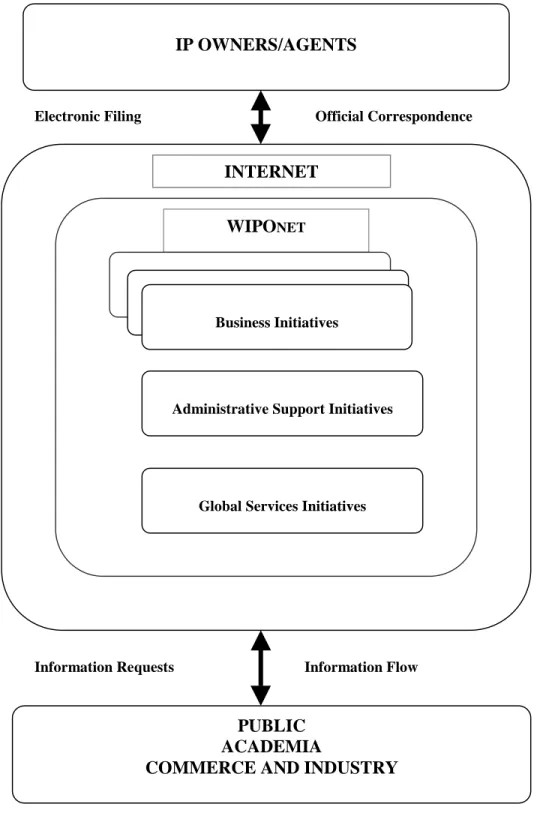
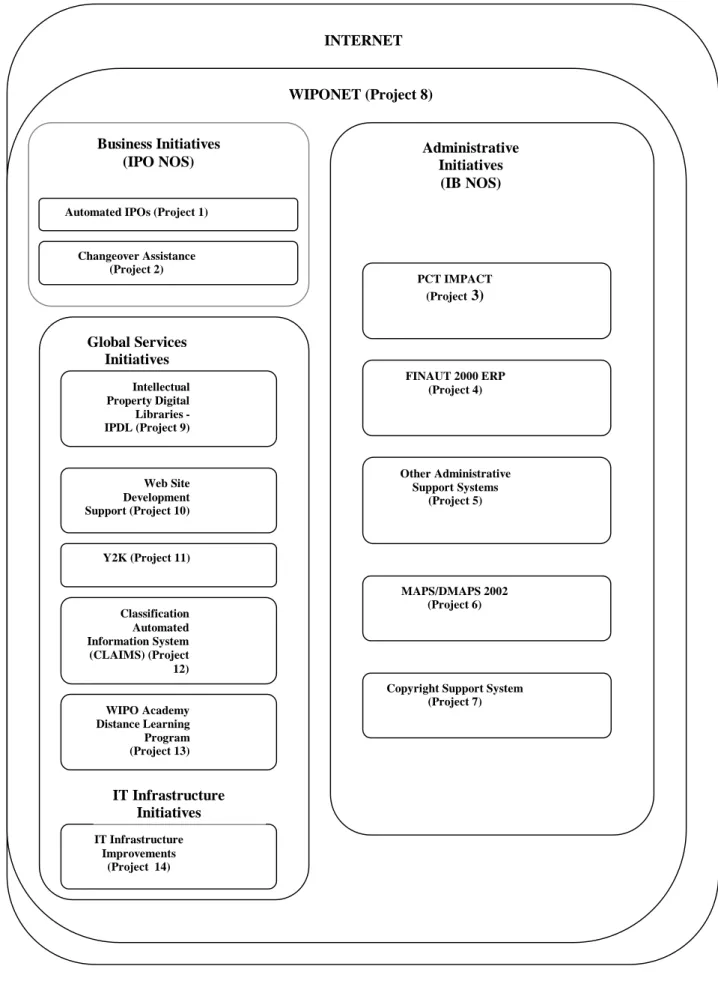
Figures 3 and 4, (pages 16 and 17) illustrate the broad functionality that is envisioned to be phased in over the next five years. The top and bottom blocks of the concept shown in Figure 3 represent the external producers and users of IP Information. The center block represents the global WIPO IP network, implemented through WIPONET on an Internet foundation, and
it also identifies the major components of the network. These components, which are further illustrated in Figure 4, show the business initiatives, administrative support initiatives, the global services initiatives and IT Infrastructure project initiatives which are planned.
There are three fundamental operational concepts of this strategic plan. First, IP owners and representatives will interface with the network to submit electronic applications and official inquiries, and receive official electronic correspondence. Second, all public users will be able to search and retrieve IP information in WIPO, IPO Web Sites, and Intellectual Property Digital Libraries at the IB and other IPO locations. Finally, IP information will be provided to meet projected customer needs and to serve the interests of stimulating innovation and invention and of protecting and enforcing IP rights.
At the technical level, operational interfaces between IP Offices and the IB will be through the WIPONET infrastructure, built on the Internet framework. This infrastructure will enable connectivity between external users, Regional and Member State IP Offices, and the IB. The services provided by IPO and IB business systems will be accessible on an interactive basis. Web-based applications are envisioned to include extensions of current WIPO Web sites, providing strategic public relations as well as legal, process, and status information to both internal and external users. Both the IB and IPOs will establish IP Digital Libraries within the WIPONET framework to serve the interests of the public. The WIPO Academy Distance
Learning Program will develop distance learning programs and other intra-office
communications programs, delivered through WIPONET, to support IPO staff development
and to assist users in making effective use of the global IP systems. In addition to the secure virtual private network established through WIPONET, the IB will establish direct, secure data exchange channels with other partner IP organizations, such as the Trilateral Offices.
The IB will provide assistance to IPOs in establishing the infrastructure to provide
connectivity to the global IP system, including equipment, software and training. It will also provide assistance and software to automate IPO business functions, where needed.
Within the IB, business process and other support systems are integral to each other and to WIPONET through the basic infrastructure of the Network Office System. IBNOS provides a
suite of common tools to system users within the IB, which, in turn, serve as interfaces to the automated support systems. A set of these tools will be installed in all IP Offices by means of IPO local area networks, as part of the basic IPO infrastructure.
Two of the major business process and administrative systems will be replaced by new systems (Information Management for the Patent Cooperation Treaty (IMPACT) and FINAUT 2000 ERP) to meet user needs in processes that have been reengineered. Others will be expanded and converted to operate within a standardized IB IT infrastructure. In addition, new specific function systems will be developed in those areas currently under-served by IT and which are not served by the major automated support systems.
n:\orgipig\shared\document\scit\4\prep\final_a2.doc
IP OWNERS/AGENTS
PUBLIC ACADEMIA
COMMERCE AND INDUSTRY INTERNET
WIPONET
Electronic Filing Official Correspondence
Information Requests Information Flow Administrative Support Initiatives
Global Services Initiatives Business Initiatives
n:\orgall\williams\final_a2.doc WIPONET (Project 8) Administrative Initiatives (IB NOS) PCT IMPACT (Project 3) MAPS/DMAPS 2002 (Project 6)
Copyright Support System (Project 7) FINAUT 2000 ERP (Project 4) Global Services Initiatives Y2K (Project 11) Intellectual Property Digital Libraries -IPDL (Project 9) Business Initiatives (IPO NOS)
Automated IPOs (Project 1)
Changeover Assistance (Project 2)
INTERNET
Figure 4. Global Network Concept - IB and IPO
Functions and Relationships.
Web Site Development Support (Project 10) Classification Automated Information System (CLAIMS) (Project 12) WIPO Academy Distance Learning Program (Project 13) Other Administrative Support Systems (Project 5) IT Infrastructure Improvements (Project 14) IT Infrastructure Initiatives
n:\orgipig\shared\document\scit\4\prep\final_a2.doc
SUMMARY OF INITIATIVES
The conceptual overview shown in Figure 4 identifies the areas in which initiatives have been taken or will be required to realize the vision of leveraging information technology.
These initiatives can be grouped into one of the following categories:
Business Initiatives
Administrative Support Initiatives Global Services Initiatives
IT Infrastructure Initiatives
An overview of each initiative, grouped into projects that will be undertaken to implement the initiatives, appears below. These projects are described in more detail in the sub-sections that follow.
Business Initiatives
Automated IPO Receiving Office Functions Automated IPO Business Functions including:
• Development of Minimum Modernization Standards for hardware and software and
• IP Electronic Information Publication.
These initiatives are addressed in Project 1, beginning on page 22.
Data carrier changeover assistance for IPOs.
The changeover from paper-based documents and procedures to electronic data carriers needs internationally coordinated, phased implementation by Member States and through WIPO’s assistance to small IPOs during the transitional period. The provision of CD-ROM
collections of patents and trademark documents to IPOs with insufficient access to the
Internet is one example of WIPO’s assistance. This will be addressed in Project 2, beginning on page 26.
Administrative Project Initiatives
PCT IMPACT. This initiative is addressed in Project 3, beginning on page 32.
FINAUT 2000 ERP– This initiative is addressed in Project 4, beginning on page 44.
Smaller, single function support systems are addressed in Project 5, beginning on page 63.
MAPS/DMAPS 2002 – An analysis of whether to retain the current mainframe-based MAPS/DMAPS architecture or whether it should migrate to a new platform, converted to operate with any necessary enhancements, is to be done in the year 2000. Accordingly, this is not a project to be immediately undertaken, but may be addressed in the future as Project 6, beginning on page 74.
Copyright Support System - This is a new project to be defined and initiated after a
preliminary business case analysis has been performed, and will be addressed in Project 7, beginning on page 74.
Global Services Initiatives
WIPONET – This initiative is addressed in Project 8, beginning on page 75.
Intellectual Property Digital Library Systems - including IB and IPO systems and support for:
• enhanced natural language search systems for official UN languages, and
• Local Collections of Intellectual Property Data. This initiative is addressed in Project 9, beginning on page 90.
IB and Member State Web Site Development
This initiative is addressed in Project 10, beginning on page 103.
Y2K – This initiative is addressed in Project 11, beginning on page 106.
Classification Automated Information System - This initiative is addressed in Project 12, beginning on page 115.
WIPO Academy Distance Learning Program including
• Multimedia Course Development System,
• Virtual Classroom Facility, and
• Instruction Delivery and Management Systems;
Information Technology Infrastructure Project Initiatives
• IT Infrastructure Improvements – This initiative is required to support the global IPCORRELATION OF SCIT OBJECTIVES WITH
PROJECT INITIATIVES
Project SCIT Objective
(a) (b) (c ) (d) (e) (f) (g)
1 Automated IPOs ✔ ✔ ✔ ✔
2 Changeover Assistance ✔ ✔ ✔
3 PCT IMPACT ✔ ✔ ✔ ✔
4 FINAUT 2000 ERP ✔ ✔
5 Other Administrative Support Services
✔ ✔
6 MAPS/DMAPS 2002 ✔ ✔ ✔
7 Copyright Support System ✔ ✔ ✔
8 WIPONET ✔ ✔ ✔ ✔ ✔ ✔
9 IPDL(Intellectual Property Digital Libraries) Systems
✔ ✔ ✔ ✔ ✔ ✔
10 Web Site Development Support ✔ ✔ ✔ ✔ ✔
11 Y2K ✔ ✔
12 CLAIMS (Classification
Automated Information System)
✔
13 WIPO Academy Distance Learning Program
✔ ✔ ✔ ✔
14 IT Infrastructure Improvements ✔ ✔ ✔
(a) Narrow the information access gap that exists between developed countries and developing countries; (b) Improve the flow of information concerning intellectual property rights among WIPO Member States,
regional intellectual property offices and the International Bureau;
(c) Improve access to and exchange of intellectual property information in terms of costs and access time in accordance with the agreed upon principles;3
(d) Improve intellectual property information dissemination;
(e) Consider the information needs and filing requirements of applicants and develop electronic services keeping in mind the need to provide benefits to applicants and intellectual property offices, and to other interested circles;
(f) Help guide the International Bureau to leverage information technologies; [NOTE: This item affects all
other projects, but does not represent a project as such]
(g) Improve the retrieval of intellectual property information through further development of international classification of patents, trademarks and industrial designs as efficient search tools
3 See “Statement of Principles Concerning the Changeover to Electronic Data Carriers for the Exchange of Patent Documents” as published in Part 8.4 of the WIPO Handbook on Industrial Property
Information and Documentation.
MEMBER STATE IPO CORE BUSINESS
PROJECT INITIATIVES
PROJECT 1 – AUTOMATED IPOS
Introduction
At its third Plenary session on June 15, 1999 the SCIT approved an IT Plan Draft directing the International Bureau (IB) to “ensure that account is taken when resourcing such projects of the special needs of developing countries in particular the availability of the necessary information technology infrastructure”. To address this point in more specific terms, Section 8.1 Modernization of Infrastructure, contained the statement: “the SCIT, as part of its strategic information technologies activities, will define and recommend minimum modernization standards (MMS) to be put in place at the intellectual property office (IPO) level. These MMS should address a wide range of areas including information technology infrastructure, human resources, training and support, process modernization, etc. The SCIT will
complement, to the greatest extent possible, IPOs’ efforts to reach the MMS level”.
The MMS should facilitate the efforts of national authorities in: modernizing, streamlining of administrative procedures, automation of procedures for the registration of intellectual
property rights, development and dissemination of patent information services and other relevant areas. The MSS should also contribute to the development and modernization of copyright offices in providing adequate access to, and deriving benefits from, a digital
information network. The MMS needs to be established on the basis of experience gained by SCIT Member States and the IB of WIPO. That experience will be applied in a process where the IB drafts the MMS in a joint effort with the SCIT standards working group and presents them to the SCIT Plenary for approval. The MMS should address a wide range of areas including IT infrastructure, human resources, training and support process modernization, and modern information dissemination to the public.
The deployment of WIPONET will provide the IB the opportunity to modernize IPOs in developing countries by providing a minimum WIPONET complement of workstation hardware and software. Beyond any initial WIPONET workstations, there are other projects
and areas to be considered to establish the MMS. Three particular projects for consideration are:
• Automation of the Receiving Office,
• Automation of Member IP Office business functions, and
• Capture of the office’s local IP data collection for IPDL publication.
In developing the draft MMS to be presented for SCIT consideration, the IB will consider the automation hardware and software suite required by developing country offices to implement services in all pertinent areas. Additionally, within the IB, there will be a need for closer coordination between project managers of various IT projects, and regional bureaus in charge of cooperation for development to developing countries and Least Developed Countries
(LDCs), as well as a section responsible for assistance to countries in transition to the market economy.
The WIPONET, its Support Program (WIPONET SP) and IB’s experience gained through the
PCT and Madrid Automation (IMPACT and MAPS) will be strategically used to elaborate and determine the MMS. WIPO’s assistance, within the framework of WIPONET and
WIPONET SP, will complement the efforts undertaken under the WIPO’s Nationally Focused
Action Plan. Initially, WIPO’s assistance to meet MMS will be provided to IPOs which are not equipped with any automated system at all. Accordingly, WIPO will, in the first place, focus on assistance to provide IPOs with hardware and software to use WIPONET and its basic
applications (e-mail, search on the Internet, access to IP Offices Web sites, etc). Although a business case analysis and project plan will be developed beginning in late 1999, a general plan of action has been designed, which is described in the following paragraphs.
General Strategy
The following general action plan, and associated key schedule milestones, will be taken in coordination with the other on-going automation projects at national offices and regional IPOs: Completion Dates Tasks/Products Initial Projection Current Projection Actual
Establish the project team 4Q of 1999 Collect requirements from
developing country Member
Offices 2Q of 2000
Collection requirements from other WIPO IP office automation
projects 2Q of 2000
Submit draft MMS for SCIT
working group consideration 3Q of 2000 Prepare final draft MMS for
review by SCIT Plenary 4Q of 2000 SCIT Plenary approval of MMS 4Q of 2000
The IB, in coordination with the relevant national and regional authorities, will review and adjust, where necessary, the current automation plan under the Nationally Focused Action Plan for reorienting their automation programs towards the best use of WIPONET.
The IB will propose to the SCIT the WIPONET SP activities by which WIPO will develop a software package which could fulfil the minimum requirements under the MMS for those offices identified by the SCIT as priority IPOs to receive WIPO’s technical assistance. The planned software package would allow for the minimum database management of
administrative procedures concerning the registration of industrial property rights, dissemination of intellectual property information in electronic form including Web
publication and electronic data exchange between the office and the International Bureau of WIPO.
Upon agreement by the SCIT, the IB will out-source the development of the software package through the selection of a successful bidder of an international tender. The COTS products compatible with the hardware provided under WIPONET program will be used for the
development of such software on the basis of the finding by the IB with regard to the minimum administrative functions. Primary targets are small IP offices particularly in developing countries.
In taking the above-mentioned steps to implement WIPO’s assistance in accordance with MMS, it is imperative for the IB of WIPO to analyze properly the needs of IPOs of the Member States and understand particular constraints existing in those offices. This will require close coordination within the IB between staff members in charge of the respective region for cooperation for development, project managers of relevant IT projects including WIPONET, IMPACT, IPDL, and staff members of the IT Division capable of providing
particular expertise and pertinent advice to those IP offices. The IB will explore the possibility of establishing a position of IT assistance coordinator who will liaise regional bureaus, the IT Division and other IT projects teams with a view to reinforcing a closer coordination and efficient collaboration to ensure the successful implementation of WIPO programs for assistance. The IT assistance coordinators will work in each region and at WIPO Headquarters in Geneva under the supervision of the IT Division Director. Their responsibilities will include in particular the following:
(a) to provide appropriate expertise and advice to IP offices for successful implementation of automation plans
(b) to provide on site assistance at IP offices in the deployment of hardware and software provided by WIPO for assistance and WIPONET deployment
(c) to facilitate communications between local authorities, IP offices and the International Bureau of WIPO
(d) to assist IP offices in the oversight of automation plans and provide any useful feed-back to the IB for further action and assistance
(e) to provide hands-on information and valuable experience of automation project
implementation with a view to developing local human resources and IT expertise at IP offices.
Benefits
The Define Minimum Modernization Standards (MMS) Project supports the SCIT strategic objectives to: “Narrow the information access gap that exists between developed countries and developing countries”, “Improve the flow of information concerning intellectual property among WIPO Member States, regional intellectual property offices, and the International
Bureau,” and “Improve access to and exchange of intellectual property information in terms of cost and access time in accordance with agreed upon principles.”
Benefits from defining the Minimum Modernization Standards are:
• Establish an equitable basis for deploying IT assets to developing countries – by defining an effective MMS suite WIPO will be able to provide fairly for the needs of developing countries.
• Define the baseline IT suite for planning purposes – the developing countries will be able to use the MMS definition for planning their own office modernization programs.
• Target training for the MMS – the MMS definition will allow the WIPO Academy Distance Learning Program to develop training packages for a standard set of equipment and improve the training as the program matures based on feedback from the initial training.
PROJECT 2 –CHANGEOVER ASSISTANCE
Introduction
In 1995, the Permanent Committee on Industrial Property Information (PCIPI), the
predecessor body of the SCIT discussed and adopted the “Statement of Principles Concerning the Changeover to Electronic Data Carriers for the Exchange of Patent Documents.” The adoption was timely in response to a gradual and non-reversible worldwide shift from paper to electronic means, such as CD-ROM, for the purpose of exchanging patent documents. The statement urged all intellectual property offices (IPOs) to make continued efforts for the reduction of the number of sets of paper documents in order to achieve a goal that all offices should in principle be prepared, at the latest by year 2000, to accept the changeover to electronic data carriers. Having noted concern expressed by many IPOs particularly in developing countries, the Member States agreed to undertake the changeover according to a carefully prepared and well-coordinated implementation plan.
Now approaching the deadline, the electronic data carrier that was widely used at the time of the adoption of the statement, CD-ROM, appears to be rapidly being replaced by Internet-based publication and online exchange of data with the advent of the Internet and WIPONET.
Many offices find it difficult to catch up with this unexpectedly rapid changeover of data carriers and need technical assistance from WIPO for the successful transition. While waiting for the deployment of WIPONET and the provision of Internet access in all countries and all IP
offices so as to disseminate and share intellectual property information online, it is essential to continue to provide IP information on portable data carriers, such as CD-ROM and DVD, for those offices which lack a sufficient network infrastructure. Portable data carriers are also valuable as archives and back-up databases.
These developments also create an opportunity to evaluate potential opportunities for
expanding the worldwide collection of computer searchable textual and image data for shared use of IPO’s. For example, WIPO intends to explore the feasibility of creating databases of “traditional knowledge” which is defined as knowledge that is passed down by word of mouth, from generation to generation. This traditional knowledge is, for the most part, undocumented. There has been concern expressed by some WIPO Member States regarding the improper granting of intellectual property rights due to a lack of accessibility to this form of prior art. WIPO has agreed to work with developing countries to help document
Traditional Knowledge as a type of prior art and classify the documented Traditional Knowledge.
Assuming it is feasible to establish such databases, the information will be made available to Intellectual Property Offices, and, where applicable, to the public through the IPDL project. These disclosures will be text and image searchable and each document will have an
International Patent Classification(s) (IPC) associated with it to facilitate classified searching of the technology. Establishing databases of Traditional Knowledge prior art will help improve the quality of issued patents and lead to increased awareness of and access to a new valuable form of intellectual property information.
General Strategy
WIPO intends to provide changeover assistance via the following sub-projects:
GlobalPat CD-ROM Sub-Project
Until a time in the future when the cost of providing substantial WIPONET bandwidth to remote offices becomes marginal, it will be necessary to supply IP data collections to such offices on optical disk media. These collections will make it possible for the small offices to perform electronic searches in a timely fashion without the delays that would be experienced via Intellectual Property Digital Library (IPDL) services over low speed Internet access connections. At the present time it is envisioned that the optical disk media technology will include DVD and CD-ROM. WIPO will function either as a coordinator to forward optical disk data that is produced by other member offices or as a publisher of optical disk media for data supplied by other small offices without their own production capability. Of course, WIPO will furnish material that WIPO itself publishes on optical disks to the subscribing offices. Proposals for hosting optical disk media collections will be solicited from interested IPOs and reviewed by WIPO to determine the amount of supplemental assistance such offices may require. Offices that can justify their need for retrieval systems, training, installation and operations assistance will be supported by WIPO.
WIPO’s traditional role of a standards publishing body will apply to this project in the area of requiring the disk media produced by member offices to be in formats that can be played on standard commercial equipment. WIPO will also establish standards for the data storage formats and search tool user interfaces so that the data can be searched using a standard tool. This will eliminate the need for the users to have to learn a different tool to retrieve the data from each source.
While the exchange of IP data between IP offices continues to be based on bilateral agreements of goodwill among those offices concerned, WIPO will facilitate the
dissemination of data and the use of compatible systems for viewing such data to small IPOs. Through WIPO standards and services the small IPOs will be ensured of having up-to-date reference information in electronic form and the tools to render and reproduce this data. WIPO will act as a hub for the physical distribution of the optical disk data. WIPO will also act as a central point to provide assistance to the small offices for keeping their systems up to date and for resolving technical issues that arise related to operation of the equipment.
WIPO purchased the subscription of GlobalPat, which is one of the best patent information sources produced within the framework of the Trilateral Cooperation for first screening of patent documents. GlobalPat CD-ROM contains the first page data in English of all major patent documents issued by the European Patent Office (EPO), the United States Patent and Trademark Office (USPTO) and other European national offices. The backfiles series of the GlobalPat CD-ROM, sorted out according to 69 technological fields, were distributed to some 50 Member States within WIPO’s budgeted assistance program during the present biennium. WIPO plans to support and expand this program in the next biennium for IPOs that need GlobalPat CD-ROM collections as data archives due to insufficient network infrastructure and
difficult circumstances of local telecommunications. WIPO will contribute to the production of GlobalPat (with EPO and USPTO, if USPTO continues to be a producer in 2000) in the interest of providing greater access by those countries to this technologically important information. In coordination with EPO, WIPO will liaise with major users and small IPOs to discuss and implement the production plan of GlobalPat, including consideration of the publication of technologically sorted out collection on DVD ROM. To take advantage of this valuable data collection, WIPO will also investigate the possibility of producing a hybrid version based on DVD technology, which will interact with the WIPO IPDL site.
WIPO CD-ROM Collections Publication Sub-Project.
Since the creation of a WIPO Web site, intellectual property information and other reference materials have been progressively included in the WIPO Web site and WIPO IPDL.
However, the International Bureau plans to continue the publication of the existing series of WIPO CD-ROM collections, that is, International Patent Classification Database (IP-CLASS-CD-ROM), Nice, Vienna and Locarno Classifications (NIVILO-(IP-CLASS-CD-ROM), WIPO Industrial Property Information Documentation Handbook CD-ROM, WIPO Industrial Property
Statistics CD-ROM. These CD-ROMs are still useful to general public and staff of IPOs particularly in those countries suffering from the lack of high-speed connection to the Internet. The cost of production and data preparation is estimated at around 1 million Swiss francs for the next four years. However, a significant portion of this investment will be recovered by the sale of these CD-ROMs.
Key schedule milestones are:
Completion Dates Tasks/Products Initial Projection Current Projection Actual
WIPO reviews the result of the first year of the program for free distribution of GlobalPat CD-ROM and also discuss proposals from member states to
establish local IP optical disk collections
and develops a list of participants. 1999 1Q of 2000 1Q of 2000
Set up plans with small offices that complete reasonable documentation on
optical disk. 1999 1Q of 2000 1Q of 2000
Begin provision of data collections on CD-ROM or DVD in addition to continued supply of GlobalPat
collections. mid-2000 mid-2000 mid-2000
Begin monitoring and collecting performance measure data on the
benefits of local optical disk databases 3Q of 2000 3Q of 2000 3Q of 2000 First report to SCIT on results achieved,
The cost will depend on a cost-sharing arrangement with the producing office (EPO). On the basis of the award price of the present manufacturer, it is reasonable to estimate WIPO’s contribution in the proximity of 500,000 SFr. for the production during the next four years.
Benefits
The GlobalPat CD-ROM and CD-ROM Collections Publications sub-projects support the SCIT strategic objectives to “Narrow the information gap that exists between developed countries and developing countries” and “Improve intellectual property information dissemination”. Multiple benefits will be derived from WIPO performing in this role:
• More efficient distribution network: By acting as a hub for distribution of this information WIPO will be able to represent the interests of the small offices to the major offices that produce the data. From a logistical standpoint, WIPO will be able to reduce the number of relationships and distribution paths between small offices and data suppliers to a more manageable number by a factor of N, where N is the number of offices that produce the data.
• Publication of previously unpublished data: Through publishing data for offices lacking the resources to publish themselves, the cause of improving the distribution of
intellectual property information worldwide will be furthered.
• Expansion of access to electronic collections: This program will make data in electronic form available to small offices that would otherwise lack the means to acquire it. Training and operational assistance supplied through WIPO will help to ensure that the systems are used effectively following their deployment.
• Improved protection in small countries: The interests of the worldwide intellectual property community as a whole will be better served through the availability of these data collections and the quality of patents issued in these countries should improve.
Supplementary Data
Collection of Laws for Electronic Access
Additionally, the Collection of Laws Section, manages, with the assistance of the Information Technology Division, an Internet-based application, Collection of Laws for Electronic Access (CLEA).
The CLEA application contains:
• National legislative texts in the field of intellectual property;
• Texts of treaties administered by WIPO;