Comparison of the effects of
intravenous propofol and inhalational
desflurane on the quality of early
recovery after hand- assisted
laparoscopic donor nephrectomy: a
prospective, randomised controlled trial
Jaesik Park ,1 Minhee Kim,2 Yong Hyun Park,3 Jung- Woo Shim,1Hyung Mook Lee,1 Yong- Suk Kim,1 Young Eun Moon,1 Sang Hyun Hong ,1 Min Suk Chae 1
To cite: Park J, Kim M, Park YH, et al. Comparison of the effects of intravenous propofol and inhalational desflurane on the quality of early recovery after hand- assisted laparoscopic donor nephrectomy: a prospective, randomised controlled trial. BMJ Open 2020;10:e039881. doi:10.1136/ bmjopen-2020-039881 ►Prepublication history and additional material for this paper is available online. To view these files, please visit the journal online (http:// dx. doi. org/ 10. 1136/ bmjopen- 2020- 039881). Received 28 April 2020 Revised 18 November 2020 Accepted 27 November 2020
For numbered affiliations see end of article.
Correspondence to Dr Min Suk Chae; shscms@ gmail. com © Author(s) (or their employer(s)) 2020. Re- use permitted under CC BY- NC. No commercial re- use. See rights and permissions. Published by BMJ.
ABSTRACT
Objectives We compared early recovery outcomes between living kidney donors who received total intravenous (IV) propofol versus inhalational desflurane during hand- assisted laparoscopic nephrectomy.
Design A single- centre, prospective randomised controlled trial.
Setting University hospital.
Participants Study participants were enrolled between October 2019 and February 2020. A total of 80 living donors were randomly assigned to an intravenous propofol group (n=40) or a desflurane group (n=40).
Intervention Propofol group received intravenous propofol and desflurane group received desflurane, as a maintenance anaesthetic.
Primary and secondary outcome measures The quality of postoperative functional recovery was primarily assessed using the Korean version of the Quality of Recovery-40 (QoR- 40K) questionnaire on postoperative day 1. Secondarily, ambulation, pain score, rescue analgesics, complications and total hospital stay were assessed postoperatively.
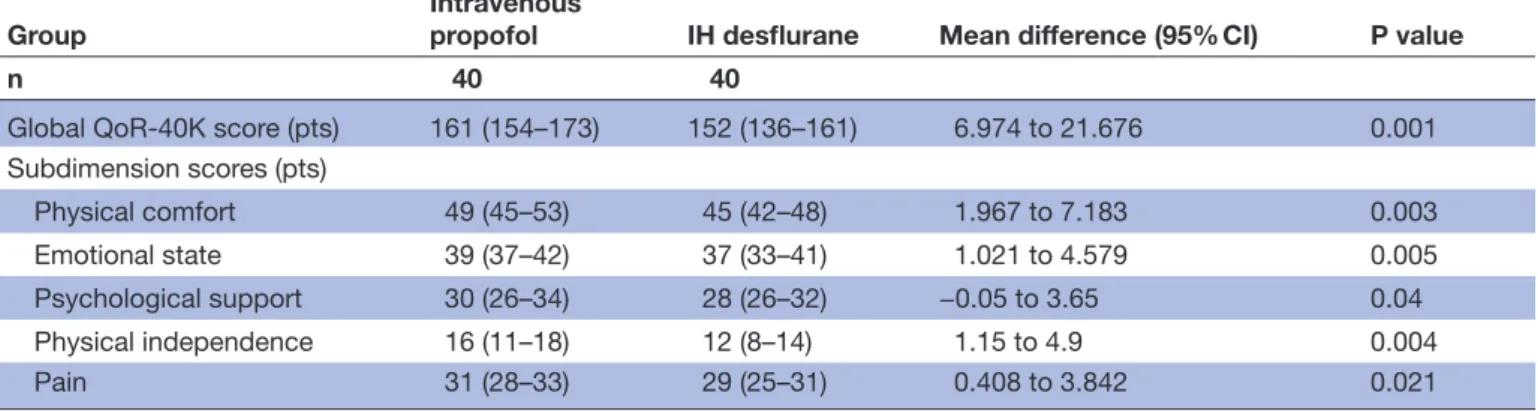
Results Our study population included 35 males and 45 females. The mean age was 46±13 years. The global QoR- 40K score (161 (154–173) vs 152 (136–161) points, respectively, p=0.001) and all five subdimension scores (physical comfort, 49 (45–53) vs 45 (42–48) points, respectively, p=0.003; emotional state, 39 (37–41) vs 37 (33–41) points, respectively, p=0.005; psychological support, 30 (26–34) vs 28 (26–32) points, respectively, p=0.04; physical independence, 16 (11–18) vs 12 (8-14) points, respectively, p=0.004; and pain, 31 (28–33) vs 29 (25-31) points, respectively, p=0.021) were significantly higher in the intravenous propofol group than the desflurane group. The early ambulation success rate and numbers of early and total steps were higher, but the incidence of nausea/vomiting was lower, in the intravenous propofol group than the desflurane group. The total hospital stay after surgery was shorter in the intravenous propofol group than the desflurane group.
Conclusions Intravenous propofol may enhance the quality of postoperative recovery in comparison to desflurane in living kidney donors.
Trial registration number KCT0004365. INTRODUCTION
Living donor kidney transplantation (LDKT) is considered a clinically appropriate treat-ment for patients with end- stage kidney disease due to its more favourable outcomes than dialysis maintenance and lower rate of donor KT.1 Satisfactory recovery of living donors has emerged as an important issue in the LDKT setting.2 Delayed recovery after surgery may be associated with adverse outcomes that decrease patient safety and satisfaction.3 In the operating room, attending physicians should employ clinical management strat-egies that support the recovery of patients, mitigate morbidity and facilitate their return to daily activities.4 Previous studies on the two most common general anaesthesia regimens
Strengths and limitations of this study
► As the quality of postoperative recovery is a key is-sue in living kidney transplantation donors, we com-pared the satisfaction regarding recovery between anaesthetic regimens.
► The enrolment and response rates of living donors were high.
► A previously validated, multidimensional question-naire was used.
► One limitation of the study was that variables, such as education and socioeconomic status, were not assessed.
on January 9, 2021 by guest. Protected by copyright.
(ie, total intravenous propofol and inhalational (IH) volatile anaesthesia) were typically concerned with only a few outcomes, such as nausea/vomiting, pain and awak-ening time, which may not adequately reflect the overall quality of recovery or health status of patients undergoing surgery.5–7
The Quality of Recovery-40 (QoR-40), a self- report questionnaire, is widely used for assessing patient recovery from various surgeries involving anaesthesia. The QoR-40 is composed of five subdimensions (physical comfort, physical independence, emotional state, psychological support and pain).5 This instrument has been translated into several languages, including Korean, and has high levels of validity and reliability for analysing the quality of recovery. The Korean version of the QoR-40 (QoR- 40K) was derived through a process of translation and cultural adaptation, for application to Korean patients under-going general anaesthesia.8 Early and vigorous mobili-sation, including walking, has been a major component of patient rehabilitation programmes aiming to prevent muscular weakness, cardiopulmonary complications and ileus, and to facilitate haemodynamic circulation and surgical repair of injury. Compliance with mobilisation regimens is associated with a higher rate of successful recovery after surgery.9 10
As one of the critical elements of perioperative care for living donors, adequate pain control poses a chal-lenge for physicians in the transplantation setting. The condition of healthy living donors can lead to low pain tolerance, such that satisfactory postoperative analgesia is essential.2 11 Previous studies demonstrated that a single dose of intrathecal morphine (ITM) is a safe and effective analgesic for living donors.12 13
Few studies have used the QoR- 40K and early ambu-lation success rate when comparing recovery outcomes between patients receiving intravenous propofol versus IH volatile anaesthesia, based on the use of ITM for pain control during living kidney donation surgery. In the current study, we compared early recovery outcomes between living donors who received intravenous propofol versus IH desflurane during hand- assisted laparoscopic nephrectomy (HALN) for KT.
PATIENTS AND METHODS
This single- centre, prospective randomised controlled trial was approved by the Institutional Review Board and Ethics Committee of Seoul St. Mary’s Hospital (approval number: KC19MESI0479) on 27 August 2019 (online supplemental file 1), and was performed according to the principles of the Declaration of Helsinki (online supple-mental file 2). Written informed consent was obtained from all patients at our hospital who were enrolled in this study between October 2019 and February 2020. Our study adhered to Consolidated Standards of Reporting Trials (CONSORT) guidelines (online supplemental file 3); a CONSORT flow chart is provided in figure 1.14 Patient and public involvement
Patients and the public were not involved in the design, conduct, reporting or dissemination of our research.
Study population
As outlined in the summary of our trial protocol (online supplemental file 4), this study included adult living donors (aged ≥19 years) accepted for KT according
Figure 1 Consolidated Standards of Reporting Trials flow chart. ASA, American Society of Anesthesiologists.
on January 9, 2021 by guest. Protected by copyright.
to clinical practice guidelines15 who had an Amer-ican Society of Anesthesiologists (ASA) physical status of I–II,16 and were scheduled for elective HALN at our hospital. The exclusion criteria were emergency case; age <19 years; ASA physical status of III–V; intraoper-ative haemodynamic instability, such as massive haem-orrhage, urgently requiring rescue treatments such as aggressive colloid infusion, blood product transfusion and/or administration of strong inotropic drugs; contra-indications for intrathecal intervention, such as bleeding diathesis, neurological dysfunction, history of lumbar spine surgery, recent systemic or local infections, or drug allergy; and refusal to participate in the study.
A total of 84 living donors were enrolled in our study. However, three donors had a history of spinal surgery due to neurological deficits in the lower limb and were unsuitable for ITM intervention, and one donor refused to participate. Therefore, 80 living donors were analysed in this study.
Randomisation
Each living donor was randomly assigned to either an intravenous propofol group or an IH desflurane group in a 1:1 ratio generated with ‘https://www. graphpad. com/ quickcalcs/ randomize1/’. Group allocation was coded either intravenous or IH and concealed in opaque sealed envelopes by one of authors. A colleague not otherwise involved in the study randomly shuffled envelops to ensure proper randomisation. The envelopes were stacked and stored before the first participant was enrolled. When an enrolled patient arrived in the holding area, the topmost envelope was opened by the attending anaesthesiologist. The surgical team, physician and nurses in the postanaes-thesia care unit and ward, as well as the researchers, were blinded to the group allocations. The attending anaesthe-siologist and nurses in the operating room, who were not involved in further patient care or data collection (other than filling in medical record forms), were aware of the group allocations. The randomisation and blindness was maintained through the entire study periods.
Total intravenous propofol versus IH desflurane anaesthesia during HALN
Hand- assisted laparoscopic living donor nephrectomy was performed by an experienced urological surgeon (YHP) as described in detail previously.17 As the left kidney has a longer renal vein than the right kidney, our surgeon has a preference for the left- sided approach and harvested the left kidney unless it showed anatomical variations or func-tional problems.18 Balanced anaesthesia was provided by experienced attending anaesthesiologists. Anaesthesia was induced with 1–2 mg/kg propofol (Fresenius Kabi, Bad Homburg, Germany) and 0.6 mg/kg rocuronium (Merck Sharp & Dohme, Kenilworth, New Jersey, USA). The living donors in the intravenous propofol group were administered propofol and remifentanil (Hanlim Pharm, Seoul, Republic of Korea) for anaesthesia using an effect- site target- controlled infusion (TCI) pump
(Orchestra Workstation; Fresenius Kabi). Living donors in the IH desflurane group were administered desflurane (Baxter, Deerfield, Illinois, USA), which is not nephro-toxic,19 along with medical air/oxygen. Remifentanil was administered using a TCI pump (Agilia; Fresenius Kabi). The TCI pump was operated according to Schneider’s pharmacokinetic model for propofol and Minto’s model for remifentanil. Fluid was administered liberally during surgery, and mannitol (25 g) was administered immedi-ately before ligation of the renal artery.
Pain relief procedure
ITM was included as an analgesic component in the living donor treatment strategy for early postoperative pain relief. On the day before surgery, informed consent regarding the use of ITM was obtained from the living donors. Living donors who were not suitable for ITM intervention received a conventional analgesic regimen, including intravenous patient- controlled analgesia (intra-venous- PCA) and rescue IV opioids.
To allow immediate identification of any nerve injury during catheter insertion, that is, before the induction of general anaesthesia, living donors were not provided with sedatives in the operating room. The living donors were placed in the right or left lateral decubitus position, and the skin over the lumbar region was cleaned with chlor-hexidine and draped. The donors were administered 0.2 mg (0.2 mL) of morphine sulfate (BCWorld Pharm, Seoul, Republic of Korea) and normal saline (1 mL) using a sterile 25 G Quincke- type spinal needle (TAE- CHANG Industrial, Chungcheongnam- do, Republic of Korea) between lumbar vertebrae 3 and 4. Morphine sulfate and normal saline (total, 1.2 mL) were adminis-tered in a single injection after cerebrospinal fluid had been obtained.
All living donors received intravenous- PCA (AutoMed 3200; Acemedical, Seoul, Republic of Korea), which included 1000 µg of fentanyl (Dai Han Pharm, Seoul, Republic of Korea) and 0.3 mg of naseron (Boryung,
Seoul, Republic of Korea). The intravenous- PCA
programme consisted of a 1 mL bolus injection, without basal infusion of the intravenous- PCA solution and with a lockout time of 10 min. When living donors experienced severe postoperative pain (pain score ≥7 on a Numeric Rating Scale (NRS)), rescue intravenous opioid drugs for pain relief were administered based on the discretion of the attending physicians in the postanaesthesia care unit and ward.
Primary outcomes
The quality of postoperative functional recovery was primarily assessed using the QoR- 40K questionnaire, which has five subdimensions: physical comfort (12 items), emotional state (9 items), physical independence (5 items), psychological support (7 items) and pain (7 items). Each item was rated on a five- point Likert scale (1, none of the time; 2, some of the time; 3, usually; 4, most of the time and 5, all of the time). The total score on the
on January 9, 2021 by guest. Protected by copyright.
QoR- 40K ranges from 40 (poorest recovery) to 200 (best recovery). The QoR- 40K was administered on postopera-tive day (POD) 1 between 18:00 and 20:00 hours.
Secondary outcomes
Regarding the recovery of physical ability, the ambulation success rate and number of steps were obtained on the day of surgery and POD 1. Due to the risk of post- dural puncture headache posed by ITM, and of falls due to dizziness, living donors were instructed to take care when attempting to sit, stand or walk at 6 hours postoperatively, with support and guidance provided by the attending physicians in the ward, who were blinded to the group allo-cations and directly determined the success of early and late ambulation.20 Successful ambulation was defined as the ability to walk more than 10 steps without any adverse events, such as nausea/vomiting, pain and dizziness, which could be potentially related to risk of fall injury, and without the requirement for physical support from the attending physicians or nurses. The early ambulation success rate was calculated on the day of surgery (between 6 and 12 hours postoperatively), while the late ambulation success rate was calculated on POD 1 (between 18:00 and 20:00 hours) by the attending physicians. The number of steps was also recorded on both days using an elec-tronic measurement device (Activity Tracker, EI- AN900; Samsung Electronics, Suwon, Republic of Korea).
Pain at the wound site was assessed using an NRS ranging from 0 to 10, where ‘0’ represented no pain and ‘10’ represented the worst possible pain. Pain was scored at 6 hours and 24 hours postoperatively, and during every nursing shift as part of the standard of care. The severity of the pain at the wound site was classified as follows: 0–3 points, mild pain; 4–6 points, moderate pain that required pain relief treatment, such as non- opioid pain killers or low- dose opioid infusion; and 7–10 points, severe pain that urgently required high- dose opioid infusion or inva-sive analgesia, such as nerve block.21 In addition, the total amount of intravenous- PCA infusion and frequency of rescue intravenous opioid treatment were assessed over the initial 24 hours postoperatively.
Other clinical complications, such as nausea/vomiting, headache, shivering, respiratory depression and pruritus, were assessed on the day of surgery and POD 1. During the hospital stay, surgical complications were assessed according to Clavien- Dindo classification.22 The total period of hospitalisation after surgery was compared between living donors who received intravenous propofol and those who received IH desflurane.
CLINICAL VARIABLES
The preoperative data included gender, age, height, weight, body mass index (BMI), ASA physical status, comorbidities (eg, hypertension (HBP) and diabetes mellitus (DM)), history of abdominal surgery and labo-ratory variables (white cell count (WCC) count, haemo-globin, platelet count, creatinine, albumin, sodium,
potassium, chloride, international normalised ratio and activated partial thrombin time). The intraoperative find-ings included total surgical duration, donation of the right or left kidney, vital signs (systolic and diastolic blood pressure, heart rate and body temperature), total remifen-tanil infusion, hourly fluid input, hourly urine output and total amount of haemorrhage. Laboratory data obtained on POD 1 included the WCC, neutrophil, lymphocyte and platelet counts, and levels of haemoglobin, creati-nine, albumin, sodium, potassium and chloride.
STATISTICAL ANALYSIS
The minimum sample size required was determined based on that needed to detect a difference in the global QoR- 40K score on POD 1 between living donors who received intravenous propofol and those who received IH desflurane. Based on a preliminary study conducted at our hospital (unpublished), mean global QoR- 40K scores in the living donors who received intravenous propofol (n=10) and IH desflurane (n=10) were 170 and 150 points, respectively, and the SD in 20 living donors was 30 points. Therefore, a minimum sample size of 36 living donors in each group was required (α=0.05, power=0.8). We recruited 40 living donors into each group, assuming a drop- out rate of 10%.
Values are expressed as the mean±SD, as medians with IQR, or as numbers with percentages. The normality of the distribution of the continuous data was evaluated using the Shapiro- Wilk test. The perioperative findings were compared between living donors who received intra-venous propofol and those who received IH desflurane using the unpaired t- test or the Mann- Whitney U test, and Pearson’s χ2 test or Fisher’s exact test, as appropriate. All tests were two sided, and a p<0.05 was considered signif-icant. Statistical analyses were performed using SPSS for Windows (V.24.0; IBM) and MedCalc for Windows soft-ware (V.11.0; MedCalc Softsoft-ware, Ostend, Belgium).
RESULTS
Demographic characteristics of living kidney donors undergoing HALN
Our study population included 35 male living donors (43.8%) and 45 female living donors (56.3%). The mean age and BMI were 46±13 years and 23.8±3.2 kg/m2, respec-tively. Four living donors had a history of HBP (5.0%), but there were no donors with DM, or with cardiovascular or cerebrovascular diseases. Twenty- eight living donors had a history of abdominal surgery (35.0%). The mean serum creatinine level was 0.8±0.1 mg/dL, and there were no living donors who had pathological laboratory or struc-tural findings in the kidney.15
Preoperative and intraoperative clinical findings of patients receiving intravenous propofol versus IH desflurane
The preoperative and intraoperative clinical findings of living donors receiving ntravenous propofol and IH
on January 9, 2021 by guest. Protected by copyright.
desflurane are presented in table 1. The clinical findings were comparable between the two groups.
QoR-40K scores on POD 1 of patients receiving intravenous propofol versus IH desflurane
Global and sub- dimension QoR- 40K scores (physical comfort, emotional state, psychological support, physical independence and pain) were significantly higher in the intravenous propofol group than in the IH desflurane group (table 2 and online supplemental file 5).
Postoperative ambulation of patients who received intravenous propofol versus IH desflurane
The success rate of early ambulation and numbers of early, late and total steps were significantly higher in the intravenous propofol group than in the IH desflu-rane group (table 3 and online supplemental file 6). In addition, all patients were able to walk without physical support on POD 1.
Clinical and laboratory variables during the initial 24 hours postoperatively of patients who received intravenous propofol versus IH desflurane
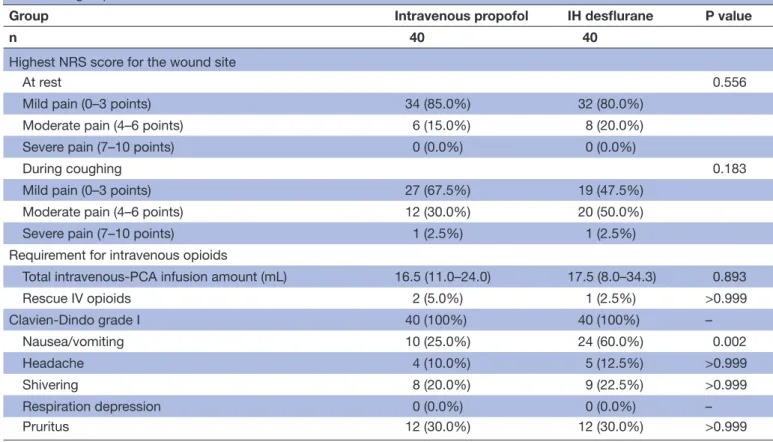
The incidence of nausea/vomiting was significantly lower in the intravenous propofol group than in the IH desflu-rane group (table 4). However, the highest NRS pain scores at the wound site, at rest and while coughing, were comparable between the groups, and other complications were also similar. There were no cases of postdural punc-ture headache exacerbated by postural change.20 Labora-tory data were comparable between the groups (table 5).
Surgical complications and total postoperative hospital stay
The median total hospital stay after surgery was 3 days (IQR: 3–4 days) in the intravenous propofol group and 4 days (IQR: 3–5 days) in the IH desflurane group (p=0.035). All patients were discharged without any fatal surgical complications (Clavien- Dindo grade I).22
DISCUSSION
The main finding of our study was that the early postoper-ative recovery was significantly better in living donors who
Table 1 Comparison of preoperative and intraoperative clinical findings between the intravenous propofol and IH desflurane groups
Group
Intrvenous propofol
IH
desflurane P value
n 40 40
Preoperative findings
Gender (male) 18 (45.0%) 17 (42.5%) 0.822
Age (years) 47±13 46±13 0.812
Height (cm) 163.9±9.2 165.7±8.0 0.346
Weight (kg) 63.7±11.6 66.0±12.0 0.372
Body mass index (kg/
m2) 23.6±3.1 24.0±3.4 0.611
ASA physical status 0.284
I 33 (82.5%) 29 (72.5%)
II 7 (17.5%) 11 (27.5%)
Comorbidities
Hypertension 2 (5.0%) 2 (5.0%) >0.999 Diabetes mellitus 0 (0.0%) 0 (0.0%) – History of abdominal
surgery 15 (37.5%) 13 (32.5%) 0.639
Laboratory variables
WBC count (×109/L) 6.2±1.7 5.8±1.6 0.187
Haemoglobin (g/dL) 13.9±1.4 13.9±1.6 0.808 Platelet count
(×109/L) 248.7±38.3 245.2±58.3 0.75
Creatinine (mg/dL) 0.8±0.1 0.8±0.2 0.45
Albumin (g/dL) 4.5±0.2 4.5±0.2 0.518
Sodium (mEq/L) 141.9±1.8 141.6±1.3 0.446 Potassium (mEq/L) 4.3±0.3 4.3±0.2 0.763 Chloride (mEq/L) 104.5±1.5 104.0±1.6 0.117 International
normalised ratio
0.99±0.05 1.00±0.05 0.186
aPTT (s) 27.6±2.2 27.6±2.0 0.913
Intraoperative findings
Total surgical duration
(min) 140±21 143±29 0.521
Donated kidney
(Right) 9 (23.7%) 7 (17.5%) 0.499
Vital signs Systolic blood
pressure (mm Hg) 119±13 118±11 0.706
Diastolic blood
pressure (mm Hg) 78±9 75±8 0.072
Heart rate (beats/
min) 68±9 70±11 0.431
Body temperature
(℃) 36.2±0.3 36.2±0.4 0.281
Total remifentanil
infusion (mg) 0.7±0.2 0.7±0.2 0.415
Continued
Group Intrvenous propofol IH desflurane P value
n 40 40
Hourly fluid input (mL/
kg/hour) 4.0±2.1 3.8±1.7 0.652
Hourly urine output (mL/kg/hour)
1.4±1.3 1.1±0.6 0.173
Total amount of
haemorrhage (mL) 74±35 75±60 0.937
Values are expressed as mean (SD) and number (proportion). aPTT, activated partial thrombin time; ASA, American Society of Anesthesiologists; IH, inhalational; WBC, white blood cell .
Table 1 Continued
on January 9, 2021 by guest. Protected by copyright.
received intravenous propofol intraoperatively compared with those who received IH desflurane during HALN for KT. The global and subdimension (physical comfort, emotional state, psychological support, physical indepen-dence and pain) QoR- 40K scores on POD 1 were signifi-cantly higher in the IV propofol group than in the IH desflurane group. The success rate of early ambulation and the numbers of early, late and total steps were mark-edly higher in the intravenous propofol group than in the IH desflurane group. Regarding surgical pain during the initial 24 hours postoperatively, the highest NRS score at the wound site and requirement for intravenous propofol opioid treatment were comparable between the groups. However, the incidence of nausea/vomiting was signifi-cantly higher in the IH desflurane group than in the intravenous propofol group. Living donors who received intravenous propofol propofol were discharged from the hospital earlier than those who received IH desflurane, without moderate- to- severe complications.
Regarding anaesthetic type (intravenous propofol propofol vs IH volatile anaesthesia) and patient recovery, Lee et al suggested that intravenous propofol was
associated with better early postoperative recovery based on QoR-40 scores on POD 1 compared with IH desflu-rane, in female patients undergoing thyroid surgery.23 Regarding endoscopic sinus surgery, Liu et al reported that the global QoR-40 score at 6 hours after surgery was significantly higher in patients receiving intravenous propofol compared with those receiving IH desflurane.24 For ambulatory surgery, such as elective vitrectomy, Na et al reported that IV propofol was associated with signifi-cantly better recovery on the day of surgery compared with IH desflurane, based on the QoR-40 questionnaire.25 Elbakry et al reported that morbidly obese patients under-going laparoscopic sleeve gastrectomy with IV propofol showed lower postoperative NRS pain scores, a lower requirement for analgesic drugs, lower incidence of nausea/vomiting and shorter postanaesthetic care unit stay than those who received IH desflurane.26 Akkurt et al reported that laparoscopic cholecystectomy patients receiving intravenous propofol exhibited a more favour-able recovery, characterised by a lower rate of postoper-ative nausea/vomiting, lower analgesic consumption, faster recovery of bowel movements and shorter hospital
Table 2 Comparison of QoR- 40K questionnaire scores on POD 1 between the intravenous propofol and IH desflurane groups
Group
Intravenous
propofol IH desflurane Mean difference (95% CI) P value
n 40 40
Global QoR- 40K score (pts) 161 (154–173) 152 (136–161) 6.974 to 21.676 0.001
Subdimension scores (pts)
Physical comfort 49 (45–53) 45 (42–48) 1.967 to 7.183 0.003
Emotional state 39 (37–42) 37 (33–41) 1.021 to 4.579 0.005
Psychological support 30 (26–34) 28 (26–32) −0.05 to 3.65 0.04
Physical independence 16 (11–18) 12 (8–14) 1.15 to 4.9 0.004
Pain 31 (28–33) 29 (25–31) 0.408 to 3.842 0.021
Values are expressed as median and IQR.
IH, inhalational; POD, postoperative day; pts, points; QoR-40, Quality of Recovery-40.
Table 3 Comparison of postoperative ambulation between the intravenous propofol and IH desflurane groups
Group Intravenous propofol IH desflurane
Mean difference (95% CI) P value
n 40 40
Successful ambulation
Early ambulation 33 (82.5%) 23 (57.5%) 0.015
Late ambulation 40 (100.0%) 40 (100.0%) –
Ambulation (steps)
Total steps 3890 (2020–5572) 1314 (736–2602) 1015 to 3875 <0.001
Early steps 252 (120–533) 74 (12–361) −121 to 326 0.001
Late steps 3425 (1545–5262) 1124 (645–2366) 965 to 3719 <0.001
Total steps were the sum of the early and late steps. Early steps were the number of steps on the day of surgery. Late steps were the number of steps on postoperative day 1. Values are expressed as number (proportion) and median (IQR). IH, inhalational.
on January 9, 2021 by guest. Protected by copyright.
stay than those receiving IH desflurane.7 In robot- assisted laparoscopic radical prostatectomy, Yoo et al reported that intravenous propofol was more effective than IH desflu-rane in preventing the development of early postopera-tive nausea/vomiting.6
Previous studies reported that intravenous propofol seemed to provide better postoperative recovery, with
fewer postoperative side effects and a lower analgesic requirement, than IH desflurane.6 7 23–26 These find-ings suggest that differences in stress modulation and inflammatory responses between intravenous propofol and IH volatile anaesthesia may impact patient recovery after surgery, since intravenous propofol seems to atten-uate overactivation of stress- related hormones and pro- inflammatory cytokines, such as tumour necrosis factor-α
and interleukin (IL)-6, and to facilitate the production of anti- inflammatory cytokines, such as IL-10.27–29 Although surgery and anaesthesia inevitably trigger the inflamma-tory response, clinical manoeuvres to reduce an excessive response are associated with an improvement in patient recovery.30 31 In addition, IH desflurane may impair bron-chociliary clearance and removal of secretions to a greater degree compared with intravenous propofol, thereby increasing vulnerability to atelectasis and/or broncho-pulmonary infection and potentially delaying the return to daily activities.32
The low incidence of postoperative side effects in patients receiving intravenous propofol, such as nausea/vomiting and pain, may lead to a more favour-able opinion of this modality among patients compared with IH desflurane, in terms of the return to daily activ-ities.6 7 Due to its neuroprotective, analgesic and antiox-idant properties, intravenous propofol is associated with a lower incidence of acute and/or chronic postoperative
Table 4 Comparison of clinical variables during the 24 hours postoperative period between the intravenous propofol and IH desflurane groups
Group Intravenous propofol IH desflurane P value
n 40 40
Highest NRS score for the wound site
At rest 0.556
Mild pain (0–3 points) 34 (85.0%) 32 (80.0%)
Moderate pain (4–6 points) 6 (15.0%) 8 (20.0%)
Severe pain (7–10 points) 0 (0.0%) 0 (0.0%)
During coughing 0.183
Mild pain (0–3 points) 27 (67.5%) 19 (47.5%)
Moderate pain (4–6 points) 12 (30.0%) 20 (50.0%)
Severe pain (7–10 points) 1 (2.5%) 1 (2.5%)
Requirement for intravenous opioids
Total intravenous- PCA infusion amount (mL) 16.5 (11.0–24.0) 17.5 (8.0–34.3) 0.893
Rescue IV opioids 2 (5.0%) 1 (2.5%) >0.999
Clavien- Dindo grade I 40 (100%) 40 (100%) –
Nausea/vomiting 10 (25.0%) 24 (60.0%) 0.002
Headache 4 (10.0%) 5 (12.5%) >0.999
Shivering 8 (20.0%) 9 (22.5%) >0.999
Respiration depression 0 (0.0%) 0 (0.0%) –
Pruritus 12 (30.0%) 12 (30.0%) >0.999
Values are expressed as median (IQR) and number (proportion).
IH, inhalational; NRS, Numeric Rating Scale; PCA, patient- controlled analgesia.
Table 5 Comparison of laboratory variables on POD 1 between the intravenous propofol and IH desflurane groups
Group Intravenous propofol IH desflurane P value
n 40 40
WBC count (×109/L) 10.3±2.4 10.1±2.3 0.77
Neutrophil (%) 76.3±6.3 77.2±5.6 0.469
Lymphocyte (%) 16.5±5.1 15.2±4.9 0.241
Haemoglobin (g/dL) 12.0±1.5 12.0±1.4 0.988
Platelet count (x109/L) 210.0±38.9 204.3±53.4 0.59
Creatinine (mg/dL) 1.3±0.3 1.3±0.3 0.58
Albumin (g/dL) 3.5±0.3 3.4±0.3 0.348
Sodium (mEq/L) 139.1±1.8 138.4±1.8 0.098
Potassium (mEq/L) 3.9±0.4 3.9±0.3 0.837
Chloride (mEq/L) 104.3±1.9 103.5±2.5 0.126
Values are expressed as mean and SD.
IH, inhalational; POD, postoperative day; WBC, white blood cell.
on January 9, 2021 by guest. Protected by copyright.
pain compared with IH volatile anaesthesia.33 34 Although the exact mechanisms underlying the effects of propofol remain unclear, its analgesic properties may originate from interactions between gamma- aminobutyric acid, glycine and N- methyl- D- aspartate receptors, which subse-quently leads to attenuation of nociceptive transmission in central and/or peripheral neurons.35 36 The antiemetic properties of propofol may be attributable to inhibition of the 5- hydroxy- tryptamin-3 receptor of the serotonergic system, and blockade of the chemoreceptor trigger zone and vagal nuclei.37 38
The outcomes in our living donors were consistent with those reported previously in surgical patients, in that early postoperative recovery was better in the intra-venous propofol group than in the IH desflurane group. However, there were differences in clinical features between our living donors and previously reported surgical patients.6 7 23–26 First, our study population comprised healthy individuals who underwent guideline- based multidisciplinary evaluation and management preoperatively, and were subsequently accepted for dona-tion.15 However, after surgery, living donors in previous studies reported worse physical/emotional well- being and poorer overall health- related quality of life compared with predonation levels, in terms of fatigue, ability to perform daily activities, and feeling physically ‘back to normal’; they also experienced donation- related medical problems, a slower than expected recovery, and clinically significant pain.39 40 Compared with patients who were surgically treated for diseases, the postoperative side effects may have had a greater impact on living donors, because they underwent procedures purely for altruistic reasons, that is, to benefit the organ transplant recipients, without receiving any therapeutic benefits themselves. Our findings support this hypothesis, in terms of the asso-ciations of optimism regarding recovery with successful early ambulation, more vigorous walking, lower incidence of nausea/vomiting complications, and earlier hospital discharge.
Based on the clinical effects of propofol, intravenous propofol may be an important component of multi-modal perioperative care protocols designed to facilitate early recovery after kidney donation surgery.27–29 35 37 38 As the condition of living donors may reduce their pain tolerance, it is necessary to devise an analgesic strategy ensuring both effective pain and donor safety.11 Our living donors were treated with ITM, which is considered a safe and effective analgesic that enhances recovery after living donor surgery.12 13 41 There were no differences in the highest NRS pain score at the wound site or require-ment for intravenous opioids between living donors receiving intravenous propofol and those receiving IH desflurane; thus, our living donors did not experi-ence significant wound pain during the early postoper-ative period. However, QoR- 40K scores for moderate pain, severe pain, headache, muscle pain, backache, sore throat and sore mouth were better in the intrave-nous propofol group than in the IH desflurane group.
We postulated that postoperative pain may be a critical factor in acute phase recovery. Therefore, intraoperative pain- relief through intravenous propofol and ITM could serve as a component of multimodal pain control proto-cols for living kidney donors. Early mobilisation makes an important contribution to recovery after surgery, where prolonged bed rest is associated with a higher risk of pulmonary and/or thromboembolic complica-tions, and loss of skeletal muscle mass and/or strength; it also promotes catabolic metabolism, characterised by insulin resistance, for example.10 In critically ill patients, early mobilisation (eg, sitting, standing and/or walking on the spot at the bedside) results in shorter- duration hospital stays, and better gastrointestinal function recovery and performance- based outcomes.9 Our living donors receiving intravenous propofol had a higher early ambulation success rate and a greater number of steps than those receiving IH desflurane, indicating a benefi-cial effect of intravenous propofol on early mobilisation. Amelioration of nausea/vomiting in the early phase after surgery may have a positive impact on recovery of living donors due to improved pain outcomes. Pain is a subjec-tive phenomenon, and a general feeling of well- being, including in both emotional and physical terms, is asso-ciated with the perception of pain.42 Our intravenous propofol group experienced less nausea/vomiting and showed lower pain sensitivity, and more mobility, than the IH desflurane group. These observations suggested that meticulous attendance to nausea/vomiting is important to avoid increasing general pain experience, and to promote optimism and a return to physical activity.
Our study had several limitations. First, although previous studies demonstrated differences in pharmaco-logical characteristics and physiopharmaco-logical effects between intravenous propofol and IH desflurane,28 29 35 36 38 we were not able to determine the specific mechanism underlying the association of early postoperative recovery with use of these anaesthetic drugs. The counts of inflam-matory cells, such as WCCs, neutrophils and lympho-cytes, were comparable between the groups. Second, the difference in delivery route of the anaesthetic drugs, that is, intravenous propofol versus IH desflurane, may have undermined the blinding of the study group and intro-duced bias from the living donors. Third, the sample size was calculated to allow detection of a difference in the global QoR- 40K score between the intravenous propofol and IH desflurane groups, but may not have been suffi-cient to compare the groups on the different subdimen-sion scores or clinical variables. Fourth, our entire study population underwent HALN for KT and received ITM for postoperative analgesia. Therefore, our findings may not be generalisable to patients treated with other kinds of surgery and pain relief modalities. Finally, we did not administer the QoR- 40K over a long- term follow- up period. Previous studies reported that living donors expe-rienced high levels of fatigue immediately after surgery, which gradually improved over the 2 years postsurgery period.39
on January 9, 2021 by guest. Protected by copyright.
In conclusion, we demonstrated that living kidney donors undergoing HALN and receiving intravenous propofol had a better recovery, higher early ambulation success rate, greater number of steps, lower incidence of nausea/vomiting and earlier hospital discharge compared with those receiving IH desflurane. Intravenous propofol is less likely to negatively impact the physical functioning of a living donor, thus allowing for a better recovery. Intravenous propofol should be considered the anaes-thetic technique of choice to facilitate a rapid return to daily activities in living donors. In addition, living donors receiving IH desflurane should be evaluated and managed meticulously to promote recovery after donation surgery. Further studies are required to determine factors that can be used to identify donors at risk for worse physical outcomes, to allow for targeted interventions.
Author affiliations
1Department of Anesthesiology and Pain Medicine, Seoul St. Mary’s Hospital, College of Medicine, The Catholic University of Korea, Seoul, South Korea 2Department of Anesthesiology and Pain Medicine, Bucheon St. Mary’s Hospital, College of Medicine, The Catholic University of Korea, Bucheon, South Korea 3Department of Urology, Seoul St. Mary’s Hospital, College of Medicine, The Catholic University of Korea, Seoul, South Korea
Acknowledgements We thank Eunju Choi, Hyeji An and Hyunsook Yoo (Anesthesia
Nursing Unit, Seoul St. Mary’s Hospital, The Catholic University of Korea, Seoul, Republic of Korea) for their supports and dedications.
Contributors MSC were responsible for the study concept and design. JP and
MSC wrote the manuscript. JP, MK, YHP, J- WS, HML, Y- SK, YEM, SHH and MSC participated in the collection and interpretation of the data. All authors approved the final version of the manuscript.
Funding The authors have not declared a specific grant for this research from any
funding agency in the public, commercial or not- for- profit sectors.
Competing interests None declared.
Patient consent for publication Not required.
Ethics approval This single- centre, prospective randomised controlled trial was
approved by the Institutional Review Board and Ethics Committee of Seoul St. Mary’s Hospital (approval number: KC19MESI0479) on 27 August 2019, and was performed according to the principles of the Declaration of Helsinki.
Provenance and peer review Not commissioned; externally peer reviewed.
Data availability statement All data relevant to the study are included in the
article or uploaded as supplementary information.
Supplemental material This content has been supplied by the author(s). It
has not been vetted by BMJ Publishing Group Limited (BMJ) and may not have been peer- reviewed. Any opinions or recommendations discussed are solely those of the author(s) and are not endorsed by BMJ. BMJ disclaims all liability and responsibility arising from any reliance placed on the content. Where the content includes any translated material, BMJ does not warrant the accuracy and reliability of the translations (including but not limited to local regulations, clinical guidelines, terminology, drug names and drug dosages), and is not responsible for any error and/or omissions arising from translation and adaptation or otherwise.
Open access This is an open access article distributed in accordance with the
Creative Commons Attribution Non Commercial (CC BY- NC 4.0) license, which permits others to distribute, remix, adapt, build upon this work non- commercially, and license their derivative works on different terms, provided the original work is properly cited, appropriate credit is given, any changes made indicated, and the use is non- commercial. See: http:// creativecommons. org/ licenses/ by- nc/ 4. 0/. ORCID iDs
Jaesik Park http:// orcid. org/ 0000- 0001- 5472- 9567
Sang Hyun Hong http:// orcid. org/ 0000- 0002- 7091- 8963
Min Suk Chae http:// orcid. org/ 0000- 0002- 1426- 4651
REFERENCES
1 Hart A, Smith JM, Skeans MA, et al. OPTN/SRTR 2018 annual data report: kidney. Am J Transplant2020;20:20–130.
2 Rege A, Leraas H, Vikraman D, et al. Could the use of an enhanced recovery protocol in laparoscopic donor nephrectomy be an incentive for live kidney donation? Cureus 2016;8:e889. 3 Kluivers KB, Riphagen I, Vierhout ME, et al. Systematic review
on recovery specific quality- of- life instruments. Surgery 2008;143:206–15.
4 Murphy GS, Szokol JW, Greenberg SB, et al. Preoperative dexamethasone enhances quality of recovery after laparoscopic cholecystectomy: effect on in- hospital and postdischarge recovery outcomes. Anesthesiology 2011;114:882–90.
5 Gornall BF, Myles PS, Smith CL, et al. Measurement of quality of recovery using the QoR-40: a quantitative systematic review. Br J Anaesth 2013;111:161–9.
6 Yoo Y- C, Bai S- J, Lee K- Y, et al. Total intravenous anesthesia with propofol reduces postoperative nausea and vomiting in patients undergoing robot- assisted laparoscopic radical prostatectomy: a prospective randomized trial. Yonsei Med J 2012;53:1197–202. 7 Akkurt BCO, Temiz M, Inanoglu K, et al. Comparison of
recovery characteristics, postoperative nausea and vomiting, and gastrointestinal motility with total intravenous anesthesia with propofol versus inhalation anesthesia with desflurane for laparoscopic cholecystectomy: a randomized controlled study. Current Therapeutic Research 2009;70:94–103.
8 Lee JH, Kim D, Seo D, et al. Validity and reliability of the Korean version of the quality of Recovery-40 questionnaire. Korean J Anesthesiol 2018;71:467–75.
9 Schaller SJ, Anstey M, Blobner M, et al. Early, goal- directed mobilisation in the surgical intensive care unit: a randomised controlled trial. The Lancet 2016;388:1377–88.
10 Brower RG. Consequences of bed rest. Crit Care Med 2009;37:S422–8.
11 Cywinski JB, Parker BM, Xu M, et al. A comparison of postoperative pain control in patients after right lobe donor hepatectomy and major hepatic resection for tumor. Anesthesia & Analgesia 2004;99:1747–52. table of contents.
12 Kang R, Chin KJ, Gwak MS, et al. Bilateral single- injection erector spinae plane block versus intrathecal morphine for postoperative analgesia in living donor laparoscopic hepatectomy: a randomized non- inferiority trial. Reg Anesth Pain Med 2019.
13 JS K, Choi SJ, Gwak MS, et al. Intrathecal morphine combined with intravenous patient- controlled analgesia is an effective and safe method for immediate postoperative pain control in live liver donors. Liver Transpl 2009;15:381–9.
14 Schulz KF, Altman DG, CONSORT MD. Statement: updated guidelines for reporting parallel group randomised trials. Bmj 2010;2010:c332.
15 Mandelbrot DA, Reese PP, Garg N, et al. KDOQI us commentary on the 2017 KDIGO clinical practice guideline on the evaluation and care of living kidney donors. American Journal of Kidney Diseases 2020;75:299–316.
16 Mayhew D, Mendonca V, Murthy BVS. A review of ASA physical status - historical perspectives and modern developments. Anaesthesia 2019;74:373–9.
17 Seo SI, Kim JC, Hwangbo K, et al. Comparison of hand- assisted laparoscopic and open donor nephrectomy: a single- center experience from South Korea. Journal of Endourology 2005;19:58–62.
18 Hsu JW, Reese PP, Naji A, et al. Increased early graft failure in right- sided living donor nephrectomy. Transplantation 2011;91:108–14. 19 Smiley RM, Ornstein E, Pantuck EJ, et al. Metabolism of desflurane
and isoflurane to fluoride ion in surgical patients. Can J Anaesth 1991;38:965–8.
20 Candido KD, Stevens RA. Post- dural puncture headache: pathophysiology, prevention and treatment. Best Pract Res Clin Anaesthesiol 2003;17:451–69.
21 Gerbershagen HJ, Rothaug J, Kalkman CJ, et al. Determination of moderate- to- severe postoperative pain on the numeric rating scale: a cut- off point analysis applying four different methods. Br J Anaesth 2011;107:619–26.
22 Dindo D, Demartines N, Clavien PA. Classification of surgical complications: a new proposal with evaluation in a cohort of 6336 patients and results of a survey. Ann Surg 2004;240:205–13. 23 Lee W- K, Kim M- S, Kang S- W, et al. Type of anaesthesia and
patient quality of recovery: a randomized trial comparing propofol– remifentanil total i.v. anaesthesia with desflurane anaesthesia. Br J Anaesth 2015;114:663–8.
24 Liu T, Gu Y, Chen K, et al. Quality of recovery in patients undergoing endoscopic sinus surgery after general anesthesia: total intravenous
on January 9, 2021 by guest. Protected by copyright.
anesthesia vs desflurane anesthesia. Int Forum Allergy Rhinol 2019;9:248–54.
25 Na SH, Jeong KH, Eum D, et al. Patient quality of recovery on the day of surgery after propofol total intravenous anesthesia for vitrectomy: A randomized controlled trial. Medicine 2018;97:e12699. 26 Elbakry A- E, Sultan W- E, Ibrahim E. A comparison between
inhalational (desflurane) and total intravenous anaesthesia (propofol and dexmedetomidine) in improving postoperative recovery for morbidly obese patients undergoing laparoscopic sleeve gastrectomy: a double- blinded randomised controlled trial. J Clin Anesth 2018;45:6–11.
27 JJ K, Zhan J, Feng XB, et al. A comparison of the effect of total intravenous anaesthesia with propofol and remifentanil and inhalational anaesthesia with isoflurane on the release of pro- and anti- inflammatory cytokines in patients undergoing open cholecystectomy. Anaesth Intensive Care 2008;36:74–8. 28 Kotani N, Hashimoto H, Sessler DI, et al. Expression of genes for
proinflammatory cytokines in alveolar macrophages during propofol and isoflurane anesthesia. Anesth Analg 1999;89:1250–6.
29 Gilliland HE, Armstrong MA, Carabine U, et al. The choice of anesthetic maintenance technique influences the antiinflammatory cytokine response to abdominal surgery. Anesthesia & Analgesia 1997;85:1394–8.
30 Crippa J, Mari GM, Miranda A, et al. Surgical Stress Response and Enhanced Recovery after Laparoscopic Surgery - A systematic review. Chirurgia 2018;113:455–63.
31 Watt DG, Horgan PG, McMillan DC. Routine clinical markers of the magnitude of the systemic inflammatory response after elective operation: a systematic review. Surgery 2015;157:362–80. 32 Ledowski T, Paech MJ, Patel B, et al. Bronchial mucus transport
velocity in patients receiving propofol and remifentanil versus sevoflurane and remifentanil anesthesia. Anesthesia & Analgesia 2006;102:1427–30.
33 Song J- G, Shin JW, Lee EH, et al. Incidence of post- thoracotomy pain: a comparison between total intravenous anaesthesia and inhalation anaesthesia. Eur J Cardiothorac Surg 2012;41:1078–82. 34 Cheng SS, Yeh J, Flood P. Anesthesia matters: patients
anesthetized with propofol have less postoperative pain than those anesthetized with isoflurane. Anesthesia & Analgesia 2008;106:264–9.
35 Orser BA, Bertlik M, Wang L- Y, et al. Inhibition by propofol (2,6 di- isopropylphenol) of the N- methyl- D- aspartate subtype of glutamate receptor in cultured hippocampal neurones. Br J Pharmacol 1995;116:1761–8.
36 Jewett BA, Gibbs LM, Tarasiuk A, et al. Propofol and barbiturate depression of spinal nociceptive neurotransmission. Anesthesiology 1992;77:1148–54.
37 Vasileiou I, Xanthos T, Koudouna E, et al. Propofol: a review of its non- anaesthetic effects. Eur J Pharmacol 2009;605:1–8. 38 Barann M, Gothert M, Fink K, et al. Inhibition by anaesthetics
of 14C- guanidinium flux through the voltage- gated sodium channel and the cation channel of the 5- HT3 receptor of N1E-115 neuroblastoma cells. Naunyn Schmiedebergs Arch Pharmacol 1993;347:125–32.
39 Butt Z, DiMartini AF, Liu Q, et al. Fatigue, pain, and other physical symptoms of living liver donors in the Adult- to- Adult living donor liver transplantation cohort study. Liver Transpl 2018;24:1221–32. 40 Dew MA, Butt Z, Humar A, et al. Long- Term medical and
psychosocial outcomes in living liver donors. Am J Transplant 2017;17:880–92.
41 Lee SH, Gwak MS, Choi SJ, et al. Prospective, randomized study of ropivacaine wound infusion versus intrathecal morphine with intravenous fentanyl for analgesia in living donors for liver transplantation. Liver Transpl 2013;19:1036–45.
42 Gorczyca R, Filip R, Walczak E. Psychological aspects of pain. Ann Agric Environ Med2013;1:23–7.
on January 9, 2021 by guest. Protected by copyright.