TNT SOFTWARE
ELM Enterprise Manager™
Getting Started
Version
T N
Software
Software
Software
Software
T
TNT SOFTWARE
ELM Enterprise Manager 3.0
Getting Started
¤
2002 TNT Software – All Rights Reserved
2001 Main Street
Vancouver, WA 98660 USA
Phone 360.546.0878 • Fax 360.546.5017
http://www.tntsoftware.com [email protected]
iiii
Table of Contents
Introducing ELM Enterprise Manager 3.0 ...1
ELM Enterprise Manager Terminology ...2
ELM Enterprise Manager Planning and Server Sizing ...6
Networking and Security ...7
System Requirements...8
ELM Enterprise Manager Server Sizing Guide ...10
Configuring the ELM Server Database ...15
ELM Enterprise Manager Architecture...18
ELM Server...18
ELM Server Database Engine ...20
Service Agents...21
Remote Agents ...25
IP Agents ...26
User Interface ...27
Web Viewer...28
Installation...30
Installing the ELM Server ...30
Installing the ELM Console ...31
Installing Service Agents...32
Installing Service Agents Remotely...33
Installing Remote Agents ...34
Installing IP Agents ...35
1 11 1
Introducing ELM Enterprise
Manager 3.0
ELM Enterprise Manager is a client/server application that automates a variety of the administrative functions required for monitoring and managing Windows-based servers and TCP/IP systems and devices. ELM Enterprise Manager provides real time monitoring, event collection and consolidation, health and performance monitoring and data collection, service and process monitoring, flat file monitoring, enhanced cluster monitoring, end-to-end monitoring for Microsoft Exchange Server, query-based monitoring of Microsoft SQL Server, support for WMI, TCP port monitoring, and TCP/IP application-based monitoring of SNMP, Syslog, HTTP/HTTPS, SMTP, POP3, FTP and PING.
ELM Enterprise Manager is essentially a rules-based management system (RBMS). Using filters and rules, you decide which events and conditions trigger notification or corrective action (collectively referred to as "Notification Methods"). In addition to executing Notification Methods, ELM Enterprise Manager also includes data archiving and reporting, a flexible and easy-to-use user interface, and an integrated, customer-built knowledge base.
ELM Enterprise Manager has a flexible architecture that enables you to deploy it in a manner that suits your organization's specific needs:
S
The ELM Server contains various Engines that handle the processing of Filters, Rules, and Notification Methods. In addition, the ELM Server performs monitoring of Remote Agents and IP Agents, executes scheduled reports, and receives SNMP and Syslog messages.S
The ELM Console, which provides remote access and configuration for administrators and other users of the application. Nearly all aspects of the Server and Agents can be configured using a remote ELM Console. ELM leverages the Microsoft Management Console platform to provide users with a customizable MMC snap-in (the ELM Console) that can be distributed to alladministrators, Help Desk technicians and other support professionals within your organization. The XML Web Viewer provides a Web-based interface to Server data and Agents.
S
Service Agents reside on Windows workstations and Servers where they monitor the systems in real-time or at specified intervals. Service Agents execute the configured Monitor Items at the specified intervals.2 22 2
ELM Enterprise Manager Terminology
The following terms are used in this document, in the ELM Enterprise Manager product documentation (EEMMMC.CHM) and in ELM Enterprise Manager.
Term Description
ELM Server The ELM server process (eemsvr.exe) and supporting modules (DLLs). This component is comprised of several engines that handle such tasks as creating and maintaining a database for data storage, archiving and reporting, managing Agents and Agent licensing, processing Event Filters and Rules, and executing Notification Methods.
The ELM server includes Receivers (SNMP and Syslog), it monitors Remote Agents and Remote IP Agents, and manages sessions with ELM Consoles.
ELM Server
Database The ELM Server database contains data collected from Agents (events and performance data), Alerts generated by Actions and the Alert Notification Method, Knowledge Base Articles created by administrators and end-users, and when configured, ELM Server diagnostic events.
The ELM Server can use Microsoft Access (runtime included), Microsoft SQL Server 6.5 or later, or Oracle 8i or later as its database platform. The ELM Server database requires the MDAC 2.6 SP1 or later and JET 4.0 SP3 or later.
ELM Console The ELM Console refers to the snap-in that resides in a Microsoft Management Console. The ELM Console is the primary user interface for the product. The ELM Console is freely distributable throughout your organization. Installing the ELM Console requires MMC 1.2 or later; you can save the ELM Console in MMC 2.0 format when running on Windows XP.
Each snap-in can connect to multiple ELM Servers, and the ELM Console snap-in can be co-mingled with other MMC snap-ins to provide single-seat administration.
Web Viewer The Web Viewer is an HTTP/XML-based interface to ELM Server Objects. It is implemented as COM objects within a set of Active Server Pages that run under Internet Information Server 4.0 or Internet Information Services 5.x.
The server side of the Web Viewer is installed using the setup package for ELM. The client side of the Web Viewer is any Javascript/XML-capable Web browser. The latest versions of Netscape and Internet Explorer support both Javascript and XML and will provide the richest Web Viewer experience. Because the client side is simply a Web browser, most organizations will not have to deploy any software to client machines in order to utilize the Web Viewer.
ELM Server Objects Term Description
Agent A system monitored by an ELM Server, or a system that transmits messages to an ELM Server.
There are three types of Agents: Service Agents, Remote Agents and Remote IP Agents.
Service
Agent The Service Agent process (tntagent.exe) and supporting modules. This component executes Monitor Items, collects data, transmits collected data to the ELM Server, and executes Actions.
Service Agents run as a service on the monitored Agent. Service Agents are required in order to monitor event logs, health and performance and other
subsystems in real-time. Service Agents can only be run on Windows NT, Windows 2000 and Windows XP computers.
3 33 3
Remote
Agent Remote Agents are also called installed on the system being monitored. Remote Agents fall into two categories: Agentless because unlike a Service Agent, nothing is Windows workstations and servers, and TCP/IP-based computers and network devices (Remote IP Agent).
The actual monitoring functions for a Remote Agent execute within the ELM Server Process. As a result, Remote Agents cannot be monitored in real-time. In addition, Remote Agents add overhead to the ELM Server process (~10MB per Remote Agent, depending on what Monitor Items are used).
Remote (IP)
Agent Remote IP Agents are non-Windows workstations and servers (e.g., Unix, Linux, NetWare, etc.) and TCP/IP-based devices (routers, switches, hubs) that send messages to the ELM Server, and/or can be pinged by the ELM Server.
Remote IP Agents can be used for receiving SNMP traps, TCP and UDP Syslog Messages, as well as for monitoring TCP/IP-based application availability and quality of service (HTTP/HTTPS, SMTP, POP3, FTP, PING and any TCP Port).
Alert A special type of event that can be generated from a Monitor Item or by the Alert Notification Method. Alerts are stored in the TNTAlerts database and displayed in the Alerts container within the ELM Console. By design, all entries in the TNTAlerts database are displayed in the Alerts container.
Although you can change what columns are displayed in the Alerts container, you cannot filter or limit the number of Alerts displayed, unless you delete an Alert. Deleting an Alert from the Alerts container also permanently deletes the Alert from the ELM Server database.
Event Filters Event Filters are displayed within the Event Filter container within the ELM Console. Event Filters are used to process incoming events to determine whether or not the event should be displayed in an Event View or a Personal View, and whether or not the event should cause a Rule to execute a Notification Method.
Event Filters can be used to isolate a single event or specific set of events, or to isolate all events except for a single event or specific set of events. You can create an unlimited number of Event Filters.
Event An event can be a single record from a Windows event log, an SNMP trap, a Syslog message or an Alert from an ELM Agent.
Event Views Event Views use one or more Event Filters to display some or all events. Events are stored in the TNTEvents table in the ELM Server database and displayed in one or more Event Views. Event Views are created as child objects within the Event Views container in the ELM Console.
You can associate one or more Event Filters to filter what events are displayed, as well as limit the number of events displayed. All Event Views have a maximum size of 50,000 events.
Knowledge Base Articles
Knowledge Base Articles are used to add notes and comments to Events. The notes, comments and event details that comprise the Knowledge Base Article are stored in the TNTKnowledgeBaseRecords table in the ELM Server database.
Knowledge Base Articles are displayed in the Knowledge Base Article container in the ELM Console. Because Knowledge Base Articles are written by administrators/end-users, they represent information that is unique and valuable to your organization.
Monitor
Item A Monitor Item is the individual thing being monitored. Monitor Items are displayed within the Monitor Item container in the ELM Console. Monitor Items watch for conditions and thresholds, collect data, check Agent, system and application availability and verify quality of service.
Notification
Methods Notification Methods are used to notify administrators/end-users or take corrective action. Notification Methods are displayed within the Notification Method container of the ELM Console.
4 44 4
The ELM Server has a rich notification engine that can execute a variety of Notification Methods. You can use beeps and sounds, electronic mail, numeric and alphanumeric pagers, SNMP traps, Syslog messages and scripts as Notification Methods.
Performance
Data Performance Data refers to the Performance Objects and Performance Object Counters that are displayed in the Performance Data container within the ELM Console. Performance Objects are published by the operating system, but software applications and by hardware devices.
Performance Counters can be monitored for thresholds and collected for capacity planning purposes. You can also import performance counters for monitoring and collection from any Windows NT, Windows 2000 or Windows XP computer.
Personal
Views Personal Views are identical to Event Filters, except that they are tied to the specific administrator/end-user that created them. Unlike Event Views which are shared views, Personal Views are only visible in the ELM Console for the user who created them. Personal Views are created as child objects within the Personal Views container in the ELM Console.
You can associate one or more Event Filters to filter what events are displayed, as well as limit the number of events displayed. All Personal Views have a maximum size of 50,000 events.
Reports Reports refer to report objects that perform database queries and return the results in a pre-designed format. The ELM Server includes a report engine that enables administrators/end-users to create reports without requiring any additional software. Reports are displayed in the Reports container within the ELM Console. Reports can be generated both on an ad hoc basis and at periodic intervals, and output to a variety of formats.
Rules Rules link Event Filters with Notification Methods. When one or more Event Filters assigned to a Rule are matched, the Notification Method(s) assigned to the Rule is/are executed.
Rules are displayed in the Rules container within the ELM Console. Each Rule can have multiple Event Filters assigned to it, and each Rule can trigger multiple Notification Methods.
Receivers The ELM Server includes two receivers: an SNMP trap receiver and a Syslog message receiver. The SNMP receiver can collect, filter and archive SNMP traps with and without SNMP Object IDs. The Syslog receiver can receive both TCP and UDP Syslog messages.
Other Terms
Term Description
Actions Actions are a form of notification that is executed by a Monitor Item. As a result, Actions occur outside of the ELM Server's notification engine.
There are four Actions that can be executed: generate Alert, generate application event log entry, send a Network Pop-up Message or execute a script.
Quality of Service (QoS)
Quality of Service deals with response times. It is a level of monitoring above general availability. Determining that a critical service or application is available is only one part of proactive monitoring. Ideally, you should also monitor the responsiveness or quality of service of your critical business applications. Many Monitor Items include quality of service monitoring that enables you to generate warning events or take corrective action when an Agent, TCP port or TCP/IP-based application does not respond within the quality of service threshold.
5 55 5
Wizards Creating new objects in ELM is accomplished through the use of Wizards. Each Wizard takes the administrator/end-user step-by-step through the creation of an object. Wizards are used to reduce the learning curve for ELM and increase usability.
Wizards are launched whenever new object creation is invoked from within the ELM Console. At the end of each Wizard is an option to re-run the Wizard to create additional objects, making multiple object creation quick and easy.
6 66 6
ELM Enterprise Manager
Planning and Server Sizing
Before installing and using ELM Enterprise Manager, it's a good idea to spend some time planning your architecture. You'll want to consider the following questions:
Which events do you want to collect? You decide which events are important to you. For example, to collect user logon events, you may decide to collect Audit Success and Audit Failure events on your domain controllers, but only Audit Failure events on your member server. You can filter which events are collected based on a number of event criteria. This filtering happens at the Agent level which reduces the impact on the Agent, the ELM Server and the network.
Which performance counter data do you want to collect? Windows NT, Windows 2000, and Windows XP provide extensive performance monitoring capabilities. On a typical server there are hundreds of different performance metrics that can be collected and analyzed. Many applications extend the list of published performance counters by including their own application-specific objects and
counters. ELM Enterprise Manager comes with several pre-defined performance data collections sets, and you can create your own custom collection sets.
How frequently do you want to collect data? Data can be collected in real-time (every second), or at periodic intervals. The frequency of data collection is directly related to both resource consumption (overhead) and database size. The more frequently you collect data, the higher your resource utilization and the larger your database becomes (unless you utilize the built-in aggregation/pruning features).
Which database platform do you want to use? You can choose from Microsoft SQL Server, Microsoft Access, and Oracle for storing events, Alerts, Knowledge Base Articles, and performance data. While Microsoft Access supports databases up to 2 GB in size, if you anticipate your database growing beyond 500 MB, we recommend using Microsoft SQL Server or Oracle.
Which notification methods work best for you? You might choose to send non-critical alerts by e-mail, and critical events by network message or pager. You can even use custom batch files as a notification method, which allows you to take action when a critical event occurs (such as restarting a failed service).
What Type(s) and Class(es) of Agents do you want to use? ELM Enterprise Manager provides two primary types of Agents: a Service Agent and a Remote Agent. Providing both Agent-based and Agentless monitoring enables you to tailor your architecture to suit your organizational needs. ELM Enterprise Manager Agent's are licensed according to class:
S Cluster Agent - Windows NT and Windows 2000 cluster nodes
S Server Agent - Windows NT Server, Windows 2000 Server and Windows 2000 Advanced Server
S Workstation Agent - Windows NT Workstation, Windows 2000 Professional, Windows XP Professional
S IP Agent - Computer or device that sends SNMP traps, Syslog messages, or is monitored via TCP/IP
7 77 7
Networking and Security
Understanding how your network resources perform is essential to healthy network management. During the planning stage, some thought should be given as to how ELM Enterprise Manager will fit into your network. At a minimum, your network will have to meet certain requirements:
Name Resolution
Healthy name resolution is essential to a trouble-free network. A thorough understanding of the name resolution methods used by Windows operating systems is essential to optimizing network resources. An unreliable name resolution system can create the appearance of slow or unreliable network applications. ELM Enterprise Manager uses TCP/IP to communicate and depends on the operating system and configured name resolution (e.g., WINS and/or DNS).
Security
ELM Enterprise Manager uses integrated Windows Security (NTLM or Kerberos depending on the Server and Agent OS) for authenticating users. Some of the functions simply won't function (such as killing a task or managing services) unless you have administrative rights on the computer being monitored. ELM Enterprise Manager also supports object and item-level security through the snap-in UI. This means that you can apply Windows Access Control Lists (ACLs) to and object in your ELM Enterprise Manager hierarchy.
DCOM Permissions
Communication between the ELM Server and the ELM Console, and between the ELM Server and a Remote Agent is all DCOM-based. At each endpoint (ELM Server, ELM Console and Remote Agent), the ELM Server service account requires DCOM Allow Access permission. In addition, on each ELM Console, the account for the administrator using the ELM Console also requires DCOM Allow Access and DCOM Allow Launch permission.
Firewalls and Port Blocking
Because communication between an ELM Server and an ELM Console, or between an ELM Server and a Remote Agent, is COM-based, TCP port 135 (RPC endpoint mapper) needs to be open between the communicating end-points. In addition, DCOM also uses RPC dynamic port allocation. By default, RPC dynamic port allocation randomly selects port numbers above 1024. You can control which ports RPC dynamically allocates for incoming communication and then configure your firewall to confine incoming external communication to only those ports (and TCP/UDP port 135). For more information on DCOM and firewalls, see Microsoft's White Paper Using DCOM with Firewalls. MSDN users can find this article here. Communication between an ELM Server and a Service Agent occurs over raw TCP/IP sockets. By default, the ELM Server listens on TCP port 1251 and the Service Agent listens on TCP port 1253.
Network Bandwidth
ELM Enterprise Manager makes very efficient use of network bandwidth. A detailed description of the network communication - at the packet level - between the various components of the ELM Enterprise Manager system follows:
ELM Server <--> Service Agent
When an event occurs on a Windows system running a Service Agent, the Service Agent reads the new event and forwards it to each ELM Enterprise Manager Server monitoring it. When multiple events occur in rapid succession, the Agent will group the events together and send them within the same session to the monitoring Server. This behavior highly optimizes network communication. When a single event occurs, packet analysis demonstrates that a total of 21 packets are exchanged between the Agent and Server with a total size of 415 bytes.
Note:
This measurement represents a single event with message text that is 300 bytes (the average size of an event log message).
ELM Server <--> Remote Agent
The amount of network traffic between an ELM Server and a Remote Agent depends in part on what Monitor Items are being used, the individual Monitor Item schedules (which determine the frequency of communication), and the amount of data to be collected (e.g., events and performance data).
8 88 8
Server <--> ELM Console
The ELM Console communicates with the Session Manager component of the ELM Server process. This communication is completely COM-based, encrypted and authenticated. DCOM and RPC connections are made between the ELM Server and the ELM Console to facilitate the transfer of the encrypted data. The amount of data transmitted depends on a variety of things, including how much data is being sent to the ELM Server by Service Agents, what containers are open in the ELM Console and so forth.
System Requirements
ELM Enterprise Manager 3.0 has the following minimum System Requirements:
ELM Server
The ELM Server can only be installed on a system that meets or exceeds the following specifications: Operating System
Windows NT 4.0 Workstation w/SP6a or later Windows NT 4.0 Server/Enterprise w/SP6a or later Windows 2000 Professional
Windows 2000 Server/Advanced Server Windows XP Professional
Software
Microsoft Data Access Components 2.6 w/SP1 or later Microsoft JET 4.0 Service Pack 3 or later
Hardware
Intel Pentium II-233Mhz (or equivalent x86 CPU) or higher 64MB memory + 3MB for each Service Agent
10MB of memory for each Remote Agent
50MB free disk space (does not include space consumed by database or backup config file) DCOM Permissions
ELM Server service account requires Allow Access DCOM permissions Network
TCP/IP
Note:
When using the ELM Server on Windows NT Workstation, Windows 2000 Professional or Windows XP Professional, you will be limited in the number of Agents you can monitor. These operating systems have a hard-coded limit of 10 inbound TCP/IP socket connections. Therefore, you cannot monitor more than 10 Agents when your ELM Server is running on one of these three platforms. This number is reduced further if you are running any other TCP/IP-based socket applications that require inbound socket connections to your ELM Server computer. In this event, you must use a Windows server family product.
The server-side of the Web Viewer component only runs on Internet Information Services 5.0 (Windows 2000) or Internet Information Services 5.1
9 99 9
ELM Console
The ELM Console can only be installed on a system that meets or exceeds the following specifications: Operating System
Windows NT 4.0 Workstation w/SP6a or later Windows NT 4.0 Server/Enterprise w/SP6a or later Windows 2000 Professional
Windows 2000 Server/Advanced Server Windows XP Professional
Software
Microsoft Management Console 1.2 or later
Hardware
Intel Pentium II-233Mhz (or equivalent x86 CPU) or higher 24MB memory
DCOM Permissions
ELM Console user requires DCOM Allow Launch and Allow Access permissions on the ELM Server computer
Network TCP/IP
Service Agent
A Service Agent can only be installed on a system that meets or exceeds the following specifications:
Operating System
Windows NT Workstation 4.0 w/SP4 or greater Windows NT Server 4.0 w/SP4 or greater
Windows NT Server 4.0 - Enterprise Edition w/SP4 or greater Windows NT Server 4.0 - Terminal Server Edition w/SP4 or greater Windows 2000 Professional
Windows 2000 Server/Advanced Server Windows XP Professional
Network TCP/IP
Remote Agent
A Remote Agent can be used to monitor a system that meets or exceeds the following specifications:
Operating System
Windows NT Workstation 4.0 w/SP4 or greater Windows NT Server 4.0 w/SP4 or greater
Windows NT Server 4.0 - Enterprise Edition w/SP4 or greater Windows NT Server 4.0 - Terminal Server Edition w/SP4 or greater Windows 2000 Professional
Windows 2000 Server/Advanced Server Windows XP Professional
Hardware
x86 or RISC (Alpha) platform Network
10 10 10 10
Web Viewer Client
The Web Viewer can be accessed using a supported Web Browser that meets or exceeds the following specifications:
Operating System
Windows 95 OSR2 or later Windows 98 or later Windows Me
Windows NT Workstation 4.0 w/SP4 or greater Windows NT Server 4.0 w/SP4 or greater
Windows NT Server 4.0 - Enterprise Edition w/SP4 or greater Windows NT Server 4.0 - Terminal Server Edition w/SP4 or greater Windows 2000 Professional
Windows 2000 Server/Advanced Server Windows XP Home Edition
Windows XP Professional Software
Web browser with the following requirements: XML parser
Javascript
ELM Enterprise Manager Server Sizing Guide
A common question regarding ELM Servers is "How many Agents can be supported?" Because of the dynamic nature inherent in monitoring computers, it is impossible to calculate a ratio of ELM Servers to Agents (e.g., the number of Agents per ELM Server). It really depends on how much data is collected from the Agent, and how frequently it is collected.General Factors
While there is no exact formula that can be used to size an ELM Server, there are guidelines that can be used to determine what general specifications your ELM Server requires. The following are the results of a stress test that was performed against an ELM Server. These tests are not meant to imply any specific configuration parameters, nor do they represent the ideal configuration. Instead, they are meant to provide a guideline for sizing your ELM Server. Ultimately, the amount of resources required and consumed by your ELM Server will be determined by a number of factors, including:
S
Number and Type of Agents monitored. This is especially important when using Remote Agents. All monitoring of and collection from Remote Agents occurs in the ELM Server process; therefore, the more Remote Agents you have and the more monitoring/collection your do on the Remote Agents, the more memory the ELM Server process requires.
S
Number of Monitor Items used and Frequency of Data from Monitor Items. To a certain extent, the number of monitor items assigned to Agents, and the frequency at which data is generated from the assigned Monitor Items (e.g., data collection or state change data) determines how much memory will be required by the ELM Server.
S
Number of Views and Filters Used. Each time event-related data is received, the ELM Server must process the incoming data against all Event Filters and enabled Rules. A large amount of data combined with a large number of Event Filters and Rules will cause the ELM Server to consume more memory. Due to the inherent dynamics involved with events, filters and rules, it is impossible to provide any usable formula to determine how much additional memory will be consumed.11 11 11 11
S
Number of ELM Consoles connected to the ELM Server. Each ELM Console connection requires the ELM Server to create and maintain a persistent session with the ELM Console. The session is used to transmit data from the ELM Server to the ELM Console for display and editing purposes. Aside from the overhead involved in maintaining the session, additional ELM Server overhead is used for the transmission of data. On average, an ELM Console session causes the ELM Server to consume approximately 10MB of memory to maintain the session. Any additional memory requirements are determined by the amount of data transmitted to the ELM Console, as well as the number of ELM Consoles to which the data needs to be transmitted.
S
Previewing and running reports. The Report Engine is a component of the ELM Server process. When you preview or run a report, the ELM Server does all of the work: it queries the ELM Server Database, it receives the database query results, it formats the results and it outputs the results to the specified output format. These operations are both CPU and memory-intensive,particularly when a large number of records are returned, or when a large database is queried. The above list is by no means exhaustive. It is meant to illustrate the types of activities that cause the ELM Server to consume resources. Below are the results of internal testing that was performed to gauge an ELM Server's resource consumption under heavy load on modest hardware.
Test Results
In a test lab, a single ELM Server running on moderate hardware has been shown to handle more than 40 events per second. This translates to approximately 5 million events per day. Table 1 below details the specifications of this test server for comparison purposes:
CPU Memory Disk Database Network
Pentium II - 400Mhz 256MB 8GB IDE HDD SQL Server 2000 (local) 100MB Ethernet Table 1 - Specifications for test ELM Server
The ELM Server in this stress test demonstrated a sustained value of 38 events per second, with frequent spikes of more than 40 events per second. Average resource utilization on the ELM Server during the test is detailed in Table 2 below.
CPU Usage Working Set Memory Virtual I/O Reads I/O Writes Handles Threads
15% 22MB 14MB 464 88 421 41 Table 2 - Average Resource Utilization by ELM Server
Performance was charted for an 8 hour period during which 7 Service Agents were used to simulate several hundred Agents. In addition to transmitting an average of 7 events per second to the ELM Server, each Service Agent was also executing additional monitor items and reporting to the ELM Server any state or status changes for those items. As shown in Chart 1 below, the ELM Server used an average of 15% of the overall CPU time, with a peak usage of just over 18%.
12 12 12 12
Chart 1 - ELM Server CPU Usage
The two primary tasks performed by the ELM Server that are CPU-intensive were Beep Notification Methods and storage to the ELM Server Database. Beep and Sound File Notification Methods in general have shown to use extra CPU time because of the processor interrupts that are generated when the sound-related Notification Methods are executed. Other Notification Methods, such as emails, SNMP traps, etc., are generally not CPU-intensive.
Chart 2 indicates that the ELM Server consumed an average of 22MB of physical memory, with a maximum peak of 23MB of physical memory. Using Remote Agents would have increased the ELM Server's working set by an average of 5-10MB per Remote Agent.
13 13 13 13
As shown in Chart 3, virtual memory (pagefile) usage by the ELM Server also remained low and steady at an average of 14MB. The stress test was done using SQL Server for the ELM Server database. Had the database platform been Microsoft Access, the amount of virtual memory used by the ELM Server would have been higher, perhaps as much as double this value.
Chart 3 - ELM Server Virtual Memory (Pagefile)
As you can see from Table 2 above, the ELM Server itself is not I/O intensive. However, what Table 1 does not show is that the ELM Server's performance can be affected if there are I/O intensive operations occurring from another process running on the same server. For example, if your ELM Server Database is on the same computer as your ELM Server, database I/O operations could impact ELM Server
performance. This is more evident when average speed IDE disk drives are used instead of fast SCSI hard drives.
Other performance metrics were collected and reviewed, and found to unremarkable. These included:
S
Page Faults/sec, which averaged less than 7S
Threads, which averaged about 40S
Handles, which averaged about 423S
Network bandwidth consumption, which averaged less than 2% of available bandwidthS
Network bytes/sec, which averaged about 10K per second (this will be greater when the ELMServer Database is on a different server)
S
Network packets/sec, which averaged about 26 packets per second (this will also be greater when the ELM Server Database is on a different server)Conclusions
A single ELM Server running on very modest hardware can easily handle millions of events per day. The critical areas for server size are (in order of importance):
S
MemoryS
CPUS
DiskS
Network14 14 14 14
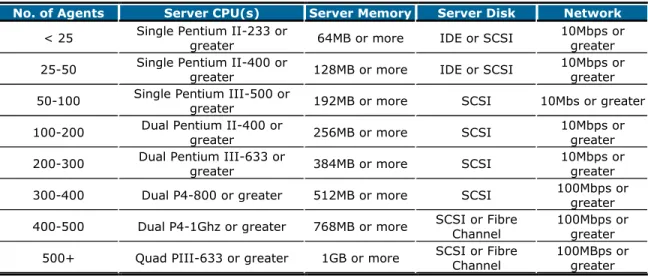
Tables 3 and 4 below shows some final guidelines and recommendations for ELM Server specifications, based on a variety of configuration elements:
Events/Day Server CPU(s) Server Memory Server Disk Network
< 250,000 Single Pentium II-233 or greater 64MB or more IDE or SCSI 10Mbps or greater 250,000 - 500,000 Single Pentium II-400 or greater 128MB or more IDE or SCSI 10Mbps or greater 500,000 - 1,000,000 Single Pentium III-500 or greater 192MB or more SCSI 10Mbs or greater 1,000,000 - 2,000,000 Dual Pentium II-400 or greater 256MB or more SCSI 10Mbps or greater 2,000,000 - 3,000,000 Dual Pentium III-633 or greater 384MB or more SCSI 10Mbps or greater 3,000,000 - 5,000,000 Dual P4-800 or greater 512MB or more SCSI 100Mbps or greater 5,000,000 - 7,000,000 Dual P4-1Ghz or greater 768MB or more SCSI or Fibre Channel 100Mbps or greater 7,000,000+ Quad PIII-633 or greater 1GB or more SCSI or Fibre Channel 100MBps or greater
Table 3 - General Server Sizing Based on Collected Events/Days
No. of Agents Server CPU(s) Server Memory Server Disk Network
< 25 Single Pentium II-233 or greater 64MB or more IDE or SCSI 10Mbps or greater 25-50 Single Pentium II-400 or greater 128MB or more IDE or SCSI 10Mbps or greater 50-100 Single Pentium III-500 or greater 192MB or more SCSI 10Mbs or greater 100-200 Dual Pentium II-400 or greater 256MB or more SCSI 10Mbps or greater 200-300 Dual Pentium III-633 or greater 384MB or more SCSI 10Mbps or greater 300-400 Dual P4-800 or greater 512MB or more SCSI 100Mbps or greater 400-500 Dual P4-1Ghz or greater 768MB or more SCSI or Fibre Channel 100Mbps or greater 500+ Quad PIII-633 or greater 1GB or more SCSI or Fibre Channel 100MBps or greater
Table 4 - General Server Sizing Based on Number of Agents
If you have any questions or comments about this guide, or if you would like assistance sizing your ELM Server or architecting your ELM-based solution, please contact TNT Software's Product Support Group.
15 15 15 15
Configuring the ELM Server Database
Out of the box, ELM creates a Microsoft Access database called ELM.MDB. Even if you cancel out of the Database Wizard that is launched during setup, an Access database called ELM.MDB will be created and used by the ELM Server.
When configuring ELM for SQL Server, MSDE or Oracle, you must first create an empty database to house the collected data. Thereafter, the appropriate tables and columns will be automatically created.
Note
You can use the following formula to determine how large your database will be once you start monitoring Agents and collecting event data:
No. Agents * No. Days Events Retained * No. Events/Day (per Agent) * 415(bytes) = DB Size
For example, if you are monitoring 10 Agents, and you need to keep events for 20 days, and each Agent generates approximately 1,000 events each day then your database will be approximately 70MB:
10 Agents * 20 Days * 1000 Events (per Agent) * 415 bytes = 83,000,000 bytes (or 83MB)
Then, add 10% to this value to account for database overhead. In the above example the resulting disk space usage should be about 92MB.
The above formula treats Alerts as Events for calculation purposes. However, the above formula does not include calculations for collected performance data or Knowledge Base Articles. It is impossible to determine the amount of space consumed by collected performance data because the number of counters, the value for the counters and the frequency of data collection cannot be adequately estimated. In addition, it is impossible to determine how many Knowledge Base Articles will be created, or how large each article will be. Note that only ELM Enterprise Manager and ELM Log Manager can collect events and store Knowledge Base Articles, and that only ELM Enterprise Manager and ELM Performance Manager can collect and store performance data.
» To configure to the ELM Server for Microsoft SQL Server or MSDE: 1. Create an empty SQL Server or MSDE database.
2. Create a Windows or SQL Server user account and grant that account database owner (dbo) privileges to the database you created in Step 1.
3. Run the Database Configuration Wizard:
a. In the Windows 2000 Services MMC snap-in, double-click on the ELM Server service and navigate to the Database tab. If your ELM Server is running on NT 4.0, double-click the ELM applet in Control Panel.
b. Click the Launch Wizard button to launch the Database Connection Wizard. Click Next to continue past the Welcome screen.
c. The Database Type screen will appear. Use the drop-down list on this screen to select Microsoft SQL Server. Click Next to continue.
d. The Microsoft SQL Server screen will appear.
i. Enter the computer name for the SQL/MSDE Server containing the database you created in Step 1.
ii. Enter the name of the database you created in Step 1.
iii. Enter the username and password for the account you created in Step 2. If this is a Windows account, check the Use Windows NT
16 16 16 16
Authentication checkbox. Click Next to continue.
e. The Database Wizard Completed screen will appear. Use the dropdown to specify the length of retention for collected events. By default, collected events are kept in the database forever.
f. Click Finish to save the database connection settings. » To configure the ELM Server for a new Access database:
1. Create a blank Access database in Microsoft Access 2.0 or later format. If you do not have Access installed, or if you have not created a new Access database, you can use the System DSN creation wizard to create a new, blank Access database.
2. Run the Database Configuration Wizard:
a. In the Windows 2000 Services MMC snap-in, double-click the ELM Server service and navigate to the Database tab. If your ELM Server is running on NT 4.0, double-click the ELM applet in Control Panel.
b. Click the Launch Wizard button to launch the Database Connection Wizard. Click Next to continue past the Welcome screen.
c. The Database Type screen will appear. Use the drop-down list on this screen to select Microsoft Access. Click Next to continue.
d. The Microsoft Access Database screen will appear. Enter the path and filename you used for the database you created or specified in Step 1. You can click the
Browse button to browse your file system for the path and filename. Click
Next to continue.
e. The Database Wizard Completed screen will appear. Use the dropdown to specify the length of retention for collected events. By default, collected events are kept in the database forever.
f. Click Finish to save the database connection settings. » To configure the ELM Server for Oracle:
1. Create an empty database on your Oracle server.
2. Create a user account and grant that account database owner (dbo) privileges to the database you created in Step 1.
3. Create a System DSN on the ELM Server computer and configure it to use the database you created in Step 1.
4. Run the Database Configuration Wizard:
a. In the Windows 2000 Services MMC snap-in, double-click the ELM Server service and navigate to the Database tab. If your ELM Server is running on NT 4.0, double-click the ELM applet in Control Panel.
b. Click the Launch Wizard button to launch the Database Connection Wizard. Click Next to continue past the Welcome screen.
c. The Database Type screen will appear. Use the drop-down list on this screen to select Oracle. Click Next to continue.
d. The Oracle Database screen will appear. Enter the name of the DSN you created in Step 3. Enter the username and password you created/used in Step
17 17 17 17
2.
e. Click Next to continue.
f. The Database Wizard Completed screen will appear. Use the dropdown to specify the length of retention for collected events. By default, collected events are kept in the database forever.
g. Click Finish to save the database connection settings.
18 18 18 18
ELM Enterprise Manager
Architecture
ELM Server
The ELM Server process is a 32-bit, multi-threaded, COM-based application that runs as a service on Windows NT, Windows 2000 and Windows XP computers. This process is implemented as a set of engines and other components that provide a variety of functions, as shown in the following illustration:
Session Manager
The Session Manager manages the state of the ELM Server. In addition, when an ELM Console is communicating with an ELM Server, it is communicating via the Session Manager. This is all COM-based communication.
19 19 19 19
Agent Engine
The Agent Engine contains the non-performance related Monitor Items. In addition, the Agent Engine manages the COM objects that represent each Agent.
Performance Engine (ELM Enterprise Manager and ELM Performance Manager only)
The Performance Engine contains the performance-related Monitor Item. In addition, it includes the list of all performance objects and counters that are displayed in the Performance Data container within the ELM Console.
Notification Engine
The Notification Engine executes all notification methods. It manages both the COM objects that represent the Notification Methods, as well as the Notification Method job queue.
Event Engine
The Event Engine manages all of COM objects that represent Event Filters, all Views (Events, Alerts, and Personal), and Rules. In addition, it also executes and maintains both the SNMP and Syslog receiver threads.
Report Engine
The Report Engine manages all of the COM objects that represent all Reports. In addition, it manages a Report Job Queue (for scheduled reports). The Report Engine also creates, manages and maintains the database used by the ELM Server. It also manages report editing, and handles both running and previewing reports.
License Manager
The License Manager maintains current licensing state. The License Manager provides license information to the Agent Engine to ensure that the proper types of Agents are licensed, and that the proper Monitor Items are available to each Agent. It also provides information to the Event Engine to facilitate the licensing of IP Agents that transmit SNMP Traps or Syslog messages to the ELM Server.
Server Socket Thread
This thread is responsible for TCP two-way socket-based communication with all Service Agents. In addition to establishing outbound communication with a Service Agent, this thread also listens for inbound communication from an ELM Agent. This thread is also responsible for reporting the current values of all of the ELM Server's published performance counters. The component of the thread that is responsible for reporting this data does not do anything unless and until something requests the data via the ELM Server performance library file.
MAPI Support
This component provides support for the MAPI Email Notification Method. In addition, in ELM Enterprise Manager, this component includes the Exchange Monitor item.
SNMP Support
This component provides support for the SNMP receiver, the SNMP OID Monitor Item, and the SNMP Trap and OID Notification Methods.
20 20 20 20
Common Objects
This component provides support for updating, managing and saving server configuration data, ELM Server logging, scheduled items, and actions that are triggered from Monitor Items.
Localization Data
This component provides support for non-U.S. English (localized) versions of Windows.
ELM Server Database Engine
ELM includes a built-in database engine that provides database support for a variety of platforms:
S
Microsoft Access (runtime included)S
Microsoft SQL ServerS
MSDES
OracleIn order for ELM to work with a database, you must install the Microsoft Data Access Components (MDAC) version 2.6 SP1 or later and JET 4.0 Service Pack 3. You can freely download both components from Microsoft's Data Access web site.
ELM stores a variety of information in its database:
S
Event Log RecordsS
SNMP TrapsS
Syslog MessagesS
AlertsS
Performance DataS
Knowledge Base ArticlesS
Events generated by ELM Server and AgentsELM includes a licensed runtime version of Microsoft Access that automatically creates an Access database for you. During Setup, a Wizard will launch that will step you through the creation of your database. By default, ELM will create an Access database called ELM.MDB that resides in the ELM program directory. If you are using Microsoft SQL Server, MSDE, or an ODBC-compliant database, you must first create an empty database to house the collected data. Thereafter, the appropriate tables and columns will be automatically created.
ELM creates the following tables in its database:
TNTAlerts
All generated Alerts are stored in this table. All Alerts in this table are displayed in the Alerts container in the MMC snap-in. When you delete an Alert from this container, you are also deleting it from this table.
TNTErrorLog
The ELM Server can be configured to log a variety of activity and error information. When you configure the Server to Log to a Database, the activity and error information will be stored in this table.
21 21 21 21
TNTEvents
This table stores the collected event data. This data includes events from Windows NT, Windows 2000, and Windows XP event logs, SNMP traps, Syslog messages, and events generated your ELM Server and Agents. By default, collected event data is retained in the database forever. You can configure the event retention period by running the Database Connection Wizard.
TNTKnowledgeBaseRecords
All Knowledge Base Articles you create are stored in this table.
For ELM Enterprise Manager and ELM Performance Manager only: In addition to the above tables, any performance data that is collected will be stored in tables whose names begin with the letters PD and correspond to the performance object being collected. For example, if you were collecting the Process performance object and counters, the data would be stored in a table called PDProcess; if you collect the Memory objects and counters, the data is held in a table called PDMemory. ELM can aggregate
(average) collected performance data on a weekly, monthly or quarterly basis. By aggregating your collected data, you can reduce the growth rate of your database.
Service Agents
ELM uses a Service Agent to monitor Windows NT, Windows 2000, and Windows XP computers in real-time.
A Service Agent can run on the following computers:
•
Windows NT Workstation 4.0 w/SP5 or greater•
Windows NT Server 4.0 w/SP5 or greater•
Windows NT Server 4.0 - Enterprise Edition w/SP5 or greater•
Windows NT Server 4.0 - Terminal Server Edition w/SP5 or greater•
Windows 2000 Professional•
Windows 2000 Server/Advanced Server•
Windows XP ProfessionalAgents and Servers can have one-to-one or one-to-many relationships. A Server can monitor multiple Service Agents and a Service Agent can be monitored by multiple Servers. Each Service Agent maintains separate configuration, collection set and cache files for each Server that is monitoring it.
The Service Agent is comprised of a 32-bit, multithreaded executable called TNTAGENT.EXE, its companion DLLs and its configuration data. These files exist in the %systemroot%\TNTAgent and \Program Files\Common Files\TNT Software\ELM 3.0 folders on the monitored system. It runs as service under the LocalSystem account on each monitored system. Service Agents typically consume about 7-15MB of memory, and less than .1% of the overall CPU time on the monitored system. The amount of resources actually consumed depend on the number of Monitor Items applied to the Agent, the frequency at which those Monitor Items are executed, and the amount of data generated by or being collected from the monitored system.
Service Agents create files in the TNTAgent folder that contain configuration data and cache information:
File Name Description
TNTAgent.dat Agent configuration data
22 22 22 22
If the communication or connectivity between the Service Agent and the ELM Server are interrupted, or if the ELM Server is down for any reason, the Agent will go into Cache Mode. In Cache Mode, the Agent will cache up to 10MB of data.
File Name Description
SERVER-XXX.CACHE
Event cache file (where SERVER is the name of the ELM Server(s) monitoring the Agent and XXX represents the three character product edition: ELM Enterprise Manager - EEM, ELM Log Manager - ELM, and ELM Performance Manager - EPM).
This cache file will be located in one of two places:
S
If the Agent has an ELM Server or an ELM Console installed, the cache file will reside in the \Program Files\Common Files\TNT Software\ELM 3.0 folder.
S
If the Agent does not have an ELM Server or an ELM Console installed, the cache file will reside in the TNTAgent folder.Note
Agents monitored by multiple ELM Servers may not go into cache mode for all Servers at the same time. The cache mode behavior on an Agent monitored by multiple Servers will depend on the nature of the communications disruption. For example, if one of the ELM Servers is down for maintenance, the Agent will go into cache mode for that ELM Server only. The Agent will only go into cache mode for those ELM Servers with which it cannot communicate.
Also note that disabling an Agent or its Monitor Items does not put it into cache mode. This means that data transmitted by the Agent after
re-enabling an Agent is not cached data and will therefore trigger applicable Rules and Notification Methods.
Windows-based Monitor Items that can be used for Service Agents include:
Event Collector/Alarm
Event Collectors are used to monitor and collect events from the event logs on Windows NT, Windows 2000, and Windows XP. You can specify the events you want to collect based on a variety of event criteria, including event type, source, event ID, and event details. Event Alarms are used to trigger action and/or notification when an event does or does not occur. Event Alarms can be configured for Windows NT, Windows 2000 and Windows XP Agents.
Cluster Monitor
Event Log Monitor used a combination of a Server Agent and ELM Cluster Monitor (a cluster-aware resource DLL) to provide enhanced monitoring and performance data collection in Windows NT and Windows 2000 clusters. A Cluster Monitor replaces these two components with an integrated cluster-aware Service Agent. You can use a Cluster Monitor to watch cluster system and cluster registry events. The Cluster Monitor thread can monitor any or all of the seven Cluster APIs: cluster events, quorum events, network events, node events, group events, resource events and registry events.
23 23 23 23
File Monitor
Event Log Monitor used a separate executable called FileMon.exe to monitor ASCII flat files. FileMon has been integrated into this version of ELM to provide you easier monitoring of flat files. You can monitor individual files, an entire directory of files, or an entire directory tree of files.
Performance Alarm
Performance Alarms monitor performance objects, counters and instances and can generate a variety of Notification Methods when a counter or instance of a counter is greater than, less than or equal to your specified threshold for your specified duration. You can use this monitor item on Windows NT, Windows 2000, and Windows XP.
Performance Data Collection Set
This Monitor Item is used to collect and store performance data from Windows NT, Windows 2000, and Windows XP computers. A Collection Set is a group of performance counters that are collected at the same time. You can use multiple Performance Data Collection Sets that contain different groups of counters, or a single Performance Data Collection Set that contains all of the counters you want to collect.
Process Monitor
If you need to monitor individual processes, you can do so with a Process Monitor. The Process Monitor is multi-functional; it can let you know when a process has exceeded the threshold of CPU usage you specify, and it can track when processes are instantiated or terminated.
Service Monitor
Service Monitor items are used to monitor individual services and devices on Windows NT, Windows 2000, or Windows XP. Service Monitors can generate notification when a service or device is stopped, started, paused or resumed. In addition, Service Monitors can alert you when it finds a service or device set to Automatic startup that is not running.
SQL Monitor
Using SQL Monitors, you can periodically execute SQL queries against a database and generate a variety of notification options if the results returned are different from what is expected. SQL Monitors support both Windows NT and SQL Server authentication, making them easy to fit into your existing SQL security environment.
WMI Monitor
If you are using Windows Management Instrumentation--the Microsoft implementation of Web-Based Enterprise Management (WBEM)--you can use WMI Monitors to query a WMI namespace and database. If the results of the query change, a variety of notification options can be executed.
In addition to the above Windows-based Monitor Items, ELM Enterprise Manager can also execute TCP/IP-based Monitor Items against a Service Agent. TCP/IP-TCP/IP-based application monitoring is performed through the use of the following Monitor Items and Receivers:
24 24 24 24
FTP Monitor
This monitor is used to monitor a specific FTP URL. The ELM Enterprise Manager Server periodically establishes an FTP connection to the URL and port specified. If the response is negative or slower than expected a variety of notification options can be triggered.
TCP Port Monitor
If you need to monitor a TCP port on any TCP/IP-based system or device, you can use a TCP Port Monitor to do so. Simply specify the port you wish to monitor and the expected response time in seconds.
Ping Monitor
The Ping Monitor is used to send period ICMP echo requests to the Agent(s) being monitored. You can specify the size of the echo request packets and the number of packets that are sent.
POP3 Monitor
POP3 Monitors are used to periodically check a POP3 mailbox for availability. The ELM Enterprise Manager Server periodically establishes a POP3 connection to the server and port specified using the mailbox credentials you enter. If the response is negative or slower than expected a variety of notification options can be triggered.
SMTP Monitor
SMTP Monitors are used to keep tabs on SMTP hosts, gateways and services. The ELM Enterprise Manager Server periodically establishes an SMTP connection to the server and port specified. If the response is negative or slower than expected a variety of notification options can be triggered.
Web Page Monitor
Web Page Monitors are used to monitor HTTP and HTTPS URLs. The ELM Enterprise Manager Server periodically establishes an HTTP connection to the server and port specified. If the response is negative, slower than expected, or if the content has been changed, a variety of notification options can be triggered.
SNMP OID
ELM includes an SNMP Monitor that enables you to query an SNMP Object ID (OID) and trigger notification if the value is greater than, less than or equal to a specified value. The SNMP Monitor includes an object browser that enables you to query the objects on an SNMP-capable computer, and select specific objects for monitoring.
SNMP Traps
SNMP systems are monitored using IP Agents. The ELM Server listens for SNMP Traps from registered IP Agents, and treats the incoming traps as events.
Syslog
Unix, Linux and other Syslog clients are monitored using IP Agents. The ELM Server listens for Syslog messages from registered IP Agents, and treats the incoming messages as events. Windows-based Syslog clients can be Service Agents and Remote Agents, as well.
25 25 25 25
Remote Agents
To monitor a TCP/IP system or device, or to monitor a Windows NT, Windows 2000, or Windows XP computer without installing any additional software, you can use a Remote Agent. Using a Remote Monitor is called Agentless monitoring because no Agent code is installed on the monitored system. Because Agent code is not used on the monitored system, this will add overhead to your network. However, this scenario is advantageous when you do not want to install any software on the monitored system in order to keep tabs on it.
Remote Agents are not monitored in real-time. Instead, they are monitored one of three ways:
S
The ELM Server can execute the Windows-based Monitor Items listed below on a Remote Agent.S
The ELM Server (ELM Enterprise Manager and ELM Log Manager only) can passively listen for SNMP traps, Syslog messages from a Remote Agent.
S
The ELM Server (ELM Enterprise Manager only) can actively make Internet application protocol connections to the Remote Agent to check availability and quality of service.Windows-based Monitor Items that can be used for Remote Agents include:
Event Collector/Alarm
Cluster Monitor
File Monitor
Performance Alarm
Performance Data Collection Set
Process Monitor
Service Monitor
SQL Monitor
WMI Monitor
FTP Monitor
TCP Port Monitor
Ping Monitor
POP3 Monitor
SMTP Monitor
Web Page Monitor
SNMP OID
SNMP Traps
26 26 26 26
IP Agents
ELM can monitor IP devices using an IP Agent (also known as a Remote IP Agent). The ELM Server listens for traffic (e.g., SNMP traps, Syslog messages) and can poll IP-based services (e.g., SMTP, HTTP, etc.) for availability and quality of service. This scenario is advantageous when you do not want to install any software on the monitored system in order to keep tabs on it.
The primary difference between a Remote Agent and an IP Agent is the available connectivity. Remote Agents are DCOM-based and therefore rely on NetBIOS, RPC and DCOM ports to be open between the ELM Server and the monitored system (Agent). IP Agents do not require these ports, and only require TCP connectivity based on what is being monitored. This means, of course, that IP Agents have a subset of the monitoring capabilities of Remote Agents. The following Monitor Items can be assigned to IP Agents:
FTP Monitor
TCP Port Monitor
Ping Monitor
POP3 Monitor
SMTP Monitor
SNMP OID
Syslog
27 27 27 27
User Interface
The user interface to the ELM Server is called the ELM Console Snap-In, or simply the ELM Console. ELM uses the Microsoft Management Console (MMC) framework to host its primary user interface. The ELM Console is implemented as a standalone snap-in that requires MMC 1.2 or later to operate. You can add multiple snap-ins if you have more than one ELM Server in your organization. You can use the ELM Console in as a standalone application, or you can add native operating system and third-party snap-ins. By combining all of your snap-ins into a single MMC console, you can manage your network and infrastructure using single-seat administration.
The ELM Console provides the user interface to the ELM Server. The left pane of the Console contains the console tree, also known as the Scope pane. This tree displays the ELM hierarchy. The ELM Server, which resides at the top of the snap-in hierarchy,is your workspace within the ELM Console. The right pane of the Console is the details pane, also known as the Results pane. When you select an item in the console tree, the contents of the details pane will change to reflect the item you selected.
The ELM Console uses both standard views and Taskpad views for the Results pane in the ELM Console. Standard view are explorer-like views of objects and items. Taskpad views are also explorer-like, but also provide the ability to add shortcuts to functions (tasks) from inside and outside a given console. The Taskpad views include shortcuts for the most common functions in the ELM Console, such as starting Wizards, updating Agents, and so forth. You can modify the existing Taskpad views, or create additional custom Taskpad views that contain the desired tasks. For more information on creating or modifying Taskpad views, refer to the Microsoft Management Console Help file.
Important
You cannot select multiple items in a Taskpad view. Attempting to do so will cause an error message to appear. In order to select multiple items, you must switch to the standard view for the results pane in the ELM Console.
The ELM Console provides a logical container-based representation of the ELM Server Objects you can configure:
Agents. The ELM Server communicates with Service Agents, Remote Agents and IP Agents. ELM Agents monitor Windows NT, Windows 2000 and Windows XP event logs, system services, performance data, and active processes and forward information to one or more central ELM Servers.
Alerts are displayed in the Alerts container, and are visible from any ELM Console. Alerts can be generated by both Actions and Notification Methods.
Event Filters are used to isolate one or more specific events. Event Filters provide a mechanism for selecting a subset of all events. Using wild cards and Boolean logic, the filter will identify an
28 28 28 28
event or group of events. Any number of Event Filters can be combined to create a complex set of events. By using wildcards and Boolean operators, the Administrator does not have to be familiar with every event log message.
Event Views provide a mechanism for grouping events into a view that match one or more filters. Each view is dynamically updated as new events occur. By using Event Views to organize volumes of event log information the administrator can quickly diagnose problems.
Knowledge Base Articles can be used to annotate collected events with customizable notes and comments. Knowledge Base articles (KBs) are used to represent this information. Since this database is centralized, all of your technicians, Help Desk staff and other users can access and benefit from using KBs . When a problem first appears, its cause and solution can be documented in a KB. Next time the problem occurs, the amount of time used to troubleshoot and resolve it is reduced because the cause and resolution information is at hand.
Monitor Items are individual items that you want to monitor. For example, to monitor the event logs on Windows NT, Windows 2000, or Windows XP, you would use an Event Monitor. If you want to monitor services, you would use a Service Monitor.
Notification Methods are the ways you would want to be notified of events that occur. You can have separate methods for various event categories, or separate methods for various application events. For example, you could have one method that describes how to notify a database administrator about important database related events, and another method for notifying a security administrator about important security related events.
Rules are used to take action when a specific event, alarm or condition occurs. A Rule combines any number of Notification Methods with any number of Event Filters to create a procedure for notifying an administrator when important events occur, for taking corrective action, or both.
Personal Views are essentially personal Event Views. Personal Views enable you to create and customize views for your own use that are separate from the server-based Event Views that you can create.
Reports are used for reporting against the collected data in your database (Events, Performance Data, Alerts or Knowledge Base items). ELM includes a robust reporting engine and provides you with a Wizard-based interface for creating reports on the fly, and for scheduling reports to run at a specified time.
ELM also uses Wizard-based technology to step you through the most commonly performed tasks.
Wizards can be run from a variety of places, including context menus and within other Wizards.
Web Viewer
The Web Viewer provides a read-only view of your ELM Server data. In addition to viewing information, you can also enable and disable items, and view reports that have been saved and output in HTML format. During installation of the ELM Server, you are presented with an option to automatically create an ELM virtual directory on the ELM Server. If your IIS server is running multiple Web Sites (also known as Virtual Web Servers), you can select which Web Site you want to contain the ELM virtual directory. The virtual directory should point to the WebSite directory on your ELM Server (by default, C:\Program Files\TNT Software\ELM30\WebSite).
The Web Viewer provides access to the following items:
Agents
Alerts
Event Filters
Event Views
Knowledge Base Articles
Notification Methods
29 29 29 29
Personal Views
Reports
Rules
The Web Viewer is implemented as a set of COM objects within Active Server Pages (ASP) documents. It uses the Extensible Markup Language (XML) as the transport mechanism for the data, making it
lightweight and fast, and XSL (XML Styles) to format the data's appearance.
The Web Viewer can be installed on Internet Information Server/Services 4.0, 5.0, and 5.1. Integration with IIS means that you can secure the Web Viewer from unauthorized use. In addition, you can control the name of the virtual directory, the port, and other properties. The Web Viewer server components must run on the ELM Server computer.
Once installed on the server, you can access the Web Viewer by pointing your Web browser at the virtual directory (by default EEM30). For example, to access the Web Viewer on a server names EARTH, you would point your Web browser to http://earth/eem30.
Note:
While we recommend using Internet Explorer as your Web browser, the Web Viewer can be access using any Web browser that supports XML parsing and Javascript.