* Dr. Karanam Pushpanadham holds Ph.D. in Education from the Maharaja Sayajirao University of Baroda, India. Currently he is working as a Director, Education E-Learning Programme at the Faculty of Education, Assumption University of Thailand. He has given special lectures in many universities such as Burapah University, Mahasarkham University etc., in Thailand and several universities in India.
BASED MANAGEMENT
byDr. K. Pushpanadham*
Abstract
Educational Leadership is identified as an important factor for quality education and developing countries have focused on this important factor and implemented systematic train-ing and development programs for their leaders. Moreover, the latest educational policies ad-vocate decentralized educational management, which has brought both benefits and problems in a number of countries. However, these initiations are far away from the expectations. Any educational reform will not be successful without both an evolution of institutional structures and specialized training and development programs for education professionals. One strategy for achieving these goals is found in School Based Management (SBM), a model of decentral-ized school administration that provides clear guidelines and has been successfully introduced in a number of countries. This paper focuses on the principles and practices of School Based Management for school effectiveness.
Introduction
The ultimate power to change is--and has always been-- in the heads, hands, and hearts of the educators who work in the schools.
Sirotnikand Clak (1988) Education is a key factor in all-national de-velopment, whether it be social, political, eco-nomical, cultural, or moral. For this reason,
de-velopment of well-managed quality education has been strongly advocated by UNESCO and made
the focus of efforts in many developing nations. A variety of policies and program perspectives have been developed to meet educational needs of particular countries, helping them to move toward educational parity with the developed world.
Organized participation in decentralized edu-cational planning has become increasingly impor-tant in these reform efforts. In the past, entities such as Parent Teachers Associations, School Development Committees, and even the Village Planning Committees have functioned without the statutory recognition that would make possible a clear charter of powers and responsibilities. (Ambast 1999). Community participation, how-ever, has been identified as a central facilitating condition for quality education, on at par with pro-fessionalism of teachers, principals' initiative be-havior, teacher collegiality, organizational flexibil-ity, pedagogical flexibility and accountability (Lockheed and Levin, 1991). These authors have recognized that if the cycle of disempowerment of marginal communities is to be broken, the cri-teria for monitoring and evaluating school perfor-mance need to include accountability to local cli-enteles.
What Research Says?
Several research studies have found that the effective decentralization of management largely depends on efficient leadership. In the contact of school management, effective principal has to pro-vide leadership in implementing changes in school programs. Principals can successfully resolve dis-ciplinary problems and give advice and direction to teachers (Sharma 1982) and several research studies conducted in India found a relationship between the effectiveness of the school principal's leadership style and overall institutional climate
and school performance. Dhulia (1989) found a positive correlation of school climate with teach-ers' job satisfaction. On the other hand, Vasantha (1989) found lack of awareness of and encour-agement for the use of modern manencour-agement tech-niques in school administration on the part of school leaders.
Chakraborti (1990) found that the open mate in schools, ways of creating congenial cli-mate largely depends on the leader's personality and his behavior. Subudhi (1990) showed the importance of management training to principals to enhance their capacity for changing their atti-tude to bring about desirable changes in their re-spective institutions. Sharma (1991) studied the administrative behavior of principals as perceived by teachers in relation to job satisfaction of teach-ers and student achievement in junior college. The author found a positive relationship between ad-ministrative behavior and teachers job satisfac-tion and educasatisfac-tional attainment of teachers.
Govinda and Verghese (1991) found that "The operational setting in which the schools function provides the internal environment in the schools and is reflected through; (i) the infrastructure fa-cilities available; (ii) the human resources espe-cially the teachers and the administrators; (iii) the teaching-learning process to take into account the way curriculum is transacted; (iv) the learner achievement. Learner achievement is considered as an indicator for education. Jayajothi (1992) studied the organizational climate and leadership behavior of principals in relation to teacher mo-rale in central schools and found that the open climate related best to the perception of leader-ship behavior of principals by the teachers. Kak (1992) studied the cybernetic approach to the school administration and found the necessary conditions for creating congenial conditions for
work in schools were autonomy, immediate re-ward, opportunity to exert, immediate awareness, interaction and manageability. Autonomy was found to be the function of security, stability and freedom to perform. Sense of responsibility was found necessary for self-actualization. Opportu-nity to exert was found essential for liberating per-ceptive effort, which was found to be crucial for creative performance.
School Based professional development is the vital concern today in most of the schools. Minis-tries of Education in developing counMinis-tries have been encouraging schools to design and develop their own professional development plans for teachers. School Based Management is a poten-tial model, which highlights the various processes of strengthening institutional capacity for quality education.
School-Based Management (SBM) Model:
It is an approach to improve the quality of education by relocating significant decision-mak-ing authority from state and district offices to in-dividual schools. SBM model fosters principals, teachers, students, and parents to have greater control over the education process by giving them responsibility for decisions about the budget, per-sonnel, and the curriculum. Through the involve-ment of teachers, parents, and other community members in these key decisions, SBM can facili-tate in generating more effective learning environ-ment for students. The core components of SBM are decentralization of administration, participa-tion by staff, parents and the community in the school, making schools more competitive, and using action research to make schools more ef-fective. Delegation of power and authority is con-sidered to be a significant factor in SBM model
that leads to commitment, trust, and a sense of ownership.
The very purpose of school-based manage-ment is to strengthen the school as a system by accelerating its structures, process and personnel for creating learning organization, where learning is considered as a value. Establishing high aca-demic standards, maintaining positive human re-lations, developing a sense of ownership, foster-ing high reputation in the society and acceptfoster-ing innovation and change are the key features. The following figure explains the concept of school-based management.
The dominant expectations, at the school level, for SBM appear to be:
.
Involvement of staff in decisions about programs and organization;.
Involvement of parents and others in the community in the school;.
Efficient and effective allocation of re-sources, based on a school budget;.
Strong instructional leadership and a fo cus on educational concerns;.
An environment supportive of profes-sional growth and collaboration;.
Long term academic improvement;.
Positive attitudes toward, and support for the school demonstrated by staff, students, par-ents, and the community; positive behavior, mod-eled by the staff; and.
The school should be successful and ef-fective in meeting its goals.(Caldwell, B. 1990) (Herman, J. & Herman, J., 1993) (Murphy, J., & Beck, L.1995) (Neal. R. 1991) Reeves (1992).
work independently with need based perspec-tive plans. The state and center's role would be to assist the decisions made at the school level, and provide technical assistance when a school has difficulty in translating the nation's vision into high-quality programs. State holds the responsi-bility to take initiatives in developing student and staff performance standards and evaluating the schools. The state provides the curricular goals, objectives, and expected outcomes while leaving it up to the schools to determine the methods to accomplish the desired results. The school man-agement councils at each school that include the principal, representatives of parents and teachers, and, in some cases, other citizens, support staff, and students, conduct the needs assessment and develop a plan of action that includes statements of goals and measurable objectives in consistent with school board policies. This means the principal has to perform
a host of challenging tasks.
Leadership for Improving the Effectiveness of SBM:
The research literature in SBM highlights that most successful principals were effective in mov-ing four resources - Delegation of power, Pro-fessional development through training, Informa-tion Management and MotivaInforma-tional devises.-- to teachers and community members. Therefore, specialized leadership training for school leaders focusing on the above dimensions is the essential requirement prior to the implementation of the SBM model in schools.
Focus areas for Leadership Training:
.
The development of a culture of continu-ous improvementSCHOOL BASED MANAGEMENT
Decentralization Autonomy Collaboration Planning and Evaluation
Curriculum Management Financial Management School Governance
Human Resource Management
*Learning Culture *High Academic Performance *Positive Human Relationship *Sense of Ownership *High Reputation *Innovation and Change
.
Increased innovation and creativity.
Enhanced skills and understandings.
Improved commitment and energy.
Improved capacity to adapt to changing circumstances.
Greater responsiveness to the external environment.
More effective school, parish, and com-munity partnerships.
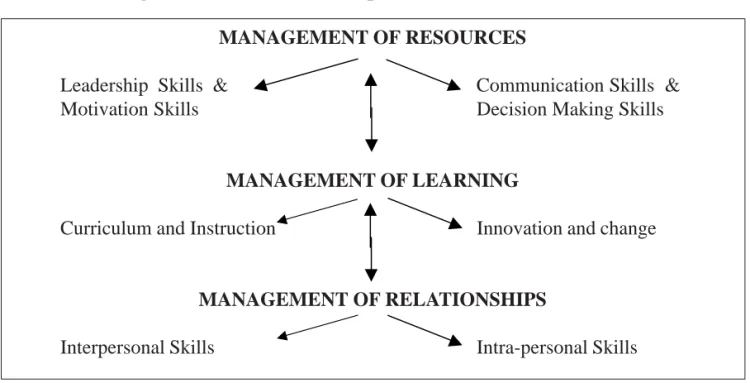
Quality of student outcomesIn the present scenario of development edu-cation, the leaders are not merely leaders but they are the agents of transformation. A suitable model for leadership training for school heads must fo-cus on the following:
Such leadership development programs cer-tainly enrich the skills, attitude and knowledge of the school leaders and thus the following impor-tant components for effective school leadership can be nurtured.
Figure 1: A Model for Development of Educational Leaders MANAGEMENT OF RESOURCES
Leadership Skills & Communication Skills & Motivation Skills Decision Making Skills
MANAGEMENT OF LEARNING
Curriculum and Instruction Innovation and change
MANAGEMENT OF RELATIONSHIPS
Interpersonal Skills Intra-personal Skills
1. Delegation of Power
Successful school leaders believe to diffuse power throughout the school organization to so-lidify and increase commitment to the organiza-tion. Schools must promote vertical and horizon-tal work groups that involve nearly all teachers in the school and community members and parents. Sometimes the groups can have binding authority to advice the principal or the school-site council.
2. Professional Development Through Training
Principals must promote school-wide staff development programs to improve the capacity of the whole school. If the school could not af-ford to train all staff, then a small group can be trained with the expectation these teachers would share their new knowledge and skills as master trainers with the other teachers. Effective princi-pals also encourage on-site, continuous staff de-velopment of the staff and not the one-shot, "go and get" variety, which is more fragmented in
na-ture. A continuous and comprehensive system of professional development through training can be created to train the teachers in pedagogical as well as managerial dimensions of the school .
3. Management of Information
The principal's role in information sharing is to distribute the information liberally and frequently across the school. Strategies must focus on the information sharing within the school, as well as stakeholders outside. Another key area is to bring the information -- ideas and research -- into the school from outside sources. Effective principals in schools use a variety of strategies to share in-formation among participants, particularly at the school site. Principals must work with staff to develop a clear vision for the school to ensure the vision is communicated school-wide to all con-stituents. Principals also must disseminate infor-mation about the school activities and student performance through newsletters to the whole school community.
4. Motivational Devices
Sustaining motivations among teachers and parents is vital in SBM Model. Principals may write thank you notes and publicly recognize staff at faculty meetings. Building the intrinsic motiva-tion of teachers is a useful mechanism for princi-pals to encourage teachers and community to use their capabilities to support school goals.
Conclusion
Professional Leadership is the necessary fac-tor for successful implementation of decentralized management of education at all levels. At this junc-ture, a systematic and need based professional preparation of Principals, teachers, parents and
members of the community is needed. SBM Model and Decentralized Management Structures at micro level of school management allow people to take part in various school programs. There-fore, at every level of decentralized structure, there is a dire need to build the capacity of stake hold-ers to make the school based management suc-cessful. The role of government at this context is to prepare the conditions of work through which the desired institutional goals are achieved.
References
American Association of School Administrators, National Association of Elementary School Principals, and National Association of Sec-ondary School Principals(1988). School-Based Management: A Strategy for Better Learning. Arlington, Virginia.
Annual Report (2000-01), Government of India, Ministry of Human Resource Development, Department of Eduation.
Arterbury, E., and Hord, S. M. (1991) “Site-Based Decision Making: Its Potential for Enhancing Learner Outcomes.” ISSUE...ABOUT CHANGE 1/4: entire issue.
Brain J.C. (1988), The Self-Managing School, The falmer Press, U.K.
Buch M.B, (Ed), (1979, 1987, 1991 ), Surveys’ of Research in Education, NCERT, New Delhi.
Brown, D. J. (1987) A Preliminary Inquiry into School-Based Management, Ottawa, Canada: Social Sciences and Humanities Research Council of Canada, March 1987. (ED 284 331).
Policymakers Can Support It or Undermine It.” The Link 10/2: 1, 7-9.
Cistone, P. J.; Fernandez, J. A.; and Tornillo, P. L., Jr. (1989) “School-Based Management/ Shared Decision Making in Dade County (Miami).” Education and Urban Society 21/ 4: 393-402.
Conley, S. C., and Bacharach, S. B. (1990) “From School-Site Management to Partici-patory School-Site Management.” Phi Delta Kappan 71/7: 539-544.
Dhulia Usha (1989). “A Study of the role, Ad-ministrative Style, Teachers Job Satisfaction and Students Institutional Perception in Determining the Nature of School Climate”. Ph.D. Edu., Hemvati Nandan Bahuguna Garhwal Univ. Fifth survey of Educational Research-Vol. I (1982-92), NCERT, New Delhi.
David Tuohy and David Coghlan (1997), “De-velopment in Schools: A System Approach Based on Organisational Levels”, Journal of Educational Management and Adminis-tration, Vol. 25, Number 1, U.K.
Education and National Development, Report of the Education Commission (1964-66), Gov-ernment of India, Ministry of Education, New Delhi.
Guthrie, James W. (1986). “School-Based Man-agement: The Next Needed Education Re-form.” Kappan 68(4), 305-9.
Johnston, G. S., and Germinario, V. (1985) “Re-lationship Between Teacher Decisional Sta-tus and Loyalty.” The Journal of Educa-tional Administration 23/1: 91- 105. Lewis, J., Jr. (1968), Planning Guidelines for
Implementing School-Based Management,
Westbury, NY: J. L. Wilkerson Publishing Company, 198 National Policy on Education,
Ministry of Education, New Delhi.
National Policy on Education (1986), Govern-ment of India, Ministry of Human Resource Development, Department of Education. Programme of Action (1992), Government of
India, Ministry of Human Resource Devel-opment, Department of Education.
Report of the University Education Commission (1948), New Delhi, 1950.
Pushpanadham. K. (2000), A Study on the Decentralised Management of District Primary Education Programme, Ph.D. Un published Thesis, CASE, MSU, Baroda. Pushpanadham, K. (2002), “Developing
Educa-tional Leadership: A Training Strategy for School principals”, Focus School Educa-tion, NIEPA Publications, New Delhi. Peterson, David.(1991) “School-Based
Manage-ment and Student Performance”. ERIC Di-gest No. 62. Eugene, Oregon: ERIC Clear-inghouse on Educational Management. Rosenholtz, S. J. (1985) “Effective Schools:
In-terpreting the Evidence.” American Journal of Education93/3: 352-388.
Report of the Secondary Education Commission, (1952), Ministry of Education, New Delhi, 1956.
Sharma S. (1982). “A Study of Leadership Be-havior of Headmasters vis-?-vis the School Climate of Secondary Schools in West Ben-gal and to Corelate it with other Relevent Variables”. Ph.D. Edu., Univ. of Calcutta.
Fifth survey of Educational Research-Vol. I (1982-92), NCERT, New Delhi.
Vasantha A. (1989). “Modern Management Techniques in School Administration: A Fea-sibility-cum-Model Setting Study with Par-ticular Reference to Schools in Tamil Nadu”. Ph.D. Edu., Karnatak Univ. Univ. Fifth
survey of Educational Research-Vol. II
(1982-92), NCERT, New Delhi.
William Walker et al (Edit.) (1991), Advancing Education: School Leadership In Action, The Falmer Press, London.