NBPHE
Presentation Objectives
•
Why a job task analysis?
•
Define a job task analysis
•
State the purpose of the public health job task analysis
•
Describe who conducted the analysis and their functions
•
Describe the development of the survey
•
Describe the survey respondents
•
Describe the task domains and specific tasks that were
CPH Eligibility
•
Graduates of CEPH accredited SPH/PHP
•
Students who have taken the core courses
•
Individuals who have taken the core and have a relevant
graduate degree
•
New – Individuals who have a bachelor’s degree and at
least five years public health work experience. Pilot in
October 2015
Who is requiring the CPH Exam?
1. Brigham Young University
2. St. George's University
3. University of Louisville
4. University of Kentucky
5. University of North Texas
6. University of Oklahoma
7. University of South Florida
8. Oregon MPH Program
Other schools/programs with significant CPH participation
•
Columbia University
•
CUNY
•
Drexel University
•
Eastern Virginia Medical School
•
University of Florida
•
Johns Hopkins University
•
University of Pittsburgh
The CPH Examination
•
3 testing cycles per year at
computer-based testing centers:
February, June
and
October
•
Exams given M-F and some Saturdays
•
Paper-pencil testing administrations
available by request
The CPH Examination
•
No calculators or scratch paper allowed
•
White board & markers may be used
The CPH Examination
•
200 items
•
Pass rate is 80-85%
Exam Coverage
Core areas
•
Biostatistics (30 items)
•
Epidemiology(30 items)
•
Environmental Health
Sciences (30 items)
•
Health Policy &
Management (30 items)
•
Social and Behavioral
Sciences (30 items)
Cross Cutting areas (25 items)
•
Communication & Informatics
•
Diversity & Culture
•
Leadership
•
Professionalism
•
Program Planning
•
Public Health Biology
•
Systems thinking
50.0% 55.0% 60.0% 65.0% 70.0% 75.0% 80.0% 85.0%
Exam Performance by Domain
Bio EOH Epi HPM SBS Cross Cutting
CC
HPM
Epi
SBS
Bio
EOH
Price and discount program
•
$385
- Regular registration
•
Schools/programs which sponsor minimum number of candidates can extend lower
price to students and alumni:
•
If minimum = 20% of graduating class:
$345
•
If minimum = 30% of graduating class:
$315
•
$250
for SPH/PHP which require the CPH
Study Resources
•
Content Outline
•
Sample Exam
Questions
•
Practice Exam
Bi-Annual Recertification Process (CEs)
•
Bi-annual recertification process requiring CPH to earn
50
recertification credits
•
Reporting via an online recertification portal
Purpose of the Public Health Job Task Analysis
The purpose of the public health job task analysis is to
survey the domains and tasks identified by workers as
associated with their positions as the basis for refining the
Certification in Public Health examination sponsored by the
NBPHE. As our purpose was to impact the CPH
examination, our focus is on workers with advanced
degrees.
Job Task Analysis Advisory Committee
•
Julie Sheen Aaron, MPH
, Chief Public Health Branch, HRSA
•
Vladimir Berthaud, MD, MPH
, Director, Division of Infectious Disease, Meharry Medical College
•
Terry Brandenburg, MBA, MPA, MPH
, Program Director, Medical College of Wisconsin
•
Justin Frederick, MPH, CPH
, Supervisor of Communicable Disease Epidemiology, Douglas County Health
Department
•
John Jacoby, MBA, PhD
, Technical Advisor, Afton Chemical
•
Pia MacDonald, PhD, MPH
, Director, Epidemiology Center, Social & Scientific Systems, Inc.
•
Elizabeth Majestic, MS, MPH
, Association Director for Program Development, CDC
•
David Palm, MA, PhD
, Director of the Office of Community and Rural Health, Nebraska Department of
Health and Human Services
•
Kalpana Ramiah, DrPH, MPH, MSc, CPH
, Principal Project Specialist, American Institutes for Research
•
Mary Helen Smith, MPH
, Director of Environmental Health, Mahoning County District Board of Health
•
Laura Streichert, PhD, MPH
, Executive Director, International Society for Disease Surveillance
•
Karen Sicard, JD, MPH
, Deputy Branch Chief, U.S. Public Health Service/Centers for Disease Control and
Prevention
Responsibilities of Advisory Committee
Define the target practitioner
Develop demographic questions
Develop job tasks and skills
What is a Job Task Analysis?
Survey to define
performance
domains and tasks
performed by a
professional
group
, and the
necessary
knowledge and
skills associated
with these tasks.
Domain #1
Task #1
Task #2
Domain #2
Task #1
Task #2
Council of Linkages
ASTHO
Blue Ribbon
ASPPH MPH Report
NBPHE JTA
CEPH Criteria
Revision
MPH Foundational
Skills
Analytical/Assessment Skills Informatics and Analytics Analytic Methods & Technology and
Information Analysis Critical / Strategic Analysis Data Analysis Communication Skills Communicating Persuasively Communications Communication Communication Communication
Cultural Competency Skills
Working with Diverse Populations & Working;
Managing a Diverse Workforce & Staff Development
Management and teamwork Diversity Diversity and Cultural Proficiency Cultural Competency
Policy Development/Program Planning
Skills Political Sensitivity Policy Policy Advocacy Policy & Advocacy Leadership and Systems Thinking
Skills Systems Thinking & Problem Solving
How the Health System Works
Problem Solving Systems Thinking Leadership & Systems Thinking Systems Thinking
Financial Planning and Management
Skills Change Management/Flexibility
Leadership;
Budgeting and Finance Management, Finance & Policy Professionalism
Public Health Sciences Skills Science Biological & Environmental Applications
Program Planning, Management & Evaluation
Community Dimensions of Practice
Skills Global Health Global Health Policy Health Systems
Collaboration Collaborating and Partnering
Adaptability; Resilience ;
Council of Linkages
ASTHO
Blue Ribbon
Job Task Analysis
ASPPH MPH
Report
Analytical/Assessment Skills
Informatics and Analytics
Analytic Methods &
Technology and Information
Critical / Strategic Analysis
Analysis
Communication Skills
Communicating
Persuasively
Communications
Communication
Communications
Diversity
Cultural Competency Skills
Working With Diverse
Populations & Recruiting
and Managing a Diverse
Diversity and Cultural
Proficiency
Diversity
Policy
Development/Program
Planning Skills
Political Sensitivity
Policy
Advocacy
Policy
Leadership and Systems
Thinking Skills
Systems Thinking
How the health system
works
Leadership & Systems Thinking
Systems thinking
Financial Planning and
Management Skills
Change
Management/Flexibility
Management and teamwork
& Budgeting and finance
Management, Finance & Policy
Public Health Sciences
Skills
Biological and
Environmental Applications
in Public Health
Biological and Environmental
Applications
Science
Global Health
Global Health
Identifying major classifications of tasks
Critical/Strategic
Analysis
Diversity and
Cultural
Proficiency
Program
Planning
Management,
Finance & Policy
Ethics
Advocacy
Communication
Collaborating
and Partnering
Biological and
Environmental
Applications
Leadership &
Systems
Thinking
Survey link was sent to:
Direct Distribution
124,567 individuals
Organizational Distribution
51 organizations including:
•
APHA
•
ASTHO
•
CDC
•
NACCHO
Survey development
•
Identify (200) task statements for the survey instrument
•
Determine the rating scales – 0 to 4:
–
Never performed = 0
–
Not very important = 1
–
Important = 2
–
Very important = 3
Survey response
Do not rate statements based on what you think other public health
professionals do or should do. Rather, base your ratings on your current work as
a public health professional.
•
8,100 started the survey
•
7,441 completed part of the survey
•
4,850 provided usable survey responses
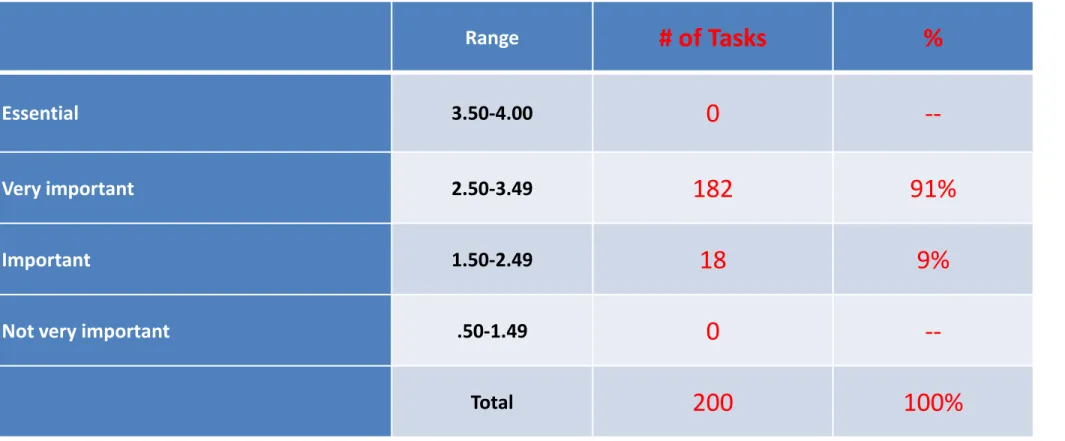
Task Significance Distribution
Range
# of Tasks
%
Essential
3.50-4.00
0
--
Very important
2.50-3.49
182
91%
Important
1.50-2.49
18
9%
Not very important
.50-1.49
0
--
Total
200
100%
Reliability of Significance Ratings
Domain
N
# of Tasks
Between Tasks
(Coefficient Alpha)
Between Raters (Inter-rater
Reliability)
Valid*
Missing
Critical / Strategic Analysis
1,681
3,169
23
0.94
0.39
Biological & Environmental
Applications in Public Health
1,834
3,016
13
0.95
0.60
Leadership & Systems Thinking
1,490
3,360
27
0.97
0.53
Management, Finance & Policy
1,448
3,402
28
0.98
0.60
Program Planning
1,601
3,249
42
0.99
0.64
Collaborating & Partnering
2,489
2,361
11
0.95
0.66
Communication
1,593
3,257
27
0.98
0.64
Advocacy
2,067
2,783
9
0.95
0.67
Ethics
2,173
2,677
8
0.95
0.68
Domain Ratings
Domain
N
Mean
Std. Deviation
Critical/Strategic Analysis
4391
2.38
0.87813
Collaborating & Partnering
4281
2.28
1.18245
Ethics
4108
2.27
1.18404
Leadership & Systems Thinking
4391
2.12
1.06881
Diversity & Cultural Proficiency
4113
1.98
1.28345
Program Planning
4391
1.96
1.18287
Communication
4167
1.95
1.13054
Management, Finance, & Policy
4391
1.95
1.12520
Advocacy
4147
1.83
1.28283
Top Ten Rated Tasks
Task
N
Mean
Std.
Deviation
Collect valid and reliable quantitative or qualitative data. (Critical/Strategic Analysis)
4391
3.26
1.05
Use information technology for data collection, storage, and retrieval.
(Critical/Strategic Analysis)
4384
3.18
1.04
Ensure the application of ethical principles in the collection, maintenance, use, and
dissemination of data and information. (Ethics)
4105
2.92
1.32
Interpret quantitative or qualitative data following current scientific standards.
(Critical/Strategic Analysis)
4370
2.85
1.25
Identify regulations regarding privacy, security, confidentiality (e.g., personal health
information, etc.). (Ethics)
4103
2.82
1.39
Identify key stakeholders. (Collaborating & Partnering)
4265
2.75
1.30
Identify opportunities to partner with health and public health professionals across
sectors and related disciplines. (Collaborating & Partnering)
4272
2.68
1.29
Interpret results of statistical analyses found in public health studies or reports.
(Critical/Strategic Analysis)
4372
2.68
1.29
Identify the limitations of research results, data sources, or existing practices and
programs. (Critical/Strategic Analysis)
4365
2.67
1.27
Synthesize information from multiple data systems or other sources.
Task Domains by Degree
MPH
N = 2675
Domain
Mean
Critical/Strategic Analysis
2.42
Collaborating & Partnering
2.31
Ethics
2.27
Leadership & Systems Thinking
2.12
Diversity & Cultural Proficiency
1.99
Program Planning
1.96
Communication
1.95
Management, Finance, & Policy
1.94
Advocacy
1.82
Biological & Environmental Applications in Public
Health
1.69
DrPH
N = 142
Domain
Mean
Critical/Strategic Analysis
2.90
Collaborating & Partnering
2.54
Ethics
2.52
Leadership & Systems Thinking
2.43
Diversity & Cultural Proficiency
2.37
Program Planning
2.37
Advocacy
2.28
Communication
2.20
Management, Finance, & Policy
2.14
Biological & Environmental Applications in Public
Top Task Ratings by Degree
MPH
N = 2675
Task
Mean
Collect valid and reliable quantitative or qualitative data.
3.30
Use information technology for data collection, storage, and
retrieval.
3.21
Ensure the application of ethical principles in the collection,
maintenance, use, and dissemination of data and information.
2.94
Interpret quantitative or qualitative data following current
scientific standards.
2.90
Identify regulations regarding privacy, security, confidentiality
(e.g., personal health information, etc.).
2.82
Identify key stakeholders.
2.81
Identify the limitations of research results, data sources, or
existing practices and programs.
2.74
Synthesize information from multiple data systems or other
sources.
2.72
Interpret results of statistical analyses found in public health
studies or reports.
2.71
Identify opportunities to partner with health and public health
professionals across sectors and related disciplines.
2.71
DrPH
N = 142
Task
Mean
Collect valid and reliable quantitative or qualitative data.
3.56
Interpret quantitative or qualitative data following current scientific
standards.
3.43
Interpret results of statistical analyses found in public health studies or
reports.
3.35
Apply descriptive techniques commonly used to summarize public
data.
3.32
Use information technology for data collection, storage, and retrieval.
3.30
Identify the limitations of research results, data sources, or existing
practices and programs.
3.22
Synthesize information from multiple data systems or other sources.
3.15
Ensure the application of ethical principles in the collection,
maintenance, use, and dissemination of data and information.
3.11
Describe a health problem in terms of magnitude, person, time, and
place.
3.09
Describe the characteristics of a population-based health problem.
3.06
Task Domains by Gender
Female
N = 3332
Domain
Mean
Critical/Strategic Analysis
2.33
Collaborating & Partnering
2.24
Ethics
2.20
Leadership & Systems Thinking
2.07
Diversity & Cultural Proficiency
1.97
Communication
1.93
Program Planning
1.92
Management, Finance, & Policy
1.89
Advocacy
1.73
Biological & Environmental Applications in
Public Health
1.61
Male
N = 1033
Domain
Mean
Critical/Strategic Analysis
2.54
Ethics
2.49
Collaborating & Partnering
2.40
Leadership & Systems Thinking
2.27
Management, Finance, & Policy
2.14
Advocacy
2.12
Biological & Environmental Applications in
Public Health
2.10
Program Planning
2.07
Communication
2.02
Diversity & Cultural Proficiency
2.01
Task Ratings by Gender
Male
N = 1033
Task
Mean
Collect valid and reliable quantitative or qualitative data.
3.33
Use information technology for data collection, storage, and
retrieval.
3.23
Interpret quantitative or qualitative data following current
scientific standards.
3.04
Ensure the application of ethical principles in the collection,
maintenance, use, and dissemination of data and
information.
2.95
Interpret results of statistical analyses found in public health
studies or reports.
2.91
Identify regulations regarding privacy, security, confidentiality
(e.g., personal health information, etc.).
2.88
Apply descriptive techniques commonly used to summarize
public data.
2.85
Synthesize information from multiple data systems or other
sources.
2.81
Identify key stakeholders.
2.81
Identify the limitations of research results, data sources, or
existing practices and programs.
2.74
Female
N = 3332
Task
Mean
Collect valid and reliable quantitative or qualitative data.
3.24
Use information technology for data collection, storage, and
retrieval.
3.16
Ensure the application of ethical principles in the collection,
maintenance, use, and dissemination of data and
information.
2.91
Identify regulations regarding privacy, security,
confidentiality (e.g., personal health information, etc.).
2.8
Interpret quantitative or qualitative data following current
scientific standards.
2.78
Identify key stakeholders.
2.74
Identify opportunities to partner with health and public
health professionals across sectors and related disciplines.
2.68
Identify the limitations of research results, data sources, or
existing practices and programs.
2.65
Synthesize information from multiple data systems or other
sources.
2.6
Interpret results of statistical analyses found in public health
Task Domains by Employment Setting
Academic
Business or
Corporation
Clinic or Hospital
Government
Non profit
Critical/Strategic Analysis
Critical/Strategic Analysis
Ethics
Critical/Strategic Analysis
Collaborating & Partnering
Ethics
Ethics
Critical/Strategic Analysis
Collaborating & Partnering
Leadership & Systems Thinking
Collaborating & Partnering
Collaborating & Partnering
Collaborating & Partnering
Ethics
Critical/Strategic Analysis
Diversity & Cultural Proficiency
Leadership & Systems Thinking
Leadership & Systems Thinking
Leadership & Systems Thinking
Diversity & Cultural Proficiency
Leadership & Systems Thinking
Management, Finance, & Policy
Diversity & Cultural Proficiency
Communication
Program Planning
Program Planning
Program Planning
Communication
Management, Finance, & Policy
Management, Finance, & Policy
Communication
Communication
Management, Finance, & Policy
Biological & Environmental
Applications in Public Health
Communication
Management, Finance, & Policy
Advocacy
Program Planning
Diversity & Cultural Proficiency
Ethics
Advocacy
Diversity & Cultural Proficiency
Biological & Environmental
Applications in Public Health
Advocacy
Advocacy
Biological & Environmental
Applications in Public Health
Biological & Environmental
Applications in Public Health
Advocacy
Program Planning
Biological & Environmental
Applications in Public Health
Academic
Business or Corporation
Clinic or Hospital
Government
Non Profit
Collect valid and reliable quantitative or qualitative data.
Use information technology for data collection, storage, and retrieval.
Use information technology for data collection, storage, and retrieval.
Collect valid and reliable quantitative or qualitative data.
Collect valid and reliable quantitative or qualitative data.
Use information technology for data collection, storage, and retrieval.
Collect valid and reliable quantitative or qualitative data.
Collect valid and reliable quantitative or qualitative data.
Use information technology for data
collection, storage, and retrieval. Identify key stakeholders. Interpret quantitative or qualitative
data following current scientific standards.
Interpret quantitative or qualitative data following current scientific
standards.
Identify regulations regarding privacy, security, confidentiality (e.g., personal
health information, etc.).
Identify key stakeholders. Use information technology for data collection, storage, and retrieval. Ensure the application of ethical
principles in the collection, maintenance, use, and dissemination
of data and information.
Synthesize information from multiple data systems or other sources.
Ensure the application of ethical principles in the collection, maintenance, use, and dissemination
of data and information.
Ensure the application of ethical principles in the collection, maintenance, use, and dissemination
of data and information.
Identify opportunities to partner with health and public health professionals across sectors and related disciplines.
Identify the limitations of research results, data sources, or existing
practices and programs.
Ensure the application of ethical principles in the collection, maintenance, use, and dissemination
of data and information.
Apply team building skills.
Identify regulations regarding privacy, security, confidentiality (e.g., personal
health information, etc.).
Develop collaborative and partnership agreements with various stakeholders
on specific projects.
Interpret results of statistical analyses found in public health studies or
reports.
Identify regulations regarding privacy, security, confidentiality (e.g., personal
health information, etc.).
Interpret quantitative or qualitative data following current scientific
standards.
Identify opportunities to partner with health and public health professionals across sectors and related disciplines.
Ensure the application of ethical principles in the collection, maintenance, use, and dissemination
of data and information. Identify regulations regarding privacy,
security, confidentiality (e.g., personal health information, etc.).
Identify the limitations of research results, data sources, or existing
practices and programs.
Apply conflict management skills.
Interpret quantitative or qualitative data following current scientific
standards.
Communicate an organization’s mission, goals, values, and shared
vision to stakeholders. Apply descriptive techniques
commonly used to summarize public data.
Identify key stakeholders.
Interpret results of statistical analyses found in public health studies or
reports.
Synthesize information from multiple data systems or other sources.
Identify challenges to program implementation.
Use statistical packages or software to analyze data.
Apply descriptive techniques commonly used to summarize public
data.
Communicate with other health professionals in a responsive and responsible manner that supports a team approach to maintaining health
of individuals and populations.
Apply descriptive techniques commonly used to summarize public
data.
Develop strategies for collaboration and partnership among diverse organizations to achieve common
public health goals.
Illustrate how gender, race, ethnicity, and other evolving demographics affect
the health of a population.
Apply team building skills.
Identify the limitations of research results, data sources, or existing
practices and programs.
Interpret results of statistical analyses found in public health studies or
reports.
Implement strategies for collaboration and partnership among diverse organizations to achieve common
Task Domains by Employment Level
Clinical
Consultant
Entry
Mid
Upper
Ethics
Critical/Strategic Analysis
Critical/Strategic Analysis
Critical/Strategic Analysis
Collaborating & Partnering
Biological & Environmental
Applications in Public Health
Collaborating & Partnering
Ethics
Collaborating & Partnering
Critical/Strategic Analysis
Critical/Strategic Analysis
Leadership & Systems Thinking
Collaborating & Partnering
Ethics
Leadership & Systems Thinking
Diversity & Cultural Proficiency
Ethics
Diversity & Cultural Proficiency
Leadership & Systems Thinking
Ethics
Communication
Diversity & Cultural Proficiency
Leadership & Systems Thinking
Program Planning
Management, Finance, & Policy
Leadership & Systems Thinking
Program Planning
Communication
Management, Finance, & Policy
Program Planning
Collaborating & Partnering
Communication
Program Planning
Diversity & Cultural Proficiency
Advocacy
Advocacy
Management, Finance, & Policy
Biological & Environmental
Applications in Public Health
Communication
Communication
Program Planning
Advocacy
Advocacy
Advocacy
Diversity & Cultural Proficiency
Management, Finance, & Policy
Biological & Environmental
Applications in Public Health
Management, Finance, & Policy
Biological & Environmental
Applications in Public Health
Biological & Environmental
Applications in Public Health
Clinical
Consultant
Entry
Mid
Upper
Collect valid and reliable quantitative or qualitative data.
Collect valid and reliable quantitative or qualitative data.
Collect valid and reliable quantitative or qualitative data.
Collect valid and reliable quantitative or qualitative data.
Collect valid and reliable quantitative or qualitative data.
Identify regulations regarding privacy, security, confidentiality (e.g., personal
health information, etc.).
Use information technology for data collection, storage, and retrieval.
Use information technology for data collection, storage, and retrieval.
Use information technology for data collection, storage, and retrieval.
Use information technology for data collection, storage, and retrieval.
Use information technology for data
collection, storage, and retrieval. Identify key stakeholders.
Ensure the application of ethical principles in the collection, maintenance, use, and dissemination of
data and information.
Ensure the application of ethical principles in the collection, maintenance, use, and dissemination of
data and information.
Identify key stakeholders.
Ensure the application of ethical principles in the collection, maintenance, use, and dissemination of
data and information.
Interpret quantitative or qualitative data following current scientific
standards.
Interpret quantitative or qualitative data following current scientific
standards.
Interpret quantitative or qualitative data following current scientific
standards.
Ensure the application of ethical principles in the collection, maintenance, use, and dissemination of
data and information. Identify the laws and regulations that
govern the scope of one’s legal authority.
Synthesize information from multiple data systems or other sources.
Identify regulations regarding privacy, security, confidentiality (e.g., personal
health information, etc.).
Identify regulations regarding privacy, security, confidentiality (e.g., personal
health information, etc.).
Identify opportunities to partner with health and public health professionals across sectors and related disciplines. Communicate with other health
professionals in a responsive and responsible manner that supports a team approach to maintaining health of
individuals and populations.
Identify opportunities to partner with health and public health professionals across sectors and related disciplines.
Identify the limitations of research results, data sources, or existing
practices and programs.
Identify key stakeholders.
Identify regulations regarding privacy, security, confidentiality (e.g., personal
health information, etc.).
Identify communication gaps.
Identify the limitations of research results, data sources, or existing
practices and programs.
Interpret results of statistical analyses found in public health studies or
reports.
Synthesize information from multiple data systems or other sources.
Interpret quantitative or qualitative data following current scientific
standards.
Apply conflict management skills.
Ensure the application of ethical principles in the collection, maintenance, use, and dissemination of
data and information.
Apply descriptive techniques commonly used to summarize public
data.
Identify the limitations of research results, data sources, or existing
practices and programs.
Give constructive feedback to others about their performance on the team.
Communicate with colleagues, patients, families, or communities about health disparities and health care
disparities.
Interpret results of statistical analyses found in public health studies or
reports.
Synthesize information from multiple data systems or other sources.
Identify opportunities to partner with health and public health professionals across sectors and related disciplines.
Engage key stakeholders in problem solving and policy development.
Apply team building skills.
Develop collaborative and partnership agreements with various stakeholders
on specific projects.
Identify key stakeholders.
Apply descriptive techniques commonly used to summarize public
data.
Communicate an organization’s mission, goals, values, and shared