GUIDELINES FOR CLINICAL FACILITATORS TO SUPPORT STUDENT NURSES IN A SIMULATION LABORATORY AT A COLLEGE OF NURSING IN THE
WESTERN CAPE
Student Name: Desiree J. Abrahams-Marra
Student Number: 3105155
Type of Thesis: Full Master‟s Thesis
Degree: Master in Nursing
Department / School: School of Nursing
Supervisor: Professor Karien Jooste
Date: June 2013
Key words: Views, Student nurse, Learning needs, Simulation Laboratory, Adult learning, Teaching, Nursing education, Guidelines, Clinical nurse facilitator
1.1 ABSTRACT
The main benefit of simulation in nursing education is the ability to teach clinical skills in a non-threatening, safe environment where mistakes can be rectified without harm to any patient. Therefore, it is clinical facilitators who must display the knowledge and skills to impart to the student nurses during their 4-year programme of study. It is unclear how student nurses at a local nursing college view teaching and learning processes in the simulation laboratory. The purpose of this study is to explore student nurses‟ views of teaching and learning in a simulation laboratory with the purpose of describing guidelines for clinical facilitators to support student nurses in a simulation laboratory at a local College of Nursing in the Western Cape.
A qualitative, exploratory, descriptive and contextual design was used in order to explore and describe the views of student nurses about teaching and learning in the simulation laboratory. The ECP (Extended Curriculum Programme), 1st, 2nd, 3rd and 4th year students (N = 880), who were registered in the R425 programme at the College of Nursing in the Western Cape, had been identified as the accessible student population of this study. A purposive opportunistic sampling population was applied. Two focus groups (20 participants) per year of study were conducted. The size of each focus group was at least 10 participants. The focus group interviews lasted around 60 minutes per group. Data gathering was conducted by the researcher who initiated, prompted, and facilitated these focus groups. For the purpose of data triangulation, voice recordings of the interviews were supported by the taking of field notes. Open coding had been used for data analysis. The credibility of the coding was checked and confirmed by an independent coder.
Trustworthiness was maintained, since credibility was ensured by means of prolonged engagement in the field until data saturation occurred, referential adequacy, and member checks that followed. Dependability was ensured by establishing an audit trail. Ethical considerations were ensured by obtaining written, informed consent from participants of the study, as well as for the voice recording of the discussions. Participants could withdraw at any stage of the study. Confidentiality was explained and the researcher requested that participants do not share the information after the group discussions.
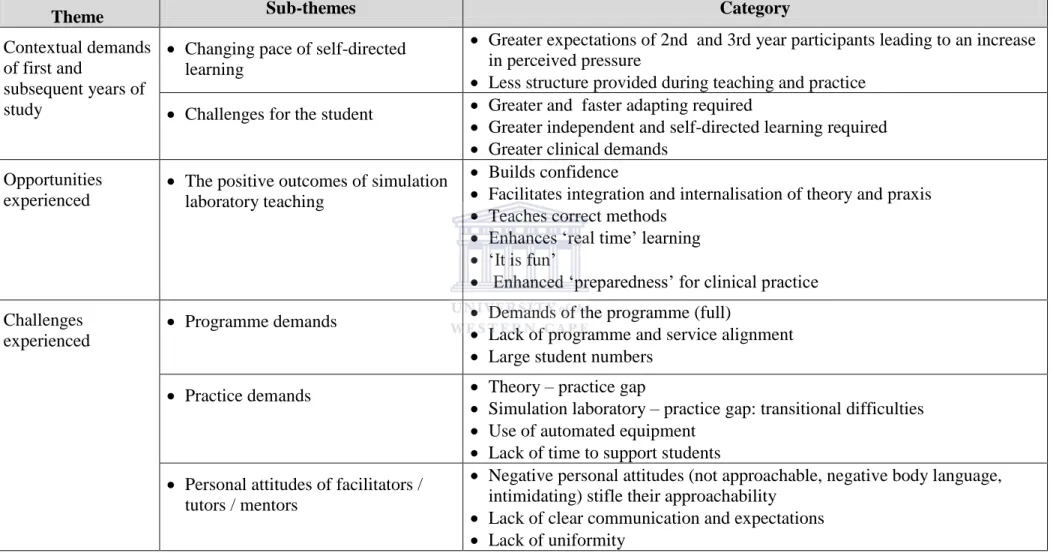
In this study, student nurses experienced both opportunities and challenges with the teaching and learning in the simulation laboratory. Furthermore, the contextual demands between the first and subsequent years of study seemed to play an essential part in their experience.
1.2 DECLARATION
I declare that “Guidelines for Clinical Facilitators to Support Student Nurses in a Simulation Laboratory at a College of Nursing in the Western Cape” is my own work, that it has not been submitted for any degree or examination at any other university, and that all sources I use or quote are indicated and acknowledged as complete references.
Full name: Desiree Jessica Abrahams-Marra
Date: 12 September 2013 Signed: __________________________________________________
1.3 ACKNOWLEDGEMENT
Deo Gratias, for his grace and blessings bestowed upon me throughout this study. I wish to acknowledge and thank several people who have been an integral part of this study:
Professor Karien Jooste ,my study supervisor ,for her patience, academic support and guidance with this research study
Ms. Theresa Schoeman, the PGE librarian at UWC library for her support in introducing and providing regular training sessions with Refworks
Ms. Nazma Vasjat and all the library staff at Cape Peninsula University of Technology, Athlone campus for providing an good selection of research textbooks and their professional assistance with all my library visits and requests
To my family for the encouragement and emotional support
To my work colleagues for the role they played in assisting me to fulfill my study obligations
Last but not least to the participants who sacrificed their time and shared their experiences and insights of simulation laboratory teaching and learning.
TABLE OF CONTENTS
1.1 ABSTRACT ... ii
1.2 DECLARATION ... iv
1.3 ACKNOWLEDGEMENT ... v
CHAPTER ONE: INTRODUCTION, BACKGROUND, AND LITERATURE REVIEW .... 1
2.1 INTRODUCTION ... 1
2.2 PROBLEM STATEMENT ... 2
2.3 PURPOSE OF STUDY... 3
2.4 OBJECTIVES ... 3
2.5 RATIONALE OF THE STUDY ... 3
2.6 lITERATURE REVIEW ... 4
2.7 THEORETICAL ASSUMPTIONS ... 6
2.8 DEFINITION OF TERMS ... 6
CHAPTER TWO: RESEARCH METHODOLOGY ... 9
2.1 INTRODUCTION ... 9 2.2 RESEARCH DESIGN ... 10 2.3 POPULATION ... 12 2.4 SAMPLING ... 13 2.5 SAMPLE ... 15 2.6 DATA COLLECTION ... 16
2.7 FOCUS GROUP INTERVIEWS ... 17
2.8 PREPARATION OF THE FIELD ... 19
2.9 FIELD NOTES ... 20
2.10 AUDIO-RECORDING OF INTERVIEWS ... 21
2.11 DATA SATURATION ... 22
2.12 PILOT FOCUS GROUP INTERVIEW... 22
2.13 TRUSTWORTHINESS ... 23 2.13.1 DEPENDABILITY ... 23 2.13.2 CREDIBILITY ... 24 2.13.3 TRANSFERABILITY ... 24 2.13.4 CONFIRMABILITY ... 24 2.13.5 AUTHENTICITY ... 25 2.15 CODING ... 26 2.16 TRIANGULATION OF METHODS ... 28
2.17 REFLECTION OF THE RESEARCHER ... 29
2.18 BASIC ETHICAL PRINCIPLES ... 29
2.18.1 Respect for persons ... 30
2.18.2 The principle of beneficence ... 31
2.18.3 The principle of justice ... 31
2.19 ANONYMITY AND CONFIDENTIALITY ... 31
CHAPTER THREE: RESEARCH FINDINGS ... 33
3.1 INTRODUCTION ... 33
3.2 OPERATIONALIZING THE FIELD OF RESEARCH... 33
3.3 PROFILE OF THE PARTICIPANTS ... 34
3.4 THE PROCESS OF DATA ANALYSIS ... 35
3.5 FINDINGS ... 38
3.5.1 Theme One: Contextual demands of first and subsequent years of study ... 38
3.5.2 Theme Two: Opportunities experienced ... 44
3.5.3 Theme Three: Challenges experienced ... 48
3.6 CONCLUSION ... 90
CHAPTER FOUR: GUIDELINES, RECOMMENDATIONS, AND LIMITATIONS OF THE STUDY ... 92
4.1 INTRODUCTION ... 92
4.2 GUIDELINES ... 92
4.2.1 The aim of the guidelines for clinical facilitators ... 92
4.2.2 Guideline One: Change the pace of self-directed learning of student
nurses ... 93
4.2.3 Guideline Two: Minimise the potential challenges for student nurses ... 95
4.2.4 Guideline Three: Student nurses should have a good grasp of the practice demands ... 97
4.2.5 Guideline Four: The personal attitudes of clinical facilitators ... 100
4.2.6 Guideline Five: A conducive learning and teaching atmosphere ... 102
4.2.7 Guideline Six: The language difficulties that student nurses experience ... 105
4.3 RECOMMENDATIONS FOR NURSING PRACTICE, NURSINg ... 106
EDUCATION, AND NURSING RESEARCH ... 106
4.3.1 Recommendations for the nursing education ... 107
4.3.2 Recommendations for nursing practice ... 108
4.4 LIMITATIONS OF THE RESEARCH STUDY ... 108
4.5 CONCLUSION ... 109
REFERENCES 110 3.1 ANNEXURE A : INFORMATION SHEET ... 117
3.2 117 3.3 ANNEXURE B: WCCN ETHICS APPROVAL ... 121
3.4 ANNEXURE C: WRITTEN INFORMED CONSENT ... 122
3.5 122 ANNEXURE D: LETTER OF REQUEST FROM EDUCATIONAL INSTITUTION TO CONDUCT THE RESEARCH ... 124
LIST OF FIGURES Figure 2.1: Coding from texts ... 27
LIST OF TABLES Table 2.1: Number of students ... 13
Table 2.2: Population of student nurses at a College of Nursing in the Western Cape ... 15
Table 2.2: Authenticity strategies ... 25 Table 3.1: Participants ... 31 Table 3.2: Themes, sub-themes, and categories ... 36
2
CHAPTER ONE:
INTRODUCTION, BACKGROUND, AND LITERATURE REVIEW
2.1 INTRODUCTIONNursing education exists for the purpose of acquiring the knowledge and developing the skills students need to function as competent nurses (Rothgeb 2008:108). These skills could be developed in a simulation environment. Nursing simulation laboratories evolve over the past decade in response to the practical learning needs of undergraduate learner nurses (hereafter referred to as „student nurses‟ according to the definition of „learner nurse‟ on page 16) (Wellard, Solvoll & Heggen 2009).
Simulation laboratories are also known as clinical skills rooms, skills laboratories, and learning resource centres with varying levels of technologies (Childs & Sepples 2006:154). Simulation teaching originates from basic life support (resuscitation) programmes developed by Laerdal, a medical equipment company in Norway. The focus of the company had been to enhance patient safety during acute hospital care. Simulation equipment was developed in anaesthesia to allow for endotracheal intubation (Wilford & Doyle 2006:604), and moved into many other areas of the health profession, that included nursing, with the initial introduction of „Resusci Annie‟ and more recently, SimMan®, a lifelike computerised manikin (Alinier, Hunt, Gordon & Harwood 2006:141).
The benefit of simulation in nursing education is the ability to teach clinical skills in a non-threatening, safe environment where mistakes can be rectified without harm to a patient. The nursing students work in peer groups which could enhance teamwork and teaching (Childs & Sepples 2009:107; Granger, Hebb, Lavallee & Murray 2011:82; Hancock 2008:262; Hovancsek, Jeffries, Escudero, Foulds, Husebo, Iwamoto, Kelly, Petrini & Wang 2009:102; Jeffries 2009:104). Simulation is used during both under- and post-graduate nursing programmes and the rationale is to develop and enhance specific nursing skill sets in order to meet the requirements of application of theory in practice, and to replicate the clinical setting that would ultimately assist with achieving safe patient care (Childs & Sepples 2006:154; Jeffries, Bambini, Hensel, Moorman & Washburn 2009:662; Rothgeb 2008:494).
However, nursing students ought to be adequately prepared for carrying out clinical skills competently and efficiently. It is the responsibility of nursing educators and nurse practitioners to display knowledge and skills required to promote integration between theory and practice in order to enhance student nursing education that results in acceptable standards of patient care. Therefore, clinical skills laboratories are necessary to guide student nurses to develop the collaborative skills required for a profession like nursing. (Childs, Sepples & Chambers2007:58; Freeth & Fry 2005:279; Hovancsek et al. 2009:2; Jeffries et al 2009:622; Morgan 2006:160). Teaching and training of basic to more complex clinical procedures can be conducted in simulation laboratories, and the more complex skills that require more dexterity can be simplified into smaller steps. The student nurse should be able to practise the skills until they are competent and confident before utilising these skills in the clinical setting with real patients (Childs et al. 2007:106; Freeth & Fry 2005:279; Jeffries 2006:96; Kardong-Edgren, Starkweather & Ward 2008:13).
Across the globe (in developed, as well as developing countries), simulation laboratories develop over a period of time due to technological changes in the midst of shortages in nursing. It adds to challenges faced by both the student nurses and clinical facilitators (Baillie & Curzio 2008:303; Barry 2009:434; Childs & Sepples 2009:107; Jeffries 2006:96). Simulation laboratories develop at colleges of nursing in the Western Cape since 2005. The need arises from an increase in student nurse enrolment numbers, a decline in clinical site placement opportunities (Jeggels, Traut & Kwast 2010:85), as well as a shortage of skilled nursing personnel in certain clinical areas.
Shortages of skilled nurses, both in clinical areas and at nursing colleges, are creating challenges that student nurses and clinical facilitators encounter in the simulation laboratory during the learning and teaching process (Howard, Englert, Kameg & Perozzi 2011:e9). This also seems to be the case at a College of Nursing in the Western Cape, South Africa.
2.2 PROBLEM STATEMENT
There is an increase in student enrolment at a local College of Nursing and shortages of trained nursing staff at clinical sites. Furthermore, in-patient stay in hospitals is shorter with decreasing opportunities of acquiring practical nursing skills at clinical sites. It leads to the recruitment of more clinical facilitators in order to meet the practical learning needs of the student learners (Morgan 2006:158; Jeffries 2006:96; Jeggels et al. 2010:85; Nehring &
Lashley 2009:248). A study by Morgan (2006:160) indicates that clinical facilitators seem motivated to utilise the simulation laboratory for basic skills development. However, they are experiencing technological challenges with some of the equipment, while being exposed to large groups of student nurses. At the time of this study, it was unclear how student nurses viewed the teaching and learning processes in the simulation laboratory at a College of Nursing in the Western Cape.
From the problem statement, the following research questions were posed:
How did student nurses view teaching and learning in the simulation laboratory?
What actions did students suggest for describing guidelines for clinical facilitators i to support them in the simulation laboratory?
2.3 PURPOSE OF STUDY
The viewpoints of student nurses were explored and described with the purpose of developing guidelines for clinical facilitators to support students in the simulation laboratory at a College of Nursing in the Western Cape.
2.4 OBJECTIVES This study‟s objectives are:
explore and describe the viewpoints of student nurses about teaching and learning in the simulation laboratory at a College of Nursing in the Western Cape; and
describe guidelines for clinical facilitators with the purpose of supporting student nurses in the simulation laboratory at a College of Nursing in the Western Cape.
2.5 RATIONALE OF THE STUDY
Positive simulation laboratory learning enhances the acquiring of basic nursing skills in a safe and non-threatening learning environment. It minimises students‟ anxiety and stress levels and increases their levels of confidence in “knowing and being able to do” the skills they require, prior to clinical placement (Rothgeb 2008:494). The simulation laboratory provides each learner with a similar learning opportunity where theory is applied in practice and group work is improved (Limoges 2010:60). Therefore, exploring and describing the viewpoints of student nurses about learning and teaching in the simulation laboratory may inform the crucial
guidelines for clinical facilitators to support students in the simulation environment at a nursing college that is consistently informed about changes in policy and procedure.
2.6 LITERATURE REVIEW
While simulation laboratories are evolving in several countries across the globe, teaching and learning methods are questioned with regard to its efficacy and whether student nurses could make the necessary transition from an artificial learning and teaching environment to one of reality, that is the clinical setting (Childs & Sepples 2009:5; Hovancsek et al. 2009:3; Freeth & Fry 2005:279; Jeffries 2005:103; Jeffries 2006:351; Howard et al. 2011:e9; Haigh 2007:101; Hosoda 2006:484; Kaakinen & Arwood 2009a:17; Lisko & O'Dell 2010:108). This process requires resources. Simulation laboratories across the world vary in levels of technology and the usefulness in developing nursing skills as part of undergraduate nursing programmes. Its success is dependent on financial and human resources to manage the facility (Jeggels et al. 2010:85).
Kaakinen and Arwood (2009a:14) reviewed nursing simulation literature between 2000 and 2007. Subsequently, they consider simulation more as a teaching model rather than a learning model. Most of the studies approach the complexity of practice as the acquisition of skills that are taught by “doing”. However, none of the studies use research about how the brain acquires or learns concepts. Even in relation to student thinking, students‟ preferences, beliefs, or perceptions of beliefs; which are all components of self-efficacy; are measured, and not conceptual learning.
However, Kaakinen and Arwood (2009a:14), state that Kolb‟s (2004) works support the purpose of designing simulation to match a student‟s needs and preferences for learning. Learning style categories are developed based strictly on observations about what people are doing while learning is assumed to be taking place. For example, some people move around all the time or fidget while paying attention (assumed learning is taking place). Therefore, they are assigned to the kinaesthetic learner style.
During the past decade, there is a steady growth in the technological sophistication of simulation laboratories in nursing education (Childs & Sepples 2009:5; Jeffries 2009:S6; Jeggels et al. 2010:85; Nehring & Lashley 2009:248; Reese, Jeffries & Engum. 2010:36; Stark & Fortune 2003:305; Wellard, Solvoll & Heggen 2009:233). That level of technological development is dependent on several factors:
Increased enrolment of students at colleges of nursing;
Diminishing clinical site placement, as well as diminishing learning opportunities; and
Having a safe learning environment.
Literature indicates limitations in the scope of learning settings that simulate patient care. It is found that there is a tendency to design the simulation laboratory as an acute hospital care setting and little or no design includes other forms of nursing and patient care (Rothgeb 2008:493; Wellard et al. 2009b:234; Stark & Fortune 2003:305). Wellard et al. (2009b:233) state that there is a lack of knowledge about how student nurses could benefit from gaining knowledge while they are moving between the lecture theatre, simulation laboratories and clinical sites for preparation to become nurses. Appropriately supervised clinical site placements, as well as decreasing learning opportunities at clinical sites create the need for simulation laboratories to provide the required psychomotor skills training that integrates theory with practice (Morgan 2006:160).
Limoges (2010:110) states that understanding how the simulation laboratory experience is theoretically integrated with the current teaching paradigm and exploring areas for change are important concepts for consideration by nursing education providers. Wellard et al.
(2009b:233), as well as Lisko and O'Dell (2010:108), state that traditional approaches to nursing education, including didactic lectures, memorisation, and return laboratory demonstration might indicate technical mastery, but these techniques do not facilitate the development of critical thinking.
Student nurses learn best by means of experiential learning. Kolb‟s Experiential Learning Theory and Model (2000) is a foundation of the practice integration method designed to provide a critical thinking experience. Introspection methodology, as used by Benner, expect expert nurses to conduct a task analysis or to explain everything they remember they are doing and why they are executing that particular action through reflective practice (Kaakinen & Arwood 2009b:17).
2.7 THEORETICAL ASSUMPTIONS
Kolb, Boyatzis and Mainemelis (2000:2) provide a holistic model of the learning process and a multi-linear model of adult development. This process and model are consistent with what we know about how people learn, grow, and develop. The theory is called “Experiential Learning” to emphasise the central role that views and experiences play during the learning process.
Subsequently, the following assumptions are made by the researcher:
It is assumed that this learning theory fits clinical skills training well;
Experience plays a central role in the learning process;
The learning cycle begins with a concrete experience that the student encounters (Jeggels et al. 2010:85); and
The student observes all the aspects of the experience and reflects on it. It gets followed by a conscious effort to gain insight and form generalisations (theory) about the experience.
Kolb et al. (2000:3) state that the learner student ought to continually choose which set of learning abilities he or she would use in a specific learning situation. In acquiring experience, some of us perceive new information by experiencing the concrete, tangible, felt qualities of the world while relying on our senses and immersing ourselves in concrete reality.
According to the theory, learning gets enhanced when students are actively involved in gaining knowledge by experience that includes problem solving and decision making.
2.8 DEFINITION OF TERMS
Simulation laboratory: A simulation laboratory is an on-campus facility that aims at simulating health care settings and allows students to rehearse clinical skills, surrounded by the artefacts of clinical environments (Wellard et al. 2009b:40). In this study, the simulation laboratory is located at the local College of Nursing, and it has the artefacts of a clinical environment.
Views: A personal opinion about something; an attitude towards something. (Oxford Advanced Learners Dictionary 2005:1640). In this study, the views of the student nurses
about learning and teaching in a simulation laboratory at a local College of Nursing in the Western Cape are explored.
Teaching: Teaching is what the educator provides the student with in terms of goals, methods, objectives and outcomes (Kaakinen & Arwood 2009b:17). In this study, teaching is what the clinical facilitator provides the student nurses with in terms of goals, methods, objectives and outcomes as determined by their curriculum at a College of Nursing in the Western Cape.
Learning needs: Learning refers to the processes that enable the student nurse to change skills, knowledge and dispositions by means of a planned experience (Kaakinen & Arwood 2009a:12). In this study, learning refers to the views of the student nurses‟ learning and teaching in a simulation laboratory at a College of Nursing in the Western Cape.
Learner nurse: It refers to a person who is duly registered in terms of Section 32 of the Nursing Act 33 of 2005 (SANC 2005):
A person undergoing education or training must apply to the Council to be registered as a learner nurse or a learner midwife;
The Council must register as a learner nurse or a learner midwife any person who complies with the prescribed conditions and furnishes the prescribed particulars for a training programme at a nursing education institution; and
In terms of Section 2 (n) of the South African Nursing Council Programme Objectives, a learner nurse or a learner midwife has the cognitive, psychomotor, and affective skills to serve as a basis for effective practice and for continuing education (Government Notice No. R425).
In this study, the term student nurse, refers to learner student nurses who are registered in the R425 programme, and are currently studying at a College of Nursing in the Western Cape.
Nursing education: It exists for the purpose of acquiring the knowledge and developing the skills students need to function as competent nurses (Rothgeb 2008:490).
Guidelines: It is an official recommendation that indicates how something should be done or what kind of action should be taken in a particular circumstance (Encarta Dictionary 2008).
Clinical facilitator: Nurse practitioners / educators who reinforce the theoretical component of the programme while teaching practical procedures in the clinical skills laboratory (Morgan
2006:159).
CHAPTER TWO:
RESEARCH METHODOLOGY
2.1 INTRODUCTIONMethodology refers to the coherent group of methods that complement one another and that have the “goodness of fit” to deliver data and findings that will reflect the research question and suit the research purpose (Henning, Van Rensburg & Smit 2007:36).
Henning et al. (2007:15) continue to state that methodology does not only include how we come to know, but it also is much more practical in nature – it means that we come to know by inquiring in certain ways. Methodology is concerned with the specific ways, the methods that we can use to try and understand our world better.
A discussion of the research design, the study population, the sample, the sampling procedure, data collection methods, data analysis, trustworthiness, and ethics are included in this chapter.
As stated by Mouton (2005:124), methodological assumptions are assumptions about the nature of the research process and the most appropriate methods to be used, about the relative worth of qualitative methods, about interpretation versus explanation, and about the ideal of universal statements versus specific and „local‟ generalisations.
As defined by Polit and Beck (2010:562), a paradigm is a way of looking at natural phenomena that encompass a set of philosophical assumptions and that guide one‟s approach to inquiry. Henning et al. (2005:31) concur that the way the researcher perceives the world and knowledge, i.e. the ontological and epistemological position of the researcher, influence the research phenomena and the design of the inquiry. In this study, the questions were directed at the meaning of participants‟ experiences, feelings, beliefs, and convictions about the theme in question (De Vos, Strydom, Fouché, & Delport 2011:317), namely their views‟ of teaching and learning in a simulation laboratory at a College of Nursing. Student nurses learned best by means of experiential learning, and Kolb‟s Experiential Learning Theory and Model was a foundation for the practice integration method designed to provide a critical thinking experience. The introspection methodology, as used by Benner, expects expert nurses to conduct a task analysis or to explain everything they remember about their duties by reflecting on their actions (Kaakinen & Arwood 2009b:117).
2.2 RESEARCH DESIGN
Denzin and Lincoln (2011:36) state that a research design situates researchers in the empirical world and connects them to specific sites, persons, groups, institutions, and bodies of relevant interpretive material that include documents and archives. The authors further describe a research design as a flexible set of guidelines that connects theoretical paradigms, firstly to strategies of enquiry and secondly to methods for collecting empirical material. Researchers select methods and a research genre / design that will not only suit the research question optimally, but will also indicate the researchers‟ (reflexive) knowledge of how language makes meaning, and what role Kolb‟s theory plays.
Polit et al.(2010:203) concur that the research design of a study provides the basic strategies that researchers adopt to develop evidence that is accurate and interpretable. The research design incorporates some of the most important methodological decisions that researchers make.
In this study; a qualitative, exploratory, descriptive, contextual design was used to explore and describe the student nurses‟ view of learning and teaching in the simulation laboratory. The purpose was to develop guidelines for supporting the learner in the simulation laboratory at a local College of Nursing in the Western Cape.
Henning et al. (2007:16) state that in qualitative studies the “variables” are usually not controlled because it is exactly this freedom and natural development of action and representation that qualitative researchers wish to capture. A qualitative study is a study that is presented largely in language and deals with the meaning constructed from the language that presents the data.
Du Plooy (2009:33) states that qualitative researchers hold the opinion that there is no one objective reality which can be observed and neutrally quantified. Gravetter et al. (2009:158) state that the primary distinction between quantitative and qualitative research is the type of data they produce. Quantitative research typically produces numerical scores, whereas qualitative research is typically a narrative report that is a written discussion of the observations. However, qualitative researchers believe that human beings are unique and that they cannot be simply categorised (Du Plooy 2009:33).
In this study, the phenomenon being studied was student nurses‟ views of learning and teaching in a simulation laboratory. It included the actions that student nurses were suggesting to clinical facilitators, in order to support students in the simulation laboratory. Plus assisted with describing guidelines for clinical facilitators with the purpose of supporting student nurses in the simulation laboratory at a College of Nursing in the Western Cape. Henning et al. (2007:3) emphasise that qualitative researchers want to find out not only what happens but also how it happens and, importantly, why it happens the way it does.
Babbie and Mouton (2005:80) state that exploratory studies are most typically conducted to:
satisfy the researchers‟ curiosity and desire for better understanding;
explicate the central concepts and constructs of a study;
determine priorities for future research; and
develop new hypotheses about an existing phenomena.
The authors continue by stating that because exploratory studies usually lead to insight and comprehension rather than to the collection of detailed, accurate, and replicable data; these studies frequently involve the use of in-depth interviews (Babbie et al. 2005:80).
According to Polit et al. (2010:22), like descriptive research exploratory research begins with a phenomenon of interest. Instead of simply observing and describing the phenomenon, exploratory researchers investigate the full nature thereof, the manner in which it is manifested, and the other factors to which it is related; including potential factors that might be causing it.
Gravetter et al. (2009:160) state that a descriptive research design is intended to answer questions about the current state of individual variables for a specific group of individuals. This design is not concerned with relationships between variables but rather with the description of individual variables. The goal of a descriptive design is to obtain a snapshot (description) of specific characteristics of a specific group of individuals.
Polit et al. (2010:552) agree that descriptive research has as its main objective the accurate portrayal of the characteristics of persons, situations, groups, and / or the frequency with which certain phenomena occur. This study described the narratives of the student nurses experiences of learning and teaching in a simulation laboratory; and what actions student
nurses suggested to clinical facilitators in order to support students in the simulation laboratory, at a College of Nursing in the Western Cape.
Babbie et al. (2001:272) state that a contextual study aims at describing and understanding events in the concrete, natural context in which they occur. The authors add that the qualitative researcher argues that one can truly claim to “understand” events when the background of the whole context and how such a context confers meaning to the events are taken into consideration.
The researcher entered the setting with an open mind, prepared to immerse them in the complexity of the situation and to interact with their participants. Categories (variables) emerge from the data that lead to “context-bound” information, patterns and / or theories that explain the phenomena under study. Therefore, data analysis is more subjective in nature (De Vos et al. 2011:64).
The purpose of this study was to explore and describe the views of student nurses in the natural context of the simulation laboratory with the view to developing guidelines for clinical facilitators to support students in the simulation laboratory at a College of Nursing in the Western Cape.
2.3 POPULATION
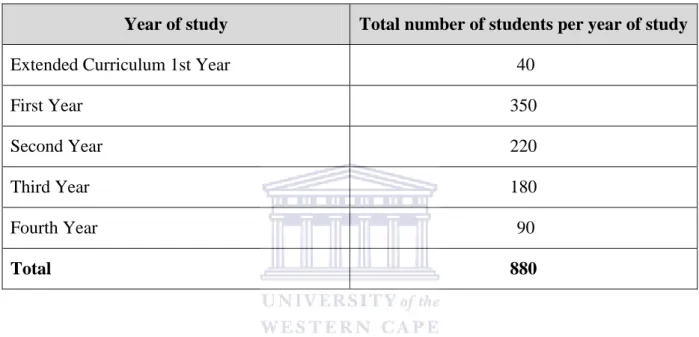
Babbie et al. (2005:100) affirm that the population of the study is that group from which a researcher wants to draw conclusions. A researcher is almost never able to study all the members of the population, nor can every possible observation of them be made. A population is the entire aggregation of cases in which a researcher is interested. A population may either be broadly defined when thousands of individuals are involved, or may be narrowly specified when the population only includes a small number of people. The accessible or source population is the aggregate of cases that conform to designated criteria and that is accessible as participants for a study. Researchers usually sample from an accessible population (Polit et al.2008:238). In this study, the accessible population was the student nurses (N=880) at the campus of a College of Nursing in the Western Cape.
Vicki, Plano and Cresswell (2010:252) agree that the qualitative researcher selects sites and people that can best assist with developing an understanding about a central phenomenon. This understanding emerges through a detailed exploration of the people or sites. It provides
information that is useful, that helps us learn about the phenomenon, or that gives a voice to individuals who are not heard. In qualitative research, where there is a need to collect detailed data from participants, it is often important to select a small sample of individuals who are both able and willing to provide the type of data the study seeks (Oliver 2010:77). In this study, a sample was selected from those student nurses at the campus of a College of Nursing in the Western Cape.
Table 2.1: Number of students
Year of study Total number of students per year of study
Extended Curriculum 1st Year 40
First Year 350 Second Year 220 Third Year 180 Fourth Year 90 Total 880 2.4 SAMPLING
Sampling is the selection process of research participants from a population that includes decisions about the observation of people, settings, events, behaviour, and / or social processes (Terre Blanche et al. 2007:49).
Wheeler et al. (2010:146) believe that there is rarely justification for a large sample in qualitative research, since it is unnecessary and might result in less depth and richness. The researcher‟s intention usually is to thoroughly research a purposive sample in a specific setting. An oversized sample might not capture the meanings participants ascribe to their experiences, and it could result in the loss of the unique and specific contributions.
According to Vicki et al. (2010:253), the research term that is used for qualitative sampling is purposive sampling. Purposive sampling means that the researchers intentionally select sites and individuals with the purpose of learning about or understanding the central phenomenon. Patton (2002:169) explains that the logic and power of purposive sampling lies in selecting
information rich cases for an in-depth study. Vicki et al. (2010:253) describe purposive sampling as information-rich cases from which one can learn a great deal about issues of central importance to the purpose of the research. They further elaborate that purposive sampling is important for good qualitative research because it demonstrates that the researcher tries to identify the best sites and participants with the purpose of learning about the central phenomenon.
According to Patton (2002:173), homogeneous sampling is the strategic picking of a small, similar sample. The purpose is to provide an in-depth description of a particular subgroup. The author continues to state that focus group interviews are typically based on homogeneous groups. Focus group interviews involve conducting open-ended interviews with groups of people about specially targeted or focused issues. It is important that sampling for focus groups typically involves the gathering of people with similar backgrounds and experiences to participate in a group interview about major programme issues that are affecting them. Terre Blanche et al. (2007:139) state that purposive sampling implies that sampling depends not only on availability and willingness to participate, but that typical cases of the population are selected.
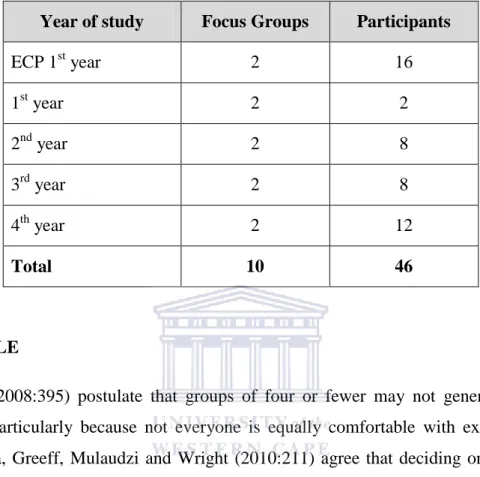
The purposive sampling group in this study was those student nurses from the (ECP) Extended Curriculum Programme, 1st, 2nd, 3rd and 4th year groups at a College of Nursing in the Western Cape. It was planned that two groups of 8 student nurses of each year of study would be selected to participate in focus group interviews (Table 2.1). In this study, purposive sampling was utilised and the researcher sought suitable participants for the focus group interviews. Polit et al. (2010:341) state that focus group interviews ideally need to be conducted with groups of about six (6) to ten (10) people whose opinions and experiences are solicited simultaneously. The interviewer guided the focus group discussions according to an interview guide.
Table 0.2: Planned focus group interviews with student nurses at a College of Nursing in the Western Cape
Year of study Focus Groups Participants
ECP 1st year 2 16 1st year 2 2 2nd year 2 8 3rd year 2 8 4th year 2 12 Total 10 46 2.5 SAMPLE
Polit et al. (2008:395) postulate that groups of four or fewer may not generate sufficient interaction, particularly because not everyone is equally comfortable with expressing their views. Botma, Greeff, Mulaudzi and Wright (2010:211) agree that deciding on the size and the right number of participants‟ means striking a balance between having enough participants to generate a discussion without having too many participants, since some valuable contributions may get lost during a crowded interview. Six (6) to ten (10) participants are preferable when they have to share in-depth, intense, and lengthy experiences.
The bigger the group, the more experienced the facilitator needs to be to ensure participation and discipline. In this study, the number of participants per focus group was five (5) to eight (8).
Inclusion criteria for the sample
For this study, nursing students in their ECP, 1st, 2nd, 3rd, and 4th year of study at a College of Nursing in the Western Cape; who were registered for the four year Diploma in General Nursing Science, Community Nursing Science, as well as Psychiatric and Midwifery Nursing Science; were included. The qualification should enable them to register as professional
nurses according to the South African Nursing Council Regulation 425, as promulgated by the Nursing Act 33 of 2005 (SANC 2005).
The sample was selected from the student nurse population, who were currently registered in the R425; for a Diploma in General Nursing, Community Nursing, as well as Psychiatric and Midwifery Nursing Science who were attending classes and / or residing on campus at a College of Nursing in the Western Cape.
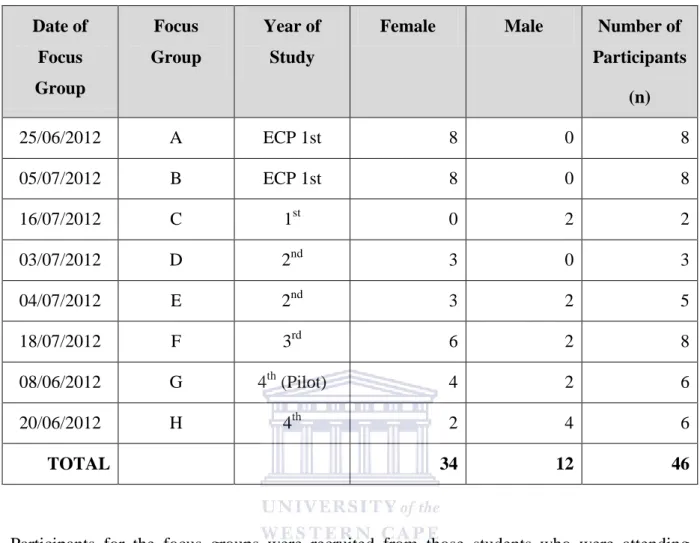
Eight focus group interviews were conducted (see Chapter 3).
2.6 DATA COLLECTION
The phenomena in which researchers are interested must ultimately be captured and converted into data that can be analysed. Without high-quality data collection methods, the accuracy and robustness of the conclusions are subject to challenge. In developing a data collection plan, the researcher needed to carefully consider the kind of evidence they want to provide to their colleagues in settings of practice (Polit et al. 2008:367). The decisions about inclusion and exclusion depended on the research topic, the emerging data and the experience of the researcher (Holloway et al. 2010:158).
Holloway et al. (2010:158) believe that in qualitative studies, the researcher is the major research tool by taking note of everything they see and hear as well as interviewing members to gain their interpretation. They further state that health researchers commonly observe behaviour in clinical or educational settings. In this study the participants and their actions were observed, as well as the ways in which they interacted with one another. The site and the use of space and time were also observed. Where the researcher did not understand what she saw or heard she asked participants to explain these instances to her.
The interviews were formal and unstructured, but the researchers asked follow-up questions on the spur of the moment. Often a researcher uncover discrepancies between the words and actions – what people do and what they say – a problem originally discussed by Deutscher (1970). On the other hand, there may be congruence between the spoken word and behaviour. If any discrepancies exist, they must be explained and interpreted.
Alasuutari, Bickman and Brannen (2009:361) state that specific issues that the researcher is expected to deal with include disagreement and arguments between members of the groups, noticing when participants are uncomfortable with a discussion and dealing with this
discomfort appropriately, and ensuring that the essential topic is covered in the available time. As Sim in Alasuutari et al. (2009:361) state, the researcher tried to ensure that discussion took place among participants rather than between participants and researcher. De Vos et al. (2011:368) agree that the researcher needs to direct discussions, encourage participation, and probe participants without expecting biased responses.
Patton (2002:372) state that probes are used to deepen responses to a question, to increase the richness and depth of responses, and to give cues to the participants about the level of response that is desired. Probing questions were used by the researcher and were conversational, offered in a natural style and voice, and used to clarify initial responses (Patton 2002:372).
Probing is a skill that originates from knowing what to look for during an interview, listening very carefully to what is said and what is not said, and being sensitive to the feedback needs of the participants who are being interviewed (Patton 2002:374).
As De Vos et al. (2011:368) state, the researcher needed to keep the discussion flowing by encouraging everyone to be an active participant. Patton (2002:374) concurs that the researcher needs to maintain awareness of how the interview is progressing, how the participants are reacting to questions, and what type of feedback is appropriate and helpful for the purpose of sustaining the flow of the discussion. Probing was done to obtain clarity and validation of what the participants said. In this study, data were collected from participants‟ discussions during focus group interviews by using the appropriate interviewing, listening, observational, and communication skills.
2.7 FOCUS GROUP INTERVIEWS
As defined by Alasuutari et al. (2010:358), a focus group is generally understood to be a group of 6 – 10 participants, with an interviewer or moderator who asks questions about a particular topic. The authors continue to state that focus group interviews are in-depth group interviews consisting of relatively homogenous participants to provide information about topics that are specified by the researchers.
Polit et al. (2010:395) state that the researcher plays a critical role in the success of focus group interviews. An important job of the researcher was to solicit input from all group members, and not to allow a few vocal people to dominate the discussion. Bless,
Higson-
Smith and Kagee (2009:123) support this point of view by explaining that group facilitation is aimed at ensuring that a safe environment for uncensored communication is created. In particular, the researcher/facilitator should ensure that everyone in the group has real opportunities to contribute, and that the group does not prevent some members from freely expressing their ideas. Some members of the group might tend to dominate and they would need to be disallowed by the facilitator. Some participants might find it extremely difficult to express their thoughts and they would need to be encouraged (Bless et al. 2009:123).
Polit et al. (2010:395) state that focus group sessions are carefully planned discussions that take advantage of group dynamics for accessing rich information in an efficient manner. Typically, the people selected for a group are fairly homogeneous to promote fairly comfortable group dynamics. People usually feel more at ease expressing their views when they share a similar background with other group members. Therefore, when the general sample is diverse, it is usually best to organise focus groups for people with similar characteristics, e.g. in terms of race / ethnicity, age, gender, or experience. This approach does not rely merely on the ideas of the researcher and a single participant. Instead, the members of the group generate new questions and answers through verbal interaction. Holloway et al. (2010:127) continue to state that through these group interviews, researchers are able to discover the experiences of the participants. They further elaborate that focus groups are characterised by interaction between the participants while researchers are discovering how people think and feel about particular issues, such as the views student nurses at a local College of Nursing, had about learning and teaching in a simulation laboratory. Focus groups members responded to the interviewer and to one another. Before the question was posed, participants were put at ease without wasting time before starting the discussion. In this study, the opening question of each focus group interview was, “What are your views of teaching
and learning in the simulation laboratory at the Western Cape College of Nursing?”
Different reactions stimulated debate about the topic because group participants responded to one another. Discussions in the groups helped not only in the development of ideas about problems and questions which the researcher did not think about before, but also with finding answers to some of the questions and solutions to problems.
Polit et al. (2010:395) state that a major advantage of a group format is the fact that the researcher efficiently obtains the viewpoints of many individuals in a short period of time. They state that focus groups encourage participants to react to what is being said by other
participants, thereby potentially creating a richer or deeper expression of opinions. Also, focus group interviews are usually stimulating to participants. Holloway et al. (2010:127) concurs that the ultimate goal for the researcher is to understand the reality of the participants, and not to make decisions about a specific issue or problem, although future actions may be determined by the findings of the focus group interviews. The second question posed to the focus groups was “What actions they could suggest to clinical facilitators in order to support
the student learner in learning in the simulation laboratory?”
Focus groups differ from individual interviews, since they depend on the stimulus that participants gain from one another by discussing both unique and shared perceptions and experiences. For this reason, the researcher chose to conduct focus group interviews with the student nurses who were registered in the R425 course that led to registration with the South African Nursing Council with a Diploma in General, Midwifery, Psychiatric, and Community Nursing Sciences.
Polit et al. (2008:395) continue to state that it is a disadvantage of focus group interviews when some people are uncomfortable about expressing their views in front of other group members. The fact that the dynamics of the sessions may allow a group culture that could inhibit individual expression is also of concern, since collective thinking inhibits the expression of individual thinking. However, the researcher noted that the topic of this study was not a sensitive issue and the students could freely air their views. Furthermore, Bless et al. (2009:123) state that many African cultures make constant use of small groups to address concerns within the community. For this reason, the focus group method of data collection was the method of choice, since participants seemed to be extremely comfortable with sharing their views. In this study, therefore, focus groups were used to capture student nurses‟ views of teaching and learning at a College of Nursing in the Western Cape and the actions the student nurses suggested for clinical facilitators to use in order to support them with learning in the simulation laboratory.
2.8 PREPARATION OF THE FIELD
Polit et al. (2008:395) state that the setting for the focus group sessions should be selected carefully and, ideally it should be a neutral space. The location was planned to be comfortable, easily accessible, and free from intimidation. Focus group interviews should be conducted in a non-threatening setting. Since the sessions in this study lasted between 45 to
60 minutes, the comfort of participants was important. The location of focus group interviews needed to meet the needs of the researcher and the participants alike. The primary concerns for the researcher are the ability to hold the discussion and to capture the data. However, for the participant comfort is the main concern (De Vos et al. 2011:370). Conducting effective focus group interviews required careful planning with regard to participants, the environment, and equipment.
Recruitment of participants for the focus group interviews required a systematic process, thus it was important to set dates, times, and locations before establishing contact with participants. The following specific tasks were taken into account during the recruitment phase of this study:
Know the segments of the target population;
Identify the appropriate composition of each group;
Apply inclusion and exclusion criteria for each participant;
Invite potential eligible participants; and
Determine the follow-up procedures that will encourage attendance.
The right group composition generates free-flowing discussions that contain useful data (De Vos et al. 2011:365). In this study, the campus library at a College of Nursing in the Western Cape had a private meeting room that was easily accessible for both the participants and the researcher and was utilised for the focus group interviews. The meeting room allowed for privacy and enhanced the use of audio-recording equipment.
2.9 FIELD NOTES
Definition of field notes: It refers to the notes that are taken by researchers to record the unstructured observations made in the field, and the interpretation of those observations (Polit
et al. 2010:555). Field notes as described by Field and Morse in De Vos et al. (2011:372) are a written account of the things the researcher hears and sees during the course of collecting or reflecting on the data obtained during the study.
The most important forms of record keeping for participant observation are field notes. A log (field diary) is a daily record of events and conversations. Field notes are broader and more interpretive, and represent the observer‟s efforts to record information and to synthesise and understand the data (Polit et al. 2010:354). In focus groups, the notes should include:
Seating arrangements;
The order in which the people speak for voice recognition purposes;
Non–verbal behaviour; such as eye contact, posture, gestures among group members, and fidgeting;
Themes that are striking; and
Emphasising as much of the conversation as possible (De Vos et al. 2011:372).
In this study, field notes were used to record the seating arrangement of participants in each focus group. For voice recognition purposes, notes were made about the order in which the participants spoke. Participants‟ behaviour was also noted and striking themes that had emerged from the discussions were highlighted.
2.10 AUDIO-RECORDING OF INTERVIEWS
As stated by De Vos et al. (2011:359), informed consent to audio record the interview must be obtained from all participants. The venue of the focus group interviews should be acoustically suited for audio-recordings (Polit et al. 2008:395). Audio-recording of interviews allows for a more complete record when compared to notes that are obtained during the interviews. It also gives the researcher the opportunity to concentrate on the development of the interview and to facilitate the direction of the discussion. It is recommended that both an electronic and battery-operated voice recorder are used to ensure that data are captured without fail. The quality of the voice recordings influences the accuracy of the transcription and analysis of the data. Audio-recorders should be placed inconspicuously, since its obvious use will unnerve the participants or the novice researcher. Some participants may feel uncomfortable with being audio-recorded and may withdraw from the focus group (De Vos et al. 2011:359).
In this study, audio recordings were used to capture the discussions of the focus group interviews during which the student nurses expressed their views about learning and teaching in the simulation laboratory and what actions student nurses suggested to clinical facilitators in order to support their learning.
2.11 DATA SATURATION
As defined by Polit et al. (2010:531), saturation is the collection of data in a qualitative study to the point where a sense of closure is attained because any new data yield redundant information.
Sometimes, the only way to find out whether more focus group meetings are required is to assess the need while the interviews are being conducted. The more diverse the responses, the more groups will be required in order to know what people are saying. Fewer groups are needed when there is a similar range of responses. If the discussion reaches saturation and becomes repetitive after two or three groups, there is little to be gained from increasing the number of groups (De Vos et al. 2011:367). Particularly with interviews and observations, there comes a point where no new categories emerge when more sets of notes or transcripts are examined. The categories are considered to be “saturated” and it indicates that the next stage of the research process may commence (Costley et al. 2010:98).
In this study, data saturation was reached when similar responses and themes were noted in the discussions during the focus group meetings. Data saturation occurred with the seventh focus group interview. However, eight focus group interview was conducted to ensure data saturation.
2.12 PILOT FOCUS GROUP INTERVIEW
Bless in De Vos (2011:237) defines a pilot study as a small study conducted prior to a larger piece of research to determine whether the methodology, sampling, and analysis are adequate and appropriate. The pilot study forms an important part of the research process. Its function is the exact formulation of the research problem, and tentative planning of the method and range of investigation (De Vos et al.2011:236).
Sarantakos in De Vos et al. (2011:236) states that researchers should never start the main inquiry, unless they are confident that the chosen procedures are suitable, valid, reliable, effective, and free from problems that might arise during the study. De Vos et al. (2011:237) continue to state that probability does not play a role in qualitative pilot studies, since the findings are not generalised.
Although the researcher may plan his / her investigation very carefully and logically, the practical situation remains an unknown factor until it is entered, thus modifications can be
made to the interviewing process after the pilot focus group interview (Vos et al. 2011:237). The authors continue to state that during the pilot study the researcher may already form an opinion about the openness of the participants, the willingness to co-operate, and the number of participants likely to be involved until saturation of data is achieved.
De Vos et al. (2011:370) state that piloting in focus group interviews can be difficult, since the questions used these interviews are difficult to separate from the environment of the focus group. Therefore, the true pilot test is the first focus group interview with the participants.
In this study, a pilot focus group was conducted to determine whether the methodology, sampling, and analysis were adequate and appropriate. The data obtained from the pilot study were included in the analysis of this study.
2.13 TRUSTWORTHINESS
Streubert and Carpenter (2011:47) state that it is critical for qualitative researchers to clarify „to outsiders‟ what qualitative research is, by stressing the use of qualitative findings and addressing the quality in qualitative studies. Holloway et al. (2010:302) describe the cornerstones of trustworthiness in qualitative research as methodological soundness and adequacy. Researchers make judgements of trustworthiness possible through developing dependability, credibility, transferability, and confirmability. The most important of these qualities is credibility. Polit et al. (2008:768) concur that trustworthiness is the degree of confidence that qualitative researchers have in their data that are assessed by using the criteria of credibility, transferability, dependability, confirmability, and the fifth criteria as authenticity.
2.13.1 DEPENDABILITY
The term dependability as opposed to reliability is used by Lincoln and Guba (1985; 1989) and replicated in Holloway et al. (2010:768). If the findings of a study are to be dependable, they should be consistent and accurate. This means that readers will be able to evaluate the adequacy of the analysis by following the decision-making processes of the researcher. The context of the research must also be described in detail. To achieve some measure of dependability, an audit trail is necessary. This helps readers follow the path of the researcher and demonstrates how she / he achieves their conclusions. It also guides other researchers
who wish to carry out similar research. Although this study cannot be replicated, in similar circumstances with similar participants, it might be repeated.
In this study, dependability was achieved by narrating the analysed data (quotes) as voiced by the study participants.
2.13.2 CREDIBILITY
Holloway et al. (2008:303) state that credibility corresponds with the notion of internal validity. This means that participants recognise the meaning that they attach to a situation or condition and the “truth” of the findings in their own social context. The researcher‟s findings are, at least, compatible with the perceptions of the people under study. Polit et al. (2010:751) concur that credibility is a criterion for evaluating integrity and quality in qualitative studies by referring to confidence in the truth of the data, i.e. analogous to internal validity in quantitative research.
In this study, the focus group participants were able to discuss their views about learning and teaching in the simulation laboratory and suggested actions that clinical facilitators could use to support the learning and teaching of students.
2.13.3 TRANSFERABILITY
Lincoln and Guba use transferability instead of generalisability (as cited in Holloway et al. 2008:303). This means that the findings in one context can be transferred to a similar situation or participants. The knowledge acquired in one context could be relevant in another, and those who carry out the same research in another context will be able to apply certain concepts originally developed by other researchers.
2.13.4 CONFIRMABILITY
Holloway et al. (2010:303) assert that, confirmability takes the place of the term objectivity. Since the research project is judged by the way in which the findings and conclusions achieve their aim and not by the results of the researcher‟s prior assumptions and preconceptions. They further explain that, in turn, this focus needs an audit or decision trail where readers can trace the data to their sources. Readers follow the path of the researcher and the way he or she arrives at the constructs, themes, and interpretation. To this end, details of the research and the background and feelings of the researcher should be open to public scrutiny.
2.13.5 AUTHENTICITY
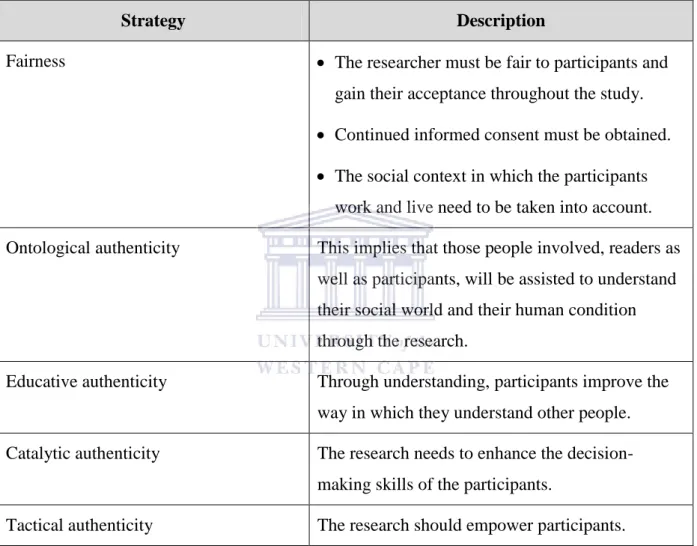
A study is authentic when the strategies used are appropriate for the true reporting of the participants‟ ideas. Authenticity consists of the following elements, as outlined by Holloway
et al. (2010: 304).
Table 0.3 Authenticity strategies
Strategy Description
Fairness The researcher must be fair to participants and
gain their acceptance throughout the study.
Continued informed consent must be obtained.
The social context in which the participants work and live need to be taken into account. Ontological authenticity This implies that those people involved, readers as
well as participants, will be assisted to understand their social world and their human condition through the research.
Educative authenticity Through understanding, participants improve the way in which they understand other people. Catalytic authenticity The research needs to enhance the
decision-making skills of the participants.
Tactical authenticity The research should empower participants.
In this study, all focus groups were facilitated by the researcher and audio recordings and field notes of each focus group interview were obtained. Also, all participants were afforded the opportunity to voice their views about teaching and learning in the simulation laboratory and suggested actions to clinical facilitators in order to support students in the simulation laboratory at a College of Nursing in the Western Cape The data were transcribed and coded by independent professionals.
2.14 DATA ANALYSIS
Immersion in the setting helps researchers to use a thick description (Holloway et al. 2010:7). Geertz in Holloway (2010:7) explains that the term “thick description” was first used by the philosopher Gilbert Ryle. Geertz explains that this process involves detailed portrayals of the participants‟ experiences by going beyond a report of surface phenomena to their interpretations, as well as uncovering feelings and the meanings of their actions. This also means that researchers create and produce another layer that is constructed from the contributions of the participants. A thick description develops from the data and the context. The task involves describing the location and its people, giving visual pictures of setting, events, and situations; as well as verbatim narratives of individuals‟ accounts of their contextual experiences and ideas. Denzin (1989:83) supports this view by defining thick description as: “deep, dense, detailed accounts of problematic experiences. It presents detail, context emotion, and the webs of social relationship that join persons to one another.” Polit et al. (2010:550) concur that a thick description refers to a rich, thorough, and vivid description of the research context, the people who participated in the study, and the experiences and processes observed during the inquiry. The prevailing sentiment is that if there is to be transferability of the findings, the burden rests with the investigator to provide sufficient information to permit judgements about contextual similarity. Lucid and textured descriptions, with the judicious inclusion of verbatim quotations from study participants, also contribute to other quality criteria; including authenticity of a qualitative study.
Holloway et al. (2010:7) emphasise that the description of the situation or discussion should be thorough. This implies that writers need to describe everything in vivid detail.
In this study, the transcription of data collected from student nurses interviews in relation to learning and teaching in the simulation laboratory and what actions they suggested to clinical facilitators in order to support their learning in the simulation laboratory at a College of Nursing in the Western Cape was conducted by an independent professional
2.15 CODING
According to Denzin and Lincoln (2000:823), an alternative approach treats interview data narratives from the perspective of people‟s description of their worlds. This narrative approach claims that, by abandoning the attempt to treat respondents‟ accounts as potentially
“true” pictures of “reality”, we open up for analysis the culturally rich methods through which interviewers and interviewees collaboratively generate plausible accounts of the world.
According to Henning et al. (2007:101), the trustworthiness of a competent qualitative researcher is evident in the analysis of the data, a process that requires analytical craftsmanship and the ability to capture understanding of the data in writing. In “showing the workings of the data” (Holliday 2001:99), a researcher also needs to demonstrate an understanding of design logic. The researcher is able to match the analysis procedures and the methodological position of the study, and consistently and coherently manages the analysis (and interpretation) process according to the principles of the study design. The analysis process represents the “heartbeat” of the research. The description of this process determines the analyst‟s quality of thinking (Holliday 2001:99).
Henning et al. (2007:102) continue to state that initial procedures of coding and categorising are just that – initial procedures – and that they lead to no more than a “thin description”.
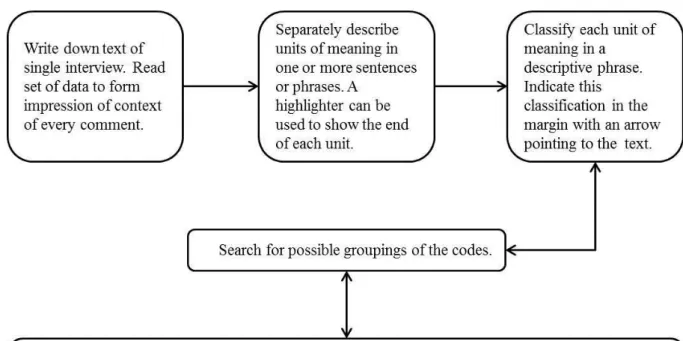
Holliday (2001:79) states that: “A thin description simply reports facts, independent of intentions or circumstances”. Therefore the following comprehensive steps were conducted in the study to obtain rich data (Figure 2.1) on next page.