Global brain inspired alignment by
Drupal: between strategic problems,
practical web development and cognitive
insights.
Mixel Kiemen
1
Vrije Universiteit Brussel, Pleinlaan 2, 1050 Brussels, Belgium
The global brain is a metaphorical description of what the Internet can become. For many, the Internet is a knowledge system, but a brain is about intelligence. This paper will make a global brain inspired alignment by adding the notion of aggregative intelligence to the global brain vision. Such an alignment can be particularly useful for R&D management. The paper will present a case study, an interdisciplinary analysis and an action-research experiment. The case is about Drupal, an open source content management system. The interdisciplinary analysis is about complex adaptive systems, multi-agent systems and feedback mechanisms. The case and the analysis lead to alignment statements, which are further illustrated by an action-research experiment. The experiment is about the course “Web Service Development for Business”. In this course, the alignment statements are applied to build social-software and web 2.0 applications, using Drupal as framework. The case study, the analysis and the experiment denote hypotheses that can be verified in future studies.
1. Introduction
The global brain concept is about a worldwide network evolving towards a super brain (Mayer-Kress and Barczys, 1995; Heylighen, 1997). The global brain is not pro-actively built: visions follow after practice. Indeed, so far mostly practitioners delight in the web as an entrepreneurial utopia. For example, venture capitalists took more risk after they saw rises in stock valuations of dot-com companies. Likewise, concerning web 2.0, businesses only recognized the web was a platform after practitioners created such application frameworks. In a similar way, this paper looks at current practice to shed new light on the global brain vision, which in turn will renew strategic alignment for web development. This new light involves inclusion of intelligence in the global brain vision.
With respect to intelligence, our current practice shows an intriguing phenomenon. On the one hand, problems in Artificial Intelligence (AI) indicate that intelligence is a hard-to-trade skill, which makes it hard to engineer, but also of tremendous economic value. Even though AI is
successful in specific niches, general artificial intelligence – known as strong AI (Searle, 1980) – is barely touched upon. On the other hand, intelligence has become abundant, through the web as a global communication platform (Friedman, 2005). Such intelligence can be coordinated to execute tasks usually done by experts (Surowiecki, 2004). Regarding this so-called crowdsourcing (Howe, 2006), the challenge is to direct abundant (amateur) intelligence and coordinate it towards solving complex problems, which usually can be solved only by scarce (professional) intelligence. Indeed, we don’t have to build intelligence, but can aggregate it.
We will intentionally create ambiguity in this paper by using the abbreviation “AI” for Artificial-or-Aggregative Intelligence. This is because intelligence for the global brain is artificial – man made as opposite to spontaneous (Simon, 1969) – and aggregative (e.g. crowdsourcing). Hence, including intelligence to the global brain is AI-alignment.
AI-alignment is about mediating people’s intelligence by social-software. In this way, bidirectional coordination between people and technology arises. In fact, such
bidirectional coordination is not exclusive for the web. It is part of a broader technological evolution, which becomes clearer with IT and overwhelmingly clear with web applications. This evolution of bidirectional coordination enables us to expand our understanding from well-controlled environments – containing many static elements – to Complex Adaptive Systems (CAS).
Understanding well-controlled environments is necessary as a solid scientific foundation. As research matures in several disciplines, researchers are now starting to work on the harder problem of understanding CAS. For example studies on the history of technology show how models of Smithian growth get complemented with models of Schumpeterian growth (Mokyr, 1995).
In innovation management, many scholars introduce their concepts by expanding a simple static problem to a harder dynamic problem – ‘static' and 'dynamic' here referring to specific skills for conducting a certain innovation. Similar dichotomies are, amongst others, incremental / radical (Freeman and Soete, 1997), continuous / discontinuous (Hamel and Prahalad, 1994), sustaining / disruptive (Christensen 1997) and component / architectural (Henderson and Clark 1990).
Remarkably, the same division can be observed in natural science, where a shift from Newtonian science to Darwinian science is occurring. This shift is particularly apparent in Newtonian physics, which is being expanded in three directions. The first two directions maintain time symmetry: quantum mechanics and general relativity. A third direction is breaking down the idea of determinism by including irreversibility and instability (Prigogine 1997). Irreversibility and instability are central to Darwinian science, as irreversibility is a necessary condition for growth, and as instability triggers self-organization.
The history of Darwinian physics, according to Prigogine (1997), began in 1893 with Poincarés solution to the “three body problem“, a prototypical problem in the Newtonian paradigm. Other Darwinian sciences emerged more or less during the same time period (e.g. fractals). At the end of the 19th century, few people knew the concepts, but by the 70s they got widely disseminated (e.g. computer-constructed Mandelbrot in 1975, Prigogine’s Nobel Prize in 1977). As Darwinian science is disruptive and evokes widespread resistance from the science community, it has emerged only slowly.
As the Schumpeterian growth model is essentially Darwinian in nature, the model is often met with similar intuitive defiance. Familiarity with the history and the models of Darwinian science may make the Schumpeterian growth model more plausible, despite this intuitive defiance. Think about Pasteur’s famous quote: fortune favours the prepared mind.
This paper should be seen in light of Darwinian science and Schumpeterian growth. The research method applied so far is action-research, which strives to create experience and build theory based on that experience. The paper has tree parts: a case study, an interdisciplinary analysis and an action-research experiment.
The case study is about a re-opening Content Management System (CMS) market. It is in these turbulent markets, where no design has become dominant
yet and economic value are redefined, that state-of-the-art strategic innovation management should be researched. More specifically, the case concerns Drupal. It is argued that Drupal can become the dominant design of the CMS market.
The interdisciplinary analysis crosses domain borders to create a particular story. It starts with innovation management in relation to CAS. The management domain shows relation to CAS properties, but not to CAS mechanisms. There are conceptual CAS mechanisms and CAS feedback mechanisms, both get elaborate by creative agents (Kiemen 2003, 2006). The mechanisms will help the transformation from an agent-based simulation to a web framework that mediates people. The mechanisms are also the reason why we stimulate ambiguity by using AI (Artificial-or-Aggregative Intelligence). Some argumentation will be given in respect to this ambiguity.
The case and the analysis build up to statements for AI-alignment, which get examined by action-research experiment on a course. The goal of the course Web Service Development for Business (WSDB) is to teach business students about opportunities for a future web development. This is a very ambitious goal if you consider the innovation speed on the web. The course is now running in its fourth year. During the years it turned out that Drupal was the best option to create prototypes.
2. Drupal case
OS projects generally are disruptive innovations, as they redefine the economic value of software development. Hence, OS is particularly useful for new markets. However, the generality of prior statement is a bit of a drawback. It would be more interesting to have a theory that can indicate, for a similar market, which projects payoff and which fail. In this case, our hypothesis is that Drupal will most likely become the dominant design for the CMS market. By comparison, we reason for our hypothesis.
Comparing the evolution of several players gives a practical way to perceive what is emerging. We will leave a more fundamental theory concerning emergence and aggregation to the interdisciplinary analysis. Still, a small example can illustration the subtlety of the problem we are dealing with. The problem to see what is emerging is about a holistic view or Gestalt. Seeing only part of the picture leads to wrong conclusions.
For example, Tuomi (2005) criticizes Linux for not being genuinely innovative, as Linux is simply re-implementing functions that exist in Windows. Now, Linux's growth is slow compared to other web projects. In this respect, the Linux case should be compared to Christens’s Bobcat case (1997): its growth is spread over generations of other, similar technologies. Insight on slowly emerging innovation arises by historical studies. Mokyr (1995) elaborates that a re-implementing technieks is a key feature for slow innovations. To take Tuomi's purely functional perspective, a long time will pass before we see innovation on top of what is re-implemented. So it is way to early to make any conclusion.
However, more importantly, the innovation focus is not on the re-implementing elements. Tuomi rejects or is blind to the emerging values, as so often is the case with disruptive innovations. The emerging values are about OS business models. We need a Gestalt-perception solution to our emerging concepts. The straightforward, but also hard solution is to create instruments to perceptive what is emerging. Such instruments at least make the discussion more tangible.
Slowly emerging innovations are in a strident contrast to turbulently emerging innovations (e.g. on the web). In case of turbulent development, the need to perceive (by instruments) is not a question of curiosity – as it is for slow emerging innovations. For turbulent innovations it is a necessity for survival. Consequentially several of such instruments exist and we shall use one to illustrate out case.
Content Management System trends
We use Google Trends1 as an instrument to visualize the reopening of the CMS market and illustrate the role of Drupal in this market. Our hypothesis – that Drupal will become the dominant design – is a non-trivial issue as will become clear. It can be criticized that using Google Trends is not academically, as it took us no effort to build the charts. The fact that the chart is easily accessible makes it a great tool for research, as one can swiftly verify, counter-argue and compare the argumentation. Our research contribution is the interpretation, based on our participatory experience, not the data analysis itself.
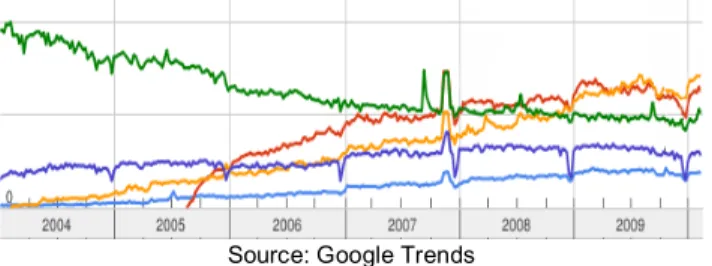
Google Trends simply returns how often a keyword has been searched over time. Our first chart is to illustrate that the CMS market is re-opening and OS products are taking the lead. This becomes clear by comparing the five trendiest systems: Drupal, Wordpress, Joomla, Lotus and Sharepoint.
Drupal, Wordpress and Joomla are the most common OS systems. The two most common business suites are Lotus by IBM and Sharepoint by Microsoft. In figure 1, you can see that before 2004 only the business suites were of interest and clearly Lotus was dominant. In the past years, Lotus’s trend has been slipping. By 2008, OS systems overtook the lead. Sharepoint grew slowly until 2008 and has been slightly declining since. The sudden appearance of Joomla in 2005 is misleading, this which will be elaborated later on.
Source: Google Trends
Figure 1. Search trends of Lotus (green), Sharepoint (purple), Wordpress (orange), Joomla (red) and Drupal (blue)
1 See http://www.google.com/trends (consulted 18 Mei 2010)
Drupal is slowly gaining in popularity, but not as fast as e.g. Wordpress. So one can question why we focus on Drupal. Note there is currently not a significant gap between the trends as compared to 2004. By looking at another CMS group a different trend occurs. Let us compare four technical OS CMS: Phpnuke, Plone, Typo3 and Drupal. Compare the period 2004-2005 in figure 2 to the period 2004-2009 in figure 1. Before 2004, Phpnuke was dominant and again Drupal was not so popular. However, Drupal clearly took over in 2006 and the other systems faded out.
Source: Moczka (1997: 4).
Figure 2. Search trends of Phpnuke (green), Plone (orange), Typo3 (red) and Drupal (blue)
The reason why Drupal is popular in figure 2 is social-technical. Drupal has a nice software architecture, with a reasonable learning curve (e.g compared to Plone). For many programmers, Drupal is as much a CMS as a framework for development.
The social reason can be found on Drupal events. Each year, there are two main conferences, one in the USA and one in Europe, next to many local events of course. The events are not like classical conferences. While non-professionals take the Drupal conference as an opportunity to learn about what is hot (and not) for Drupal, the developers create their own dimension on the event. Organizational structures like code-sprints and BOF-sessions make this extra dimension possible. Code-sprints are organized workshops where developers are tackling one of the issues that need a lot of communication. Mostly these issues arose online, did not get solved and were postponed to the conference. BOF-sessions – which stands for “Birds of a Feather flog together” – is a name for self-organizing brainstorm sessions that emerge during the conference.
Such event structures are only possible if there is a strong community momentum. The worst thing that can happen to a community momentum is a polarization followed by the split of a community. This is known in OS environments as “forking”. A fork occurred to Mambo in 2005, which became Joomla afterwards. Figure 3 illustrates the lost of momentum by comparing Drupal, Wordpress, Joomla and Mambo. Notice how the lost of momentum allowed the slower emerging Wordpress to take the lead. Forking is a social-technical issue too. Joomla has not such nice software architecture compared to Drupal, which translates to a less robust community momentum.
Figure 3. Search trends of Mambo (green),, Wordpress (orange), Joomla (red) and Drupal (blue)
Drupal has avoided a fork with Deanspace, which is now known as CivicSpace. Deanspace was used during 2004 presidential campaign of Howard Dean. The success made Deanspace drifted away from the Drupal community. Still the recognition of new “Application Programming Interfaces” (APIs) in drupal 4.7 and the recognition of a great Drupal community made them rejoin to one project by integrate much of their innovation to Drupal 5.
We cannot emphasize enough the importance to take a social-technical view. Not only is good software architecture needed, but also a clear intrinsic community spirit and the need of a healthy business ecosystem, to make a web project succeed. While Joomla and Wordpress are currently the most trendy or searched systems, it is our impression that Drupal is business-oriented stronger. Drupal has become an enterprise-oriented system and this can explain why it is less popular by the larger public, although recent versions are trying to bridge the usability gap.
The enterprise-orientation can be illustrated. Gartner (2009)2 has put Drupal in: the Visionaries quadrant of the “Magic Quadrant for Social Software in the Workplace”. Joomla and Wordpress are not even in the graph. Recent success by Drupal is significant. For example whitehouse.gov, which clearly increased the reputation of Drupal as enterprise solution. A most recent trend is Joomla businesses expanding into Drupal.3 The rich business ecosystem and the support to this ecosystem by Aquia is becoming a keystone in the Drupal story. Therefore Drupal is a very interesting project to study strategic management of dynamic capabilities and our hypothesis that it will become the dominant design of the CMS market.
Social-technical people
People's love for Drupal makes them do funny stuff, like knitting socks or baking cakes with Drupal-icon, creating a Drupal song, or walking around in a Drupal-icon costume. The emotional bond of people with the Drupal project should not be treated lightly. A distinction can be made between the emotional expressions about technology and emotional expressionsby technology. The former is more common as it happens also to other technological companies with a strong brand (e.g. Google, IBM and Apple). The latter is illustrated by Wesch’s anthropological studies on Youtube. 4
Welsch explain how emotional expressions is created by video-copycat. While the videos on Youtube clearly illustrate the love given through technology – in this case
2 See
http://www.gartner.com/technology/media-products/reprints/microsoft/vol10/article4/article4.html
(consulted 18 Mei 2010)
3 See
http://buytaert.net/joomla-vs-drupal-business-models-and-commercial-ecosystem (consulted 18 Mei 2010)
4 See http://www.youtube.com/watch?v=TPAO-lZ4_hU
(consulted 18 Mei 2010)
through creating videos – developers give a similar love to the Drupal project – by creating modules, themes etc., they like to share with the community.
Literature on the intrinsic bond between developers and their projects fails to describe clearly the emotional social-technical relation. A new social class has emerged, which Florida (2002) calls the creative workersx. Although the idea of the creative class is not directly based on OS work, his concept is appropriate to describe OS development. Some examples are: an intrinsic drive that blurs the boundaries between work and off-work hours; a broad social network; striving for responsibilities and leadership; deciding to live somewhere, not because of work, but because of the openness or the challenges the place brings with it; etc.
Take for example the founder of Drupal, Dries Buytaert. He created Drupal in 2000 as a hobby next to his PhD studies. In 2006 he co-founded the Drupal Association, later he co-founded two companies: Aquia in 2007 and Mollom in 2008. When asked why he focuses on collaboration, he’s immediate response was: it is fun and easy. He elaborated that the isolation one has during a PhD was in great contrast to the collaboration he had on the Drupal project. He likes to get challenged and tries to compensate weaknesses by collaborating with people who are better, as it challenges him to do better too. Indeed he fits Florida’s profile perfectly.
The moneymaking values of the extrinsically motivated incumbents are being disrupted by the problem solving values of the intrinsically motivated creative class. On the web this results in an Internet dilemma, meaning businesses don’t know how to behave toward the Internet. In essence, they don’t know how to make profits and they make wrong strategic decisions, because the decisions are based on non-digital markets.
A key motivation of a creative project, like Drupal, is to disrupt its own core activity. For example, during the 2007 Drupal Barcelona conference, the keynote presentation by Buytaert explains how the Internet is eliminating the middleman (e.g. Amazon versus bookshops, iTunes versus music stores etc.). So he raised the question: “how can Drupal eliminate the webmaster, developer and the designer?” The room – full of webmasters, developers and designers – reacted with applause. Today, that motivation has lead to the “Aquia Garden” service, which allows end-users to easily create a nice website.
It may look as if they try to make their own jobs abundant, but they have created a very economically competitive strategy. By trying to automatize your own core activity, you will be more aware of the hard-to-trade skills hidden in the bulk of activities, which thus enables you to create a competitive advantage. By their exposure and the focus on hard-to-trade skills, they indeed become the best developers around and won’t fall short of interesting projects to do. It is actually very hard to find skilled developers. Consequentially training is high on the agenda.
Drupal may thus try to eliminate one kind of middleman, but simultaneously it creates a new one. Drupal has become a framework for many SMEs to provide services on the web. A rich business ecosystem
has emerged in which companies collaborate, as the demand of customers may require skills by other companies. The Drupal project tries to help its ecosystem. One such example is the construction of an instrument to visualize the usage of Drupal modules or the recent focus on distributions. It would be interesting to build instrument to visualize the ecosystem itself and get a better understanding of the ecosystem dynamics.
Interdisciplinary analysis
AI-alignment relates to strategic innovation management and IT-alignment, which is also a strategic management topic. However, both topics lack theory to ground AI-alignment. Therefore, this interdisciplinary analysis is to build theory to support AI-alignment. Such theory can be retrieved from cognitive studies on CAS.
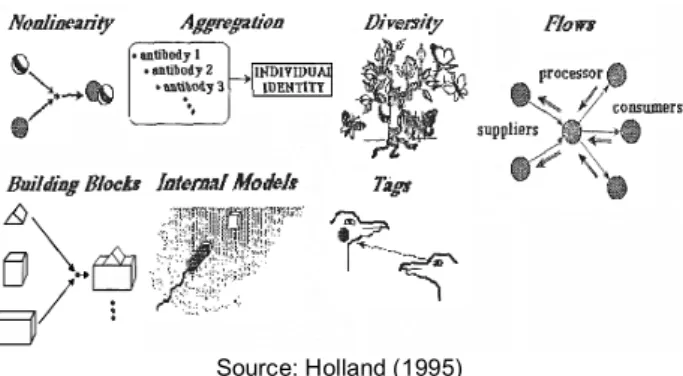
Holland (1995) came forth with four CAS properties and three CAS mechanisms (figure 4). While the CAS properties seem to be clearly present in the innovation literature, this is not so for the CAS mechanisms. CAS mechanisms can be used to build agents, agents being instruments to studying life, evolution and intelligence. Agents are autonomous entities that have cognitive abilities and will be essential for AI-alignment. We shall start by illustrating how CAS properties are relevant for innovation management. Once the cognitive study has illustrated CAS mechanisms, the paper will turn to IT-alignment and build statements for AI-IT-alignment.
Source: Holland (1995)
Figure 4. CAS properties: non-linearity, aggregation, diversity and flow. CAS mechanisms: building blocks, internal models and tags.
Strategic innovation management
Darwinian science has been revolutionary, in both to the perception of science as the research methods. The research shift from Smithian to Schumpeterian growth is mostly perceptual: no extensive change in research methods is perceived. Methods like statistical surveys are still valid, but have to deal with dynamic components. The same accounts for best practices. From the case study it should be clear that we want instrument to get a (Gestalt) visualization of what is emerging. We will need to combine theory on strategic management and insights on cognition to build theory about such instruments.
The strategic management is about dynamic capabilities framework (Teece, Piasno and Shuen, 1997; Eisenhardt and Martin, 2000). The dynamic capabilities framework is about the competitive advantages in rapid changing environments. It builds on the resource-based view (Wernerfelt, 1984; Barney, 1991), which goes back to the notion of competitive advantages of Porter (1980).
From Porter to Schumpeterian notion of “creative destruction” (Schumpeter, 1975) is still a large gap. There is also a lager gap between popular innovation management and academic publications. For example when Christensen outlines disruptive innovation he uses “organizational capabilities framework” (1997, 2006), which comes very close to dynamic capabilities framework. Likewise Chesbrough’s open innovation (2003), comes close to Cohen’s and Levinthal’s absorptive capacity (1990).
When one can observe large gap in literature around the same topic in the same domain, it should go without saying how hard it is to interdisciplinary connect it to insights on cognition. Therefore it is surprising to find the attempt to identify dynamic capabilities being so related to the attempt of to identify CAS properties. There is no one-on-one relation, particular because different names are used, but the similarities are significant. For example the dynamic capabilities is very focused on CAS properties as flow and aggregation. The CAS non-linearity is even explicitly used in management literate (Kline and Rosengerg 1986). The property diversity is even more common, but know as R&D portfolios.
Even when CAS properties are not explicitly mentioned in the literature of innovation management, they are clearly present tacitly. The relevance of cognitive abilities has been used in innovation literature too. For example Vodjak and Price (2009) use it to illustrate the nature of systematic or serial innovators.
It is so exceptional to see a clear relation to CAS properties while there seems no relation to CAS mechanisms. This is not to say that no mechanisms exist. IT-alignment is a well-discussed topic related to strategic management. However, seeing CAS mechanism in IT-alignment requires quite some imagination. Therefore an extended detour to cognitive agents is needed before we can address IT-alignment.
Gestalt by anticipation and bootstrapping
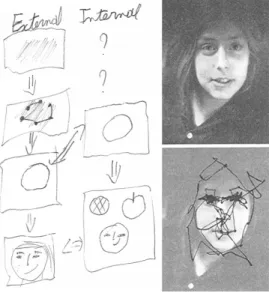
Agent simulations can be used to investigate out of the box learning. Such creative agents have all the CAS mechanisms and follow a particular pattern, which can be described by CAS feedback mechanism. They are used to build a novelty regulation model (Kiemen 2006, 2008). Let us illustrate two-feedback mechanism: anticipation and bootstrapping. To do so we use an example of how perception is being constructed. Gestalt-perception referees to a holistic approach: you see the whole picture at once. Still all cognition seems constructive. For perception you observe the construction by rapid eyes movement or so called saccade of eyes. It is illustrated in the right side of figure 5.
behind the saccade eye is given to illustrate Gestalt-perception. During the first few milliseconds light touches the retina, only a vague blur is perceived. This would evolutionarily be similar to more primitive cognition (e.g. fish). The saccading eye iterates the boundaries and so constructs a round shape. Parallel an internalizing process works on associations, linking round with: ball, apple or face. Each of these associated objects has specific external tags. In our case the face validates correct and now face can get associated with new elements, like emotions, gender, etc.
Figure 5. How anticipation and bootstrapping could make Gestalt-perception
Gestalt-perception is a combination of measuring sensory input (by tags) and mapping it to internal models (by associations). There are two feedback mechanisms working to make the perception: anticipation and bootstrapping.
Anticipation is a process of entwined feedback with feed-forward. This is very useful as feedback may come to late (e.g. the company is bankrupt). Feed-forward may seem better, but it can loses grip with reality. As the reality changes and feed-forward is based on knowledge about that reality. Anticipation is compensating the two negative effects: feedback constantly updates the knowledge the feed-forward is using. In figure 5 there are two anticipating processes: anticipating tags by using associations and anticipating associations by using tags.
The complication of the two anticipating processes is its bootstrapping relation. Bootstrapping is a process where A is used to develop, support or improve B, while B is used to develop, support or improve A. In our example there are tags and associations. Each process was performing a simple task: verifying tags or adding associations. The complicated face only emerges by the bootstrapped relation between the two anticipating processes.
The novelty model and mediation
The Gestalt-perception is only possible when building
blocks (tags and associations) exist. The harder task is to create a learning process for the building blocks, based on the same principles of aggregation by anticipation and bootstrapping. To get to such a model, we first define the principle of novelty:
Novelty is not something that can be deduced out of the knowledge system nor can it simple be observed.
Learning novelty happens by a bootstrapped relation between two anticipating processes. Indeed, novelty is like the face in figure 5: no single process has created it. The two learning directions are: anticipating experience (or outcome) by acting on an internal model and anticipating an internal model by abstracting (or modelling) experience.
A direct link exist between the processes of figure 5 and the learning of novelty. By expanding the internal-external interaction with two more processes a novelty regulation model is created. Understanding the regulation of novelty is a complicated matter we cannot fully elaborate it in this paper. Let us give the essential parts. The novelty regulation model has four anticipating processes, which are: internalizing, externalizing, directing and growing. Direction adds motivations. It will steer the selective pressure of tags and association. In an extreme case, direction can focus purely on internalizing or on externalizing, which make up the two learning directions for novelty. Growing, then, deals with experiences and is the actual learning process. The other three processes are to make the model be in the present, thus allows novelties to emerge.
While we have been focusing on the processes, it is what happens between the processes is interesting for this paper. The four processes are all connected to a working memory where a construction of mediation occurs. Heylighen (2006) expresses the construction of mediation by an evolutionary study:
Source : Heylighen (2006)
Figure 6. Observation of the evolution of mediation
Let us illustrate the construction of mediation by using our own Gestalt-perception example. In figure 5, first interactions are denoted by question marks, because at the start the working memory is just a dump for all the building blocks. So it starts as a collective. Interactions occur, as illustrated by arrows between tags and associations. Thus the collective becomes a medium. Motivations can emerge, which will focus on a particular task (e.g. learning). Performing a task requires coordination and the medium becomes a mediator. Now the system is building rich internal models and so it is becoming aware of the possibilities. This knowledge transforms coordination to control and simultaneously the mediator transforms to a manager.
Notice that the transition from collective to manager did not change the nature of the building blocks (experience, tags, associations and motivations). What
changes are the relations between the elements. The extraordinary observation requires us to investigate the nature of mediation from another angle, by looking at the notion of stigemergy.
Multi Agent Systems and stigmergy
Evolution of mediation happens to a collective. While it is about a collective of building blocks for the novelty model, a collective is more commonly about populations. The notion of extended mind (Clark & Chalmers 1998) can help us to shift from the internal processing of one agent to Multi Agent Systems (MAS). An agent can extended its mind by putting information into the environment, thereby expanding their capabilities for reasoning. Of course, as it is in the environment, another agent can pick up the information and react to it. What brings us to studying communication, but also studying swarm behaviour, like termites, ants, wasps, etc.
Grassé (1959) conceived the term stigmergy in his study of communication effects in swarms (Theraulaz and Bonabeau, 1999: 97). The term stigmergy is from Greek words “stigma” – which means mark – and “ergon” – which means work. Simply put, stigmergy indicates that the mark will make the agent work. An example of stigmergy is ants that create pheromones (stigma), with which they make a path from the food to the nest. This path will mediate the other ants to find the food.
Stigmergic activities are also used to describe wiki collaboration and open source development (Heilighen 2007). A mediator evolution can be observed on the web in general. Before the 90’s the web can be perceived as a collective of computers. It has become a medium on several levels. It has become a fast medium for information before the millennia. Currently it is a social-technical medium too. The social medium is by social software, which illustrates that people have the stigmergic urge to be present on the medium. Web 2.0 illustrates the technical medium. O'Reilly (2004) expresses this nicely: a platform where customers are building your business for you.
Thanks to stigmergy and the evolution of mediation it becoming clearer what the power of the CAS feedback mechanism are in relation to agents. We may say that stigmergy reinforces agency. So agency can emerge out of interaction. In some cases the agency gets autonomy, in that case we have agents. It is this agency that becomes perceived as intelligence. In case of crouwdsourcing it was from amateur to professional intelligence. In case of the novelty regulation model, aggregation of pattern matching (e.g. no-intelligence) emergences to something that looks intelligent. Indeed, in our research we understand that intelligence is not build but aggregated.
IT-alignment and agility
We end this interdisciplinary analysis by going back to strategy management. Both the Drupal case as IT-alignment makes effort to ensure interaction will lead to proper coordination. With the cognitive detour we know
that coordination leads to mediation. Best practices on IT-alignment are inline with our cognitive insights. Henderson and Venkratraman (1993) propose an IT-alignment by separate IT-alignment to an internal and an external component. Then, they continue to give two alignment motivations: business strategy as the driver and IT strategy as enabler. In other words: two alignment motivations are applied on two learning directions (internal & external). This is exactly a description of how novelty is learned. It is our assumption that the common critics to their model may get solved by fully including the novelty regulation model, thus be AI-aligned. To do so, two missing components need to be added next to the internal and external. The components should relate to the directing and growing processes of the novelty model. This absence of the two components comes forth by the focus to express what needs to be done. The directing and growing come about when expressing how it should be done. It is common to express how innovation and OS development it done, by using iterative development processes. For software development the agile manifesto (2001) expresses how the development should be done:5 1. Individuals and interactions over processes and tools 2. Working software over detailed documentation 3. Customer collaboration over contract negotiation 4. Responding to change over following a plan
The accent on “over” in each statement is to split the sentence in two. The manifesto acknowledges that the last part has value, but stresses that the first part should have priority. Notice how these statements include a direction, which was missing in the IT-alignment model. There are some attempts to use agile method for innovation management, but it fails to make a strong position.6 This paper is an attempt to fill the gap, but it did require a broad cognitive detour. Luckily the detour is only needed to build and improve the theory. Using the theory will not require that level of understanding. In an attempt to build a theory that won’t require the cognitive insight, we use some of the negative remark about IT-alignment and transform them to statements for AI-alignment. The negative remarks on IT-alignment come form the survey by Yolande, Blaize and Reich (2007):
1. Alignment research is mechanistic and fails to capture real life.
2. Alignment is not possible if the business strategy is unknown or in process.
3. Alignment is not desirable as an end in itself since the business must always change.
4. IT should often challenge the business, not follow it. A slight transformation makes them become positive statements for AI-alignment:
AI-S1. Capturing real life by understanding how “life entwines mechanistic”.
AI-S2. Creating unknown and emerging businesses. AI-S3. Changing business by automating its core
activity.
AI-S4. IT will challenge the business, the public sphere
5 See http://agilemanifesto.org/ (consulted 18 Mei 2010) 6 We can see this by the pore wikipedia entry on agile
management http://en.wikipedia.org/wiki/Agile_Management
and markets, not follow it.
With these statements we can stop the detour and go back to the Drupal case. Now, with AI-alignment statements (AI-Sx) as our tools, we illustrate a proof-of-concept to manage web projects. The AI-alignment statements are mentioned to give an extra dimension to the story.
Web Service Development for Business
The course Web Service Development for Business (WSDB) got created in an attempt to get heads on with our educational task at the University. The course was inspired on the experience with Drupal. The WSDB course tries to tackle multiple issues. The basic objective is to teach managers how to deal with software development. To make it more interesting we focus on web development and how a next generation of web development can look. This is indeed an ambitious goal, if one takes into account the speed of change on the web. The course mimics an OS community and focuses on creative work. Although the main object was set, we had many uncertainties on how to bring it to practice (AI-S2).
The creation of the course had no relation with our research agenda, only with our research experience. However, latest development in the course has drawn our attention to use it for research (AI-S4). During the third year some of the good students soled their projects. A logical question is what happened to the best students? It seems as the best students came up with something so creative it became a prototype for a new service. It would require a further cultivation of the project to make a spinoff out of it. You need to take into account that this are master students in business technology, they didn’t had any experience on programming or web development before the WSDB course. The fourth year is reconfirming the trend. At least one student is again ahead of me by building a business model of its project.
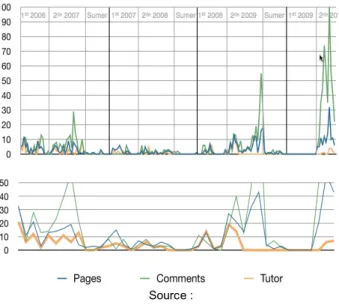
Another goal was to use computer-mediating learning to automate some teaching tasks (AI-S3). The positive trend toward this goal can be explained by figure 7. Figure 7 gives the amount of interactions that happened during the course. Three categories are shown: the amount of pages the students posted, the amount of comments students give and the amount of feedback the tutor has to provide. The top graph counts per week and gives a general overview. The bottom graph gives a smoother result by counts per mount, this graph is to show the tutor interaction more clearly.
Source :
Figure 7. WSDB posting activities over time
There are several patterns to be observed in the top graph. The clearest pattern is the peak that increases every year, except for the second year. The second year is an anomaly as it was a transition year –it stopped in one program and got planed in a new program. Only students who still need to finish their projects were using the website. During the first year the course was given to master-after-master students, with a group of 15 students who had 2 hours class during the whole year, for a total of 52 hours. In the third year the course was an option for another master-after-master class, which turned out be a disaster. At start some interaction occurred but they soon died out.
The course target audience were master students who started in the 2de semester and got 4 hours of class (total again 52 hours). 33 students were active during the year, were half was active – 14 students had less than 3 replies. To solve the problem with the master-after-master class, the course got moved to in the fourth year to the 2de semester too. During the fourth year 34 students from both classes were active on the website.
To automate the teaching, the system needs to become the mediator. A shift from tutor to system can be observed in the bottom graph of figure 7. During the first year the coordination was clearly by the tutor, as the amount of feedback is almost as big as the amount of pages made by the students. During the third year coordination was not needed for the last part. In the fourth year coordination by the tutor dropped to a minimum. This is also how I experienced the course, there was no more coordination needed than the one given during class. Normally each first project post would require correction. Several details about a specific project can’t be explained during class. However in the fourth year the comments from the students were as good as any feedback I would have given. Some questions were not at all trivial and the feedback was surprisingly accurate. Indeed, crouwdsourcing was reached, thus the system starts to Aggregate Intelligence.
To have a real AI-alignment we are missing AI-S1, which is probably the hardest of all statements to get. To explain how this last statement is met, will require the
social-technical relation explained in the Drupal case. Technically, Drupal can be used as framework for other web services to create resource-bundles. Drupal allows creating of specific content types, which work as the artefacts of the project. For example, on the site there were two content types: blogs and forum-items. Functional there is little difference, but for interaction there is. Coenen (2006) illustrate why blogs are good to tell a story and forums are good to ask questions.
Blogs and Forms can hardly be called artefacts. To give a significant example we look at a project during the third year. There are other excellent and creative projects, but this one requires less technical knowledge; what makes it even more extraordinary. The project was called “my Wardrobe” made by El-Ali Randa. The idea arose to have an online Wardrobe so one can create combinations of what to wear. In this case images where getting tags and so transformed to artefacts like: trousers, skirt, sweater, shoes, etc. Her prototype illustrated three images galleries on top of each other. For example, you could put different sweaters under different trousers. This is fun to play with and we expect people would like to upload their pictures to become part of the game (AI-S1).
Recently we are focusing on the Internet dilemma that we can investigate with such prototypes. By creating a free service to make users upload pictures and create combinations they can exchange with friends, they are making an interesting data that contain unique and valuable information. Here we can raise the questions on how to use this information to aggregated data that can function for a paid service. For example, to give garment industry instant and detailed visibility of user demands.
It would be interesting to further cultivate such prototype to a spinoff. This is how we see a link between the project and our research on Enterprise Innovation Planning (EIP). A conceptual model on EIP-system was given in earlier publications (Kiemen and all 2009, Kiemen and Coenen 2010). Such EIP-systems is an AI-aligned model to systematic managing breakthrough innovations. Currently the action-research on EIP-system is still in a planning phase. The WSDB course is crating the prototypes that would be the input for an EIP-system. We can learn how to traonsform the EIP-system to a practical system by learning from the development path the WSDB course has followed.
WSDB learning path
The inspiration for the WSDB course comes from the experience with co-organization of a triple ad-hoc conference in Brussels during September 2006: Drupalcon-Barcamp-Govcamp. The experience was mind blowing. Not a week later we were discussing the content of a course called Programming for economic students. The conference experience made us transform the course to deal with web development in an OS spirit.
Each student has to create an individual, personal and extremely creative project. This gave the students an intrinsic motivation and increases the need for community collaboration. The goal of the community collaboration is to lower the effort of development by knowledge sharing.
The students are encouraged to take an idea with uncertain outcome by evaluating the process and not just the outcome. At start, the course was a rollercoaster of enthusiasm and disbelief. For example, early post had titles like “So I am a Belgian, but yesterday's course was a culture-shock”.7 During this first year the course had to be corrected on weekly basis.
One of the early problems was the lack of clarity towards the evaluation. Therefore a midterm informal evaluation was setup. There was a clear pattern in what the students were missing and this has lead to define the criteria, which are still used today. At start many small correction where made, this faded out over the years. The exam period was the real feedback. Each time a pattern was seen and this was useful to understand our own objectives. Patterns emerge about parts that were missing over most projects and few projects turned out to have that extra feature that made our objects concrete. This is how the second year more attention went to software design and the third year Drupal became obligatory.
Notice how the learning novelty path is emerging. Each time I anticipate what needs to be taught and the students anticipate on what they think is required. Together we bootstrap the objectives and the content of the course.
During this fourth year, the exercises were given faster so to spend the last classes on a workshop for the projects. Students present their project and discussion follows. This is indeed creating quite some feedback again. The current workshops functions like the midterm evaluation of the first year. By creating an event to experience what the novelty can be, the novelty will emerge. The novelty emerging by the midterm evaluation was the criteria to evaluate the project. The novelty emerging by the workshops on projects are better ways to express what a good project should focus. What wasn’t anticipated were the discussions on potential economic value of the project. Indeed, the last is almost naturally shifting toward spinoffs. The feedback of the workshops is confirming the other trend. At least one student is making business plans about its project, but no students seem to sell their project this year. This means that more students are focused on the harder assets in their project and thus are more learning. As the economic value is the emerging trend, we are interested in using the EIP-system to follow up the projects after the course WSDB.
Conclusion
The introduction mentioned the global brain as a metaphor to what the web can become. From their on the problem of engineering intelligence and the alternative to aggregate intelligence was used as argument for an intentional ambiguity of Artificial-or-Aggregative Intelligence (AI). A global brain inspired alignment is about intelligence and so about AI-alignment.
Both the Drupal case and the WSDB case illustrate how self-organizing AI-alignment is. The case illustrated
7 See http://mosi.vub.ac.be/webdev/?q=node/46 (consulted 18
several aspects: the use of an instant measuring tool (by Google Trends); a turbulent development in the CMS market; the notion of social-technical people and the mediating effect of a framework (by stigmergic actions).
Mediation and stigmergy are CAS feedback mechanisms, just like anticipation, bootstrapping and novelty regulation. The analysis began by strategic innovation management, where CAS properties were recognized, but CAS mechanism where absent. The CAS mechanisms where introduced as agents and lead to agency by stigmergy. On the web agency plays again an important role, but now real people who uses frameworks as medium for their interactions produce them. This brings us to IT-alignment and agile management to finally round up with AI-alignment statements.
The AI-alignment statements were further illustrated by our own action-research on the WSDB course. The course illustrated how incremental steps transformed the course to be more relevant for today’s web development. By data we could illustrate how the system becomes the mediator of the course. By examining the learning path it becomes more concrete how novelty emerges and how this novelty is transforming a general motivation to a concrete situation. In the process the course has transformed significantly. While we started with a course on programming, the current trend is to have a course on the Internet dilemma.
Our current research is toward the EIP-system. While WSDB had no relation to the research, the current trend is making prototypes that could be cultivated by an EIP-system. The WSDB course has thereby become an inspiration on how to transform the EIP-system vision to practice. A similar learning path is expected. Several cases are now in a planning phase.
The difficulty of this paper comes from the interdisciplinary research. Not only are terms unfamiliar, but also methods are. The involved methodologies for our research are: case analysis, action-research, proof-of-concepts and cybernetic observation. In management case analysis is an accepted methodology. Action-research may be more commonly applied by anthropological studies. Proof-of-concepts, then, is common in software development and other engineering disciplines. Cybernetic observation is to search for same control problems to find the hidden feedback mechanism. This was used for the interdisciplinary analysis. Cybernetic method is therefore an intrinsic interdisciplinary research discipline, which relate to the general theme of our research: to understand Darwinian science and Schumpeterian growth. It may be interesting to devote some more time to investigate the complementary effects of the methodologies, which may lead to some improved methodologies.
The research is part of a long-term goal on learn novelty. In particular we are interested in the shift from medium to mediator. Mediation is not the final goal, we know the evolution continues (figure 6), but it is way to early to research how coordination leads to control and how mediator transforms to manager. Or current wild guess would be to investigate the process of institutionalization, which is creating control over growth. To stay more practical we focus on first steps on
EIP-system. The expansion of the WSDB course is seen as one candidate to research the EIP-system. Another case is more related to IT-alignment. By collaborating with organizations that have pools of research teams, we expect to give management suggestion. They are expected to begin with pragmatic improvements but the final goal is to go to an AI-alignment by an EIP-system. The course is more of a bottom up approach, as no teams exist yet, only prototypes. Still both learning paths are expected to be similar to the learning path outlined in this paper. A possible third option is to work with the Drupal project itself. This would first require a better view on the Drupal business ecosystem to understand how our research could support their needs.
8. Acknowledgements
I would like to thank Dries Buytaert for his support on the Drupal case. Many thanks should also go to our MOSI-department to give me the opportunity to develop the WSDB course. In particular I like to thank the following professors: Frank Plastria, Edmond Torf and Eduard Vandijck. I would also like to thank Anna de Bruyckere for here help in editing this paper. Thanks go also to Francis Heylighen for discussing the interdisciplinary insights and Tanguy Coenen for discussing the web development. Last, I like to thank Jeff Butler and Boris Bent, as our discussion on a related topic gave me the incentive to writing this paper.
9. References
Barney, J.B., (1991): Firm Resources and Sustained Competitive Advantage, Journal of Management; Vol. 17, 1 , p. 99–120 Chesbrough W.H. (2003): Open Innovation: The New
Imperative for Creating and Profiting from Technology, Boston: Harvard Business School Press.
Christensen M.C. (1997): The innovator's dilemma, Boston: Harvard Business School Press.
Christensen M.C. (2003): The innovator's solution, Boston: Harvard Business School Press.
Clark A.; Chalmers J.D. (1998): The Extended Mind, Analysis,
58, p. 10–23
Coenen T. (2006): Knowledge sharing over social networking systems, Ph.D. diss., Vrije Universiteit Brussel.
Cohen W.; Levinthal D. (1990): Absorptive capacity: a new perspective on learning and innovation, Administrative Science Quarterly; Vol. 35, 1, p. 128–152
Florida R. (2002): The Rise of the Creative Class: And How it’s transforming work, leisure, community and everyday life, New York: Perseus Book Group
Freeman C.; Soete L. (1997): The Economics of Industrial Innovation, MIT Press Books, The MIT Press
Friedman T. (2005): The World Is Flat: A Brief History of the Twenty-First Century, Farrar, Straus and Giroux
Grassé, P.P. (1959): La reconstruction du nid et les coordinations inter-individuelles chez Bellicositermes natalensis et Cubitermes sp. La théorie de la stigmergie: Essai d'interprétation des termites constructeurs, Insect Sociaux, Vol. 6, p. 41-83.
Hamel G. and Prahalad C.K. (1994): Competing for the future, Boston: Harvard Business School Press.
Heylighen F. (1997): Towards a Global Brain. Integrating Individuals into the World-Wide Electronic Network, published in German as: "Auf dem Weg zum 'Global Brain'. `Der Mensch im weltweiten electronischen Netz", in: Der Sinn der Sinne, Uta Brandes & Claudia Neumann (Eds.) (Steidl Verlag, Göttingen), p. 302–318.
Heylighen F. (2006): Mediator Evolution: a general scenario for the origin of dynamical hierarchies, in D. Aerts, B.D'Hooghe & N. Note (eds.) Worldviews, Science and Us., Singapore: World Scientific
Heylighen F. (2007): Why is Open Access Development so Successful? Stigmergic organization and the economics of information, in B. Lutterbeck, M. Baerwolff & R. A. Gehring (eds.), Open Source Jahrbuch 2007, Lehmanns Media, 2007, p. 165-180.
Venkatraman, N.; Henderson, J.C; Oldach, S. (1993): Continuous Strategic Alignment: Exploiting information technology capabilities for competitive success, European Management Journal, Vol. 11, 2, p. 139–149.
Henderson Clark (1990): Architectural Innovation: the reconfiguration of existing product technologies and the failure of established firms, Administrative Science Quarterly
March, 1990
Holland H.J.(1995): Hidden order: how adaptation builds complexity, Redwood: Addison Wesley.
Howe J. (2006): The Rise of Crowdsourcing. Wired, 14.06. Kiemen M. (2003): Het appropriatiegedrag’ Master diss. Vrije
Universiteit Brussel.
Kiemen M. (2006): A triple loop model to ground higher-level cognition, In Proceedings of the 18th European Meeting on Cybernetics and systems Research, Vol. 18, 2, p. 369–374. Kiemen M. (2008): Artificial Meta-System Transition to clarify
useful Novelty Control, In Proceedings of the 19th European Meeting on Cybernetics and systems Research, Vol. 19, 1, p. 289–294.
Kiemen M.; Coenen T.; Torft E.; Vandijck E. (2009): Enterprise innovation planning with social software, in Proceeding of the 10th International Society of Professional Innovation Management conference, (digital print).
Kiemen M.; Coenen T. (2010): A conceptual framework for Enterprise Innovation Planning software, Special Issue of International Journal of Entrepreneurship and Innovation Management, (forth coming)
Stephen K.; Rosenberg N. (1986): An overview of innovation, in The positive sum strategy. R. Landau and N. Rosenberg (eds.), p. 275-305.
Mayer-Kress, G.; Barczys, C. (1995) The global brain as an emergent structure from the worldwide computing network.
The information society, Vol. 11, 1, p. 1-28.
Mokyr J. (1990): The level of riches: Technological Creativity and Economic Progress, New York: Oxford university press. O'Reilly, T.; and Battelle. J. (2004). Opening Welcome: State of
the Internet Industry. San Francisco, CA, October 5.
Porter M.E. (1980): Competitive Strategy: Techniques for Analyzing Industries and Competitors, New York, NY: Free Press
Prigogine, I. (1997): End of Certainty. The Free Press.
Schumpeter J. (1975) Capitalism, Socialism, and Democracy,
New York: Harper.
Searle, J. (1980), Minds, Brains and Programs, Behavioral and Brain Sciences, Vol.3, 3, p. 417–457
Simon H. (1969): The Sciences of the Artificial. MIT Press, Cambridge,
Surowiecki, J. (2004): The Wisdom of Crowds: Why the Many Are Smarter Than the Few and How Collective Wisdom Shapes Business, Economies, Societies and Nations.
Teece, J.D.; Pisano G.; Shuen A. (1997): Dynamic Capabilities and Strategic Management, Strategic Management Journal, Vol. 18, 7, p.509-533
Theraulaz, G.; Bonabeau, E. (1999): A brief history of stigmergy. Artificial Life, 5, p. 97 – 116.
Vojak A.B.; Price L.R. (2009): Interdisciplinarity and Innovation, in the Corporate World Oxford Handbook of Interdisciplinarity, Winter 2009
Wernerfelt B. (1984): The Resource-Based View of the Firm,
Strategic Management Journal, Vol. 5, 2, p. 171–180. Yolande E. Y.; Blaize H.R. (2007): IT alignment: what have we