Cortex
-A Series
Version: 2.0
Cortex-A Series
Programmer’s GuideCopyright © 2011 ARM. All rights reserved.
Release Information
The following changes have been made to this book.
Proprietary Notice
This Cortex-A Series Programmer’s Guide is protected by copyright and the practice or implementation of the information herein may be protected by one or more patents or pending applications. No part of this Cortex-A Series Programmer’s Guide may be reproduced in any form by any means without the express prior written permission of ARM. No license, express or implied, by estoppel or otherwise to any intellectual property rights is granted by this Cortex-A Series Programmer’s Guide.
Your access to the information in this Cortex-A Series Programmer’s Guide is conditional upon your acceptance that you will not use or permit others to use the information for the purposes of determining whether implementations of the information herein infringe any third party patents.
This Cortex-A Series Programmer’s Guide is provided “as is”. ARM makes no representations or warranties, either express or implied, included but not limited to, warranties of merchantability, fitness for a particular purpose, or non-infringement, that the content of this Cortex-A Series Programmer’s Guide is suitable for any particular purpose or that any practice or implementation of the contents of the Cortex-A Series Programmer’s Guide will not infringe any third party patents, copyrights, trade secrets, or other rights.
This Cortex-A Series Programmer’s Guide may include technical inaccuracies or typographical errors.
To the extent not prohibited by law, in no event will ARM be liable for any damages, including without limitation any direct loss, lost revenue, lost profits or data, special, indirect, consequential, incidental or punitive damages, however caused and regardless of the theory of liability, arising out of or related to any furnishing, practicing, modifying or any use of this Programmer’s Guide, even if ARM has been advised of the possibility of such damages. The information provided herein is subject to U.S. export control laws, including the U.S. Export Administration Act and its associated regulations, and may be subject to export or import regulations in other countries. You agree to comply fully with all laws and regulations of the United States and other countries (“Export Laws”) to assure that neither the information herein, nor any direct products thereof are; (i) exported, directly or indirectly, in violation of Export Laws, either to any countries that are subject to U.S. export restrictions or to any end user who has been prohibited from participating in the U.S. export transactions by any federal agency of the U.S. government; or (ii) intended to be used for any purpose prohibited by Export Laws, including, without limitation, nuclear, chemical, or biological weapons proliferation. Words and logos marked with ® or TM are registered trademarks or trademarks of ARM Limited, except as otherwise stated below in this proprietary notice. Other brands and names mentioned herein may be the trademarks of their respective owners.
Copyright © 2011 ARM Limited
110 Fulbourn Road Cambridge, CB1 9NJ, England
This document is Non-Confidential but any disclosure by you is subject to you providing notice to and the acceptance by the recipient of, the conditions set out above.
In this document, where the term ARM is used to refer to the company it means “ARM or any of its subsidiaries as appropriate”.
Web Address
Change history Date Issue Confidentiality Change
25 March 2011 A Non-Confidential First release
10 August 2011 B Non-Confidential Second release. Virtualization chapter added Updated to include Cortex-A15 processor, and LPAE Corrected and revised throughout
Cortex-A Series Programmer’s Guide
Preface
References ... x
Typographical conventions ... xi
Feedback on this book ... xii
Terms and abbreviations ... xiii
Chapter 1
Introduction
1.1 History ... 1-3 1.2 System-on-Chip (SoC) ... 1-4 1.3 Embedded systems ... 1-5
Chapter 2
The ARM Architecture
2.1 Architecture versions ... 2-3 2.2 Architecture history and extensions ... 2-4 2.3 Key points of the ARM Cortex-A series architecture ... 2-8 2.4 Processors and pipelines ... 2-9
Chapter 3
Tools, Operating Systems and Boards
3.1 Linux distributions ... 3-2 3.2 Useful tools ... 3-6 3.3 Software toolchains for ARM processors ... 3-8 3.4 ARM DS-5 ... 3-11 3.5 Example platforms ... 3-13
Chapter 4
ARM Registers, Modes and Instruction Sets
4.1 Instruction sets ... 4-2 4.2 Modes ... 4-3 4.3 Registers ... 4-4
Contents
4.4 Instruction pipelines ... 4-7 4.5 Branch prediction ... 4-10
Chapter 5
Introduction to Assembly Language
5.1 Comparison with other assembly languages ... 5-2 5.2 Instruction sets ... 5-4 5.3 ARM tools assembly language ... 5-5 5.4 Introduction to the GNU Assembler ... 5-7 5.5 Interworking ... 5-11 5.6 Identifying assembly code ... 5-12
Chapter 6
ARM/Thumb Unified Assembly Language Instructions
6.1 Instruction set basics ... 6-2 6.2 Data processing operations ... 6-6 6.3 Multiplication operations ... 6-9 6.4 Memory instructions ... 6-10 6.5 Branches ... 6-13 6.6 Integer SIMD instructions ... 6-14 6.7 Saturating arithmetic ... 6-18 6.8 Miscellaneous instructions ... 6-19
Chapter 7
Caches
7.1 Why do caches help? ... 7-3 7.2 Cache drawbacks ... 7-4 7.3 Memory hierarchy ... 7-5 7.4 Cache terminology ... 7-6 7.5 Cache architecture ... 7-7 7.6 Cache controller ... 7-8 7.7 Direct mapped caches ... 7-9 7.8 Set associative caches ... 7-11 7.9 A real-life example ... 7-12 7.10 Virtual and physical tags and indexes ... 7-13 7.11 Cache policies ... 7-14 7.12 Allocation policy ... 7-15 7.13 Replacement policy ... 7-16 7.14 Write policy ... 7-17 7.15 Write and Fetch buffers ... 7-18 7.16 Cache performance and hit rate ... 7-19 7.17 Invalidating and cleaning cache memory ... 7-20 7.18 Cache lockdown ... 7-21 7.19 Level 2 cache controller ... 7-22 7.20 Point of coherency and unification ... 7-23 7.21 Parity and ECC in caches ... 7-24 7.22 Tightly coupled memory ... 7-25
Chapter 8
Memory Management Unit
8.1 Virtual memory ... 8-3 8.2 Level 1 page tables ... 8-4 8.3 Level 2 page tables ... 8-7 8.4 The Translation Lookaside Buffer ... 8-9 8.5 TLB coherency ... 8-10 8.6 Choice of page sizes ... 8-11 8.7 Memory attributes ... 8-12 8.8 Multi-tasking and OS usage of page tables ... 8-15 8.9 Linux use of page tables ... 8-18 8.10 The Cortex-A15 MMU and Large Physical Address Extensions ... 8-21
Chapter 9
Memory Ordering
9.2 Memory barriers ... 9-6 9.3 Cache coherency implications ... 9-12
Chapter 10
Exception Handling
10.1 Types of exception ... 10-2 10.2 Entering an exception handler ... 10-4 10.3 Exit from an exception handler ... 10-5 10.4 Exception mode summary ... 10-6 10.5 Vector table ... 10-8 10.6 Distinction between FIQ and IRQ ... 10-9 10.7 Return instruction ... 10-10 10.8 Privilege model in ARMv7-A Virtualization Extensions ... 10-11
Chapter 11
Interrupt Handling
11.1 External interrupt requests ... 11-2 11.2 Generic Interrupt Controller ... 11-5
Chapter 12
Other Exception Handlers
12.1 Abort handler ... 12-2 12.2 Undefined instruction handling ... 12-4 12.3 SVC exception handling ... 12-5 12.4 Linux exception program flow ... 12-6
Chapter 13
Boot Code
13.1 Booting a bare-metal system ... 13-2 13.2 Configuration ... 13-6 13.3 Booting Linux ... 13-7
Chapter 14
Porting
14.1 Endianness ... 14-2 14.2 Alignment ... 14-6 14.3 Miscellaneous C porting issues ... 14-8 14.4 Porting ARM assembly code to ARMv7 ... 14-11 14.5 Porting ARM code to Thumb ... 14-12
Chapter 15
Application Binary Interfaces
15.1 Procedure Call Standard ... 15-2 15.2 Mixing C and assembly code ... 15-7
Chapter 16
Profiling
16.1 Profiler output ... 16-3
Chapter 17
Optimizing Code to Run on ARM Processors
17.1 Compiler optimizations ... 17-3 17.2 ARM memory system optimization ... 17-8 17.3 Source code modifications ... 17-14 17.4 Cortex-A9 micro-architecture optimizations ... 17-19
Chapter 18
Floating-Point
18.1 Floating-point basics and the IEEE-754 standard ... 18-2 18.2 VFP support in GCC ... 18-9 18.3 VFP support in the ARM Compiler ... 18-10 18.4 VFP support in Linux ... 18-11 18.5 Floating-point optimization ... 18-12
Chapter 19
Introducing NEON
19.1 SIMD ... 19-2 19.2 NEON architecture overview ... 19-4
Contents
19.3 NEON comparisons with other SIMD solutions ... 19-11
Chapter 20
Writing NEON Code
20.1 NEON C Compiler and assembler ... 20-2 20.2 Optimizing NEON assembler code ... 20-6 20.3 NEON power saving ... 20-9
Chapter 21
Power Management
21.1 Power and clocking ... 21-2
Chapter 22
Introduction to Multi-processing
22.1 Multi-processing ARM systems ... 22-3 22.2 Symmetric multi-processing ... 22-5 22.3 Asymmetric multi-processing ... 22-7
Chapter 23
SMP Architectural Considerations
23.1 Cache coherency ... 23-2 23.2 TLB and cache maintenance broadcast ... 23-4 23.3 Handling interrupts in an SMP system ... 23-5 23.4 Exclusive accesses ... 23-6 23.5 Booting SMP systems ... 23-9 23.6 Private memory region ... 23-11
Chapter 24
Parallelizing Software
24.1 Decomposition methods ... 24-2 24.2 Threading models ... 24-4 24.3 Threading libraries ... 24-5 24.4 Synchronization mechanisms in the Linux kernel ... 24-8
Chapter 25
Issues with Parallelizing Software
25.1 Thread safety and reentrancy ... 25-2 25.2 Performance issues ... 25-3 25.3 Profiling in SMP systems ... 25-5
Chapter 26
Security
26.1 TrustZone hardware architecture ... 26-2
Chapter 27
Virtualization
27.1 ARMv7-A Virtualization Extensions ... 27-3 27.2 Hypervisor exception model ... 27-5 27.3 Relationship between virtualization and ARM Security Extensions ... 27-6
Chapter 28
Debug
28.1 ARM debug hardware ... 28-2 28.2 ARM trace hardware ... 28-3 28.3 Debug monitor ... 28-6 28.4 Debugging Linux applications ... 28-7 28.5 ARM tools supporting debug and trace ... 28-8
Appendix A
Instruction Summary
A.1 Instruction Summary ... A-2
Appendix B
NEON and VFP Instruction Summary
B.1 NEON general data processing instructions ... B-6 B.2 NEON shift instructions ... B-12 B.3 NEON logical and compare operations ... B-16
B.5 NEON multiply instructions ... B-30 B.6 NEON load and store element and structure instructions ... B-33 B.7 VFP instructions ... B-39 B.8 NEON and VFP pseudo-instructions ... B-45
Appendix C
Building Linux for ARM Systems
C.1 Building the Linux kernel ... C-2 C.2 Creating the Linux filesystem ... C-6 C.3 Putting it together ... C-8
Preface
This book provides an introduction to ARM technology for programmers using ARM Cortex-A series processors that conform to the ARM ARMv7–A architecture. The “v7” refers to version 7 of the architecture, while the “A” indicates the architecture profile that describes Application processors. This includes the Cortex-A5, Cortex-A8, Cortex-A9 and Cortex-A15 processors. The book complements rather than replaces other ARM documentation that is available for Cortex-A series processors, such as the ARM Technical Reference Manual (TRMs) for the processors themselves, documentation for individual devices or boards and of course, most importantly, the ARM Architecture Reference Manual (or the “ARM ARM”).
Although much of the book is also applicable to other ARM processors, we do not explicitly cover processors that implement older versions of the Architecture. The Cortex-R series and M-series processors are mentioned but not described. Our intention is to provide an approachable introduction to the ARM architecture, covering the feature set in detail and providing practical advice on writing both C and assembly language programs to run efficiently on a Cortex-A series processor. We assume familiarity with the C language and some knowledge of microprocessor architectures, although no ARM-specific background is needed. We hope that the text will be well suited to programmers who have a desktop PC or x86 background and are taking their first steps into the ARM-based world.
The first dozen chapters of the book cover the basic features of the ARM Cortex-A series processors. An introduction to the fundamentals of the ARM architecture and some background on individual processors is provided in Chapter 2. In Chapter 3, we briefly consider some of the tools and platforms available to those getting started with ARM programming. Chapters 4, 5 and 6 provide a brisk introduction to ARM assembly language programming, covering the various registers, modes and assembly language instructions. We then switch our focus to the memory system and look at Caches, Memory Management and Memory Ordering in Chapters 7, 8 and 9. Dealing with interrupts and other exceptions is described in Chapters 10 to 12.
The remaining chapters of the book provide more advanced programming information.
Chapter 13 provides an overview of boot code. Chapter 14 looks at issues with porting C and assembly code to the ARMv7 architecture, from other architectures and from older versions of the ARM architecture. Chapter 15 covers the Application Binary Interface, knowledge of which is useful to both C and assembly language programmers. Profiling and optimizing of code is covered in Chapters 16 and 17. Many of the techniques presented are not specific to the ARM architecture, but we also provide some processor-specific hints. We look at floating-point and the ARM Advanced SIMD extensions (NEON) in Chapters 18-20. These chapters are only an introduction to the relevant topics. It would take significantly longer to cover all of the powerful capabilities of NEON and how to apply these to common signal processing algorithms. Power management is an important part of ARM programming and is covered in Chapter 21. Chapters 22-25 cover the area of multi-processing. We take a detailed look at how this is implemented by ARM and how you can write code to take advantage of it. The final chapters of the book provide a brief coverage of the ARM Security Extensions (TrustZone®), the ARM Virualization extensions (Chapter 27) and the powerful hardware debug features available to programmers (Chapter 28). Appendices A and B give a summary of the available ARM, NEON and VFP instructions and Appendix C gives step by step instructions for configuring and building Linux for ARM systems.
Preface
References
Cohen, D. “On Holy Wars and a Plea for Peace”, USC/ISI IEN April, 1980, http://www.ietf.org/rfc/ien/ien137.txt.
Furber, Steve. “ARM System-on-chip Architecture”, 2nd edition, Addison-Wesley, 2000, ISBN: 9780201675191.
Hohl, William. “ARM Assembly Language: Fundamentals and Techniques” CRC Press, 2009. ISBN: 9781439806104.
Sloss, Andrew N.; Symes, Dominic.; Wright, Chris. “ARM System Developer's Guide: Designing and Optimizing System Software”, Morgan Kaufmann, 2004, ISBN: 9781558608740.
Yiu, Joseph. “The Definitive Guide to the ARM Cortex-M3”, 2nd edition, Newnes, 2009, ISBN: 9780750685344.
ANSI/IEEE Std 754-1985, “IEEE Standard for Binary Floating-Point Arithmetic”. ANSI/IEEE Std 754-2008, “IEEE Standard for Binary Floating-Point Arithmetic”. ANSI/IEEE Std 1003.1-1990, “Standard for Information Technology - Portable Operating System Interface (POSIX) Base Specifications, Issue 7”.
ANSI/IEEE Std 1149.1-2001, “IEEE Standard Test Access Port and Boundary-Scan Architecture”.
The ARM Architecture Reference Manual (known as the ARM ARM) is a must-read for any serious ARM programmer. It is available (after registration) from the ARM website. It fully describes the ARMv7 instruction set architecture, programmer’s model, system registers, debug features and memory model. It forms a detailed specification to which all implementations of ARM processors must adhere.
References to the ARM Architecture Reference Manual in this document are to:
ARM Architecture Reference Manual - ARMv7-A and ARMv7-R edition(ARM DDI 0406). Note
In the event of a contradiction between this book and the ARM ARM, the ARM ARM is definitive and must take precedence.
ARM Generic Interrupt Controller Architecture Specification (ARM IHI 0048). ARM Compiler Toolchain Assembler Reference (DUI 0489).
The individual processor Technical Reference Manuals provide a detailed description of the processor behavior. They can be obtained from the ARM website documentation area, http://infocenter.arm.com/help/index.jsp.
Typographical conventions
This book uses the following typographical conventions:
italic Highlights important notes, introduces special terminology, denotes internal cross-references, and citations.
bold Used for terms in descriptive lists, where appropriate.
monospace Denotes text that you can enter at the keyboard, such as commands, file and program names, instruction names, parameters and source code.
monospaceitalic Denotes arguments to monospace text where the argument is to be
replaced by a specific value.
< and > Enclose replaceable terms for assembler syntax where they appear in code or code fragments. For example:
MRC p15, 0, <Rd>, <CRn>, <CRm>, <Opcode_2>
“term” We use quotation marks to identify unfamiliar or configuration specific terms when they are first used, For example: “flat mapping”.
Preface
Feedback on this book
We have tried to ensure that the Cortex-A Series Programmer’s Guide is both easy to read, and still covers the material in enough depth to provide the comprehensive introduction to using the processors that we originally intended.
If you have any comments on this book, don’t understand our explanations, think something is missing or could be better explained, or think that it is incorrect, send an e-mail to
[email protected]. Give:
• The title: The Cortex-A Series Programmer’s Guide
• the number, ARM DEN0013B
• the page number(s) to which your comments apply • what you think needs to be changed.
Terms and abbreviations
Terms used in this document are defined here.
AAPCS ARM Architecture Procedure Call Standard.
ABI Application Binary Interface.
ACP Accelerator Coherency Port.
AHB Advanced High-Performance Bus.
AMBA® Advanced Microcontroller Bus Architecture.
AMP Asymmetric Multi-Processing.
APB Advanced Peripheral Bus.
ARM ARM The ARM Architecture Reference Manual. ASIC Application Specific Integrated Circuit. APSR Application Program Status Register.
ASID Address Space ID.
ATPCS ARM Thumb® Procedure Call Standard.
AXI Advanced eXtensible Interface.
BE8 Byte Invariant Big-Endian Mode.
BSP Board Support Package.
BTAC Branch Target Address Cache.
BTB Branch Target Buffer.
CISC Complex Instruction Set Computer.
CP15 Coprocessor 15 - System control coprocessor. CPSR Current Program Status Register.
DAP Debug Access Port.
DBX Direct Bytecode Execution.
DDR Double Data Rate (SDRAM).
DMA Direct Memory Access.
DMB Data Memory Barrier.
DS-5™ The ARM Development Studio.
DSB Data Synchronization Barrier.
DSP Digital Signal Processing.
DSTREAM® An ARM debug and trace unit. DVFS Dynamic Voltage/Frequency Scaling.
Preface
ECC Error Correcting Code.
ECT Embedded Cross Trigger.
ETB Embedded Trace Buffer™.
ETM Embedded Trace Macrocell™.
FIQ An interrupt type (formerly fast interrupt).
FPSCR Floating-Point Status and Control Register.
GCC GNU Compiler Collection.
GIC Generic Interrupt Controller.
GIF Graphics Interchange Format.
GPIO General Purpose Input/Output.
Gprof GNU profiler.
Harvard architecture
Architecture with physically separate storage and signal pathways for instructions and data.
IDE Integrated development environment.
IPA Intermediate Physical Address.
IRQ Interrupt Request (normally external interrupts).
ISA Instruction Set Architecture.
ISB Instruction Synchronization Barrier.
ISR Interrupt Service Routine.
Jazelle™ The ARM bytecode acceleration technology.
JIT Just In Time.
L1/L2 Level 1/Level 2.
LPAE Large Physical Address Extension.
LSB Least Significant Bit.
MESI A cache coherency protocol with four states, Modified, Exclusive, Shared and Invalid.
MMU Memory Management Unit.
MPU Memory Protection Unit.
MSB Most Significant Bit.
NEON™ The ARM Advanced SIMD Extensions.
NMI Non-Maskable Interrupt.
Oprofile A Linux system profiler. QEMU A processor emulator.
PCI Peripheral Component Interconnect. A computer bus standard. PIPT Physically Indexed, Physically Tagged.
PLE Preload Engine.
PMU Performance Monitor Unit.
PoC Point of Coherency.
PoU Point of Unification.
PPI Private Peripheral Input.
PSR Program Status Register.
PTE Page Table Entry.
RCT Runtime Compiler Target.
RISC Reduced Instruction Set Computer.
RVCT RealView® Compilation Tools (the “ARM Compiler”).
SCU Snoop Control Unit.
SGI Software Generated Interrupt.
SIMD Single Instruction, Multiple Data.
SiP System in Package.
SMP Symmetric Multi-Processing.
SoC System on Chip.
SP Stack Pointer.
SPI Shared Peripheral Interrupt.
SPSR Saved Program Status Register. Streamline A graphical performance analysis tool.
SVC Supervisor Call. (Previously SWI.)
SWI Software Interrupt.
SYS System Mode.
TAP Test Access Port (JTAG Interface).
TCM Tightly Coupled Memory.
TDMI® Thumb, Debug, Multiplier, ICE.
TEX Type Extension.
Thumb® An instruction set extension to ARM.
Thumb-2 A technology extending the Thumb instruction set to support both 16- and 32-bit instructions.
TLB Translation Lookaside Buffer.
Preface
TrustZone The ARM security extension.
TTB Translation Table Base.
UAL Unified Assembly Language.
UART Universal Asynchronous Receiver/Transmitter. UEFI Unified Extensible Firmware Interface. U-Boot A Linux Bootloader.
USR User mode, a non-privileged processor mode.
VFP The ARM floating-point instruction set. Before ARMv7, the VFP
extension was called the Vector Floating-Point architecture, and was used for vector operations.
VIC Vectored Interrupt Controller.
VIPT Virtually Indexed, Physically Tagged. VMID Virtual Machine ID.
VMSA Virtual Memory Systems Architecture.
Introduction
ARM processors are everywhere. More than 10 billion ARM based devices had been manufactured by the end of 2008 and at the time of writing (early 2011), it is estimated that around one quarter of electronic products contain one or more ARM processors. By the end of 2010 over 20 billion ARM processors had been shipped. It is likely that readers of this book own products containing ARM-based devices – a mobile phone, personal computer, television or car. It might come as a surprise to programmers more used to the personal computer to learn that the x86 architecture occupies a much smaller (but still highly lucrative) position in terms of total microprocessor shipments, with around three billion devices.
The ARM architecture has advanced significantly since the first ARM1 silicon in 1985. The ARM processor is not a single processor, but a whole family of processors which share common instruction sets and programmer’s models and have some degree of backward compatibility. The purpose of this book is to bring together information from a wide variety of sources to provide a single guide for programmers who want to develop applications for the latest Cortex-A series of processors. We will cover hardware concepts such as caches and Memory Management Units, but only where this is valuable to the application writer. The book is intended to provide information that will be useful to both assembly language and C programmers. We will look at how complex operating systems, such as Linux, make use of ARM features, and how to take full advantage of the many advanced capabilities of the ARM processor, in particular writing software for multi-processing and using the SIMD capabilities of the device.
This is not an introductory level book. We assume knowledge of the C programming language and microprocessors, but not any ARM-specific background. In the allotted space, we cannot hope to cover every topic in detail. In some chapters, we suggest further reading (referring either to books or websites) that can give a deeper level of background to the topic in hand, but in this book we will
Introduction
focus on the ARM-specific detail. We do not assume the use of any particular tool chain. We will mention both GNU and ARM tools in the course of the book. Let’s begin, however, with a brief look at the history of ARM.
1.1
History
The first ARM processor was designed within Acorn Computers Limited by a team led by Sophie Wilson and Steve Furber, with the first silicon (which worked first time!) produced in April 1985. This ARM1 was quickly replaced by the ARM2 (which added multiplier hardware), which was used in real systems, including Acorn’s Archimedes personal computer.
ARM Limited was formed in Cambridge, England in November 1990, as Advanced RISC Machines Ltd. It was a joint venture between Apple Computers, Acorn Computers and VLSI Technology and has outlived two of its parents. The original 12 employees came mainly from the team within Acorn Computers. One reason for spinning ARM off as a separate company was that the processor had been selected by Apple Computers for use in its Newton product. The new company quickly decided that the best way forward for their technology was to license their Intellectual Property (IP). Instead of designing, manufacturing and selling the chips themselves, they would sell rights to their designs to semiconductor companies. These companies would design the ARM processor into their own products, in a partnership model. This IP licensing business is how ARM continues to operate today. ARM was quickly able to sign up licensees with Sharp, Texas Instruments and Samsung among prominent early customers. In 1998, ARM Holdings floated on the London Stock Exchange and Nasdaq. At the time of writing, ARM has nearly 2000 employees and has expanded somewhat from its original remit of processor design. ARM also licenses “Physical IP” – libraries of cells (NAND gates, RAM and so forth), graphics and video accelerators and software development products such as compilers, debuggers, boards and application software.
Introduction
1.2
System-on-Chip (SoC)
Chip designers today can produce chips with many millions of transistors. Designing and verifying such complex circuits has become an extremely difficult task. It is increasingly rare for all of the parts of such systems to be designed by a single company. In response to this, ARM Limited and other semiconductor IP companies design and verify components (so-called IP blocks or processors). These are licensed by semiconductor companies who use these blocks in their own designs and include microprocessors, DSPs, 3D graphics and video controllers, along with many other functions.
The semiconductor companies take these blocks and integrate many other parts of a particular system onto the chip, to form a System-on-Chip (SoC). The architects of such devices must select the appropriate processor(s), memory controllers, on-chip memory, peripherals, bus interconnect and other logic (perhaps including analog or radio frequency components), in order to produce a system.
The term Application Specific Integrated Circuit (ASIC) is one that we will also use in the book. This is an IC design that is specific to a particular application. An individual ASIC might well contain an ARM processor, memory and so forth. Clearly there is a large overlap with devices which can be termed SoCs. The term SoC usually refers to a device with a higher degree of integration, including many of the parts of the system in a single device, possibly including analog, mixed-signal or radio frequency circuits.
The large semiconductor companies investing tens of millions of dollars to create these devices will typically also make a large investment in software to run on their platform. It would be uncommon to produce a complex system with a powerful processor without at least having ported one or more operating systems to it and written device drivers for peripherals.
Of course, powerful operating systems like Linux require significant amounts of memory to run, more than is usually possible on a single silicon device. The term System-on-Chip is therefore not always named entirely accurately, as the device does not always contain the whole system. Apart from the issue of silicon area, it is also often the case that many useful parts of a system require specialist silicon manufacturing processes that preclude them from being placed on the same die. An extension of the SoC that addresses this to some extent is the concept of
System-in-Package (SiP) that combines a number of individual chips within a single physical package. Also widely seen is package-on-package stacking. The package used for the SoC chip contains connections on both the bottom (for connection to a PCB) and top (for connection to a separate package that might contain a flash memory or a large SDRAM device).
This book is not targeted at any particular SoC device and does not replace the documentation for the individual product you intend to use for your application. It is important to be aware of, and be able to distinguish between specifications of the processor and behavior (for example, physical memory maps, peripherals and other features) that are specific to the device you are using.
1.3
Embedded systems
An embedded system is conventionally defined as a piece of computer hardware running software designed to perform a specific task. Examples of such systems might be TV set-top boxes, smartcards, routers, disk drives, printers, automobile engine management systems, MP3 players or photocopiers. These contrast with what is generally considered as a computer system, that is, one that runs a wide range of general purpose software and possesses input and output devices such as a keyboard, and a graphical display of some kind.
This distinction is becoming increasingly blurred. Consider the cellular or mobile phone. A basic model might just perform the task of making phone calls, but a smartphone can run a complex operating system to which many thousands of applications are available for download. Embedded systems can contain very simple 8-bit microprocessors, such as an Intel 8051 or PIC micro-controllers, or some of the more complex 32- or 64-bit processors, such as the ARM family that form the subject matter for this book. They need some Random Access Memory (RAM) and some form of Read Only Memory (ROM) or other non-volatile storage to hold the program(s) to be executed by the system. Systems will almost always have additional
peripherals, relating to the actual function of the device – typically including Universal Asynchronous Receiver/Transmitters (UARTs), interrupt controllers, timers, General Purpose I/O (GPIO) signals, but also potentially quite complex blocks such as Digital Signal Processing (DSP) or Direct Memory Access (DMA) controllers.
Software running on such systems is typically grouped into two separate parts, the Operating System (OS) and applications that run on top of the OS. A wide range of operating systems are in use, ranging from simple kernels, to complex Real-Time Operating Systems (RTOS), to full-featured complex operating systems, of the kind that might be found on a desktop computer. Microsoft Windows or Linux are familiar examples of the latter. In this book, we will
concentrate mainly on examples from Linux. The source code for Linux is readily available for inspection by the reader and is likely to be familiar to many programmers. Nevertheless, lessons learned from Linux are equally applicable to other operating systems.
Applications running in an embedded system take advantage of the services that the OS provides, but also need to be aware of low level details of the hardware implementation, or worry about interactions with other applications that are running on the system at the same time. There are many constraints on embedded systems that can make programming them rather more difficult than writing an application for a general purpose processor.
Memory Footprint
In many systems, to minimize cost (and power), memory size can be limited. The programmer could be forced to consider the size of the program and how to reduce memory usage while it runs.
Real-time behavior
A feature of many systems is that there are deadlines to respond to external events. This might be a “hard” requirement (a car braking system must respond within a certain time) or “soft” requirement (audio processing must complete within a certain time-frame to avoid a poor user experience – but failure to do so under rare circumstances may not render the system worthless).
Power In many embedded systems the power source is a battery, and programmers and hardware designers must take great care to minimize the total energy usage of the system. This can be done, for example, by slowing the clock, reducing supply voltage and/or switching off the processor when there is no work to be done. Cost Reducing the bill of materials can be a significant constraint on system design.
Introduction
Time to market
In competitive markets, the time to develop a working product can significantly impact the success of that product.
The ARM Architecture
As described in Chapter 1 of this book, ARM does not manufacture silicon devices. Instead, ARM creates microprocessor designs, which are licensed to semiconductor companies and OEMs, who integrate them into System-on-Chip devices.
To ensure compatibility between implementations, ARM defines architecture specifications which define how compliant products must behave. Processors implementing the ARM architecture conform to a particular version of the architecture. There might be multiple processors with different internal implementations and micro-architectures, different cycle timings and clock speeds which conform to the same version of the architecture.
The programmer must distinguish between behaviors which are specific to the following: Architecture This defines behavior common to a set, or family, of processor designs and is
defined in the appropriate ARM Architecture Reference Manual (ARM ARM). It covers instruction sets, registers, exception handling and other programmer’s model features. The architecture defines behavior that is visible to the programmer, for example, which registers are available, and what individual assembly language instructions actually do.
Micro-architecture This defines how the visible behavior specified by the architecture is implemented. This could include the number of pipeline stages, for example. It can still have some programmer visible effects, such as how long a particular instruction takes to execute, or the number of stall cycles after which the result is available.
Processor A processor is an individual implementation of a micro-architecture. In theory, there could be multiple processors which implement the same micro-architecture, but in practice, each processor has unique
The ARM Architecture
manufactured by many companies. It might therefore, have been integrated into a wide range of different devices and systems, with a correspondingly wide range of memory maps, peripherals, and other implementation specific features Processors are documented in Technical Reference Manuals, available on the ARM website.
Core We use this term to refer to a separate logical execution unit inside a multi-core processor.
Individual systems A System-on-Chip (SoC) contains one or more processors and typically also memory and peripherals. The device could be part of a system which contains one or more of additional processors, memory, and peripherals. Documentation is available, not from ARM, but from the supplier of the individual SoC or board.
2.1
Architecture versions
Periodically, new versions of the architecture are announced by ARM. These add new features or make changes to existing behaviors. Such changes are typically backwards compatible, meaning that user code which ran on older versions of the architecture will continue to run correctly on new versions. Of course, code written to take advantage of new features will not run on older processors that lack these features.
In all versions of the architecture, some system features and behaviors are left as implementation-defined. For example, the architecture does not define cycle timings for individual instructions or cache sizes. These are determined by the individual
micro-architecture.
Each architecture version might also define one or more optional extensions. These may or may not be implemented in a particular implementation of a processor. For example, in the ARMv7 architecture, the Advanced SIMD technology is available as an optional extension, and we describe this at length in Chapter 19 Introducing NEON.
The ARMv7 architecture also has the concept of “profiles”. These are variants of the architecture describing processors targeting different markets and usages.
The profiles are as follows:
A The Application profile defines an architecture aimed at high performance processors, supporting a virtual memory system using a Memory Management Unit (MMU) and therefore capable of running complex operating systems. Support for the ARM and Thumb instruction sets is provided.
R The Real-time profile defines an architecture aimed at systems that need deterministic timing and low interrupt latency and which do not need support for a virtual memory system and MMU, but instead use a simpler memory protection unit (MPU).
M The Microcontroller profile defines an architecture aimed at lower
cost/performance systems, where low-latency interrupt processing is vital. It uses a different exception handling model to the other profiles and supports only a variant of the Thumb instruction set.
Throughout this book, our focus will be on version 7 of the architecture (ARMv7), particularly ARMv7-A, the Application profile. This is the newest version of the architecture at the time of writing (2011). It is implemented by the latest high performance processors, such as the Cortex-A5, Cortex-A8, Cortex-A9, and Cortex-A15 processors, and also by processors from Marvell and Qualcomm, among others. We will, where appropriate, point out differences between ARMv7 and older versions of the architecture.
The ARM Architecture
2.2
Architecture history and extensions
In this section, we look briefly at the development of the architecture through previous versions. Readers unfamiliar with the ARM architecture shouldn’t worry if parts of this description use terms they don’t know, as we will describe all of these topics later in the text.
The ARM architecture changed relatively little between the first test silicon in the mid-1980s through to the first ARM6 and ARM7 devices of the early 1990s. The first version of the architecture was implemented only by the ARM1. Version 2 added multiply and
multiply-accumulate instructions and support for coprocessors, plus some further innovations. These early processors only supported 26-bits of address space. Version 3 of the architecture separated the program counter and program status registers and added several new modes, enabling support for 32-bits of address space. Version 4 adds support for halfword load and store operations and an additional kernel-level privilege mode.
The ARMv4T architecture, which introduced the Thumb (16-bit) instruction set, was
implemented by the ARM7TDMI® and ARM9TDMI® processors, products which have shipped in their billions. The ARMv5TE architecture added improvements for DSP-type operations and saturated arithmetic and to ARM/Thumb interworking. ARMv6 made a number of
enhancements, including support for unaligned memory access, significant changes to the memory architecture and for multi-processor support, plus some support for SIMD operations operating on bytes/halfwords within the 32-bit general purpose registers. It also provided a number of optional extensions, notably Thumb-2 and Security Extensions (TrustZone). Thumb-2 extends Thumb to be a variable length (16-bit and 32-bit) instruction set. The ARMv7-A architecture makes the Thumb-2 extensions mandatory and adds the Advanced SIMD extensions (NEON), described in Chapter 19 and Chapter 20.
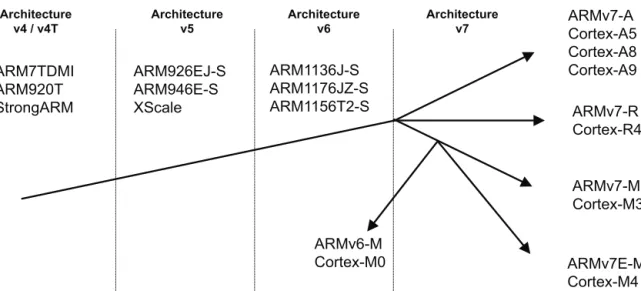
A brief note on the naming of processors might be useful for readers. For a number of years, ARM adopted a sequential numbering system for processors with ARM9 following ARM8, which came after ARM7. Various numbers and letters were appended to the base family to denote different variants. For example, the ARM7TDMI processor has T for Thumb, D for Debug, M for a fast multiplier and I for EmbeddedICE. For the ARMv7 architecture, ARM Limited adopted the brand name Cortex for many of its processors, with a supplementary letter indicating which of the three profiles (A, R, or M) the processor supports. Figure 2-1 on page 2-5 shows how different versions of the architecture correspond to different processor implementations. The figure is not comprehensive and does not include all architecture versions or processor implementations.
Figure 2-1 Architecture and processors In Figure 2-2, we show the development of the architecture over time, illustrating additions to the architecture at each new version. Almost all architecture changes are backwards-compatible, meaning unprivileged software written for the ARMv4T architecture can still be used on ARMv7 processors.
Figure 2-2 Architecture history
Architecture
v4 / v4T Architecturev5 Architecturev6 Architecturev7 ARM7TDMI ARM920T StrongARM ARM926EJ-S ARM946E-S XScale ARM1136J-S ARM1176JZ-S ARM1156T2-S ARMv7-A Cortex-A5 Cortex-A8 Cortex-A9 ARMv7-R Cortex-R4 ARMv7-M Cortex-M3 ARMv6-M Cortex-M0 ARMv7E-M Cortex-M4
4T
5
6
7
Halfword and signed halfword/byte support System mode Thumb instruction set Improved ARM/Thumb Interworking CLZ Saturated arithmetic DSP multiply-accumulate Instructions Extensions: Jazelle (v5TEJ) SIMD instructions Multi-processing v6 memory architecture Unaligned data support Extensions: Thumb-2 (v6T2) TrustZone (v6Z) Multiprocessor (v6K) Thumb only (v6-M) Thumb technology NEON TrustZone Profiles: v7-A (Applications) NEON v7-R (Real-time) Hardware divide NEON v7-M (Microcontroller) Hardware divide Thumb only
The ARM Architecture
Individual chapters of this book will cover these architecture topics in greater detail, but here we will briefly introduce a number of architecture elements.
2.2.1 DSP multiply-accumulate and saturated arithmetic instructions
These instructions, added in the ARMv5TE architecture, improve the capability for digital signal processing and multimedia software and are denoted by the letter E. The new instructions provide many variations of signed multiply-accumulate, saturated add and subtract, and count leading zeros and are present in all later versions of the architecture. In many cases, this made it possible to remove a simple separate DSP from the system.
2.2.2 Jazelle
Jazelle-DBX (Direct Bytecode eXecution) enables a subset of Java bytecodes to be executed directly within hardware as a third execution state (and instruction set). Support for this is denoted by the J in the ARMv5TEJ architecture. Support for this state is mandatory from ARMv6, although a specific ARM processor can optionally implement actual Jazelle hardware acceleration, or handle the bytecodes through software emulation. The Cortex-A5, Cortex-A9, and Cortex-A15 processors offer configurable support for Jazelle.
Jazelle-DBX is best suited to providing high performance Java in very memory limited systems (for example, feature phone or low-cost embedded use). In today’s systems, it is mainly used for backwards compatibility.
2.2.3 Thumb Execution Environment (ThumbEE)
This is also described as Jazelle-RCT (Runtime Compilation Target). It involves small changes to the Thumb instruction set that make it a better target for code generated at runtime in controlled environments (for example, by managed languages like Java, Dalvik, C#, Python or Perl). The feature set includes automatic null pointer checks on loads and stores and instructions to check array bounds, plus special instructions to call a handler. These are small sections of critical code, used to implement a specific feature of a high level language. These changes come from re-purposing a handful of opcodes.
ThumbEE is designed to be used by high-performance just-in-time or ahead-of-time compilers, where it can reduce the code size of recompiled code. Compilation of managed code is outside the scope of this document.
2.2.4 Thumb-2
Thumb-2 technology was added in ARMv6T2. This technology extended the original 16-bit Thumb instruction set to support 32-bit instructions. The combined 16-bit and 32-bit Thumb instruction set achieves similar code density to the original Thumb instruction set, but with performance similar to the 32-bit ARM instruction set. The resulting Thumb instruction set provides virtually all the features of the ARM instruction set, plus some additional capabilities.
2.2.5 Security Extensions (TrustZone)
The TrustZone extensions were added in ARMv6Z and are present in the ARMv7-A profile covered in this book. TrustZone provides two virtual processors with rigorously enforced hardware access control between the two. This means that the processor provides two “worlds”, Secure and Normal, with each world operating independently of the other in a way which prevents information leakage from the secure world to the non-secure and which stops non-trusted code running in the secure world. This is described in more detail, in Chapter 26
2.2.6 VFP
Before ARMv7, the VFP extension was called the Vector Floating-Point Architecture, and was used for vector operations. VFP is an extension which implements single-precision and optionally, double-precision floating-point arithmetic, compliant with the ANSI/IEEE Standard for Floating-Point Arithmetic.
2.2.7 Advanced SIMD (NEON)
The ARM NEON technology provides an implementation of the Advanced SIMD instruction set, with separate register files (shared with VFP). Some implementations have a separate NEON pipeline back-end. It supports 8-, 16-, 32- and 64-bit integer and single-precision (32-bit) floating-point data, which can be operated on as vectors in 64-bit and 128-bit registers.
The ARM Architecture
2.3
Key points of the ARM Cortex-A series architecture
Here we summarize a number of key points common to the Cortex-A family of devices. • 32-bit RISC processor, with 16 × 32-bit visible registers with mode-based register
banking.
• Modified Harvard Architecture (separate, concurrent access to instructions and data). • Load/Store Architecture.
• Thumb-2 technology as standard.
• VFP and NEON options which are expected to become standard in general purpose applications processor space.
• Backward compatibility with code from previous ARM processors.
• Full 4GB virtual and physical address spaces, with no restrictions imposed by the architecture.
• Efficient hardware page table walking for virtual to physical address translation.
• Virtual Memory for page sizes of 4KB, 64KB, 1MB and 16MB. Cacheability and access permissions can be set on a per-page basis.
• Big-endian and little-endian support.
• Unaligned access support for load/store instructions with 8-,16- and 32-bit integer data sizes.
• SMP support on MPCore™ variants, with full data coherency from the L1 cache level. Automatic cache and TLB maintenance propagation provides high efficiency SMP operation.
2.4
Processors and pipelines
In this section, we briefly look at some ARM processors and identify which processor implements which architecture version. We then take a slightly more detailed look at some of the individual processors which implement architecture version v7-A, which forms the main focus of this book. Some terminology will be used in this chapter which may be unfamiliar to the first-time user of ARM processors and which will not be explained until later in the book.
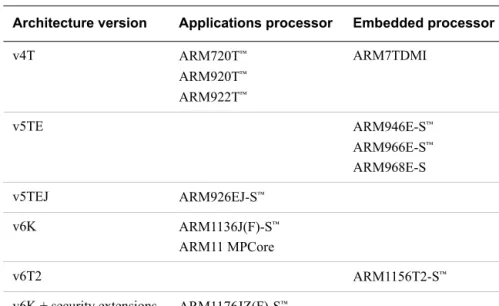
Table 2-1 indicates the architecture version implemented by a number of older ARM processors.
Table 2-2 shows the Cortex family of processors.
In the next sections, we’ll take a closer look at each of the processors which implement the ARMv7-A architecture.
2.4.1 The Cortex-A5 processor
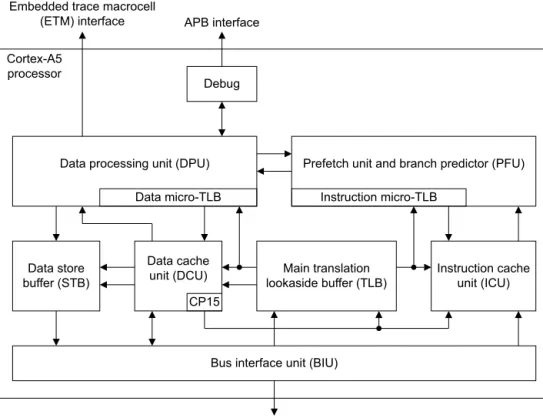
The Cortex-A5 processor supports all ARMv7-A architectural features, including the TrustZone Security Extensions and the NEON multimedia processing engine. It is extremely area and power efficient, but has lower maximum performance than other Cortex-A series processors. Both single and multi-core versions of the Cortex-A5 processor are available.
Table 2-1 Older ARM processors and architectures
Architecture version Applications processor Embedded processor
v4T ARM720T™ ARM920T™ ARM922T™ ARM7TDMI v5TE ARM946E-S™ ARM966E-S™ ARM968E-S v5TEJ ARM926EJ-S™ v6K ARM1136J(F)-S™ ARM11 MPCore v6T2 ARM1156T2-S™
v6K + security extensions ARM1176JZ(F)-S™
Table 2-2 Cortex processors and architecture versions
v7-A (Applications) v7-R (Real Time) v6-M/v7-M (Microcontroller)
Cortex-A5 (Single/MP) Cortex-R4 Cortex-M0 (ARMv6-M)
Cortex-A8 Cortex-M1™ (ARMv6-M)
Cortex-A9 (Single/MP) Cortex-M3™ (ARMv7-M)
The ARM Architecture
Figure 2-3 The Cortex-A5 processor The Cortex-A5 processor shown in Figure 2-3 has a single-issue, 8-stage pipeline. It can dual-issue branches in some circumstances and contains sophisticated branch prediction logic to reduce penalties associated with pipeline refills. Both NEON and floating-point hardware support are optional. The Cortex-A5 processor VFP implements VFPv4, which adds both the half-precision extensions and the Fused Multiply Add instructions to the features of VFPv3. Support for half-precision was optional in VFPv3. It supports the ARM and Thumb instruction sets plus the Jazelle-DBX and Jazelle-RCT technology. The size of the level 1 instruction and data caches is configurable (by the hardware implementer) from 4KB to 64KB.
2.4.2 The Cortex-A8 processor
The Cortex-A8 processor was the first to implement the ARMv7-A architecture. It is available in a number of difference devices, including the S5PC100 from Samsung, the OMAP3530 from Texas Instruments and the i.MX515 from Freescale. A wide range of device performances are available, with some giving clock speeds of more than 1GHz.
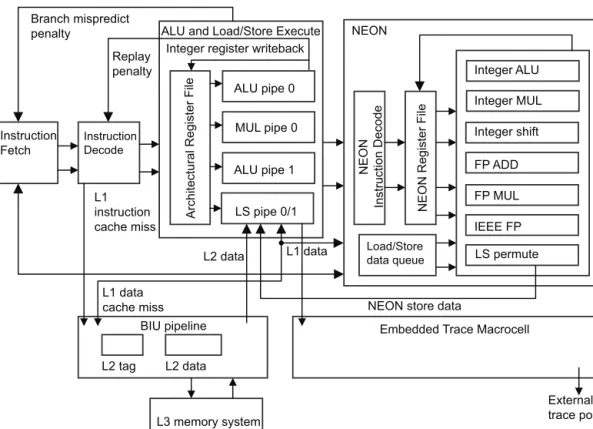
The Cortex-A8 processor has a considerably more complex micro-architecture compared with previous ARM processors. Its integer processor has dual symmetric, 13 stage instruction pipelines, with in-order issue of instructions. The NEON pipeline has an additional 10 pipeline stages, supporting both integer and floating-point 64/128-bit SIMD. VFPv3 floating-point is supported, as is Jazelle-RCT.
Figure 2-4 on page 2-11 is a block diagram showing the internal structure of the Cortex-A8 processor, including the pipelines.
Data processing unit (DPU) Prefetch unit and branch predictor (PFU) Debug
Data store buffer (STB)
Data cache
unit (DCU) Main translation lookaside buffer (TLB)
Instruction cache unit (ICU)
Bus interface unit (BIU) Cortex-A5
processor
Data micro-TLB Instruction micro-TLB Embedded trace macrocell
(ETM) interface APB interface
AXI interface CP15
Figure 2-4 The Cortex-A8 processor integer and NEON pipelines The separate instruction and data level 1 caches are 16KB or 32KB in size. They are
supplemented by an integrated, unified level 2 cache, which can be up to 1MB in size, with a 16-word line length. The level 1 data cache and level 2 cache both have a 128-bit wide data interface to the processor. The level 1 data cache is virtually indexed, but physically tagged, while level 2 uses physical addresses for both index and tags. Data used by NEON is, by default, not allocated to L1 (although NEON can read and write data that is already in the L1 data cache).
2.4.3 The Cortex-A9 processor
The Cortex-A9MPCore processor and the Cortex-A9 uniprocessor provide higher performance than the Cortex-A5 or Cortex-A8 processors, with clock speeds in excess of 1GHz and performance of 2.5DMIPS/MHz. The ARM, Thumb, Thumb-2, TrustZone, Jazelle-RCT and DBX technologies are all supported.
The level 1 cache system provides hardware support for cache coherency for between one and four processors for multi-core software. A level 2 cache is optionally connected outside of the processor. ARM supplies a level 2 cache controller (PL310/L2C-310) which supports caches of up to 8MB in size. The processor also contains an integrated interrupt controller, an
implementation of the ARM Generic Interrupt Controller (GIC) architecture specification. This can be configured to provide support for up to 224 interrupt sources.
Embedded Trace Macrocell ALU and Load/Store Execute NEON
Integer ALU Integer MUL Integer shift FP ADD FP MUL IEEE FP LS permute Load/Store data queue ALU pipe 0 MUL pipe 0 ALU pipe 1 LS pipe 0/1 Instruction Decode Instruction Fetch BIU pipeline L3 memory system
NEON Register File
NEON Instruction Decode Branch mispredict penalty Replay penalty
Integer register writeback
NEON store data
External trace port L1 instruction cache miss L1 data cache miss L2 data L1 data
Architectural Register File
The ARM Architecture
Figure 2-5 Block diagram of Cortex-A9 single core Devices containing the Cortex-A9 processor include nVidia’s dual-core Tegra-2, the
SPEAr1300 from ST and TI’s OMAP4 platform.
2.4.4 The Cortex-A15 processor
The Cortex-A15 MPCore processor is currently the highest performance available ARM processor. It is application compatible with the other processors described in this book. The Cortex-A15 MPCore processor introduces some new capabilities, including support for full hardware virtualization and Large Physical Address Extensions (LPAE), which enables addressing of up to 1TB of memory. In this book, we will describe the LPAE extension and provide an introduction to virtualization, but as the Cortex-A15 MPCore processor will not be encountered by most readers for some time, we do not provide detailed coverage throughout the text.
CoreSight Debug Access Port
Profiling Monitor Block
Dual-instruction Decode Stage
Fast Loop Mode
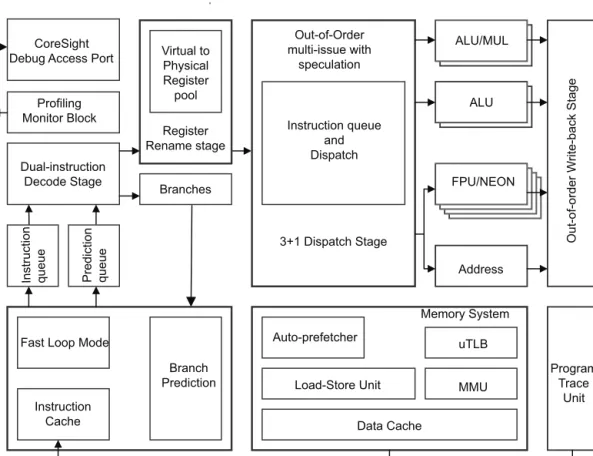
Instruction Cache Branch Prediction Virtual to Physical Register pool Register Rename stage Branches Out-of-Order multi-issue with speculation Instruction queue and Dispatch 3+1 Dispatch Stage Auto-prefetcher Load-Store Unit Data Cache Memory System uTLB MMU Program Trace Unit Out-of-order W rite-back Stage ALU/MUL ALU FPU/NEON Address
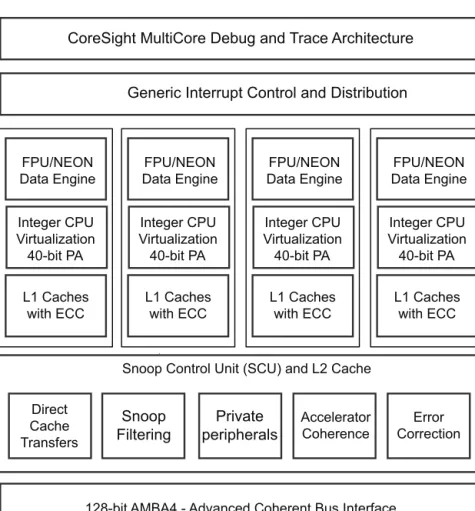
Figure 2-6 Cortex-A15 MPCore block diagram Snoop Control Unit (SCU)
The SCU is responsible for managing the interconnect, arbitration,
communication, cache-to-cache and system memory transfers, cache coherence and other capabilities for the processor.
Accelerator Coherence Port
This AMBA 4 AXI compatible slave interface on the SCU provides an interconnect point for masters which need to be interfaced directly with the Cortex-A15 processor.
Generic Interrupt Controller
This handles inter-processor communication and the routing and prioritization of system interrupts. Supporting up to 224 independent interrupts, under software control, each interrupt can be distributed across the processors, hardware prioritized, and routed between the operating system and TrustZone software management layer.
The Cortex-A15 MPCore processor has the following features: • an out-of-order superscalar pipeline
• 32kB L1 Instruction and 32kB L1 Data caches
128-bit AMBA4 - Advanced Coherent Bus Interface Generic Interrupt Control and Distribution CoreSight MultiCore Debug and Trace Architecture
FPU/NEON Data Engine Integer CPU Virtualization 40-bit PA L1 Caches with ECC FPU/NEON Data Engine Integer CPU Virtualization 40-bit PA L1 Caches with ECC FPU/NEON Data Engine Integer CPU Virtualization 40-bit PA L1 Caches with ECC FPU/NEON Data Engine Integer CPU Virtualization 40-bit PA L1 Caches with ECC
Snoop Control Unit (SCU) and L2 Cache Direct Cache Transfers Error Correction Accelerator Coherence Private peripherals Snoop Filtering
The ARM Architecture
• tightly-coupled low-latency level-2 cache (up to 4MB in size) • improved floating-point and NEON media performance • full hardware virtualization
• Large Physical Address Extension (LPAE) addressing up to 1TB of memory • error correction capability for fault-tolerance and soft-fault recovery • Multicore 1-4X SMP within a single processor cluster
• multiple coherent multi-core processor clusters through AMBA4 technology
• AMBA4 Cache Coherent Interconnect (CCI) allowing full cache coherency between multiple Cortex-A15 MPCore processors.
2.4.5 Qualcomm Scorpion
ARM is not the only company which designs processors compliant with the ARMv7-A instruction set architecture. In 2005, Qualcomm Inc. announced that it was creating its own implementation under license from ARM, with the name Scorpion. The Scorpion processor is available as part of Qualcomm’s Snapdragon platform, which contains the features necessary to implement netbooks, smartphones or other mobile internet devices.
Relatively little information has been made publicly available by Qualcomm, although it has been mentioned that Scorpion has a number of similarities with the Cortex-A8 processor. It is an implementation of ARMv7-A, is superscalar and dual issue and has support for both VFP and NEON (called the VeNum media processing engine in Qualcomm press releases). There are a number of differences, however. Scorpion can process 128 bits of data in parallel in its NEON implementation. Scorpion has a 13-stage load/store pipeline and two integer pipelines. One of these is 10 stages long and can execute only simple arithmetic instructions (for example adds or subtracts), while the other is 12 stages and can execute all data processing operations, including multiplies. Scorpion also has a 23-stage floating-point/SIMD pipeline, and VFPv3 operations are pipelined.
We will not specifically mention Scorpion again in this text. However, as the processor conforms to the ARMv7-A architecture specification, most of the information presented here will apply also to Scorpion.
2.4.6 Marvell Sheeva
Marvell is another company which designs and sells processors based on the ARM Architecture. At the time of writing, Marvell has four families of ARM processors, the Armada 100, Armada 500, Armada 600, and Armada 1000. Marvell has designed a number of ARM processor implementations, ranging from the Sheeva PJ1 (ARMv5 compatible) to Sheeva PJ4 (ARMv7 compatible). The latter is used in the Armada 500 and Armada 600 family devices.
The Marvell devices do not support the NEON SIMD instruction set, but instead use the Wireless MMX2 technology, acquired from Intel. The Armada 510 contains 32KB I and D caches plus an integrated 512KB level 2 cache and support for VFPv3. The Armada 610 is built on a “low power” silicon process and has a smaller (256KB) level 2 cache and can be clocked at the slightly slower rate than Armada 510. We will not specifically mention these processors again in this book.
Tools, Operating Systems and Boards
ARM processors can be found in a very wide range of devices, running a correspondingly wide range of software. Many readers will have ready access to appropriate hardware, tools and operating systems, but before we proceed to look at the underlying architecture, it might be useful to some readers to present an overview of some of these readily available compilation tools, ARM-based hardware and Linux operating system distributions.
In this chapter, we will provide a brief mention of a number of interesting commercially available development boards. We will provide some information about the Linux Operating System and some useful associated tools. However, information about open source software and off-the-shelf boards is likely to change rapidly.
Tools, Operating Systems and Boards
3.1
Linux distributions
Linux is a Unix-like operating system kernel, originally developed by Linus Torvalds, who continues to maintain the official kernel. It is open source, distributed under the GNU Public License, widely-used and available on a large number of different processor architectures. A number of free Linux distributions exist for ARM processors, including Debian, Ubuntu, Fedora and Gentoo.
You can obtain pre-built Linux images, or read the Linux on ARM Wiki at
http://www.linux-arm.org/.
In Appendix C, we will look at how to build Linux for your ARM device. Before doing that, we will briefly look at the basics of Linux for ARM systems.
3.1.1 Linux for ARM systems
Support for the ARM architecture has been included in the standard Linux kernel for many years. Development of this port is ongoing, with significant input from ARM to provide kernel support for new processors and architecture versions. The ARM Embedded Linux distribution only includes the kernel. The filesystem and U-Boot bootloader are available through Linaro. It might seem strange to some readers that a book about the Cortex-A series of processors contains information about Linux. There are several reasons for this. Linux source code is available to all readers and represents a huge learning resource. In addition, it is easy to use to program, and there are many useful resources with existing code and explanations. Many readers will be familiar with Linux, as it can be run on most processor architectures. By explaining how Linux features like virtual memory, multi-tasking, shared libraries and so forth are implemented in Linux for ARM systems, readers will be able to apply their understanding to other operating systems commonly used on ARM processors. The scalability of Linux is another factor – it can run on the most powerful ARM processors, and its derivative uClinux is also commonly used on much smaller processors, including the Cortex-M3 or ARM7TDMI processors. It can run on both the ARM and Thumb ISAs, in little- or big-endian and with or without a memory management unit.
Linux makes large amounts of system and kernel information available to user applications by using virtual filesystems. These virtual files mean that we don’t have to know how to program the kernel to access many hardware features. An example is /proc/cpuinfo. Reading this file on a Cortex-A8 processor might give an output like that in Example 3-1. This lets code determine useful information about the system it is running on, without having to directly interact with the hardware.
Example 3-1 Output of /proc/cpuinfo on the Cortex-A8 processor
Processor : ARMv7 Processor rev 7 (v7l) BogoMIPS : 499.92
Features : swp half thumb fastmult vfp edsp neon vfpv3 CPU implementer : 0x41
CPU architecture: 7 CPU variant : 0x1 CPU part : 0xc08 CPU revision : 7
In this book, we can merely scratch the surface of what there is to be said about Linux development. What we hope to do here is to show some ways in which programming for an embedded ARM architecture based system differs from a desktop x86 environment and to give some pointers to useful tools, which the reader might care to investigate further.
3.1.2 Linaro
Linaro is a non-profit organization which works on a range of open source software running on ARM processors, including kernel related tools and software and middleware. It is a
collaborative effort between a number of technology companies to provide engineering help and resources to the open source community. Linaro does not produce a Linux distribution, nor is it tied to any particular distribution or board. Instead, Linaro works to produce software and tools which interact directly with the ARM processor, to provide a common software platform for use by board support package developers. Its focus is on tools to help you write and debug code, on low-level software which interacts with the underlying hardware and on key pieces of middleware. Linaro engineers work on the kernel and tools, graphics and multimedia and power management. Linaro provides patches to upstream projects and makes monthly source tree tarballs available, with an integrated build every six months to consolidate the work. See http://www.linaro.org/ for more information about Linaro.
3.1.3 Linux terminology
Here, we define some terms which we will use when describing how the Linux kernel interacts with the underlying ARM architecture:
Process A process is the kernel's view of an executing unprivileged application. The same application (for example, bin/bash) can be running in several simultaneous instances in the system – and each of these instances will be a separate process. The process has resources associated with it, such as a memory map and file descriptors. A process can consist of one or more threads.
Thread A thread is a context of software execution within a process. It is the entity which is scheduled by the kernel, and actually executes the instructions that make up the application. A process can consist of multiple threads, each executing with their own program counter, stack pointer and register set – all existing within the memory map and operating on the file descriptors held by the process as a whole. In a multi-processor system, threads inside the same process can execute concurrently on separate processors. Different threads within the same process can be configured to have different scheduling priorities.
There are also threads executing inside the kernel, to manage various tasks asynchronously, such as file cache management, or watchdog tickling (which is not as exciting as it sounds).
Scheduler This is a vital part of the kernel which has a list of all the current threads. It knows which threads are ready to be run and which are currently not able to run. It dynamically calculates priority levels for each thread and schedules the highest priority thread to be run next. It is called after an interrupt has been handled. The scheduler is also explicitly called by the kernel via the schedule() function, for example, when an application executing a system call needs to sleep. The system will have a timer based interrupt which results in the scheduler being called at regular intervals. This enables the OS to implement time-division multiplexing, where many threads share the processor, each running for a certain amount of time, giving the user the illusion that many applications are running