Volume 3 Issue 3 Article 3
The Effectiveness of an Introductory Interprofessional Course in
The Effectiveness of an Introductory Interprofessional Course in
Building Readiness for Collaboration in the Health Professions
Building Readiness for Collaboration in the Health Professions
Kathrin A. EliotSaint Louis University, [email protected] Anthony P. Breitbach
Saint Louis University, [email protected] Leslie Hinyard
Saint Louis University, [email protected] Eileen Toomey
Saint Louis University, [email protected]
Recommended Citation Recommended Citation
Eliot, KA, Breitbach, AP, Hinyard, L, Toomey, E. (2018). The Effectiveness of an Introductory
Interprofessional Course in Building Readiness for Collaboration in the Health Professions. Health, Interprofessional Practice & Education 3(3).
Available at: https://doi.org/10.7710/2159-1253.1141
© 2018 Eliot et al. This open access article is distributed under a Creative Commons Attribution License, which allows unrestricted use, distribution, and reproduction in any medium, providing the original author and source are credited.
The Effectiveness of an Introductory
Interprofessional Course in Building
Readiness for Collaboration in the Health
Professions
Kathrin A. Eliot
PhD, RDN Nutrition and Dietetics, Saint Louis UniversityAnthony P. Breitbach
PhD, ATC Physical Therapy and Athletic Training, Saint Louis UniversityEileen Toomey
MS Center for Interprofessional Education and Research, Saint Louis UniversityLeslie Hinyard
PhD, MSW Saint Louis University Center for Health Outcomes Research, Saint Louis UniversityAbstract
INTRODUCTION Interprofessional Education (IPE) prepares collaborative-ready health professionals although the actual process of learning “about, from and with” each other is widely debated in the literature (World Health Organization, 2010). The goal of the study was to examine the effectiveness of an introductory IPE course in improving students’ collaboration skills.
METHODS Undergraduate, health professions students completed the 11-item Self-Assessed Collaboration Skills (SACS) survey before and after completing an introductory IPE course.
RESULTS Results of paired samples t-tests suggest that there were significant improvements in students’ self-assessed collaboration skills and on the learning, information sharing, and team support dimensions.
DISCUSSION This study highlights the role of an introductory IPE course in improving self-assessed collaboration and teamwork skills of entry-level learners. Features of the course design that contribute to its effectiveness include: interactive class sessions, a culminating team project, and using in-class time for team meetings.
CONCLUSION An introductory IPE course can be effective in improving learners’ self-assessed collaboration skills and can prepare them for future IPE courses.
Received: 08/02/2017 Accepted: 02/13/2018
© 2018 Eliot, et al. This open access article is distributed under a Creative Commons Attribution License, which allows unrestricted use, distribution, and reproduction in any medium, provided the original author and source are credited.
Introduction
Interprofessional Education (IPE) has been established as a widely accepted strategy for preparing health professionals to be collaborative-ready as they enter the health care system upon graduation from their respec-tive programs (Institute of Medicine (IOM), 2015; Rogers et al., 2016; World Health Organization, 2010). However, the actual process of learning “about, from and with” each other is widely debated in the literature (World Health Organization, 2010). Some researchers advocate for IPE to be contextual, embedded into professional programs in practice settings, and other researchers feel that IPE is best initiated early in the students’ professional preparation. The best answer is likely somewhere in between with a hybrid of these approaches that begins with early courses that build readiness for collaboration followed by later courses that contextualize Interprofessional Collaborative Practice (IPCP) with clinical integration (Dow, Blue, Konrad, Earnest, & Reeves, 2013; Freeth, Hammick, Reeves, Koppel, & Barr, 2005; Oandasan & Reeves, 2005; Reeves et al., 2016). This study focuses on the assessment of a large introductory course that is part of a comprehensive IPE program, using a newly vali-dated instrument which allows students to self-assess collaboration skills.
Background
Courses designed to provide an introduction to inter-professional health care have been implemented to engage students early as a part of many emerging IPE initiatives. Introductory IPE engagement helps
decrease professional stereotypes, allowing for a better understanding of roles and responsibilities across the professions. Additionally, IPE has been shown to promote more positive perceptions among health professional students in several studies (Ateah et al., 2011; Ruebling et al., 2014). These positive perceptions are the critical component of collaboration identified by Baggs and Schmitt (1997) as “being receptive” to working with others. “Being receptive” involves an open attitude and recognizing when others have some-thing to offer (Baggs & Schmitt, 1997).
Research supports the development of IPE early in the students’ professional education. In a study comparing the learning outcomes of younger students to more mature students, the younger learners were more eager to participate in IPE learning and showed greater increases in knowledge than the learners who did not enter the program directly from secondary educa-tion. Specifically, the younger learners experienced significant gains in knowledge related to teamwork and collaborative practice (Anderson & Thorpe, 2008). Students may feel more comfortable relating to other professions before they have been fully immersed in their own professional training, which may help reduce biases about other professions. Early IPE also helps develop a “common bond” among the students (Cooper, Spencer-Dawe, & McLean, 2005).
Early introduction of IPE does have its challenges. IPE initiatives involving multiple professional programs create large cohorts of students participating in the learning activities (Breitbach et al., 2013). Many times, these are large classes that require creative pedagogy
Implications for Interprofessional Practice
• Intentional and authentic learning experiences in an entry-level IPE course promote improved self-perceived collaboration skills.
• In this course, pedagogy for entry-level IPE includes interactive class sessions, a culminating team project, and in-class time for team meetings.
• Focusing on collaboration skills acquired in an entry-level IPE course will prepare students for future coursework and clinical experience in IPE.
to create authentic collaborative learning experiences (Lockeman et al., 2017). Additionally, these students may encounter difficulty connecting the IPE course-work to their future profession because they have little experience providing patient care in a clinical context (Oandasan & Reeves, 2005).
Thus, the challenge is to deliver an introductory course that provides foundational knowledge and skills designed to foster a level of readiness for collaboration and a positive attitude towards IPCP while, at the same time, creating a dynamic and relevant learning envi-ronment for a large group of students with minimal clinical experience as health professionals. Research by Blue, Mitcham, Smith, Raymond, and Greenberg (2010) supports this approach, suggesting that a crit-ical component to successful IPE pedagogy includes providing opportunities for shared learning that are interactive. Additionally, a culminating team project
is beneficial in reinforcing IP concepts learned in class (Blue et al., 2010).
Description of Learning Experience
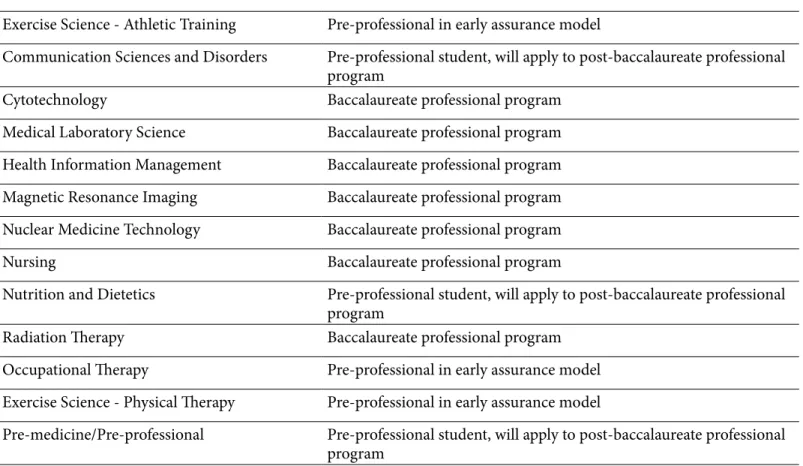
Saint Louis University developed a course, IPE 1100 – Introduction to Interprofessional Health Care, designed to lay the foundation for a 4 course Concentration in Interprofessional Practice (Breitbach et al., 2013). This course has been in place since 2007 but was revised with a new teaching team in fall term 2015 as a part of a strategic realignment of Saint Louis University’s IPE program (Reynolds-Kueny, Toomey, Pole, & Hinyard, 2017). The course teaches students from 12 professional programs along with pre-medicine students (Table 1). The students are at variable points in their professional preparation, with several in the professional phase of their programs and others in the pre-professional phase of early assurance post-baccalaureate programs. Table 1 details the programs participating in the course.
Profession Level
Exercise Science - Athletic Training Pre-professional in early assurance model
Communication Sciences and Disorders Pre-professional student, will apply to post-baccalaureate professional
program
Cytotechnology Baccalaureate professional program
Medical Laboratory Science Baccalaureate professional program
Health Information Management Baccalaureate professional program
Magnetic Resonance Imaging Baccalaureate professional program
Nuclear Medicine Technology Baccalaureate professional program
Nursing Baccalaureate professional program
Nutrition and Dietetics Pre-professional student, will apply to post-baccalaureate professional
program
Radiation Therapy Baccalaureate professional program
Occupational Therapy Pre-professional in early assurance model
Exercise Science - Physical Therapy Pre-professional in early assurance model
Pre-medicine/Pre-professional Pre-professional student, will apply to post-baccalaureate professional
program
Learning experiences culminate with a video project, in which the teams develop a one-minute evidence-based Public Service Announcement (PSA) video on assigned health topic. These are presented for peer review on the last class meeting. Assignments also include team reports that are completed in class and
uploaded to the LMS at the end of class. This approach was used to alleviate student concerns about the chal-lenge of coordinating regular out of class meeting times for students with varied responsibilities. There are also readings, taken from relevant current literature and other primary sources, and two assignments: “My
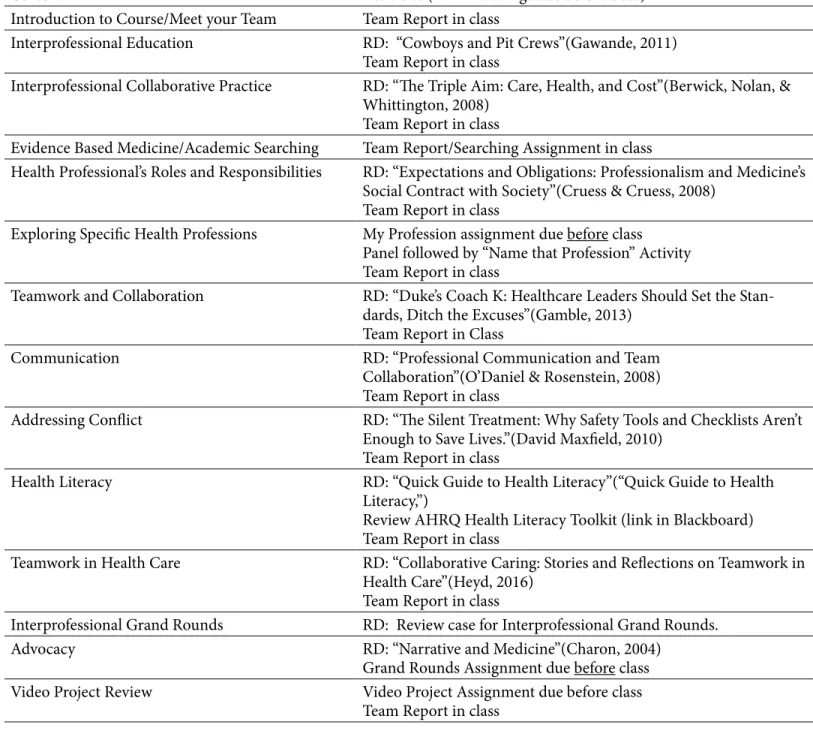
Content Activities (RD = Readings due before class)
Introduction to Course/Meet your Team Team Report in class
Interprofessional Education RD: “Cowboys and Pit Crews”(Gawande, 2011)
Team Report in class
Interprofessional Collaborative Practice RD: “The Triple Aim: Care, Health, and Cost”(Berwick, Nolan, &
Whittington, 2008) Team Report in class
Evidence Based Medicine/Academic Searching Team Report/Searching Assignment in class
Health Professional’s Roles and Responsibilities RD: “Expectations and Obligations: Professionalism and Medicine’s
Social Contract with Society”(Cruess & Cruess, 2008) Team Report in class
Exploring Specific Health Professions My Profession assignment due before class
Panel followed by “Name that Profession” Activity Team Report in class
Teamwork and Collaboration RD: “Duke’s Coach K: Healthcare Leaders Should Set the
Stan-dards, Ditch the Excuses”(Gamble, 2013) Team Report in Class
Communication RD: “Professional Communication and Team
Collaboration”(O’Daniel & Rosenstein, 2008) Team Report in class
Addressing Conflict RD: “The Silent Treatment: Why Safety Tools and Checklists Aren’t
Enough to Save Lives.”(David Maxfield, 2010) Team Report in class
Health Literacy RD: “Quick Guide to Health Literacy”(“Quick Guide to Health
Literacy,”)
Review AHRQ Health Literacy Toolkit (link in Blackboard) Team Report in class
Teamwork in Health Care RD: “Collaborative Caring: Stories and Reflections on Teamwork in
Health Care”(Heyd, 2016) Team Report in class
Interprofessional Grand Rounds RD: Review case for Interprofessional Grand Rounds.
Advocacy RD: “Narrative and Medicine”(Charon, 2004)
Grand Rounds Assignment due before class
Video Project Review Video Project Assignment due before class
Team Report in class
Table 2. IPE 1100 Learning Experiences
The main focus areas of the course are: Teamwork, Communication and Collaboration, Roles and Respon-sibilities, Health Literacy, and Evidence Based Practice. Table 2 details the specific assignments and learning activities in the course. Students in the course are assigned to teams of 5-7 students from a minimum of
3 professions per team. Team size is determined by course enrollment, ensuring that there are no more than 40 total teams in a specific term. The course relies heavily on coordination from the central IPE office through the Blackboard Learning Management System (LMS).
Profession” and “Grand Rounds Reflection,” done indi-vidually outside of class.
The IPE 1100 course presents a diverse range of opportunities for experiential learning. Considering the structure of the course and learning experiences provided to students, participation in the course should develop foundational skills in collaboration. The main goal of the current study is to examine the effectiveness of the course as a whole in improving the collaboration skills of students and seeks to answer the research ques-tion, “Does participation in IPE 1100 improve students’ perceptions of their collaboration skills?” We hypoth-esized that students’ perceptions of their collaboration skills will improve as a result of taking the course. Participants
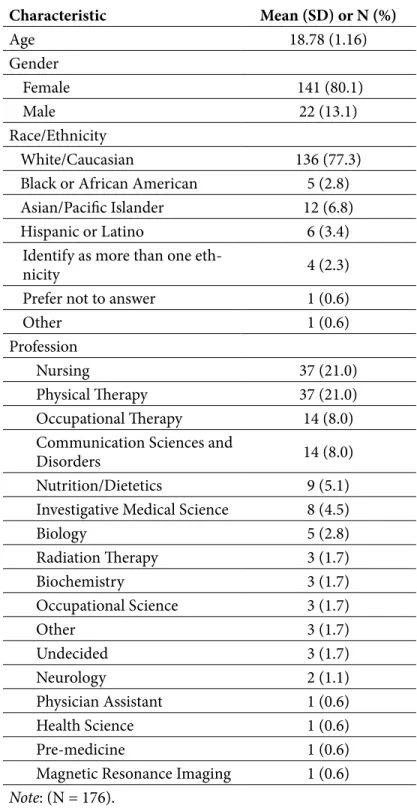
In the spring term of 2017, 270 participants were recruited using a convenience sample from IPE 1100. As part of routine course assessment, participants completed a measure of collaboration at two time points: 1) directly after their first meeting, and 2) upon completion of the final semester project. The primary intervention was IPE 1100 introductory course content and activities intentionally designed to enable authentic collaboration and teamwork. The study was approved by the university’s institutional review board. There were 227 completed questionnaires at the begin-ning of the course, and 215 were collected at the end, resulting in 176 matched pretest and posttest question-naires. Attrition was attributable to missing data on the linking variable and participants not consenting to the use of their data in research. The represented health professions in the final sample were: nursing, exercise science-physical therapy, occupational therapy, communication sciences and disorders, nutri-tion/dietetics, investigative medical science, biology, biochemistry, occupational science, radiation therapy, pre-med, health science, magnetic resonance imaging, neurology, physician assistant, undecided, and other. Participants were predominantly female (80.1%) and white (77.3%), with an average age of 18.78 (SD = 1.16). The sample characteristics are presented in Table 3. Procedure
Undergraduate, health professions students enrolled in IPE 1100 at Saint Louis University were invited to participate in a study examining the impact of the
intro-ductory course on the development of self-assessed collaboration skills. Participants were informed that participation in the study was completely voluntary and that if they did not wish have their information used for research purposes to choose the option “I do not wish to participate in the study.” Data from five indi-viduals who selected to not participate are not included in the current study, and there were no meaningful differences between those completed measures at both time points and those who had missing data. Partici-pants were sent individual emails at the first meeting of the class and at the final class meeting containing the study’s recruitment statement, link to the survey containing the pre- and post-measure of collabora-tion, and a random numeric code to be used to pair the pre and post surveys to one another. The participant email addresses were only used to inform participants of the availability of the surveys. These addresses were not associated with the information provided by the participants in the study and the master list containing the email addresses and numeric codes was destroyed upon completion of data collection. The main hypoth-esis of the study was that the introductory course and the team-based activities would improve students’ perceptions of their collaboration skills.
Measures
Self-assessed Collaboration
The Self-assessed Collaboration Skills survey (SACS) is an 11-item scale that measures self-assessed collabora-tive behaviors (Hinyard, Toomey, Eliot, & Breitbach, 2017). The tool uses a multi-dimensional approach to measuring collaboration. These dimensions include: learning, information sharing, and team support. This measure asks respondents to rate their level of agree-ment with each stateagree-ment reflecting their abilities. Example items include: “I routinely listen to the opin-ions of my fellow team members” and “I encourage other team members to get involved in the decisions that affect the team.” These items are rated using a 1 (strongly disagree) to 7 (strongly agree) Likert-type scale. The scale demonstrated high internal consis-tency at both time points with alphas, αpre = 0.82 and αpost = 0.78. Exploratory and confirmatory factor anal-yses provide evidence for the three-factor nature of the SACS (Hinyard et al., 2017).
Characteristic Mean (SD) or N (%) Age 18.78 (1.16) Gender Female 141 (80.1) Male 22 (13.1) Race/Ethnicity White/Caucasian 136 (77.3)
Black or African American 5 (2.8)
Asian/Pacific Islander 12 (6.8)
Hispanic or Latino 6 (3.4)
Identify as more than one
eth-nicity 4 (2.3)
Prefer not to answer 1 (0.6)
Other 1 (0.6)
Profession
Nursing 37 (21.0)
Physical Therapy 37 (21.0)
Occupational Therapy 14 (8.0)
Communication Sciences and
Disorders 14 (8.0)
Nutrition/Dietetics 9 (5.1)
Investigative Medical Science 8 (4.5)
Biology 5 (2.8) Radiation Therapy 3 (1.7) Biochemistry 3 (1.7) Occupational Science 3 (1.7) Other 3 (1.7) Undecided 3 (1.7) Neurology 2 (1.1) Physician Assistant 1 (0.6) Health Science 1 (0.6) Pre-medicine 1 (0.6)
Magnetic Resonance Imaging 1 (0.6)
Note: (N = 176).
Analyses
To test the hypothesis that participation in the intro-ductory course improves students’ perceptions of their collaboration skills, paired samples t-tests were performed on the three dimensions and the composite SACS score using SPSS 22. Statistical significance was established at α = 0.05. Following the guidelines of Cohen (1988), the effect size of the mean differences were calculated. Consistent with Cohen’s D guidelines, an effect size of 0.2-0.5 is considered small, 0.5-0.8 medium, and > 0.8 large.
Results
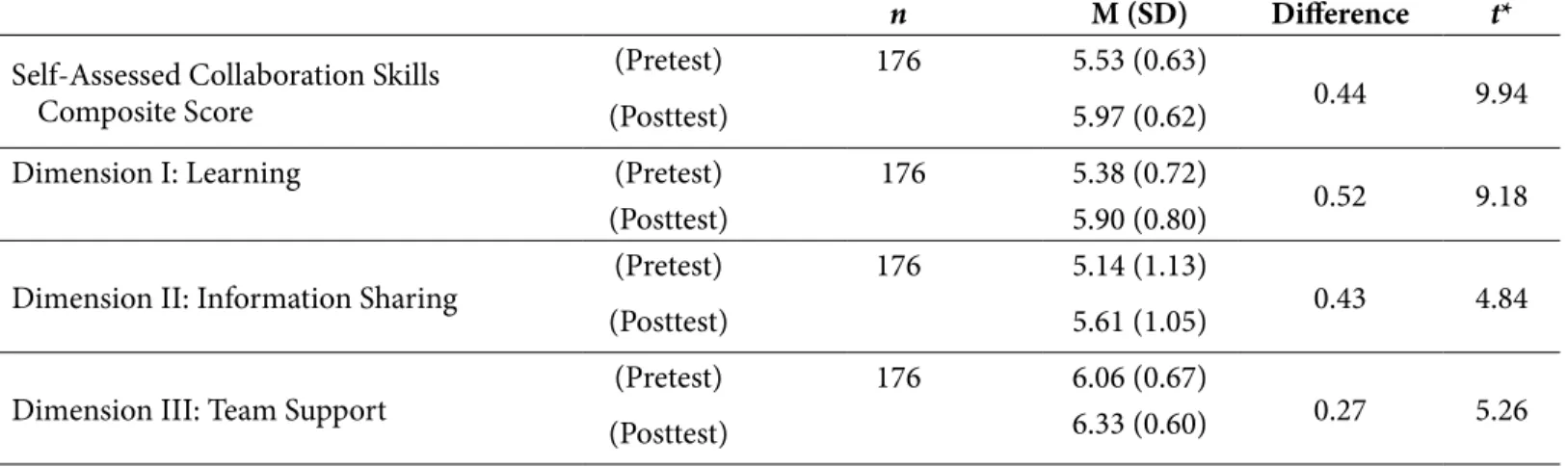
Pre- and post-test means for each scale and the results of the paired samples t-tests are presented in Table 4. The results of the paired samples t-tests suggest that there were significant improvements on students’ self-assessed collaboration skills and on the learning, information sharing, and team support dimensions as well. Specifically, average SACS scores were higher after the introductory IPE course than before the course. In regards to the learning subscale, results suggest that scores improved significantly after the introductory IPE course from before the course. Average information sharing scores improved significantly after the
intro-ductory IPE course from before the course. Finally, in regards to the team support subscale, results suggest that average scores on the subscale improved signifi-cantly after the introductory IPE course from before the course.
Discussion
The results of this study highlight the role of an introduc-tory IPE course in improving self-assessed collaboration and teamwork skills of entry-level learners. As stated earlier, literature provides support for early integration of IPE into health professions education. However, this is the first to use the SACS instrument for evaluation of students’ self-assessed collaboration skills. A critical difference in the SACS compared to previously used instruments is that it is not a context-specific measure and can be used to examine collaborative skill-building in an academic setting (Hinyard et al., 2017). As a self-reported measure, the SACS provides a feasible method of collecting data on a large cohort. Instruments, such as the SACS, that use self-assessment provide a prac-tical alternative to assessing behavior change and have been shown to provide valuable information on inter-personal skills and abilities (Ferris et al., 2005; Riggio & Riggio, 2001).
n M (SD) Difference t*
Self-Assessed Collaboration Skills Composite Score
(Pretest) 176 5.53 (0.63)
0.44 9.94
(Posttest) 5.97 (0.62)
Dimension I: Learning (Pretest) 176 5.38 (0.72)
0.52 9.18
(Posttest) 5.90 (0.80)
Dimension II: Information Sharing (Pretest) 176 5.14 (1.13) 0.43 4.84
(Posttest) 5.61 (1.05)
Dimension III: Team Support (Pretest) 176 6.06 (0.67) 0.27 5.26
(Posttest) 6.33 (0.60)
*All paired-samples t-tests were significant at p < .001
**All scales were rated on a 1 = strongly disagree, 7 = strongly agree Likert-type scale.
The critical components required for collaboration that were improved as a result of this course included information sharing and team support. As other intro-ductory courses report in the literature, necessary components of an IPE course for early learners should include interactive opportunities for shared learning and the use of a team project (Blue et al., 2010). While all course activities were intentionally created to be interactive, the “Name that Profession” activity was specifically designed for interaction among team members and teams as a whole. The activity enabled students as individuals to provide expertise at an early stage in their professional training to their teams, thereby engaging in shared goals and outcomes along with mutual interdependence (D’Eon, 2004).
The team PSA video project, as described earlier, serves as a culminating activity that relies on the best evidence, content presented in class, and collabora-tive skills modeled throughout the course. The peer review component, consistent with findings from other research (Lockeman et al., 2017), plays an important role in making the activity authentic for the students involved.
Additionally, a factor that was carefully considered when designing this course was the creation of oppor-tunities for team activities to be completed in class. Students remained in the same assigned teams for the duration of the course, which is supported by the litera-ture (D’Eon, 2004). Aside from the culminating team project, all team activities were completed during class time. This reduced the need for coordinating students’ out of class schedules and allowed for direct instructor feedback of students’ team behaviors.
An important benefit, shown through improved self-assessed collaboration skills seen in this course, is the contribution to students’ readiness to engage in upper level IPE and professional coursework. Most, if not all, health professions have incorporated IPE into their professional competencies with the hope that this translates into IPCP with the goal of improving patient outcomes. This course provides the students with a common baseline for collaboration moving forward as they enter their chosen professions, regardless of what further training they receive in their professional prep-aration.
Courses such as the one presented in this research show great promise in preparing interprofessional students for future work in collaboration. However, as this is the first study to use the SACS instrument for evalu-ation, future research is needed to establish ranges for substantive changes in attitudes and behaviors in early IPE learners as well as validation in diverse populations and professions.
Conclusion
As IPE becomes routinely included across health professions, it often begins with the earliest of learners, thus it is critical to investigate best practices for the development of collaboration skills. It appears from this research that early integration of IPE is beneficial, specifically in improving students’ perceived abilities to collaborate. As students move through their profes-sional preparation, it is hoped they are provided with a critical foundation for future education and training where the ultimate objective is to develop a collab-orative-ready workforce that improves personal and population health outcomes.
References
Anderson, E. S., & Thorpe, L. N. (2008). Early interprofessional interactions: Does student age matter? Journal of Interprofessional Care, 22(3), 263-282. https://doi.org/10.1080/13561820802054689 Ateah, C. A., Snow, W., Wener, P., MacDonald, L., Metge, C., Davis, P., . . . Anderson, J. (2011). Stereotyping as a barrier to collabora-tion: Does interprofessional education make a difference? Nurse Education Today, 31(2), 208-213. https://doi.org/10.1016/j .nedt.2010.06.004
Baggs, J. G., & Schmitt, M. H. (1997). Nurses’ and resident physicians’ perceptions of the process of collaboration in an MICU. Research in Nursing and Health, 20(1), 71-80. https:// doi.org/10.1002/(SICI)1098-240X(199702)20:1<71::AID -NUR8>3.0.CO;2-R
Berwick, D. M., Nolan, T. W., & Whittington, J. (2008). The triple aim: Care, health, and cost. Health Aff (Millwood), 27(3), 759-769. https://doi.org/10.1377/hlthaff.27.3.759
Blue, A. V., Mitcham, M., Smith, T., Raymond, J., & Greenberg, R. (2010). Changing the future of health professions: Embedding interprofessional education within an academic health center. Academic Medicine, 85(8), 1290-1295. https://doi.org/10.1097 /ACM.0b013e3181e53e07
Breitbach, A. P., Sargeant, D. M., Gettemeier, P. R., Ruebling, I., Carlson, J., Eliot, K., . . . Gockel-Blessing, E. A. (2013). From buy-in to integration: Melding an interprofessional initiative into academic programs in the health professions. Journal of Allied Health, 42(3), e67-73.
Charon, R. (2004). Narrative and medicine. New England Journal of Medicine, 350(9), 862-864. https://doi.org/10.1056/NEJMp038249 Cooper, H., Spencer-Dawe, E., & McLean, E. (2005). Beginning the process of teamwork: Design, implementation and evalua-tion of an inter-professional educaevalua-tion intervenevalua-tion for first year undergraduate students. Journal of Interprofessional Care, 19(5), 492-508. https://doi.org/10.1080/13561820500215160
Cruess, R. L., & Cruess, S. R. (2008). Expectations and obliga-tions: Professionalism and medicine’s social contract with society. Perspectives in Biology and Medicine, 51(4), 579-598. https://doi .org/10.1353/pbm.0.0045
D’Eon, M. (2004). A blueprint for interprofessional learning. Medical Teacher, 26(7), 604-609. https://doi .org/10.1080/01421590400004924
David Maxfield, J. G., Ramón Lavandero, Linda Groah (2010). The silent treatment: Why safety tools and checklists aren’t enough to save lives - Executive summary: American Association of Critical-Care Nurses.
Dow, A., Blue, A., Konrad, S. C., Earnest, M., & Reeves, S. (2013). The moving target: Outcomes of interprofessional education. Journal of Interprofessional Care, 27(5), 353-355. https://doi.org/10 .3109/13561820.2013.806449
Ferris, G. R., Treadway, D. C., Kolodinsky, R. W., Hochwarter, W. A., Kacmar, C. J., Douglas, C., & Frink, D. D. (2005). Development and validation of the political skill inventory. Journal of Manage-ment, 31(1), 126-152. https://doi.org/10.1177/0149206304271386 Freeth, D., Hammick, M., Reeves, S., Koppel, I., & Barr, H. (2005). Effective interprofessional education: Development, delivery, and evaluation. London: Wiley-Blackwell. https://doi .org/10.1002/9780470776438
Gamble, M. (2013, June 15, 2013). Duke’s Coach K: Healthcare leaders should set the standards, ditch the excuses. Becker’s Hospi-tal Review.
Gawande, A. (2011, May 26, 2011). Cowboys and pit crews. The New Yorker.
Heyd, M. (2016). Collaborative caring: Stories and reflections on teamwork in health care. Journal of the Medical Library Asso-ciation : JMLA, 104(1), 85-86. https://doi.org/10.3163/1536 -5050.104.1.017
Hinyard, L., Toomey, E., Eliot K. A., & Breitbach A. P. (2018). Student perceptions of collaboration skills in an interprofessional context: Development and initial validation of the Self-Assessed Collaboration Skills (SACS) Instrument. Evaluation and Health Professions. https://doi.org/10.1177/0163278717752438
Institute of Medicine (IOM). (2015). Measuring the impact of interprofessional education on collaborative practice and patient outcomes. Washington DC: The National Academies Press.
Lockeman, K. S., Lanning, S. K., Dow, A. W., Zorek, J. A., DiazGra-nados, D., Ivey, C. K., & Soper, S. (2017). Outcomes of introducing early learners to interprofessional competencies in a classroom setting. Teaching and Learning in Medicine, 1-11. https://doi.or g/10.1080/10401334.2017.1296361
O’Daniel, M., & Rosenstein, A. H. (2008). Advances in patient safety: Professional communication and team collaboration. In R. G. Hughes (Ed.), Patient safety and quality: An evidence-based handbook for nurses. Rockville (MD): Agency for Healthcare Research and Quality (US).
Oandasan, I., & Reeves, S. (2005). Key elements for interprofes-sional education. Part 1: The learner, the educator and the learning context. Journal of Interprofessional Care, 19 Suppl 1, 21-38. https:// doi.org/10.1080/13561820500083550
Quick Guide to Health Literacy. In U.S. Department of Health and Human Services (Ed.), Office of Disease Prevention and Health Promotion, Washington DC.
Reeves, S., Fletcher, S., Barr, H., Birch, I., Boet, S., Davies, N., . . . Kitto, S. (2016). A BEME systematic review of the effects of inter-professional education: BEME Guide No. 39. Medical Teacher, 38(7), 656-668. https://doi.org/10.3109/0142159X.2016.1173663 Reynolds-Kueny, C., Toomey, E., Pole, D., & Hinyard, L. (2017). Uniting Saint Louis University’s interprofessional education program with organizational learning: A theory-based model to guide IP education and practice. Journal of Interprofes-sional Education & Practice, 6, 7-14. https://doi.org/10.1016/j .xjep.2016.11.001
Riggio, R. E., & Riggio, H. R. (2001). Self-report measurement of interpersonal sensitivity Interpersonal sensitivity: Theory and measurement. (pp. 127-142). Mahwah, NJ, US: Lawrence Erlbaum Associates Publishers.
Rogers, G. D., Thistlethwaite, J. E., Anderson, E. S., Abrandt Dahl-gren, M., Grymonpre, R. E., Moran, M., & Samarasekera, D. D. (2016). International consensus statement on the assessment of interprofessional learning outcomes. Medical Teacher, 1-13. https://doi.org/10.1080/0142159X.2017.1270441
Ruebling, I., Pole, D., Breitbach, A. P., Frager, A. J., Kettenbach, G., Westhus, N., . . . Carlson, J. (2014). A comparison of student attitudes and perceptions before and after an introductory inter-professional education experience. Journal of Interprofessional Care, 28(1), 23-27. https://doi.org/10.3109/13561820.2013.829421
World Health Organization. (2010). Framework for action on interprofessional rducation and collaborative practice. Geneva: WHO. https://hsc.unm.edu/ipe/resources/who-framework-.pdf
Corresponding Author
Kathrin A. Eliot, PhD Assistant Professor Allied Health Building 3437 Caroline Street, 3069 St. Louis, MO 63104